




Abstract
The Microenterprise Development Programs (MDPs) in the United States provide low-income women with business training and loans for their business start-up. This study investigates whether gender differences in social capital influence business start-up in order to find implications to improve female micro-entrepreneurs’ business start-up. By analyzing the data from Panel Study of Entrepreneurial Dynamic (2001–2004), this research finds that women are less likely to utilize bridging and linking social capital for their businesses and also are less likely to start up business compared to men. This study provides implications that U.S. MDPs need to develop gender-specific social capital interventions that support female participants’ business start-up.
Introduction
In the United States, microenterprise is defined as a small business with fewer than five employees (The Association for Enterprise Opportunity, 2000). U.S. Microenterprise Development Programs (MDPs) provide business training, microloans, business consultations, and support networks to low-income women interested in microenterprise (Schreiner, 2003). As of 2008, 700 MDPs existed with U.S. Government support (Edgcomb & Girardo, 2010).
Women’s microenterprise significantly increases their incomes, empowers them to gain autonomy in their family, and improves the welfare of their families and children (Strier & Abdeen, 2009). However, researchers also indicated that the majority of female-owned microenterprises are heavily concentrated on female-dominated businesses, such as restaurants and Laundromats, which are characterized by high failure rates, low profit margins, and poor growth prospects. Structural gender segregation and lack of business resources are barriers that can discourage women from entering profitable fields considered to be masculine, such as construction, technical service, and engineering (Strier, 2010).
In addition, some researchers criticized that MDPs do not provide female participants with trainings for coping with gender discrimination and segregation in business fields (Fried, 2000; Jurik, 2005). In this context, Ehlers and Main (1998) criticized the microenterprise approach for forcing women toward gender-segregated fields and conclude that microenterprise is a “false promise” to women (p. 424).
These arguments indicate that, on one hand, the microenterprise approach has the potential for supporting women in achieving self-sufficiency and empowerment through income improvement, but on the other hand, structural gender inequality related to business start-up and maintenance, such as existing gender roles and relations, could be barriers for women in achieving success in microenterprise (Drolet, 2010). Therefore, the key issue is to identify important factors that could help reduce gender inequality related to business start-up and maintenance and strengthens women’s microenterprise performance.
Building upon a number of studies that find that social capital is imperative in business start-up performance (Davidsson & Honig, 2003; Renzulli, Aldrich, & Moody, 2000), this study focuses on examining the relationship among micro-entrepreneurs’ gender, social capital, and business start-up in the United States through empirical research employing multivariate analysis methods. “Business start-up” is the output of idea conception and gestation and is the first step of the business life cycle consisting of start-up, growth, and termination (Reynolds & Curtin, 2008). Since many individuals get stuck in the business start-up process or give up during start-up, the success of business start-up is the most critical factor in determining business success (Drnovšek, Wincent, & Cardon, 2010).
This study specifically examines gender differences in social capital (bonding, bridging, and linking social capital) and how these gender differences affect business start-up. The findings from this study can be used to inform governmental and nongovernmental organizations of gender differences in social capital and their impacts on business. In addition, it will help these organizations to establish gender-sensitive MDPs and appropriate training programs.
Theory and Literature Review
What Is Social Capital?
There is a general agreement that social capital refers to the assets that result from connecting to certain others (networks), trusting certain others (trust), and being obligated to certain others (norms; Bourdieu, 1986; Coleman, 1988, Putnam, 1993). Since social capital is multidimensional, the definition of social capital varies by discipline and level of investigation of a study. For the purposes of this article, social capital can be defined as the benefits that come from acquiring a membership in a social network (Portes, 1998). Under this definition, three types of social capital are discussed in the literature: bonding, bridging, and linking. Bonding social capital refers to relationships among members of a network, who are similar and tightly knit, in an emotionally close relationship, such as in the relationships among family and close friends (Beugelsdijk & Smulders, 2003). Bridging social capital refers to the type of social capital that links different communities/groups among people who are dissimilar in a demonstrable fashion, such as by age, socioeconomic status, or race/ethnicity (Harpham, Grant, & Thomas, 2002). While bridging capital has horizontal dimensions between people, linking social capital shows more vertical dimensions and are relationships with institutions and individuals that are hierarchically based (Szreter & Woolcock, 2004). The capacity to leverage resources, ideas, and information from formal institutions beyond the community is a key function of linking social capital.
Gender Differences in Social Capital
Some researchers identified gender differences in social capital. While men’s networks consist of fewer kin, but more male coworkers in larger organizations that have more information and resources related to business, women’s networks have much higher proportions of kin (Klyver & Terjesen, 2007; Renzulli et al., 2000; Robinson & Stubberud, 2011). In other words, women’s networks are more likely to have more bonding capital rather than bridging and linking capital, whereas men’s networks have more bridging and linking capital than bonding capital. Researchers (Lin, 2000; Molyneux, 2002) argued that women are less likely to rely on their networks for job searches, business development, and promotions since their networks consist of more kin and close neighbors rather than business associates. In contrast, men can receive benefits such as business information and resources from larger, male-dominated networks. This gender differences in social capital can be explained by gender-based structural constraints. In particular, women’s child care and housekeeping responsibilities imposed by gender-segregated roles place women in a limited boundary of social networks comprised of family and kin (Dhaliwal, 2010; Kim, 2012).
Social Capital and Business Start-Up
With respect to the impact of different types of social capital on business start-up, the positive role of bridging capital is emphasized in research. Since bridging capital links different people, it provides nascent entrepreneurs with better access to new and valuable information and resources (Granovetter, 1983). During the business start-up process, bridging capital assists nascent entrepreneurs by exposing them to new and different ideas and information and helping them discover new business opportunities and resources (Davidsson & Honig, 2003; Liñán & Santos, 2007). However, some empirical research found that bonding as well as bridging capital positively influences the business start-up process by providing unpaid family labor and emotional support (Brüderl & Preisendörfer, 1998; Davidsson & Honig, 2003). Since nascent entrepreneurs have limited information and resources during the start-up process, both capitals convey useful information and resources.
However, some researchers (Johannisson, 1996; Littunen, 2000) found no significant positive effect from social capital on business start-up. The possible reason for this inconsistent research outcome might be related to a measurement error. Social capital would affect business start-up only if business owners utilized their networks for their businesses. Therefore, research should estimate social capital by measuring actual utilization or support coming from the networks for businesses (Brüderl & Preisendörfer, 1998).
Gender, Social Capital, and Business Performance
Even though many studies showed that gender differences in social capital exist, a limited number of researchers investigated how gender differences in social capital affect business performance.
Tata and Prasad (2008) provide a conceptual model on the relationships among micro-entrepreneurs’ gender, social capital, and business performance. The authors propose that women’s less diverse, smaller, strong tie-oriented networks can result in female micro-entrepreneurs having fewer opportunities to engage in collaborative exchanges through network activity, which may, in turn, negatively impact their business performance. But they also propose that female micro-entrepreneurs’ strong ties would positively improve their microenterprise performance by increasing their motivation to be involved in collective exchanges. Therefore, both women and men are able to get benefits from their social capital for their microenterprises. However, this model is not able to explain whether these benefits would be similar between women and men in terms of the effect on business performance.
A limited number of empirical studies were conducted to find the relationships among micro-entrepreneurs’ gender, social capital, and business start-up. Chowdhury and Amin (2011) found that the greater the social capital of female micro-entrepreneurs, the greater their intention to start-up a business. However, since this study sampled only women, it does not allow researchers to figure out how gender differences in social capital affect business start-up. Only Renzulli, Aldrich, and Moody (2000) did a comparative study to find the relationships among micro-entrepreneurs’ gender, social capital (heterogeneity, proportion of kin, network size), and business start-up. They found that women were more likely to have homogeneous networks than men in terms of the ratio of kin, which resulted in negative effects on business performance. However, their study has a major drawback in terms of not measuring actual utilization of social capital.
Based on the previous studies mentioned, this study empirically examines the relationships among micro-entrepreneurs’ gender, social capital, and business start-up. In particular, this study aims to examine how gender differences in social capital affect business start-ups differently.
Conceptual Model and Research Hypothesis
Based on social capital theory (Brüderl & Preisendörfer, 1998; Granovetter, 1983; Lin, 2000), Tata and Prasad’s (2008) model of the relationships among micro-entrepreneurs’ gender, social capital configuration, collaborative exchange, and microenterprise performance and other empirical studies (Chowdhury & Amin, 2011; Davidsson & Honig, 2003; Granovetter, 1983; Klyver & Terjesen, 2007; Renzulli et al., 2000; Robinson & Stubberud, 2011), this section proposes a conceptual model and research hypotheses for this study. This conceptual model examines the relationship among micro-entrepreneurs’ gender, social capital, and business start-up (Figure 1). This model shows that micro-entrepreneurs’ gender affects business start-up through social capital.
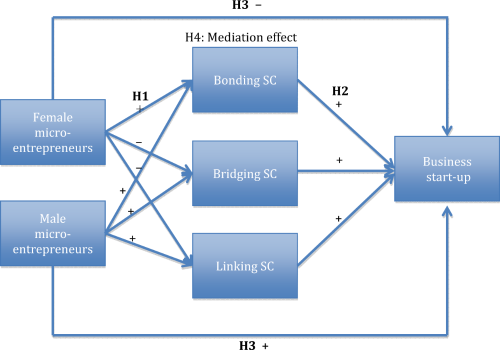
The conceptual model: the relationship between gender, social capital, and business start-up.
Method
Sampling Strategies and Study Sample of Data
This study uses the secondary data from the Panel Study of Entrepreneurial Dynamic I (PSED I, 2001–2004). PSED is a longitudinal national database, which provides information on the characteristics and activities of individuals involved in the process of starting businesses, as well as those who successfully started an infant enterprise (Reynolds, Carter, Gartner, & Greene, 2004). This study uses PSED I data because the most recent PSED II (2005–2011) does not include information about respondents’ participation in microenterprise training programs, which is measured for linking social capital in this study.
In the first stage of sampling PSED I, a random digit dial methodology was used for contacting 64,622 individuals within 48 states in the United States. Individuals who had engaged in some start-up activities in the past 12 months but had not started-up businesses were invited to participate in the study (Reynolds, Carter, Gartner, & Greene, 2004). Through these screening processes, 830 nascent entrepreneurs were invited to a 60-min phone interview (Reynolds & Carter, 2004). This study includes all cases of the 2001 and 2002 data from the PSED I data (n = 830). Since participants are nascent entrepreneurs who are in the process of starting up a business in Wave I, it is impossible to know in advance if they will become micro-entrepreneurs or not.
Multiple imputations
This study used the multiple imputation procedure for dealing with missing values. Of the 830 respondents, the number of missing values for the business start-up variable was 248 in 2001(29.8%). This study used the PROC MI and PROC MIANALYZE procedures in SAS for creating and analyzing multiple imputed data sets for incomplete multivariate data. The multiple imputation method generates M sets of imputation and combines them to form one summary statistic. The major advantage of using this method is that the combined variance explains the uncertainty made by estimating the missing values (Twisk & Vente, 2002). The disadvantage of using the multiple imputation method for a binary (0,1) variable is that the imputed values can fall outside that range. However, many authors have suggested rounding the imputed values, which sets imputed values greater than or equal to .5 as 1 and anything less as 0 (Allison, 2001). Following this suggestion, this study rounded the imputed values for the business start-up variable to 0 or 1.
Independent variables
Micro-entrepreneurs’ gender (male = 0) was the independent variable in this study.
Mediator variables
Social capital variables were hypothesized as potential mediator variables in the relationship between micro-entrepreneurs’ gender and business start-up in this study. In particular, this study aims to measure the actual utilization of social capital. Social capital could improve business start-up rate only in cases where it is utilized for getting better information or resources for entrepreneurial activities. Social capital variables were measured by a single item. Bonding social capital was measured by whether respondents requested funding support from spouses/family/relatives/friends (Variable: Close Fund, yes = 1; no = 0). Bridging social capital was measured by whether respondents received help from business associates, colleagues, or others, who are not spouses/partners/relatives/family members/friends (Variable: Other Help, yes = 1; no = 0). Linking social capital was measured by training hours in microenterprise training programs (Variable: Class). This variable is intended to measure whether respondents utilized relationships with institutions that are hierarchically based for starting a business.
Dependent variables
The dependent variable is business start-up. It is measured by whether respondents started a business or not by 2002 (business start-up: start-up = 1, nonstart-up = 0).
Control variables
Respondents’ ethnicity, educational level, marital status, parents’ business experience, and managerial/full-time work experience were controlled in data analysis since previous studies show these factors can influence business start-up (Dixon, 2003; Semrau & Werner, 2009). Marital status, education, ethnicity, parents’ business experience, respondents’ full-time work experience, and managerial/supervisory/administrative working experience were measured as dichotomous variables (marital status: married = 0, unmarried = 1; education: colleague degree = 0, noncollege degree = 1; ethnicity: white = 0, nonwhite = 1; parents’ business experience: having experience = 0, no experience = 1; full-time work experience: having experience = 0, no experience = 1; managerial/supervisory/administrative working experience: having experience = 0, no experience = 1).
Data Analysis
Regression models were used in this study in order to examine the relationships among micro-entrepreneurs’ gender, social capital, and business start-up. The first set of analysis included several regression models to examine the relationships between independent variables (i.e., gender) and the mediating variables (i.e., bonding, bridging, and linking social capital; Hypothesis 1). Each of the three social capital variables was regressed separately on micro-entrepreneurs’ gender and control variables. The first two analyses were the logistic regressions for bonding and bridging capital, and the last one was the ordinary least squares regression for linking social capital. The second set of analyses included a logistic regression model to examine the relationship between micro-entrepreneurs’ gender and business start-up (Hypothesis 3). The business start-up variable was regressed sequentially on micro-entrepreneurs’ gender and the control variables. In the third set of analyses, each group of mediators (i.e., bonding, bridging, and linking social capital) was entered sequentially into the logistic regression model on business start-up (Hypotheses 2 and 4). In order for social capital variables to function as mediators, the independent variable (micro-entrepreneurs’ gender) must be associated with the mediating variable (social capital variables; Condition 1). In addition, the mediating variable (social capital variables) must be significantly related to the dependent variable (business start-up; Condition 2). Furthermore, when the mediating variables (social capital variables) were added to the model, the effect of independent variable (micro-entrepreneurs’ gender) on the dependent variable (business start-up) must be eliminated or reduced significantly (Condition 3; Baron & Kenny, 1986).
Results
Micro-Entrepreneurs’ Gender and Social Capital
The respondents’ characteristics are described in Table 1. Approximately 49% of respondents are female entrepreneurs and 62% are nonwhite. More than 56% of the respondents are married; more than 39% of respondents have a college degree. Approximately 23–26% of respondents had utilized bonding, bridging, and linking social capital for their businesses. The business start-up rate is approximately 38% of the respondents.
Means (Standard Deviations) or Percentages for the Study Variables.
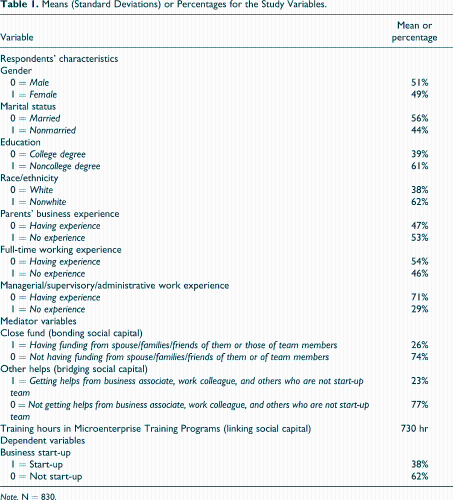
Note. N = 830.
The results from the regressions of micro-entrepreneurs’ gender on social capital are presented in Table 2. Hypothesis 1 is confirmed. After controlling for demographic variables, parents’ business experience, and respondents’ work experience, women are more likely to utilize their bonding capital in order to ask for funding support for their businesses. However, this result is only marginally significant (b = .40, p = .05). Female micro-entrepreneurs are less likely to utilize bridging and linking social capital compared to males. Female micro-entrepreneurs are significantly less likely to receive assistance from business associates, work colleagues, and others (bridging social capital, b = −.09, p < .001) and less likely to take any classes (hours) on starting a business (linking social capital, b = −.14, p < .001).
Unstandardized Coefficients From Regression Models of Gender on Social Capitals.
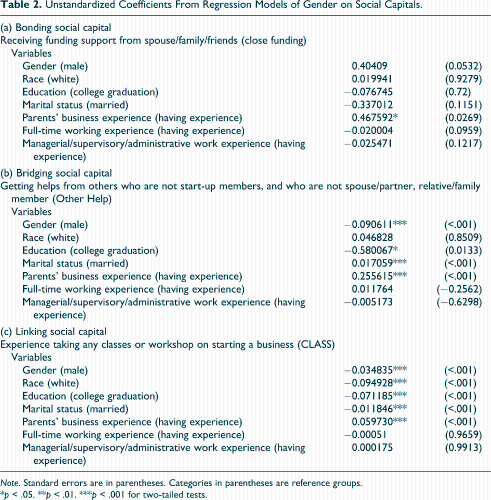
Note. Standard errors are in parentheses. Categories in parentheses are reference groups.
*p < .05. **p < .01. ***p < .001 for two-tailed tests.
With respect to the relationship between other control variables and social capital, nonwhite entrepreneurs are less likely to utilize linking capital. Entrepreneurs whose parents do not have business experience were more likely to utilize bonding, bridging, and linking capital. Nonmarried entrepreneurs are more likely to utilize bridging capital, but less likely to utilize linking capital. Having full-time or managerial/ supervisory/administrative work experience is not associated with any social capital utilization. Entrepreneurs without a college diploma are less likely to utilize bridging and linking capital.
Micro-Entrepreneurs’ Gender and Business Start-Up
The results from the logistic regression model are presented as Model 1 in Table 3. Hypothesis 3 is confirmed. After controlling for demographic variables and full-time/managerial work experience, micro-entrepreneurs’ gender is significantly associated with business start-up (b = −.21, p < .001), with women being less likely to start up a business. Interestingly, nonwhite respondents (b = 1.18, p < .001) and entrepreneurs whose parents do not have business experience (b = .09, p < .001) are more likely to start up businesses. Entrepreneurs without a college diploma are less likely to start up businesses (b = −.42, p = .01).
Unstandardized Coefficients From Logistic Regression Model of Gender on Business Start-Up: Bonding, Bridging, and Linking Social Capitals.
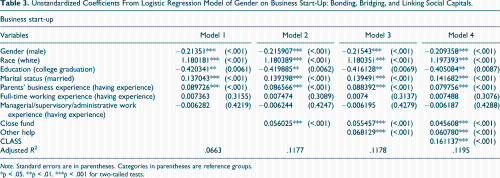
Note. Standard errors are in parentheses. Categories in parentheses are reference groups.
*p < .05. **p < .01. ***p < .001 for two-tailed tests.
The Mediating Effects of Social Capital
Table 3 includes unstandardized coefficients from the logistic regression models that predict business start-up from micro-entrepreneurs’ gender and the mediator (social capital) variables. The results of the logistic regression models confirm Hypothesis 2. After controlling for demographic variables and other control variables, utilizing bonding (Close Fund, b = .045, p < .001), bridging (Other Help, b = .06, p < .01), and linking (Class, b = .16, p < .001), social capital is positively associated with the probability of successful business start-up.
To test the mediation model, bonding (Close Fund), bridging (Other Help), and linking (Class) social capital variables were sequentially entered into the Model 1 (Models 2, 3, and 4). However, the significant relationship between micro-entrepreneurs’ gender and business start-up remained. Similarly, the significant relationship between race/education/marital status/parents’ business experience and business start-up remained after each social capital variable was entered.
In sum, while conditions 1 and 2 of Baron and Kenny’s (1986) criteria for mediation were satisfied, condition 3 was not. In order for the social capital variables to function as mediators between micro-entrepreneurs’ gender and business start-up, the relationship between micro-entrepreneurs’ gender on business start-up must be eliminated or reduced significantly when each social capital variable is sequentially entered into the Model 1. Therefore, the hypothesis with respect to the mediation effect of social capitals between micro-entrepreneurs’ gender and business start-up has not been supported. This means that female micro-entrepreneurs are not less likely to start-up business because of their social capitals. However, each additional social capital variable significantly increases the power from Model 1 to Models 2, 3, and 4, which implies that social capital also contributes to the relationship between micro-entrepreneurs’ gender and business start-up.
Discussion and Conclusion
A Summary and Interpretation of the Results
This study examines the relationships among micro-entrepreneurs’ gender, social capital, and business start-up. This study focuses particularly on how women and men may have different types of social capital (bonding, bridging, and linking social capital), which in turn, influences their business start-up. The findings confirm Hypotheses 1, 2, and 3 but not Hypothesis 4. The findings show that women are more likely to utilize bonding capital, but less likely to use bridging and linking capitals for their businesses (Hypothesis 1). The findings indicate that having social capital increases the probability of business start-up (Hypothesis 2) and that women are less likely to start-up business compared to men in the United States (Hypothesis 3). However, the findings do not provide any evidence that social capital mediates the relationship between micro-entrepreneurs’ gender and business start-up (Hypothesis 4).
These findings are also consistent with some empirical research that contend gender differences in social capital (Klyver & Terjesen, 2007; Lin, 2000; Molyneux, 2002; Renzulli et al., 2000; Robinson & Stubberud, 2011). With respect to the impact of different social capital on business start-up, this study does not support the theory that bridging capital is more likely associated with entrepreneurial development (Granovetter, 1983). This study indicates that bonding and linking as well as bridging capital positively influence the business start-up process. This finding supports the argument of Brüderl and Preisendörfer (1998) that bonding capital positively influences business performance during the business start-up process because nascent entrepreneurs usually do not have enough information and resources.
Since this study finds that bonding, bridging, and linking social capital are positively related to business start-up (Hypothesis 2), it is assumed that women’s lesser use of bridging and linking capital might negatively affect their business start-up. However, since the negative relationship between gender and business start-up is already so strong, each addition of bonding, bridging, and linking capital does not affect the existing strength of the relationship between gender and business start-up. Therefore, Hypothesis 4 has not been confirmed. This finding is inconsistent with Tata and Prasad’s (2008) conceptual model of the relationships among micro-entrepreneurs’ gender, social networks (network structure), collaborative exchange, and microenterprise performance. According to their model, micro-entrepreneurs’ gender affects microenterprise performance through network structure and collaborative exchange. Even though this study does not include collaborative exchange among these relationships, it does not find statistical evidence that gender influences microenterprise performance through network structure. This finding implies that other factors, which were not controlled in this research, such as financial capital, might affect the relationship between gender and business start-up. For example, studies have shown that women start their new businesses with significantly lower financial capital than men (Coleman & Robb, 2009). Therefore, other confounding factors that significantly affect the relationship between gender and microenterprise performance need to be identified.
However, the addition of the social capital variables significantly increases the power from Model 1 to Models 2, 3, and 4. This implies that social capital also contributes to the relationship between gender and business start-up. That is, typical female micro-entrepreneurs have fewer bridging and linking social capital that predicts the lower likelihood of business start-up compared to males. Therefore, although the mediation effect of social capital between gender and business start-up has not been proved in this study, the finding supports the important role of social capital between gender and business start-up.
Study Limitations
This study has some limitations. First, this study could not measure and include all the factors that might influence the relationships among gender, social capital, and business start-up. In particular, financial investments for business start-up might affect the relationship between gender and business start-up. However, due to the considerable number of missing values for the financial investment variable (86%), this study did not control that variable. Hence, this study does not provide a full understanding of the relationships among gender, social capital, and business start-up. Second, since the PSED I data do not sample only micro-entrepreneurs, the results of this study with respect to the relationships among gender, social capital, and business start-up could not be generalized for micro-entrepreneurs. Third, since this study is not longitudinal, it could not measure changes in social capital. Micro-entrepreneurs might obtain their social capital resources as their businesses grow. Therefore, changes in their social capital might affect their business performance. Fourth, since this study is not an experimental design, people who have a greater intention to start-up businesses could be more likely to be included in the sample. In order to overcome these limitations, future research needs to sample only micro-entrepreneur cases in the United States and control more variables that may affect the relationships among gender, social capital, and business start-up.
Study Implications
Despite of the limitations of the study, this study provides important implications for microenterprise practice and policy for women. Since the PSED data sampled only nascent entrepreneurs in the United States, the findings would not be applicable to other countries. Therefore, implications of the findings are limited to the U.S. context.
U.S. MDPs aim to increase female micro-entrepreneurs’ business start-up and maintenance rates by providing diverse supports (Schreiner, 2003). One of the main programs of U.S. MDPs is to improve female participants’ social capital by connecting them to diverse social networks (Kim, 2012). For instance, 55 Women’s Business Centers (WBCs) provide low-income women with referrals to specialized business professionals in a variety of fields such as accountancy, law, and sales consulting (Langowitz & Sharpe, 2006). Additionally, they organize peer-support groups for female micro-entrepreneurs (Women’s Development Business Council, 2013). Therefore, the findings with respect to the relationships among micro-entrepreneurs’ gender, social capital, and business start-up can provide important implications for U.S. MDPs.
First, the findings imply that U.S. MDPs need to focus on providing female participants with support for their business start-up stage because the findings indicate that female nascent entrepreneurs are less likely to start up businesses compared to their male counterparts. Second, the findings can serve as an encouragement for U.S. MDPs to provide gender-sensitive social capital programs that satisfy women’s special needs for social capital. This study as well as other literatures indicates that female micro-entrepreneurs are less likely to utilize bridging and linking capital compared to their male counterparts (Klyver & Terjesen, 2007; Renzulli et al., 2000; Robinson & Stubberud, 2011). In addition, the findings indicate that utilizing more bridging capital significantly improves the probability of business start-up. U.S. MDPs could contribute to improving their female participants’ bridging and linking social capital by providing them with more opportunities to build relationships with other entrepreneurs and experts who have different information, ideas, and resources such as male cohorts, bankers, and business associations. Third, the findings suggest that U.S. MDPs need to strengthen their networks with diverse community groups in order to provide helpful social network resources to female participants. The quality or effectiveness of networks that MDPs hold in their community would determine the quality of their network programs for their female participants. In addition, since MDPs are unable to provide female participants with all resources related to business, the joint production of services at the community level would be desirable for satisfying participants’ multiple needs (Provan & Milward, 2013). Finally, the U.S. government should provide more financial support for MDP agencies to help them provide female participants with gender-sensitive social capital interventions. According to Langowitz and Sharpe (2006), funding problems are the greatest challenge for WBCs that provide MDPs for women. Providing gender-sensitive social capital interventions demands greater resources for staff, technical assistance, business association membership fees, and networking events, such as workshops with successful businesspeople or business experts.
Suggestions for Future Research
The findings of this study suggest future research directions. First of all, more research needs to investigate how the race and economic class of female micro-entrepreneurs influences the relationship between social capital and business performance. Since a large portion of female participants in U.S. MDPs are minority or low-income women (Langowitz & Sharpe, 2006), figuring out the impact of race and economic class on the relationship would be crucial for developing more effective network development programs for minority and low-income women. In addition, future research needs to control critical confounding factors, such as financial capital, in order to permit a better valid answer about the relationships among gender, social capital, and business start-up. Finally, future research needs to investigate the impact of gender and social capital on the different stages of business performance, such as business growth and survival, by using longitudinal data. Since the effect of social capital on business performance could be different as businesses grow, longitudinal data analysis can reveal the dynamic impact of social capital on microenterprise performance.
Footnotes
Declaration of Conflicting Interests
The author(s) declared no potential conflicts of interest with respect to the research, authorship, and/or publication of this article.
Funding
The author(s) disclosed receipt of the following financial support for the research, authorship, and/or publication of this article: Graduate Scholarship from the Academy for Entrepreneurial Leadership, University of Illinois at Urbana-Champaign.