




Abstract
The study reported in this article explored the perceptions of rural women on custody and visitation arrangements with abusive ex-partners. Data were collected from questionnaires and focus groups with 23 mothers who were recruited from domestic violence support groups. Most mothers reported experiencing ongoing abusive and controlling behavior by their ex-partners related to custody and visitation arrangements. Counseling and legal services were most frequently used, while visitation exchange sites and supervision visitation and support groups were considered the most helpful services. Recommendations for rural areas include improving methods for screening and monitoring custody cases within the court system and improving access to child visitation services.
Domestic violence has been found to occur as frequently in rural areas as it does in urban areas. A rural public health survey in 16 states found that 26.7% of women and 15.5% of men reported experiencing physical or sexual interpersonal violence (IPV) during their lifetime (Breiding, Ziembroski, & Black, 2009). Rural women face particular challenges in finding the support and resources they need to escape violent relationships. Geographic isolation, gender stereotypes, the lack of resources, the lack of privacy, economic dependence, and limited access to services have been identified as barriers for rural women who are experiencing domestic violence (Eastman, Bunch, Williams, & Carawan, 2007; Homosty & Doherty, 2004; Shepherd, 2001). Women with children who separate from or divorce abusive partners often find that ongoing contact because of child visitation and custody arrangements leaves them and their children vulnerable to continued abuse (Stark, 2009). Abusive ex-partners may use custody and visitation disputes as a way to retain coercive control (Jaffe, Lemon, & Poisson, 2003). Although there has been some research on the experiences of survivors of domestic violence who reside in rural areas, none has specifically addressed the issue of custody arrangements among this group of survivors. The study presented here explored the experiences of rural women who had custody and visitation arrangements with abusive ex-partners and the extent to which they found services to be helpful.
Background
Barriers to the Provision of Rural Services
Women who separate from their abusive partners use a wide range of social, medical, legal, mental health, financial, and employment services to help support them in gaining independence and maintaining safety. Overall, rural communities face a shortage of physical and mental health services, which can further complicate the challenges that rural victims of domestic violence have in accessing supportive services (Breiding, Ziembroski, & Black, 2009). A survey of providers of domestic violence services in a rural region found that they struggled with addressing issues, such as the isolation of victims, victims’ transportation needs and limited support networks, a shortage of medical facilities, and an unresponsive criminal justice system (Eastman et al., 2007). These service providers also reported frustration with other community professionals for not understanding the dynamics of domestic violence and addressing it appropriately. Compared to urban service providers, the rural providers were more likely to report that the demand for services outweighed available resources (Eastman & Bunch, 2007).
One service that has been developed specifically to address the needs of families who are experiencing domestic violence are visitation centers that provide space for on-site visits and safe locations for children to be dropped off and picked up for off-site visits and that limit the amount of contact that parents have with each other. Supervised visitation services and exchange sites in custody disputes provide a safe and neutral setting for parents to visit with their children (Saini, Van Wert, & Gofman, 2011). Rural women are less likely to have access to this kind of supervised visitation service that would afford them additional protection from their abusive ex-partners.
Another barrier for rural women is adequate sources of income. Poverty rates are particularly high in many rural communities (Eastman et al., 2007). Araji and Bosek (2010) discussed the significant role that finances and other resources play in custody decisions. Women often have fewer financial resources, struggle to receive adequate child support, and find that their limited resources are depleted by court battles. Manipulative behavior by their abusive partners can lead to court delays, and the fathers’ avoidance of paying child support further compounds women’s economic stress.
Community norms that characterize rural communities and that are often supported by their religious institutions, such as the importance of family privacy, traditional gender roles, and the value placed on keeping families intact, can place additional pressure on victims of domestic violence to keep silent. Violence may be tolerated in the name of keeping the family together. In a review of the literature, Fitzsimons, Hagemeister, and Braun (2011) found that rural criminal justice systems have been characterized as politicized and unresponsive, leaving victims vulnerable to retaliation. Child custody disputes have the potential to involve extended family networks in rural communities in ongoing conflict around child custody and visitation arrangements.
Child Custody and Visitation in Cases of Domestic Violence
Child custody determinations provide parameters for the extent to which parents have access to their children and decision-making authority over their lives. Court decisions in recent decades have shown a preference for joint custody (which may or may not involve shared physical custody). Many experts in the field of domestic violence have strong reservations about joint custody arrangements when domestic violence is (or has been) present in the family because of the potential for ongoing abuse (Zorza, 2010). Araji and Bosek (2010) identified numerous problems with joint custody and visitation arrangements, including the lack of enforcement of court orders, the lack of knowledge of domestic violence by court personnel, and ongoing problems with abuse after custody decisions were made.
Most states mandate that domestic violence be considered in child custody proceedings. However, some studies in urban communities have found that domestic violence is often not identified when it is present and that the courts often fail to order adequate protections when making child custody determinations (N. E. Johnson, Saccuzzo, & Koen, 2005; Kernic, Monary-Ernsdorff, Koepsell, & Holt, 2005). One study of court mediation in custody disputes found that mediators did not identify and report domestic violence in 56.9% of the cases and that the courts’ screening process failed to identify at least 14.7% of the cases (N. E. Johnson et al., 2005). Another study found that “almost one half of those cases with a history of police-or-court-reported IPV had no mention of IPV whatsoever in the dissolution case file; and more than half the remainder had documentation of allegations of IPV with no substantiation, although evidence clearly existed” (Kernic et al., 2005, p. 1013). Of particular concern in the latter study was the finding that strong custody protections were often not ordered when IPV was substantiated. For example, 83.2% of the fathers in these cases were allowed visitation, and fathers with a history of IPV were not more likely to be required to have supervision than comparison group fathers.
Impact of Custody and Visitation Arrangements on Children
Early anti-domestic violence advocates developed the term battering to refer to the systematic use of physically and psychologically abusive behaviors to achieve and maintain control in relationships. “Using the children” (e.g., making the mother feel guilty about the children, using the children to give the mother messages, and using visitation to harass the mother) to control is one spoke on the “power and control” wheel, a widely used framework developed from a feminist analysis of battering as rooted in power and control (Pence & Paymar, 1993). M. P. Johnson (2006) referred to this type of violence as “intimate partner terrorism,” which involves the use of coercive control. An abusive partner’s control is challenged when separation or divorce takes place. A recent study of the impact of prior controlling behavior on indirect abuse (e.g., telling lies to the children and keeping the children longer than the scheduled visitation visit) found that “women experienced a decline in the occurrence of physical abuse, but did not experience the same decline in controlling behaviors over the follow-up period” (Hayes, 2012, p. 333). Research has indicated that men who batter their partners are also likely to be abusive and controlling toward their children (Bancroft & Silverman, 2002; Saunders, 2007).
Little research is available on the impact of different custody arrangements on children when domestic violence has occurred. Typically, these situations result in high-conflict custody disputes for which, according to Jaffe, Lemon, and Poisson (2003, p. 15), “joint custody plans and shared plans are not viable solutions.” One study of the effects of fathers’ visitations on preschool-aged witnesses of domestic violence had mixed findings. Overall, preschool children who saw their fathers less often had higher internalizing and externalizing scores, suggesting harm to their emotional well-being. However, children who had witnessed more severe violence evidenced more aggression and antisocial behaviors (Stover, Van Horn, Turner, Cooper, & Liberman, 2003). In a review of the literature, Stark (2009, p. 289) concluded that “there is no evidence that children benefit in the long term from having regular face-to-face contact with a violent parent and considerable suggestive evidence that the real and potential harms to children of being exposed to domestic violence or other forms of abuse of their mother outweighs any harms experienced by not seeing an abusive parent.” Although there may be disagreement about the benefits of visitation, it is clear that these cases demand special attention to ensure the safety and well-being of children.
The purpose of the study presented here was to explore the perspectives of rural women in regard to their experiences with custody and visitation arrangements with abusive ex-partners and the extent to which child custody and visitation arrangements were used to maintain control. The research questions included the following: How do child custody and visitation arrangements with abusive ex-partners affect the lives of rural women and their children? To what extent do women report that their abusive ex-partners use the children and visitation arrangements to maintain control? What services have rural women who have experienced domestic violence used to assist them and their children with custody and visitation arrangements, and how helpful have these services been?
Method
Sample
Six focus groups were conducted with 23 mothers who had experienced abuse by their ex-partners. Survey data were also collected at the time of the focus groups. Assistance in finding participants was provided by advocates at six different programs that provide services to victims of domestic violence and their children who live in rural areas of a Midwestern state; four were conducted in northern counties, and two were conducted in southern counties. Four other agencies were contacted that chose not to participate. The focus groups were conducted in towns whose populations ranged from about 1,000 to 14,000 on the basis of 2000 census data. The counties in which these towns were situated had population densities between 5 and 46 persons per square mile, which is well below the density of 500–1,000 persons per square mile that defines an urban area, according to the U.S. Census Bureau. Women who had child custody and visitation arrangements with their children’s fathers were recruited for the study. Each focus group was attended by 3–6 women and lasted from 1 to 1½ hr.
The women ranged in age from 20 to 48 years (with a mean of 35 years). The mean number of children in a family was 2.6; the children ranged from infants to young adults. The sample was predominately white (21), with 1 participant who was American Indian and 1 who was white and American Indian.
Procedures
The women were asked to complete a short questionnaire and participate in a focus group as part of their regularly scheduled group session or at another session scheduled by the anti-domestic violence advocates. The focus groups were conducted by the coauthors. The women were informed at least a week ahead of time that the study was to take place during a group session and that they could choose whether or not to attend. Once the women gathered, they were provided with an informed consent form explaining the study; its purpose; and other informed consent issues, such as potential risks, benefits, and issues of privacy and confidentiality. The women who chose not to participate in the study or who did not have child custody and visitation arrangements had the option to meet with the advocates separately during the time of the focus group if it was during the regularly scheduled meeting time.
The questionnaire and focus group process were developed in consultation with the staff of a rural domestic violence agency to enhance the validity of the content. The focus group allowed the participants to expand on the survey results so that the survey data could be triangulated with the focus group results. A portion of the questionnaire incorporated the Use of Children Scale, developed by Beeble, Bybee, and Sullivan (2007). This 7-item scale was developed to determine the extent to which abusive partners used child custody and visitation arrangements to control their partners or ex-partners. In the study, the participants were asked the extent to which their abusive ex-partners demonstrated these behaviors as part of custody and visitation arrangements. Their responses were based on a 4-point Likert-type scale. According to Beeble et al. (p. 3), “principle components analysis confirmed that the items comprised a single factor,” and the “Cronbach’s alpha for this scale was .88.”
Results
Experiences With Domestic Violence
The women were asked three questions to screen for the presence of domestic violence (with the number and percentage responding yes in parentheses): [Have you ever been] afraid of being physically harmed by your children’s father? (18 women, 78%); hit, slapped, punched, pushed, or choked by him? (18 women, 78%); or obtained an Order of Protection against him? (12 women, 52%). Three women did not respond yes to any of these questions, although one of these women reported that she did not feel safe during visitation exchanges with the father. Because all these women were voluntarily participating in a domestic violence support group and because all these indicators focused on physical aspects of IPV, we decided to include all the participants in the study.
Of the 23 (78%) women, 18 reported that they had been at some time afraid of being physically harmed by their children’s fathers. The same percentage reported having been hit, slapped, punched, pushed, or choked by the fathers. Twelve women (52%) had obtained an order of protection in the past against the fathers.
The women were also asked whether they ever felt that they were not safe during visitation exchanges because of the behavior of the children’s fathers. If they responded yes, they were asked how frequently they felt they were unsafe. Close to half the women (11 out of 23) said that they frequently or very frequently felt unsafe during visitation exchanges. Eight (35%) women reported that they believed that their children had been unsafe during visitation exchanges because of the behavior of the children’s fathers; five of the eight said that this had been frequently or very frequently the case. These experiences are further elaborated on in the findings of the focus group.
Types of Custody and Visitation Arrangements
Only five participants (21.7%) reported that domestic violence was considered a factor in court decisions related to custody. The most common arrangements were that the mother had sole physical and legal custody (four women), the mother had sole physical custody with shared legal custody (four women), and the parents had joint physical and legal custody (four women). Two fathers had physical custody and joint legal custody, and two fathers had sole legal and physical custody. Two women had custody and visitation agreements still pending, while two families had different custody agreements for siblings. Two mothers reported that counties had custody of their children, and another reported that her child had turned 18.
Use of Custody and Visitation to Control
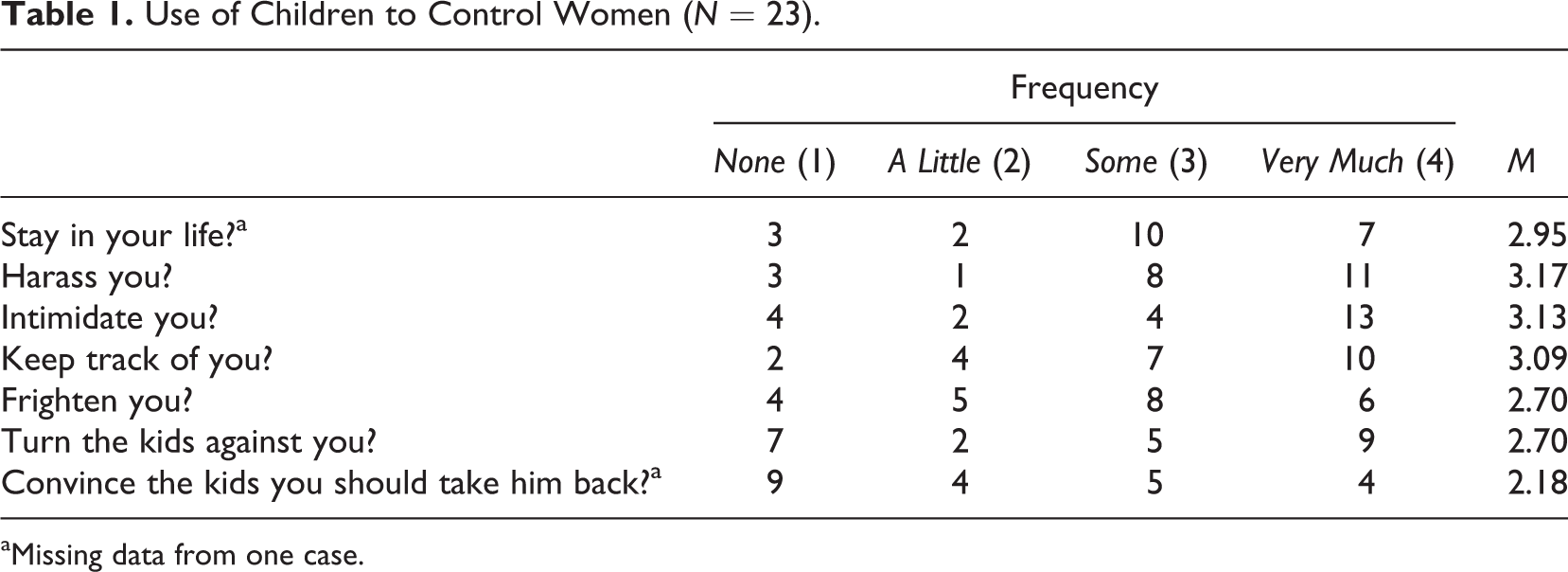
The Use of Children Scale was used to ask the women about the extent to which their former partners used their custody and visitation arrangements to control them (Beeble, Bybee, & Sullivan, 2007). Each item was rated from 1 (none) to 4 (very much; see Table 1). Approximately half the women reported that the children’s fathers used the custody and visitation arrangements “very much” to harass, intimidate, and keep track of them. These experiences are elaborated further in the findings of the focus group.
Use of Children to Control Women (N = 23).
aMissing data from one case.
Frequency and Helpfulness of the Services
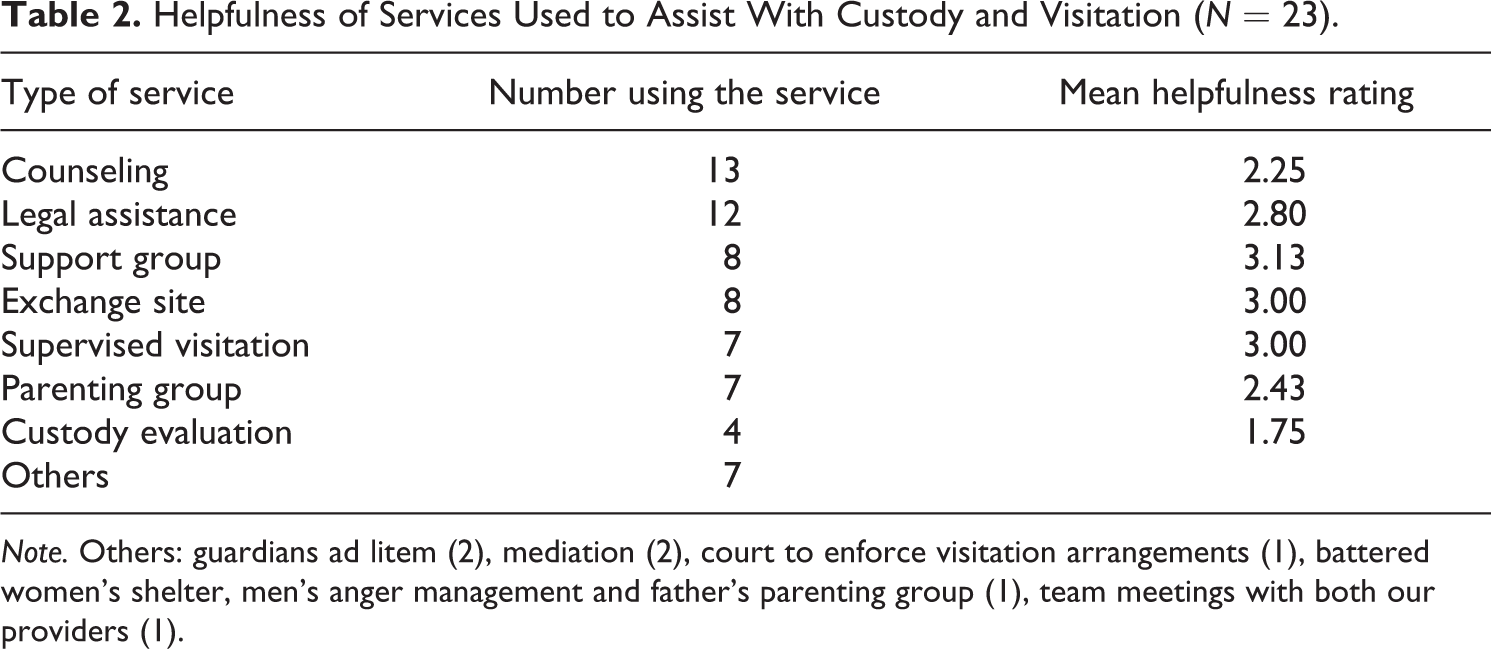
The last major area of inquiry was what services the women had used to assist them with child and custody and visitation arrangements and how helpful the services had been. Table 2 lists the frequency of services used and how helpful they were, rated by those who used them on a scale of 1 to 4. Counseling and legal assistance were used by approximately half the women. Support groups, child exchange sites, and supervised visitation were considered the most helpful services and were each used by approximately one third of the women. Custody evaluations were reported as the least helpful service and the least frequently used.
Helpfulness of Services Used to Assist With Custody and Visitation (N = 23).
Note. Others: guardians ad litem (2), mediation (2), court to enforce visitation arrangements (1), battered women’s shelter, men’s anger management and father’s parenting group (1), team meetings with both our providers (1).
Focus Groups
The themes of the focus group interviews were divided into three primary areas: the women’s perceptions of the effects of the custody arrangements on them; the women’s perceptions of the effects of the custody arrangements on their children; and the women’s perspectives on the professionals, programs, and services that were involved. In the following sections, these themes are discussed, and exemplar quotes from the participants are used to illustrate the themes.
Impact on the Women
The women described four ways in which their custody and visitation arrangements affected them, especially as mothers: (1) stress, worries, fears, and anxieties; (2) financial concerns; (3) continuing power and control and abuse issues; and (4) information sharing and communication issues.
The women commonly expressed how much they worried about their children’s well- being, particularly when the children were not with them, but instead were in the care of their ex-partners. For example, one woman who has sole legal and physical custody with no visitation because her husband was in jail and treatment said that this arrangement was going well for her because “I know where my child is at during all times.” Another woman whose children spent some visitation or parenting time with their father said, “I am still scared to leave the kids with him, especially the little one. He drinks a lot and could pass out.” Still another woman noted, “The divorce was really to protect the kids. When they’re with their dad, they call me all the time, say they are scared, want to come home, want me to come get them.” Despite these stressful situations and their worries about their children, many women felt the need to maintain the relationship with their children’s fathers. One said, “I have to stay in a working relationship in order to keep my child and myself safe.”
Many women discussed the financial aspects of their particular custody arrangements. In spite of the emotional costs of their situations, some concrete economic costs were also central to them. For example, more than one woman talked about how their children’s fathers who had more means bought the children’s affection. One said, “My ex is buying them with money.” Another said her ex-husband spent money on “big toys,” such as a four-wheeler for their 8-year-old son, so their son seemed to think that the father loves him more. With shared/joint arrangements in which child support was paid, the “finances are better because one parent doesn’t have the burden.” One the other hand, financial issues can have both benefits and problems in sole custody, such as claiming the child on taxes and the ease of child support payments going one way. On the other hand, those with sole custody would have liked to be able to save the money of child care and noted that it was difficult to pay for school lunches and activities. Many thought they received less financial help when they had sole custody. Another major financial burden was the cost of constantly having to return to lawyers and court to fight claims or revisit custody arrangements, which was often prohibitively expensive.
The women in the focus groups talked about the ways in which their ex-partners still exercised abuse, power, and control over their lives when they had contact because of either joint custody or regular visitation arrangements. Custody and visitation orders were often violated, but the women did not have the legal or financial resources to bring the cases back to court. One woman reported that her teenage children lived with her ex-partner even though she had physical custody of them. Her husband was a leader in the community, and she did not feel she could successfully challenge him in the legal system. Another woman described an example of day-to-day control by her children’s father. She said that one day a week, the girls stayed at their father’s house, but he refused to make their school lunches, so she has to prepare the lunches, drive to the house, walk up the driveway because he would not let her park in the driveway, and leave their lunches on the porch because he would not come to the door to get them. She noted that this was his way of “making me know that he’s still in control.” Another told us that she and her ex have two children, and it is “a constant power struggle. Due to day care issues, he has to drop our daughter off every day.”
Another major issue of concern was the lack of information sharing, especially with joint custody and regular visitation arrangements. The women noted that they often did not get clear information from their children’s fathers about what had gone on while the children were in the fathers’ care, and information about school, homework, health, and activities was often kept from them. They said that this lack of information often placed a burden on their children to update them on events and activities while they were in their fathers’ care.
Impact on the Children
The women were asked about the impact their custody arrangements had on their children. The following nine areas were the most commonly discussed: safety and well-being of the children; sadness/unhappy/depressed; confusion; relationships with the father and mother; children stuck in the middle/used as “pawns”; children “bought off”; behavior/attitude changes; impact on schoolwork; and different parenting standards.
In most cases, the women described several ways in which each of their children was affected, not just one. No matter what type of custody arrangement they had, many women talked about what they saw as a benefit of their children having at least some contact with their fathers. Most noted that they wanted their children to know their fathers or felt it was important even if they themselves had concerns about that relationship. The idea that the children should have relationships with both parents was important, but it did not always mean that the women were comfortable with how their ex-partners parented. One woman said, “Now he is abusing his new girlfriend, and my daughter always has to witness it. It’s ongoing exposure to abuse.” Another noted that she believes he “still abuses my daughter; I can’t ever be sure she’s safe.”
Examples from the focus groups also included behavioral and development impacts. One woman reported, “My son began wetting the bed again after he started seeing his dad. He was potty trained, but no more. And he has nightmares.” Another said, “I noted that when my son is with me, he talks pretty well, words, some sentences. But when he’s with his dad or that family, it’s just babbling and baby talk. I know he gets scared, even if we have an argument over the phone. He knows we’re fighting. And he cries a lot when we separate, like at day care.” Some women said their children were different when they came back from visits. One woman talked about feeling like she had to retrain the children about house rules when they got home; others talked about changes in attitude, such as being sassy or talking back, or having tantrums and sleep problems right after returning from parenting time with their fathers.
Perspectives on Services and Professionals
While the survey indicated that many women were involved with many type of services, the women spent most of the time in the focus groups discussing the following: courts and judges; lawyers or legal assistance; mediators or guardians ad litem; social workers, social services, or child protection workers; child visitation centers; and parenting education, counseling and psychological evaluation, counseling, or therapy. Often, though not always, the discussion revolved around their dissatisfaction with services or professionals. In addition, the women were asked about and discussed what services they would like to have access to but may not have used. The women often noted that they did not receive adequate or sufficient information about their options.
The most discussed professionals were lawyers and social service providers. For obvious reasons, many women were involved with lawyers as part of their divorce and/or custody proceedings, although not all the women went to court and had their cases heard in front of a judge. Some said that they did not think that their lawyers understand them or the abuse in their situations, particularly if the abuse they had experienced was more emotional and verbal than physical. One told us, “The lawyer didn’t want to enter the claims of emotional abuse” into the proceedings. Another said, “I think the lawyers are taught to keep the divorce out of the courtroom in front of judges. But, then in mediation, it seems like they are trying to rush to get you to settle things here and now.” One said that she felt misled by her lawyer or, at least, he did not seem to have the right information. Another said that her lawyer told her that if her husband did not comply with the legal agreement, she should “take the papers and shake them at him.” One woman told us her first lawyer was shaming and got angry with her. “My first lawyer, I didn’t feel she really stood up for me. Once when we were meeting together, she got mad about something I said. So, she says, ‘You! Me! Out in the hall now!’ She got right up in my face. And I was paying her like $200 an hour.” Later, the woman found a different lawyer who “really understood domestic violence” and “gave me great advice.”
The women who were involved with public social services, social workers, or child protection found that these services were helpful sometimes, but were quite dissatisfied in other cases. One woman said, “Child protection has helped a lot. They can document parenting and make a case for me.” But most others thought that social services were not helpful to them. One said that her social worker did not answer or return her phone calls quickly, and she feared “retribution for asking for help.” Another said that she thought that the social worker was doing things “behind my back.” Finally, one said that she thought that she lacked information and that “social services made demands, but gives me no help getting there.” Some, but not all, thought that supervised visitation centers/child safety centers were helpful in providing greater safety.
The barriers to receiving services were also discussed in the focus groups. It was clear that most of the women believed they had limited access to resources at least, in part, because of their rural locations. Distance and limited access to transportation was an issue for some women, but the major issue they described was the lack of services that were affordable. The women noted their inability to get legal aid, the lack of affordable counseling services, the lack of batterers’ education or treatment, the lack of parenting education and parent support groups, and the lack of services for their children. In some cases, this “lack” of services had to do with the fact that the services simply were not available in their area. And, in other cases, it had to do with cost. The women reported not having the money to pay for some of the services that were accessible.
In all the focus groups, a predominant theme related to services was the lack of understanding of domestic violence by most of the professionals and services they had used. This lack of understanding of the dynamics of abuse they had experienced extended from the judges and lawyers, to guardians ad litem and social workers, and to employment or financial workers. One woman noted, “Women, we, get blamed. [Our] ability to be a mother is questioned, [get] accused of neglect. This doesn’t help women get help and get out.” Another said that service providers “shouldn’t just brush things under the table. Sometimes they just act like it [the abuse] didn’t happen at all. Like it’s not important.”
Discussion
The study sought to explore three broad questions by examining the experiences of a small convenience sample of rural battered women in a Midwestern state. First, how do child custody and visitation arrangements with abusive ex-partners affect the lives of rural women and their children? The women reported many of the same difficulties with ongoing abuse and manipulation, inconsistent custody visitation arrangements, and unresponsive legal and social service systems that have been identified in the literature (Araji & Bosek, 2010; Stark, 2009). In the focus groups, the women discussed ongoing struggles with making their custody and visitation arrangements work in ways that did not risk their safety or that of their children and that allowed them to meet the financial and emotional needs of their children. The mothers with children who had ongoing visitation with their children’s fathers often expressed safety concerns for themselves and their children. They expressed concerns about their children’s emotional well-being because of ongoing abusive behavior experienced during visits and difficulties communicating with their ex-partners about their children’s needs.
Second, to what extent did the women report that their abusive ex-partners used the child custody and visitation arrangements to maintain control? The study documented the ongoing struggles that the women and their children faced in dealing with custody and visitation arrangements when their abusive ex-partners continued to harass and intimidate them. The results from the Use of Children Scale demonstrated that the women experienced controlling behavior in relation to their child custody arrangements. The finding that approximately half the women reported that the children’s fathers used the custody and visitation arrangements “very much” to harass, intimidate, and keep track of them indicates that the women were experiencing substantial levels of ongoing abuse that negatively affected their safety and well-being. In the focus groups, the women told many stories of how their abusive ex-partners manipulated child custody and visitation arrangements, so that they continued to control the day-to-day lives of their former partners.
Finally, the study examined the services that the rural battered women used and how helpful these services had been. As we noted previously, rural women have access to fewer services and resources to assist them in addressing domestic violence than do their urban counterparts (Eastman et al., 2007; Homosty & Doherty, 2004; Shepherd, 2001). The women reported that this was also the case when they sought help for custody and visitation issues in cases of domestic violence. Only about 22% of the women reported that domestic violence was considered a factor in court decisions related to custody, even though this is a requirement of state law. This finding appears to be substantially lower than previous studies that examined screening rates in urban settings (N. E. Johnson et al., 2005; Kernic et al., 2005).
In the survey, the most frequently used services were counseling and legal services. Visitation exchange services/supervised visitation and support groups were rated as the most helpful services, probably because these services directly addressed issues of domestic violence. Only one third of the women reported using visitation/supervised visitation services, which may have been due to their lack of access to the services. The women noted difficulties accessing services from knowledgeable and supportive professionals, which they often attributed to their rural location. Many women in the focus groups believed that they did not have adequate information about their legal options because they did not have the financial resources for adequate legal representation. After court decisions were made, they sometimes found that other alternatives could have been pursued. It was striking that the women felt that they had few alternatives available to them other than learning to live with the abusive situation and trying to minimize the negative impact on themselves and their children.
A major limitation of the study was the small convenience sample, which was predominantly Caucasian. The opinions reflected here may not be representative of rural women who have not sought services from domestic violence agencies. The findings can be considered only exploratory in nature, although they appear to be consistent with the literature on rural domestic violence. What is unique about the study was that it provided previously undocumented information about the lived experiences of rural women with abusive ex-partners and child custody and visitation arrangements. Further research is needed to examine the difference between rural and urban women in this regard.
Implications for Practice
The findings suggest several areas in which services could be improved for rural women and their children who have experienced domestic violence, such as conducting more effective screening for domestic violence in child custody cases, conducting thorough custody evaluations that take into account domestic violence, and carefully monitoring custody and visitation arrangements when domestic violence has been identified as a concern. Better avenues for courts to review the status of these cases without additional expense to low-income women and their children need to be put into place. Social workers must be prepared to screen adequately for domestic violence in all fields of practice, but particularly in situations involving child custody arrangements. In addition, they can advocate for the improved judicial review of these cases and more resources for adequate legal representation.
Innovative rural models for addressing domestic violence must be developed and funded. They would include enhancing the availability of visitation exchange sites that are easily accessible and private, addressing transportation challenges, and finding ways to support families and reduce isolation. Social workers should play a significant role in developing visitation exchange sites and refer their clients to them. Because religious institutions play a particularly influential role in many rural communities, working with them to gain a better understanding of the dynamics of domestic violence so that they can support victims is essential. Furthermore, there is a need for ongoing training on domestic violence and its impact on families for community professionals. Social workers in rural communities should take immediate proactive steps to lead the way by educating other community professionals on the dynamics of domestic violence, developing services that fit the unique environments of rural communities, and advocating for women who are struggling with challenging custody and visitation arrangements.
Footnotes
Declaration of Conflicting Interests
The author(s) declared no potential conflicts of interest with respect to the research, authorship, and/or publication of this article.
Funding
The author(s) disclosed receipt of the following financial support for the research, authorship, and/or publication of this article: The study was supported by the Center for Community and Regional Research at the University of Minnesota Duluth.