




Abstract
This article compares the results of two qualitative studies, the first examining conflict between sexual identity and a Christian upbringing and the second examining conflict between gender identity and a Christian upbringing. After briefly reviewing the theoretical frameworks, methodology, and results of these two studies, similarities and differences will be discussed. Finally, this article will offer implications for theory and practice as well as recommendations for future research.
The conflict that many gay and lesbian individuals experience between their sexual identity and Christian upbringing has been widely reported in recent literature (Buchanan, Dzelme, Harris, & Hecker, 2001; Couch, Mulcare, Pitts, Smith, & Mitchell, 2008; Donnelly, 2001; Levy & Reeves, 2011; Rodriguez & Ouellette, 2000; Super & Jacobson, 2011). Most of these studies examine the end result or final resolution of the conflict between sexual identity and religious beliefs and focus on outcomes such as rejection of sexual identity, rejection of Christian identity, integration of sexual and Christian identities, and compartmentalization (Buchanan et al., 2001; Rodriguez & Ouellette, 2000). Though some researchers have examined the characteristics of the conflict experienced by lesbian and gay Christians (Harris, Cook, & Kashubeck, 2008) and resources used to navigate this conflict (Schuck & Liddle, 2001), few studies have addressed the process by which people resolve these conflicts (Levy & Reeves, 2011).
Most of the literature on gender identity and Christianity only reports on theological applications or personal commentaries (Kelley, n.d.a., n.d.b.; Kujawa-Holbrook & Montagno, 2009; Lewis, 2009; Mann, 2012) rather than research. However, there is some new research emerging in this area. For instance, Kennedy (2008) and Stone (2007) explored gender identity from the perspective of churches and suggested ways in which churches and pastors can be more supportive of transgender members. Rodriguez and Follins (2012) and Westerfield (2012) examined the spiritual and religious views of the transgender population in general. A newer area of inquiry, including very few studies, investigates conflicts experienced by the transgender population related to Christian upbringing (Kennedy, 2008; Kidd & Witten, 2008; Stone, 2007; Wilcox, 2002). Unfortunately, although some researchers claim to address experiences of gay, lesbian, bisexual, and transgender individuals in their research, they actually only included one or two transgender participants in their studies (see Buser, Goodrich, Luke, & Buser, 2011, as an example). Even with these limitations in the existing literature, there are common experiences of transgender Christians across these studies: isolation and individualized or personalized faith (Kidd & Witten, 2008; Wilcox, 2002). Rodriguez (2010) noted that more research is needed to address the struggles that both bisexual and transgender individuals have with Christianity. Like the literature on sexual identity, there are few studies concerning gender identity and Christianity that provide models of the process by which individuals resolve conflict between gender identity and a Christian upbringing (Levy & Lo, 2013).
According to Shanor (1997), experiences of transgender Christians are similar to those of gay Christians. One difference, however, is that the transgender population not only experience interpersonal conflicts, but they also question their own realities and beliefs (Shanor, 1997). Shanor’s comments may ring true for some, but they are anecdotal. With the limited research as outlined previously, more information is needed in order to adequately understand the experiences of these populations and to draw conclusions. In order to meet this need, this article compares the results of two studies, one focused on sexual identity and the other on gender identity, which examined the process by which individuals resolved conflict between these identities and their Christian upbringing. The purpose of the first study (Levy & Reeves, 2011) was to understand how gay, lesbian, and queer-identified individuals with a Christian upbringing resolve conflict between sexual identity and religious beliefs. For the second study (Levy & Lo, 2013), the purpose was to understand the process by which individuals with a Christian upbringing resolve conflict between their gender identity and religious beliefs. Additional information about these two studies, including a thorough summary of the results, is available (Levy & Lo, 2013; Levy & Reeves, 2011).
It is important to note that Christian denominations are becoming more accepting of same-sex sexuality and transgender identity (Russell, 2012; Thomas & Olsen, 2012). In fact, some denominations, such as the Universal Fellowship of Metropolitan Community Churches (MCC, 2004), were formed specifically to minister to and accept gay, lesbian, bisexual, and transgender individuals. Welcoming organizations exist for every mainstream denomination, though most are not officially tied to the denomination. Even with the diversity of opinions about sexual and gender identity and the move toward acceptance, a “culture war” still exists between the gay and lesbian population and religious conservatives (Marin, 2011, p. 501). Because this tension continues, it is important to understand the conflicts experienced by sexual and gender minorities who grow up in Christian churches. As such, the two studies presented in this article focused solely on individuals who identified experiencing and resolving some conflict between their sexual or gender identity and religious upbringing.
Theoretical Frameworks
Both of these studies relied on postmodern notions of identity, viewing identity as fluid, multifaceted, and ever changing (Clark & Dirkx, 2000). For instance, the way in which individuals experience and understand their racial identity can be mediated by other identity factors, such as age, gender, religion, or sexual orientation (Adams et al., 2000). Not only do various aspects of identity mediate other aspects of identity, but the intersectionality of all of these categories is important. Indeed, “intersectionality reminds us that … no category of identity works alone” (Mayo, 2007, p. 68). With postmodern notions of identity, researchers can incorporate these mediating factors, allowing for a process of identity formation that is flexible and open ended (Hebert, 2001). This is in contrast to much of the literature on modern identity which views identity as fixed and stable (Hebert, 2001).
In addition to postmodern notions of identity, these studies were impacted by theories of identity development, especially those related to faith, sexual identity, and gender identity. For instance, both studies relied on Fowler’s (1981) stages of faith to inform notions of religious or spiritual identity development. Based on interviews with hundreds of people, Fowler created his model of faith development which included the following six stages: intuitive projective, mythic literal, synthetic conventional, individuative reflective, conjunctive, and universalizing faith. In the first stage (intuitive projective), children typically exhibit on magical thinking and rely on the faith caregivers. By the time children develop logical reasoning, they move into the section stage (mythic literal), where they are able to distinguish make believe from reality (Fowler, 1981). When individuals reach puberty, they develop their faith based on the myriad of influences in their lives; this is known as the synthetic conventional stage. Although most people stay in this stage until their 20s, some might remain here until their 40s or for their entire lives. The next stage, the individuative reflective stage, is the first stage that includes critical reflection of faith. Individuals in this stage experience and address conflicts between group membership and individualism as well as conflicts between objectivity and subjectivity (Fowler, 1981). Individuals in the conjunctive stage, typically occurring in midlife, recognize that their faith is subjective and multidimensional. The final stage (universalizing) is rarely achieved; individuals in this stage stand out as leaders committed to justice, selflessness, and love. It is important to note that although Fowler’s stages certainly informed these two studies, they were utilized as a general guide. Staying true to the notion of postmodern identity, stages were considered with an eye for fluidity, overlap, and nonlinear connections.
In order to understand sexual identity development, the first study recognized Cass’ (1984) theory of sexual identity development and queer theory. Again based on interviews, Cass’ stages include identity confusion, identity comparison, identity tolerance, identity acceptance, identity pride, and identity synthesis. The first stage, identity confusion, includes conflict between assumed heterosexuality and same-sex sexual desires. In identity comparison, individuals begin to compare their sexuality to heterosexuals and often experience isolation (Cass, 1984). Identity tolerance addresses this isolation as people seek out other gay or lesbian individuals. After acknowledging their gay or lesbian identity (acceptance), individuals begin to develop identity pride. However, the identity pride stage also includes anger at homophobia and heterosexism present in society. This anger often takes an “us” versus “them” attitude, which is no longer present in the identity synthesis stage (Morrow & Messinger, 2006). This final stage also includes a recognition that sexual orientation is only one aspect of identity. Similar to the use of Fowler’s theory, Cass’ stages were utilized from a postmodern perspective.
Finally, gender identity development in the second study was conceptualized using Devor’s (2004) stages of transsexual identity development as well as Morgan and Stevens’ (2008) research with the transgender population. Devor’s theory of transsexual identity development includes the following 14 stages: abiding anxiety, identity confusion about originally assigned gender and sex, identity comparisons about originally assigned gender and sex, discovery of transsexualism, identity confusion about transsexualism, identity comparisons about transsexualism, tolerance of transsexual identity, delay before acceptance of transsexual identity, acceptance of transsexual identity, delay before transition, transition, acceptance of posttransition gender and sex identities, integration, and pride. Devor’s stages are similar in nature to Cass’ stages outlined previously. Morgan and Stevens’ research focuses more on the common experiences of the transgender population, and they found the following similarities: early experiences of dissonance between the body and mind, biding time until transition opportunities arose, missing potential opportunities for transition, and physically transitioning into the preferred gender.
Methodology
In order to focus on the process of resolving conflict, both studies employed qualitative methods. Both also utilized Charmaz’s (2006) constructivist grounded theory methods, which are especially helpful with studies that focus on some sort of process. These methods include the simultaneous collection and analysis of data, creating codes and categories that are grounded in the data, comparing the data constantly throughout the analytic process, and constructing a theory based on the data and analysis (Charmaz, 2006). In order to foster trustworthiness, a concept synonymous with reliability and validity in qualitative research, the researcher performed member checks, peer examinations, rich description, maximum variation sampling, and triangulation.
The first study, focused on sexual identity, included 15 participants who self-selected as gay, lesbian, and/or queer. They also self-identified having a Christian upbringing, experiencing conflict between their religious beliefs and sexual identity, and having resolved some aspect of this conflict. Ranging in age from 19 to 43, these individuals were fairly young. Educational status reported included a high school diploma (3), an associate’s degree (1), a bachelor’s degree (7), and a master’s degree (4). Racial identification, though not very diverse, was consistent with the demographics in the region; 12 identified as Caucasian, 2 as biracial, and 1 as Filipino American. Participants were from the Southeastern region of the United States and were raised in the following denominations: Catholic (5), Southern Baptist (3), Church of Christ (2), Jehovah’s Witness (1), United Methodist (1), Lutheran (ELCA) (1), Free Will Baptist (1), and Various Christian (1). At the time of the interview, participants identified as Christian (4), spiritual (4), Catholic (3), Episcopal (1), Agnostic (1), Atheist, (1), and Wiccan (1). Semistructured, in-depth interviews were completed with these individuals over the course of 12 months and lasted from 50 to 105 min. Interviews included questions about participants’ backgrounds, the conflicts between their sexual identity and religious beliefs, the personal and contextual factors that shaped their efforts to resolve conflicts, the process by which they resolved conflicts, and a description of their resolution. Transcripts were analyzed using grounded theory methods of coding, including initial, focused, and axial coding.
The second study, focused on gender identity, included five participants who self-selected as transgender, transsexual, and gender queer; four identified as heterosexual and one as gay. They also self-identified having a Christian upbringing, experiencing conflict between their religious beliefs and sexual identity, and having resolved some aspect of this conflict. Participants ranged in age from 18 to 53. Although they were not racially diverse (all identified as Caucasian), this is consistent with the region in rural Appalachia where the study took place (95% Caucasian). Participants were all from the Southeastern region of the United States and reported being raised in the following denominations: both Presbyterian and Baptist (2), Church of Christ (1), Catholic (1), and United Methodist (1). At the time of the interview, they identified as Church of Christ (1), Christian (1), Nondenominational Christian (1), Catholic (1), and both Christian and Agnostic (1). Semistructured, in-depth interviews were completed with these individuals over the course of 8 months and lasted from 30 to 100 min. Interviews included questions about participants’ backgrounds, the conflicts between their gender identity and religious beliefs, the personal and contextual factors that shaped their efforts to resolve conflicts, the process by which they resolved conflicts, and a description of their resolution. Transcripts were analyzed using grounded theory methods of coding, including initial, focused, and axial coding. Transcripts were also analyzed using ATLASti.
Both studies utilized the following techniques to ensure trustworthiness: triangulation, peer examinations, member checks, rich description, memo writing, and maximum-variation sampling. Even with these techniques in place, both studies included some limitations. First, there is a discrepancy between the sample sizes of the two studies, and both sample sizes are small. Because of the small samples sizes and the limitations in the region regarding racial diversity, the findings are not generalizable to the general public. Additional research is needed with more diverse populations from across the country and internationally.
Brief Overview of Findings
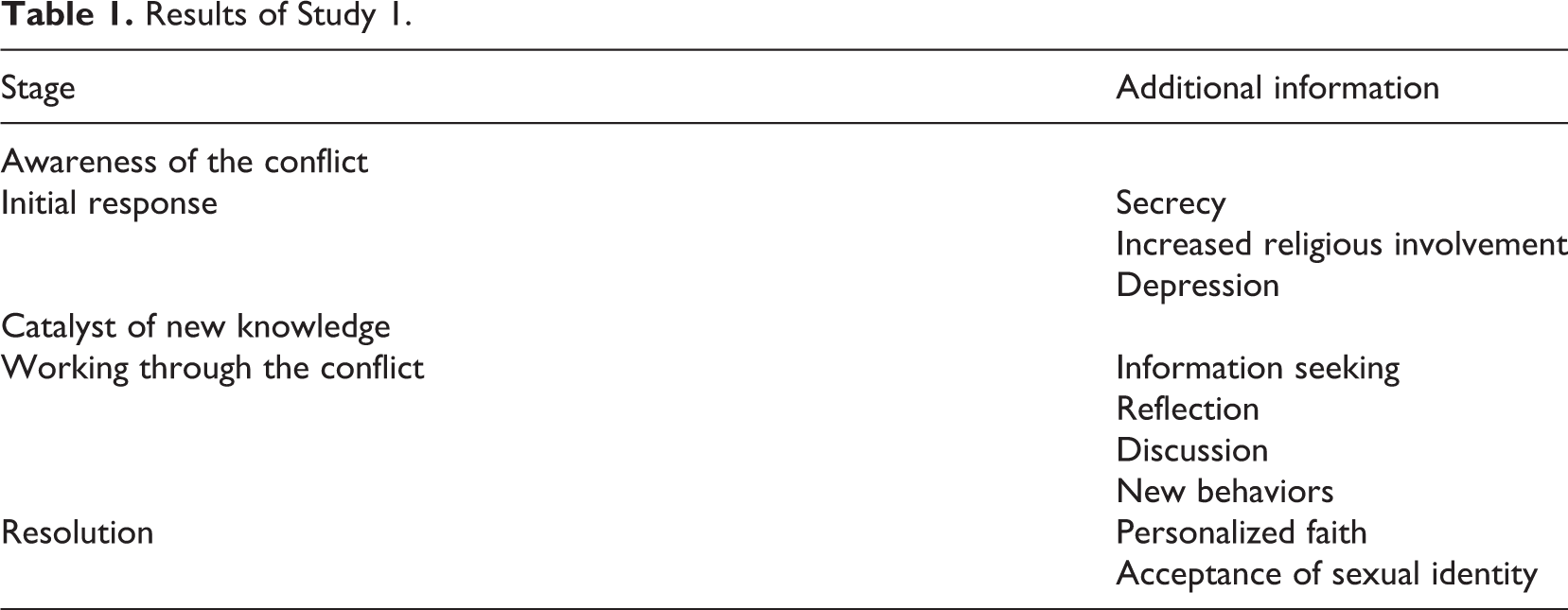
Analysis of the first study’s interview transcripts revealed a five-stage, fluid process of internal conflict resolution that was affected by personal and contextual factors (Levy & Reeves, 2011). These five stages, outlined in Table 1, are awareness of the conflict, initial response (including secrecy, increased religious involvement, and depression), a catalyst of new knowledge, working through the conflict (including information seeking, reflection, discussion, and new behaviors), and resolution (including personalized faith and acceptance of sexual identity). All of the stages were influenced by personal factors (reflective abilities, strength and resiliency, anger, creativity, and humor) and contextual factors (family, community, and church).
Results of Study 1.
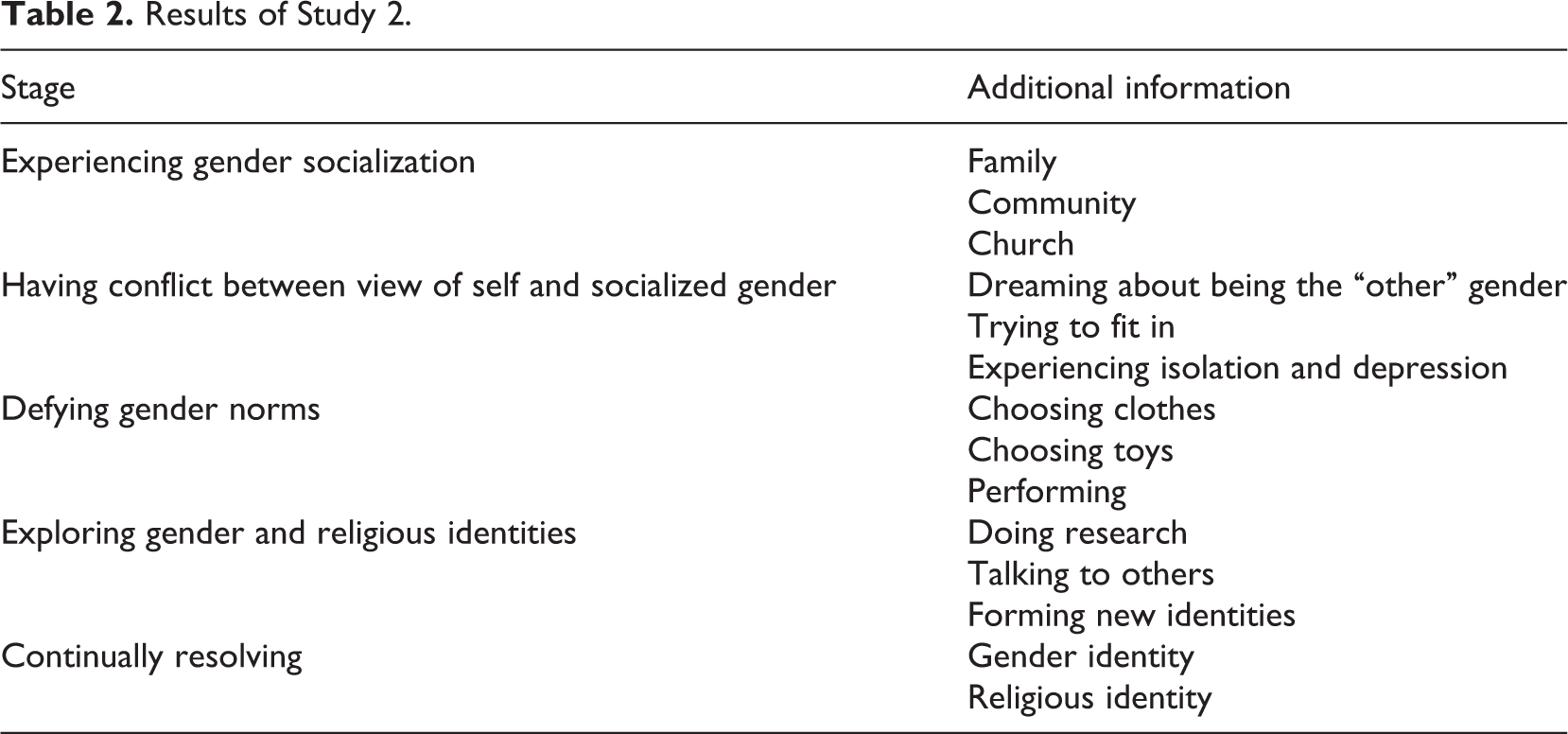
Analysis of the second study’s interview transcripts revealed a five-stage, fluid process of internal conflict resolution (Levy & Lo, 2013). These five stages, outlined in Table 2, are experiencing gender socialization (from family, community, and church), having conflict between view of self and socialized gender (including dreaming about being the “other” gender, trying to fit in, and experiencing isolation and depression), defying gender norms (in choosing clothes, choosing toys, and performing), exploring gender and religious identities (by doing research, talking to others, and forming new identities), and continually resolving (both gender identity and religious identity).
Results of Study 2.
Study Comparisons
When compared, it becomes clear that the results of these two studies contain similarities as well as differences. These are outlined below, complete with quotes from the interviews. In the quotes, participants are identified using pseudonyms.
Similarities
In comparing the results of these two studies, similarities emerged. First, analysis of both studies revealed fluid, five-stage processes of resolving conflict as described previously. Participants in both studies viewed the process of resolving these conflicts as first and foremost internal. Although these models were not identical and focused on different aspects of identity, both models noted the following experiences: depression, conducting research, dialogue with others, development of personalized faith, and acceptance of sexual or gender identity.
Regarding depression, Deborah (Study 1) said: “I went into a huge depression, and some of that was because of my sexuality.” Similarly, Steve (Study 2) said: “I was going through so much depression because there were all these things going on and all this pressure to conform.” Experiences of depression were common for participants in both studies, and they spoke about feeling alone and isolated. Many suffered in silence for fear of being “found out.” Several attempted suicide. Some were formally diagnosed with depression, and they viewed diagnosis as positive because it connected them to supportive counselors and therapists.
As they worked to resolve conflicts, participants in both studies discussed the importance of doing research and talking with others. Allen (Study 1) explained that “there’s one doctrine and that’s all you’re shown. You really have to search and find” other information. Alex (Study 2) explained what was helpful to her: “I started doing my own research and then I talked to a couple of my friends and I found out that they were transgender, and they helped introduce me to all of the culture and terms and things to help figure me out the big question mark that is me.” Discussions with others were both supportive and challenging and occurred in formal and informal environments.
Resolutions for both studies included the development of personalized or individualized faith. Although some participants continued to attend church services, most did not attend regularly. For all of these individuals, personalizing faith was important. This meant that individuals did not accept some aspects of their church’s doctrine; rather, they sought truth or meaning individually. Mark wanted to emphasize “how often gay people need to realign our spiritual identities. Many of us keep them, but they have to be altered because, otherwise, there’s no way that we could conceive of ourselves in a positive way.” Peter (Study 2) explained his personalized faith: I have kind of a personal religion type of thing. Or is it even ‘religion’? I don’t know if it’s even really religion. It’s just more of a connection to God in my mind and where every morning I have my quiet time.
Whereas Peter discussed having quiet time alone with God each morning, Chad (Study 1) discovered that Christianity, for him is “fully being the person that you are, that God made you.” For Chad, living his life and being open about his sexual orientation was his way of honoring God. Developing a personalized faith was a common experience among all of the participants in these two studies and even held true for those who continue to identify as Christians and are involved in church communities. For those identifying as Atheist and Agnostic, faith was considered nonreligious and included, by self-report, faith in humanity, and in the goodness of people.
All of the participants described an acceptance of sexual or gender identity. Logan (Study 1) explained: “I knew I was gay since the day I was born; I just finally came to terms with it in about tenth grade.” Peter (Study 2) reflected: “I think I’ve come to a place in my life where I accept myself for who I am and if others don’t like me, for whatever reason, that is their loss.” Similarly, Deborah acknowledge of her lesbian identity: “this is who I am and I need to trust it because it’s not going to change.” It is important to note that these two studies only included those who self-identified as gay, lesbian, queer, transgender, transsexual, and gender queer, so perspectives of those who have not accepted sexual or gender identity were missing.
Finally, both models were influenced by personal and contextual factors. Regarding contextual factors, participants in both studies emphasized the roles of their families, churches, and communities. Allison (Study 1) said: The people that I had been around my whole life are very conservative, politically and socially, very narrow-minded about what’s acceptable in terms of race and class …. I never ever got the idea from anyone in my family or any of my friends that being gay was an option, or that it in any way was a good thing. There was no positive light ever shone on that at all.
Similarly, Steve reported: The school was very, very extreme about all these sorts of things. I can really think about times when I unknowingly pushed the line I guess. To a large extent I really wanted to try and fit in there because it was where I was. It was my life. For those thirteen years, I was to be in that school. I couldn’t really escape it and so, to some extent, I needed to fit in.
Common personal factors included relying on internal strength and resiliency while experiencing and resolving these conflicts. Chad described this as his “will and determination” and Logan discussed how the hardships he endured “built a very strong character.” He explained “I was just resilient. It didn’t mean that it [the bullying and teasing] didn’t hurt. I cried a lot. I got upset a lot. But I quickly bounced back.”
Differences
In addition to similarities outlined previously, there were several differences that emerged when comparing the results of these two studies. In participants’ Christian churches, sexuality was discussed far more than gender identity and expression. Individuals in the first study provided messages they heard at their churches, including: you should “hate the sin [and] love the sinner,” homosexuality is “a ticket to Hell,” “you could not be gay and go to church. You cannot be a Christian. You cannot inherit the Kingdom of God.” Amy (Study 2) explained that gender identity “wasn’t on the radar” and that instead the message was that “homosexuality is bad.” Although Amy and others in the second study did not hear messages as church regarding transgender identity, they did not initially ask questions related to these topics. Perhaps because of this, participants’ conflicts related to sexual identity (Study 1) were reportedly more frequent and intense. In the first study, 7 of the 15 participants reported rejecting the label “Christian” and identifying instead as either spiritual, Agnostic, Atheist, or Wiccan. In the second study, all five of the participants continue to identify as Christian, although one identifies as both Christian and Agnostic.
Regarding the model itself, participants in the first study described distinct “aha” moments (catalyst of new knowledge) and participants in second study reported going through a longer, slower process of resolution. Mark (Study 1) experienced his “turning point” when he attended an MCC service and learned about alternative interpretations of Biblical verses about homosexuality. Hannah (Study 1) had a similar “aha” moment; the “light bulb” went off at her Christian college when she “met people who were involved with the church who did accept people who were gay.” In a process of exploration and questioning, Jessie (Study 2) tried a bit of everything, including new age religions, psychedelic drugs, meditation, Judaism, Neo-Paganism/Wicca, and traditional Catholicism.
In the resolution stage, participants in the first study described distinct resolutions that did include the possibility of future change whereas participants in the second study reported much more continual resolutions that were unfinished. Laura (Study 1) described her resolution this way: Somewhere in all this, I had decided that I was a Christian but my definition of Christianity was probably different than other people’s, so much so that maybe no one else would think I was Christian. And so that’s okay, I was willing to be a heretic.
Steve (Study 2) was much more tentative; he explained: “I have a better understanding in some ways and in some ways I have no understanding at all.”
In discussing resolution, participants experiencing conflict related to gender identity (Study 2) reported that they were less likely to attend church (than those in Study 1) because of fears of standing out. Steve (Study 2) explained: To some extent I would really like to find a church where I’d feel comfortable or even just feel anonymous, like a big cathedral up in New York where thousands of people go in and out, and I could just come in and have my worship experience.
All of the participants in the second study described feeling uncomfortable attending church because of “standing out.” It is important to note that participants, for the most part, did not hear messages at their churches regarding transgender identity. However, they felt certain that gender bending or crossing would not be accepted.
Finally, during all of the stages, participants in the first study reported depending more on distinct personal factors such as humor, creativity, and anger, than did those in the second study. Certainly, participants in the second study might agree that they relied on these factors as well, but, when asked, they did not bring up or discuss many personal factors.
Discussion and Implications
Based on the results of these studies, implications for theory and practice, along with suggestions for future research, are outlined below.
Implications for Theory
These studies utilized postmodern notions of identity, viewing identity as fluid, multifaceted, and ever changing (Clark & Dirkx, 2000). Even the models of conflict resolution, based on interviews with participants, revealed very fluid stages. The second study, in particular, included a resolution that was only tentative, and participants in both studies acknowledged the possibility of future changes. In essence, these models queer the concepts of sexual, gender, and faith identities and trouble the notion that one cannot be both gay or transgender and Christian.
Regarding faith development, participants in both studies described having to develop their faith very quickly. In fact, they explained that because of the conflicts they experienced, they were “forced” to ask questions of faith that would not have otherwise asked. Jake (study 1) put it this way: “If I was straight, I would still be attending the Church of Christ and maybe even have a kid or something. Because that would be all I knew.” He went on to say that he had to “force” himself to “think differently.” He said, “I’m glad I had to force myself to step outside of myself at a younger age and [tell myself] ‘I am okay.’ I think that’s made me stronger.” Likewise, Amy (study 2) explained that she was “forced” to question and deal with what her church said because of her “gender issues” and that it was her gender identity that initiated her changing religious views. All of the participants experienced Fowler’s (1981) individuative-reflective stage of faith early in their lives, typically during adolescence. As mentioned previously, it was precisely because of the conflicts they experienced that these individuals were compelled to question and critically examine their faith. Many participants had since moved into the conjunctive faith stage in which they acknowledged the inherent worth of all faith traditions regardless of their own identifications. Although most participants might identify with these two stages of faith development, all can be characterized as having a rational critical type of faith (Fowler, 2001). In fact, this type of faith, which critically compares “religious or ideological claims and commitments with reflective experience and with other sources of authority” (Fowler, 2001, p. 170), is similar to the personalized or individualized faith mentioned previously.
Interestingly, participants reported developing their sexual or gender identities at a much slower pace and suggested that perhaps this was due to their Christian upbringing and the conflicts they experienced. Allison (Study 1) said that it was only when she got a new job and met new people that she began to “get out of that box” of Christianity and explore her sexual identity. In fact, Savin-Williams (1990) and Wagner, Serafini, Rabkin, Remien, and Williams (1994) found that having a Christian background slowed the development of a non-normative sexual identity. In the first study presented in this article, participants were confronted with the task of managing conflicts between their faith and same-sex desires during the identity confusion stage in addition to the conflicts Cass (1984) mentions (between assumed heterosexuality and same-sex desires). This added component of faith, especially as it related to pressures from their family members and communities, led participants in both studies to very slowly accept themselves; some have not attained identity synthesis (Cass, 1984) or integration and pride (Devor, 2004). In fact, several participants are not “out” to family members or coworkers. When explaining why he is not out to his parents, Allen stated: “I never felt like my parents would really love me if they knew who I was.”
Implications for Practice
In addition to theoretical implications, there are practical implications. First and foremost, it is vital for professionals in many fields to understand conflicts people experience between their sexual or gender identity and their religious upbringing. Professionals who benefit from this knowledge include clergy, faith-based professionals, medical professionals, social workers, counselors, teachers, and others. Further, understanding the process by which people resolve these conflicts can be particularly useful for helping professionals such as therapists, counselors, and social workers. By normalizing the experiences of their clients, helping professionals can utilize their knowledge of these conflicts in practice. Further, clients themselves may identify with various parts or stages of these models and look to other stages for information on how to proceed.
In addition to the practical implications listed for these two studies in general, there are important implications in the comparisons presented in this article. First, some of the similarities (depression, doing research, talking to others) offer opportunities for community-wide interventions. Individuals experiencing such conflicts should be able to find resources and support in their communities, and helping professionals ought to have access to continuing education on these topics. Regarding differences in these two studies, Steve (Study 2) said it best: I’ve noticed that there’s this level of awareness and understanding and tolerance and acceptance now for homosexuality and sexual orientation, and nothing at all for gender related stuff, nothing at all for transgender people … In fact, it’s just a T that gets thrown in with other letters, without anybody understanding it and a lot of people speaking for us without really even representing us. I want there to be some understanding where people can look at me and say ‘okay you’re not some weird freak.’
The participants in the second study echoed Steve’s comment. They explain that additional resources are needed that apply specifically to the transgender population. Although they all mention this in regard to faith communities, some also suggested additional resources for counselors and helping professionals. On a related note, many research studies highlight a shift in some denominations’ views about sexual identity and debates are certainly ongoing (Levy, in press); however, there is very little research on gender identity in faith communities (Stone, 2007). Continuing research and discussions on this topic, with input from clergy and mental health professionals, is vital considering the conflicts experienced by those in these studies.
Future Research
Empirical research examining conflicts between sexual or gender identity and religious upbringing is scarce, especially studies focusing on the process of resolving conflict. Researchers should continue to study these conflicts, and future studies could include additional groups. For instance, regarding sexual identity, researchers can interview those identifying as bisexual, pansexual, asexual, and so forth. Related to gender identity, people identifying as intersex or cross-dressing can speak to their experiences. Finally, people of additional religious traditions, such as Islam and Judaism, can add to the discussion. In addition to replicating these studies and including other groups, new quantitative studies should be completed. Widespread studies including large, diverse samples are particularly suggested.