




Abstract
The state of New Jersey has recommended the widespread adoption of bystander intervention education as a way to engage communities in the prevention of sexual violence. The study reported here gathered baseline data from a random sample of New Jersey residents about their attitudes as bystanders, gender roles, and sexual violence. The analysis of the data revealed that the women reported less support for rigid gender roles and a greater willingness to become active bystanders than did the men. Age and race were also significant in some of the scales. Implications for the development of programs to prevent sexual violence are discussed.
The widespread and insidious nature of sexual violence in our society has been well documented, with approximately 1 of the 6 women and 1 of the 33 men experiencing sexual assault in their lives (Tjaden & Thoennes, 2006). Experiencing sexual violence has a devastating impact on a survivor’s physical, mental, social, and interpersonal domains (Bachar & Koss, 2001; Campbell, 2008). In an effort to address this major social problem, sexual violence programs have evolved their prevention efforts over the years, with the most recent shift toward primary prevention, occurring before the onset of the problem (Conway et al., 2010; Cox, Lang, Townsend, & Campbell, 2010).
One increasingly popular method for addressing the primary prevention of sexual violence is through education in bystander intervention (Banyard, Moynihan, & Plante, 2007; McMahon, Postmus, & Koenick, 2011). Bystanders are individuals who are present before, during, or after an act of sexual violence and have the potential to help the situation, make the situation worse, or do nothing (Banyard, Plante, & Moynihan, 2004). The engaged bystander approach is a framework that encourages individuals to take positive action to help address sexual assault (McMahon et al., 2011). Instead of focusing on the victim and perpetrator of sexual violence, this approach suggests that everyone, as part of the community, has a responsibility to be an active bystander by intervening before a sexual assault occurs (Banyard et al, 2004). In addition, bystanders can engage in secondary and tertiary prevention by intervening during or after an assault occurs (McMahon & Banyard, 2012). The failure of communities to intervene and address sexual violence has been identified as a risk factor for sexual violence by the Centers for Disease Control and Prevention (CDC, 2007) and the World Health Organization (WHO, 2010), whereas the willingness to intervene to prevent sexual violence can be regarded as an important protective factor (CDC, 2007). The popularity of bystander education programs nationwide has increased exponentially over the past few years. Bystander education has been adopted by many college campuses; organizations, such as the National Collegiate Athletic Association; and even as a statewide prevention strategy in a handful of states, including New Jersey (New Jersey Department of Community Affairs, 2009).
Social workers in diverse community-based settings have the opportunity and sometimes the mandate to increase awareness of and provide education on the issue of sexual violence. Bystander education is a strategy that is highly compatible with the social work profession’s values, such as community engagement, self-determination, and empowerment (McMahon & Farmer, 2009). However, a major limitation of research on bystander intervention has been that the studies have relied on college samples without exploring community samples. Given that a number of communities are implementing bystander intervention, it is important to extend research on bystanders’ attitudes beyond college campuses. Many questions remain as to how members of the larger public perceive bystander intervention and their willingness to engage in such behaviors, as well as whether these attitudes vary by important factors, such as gender, race, and age. In addition, there is a need to understand attitudes toward gender roles and how they may influence an individual’s willingness to intervene as an active bystander. A number of studies have demonstrated that communities in which there are higher levels of sexist beliefs and rigid adherence to gender roles also have higher rates of violence against women (see Casey & Lindhorst, 2009, for a review).
This article presents the results of baseline data collected from a random sample of New Jersey residents to determine their attitudes toward bystander intervention and gender roles. We first present the continuum of sexual violence as a theoretical foundation for bystander intervention to understand its connection with gender roles and attitudes toward sexual violence.
Continuum of Sexual Violence
Bystander intervention as a strategy to prevent sexual violence is based on the notion of a continuum of sexual violence. As engaged bystanders, members of a community can intervene by challenging a wide range of situations and behaviors that support sexual violence. The concept of a continuum purports that there is a range of behaviors that escalate in severity and violence and that are linked to one another (Kelly, 1987; Leidig, 1992; Stout, 1991). At one end of the continuum are behaviors that are generally considered sexually violent in our society, including rape, sexual assault, and criminal sexual contact. These acts are recognized as crimes in our culture, have legal ramifications and punishment, and hence are more overt and judged more harshly (Stout, 1991). At the other end of the continuum are lower-risk behaviors that are more commonly accepted by our society, including using sexually degrading language, making jokes about sexual violence, and viewing pornography. The behaviors at this end of the continuum are often normalized as part of our culture, and therefore their connection to sexual violence is not widely recognized or judged as harmful (Stout, 1991).
A number of sociocultural theorists have emphasized the importance of identifying behaviors on the less severe side of the continuum because such behaviors contribute to a culture of violence that supports and tolerates the more severe forms of violence against women (Fabiano, Perkins, Berkowitz, Linkenbach, & Stark, 2003; Sanday, 2007). These behaviors include actions that support sexism and rigid gender roles (how men and women should behave). Such roles are part of society’s “gender norms,” which “are powerful, pervasive values and attitudes about gender-based social roles and behaviours that are deeply embedded in social structures” (Keleher & Franklin, 2008, p. 43). Gender norms operate at multiple levels in our society and serve to maintain power and dominance by men over women. For years, feminist theorists have maintained that the promotion of stereotypical gender roles creates unequal power relationships between women and men and sets the foundation for sexual violence (Abbey, McAuslan, Zawacki, Clinton, & Buck, 2001; Berkowitz, 1992; Brownmiller, 1975; Kalichman et al., 2005). One subset of gender roles includes attitudes about women’s behavior, sexuality, and sexual violence. Research has found that some people believe that women’s behavior, such as dressing in provocative clothing, provokes or invites sexual violence (Burt, 1980). These negative beliefs about women’s behavior, often termed “rape myths,” minimize sexual violence, blame the victim, and are persistently held (Burt, 1980; Lonsway & Fitzgerald, 1995). Individuals with negative attitudes toward women typically endorse stronger rape myths (Burt, 1980; Flood & Pease, 2009; Lonsway & Fitzgerald, 1995). Indeed, adherence to strict gender roles and the belief in rape myths are linked in the research literature to the greater likelihood of tolerating and committing sexually violent acts (Berkowitz, 1992; Christopher, Madura, & Weaver, 1998; Lanier, 2001; Lyndon, White, & Kadlec, 2007).
The authors of a growing body of research have therefore concluded that effective efforts to prevent sexual violence must address the underlying assumptions about gender and sexual violence, and changing rape-supportive ideologies and gender norms will ultimately decrease the perpetration of sexual violence (Berkowitz, 2001; Davis & Liddell, 2002; Fabiano et al., 2003; Stein, 2007). It is important to recognize that assumptions about gender roles, sexual violence, and bystander intervention may vary within communities, shaped by larger identities, such as gender, race, or age.
Demographic Patterns and Attitudes
The literature has begun to explore how factors, such as gender, race, and age, may influence attitudes about gender roles, sexual violence, and bystanders’ behaviors. Regarding beliefs in traditional gender roles, research has depicted a complex picture of demographic patterns. A number of studies have indicated that men generally hold more traditional gender-role beliefs than do women (Erchull, Liss, Axelson, Staebell, & Askari, 2010; Hojat et al., 2000; Kaufman, 2005; Ogletree, 2010; Parks & Roberton, 2004; Wentworth & Chell, 2001). Racial patterns are less consistent. For example, a number of studies have reported that African Americans tend to believe in more egalitarian gender roles than do whites, whereas other studies have reported no racial differences when specifying particular gender roles, such as women’s participation in the labor force (see Kane, 2000, for a review). Still other studies have indicated that it is the interaction between race and gender that is salient (Blee & Tickamyer, 1995; Bolzendahl & Myers, 2004; Scott Carter, Corra, & Carter, 2009). Some research has found that Latinos are more accepting of traditional gender roles than are whites or blacks, but this research was criticized for grouping the many diverse types of Latinos under one umbrella term (Kane, 2000). Other research has indicated that educational levels may be an important factor to consider, with individuals who have attained more education more likely to endorse egalitarian gender roles (Boehnke, 2011)
Research has also revealed certain demographic patterns of who is more likely to hold negative or prejudicial attitudes about sexual violence, also called rape myths. For example, Anderson, Cooper, and Okamura’s (1997) meta-analysis found that men and older people were more accepting of rape myths. Suarez and Gardalla’s (2010) meta-analysis also found that men accepted higher levels of rape myths, as did those who expressed hostility toward women; engaged in aggressive behaviors; and endorsed a number of other oppressive belief systems, such as racism and religious intolerance. The research on the role of race and rape myths have been less clear. Some studies have found that African American men are more likely to endorse rape myths (e.g., Nagel, Matsuo, McIntyre, & Morrison, 2005), yet others have found that high racial identity is associated with less acceptance (Suarez & Gadalla, 2010).
Less research is available on bystanders’ attitudes and thus far has pointed mainly to the salient role of gender. Studies have found that women are generally more likely to hold positive bystander attitudes and exhibit more active bystander behaviors (Banyard, Eckstein, & Moynihan, 2010; McMahon et al., 2011). Unfortunately, since most of the research has been conducted with college populations, limited information exists on the role of age, race, and attitudes toward becoming involved as a bystander. Hence, more research is needed to gain a greater understanding of whether such demographic factors are indeed linked to bystanders’ attitudes.
The study presented here fills in these gaps in the understanding of the link between gender, age, and race and attitudes toward gender roles, sexual violence, and bystanders’ behavior by using a statewide random sample. The research questions guiding this study included (1) How willing are New Jersey residents to become bystanders (i.e., to intervene in situations) to prevent sexual violence? (2) How strongly do New Jersey residents support traditional gender roles? (3) How do these beliefs about becoming an engaged bystander and about gender roles vary by gender, race, and age? (4) What is the relationship between attitudes about gender and bystanders’ attitudes?
Method
To answer the research questions, a cross-sectional, random sample of adult New Jersey residents were administered a survey about attitudes toward traditional gender roles and bystanders’ attitudes.
Sample and Data Collection
A survey was administered by a private research organization (Abt SRBI) to a random sample of New Jersey residents aged 18 or older. To ensure a proportionate geographic dispersion of completed interviews across the state, area codes were used to stratify the sample. A dual-frame (landline and cellular phone) sample of New Jersey households was collected through random digit dialing, attempting to reach 41,848 residents. Of this total frame, 3,526 adults were reached and asked to complete the survey. The rest of the total sample frame included those who (1) were screened out (n = 989) because they did not meet the criterion of age or New Jersey residence, (2) were unavailable (n = 13,362), and (3) were not working numbers for New Jersey residents (i.e., fax numbers, businesses, or disconnected lines; n = 23,971). Of those who were reached, 886 completed the survey, 28 did not finish the survey (<1%), and 2,612 refused to participate (74%), for a total response rate of 25%. In addition, Hispanic respondents were oversampled by targeting New Jersey tracts with 7% or more Hispanics to yield 79% coverage of Hispanic telephone households. Of the 11,480 Hispanics who were identified, only 795 were reached, and 152 completed the survey (a response rate of 19%).
The final sample size for the survey was 886; however, 30 cases were removed because they were missing demographic information used in the current analysis; therefore, the final sample was 856. There were no missing data for the scale items; the only missing data were for age, education, and race. According to the organization that collected the data (Abt SRBI), the data were weighted to “account for differential probabilities of selection and to account for an overlap in the landline and cell phone sampling frames. The sample was adjusted to match census demographic (American Community Survey) benchmarks for gender, age, education, race/ethnicity, and telephone service (NHIS)” (K. Daley, personal communication, September 11, 2012).
Development of the Questionnaire
To gather baseline information about the priority areas of bystanders’ attitudes and attitudes about gender roles, a survey was developed by the authors in collaboration with the New Jersey Coalition Against Sexual Assault (NJCASA). The scale was developed using an in-depth process that included several steps. First, a number of existing scales were selected: the Classical and Modern Sexism Scales (Ekehammar, Akrami, & Araya, 2000) and the Ambivalent Sexism Inventory (Glick & Fiske, 1996) to measure attitudes about gender roles, the Sexual Conservatism and Sex Role Stereotyping Scales (Burt, 1980) and the Illinois Rape Myth Acceptance Scale (Payne, Lonsway, & Fitzgerald, 1999) to measure attitudes about sexual violence, and the Bystander Attitude Scale (Banyard et al., 2007) to measure bystanders’ attitudes.
The scales were then reviewed by members of NJCASA, who prioritized the items from each scale on the basis of the state prevention team’s goals to increase an individual’s willingness to engage as a bystander and understand an individual’s attitude toward gender roles and rape myths. The questionnaire was then pilot-tested with a convenience sample representing various demographic groups (those of different races, ages, and educational backgrounds), revised to ensure reliability and validity, and shortened on the basis of limited time constraints for telephone surveys (10 minutes maximum). Finally, exploratory and confirmatory factor analyses were conducted on the final 30 items (for a detailed explanation of the development of the survey, see Koivunen, McMahon, & Warrener, 2009; Warrener, McMahon, & Postmus, 2011). The final results included two scales to measure bystanders’ attitudes and attitudes about gender.
Bystander Attitudes Scale
The Bystander Attitudes Scale covers our first research question about residents’ willingness to intervene in a range of situations. This scale has 5 items that focus on a person’s willingness to intervene in bystander situations (e.g., a willingness “to challenge a friend who uses sexist language to talk about or describe girls or women” and “to express concern if a family member makes a sexist, degrading, or disrespectful joke”). Possible responses range from 1 (very unlikely to intervene) to 5 (highly likely to intervene). A higher score on this scale indicates a greater willingness to intervene. The Cronbach’s α was .66.
Attitudes About Gender Scale
The Attitudes About Gender Scale addresses our second research question, which asks about the respondents’ general attitudes related to gender. This scale includes 8 items that focus on traditional gender roles (e.g., “Women should be protected by men” and “It is more important for the man in the family to have a job than it is for a woman”) and blaming attitudes about sexual violence (e.g., “A woman who dresses in skimpy clothes should not be surprised if a man tries to force her to have sex”). Responses were coded from 1 (strongly agree) to 5 (strongly disagree). A lower score for this scale indicates more support of traditional gender roles and greater victim-blaming attitudes. The Cronbach’s α for this scale was .69.
Demographic Characteristics
To answer our third research question, we collected a number of demographic items, including gender, age (categorized into 5 groups), and race/ethnicity (grouped into 4 categories: non-Hispanic white, non-Hispanic African American/black, Hispanic, or Other), and education (grouped into 3 categories: up to high school or the equivalent; some college, college graduate, or some graduate education; and graduate degree).
Data Analysis
The data analysis was conducted using Statistical Package for the Social Sciences statistical software and began with running descriptive information on both scales and demographic information. Next, two separate analyses of covariance (ANCOVAs) were conducted to examine the relationship between the demographic groups and the two scales: Bystander Attitudes and Attitudes About Gender. Age, race, and gender were used as independent variables while controlling for education to focus on the other demographic characteristics because it was significantly correlated with both dependent variables (Bystander Attitudes = .13, p < .001; Attitudes About Gender = −.29, p < .001). Finally, a correlation was run to determine the relationship between the two scale variables. All the bivariate and multivariate analyses used weighted data. A power analysis indicated that the sample size and analysis are able to detect a small effect size, and the ANCOVAs have a power of .85.
Results
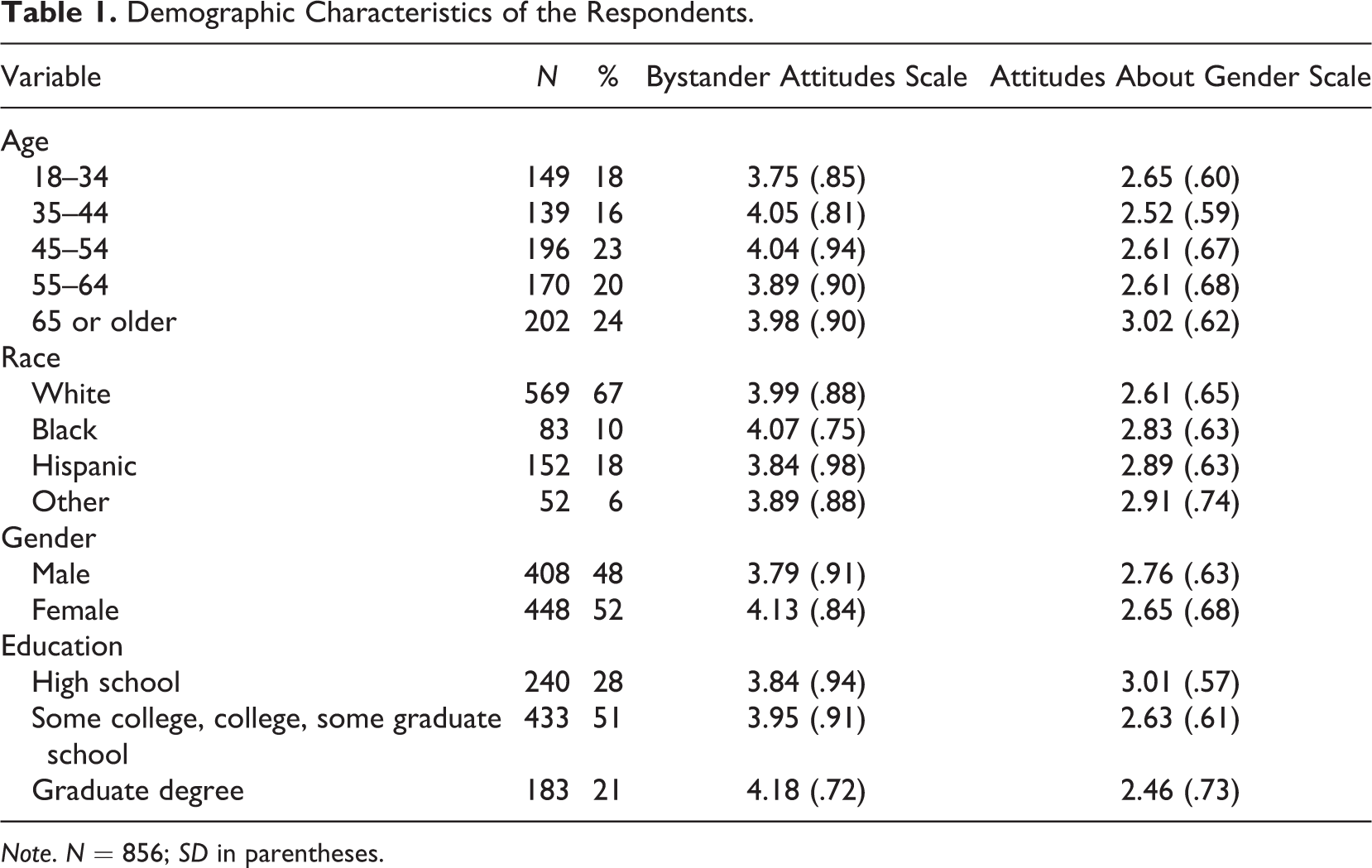
The respondents varied in age, race, gender, and education. The largest age group was 65 and older, the majority of respondents were white (67%), gender was split almost evenly, and 51% had some college through some graduate education (see Table 1).
Demographic Characteristics of the Respondents.
Note. N = 856; SD in parentheses.
The first research question focused on bystanders’ attitudes, with a higher score indicating a greater willingness to intervene. The overall mean for the Bystander Attitude Scale was 3.90 (.89). The mean for the younger respondents (aged 18–34) was 3.75 (SD = .85), and the mean for those aged 35–44 was 4.05 (SD = .81); for all the means for this scale, see Table 1. The mean for the Hispanic respondents was 3.84 (SD = .98), while the mean for the black respondents was 4.07 (SD = .75). On the other demographic factors, such as gender and education, the mean for women was 4.13 (SD = .84), and the mean for the respondents with graduate degrees was 4.18 (SD = .72).
The second question focused on attitudes toward gender, with a lower score indicating a greater belief in rigid gender roles. The mean score for the Attitudes About Gender Scale was 3.29 (SD = .66). Table 1 provides a breakdown of the means for these scales by demographic groups. The mean for those aged 65 and older was 3.02 (SD = .62), the mean for men was 2.76 (SD = .63), and the mean for the respondents with a high school education was 3.01 (SD = .57).
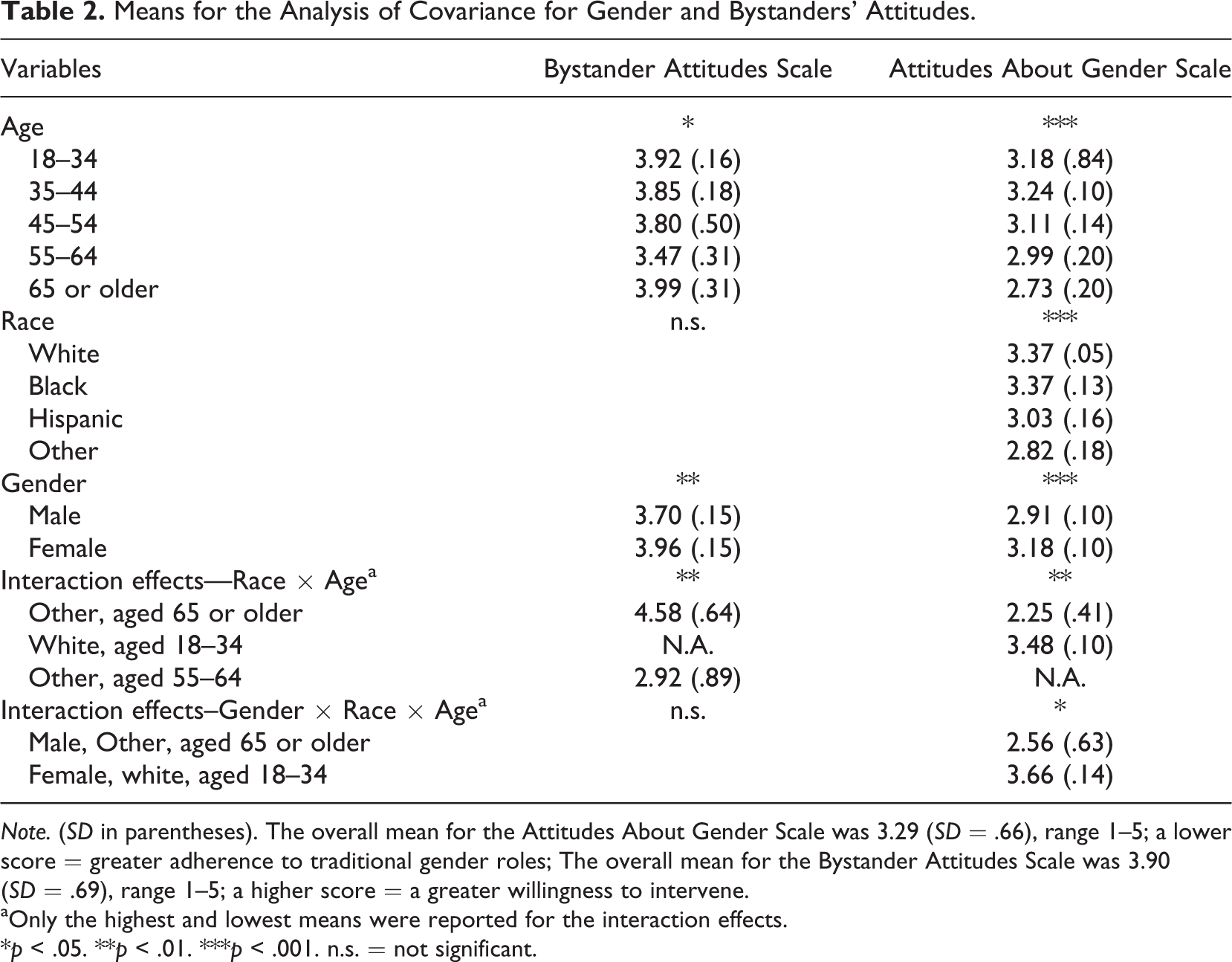
The third research question asked how the beliefs about becoming a bystander and about gender roles vary by gender, race, and age when education is controlled for. Two ANCOVAs examined these demographic variables (see Table 2). For bystanders’ attitudes, gender—F(1, 856) = 6.27, p < .01—and age—F(1, 856) = 2.68, p < .05—were significant on their own, and the combination of age and race was significant—F(12, 856) = 2.50, p < .01. For gender, women’s scores (3.96, SD =.15) were significantly higher than men’s (3.70, SD = .15), indicating that the women reported a greater willingness to intervene in sexual violence situations than did the men. For age, the highest score came from the group aged 65 and older (3.99, SD = .31), and the lowest score came from the 55–64 age group (3.47, SD = .31). For the combination of age and race, the highest score and the greatest willingness to intervene came from the Other racial category aged 65 and older (4.58, SD = .64), and the lowest score came from the Other racial category aged 55–64 (2.92, SD = .89).
Means for the Analysis of Covariance for Gender and Bystanders’ Attitudes.
Note. (SD in parentheses). The overall mean for the Attitudes About Gender Scale was 3.29 (SD = .66), range 1–5; a lower score = greater adherence to traditional gender roles; The overall mean for the Bystander Attitudes Scale was 3.90 (SD = .69), range 1–5; a higher score = a greater willingness to intervene.
aOnly the highest and lowest means were reported for the interaction effects.
*p < .05. **p < .01. ***p < .001. n.s. = not significant.
The second ANCOVA looked at the Attitudes About Gender scale, examined by the demographic factors of age, race, and gender, controlling for education (see Table 2). Individually, there were significant differences among the groups by gender, age, and race compared for the Attitudes About Gender scale. For age—F(4, 856) = 5.67, p < .001)—the oldest group (aged 65 and older) had the lowest score, or the greatest belief in rigid gender roles, and the group aged 35–44 had the highest score. For race—F(3, 856) = 23.21, p < .001—the Other group had the lowest score, and whites had the highest score, meaning that the Other group were the most likely to adhere to rigid gender roles and whites were the least likely. For gender—F(1, 856) = 14.94, p < .001—the lower group was men, and the higher group was women, indicating that men were more likely than women to believe in traditional gender roles.
Certain combinations were significant for the Attitudes About Gender scale, including age and race—F(12, 856) = 2.19, p < .01—and gender, age, and race—F(8, 6722) = 3.95, p < .001. For age and race, the lowest score (the greatest adherence to traditional gender roles) was for the Other racial category who were aged 65 or older (2.25, SD = .41), while the highest score (the least adherence to traditional gender roles) was for whites aged 18–34 (3.48, SD = .10). For gender, race, and age, the men in the Other racial category aged 65 and older had the lowest score (2.56, SD = .63) and white women aged 18–34 (3.66, SD = .14) had the highest score; the men aged 65 or older who identified racially as Other had the greatest beliefs in traditional gender roles, while the white women aged 18–34 had the lowest beliefs in traditional gender roles.
The results for the final research question, which asked about the relationship between the Attitudes About Gender and the Bystander Attitudes scales, showed a significant, but weak, positive relationship at .14 (p < .001). The positive correlation indicates that a person who believes in more rigid gender roles is less willing to intervene in bystander situations.
Discussion
The results of the study provide some baseline information about a random sample of New Jersey residents, their attitudes about intervening as an active bystander, and their attitudes about gender roles and sexual violence. The study contributes to the literature by providing data that are representative of a statewide population, and the results can be used for comparison in future research when examining other states, communities, or groups.
Our first research question explored the willingness of New Jersey residents to intervene as active bystanders in situations related to sexual violence. The results provide details on a new population for bystanders’ attitudes, since previous research has focused largely on college students. They indicate that the mean score was skewed toward a willingness to intervene as bystanders by residents of New Jersey. Although there was a clear willingness to intervene, more information is needed to determine how best to move individuals from being willing to intervene to actually intervening in sexual violence situations. The several different bystander programs have provided evidence of their effectiveness in engaging college students to become bystanders (Banyard et al., 2007; Katz, 1995; McMahon, Postmus, Warrener & Koenick, in press); however, more research and evaluation are needed to determine how to revise these programs to engage individuals of all ages, ethnicities, and educational levels in their communities.
Our second question on the beliefs regarding gender roles resulted in an overall mean of 3.29. Previous studies are not available to determine whether this mean response indicates a certain level of adherence to gender roles. However, such results provide a point of comparison for the different demographic groups in the study as well as a baseline for future research on attitudes about gender among New Jersey residents. Our third question examined the role of key demographic characteristics, including gender, race, and age, in attitudes toward bystanders’ involvement and gender while controlling for education. Gender was consistently a significant variable in our analyses, with the female respondents reporting less adherence to rigid gender roles and a greater willingness to become active bystanders than did the male respondents. These findings are consistent with previous research in these areas (Banyard, 2008; McMahon et al., 2011). They also support the notion that norms related to masculinity and gender equity are key areas that need attention in the movement to prevent sexual violence (Carlson, 2008; Katz, 2006), and, therefore, opportunities for men to address sexual violence with other men may be particularly important (Fabiano et al., 2003; McMahon & Dick, 2011; Schwartz & DeKeseredy, 1997).
The fourth research question explored the relationship between attitudes about gender and bystanders. The results indicated a positive, albeit weak, relationship between attitudes about gender and bystanders’ attitudes. Although weak (.14), this correlation suggests that there are better likely indicators of bystanders’ attitudes and that more complex modeling will be necessary to gain a full understanding of what affects these attitudes.
The findings of the study suggest that programs to prevent sexual violence must address gender differences by changing attitudes about gender roles and promoting intervention by bystanders. They provide support for programs that focus on changing men’s norms, such as national and international organizations like Men Can Stop Rape (2010) and the White Ribbon Campaign (2010), which enlist boys and men to take a leadership stance against violence and to challenge views of masculinity as intrinsically connected with violence and aggression.
Age was also significant in certain areas of our findings. For example, the older respondents believed in more traditional gender roles yet were more willing to engage as bystanders. Although it may be assumed that the older respondents would hold more traditional beliefs about gender roles, what is interesting is their willingness to engage as bystanders. These results suggest that research is needed with older populations to gain a fuller understanding of the findings, since there is a dearth of research on age and intervention by bystanders. More research is also needed to understand what barriers may be inhibit young adults from intervening as bystanders. Given their developmental stage, young adults may be particularly influenced by peer norms (Berkowitz, 2005). Studies with college students may help inform this line of inquiry, since research has illuminated a number of potential obstacles to intervening, such as not recognizing situations as appropriate for intervention or not having the skills or confidence to do so (Burn, 2009).
The findings about race raise some interesting questions and indicate the need for additional, in-depth research to gain a better understanding of potential differences. The respondents who identified as Other (i.e., Asian or multiracial) believed in more traditional gender roles and were less likely to intervene as bystanders. Although these respondents represented only 6% of the sample, their responses should prompt further investigation. On the basis of this research and our findings, there is a need for further discussion with various communities and groups based on race and to address their specific community and cultural norms related to gender and intervening as a bystander. Identifying the social norms that support sexual violence should be done in conjunction with members of the community who can speak to the particular norms of their context (Casey & Lindhorst, 2009). This information can be used to inform the development of culturally appropriate strategies to prevent sexual violence, including culturally sanctioned ways of intervening as a bystander.
There were a number of limitations of the study that readers should take into account when interpreting the results. First, the study focused on just one state, and there may be important geographic and regional differences that can be captured with comparative studies in other areas of the country. Second, the survey needs further testing and validation to determine whether the items actually reflect the constructs identified in the study. Some items may need to be added, such as the respondents’ personal experiences with sexual violence or their income levels. Third, youths aged 18 and younger were not included in the study but have been identified as being at risk of sexual violence, and more research is needed to understand their attitudes and beliefs about gender and sexual violence. Fourth, the study was also limited by the 25% response rate, although this rate is consistent with the rates of other studies that have used random digit dialing and national trends that indicate a decline in response rates (Pew Research Center, 2012). Finally, in an effort to provide one standardized, feasible survey, the study was not able to capture cultural differences or interpretations. There is evidence that attitudes about gender roles are influenced by culture and immigration status (see, e.g., Chuang & Tamis-Lemonda, 2009), although we did not collect this information in our study because of our desire to maintain the respondents’ anonymity. More research is needed, whether using quantitative or qualitative methods, to develop a greater understanding of the attitudes and beliefs found in different cultures, how they relate to sexual violence, and how to develop programs that are culturally and community-specific (Casey & Lindhorst, 2009).
In conclusion, the results provide baseline information on the attitudes in one state that are related to key risk and protective factors for the prevention of sexual violence. The lessons learned from the study can inform future studies and provide a glimpse into understanding the attitudes and beliefs of a sample randomly drawn from those residing in one state. Such an understanding can help inform efforts to prevent sexual violence and the policies that are needed to improve such attitudes and beliefs to encourage citizens to become active bystanders in preventing sexual violence.
Footnotes
Declaration of Conflicting Interests
The author(s) declared no potential conflicts of interest with respect to the research, authorship, and/or publication of this article.
Funding
The author(s) disclosed receipt of the following financial support for the research, authorship, and/or publication of this article: the research was supported by funding from the New Jersey Coalition Against Sexual Assault (NJCASA) to the Center on Violence Against Women and Children at the Rutgers University School of Social Work.