




Abstract
Violence against women is a pervasive and widespread problem, but the understanding of how to prepare social workers best for working with survivors is inadequate. One area of focus is professional efficacy, which stems from the literature on self-efficacy. This article focuses on the confidence and comfort that social work students have in working with survivors of domestic violence and sexual assault and identifies the factors that affect professional efficacy among these students. The results indicate that age, professional experience, master of social work education, and training have a positive impact on professional efficacy.
Keywords
Violence against women is a pervasive and widespread problem (Tjaden & Thoennes, 1998), but many professions struggle with how best to prepare their professionals. Social work is one such discipline that has struggled with preparing students to deal with issues of violence against women after they have graduated (Danis & Lockhart, 2003). Few social work programs have courses that deal specifically with violence against women, and deans and administrators of these programs often relegate the topic to be covered in other courses (Danis & Lockhart, 2003). One study reported that 55% of social work students having little or no academic preparation for working with survivors and a lack of understanding of how to use interventions, such as safety planning or legal options, that are needed by many survivors (Danis, 2003).
Until the early 2000s, little was published about the inclusion of violence against women in social work curricula (Cohn, Salmon, & Stobo, 2002; Danis & Lockhart, 2003). Since those evaluations, there have been no systematic updates on the inclusion of violence against women in social work education.
As disciplines such as social work struggle to determine how best to prepare their students to work with survivors of abuse, one avenue may be to focus on students’ sense of professional efficacy or their level of confidence in their abilities. By looking at how professional efficacy has been developed in other disciplines, educators can apply some of those findings to the field of social work and prepare students to work with survivors of domestic violence and sexual assault.
The theory of and literature on self-efficacy demonstrate that increased efficacy leads to better work performance and more effective practice (Bandura & Locke, 2003; Rosenberg, Schooler, Schoenbach, & Rosenberg, 1995). In this article, we define and use the concept of professional efficacy as students’ confidence to work effectively with survivors of abuse in social work practice settings. On the basis of the evidence that greater confidence will improve professional behavior, we identify what affects the professional efficacy of social work students in their preparation to work with survivors of abuse. The study presented here examined the impact of a range of variables (age, personal experience with abuse, education, and training) on the professional efficacy of master of social work (MSW) students. We conclude with implications for how to strengthen students’ professional efficacy to work effectively with survivors.
Professional Efficacy
The term professional efficacy comes from the broader area of self-efficacy, which is defined as “a person’s feelings or thoughts about his/her own capability of accomplishing any given task” (Buchmann, 1997, p. 133). Self-efficacy is a measure of one’s previous accomplishments, as well as future behavior, in terms of whether one tries harder after failed efforts (Bandura & Locke, 2003). Self-efficacy is a general sense of confidence in one’s abilities but can vary widely from a sense of self-worth to more specific areas regarding beliefs about one’s physical, personal, or professional abilities.
Professional efficacy as a more specific conceptualization of self-efficacy may yield better results because it is a more focused construct and may improve the validity of the construct (Rosenberg et al., 1995). It is a measure of confidence specific to one’s professional work and the ability to complete work-related tasks. The term was adapted from the literature on self-efficacy to identify the concept within the context of a professional environment. A further delineation of the terms explains that individual self-efficacy focuses on overall confidence with one’s abilities, whereas professional efficacy is context-specific. This is an important distinction because while individuals may feel confident in their abilities as social workers, they may not feel competent in their ability to work with a survivor of domestic violence or sexual assault (Danis, 2004; Rosenberg et al., 1995). In other words, specificity in efficacy (e.g., “I feel confident in my knowledge of strategies to help victims of violence to change their situation”) should have more accurate results when measuring how it affects a person’s behavior, rather than a general statement (e.g., “I am confident in myself” or “I am confident in my knowledge of social work principles”). The term professional efficacy could be used to identify professional confidence in any field; however, in the context of the study reported here, it indicates the respondent’s self-confidence and level of comfort in identifying and supporting survivors of domestic violence and sexual assault.
The relationship between self-efficacy and work performance is especially critical for understanding the concept of professional efficacy, since a body of evidence suggests a positive relationship. For example, in one meta-analysis of self-efficacy and work-related performance, the findings indicated that although people tend to avoid challenging environments, those with higher self-efficacy will challenge themselves at work and perform better (Stajkovic & Luthans, 1998). Bandura and Locke’s (2003) review of nine meta-analyses concluded that higher feelings of self-efficacy, or greater confidence in one’s abilities, led to better behavioral outcomes whether in laboratory or in natural settings.
Although the literature on self-efficacy is fairly consistent in its conclusions that higher levels of efficacy will yield better behavioral outcomes, one group of authors offered some criticisms of these findings. The results of their studies indicated that efficacy was not an indicator of behavior but, rather, a predictor of personal goals and that overconfidence led to errors (Vancouver, Thompson, Tischner, & Putka, 2002; Vancouver, Thompson, & Williams, 2001). It is important to note that these studies have been criticized for their poor application of theory and methods; the overwhelming conclusion from the literature on self-efficacy is that self-efficacy is indeed a positive indicator of behavioral performance.
Collectively, the results from the literature on self-efficacy have implications for those who work with survivors of abuse because it is critical that social workers have confidence when they encounter survivors (Campbell et al., 1999; Payne, 2007). That confidence must include the ability to talk about violence, since an avoidance of such a discussion may be detrimental to a client’s physical safety and emotional well-being (Campbell et al., 1999; Payne, 2007; Stajkovic & Luthans, 1998). The challenge, then, is to understand what factors influence professional efficacy to prepare social work students adequately for practice with survivors of abuse. By understanding which areas of study or experience promote professional efficacy, one can determine which elements should be incorporated into the MSW curriculum.
Using the evidence that professional efficacy yields better work-related performance, our study sought to identify the areas that will improve professional efficacy in the context of working with survivors of abuse. It used graduate-level social work students as a sample to capture a range in levels of course work, professional training, and professional experience on the topic of violence against women. Furthermore, focusing on students is important to enhance the understanding of how to improve professional efficacy during the pursuit of a graduate degree in social work. The next section reviews the relationship among training, education, and professional efficacy in the context of domestic violence and sexual assault. By understanding what affects a person’s feeling of professional efficacy, educators can begin to understand how to promote professional efficacy among social work students and advance their skills.
Training, Education, and Professional Experience
Two important avenues for increasing professional efficacy are training and education, which have been shown to have a positive effect on efficacy and behavior in other professions that deal with survivors of abuse. For example, a study of law enforcement professionals found that when police officers in Maryland received training on sexual assault, they were better equipped to handle sexual assault cases, had a greater ability to connect survivors with resources, and improved their self-efficacy (Kinney, Bruns, Bradley, Dantzler, & Weist, 2008). These results suggest that training is effective in positively changing both efficacy and behavior.
Other research with child welfare workers has suggested that domestic violence training brings about changes in behavior—namely, in the assessment of and interventions with families who are experiencing violence (Humphreys, 1999; Magen & Conroy, 1998; Mills & Yoshihama, 2002; Postmus & Ortega, 2005; Saunders & Anderson, 2000; Waugh & Bonner, 2002). Research has also found that perceived self-efficacy is a significant variable in determining screening behaviors (Tower, 2003). Health care professionals who received domestic violence training temporarily improved their skills in screening for domestic violence and their knowledge about available resources (Haase, Short, Chapman, & Dersch, 1999; Tower, 2003). Similarly, a study of 21 physicians in a residency program found that simulated training in screening for survivors of domestic violence led to greater comfort in screening and counseling, while increasing the perceived role of the physician in addressing all aspects of abuse, not just physical abuse (Glowa, Frasier, & Newton, 2002). Research on social work students found that education, training, and personal and professional experience with domestic violence/sexual assault led to decreased beliefs in myths regarding victims, decreased blaming attitudes toward victims, and a greater tendency toward screening behavior (Postmus, McMahon, Warrener, & Macri, 2011). Unfortunately, the research did not factor in efficacy, which may act as a mediator between attitudes about victims and behavior toward victims. Although the aforementioned studies found that training improves knowledge, the studies did not mention the effect of training on professional efficacy.
Professional experience is another area that may influence professional efficacy because of its significance with such variables as attitudes, beliefs, and behavior toward survivors. A greater level of professional experience working with survivors of abuse has been shown to decrease negative attitudes and beliefs toward survivors and to increase the frequency of screening for victimization (Postmus et al., 2011). A study of child protection supervisors found that the length of professional experience was significantly related to attitudes about cases involving domestic violence. These attitudes included whether reports should be made in cases of domestic violence in the home, whether children should be removed from these homes, and what role sexism plays in promoting domestic violence (Postmus & Ortega, 2005). Another study also found that professional experience affects attitudes toward reporting (Postmus & Merritt, 2010). Although there is evidence that professional experience is related to attitudes and certain behaviors, virtually no research has been conducted on the relationship between experience and professional efficacy. In our study, we examined professional experience to see if this variable also influences professional efficacy. However, instead of using length of time in the professional field, we used the degree to which the individual had worked with survivors in a professional setting (such as a field placement) because as students, they may not have had lengthy careers yet. As with education and training, professional experience has a positive impact on attitudes, beliefs, and behaviors, but little is known about its effect on confidence.
In summary, the literature has indicated a connection among education, experience, professional efficacy, and behavior. This evidence suggests that professional efficacy may be an important factor in promoting positive behavioral outcomes in working with survivors of domestic violence and sexual assault.
Personal Experiences With Victimization
Evidence indicates that training and education are linked to efficacy and positive behavior; however, less is known about whether personal experiences of victimization have a similar connection. This is an important area of inquiry because of evidence that those who work in helping professions tend to have histories of victimization, drug or alcohol problems, and other personal difficulties at similar or higher rates than the general population (Pooler, Siebert, Faul, & Huber, 2008; Pope & Feldman-Summers, 1992; Siebert, 2005). Specific to victimization experiences, studies have reported that a range of workers (11–37%) in the helping professions had experienced abuse in childhood or adulthood (Elliott & Guy, 1993; Hagen & Owens-Manley, 2002; Hansen et al., 1997; Magen & Conroy, 1998; Pope & Feldman-Summers, 1992). Other studies with social workers found that 15–50% of those who responded had experienced some negative family history (e.g., physical, sexual, or emotional abuse as a child or addictions; Pooler et al., 2008). A study of social work students found higher than average rates of experiencing or witnessing domestic violence and sexual assault, with one third experiencing physical violence and one fourth experiencing rape (Postmus et al., 2011). Given the potentially high rates of personal experience with abuse among social work students, it is necessary to examine the impact of these experiences on their ability to work with survivors of abuse.
Only a few studies have examined the relationship between personal victimization and professional behavior in working with survivors of abuse, and their findings have often contradicted each other. For example, in studies with medical providers, one study found that medical students’ personal experiences were associated with appropriate responses to domestic violence (Cullinane, Alpert, & Freund, 1997), whereas other studies found no relationship (Coleman & Stith, 1997; Moore, Zaccaro, & Parsons, 1998; Parsons, Zaccaro, Wells, & Stovall, 1995). Pooler, Siebert, Faul, and Huber’s (2008) study with social workers found that the respondents with personal history issues (e.g., childhood abuse, addictions, troubled family histories) had significantly higher professional impairment, such as missing work or providing less than adequate care for clients. Whether social workers are helping clients or dealing with their own experiences of abuse, they must be educated on the subject matter to be confident in their abilities to screen and provide appropriate interventions for survivors of abuse (Pooler et al., 2008; Siebert & Siebert, 2005).
The understanding of how age affects one’s ability to work with survivors of domestic violence and sexual assault is also unclear. Studies of physicians have provided some evidence that younger women are more likely to screen for victimization than are older women (Best, Dansky, & Kilpatrick, 1992; Parsons et al., 1995; Saunders & Kindy, 1993). However, older social work students have been found to have fewer stereotypical beliefs about survivors (Postmus et al., 2011). Since the impact of age has not been fully explored, it warranted inclusion in our study.
The literature has provided a limited understanding of how education, training, and professional or personal experiences influence professional efficacy about violence against women. As research in this area continues, it is important to be clear about the use and definition of terms, such as self-efficacy and professional efficacy. A greater understanding of professional efficacy may provide the link between such personal experiences and the behavior of practitioners who work with survivors of abuse. Since such an understanding is somewhat new, we conducted an exploratory study to provide introductory information to determine if relationships exist and to lay the groundwork for further explanatory studies. Our exploratory study sought to answer the following questions: (1) Are professional efficacy and screening behaviors significantly related? (2) How do age, education, training, and personal or professional experiences with abuse affect professional efficacy?
Method
The results presented here are part of a larger study that sought to determine the attitudes, beliefs, and behaviors of MSW students toward survivors of abuse (Postmus et al., 2011). For this article, the purpose is to explore the factors that influence the professional efficacy of MSW students in the context of working with survivors of abuse.
Sample and Data Collection
All 1,116 students who were enrolled in an MSW program at a large northeastern university were invited to participate in an online questionnaire about their knowledge of, attitudes toward, and experiences with violence against women. The students received an e-mail message in March 2008 inviting them to participate with a link to a website where they could complete the questionnaire. The faculty were given fliers with a description of the study and encouraged to distribute the fliers to students in their courses. The survey began with an informed consent form, approved by the university’s institutional review board, in which the students agreed to participate after learning of the risks and benefits of participating. At the completion of the online questionnaire, the students were given the opportunity to enter a raffle to win gift certificates to the university’s bookstore by entering information on a separate website.
A total of 301 MSW students completed the questionnaire (response rate = 27%); after cases with missing data were eliminated, the final number of valid cases was 283. The final sample included 93% female, 66% white, 61% aged 21–30, and 60% full-time students. The sample’s demographic characteristics were comparable to the population of the MSW program (87% female, 56% white, 59% aged 21–30, and 52% full-time students).
Measures
The questionnaire included several questions and scales for use in the analyses. The correlation and regression analyses used professional experiences, personal experiences, MSW education, training received outside MSW courses, and age as independent variables. The dependent variable for analysis was professional efficacy.
Professional Experiences
Two questions asked “to what extent” the respondents had experience working with survivors of domestic violence or sexual assault in a professional setting such as field placements. The questions were created by the research team and scored using a 5-point Likert-type scale (from 1 = never having worked with survivors to 5 = four or more experiences working with survivors). These items were carefully reviewed by a number of researchers before the questionnaire was administered. A mean score of the 2 items was used in the analyses to allow for more variance, since some respondents had experience in one or both areas. The Cronbach’s α was .80.
Personal Experiences
Personal experience was measured by creating a mean score of four questions that asked to what extent the respondents (1) had witnessed violence between their parents; (2) had experienced physical violence in their own relationships; (3) had experienced forcible touching, fondling, or kissing; or (4) had experienced rape. The questions were combined to account for more variance among respondents who may have only experienced one form of violence. The mean score ranged from 1 (never) to 5 (four or more times). These items were carefully reviewed by a number of researchers before the questionnaire was administered.
MSW Education
This variable was a mean score of four questions created by the research team that asked whether or not the respondent had received information on domestic violence or sexual assault in an MSW course (e.g., reading articles, writing a paper, learning about treatment, or learning about prevention). The scores ranged from 0 to 1, with 0 indicating no exposure in their course work, to 0.1 to 1, indicating exposure in one or more areas. This variable did not examine the length of time in the MSW program but, rather, the level of exposure to topics of domestic violence or sexual assault. The Cronbach’s α was .95. About half the respondents had some exposure to domestic violence or sexual assault in their courses. This variable and the external training variable were both used as mean scores to be more consistent with each other, given the different number of inventory questions asked for each grouping.
External Training
This variable was a mean score of seven questions developed by the research team that asked whether or not the respondents had received information on domestic violence or sexual assault through training outside their MSW courses. This variable measured the level of exposure to the topics of domestic violence/sexual assault outside the social work curriculum but within a professional setting, such as a professional training or continuing education course. Scores ranged from 0 to 7, with 0 representing no training received and 1–7 indicating the number of areas in which the respondent received training (e.g., community presentation, conference, or in-service training). The Cronbach’s α was .70. A little more than half the respondents had some level of training in domestic violence/sexual assault.
Age and Other Descriptive Questions
Age was coded from 1 to 6 on the basis of categories used in the original instrument. The categories were 1 (21–25), 2 (26–30), 3 (31–40), 4 (41–50), 5 (51–60), and 6 (61 or older). Other descriptive questions that were included in the questionnaire were gender and ethnicity. These questions provided descriptive information about the sample but were not included in the regression analysis because of their categorical nature. Gender was asked as male, female, or other; all responses were male or female. Ethnicity was collapsed into Caucasian, black, Latino, or other.
Professional Efficacy
This dependent variable was a mean score of 6 items that were developed by the research team and was used to assess the construct of professional efficacy. The literature on efficacy was carefully reviewed and compared with our questions to ensure that the professional efficacy scale is consistent with the established literature and existing scales, such as Danis’s (2004) study of efficacy among social work graduates in the context of survivors of domestic violence; however, it was different in that it included questions about sexual assault in addition to domestic violence and reference to violence in same-sex relationships. The mean score was intended to represent the definition of professional efficacy, which was defined as the level of confidence and comfort in working with survivors of domestic violence and sexual assault, including one’s confidence and comfort in screening, making referrals, and providing interventions. Some sample questions included “I feel confident in my knowledge of strategies to help victims of violence to change their situation” and “I feel comfortable asking my clients if they have experienced domestic violence.” The responses were rated on a Likert-type scale from 1 (strongly disagree) to 5 (strongly agree). The Cronbach’s α was .86, indicating a good internal consistency among the items.
Screening
This item asked the respondents the frequency with which they screened for domestic violence or sexual assault in their field placement work. The responses were coded from 1 (never) to 5 (always).
Data Analysis
All the data were collected through an online survey program that was used to capture answers to the questions anonymously. The data were then imported into Statistical Package for the Social Sciences 16.0 for analysis, thoroughly cleaned, and double checked for invalid responses and missing data. The missing data were less than 2% for all items in the analysis, and therefore listwise deletion was used (Howell, 2007). Descriptive statistics were run for all the variables, and scores were created for the scales. Bivariate correlations were run to determine the relationships between the main variables. A regression analysis was conducted to determine the impact of the dependent variables on one’s sense of professional efficacy. A power analysis using G*Power was conducted to determine the achieved power for the regression analysis. The power analysis indicated that the achieved power was 83% using a conservative two-tailed approach.
Results
Most of the respondents were female (93%) and Caucasian (66%; 15% black; 9% Latino; 10% other). Thirty-eight percent reported some level of abuse between their parents (threaten, push, slap, kick, or otherwise physically hurt), and 33% reported some level of personal experience with physical abuse by a partner. Fifty-two percent replied that they had no exposure to the topic of domestic violence/sexual assault in their MSW education and 45% replied that they had no exposure to the topic in training outside their MSW education. The mean for the professional efficacy scale was 3.5 (SD = 0.81, range 1–5).
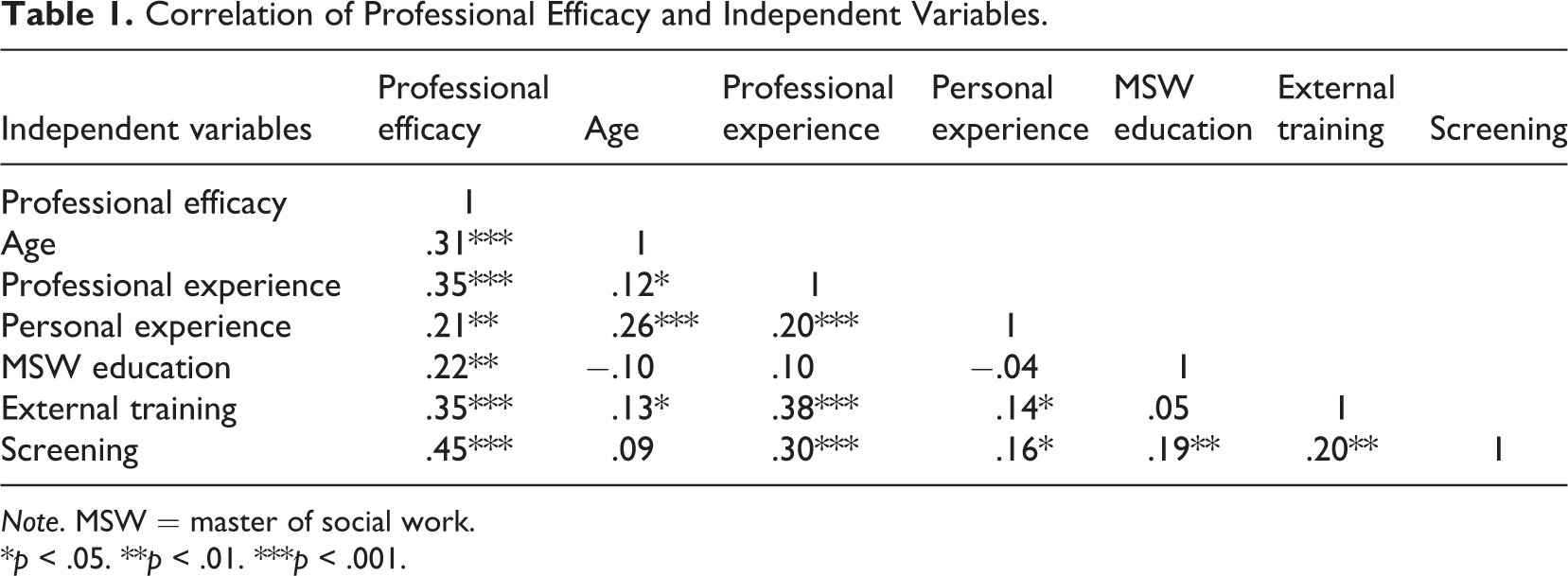
A correlation matrix (see Table 1) provides the correlational findings between professional efficacy and potential indicators (age, professional experience, personal experience, MSW education, and external training). All these variables were found to be significantly and positively correlated with professional efficacy and therefore were included in the regression analysis. That the correlation between professional efficacy and screening behavior was significant and positively correlated (.45, p < .001) indicates a relationship between the level of confidence in working with survivors and a propensity for screening for survivors.
Correlation of Professional Efficacy and Independent Variables.
Note. MSW = master of social work.
*p < .05. **p < .01. ***p < .001.
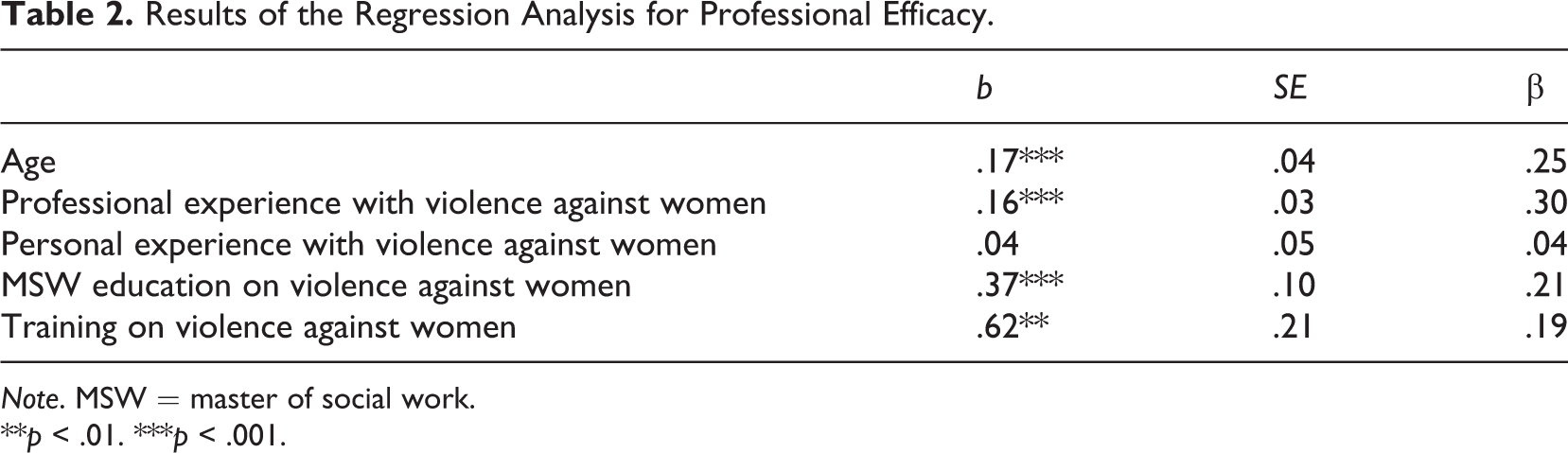
A regression analysis was run to determine whether the model of age, professional experience, personal experience, MSW education, and external training accounted for a significant amount of the variance in professional efficacy (see Table 2). The results of the regression analyses indicated that age, professional experience, MSW education, and training are all significant for professional efficacy. Professional experience had the greatest impact on professional efficacy. The adjusted R 2 was .31, indicating that the model accounts for 31% of the variance.
Results of the Regression Analysis for Professional Efficacy.
Note. MSW = master of social work.
**p < .01. ***p < .001.
Discussion
The purpose of the study was to understand if professional efficacy is related to screening behaviors and how age, MSW education, external training, and personal and professional experiences with violence affect the professional efficacy of social work students who may encounter survivors of domestic violence or sexual assault. To answer the first research question, the results indicated that, indeed, professional efficacy is positively related to screening behaviors. Students who have stronger professional efficacy will be more likely to screen for victimization with their clients. Such a relationship needs further study that reveals why this relationship exists and how professional efficacy affects and predicts screening behavior.
To answer the second research question, the results provide a preliminary understanding of how age, MSW education, external training, and professional experiences in violence against women and children affect professional efficacy. The greatest indicators of the students’ professional efficacy included exposure to the issue through education, training, or professional experiences. External training was a major indicator, which could be due to the fact that education received through workshops or extracurricular training might have been more specialized to the topic of violence against women. The measure of education in MSW course work asked about exposure in courses that were not specifically focused on violence against women. Further research could determine whether professional efficacy is improved by focused education, such as specialized courses, workshops, and training, or whether the incorporation of the topic of violence against women into other topics is adequate. It is also possible that external training had a major impact on professional efficacy because people who were inclined to pursue training on the topic outside their formal education were already involved in the field of violence against women or already had advanced knowledge or interest in the topic.
It is important to recognize that the education and training variables measure the cumulative effects of education and training, rather than the length of time in the MSW program; therefore, the results indicate that the more education and training a student has on violence against women, the stronger his or her professional efficacy will be in this area. Professional experience means experience working with survivors of domestic violence or sexual assault in a professional setting, such as a field placement or job experience where the students should be receiving guidance from a supervisor as they encounter survivors. The significance of education, outside training, and professional experience suggests that any or all these areas are potential avenues to train MSW students to work with survivors. It is not realistic to require that all MSW students work with survivors at some point in their field placements, nor is it possible to require them to pursue external training; however, programs could require that students receive education on the topic of violence against women at some point in their course work. This education could be provided by practice courses on how to work with survivors at the individual or group level or mandating inclusion of the topic in courses, such as Human Behavior in the Social Environment and Social Welfare Policy and Services. Social work degree programs could also go one step further by offering workshops or seminars on violence against women or creating specialized certificate programs that allow students to focus their studies and field placements on violence against women. MSW programs could also work on increasing the number of field placements related to violence against women, thereby giving more students the opportunity to pursue skills and knowledge in this area.
Although training, education, and experience were the variables with the most impact, age was also significant, albeit less so, perhaps because the student population and sample of respondents are skewed toward younger students. Care must be taken in discussing age as a factor because an older student may have had more time and opportunities to become educated, attend training, or have more professional experiences and therefore increase his or her professional efficacy. More research is needed in this area to determine the implications of age, how age affects an individual’s ability to work with survivors, and how best to address this issue in the MSW curriculum.
The findings indicated that personal experiences with violence were not significantly related to professional efficacy in working with survivors. The literature has contradictions about the importance of this factor (Cullinane et al., 1997; Danis, 2004). Indeed, these results mirror a similar study of social work graduates (Danis, 2004). Although personal experiences do not appear to affect confidence, a greater understanding of the impact of personal experiences on behavior toward survivors still needs further investigation to ensure that personal experience does not negatively affect the quality of interaction between the social worker and the survivor.
The adjusted R 2 was .31, indicating a moderate account for the variance in the model for predicting professional efficacy. This finding furthers the argument that education and training specific to the area of violence against women should be considered when preparing social work students to work with survivors because it is related to professional efficacy. Unfortunately, less than half the respondents had received some formal education in their MSW courses.
There are several limitations to keep in mind when considering the results of the study. First, the valid response rate of 27% may not indicate a sample generalizable to the wider MSW student population at this or any university, although it is a typical response rate for the recruitment and implementation methods that were used. The sample was relatively small and could be an indicator of self-selection that was due to the nature of the survey focusing on issues of violence. Second, the sample was overwhelmingly female, although this is also true of the MSW student body. While the study focused on the factors that influence professional efficacy, it did not explore how professional efficacy affects clients’ outcomes. The study also focused on domestic violence and sexual assault and did not examine students’ confidence in dealing with other areas of violence, such as child abuse, bullying, or community violence. In addition, the terms domestic violence and sexual assault do not specify the nature of the relationship between the victim and perpetrator and may have been interpreted by the students to include domestic violence and sexual assault by nonintimate partners.
Given these limitations, the results of this exploratory study provide a foundation on which to build future research. Indeed, given the likelihood that social workers in any practice arena may encounter survivors of domestic violence or sexual assault, it is important to know how best to prepare students in MSW programs as they embark on their professional careers. Such preparation should include content and course work on violence against women, including domestic violence and sexual assault. In addition, social work students should be exposed to external training and fieldwork with supervision that will connect their classroom education to practical experience. Such exposure, as indicated by the results in the study, will strengthen students’ professional efficacy in working with survivors. The inclusion of content on domestic violence and sexual assault is in accordance with the Council on Social Work Education’s (CSWE, 2008) Education Policy and Accreditation Standards (EPAS). Although CSWE no longer mandates specific content, incorporating these topics into a school’s curriculum would work within the standards. Under these standards, MSW programs should promote knowledge of how oppression, power, and privilege affect violence against women (Education Policy 2.1.4); educate students on promoting the rights of survivors of violence (Education Policy 2.1.5); ensure that students are aware of the current research and practices in the area of violence against women (Education Policy 2.1.6); and educate students on the impact of the social environment on victimization, perpetration, and outcomes for victims (Education Policy 2.1.7). Finally, MSW students should be taught how to engage, assess, intervene with, and evaluate clients who may be victims of violence (Education Policy 2.1.10). According to the National Association of Social Workers (NASW, 2008) Code of Ethics, it is a social worker’s duty to be competent in his or her work to protect clients from harm; to do so, all social workers need to have at least a baseline understanding of the dynamics of domestic violence and sexual assault to work effectively with survivors.
An important next step would be to develop the scale further to ensure accurate measurement of professional efficacy. More testing of the construct and the connection to behavior is necessary. The results of the study should be interpreted carefully, with the understanding that this was an exploratory study intended to further the construction of the term professional efficacy and what factors affect professional efficacy, so as to provide a foundation for understanding professional efficacy and its relationship to screening behaviors when working with survivors of abuse.
Finally, more research is needed to understand fully how social work students and professionals from other disciplines treat survivors and the implications for services for survivors. The findings of our study provide an understanding of what and how factors affect the professional efficacy of social work students and a basis for future research that seeks to complete the puzzle of how best to prepare MSW students to serve survivors of abuse.
Footnotes
Declaration of Conflicting Interests
The author(s) declared no potential conflicts of interest with respect to the research, authorship, and/or publication of this article.
Funding
The author(s) received no financial support for the research, authorship, and/or publication of this article.