




Abstract
This article reports on a study of the lived experiences of 10 women who participated in feminist activism within a grassroots feminist organization. The study analyzed the women’s narratives to determine how power shapes their subjective experiences in feminist activism. Their narratives were categorized into two broad themes: the intrapersonal locus of power and the relational locus of power. The themes refer to how women mediate power in practice and how their experiences with power are interconnected with relationships in the collective. The women in the study elaborated on the role of power in their own agency and in tensions, such as privilege and oppression.
Researchers have identified power as an inevitable presence in women’s experience of feminist activism (Healy, 1999; Horn, 2009; Reid, 2004). Cole (2008) referred to the need to examine the role of power and its immediacy in feminist social movements because of the diversity of perspectives and interests that are represented. Horn (2009, p. 152) wrote, “It is a sociological truism that power circulates everywhere. However, in our own progressive activist spaces we very often ignore the power relations that exist between each other.” The study presented here examined how women understand and mediate power between and within the individual and collective realms of women’s social movements, situating individual women’s experiences as a central starting point.
Women who participate in feminist activism determine their own truths about how they experience and understand power and how these truths circulate beneath the surface of their social activism. Experiences of power in social activism have been analyzed in the literature according to the themes of empowerment, intersectionality, identity and difference, and positionality or one’s subjective perception of their social location (Hanvinsky et al., 2010; Rowe, 2009; Williams, 1994). Women who participate in feminist social movements are in the best position to validate, refute, or elaborate on these themes by describing, in their own terms, how they experience power in the context of their lived experiences.
Literature Review
Situating Power Within Women’s Activism
In responding to the question, why study power? Foucault (1982) argued that the subjective is central to interpreting the influence of power and that subjective interpretation is embedded in social and historical contexts and networks of social relationships. Deveaux (1994) speculated on the role of power in feminism and highlighted the need to account adequately for the role of women’s agency in defining and negotiating power. She advocated for research that explicates women’s processes of empowerment and attended to women’s direct experiences with power, commenting:
Feminist critiques on how power shapes women’s experiences have suggested the need to place the subject’s interpretation and mediation of her experiences with power at the centre of inquiries into the how and why of power. Such an analysis might ask, “what do relationships of power feel like from the inside, what are the possibilities for resistance, and what individual and collective processes will take us there?” (p. 244)
Deveaux’s definition gives hegemony to the subjective, intrinsic, and less visible aspects of experiencing power and, in so doing, implies the role of consciousness and the agency of the individual woman. Individual women, Deveaux suggested, are in a position to reflect on their own experiences and attend to the influence and complexities of power. Women who participate in activism have a proximity to power and the agency to interpret, mediate, and direct it actively. Their consciousness of power places women in control of their own empowerment.
Women’s Empowerment
Empowerment has been a central and contested concept in antioppressive and antiracist feminist work since the late 1960s (Yuval-Davis, 1994). Ample discussion in the social work and feminist literatures has defined empowerment and its parameters.
In feminist discourse, a common theme is how empowerment can be a catalyst for transformation and change. Rowe (2009) contrasted the transformative potential of individual women’s consciousness of power with domination, an oppressive tradition of power that is imposed on women and associated with victimization and marginalization. She asserted that situating power in the individual allows women to engage their individual and collective power toward social change. Green (2008) cautioned that in feminist discourse, dominant ideologies regarding resistance to patriarchalism are central to feminist definitions of empowerment. Dominant themes in feminist discourse contribute to a prescribed feminist agenda on women’s individual and collective empowerment. In this discourse, gender equality and resisting patriarchal power structures are noted as individual women’s priority concerns related to power and empowerment.
The predominance of empowerment in the literature attunes women to the influence of power on individual and collective experiences of feminist activism. However, empowerment has been discussed primarily in terms of desired outcomes with less consideration of how empowerment is negotiated by individual women. Although feminist theorists have explored the finer points of theoretical definitions of empowerment and discussed how these subtleties translate into women’s experiences of power, they have done less work to bring women’s reflections on their own experiences with power to the surface and to identify women’s specific concerns and interests.
Pease (2002) advocated for a critical analysis of how empowerment is defined, cautioning that it cannot be assumed that empowerment practice or intentions to empower will lead to emancipation. Other feminist researchers have challenged prevalent assumptions that empowerment is necessarily an externally imposed force (Bay-Cheng, Lewis, Malley, & Stewart, 2006; Carillo, 2007; Nelson, Shanahan, & Olivetti, 1997; Pearlmutter, 2002). They have critically analyzed the role of power in activism in terms of empowerment and challenged prevalent assumptions of empowerment and power as a commodity that can be shared, transferred, or imposed. Some have also elaborated on how empowerment can be construed and how externally imposed power can inadvertently perpetuate oppression. Bay-Cheng, Lewis, Malley, and Stewart (2006), for example, argued that making assumptions about what is empowering can potentially undermine women’s ownership of power in social movements. Researchers who have focused on how individual women in the collective experience empowerment have raised awareness of how women’s agency can mediate prescriptive forces of empowerment. The self-efficacy and internal locus of control of individual women challenge the “power over” theme of power that is dominant in the mainstream discourse on power in positivist paradigms (Nelson et al., 1997). Similarly, second-wave feminist authors were instrumental in placing the locus of control of power in the individual. For example, Hill Collins (2000) conceptualized empowerment as an emerging self-awareness in which women recognize and understand the presence and dynamics of power and oppression in their circumstances and daily lives.
Although examining how individual women negotiate power has underscored the agency of individual women, more holistic considerations of women’s experiences with feminist activism account for the reciprocal relationship between the individual and the collective. Yuval-Davis (1994) emphasized the vital connection between the individual and the collective. Empowerment, she suggested, becomes possible when the boundaries between the individual and the collective are transcended and when positions related to difference in the collective are recognized and addressed. McPhee, Marcus, Caragata, and Hutchinson (2002) envisioned collective empowerment whereby individuals contribute to consciousness-raising processes. This dynamic, interpersonal process of “conscientization,” which was originally described by Friere (1970), is achieved through dialogic processes and promotes consciousness and shared understandings of power and oppression that emerge as collective knowledge. Popular education has thus contributed to the conversation about power in the feminist literature, suggesting that empowerment that arises from the collective can propel action toward social change.
Understanding Power According to Identity
Intersectionality, originally defined by Crenshaw (1991) as intersecting identities of gender and race that shaped the experiences and oppression of black women, has since been discussed more broadly by acknowledging additional identity categories that intersect with race and gender. According to Hanvinsky et al. (2010, p. 1), intersectionality “places an explicit focus on differences among groups and seeks to illuminate various interacting social factors that affect human lives, including social locations, health status, and quality of life.” The proponents of intersectionality theory promote its value as an interpretive tool, as an analytic method that is conducive to understanding power relations in social movements (Cole, 2008; Egeland & Gressgard, 2007; Hanvinsky et al., 2010; Jaramillo, 2010; Samuels & Ross-Sheriff, 2008; Yuval-Davis, 2006). The value of using intersectionality to analyze women’s experiences with power is that it not only draws attention to difference but invites individual interpretations of those differences. Williams (1994) commented on how difference and power are inextricably linked in the context of women’s participation in social movements. She alluded to how diverse perspectives and experiences of difference can emerge as a source of tension: “the struggle over which differences matter and which do not is neither an abstract nor an insignificant debate among women. Indeed, these conflicts are about more than differences as such, they raise critical issues of power” (p. 110).
Intersectionality asserts that women’s subjective experience represents a complex network of intersecting identities. It focuses on the complexity and depth of women’s experience of power and underscores the heterogeneity represented in women’s social movements within and across identity categories, such as gender, race, color, social class, sexual orientation, ethnicity, and health. For example, scholars who have written about black women’s feminism have been more overt in addressing issues that are related to power and in illustrating how women have openly dealt with issues of power in social movements. hooks (2000), for example, argued that confronting racial differences was essential to addressing other categories of difference in the second-wave feminist movement. Her analysis of power within the broader context of North American 20th-century feminist movements and in the evolution of black women’s feminism highlighted examples of women sharing perspectives and experiences and actively bringing issues of privilege into the open so that power could be collectively negotiated.
The literature provides ample theoretical discussion of intersectionality as a heuristic tool, yet scant research has indicated how women experience and understand power, struggle over difference in actual activist practice, or engage in analyses of intersectionality to understand their experiences with activism and power relations within collective contexts. Other feminist scholars have addressed the difficulty of applying a complex, theoretical concept, such as intersectionality to actual practice. Davis (2008) commented that the ambiguity and open-endedness of intersectionality as a methodology make the approach complementary to reflexivity in the activist practice of individual women and conducive to their interpretation of difference and identity.
Privilege and Oppression
Feminist scholars have identified interrelated subthemes of power that influence how women negotiate and reconcile difference. Privilege and oppression have been inextricably related to power in feminist social movements. In reflecting on black women’s historical and contemporary struggles against oppression in North America, Hill Collins (2000) emphasized how women have constructed a collective awareness of difference and how individual and collective consciousness have fueled a resistance to oppression and forged solidarity across differences. Similarly, hooks (2002) conceptualized privilege as an issue of awareness that exists whether it is recognized or not. Privilege, she suggested, can be deconstructed according to race, suggesting that it is incumbent on the individual to recognize and understand the implications of privilege. Gillespie, Ashbaugh, and DeFiore (2002) critiqued the notion of white privilege as it relates to the experience of power in women’s activism:
Race shapes our lives as white women in ways that continue to be imperceptible to us. Even women involved in anti-racist work often consider their work an act of compassion for the “other” rather than an issue integral to their own lives. (p. 241)
In addition, they addressed the resistance to and emotional reactions that are associated with recognizing privilege by referring to the experiences of postsecondary students who were exposed to “white privilege pedagogy.” In their study, recognizing privilege had a destabilizing effect on the students, who reported anxiety, defensiveness, guilt, and shame in recognizing that they participate in a societal system that perpetuates racial privilege. Feminist scholars have explored how power as it circulates in women’s social movements can be understood according to such terms as privilege and oppression (Cole & Luna, 2010; Hill Collins, 2000; hooks, 2002; Mehta & Gopalakrishnan, 2007).
Reflexivity: Accessing Women’s Experiences and Understandings
Reflexivity is essentially concerned with power and its implications, putting one’s own experience and position in perspective, and balancing it with the perspective of others in the collective (Reid, 2004). Dean (2007) promoted reflexivity as a means of alleviating “othering,” the possible separation of self from the social issue of interest and those who are affected by the issue of interest. Although it endorses critical self-reflection, reflexivity has been criticized for its potential for self-centeredness and an inward focus that threatens to distance individuals from the collective and from the experiences and perspectives of others (Gilbert & Sliep, 2006; Kobayashi, 2003). Despite the acknowledgment of its limitations, reflexivity is promoted as a window into women’s subjective, and otherwise inaccessible, experiences and perspectives.
Listening to Women’s Voices
It is crucial to consider voice and its implications for individual experiences of power in social movements. Individual women can most accurately convey the specific realities and nuances of their experiences (Dugan & Reger, 2006; Krumer-Nevo, 2009). The collective voice of the movement as a whole can conceal the heterogeneity of experience and the individual voices within; in addition, the unequal distribution of power within movements suppresses some voices and privileges others (Dugan & Reger, 2006; Grahame, 1998). Voice goes beyond merely having the opportunity to express oneself; it demands full citizenship and visibility in social movements, which translates into active participation in decision making and opportunities to contribute recommendations and solutions (Dugan & Reger, 2006; Grahame, 1998).
A substantial body of literature has stated that power is a significant concern in contemporary feminist activist movements, given its implications for achieving inclusion and equality. Feminist scholars have engaged theoretical concepts, such as reflexivity, voice, and intersectionality, to analyze women’s experiences of power. Considerably less attention, however, has been paid to women who have the opportunity to personalize theoretical constructs according to their own lived experience or to explain how they translate theoretical concepts into negotiating and understanding power in their activist practice. Excluding women’s descriptions of their experiences with activism or speaking on their behalf has fractured the connection between theoretical frameworks and lived experience.
Method
Approach
The study was a secondary analysis of a qualitative investigation of women’s experiences in social activism. The objective of the original study was to identify what mattered to women in activism and to explore individual subjective definitions of social activism. All the women in the study identified themes that were related to power as being significant to their experiences in activism. The study presented here engaged intersectionality as a theoretical framework for interpreting women’s experiences of power. The primary objective was to uncover women’s implicit experiences with power and to determine how power shapes women’s experience in feminist activism.
Procedure
Following ethics approval by the Conjoint Faculties Research Ethics Board, University of Calgary, participants were recruited from a local women’s feminist, grassroots activist organization. The organization provides a variety of opportunities for women to participate in social activism and volunteer initiatives. It was chosen for its explicit commitment to feminism and inclusive feminist activism.
The written invitation to participate was open to any woman who participated in the organization as a volunteer, board member, or committee member. The organization has 400 active volunteers who participate in various capacities in the organization. Ten women responded to the invitation and provided written informed consent. The lead author conducted individual face-to-face interviews, lasting approximately 1–1.5 hr at a convenient time and location for each participant. The interviews were conducted with a field guide, consisting of 12 open-ended questions that allowed the women to describe their experiences with collective social activism. The women were not asked directly about the role of power or any other feminist centered themes. The following six questions led the women to reflect on power in their activism:
How would you describe your experience of activism in the group?
What have you learned by participating in social action?
What are your reasons for joining other people to work together on social action?
How do you express your own voice or perspective in a group situation?
What supports, tensions, or other forces have you experienced in groups?
What benefits or obstacles have you experienced in the course of group social action or during your activism journey?
The interviews were audiotaped and transcribed verbatim.
Data Analysis
ATLAS.ti was used to manage the data from the interviews. The analysis used the constant comparative approach to grounded theory analysis outlined by Strauss and Corbin (1990). Initially, the data were analyzed line by line, and distinct units of meaning were assigned conceptual labels. Emergent concepts were then grouped into categories. From open coding, the analysis proceeded to axial coding; categories were grouped together, and categories and links among concepts were established. The analysis continued with selective coding until an overarching theme that encompassed all other categories was identified. A further analysis examined connections between the categories and the overarching theme. Categories were interrelated and analyzed according to how they described or explained the central theme.
Themes from the women’s narratives were evaluated according to how they validated and elaborated on themes that were identified in the literature. The responses were coded according to themes that described how women sourced or understood their participation in feminist activism.
Six of the 10 participants were Caucasian; the remaining identified themselves as Aboriginal, West Indian, or Asian. The data were grouped into two interrelated, major categories that are embedded in women’s interpersonal relationships within the collective: intrapersonal and relational locus of power. These themes situate the experience of power in women’s lived experiences, reinforce the centrality of the individual in mediating power in feminist activism, and illustrate how women direct their own processes of cultivating power.
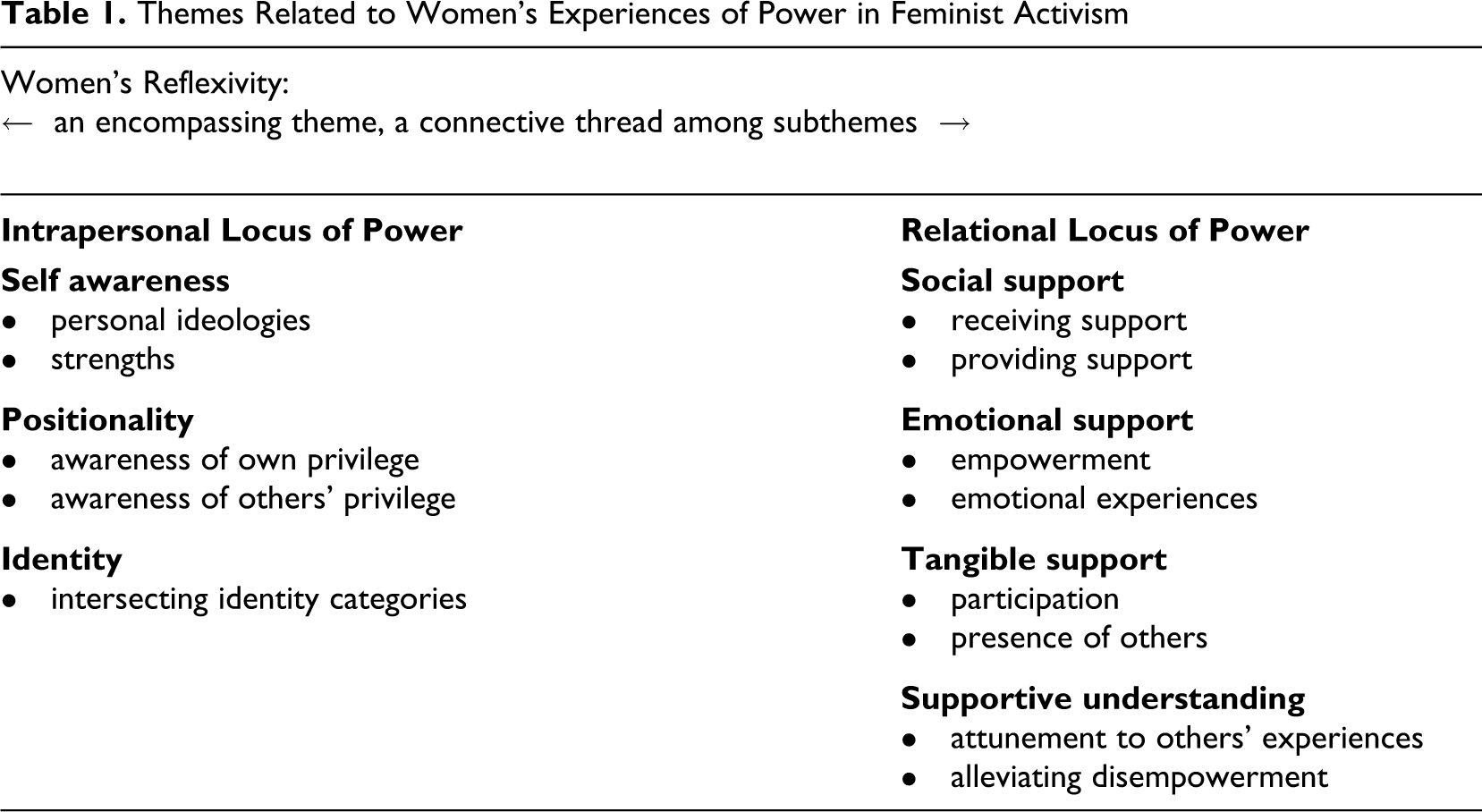
Reflexivity was an underlying theme, which served as a connective thread among the women’s identified subthemes of power. Via reflexivity, the women advanced their own understanding of power and channeled power simultaneously inward and outward to sustain the agency of self and others. The women’s accounts represent their commitment to reflexivity and demonstrate how essential it is to the women’s experiences of power in feminist activism. Table 1 presents a summary of the themes and subthemes related to women’s experiences of power in feminist activism. The sections that follow describe themes and subthemes with illustrative quotes.
Themes Related to Women’s Experiences of Power in Feminist Activism
Results
Intrapersonal Locus of Power
Each participant’s narrative revealed how the participant was deliberately compelled to mediate power, how she cultivated her own empowerment, and how she strived to achieve a depth of understanding by analyzing and reflecting on power according to her own experiences. The women’s accounts within this theme represent the women’s own consciousness of power; the participants demonstrated how power at the individual level is understood via introspective reflection.
Self-awareness
An experienced activist reflected on the core of her personal power, her awareness of where her personal power originates, and what sustains her participation in feminist activism.
I set a very high standard for myself. But I am a pretty tenacious personality, so I have to admit that. But um, I think there’s something deeper that drives people like myself. That is a real sense of obligation, a real sense of responsibility to your fellow man and woman. We’re fortunate to live in such a wonderful country. We have so many things going for us.
Positionality
Six of the 10 women explicitly mentioned privilege. They acknowledged their own privilege, the personal power that their privilege affords them, and its relationship to power.
I was in a group of women who were all in poverty. I didn’t realize it at the time how dramatically they were affected by their experience of poverty. But we were sharing, and I thought, I was a poor student like everybody else, but ever since then, I’ve been able to pay my debts and I’m really quite fortunate. It wasn’t that I wasn’t welcome there, but I did feel the odd person out because of my privilege.
Another participant referred to how reflecting on power and her own position of power became an integral practice that was woven into her participation in activism.
You’re dealing lots of times with racism. There I am, and I’m representing a middle-class white Canadian-born person with a Canadian accent. So I think there’s tons of power privilege in that. I’m always looking at the filter of power and privilege in my relationships. I think it starts with us. Because it’s one thing to recognize the marginalization of people, but it’s harder to recognize our own privilege, right?
Identity
The women explained that their experiences with power could be traced to aspects of identity and difference. Seven of the 10 women reflected on how race and class influenced their experience of power. One participant described how reflecting on difference became a catalyst to awareness, understanding, and connection to the collective.
It’s about looking at the world and knowing I’m not the only person that lives on this planet. My experience as a white woman is probably similar to any other middle class white woman. It’s not the experience of somebody who has a disability or somebody who is not heterosexual or someone who is an immigrant. I don’t know how you walk blindly through life not noticing that the other people are different. You can get the power struggle, and I’ve certainly experienced that where people that I thought I was an advocate for them, I thought I was their ally. They didn’t see me that way. They saw me as a white woman.
Another participant explained how she dealt with the complexity of difference:
You need an integrated analysis of any of the “isms.” You can’t look at feminism without looking at class and racism. You can’t look at class without looking at gender. So, it is about an integrated anti-oppression analysis. So, no matter where you are working, you can’t be ignoring these other issues. Activism has to include an analysis of why we are in the situation we are in.
Relational locus of power
This category represents how the women mediated the circulation of power in activism and describes how their own experience of power was connected to the experience of power within the collective. The women described the reciprocal nature of relationships in the collective, explaining how they channeled power from the collective and, conversely, how they contributed power to the collective.
Social support
The women drew from their perceived strength of the collective to cultivate personal power. All 10 described how social support bolstered their own personal power. One participant, who described gradually gaining power from her evolving learning in an inclusive activist community, eventually cultivated her own power to participate more fully and extend her understanding to action.
So I just took everything in and just was learning and learning until I got to the point that I felt that I could participate in making things happen. So I felt safe, I felt welcome, I felt comfortable. I didn’t feel different; I just felt accepted. It was a safe place for me to learn and grow and figure things out, and being able to transform, to change my views without feeling judged as I asked questions, . . . being able to question and not feel stupid. It was a great environment.
Similarly, all 10 women consciously endeavored to contribute to the experience of others in regard to power. One woman described the reciprocal nature of support as she participated in collective feminist activism. “I can have a really crappy day at work and go there and talk about some really horrible, horrible stuff, but feel safe and feel heard and supported and be able to give that support back.”
Emotional support
Another woman reflected on the empowering effect of one of her own experiences with activism. She gained power from her experience by both giving and receiving emotional support.
It was extremely empowering for me to be there. We went to the site where the women had been killed, and we cried and were there in solidarity, and we took back the campus. It was quite, . . . it’s quite emotional actually even today. So I think for me that was a part where that collective being together, that support and solidarity, helped me to overcome my individual fears. It also let me know that I could make a difference.
Tangible support
Another woman discussed how a trend toward more transient, ad hoc activism focused attention on tangible demonstrations of support from their activist colleagues:
When we had a long-term standing coalition, a lot of time and energy were spent on processes and negotiation between members. Whereas now, people might agree on a petition, and we’ll all sign it. Then we’ll be gone again, and we might have a totally different group of allies for the next issue.
The same participant described how sharing power translated into supporting one another’s actions and initiatives.
I think the support is just being with a group of activists. I think it’s much more empowering to act, even if it sometimes feels like you’re bumping your head a lot, than it is not to act and feel disempowered. I think the activism community in Calgary is quite supportive of each other, and it’s because, as I said, it’s relatively small and people get to know each other. People do extend or even over extend, I think, in order to support each other. Something might come up, and it might not be your biggest burning issue, but the person that’s putting it forward supported your big burning issue so you go out to support hers.
Supportive understanding
Just as the women were compelled to cultivate an understanding of their own experiences with power in their experiences of activism, they were also inclined to understand other women’s experiences with power. It was pivotal for one participant to realize the limitations of her own inferences about other women’s experiences and to recognize that, somehow, issues and experiences of power needed to be addressed collectively and in greater depth. This participant expressed her concern about how best to share power in a respectful understanding manner:
There is power that is identified and power that isn’t. I find it is a big challenge. There are some women who are really troubled. It’s not just that they are in a bad economic situation. Poverty is interfering with their ability to interact with the world. For those of us that don’t experience that, how do we understand it, how do we support it, how do we make space for those women and find time to listen? It is uncomfortable for those of us with privilege to address privilege. You are more and more conscious of it when you work with women in the shelters. You have to look at what it means to be an ally [for those with privilege]. So what does that mean?
Discussion
Hill Collins (2000) reinforced the centrality of the individual woman in feminist activism and referred to women’s self-awareness as the authentic locus of their own empowerment. The ways in which the participants described ownership for understanding and reconciling power are reminiscent of Hill Collins’s characterization of empowerment. These women confirmed that they were oriented toward and adept at cultivating consciousness and personal understandings of power, drawing from their own experiences and emerging self-awareness. This investigation depicted how women advance their subjective understandings of how power circulates in activism and how subjective understanding becomes the basis for locating their own position in the collective and for deriving personally relevant themes that are related to power from their own experiences. For the women in the study, reflexivity advanced their self-awareness. Their evolving self-awareness became a framework for interpreting their experiences, for understanding how power circulates and is a catalyst for taking ownership of power. It was clear that the women purposefully mediated their own experiences with power on their own terms, according to factors that were relevant to their reality. The women’s narratives described how they integrated personally meaningful sources of power and engaged their understanding to further their own agency in activism. The women engaged power to facilitate their own transformation and the transformation of others as they participated in feminist activism.
As intersectionality methodology has suggested, women interpret their experiences in the collective according to intersecting aspects of difference. For example, considering and analyzing difference influenced the women’s awareness and reconciliation of privilege. The women in the study were more inclined to recognize and discuss the implications of personal privilege on their experiences of power than they were to reflect on personal experiences of disempowerment. For the women who said that privilege was a significant factor in their experience, recognizing their own privilege was an impetus for taking action to alleviate power differentials in tangible ways, such as making space for other women to tell their stories or express their opinions, even at the expense of sharing their own. Evidently, the women’s awareness of their own privilege created a dissonance that clashed noticeably with their values of equality and inclusion. Although the women readily acknowledged their privilege, they were less clear on how to negotiate the complexity of issues of power and oppression actively and explicitly in the collective or how to engage in a dialogue in response to tensions around power, privilege, and difference.
Although individual women enact their own resistance, transforming power in social movements requires women to venture beyond their own locus of power to engage in a collective struggle to deconstruct existing oppressive power structures. Grahame (1998) advocated making the complex network of interpersonal dynamics and differences explicit and stated the need for a focus of discussion in movements to address issues of power, inclusion, and visibility for women of color who experience oppression in mainstream feminist movements that are dominated by predominantly white middle-class women. Following a critical analysis of the role of power in African feminist movements, Batliwala (2009) posed the following challenge to women who participate in contemporary feminist movements:
We are going to grapple with our own deep structures of power, and struggle to create better rules of engagement that enable us to treat each other well, and harness our diverse strengths and experiences without the kinds of hierarchy and dominance and exclusion and aggression that has damaged us individually and organizationally in the past. (p. 143)
Gillespie et al. (2002) advocated engaging in a reflective dialogue as a way for individuals to come to terms with their privilege and to understand the complexity of the experience of race and privilege in the context of their own and others’ lived experiences. Such a dialogue would require women to extend their own reflexivity to the collective.
This investigation illuminated the highly subjective nature of women’s experiences with power in activism by presenting women’s reflections on their experiences of activism in a single grassroots community feminist activism organization. The small sample limited the generalizability of the findings to the experiences of a larger population of women who participate in feminist activism.
The organization to which the participants belonged professes an explicit, nonhierarchical shared power structure and aims to provide women with experiential opportunities to construct their own understanding of feminist issues. Women who participate in the organization are encouraged to shape their own ideologies related to power and other aspects of feminist praxis. Since women’s reflections on activism arise from and are embedded in a specific context, the findings of this study may not generalize to women’s participation in other forms of activism or contexts.
A further limitation of the study is that only race and class aspects of difference arose in the women’s commentaries. Future research involving more focused questions regarding difference and identity would encourage women to elaborate on how race and class intersect with other aspects of identity, such as age, ability, and sexual orientation. A more representative examination of the role of difference in feminist activism would necessarily include the perspectives of women who experience disempowerment and marginalization. As Fredericks (2010) noted, women who have histories that are marked by marginalization and disempowerment envision and experience power from a unique perspective.
Although the women in the study conveyed their dedication to understanding the role that power plays in their activism and their commitment to devising alternatives to oppression and domination, further research could identify women’s strategies for addressing power at the collective level and negotiating resistance or tensions that undermine the collective exploration of power. Feminist authors and the women in the study have illustrated how confronting power and deconstructing one’s privilege can create tension, resistance, and ambiguity in terms of what direction to take to reconcile the negative implications of identity and difference. Further consultation with women to determine how the negotiation of power could be transformational and conducive to achieving social justice objectives is necessary. Fixmer and Wood (2005) envisioned a tradition of feminist activism that incorporates dialogue and coalition building as a means of deconstructing and transforming power and promoting meaningful inclusion.
Prominent feminist theorists, such as Hill Collins (2000) and hooks (2000), cited women’s historical struggles to understand and negotiate power, acknowledging how the collective negotiation of power has been conducive to a transformative understanding of how identity and difference shape women’s experiences of power. Their analytical commentaries on consciousness-raising in second-wave feminist activism depicted how women were the vital force that eventually brought about collective consciousness. These feminist theorists elaborated on how power was brought into the open, how tensions were addressed, how perspectives were shared, how differences were discussed, and how assumptions were challenged. In contrast, the way in which the participants described their experience of power suggests that their struggles related to power and privilege transpire in the intrapersonal realm beneath the surface of their participation in feminist activism. Although these women were inclined to pursue deeper levels of understanding and critical analysis as an integral component of their participation in feminist activism, advancing their understanding of power was largely an isolated endeavor. They shared the revelation that mediating power is a solitary, reflexive endeavor and revealed that opportunities to negotiate and understand power openly within the collective are scarce. The women offered limited and cursory explanations of why issues related to power are not readily discussed. As one woman explained, the way in which contemporary feminist activism is organized in light of practical considerations is simply not conducive to finding time or space for dialogue. It is apparent from the women’s narratives that deliberately addressing power relations is a subjective ancillary process that has been relegated to the intrapersonal shadows of feminist activism and depends on the will of individuals. In the mid of transient, dynamic, action focused, and often ad hoc activism, some of the women accepted that cultivating a consciousness and integrated understanding of power and its role in feminist activism will start, but does not inevitably have to end, with them.
Blumer, Green, Compton, and Barrera (2010) conceived of empowerment as an ideal, an outcome of power being addressed openly within the interpersonal realm of collective feminist activism. hooks (2000) urged contemporary feminist activists to continue to cultivate a collective understanding of power despite the struggle it entails and argued that that there is still much work to be done in this regard. To achieve collective transformation, women will have to devise multiple ways to channel their self-determined power, reflexivity, and understanding toward engagement at the collective level. The lived experiences of the women in the study could inform recommendations on how women who create activist spaces can support one another in constructing individual and collective understandings of power.
Footnotes
Declaration of Conflicting Interests
The author(s) declared no potential conflicts of interest with respect to the research, authorship, and/or publication of this article.
Funding
The author(s) received no financial support for the research, authorship, and/or publication of this article.