




Abstract
The responses of 632 Michigan residents to a public opinion survey showed that the respondents thought that children’s exposure to intimate partner violence (IPV) is damaging to children but that mothers who seek outside help should not lose custody of their children. Two thirds believed that mothers who are victimized by IPV more than once and do not immediately find a way to stop the violence are neglectful. The findings suggest the need for education about ways to support children without holding mothers to unreasonable expectations.
National surveys have found that 22% of women experience intimate partner violence (IPV) at some time in their lives (Thoennes & Tjaden, 2000) and that an estimated 15.5 million children are exposed to such violence each year (McDonald, Jouriles, Ramisetty-Mikler, Caetano, & Green, 2006). It has been well established in the literature that children who are exposed to violence in their homes are at risk of a host of problematic outcomes (Bedi & Goddard, 2007; Kitzmann, Gaylord, Holt, & Kenny, 2003). In response to the mounting concern that children are negatively affected by exposure to domestic violence, significant changes have been made to child protection policies and criminal laws in several states (Edleson, 2001). These changes have sometimes resulted in policies that mandate that mothers be investigated and possibly lose custody of their children for “failing to protect them” from exposure to domestic violence.
Little research has been conducted on how the public views mothers’ responsibility for their children’s exposure to IPV. Public opinion should be explored, since it can have an impact on public policy (Burstein, 2003), and improvements in intervention and prevention programs should be based on sound knowledge about people’s attitudes and assumptions (Worden & Carlson, 2005). Survivors themselves, as well as those who may be able to offer them social support or formal help, may have attitudes that either facilitate mothers’ empowerment or blame mothers for harm to their children because of exposure to IPV. Victim-blaming attitudes can cause victims to avoid seeking help or to turn away from help after they receive a judgmental response. In addition, perpetrators of IPV may use mother-blaming norms to support their denial of the effects of their violent behavior on their children. Social workers and child protective workers whose views are consistent with mother-blaming public opinion may be harsher toward women they believe have not done enough to protect their children, which could lead to an increase in the number of children who enter the foster care system (Dosanjh, Lewis, Mathews, & Bhandari, 2008). Furthermore, women who choose to remain with their abusive partners may be viewed as making a poor choice, inadvertently reaffirming the belief that the women do so at the expense of their children’s safety (Bancroft, 2002).
The Literature
It has been estimated that more than half the victims of IPV in the United States will have some form of contact with child protection services prior to the end of their violent relationships, partly as a result of the policy changes that attempt to protect children from exposure to IPV (Dosanjh et al., 2008). The policy changes have been controversial, with proponents and opponents debating the merits of the new policies (Edleson, 2004; Magen, 1999; Nixon, Tutty, Weaver-Dunlop, & Walsh, 2007). Because these arguments have been ably summarized by others (Edleson, 2004; Magen, 1999; Nixon et al., 2007), we limit our discussion of that debate. Advocates who work on behalf of abused women have contended that victims of IPV cannot and should not be held responsible for their partners’ behavior (Magen, 1999) and that women of color and those with fewer economic resources who face IPV may be disproportionately involved with child protective services (Dosanjh et al., 2008). If they fear losing custody of their children after the violence becomes known to formal helpers or the criminal justice system, abused women are less likely to seek much-needed help for IPV (DeVoe & Smith, 2003). However, it is important to have policies and intervention programs that recognize that children are also victims of IPV and should be protected from the well-documented harm resulting from exposure to IPV (Lewis-O’Connor, Sharps, Humphreys, Gary, & Campbell, 2006; Rossman, Rea, Graham-Bermann, & Butterfield, 2004).
Public Opinion Studies
We did not find any articles that reported on public opinion about how to respond to children’s exposure to IPV. However, Bensley et al. (2004) investigated the level of public consensus on which types of behaviors constitute child maltreatment. They found that 93.6% of the respondents thought that “letting a child watch one parent physically hurting the other” was abusive or neglectful; this response ranked 15th in the level of consensus. By comparison, having a parent who abused drugs or alcohol ranked 23rd in the level of consensus. In one of the few recent public opinion studies about IPV, Worden and Carlson (2005) reported on a random sample of 1,200 people from six communities in New York State who were surveyed by telephone in 2000. They found that in open-ended questions, people rarely mentioned women’s behavior as a cause of IPV. In a subsample of 600 people who were asked questions about common myths and beliefs, less than half (45.9%) thought that IPV “is caused by the way women treat men,” but 63.1% believed that “most women could find a way to get out of an abusive relationship if they really wanted to” (p. 1227). Taylor and Sorenson (2005) conducted a public opinion survey using a sample of people residing in the community and exposing them to vignettes about IPV. They found that the respondents rarely held victims responsible for causing IPV but often held victims solely (31%) or jointly (52%) responsible for finding a solution to end the IPV. If the vignette stated that the incident was not the first incident of IPV, expectations that the victim should find a solution increased.
Holding Women Responsible for Children’s Exposure to IPV
As in many states, Michigan’s legislation related to criminal child maltreatment was amended in 2008 so that a victim of IPV may now be charged with criminal neglect if the person’s “omission causes serious physical harm or serious mental harm to a child” (Child Protection Law Public Act 577, 2009, para 3a). This amended law suggests that parents who “fail to protect” their children from exposure to violence in the home may be held criminally liable.
According to Risley-Curtiss and Heffernan (2003), practice with this population is supported by gender-biased laws that reinforce the assumption that mothers are primarily responsible for the safety and welfare of their children. As a corollary of this belief in mothers’ responsibility, Landsman and Hartley (2007) found that child welfare workers held women more responsible for the maltreatment of their children when IPV was present—even when the batterers were responsible for maltreating the children. However, if the female caregiver attempted to end the relationship with the batterer or had told the batter to leave, then child welfare workers held her less responsible for the maltreatment of her child. This work supports Risley-Curtiss and Heffernan’s (2003) conclusion that women are held largely responsible for the safety of their children. In Douglas and Walsh’s (2010) study, Australian community social workers who support mothers who are dealing with both IPV and child protection matters reported that their primary concern was that child protection workers often hold nonviolent mothers responsible for ending the violence. The participants in that study suggested that the lack of education regarding the dynamics of IPV has negative consequences for both mothers and children, which has led to the removal of the children from the home in a number of situations.
Postmus and Merritt (2010) found that younger and less experienced child protection workers were more likely to remove children from families who are experiencing IPV. Given that many child protection agencies experience high rates of staff turnover, specialized training is critical to help these workers understand the etiology of IPV (Postmus & Merritt, 2010). This finding is similar to the findings of Johnson and Sullivan (2008), who reported that the female victims of IPV often felt misunderstood, unsupported, and blamed by child protection workers for the violence. Without sufficient education and training in the dynamics of IPV, workers may rely on their personal beliefs about this issue.
It is consistent with the traditions of child protective services to focus on mothers’ obligation to protect children from harm (Beeman, Hagemeister, & Edleson, 1999). Traditionally, most social service agencies have tended to work primarily with mothers (Radford & Hester, 2001). However, as Magen (1999) noted, unlike its response to IPV, the legal system does not initiate proceedings against parents who fail to protect their children from violence in the community, even though exposure to such violence is known to be harmful.
Radford and Hester (2001) reported that social workers sometimes encourage women to reconcile with their batterers “for the sake of the children” and sometimes encourage the women to “protect their children by leaving their partners” (p. 137). These approaches minimize the role of the primary abuser and do not allay women’s fears that they will lose their children if they disclose IPV to formal helpers, such as the police or social workers. Magen (1999) stated that a woman may appear passive to outsiders when, in reality, she may have made multiple attempts to end the abuse. Protective service workers and others may believe that women should seek formal help from professionals or the police and overlook the informal help they may be getting from family members and friends (Radford & Hester, 2001).
People often assume that a woman should leave an abusive partner so that her children are less at risk of harm but actually the risk may be even higher (Bancroft & Silverman, 2004). When a couple is still living together, the mother may be better able to protect the children from abuse than she could when a violent man has unsupervised visitation (Kopels & Sheridan, 2002).
Several researchers (Davies, Lyon, & Monti-Catania, 1998; Kopels & Sheridan, 2002; Moe, 2009; Zink, Elder, & Jacobson, 2003) have documented the centrality of concerns about children in abused women’s decision making. They have pointed out that most mothers seriously take their children into account in their complex decision making about whether to stay with their abusive partners.
The Study
Research Questions
Our research and clinical experiences showed us that some child protection workers, judges, and court-appointed advocates seem to blame mothers when children are exposed to IPV. In addition, domestic violence workers in Michigan were sometimes concerned that battered women could be revictimized and lose their children if they were blamed for their “failure to protect” (Findlater & Kelly, 1999). Therefore, we wanted to know whether these blaming attitudes are rooted in public opinion. Does the public blame abused women for children’s exposure to IPV and expect them to take rapid action to protect their children? We also investigated the community’s opinions on laws about exposure to IPV and respondents’ views about appropriate sources of help for IPV victims. We explored whether views on exposure to IPV varied according to the demographic characteristics of the respondents, their past experiences, or their level of concern about IPV. We addressed these questions using bivariate and multiple regression analyses.
Method
We used data from a statewide public opinion survey to address our research questions. After we received approval from the university’s Institutional Review Board, the survey research center at Wayne State University purchased a random sample of 7,350 telephone numbers of Michigan residents. This list was narrowed down by eliminating known disconnected numbers and business numbers, leaving a total sample of 5,498 active telephone numbers. Trained interviewers then called the numbers in the sample up to eight times. Individuals who did not have the time to complete the survey by telephone were provided with the web address for the survey. After 1 month of telephone interviewing, paper copies of the surveys, including information on how to access the survey online, were sent to all the nonrespondents for whom the survey research center staff had mailing addresses (n = 2,116). After 6 months of telephone interviewing, as well as a second mailing to the nonrespondents, data collection ceased.
The total number of completed surveys was 630, out of a total sample of 5,498. An additional 2,115 numbers were removed from the sample because of ineligibility discovered by attempting to contact them (disconnected number, business number, computer/fax/modem, or unqualified resident, as well as no mail address or a survey returned by the post office), and 1,654 numbers had unknown eligibility (a busy signal or no answer). Using the American Association of Public Opinion Researchers’ approved response-rate calculation, we removed a percentage of these unknown numbers (55%, the proportion of ineligible numbers from the known sample) from the sample. Thus, we obtained a total response rate of 25.5%. The majority of the surveys (60.2%) were completed by telephone, 37.3% were completed by mail, and 2.5% were completed on the web.
The questions on IPV constituted part of a larger survey that focused on unrelated topics. The relevant section began by defining IPV as “violence between spouses or people who are dating. For this survey, we defined IPV as any kind of physical aggression, such as slapping, hitting, punching, pushing down, threatening with a weapon, or hurting with a weapon.” We acknowledged that men might be affected by violence from partners but asked the respondents to focus on women as victims. The first question asked for a yes-or-no response about whether a woman should seek help if she is physically abused by her partner. The next question asked whether she should seek help from close family members, close friends, the police, a professional, or “others,” with the subsequent question specifying whether professional help should come from clergy persons, counselors or therapists, physicians, or nurses. The respondents could select as many of these potential helpers as they wished.
The next question used a 5-point Likert-type-scaled response ranging from 1 (not at all) to 5 (strongly agree) to measure the range of agreement with a state law under which women who are victimized by IPV may lose custody of their children because they failed to protect their children from the harmful effects of being exposed to violence. Further questions measured agreement with various beliefs about children’s exposure to IPV using a dichotomous true/false variable. The survey also asked how often the respondents thought about how female victims of IPV should respond to this type of violence and whether the respondents had been victims of IPV or had been close to any victims of IPV.
Results
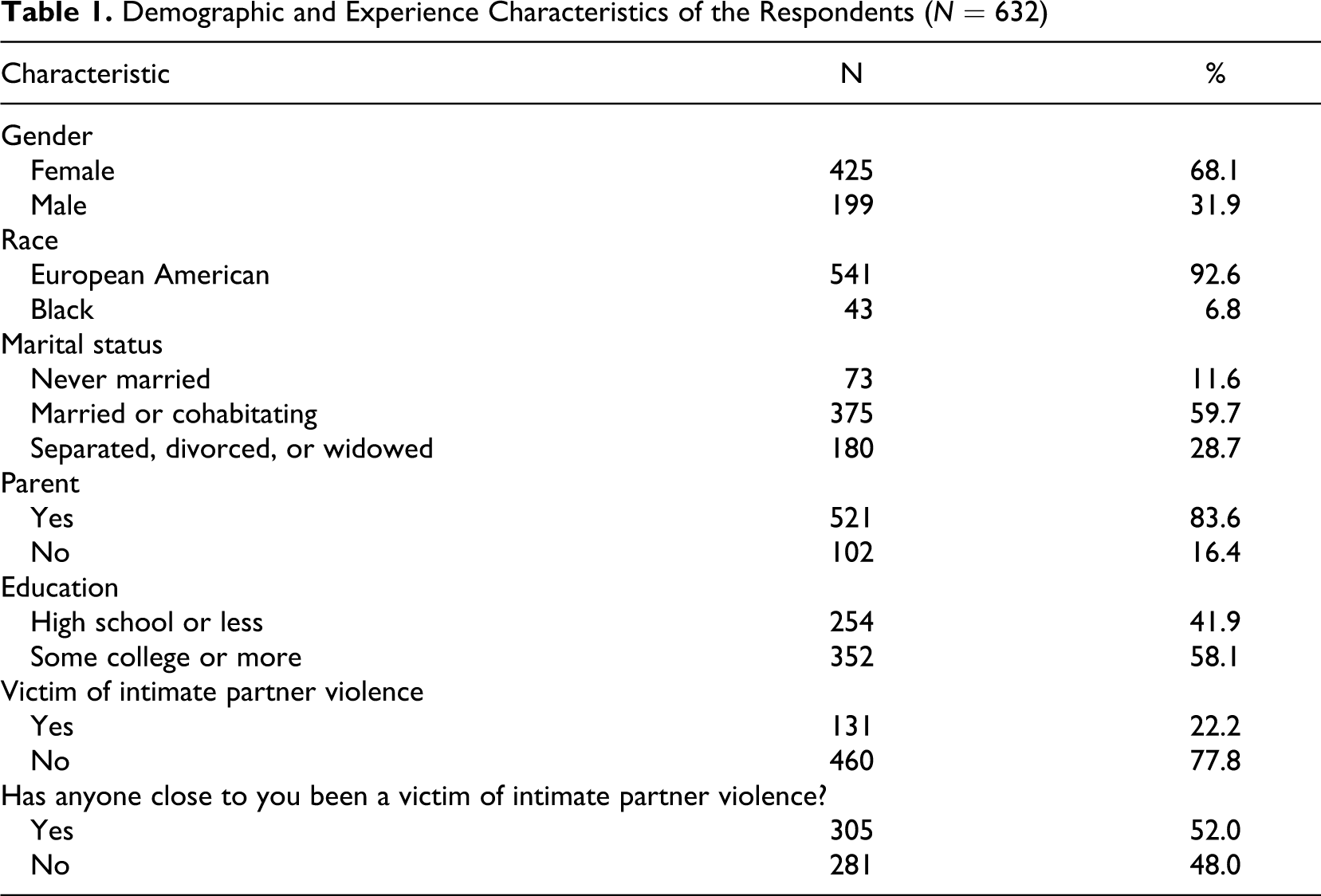
Table 1 presents the demographic and experience characteristics of the respondents. The majority of the respondents were women (68.1%), European American (92.6%), and married or cohabitating (59.7%). Although most had never been victims of IPV (77.8%), 52% reported knowing someone close to them who was a victim of IPV. In addition, the majority of the respondents thought about IPV once a year (28.6%) or once a month (27.9%). According to the U.S. Census Bureau, Michigan’s population is 50.8% female, 81.2% European American (U.S. Census Bureau, 2009), and 50.5% married (U.S. Census Bureau, 2000). Therefore, our sample overrepresented women, European Americans, and married people.
Demographic and Experience Characteristics of the Respondents (N = 632)
In response to a few general questions about whether women should seek help for IPV, only 4.1% of the respondents believed that a woman should not seek help for IPV and only 1.7% thought that IPV is a private matter or that no one can help a victim of IPV (1.2%). Most of the respondents (97.3%) believed that if a woman is physically abused by her partner, she should seek outside help.
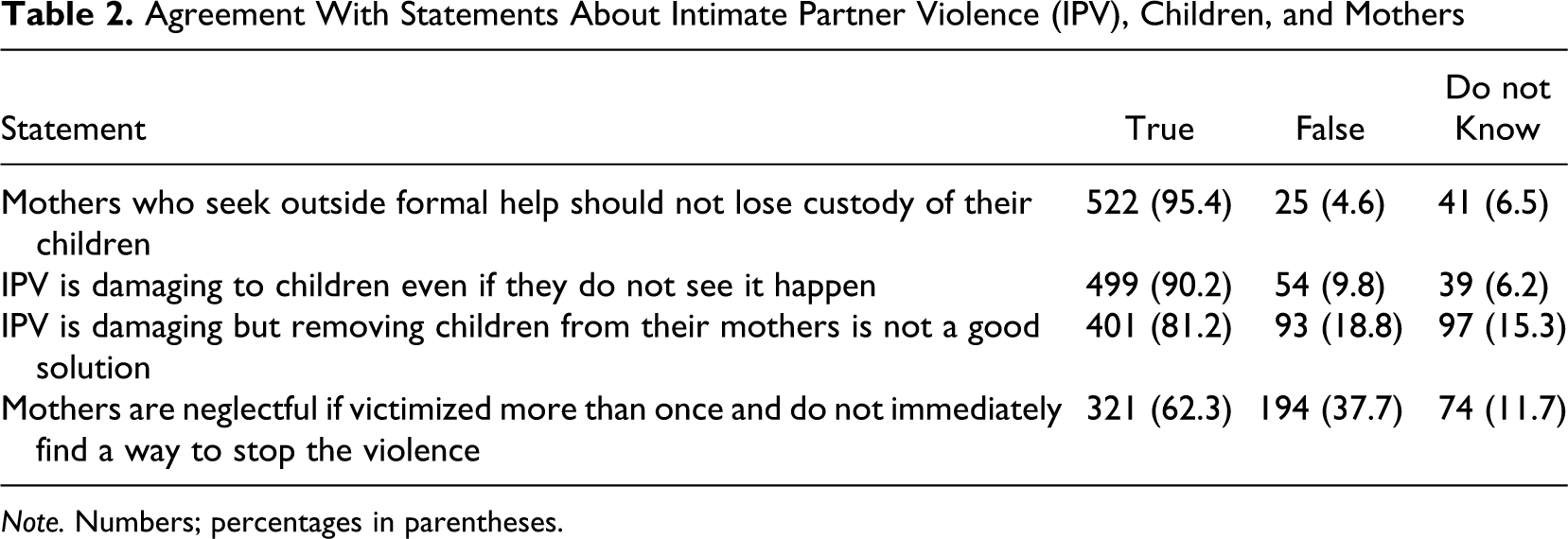
Just over 40% of the respondents disagreed with the Michigan law that states that IPV victims may lose custody of their children for failing to protect them from the harmful effects of exposure to IPV. However, more than 50% either agreed (32%) with the law or were neutral (24.2%). Table 2 shows the frequencies of responses to four statements about whether IPV is damaging to children and whether or not a mother should be held accountable if her child is exposed to IPV. Sixty-two percent believed that mothers who are victimized more than once by IPV are neglectful if they do not immediately find a way to stop the violence.
Agreement With Statements About Intimate Partner Violence (IPV), Children, and Mothers
Note. Numbers; percentages in parentheses.
The majority of the respondents (95.4%) said that women who seek outside help for IPV should not lose custody of their children (see Table 2). The helpers they identified as appropriate sources of assistance for an IPV victim were the police (96%), counselors or therapists (87.2%), close family members (83.4%), and close friends (83.4%). In addition, 69% thought that women should seek help from members of the clergy.
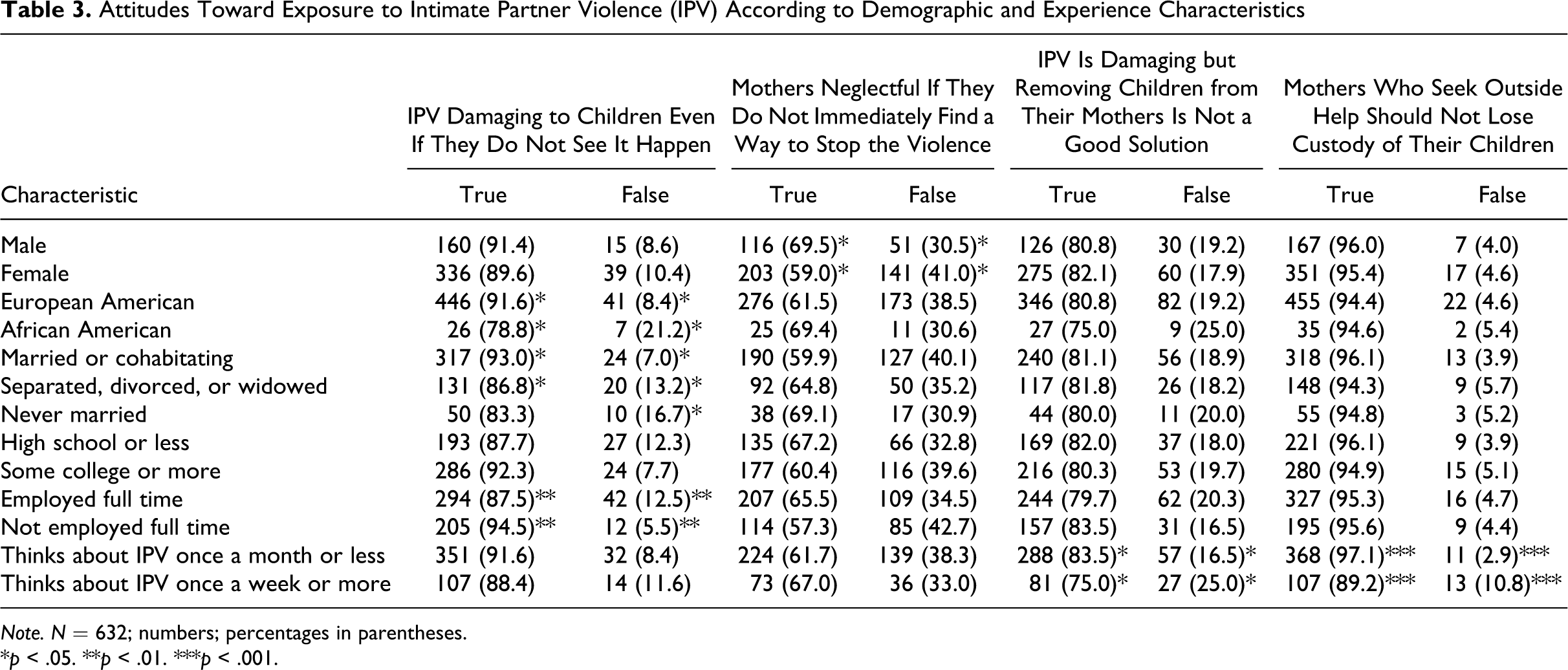
Table 3 presents a summary of the bivariate analyses relating demographic characteristics and experience with IPV to the attitudinal statements about children’s exposure and mothers’ responsibilities. There were several variations in the respondents’ views about whether IPV is damaging to children, even if the children do not see it. Those who were European American, χ2 = 6.04 (1, N = 520), p < .05, married or cohabiting, χ2 = 8.18 (2, N = 552), p < .05, and not employed full time, χ2 = 7.27 (1, N = 553), p < .01, were more likely to agree with this statement. The relationship between gender and the belief that mothers are neglectful if they do not find a way to stop the violence immediately was statistically significant, χ2 = 5.23 (1, N = 511), p < .05, with men being more likely to endorse this statement. For the statement that IPV is damaging but removing children from their mothers is not a good solution, those who thought about IPV once a month or less were significantly more likely to agree than were those who thought about it once a week or more, χ2 = 3.91 (1, N = 453), p < .05. Similarly, the relationship between how often an individual thought about IPV and whether mothers should not lose custody of their children if they seek outside help was significant, χ2 = 12.52 (1, N = 499), p < .05, with those who thought about it less often being more likely to agree.
Attitudes Toward Exposure to Intimate Partner Violence (IPV) According to Demographic and Experience Characteristics
Note. N = 632; numbers; percentages in parentheses.
*p < .05.
**p < .01.
***p < .001.
We conducted multivariate analyses using logistic regressions that included all the demographic and experience-with-IPV variables as predictors of views on mothers’ responsibilities about children’s exposure to IPV. However, the findings of the multivariate analyses were almost identical to the findings from the bivariate analyses. Therefore, for brevity, we have reported only the bivariate analyses.
Discussion
An initial finding of our study is that IPV was an important topic for many of the respondents to this statewide survey. Over half the sample had been close to someone who had been victimized by IPV and more than one fifth had been victimized themselves. About one fifth of the respondents reported that before they completed the survey, they thought about IPV once a week or more frequently.
Public Definitions of Exposure to IPV and Expectations for Mothers
The two items for which there was the most consensus regarding IPV and the exposure of children were these: “Mothers who seek outside help should not lose custody of their children” and “IPV is damaging to children even if they do not see it happen.” As Carlson and Worden (2005, p. 1213) noted, “A public that defines abuse inclusively and believes it is a widespread problem may be more open to social and legal efforts to ameliorate it.”
An important finding was that nearly two thirds of the respondents agreed that mothers who are victimized by IPV more than once are neglectful if they do not immediately find a way to stop the violence. It is important to note that two thirds of the sample agreed, even though the word “immediately” was included. This finding resonates with Taylor and Sorenson’s (2005) finding that the respondents held women even more responsible for finding a solution after a repeated incident of IPV. Such findings suggest that people lack an understanding of the complexities of seeking help. When questions are phrased to focus on the mother’s responsibility, the public, indeed, places a high level of responsibility on the mother. Public opinions such as these could affect public policy in the future, leading to a greater emphasis on the need for mothers to take prompt and formal (easily documented) actions to protect children from exposure to IPV.
Our findings seem to indicate that the general consensus is that mothers should be held accountable for being unable to stop IPV, although they probably should not lose custody of their children. This finding is consistent with Worden and Carlson’s (2005) finding that two thirds of those surveyed believed that women who are involved with violent partners can find a way to end the violence. In addition to influencing the legal system, such beliefs may affect the social networks of abused women and may make people less willing to help these women if the women do not seek help immediately.
Considering that the respondents to our study believed strongly in the importance of women finding ways to stop children’s exposure to IPV, their views on the appropriate sources of help are important. It is noteworthy that almost all the respondents thought that women should get help from the police, and many endorsed receiving help from professionals and nonfamily members. This finding suggests that the respondents did not view IPV as a private family matter.
Views on Exposure to IPV Based on the Respondents’ Characteristics
It is interesting to note that there were few significant associations between the respondents’ views on exposure to IPV and the selected demographic characteristics (Taylor & Sorenson, 2005; Worden & Carlson, 2005). Those who thought about IPV more often were less likely to agree that removing IPV-affected children from their mothers is not a good solution or with the statement that mothers who seek outside help should not lose custody of their children. Unlike the third of Worden and Carlson’s (2005) respondents who thought that IPV was a normal reaction to stress and frustration and may have been less aware of the impact of IPV on victims and children, those in our sample who thought often about IPV were probably more aware of these painful consequences and thus were more concerned that something should be done to protect children.
Although the frequency of thinking about IPV was associated with differences in responses, those who experienced IPV themselves or knew victims did not select the most severe responses to children’s exposure to IPV. The group of respondents who knew victims may well have included some who were exposed to IPV during their own childhoods. Therefore, these respondents might have chosen to view the harm to children as not extremely damaging or might have been more aware of the difficulties of ending the violence.
American culture has historically viewed women as having the primary responsibility for children’s welfare. Like many protective service workers (Beeman et al., 1999), the respondents seemed to see mothers as the ones who were available to make the required changes to protect their children. However, if abused women who are mothers endorse the same views that hold mothers responsible, it may be difficult to engage them in interventions because of their shame about how IPV has harmed their children (Groves & Gewirtz, 2006). The views of the respondents who had been victimized by IPV did not differ significantly from those of the general public, so it appears that survivors may well expect that they need to end the violence and protect their children.
These are significant issues that should be explored, given that public opinion may influence public policies (Burstein, 2003) as well as the views of potential helpers (Taylor & Sorenson, 2005). Furthermore, victim-blaming attitudes can cause women who are victims of IPV to avoid seeking help or turn away from help after receiving a judgmental response. Social workers and child protective workers whose views are consistent with mother-blaming public opinion may behave more harshly toward women they believe have not done enough to protect their children, which could lead to an increase in the number of children who enter the foster care system (Dosanjh et al., 2008). Studying public opinion on this issue may help current practitioners have a clearer understanding of the barriers that victims of IPV face when they attempt to seek help.
Limitations
The response rate to our survey was quite low, which is an increasing problem in public opinion survey research (Galea & Tracy, 2007; Johnson & Owens, 2003). The sample also overrepresented women, European Americans, and married people, compared to the population of the state of Michigan. For these reasons, our findings are merely suggestive and exploratory and not representative of Michigan or of the American public.
Our questions did not explore the nuances of how or why people may blame mothers for the harm caused by exposure to IPV. We also did not address variations in the severity of children’s exposure to IPV or in the effects of exposure. We also did not ask whether people are more concerned or less concerned about the harm to children, depending on the children’s ages or the context of the violence, such as the batterer’s previous behavior (Magen, 1999). We did not ask how the respondents believed male abusive partners should be held accountable, nor did we ask about what they thought the community should be doing to prevent harm resulting from children’s exposure to IPV. Although these are clearly limitations, our questions followed the typical patterns of child protective service workers, who focus primarily on mothers (Beeman et al., 1999).
Conclusion: Implications for Policy and Practice
The findings of our public opinion survey alerted us to the possibility that potential helpers and abused women themselves may expect abused women to take prompt action to protect their children from IPV. The respondents supported the idea that women should seek help from formal sources, such as the police and counselors, without seeming to have a clear awareness of the fears that abused women may have for themselves and their children about seeking such help (Davies et al., 1998). In addition, one of the most meaningful comparisons offered in the study was related to respondents who thought more often about IPV. That is, these respondents were less likely to agree that removing IPV-affected children from their mothers is not a good solution or with the statement that mothers who seek outside help should not lose custody of their children, reminding us that the pain experienced by children who are exposed to IPV is real and important. Recent research on women who survived childhood exposure to IPV should increase understanding of this pain and of recovery processes (Anderson & Danis, 2006; Anderson, Danis, & Havig, 2011; Humphreys, 2001).
Messages to the public about IPV should convey the complexities and difficulties of ending the violence and the need for more societal efforts to remove external barriers that victims face. Therefore, there is ample room for growth in understanding among both the professionals and the public. The findings of this study suggest that if social workers’ views are consistent with public opinion, the workers may need education and guidance about how to talk to abused women in a way that will not shame, punish, or threaten them. Black, Weisz, and Bennett (2010) found that social work students seemed to blame the victim or, at least, expected her to take a great deal of responsibility for making changes in the relationship. There is a risk that uninformed social workers may talk to women in a way that limits the women’s willingness to discuss their own safety or that of their children. In addition, prevention programs that strive to change social norms should continue to address public opinion.
The findings of the survey also point to a need for better coordination between child welfare agencies and IPV agencies. Improving collaboration and integration can lead to improved assessments, expanded training of workers, and increased resources (Mole, 2008). Furthermore, working together may provide the necessary data to determine whether or not legislation that may penalize nonabusive parents for “failing to protect” their children is actually helpful to children and punishes the perpetrator or if it is being used against victims of IPV who are seeking help (Kaufman Kantor & Little, 2003). This is an important point because the definition for failure to protect is broad and vaguely defined (Kaufman Kantor & Little, 2003), which then requires that child protection workers use their own judgment when assessing a particular situation. Given the danger that some social workers or child protection workers may share similar mother-blaming attitudes as the general public, it is critical that IPV agencies and child protection agencies cooperate in an effort to provide appropriate, nonjudgmental services to these families. Although there has been a history of tension between these two response systems, practitioners in both service systems can support broader common goals that include the well-being of families, the empowerment of parents to protect their children, and accountability of the perpetrator (Mole, 2008). Collaborating on these common goals can serve to help educate both the professionals and the public about the dynamics surrounding IPV relationships and ultimately help empower and support nonabusive parents and their children.
Footnotes
The authors declared no potential conflicts of interest with respect to the research, authorship, and/or publication of this article.
The authors received no financial support for the research, authorship, and/or publication of this article.