



Abstract
Play has well-established physical and mental benefits for people of all ages. Urban spaces, such as parks, provide important public arenas in which to play. But to what extent do planners or planning scholarship focus on facilitating play? Our systematic literature review of 3,800 articles in nineteen academic planning journals returned 126 articles related to play. We found that the planning for play literature is an emerging discourse overwhelmingly focused on children and the physical design of urban spaces in predominantly English-speaking nations. The study identifies gaps in the planning for play literature and outlines recommendations for future research.
Introduction
Cities are often depicted as spaces of play. Basketball courts, hiking trails, urban parks, and especially playgrounds provide opportunities to engage in activities that are “intrinsically motivated, entail active engagement, and result in joyful discovery” (Yogman et al. 2018, 2). Urban space also has a relationship with play at its most fundamental, spontaneous, and creative level. While play can refer to specific activities, it can also be viewed as transcending the utilitarian and offering the opportunity to transform everyday life (Lefebvre 1991). Within its innate ambiguity (Sutton-Smith 2001), there is room to plan for the possibilities of play (Stevens 2007) and to shape play experiences through urban design (Thrift 2003). Play as spontaneous and creative behavior can improve community relationships and increase social connections (Spencer and Mahjoubi 2015), improve cardiovascular health and decrease risk of heart disease (World Health Organization 2014), counter depression (Sutton-Smith 2001) and improve mental well-being (Kerr and Apter 1993). In short, play can help create healthier and happier communities. But to what extent does the planning literature focus on play?
Our study undertakes a systematic quantitative review to determine if and to what extent play as a joyful, creative activity is present in the planning literature. Specifically, the study objectives are to determine (1) the prevalence of play in the academic planning literature over time, (2) the concentration of play articles by planning sub-discipline, (3) the geography of the planning for play discourse, and (4) the age-focus of the planning for play discourse.
The paper begins with an overview of the play and planning for play literatures, followed by a description of the study methods. Next, the findings section presents overall trends from the systematic review and a critical examination of the geography and demographic age focus of the articles included in the review. The findings are followed by a summary of the implications and practical realities of planning for play that arose from the analysis of the reviewed articles. Lastly, we present the conclusions from the study and opportunities for future research.
What is Play?
The diverse nature of play makes it difficult to conceptualize and define in academic discourse. Parham and Fazio (2008, 448) described play as “any organized activity that provides enjoyment, entertainment, amusement, or diversion.” Similarly, Yogman et al. (2018, 2) state that play “is voluntary and often has no extrinsic goals; it is fun and often spontaneous.” While individual definitions of play differ depending on the discipline, context, and audience, there are foundational elements common to most descriptions of play. Play is often regarded as being spontaneous, involving active engagement, intrinsically motivated, a means rather than an end, and having no time dimension and place (Wuest and Butcher 2008).
Play is also almost always discussed in the context of children (Woodyer 2012). In fact, a child's right to play was codified in Article 31 of the United Nation Convention on the Rights of a Child (Office of the United Nations High Commissioner for Human Rights 1989). Article 31 states that children have the right to “rest and leisure, to engage in play and recreational activities appropriate to the age of the child and to participate freely in cultural life and the arts” (Office of the United Nations High Commissioner for Human Rights 1989). The Convention has been ratified by every country in the world, with the exception of the United States of America 1 (United Nations 2022).
Article 31 positions play as an essential component of children's lives. Along with being a source of enjoyment for children, the physical, cognitive, and psychosocial benefits of play are extensive and well documented (Yogman et al. 2018; Schlesinger et al. 2020). Children benefit physically by engaging in structured play, such as physical education and organized sports, or through active free play, such as playground activities and games played in backyards and streets (Janssen 2014). Play involving physical activity promotes cardiovascular fitness and enhances the efficacy of the immune, endocrine, and cardiovascular systems (Lubans et al. 2010; Goldstein 2012). Engaging in active play has also shown to decrease fatigue and the prevalence of injury, while increasing range of motion, agility, coordination, balance, and flexibility (Goldstein 2012). The physical benefits of play are not limited to children—teenagers, adults, and even older adults benefit from engagement with playful activities (Skropeta, Colvin and Sladen 2014).
Play is fundamentally important for cognitive development as it stimulates learning, enhances brain structure and activity, and promotes executive function (Kerr and Apter 1993; Yogman et al. 2018). Play has been shown to improve attention levels, language and thought, creativity, problem-solving abilities, cognitive reasoning, negotiation and contribute to skill building and mastery (Nestor and Moser 2018; Goldstein 2012; Brown et al. 2019). In addition to the physical and cognitive benefits, there are a myriad of psychosocial benefits associated with play in people of all ages. Play at a young age combines playful discovery with the development of social-emotional skills (Yogman et al. 2018). These benefits continue into older age as play is positively related to collaboration, empathy, compassion, and self-expression (Nestor and Moser 2018; Goldstein 2012). Play has been shown to improve community relationships and increase social capital and social connections (Spencer and Mahjoubi 2015). Engaging in play together fosters a bond between children and parents, which elicits mutual joy and shared communication between parties (Williams et al. 2012). Intergenerational play provides rich opportunity for older and younger people to enjoy each other's company and learn from one another, while also serving as a connecting force between generations (Davis, Larkin and Graves 2002). Intergenerational play allows participants to make meaningful contributions to each other's lives; it affords adults with the chance to reminisce on their childhood, and children with the opportunity to interact with positive role models (Skropeta, Colvin and Sladen 2014; Davis, Larkin and Graves 2002).
Planning for Play
Planning can play an important role in creating environments that encourage and enable play. According to Donoff and Bridgman (2017, 295), public space that effectively enables play is a “product of human intent and invention.” They assert that the success of playful public spaces is not accidental but instead, the product of careful urban design. Success is derived from the understanding that public spaces have the ability to cultivate or suppress play. Play can be thought of as an alternative to the conventional use of public space—one that inspires happiness and playful interaction (Donoff and Bridgman 2017). In many ways, planning theory and practice have already laid the groundwork for playful environments. Social inclusion and healthy communities have become important planning discourses and the societal role of public space has been the subject of intense scrutiny and debate since the onset of the COVID-19 pandemic (Hartt 2020; Jon 2020; Jasiński 2022).
Healthy community planning involves a people-centric process that positions the needs of people and communities at the heart of the urban planning process, while recognizing the implications of planning decisions for community health and wellbeing (World Health Organization 2022). Public play spaces can enhance community health and wellbeing by serving as a venue to be physically active, social, and close to the natural environment (Frumkin and Eysenbach 2003). To contribute to greater health and social equity, Frumkin and Eysenbach (2003) argue that public play spaces should provide a variety of functions to accommodate people from different age, ethnic, and socioeconomic groups and their corresponding health needs and traditions in play.
Planning for play can do more than shape physically healthy habits. Donoff and Bridgman (2017) contend that play has the capacity to shape and improve our daily movements, interactions, and experiences. Inclusive play spaces need to be designed for social interaction as well as opportunities to improve physical health (Woolley et al. 2006; Burke 2013). There is power in bringing people together—research has shown that children are more likely to engage in active play in the presence of a friend (Umstattd Meyer et al. 2021). Urban design of public play spaces that create opportunities for collaboration and social interaction has the potential to bring people of all ages together.
Although planning for play is in many ways an emerging discourse, two play-based interventions have gained traction in recent years: child-friendly cities and play streets. It is important to note that both are focused exclusively on children. UNICEF's (2022) Child Friendly Cities Initiative provides a governance framework to guide the creation of child-friendly cities and communities. Within this framework is the goal of ensuring that every child and adolescent has the opportunity to experience and enjoy play (UNICEF 2022). By encouraging child-friendly insights, Gill (2021) argues that we can create happier, greener, and more resilient communities for everyone. However, optimizing play opportunities for children is difficult when faced with a lack of safe and accessible play spaces in a community (Umstattd Meyer et al. 2019). Creating and improving public spaces can lead to an increase in active play; however, making permanent alterations to the built environment is not always feasible (Pollack Porter et al. 2019). Instead, some municipalities have adopted innovative strategies such as play streets, which calls for the temporary closure of streets to create safe spaces for active play (Umstattd Meyer et al. 2019, 2021; Smith et al. 2022). Play streets have been shown to increase opportunities for active play and physical activity, as well as improving community cohesion (Esmonde et al. 2022; Umstattd Meyer et al. 2019). This initiative addresses issues related to health equity by increasing opportunities for physical activity in low-income or under-resourced communities that may lack well-maintained parks and playgrounds (Pollack Porter et al. 2019; Umstattd Meyer et al. 2019).
Despite having clear benefits for people of all ages, “play is assumed to be the activity of children” (Woodyer 2012, 313). This perception has resulted in the majority of play-based interventions in the field of urban planning being exclusively tailored to children, with limited focus on enabling opportunities for play in adolescence, working age, and later life. For older adults, play can be used as an opportunity to escape ageism, process loss, and improve mental and physical health (Lefebvre 1991). It is also incredibly well suited to combat loneliness among older adults. The proven benefits of play, in conjunction with the lack of research outside of child-friendly literature, presents a unique opportunity for researchers to enrich the discourse on the play-based interventions for older adults and produce tangible recommendations for planning practice. However, as Xiao and Watson (2019, 93) note “to push the knowledge frontier, we must know where the frontier is.” A valid, reliable, and repeatable systematic review of the planning and play literature is needed to establish a foundation for future research and policy development.
Methods
In order to determine whether and to what extent play is present in the urban planning literature, we undertook a systematic quantitative literature review. A systematic quantitative literature review identifies gaps and analyzes trends in the literature through bibliometric and content analysis of articles identified from academic databases and search engines that meet a certain set of inclusion criteria (Potts 2020). It is considered systematic as the methods used are explicit and reproducible (Pickering and Byrne 2014). This specific type of review methodology is considered particularly rigorous and unbiased due to its use of predefined criteria and a priori protocol (Pullin and Stewart 2006). According to Harden and Thomas (2005, 258), “systematic reviews have developed in response to a growing need for policymakers, researchers and education practitioners to have access to the latest research evidence when making decisions.” While this review type is well established in the health and medical sciences, systematic quantitative literature reviews in urban planning, and the broader field of social sciences, are much more scarce (Xiao and Watson 2019). Xiao and Watson (2019, 109) emphatically argue that “the planning field needs to increase its rigor in literature reviews.” In an effort to advance the conceptual and practical discourse of an emerging planning topic in a rigorous way, we examine the intersection of urban planning and play through a systematic literature review.
Google Scholar was selected as the database for the study as electronic databases are the predominant source of published literature collections and Google Scholar is a powerful open access database that archives journal articles as well as gray literature (Xiao and Watson 2019). Furthermore, Google Scholar Advanced allows the user to search within specific journals. This feature was key to our approach as our study focused solely on the urban planning literature. Limitations associated with relying on Google Scholar include its fuzzy criteria of what is considered scholarly work and its opaque and regularly changing algorithms and database structure (Giustini, Dean and Kamel Boulos 2013). However, as our study focused on output from a specified set of journals, the implication of these limitations is relatively modest.
The selection of journals included in our study was informed by Goldstein and Maier's (2010) article “The Use and Valuation of Journals in Planning Scholarship: Peer Assessment Versus Impact Factor.” The authors surveyed the tenured and tenure-track faculty in all member schools of the Association of Collegiate Schools of Planning to determine the rank and subjective importance of a range of academic planning journals. Our study of the planning literature included all of the journals that Goldstein and Maier (2010, 72) concluded to be “the top journals by peer evaluation”: Journal of the American Planning Association, Journal of Planning Education and Research, Urban Studies, Journal of Urban Affairs, Journal of Planning Literature, Urban Affairs Review, Landscape and Urban Planning, Journal of Architectural and Planning Research, Housing Policy Debate, Economic Development Quarterly, Environment and Planning A, Environment and Planning B, International Journal of Urban and Regional Research, Journal of Environmental Planning and Management, Journal of Urban Design, Transportation Research Part A – Policy and Practice, and Planning Theory. Planning Theory and Practice and Planning Practice and Research were also included, as our initial broad Google Scholar search showed that they generated valuable results pertinent to the study focus.
A keyword search was used to identify relevant articles. The initial keywords included play, playing, fun, game, and games. These keywords were derived from the research questions and tested through several iterations (Xiao and Watson 2019). The initial keyword search generated a wide range of results, with many of the articles being unrelated to the research topic. In this instance, a certain amount of trial and error was necessary to determine the best keywords for the study (Pickering and Byrne 2014). The final search was limited to the keyword “play” to prompt the most relevant results.
Using the keyword search in Google Scholar Advanced, we collected the first 200 articles, sorted by relevancy, in each of the aforementioned journals. In total, our sample included 3,800 articles from 19 academic journals. To ensure that the articles reflected our research questions, we undertook a two-stage procedure consisting of a title and abstract review followed by a “refined quality assessment based on a full-text review” (Xiao and Watson 2019, 105). In any instance of uncertainty about whether to include an article, two reviewers independently reviewed the article and reached a consensus decision.
A total of 126 articles were included in the final selection. The articles were analyzed and coded in an Excel database according to a range of variables modeled from other systematic literature reviews (Boulton, Byrne and Dedekorkut-Howes 2015; Potts 2020; Rupprecht and Byrne 2014; Thomas 2014), with additional categories being added to reflect the study focus. The variables include journal name, article title, authorship, year of publication, country of research, case study location(s), age focus, social or physical environment focus, informal or formal play spaces, and whether the article focused on urban, suburban, or rural environments. We then undertook a descriptive analysis of the variables to identify trends and gaps in the literature and draw conclusions regarding the state of play in planning scholarship.
Findings
Overall Trends
The systematic quantitative literature review revealed that play as a topic within urban planning scholarship has become more pertinent in recent decades. Figure 1, which depicts the 126 articles featured in the review sorted based on the year of publication, shows that the rate of play publications in planning journals has grown over time. The oldest article included in the review is “Some Childhood Memories of the City” by Alvin K. Lukashok and Kevin Lynch (1956). Theirs was the sole article published in the 1950s or 1960s. The following decades showed a gradual increase with three articles in the 1970s, four in the 1980s, and six in the 1990s. Play had a boost in popularity in the 2000s with 31 articles in planning journals. That tally continued to increase as the number of articles in the 2010s more than doubled the 2000s, with a total of 74 articles. Two years into the current decade, the 2020s had produced five articles. The single year with the highest number of publications was 2015 with a total of 15 articles relating to urban planning and play. The overall trend is quite clear: play is an emerging topic in the planning literature. It has been gradually receiving more attention from planning scholars. The broader recent interest in children's rights (Office of the United Nations High Commissioner for Human Rights 1989), child-friendly cities (UNICEF 2022), and play streets (Umstattd Meyer et al. 2021) suggest that scholarship focused on planning for play may still be building momentum.
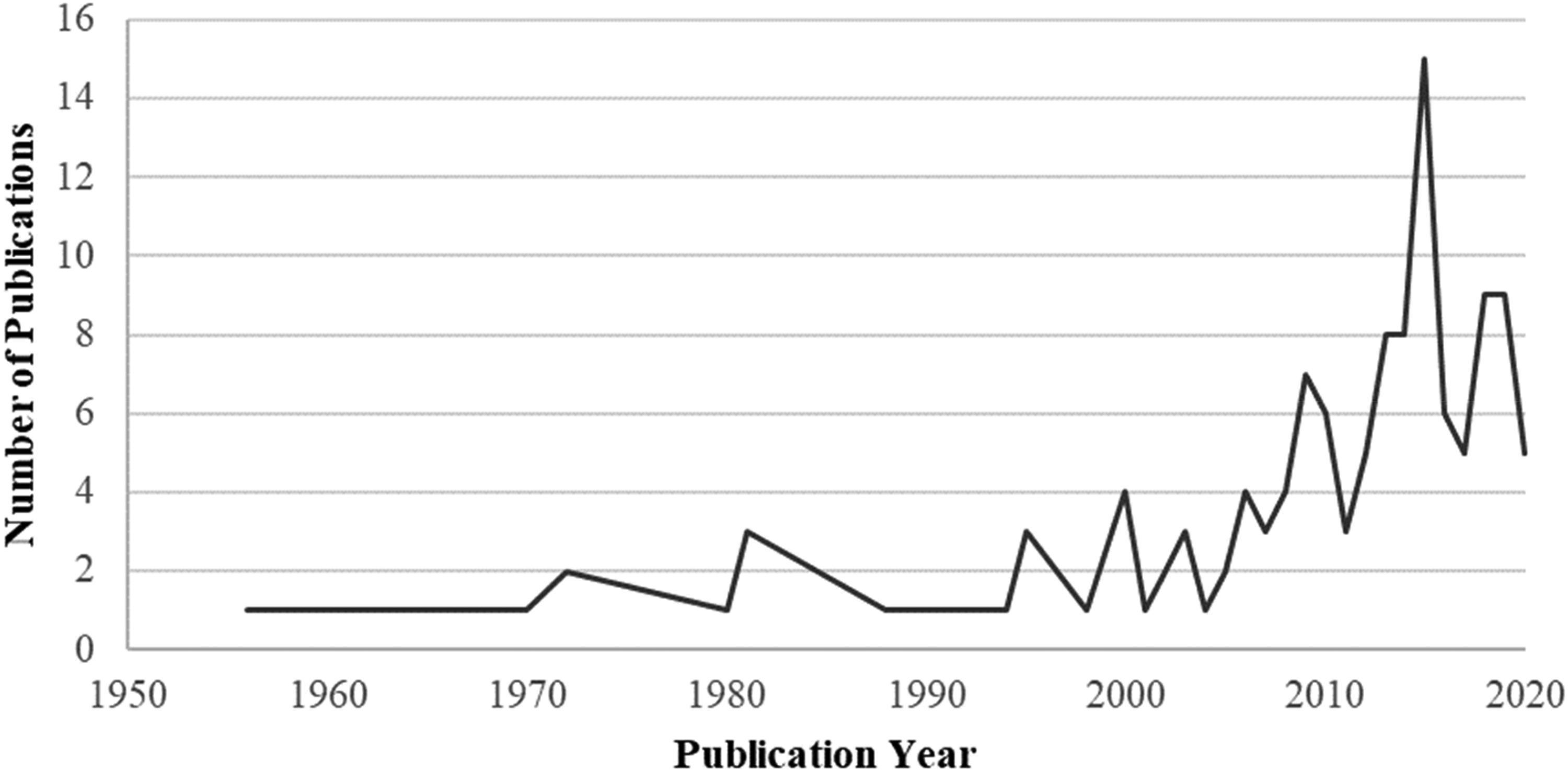
Number of play publications in planning journals by publication year.
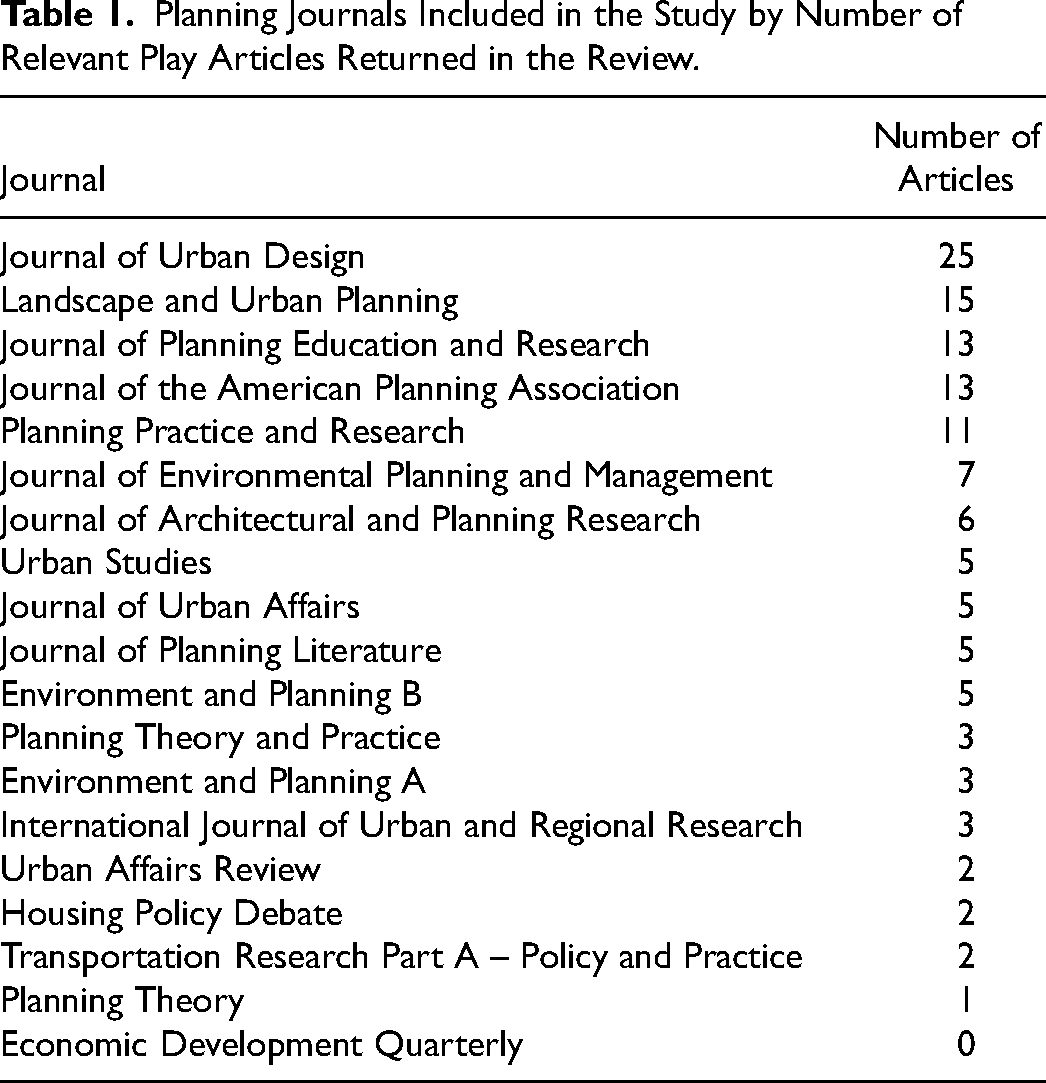
Of the 19 journals included in the review, the Journal of Urban Design contained the largest number of relevant articles, with a total of 25 articles pertaining to urban planning and play. All but one of the 25 articles were published in the 2000s or 2010s—reflecting the emergence of the planning for play literature (Figure 1). The extent of the urban design perspective is apparent in the environmental focus of the articles returned in the review. 90% of the articles were either exclusively or primarily focused on the physical environment, whereas only 7% of the inquiries were socially led inquiries. Moreover, over 60% focused on urban environments and almost 80% of the articles discuss formal play spaces such as playgrounds, parks, schoolyards.
In addition to the Journal of Urban Design, the following journals each contained a notable number of articles on the research topic: Landscape and Urban Planning (15), Journal of Planning Education and Research (13), Journal of the American Planning Association (13), and Planning Practice and Research (11). Similar to the Journal of Urban Design, Landscape and Urban Planning and the Journal of Planning Education and Research, with 15 and 13 articles respectfully, also had the vast majority of relevant articles published between 2000 and 2020. In contrast, more than half of the relevant articles in the Journal of the American Planning Association were published before the turn of the millennium. In fact, the first six articles ever published on the topic of play in a planning journal were featured in the Journal of the American Planning Association. While this does reflect the cutting-edge nature of the journal, it is likely also a product of its history. The Journal of the American Planning Association is the oldest of the planning journals—dating back to 1935. The journal with the fewest articles related to play and urban planning was Economic Development Quarterly, which did not return a single article. A complete list of journals and their respective number of articles can be found in Table 1.
Planning Journals Included in the Study by Number of Relevant Play Articles Returned in the Review.
Geography
To get a sense of the geography of planning for play research, we analyzed the 126 articles included in the review by the country of residence of the author and the country of the case studies (when applicable). In instances with multinational authorship teams, we counted the country of residence of the first author. Table 2 shows that the United States led, and the United Kingdom ranked second in both categories. The USA was home to authors in 53 of the articles included in the review, as well as being the focal point of 37 case studies. 29 of the articles were products of the United Kingdom, as well as the basis for 16 case studies. Australia (9, 7), Canada (6, 4), and New Zealand (5, 7) followed their commonwealth cousin in both categories. The narrow geographic scope of the articles included in the analysis is likely a reflection of broader publication trends in English-language planning-related academic journals. Of the 126 articles featured in the review, 82 percent were produced in predominantly English-speaking nations. Similarly, almost 70 percent of the case studies were focused on communities in predominantly English-speaking countries.
Geographic Distribution of Articles by Country by Author Location and Case Study Location.
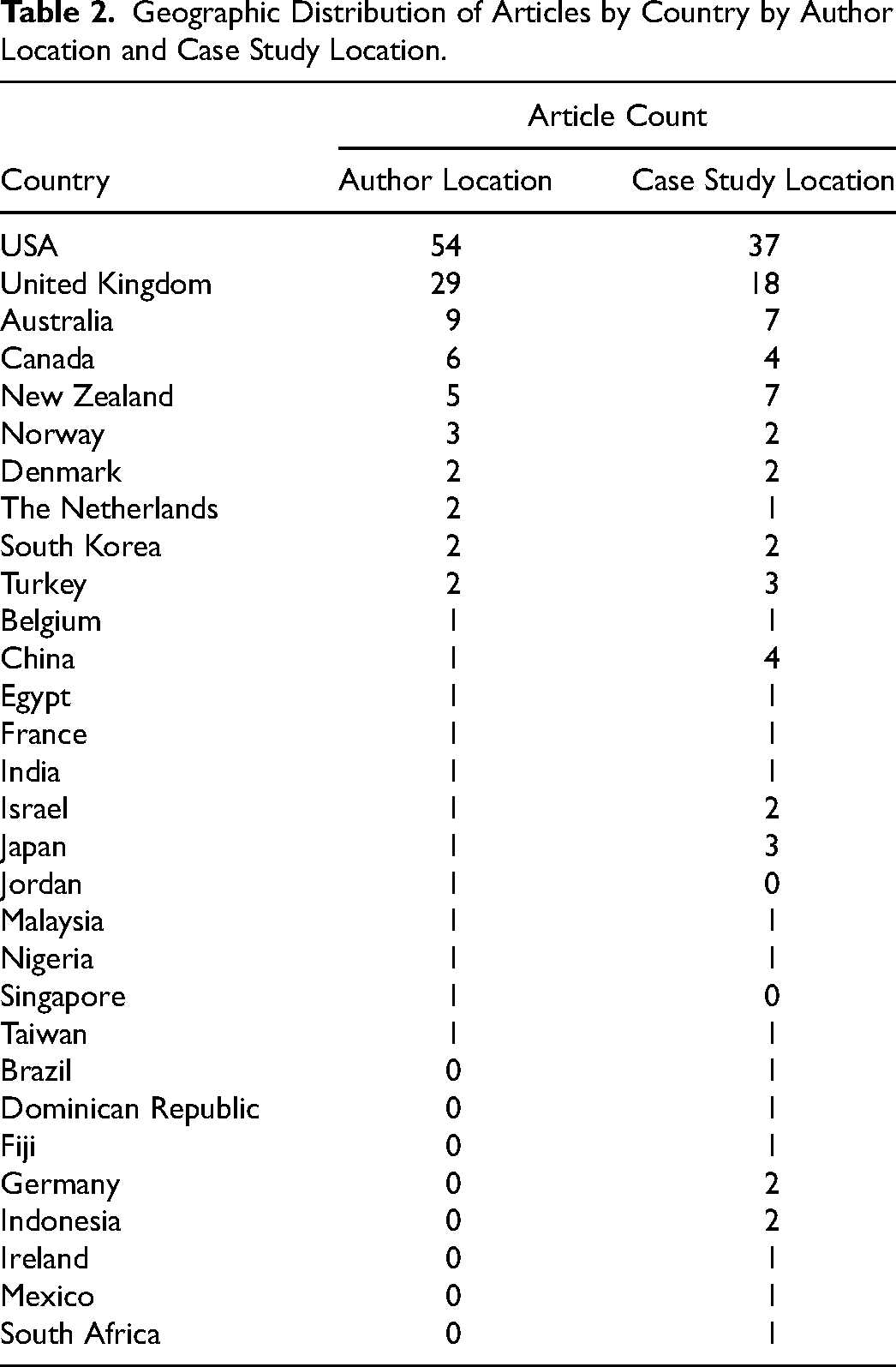
While much of the literature included in the review focused on only a handful of geographic contexts, the geography of play research was quite global in reach. Freeman, Ishwar Lingam and Burnett (2015) focused on Suva, Fiji to explore the implications of urbanization and globalization in Pacific Island countries on children's lived realities. Omuta (1988) used a deferred demand approach to examine recreation potential in Benin City in Nigeria. “Inventing Space in the Cañada: Tracing Children's Agency in Los Platanitos, Santo Domingo, Dominican Republic” by Sletto and Diaz (2015) was the only article to focus on the Caribbean. They examine children's placemaking in an informal settlement, with an overarching focus on their practice, imaginaries, and interactions with the landscape (Sletto and Diaz 2015). Huang's (2006) study in Taipei, Taiwan found that social interaction amongst children and their caregivers increased as opportunities for children's play increased. While the planning for play English-language literature remains dominated by predominantly English-speaking global north nations, play is universal and research at the intersection of planning and play is taking place all over the globe.
Age
Cities are generally designed for a working-age population while the needs of younger and older citizens have historically not been prioritized in urban decision-making (Biggs and Carr 2015; Joy 2020). However, the planning for play discourse is a clear exception. There is a distinct age-related inclination with regards to the subjects of urban planning and play interventions. Children are the overwhelming focus of the literature. Of the 106 articles with a specific age-focus, ninety (85%) concentrated on residents under 18 years of age. Seventy-two of the articles focused exclusively on children (0 to 12 years of age) and eighteen articles centered on adolescents (13 to 17 years of age). In comparison, there were only eleven articles focused on working-age adults (18 to 65 years of age), and a mere five on older adults (65 years of age and above). The literature demonstrates a clear trend: as the age focus of the research increases, the number of articles published on the topic decreases. And while some articles did include multiple age groups, none explicitly focused on intergenerational play and how different policies, programs, and infrastructure could foster interactions between different age groups.
The paucity of research on planning for play for older adults warrants further examination as, like the child-friendly discourse, the age-friendly discourse has grown considerably in recent years due to the recognition of the need for tailored policy and planning to support the physical, mental, and emotional health of older adults (Hartt et al. 2021). However, unlike their younger counterparts, planning for play for older adults has not generated research attention—less than 4% of the planning for play articles in the study focused on older adults.
Thematically, the planning for older adult play articles focused on park space and social infrastructure. One of the two articles related to park space, Loukaitou-Sideris et al.'s (2016) “Parks for an Aging Population: Needs and Preferences of Low-Income Seniors in Los Angeles” highlights the physiological and psychological benefits of parks for older adults, while also examining older adults’ preferences and barriers regarding their use of neighborhood parks. While the article does not specifically engage with concepts, policies or programs, or lived experiences of older adult play, the focus on potential play space (i.e., parks) does shed light on the opportunities for older adult play. For example, participants in the study expressed their interest in bringing their grandchildren to play in neighborhood parks—highlighting an opportunity for intergenerational play. The second article related to park space also focused on promoting physical activity among older adults. Duan et al.'s (2018) examination of parks in Hong Kong, China and Leipzig, Germany detailed the scope of activities commonly performed by older adults in neighborhood parks. While the study did include an intergenerational focus, the extent of the discussion on play for older adults was limited to their role in assisting children in their play, as opposed to engaging in different forms of play themselves (Duan et al. 2018).
The remaining three articles focusing on older adults and play all engaged with the concept of social infrastructure. In their photovoice study of the lived experiences of older adults and people with disabilities, Baldwin and Stafford (2019) argue for universally accessible social infrastructure for enabling inclusion and community participation. While the article did not have a significant focus on older adult play, it did outline recommendations for improving the accessibility of certain sports through changes to infrastructure and the built environment. Community participation was also at the heart of both Campbell's (2015) article on third places (a person's social home away from home) in planned retirement communities and van Houwelingen's (2012) article on the role of neighborhood associations in preserving social capital. The former found that third places bolster the health and wellbeing of individual residents, as well as the community as a whole. The latter concluded that neighborhood associations can foster play, highlighting the example of older adults teaching children to play traditional games and tell traditional stories. However, despite both articles tangentially engaging with concepts and practicalities of older adult play, neither had an explicit focus on the role of urban planning in facilitating and promoting older adult play.
Planning for Play
Taken together, the 126 articles included in the review provide broad sketch of the implications and practical realities of planning for play. Due to the diversity of the articles and the innate ambiguity of the concept of play (Sutton-Smith 2001), no cumulative best practices can be outlined regarding how to plan for play. That being said, there were major themes that emerged from the analysis related to planning practice and policy.
Several articles focused specifically on the planning process with relation to play. Derr, Corona and Gülgönen (2019) emphasized the importance of children's participation in planning processes, Freeman and Vass (2010) discussed opportunities to engage and empower children, and Wood (2015) underscored children's right to the city. Warner and Rukus’ (2013, 627) examination of American planners’ attitudes and perceptions found that the key to creating family-friendly communities is “family participation and addressing family needs in site planning and zoning.” Other articles focused on established and novel planning approaches, such as shared streets (Ben-Joseph 1995), pop-up art installations (Leddy-Owen, Robazza and Scherer 2018), and the joint-use of school facilities with non-school entities or individuals (Vincent 2014).
In terms of play and urban design, there was a considerable focus on parks (Gold 1972; Loukaitou-Sideris and Sideris 2010; Bangs and Mahler 1970), playgrounds (Oke and Middle 2016; Gagen 2000), and skateparks (Freeman and Riordan 2002; Németh 2006; Taylor and Khan 2011). Major themes within the design-focused articles include child safety (Al-Homoud and Al-Oun 2009), physical activity (Day 2006; Baek et al. 2015), vehicle traffic, noise, and pollution (Appleyard and Lintell 1972; Pharoah 1993), spatial equity (Rigolon 2017; Macedo and Haddad 2016), and accessibility (Baldwin and Stafford 2019). Access to public play spaces, which in the literature are most often public parks, was found to be critical to promoting and harnessing the benefits of play. Public play spaces must be equitably distributed and designed to welcome people with disabilities and limited mobility to define and partake in their own versions of play. Moving forward, the design of play spaces will need to evolve alongside other planning practices to consider and adapt to changing demographic structures, as well as a changing environment. Climate change is already compelling planners, designers, and policymakers to re-evaluate how to plan for extreme heat and cold (Wamsler, Brink and Rivera 2013; Jiang et al. 2017), and the implication of these changes for society's most vulnerable citizens (Kosanic et al. 2022). Public space, and play specifically, have the potential to help mitigate the human social and physical risks associated with climate change.
Conclusion
Play has remarkable benefits for mental and physical well-being (Kerr and Apter 1993; Nestor and Moser 2018). Public space has incredible potential as a proverbial sandbox to support, promote, and generate play for and between people of all ages (Stevens 2007). There is an underdeveloped opportunity for planning and urban design to help create inclusive, accessible play spaces to combat social isolation, improve physical, and build community cohesion. However, play remains an overlooked area of research in the planning literature. Of 3,800 articles published in the top nineteen planning journals (Goldstein and Maier 2010), only 126 discussed play. While the planning for play literature has gained momentum in the last two decades, there remains ample opportunity for growth in both breadth and depth. Articles that develop conceptual frameworks to establish a theoretical foundation to the discourse are particularly in need. Further research could also generate research-led policies and designs.
It is important to note that there is a wealth of literature relevant for professional planners and scholars that fall outside the scope of this review. Future research could engage with the wider interdisciplinary play literature by expanding the scope of the review to include journals including but not limited to the play, sociology, environmental psychology, and early childhood education discourses. The ease of database searches means that a plethora of play research is readily available for planners, designers, and others. However, convenient access to a wide range of play scholarship does not necessarily equate to engagement. The dearth of articles focused on play in planning journals means that planners not actively searching for play literature may not be exposed to potentially useful concepts, theories, programs, policies, and design principles.
Within the existing planning for play literature, two trends are abundantly clear: the literature is overwhelmingly focused on (1) the physical environment and (2) children. 90% of the articles were either exclusively or primarily focused on the physical environment. There is a clear opportunity for future research that focuses primarily on the social components of planning for play (which made up only 7% of the articles reviewed).
Similar to the dominance of the physical environment in the planning for play literature, 85% of the articles with an age-focus (and over 70% of the articles overall) concentrated on children. This inclination reflects the wider societal assumption that play is solely for children (Woodyer 2012). While planning for children's play research has valuable implications for advancing children's mental, physical, and social development, the singular age focus of the literature overlooks the fact that play is beneficial for all. Our findings demonstrate a clear trend in planning for play research: as the age focus of the research increases, the number of articles published on the topic decreases. Future research on planning for adolescent play could explore the tension between the cognitive and social developmental benefits of adolescent play (Ginsburg et al. 2007) and exclusion of adolescent activities, and even adolescents themselves, from public spaces (Owens 2002). For the working age population, future research could critically examine the role of consumption, consumerism, and neoliberalism in planning for play.
The group with the most potential of all may be the most overlooked: older adults. Play is very well suited to combat older adult loneliness and its associated mental and physical health challenges. The very frustrations and constraints that can normally produce apathy and withdrawal in day to day life actually lead to increased involvement in a play environment (Sennett 1978). Whereas loneliness decreases cardiovascular health (Courtin and Knapp 2017), play improves cardiovascular and muscular fitness, bone health, and general functional health while decreasing the risk of heart disease and type 2 diabetes (World Health Organization 2014). And while loneliness is associated with depression and poor mental health (Menec et al. 2019), play exists in direct opposition to depression (Sutton-Smith 2001) and tangibly improves mental well-being by stimulating learning, creativity, self-actualization, and even coping strategies (Kerr and Apter 1993). Yet only five articles, less than 4% of the planning for play articles in the study, focused on older adults. Moreover, none of the articles explicitly engaged with concepts, policies or programs, or lived experiences of older adult play. They did, however, share a common interest in improving older adult wellbeing through planning approaches that overlapped with the play discourse. By concentrating on social infrastructure, third spaces, and park space, the authors began a conversation about the potential of planning to support older adult wellbeing through joy, physical activity, and community.
Future research can harness the same motivation and apply it explicitly to planning for older adult play. Considering the rise of the age-friendly discourse and the fact that the benefits of play are well suited to counter physical and mental challenges related to aging, there is an opportunity for planning scholars and practitioners to marry age-friendliness with play to build more age-inclusive and support cities. Planning for older adult play could also be inspired by and unified with the existing child-friendly literature to spawn intergenerational play and to, more broadly, help create healthier and happier communities. For the planning and play nexus to mature, research must go beyond disciplinary boundaries, age-based assumptions, and normative arguments to engage with questions of how planning can create change and meaningfully foster play.
Footnotes
Funding
The author(s) disclosed receipt of the following financial support for the research, authorship, and/or publication of this article: This research was supported by funding from the Social Sciences and Humanities Research Council of Canada.
