



Abstract
Rising complexities and uncertainties have emphasized the need to employ scenario thinking in urban design and planning. While different scenario methods have been widely used across disciplines, a comprehensive review of scenario approaches in planning literature is limited. Thus, we provide an overview of scenarios and existing scenario approaches currently in practice. We also review a scenario building process to provide a guide for developing scenarios in the context of urban design and planning. The process highlights the different steps that contribute to adaptive planning and improve decision-making.
Introduction
Cities and regions today are confronted with numerous challenges and uncertainties induced by pandemics, radical technological shifts, migration, climate change and economic burdens. For decades, avant-gardist plans and large-scale proposals depicted speculative explorations of better futures (Brown 2009). With time, these utopian ideals and radical visions faded as they failed to account for increasing challenges (Klanten and Feireiss 2011). Against the “wicked” nature of problems (Rittel and Webber 1973), planners were urged to reconsider the approaches used to address these challenges and the stakeholders involved in the process (Wiebe et al. 2018). As a result, different scenario traditions, including visioning (Shipley 2000, 2002), consensus building (Susskind, McKearnan and Thomas-Larmer 1999), forecasting (Isserman 2007; Wachs 2001), and scenario planning approaches (Avin 2007; Goodspeed 2020), surged in urban design and planning as effective tools to address challenges and uncertainties.
Scenarios are used to instigate new ways of thinking among planners and stakeholders. As stories about the future, scenarios depict visions or possible alternatives and are used to assess the implications of decisions and policies (Chakraborty and McMillan 2015). Apart from revealing assumptions and values, scenarios aim to provide an understanding of current and future challenges, identify incipient discontinuities and dependencies, and prepare and adapt for the future (Khakee 1991).
With scenario methods, varying from highly intuitive to highly technical, planners adopted new analytical methods and tools from diverse disciplines, such as corporate planning, applied science and engineering (Wachs 2001). While the diversity of approaches, tools, and techniques offered planners the advantage of using them creatively and interdependently (Avin 2007), the glut of methods has contributed to a “methodological chaos” (Bradfield et al. 2005) and a misuse of terms (Godet 2000). Given the confusion, a growing body of work in scenario literature has been systematically categorizing scenario types and methods to enhance their applicability across domains (Bishop, Hines and Collins 2007; Börjeson et al. 2006; van Notten et al. 2003). Although scholars have focused on certain components of future thinking, comprehensive reviews of scenario approaches are rather limited in the urban design and planning literature. With a lack of methodological procedure transparency (Kosow and Gaßner 2008), recent scholarship advocated for expanding urban planning toolkits and developing new methods to address the future (Brück and Million 2018; Myers 2001; Pettit et al. 2018). Thus, this review aims to highlight recent scholarship in scenario literature, and its use in urban planning and design. We provide a brief overview of scenarios and participatory approaches in the urban design and planning context. Given the increasing need for planners and practitioners to familiarize themselves with the broad range of existing methods, we review different scenario approaches, including forecasting, visioning, backcasting and exploratory scenario planning (XSP). Based on the literature, we provide a brief overview of an exemplary scenario building process for urban designers and planners and discuss different phases, digital models and tools as well as evaluation approaches to develop and evaluate scenarios.
Brief Overview of Scenarios in Urban Design and Planning
Cities are palimpsests of spatiotemporal transformations and future aspirations. Historically, urban planners and architects have imagined cities by illustrating visions depicting a shift towards a better future (Dunn, Cureton and Pollastri 2014). From prescriptive to experimental, prominent examples of architects’ utopian visions include Ebenezer Howard's Garden City, Le Corbusier's Radiant City, and Archigram's Instant City. These utopias provided “socio-spatial blueprints” and emphasized the need to reshape the built environment with transformative concepts that reconfigured architecture, transportation, society, and the environment (Brown 2009, 125). The visions, which were often depicted at the city scale, illustrated interdependencies between the context and the existing conditions, while also expanding possibilities and projecting new prospects (Dunn, Cureton and Pollastri 2014). This long-standing tradition marked future thinking as an indispensable component of urban planning—a discipline aimed at devising steps to overcome the difference between today and an aspired future (Myers and Kitsuse 2000).
With the ceasing influence of grandiose urban plans in the late 20th century, contemporary planning has been criticized for abandoning its utopian potential, while gradually shifting to unidimensional practical visions and forecasts that often ignored political realities and implementation (Myers and Kitsuse 2000). The gradual shift was partly due to grandiose plans’ misleading claims that often resulted in inhospitable places and played a major role in debasing the effect of utopian visionary thinking in planning (Chakraborty 2011; Klanten and Feireiss 2011).
By the 1960s, urban planning transitioned from its focus on utopian projects and design of the physical city to quantitative techniques and rational processes. Planning, as an applied science, sought the best actions and policies for realizing identified goals as well as creating and evaluating alternatives (Klosterman 1997). Following the rational model, forecasting techniques and expert design were used to simulate system functions and select the optimal plan from various alternatives. However, the rational planning approach later came under attack, as planning was considered a political process where new approaches proliferated from business and strategic planning (Friedmann 2008).
Strategic planning connected greater resources and general goals to particular objectives but lacked a spatial dimension. This shortcoming prompted a greater theoretical focus on communicative rationality (Habermas 1984; Innes and Booher 2010). With the “communicative turn” and rise of participatory approaches, rationality was no longer viewed as purely based on logic “but rather on an informed consensus formed by a community of individuals in a particular place and time” (Healey 1992; Klosterman 1997, 50). Stakeholder participation and scenario development based on participatory approaches became key for future planning (Grant 2007), which witnessed a transition from blue-print expert-led planning to process and collaborative planning (Innes and Booher 1999).
Participatory Planning Approaches
Participatory planning approaches enrich the scenario development process by actively involving stakeholders, the public, or experts to collaboratively explore a wide range of futures, develop a vision, or identify strategies and actions (Innes and Booher 1999; Klosterman 2012). To facilitate scenario implementation and adoption, locals are engaged in participatory workshops to learn from their experiences, discuss past and current challenges, raise awareness and delineate future trajectories (Chakraborty 2011). Through discussions, stakeholders’ interests, values and tensions arise and are integrated early on in the scenario building process. Despite diverse and often contrasting viewpoints, participatory scenario processes prompt different participants to establish a common ground for building scenarios. In this process, planners act as mediators and facilitators to guide and ensure consensus among participants (Innes and Booher 1999).
A prominent form of public participatory engagement, common to North America, is the charrette. By definition, it is a collaborative, hands-on, and intensive planning and design workshop that spans across several days, where community members and professionals create solutions incorporating public feedback (Lennertz and Lutzenhiser 2017). The charrette expedites decision-making and minimizes unproductive responses from participants. The National Charrette Institute proposed a charette framework consisting of three phases: (1) research and preparation; (2) the charrette, ranging from four to seven days with three feedback loops or interactive meetings that engage community members in a plan's design; and (3) implementation (Madill, Lennertz and Beyea 2018).
Integrating computer modeling tools such as planning support systems (PSS), in participatory scenario workshops and charettes enables participants, through real-time modeling, to experiment with, evaluate and compare the implications of their choices and consider trade-offs for policies. Participatory processes can range from low-tech to sophisticated efforts where models are operated by technicians. For example, Pollastri et al. (2017) used thinking cards and physical models in participatory workshops to envision multiple urban futures; whereas the Town of Damariscotta (2010) used CommunityViz, a PSS, in a charrette to develop scenarios according to previously set visions and values. Overwhelming participants and stakeholders with complex models and tools can jeopardize their engagement in the scenario building process (Chakraborty 2011). Applying social media and web-based participation tools can complement participatory processes while collecting feedback in real time.
Scenario Types and Approaches
In the recent past, various studies have sought to distinguish between different scenario types, methods, and techniques (Amer, Daim and Jetter 2013; Bishop, Hines and Collins 2007; Börjeson et al. 2006; Chermack, Lynham and Ruona 2000). To resolve the methodological chaos, Bradfield et al. (2005) reviewed the origins and evolution of three schools of technique, namely intuitive logics, probabilistic modified trends, and La Prospective (The Prospective) school. Dreborg (2004) differentiated between predictive, exploratory, and visionary modes of thinking, asserting that each comprises detailed and systematic methodologies. Following a review of articles that intended to organize the scenario development field, Bishop, Hines and Collins (2007) categorized and compared the advantages and disadvantages of 23 scenario techniques, while van Notten et al. (2003) offered a scenario typology based on three overarching themes: project goal (why), process design (how), and scenario contexts (what). In a similar vein, Chakraborty and McMillan (2015) proposed nine scenario types for developing future alternatives. Instead of a typology, their approach is rather a systematized process with multiple components that facilitate decision-making throughout a scenario-based project. Drawing on Amara's classification, Börjeson et al. (2006) proposed three main scenario categories or thinking approaches: (1) predictive or probable scenarios predict future outcomes based on occurrence probability and likelihood; (2) exploratory or possible scenarios explore possible and alternative long-term future developments from diverse perspectives; and (3) normative or preferable scenarios consider how to attain a certain vision or desirable target in the long-term.
Given the extensive use of Börjeson et al.’s (2006) work, we focus on their tripartite division of scenario approaches, namely predictive (forecasting), normative (visioning and backcasting) and XSP and highlight the limitations and capabilities of each approach. We loosely follow a chronological order where we first review predictive and normative traditions and then discuss scenario planning approaches. Forecasting, visioning and backcasting have been incorporated in scenario planning projects while maintaining their identity. As detailed later in this review, various scenario planning exercises use forecasting tools to create a reference scenario or visioning methods to develop normative futures.
Forecasting
Forecasting is used to develop probable futures by predicting changes in a variable “over time and perhaps disaggregated in space” (Hopkins and Zapata 2007, 8). The term implies a predictive exercise that determines the most likely future in a short timeframe. Forecasts are conducted to test the outcomes of different policies and are used to support decision-making and planning processes. They can be either qualitative, generated through the Delphi method (experts answering an iterative questionnaire), or quantitative, formulated through Time-Series or Causal analysis among other techniques. Wachs (2001) considered forecasting a projection and thus the opposite of visionary thinking. Alternatively, Myers and Kitsuse (2000, 223) characterized forecasts as a “best guess about the future achieved by adding judgement about the most likely future rates of behavior” while projections are mechanical exercises that clarify current trends’ implications.
In the 1960s, forecasting techniques were strongly criticized because of the prevalent assumption that past trends would remain unchanged and will continue in the future (Bunn and Salo 1993). Traditional planning paradigms, that relied on single forecasts and extrapolation of historical data, such as the predict-and-plan approach, have thus proven to be inadequate (Hopkins and Zapata 2007; Quay 2010). Currently, various mathematical models, such as UrbanSim, are employed in forecasting to produce predictive scenarios using historic data and assumptions on the development of some external variables (Dreborg 2004; Isserman 2007). As models are becoming more data-intensive and complex, their underlying processes are treated as black boxes. However, with increasing uncertainty, their forecasts may be inadequate, particularly for the long run, as underlying functional relationships that simulate system behavior may change over time. To better assess and narrow uncertainty in these models, sensitivity analysis is conducted not only to calibrate models but also to reduce risks in forecasts (Zmud et al. 2014).
Forecasts can be politically powerful tools, making them prone to misuse among policymakers, planners and forecasters, who might promote specific results or manipulate forecasts to favor certain plans (Voulgaris 2020). Forecast-based scenarios and plans, commonly used in transportation planning, have often proven unreliable and misleading due to the largely implicit nature of assumptions underlying models, political influence, forecasters’ deliberate manipulation, policy amendments, and the inability of forecasts to account for complexities shaping the built environment (Flyvbjerg, Skamris Holm and Buhl 2005; Lempert et al. 2020). Incentives to historically inflate forecasts, underestimate costs and overestimate demand and benefits, stem from concerns over project evaluation fairness and increasing competition among cities to get major projects approved for federal funds (Voulgaris 2020). While assessing the accuracy of forecasts, numerous scholars noted that errors in estimating costs and demand have resulted in cost overruns and benefit shortfalls (Flyvbjerg, Bruzelius and Rothengatter 2003; Pickrell 1992). Despite technical advancements in modeling, demand and cost forecasting remain elements of uncertainty and risk in the evaluation of projects. As decision-makers are increasingly incorporating forecasts in decision-making and planning processes, accuracy is required. In this regard, Voulgaris (2019) suggested three criteria for planners to assess forecasts, namely methodology, accuracy, and usefulness. Furthermore, to reduce bias, Flyvbjerg, Skamris Holm and Buhl (2005) advocated the use of the reference class forecasting method, which identifies and draws upon the experiences of other comparable projects to establish a likely outcome.
To achieve a successful model, forecasts should portray how past trends and relationships, change and why. These approaches should also examine discontinuities and wild-cards that may cause fundamental shifts in a system, allowing planners to adapt to unexpected changes through certain policy measures or actions. While forecasting may improve participants’ understanding of their future assumptions, it falls short in the creative and communicative dimensions that prompt shifts in mental models. Thus, forecasting techniques are currently used to formulate reference or “business-as-usual” scenarios or substantiate scenarios.
Normative Approaches
Visioning
Acknowledging the normative nature of planning, visioning which commonly refers to a desirable future gained popularity during the 1980s and 1990s, as it combined systems thinking with participatory approaches (Shipley 2002; Wiek and Iwaniec 2013). Visioning emerged against isolated neighborhood redevelopment projects to involve stakeholders and citizens and embody their values (Shipley 2000, 2002). Prior to its widespread use, the term “vision” was restricted to such idealized future cities such as those of Le Corbusier, Frank Lloyd Wright and Ebenezer Howard. Visions are potential agents of change, particularly when they encompass a set of shared goals and prompt change in actions, regulations and measurable targets (Hopkins 2001; van der Helm 2009).
The Oregon model of community visioning developed by Ames (2006) in the 1990s emerged as an influential visioning technique. In fact, a surge in visioning manuals and methods was witnessed, many of which lacked theoretical and methodological robustness for practice (Shipley 2002; van der Helm 2009). Shipley’s (2002) review of visioning techniques revealed weaknesses in the theoretical premises and questioned tacit assumptions about visioning. Thus, advanced and theory-supported visioning approaches are still needed in literature. Recently, Iwaniec and Wiek (2014) applied a sustainability visioning approach for Phoenix, Arizona. However, their study did not rigorously pursue evaluation and monitoring.
It is evident that evaluation studies on visioning are limited across urban planning literature with few notable exceptions (McCann 2001; Oels 2009; Uyesugi and Shipley 2005). Helling (1998) noted, while evaluating the Atlanta Vision 2020 project, that the costly collaborative process undermined planning expertise and did not result in a plan to attain the vision. In practice, community visioning exercises are at times oversimplified by considering a single vision that often neglects contrasting views. Some exercises simplify choices to two visions: one associated with Smart Growth principles and another reflecting sprawl or current trends. These exercises often involve obvious analysis, yield similar conclusions and are biased against a sprawl scenario. By favoring a certain vision and involving the public passively, participatory visioning processes with predetermined agendas may be subtly manipulative and biased (Bartholomew 2007; Grant 2007). Visioning processes also produce large lists of goals and policy-oriented outcomes that are often difficult to condense into specific factors to derive evaluation criteria or synthesize into planning strategies (Avin 2007). Apart from the lack of theoretical underpinnings, another shortcoming stems from the limited analysis of visions’ feasibility and internal consistency (Goodspeed 2020). Additionally, visioning, which lacks in technique, can often ignore influential external factors that affect a vision's attainment.
Backasting
Backcasting can be defined as “generating a desirable future, and then looking backwards from that future to the present in order to strategize and to plan how it could be achieved” (Vergragt and Quist 2011, 747). Backcasting consists of a normative and an analytical component. While visioning only portrays a normative future (utopian or dystopian), backcasting centers on developing and analyzing pathways, mechanisms, and policy measures to attain desirable visions and avoid undesirable futures (Holmberg 1998; Robinson 1990). These characteristics have attracted policymakers to implement backcasting across a range of topics including climate change, transport studies and smart city development (Bibri and Krogstie 2019; Hickman and Banister 2014; Höjer, Gullberg and Pettersson 2011).
Developed in the 1970s and 1980s, backcasting was used in energy studies as a substitute for traditional energy forecasting methods and a tool to compare normative future alternatives and their policy implications (Vergragt and Quist 2011). With the rise of normative sustainability concepts in the 1990s, backcasting was adapted from soft energy studies to explore sustainable futures (Holmberg 1998). Given their problem-solving nature, backcasting approaches are well-suited for long timeframes and when local factors, typically within the influence of local stakeholders, are considered (Avin and Goodspeed 2020). They offer the advantage of extending beyond current trends to find interesting and structurally different solutions that impact mental models (Carlsson-Kanyama et al. 2003).
Backcasting remains one of the most promising methods for addressing urban sustainability in complex urban design and planning exercises (Bibri and Krogstie 2019). Literature highlights a variety of backcasting approaches that are continuously adapted to context-specific projects (Carlsson-Kanyama et al. 2003; Hickman and Banister 2014; Robinson 1990). For example, Hickman and Banister (2014) proposed the visioning and backcasting in transport (VIBAT) which derives from scenario building, includes simulation tools to facilitate discussions and decision-making, and emphasizes participation. Backcasting approaches generally consist of: (1) a visioning phase that creates a baseline scenario and images of the future; (2) policy packaging that devises developmental paths and sets timelines for implementation; and (3) an appraisal phase that evaluates the impacts of the proposed policy packages (Soria-Lara and Banister 2018). While visioning and policy packaging are widely addressed, the appraisal phase is underrepresented in literature producing a gap between research and practice (Hickman and Banister 2014). To minimize the implementation gap, Olsson et al. (2015) complemented backcasting with policy integration analysis to identify policy implications and constraints. Alternatively, Soria-Lara and Banister (2018) applied a collaborative framework that combined multi-criteria analysis with participatory workshops and scenario analysis to evaluate policy pathways derived from transport backcasting scenarios.
A major drawback of backcasting is that it traditionally requires selecting a single normative vision (Bibri and Krogstie 2019). This shortcoming necessitates trade-offs between different views and may lead to the loss of interesting future images (Soria-Lara and Banister 2017). One solution could be the development of multiple visions to balance between various goals and interests (Höjer, Gullberg and Pettersson 2011; Tuominen et al. 2014). While participatory approaches are common, backcasting can sometimes be an expert-led process with limited stakeholder and public engagement—a drawback that exacerbates the implementation gap and absents relevant actors (Soria-Lara and Banister 2017). Other drawbacks include lock-in situations when setting developmental paths, and conflicting goals that impede the policy process or derail the continuing rationale between different backcasting phases (Olsson et al. 2015). Thus, potential solutions could include setting realistic developmental paths to cope with unexpected events and engaging different stakeholders to raise public awareness.
Scenario planning
Scenario planning evolved from the intuitive logics school that integrates detailed analysis and creative thinking to develop narratives for the future. The approach was developed at the RAND corporation through the efforts of Herman Kahn, who used game theory and simulation models to create scenarios during the Cold War (Bradfield et al. 2005). The Royal Dutch Shell later advanced scenario planning, which became a highly influential approach as it succeeded in preparing Shell's management for the 1973 oil crisis (Wack 1985a, 1985b). The method's acclaim later extended beyond the business domain to other fields.
Schoemaker (1995, 25) defined scenario planning as a “disciplined method for imagining possible futures”. Scenario planning identifies critical future uncertainties, and centers on exploring and developing a wide range of plausible alternatives for the long-term future (Chermack, Lynham and Ruona 2000). More specifically, it considers past and present events and factors and their interdependencies to understand their impact on future developments (van der Heijden 2005). Thus, scenario planning promotes systems thinking and can be used to assess a plan's performance or the implications of assumptions (Twaddell et al. 2016). While some agencies use scenario planning to ultimately create a vision, others implement it to test multiple futures or identify relevant strategies and policies (FHWA 2011). The approach was used in several urban planning exercises including Envision Utah, Sacramento Region's Blueprint Plan, Delaware Valley Regional Planning Commission: Connections 2035 among others. Scenario planning enhances decision-making under uncertainty, challenges and shifts conventional thinking, and integrates transformative learning as an outcome (Goodspeed 2017).
Scenario planning involves public participation, considers contrasting viewpoints, integrates normative goals and incorporates quantitative and qualitative data (Goodspeed 2020). It analyzes and prioritizes critical uncertainties (indeterminates that might affect a particular community's future) and begins with a contextual analysis to identify forces and predetermined factors (factors bound to happen). In this regard, differentiating between the contextual (where planners have no influence) and the transactional environment (where the community is an important actor) is necessary in scenario planning (Avin 2007). Multiple narratives generated during a scenario planning process detail how scenarios might evolve, include predetermined elements, and reflect on uncertainties, thereby covering a broad range of futures.
Corporate scenario planning processes proposed the political, economic, socio-cultural, technological, legal and environmental (PESTLE) framework for identifying contextual influences (van der Heijden 2005). Despite slight variations, a standard scenario development process, widely applied in the business realm, involves a sequence of prescribed steps (Schoemaker 1995; Schwartz 1996): (1) defining the focal issue, scope, and scenario agenda; (2) identifying key local factors and driving forces; (3) ranking local factors and driving forces, and synthesizing combinations of critical uncertainties to develop scenarios; and (4) elaborating on narratives, reviewing their plausibility, and reiterating prior to publishing. With most applications centered around business contexts, scenario planning approaches and methods have lacked robust theoretical foundations—a major reason behind the proliferation of untested methods (Chermack, Lynham and Ruona 2000).
Compared to the military and corporate contexts, urban planning was slow to adopt scenario planning (Chakraborty et al. 2011). Current land use-transportation scenario practice derives from military and business strategic planning as well as the alternatives analyses technique that evolved from several federal and planning mandates (Bartholomew 2007). However, there are obvious differences in the scenario usage and the treatment of internal and external influences between the different disciplines. For example, business and military scenario planning has conventionally “focused on assessing interactive causal relationships between external and internal influences”, yet this aspect was less addressed in 3C (continuing, comprehensive, and cooperative) and the National Environmental Policy Act-style alternative analysis (Bartholomew 2007, 398). Avin and Dembner (2001) noted three differences between the business and urban planning contexts. Businesses adopt scenario planning to cope with future uncertainties, use flexible strategies, and seek a single business idea, while urban planning seeks to mitigate uncertainties to serve the public good, implements policies, and accommodates diverse and often contrasting ideas and goals. Contrary to businesses that are often themselves the stakeholders, seek their own interest, and use scenario planning to guide the strategy of a corporation, urban planning usually has a broader scope, number of participants, and funding schemes and uses scenario planning to analyze and inform decisions or develop a plan (Avin and Goodspeed 2020).
Many scenario planning projects focus on the analysis and use of performance metrics, particularly in transportation planning, where there is a need to maximize performance, improve decision-making and ensure goals are implemented and met. In this context, the “Supporting Performance-Based Planning and Programing through Scenario Planning” report emphasized, through a framework, linkages between scenario planning and Performance-Based Planning and Programing (PBPP) ‒ a data-driven process that identifies goals and performance metrics; analyzes trends and scenario alternatives; prioritizes investments to achieve set measures; and evaluates investments’ impacts and performance (Twaddell et al. 2016).
Exploratory scenario planning
Exploratory projects explore possible futures and are used to broaden and deepen planners and participants’ understanding of external forces and uncertainties. Derived from the intuitive logics school, XSP is qualitative in nature and relies on deductive and inductive methods to develop scenarios (Bradfield et al. 2005). The method draws on the thorough and systematic processes developed by the Global Business Network (GBN), the Stanford Research Institute and the Royal Dutch Shell and has been implemented in urban planning without much modifications (Goodspeed 2020). XSP identifies the root causes of challenges and prompts the design of systemic solutions. Regardless of whether future prospects are attractive, XSP is used to evaluate different decisions against external uncertainties and develop contingent and robust strategies and plans to adapt to and mitigate challenges (Chakraborty et al. 2011; Stapleton 2020).
Inspired by approaches developed in the corporate domain, XSP has recently garnered attention in urban design and planning literature (Avin and Goodspeed 2020; Knaap et al. 2020; Stapleton 2020). The approach encourages collaboration, enables participants to ask what-if questions and tests impacts and trade-offs between alternatives, through indicators. XSP can also create analytical and social capacities among participants, establish collective awareness and foster learning (Goodspeed 2017). Stapleton (2020) thoroughly discussed an XSP process, in which a core project team initially sets the planning timeframe and identifies focal questions and stakeholders. The XSP process, in his low-resource, charrette framework, is divided into two workshops. In the first, participants identify and rank driving forces and uncertainties. They pair critical uncertainties placing them on an uncertainty matrix that represents a range of desirable and undesirable futures. The team generates different matrices, of which one is selected to explore potential futures. The root causes, characteristics, and titles of each scenario are defined to develop a frame for the second workshop. In the second workshop, participants detail the narratives, reflect on their implications and set robust and contingent strategies and plans. Finally, the XSP process is transcribed into actions and strategies which are refined into recommendations with timelines.
Mixed Approaches
With increasing complexity, there is a growing need among urban designers and planners to customize and integrate diverse scenario approaches to maximize the effectiveness of the scenario exercise (Myers and Kitsuse 2000; ODOT 2017). Some hybrid approaches address external factors, uncertainty, and desired goals by merging possible, probable or preferred futures. For instance, the SmartRetro project integrated forecasting and backcasting to develop three scenarios that depicted a long-term transition to a carbon neutral society in Nordic cities (Neuvonen et al. 2015). However, mixed methods are not strictly limited to these approaches. Star et al. (2016) considered the integration of participatory and expert-driven approaches as mixed methods where expert knowledge is linked with local stakeholders’ practical experience.
Comparison of Approaches
The choice of approach is contingent upon the scenario exercise's aim, planning context, scenario users, degree of uncertainty, and interest in transformative change (Börjeson et al. 2006; Dreborg 2004). While forecasting and visioning approaches have been widely used, XSP remains underrepresented in planning literature. As each approach reflects a different mode of thinking about the future, significant differences between the approaches lie in their consideration of external factors and the kind of scenarios developed. By relying on extrapolation and forecasts, planners are incapable of influencing external factors or shaping the future. In contrast, XSP requires planners to focus on external factors and their impact on scenarios. Backcasting and visioning often do not thoroughly consider uncertainties about the future. Visioning is used more locally or when the context is controllable (Avin and Goodspeed 2020). This is largely evidenced in community-based planning exercises in the US where local governments retain land use authority and can manage and control implementation (Barbour and Deakin 2012; Sciara 2014). This point brings to the fore the applicability of scenario approaches, particularly in the US context. US practice and research has largely focused on and documented scenario planning efforts conducted by metropolitan planning organizations (MPOs) while highlighting the barriers that hamper the effective implementation of scenario planning regionally (Barbour 2020; Bartholomew 2007; Chakraborty 2010). In contrast, scenario planning exercises conducted by empowered local governments and cities remain underrepresented in literature, despite being more widespread, and tend to apply sketch tools that receive less respect from researchers (Avin, Cambridge Systematics and Patnode 2016). The use of agile well-developed tools in participatory US practice are necessitated by local government planning, which is spurred by federal and state mandates, particularly from the Environmental Impact Statement processes and Federal Highway Administration (FHWA). These mandates require public participation that results in bottom-up pressures (e.g., 23 U.S. Code § 134; 49 C.F.R. pt. 622 (2015)). In contrast, top-down European planning is funded by national and EU grants to support academic and scenario-related research and the development of sophisticated tools. A notable example is the Delta Scenarios for 2050 and 2100, a project funded by the Dutch government as part of the “National Delta Programme”, that focused on the impacts of climate change on the Netherlands (Meyer, van den Berg and Edelenbos 2014).
Scenario planning, particularly XSP, is most valuable when external uncertainties (structural uncertainty) are imminent, critical and impactful; conflicting values and views between stakeholders exist (value uncertainty); policy influence is low; or problems and issues are unknown, future oriented and long-term (Abbott 2005; Ange et al. 2017; Avin 2007). Alternatively, predictive approaches are common when the system's dynamics are foreseeable and the expected values of certain external variables are unknown. Normative approaches are used when problems are identified or current trends are problematic.
In terms of scenario types, XSP seeks to broaden the range of possible futures and develop robust and contingent plans. Exploratory scenarios enable users to adequately adapt to uncertainties (Ange et al. 2017). Alternatively, visioning and backcasting seek to create preferred scenarios and delineate the necessary pathways to guide the future according to the set vision. By considering various pathways, backcasting may expand the range of potential solutions (Dreborg 2004), whereas forecasting provides predetermined scenarios based on typical development patterns and thus conveys a false sense of objectivity. XSP, which is essentially subjective and qualitative, offers a rigorous and systematic process. Comparatively, visioning is more intuitive and subjective as it seeks to develop a desired future.
Regardless of the approach, issues pertaining to objectivity and planners’ roles are always questioned. All approaches and models can be politically powerful instruments, particularly with policymakers’ involvement and their potential to prioritize issues that are relevant to their interests. Regularly informing elected officials and decision-makers about the results and outcomes throughout the scenario development process is important particularly in XSP where less desirable futures are considered. While most politicians are inclined towards optimistic futures, their commitment to plausible but less desirable outcomes is necessary for the project's success and implementation of actions (Avin and Goodspeed 2020). Therefore, planners should be cognizant of the timing and ways to involve policymakers during the scenario development process.
Approaches and methods can be adjusted and scaled prior to project initiation to fit the budget and duration (Goodspeed 2020). In general, participatory scenario workshops are costly since preparations and execution consume resources and time. Compared to traditional urban planning approaches, scenario planning can be complex, costly and time-consuming since it considers a broad range of external forces and topics that requires more analysis, experts for consultation, and the use of complex digital models (Avin 2007). The FHWA and the Federal Transit Administration (FTA) (2018) corroborated that scenario planning can generate additional costs for MPOs and can be more time- and resource-intensive compared to other approaches; yet costs are manageable and affordable through external funding. To reduce these costs, MPOs conduct scenario planning as an internal exercise or rely more on qualitative analyses, rather than expensive modeling tools.
Overall, comparative research of scenario projects and approaches is limited. Notable examples include Bartholomew’s (2007) review and comparison of 80 scenario projects from more than 50 US metropolitan areas. Despite the broad reach of scenario planning, the study noted that the practice of land use-transportation scenario planning failed to realize the technique's potential and highlighted various shortcomings, such as the lack of details on methods and outcomes; the need for institutional structures that support land use-transportation scenario planning; and the limited implementation of ensuing scenarios and plans. The difficulty of conducting such comparative studies is exacerbated by the lack of a common framework and database that enables the evaluation and comparison of projects and outcomes.
Scenario Building Process for Urban Design and Planning
As no two scenario planning processes are similar, we reviewed several urban planning and design articles and reports and summarized different processes in Table 1. This review revealed an incompatibility between quantitative analysis and qualitative narratives (Khakee 1991). Most projects complemented exploratory methods with forecasting and normative techniques to enrich scenarios or generate reference scenarios (ARC 2016; FHWA 2011; ODOT 2017). For example, Avin’s (2007) scenario building framework consisted of two parallel processes: an analytic process that analyzes driving forces and explores a range of possible alternatives; and a normative process that involves and assesses stakeholders’ values and goals to develop a desired future. When a possible future matches a normative one, scenarios are created and evaluated and an action plan is devised. Several guidebooks were also released to support transportation agencies in regional-scale scenario planning processes (Ange et al. 2017; Caplice et al. 2013; FHWA 2011). While the level of detailing differed across guidebooks, most scenario processes merged exploratory and normative approaches to develop and evaluate land use-transportation alternatives and then select a preferred future or create a vision (FHWA 2011; ODOT 2017). Ange et al. (2017) distinguished between normative (decision support) and exploratory (information) scenarios and suggested practitioners to select the future orientation of scenarios beforehand. Their FHWA report detailed a framework for scoping a scenario planning process and addressed normative, exploratory and predictive steps and questions relevant to each phase of the scenario process. With a focus on scenario planning, Caplice et al. (2013) provided a detailed process that systematically applied the GBN method to urban planning.
Examples of Scenario Planning Building Methods for Urban Design and Planning.
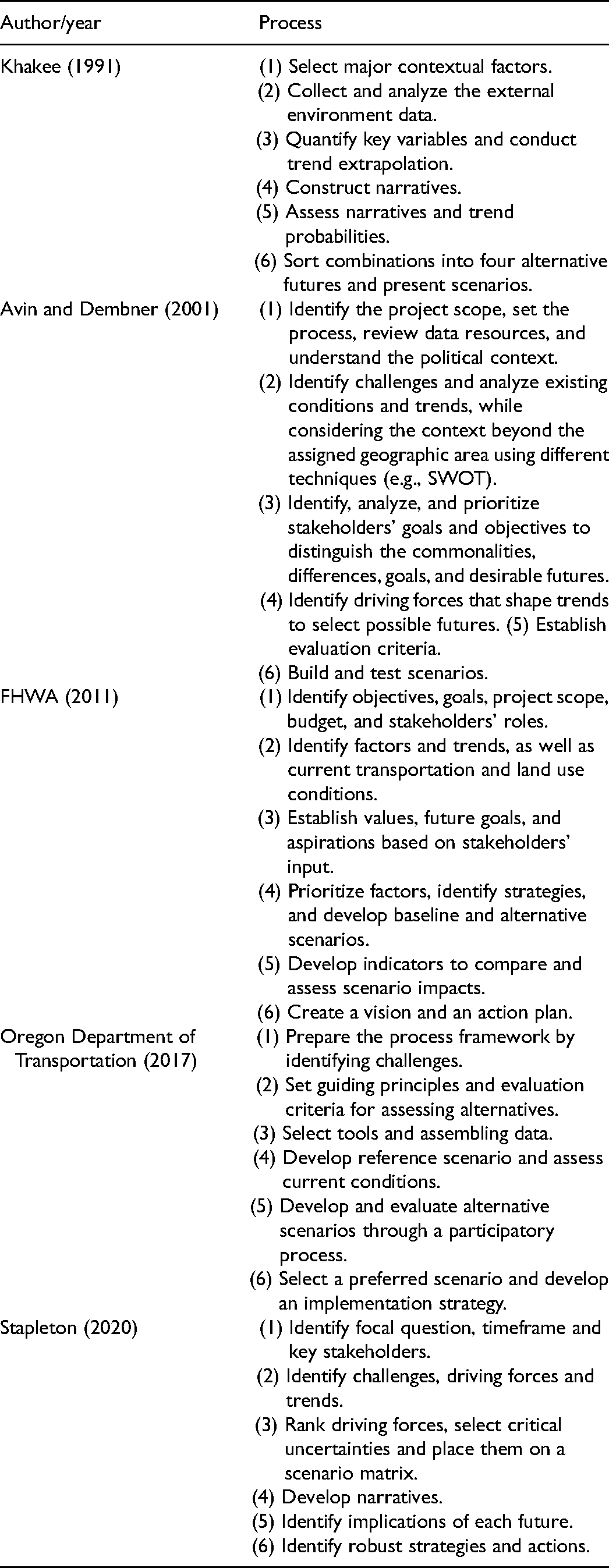
Avin and Goodspeed’s (2020) and Stapleton’s (2020) discussion of several exploratory scenario building projects revealed that most scenarios were developed through sequential processes and some projects yielded strategies, plans, or preferred scenarios. Selecting a desirable scenario from a range of exploratory alternatives is a widely established practice in urban design and planning, particularly in the US (Avin and Goodspeed 2020; ODOT 2017). However, choosing a preferred scenario from a number of exploratory alternatives is a controversial step since XSP inherently requires exploring multiple futures and incorporates contextual drivers beyond the stakeholders’ influence; whereas desirable scenarios reflect values and goals within the participants’ reach and may include competing visions based on the stakeholders dominating the process (Avin and Goodspeed 2020).
Based on our review, we affirm that the sequential phases and complementary approaches used in a scenario-based process can vary across different exercises. Within this section, we discuss a scenario planning process highlighting different phases and issues.
Defining the Scenario Agenda
The first phase of a scenario building process provides a scoping framework and results in a workplan that identifies the goals, scope, level of effort, stakeholders involved, scenario approach selected, and desired outcomes. It also delineates the focal question, the exercise's aim, and time horizon. Defining the goals, topical breadth and spatial extent can help determine which stakeholders to engage, the public outreach strategy, and the research and analytical tools required, given the available resources. The scenario approach used, whether intended to inform policies and plans or build a common understanding of imminent issues, should serve the project's goals and outcomes (Ange et al. 2017). The level of effort and resources can vary from high, which may involve sophisticated analysis, tools and models and a rigorous public engagement strategy, to low which builds on small groups, qualitative tools and information to think about the future. Within this step, it is also important to define the organizational structure, assign responsibilities, and conduct interviews with stakeholders to gather insights on values and interests (Stapleton 2020; van der Heijden 2005). With a larger number of affected people, the project will likely have a longer time horizon, involve greater complexity and uncertainty, and require a structured scenario process (Wiebe et al. 2018).
Number of scenarios
The appropriate number of scenarios varies between scenario-based projects where many develop three to five alternatives. Constructing two scenarios may indicate extremes: a desirable versus an undesirable scenario which neither broadens thinking nor provides new insights into the project (Bartholomew 2007; Hickman and Banister 2014). XSP typically results in four scenarios, in addition to a reference scenario, particularly when implementing the 2 × 2 matrix ‒ a prevalent yet not necessarily a preferred practice (Stapleton 2020). Xiang and Clarke (2003) offered a detailed discussion on the appropriate number of scenarios and suggested a range of two to seven. When simulation models are involved, thousands of runs can be readily produced, through sensitivity analysis, as a preliminary exercise, and later compared and condensed into a smaller number. Overall, formulating a large number of scenarios may complicate an exercise given the difficulties in managing numerous combinations of assumptions (Amer, Daim and Jetter 2013).
Scale and authority
Working across different scales enriches scenarios and involves various stakeholders. By analyzing contextual uncertainties at the broader scale and considering their implications on scenarios at the lower levels, scenario planning accounts for the interconnectivity and interactions between system components. Although broader geographic scales may complicate processes, they can also contribute to efficiencies, particularly when addressing problems related to greenhouse gas (GHG) emissions or transportation, where regional approaches are far more impactful than the local scale (Stapleton 2020). While bottom-up processes are limited, most scenario development exercises “scale-down” contextual or higher-level scenarios.
A critical driver in scenario-based projects is the authority and power of involved institutions. Generally, a mismatch exists between the scale of analysis and the extent of an institution's authority to implement actions (Bartholomew 2007). While empowered counties in the US, such as San Diego and Sacramento, often conduct scenario planning projects, other small regions may opt not to given the lack of resources, power, expertise and funds (Chakraborty and Sherman 2020). Due to scant resources, lack of authority and inadequate state and federal mandates, many agencies and MPOs are hampered by the effective use and implementation of land use-transportation scenario planning (Barbour and Deakin 2012). Accordingly, effective regional land use planning is deterred in the US as local governments control land use (Sciara 2014). Given the lack of a regional authority or framework of interinstitutional coordination across different levels, the result is often a fragmented regional and land use planning and policymaking.
Data Collection and Analysis
Most projects involve gathering information, data and maps to develop a thorough understanding and assessment of the historical and current conditions and challenges. Community values, goals and aspirations are also gathered to formulate working principles and indicators that are later used to evaluate scenario performance (FHWA 2011).
Factors and key drivers, often selected along the PESTLE categories, are identified using brainstorming workshops, Delphi methods, expert interviews, etc. They are later narrowed down and prioritized using the Wilson matrix (assessing drivers based on their degree of future uncertainty and impact) or cross impact analysis (comparing a number of identified trends and assigning a score reflecting the strength of causal links) among other techniques (Amer, Daim and Jetter 2013; van der Heijden 2005). For example, the Atlanta Regional Commission derived insights and drivers from the National Cooperative Highway Research Program Report 750 Foresight Series and tailored Impacts 2050 pre-specified scenarios to highlight Atlanta's drivers of change (ARC 2016). Drivers’ root causes are also traced and causal relationships between driving forces are established to later design systemic solutions (Stapleton 2020). Given the large number of driving forces and the difficulty of explaining and communicating their contingencies, low tech efforts, such as flow charts, and causal loop diagrams are used to illustrate links and discuss drivers among lay and informed audiences.
Using the data collected, a reference scenario is developed and indicators are identified to evaluate and compare alternatives at later stages. A baseline scenario assumes that current trends, policies, and investment patterns remain unchanged through the planning timeframe and integrates analyses of predetermined forces (FHWA 2011). The baseline data are used to customize the scenario analysis tools and calibrate models. For example, the Baltimore-Washington region's project used the Prospects for Regional Sustainability Tomorrow modeling suite to create a baseline scenario by projecting the impacts of current plans, policies, and driving forces (Knaap et al. 2020). Alternative scenarios are typically compared against the reference scenario and baseline assumptions to understand tradeoffs and impacts of change, identify actions needed, circumvent imminent challenges or adapt to uncertainties (Ange et al. 2017; ODOT 2017).
Drafting Narratives
This phase consists of formulating multiple qualitative scenarios that cover a broad range of possibilities. Stakeholders’ assumptions and values are explicitly laid out. Clustered drivers are combined through causal chains to formulate first-generation or raw scenarios. When the application of causal or inductive reasoning is challenging, other tools and deductive methods, initially used to reduce the number of drivers, can be implemented to support the scenario building process. Examples of these tools include morphological analysis, used for selecting possible and compatible combinations of assumptions, and the 2 × 2 matrix, also known as the four quadrants matrix or the scenario-axis technique, which distills drivers into two critical uncertainties to develop four scenarios (Amer, Daim and Jetter 2013; van der Heijden 2005). The prevalence and appeal of the 2 × 2 matrix are attributed to its clear and communicable structure. However, narrowing down an array of driving forces to the two most uncertain and impactful drivers is less apt to give insights into the complexities and causal relationships and can result in simplistic scenarios (Ramirez and Wilkinson 2014). While certain projects applying the 2 × 2 matrix consider polarized outcomes to create differentiated scenarios, others expand the structure to three axes or implement sophisticated tools. By doing so, they risk complicating the analysis and overwhelming participants (Avin and Goodspeed 2020). However, depending on the project and context, complex forms of analysis may be necessary to develop rich scenarios.
To create the Future Freight Flows scenarios, Caplice et al. (2013) comprehensively analyzed driving forces and provided a clear description of the XSP development and application. Drawing on the presentations of experts, attendees brainstormed potential driving forces that the team analyzed and consolidated into 12 snapshot scenarios. During an interactive workshop, estimates of each driving force's impact on the market and influence on the freight system were set. Based on the 12 snapshot scenarios and the participants’ feedback, the team developed a web-based survey that was distributed to many freight stakeholders for ranking driving forces based on their impact and probability of occurring. Results were further analyzed to classify different drivers and determine the underlying logic for the scenarios. The team selected the level of trade and resource availability as two critical dimensions to define four exploratory futures and develop narratives.
When raw scenarios are drafted, they are given a name that encapsulates their gist. Urban designers and planners widely employ these qualitative scenarios as tools to emphasize challenges and priorities, engage stakeholders, embrace local values and “generate alternative objectives that are not possible in a purely data-driven system” (Chakraborty 2011, 388). GIS maps, sketches, 3D models, virtual reality, interactive components and urban simulators are effective visualization tools that provide a common language and enhance public participation and accessibility (Al-Kodmany 2002). For example, Böttger, Carsten and Engel (2016) used storylines and maps to depict three scenarios that encapsulated spatial, social, and environmental driving forces and illustrated how Germany could change in 2050 .
Modeling
Digital tools are widely used in urban and regional planning to model future development patterns and urban dynamics. With increasing computational power, attempts to combine GIS, large-scale urban modeling, and decision support systems have contributed to the rise of PSS ‒ geotechnology instruments and information infrastructure used for planning tasks (Geertman and Stillwell 2020; Klosterman 1997). Introduced as a response to top-down black-box models (Lock, Bain and Pettit 2021), PSS are used for designing, analyzing, assessing and visualizing scenarios to enhance system understanding. While various scholars have differentiated between different types of PSS (Avin, Cambridge Systematics and Pantode 2016; Goodspeed 2020; Klosterman and Pettit 2005), we focus on sketch tools and urban system models used in the planning context.
Sketch tools
Scenario sketch tools have been used to analyze and evaluate transportation, land use, energy, and GHG alternatives, particularly across local scales. Avin, Cambridge Systematics and Patnode (2016, 1–3) defined sketch tools as “simplified, agile spatial tools that require limited data and can generate multiple scenarios of the built and natural environment and provide rapid feedback on their impacts”. These lightweight tools are less theoretically-derived, non-calibrated, and provide limited support for the scenario building process. Examples include UrbanFootprint, CommunityViz, and Envision Tomorrow Plus (ET+). In participatory workshops, sketch planning consists of either a GIS interface displayed on touch-sensitive monitors (e.g., MapTables) or gridded paper maps that participants use to sketch by hand and are simultaneously entered into the sketch tool by a technician (Vonk and Ligtenberg 2010).
Mostly focused on land use planning, sketch tools depart from conventional historical planning to analyze alternative land-use patterns and entail place-types that are formed by combining area and development types (a block consisting of building prototypes). Given the sketch tools’ level of detail, scenario analysis can be conducted using descriptive summaries and indicators can be derived. Despite their limited interoperability with heavyweight models, various sketch tools at the local scale are coupled with middleweight models at the regional scale, such as Impacts 2050, to develop comprehensive land use patterns and provide timely results, sensitivity, and exploratory scenario analysis.
While used in normative scenario planning, most sketch tools do not fully supplement the growing interest in XSP. Thus, further research is needed on lightweight tools that support the development of exploratory and robust scenarios. In addition to their inadequacy to fully capture system dynamics and complexities, sketch tools sometimes fail to incorporate participants’ discussions and qualitative non-spatial inputs during workshops. The cost of software varies between different sketch tools. Some costs are negligible compared to the fees of hiring and training staff and performing data maintenance. While ET+ is open-access and freely available, it has been outpaced by UrbanFootprint. As an ArcGIS extension, CommunityViz is affordable and flexible allowing users to program and customize formulas. Given its complexity and extensive need for user configuration, CommunityViz requires thorough learning compared to UrbanFootprint; yet both tools necessitate technical support and familiarity with spatial datasets which hinders their widespread usage. On that note, Avin, Cambridge Systematics and Patnode (2016) offered an extensive explanation and comparison of different sketch tools, their strengths and limitations.
Urban system models
Urban system models are theoretically-grounded, sophisticated, and data-intensive spatial models. They are based on theories and mathematical relationships to simulate a set of interactions between transportation, prices, land use, policies, demographic and economic systems across different scales (Klosterman 2012). Examples of these models include statistical integrated models (e.g., PECAS and TRANUS), cellular automata models (e.g., SLEUTH), and agent-based models (e.g., UrbanSim). These models are calibrated using historical data of input drivers to improve sensitivity to key factors and are used to simulate and map the consequences of core assumptions (Goodspeed 2020).
Complex models reflect causal relationships between a set of variables, their feedback loops, and their responses to policy issues. While certain heavyweight models are shifting to web-based applications that increase their adoption and accessibility to the public, they require technical expertise, are costly and cannot yet substitute the immediacy of sketch tools (Avin, Cambridge Systematics and Patnode 2016). Despite capturing system complexities and dynamics better than lightweight tools, urban systems models run the risk of holding to hidden, underlying, and sometimes unverified core assumptions and structural relationships given their large number of drivers and scale (Goodspeed 2020). Thus, when selecting digital tools, planners should carefully consider the model's suitability against the planning context and focus on integrating local knowledge to provide responses to policies rather than the model's complexity (Klosterman 2012).
Bridging Qualitative and Quantitative Approaches
Qualitative and quantitative scenarios are key tools for communication between science and policymaking. Qualitative scenarios consist of texts, images, and maps that describe future developments, while quantitative scenarios contain data and numerical outcomes that are largely generated through models. Linking qualitative and quantitative scenarios is a difficult task. In this regard, Mallampalli et al. (2016) reviewed different methods for translating narratives into quantitative interpretations including system dynamics, agent-based modeling, and Bayesian reasoning. Other approaches used were the Q2 scenario technique (Varho and Tapio 2013) and the Story and Simulation (SAS) approach (Alcamo 2008). Despite the large degree of complementarity, the SAS method is resource consuming and exhibits weaknesses in terms of the reproducibility of the analysis and the conversion of qualitative narratives to quantifications (Alcamo 2008).
XSP can be an effective tool for bridging qualitative scenarios and quantitative modeling (Stapleton 2020). A relevant example is the Austin Sustainable Places Project where participants developed land use plans using a gridded map and a set of colored stickers, each symbolizing a development type. A PSS operator worked with each group to simultaneously input the map into Envision Tomorrow. The sketch tool calculated future estimates of different drivers connecting the qualitative exercise and quantitative indicators and enabling participants to compare and evaluate scenarios (Goodspeed 2020).
Many scenario exercises initially develop qualitative narratives, that are subsequently quantified for modeling. Quantitative assumptions about key driving forces are derived from the storylines, transformed by experts into numbers and fed into models for calculations. Some participatory workshops use simple formats, such as signs or arrows, to represent an indicator's direction or rate of change, integrate stakeholders’ assumptions and facilitate communication between stakeholders and experts operating models. After running the model, a de-quantification step is required to incorporate the outputs into qualitative scenarios and correct held assumptions (Alcamo 2008; Wiebe et al. 2018). Alternatively, qualitative inferences and narratives could be retained and presented alongside model outputs to solicit feedback and engage stakeholders rather than merging quantitative and qualitative results.
Discrepancies often surface when translating qualitative storylines into quantitative scenarios. The limited availability of data often reduces the number of assumptions that could be integrated, particularly for complex models. While many models rely on spatially explicit data and measurable variables, nonspatial parameters that can influence planning and policy making are sometimes not captured. This conceptual drawback limits the inclusion of stakeholders’ values and qualitative variables (e.g., equity-related issues) in models (Avin, Cambridge Systematics and Patnode 2016). Kok (2009) also noted a mismatch between narratives and model inputs where few assumptions from narratives could be incorporated into models. When models used are limited in their inputs and outputs, the richness of the storylines is often compromised and their impacts and scope are narrowed down.
Comparing Scenarios and Plans through Indicators
Defined as the systematic assessment of plans, processes, and outcomes using specific criteria (Laurian et al. 2010), evaluation is an essential component of planning practice and theory. While evaluating scenarios, various scholars (Ange et al. 2017; Caplice et al. 2013; Xiang and Clarke 2003) argued that a “good” scenario incorporates plausible and unexpected futures that are internally consistent, challenging and coherent; presents diverse and competing views of the future; provides connections to critical issues that could be integrated into strategies and policy; and supports comparative insights.
Indicators and performance metrics are used to evaluate and compare scenarios, inform trade-off discussions and support decision-making (Perdicoúlis and Glasson 2011). As quantitative measures, indicators are separated into three types: system performance, policy and program, and rapid feedback indicators (Innes and Booher 2000). When evaluating scenarios and their impacts, planners can employ qualitative or quantitative approaches, such as roundtables, working groups or GIS-based scenario analysis sketch tools and models. Qualitative and quantitative indicators can correspond to different themes such as land use, transportation, or other PESTLE categories (FHWA 2011). Indicators can be derived from scenario narratives (drivers to which the analysis is sensitive), stakeholders’ values and goals, or quantitative plans resulting from digital tools and models.
The selection of indicators is a critical task and can start prior to the scenario analysis phase. Tradeoffs must be considered during selection, as a higher number of indicators results in more comprehensive scenario analysis but requires more time, data and modeling. In contrast to complex models with a large number of indicators, some sketch tools have a limited number of built-in indicators (Avin, Cambridge Systematics and Patnode 2016). Indicators are also used to identify early warning signs based on key trends present in the scenarios. Using Impacts 2050, Zmud et al. (2014) identified key and lagging indicators to monitor imminent signposts—events or warning signals that indicate whether a plan's underlying assumptions are changing (Quay 2010) ‒ and conducted cross-impact analysis to determine key drivers associated with early warning signs.
Translating Scenarios into Actions and Plans: Formulating Contingent and Robust Plans
Scenario planning offers the advantage of translating possible scenarios into adaptive strategies and plans to enhance resilience against uncertainties. In this regard, contingent and robust plans, strategies or policies can support decision-making under uncertainty through a scenario analysis of internal and external forces of change. Contingent plans are essentially customized to specific scenarios whereas robust plans work well across multiple possible futures (Chakraborty et al. 2011).
Contingency planning, also known as anticipatory governance (Quay 2010) or exploratory scenario analysis (Knaap et al. 2020), is widely used in the climate, defense and corporate sectors, as it effectively accounts for high uncertainty and long timeframes. As a tool of scenario planning, anticipatory governance seeks to create and rigorously analyze numerous possible scenarios, their causes, and implications, using a set of indicators, and respectively craft contingent and robust plans (Quay 2010). Based on a hypothetical model's outputs for land consumption and traffic congestion, Chakraborty et al. (2011) illustrated the ways in which scenario planning can effectively address uncertainty through contingent and robust plans and support decision-making. However, their institutional exercise focused on formal analysis, and failed to consider the contradictory interests and values that typically emerge during participatory workshops. Following an exploratory scenario analysis exercise for the Baltimore-Washington region, Knaap et al. (2020) emphasized the dearth of contingency planning exercises given the difficulty of identifying robust and contingent policies with increasing decision-making complexity. Indeed, many scenario planning efforts do not result in plans but rather only in insights and recommendations. Through their repertoire-building approach, Avin and Goodspeed (2020) noted the dearth of scenario-based planning projects that yielded plans and achieved through XSP the theoretical goal of developing robust and contingent policies or actions. Additionally, many XSP projects struggle to connect scenarios to effective decisions and are sometimes discontinued after presenting the outcomes of different narratives.
Evaluating Scenario Planning Processes and Plans
Evaluating plans, planning processes, and outcomes is necessary to establish an intervention's advantages, gain more knowledge of the context, improve subsequent plan evaluations and implementation and increase the likelihood of adopting recommendations (Oliveira and Pinho 2010). Three types of evaluation exist in planning literature: (1) ex ante, taking place at the beginning of the planning process and referring to the selection of a plan from a set of alternatives; (2) ongoing, occurring simultaneously with the plan's implementation and involving constant monitoring of identified outcomes; and (3) ex post, involving a plan's implications and applied to ascertain whether an implemented plan has met the objectives (Guyadeen and Seasons 2016). While various scholars discussed different criteria to evaluate plans (Baer 1997; Laurian et al. 2010; Shahab, Clinch and O’Neill 2019), Hopkins (2001) proposed four broad criteria: effect (i.e., whether the plan affected decision-making, actions and outcomes); net benefit (resulted in benefits that compensate the costs); internal validity (had an internally consistent logic); and external validity (sought outcomes that are ethically appropriate).
Systematic approaches to evaluate scenario planning processes, plans and outcomes remain limited in urban planning literature, with few notable exceptions (Goodspeed 2020; Oliveira and Pinho 2010). Building on evaluation studies in urban planning, environmental planning, and management, Goodspeed (2017) proposed a framework to evaluate performance across three levels: individual, organizational, and geographic units; and against three theoretical perspectives: psychological (individuals), institutional (outcomes related to social structure), and system (shifts in the social and physical elements in urban systems). In a similar vein, Allred and Chakraborty’s (2015) post-hoc evaluation operationalized the Sacramento Blueprint principles into 19 performance measures to evaluate the degree of conformity between post-plan residential developments and the plan's objectives. Their evaluation revealed that post-plan developments occurred in neighborhoods that did not score high on the plan's principles, and that certain jurisdictions adopted the plan depending on their needs and interests.
Overall, evaluations should consider an outcome's priority, “ease of measurement”, scale of analysis and timeframe of measurement (Goodspeed 2020). Long timeframes are preferable to investigate the long-term implications of plans and institutional changes. Evaluation instruments can be classified into three categories: surveys, questions customized to the project's content, and structured interview protocols (Goodspeed 2017). Various studies used these instruments before or after scenario workshops to evaluate scenario processes, plans, and policies. There is an increasing need not only to consider the plans’ tangible outcomes, such as policies and decisions, but to evaluate the impact of planning on participants by examining their learning experiences, shifts in perspective, or social connections developed (Goodspeed 2020). Studies that employed surveys corroborated that learning occurred among scenario planning project participants, but documentation on transformational benefits and shifts in perspectives remain underrepresented in urban planning literature (Zegras and Rayle 2012). In this regard, Zapata (2013) interviewed participants in the Valley Futures Project five years after the scenario workshops’ completion and found that while transformative learning occurred and persisted over time, the organization that conducted the workshop did not provide support or necessary infrastructures to translate learning into actions.
Scenario Planning Project Example
In this section, we briefly elaborate on the Plan Bay Area 2050 project to illustrate the steps taken throughout a scenario planning process.
The Metropolitan Transportation Commission (MTC) and the Association of Bay Area Governments (ABAG) conducted a scenario planning exercise to develop Plan Bay Area 2050 ‒ a long-range integrated land use and transportation plan for the nine-county region (ABAG and MTC 2020). Contrary to past plans where a preferred future was selected, MTC and ABAG staff along with stakeholders developed, through a day-long peer exchange workshop, eleven future alternatives that were later narrowed down to three scenarios (ABAG and MTC 2020). Each scenario focused on a primary “what-if” question and incorporated a number of external forces with differing assumptions for 2050. To analyze the three scenarios and evaluate their impact on the Bay Area, MTC and ABAG coupled a suite of models where outputs from the Regional Economic Model Inc. were fed as input into the Bay Area UrbanSim land use model; thereafter, the outputs of the land use model were coupled with the MTC regional travel model. The first round of analysis assumed that the region maintains current strategies in response to emergent issues and simulated current policies and investments. This analysis started with the baseline conditions of 2015, highlighted challenges and opportunities on affordability, connectedness, diversity, environmental health, and economic vibrance; and concluded that current strategies did not adequately mitigate imminent risks.
In the second round, MTC and ABAG staff analyzed additional strategies across the three futures to identify robust strategies, their impact on the Bay Area and their efficacy in improving regional outcomes. Fiscal revenue generating evaluations were also modeled. While the strategies differed across the two rounds, the assumptions on external forces remained the same. Comparing both rounds of analysis, results revealed how new policies can enhance regional outcomes. During these phases, sensitivity analysis was conducted to understand the impact of individual strategies for each future (ABAG and MTC 2020).
MTC and ABAG later developed a Draft Blueprint that comprised equitable and resilient strategies across four themes: transportation, housing, economy, and environment. The Draft Blueprint was shaped by public engagement around the Bay Area and focused on prioritizing robust strategies that could be advanced by local jurisdictions, regional agencies or the state (ABAG and MTC 2021). Since the plan is fiscally constrained, certain strategies were only incorporated. As the COVID-19 pandemic evolved during the development of the long-range plan, MTC and ABAG staff communicated again with residents to understand their challenges and incorporated changes into the plan. Subsequently, new strategies were added and the final plan was published (ABAG and MTC 2021).
While strategies are identified at the local, regional and state levels, authority is fragmented in the region. No single agency can implement the strategies across different scales and thus coordination between governments and partners is key. MTC and ABAG proposed an implementation plan, with a series of specific actions, and identified strategic partners and priorities over the next five years. Additionally, they conducted a strategy assessment to understand the potential cost of implementing each strategy, the revenues generated, and the budget required to support the plan's implementation. However, the agencies identified a gap between the existing and required revenues to implement the plan and emphasized the need for new funding sources.
While federal guidelines promote scenario planning approaches, they typically do not recognize multiple outcomes and favor a single prediction or a preferred scenario (ABAG and MTC 2021). Contrary to this mindset, Plan Bay Area 2050 sought to explore different futures for a more resilient and equitable region. The process conducted rigorous robust and contingent analysis to understand the performance of strategies and provided a successful example of an XSP that yielded a plan (Figure 1).
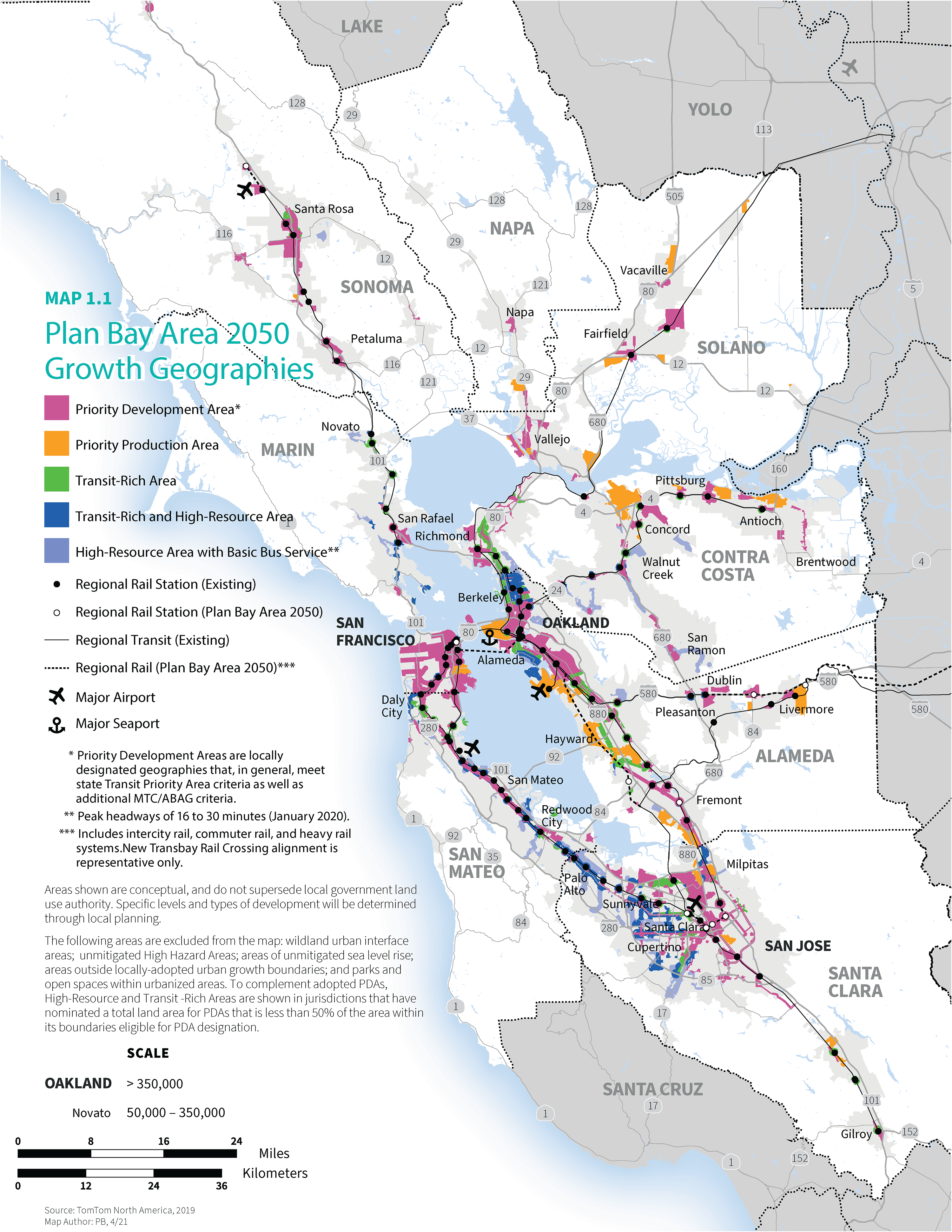
The project identified priority areas where future growth would be focused in the context of the proposed strategies (ABAG and MTC 2021) (With permission from ABAG).
Discussion
Increasing complexities challenge decision-makers and planners alike and call for the use of scenarios to inform planning processes. We reviewed different scenario approaches including forecasting, visioning, backcasting and XSP and highlighted their merits and limitations. This review served to resolve the confusion given the glut of approaches and sought to guide planners to select the relevant approach based on their needs and expected outcomes. Additionally, we provided an overview of a scenario building process with the initial phase requiring the development of a workplan, and subsequent phases necessitating study area analyses, identifying drivers, uncertainties, and their interrelationships, as well as developing raw scenarios. These steps involve creative thinking and are analytical in nature, highlighting the significance of the systems thinking approach that underpins the scenario planning process. Throughout the modeling and evaluation phases, the impacts of the developed scenarios are analyzed to improve decision-making and adapt to possible upcoming risks through contingent and robust plans.
Despite increasing interest, evaluation in scenario planning practice remains limited (Allred and Chakraborty 2015; Goodspeed 2020). Implementing evaluation methods to monitor performance and progress would highlight the benefits and weaknesses of the approach used. As one of the resource-demanding approaches, it is necessary to build on the evaluation of scenario planning efforts to improve the approach and potentially develop new methods, tools and techniques to sustain and advance the practice. Despite its increasing use across crosscutting issues, such as climate change, the potential of XSP is yet to be fully explored in urban design and planning practice. In this regard, planning can borrow new techniques from other disciplines, such as environmental sciences, where the application of XSP approaches is more common and methods for bridging qualitative and quantitative structures are robustly tested. Intergovernmental coordination and matching of scenario analyses with the level of authority are key to facilitate the implementation of outcomes. Practical guidance to conduct scenario analysis and develop robust and contingent plans could offer insights to address uncertainties, raise public awareness, provide opportunities for policy evaluation and help planners understand and further scenario-based planning practice.
Effective scenario planning seeks to bridge between different scales and form a common ground for diverse and often contrasting perspectives. Scenarios can contribute to effective decision making by broadening users’ thinking about the future (stretching) and spurring communication and knowledge exchange between diverse stakeholders and scenarists in a participatory framework (bridging) (Xiang and Clarke 2003). Embracing qualitative and quantitative perspectives—despite challenges in linking both structures—can contribute to effective scenario planning, improve the participation of diverse stakeholders and cover a broad range of a community's priorities (Wiebe et al. 2018).
Constructive scenario exercises adapt scenario planning methods and tools to their needs. While many scenario-based planning projects are essentially qualitative, others benefit from digital tools and models, particularly when iterations are required to refine and verify results, or stakeholders are faced with tough decisions where the testing of impacts and tradeoffs between scenarios is necessary. Stapleton (2020) demonstrated that effective XSP can result in insights and guide policy per se without the use of tools and models. Generally, regional-scale projects and large organizations, counties and cities are capable of this quantitative level of analysis. Prior to applying any tool, careful examination and tuning is needed to ensure that fundamental assumptions align with the context.
Recent advancements in artificial intelligence, Internet of Things, immersive environments and big data are important, as they create new possibilities for broadening the scope of PSS and improving the analysis and visualization of the built environment (Geertman and Stillwell 2020; Lock, Bain and Pettit 2021). While some tools are used in stakeholder and community workshops to illustrate the consequences of certain policy decisions in real time, there remains a low interest and awareness among urban planners to use PSS (Pettit et al. 2018; Vonk, Geertman and Schot 2005). Open access, web-based and simplified tools are also needed to enhance the outreach and accessibility of PSS and improve scenario-based planning practice, particularly for communities that lack the resources and capacity to conduct quantitative analysis. To increase their outreach, there is a need to empirically evaluate PSS performance in workshops (te Brömmelstroet 2013); develop an information infrastructure for PSS to support the effective use of scenarios and tools among stakeholders (Geertman 2017; Goodspeed and Hackel 2019); and match PSS types to planning tasks and contexts (Pelzer, Geertman and van der Heijden 2015).
Legislative Context
To help cities better respond to uncertainties, policies and regulations are necessary to support institutions and agencies electing to develop scenarios and plans. To attain climate targets, the State of California enacted Assembly Bill 32, requiring a statewide reduction of GHG emissions to 1990 levels by 2020 (Barbour and Deakin 2012). The Sustainable Communities and Climate Protection Act (SB-375) ensued in 2008 as the first bill passed in the US that coordinated land use, housing, and transportation planning to promote transit-accessible places and reduce GHG emissions from automobiles and light trucks (Mattiuzzi 2016). The Senate bill required MPOs to develop a sustainable communities strategy that depicts locations and development types to reduce GHG emissions. Under SB-375, which derives from blueprint planning and antecedent participatory visioning initiatives in California, alternative growth scenarios are developed. While federal guidelines promote scenario approaches, they do not permit multiple predictions and outcomes and typically adopt a preferred future to guide regional and local land-use transportation decisions. As a result, regional planning and MPO plans remain rooted in normative and predictive thinking (Lempert et al. 2020). This practice, which is inadequate in the context of increasing uncertainties, limits the potential of SB-375 and the full application of XSP to regional planning. Mawhorter, Martin and Galante’s (2020) recent evaluation of SB-375 averred that its potential is not fully realized, with modest impacts on actual development patterns. The authors’ findings are similar to notions presented earlier that attributed the shortcomings not only to the disconnect between authority and responsibility ‒ since the extent to which the law is implemented is dependent on local jurisdictions, their technical capacity and political acceptance—but also to limited resources, inadequate funding for implementation and legislative compromises (Barbour 2020; Mattiuzzi 2016). Other similar bills include Oregon's renowned land use legislation, known as Senate Bill 100, that was passed in 1973 institutionalizing planning and requiring cities to develop a comprehensive plan that aligns with the state goals. In 2010, Senate Bill 1059 was passed mandating MPOs, cities, and counties to conduct scenario planning to evaluate land use and transportation alternatives and align plans with the GHG emission reduction targets (ODOT 2018). Similarly, federal laws such as Fixing America's Surface Transportation Act support yet do not mandate the application of PBPP through scenario planning to develop a transportation plan (FHWA and FTA 2018).
Endeavors for enshrining scenario planning and thinking in national schemes and legislations beyond the US were very limited. For example, the Foresight for Cities project in the UK, launched by the Government Office for Science (GO-Science), involves a set of tools for policymakers and planners to incorporate long-term future thinking in planning processes (GO-Science 2016). Similarly, the European Union supports foresight programs and projects driven by the European Commission (Dreyer and Stang 2013). Other notable contexts that promote the use of scenarios include Finland (requires foresight studies by the Committee of the Future), Russia (mandates strategic planning through Federal Law 172) and the Netherlands (OECD 2019; Salewski 2012).
Scenario Exercises Across the Global South
Based on our review, scenario planning is mandated by institutional contexts and employed more in the Global North than in the Global South, with few notable examples. These include developing scenarios through a participatory process for Metropolitan Tunis, Tunisia (Barbanente, Khakee and Puglisi 2002), formulating sustainable, low-carbon transport futures for the Mexico City Metropolitan Area (Steurer and Bonilla 2013) and developing possible scenarios through a collaborative framework for the Costa Rican region of Monteverde (Harwood and Zapata 2006).
Future Directions
Based on our literature review, future research should focus on improving PSS tools and models and developing a robust PSS infrastructure to further scenario-based planning practice. Additionally, approaches and methods that link qualitative narratives and quantitative scenarios are necessary to inform decision-making and effective scenario planning. Further research is also needed to establish a common framework that facilitates comparison between different scenario projects, processes, and outcomes and that improves the systematization, implementation and development of more effective and transparent scenario methods and techniques. In that regard, a detailed database of scenario exercises and results, is key to exchange knowledge and support context-specific exercises. Institutions and agencies, such as the FHWA, the American Planning Association, and the Lincoln Institute of Land Policy with its Scenario Consortium group—a leading forum in the US where communities and practitioners engage in a constructive dialogue—can also support such efforts to empower communities by sponsoring and disseminating scenario-related research and offering access to resources and practitioners. Institutional structures and legislations that foster and incentivize scenario-based planning are necessary across different contexts. With more scenario exercises implemented across government agencies and through private initiatives, opportunities to develop new scenario concepts and optimize methods will become more viable. The evaluation of scenario-based planning processes and their outcomes and the development of robust and contingent plans and strategies are key to effective decision-making. Thus, further studies are needed to understand the ways in which evaluation practices and their methodological developments can be integrated in scenario-based planning processes. Additionally, more guidance is necessary to support projects and practitioners in the development of robust and contingent plans. Finally, additional explorations into the theoretical underpinnings of scenario approaches and methods are still needed to improve scenario exercises in urban design and planning.
Footnotes
The authors sincerely acknowledge the constructive comments of three anonymous reviewers which substantially improved the quality of the review article. We also would like to express our gratitude for the financial support provided by the "Strategic Networking of the Leibniz Competition in the Context of a Leibniz Science Campus" supported by the Ministry of Science and Culture of Lower Saxony, Germany.
Declaration of Conflicting Interests
The author(s) declared no potential conflicts of interest with respect to the research, authorship, and/or publication of this article.
Funding
The author(s) disclosed receipt of the following financial support for the research, authorship, and/or publication of this article: This work was supported by the Ministry for Science and Culture of Lower Saxony, Volkswagen Foundation (grant number ZN3121).
