



Abstract
The term “behavioral” has become a hot topic in recent years in various disciplines; however, there is yet limited understanding of what theories can be considered behavioral theories and what fields of research they can be applied to. Through a cross-disciplinary literature review, this article identifies sixty-two behavioral theories from 963 search results, mapping them in a diagram of four groups (factors, strategies, learning and conditioning, and modeling), and points to five discussion points: understanding of terms, classification, guidance on the use of appropriate theories, inclusion in data-driven research and agent-based modeling, and dialogue between theory-driven and data-driven approaches.
Keywords
The term “behavioral” in the context of behavioral sciences has become especially fashionable in recent years as an innovative and alternative approach in many disciplines. These not only include the disciplines considered part of behavioral sciences such as psychology, cognitive neuroscience, sociology, and behavioral economics (University of Cambridge 2018; Adhikari 2016; London School of Economics 2018) but also health-care sciences, computer science, engineering, and education as well as the disciplines closely related to planning such as transportation, sociology, and environmental science (Web of Science [WoS] 2018a). One cause of this increased interest (Google Trends 2017; WoS 2018a) can be the substantial emphasis that the two recent Nobel laureates produced in behavioral economics, Kahneman in 2002 and Thaler in 2017, exponentially promoting the importance of behavioral theories for the sciences and social sciences in general. Another cause may be the large influence that an international bestseller book, “Nudge” (Thaler and Sunstein 2008), made on politics and business worldwide including the United States, United Kingdom, and Australia (Berg 2015; Bradshaw 2015; Chakrabortty 2008; Easton 2015). Along with this trend, many academics and practitioners have developed interest in applying various behavioral theories in their research: neural networks theory (e.g., Justo et al. 2017), reinforcement learning theory (e.g., Ertuğrul and Tağluk 2017), game theory (e.g., Gintis 2014), the theory of planned behavior (e.g., Wolske, Stern, and Dietz 2017), nudge theory (e.g., Abdulkadirov 2016), and prospect theory (e.g., Dasgupta 2017) to name a few.
Understanding and applying behavioral theories can be greatly beneficial in many disciplines including urban and environmental planning. Firstly, behavioral theories can take into account a variety of factors that affect people’s decision-making process (Morris et al. 2012). When choosing the means of transport for a trip, an individual may consider qualitative factors such as social reputation, heuristics, and even beliefs and values in addition to time, distance, and cost (Hensher et al. 2013). For example, in some cultures, individuals of medium or high social income levels may prefer taking a private car even if public transport is significantly faster. Likewise, other individuals who have pro-environmental values may choose to cycle even if it requires more time and effort compared to other means (Damant-Sirois and El-Geneidy 2015). Secondly, behavioral theories can provide a framework to model, explain, and predict behavior which may enhance the effectiveness of policy design and behavior intervention. For example, when modeling the behavior of household locational decision from a set of household survey, theories can provide the rationale for the rules, variables, assumptions, and parameters that form the basis of an analytical model, enable the explanation of “how, why and what now” in addition to “who and what” (Elragal and Klischewski 2017, 2; Wise and Shaffer 2015, 7), and allow generalization of the results to make the findings applicable in other contexts (Davis et al. 2015).
Although some of the theories about human behavior have been in existence for some time, such as reinforcement learning theory (Thorndike 1898), the concept of behavior is so broad that it is difficult to figure out which theories can be considered behavioral theories across all fields of academic research. While behavioral theories have been previously reviewed, there is a gap in the literature because they are mostly confined to specific fields with a focus on behavior change and intervention. In the health sector, Michie et al. (2005) identified thirty-three psychological theories for behavior change through expert consultation and Munro et al. (2007) presented nine behavior change theories by reviewing health-related journal databases. Also, Davis et al. (2015) went through a review of nine health-related journals and identified 276 journals and eighty-two theories of behavior and behavior change. In environmental science, a report by the UK Forestry Commission’s research organization performed a key word search on bibliographic databases, reviewed eighty-seven key documents, and shortlisted five key theories of behavior and behavior change classified into individual and social (Morris et al. 2012). More recently, Schlüter et al. (2017) viewed behavioral theories as theories on human decision-making, selected six key theories from a variety of research areas and types of behavior (individual, social, and environmental), and positioned them in the framework in an attempt to facilitate their application in the modeling of social–ecological systems. In transport, the UK Department for Transport published a Behavioral Insights Toolkit focusing on how to achieve policy objectives with regard to transport behavior referring to neoclassical economic theories, psychological theories, behavioral economic theories, sociological theories, and theories of change (Savage et al. 2011).
Some literature attempted to review behavioral theories for general application; however, there is not yet a publication that systematically reviews the academic journal database across all disciplines to provide a comprehensive landscape of behavioral theories. For example, the UK Government Social Research produced a behavior change knowledge review that describes over 60 social–psychological models, distinguishing them into models of behavior and theories of change, yet this was based on contacting key individual experts to ask for relevant sources (Darnton 2008, 75). There is much more room to synthesizing how we conceptualize, model, and formalize behavioral theories in the era of data-driven research and big data analytics in addition to guiding our understanding, selection, and use of behavioral theories for particular uses.
In order to attempt to fill this gap, this article performs a systematic literature review to identify theories of general human behavior that can be applied to all disciplines but especially to social sciences including planning. The reason why this article takes a general approach rather than zooming into the planning-related fields is because there are many behavioral theories used in other disciplines that are not being applied yet in the field of planning but have the potential to be. At present, only a few popular behavioral theories are being applied in planning such as the theory of planned behavior in transport (e.g., Castanier, Deroche, and Woodman 2013; Silva and Wu 2014) and prospect theory in housing and real estate (e.g., Dunning 2017). It is important for planners to broaden their horizon and be aware of the full list of behavioral theories available across disciplines. This article takes a step forward from the existing literature by expanding the search database to “all database” in the WoS rather than a few preselected journals. In addition, we employ the concept of “mapping” and present the map as a diagram instead of a classification table.
This article will first explain the methodology of the systematic literature review and provide a conceptualization of the type of behavior. Then, it will present a comprehensive list of the sixty-two behavioral theories, classification, and mapping of the theories in a diagram by disciplines of origin and an analysis of the selected literature. Finally, discussions will be made about the implications from the literature review process for further research and the importance of behavioral theories in the era of big data analytics followed by a conclusion.
Methodology of the Systematic Literature Review
This article uses the definition of the term “behavior” as “the way in which an animal or person behaves in response to a particular situation or stimulus” (Oxford Dictionaries 2018). There is an immense amount of literature on behavioral theories across disciplines: there are 96,700 publications on the WoS’s all databases that contain “behavio(u)ral theor(ies)” in topic from 1900 to 2017 (WoS 2018b). Therefore, this study attempted to filter the most significant and relevant papers in recent years, having a focus on general human behavior in a general living environment, which can be especially applied to the fields of social sciences such as psychology, sociology, economics, political science, and geography.
First, from all databases on WoS, we used the search key word “behavioral theory OR behavioral theories OR behavioural theory OR behavioural theories” (hereafter “behavio(u)ral theor(ies)”) for title only and received 963 results in the time frame from 2000 to 2017. While psychology, behavioral sciences, and business economics were top three research areas identified, seven areas of twenty-five were closely related to health, for example, health-care sciences services and psychiatry (Figure 1). We realized that many publications deal with specific behaviors, for example, health-related disciplines largely deal with patient behavior with regard to medication or treatment.
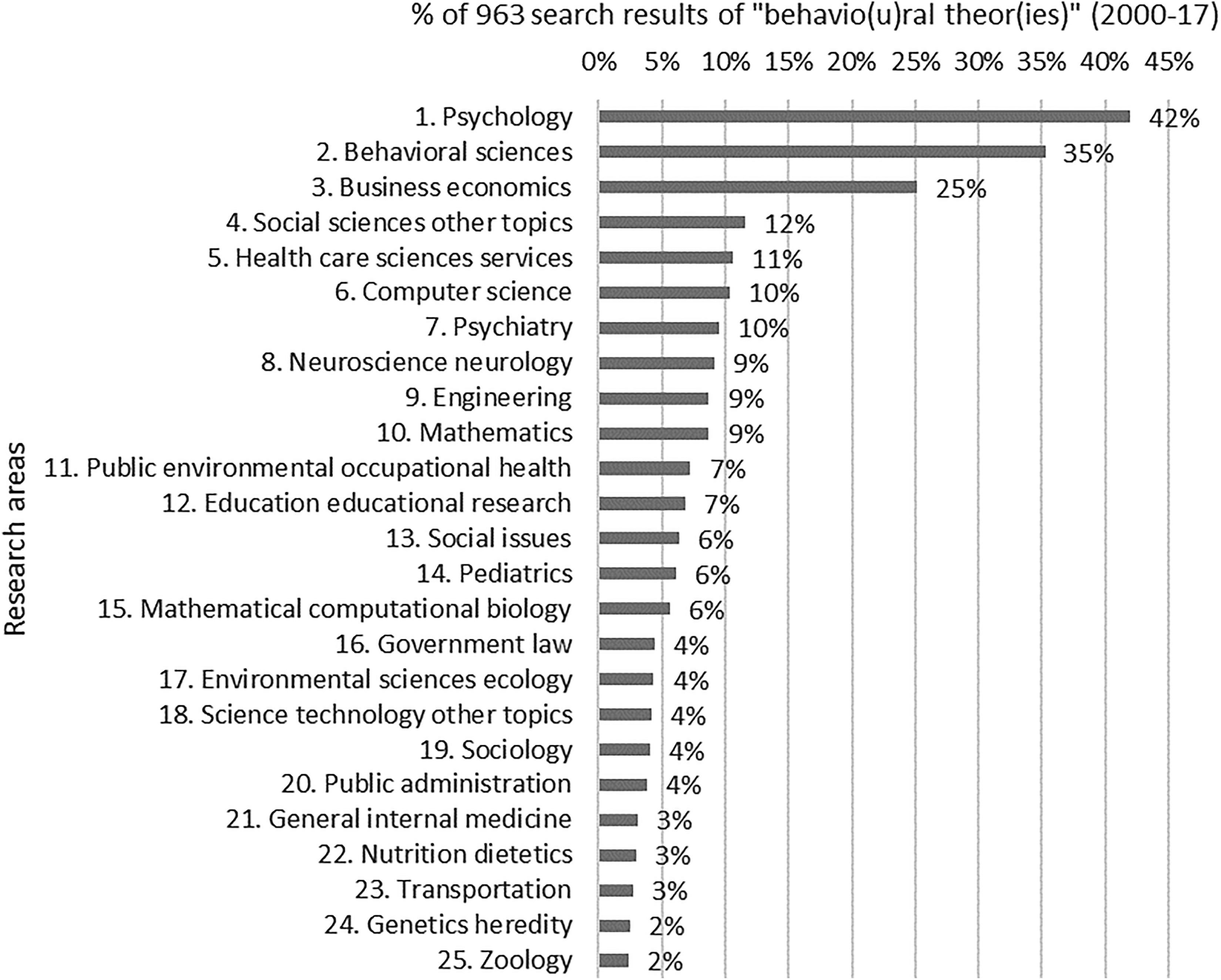
Top twenty-five research areas of the search key word “behavio(u)ral theor(ies)” (2000–2017).
Second, we used different thresholds for times cited according to the year of publication and narrowed down the results to 467 in total: 0+ for 2016–2017 (209 results), 5+ for 2012–2015 (105 results), 10+ for 2008–2011 (75 results), 15+ for 2004–2007 (53 results), and 20+ for 2000–2003 (25 results). We tried to include more recent publications to observe the current trend of research method while being stricter to older publications to only include the ones that were fairly recognized by other researchers.
Third, we noted the types of behavior that publications deal with while reading the abstracts of all 467 results and subselected 156 publications by setting the scope of this literature review to “general human behavior.” The list of 156 relevant results is provided in Online Appendix B, including the research area, key words, and theories associated with each publication. 1 Publications about nonhuman behaviors such as behavior of animals, particles, data, market, and firm were excluded unless they directly link to human behavior. For example, this article kept some conditioning theories that conduct experiments on animals to draw implications for human behavior. Similarly, topics like machine learning were kept because they make use of interesting theories of human behavior.
We classified the types of representations of human behavior identified during literature review into agent-based and activity-based: agent as in consumer behavior (e.g., Webb et al. 2013; Justo et al. 2017) and activity as in learning behavior (e.g., Ertuğrul and Tağluk 2017; Lu and Lee 2017). Then, we attempted to position them along a spectrum of specific to general behavior: specific behavior as in patient behavior (e.g., Kolanowski et al. 2011) and general behavior as in consumer behavior (Figure 2). We decided to exclude the behaviors that we considered more specific—those that deal with specific individuals or groups of people in specific settings—such as health-related behaviors (patient, substance abuse, sexual, and emotional), education, and child development-related behaviors (teacher and student, parent and child) as well as police and tourist behaviors. Literature about personality traits such as extraversion and introversion was also considered specific. On the other hand, we included those that we considered more general, that is, applicable to the general population in general living environment, such as public health behaviors (related to healthy diet and exercise, etc.), business, management, and finance-related behaviors (investor, consumer, employer, and employee, financial, and business), criminology-related behaviors (criminal, violent, and antisocial), and learning, pro-environmental, technology acceptance, driving, and cooperative behaviors. The diagram below is conceptual only and neither reflects the weighting of how frequently each behavior came up in the literature nor takes account of the hierarchy of behavior. For example, criminal behavior can be an overarching term that could include other behaviors like violent behavior while technology acceptance behavior is more distinct.
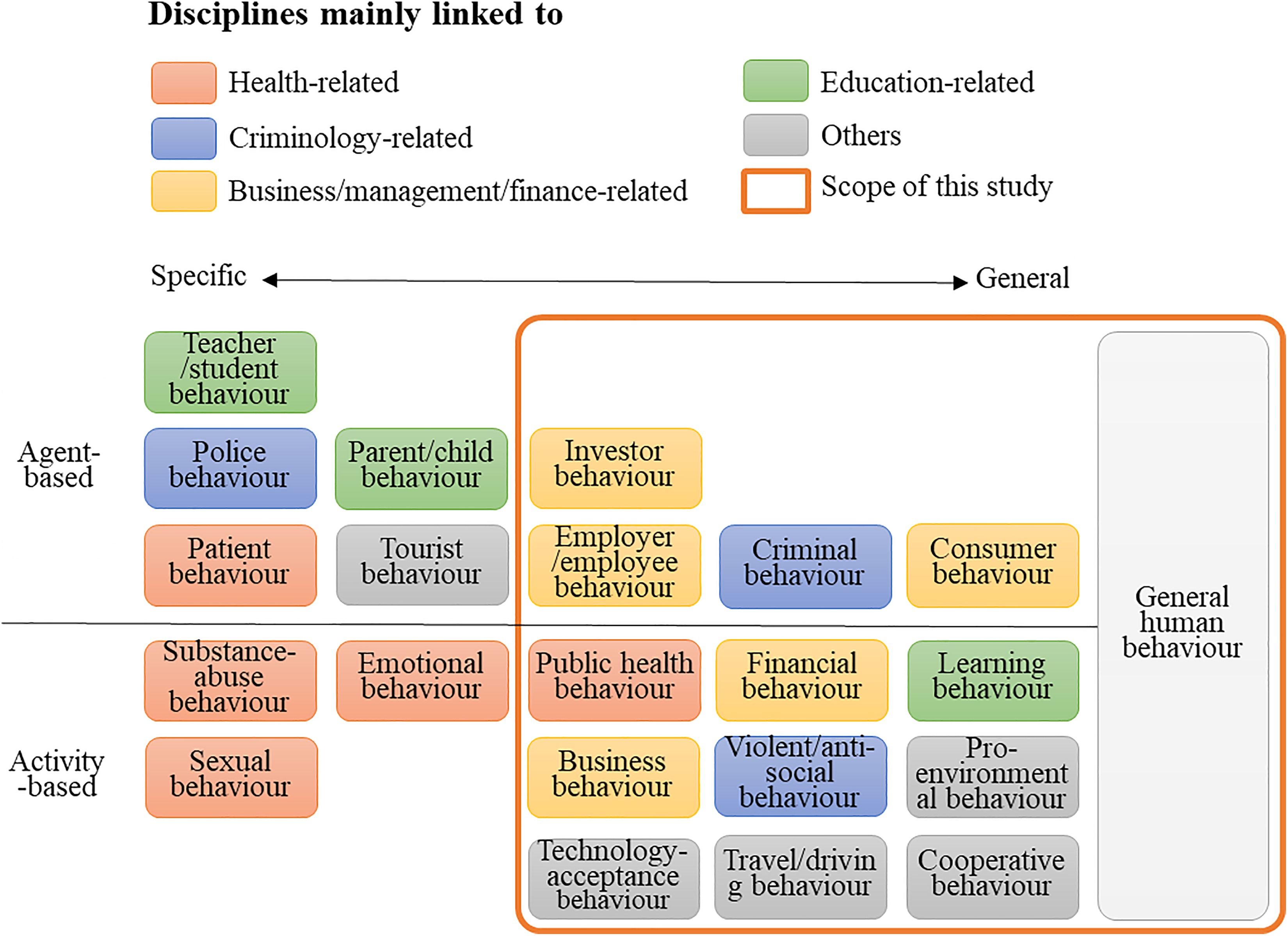
Types of human behaviors identified during literature review.
Fourth, we listed the total of eighty-seven theories used in the 156 relevant results with the following information: founder, year of publication, number of WoS search results (2000–2017) and search key words used, top five research areas, top three publication years, and a short definition of theories based on the literature review (Online Appendix A). For some theories, especially the ones that developed gradually over time, there may be other scholars who can also be considered as founders and other fundamental publications that are not identified by this article.
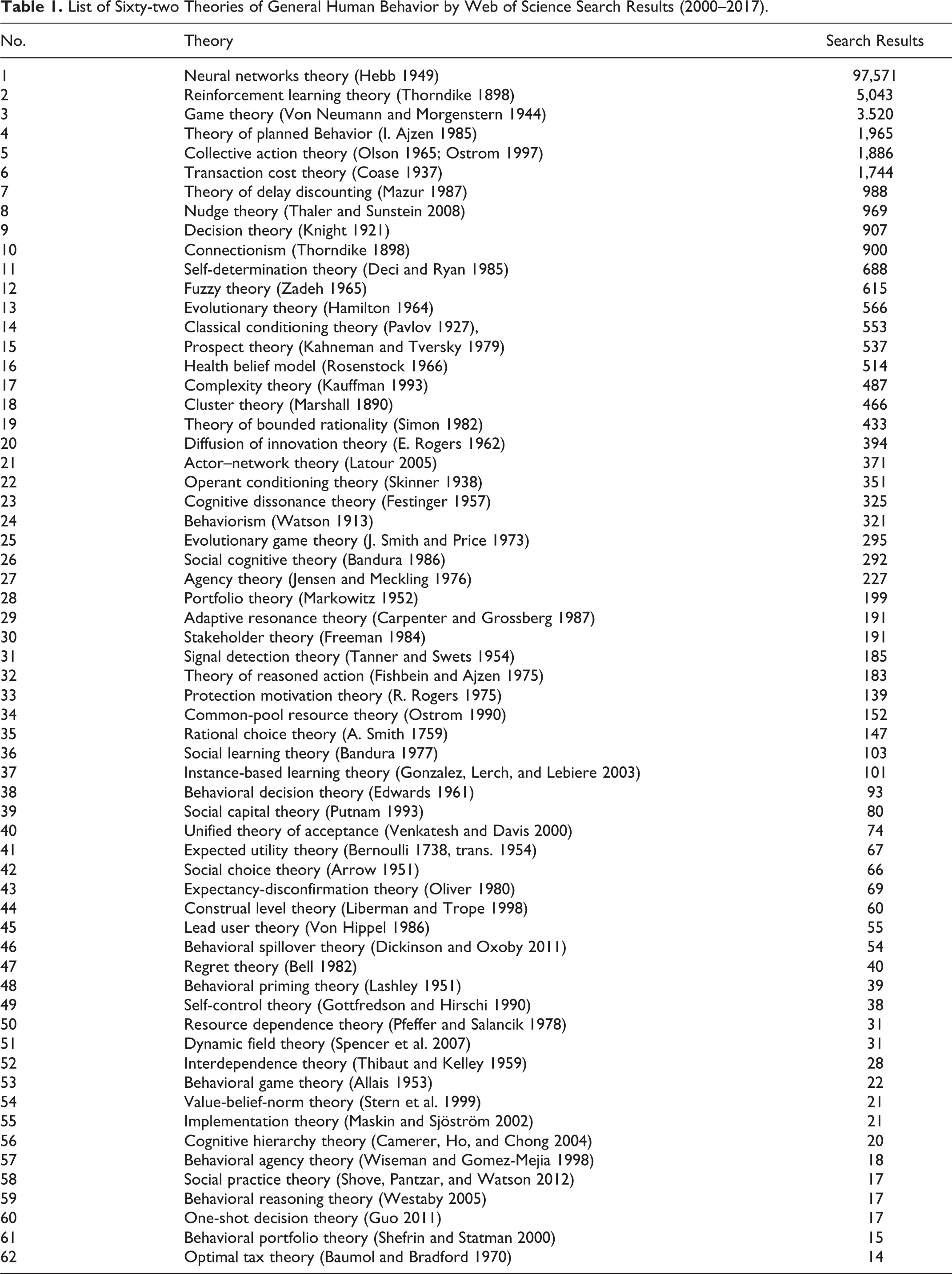
Fifth, of the eighty-seven theories, only those with more than ten WoS search results (2000–2017) were kept, resulting in sixty-two theories (Table 1). From the 156 publications, 47 that cover all sixty-two theories were chosen as key publications by giving preference to empirical papers, those that cover multiple theories, more recent papers, and those with higher citation number. This is to guide the readers to a selection of publications that can be read first before the others. The selection methodology is summarized in Figure 3.
List of Sixty-two Theories of General Human Behavior by Web of Science Search Results (2000–2017).
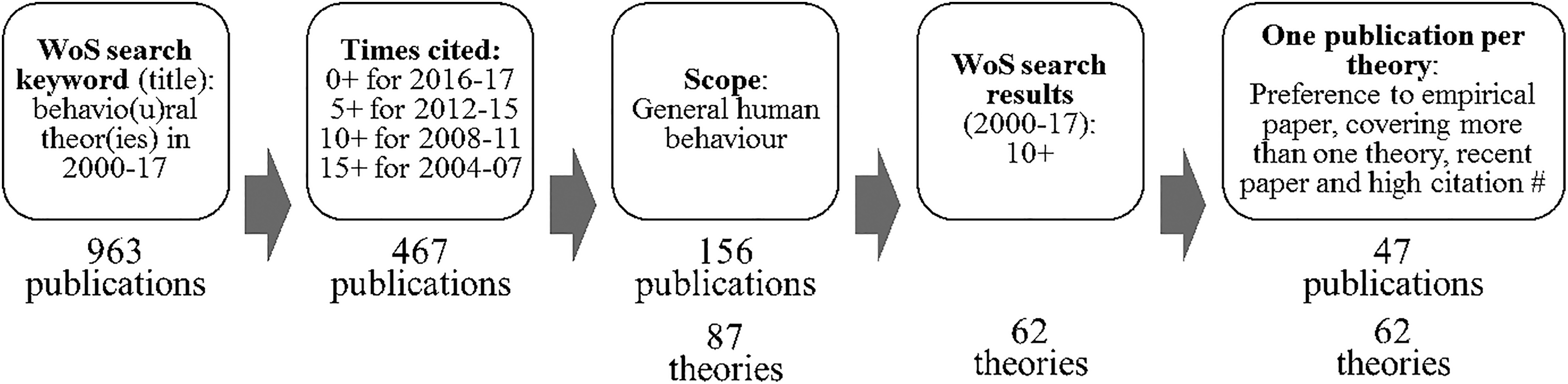
Summary of the selection methodology for publications and theories.
Review of the Selected Behavioral Theories
Table 1 lists sixty-two theories 2 of general human behavior by WoS search results in the time frame of 2000–2017 in all database, title only. Search key words were used appropriately, for example, “theory of planned behavior” OR “theory of planned behaviour.” In the search key words, “theory” was kept for some, for example, “game theory” and not for others, for example, “neural networks.” Search key words tried to include all other names of the theories, for example, “delay discounting” OR “time discounting” OR “temporal discounting.”
Table 2 lists top ten theories by search count along with top five research areas in the WoS classification to provide an indication of to what extent the theories have been used in the academic world in recent years and in which research areas. Some research areas can be very broad with regard to the type of behaviors that they deal with. For example, psychology can deal with a variety of behaviors from personality to violent behavior, and sociology can deal with behaviors from substance abuse to antisocial behavior. Many topics are multidisciplinary and often involve several research areas. The top three theories by search count: neural networks theory, reinforcement learning theory, and game theory have been especially used in computer science in the past three years due to an increasing interest in topics such as artificial intelligence and machine learning.
List of Theories by Research Area, Publication Years, and Classification (Top Ten).
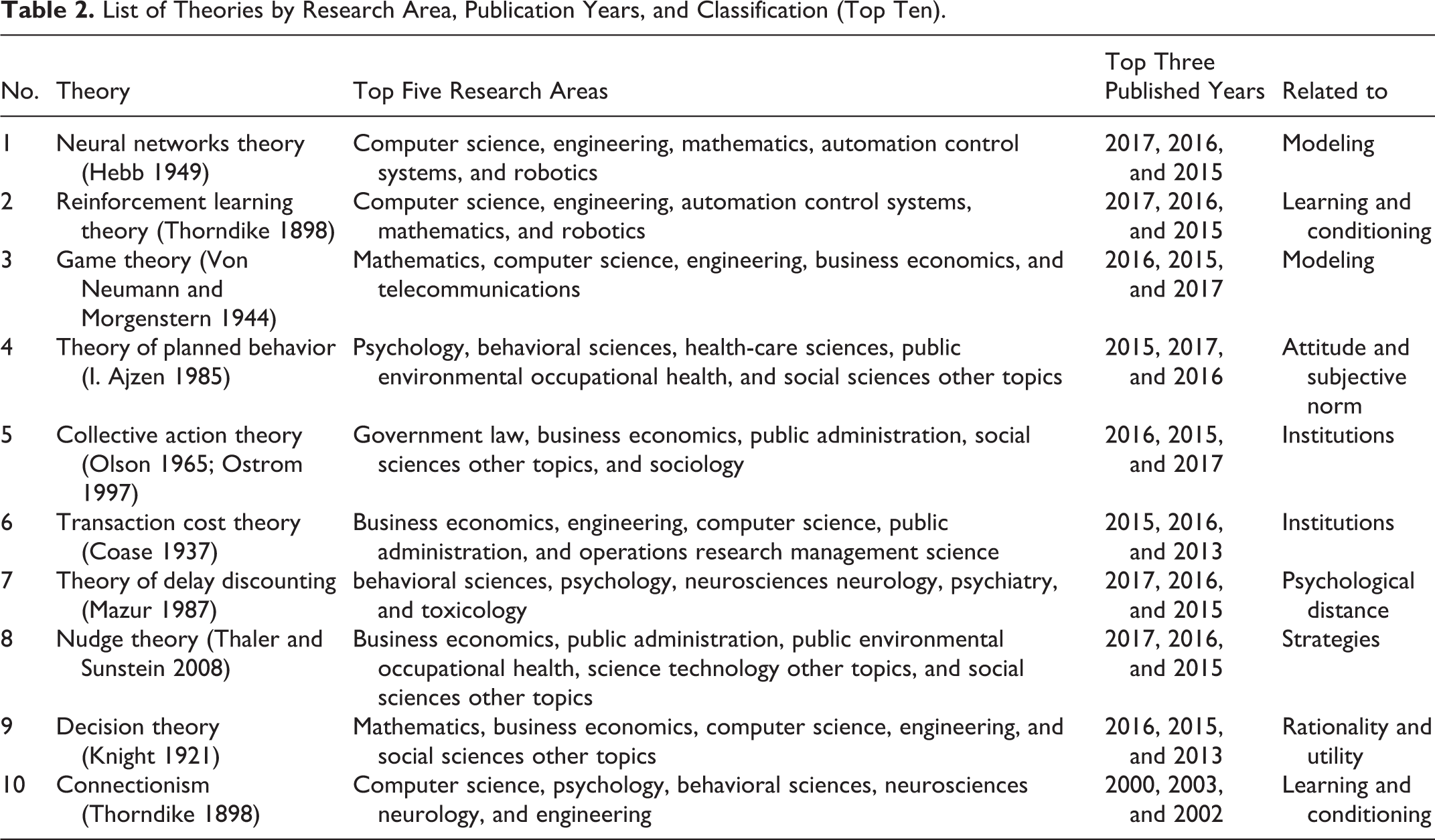
The top seven research areas of the sixty-two theories are “business economics (41),” “computer science (37),” “psychology (30),” “engineering (26),” “behavioral sciences (25),” “mathematics (22),” and “social sciences other topics (16).”
Classification and Mapping of the Selected Behavioral Theories in a Diagram
We conceptualized “behavior” as a process where a stimulus or situation gets imposed on a person, he or she develops intention or motivation, and this leads to a response or decision. We decided to call a theory a “behavioral theory” if it explains some aspects of this response- or decision-making process. As a consequence, we classified the sixty-two theories into four groups based on their focus: (1) factors that affect the intention or motivation (seventeen factors), (2) strategies that influence the intention or motivation, (3) learning and conditioning that can modify the response or decision, and (4) modeling approach that can represent the response or decision.
The first group focuses on the factors that affect the process of decision-making inside the human brain. The theories from psychology tend to focus on more subjective and personal factors like attitude, subjective norm, psychological distance, fear appeal, beliefs and values, reasons, interest and satisfaction, probabilities, risk and heuristics, and conflicting interests (e.g., Fiedler 2007; Van Riper and Kyle 2014; Webb et al. 2013; Kahneman 2003), while theories from sociology tend to focus on social interaction (e.g., Latour 2005). On the other hand, the theories from economics, business, management, and finance tend to focus on slightly more objective and nonpersonal factors like different interests, institutions, rationality and utility, imagined scenario, responsibility, and external environment (e.g., Yuen et al. 2017; Tsang 2006; Mongin 1997). There is a difference between the disciplines that the theories originate from and the disciplines in which they get used most frequently. For example, prospect theory is one of the major theories used in behavioral economics or in the general subjects of urban and environmental planning, yet its founders Kahneman and Tversky (1979) are psychologists. In fact, from our reading, it became apparent that a vast number of the research area of behavioral economics are largely about applying psychological theories to economics such as prospect theory (e.g., Dasgupta 2017), the theory of delay discounting and cognitive dissonance theory (e.g., Laajaj 2017), construal level theory (Fiedler 2007), behavioral decision theory (e.g., Morton and Fasolo 2009), and behavioral reasoning theory (e.g., Claudy, Peterson, and O’Driscoll 2013).
The second group focuses on the intervention strategies to influence behavior change and gets used largely in public policy to influence pro-environmental and prosocial behavior such as nudge theory (e.g., Abdulkadirov 2016) and behavioral spillover theory (e.g., Nash et al. 2017), and business management to influence consumer, employee, and business behavior such as behavioral priming theory (e.g., Minton, Cornwell, and Kahle 2017) and diffusion of innovation theory (e.g., Wolske, Stern, and Dietz 2017).
The third group concerns learning and conditioning theories from psychology that can modify the response which are largely applied in computer science lately for the topics of artificial intelligence and machine learning (e.g., Ertuğrul and Tağluk 2017; Marsan, Bellomo, and Gibelli 2016). Finally, the fourth group focuses on modeling the response-making and decision-making processes and includes more mathematical elements compared to other groups (e.g., Justo et al. 2017; Martinez-Moyano 2008). Such theories about modeling get used in the areas of computer science and neuroscience, the most for modeling techniques such as machine learning, agent-based modeling, dynamic network analysis, and microsimulation (e.g., Khashanan and Alsulaiman 2016; Spencer et al. 2012). We included these theories as behavioral theories because, while they do not directly provide an explanation about how behavior works, they help us model and understand the response- or decision-making process and are crucial theories that can link the behavioral approach with data-led research in the era of big data analytics.
The theories in all four groups can be combined to be applied in modeling practices, for example, when representing real-world actors’ behavior using an agent-based modeling approach (e.g., Rounsevell, Robinson, and Murray-Rust 2012). Modelers can use the theories about factors when setting variables and the theories about strategies to design policies to put in a model or extract policy implications from simulation results. Furthermore, learning and conditioning theories can be used when developing algorithms for the models while modeling theories can be used to design the modeling approach itself.
This classification is mapped in a diagram below with the labeling of which research area the theories originate from (Figure 4). This is based on the main field of the founder; however, it is a general indication only as some founders are from multiple fields. For example, Herbert A. Simon, the founder of the theory of bounded rationality, had a large span of educational background and research areas and can be considered economist, political scientist, psychologist, and perhaps a few more.
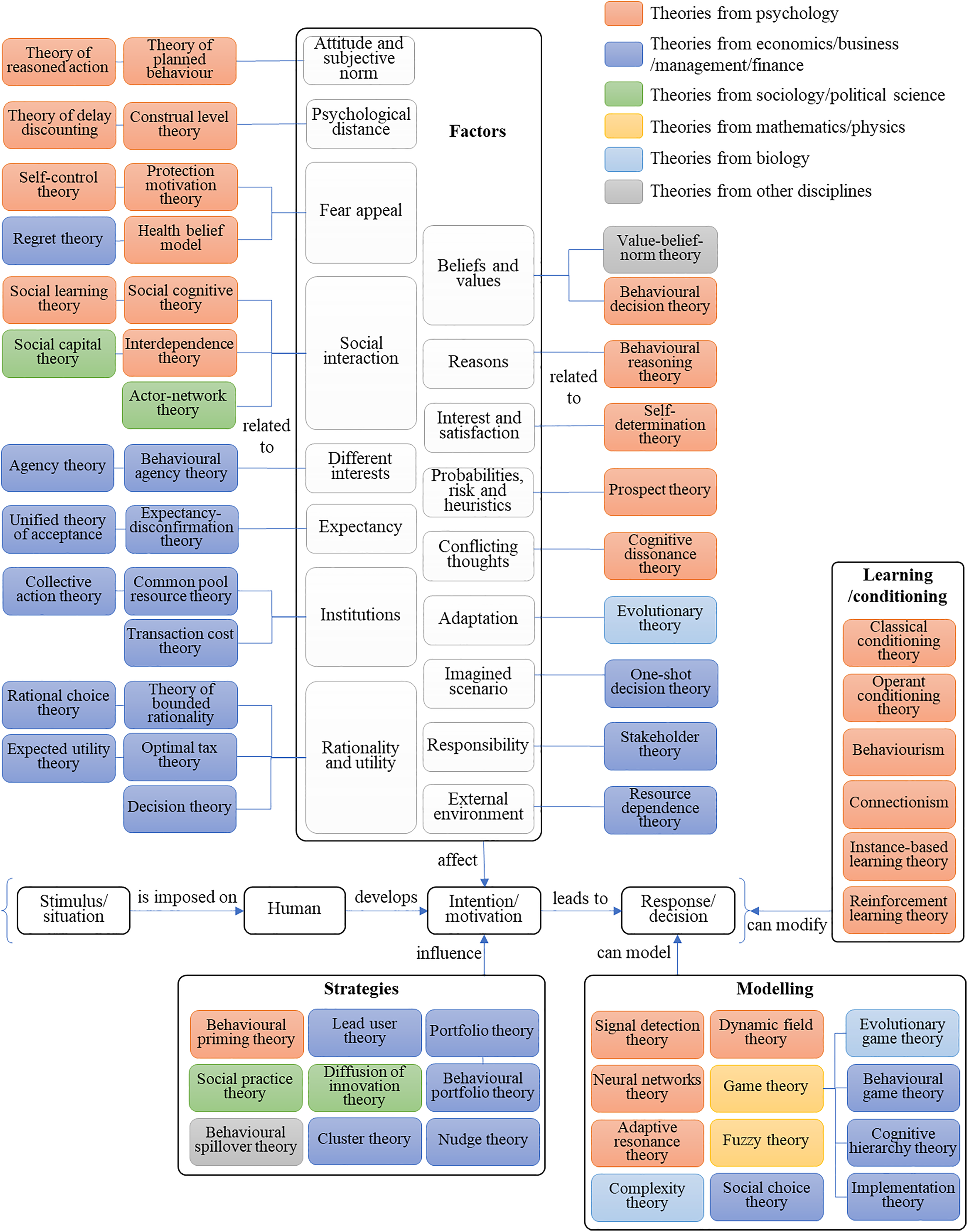
Map of theories of general human behavior.
Analysis of Selected Literature on Behavioral Theories
Table 3 provides a descriptive summary of the 156 publications. The list includes more of the recent publications possibly due to the selection threshold by times cited in the methodology. Eighty-seven percent of the literature are articles in a variety of journals while the rest are books or book chapters in research areas mainly psychology, social sciences, computer science, environmental sciences, transportation, and engineering. Sixty-six percent of the publications are available in full-text online, free to many educational institutions. Also, 70 percent of the 156 publications were classified as empirical research, that is, those that collect and analyze real-life observations, and 30 percent as theoretical research, that is, those that do not use real-life observations, instead, use hypothetical examples (Babbie 2010). These two types of research are closely linked to each other in the “wheel of science” of theories, hypotheses, observations, and empirical generalizations, corresponding to the cyclical nature of deductive and inductive reasoning (Wallace 1971; Babbie 2010, 22).
Descriptive Summary of 156 Publications.
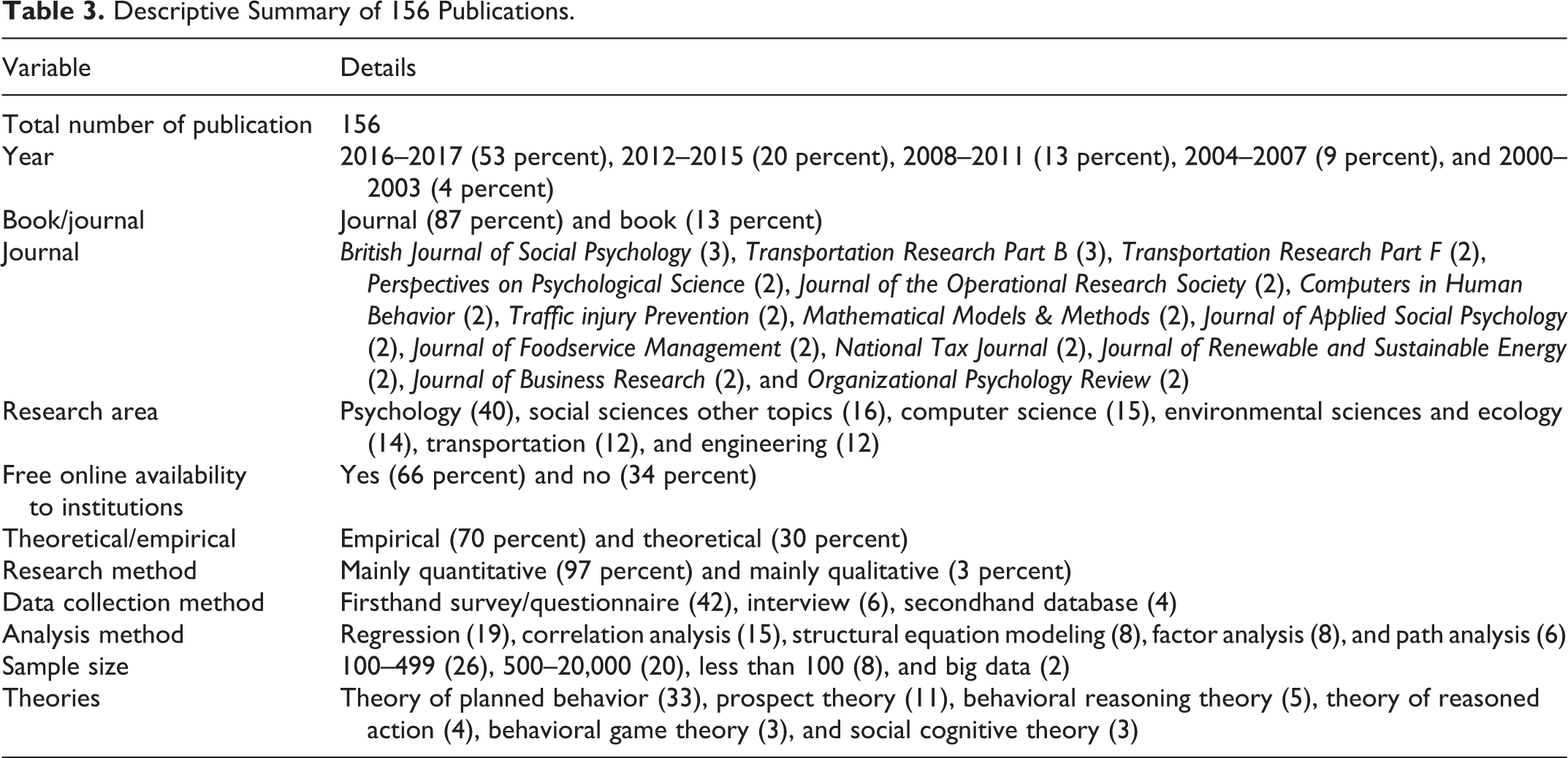
Regarding the research method, most publications (97 percent) were identified to mainly use a quantitative approach while only 3 percent mainly employed a qualitative approach. However, it is important to mention that these two approaches are in a spectrum rather than being dichotomic. The research studies that seem to employ a qualitative method often use statistical methods to analyze text or image-based data by coding words or features into categories (e.g., Denehy et al. 2017; Prosman, Scholten, and Power 2016; Bellomo and Gibelli 2015). Similarly, the research studies that seem to use quantitative methods often include qualitative survey questions that are categorical or in the form of short answer, especially with regard to the questions related to “why” and “how” (e.g., Wolske, Stern, and Dietz 2017; Claudy, Peterson, and O’Driscoll 2013; Castanier, Deroche, and Woodman 2013).
As for the data collection methods, firsthand survey and questionnaire were the dominant methods followed by interview, secondhand database, and simulation. Some innovative methods were observed, such as observation of investment decision-making behavior through an online computer game, a survey using a web page with a user interface to collect carbon footprint report, and collection of multi-object tracking behavior by conducting simulation exercise on the participants. With regard to the analysis method, regression was used most frequently (e.g., Dynarski and Scott-Clayton 2006) followed by correlation analysis (e.g., Wolske, Stern, and Dietz 2017), structural equation modeling, factor analysis (e.g., Yuen et al. 2017), and path analysis (e.g., Van Riper and Kyle 2014). As for the sample size, publications had 100–499 samples the most, followed by 500–20,000, less than 100, and big data such as 104 weeks of transaction screening through simulation with an ambiguous unit of data (e.g., Martinez-Moyano 2008; Wolske, Stern, and Dietz 2017; Denehy et al. 2017; Lapinski et al. 2017). Of the 156 publications, the most frequently occurring theory was the theory of planned behavior (in 33 publications) followed by prospect theory (in 11 publications; Online Appendix B).
Table 3 and Online Appendix B can be a useful guide for researchers including those in the planning-related fields to get an overview of how behavioral theories have been used in research since 2000 and what the current trends are in terms of data collection and analysis method, and so on.
Discussion
Lack of Understanding of Behavioral Theories and Behavioral Sciences
While the behavioral approach has been an issue throughout the twentieth century, for example, regarding the rationality of “economic man” (Simon 1955), this article’s literature review reveals that the interest in behavioral theories grew significantly in recent years in various disciplines of research. According to the WoS all databases, the number of publications with “behavio(u)ral theor(ies)” in title had a gradually increasing trend from 2000 to 2014 with an average annual increase of 13.6 percent (WoS 2018a) and had a sharp increase of 55.9 percent in 2015. There are more than hundred research areas associated with these publications with the top three being psychology (42 percent), behavioral sciences (35 percent), and business economics (25 percent).
Despite the growing interest, the definition of “behavioral theory” is yet unclear. First, both the terms “behavior” and “theory” are not clear-cut concepts. While a general definition of a behavior of something “is the way it behaves” (Collins English Dictionary 2018b), more specifically, it can refer to “the way in which an animal or person behaves in response to a particular situation or stimulus” or “the way in which a machine or natural phenomenon works or functions” (Oxford Dictionaries 2018). Even the field of psychology, described as “the science of behavior,” has not arrived at any consensus on what the concept of behavior means (Bergner 2011, 147). The term behavior can refer to different things in different context, for example, animal behavior in zoology, criminal behavior in criminology, and patient behavior in health sciences. The behaviors dealt in behavioral economics or in the general subjects of urban and environmental planning are often the behaviors considered less rational such as heuristics and bias.
Likewise, while the general definition of “theory” is “a formal idea or set of ideas that is intended to explain something” (Collins English Dictionary 2018c), it can be understood differently in different disciplines. In the social sciences, a theory can be defined as “a systematic explanation for observations that relate to a particular aspect of life” (Babbie 2010, 8). However, in the natural sciences and engineering, a theory is often understood as “a system of testable, strictly general propositions” where the propositions constitute statements and are empirical, mutually related, and universal (Malewski 2017, 421). Also, the term “theory” is often used interchangeably with other terms such as model or approach as identified in this article’s literature review (e.g., cognitive hierarchy theory/model/approach; see Online Appendix A).
There are many more theories that did not come up in this article’s search results that may be counted as behavioral theories depending on these criteria, for example, Maslow’s (1987) well-known theory which describes the hierarchy of needs that motivate human behavior or Wilson and Kelling’s (1982) broken windows theory about criminal and antisocial behavior. Also, theories like collective action and transaction cost theory are being used as behavioral theories according to this article’s literature review; however, economists may not consider them as part of the domain of behavioral economics.
Second, the understanding of what “behavioral sciences” entail is vague. While behavioral science can be broadly defined as “the scientific study of human and animal behavior” (Oxford English Dictionary 2018), in academia, it can refer to “any of several studies, as sociology, psychology, anthropology, etc. that examine human activities in an attempt to discover recurrent patterns and to formulate rules about social behavior” (Collins English Dictionary 2018a). In this sense, the term behavioral science gets often used interchangeably with social science because they are interconnected and both examine behaviors (Adhikari 2016). Adhikari (2016, 128) suggests that the difference is “at the level of scientific analysis of behavior” where social science is “the study of relationships between macro type variables, like culture and society, and micro type variables such as how people behave” while behavioral science is “the organized study of human and animal behavior through controlled systematic structure” where “the experimenter selects and organizes participants into groups, operates variables, and obtain measures of participants’ responses.” Main subfields within behavioral science tend to be multidisciplinary fields with cognitive, neuro, and social elements such as social, developmental, and experimental psychology, cognitive neuroscience, neurobiology, sociology, biological and social anthropology, and behavioral economics; however, the boundary of the term is not clear-cut in that it can include other disciplines such as management science, philosophy, education, politics, criminology, linguistics, and health sciences (University of Cambridge 2018; Adhikari 2016; London School of Economics 2018).
It will be beneficial to reach a consensus on the list of academic subfields that belong to the umbrella of behavioral sciences and the fields where behavioral approach or behavioral theories are applied to. This is even more important as not only that there is a limited consensus about the meaning of behavior and behavioral theory but also on the mechanics (i.e., variables and relations) of behavior. In order to transfer models or compare results, we need to move with confidence that the ground regarding concepts and relationships among variables are solid and reflect the intended behaviors. In a way, the goal of this article is to contribute to a better clarification of what is available and what fields are involved so that we start to speak similar languages and are able to compare and contrast results.
Lack of Classification of the Type of Behavior and Behavioral Theories
A detailed classification of behavioral theories can be greatly useful for researchers to identify what theories can be used for what types of behavior, for answering what types of research questions, and what types of data are required to use different types of behavioral theories. In this article, due to the nature of the planning-related disciplines that deal with human behavior and land-related issues (e.g., urban and environmental planning, urban economics, and transport planning), we classified behaviors into specific and general categories by conceptualizing them in the form of “agent or activity + behavior” as shown in Figure 2. However, many other approaches are possible. Davis et al. (2015) and Schlüter et al. (2017) suggested two types of health behavior: individual and sometimes interpersonal (e.g., capabilities and motivation) and broader social and environmental (e.g., context like community). With this classification, it is likely to see the theories from psychology and economics focus on the former while those from sociology deal with the latter. Another grouping can be individual versus group, collective, or social behavior (Davis et al. 2015; Morris et al. 2012; Schlüter et al. 2017). While this article conceptualizes behavior with reference to intention, further research can expand the scope to include unintended behavior that has been gaining increasing attention in many fields, for example, unintended collective behavior and emergent in the complexity sciences linked with the processes of self-organization (Mittal and Risco-Martin 2017). The classification of the types of behavior is important because different behavior gets affected by different variables. For example, while consumer behavior may be largely influenced by habits or emotional states, pro-environmental behavior might be influenced more by beliefs or reflective thought processes (Davis et al. 2015).
Previous attempts to classify behavioral theories have been limited in the number of disciplines that they cover. For health behaviors, Michie et al. (2005, 28) categorized thirty-three psychological behavioral theories into three groups: motivational (theories that explain change in people who have not yet established an intention), action (theories that explain behavior of those who are motivated to change), and organizational (theories that explain change at a social and systems level). For modeling social–ecological systems, Schlüter et al. (2017, 22) mapped six behavioral theories by suggesting a framework with five elements: perception, evaluation, selection, state, and perceived behavioral options.
This article has attempted to classify the theories of general human behavior across all disciplines in four groups: factors, strategies, learning and conditioning, and modeling (Figure 4). While providing a useful starting point, there is a lot of room for improvement. Firstly, the hierarchy of theories can be identified in terms of scope. Theories like game theory and decision theory are much larger in scope compared to more specific theories like optimal tax theory. Such theories with large scope tend to have subtheories under them, for example, cognitive hierarchy theory can be considered as a subtheory of game theory. Secondly, the family tree of theories can be identified. Many theories have an evolving nature, and new theories often emerge by adding a new element or perspective to an existing theory. For example, most of the learning and conditioning theories originate from the classical conditioning theory by Pavlov (1927). The theory of planned behavior is a theory that added the concept of perceived behavioral control on top of the existing theory of reasoned action (Icek Ajzen 1991; Adjei and Behrens 2012). Also, common-pool resource theory can be argued to have roots in collective action theory. Furthermore, many theories like behavioral decision theory and behavioral game theory are the addition of behavioral elements on top of the existing theories. In the planning-related field, many of these behavioral theories are related to the development of planning theories, for example, rational theory of planning and the criticisms of it (e.g., Faludi 1987; Allmendinger 2009; Forester 1984).
Thirdly, the overlapping concepts among theories can be identified. The theories in the same family tree inherently share some key concepts. Even the theories that have developed independently in different disciplines often share some key concepts like the social norm, perceived behavioral control, bounded rationality, utility, beliefs, values, heuristics, and bias. This can help identify possible dependencies among theories when multiple theories are used in combination in a model. Fourthly, theories can be connected to the research areas, topics, and types of behaviors that they get applied to. Currently, Figure 4 only depicts the disciplines that the theories originate from; however, many theories get applied more vigorously in other disciplines than their original root. For example, although founded by psychologists, prospect theory is mostly applied in behavioral economics, and neural networks and reinforcement learning theory are mostly applied in computer science and engineering. Further studies can attempt to systematically map behavioral theories reflecting the suggestions above in one or more diagrams, possibly employing techniques such as network analysis function in the statistical software R version 3.5.0 (The R Foundation 2019).
Lack of Guidance on the Selection and Use of Appropriate Behavioral Theories
As identified in this article, there is a long list of behavioral theories with overlapping constructs which makes it a large challenge for policy makers and modelers to choose appropriate theories (Michie et al. 2005). This often leads them to choose more common and well-known theories rather than ones that may suit the target behavior and population most appropriately (Painter et al. 2008).
This article has started to answer to this overall need for more clarity by producing an overall portfolio of available options, and we are now engaged in the development of research to answer to some of these gaps. The concepts of behavioral theory and behavioral science have an evolving nature that there will be dynamic patterns within the debate rather than having one clear definition that is agreed across all disciplines. Nevertheless, to assist researchers navigate the multiple options available, it will be greatly beneficial to have a table that shows a clear connection among the list of theories, key variables, the types of behavior, and the social or environmental context that they are applicable to in the future with more in-depth analyses and comparative studies.
Lack of Inclusion of Behavioral Theories in Data-driven Research and Agent-based Modeling
The literature review for this article suggests important disciplines and topics in the behavioral research at the present moment: computer science, artificial intelligence, and big data analytics. These are all part of the bigger effort toward the development of data science linked with digital information and are closely related to the field of urban and environmental planning in the era of smart cities. In order to achieve the goal of producing smarter cities in a digital world, big data analytics play a very important role in recent years by automating some of the data harvesting and data mining using “machine learning, statistics, and visualization techniques in order to collect, process, analyze, visualize, and interpret results” (Elragal and Klischewski 2017, 1). With this new trend, many scholars suggest that there is a shift from theory-driven analysis to data- or process-driven analysis and question the role of theories in this new era where data seem to speak for themselves (Elragal and Klischewski 2017; Wise and Shaffer 2015; Sparks, Ickowicz, and Lenz 2016).
In the previous line of thought that compartmentalizes theory-driven and data-driven research, some researchers argue that big data analytics in a digital world is a new approach that generates insights and prediction directly from big data sets rather than using the traditional methods of inductively generating theories from sample data or deductively verifying theories through data collection and analysis based on theoretical frameworks.
The traditional theory-driven approach is largely linked with global equation-based modeling (EBM) while the new data-driven approach is closely linked with new language-based coding constructs such as agent-based modeling (ABM). The modelers of EBM tend to take a top-down, aggregate approach with “a set of equations that express relationships among observables” often based on theoretical frameworks (Parunak, Savit, and Riolo 1998, 19). On the other hand, the modelers of ABM tend to take a bottom-up, disaggregate approach that looks at the “behaviors through which individuals interact with one another” (Parunak, Savit, and Riolo 1998, 19). Nevertheless, the two fields are not hermetic, and there can be a hybridization of methods, in other words, ABM using the equation-based method as a first instance for identifying patterns and processes (e.g., Robinson et al. 2012; Robinson and Brown 2009). We should see the integration of ABM and cellular automata (CA) as a result of a revolution during the past thirty years. In the first instance, most ABM and CA (most microsimulation models in general) would use general equations to extract some of the behaviors at the local scale, running the “Markov” style of analysis in order to establish the predominant behaviors from hundreds of simulations. In the second instance, general equations can still be used these days as the first point to start understanding the system (or to calibrate the agents; e.g., Evans and Kelley 2004); however, some of these equations are being replaced by language-based coding. This language-based coding, instead of “statistically” extrapolating the behaviors from initial sets of equations, uses learning algorithms that are trained in vast data sets (some of them quasi-live in order to extract the behaviors).
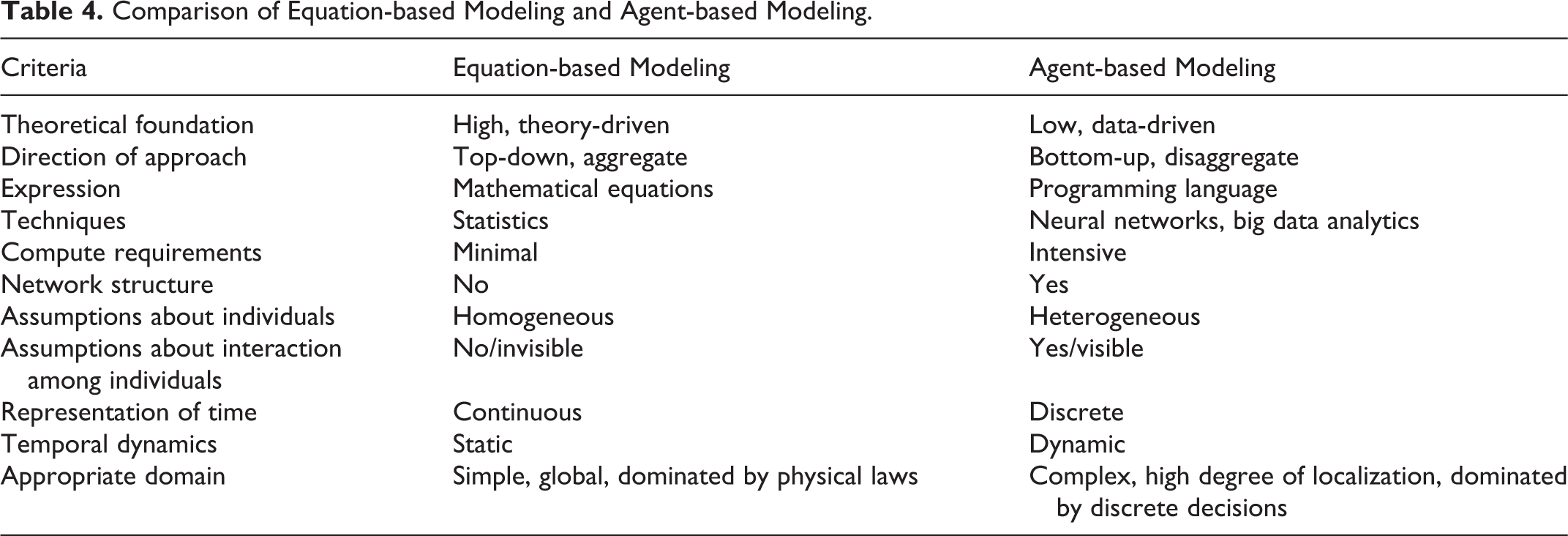
In addition, while EBM largely uses mathematical equations that express the relationships among observables like econometrics, ABM is mainly based on a programming language that defines agent behavior in a set of rules of “if-then/else” statements. ABM also uses equations, however, they tend to be more for disaggregate sets of behaviors, and in recent years, these are migrating to learning algorithms where the rule is no longer given by statistical analysis but by a set of behaviors extrapolated for mining big data sets such as social media feeds. A learning algorithm by itself can be both equation-based and/or language-based, for example, a CA model can extract rules of behavior from a set of general equations of shortest paths (e.g., in a node-arc network calculating the number of nodes arcs between location and identifying the shortest path between locations A and B) on proximity or through what-if questions (e.g., cities close to each other by Euclidean distance between cells have more visitors, if city A is close to city B, then it will have more visitors than city C). The comparison of two approaches is provided in Table 4, which is the author’s compilation of Sukumar and Nutaro (2015, 2) and Sun and Cheng (2006, 7). As the fuzzy line indicates, this table indicates the main trends rather than presenting the two approaches as binary. Nevertheless, if one looks at these overall assumptions of what is happening in each area and the modeling approach, one starts to see that most of the approaches today are gearing into hybrid models, where theory informing data and data informing theory are intertwining (Wu and Silva 2010; Silva 2004; Wu and Silva 2013; Silva 2011). Such hybrid approach can suggest a new direction for the modeling of complex urban systems as part of the planning support science, for example, for the efforts to establish a “digital twin” of a city to aid planning-related decision-making.
Comparison of Equation-based Modeling and Agent-based Modeling.
Behavioral theories are closely linked with the concepts of equation-based and the new language-based coding constructs such as ABM and CA because applying behavioral theories can be very useful for achieving the hybrid approach and linking de facto not only the two models and modeling approaches but also the wider discussions between the theorists and data-led analysis/policy defenders.
The Role of Behavioral Theories in Bridging the Theory-driven and Data-driven Approaches
Behavioral theories can play a critical role in “closing the loop” and bridging the theory-driven and data-driven approaches. They are ever more important for researchers in the era of big data analytics, ABM, CA, and all other novel modeling approaches for three reasons. This can be summarized by Kant’s statement that “theory without data is blind, but facts without theories are meaningless” (Sparks, Ickowicz, and Lenz 2016, 33).
First, theories have the power of answering not only the descriptive “what” but also “when, how and why” (Elragal and Klischewski 2017; Davis et al. 2015). Behavioral theories enable the inclusion of qualitative and language-based realms such as psychology and sociology to the mathematical realms and vice versa. Theories enable unstructured data such as text and human language and semi-structured data such as XML, JSON, and RSS 3 feeds to be rigorously included in the analysis to extract meaningful outcomes by providing the explanatory power. For example, in the field of urban and environmental planning, behavioral theories can be used to make the meaning of crowdsourcing data such as social media feeds to better understand the movement behavior of certain groups (Silva et al. 2020). Also, behavioral theories can be used to explain the psychological and sociological reasons behind the movement patterns and processes in the big data provided by smart transport cards.
Second, theories can provide the rationale for the rules, variables, assumptions, and parameters that form the basis of analytical models and for how the results should be interpreted (i.e., Conway’s Game of Life [Gardner 1970]). While having an advantage in extracting the features of interest from large volumes of data, data mining carries a danger of overlooking important issues such as defining variables adequate to research problem or question, utilizing background information or metadata, minimizing selection biases in data collection, and paying attention to randomness and control groups in the research design (Sparks, Ickowicz, and Lenz 2016, 45). Coherent and reasoned theoretical frameworks can provide a safeguard against a key danger in big data analytics where the outcomes may be a result of arbitrary decisions that fail to detect nuanced findings for the groups of higher relevance (Wise and Shaffer 2015).
While it is not the goal of this article, it has been proposed that complexity theory should be taken as the overall theoretical concept and data science as the operationalization of some of the constructs required by complexity theory (de Roo and Silva 2010). Due to the dual role of looking at bottom-up, data-led analysis and simultaneously to top-down constructs of decision-making and institutional frameworks, by doing so, it also accepts the importance of highly disaggregated data (in many cases behavioral in character) as an engine for local dynamics. Adding to local dynamics, complexity theory and the models integrate well the role of “action at the distance” that governments and other constraining agents produce, allowing for adaptation and self-organization that is closer to what is observed in the real world. According to de Roo and Silva (2010, 2), complexity “represents dynamic realities and non-linear behavior.” The debate on “complex systems and their ‘evolutionary’ behavior” has numerous origins such as “systems science, cybernetics, fractal geometry, fuzzy logic, agent-based modeling, cellular automata, meteorology, physics and biology” (de Roo and Silva 2010, 8). In the realms of mathematics and physics, and to certain extent spatial planning, this debate is associated with a concept known as the “arrow of time” (Eddington 1928), which can be related to how self-organization and future prediction can be solely the result of one single trajectory or how the feedback loops with the intent to correct trajectories can substantially alter the direction of urban growth. The two groups in this debate can be identified as those who argue that regions evolve according to their path dependence and emergent behavior and those who feel that it is still possible to “re-self-organize” and move the entire region to completely different future through calibration and variable optimization. Understanding these two views of evolutionary behavior is important because planners need to understand that using the same metrics of one region would not bring the same outcomes in other regions (Silva 2004).
The founding scholars of complexity theory closely linked to the field of spatial planning can be clustered into two groups in which present academics are integrating into hybrid models (Silva 2011, 325–27). The first group includes the scholars who contributed to the birth of the cell and self-organization by linking game theory and micro-behavior through the concept of CA, which enabled the generation of mathematical patterns in two- and three-dimensional space as a model of spatiotemporal dynamics obeying local laws (Von Neumann and Morgenstern 1944; Ulam 1960). The second group employed a behavioral approach by mimicking the decision-making process of people with the concept of genetic algorithms (GA) including decision trees and neuronal nets (Flood 1952; Nash 1950; Holland 1975; Parunak, Savit, and Riolo 1998), often simulated using ABM which is most effective with aspatial dynamics. It is this bigger picture of the integration of spatial and aspatial approach of modeling human behavior that behavioral theories fit in to play an important role in the field of spatial planning.
Third, theories can help researchers generalize results to make the findings applicable in other population and context, hence create a feedback loop by generating new theories from data-based microsimulation approach and improving the existing EBMs. Big data analytics can generate useful findings from the population involved in the data sets; however, the findings cannot contribute to the systematic scientific framework of the related academic field without achieving generalizability (Wise and Shaffer 2015).
Conclusion
To better understand the landscape of behavioral theories, this article performed a systematic literature review and identified forty-seven key publications which cover sixty-two key theories. These theories were then classified into four groups (factors, strategies, learning and conditioning, and modeling) based on their focus and were mapped in a diagram with the labeling of which research area the theories originate from. Among the theories in the group “factors,” those from psychology tended to focus on more subjective and personal factors while those from economics-related disciplines tended to focus on more objective and nonpersonal factors. The theories in “strategies” seemed to get used largely in public policy and business management to influence behavior while learning and conditioning theories are largely applied in computer science for the topics of artificial intelligence and machine learning. As for the theories about modeling, they seemed to get especially used in the areas of computer science and neuroscience for modeling techniques such as ABM, dynamic network analysis, and microsimulation.
As a result, the literature review pointed to the following discussion points, which are the areas that require further research: (1) lack of clear understanding of behavioral theory and behavioral science, (2) lack of classification of the type of behavior and behavioral theories, (3) lack of guidance on the selection and use of appropriate behavioral theories, (4) lack of inclusion of behavioral theories in data-driven research and ABM, and (5) lack of dialogue between theory-driven and data-driven approaches.
Supplemental Material
Supplemental Material, 27May2019_Mapping_the_landscape_of_behavioral_theories_Appendix_A_List_of_theories - Mapping the Landscape of Behavioral Theories: Systematic Literature Review
Supplemental Material, 27May2019_Mapping_the_landscape_of_behavioral_theories_Appendix_A_List_of_theories for Mapping the Landscape of Behavioral Theories: Systematic Literature Review by Heeseo Rain Kwon and Elisabete A. Silva in Journal of Planning Literature
Supplemental Material
Supplemental Material, 27May2019_Mapping_the_landscape_of_behavioral_theories_Appendix_B_List_of_publications - Mapping the Landscape of Behavioral Theories: Systematic Literature Review
Supplemental Material, 27May2019_Mapping_the_landscape_of_behavioral_theories_Appendix_B_List_of_publications for Mapping the Landscape of Behavioral Theories: Systematic Literature Review by Heeseo Rain Kwon and Elisabete A. Silva in Journal of Planning Literature
Footnotes
Acknowledgments
The authors are grateful to the Economic and Social Research Council and the Cambridge Humanities Research Grant for financial support and to the anonymous reviewers for their valuable comments.
Declaration of Conflicting Interests
The author(s) declared no potential conflicts of interest with respect to the research, authorship, and/or publication of this article.
Funding
The author(s) disclosed receipt of the following financial support for the research, authorship, and/or publication of this article: Economic and Social Research Council (Grant No. RG76702/JPAG254) and the Cambridge Humanities Research Grant (Grant No. GASR009831/JPES.AHAS).

Supplemental Material
Supplemental material for this article is available online.
Notes
References
Supplementary Material
Please find the following supplemental material available below.
For Open Access articles published under a Creative Commons License, all supplemental material carries the same license as the article it is associated with.
For non-Open Access articles published, all supplemental material carries a non-exclusive license, and permission requests for re-use of supplemental material or any part of supplemental material shall be sent directly to the copyright owner as specified in the copyright notice associated with the article.
