



Abstract
Despite the popularity of the “behavioral approach,” there is as yet a lack of guidance on the selection and use of appropriate behavioral theories for specific planning purposes. Based on a literature review of 318 articles in spatial planning-related journals, this paper presents a portfolio of behavioral theories by types of behavior, key variables, rules, and research methods. In addition, based on the survey of twenty-two international experts, it cross-validates the findings and highlights particularly appropriate theories for certain types of behavior dealt in related disciplines. Finally, the paper derives discussion points including the applicability of various behavioral theories in urban models such as space and time-sensitive dynamic simulations.
Keywords
Introduction
The interest in the “behavioral” approach in the context of behavioral sciences has increased in recent years in many disciplines. Following this trend, the psychological and sociological aspects of decision-making, for example, the concepts of habitual behavior, loss aversion, cognitive biases, heuristics, and social norms are being highlighted when developing appropriate methods for studying behavior in various domains including the spatial planning-related fields (Asgari and Jin 2020; Bandsma, Rauws and de Roo 2021; Bao, Meng and Wu 2021). Behavioral theories, or theories of behavior, can be especially beneficial in spatial planning-related fields in the landscape of the rising popularity of data-driven research, big data analytics, and space and time-sensitive modeling approaches. This is because behavioral theories can enable answering “how” and “why” questions, including more qualitative realms such as psychology and sociology in addition to the more mathematical realms, and providing the rationale for setting certain assumptions, variables, and rules of analytical models to safeguard against a black box approach (Davis et al. 2015; Elragal and Klischewski 2017; Kwon and Silva 2020).
Here, we understand “behavior” as the way in which a “person behaves in response to a particular situation or stimulus” or “a machine or natural phenomenon works or functions” (Oxford Dictionaries, 2018), encompassing the action (or inaction) taken by individuals, collective action, and system performance from the perspective of complex adaptive systems (Batty 2005; De Roo and Silva 2010; Donaghy 2021). Also, we understand “theories” as “bodies of knowledge that … aim to explain robust phenomena” and “models” as “instantiations of theories” that illustrate “the mechanisms that might govern the processes into relevant parts, properties of these parts, relations between parts, and temporal dynamics of their change” (Fried 2020, p. 336; Smaldino 2020). While this “behavioral” approach is linked to the rise of behavioral economics which challenges the notion of “rational” and “optimal” decisions (Mullainathan and Thaler 2001), there is a benefit in taking a broader perspective of “behavioral sciences” (i.e., studies that “examine human activities in an attempt to discover recurrent patterns and to formulate rules about social behavior” (Collins English Dictionary, 2018)) and understanding the landscape of various theories of human behavior that one can apply to research and practice.
A number of existing publications provide guides to using behavioral theories in various disciplines. Among them, the health sector, especially public health, is one of the fields in the frontier of behavioral research (Clarivate Analytics, 2020). A scoping review by Davis et al. (2015) identified eighty-three behavioral theories applicable in this sector; and frameworks such as the Theoretical Domains Framework (Cane, Connor and Michie 2012; Richardson et al. 2019) and intervention mapping protocol (Kok 2014; Fernandez et al. 2019) are being used along with other guidance (Prestwich, Kenworthy and Conner 2018). Recently, Engl and Sgaier (2020) proposed a toolkit to help researchers identify determinants of target behavior based on behavioral theories and provide guidance on the methods and strategies for health behavior intervention. In environmental science, Morris et al. (2012) shortlisted key theories of behavior related to forestry, O’Brien et al. (2017) developed four key principles to guide forestry interventions seeking behavioral change, and Schluter et al. (2017) positioned six behavioral theories in a framework to facilitate the modeling of social-ecological systems. In transport, Götschi et al. (2017) proposed a comprehensive conceptual framework of active travel behavior and Pronello and Gaborieau (2018) reviewed behavioral theories and variables especially for pro-environmental travel behavior. However, there is not yet a publication that proposes guidance in applying behavioral theories based on types of behavior across planning-related fields.
While Kwon and Silva (2020) have identified and classified sixty-two behavioral theories into four groups (factors, strategies, learning and conditioning, and modeling) through a cross-disciplinary literature review, there is much room for improvement. First, it is important to further classify the types of behavior because different behaviors get affected by different variables, making some theories more applicable than others depending on the contexts and purposes. For example, mode choice such as cycling can be affected by pro-environmental values in an ethical sense especially in some cities (Damant-Sirois and El-Geneidy 2015) where “value-belief-norm” theory (Stern et al. 1999) can be particularly applicable while the choice between car and public transport can be influenced by social status in some cultures (Hensher et al. 2013) where “social identity theory” (Tajfel and Turner 1979) might be relevant. Second, the hierarchy of theories, family tree, and overlapping concepts can be identified, which is important for understanding the scope that each theory covers and the evolving nature that leads to the emergence of new theories, and for identifying dependencies among theories when applying multiple theories in combination. Finally, a portfolio that links theories with types of behavior, key variables, and research methods can serve as a useful reference for researchers and policymakers to identify theories that suit the target behavior and population most appropriately, not to replicate existing studies but to expand the understanding of the available theories (Painter et al. 2008; Kwon and Silva 2020).
To fill this gap, this paper zooms into the behavioral theories and rules used in spatial planning-related fields. It will first explain the methodology used and propose a portfolio of behavioral theories, a diagram of types of behavior, and a flow chart of behavioral theories and variables based on the literature review. In addition, it will add more theories based on the expert survey and highlight particularly appropriate theories for specific types of behavior dealt in related disciplines like transportation, real estate, urban design, and environmental sciences. Finally, discussions will be made about the applicability of behavioral theories in planning-related fields, especially for space and time-sensitive modeling approaches in the era of big data analytics and data-driven research.
Methodology
Systematic Literature Review
Spatial planning is often understood to give “geographical expression to the economic, social, cultural and ecological policies of society” (Council of Europe, 1984, p. 2). More explicitly, spatial (or regional) planning in the public sphere is characterized as “the management of change in territorially organized systems” (Friedmann 1988, as cited in Donaghy 2021, p. 142). While acknowledging the debate around this term (Allmendinger and Haughton 2009), this paper uses “spatial planning” as a wider concept compared to traditional land use planning, encompassing the activities variously called “town and country,” “urban and rural,” “city and regional,” “land use,” “land use/transportation,” “environmental,” etc., planning (Taylor 2010), while retaining the link with the spatial element to connect to the discussion with time- and space-sensitive dynamic models in the later part of the paper.
First, we decided to examine the three Web of Science categories of “Urban Studies,” “Geography,” and “Transportation” and selected twenty-nine key planning-related journals, composed of the top ten journals in these three categories by impact factor according to the 2017 Journal Citation Report (Clarivate Analytics, 2018) (Appendix C, Table A). While there are other relevant WoS categories such as “Architecture,” we decided not to include them to contain the scope of the literature review and instead, conducted surveys with experts from these disciplines to fill the possible gap (Appendix C, Table F).
Second, this paper searched all articles in the 29 journals between 2010 and 2018 that contain “behavio(u)r” in the title, except for transportation journals, which we included an additional criterion of times cited 1 because the number of articles was significantly larger than the other two categories. This generated a list of 318 articles: 78 from urban studies journals, 48 from geography, and 192 from transportation. The journals with the largest number of articles that fit these criteria were: Urban Studies (24) and Landscape and Urban Planning (12) from urban studies, Global Environmental Change – Human and Policy Dimensions (17) and Computers, Environment and Urban Systems (15) from geography, and Transportation Research Part A – Policy and Practice (47) and Journal of Transport Geography (42) from transportation (see Appendix C, Table A for more detail).
Third, by going through the articles one by one, we selected only the ones that use behavioral theories or concepts in their research. We employed an understanding of “behavioral theory” as “a broad term for a set of pre-specified ideas or predictions aimed at explaining behavior” where “behavioral theories come from multiple disciplines (e.g., psychology, sociology, behavioral economics), and identify multiple determinants or mechanisms of behavior including beliefs, motivation and intentions, individual differences, social influence, and environment and demographics” (Hayes 1996; Hagger and Weed 2019, p. 2; Carlson 2020). This generated a list of 152 articles: 31 from urban studies, 25 from geography and 96 from transportation. Other terms such as “model” were included where appropriate (e.g., social ecological model).
Fourth, to produce a portfolio, we organized these articles in an excel file, one row for each theory, containing information such as types of behavior, behavioral theories used and definitions, variables, rules, and research methods (e.g., data collection method, analysis method, sample size, city/country). Type of behavior was classified into two levels of activity (e.g., travel behavior as a main category and mode choice behavior as a subcategory) and two levels of agents (e.g., individual behavior as a main category and elderly behavior as a subcategory) (more details provided in Appendix C, Table E).
Expert Interview and Survey
To complement and cross-validate the literature review, we conducted interviews and surveys with twenty-two international experts. We focused on selecting diverse experts, mostly in academia and a few at research institutes, with more than ten years of research experience (average 23 years) 2 from various countries: 54.6% from North America, 22.7% from Europe, and 22.7% from Asia. We included researchers who use different research methods: quantitative researchers who tend to be modelers (36.4%), qualitative researchers who tend to be theorists (27.2%), and those who are both (36.4%). We included researchers from various backgrounds in planning-related fields based on their bachelor's degree: architecture, landscape architecture and urban design (31.8%), geography (22.7%), planning (9.1%), sociology (9.1%), economics and commerce (9.1%), transportation engineering (9.1%), government (9.1%), and environmental sciences (4.5%). The doctoral degree of most of these researchers involved planning.
We carried out the interview/survey over two rounds. Most interviews were carried out face-to-face (one virtual), and some of the experts who participated in the first round participated in the second round as well through an online survey form. Five participated in just the first round, seven in just the second round, and ten in both. We asked to identify the gaps in this paper's diagrams, how the experts are using behavioral theories in their own research, how some of the presented theories can be applied in their research, and general opinions they have with regards to behavioral research in planning, which led to a number of important points that this paper discusses later.
Portfolio of Behavioral Theories in Planning-Related Fields
Figure 1 shows an excerpt of the portfolio presented (see Appendix A for the full version). 252 rows contain one theory each used in 152 articles, as some articles use more than one theory. An example of rows 172–176 in this portfolio, of how individual travel/mobility behavior was analyzed by Krueger, Vij and Rashidi (2018) using five theories, is provided in Appendix C, Table B along with a detailed introduction of the portfolio overall. While this list of theories was generated from this paper's review of selected journals in urban studies, geography, and transportation, it can provide a useful snapshot of what kind of theories were being used to study different behavior in planning-related fields between 2010 and 2018.
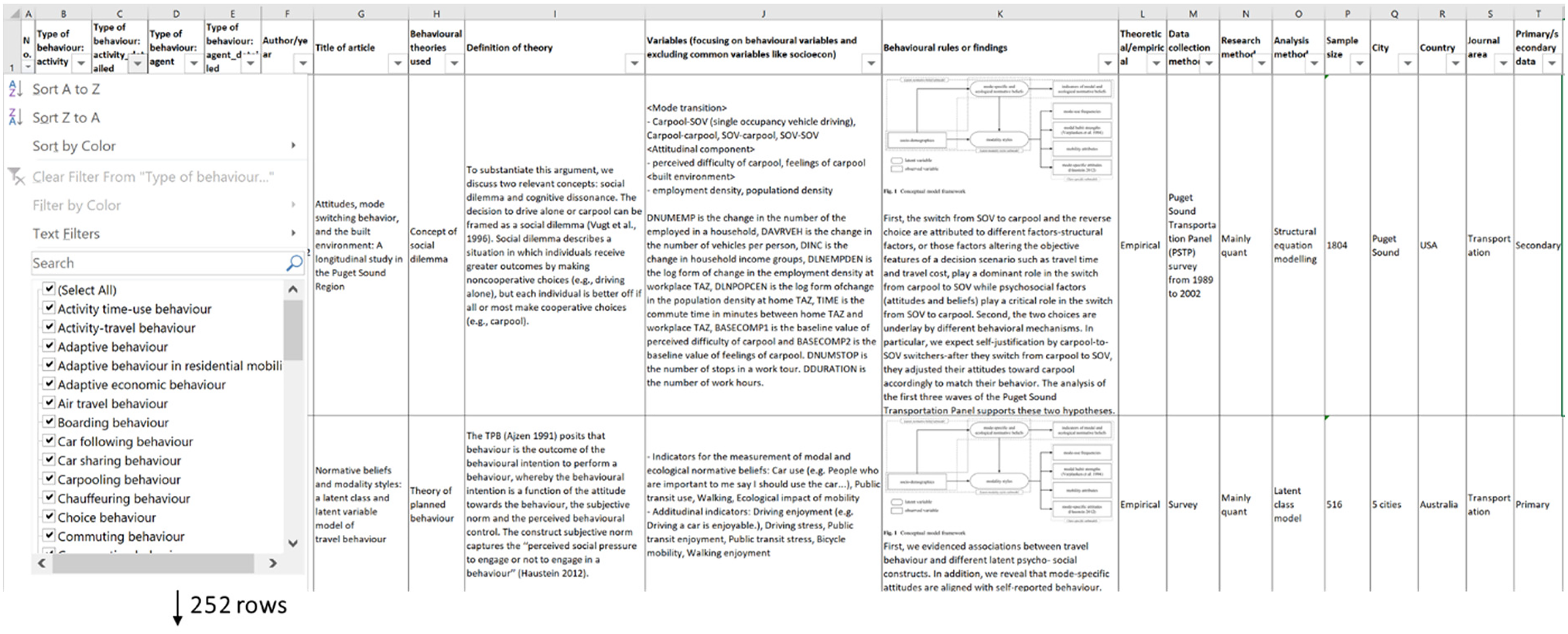
Portfolio of behavioral theories in planning-related fields (excerpt).
The top ten most frequently used behavioral theories in the articles reviewed in this paper are: the “theory of planned behavior,” “random utility theory,” “prospect theory,” the “theory of cognitive dissonance,” “expected utility theory,” the “theory of bounded rationality,” “Bayesian theory,” “nudge theory,” “social ecological model,” and “norm-activation theory.” Twenty-three theories that were used in more than one article are marked with an asterisk in Table 1 and short definitions are provided in Appendix C, Table C (full list provided in Appendix C, Table D). We also included articles that used behavioral concepts even if specific theories were not referred to and many of these concepts are considered behavioral determinants in the related behavioral theories (e.g., “norm” is a concept linked to many theories such as the theory of planned behavior and value-belief-norm theory). These behavioral concepts include many social elements such as trust, social norms, crowd mentality and collective norm, social network, and swarm intelligence as well as more personal elements such as personal norms, attitude, lifestyle, beliefs, fear, habit, utility, motivation, emotion, perception, values, and self-identity (full list provided in Appendix C, Table D). The analysis methods frequently used by these articles include statistical methods (descriptive statistics, ANOVA, regression, latent variable models including factor analysis, correlation analysis, cluster analysis, structural equation modeling, etc.), agent-based modeling, Markov process and Monte Carlo simulation, GIS mapping, and thematic analysis.
Behavioral Theories and Other Related Theories, Models, Rules and Concepts Used in the six Planning-Related Domains Based on Literature Review and Expert Survey.
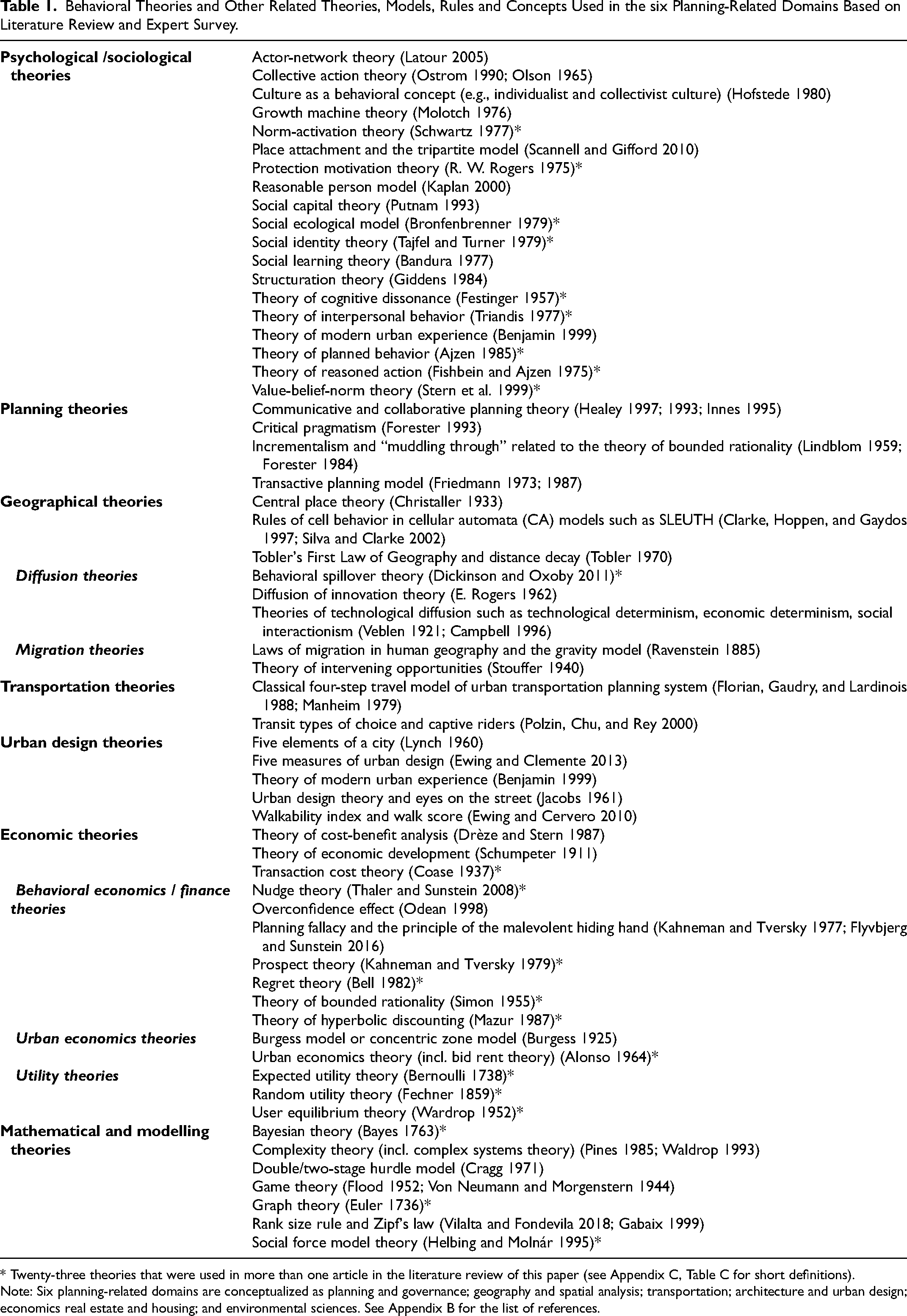
* Twenty-three theories that were used in more than one article in the literature review of this paper (see Appendix C, Table C for short definitions).
Note: Six planning-related domains are conceptualized as planning and governance; geography and spatial analysis; transportation; architecture and urban design; economics real estate and housing; and environmental sciences. See Appendix B for the list of references.
Types of Behavior, Hierarchy of Theories, Family Tree, and Overlapping Concepts in Planning-Related Fields
This paper classified types of behavior into two levels of “agent” and two levels of “activity” (Figure 2) to take a snapshot of the detailed types of behaviors being studied in planning-related fields, rather than to create a systematic categorization. As for agent, most behaviors dealt in the 152 articles that this paper reviewed were individual behavior such as pedestrian, driver, elderly, adolescent, and consumer behavior. A few articles looked into collective behavior (mainly crowd behavior) and government behavior.
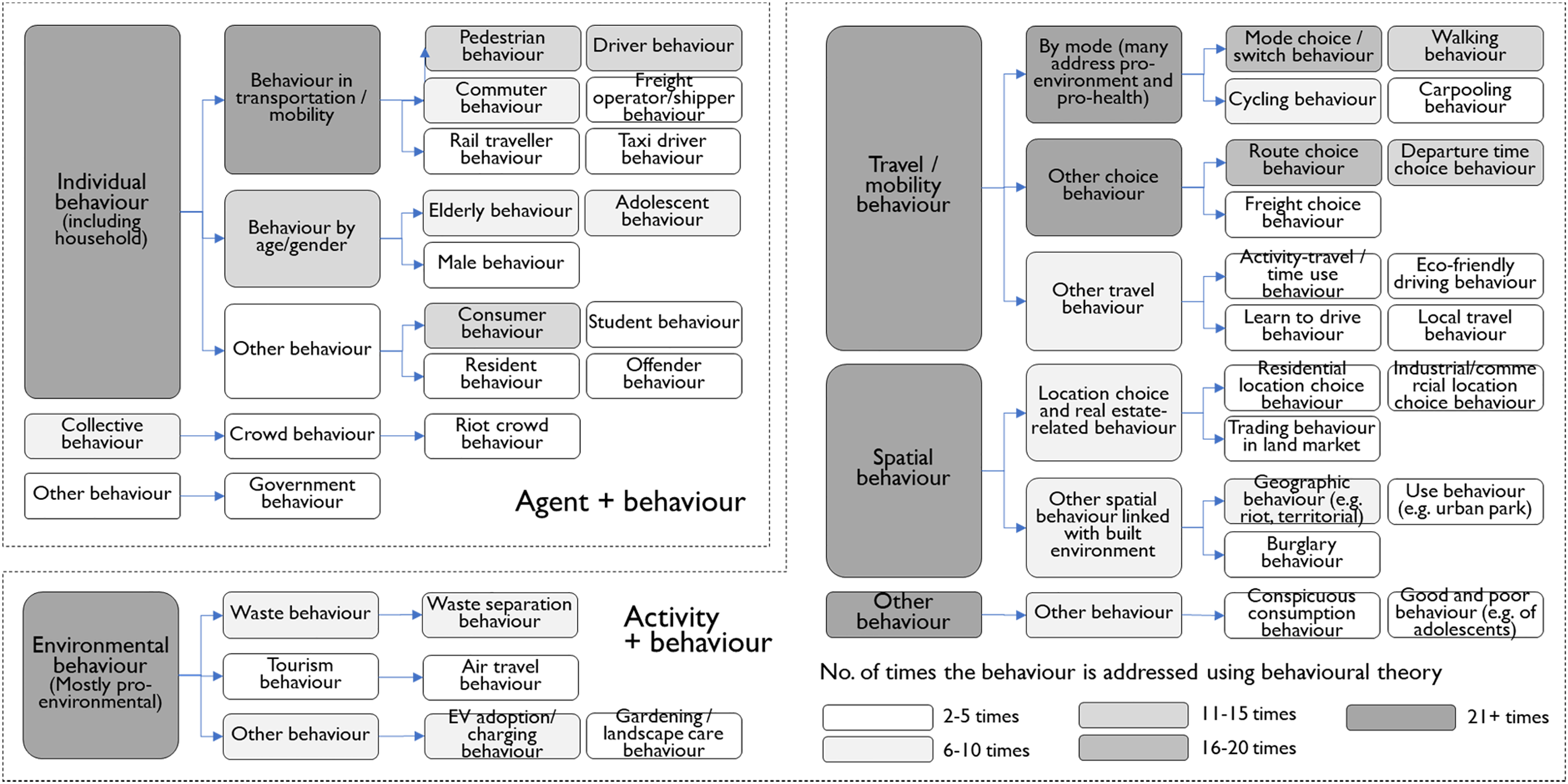
Types of behavior frequently studied in planning-related fields by agent and activity.
As for activity, travel behavior was studied widely, especially mode-related behavior such as mode choice and switch, walking (especially for the elderly), and cycling. (Note that travel behavior is represented largely in this paper possibly because putting “travel behavior” in the title is relatively common for transportation-related articles.) Environmental (mostly pro-environmental) behavior was also studied widely including waste separation, air travel, electric vehicle adoption and charging, and energy and water saving. Many articles studied spatial behavior, including location choice of households and firms, trading behavior in the land market, and behavior related to the use of space (e.g., riot and territorial, use of urban parks).
Furthermore, this paper presents a flow chart of behavioral theories and determinants that were addressed more than once in the planning-related articles reviewed above. It illustrates the hierarchy of theories, family trees, and overlapping concepts to a degree as can be seen in Figure 3. One may find it helpful to first identify the types of behavior (e.g., individual commuters’ mode choice behavior) (see Figure 2) and the domain of application around which the analysis of theory can be conducted (e.g., geography and spatial analysis, transportation, environmental sciences) (Appendix C, Table F), and then use Figure 3 to make sense of the data.
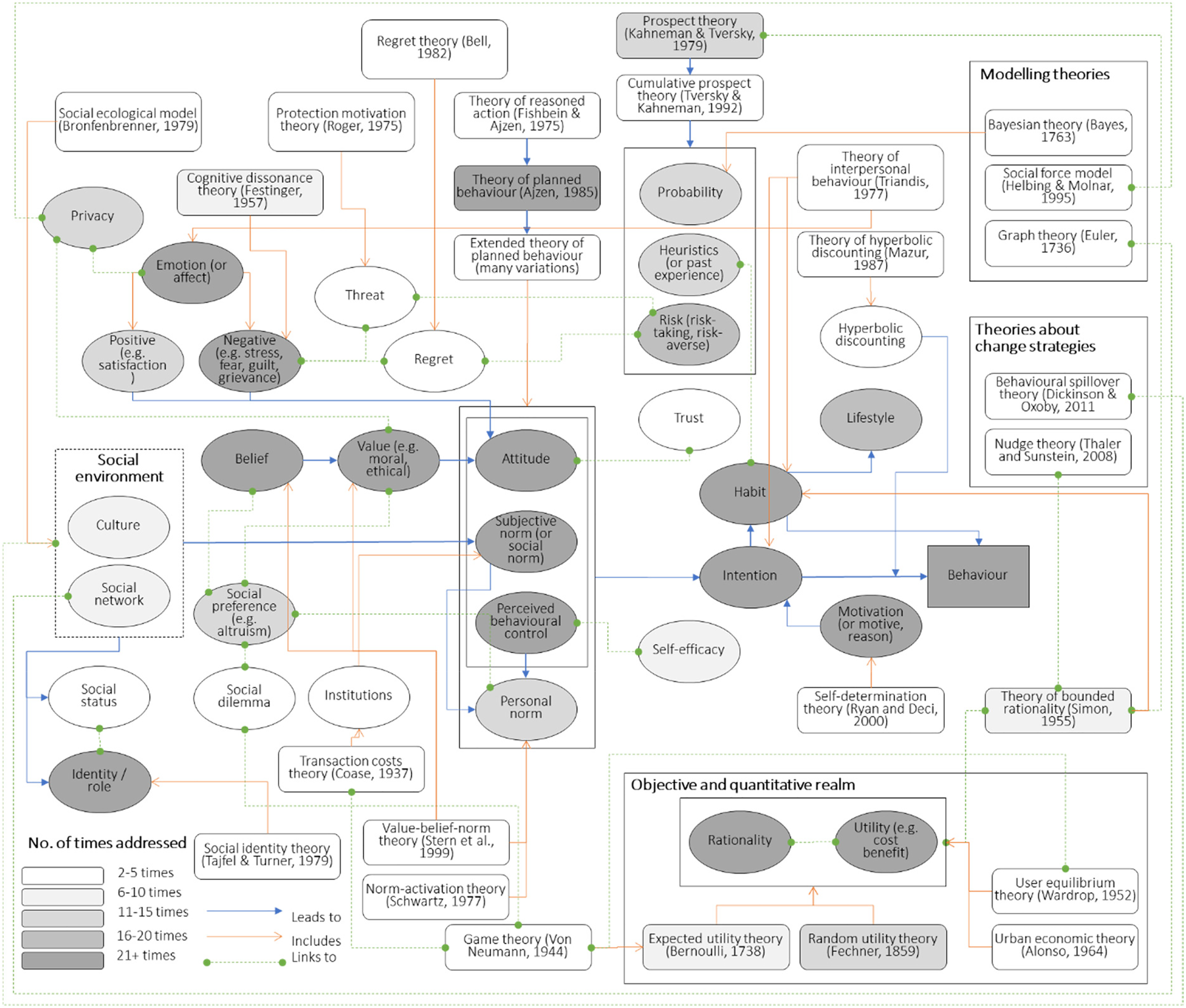
Flow chart of behavioral theories and concepts used in planning-related fields. Note: This chart is a compilation of many theoretical frameworks found in the literature review including Klöckner (2013), Bockarjova and Steg (2014), Zhao et al. (2018), Ji et al. (2018), Van Acker, Witlox, and Van Wee (2007), Garcia-Sierra, Van Den Bergh and Miralles-Guasch (2015), Maness et al. (2015) and Pronello and Gaborieau (2018) (See Appendix B for the list of references).
As can be seen in Figure 3, the most frequently used determinants found in our literature review can be explained in the flow of belief leading to value to attitude to intention, and to behavior (Pronello and Gaborieau 2018). Belief and value are concepts closely linked to social preference (e.g., altruism), personal norm, and social dilemma which are used in theories like “value-belief-norm theory,” “norm-activation theory,” and “game theory” (Klöckner 2013). Attitude is influenced by emotion or affect both positive (e.g., satisfaction) and negative (e.g., stress, fear, guilt, and grievance), and links with trust. It is an important determinant of the “theory of reasoned action” along with subjective norm (or social norm), which developed into the “theory of planned behavior” by adding the element of perceived behavioral control, and furthermore into the “extended theory of planned behavior” by adding personal norm (Klöckner 2013). Subjective norm is part of institutions that theories like transaction costs theory and collective action theory deal with, is influenced by social environment such as culture and social network included in “social ecological model,” and influences the formation of the personal norm. Social environment then leads to the concepts of social status, identity, and role which are covered in “social identity theory.”
Probability, heuristics (including past experience), and risk (risk-taking or risk-averse) form another group of determinants frequently used as part of “prospect theory,” closely linked with the “theory of bounded rationality (Sun, Karwan and Kwon 2016).” The concept of probability is included in the “Bayesian theory” and heuristics are closely related to the concept of habit which leads to lifestyle and influences behavior (Garcia-Sierra, van den Bergh and Miralles-Guasch 2015) and the “theory of interpersonal behavior” specifically stresses habit along with emotion and intention. The concept of risk is closely related to threat and regret which are related to negative emotions, and are largely covered in theories like the “theory of cognitive dissonance,” “protection motivation theory,” and “regret theory.” “Self-determination theory” includes the notion of motivation (or motive and reason) which leads to intention and the “theory of hyperbolic discounting” talks about the delay discounting that moderates the relationship between intention and behavior (Adnan et al. 2018).
In addition, this paper places other theories in three groups. First, “Bayesian theory” is placed as a modeling theory along with “social force model” which is linked with privacy and emotion (mainly comfort and discomfort) and “graph theory” which gets used in social science for social network analysis. Second, theories about strategies for behavioral change include “behavioral spillover theory” linked with social environment and social diffusion (Nash et al. 2017), and “nudge theory” which closely relates to the “theory of bounded rationality”. Third, some of the precursor theories mostly developed between the eighteenth century and mid-twentieth century were placed in the objective and quantitative realm with the concepts of rationality and utility which the “theory of bounded rationality” challenges. The theories that contain these concepts include “expected utility theory,” “user equilibrium theory” (which link with “game theory”), “random utility theory,” and “urban economics theory.”
It is important to note that some theories are overarching theories that encompass other theories. For example, “decision theory,” which is closely related to the field of “game theory,” encompasses other theories such as “expected utility theory” and the “theory of delay (or hyperbolic) discounting.” “Expected utility theory” is also considered a version of another overarching field of “(rational) choice theory.”
Discussions
Different Focus of Types of Behavior and Theories in Each Planning-Related Field
Pro-environmental and pro-health behaviors are commonly looked at across disciplines, theories like the theory of planned behavior are widely used across disciplines, and many topics are interdisciplinary such as transportation geography. Even so, the literature review and expert survey revealed that different planning-related fields tend to be interested in different types of behavior in detail which can be explained by different theories. Also, while difficult to be classified as “behavioral theories,” each planning-related field uses some other theories and concepts relevant to behavior as presented in Table 1 as identified from the expert survey. (Note: these are examples rather than a comprehensive list.)
The planning and governance sector is interested in a wide range of behavior such as travel, land-related (e.g., land leasing), and location choice behavior of households and industries. Many experts pointed to the importance of examining the behavior of planners, policymakers, and citizens (e.g., participation, compliance) as important actors/agents (e.g., Scholz and Stiftel 2005; Campbell 2006; Crawford et al. 2008; Podagrosi, Vojnovic and Pigozzi 2011; Cooper et al. 2014; Cvetinovic, Nedovic-Budic and Bolay 2017; Salet 2018; Qiao, Wong and Zheng 2019) and pointed to planning theories such as “communicative/collaborative planning theory” and “incrementalism” as well as economic and community development theories. In geography and spatial analysis, experts mainly look at spatial behavior, for example, the spillover of pro-environmental behavior using “behavioral spillover theory” and “social identity theory” as well as walking and crowd movement using “social force model,” “graph theory,” and concepts like collective norm (e.g., Morgado and Costa 2011). Other related theories, models, rules and concepts include rank size rule, Zipf's law, theories of diffusion and migration (e.g., Campbell 1996; Whitley et al. 2018), and rules for cell behavior in modeling approaches like cellular automata (e.g., Kim and Han 2015; Chaudhuri and Clarke 2019).
In transportation, the focus is on travel and mobility behavior as well as consumer (e.g., vehicle purchase), pro-environmental (e.g., mode choice, carpooling, and electric vehicle adoption), and pro-health behavior (e.g., walking and cycling) (e.g., Lee et al. 2016, 2017; Lee and Jung 2019). Widely used behavioral theories include utility theories and “prospect theory,” and other related theories were suggested including the “classical four-step travel model of urban transportation planning system.” Planning researchers in architecture and urban design are interested in the relationship between people's behavior (e.g., user, travel behavior) with the built environment, urban form, and morphology (e.g., Partanen 2015; Cidre 2017; Sarkar, Webster and Gallacher 2018; Park et al. 2019). The behavioral theories or concepts widely used in this field include emotion, especially satisfaction in terms of user experience and place attachment (e.g., Lokocz, Ryan and Sadler 2011) and social ecological model (e.g., Forsyth and Oakes 2015) and other theories include design theories such as “Lynch's five elements of a city.”
Researchers in economics, real estate, and housing focus on consumer, transaction, investment, housing choice, and location choice behavior mainly using behavioral economics and urban economics theories. Experts suggested other theories such as “overconfidence theory,” the concept of individualist and collective culture, and confirmatory bias. Planning researchers in environmental sciences mainly look at (pro-)environmental behavior such as energy conservation, climate change mitigation, land stewardship and use of urban green space, landscape care, and organic produce consumption behavior (e.g., Andersson et al., 2014; Ryan, 2012) and suggested other theories such as the “reasonable person model.”
Table 1 provides an overview of the theories related to behavior frequently used in the six planning-related domains based on this paper's literature review and expert survey. Appendix C, Table F provides recent publications, wherever possible, as examples of how these theories are used in each domain, to help planning researchers get exposed to the range of behavioral theories used in other related disciplines, instead of relying on the most common theories within their typical frame of reference.
Definition and Inter-Disciplinary Nature of Behavioral Theories
The literature review and expert survey of this paper suggested that many researchers think of the cognitive aspect when thinking of behavioral theories. The definition in the sense of cognitive psychology attempts to explain behavior based on mental thought processes, in other words, what takes place in people's minds (Moore 1996). However, it is also important to consider the approach in the sense of behaviorism, which focuses on observing response based on external environmental influences or stimulus (Moore 1996), as it can play a complementary role in examining behavior especially for behavior modeling. The learning and conditioning theories of behaviorism such as “reinforcement learning theory” can be useful for not only policy design but for building learning algorithms for computer models to simulate behavior. The groups of theories that explain factors that affect people's decision-making process such as the “theory of planned behavior” can be used to set variables for the model and their micro-nature focusing on individual minds make them especially applicable for simulating individual behavior. On top of these, theories about change strategies such as “nudge theory” can be particularly useful for designing policies for behavior intervention; and modeling theories like “game theory “can be used as the theoretical base for the modeling approach itself (Silva et al. 2020).
The experts in this paper's survey also highlighted the inter-disciplinary nature of the behavioral discussion in planning-related fields and the potential for planners to apply various behavioral theories used in other disciplines, such as public health, linguistics, and physics. For example, “health belief model,” “transtheoretical model of behavior change”, and “social ecological theory” commonly used in public health are especially applicable for looking at pro-health behavior in planning (e.g., Forsyth and Oakes 2015; Ligmann-Zielinska, Grady and McWhorter 2016). Also, while originating from linguistics, “Zipf's law” can be used for studying the size of cities (e.g., Vilalta and Fondevila 2018) and the concept of semantic information is used to explain the complexity and cognition of cities (e.g., Thagard 2016). Furthermore, “fuzzy theory” from physics is being used in urban modeling to account for uncertainties and complexities in the decision-making process (e.g., Al-Ahmadi 2018).
Further Classification of Types of Behavior, Cultural Context, and Relevant Determinants
While this paper attempted a classification in Figure 2, behaviors are complex and multi-layered and further classification can be beneficial. First, one can ask whether it is more “habitual (or routine) behavior” or more “occasional (sometimes spontaneous) behavior” (e.g., Lavelle, Rau and Fahy 2015). These characteristics are in a spectrum and are difficult to generalize, and are closely linked because habit can also influence occasional behaviors in the form of heuristics (Wohn et al. 2012). However, this classification can be useful to determine the amplitude of the impact of habit on specific types of behavior in specific settings. Klöckner (2013, p. 1031) called it “the degree of habitualization” and DEFRA (2008) detailed this into “one-off, occasional, regular, and habitual” behavior (DEFRA, 2008, p. 27). As Lavelle, Rau and Fahy (2015, p. 368) suggest, some behavior can be more habitual, such as “regularly buying organic food or habitually consuming water” while other behavior can be more occasional, such as “installing insulation and purchasing energy-efficient household appliances.” However, many behaviors can be both depending on the stability of the context in terms of time and place (Kardes, Cronley and Posavac 2005), for example, mode choice and route choice behavior of a commuter could be considered more habitual compared to a visitor making these decisions in a new location.
It is important for researchers to clearly define the context of behavior because determinants could have different levels of applicability depending on how habitual the behavior is. For example, Kardes, Cronley and Posavac (2005) and Miller (2016, p. 401) suggest that “intentions” affect habitual behaviors less because the processes that regulate habitual behaviors are rather automatic with minimal attention. On the contrary, “intentions” guide occasional behaviors in non-stable contexts because the processes that regulate occasional behaviors are more deliberate and involve time, effort, attention, and opportunity costs. In this sense, concepts such as lifestyle, belief, and value may be more applicable to habitual behaviors connected to theories like value-belief-norm theory (Xu et al. 2017; Krueger, Vij and Rashidi 2018) while for occasional behavior, determinants like emotion, probability, heuristics, and risk can be more fitting linked with theories like prospect theory (Ben-Elia and Shiftan 2010; Ramos, Daamen and Hoogendoorn 2014).
Second, another further classification is how personal or social the behavior is. Referring to the typology of influences suggested by Fuciu and Hortensia (2009) and Durand, Limkriangkrai and Fung (2019), “personal behaviors” can be understood as behaviors that are mainly influenced by endogenous variables such as internal goals, beliefs, personality, personal norms, and preferences, while “social behaviors” are more influenced by exogenous variables such as culture, social norm, and social class. This characteristic is in a spectrum as well and the variables in both groups are closely linked especially so as exogenous variables can be argued to influence the formation of endogenous variables (Polavieja 2015), and it is difficult to think of planning-related behaviors that do not involve any social influence. However, this classification can be useful to determine the magnitude of the impact of exogenous variables on specific types of behavior in specific settings of cultural context. For example, when looking at the travel mode choice behavior of individuals, a researcher can select “social status” (linked with “social identity theory”) as a key variable in some cities where social acceptance and image is considered a barrier to using public transport (e.g., Van, Choocharukul and Fujii 2014). Similarly, the determinant of “social identity/role” can be more important for housing location choice in some cities than others depending on the culture of strong familial bonds or filial duty and especially so for the elderly (e.g., Choi, Kwon and Kim 2018).
The portfolio and diagrams presented in this paper suggest a systematic approach to behavior modeling in planning-related disciplines, as illustrated in Figure 4. As the bi-directional arrows in Figure 4 indicate, the elements of the research design can be decided in any order as appropriate to each study, and the following is suggested as one of the many ways. First, a researcher or practitioner can define the type/s of behavior of interest in terms of agent and activity and refer to the portfolio of behavioral theories (Figure 1) and the list of behavioral theories by different planning-related domains (Table 1; Appendix C, Table F) to see what kinds of behavioral theories, variables, rules, and research methods have been used in the literature to study the selected type/s of behavior. Second, the researcher can identify whether the behavior is habitual or occasional as well as the cultural context of the case study city/ies and use the flow chart of behavioral theories and concepts (Figure 3) to select the applicable determinants of the behavior and link them with relevant behavioral theories. Third, the modeler can extract applicable behavioral variables, gather relevant data, and choose research method/s depending on the research question/s and the nature of the data. After selecting the appropriate analytical method/s, the modeler can decide whether to employ equations or language-based rules, or both, with an option of including learning algorithms if appropriate. Further research can demonstrate the application of the tables and figures suggested in this paper for establishing a research design for empirical modeling of particular type/s of behavior in a specific context.
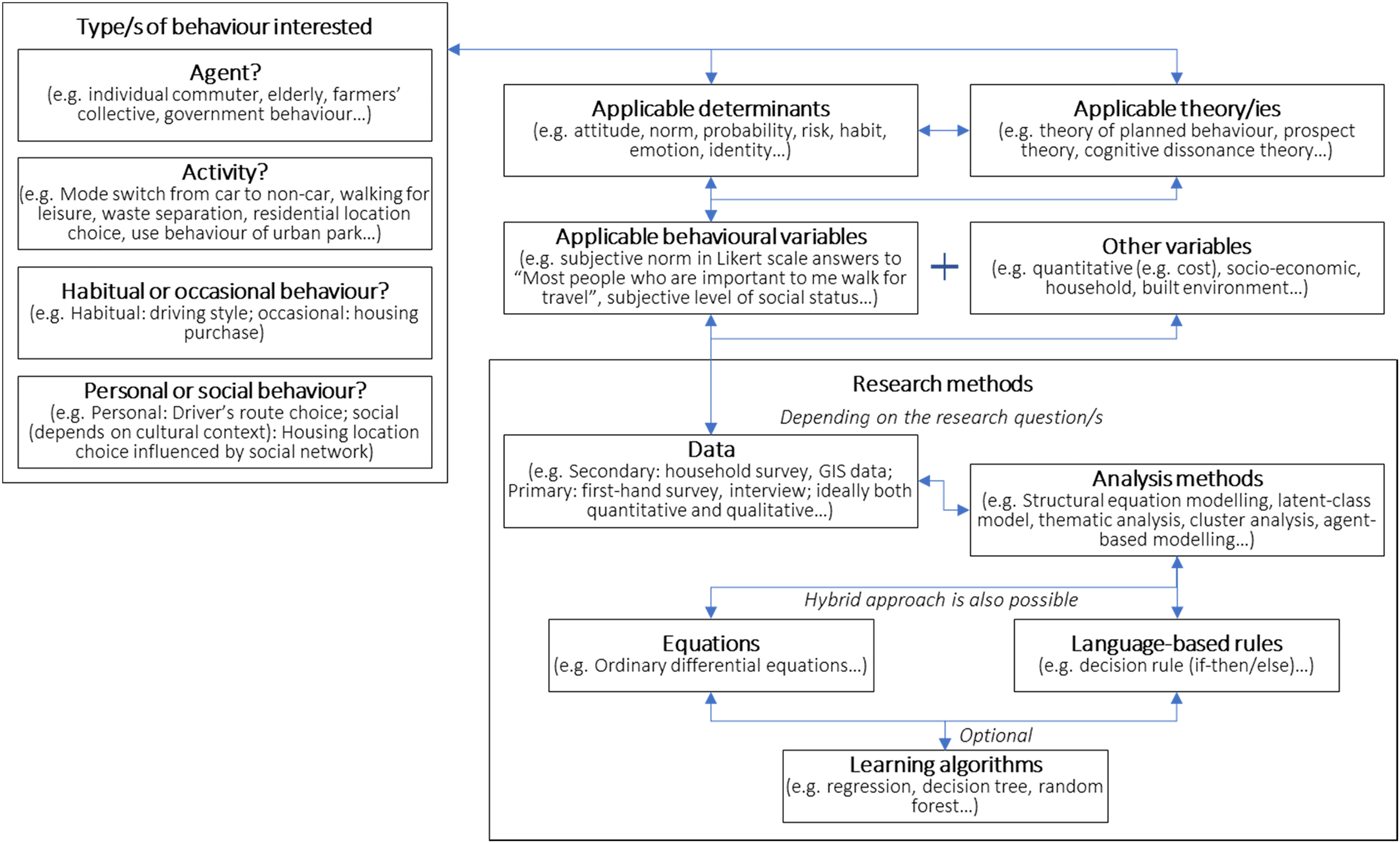
Systematic approach to behavior modelling: linking types of behavior with determinants, theories, variables, and research methods.
Linking Behavioral Theories with Behavioral Rules
Behavioral rules for modeling can be extracted in two ways: using deduction from theories and using induction from data analysis. First, as this paper's portfolio (Figure 1) suggests, rules can be extracted from theories. For example, the theory of planned behavior can be used to set an equation for behavioral intention (BI): “BI = WAA + WSNSN + WPBCPBC” where W = weight/coefficient, A = attitude, SN = social norm, and PBC = perceived behavioral control where the three factors are proportional to underlying beliefs. BI and PBC then can be used to predict behavior (B) which can be expressed as: “B = WBIBI + WPBCPBC” (Ajzen 1991; Silva and Wu, 2014). However, such global equations may not be enough to generate language-based rules. This links to the other method of generating rules from data analysis, for example, identifying coefficients of variables of elderly walking behavior through structural equation modeling (Leung et al., 2018), clustering mode choice patterns of commuters using Markov Chain Monte Carlo simulation (Dawkins et al., 2018), and detecting significant changepoints in travel patterns of individuals from smart card big data using the Bayesian method (Zhao et al., 2018).
Using these two approaches in combination can be of great benefit for time and space-sensitive dynamic simulation in planning-related fields, which is an area of increasing importance in behavior modeling in the era of big data analytics. One way to decide the extent of applying the deductive and inductive approaches can be by identifying the position of the type of behavior in question in the spectrum of general and well-studied on one side and specific and less-explored on the other side. For example, if the type of behavior in question is relatively general with an existing body of empirical research that supports some established behavioral theories, the modeler could justify the assumptions and extract behavioral rules based on such theories. On the other hand, if the behavior concerns a specific group of population in a unique context, the modeler may choose to establish behavioral rules based solely on data to avoid potential biases resulting from constraints of particular theories, even if this approach is much more time- and resource-consuming. The studies positioned somewhere in between can benefit from using both approaches in combination. For example, to build an agent-based model for waste recycling, Scalco et al. (2017) used the theory of planned behavior to set the mathematical expression, applying the coefficients identified in an existing study using survey data from a Taiwanese city (Chu and Chiu, 2003), and additionally used data of the same city to initialize the parameters (such as the number of households and trucks, and amount of waste production) and set behavioral rules for agents.
Importance of Behavioral Theories and Mixed Methods Approach in Urban Modeling
Many experts, especially modelers, emphasized that it can be beneficial for researchers to build more rigorous theoretical frameworks referring to theories rather than loosely using some behavioral concepts. While linking the model to behavioral theories is often not the main objective of many modelers, applying behavioral theories using guidance like the portfolio presented in this paper can enhance urban modeling, as illustrated above along with Figure 4. First, theories can help modelers justify their approach and refrain from the criticism on the lack of theoretical foundations and black box approach, especially for structuring behavioral rules. Second, behavioral theories can help include more qualitative and psychological realms using language-based coding like if then/else statements. The traditional approach of expressing rules in equations based on combining variables may not necessarily reflect how a person makes a decision and other types of rules such as decision trees can be more applicable to behavioral modeling (An, 2012). Finally, theories can help make sense of big data and suggest the psychological and sociological reasons behind certain behavioral patterns.
Most behaviors related to planning, if not all, require both the psychological/cognitive side and the rational/economic side of the mind. While the ratio would differ for different types of behavior, these two sides work together to minimize effort and optimize performance in decision-making. However, there has been too much emphasis on the quantitative approach in modeling. While it is partly possible to account for psychological factors as “utility” for certain types of behavior closely associated with monetary values such as housing purchases, there is much to gain from using both qualitative and quantitative data and analysis techniques in behavioral modeling, especially for constructing behavioral rules.
Space and time-sensitive modeling approaches of dynamic micro-simulation like agent-based modeling (ABM), cellular automata (CA), and neural networks (NN) can be especially useful tools for using a mixed research method for examining behavior in planning. First, dynamic simulation allows both induction and deduction in a new way. While starting with a set of rules using a deductive approach, the model can then generate simulated data that requires analysis by induction, which is called generative social science (Epstein, 1999). Second, these approaches offer a platform that allows the use of both quantitative and qualitative data and methods based on equations and language-based rules (Yang and Gilbert, 2008; Millington and Wainwright, 2017; Bac-Bronowicz and Grzempowski, 2018; D’Autilia and Hetman, 2018). While computer codes allow a much more language-based approach, a modeler still needs to set various values for parameters and thresholds, etc. and this is where existing behavioral theories or existing empirical findings can be of use (Badham et al., 2018; Silva et al., 2020). Good examples of this include Batty (2013)'s use of Coleman (1964)'s theory of collective action to model the design of urban systems using Markov chains as well as Ioannides (2013)'s illustration of how the modeling of social interaction in cities can use social network theory, urban economics, and spatial econometrics.
Third, dynamic simulation such as ABM, CA, and NN is a particularly useful tool for spatial planners for its ability to link with geographic information systems (GIS) and work with spatial data (Brown et al., 2005; Lu et al., 2020; Xu et al., 2020) as demonstrated in many existing models including SLEUTH (Silva and Clarke, 2002), UrbanSim (Waddell, 2007) and LEAM (Deal and Sun, 2006). Simulation of the interaction between a-spatial agents (e.g., residents, firms) and spatial agents (e.g., land parcels) with a set of assumptions (Benenson and Torrens, 2004) can not only deductively generate results that can be statistically studied but also generate emergent patterns that require inductive and ethnographic observations, which is often called “abductive reasoning” (Sætra, 2017).
Importance of Understanding Different Scales of Behavior and Theories
The behaviors that planning-related researchers and policymakers are interested in generally span from the micro-level behavior of individuals to the macro-level behavior of systems including the planning system, policies, and culture. However, this paper's literature review and expert survey suggested that behavioral modeling in planning-related fields tends to be focused on individual behavior and that more consideration can be given to the aspect of institutions and governance. As highlighted by Donaghy and Hopkins (2006, p. 177), effective planning can be supported by “good theories of both planning behavior … and the workings of interdependent systems … within which planning activities are being considered.” Different theories can be applicable to different scales of behavior, for example, theories such as the rational actor model, organizational process model, and governmental politics model can be useful for government behavior (Allison, 1971; van Riel et al., 2016), and institutional theories such as collective action theory for collective behavior (Olson, 1965; Scholz and Stiftel, 2005; Zellner et al., 2009; Salet, 2018). Also, for behavioral intervention, theories like nudge theory tend to focus on targeting individual behavioral change while theories like the theory of change can be applied at a larger level beyond individuals.
Dynamic simulation platforms enable researchers and policymakers to deal with multiple scales of behavior that interact with one another through both top-down, deductive approach and bottom-up, inductive approach as illustrated in Figure 5, which is specifically applicable for planning-related researchers whose research concerns cities as complex systems (Silva et al., 2021). First, larger-scale behavior such as government or policy behavior can be included by setting them as super-agents or fixed system parameters, often referred to as policy scenarios, which systematically influence other individual agents (Chang and Harrington, 2006). At the same time, larger-scale behavior can be understood as the emergent and self-organizing property of the system, resulting from the interactions among individual agents (Chappin and Dijkema, 2008). This could be observed by the modeler in the form of patterns such as the culture of cooperative behavior of groups (Gautam et al., 2009) and the spatial pattern of urban development (Yen et al., 2019). When dealing with multiple scales of behavior, it can be helpful for researchers to specifically confine the types of behavior that the model concerns to prevent overcomplication (Lee, 1973).
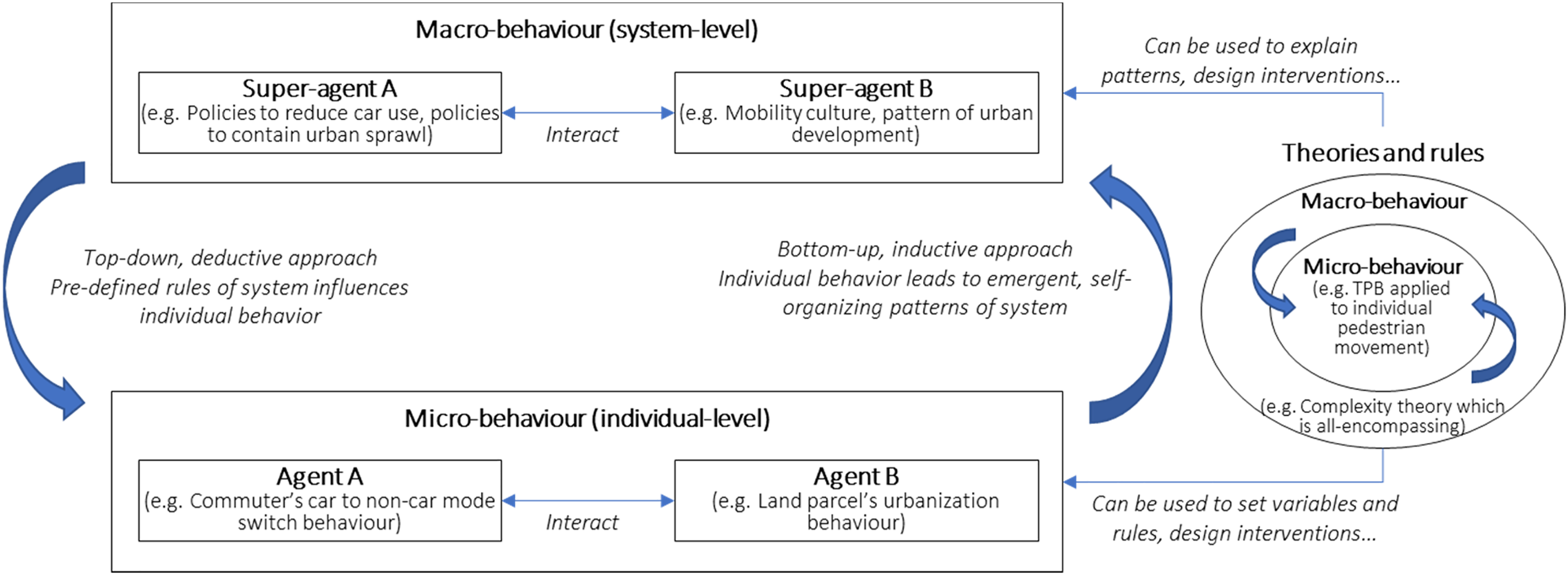
Dealing with multiple scales of behavior in space and time-sensitive dynamic simulation models using deductive and inductive approaches linked with theories.
Importance of Philosophical Discussions When Applying the Results of Behavioral Models to Public Policy
In the era of increasingly available big data of individual behavior, modeling approaches such as ABM are receiving growing attention to simulate emergent behavior from the interaction among individual agents. However, computer-based models of behavior and the analysis of patterns within data remain a technical activity until we take it to public policy and strategy with value judgments. Even for policy objectives that seem to carry universal values such as the promotion of pro-environmental and pro-health behavior, the concept of behavioral intervention inherently carries an ethical debate concerning the aspect of individual freedom (Campbell, 2006), for example, installing and monitoring CCTVs to deter certain behaviors. The nature of such debate is even more complex, often described as “wicked problems” (Zellner and Campbell, 2015), when concerning behaviors regarding social justice, for example, certain social mix policies and regulations that discourage developers from supplying gated communities (Webster et al., 2018). This makes it ever more important for modelers to apply various theories to answer questions such as why certain behavioral patterns are observed in the data (explanations), why should certain measures be instituted (justifications), and what is the meaning and intent of certain behavior of certain actors (interpretations) (Donaghy, 2021).
Furthermore, understanding and applying theories of behavior from various disciplines such as psychology, sociology, and political science in behavioral modeling can enable more bottom-up behavioral interventions, which can complement the top-down approach and encourage individuals to make proactive and lasting behavioral change. Promoting certain cultures through sophisticated and trendy campaigns based on theories such as social ecological model and behavioral priming theory can be an effective strategy, which can affect social norm, personal norm, hence intention and behavior as illustrated in Figure 3. For example, social media hashtags can be used to promote the perception of healthy urban activities like urban marathon as cool and fun (CIVITAS Initiative, 2015) and urban branding techniques can be used to create a culture that perceives pro-environmental choices like electric vehicle adoption as sophisticated behavior (Rehan, 2014).
Conclusion
Based on the literature review of 318 planning-related articles and the survey of twenty-two international experts, this paper presented a portfolio of behavioral theories by types of behavior, key variables, rules, and research methods. Along with this, it provided a snapshot of the detailed types of behavior studied in the planning-related fields by agent and activity. In terms of scale, the articles reviewed dealt with individual behavior, and most behaviors studied were either directly or indirectly linked with pro-environmental or pro-health behavior which are two areas of focus of behavioral intervention. In addition, the paper illustrated the hierarchy of theories, family tree, and overlapping concepts through a flow chart, which linked various behavioral determinants (e.g., belief, value, attitude, social norm, heuristics, and risk) with theories such as the theory of planned behavior and prospect theory, and illustrated how other theories such as modeling theories, theories about change strategies, and those in the objective and quantitative realm come into the picture.
This paper extracted seven points of discussion from the literature review and expert survey. First, it provided an overview of the theories related to behavior frequently used in six planning-related domains and highlighted how some theories can be especially useful in certain domains. Second, it suggested that two approaches to examining behavior, one in the sense of behaviorism and the other in the sense of cognitive psychology, can play complementary roles, especially for behavior modeling in planning-related fields. Third, a systematic approach to behavior modeling was proposed to identify the type/s of behavior in detail by agent, activity, habitual or occasional, and personal or social, and link them with applicable behavioral determinants, theories, variables, and research methods. Fourth, this paper highlighted the benefits of using both deduction from theories and induction from data analysis when establishing behavioral rules for modeling. Fifth, it advocated for a more robust inclusion of qualitative data and methods in space- and time-sensitive dynamic models based on both equations and language-based rules. Sixth, it illustrated how dynamic simulation platforms enable the modeling of multiple scales of behavior by linking with complex systems theory in planning-related fields. Finally, it highlighted the importance of philosophical discussions when applying the results of behavioral models to public policy and suggested the use of behavior modeling to enable more bottom-up behavioral interventions to complement the top-down approach.
Supplemental Material
sj-xlsx-1-jpl-10.1177_08854122231157708 - Supplemental material for Matching Behavioral Theories and Rules with Research Methods in Spatial Planning-Related Fields
Supplemental material, sj-xlsx-1-jpl-10.1177_08854122231157708 for Matching Behavioral Theories and Rules with Research Methods in Spatial Planning-Related Fields by Heeseo Rain Kwon and Elisabete A. Silva in Journal of Planning Literature
Supplemental Material
sj-docx-2-jpl-10.1177_08854122231157708 - Supplemental material for Matching Behavioral Theories and Rules with Research Methods in Spatial Planning-Related Fields
Supplemental material, sj-docx-2-jpl-10.1177_08854122231157708 for Matching Behavioral Theories and Rules with Research Methods in Spatial Planning-Related Fields by Heeseo Rain Kwon and Elisabete A. Silva in Journal of Planning Literature
Supplemental Material
sj-docx-3-jpl-10.1177_08854122231157708 - Supplemental material for Matching Behavioral Theories and Rules with Research Methods in Spatial Planning-Related Fields
Supplemental material, sj-docx-3-jpl-10.1177_08854122231157708 for Matching Behavioral Theories and Rules with Research Methods in Spatial Planning-Related Fields by Heeseo Rain Kwon and Elisabete A. Silva in Journal of Planning Literature
Supplemental Material
sj-docx-4-jpl-10.1177_08854122231157708 - Supplemental material for Matching Behavioral Theories and Rules with Research Methods in Spatial Planning-Related Fields
Supplemental material, sj-docx-4-jpl-10.1177_08854122231157708 for Matching Behavioral Theories and Rules with Research Methods in Spatial Planning-Related Fields by Heeseo Rain Kwon and Elisabete A. Silva in Journal of Planning Literature
Footnotes
Acknowledgments
The authors are grateful to all experts who contributed to this paper in improving multiple versions and sharing thoughts via surveys and interviews: Prof H. Campbell, Prof E. Cidre, Prof K.C. Clarke, Prof A. Forsyth, Dr D.H. Kim, Prof Z. Kotval, Dr Z. Kotval-Karamchandani, Dr S.H. Lee, Prof S.J. Lee, Dr S.K. Lee, Dr A. Ligmann-Zielinska, Prof J.R. Mullin, Prof Z. Nedović-Budić, Dr K. Park, Prof J. Partanen, Prof R. Ryan, Prof W. Salet, Dr P.M. Sousa, Prof B. Stiftel, Prof C. Webster, Prof I. Vojnovic, Prof C. Wong, as well as to the anonymous reviewers for their valuable comments.
Author Note
Heeseo Rain Kwon, Bartlett School of Planning, University College London (UCL), London, UK.
Declaration of Conflicting Interests
The author(s) declared no potential conflicts of interest with respect to the research, authorship, and/or publication of this article.
Funding
The author(s) disclosed receipt of the following financial support for the research, authorship, and/or publication of this article: Economic and Social Research Council (Grant No. RG76702/JPAG254) and the Cambridge Humanities Research Grant (Grant No. GASR009831/ JPES.AHAS).

Supplemental Material
Supplemental material for this article is available online.
Notes
Author Biographies
References
Supplementary Material
Please find the following supplemental material available below.
For Open Access articles published under a Creative Commons License, all supplemental material carries the same license as the article it is associated with.
For non-Open Access articles published, all supplemental material carries a non-exclusive license, and permission requests for re-use of supplemental material or any part of supplemental material shall be sent directly to the copyright owner as specified in the copyright notice associated with the article.
