




Abstract
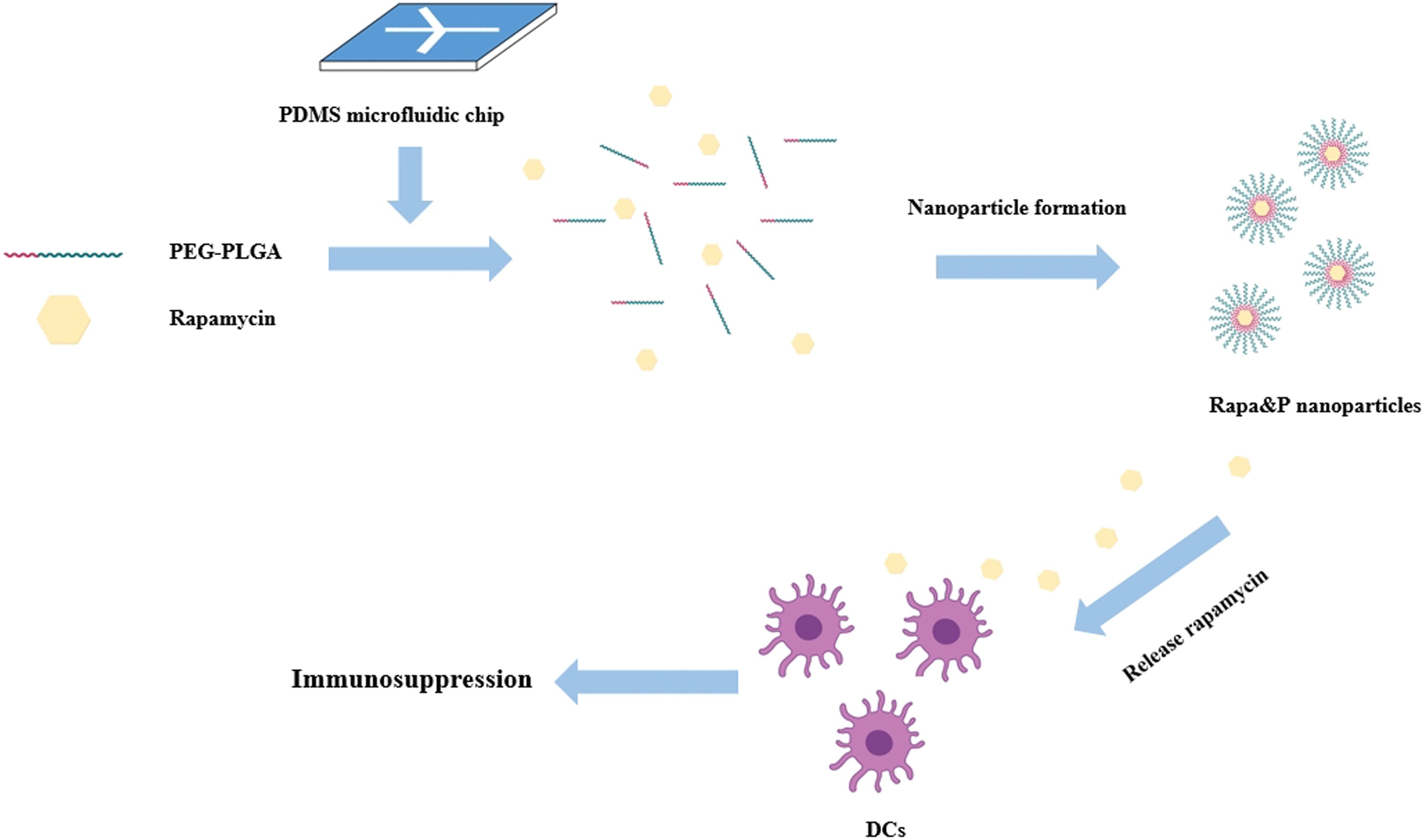
The high hydrophobicity and low oral availability of immunosuppressive drug, rapamycin, seriously limit its application. It was thus aimed to develop a PEG-PLGA based nano-loading system for rapamycin delivery to achieve improved bioavailability with sustained effects via a novel microfluidic chip and manipulation of the hydrophobic PLGA chain length. PDMS based microfluidic chip with Y shape was designed and PEG-PLGA polymers with different PLGA chain length were used to prepare rapamycin nano-delivery systems. Dendritic cells were selected to evaluate the immunosuppressive effect of the nanoparticles including cytotoxicity assay, dendritic cell activation, and cytokine levels. The effects of different PEG-PLGA nanoparticles on the immunomodulatory properties were finally compared. It was shown that PEG-PLGA could be successfully used for rapamycin encapsulation via microfluidics to obtain nano-delivery systems (Rapa&P-20 k, Rapa&P-50 k and Rapa&P-95 k) ranging from 100 nm to 116 nm. The encapsulation efficiency was ranged from 69.70% to 84.55% and drug loading from 10.45% to 12.68%. The Rapa&P-50 k (PLGA chain length: 50 k) could achieve the highest drug loading (DL) and encapsulation efficiency (EE) as 12.68% and 84.55%. The encapsulated rapamycin could be gradually released from three nanoparticles for more than 1 month without any noticeable burst release. The Rapa & P nanoparticles exhibited enhanced immunosuppressive effects over those of free rapamycin as shown by the expression of CD40 and CD80, and the secretion of IL-1β, IL-12 and TGF-β1. Rapa&P-50 k nanoparticles could be the optimal choice for rapamycin delivery as it also achieved the most effective immunosuppressive property. Hence, this study could provide an efficient technology with superior manipulation to offer a solution for rapamycin delivery and clinical application.
Get full access to this article
View all access options for this article.
References
Supplementary Material
Please find the following supplemental material available below.
For Open Access articles published under a Creative Commons License, all supplemental material carries the same license as the article it is associated with.
For non-Open Access articles published, all supplemental material carries a non-exclusive license, and permission requests for re-use of supplemental material or any part of supplemental material shall be sent directly to the copyright owner as specified in the copyright notice associated with the article.
