




Abstract
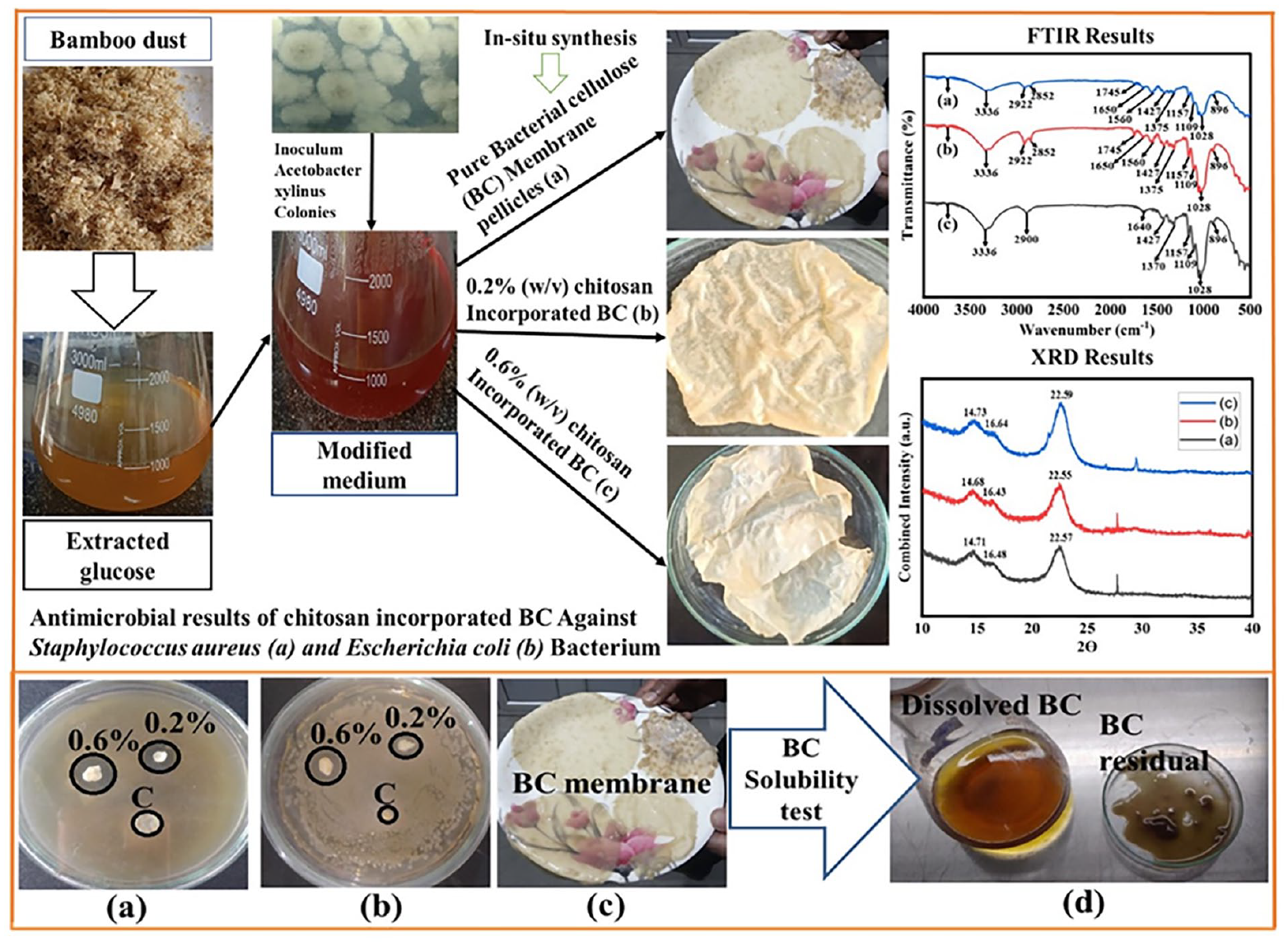
Various carbon sources can be utilized for the biosynthesis of bacterial cellulose (BC), with agricultural wastes being explored as sustainable options. In this study, glucose was extracted from bamboo dust via mild acid hydrolysis to prepare a modified medium combining extracted glucose with Hestrin-Schramm (HS) medium for BC biosynthesis using Acetobacter xylinus NCIM 2526. Chitosan, a biopolymer, was incorporated into the BC synthesis medium at concentrations of 0.2%, 0.6%, and 1% (w/v) after 2 days of shaking incubation, producing chitosan-incorporated BC membranes through in situ synthesis. Fourier transform infrared (FTIR) spectroscopy confirmed cellulose in the BC produced from the modified medium and chitosan in BC membranes with 0.2% and 0.6% (w/v) chitosan. Changes in physical and crystalline morphology were further characterized by scanning electron microscopy (SEM) and X-ray diffraction (XRD) analysis. The purity of cellulose was validated through chemical solubility tests, while energy-dispersive X-ray (EDX) analysis confirmed the presence of chitosan in the BC membranes. The average yields were 5.8 ± 0.21 g/l for pure BC, 5.2 ± 0.21 g/l for BC with 0.2% (w/v) chitosan, and 4.6 ± 0.21 g/l for BC with 0.6% (w/v) chitosan after 7 days. The medium with 1% (w/v) chitosan did not produce BC membranes. BC synthesized with 0.2% chitosan exhibited similar physical and chemical properties to pure BC and demonstrated good antimicrobial properties, suggesting its potential use in bandages and wound dressings.
Keywords
Get full access to this article
View all access options for this article.
References
Supplementary Material
Please find the following supplemental material available below.
For Open Access articles published under a Creative Commons License, all supplemental material carries the same license as the article it is associated with.
For non-Open Access articles published, all supplemental material carries a non-exclusive license, and permission requests for re-use of supplemental material or any part of supplemental material shall be sent directly to the copyright owner as specified in the copyright notice associated with the article.
