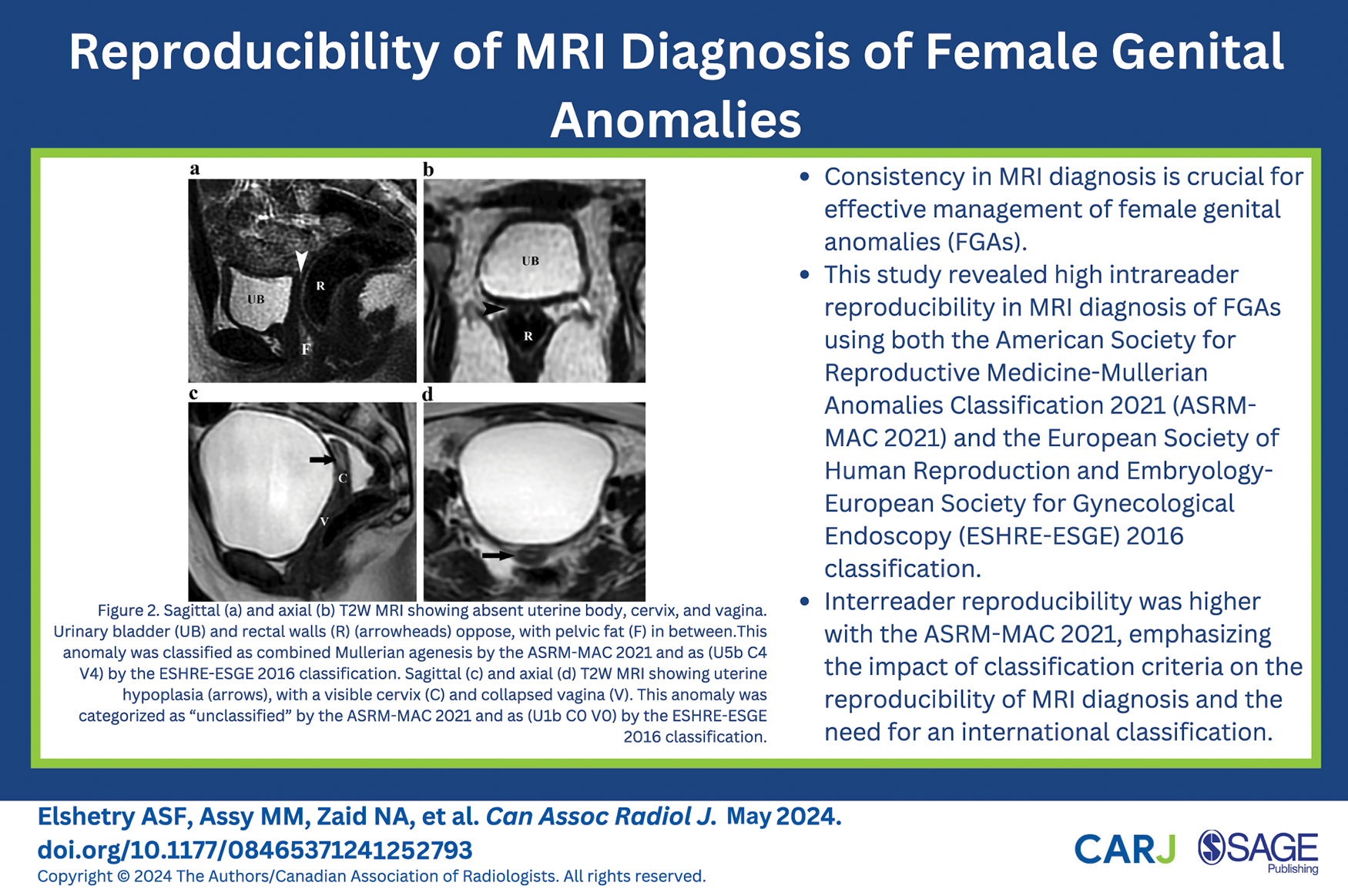
Purpose: To assess and compare intrareader and interreader reproducibility of magnetic resonance imaging (MRI) diagnosis of female genital anomalies (FGAs) using the American Society for Reproductive Medicine-Mullerian anomalies classification 2021 (ASRM-MAC 2021) and European Society of Human Reproduction and Embryology-European Society for Gynecological Endoscopy (ESHRE-ESGE) 2016 classification. Methods: In this retrospective study, we searched our electronic MRI database from April 2021 to September 2023, selecting MRI studies with FGAs. Seventy-six consecutive studies were included and reviewed by 4 independent radiologists using both classifications. Studies were re-evaluated after 1 month. Reproducibility was assessed using kappa (κ) scores with 95% confidence intervals (CI). Results: Intrareader agreement for MRI diagnosis of FGAs was substantial to excellent, with κ scores ranging from 0.684 (95% CI, 0.534-0.834) to 0.985 (95% CI, 0.963-1.01) using the ASRM-MAC 2021 and from 0.743 (95% CI, 0.621-0.865) to 0.846 (95% CI, 0.719-0.973) using the ESHRE-ESGE 2016 classification. Pairwise interreader agreement was higher with the ASRM-MAC 2021, ranging from moderate (κ = 0.491; 95% CI, 0.341-0.642) to substantial (κ = 0.709; 95% CI, 0.597-0.821), compared to the ESHRE-ESGE 2016 classification, with weak (κ = 0.080; 95% CI, 0.068-0.228) to moderate (κ = 0.511; 95% CI, 0.344-0.678) agreement. Overall interreader agreement was moderate for both classifications (κ = 0.599; 95% CI, 0.562-0.638 for ASRM-MAC 2021 and κ = 0.429; 95% CI, 0.396-0.463 for ESHRE-ESGE 2016 classification), but with significant differences (non-overlapping CIs). Conclusion: The intrareader reproducibility was high for both classifications, whereas the interreader reproducibility was higher using the ASRM-MAC 2021, highlighting the impact of classification criteria on the reproducibility of MRI diagnosis of FGAs.
GrimbizisGFTarlatzisBC. Fertility in women with uterine malformations. In: GrimbizisGCampoRTarlatzisBGordtsS, eds. Female Genital Tract Congenital Malformations. Springer; 2015:147-155.
4.
De AngelisCCasertaD. Pregnancy outcome in women with uterine anomalies. In: GrimbizisGCampoRTarlatzisBGordtsS, eds. Female Genital Tract Congenital Malformations. Springer; 2015:157-167.
5.
SaravelosSHLiTC. Prevalence in the general and selected populations. In: GrimbizisGCampoRTarlatzisBGordtsS, eds. Female Genital Tract Congenital Malformations. Springer; 2015:133-139.
6.
ButtramVCJrGomelVSieglerADeCherneyAGibbonsWMarchC. The American Fertility Society classifications of adnexal adhesions, distal tubal occlusion, tubal occlusion secondary to tubal ligation, tubal pregnancies, Mullerian anomalies and intrauterine adhesions. Fertil Steril. 1988;49:944-955.
7.
OppeltPRennerSPBruckerS, et al. The VCUAM (Vagina Cervix Uterus Adnex-associated Malformation) classification: a new classification for genital malformations. Fertil Steril. 2005;84:1493-1497.
8.
AciénPAciénMI. The history of female genital tract malformation classifications and proposal of an updated system. Hum Reprod Update. 2011;17:693-705.
9.
GrimbizisGFGordtsSDi Spiezio SardoA, et al. The ESHRE/ESGE consensus on the classification of female genital tract congenital anomalies. Hum Reprod. 2013;28:2032-2044.
10.
GrimbizisGFDi Spiezio SardoASaravelosSH, et al. The Thessaloniki ESHRE/ESGE consensus on diagnosis of female genital anomalies. Hum Reprod. 2016;31(1):2-7.
11.
LudwinALudwinIKudlaMKottnerJ. Reliability of the European Society of Human Reproduction and Embryology/European Society for Gynaecological Endoscopy and American Society for Reproductive Medicine classification systems for congenital uterine anomalies detected using three-dimensional ultrasonography. Fertil Steril. 2015;104(3):688-697.
12.
Di Spiezio SardoACampoRGordtsS, et al. The comprehensiveness of the ESHRE/ESGE classification of female genital tract congenital anomalies: a systematic review of cases not classified by the AFS system. Hum Reprod. 2015;30:1046-1058.
13.
HeinonenPK. Distribution of female genital tract anomalies in two classifications. Eur J Obstet Gynecol Reprod Biol. 2016;206:141-146.
14.
LudwinALudwinI. Comparison of the ESHRE–ESGE and ASRM classifications of Müllerian duct anomalies in everyday practice. Hum Reprod. 2015;30(3):569-580.
15.
KnezJSaridoganEVan Den BoschTMavrelosDAmblerGJurkovicD. ESHRE/ESGE female genital tract anomalies classification system—the potential impact of discarding arcuate uterus on clinical practice. Hum Reprod. 2018;33(4):600-606.
16.
OuyangYYiYGongFLinGLiX. ESHRE-ESGE versus ASRM classification in the diagnosis of septate uterus: a retrospective study. Arch Gynecol Obstet. 2018;298:845-850.
BortolettoPRomanskiPALindheimSRPfeiferSM. The American Society for Reproductive Medicine Müllerian Anomalies Classification System: an updated framework with interactive tools. J Minim Invasive Gynecol. 2022;29(7):820-822.
19.
PelleritoJSMcCarthySMDoyleMBGlickmanMGDeCherneyAH. Diagnosis of uterine anomalies: relative accuracy of MR imaging, endovaginal sonography, and hysterosalpingography. Radiology. 1992;183:795-800.
20.
MuellerGCHussainHKSmithYR, et al. Müllerian duct anomalies: comparison of MRI diagnosis and clinical diagnosis. AJR Am J Roentgenol. 2007;189:1294-1302.
21.
ColemanADArbuckleJL. Advanced imaging for the diagnosis and treatment of coexistent renal and mullerian abnormalities. Curr Urol Rep. 2018;19(11):89.
22.
LudwinAMartinsWPNastriCO, et al. Congenital Uterine Malformation by Experts (CUME): better criteria for distinguishing between normal/arcuate and septate uterus?Ultrasound Obstet Gynecol. 2018;51:101-109.
23.
McHughML. Interrater reliability: the kappa statistic. Biochemia Medica. 2012;22(3):276-282.
24.
KooTKLiMY. A guideline of selecting and reporting intraclass correlation coefficients for reliability research. J Chiropr Med. 2016;15(2):155-163.
25.
SmitJGOverdijkinkSMolBW, et al. The impact of diagnostic criteria on the reproducibility of the hysteroscopic diagnosis of the septate uterus: a randomized controlled trial. Hum Reprod. 2015;30(6):1323-1330.
26.
LudwinALudwinICoelho NetoMA, et al. Septate uterus according to ESHRE/ESGE, ASRM and CUME definitions: association with infertility and miscarriage, cost and warnings for women and healthcare systems. Ultrasound Obstet Gynecol. 2019;54(6):800-814.
SalimRWoelferBBackosMReganLJurkovicD. Reproducibility of three-dimensional ultrasound diagnosis of congenital uterine anomalies. Ultrasound Obstet Gynecol. 2003;21(6):578-582.
Supplementary Material
Please find the following supplemental material available below.
For Open Access articles published under a Creative Commons License, all supplemental material carries the same license as the article it is associated with.
For non-Open Access articles published, all supplemental material carries a non-exclusive license, and permission requests for re-use of supplemental material or any part of supplemental material shall be sent directly to the copyright owner as specified in the copyright notice associated with the article.