



Abstract
Introduction
Recently, large language models (LLMs) received much attention in scientific literature including radiology.1-6 Probably, the most well-known model is OpenAI’s GPT-3, which is based on generative pre-trained transformer (GPT) 3.5 with over 175 billion parameters.2,7 ChatGPT-3 is an AI chatbot fine-tuned using reinforcement learning from human feedback to reward desired behavior and punish “toxic” text.1,8,9 Within two months after its launch in November 2022, ChatGPT-3 has allowed over 100 million users to access and dialogue with its autoregressive LLM. 10 Several recent reports have shown promising performances of ChatGPT-3 including in an MBA degree exam 11 and in the United States Medical Licensing Exam. 12
A recent pre-print study by Rao et al 4 evaluated ChatGPT-3 as an adjunct for radiologic decision-making. ChatGPT-3 achieved moderate scores when determining appropriate imaging modalities for various clinical presentations of breast cancer screening and breast pain. 4 Given the ability to generate text responses to complex input criteria, 4 we hypothesized that ChatGPT-3 is able to provide accurate answers to questions pertaining to clinical radiology.
The aim of our study was to assess the accuracy of answers provided by ChatGPT-3 when prompted with questions from the daily routine of radiologists. In addition, we aimed to evaluate the text response when ChatGPT-3 was prompted to provide references for a given answer.
Materials and Methods
ChatGPT-3
ChatGPT-3 (San Francisco, OpenAI) is an AI chatbot based on a LLM that has been designed to generate human-like text. 3 The language model is trained on approximately 570 GB of internet texts including books, articles, websites, and Wikipedia all limited to until 2021.2,4 ChatGPT-3 does not search the internet when prompted to respond to user inputs. Instead, it employs a prediction algorithm that identifies the most likely “token” to succeed the previous one, based on patterns from its training data. Consequently, it does not duplicate existing information. All ChatGPT-3 model output was collected from the February 13, 2023, version of ChatGPT-3.
Model Input
A total of 88 questions were asked using textual prompt. These 88 questions were equally dispersed throughout 8 radiology sections including: Neuroradiology, pediatric radiology, gastrointestinal and genitourinary radiology, interventional radiology, cardiac radiology, musculoskeletal radiology, breast radiology, and chest wall and pulmonary radiology. Questions were randomly selected based on clinical experience. Questions were not systematically stratified into varying levels of difficulty. Six major categories of questions were created: 1) imaging findings of a condition (n = 15, 17%), 2) imaging findings of two differential diagnoses (n = 29, 33%), 3) modality-related questions (n = 11, 12.5%), 4) questions related to indications and contraindications (n = 7, 8%), 5) prognostic questions (n = 5, 5.7%), and 6) mixed content including differential diagnosis, anatomical questions, reference values, and complications (n = 21, 23.8%). All textual prompts are available in the supplementary table. New sessions were created for each question. Since the study used questions dispersed throughout 8 radiology sections, approval by the Ethics Committee and requirement for individual consent were not required.
Assessment of Responses
Each question was inputted once. Each response was assessed for the accuracy of the response using a 5-point Likert scale (1—incorrect, 2—some correct content, 3—approximately half correct content, 4—largely correct content, and 5—entirely correct content). Subsequently, a second textual prompt was provided consisting of the command: “Provide references for the answer above.” Responses were then assessed for their number and accuracy (0—inaccurate and 1—accurate) and whether the cited article was indexed in the PubMed database (0—no and 1—yes). Last, in the event that a cited article was indexed, the article was accessed and a 5-point Likert scale was used to assess if the article or articles provided enough background to answer the initial question (1—no pertinent information, 2—some pertinent information, 3—approximately half pertinent information, 4—largely pertinent information, and 5—entirely pertinent information).
Statistical Analysis
Categorical data are presented as integers and percentages (%). Data were plotted using Microsoft Excel ® 2021.
Results
Responses to Questions
Out of 88 questions, 59 responses were correct (67%), 15 were largely correct (17%), 6 were approximately half correct (7%), 4 were mostly incorrect (4.5%), and 4 were entirely incorrect (4.5%). All questions and categorization of answers are available in the supplementary table.
Responses to Reference Prompt
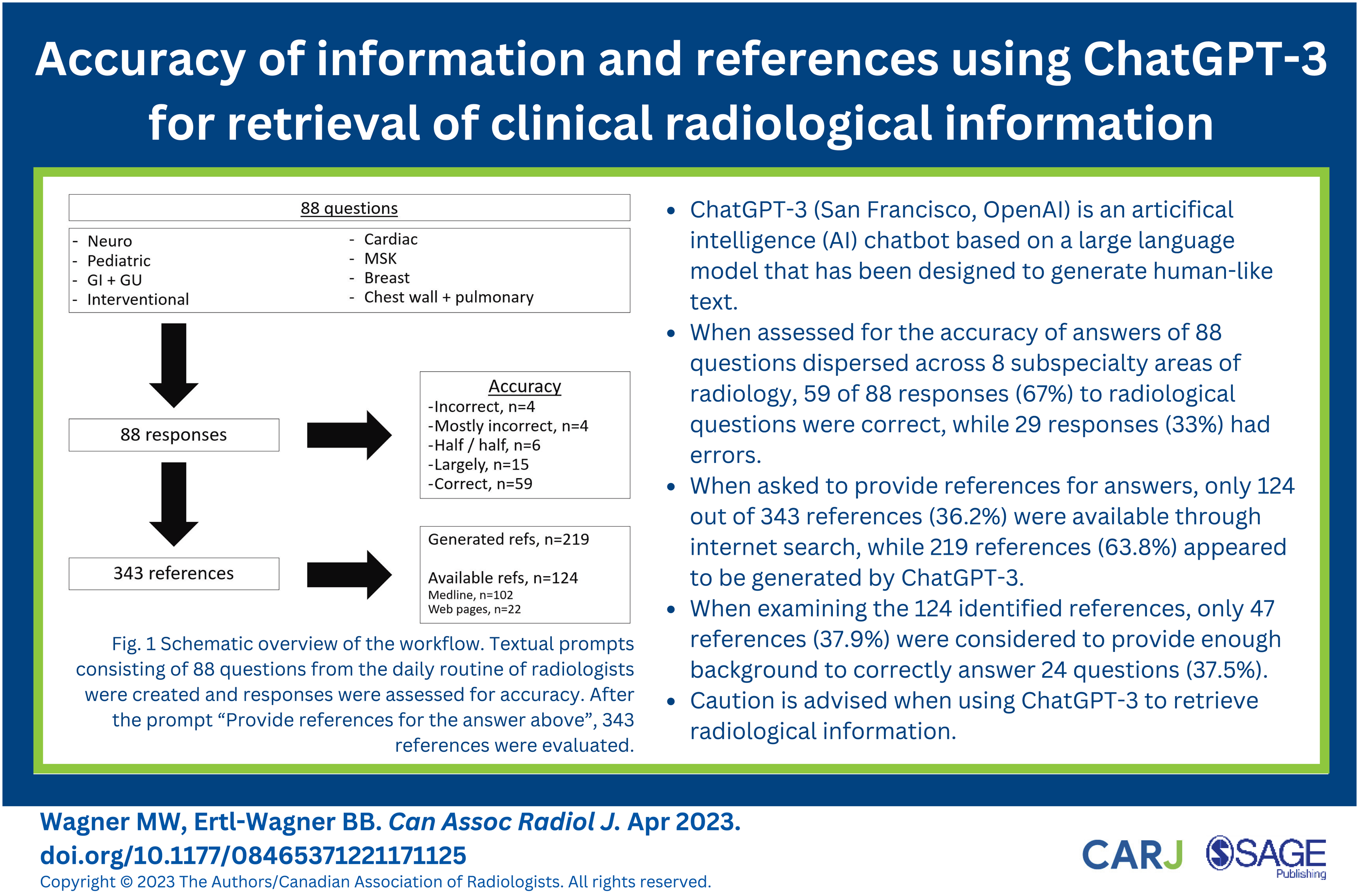
For 88 reference prompts, a total of 343 references were provided. The median number of references per prompt was 4 (range: 1–6). Out of 343 references, 124 real references (36.2%) were available through internet search. The remainder of the references (n = 219, 63.8%) were unavailable through internet search and appeared to be generated by ChatGPT-3. References which appeared to be generated were not assessed systematically. Upon review of generated references, only a thorough internet search could prove that they were not authentic (example of reference number 1 to question number 1: Pascual-Castroviejo I, Roche C, Martínez-Bermejo A, et al. Polymicrogyria in tuberous sclerosis: a report of 14 patients and a review of the literature. Neuropediatrics. 2008; 39(1):1–9. doi: 10.1055/s-2008-1038372). Of the 124 real references, 102 references (82.3%) were indexed in the PubMed database. The remainder of the identified references (n = 22, 17.7%) consisted of hyperlinks to various web pages (Figure 1). Schematic overview of the workflow. Textual prompts consisting of 88 questions from the daily routine of radiologists were created and responses were assessed for accuracy. After the prompt “Provide references for the answer above,” 343 references were evaluated.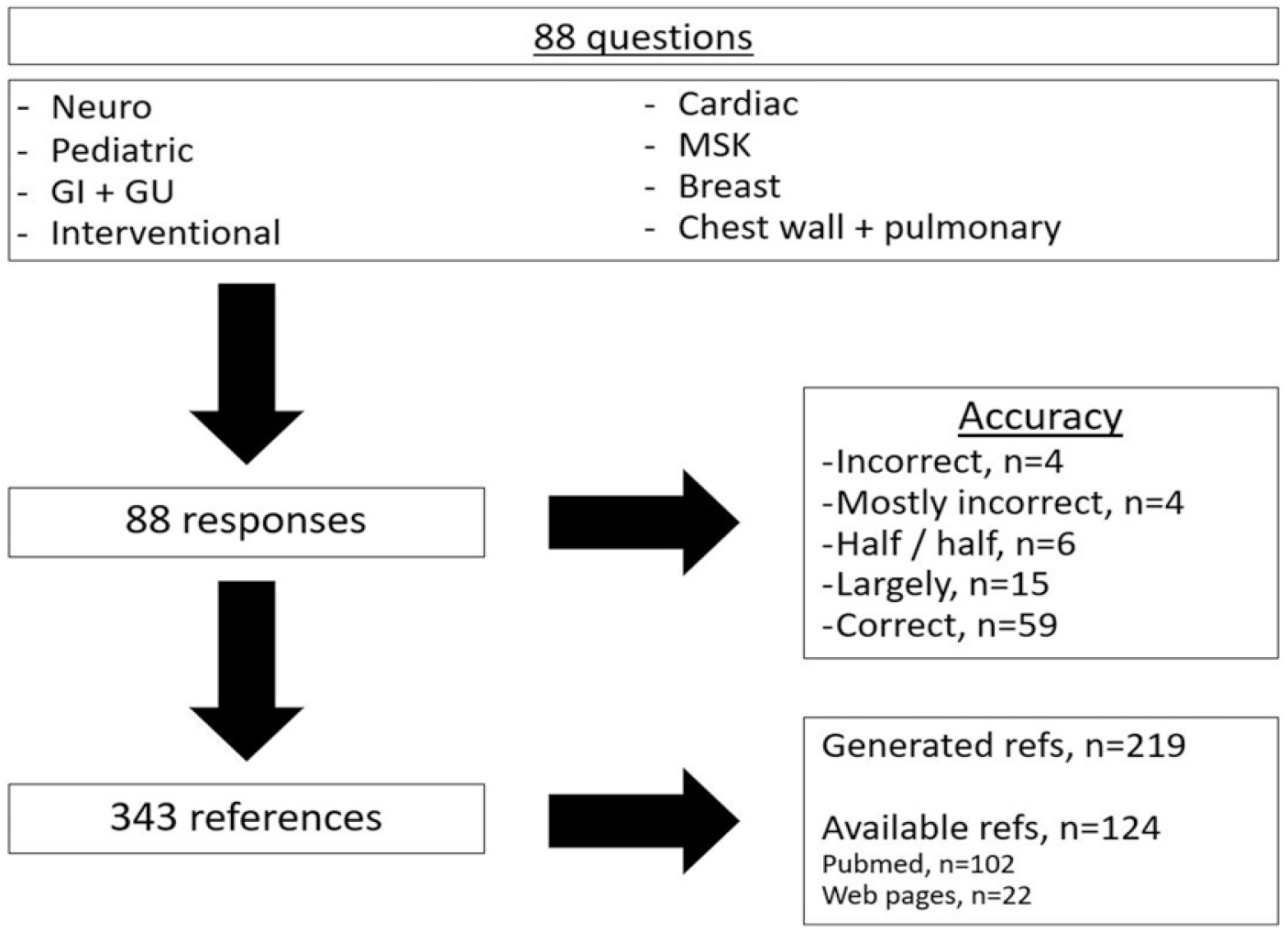
Background to Answer Questions
The 124 identified references were distributed across 64 questions. A total of 47 references (37.9%) were considered to provide enough background to correctly answer 24 questions (37.5%). Two references (1.6%) were considered to provide most of the background needed to correctly answer one question (1.6%). Five references (4%) were considered to provide approximately half the background needed to correctly answer 5 questions (7.8%) and seven references (5.6%) were considered to provide little background needed to correctly answer 6 questions (9.4%). Interestingly, 16 references (12.9%) were provided by ChatGPT-3, which did not provide any background to answer 10 questions (15.6%). For the latter calculation, 4 questions were excluded since there were more references available potentially providing enough background. Furthermore, 19 questions were correctly answered although no identifiable reference was provided.
Discussion
In this pilot study investigating the accuracy of answers provided by ChatGPT-3 when prompted with 88 questions from the daily routine of radiologists, we found that only 59 responses (67%) were correct and that the remaining 29 responses (33%) had errors. We also assessed the response when ChatGPT-3 was prompted to provide references for a given answer. We found that out of 343 references provided, only 124 references (36.2%) were available through internet search, while 219 references (63.8%) appeared to be generated by ChatGPT-3. Furthermore, when examining those “true” references, we found that only 47 references (37.9%) were considered to provide enough background to correctly answer 24 questions (37.5%). Furthermore, 19 questions were correctly answered although no “true” reference was provided.
Given the ease of access and the ability to input individualized requests, it is tempting to consult ChatGPT-3 for information or problem-solving. In fact, few studies already investigated the abilities of ChatGPT-3 in the context of questions in daily clinical routine. Hirosawa et al 6 assessed the accuracy of differential diagnoses lists created by ChatGPT-3 compared to physicians for clinical histories with common presentation complaints. Authors found that the rate of correct diagnosis by ChatGPT-3 within the differential diagnoses lists was 83% compared to 93% correct physician’s diagnosis. Rao et al 4 evaluated ChatGPT’s capacity for clinical decision support in radiology. They compared ChatGPT’s responses to the American College of Radiology Appropriateness Criteria for breast pain and breast cancer screening. Authors used an open-ended format to prompt ChatGPT to provide the single most appropriate imaging procedure and a select-all-that-apply format when ChatGPT was provided with a list of imaging modalities to assess. ChatGPT achieved moderate to good results for both breast pain and breast cancer screening. Rao et al listed some shortcomings of language models, which probably limited their results, 4 namely, the tendency or inability to relate facts to sources and the fabrication of information presented, aka “hallucinations.” We also encountered these shortcomings in our study: Only 124 of 338 references (36.7%) were in fact “true” references. The remainder of the references were likely fabricated. In addition, 29 of 88 responses (33%) appeared to have also been fabricated.
In this study, 88 questions across 8 radiology subspecialties were submitted to ChatGPT-3. Questions covered common reading room scenarios including imaging findings of a condition, imaging findings of two differential diagnoses, modality-related questions, and questions related to prognosis, indications and contraindications. While the results of this study inform about the accuracy of ChatGPT-3’s responses and the authenticity of references, there remain a number of unanswered questions. First, given that a third of questions were answered incorrectly and only 36% of its references are in fact authentic, what is the future role of ChatGPT-3 and other chatbots for radiologists? How can the user ensure that the medical information presented is accurate, complete, and robust to slight alterations of the input question? There is a need for further studies to address these questions also in the context of the newly released ChatGPT-4. In addition, users should keep in mind that any AI-powered chatbot is only as knowledgeable as the data they have been trained with. 6 ChatGPT-3 has been trained on data until 2020 with limited knowledge of events in 2021. Consequently, any radiologic study or textbook published in 2022 or later cannot be considered “training data.” It is also important to note that the 88 questions submitted to ChatGPT-3 in this study do not represent the entire depth of radiology knowledge. In order to consider a certain (differential) diagnosis, radiologists first need to be trained to describe and recognize imaging findings and appreciate these findings in their clinical context.
ChatGPT-4 and future variants of LLMs might be able to address some of the questions and concerns mentioned above and if utilized correctly, AI-powered chatbots might have a positive impact in the reading room for example as problem-solving tools. However, users must be cognizant about the potential fabrication of incorrect information.
Our study has limitations that need to be taken into account when interpreting the results. Since the content of ChatGPT-3’s training data is unknown to the public, 4 it is unclear which journal articles and web pages contributed to ChatGPT-3’s answer to the question and prompt to provide references. In addition, the number of questions per radiological field was limited and the questions were not graded by difficulty. Future studies could also systematically analyze the effect of slight alterations of an input question on content of an answer and the authenticity of references.
Conclusion
In this pilot study, we demonstrated that ChatGPT-3 provided correct responses to questions from the daily clinical routine of radiologists in 67%, while 33% of answers had errors. When ChatGPT-3 was prompted to provide references for a given answer, only 36.7% of references were in fact “true,” identifiable references, whereas 63.3% appear to have been generated by ChatGPT-3. Finally, we showed that only 37.9% of “true,” identifiable references provided enough background for 37.5% of correctly answered questions. These results serve as a stark reminder of the limitations of ChatGPT-3 that must be considered when consulting ChatGPT-3 for clinically oriented questions. Caution is advised when using ChatGPT-3 to retrieve radiological information, especially in a clinical context.
Supplemental Material
Supplemental Material - Accuracy of Information and References Using ChatGPT-3 for Retrieval of Clinical Radiological Information
Supplemental Material for Accuracy of Information and References Using ChatGPT-3 for Retrieval of Clinical Radiological Information by Matthias W. Wagner, and Birgit B. Ertl-Wagner in Canadian Association of Radiologists Journal
Footnotes
Declaration of Conflicting Interests
The author(s) declared no potential conflicts of interest with respect to the research, authorship, and/or publication of this article.
Funding
The author(s) received no financial support for the research, authorship, and/or publication of this article.

Supplemental Material
Supplemental material for this article is available online.
References
Supplementary Material
Please find the following supplemental material available below.
For Open Access articles published under a Creative Commons License, all supplemental material carries the same license as the article it is associated with.
For non-Open Access articles published, all supplemental material carries a non-exclusive license, and permission requests for re-use of supplemental material or any part of supplemental material shall be sent directly to the copyright owner as specified in the copyright notice associated with the article.
