




Abstract
Cancer screening is invaluable for early detection of disease, including for breast and lung cancer. Through early detection, cancer treatment can be commenced prior to the development of advanced stage disease, significantly reducing morbidity and mortality. However, eligible patients may face barriers when accessing screening services, and some groups may be more disproportionately affected than others. This review aims to describe some of the most prominent barriers that at-risk populations may face when accessing image-based cancer screening services in Canada. Characterizing these barriers would be helpful in determining the best strategies to increase uptake to these screening services and, consequently, improve health equity.
Introduction
Cancer is the leading cause of death in Canada, with approximately 85 100 deaths expected in 2022. 1 Among the different types of cancers, lung cancer is projected to account for 24.3% of all cancer deaths in 2022, which makes it the cancer with the highest mortality in Canada. 2 Breast cancer is also among the leading cancer-related deaths, accounting for an estimated 6.5% of all cancer deaths in 2022. 2 Despite overall survival rates increasing, the incidence of cancer and cancer-related deaths is expected to rise as a result of the aging Canadian population. Therefore, the topic of effective screening and treatment of common cancers remains an important area of discussion.
Cancer screening is a secondary prevention strategy, and it entails checking for the presence of a disease in an asymptomatic population group. Medical imaging is often included as a crucial component of screening services for the general population. Studies have shown reductions in all-cause mortality as a result of the implementation of population-based screening programs, for example, the use mammography for breast cancer and low-dose computed tomography (LDCT) for lung cancer.3,4 However, despite the evidence of benefit of these cancer screening programs, in practice, screening rates in the general population have not necessarily met the intended targets. 5 What is particularly concerning is the fact that screening rates seem to be disproportionately lower in certain population groups compared to others.6-9 This includes at-risk population groups such as low-income individuals, immigrants, Indigenous peoples, among many others. 9 The reason for this discrepancy in screening participation is often multifaceted and complex, though it ultimately results in higher Canadian cancer mortality rates than warranted, with many preventable deaths in the setting of appropriate screening uptake.
Disparities that affect screening participation need to be addressed to minimize cancer mortality rates in a steadily aging Canadian population. As such, the purpose of this review is to identify the disparities that prevent adequate screening from taking place and provide insights on how barriers to screening participation can be potentially dismantled.
Disparities in Lung Cancer Screening
Screening via imaging has been fruitful for malignancies with the highest prevalence and mortality rates. For lung cancer specifically, studies have shown that while annual chest radiography did not reduce lung cancer mortality compared to usual care, LDCT provided a relative reduction in lung cancer mortality of 20.0%.4,10 These results translate to a number needed to screen of 320 with LDCT to prevent a lung cancer-related mortality. 4 Due to the relative novelty of these findings, only some LDCT screening programs have been implemented across Canada. As of 2022, British Columbia and Ontario are the only 2 provinces where lung cancer screening programs for at-risk populations have been established. 11 Eligibility criteria vary by province, but generally, at-risk populations include people who have a 2% or greater risk of developing lung cancer within the next 6 years. 12 Clinical risk calculators, such as the PLCOM2012, consider a multitude of factors in order to best categorize the risk of each individual person. 12
Because of the relative novelty of lung cancer screening programs in Canada, the sociodemographic characteristics related to uptake for lung cancer screening have not been well-studied. However, it is theorized that because individuals with lower socioeconomic status already have reduced uptake in more established screening programs, such as for breast cancer, lung screening programs may encounter similar disparities in access. 13
There have been qualitative studies done that contextualize the health inequities that low-income individuals face with regards to accessing lung screening programs. A study that used a theoretical thematic analysis approach affirmed that low-income individuals face numerous barriers that tended to sway them away from lung cancer screening participation. 14 In that study, of the 15 screen-eligible individuals that reported an income of less than $30.000 per year, 9 of them chose not to undergo LDCT lung cancer screening. 14 The reasoning behind this choice was multifaceted, touching on aspects such as income instability, poor life outlook, and insensitive clinical encounters. 14 Moreover, perspectives from family physicians in the downtown Toronto area showcase concerns that low-income individuals may not necessarily have the means to adhere to the stipulations of a lung cancer screening program. 15 Considering these findings, it is evident that Canadian lung cancer screening programs may not necessarily be accessible enough to low-income individuals when fully implemented.
Indeed, low-income individuals in Canada form a significant at-risk population group that should demand dedicated attention from newly established lung screening programs. 16 First, individuals with lower income have a higher propensity to develop lung cancer in their lifetime. 17 Specifically, the population attributable risk associated with low-income status in Canada was 24% for males and 14% for females. 17 Moreover, data from the Canadian Cancer Registry has shown that, from the period of 1992-2010, the incidence of lung cancer among the lower socioeconomic status population of Canada is significantly higher than that of the higher socioeconomic status population, even after age adjustment. 18 Second, low-income individuals in Canada experience higher mortality rates due to lung cancer. The discrepancy in mortality affecting low-income individuals is seen in 5-year survival rate, which decreases from 15% to 11% when income changes from $50,000 per year or greater to less than $20,000 per year. 19 In addition, low-income individuals are often diagnosed with lung cancer at a more advanced stage versus those with a higher income, which also reflects why mortality rates tend to be higher for lower income individuals. 13
The Ontario lung screening pilot presented some initial insights on participation rates in lung cancer screening programs. Women were more likely to participate in lung cancer screening than men via self-presentation. 20 As such, for the portion of the population outside of the physician referral system, screen-eligible men may be relatively less involved in lung cancer screening programs. Gender differences affecting cancer screening participation have been documented in the past and reflect the trend seen here.21,22 Women’s relative increased participation in cancer screening could be attributed to differences in each gender group’s awareness level of the benefits of cancer screening. For example, men’s participation level in cancer screening seemed to improve when given more information about screening conditions, procedures, and goals. 21 As permanent lung cancer screening programs become more established in Canada, more at-risk population groups may be uncovered in the coming years.
Disparities in Breast Cancer Screening
Canada faces a significant healthcare burden from breast cancer, which is the second leading cancer-related cause of death for Canadian women after lung cancer. 23 Breast cancer screening guidelines in Canada currently recommend that women of average risk aged 50 to 74 years should participate in a routine mammography screening every 2 to 3 years. 23 Alberta has recently changed their recommended age range to between 45 and 74 years. 24 As of July 2019, there are breast cancer screening programs established in all provinces and territories in Canada except Nunavut. 25 Strong recruitment efforts and measures to increase awareness of such programs all serve to bring the Canadian breast screening rate to at least 70% of the eligible population. 26
Despite the country’s successes with reducing breast cancer mortality, numerous studies highlight the barriers that hinder screening participation, in particular for at-risk populations. As well, there is evidence of declining retention and reduced participation in breast cancer screening. The 2020 Ontario Cancer Screening Performance Report indicates that participation in breast cancer screening declined from 2012 to 2018. In 2012, 83% of the eligible population returned for a subsequent mammogram within 30 months from their previous one. However, this participation level dropped to 77% by 2018. 27
The immigrant population in Canada has been frequently described as an at-risk population with regards to equitable access to healthcare, which includes programs such as breast cancer screening. Cultural barriers are often described as a prominent force that reduces immigrant engagement with breast screening programs. In some cultures, women may perceive exposing their breasts for a health evaluation to be an immodest act, and thus are less inclined to view breast cancer screening programs positively. 28 Immigrant women may face significant social stigmatization and pressures from family, friends, or other culturally aligned groups, which may also deter them from participating in breast cancer screening. 28
Knowledge-based barriers are another force that reduces breast cancer screening participation, for example low cancer literacy, limited knowledge of the benefits of screening, or poor understanding of how to navigate through the Canadian healthcare system. Immigrant women were found to be relatively less aware about the concept of breast cancer screening and the benefits it entails. 28 In particular, women who report having recently immigrated to Canada were more likely to be unfamiliar with the Canadian healthcare system and thus the breast cancer screening process. 28 A cross-sectional study found 71.1% of all sampled Asian immigrants have had a mammogram, while 89.0% of all sampled non-immigrants have had a mammogram, and this was found to be a statistically significant difference. 29 Though mammography is more likely to have been done by women the longer they have resided in Canada that does not necessarily preclude long-time residents from facing knowledge-based barriers. 30 Fear, anxiety, and worries of unknown in breast cancer screening are cited as a common concern in under-screened women. 31
There are also access-based barriers that are primarily linked to difficulties engaging with the healthcare system. In many cases, women who do not have physician referrals will be less likely to be involved in the screening process. 29 This can come about from physicians who underestimate the value of screening and thus recommend against testing, or from situations in which patients do not have a primary healthcare provider or have not seen one in a long time. 29 This situation may be further exacerbated by the shortage of family physicians in Canada, with 15% of Canadians who have previously reported being without a family doctor. 32 As well, women reported feeling less comfortable with discussing the topic of breast cancer screening with male physicians. 29 Patients who reside in remote geographic locations or who lack adequate transportation may also find it to be more of a struggle to access screening resources. 33 Finally, language barriers also work as a significant hindrance that reduces women’s ability to effectively communicate with physicians and the Canadian healthcare system. 29
Like with lung cancer screening, low income and low socioeconomic status have been identified as a major category of barriers. Women in either lower income or education groups were less likely to have done a mammogram within the previous year, with income level being measured via poverty thresholds and education being measured by the level of education attainment, ranging from having no high school diploma, to having a college degree or more34,35 Attending screening-related healthcare visits translates to both a loss of income and time to women in low socioeconomic status groups. As such, screening tends to take a lower priority, compared to activities such as work or childcare arrangements. 29
There are numerous barriers that at-risk groups face in accessing breast cancer screening services and characterizing these barriers has traditionally been difficult. For example, at-risk groups are not necessarily homogenous in terms breast cancer risk, incidence, and mortality. 21 As well, many studies that have identified barriers only look at them simultaneously rather than individually, and as such, the cause-and-effect relationship and impact of each individual barrier after implementing an intervention is difficult to determine. 21 Despite this, close examination of contemporary disparities can identify the necessary steps to overcome the barriers faced by at-risk populations.
Delayed Screening due to the Pandemic
The COVID-19 pandemic has been an exacerbating force that magnified existing barriers and increased delays to cancer screening across all of Canada. In accordance with the pandemic response, cancer screening programs were suspended for a period before gradually resuming operation in May 2020.
Consequently, the Canadian population underwent less screening procedures in 2020 compared to 2019. For the period of March to November 2020, 3178 individuals participated in lung cancer screening in Ontario compared to 4095 individuals in the same time span in 2019. Meanwhile, for breast screening, the decline was more pronounced. From March to December 2020, 284 242 individuals participated in breast cancer screening in Ontario compared to 605 889 individuals in the same time span in 2019, a decrease of almost 50%. 34
Studies have discussed the detrimental effects episodic screening interruptions may have on cancer-related mortality. Simulations show that excess deaths resulting from a 3-months interruption to breast cancer screening could result in 310 extra breast cancer cases diagnosed at more advanced stages in the 2020–2029 period. 36 Excess deaths would accumulate and rise well beyond 2030 compared to if there had been no interruptions at all. 36 Moreover, estimates of excess cancer deaths rise further when taking into consideration that screening may not necessarily be immediately restored. During transitional periods where breast cancer screening gradually resumes to full capacity, excess deaths were predicted to rise above the baseline as well. 36
Though screening delays have affected all of Canada’s screening-eligible population, it has been suggested that some groups, especially those who had already been experiencing disparities in cancer screening prior to the pandemic, have been disproportionately impacted. Looking at the Ontario Breast Screening Program (OBSP) specifically, it has been found that individuals belonging in older age groups have been disproportionately affected by screening interruptions. 34 Income level is another significant patient characteristic associated with screening delays. When broken down into quintiles, neighborhood income of the lowest quintile had an odds ratio of 1.28 with regards to screening delays, whereas the highest quintile had an odds ratio of 1.00. 34 Finally, women residing in areas that share high overlap with First Nations reserves were found to be more likely to experience diagnostic delays following abnormal screens. 34 Among the demographic characteristics studied, postal code overlap with First Nations reserve has the highest odds ratio (1.44) in relation to experiencing diagnostic delays following an abnormal OBSP mammogram. 34
Social Determinants of Health
Disparities affecting lung and breast cancer screening programs have showcased the numerous barriers Canadians may face in ensuring equitable access to healthcare. These barriers share a few common themes that can be linked to discussions about the social determinants of health, which should be addressed to better understand how screening disparities can be reduced.
It is notable that income disparities play a role in preventing equitable access to cancer screening programs. This is a serious issue, as low-income individuals may more frequently be diagnosed with late-stage cancer as a result of missed screening opportunities compared to higher income individuals. 37 Many underlying factors that reduce the ability to access cancer screening are often masked as a result of having a lower income. For example, low-income individuals may have less flexible employment structures, which may subsequently result in difficulties making appointments or poor experiences engaging with health care providers. 37 Expenses associated with transportation serve as another hindrance that deters low-income patients from participating in screening.
Even though Canadian healthcare is publicly funded, low-income patients are still screened less compared to the rest of the screen-eligible population, at least in part due to additional cost-related barriers that may not be reflected in the “covered healthcare costs”. To better target low-income groups, increased funding may be necessary in health institutions where a critical need for screening services is warranted. Designing schedules that involve automatic enrollment or apply other behavioral economics principles may also be acceptable, cost-effective strategies to improve screening rates. 38
Low education attainment or limited knowledge of breast cancer and breast cancer screening also reduces the likelihood of undergoing screening mammography. This can potentially be attributed to a lack of understanding of general health issues and preventative medicine. As such, patients with a poor educational background may hold stronger beliefs in rumors than in the recommendations of their doctors. 39
To improve on this, efforts should be made not only on educating women about screening, but also on clarifying potential misconceptions about the process. The scope of educational efforts can expand beyond just the screen-eligible population. For example, involving family members in educational pathways can help increase screening uptake because family opinion can be a major influence on healthcare decision making for some patients. 40 Another approach could involve leveraging existing social networks to disseminate accurate information, such as through local health clinics, trusted leaders in the community, or through social media.
As well, on the healthcare provider side, incorporating cultural competency into medical practice would assist with overcoming cultural barriers that hinder screening participation. This can include activities such as community-based navigator programs, which has been shown to improve adherence to breast screening regiments for immigrant women in the United States. 28 Interventions like this highlight the importance of targeting patients via a tailored response and not just through general health messaging.
Healthcare services may be more inaccessible depending on the region in which patients reside. In British Columbia, for example, screening mammography use was lower in rural health authority populations compared to urban ones. 41 Correspondingly, rural areas may feel more insulated from healthcare, and thus the ability to gain widespread adoption of screening services in rural areas may be diminished. Furthermore, screening services run the risk of being more disorganized compared to cancer services along other stages of the continuum of care. 16 This has been suggested given the standardized and streamlined approach of treatment and cancer management following diagnosis, compared to screening services which require more voluntary patient engagement and awareness.
There are multiple approaches to increasing access to care. First, health authorities should be cognizant of geographic barriers that may affect access to screening services. There may be a shortage of testing facilities in some locations, which may inconvenience patients enough to delay or forgo screening. There could also be a shortage of primary care providers to educate eligible patients and recommend screening. These challenges have been found in the region of Peel, Ontario. 42 In these cases, more partnerships should be fostered between health authorities and the greater community to promote cancer screening, which could come in the form of starting new cancer screening awareness initiatives. Authorities and health care providers could partner to provide automated reminders to patients so that uptake could increase and the whole process could be more streamlined.
Conclusion
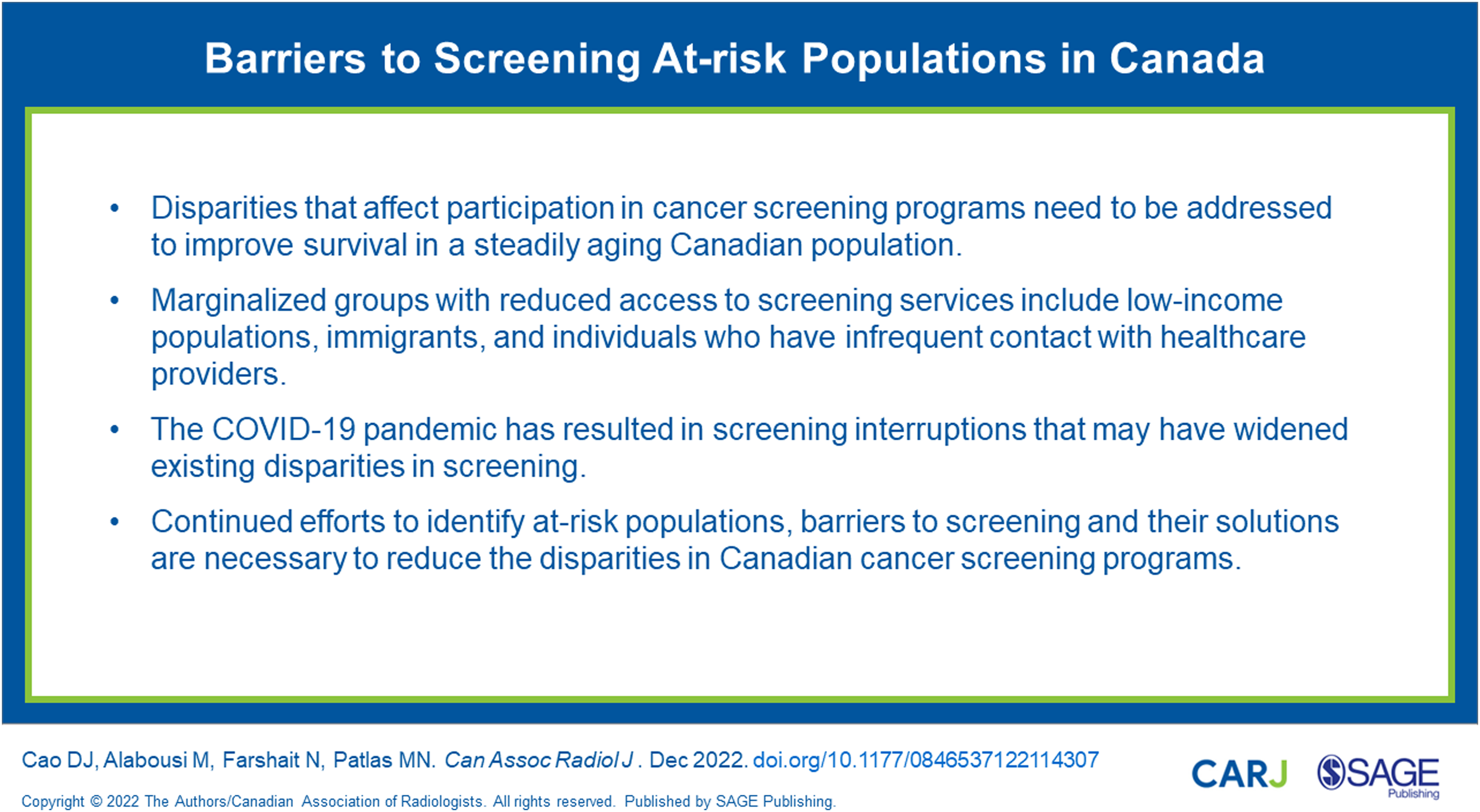
In conclusion, screening disparities are pervasive across lung and breast screening programs in Canada. Marginalized groups with reduced access to screening services include low-income populations, immigrants and especially newly arrived immigrants, and individuals who have infrequent contact with healthcare providers, among other groups. Meanwhile, the COVID-19 pandemic has resulted in screening interruptions that may have widened existing disparities. Barriers faced by patients are difficult to comprehensively characterize as they are not necessarily homogenous across demographics. As such, there should be continued effort in identifying at-risk populations, the barriers they face, and the solutions necessary to reduce the disparities that perpetuate screening gaps.
Footnotes
Declaration of Conflicting Interests
The author(s) declared no potential conflicts of interest with respect to the research, authorship, and/or publication of this article.
Funding
The author(s) received no financial support for the research, authorship, and/or publication of this article.
