



Abstract
Introduction
The representation of women in medicine has increased dramatically over the past decades. In 2021, women represented 57% of medical school graduates in Canada, a significant increase compared to 44% in 1990. 1 The greater participation of women in medicine is especially apparent in fields such as pediatrics, dermatology, rheumatology, and obstetrics and gynaecology, where women now constitute 50% or more of practicing physicians in Canada. 2 However, significant gender gaps remain in fields such as diagnostic radiology, where in 2019 women made up only 32% of current radiologists and 31% of radiologists under 35 years old. 3
Authorship gender gap has been examined in articles published in various major radiology journals.4-6 Publishing articles in major journals is an important aspect of academia and identifying trends in female authorship may help shed light on the current participation and future direction of women in academic radiology. There is a significant correlation between the rate of female authors and the radiologic subspeciality examined. Women represent 56–64% of authors within breast imaging, whereas women only represent 5–18% of authors within vascular and interventional imaging.4-6
Recent technological advances have led to computers being asked to perform novel tasks on an increasingly regular basis. The field of medicine has been a beneficiary of these advancements as various forms of artificial intelligence (AI) have consistently outperformed highly-trained physicians in the specific tasks they are asked to accomplish.7-9 AI has been gaining particular attention in the radiology community as successfully incorporating its use into radiologists’ workflow may lead to improvements in diagnostic certainty, greater efficiency and better outcomes for patients. 10 Unfortunately, there are well-known existing authorship gender gaps in articles related to AI and computer science.11,12 It is important that researchers, builders and designers of AI technologies within radiology reflect the diversity of their patient population. The aim of this study is to assess the status and recent trends of female authorship in articles using AI in major North American radiology journals. Understanding existing gender gaps can spur action to address them.
Methods
We conducted a retrospective bibliographic analysis of all published articles about AI among four North American radiology journals including the Canadian Association of Radiologists Journal (CARJ), the Journal of the American College of Radiology (JACR), the American Journal of Roentgenology (AJR) and Radiology. The journals were selected through expert opinion as a representative group including two of the larger impact factor journals in radiology and two journals associated with Canadian and American national radiology organizations.
An Ovid MEDLINE search was conducted to retrieve all articles published in the selected journals associated with the medical subject heading (MeSH) terms ‘artificial intelligence’, ‘machine learning’, or ‘neural networks, computer’. Articles published before the date of the search (May 11, 2022) were included with no specified earliest date. The research team then collected data from publicly available online information about the articles and authors in order to identify author gender.
Data collection and analysis of author gender occurred from May to June 2022 by three team members (TDY, PHY and TS) and was reviewed for accuracy and consistency by a single team member (TDY). The primary outcomes for this analysis were first author gender and last author gender for each included article. The author gender of articles with only one author were included in both first and senior author datasets. Using the same approach as described in a study in the CARJ about female authorship trends, 4 we used the following to determine author gender:
‘First and last authors were categorized as female or male based on the common knowledge of gender-appropriated names, for example, Jennifer as female and Richard as male. For names of uncertain gender, a Google search of the author was performed in an attempt to determine the author’s gender, most commonly obtained within biographies or licencing websites. Photos and pronouns on publicly available resources provided additional information in gender determination. If the gender remained uncertain, the first name of the author was searched on “www.behindthename.com,” an online name database that provides users with name etymology and information including gender. Articles for which author gender remained unknown were excluded from the final analysis’.
Secondary outcomes included the journal, country and year of each publication. Categorical data including journal and country were analysed using the Pearson chi-squared or Fisher exact tests and presented as frequencies with percentages. One-way analysis of variance tests were performed to determine any differences between proportions of female first authors and senior authors among the different journals. Statistical analysis of publication year was completed using logistic regression models with reporting of an odds ratio (OR) for each analysis. All analyses were conducted with R version 4.2.1. P-values < .05 were considered statistically significant, and all tests were two-sided.
Ethics approval was not required since the study did not include human or animal subjects and the data was collected from publicly available sources. We also applied the ‘A pRoject Ethics Community Consensus Initiative’ (ARECCI) screening tool which scored minimal risk and indicated that our study did not require research ethics board review.
Results
A total of 453 articles met inclusion criteria from our search, 183 (40.4%) of which were from Radiology, 147 (32.5%) from the JACR, 101 (22.3%) from the AJR and 22 (4.9%) from the CARJ. 86 of the included articles had a single author.
Female First Authorship and Senior Authorship Among Articles About Artificial Intelligence Published in Radiology, JACR, AJR, and CARJ.
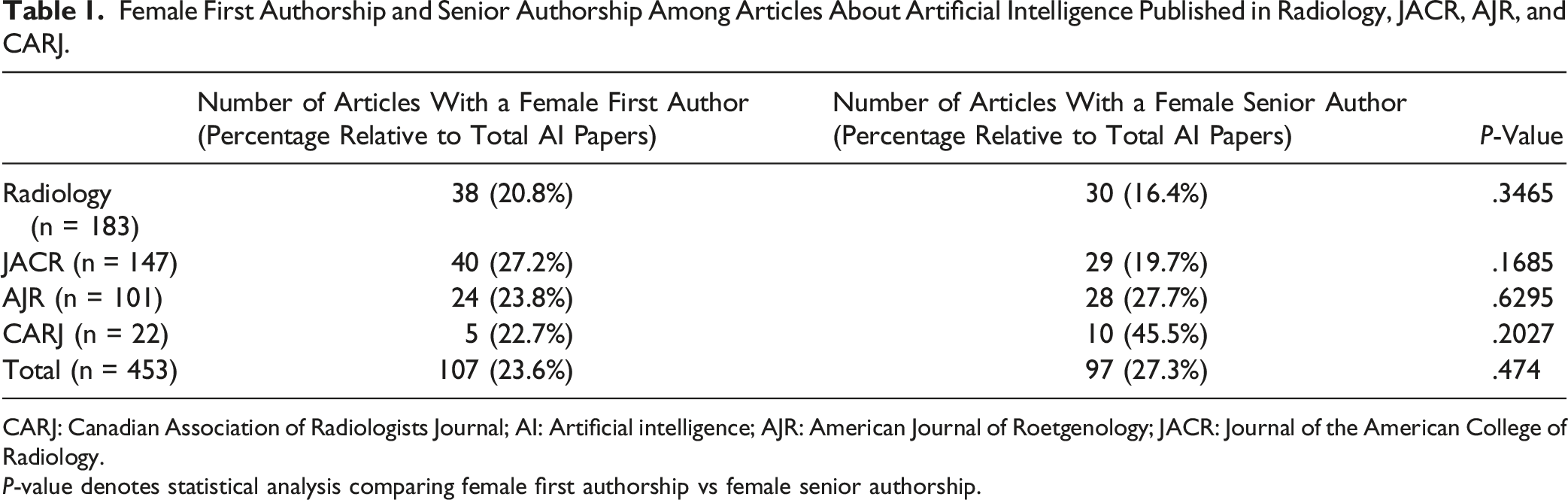
CARJ: Canadian Association of Radiologists Journal; AI: Artificial intelligence; AJR: American Journal of Roetgenology; JACR: Journal of the American College of Radiology.
P-value denotes statistical analysis comparing female first authorship vs female senior authorship.
Logistic regression models were performed comparing female first authorship over time for each journal (Figure 1). Overall, there were no significant changes among any of the journals. In Radiology, the first article about AI was published in 1987. The proportion of female first authors among AI articles published in Radiology has not significantly changed over the years. Before the year 2000, the proportion was 12.5%, from 2000 to 2010 it was 30.0%, from 2011 to 2020 it was 15.7%, and from 2021 onwards it was 30.6% (OR = 1.01, 95% CI = 0.91–1.06, P = .524). The proportion of female first authors among AI articles in JACR (OR = 0.99, 95% CI = 0.84–1.17, P = .938) and AJR (OR = 1.04, 95% CI = 0.97–1.11, P = .264) have remained similar over the years. The first CARJ article about AI was published in 2001, but thereafter all articles have been published from 2018 onwards. There was no significant change in female first authorship among CARJ AI articles over time (OR = 1.08, 95% CI = 0.75=1.54, P = .644). Logistic regression models comparing female first authorship among articles about AI published in (A) Radiology, (B) JACR, (C) AJR, and (D) CARJ over time.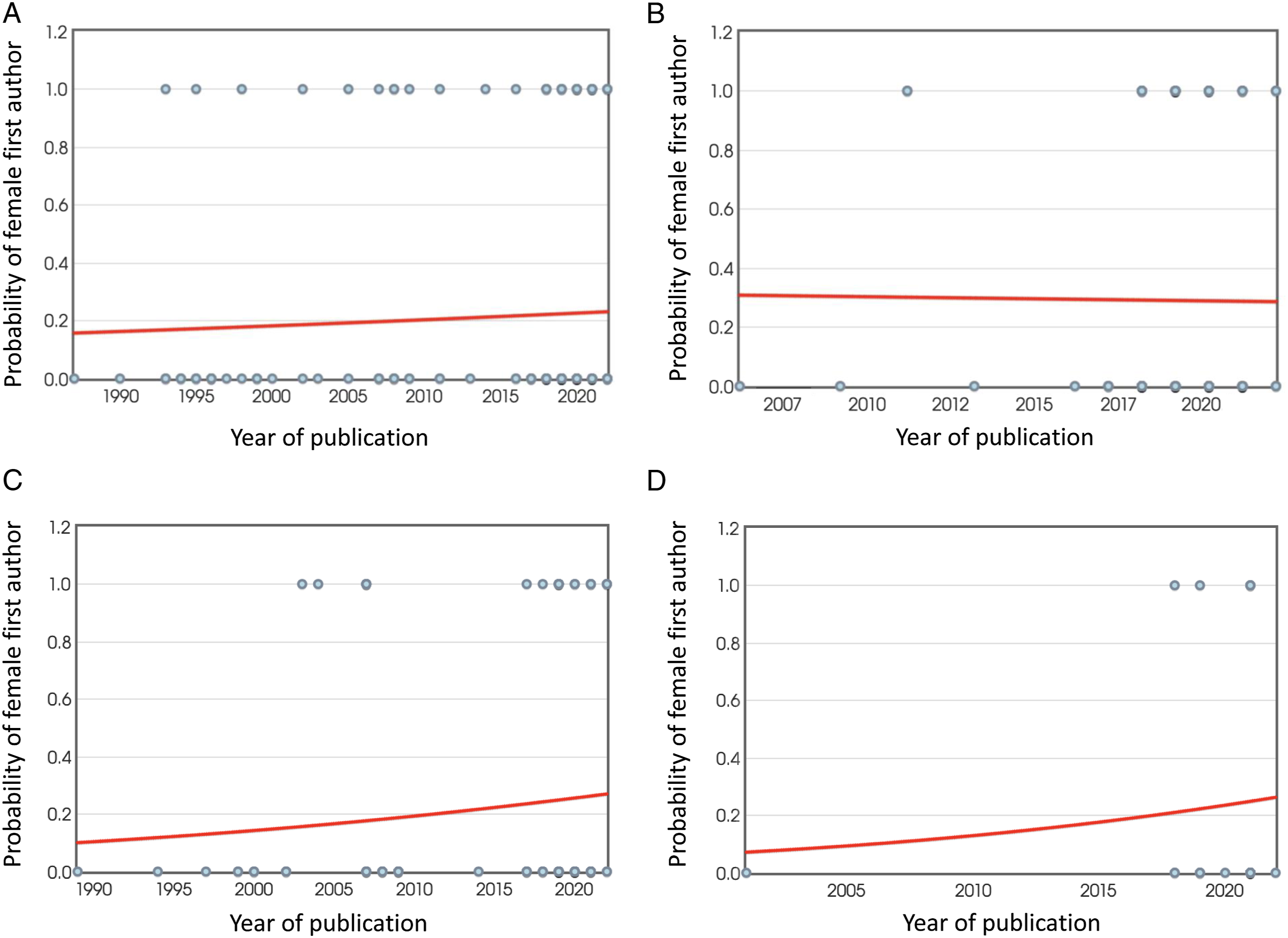
Logistic regression models were similarly performed comparing female senior authorship over time for each journal (Figure 2). Radiology was the only journal to show significant change in female senior authorship over the years, increasing from 0% before the year 2000 to 55.6% in 2022 (OR = 1.22, 95% CI = 1.04–1.44, P < .001). Otherwise, neither the JACR (OR = 1.02, 95% CI = 0.84–1.25, P = .813), AJR (OR = 1.05, 95% CI = 0.99–1.12, P = .1019), nor CARJ (OR = 0.92, 95% CI = 0.72–1.17), P = .453) had any significant changes in female first authorship among AI articles over time. Logistic regression models comparing female senior authorship among articles about AI published in (A) Radiology, (B) JACR, (C) AJR, and (D) CARJ over time.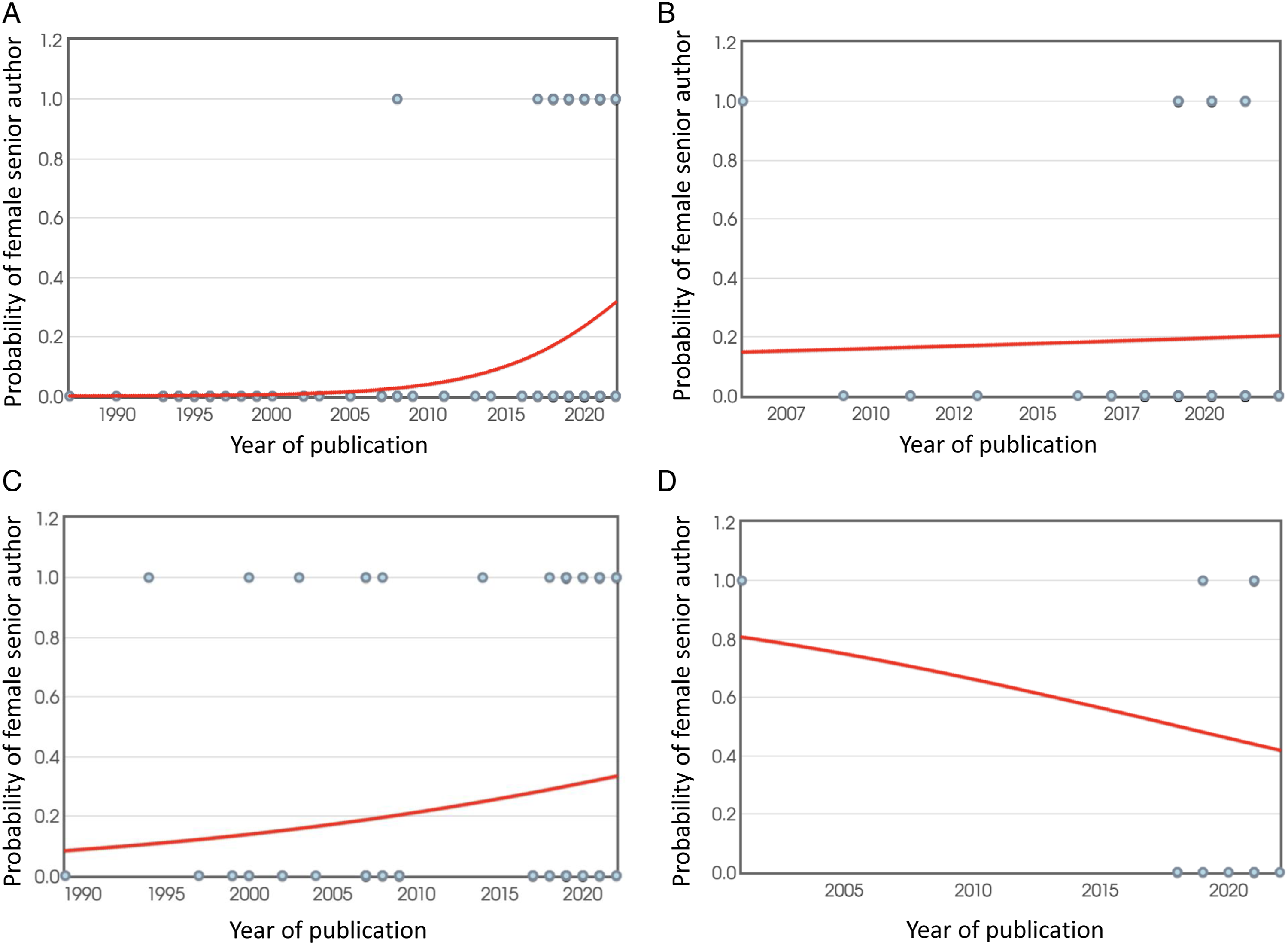
Analyses by country were performed and the results are presented in Figure 3. The included articles originated from 24 different countries. The countries with the highest number of AI articles published in the selected journals were the United States (USA) (n = 290), Canada (n = 30), Germany (n = 22), South Korea (n = 21) and Netherlands (n = 17). Israel (n = 5), Italy (n = 5), Australia (n = 2) and Belgium (n = 2) were the only countries with 50% or greater female first authorship among AI papers. Among the countries with a sample size of 15 or greater, the Netherlands had the highest proportion of female first authorship at 29.4% and Germany had the lowest proportion at 4.5%. There were 10 countries with no female first authors among the included articles. Italy, Australia and Denmark (n=2) were the only countries with 50% or greater female senior authorship among AI papers. Among the countries with a sample size of 15 or greater, Canada had the highest proportion of female senior authorship at 43.3% and Germany had the lowest proportion at 13.6%. There were 8 countries with no female senior authors among the included articles. Analysis by country of female (A) first authorship and (B) senior authorship among AI articles published in Radiology, JACR, AJR, and CARJ. Data bars in red denote countries with a sample size of 15 articles or greater.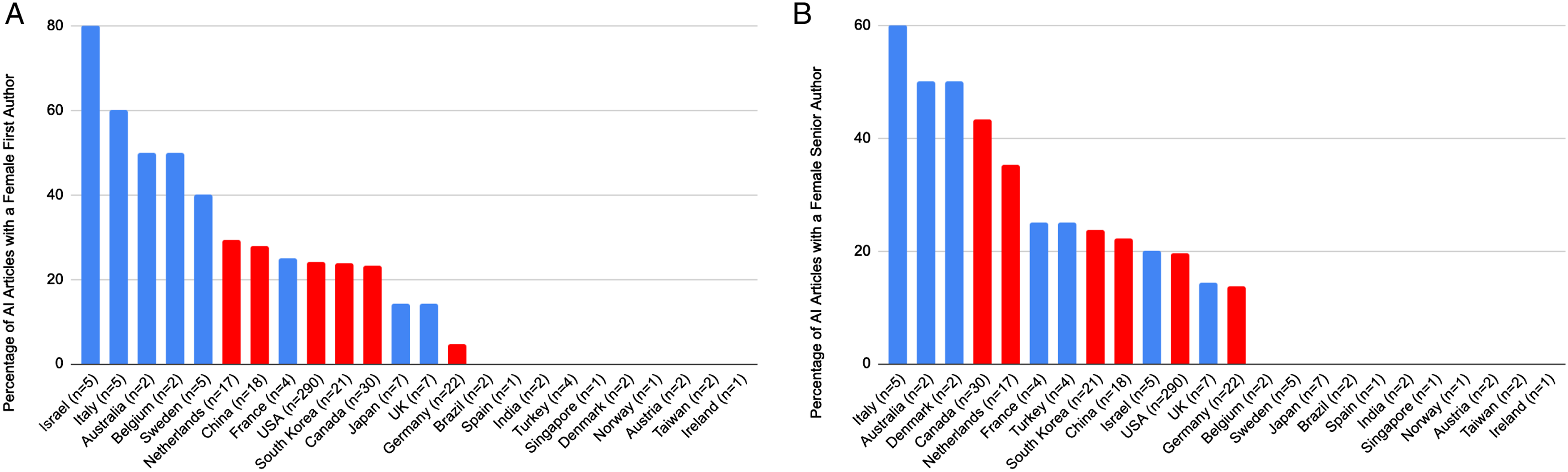
Discussion
Our study reports information about the author gender gap in academic radiology publications pertaining specifically to AI. We found that among the major North American radiology journals investigated, only 23.6% of articles about AI had a female first author and 27.3% had a female senior author. We also found that female authorship over time has not significantly changed over the years, with the exception of a statistically significant increase in female senior authors among AI articles published in Radiology. Our analyses by country showed that among the countries with a sample size of 15 articles or greater, female first authorship was low among all countries (the highest was 30%), whereas Canada had the highest female senior authorship at 45%.
Our findings support those of previous studies that have demonstrated women in medicine generally, and especially in the field of radiology, are underrepresented in academic literature.13,14 For example, in a study of all major articles among three general radiology journals similar to those we evaluated (Radiology, AJR and Academic Radiology), the proportion of female first authors was found to be 32% and of female senior authors to be 22% in 2013. 14 However, these previous studies evaluated the gender gap present in all radiology literature, whereas to the best of our knowledge, our study is the first to investigate female authorship trends among radiology literature focused on AI. Compared to previous reports, our study about AI in radiology yielded a markedly lower proportion of female first authors (23.6%).
In contrast, a recent study of all articles published in the CARJ from 2010 to 2019 reported the proportion of female first authors to be approximately 40%, 4 a figure almost double that of our study. This difference is striking, but unfortunately may not come completely unexpected. Coupled to the well-known gender gap in radiology, there is similarly a considerable lack of female representation in the artificial intelligence and computer science literature. A study reporting on the authorship among almost 7000 computer science articles found that women represented only about 10% of published researchers. 15
With regards to senior authorship, females were represented in about a quarter of articles in our sample. Senior authorship was deemed an important metric to evaluate as a proxy indicator for the progress of women’s representation in senior radiology roles. In previous studies about general academic radiology, female representation among senior authorship has varied from 14 to 27%, a range comparable with the proportion demonstrated in our study.4,14,16 We found that the first author was over three times more likely to be a female if the senior author was also female. This phenomenon of same-gender mentorship has been described previously, elucidating how female academic underrepresentation persists and the importance of gender diversity in senior and leadership positions.4,5,17 Unsurprisingly, a recent study of all North American academic radiology faculty members reported that while 40% of assistant professors (the lowest rank) are women, only 23% of full professors and 29% of leadership positions are held by women. 18 Furthermore, among the higher levels of the leadership ladder, women make up only 25% of vice chairs/section chiefs and 9% of chairs. 19 The lack of female leadership representation, coupled with the appreciable effect of same-gender mentorship on academic output, underpins the persistent nature of the gender gap and the need for more female leads to help spur the next generation of junior female radiologists.
Although many other studies reported significant temporal increases in female first authors in diagnostic radiology articles, this was not observed in our study.4-6,14,16,18 However, we found an encouraging temporal increase trending towards significance in the proportion of female first authors in AI-related radiology articles, which may suggest increasing female participation in the intersection of AI and diagnostic radiology. This is supported by a statistically significant increase in female senior authors publishing AI-related radiology articles in the journal Radiology when comparing articles from before 2000 to articles published in 2022. It is important to note that although significant temporal trends were not widely observed in the four journals examined, AI-related radiology articles have only become prevalent within the last few years. Between 1987 and 2016, of the radiology journals examined, there were only on average .76 AI-related articles published per year per journal. We believe this lack of volume contributed to difficulty in detecting significant temporal trends. In the coming years, with increasing interest in AI-related radiology research and efforts to increase female participation in these fields, we are hopeful that a similar future study will detect significant temporal increases in the representation of female authors.
The importance of equity, diversity, and inclusion (EDI) in all fields of medicine cannot be understated. It is important to have a physician workforce that reflects the patient population whom they serve and past research has shown that shared identities between patients and physicians improves patients’ satisfaction, enhances physician–patient communication, improves compliance with medical advice and reduces health outcome disparities.4,20,21 This is especially important in an innovative field such as AI-related diagnostic radiology, as diversity is necessary in providing the varying perspectives, knowledge, and backgrounds required for developing new ideas.15,20 Integrating AI into radiologists’ daily workflow has the potential to both reduce or widen health inequities. It can be used to help radiologists become more efficient and overcome difficulties in providing healthcare to underserved or rural communities. On the other hand, if not adequately designed, AI may also introduce systemic biases in the detection of disease.22,23 It is thus important that a wide diversity of voices be heard and valued when developing AI-related radiology technologies. In Canada, there are existing efforts to reduce the gender gap in radiology such as ‘Canadian Radiology Women’, a platform to showcase female leaders in radiology and to facilitate female mentorship for interested medical students. 24 In the United States, the American College of Radiology has published several impactful papers on the importance of EDI.20,25,26 Strategies to promote diversity in radiology also include creating female mentorship programmes, actively recognizing and addressing bias, recruiting diverse trainees, creating departmental EDI committees and offering leadership training for underrepresented groups, among others.27,28 We urge that these efforts continue in order to encourage more women to become leaders within radiology and play important roles in the optimization of radiology-centred AI. Intentional AI mentorship programmes to attract and support diverse genders of trainees and junior staff are indicated.
The greatest limitation to our study was the method used to classify authors’ gender. Authors may identify differently than the gender most commonly associated with their legal first name, and if their name was gender-neutral (e.g. Alex), a search for their institutional biography may not have been performed. This was deemed to be an acceptable limitation by our team as we attempted to the best of our ability to exclude articles with authors whose gender we could not confidently identify. Furthermore, our primary outcome of gender was classified using a binary system similar to the vast majority of radiology research. We acknowledge that this fails to capture individuals who are transgendered, gender-fluid or otherwise identify as non-binary. However, we believe that this concerned a limited number of authors and did not significantly impact the results of our study. Another limitation was that articles with only a single author were included in both the first author and senior author datasets. Additionally, we acknowledge that the representation of women in authorship may follow the overall representation of women in radiology. For example, the proportion of radiologists who are women is reported to be 32% which is comparable to women in academic radiology accounting for 34% of all radiologists.16,19 Given this, it is not unexpected that women remain underrepresented in academic radiology authorship, though this overall gender gap only highlights the importance of mentorship and improving diversity at the recruitment level. Lastly, although we investigated the four largest North American radiology journals, this may not be a representative sample of academic radiology in North America.
Conclusion
In conclusion, women are underrepresented in AI-related academic radiology, unsurprisingly reflective of the known gender gaps in the fields of radiology and computer science. Interestingly, first authors were over three times more likely to be female if the senior author was also female, highlighting the importance of same-gender mentorship and the need for more female radiologists in leadership academic and research roles. Over the years, there has been an overall increase in the proportion of female senior authors of Radiology AI-related publications, though this temporal trend was not similarly demonstrated in the other journals evaluated. The lack of diversity in AI-related academic radiology is unmistakable, and as AI becomes an increasing focus in the field, the gap in female representation is not closing fast enough. There is continued opportunity for mentorship for women in radiology to strengthen AI research and radiology as a whole.
Footnotes
Acknowledgements
We thank Luke MacLean for his assistance during data collection of secondary outcomes including article year and country.
Declaration of Conflicting Interests
The author(s) declared no potential conflicts of interest with respect to the research, authorship, and/or publication of this article.
Funding
The author(s) received no financial support for the research, authorship, and/or publication of this article.
