




Abstract
Background and purpose
Open educational resources (OER) are socially progressive learning resources that are well positioned to disrupt the exclusionary and marginalizing processes that can sometimes occur within nursing texts. Recognizing the social justice underpinnings of OER, the study focus was to examine how leadership teams should integrate equity, diversity, and inclusion (EDI) into the design and production of nursing-related OER.
Methods and procedures
This study was theoretically informed by the concept of Othering. The interpretive descriptive methodology involved reflexive and critical dialogue with focus group data that honed skeptical thinking and encouraged the search for alternative ways to think about how codes and themes were named and conceptualized.
Findings
Participating in the two hour focus group were nine leaders, who were authors of two nursing-related OER. Participants included six nurse educators, one educational developer, and two students. Three themes were identified including: diversifying design and production; centring social justice; and nuancing inclusion.
Discussion and conclusion
Part of the blueprint to the design and production of OER that are shaped by EDI must include incredibly rich, vibrant, and diverse voices and teams who are focused on social justice. This approach offers ways to create space for the beauty of human difference, the nuances of inclusion, and the flourishing and growth of learners. Although we may never produce resources that fully embrace inclusion and belonging, we are confident that diverse and critical voices will shift us closer while centring social justice.
Background and Purpose
Social justice is central to the nursing profession and nursing education. While emphasizing access, fairness, equity, diversity, and human rights (United Nations, 2025), social justice is embedded in many nursing codes of ethics (Canadian Nurses Association, 2017; International Council of Nurses, 2021) and education frameworks (Canadian Association of Schools of Nursing, 2022). Despite the declarations of its importance in Canadian nursing documents, the mandated actions and guidance on how to specifically address inequities remains limited (Slemon et al., 2024). As such, the implementation of various social justice initiatives is sometimes hampered (Garland & Batty, 2021).
Complicating this matter is the rapidly evolving political landscape in the United States and its impact on academic and healthcare-related matters in Canada. With the signing of the executive order related to the dissolution of equity, diversity and inclusion (EDI) programs by the President of the United States (The White House, 2025), we are backsliding into a discourse that equates equity with equality and risks the perpetuation of systemic inequities (Lapum et al., 2025). This discourse is not limited to the United States, but has far-reaching consequences for Canada and abroad as it shapes global priorities surrounding social justice issues, specifically the important concepts of EDI.
As such, many universities are distressed about how this order affects academia and education related to these social justice issues. Specific to EDI, hundreds of grants have been revoked by the National Science Foundation (Miller & Zimmer, 2025) with hundreds more to be revoked by the National Institutes of Health (NIH) (Kozlov & Mallapaty, 2025). Some of these projects involve collaborations with Canadian partners. In addition, it has been reported that NIH will not provide funding to post-secondary institutions that have EDI programs (Knott, 2025). With increased racial profiling, border scrutiny, and risks of detainment, the Canadian Association of University Teachers (2025) has made strong recommendations that faculty should only travel to the United States if necessary and those who have voiced negative comments or whose research is in opposition to the United States’ administrative policies should be particularly prudent. Despite deeply valuing EDI, some of our own colleagues in Canada have distanced themselves from these types of projects due to fear of personal and professional repercussions.
So, where does this leave Canadian nurse educators and leaders as related to EDI in our scholarship? To answer this question, we need to return to why a steadfast commitment to EDI remains vital in education, nursing, and healthcare. The history of EDI dates back to at least the mid-twentieth century and is deeply rooted in civil rights, feminism, disability and social justice movements, all aimed at eliminating discrimination and dismantling structures that maintain oppressive systems leading to racism, sexism, ableism and all other “isms” (Canadian Equality Consulting, 2024). In nursing education specifically, the dominant discourse has privileged Westernized thinking and perspectives of whiteness, colonialism, ableism, gender binaries, and cis-heteronormativity (Bell, 2021; Browne, 2001; Garland & Batty, 2021; Lapum et al., 2022).
Alongside white abled-bodies, these discourses also portray bodies that are lean, muscular and without “flaws” like stretch marks, scars, and tattoos. These discourses emanate and are continually reproduced through educational nursing texts and resources (Lapum et al., 2022). As Ng and colleagues (2025) have indicated, the commitment to EDI is a strategy to address historical injustices while also constructing a future where each person can be “seen, belong and thrive” (p. 9). A world without a commitment to EDI is a world in which these injustices and inequities are continually reproduced and marginalized individuals continue to feel insignificant including students and as a result, the people they care for: patients, families, and communities.
This is the harmful act of Othering in which some people are marginalized, unseen, and excluded from participation in social activities like higher education, decision-making, and policy development. Othering refers to the processes and discourses that result in dividing people into dominant and non-dominant/subordinate groups (Jacob et al., 2021). These processes and discourses are upheld by institutional structures that outline dominant norms (Nye et al., 2023).
Nursing education specifically can be a site of exclusionary Othering in which certain groups of people are considered outside the dominant norm (Nye et al., 2023). Such exclusionary practices risk emboldening hegemonic discourses and furthers Othering marginalized groups and inequities, for example when curricula and textbooks exclusively centre white eurocentric ideology. The impact of Othering, or merely the lack of diversity, in nursing education is serious and consequential because it can result in students feeling like they do not belong, feeling marginalized, and that they are not valuable and worthy of representation (Byrne et al., 2003; Hamzavi & Brown, 2023). The values associated with these dominant norms and the consequential feelings are then often carried forward into nursing practice. Recognizing how Othering is structural and embedded in discourse (Akbulut & Razum, 2022) sheds light on the ways that discursive power privileges or excludes people (Crenshaw, 2015, 1991). It is important to take note that these Othering social processes can be reinforced or alternatively dismantled through the design and production of learning resources in terms of how people are represented and conceptualized in text and multimedia. As such, nursing education can instead also be a site of inclusion in which students feel seen and valued and their learning and growth fostered.
Open educational resources (OER) are types of learning resources that are well positioned to disrupt the Othering processes that can intentionally or unintentionally occur within nursing texts. Commonly located on the internet, OER reside in public domains with open licenses permitting free access as well as use, distribution, and adaptation by others (United Nations, Educational, Scientific and Cultural Organization, 2019). The original driver of producing OER was related to the social justice issue of affordable access (Cox et al., 2022) considering the high cost of traditional textbooks (Panday-Shukla, 2024). These social justice drivers have since expanded to include more inclusive pedagogies incorporating multimodal learning (through multimedia) and the tailoring of content to students (Panday-Shukla, 2024). In nursing education, we are constantly learning how to dismantle oppressive systems and make educational texts, such as OER and conventional textbooks, diverse, equitable and inclusive.
Expansion of both infrastructure and peer-review literature has extended the scholarship and curricular integration of OER in nursing education. For example, the development and uptake of OER in nursing education has been strengthened by OER libraries and provincial grants offered by organizations such as eCampusOntario and BCcampus as well as information provided by the Canadian Association of Schools of Nursing (n.d.). Ten years ago, there were only a couple hundred sources found when doing a Google Scholar search whereas now there are a couple of thousand sources. Anderson and colleagues (2025) found that there is a trend in curricular uptake of OER in nursing education. Although the experiences and outcomes of OER use in nursing education have been positive (Svoboda, 2023), there still remains limited research in this discipline. More specifically, there is untapped potential to advance equity with the production, uptake, and scholarship of OER in nursing education (Keating et al., 2020).
Aligned with concepts of EDI, the shift to OER is grounded in a social justice framework with a commitment to inclusion and equity (United Nations, Educational, Scientific and Cultural Organization, 2019). As socially progressive texts, it is a promising time to focus attention on EDI within these types of learning resources and the OER movement (Lapum et al., 2022). Recognizing the social justice underpinnings of OER, the focus of this study was to further examine how EDI should shape the design and production of OER in nursing education. The guiding research question of this focus group study was: How should leadership teams integrate EDI into the design and production of nursing-related OER?
Project Background: OER and EDI
With a commitment to social justice, we have led and been involved in the design and production of several OER in nursing education. As related to this study, two of the OER were integrated into a Baccalaureate program at three post-secondary institutions in Ontario, Canada. Both OER were integrated as the main learning resources in two different year one courses. One of the OER was titled Introduction to Health Assessment for the Nursing Professional and was integrated into the introductory health assessment course (https://pressbooks.library.torontomu.ca/assessmentnursingmain/#main). The second OER was titled Introduction to Communication in Nursing and was integrated into a communication course focused on nursing (https://pressbooks.library.torontomu.ca/communicationnursing/).
These OER were developed as a social justice initiative with a commitment to EDI in nursing education. Considering the rising cost of textbooks, our initial focus was to ensure equitable access to education by making resources free. In addition, it was our aim to integrate textual and visual content from an EDI lens. In our work, we considered diversity as the many variations of difference related to race, ethnicity, gender, sexuality, disability, educational and socioeconomic background among other characteristics and identities (Gordon et al., 2023; Government of Canada, 2025; The College of Physicians and Surgeons of Ontario, 2025), whereas inclusion was about ensuring that each person feels included, valued, and respected (Government of Canada, 2025). Part of inclusion in an OER is attending to how students are able to see parts of themselves in the resource and as such, being able to envision themselves as a nurse. Ultimately, diversity and inclusion help us work towards equity, which is focused on fair and equitable opportunities and conditions (Lartey et al., 2025; The College of Physicians and Surgeons of Ontario, 2025). This commitment to a critical integration of EDI in nursing-related OER is the focus of this research.
Methods and Procedures
Methodological Approach
The methodological approach of this focus group study was informed by interpretive description, which involves moving beyond simple description and asking so what?, so that the research has an applied use (Thorne, 2016). In this case, it was our aim to draw upon the research to make improvements to the nursing-related OER as we moved forward. Interpretive description focuses on producing interpretive accounts generated by exploring and explaining a topic through iterative and critical questioning (Thorne et al., 2004). This approach recognizes the socially constructed nature of knowledge (Thorne et al., 2004) while opening up space for interpretive discussions grounded in the data and one's own experiential and professional knowledge (Brewer et al., 2014). When drawing upon this methodology, it is important to recognize that formal and a priori theory is not required and thus, for us, the theoretical approach emerged based on our work with the data (Thorne, 2016; Thorne et al., 2004).
Theoretical Approach
In our critical and reflexive analytical work, our interpretive thinking became influenced by the theoretical concept of Othering as we began to recognize how students (the users/readers of OER) can feel included or excluded as a result of how EDI is taken up in the resource. We conceptualized Othering as a process of differentiation that produces a We (those who are included and belong) and a Them (those who are excluded, marginalized, and do not belong) (Jacob et al., 2021; Said, 1978). The differentiation and exclusion that occurs work together to impact people (Roberts & Schiavenato, 2017) and is marked by identity attributes such as race, ethnicity, gender, sexual orientation, age and disability (Nye et al., 2023). We recognized that Othering would be further reproduced if identity attributes were considered separately in this project. It is this recognition that prompted us to consider the integration of EDI from an intersectional frame of reference. From an intersectionality perspective (Crenshaw, 2015, 1991), we were constantly attending to the many features of identity and their intersecting nature.
Drawing upon the work of Jacob and colleagues (2021), we took into consideration structures that influence Othering such as institutionalized practices (e.g., norms and systems that govern behaviour). Recognizing that this differentiation is constructed and sustained by structural conditions and power relations (Akbulut & Razum; Nye et al., 2023), we were charged to examine concepts such as difference, access, agency, decision making, exclusion, and opportunities in terms of how EDI should influence the design and production of OER. On the same lines of de Beauvoir’s (2010) work, we recognize that the democratic ideals of equality and humanity can act to conceal how Us does not outwardly posit (or convince themselves) that Them is inferior. Thus, the Othering process and outcomes become difficult to see and are not necessarily intentional. Examining Othering and these concepts from an intersectional perspective was vital to create a cohesive conceptual narrative about how leadership teams integrate EDI into the design and production of nursing-related OER.
Recruitment, Data Collection, and Analysis
The study received approval from the three institutional research ethics boards. An invitation email with a description of the study was sent to the leadership team members involved in the creation of two OER related to health assessment and nursing communication. These leadership team members were authors of the OER and included nurse educators, students, and educational developers. We aimed for a sample size that would stimulate discussion and create safe environments for discussion; our estimate was no more than 12 (Nyumba et al., 2018). Individuals who indicated interest were emailed a consent form and provided the opportunity to meet to ask questions. It was emphasized that although data would be confidential, their anonymity could not be protected as they would see each other's faces and may know one another at the focus group. At the start of the focus group, participants were encouraged to not share information such as peoples’ names and what they said outside of the focus group.
The focus group was conducted via Zoom and facilitated using a semi-structured interview guide. A sample of interview questions were: How did the concept of diversity influence the design and production of the OER that you were involved in? In terms of how diversity and inclusion were included in the design and production of the OER, in what ways do you feel that students felt included or excluded? How would you advise others to incorporate diversity and inclusion in designing and producing OER?
The data analytic approach was informed by an inductive analysis grounded in interpretive description (Thorne et al., 2004). The focus groups transcripts were generated using Zoom recording functions. Following transcription, accuracy checks were completed by two researchers and then the team reviewed the focus group transcript. Drawing upon this approach, the team engaged in reflexive and critical questioning and dialogue. This analytical approach helped hone skeptical thinking and encouraged the research team to search for alternative ways to think about codes and themes (Thorne et al., 2004). The team read transcripts individually and then met for analytical discussions in which data were coded as a group. The critical and reflexive questioning and dialogue led to consensus and the finalizing of the coding and thematic structure. An audit trail was documented about decision making in terms of why codes and themes were identified and named.
Study Findings
Nine OER leaders from three post-secondary institutions engaged in a two hour focus group. This sample included six nurse educators, one educational developer, and two students, of which three were visibly racialized, seven were women, and two were men. As a result of the interpretive analysis, we identified three themes including: (1) diversifying design and production; (2) centring social justice; (3) and nuancing inclusion.
Diversifying Design and Production
Diversifying design and production involved integrating and taking into consideration a wide variety of characteristics. Captured under this theme were three codes: language and content; multimedia and interactivity; and accessibility.
Language and Content
The first code refers to the diversity of language and content used in the design of the OER. Leadership teams noted the importance of using “appropriate language” so content is “easily readable to first year nursing students.” Tailoring language to students’ level is important considering that the complexity of health-care terminology is described as akin to learning a new language and can act in an exclusionary manner. Participants emphasized the design decision to use “second person voice … [to] engage learners in a conversation” and “enhance their learning.” As opposed to feeling Othered, this language style invited students into the OER and promoted a sense of belonging and inclusion. Another example was inclusive pronouns: “We did a really good job at using gender inclusive language, using plural pronouns, such as ‘they’ as opposed to merely relying on gender specific pronouns of ‘he’ and ‘she.’” This design decision challenges the institutionalized practices of gender and counters dominant narratives of gender while inspiring students to not assume gender identity. It was suggested that in addition to diversifying “gender, sexuality, race and ethnicity”, teams must consider how to better integrate “differently abled” people particularly in the context of “ableism.” Differently abled includes people with various “physical abilities” and “neuro typical considerations.” Considering that not all disabilities are visible, ableist norms can be disrupted in the text and case studies specifically. Design practices that diversify OER language and content can help students approach their own nursing practice in ways that are “inclusive and fair and equitable for everyone.”
Multimedia and Interactivity
In addition to language and content, leadership teams considered how to diversify multimedia and interactivity. It was discussed how “different aspects of design, such as videos or questions or an audio piece … helps with diversity-inclusion because it's not just this one-way text.” Supplementing multimedia with “interactive piece[s]” such as multiple choice questions were important to “check” students’ “understanding” of the content. Challenging the didactic nature of one-way texts enhances learning opportunities by inviting learners into the content in more interactive ways. The group discussed how “conscious efforts” were made “to have diversity in the images” and how they incorporated a “process of looking at every image and saying, do we feel like it's inclusive?” One example of diversifying multimedia was having “same sex couples” while “purposely … not conceptualizing gender as that binary of visually male or female, but rather thinking about how images can be created along a gender continuum.” These excerpts speak to challenging institutionalized practices by curating and creating images that disrupt normative ideas of gender and sexuality while dismantling the Othering discourse. Other examples include making multimedia “racially diverse … have religious considerations such as being Muslim.” Participants expanded on this by saying “we have the older client, a smaller client, somebody who's overweight, balding, or hunched over.” Intentionally diversifying multimedia makes the OER more inclusive while challenging institutionalized practices including normative bodies. The focus group discussed how institutionalized practices have resulted in the historical portrayal of white, thin, and muscular bodies in traditional textbooks. However, one participant highlighted the complexities in diversifying multimedia stating that “just because you put someone's picture with slanty eyes doesn’t mean that it makes me feel included.” They expanded by saying you need to “think about how inclusivity and diversity will be appropriately applied to the subject.” These were important remarks about how diversifying design and production is not as simple as using diverse images, but more importantly attending to the meaning, context, and deliberate thought that goes into making equitable decisions.
Accessibility
Accessibility refers to designing and producing OER so that all students, regardless of abilities, can access and participate fully in learning. A fundamental aspect of accessibility is facilitating access to learning resources. The group discussed how students often “suffer from a huge financial need in post-secondary education” and how many rely on old textbook editions and library versions. As a result, it was stated that making OER “available … for free is actually promoting inclusion in student engagement.” These excerpts speak to designing and producing the OER in ways that are financially accessible and breaking down the financial burdens and barriers associated with nursing education and the purchasing of textbooks.
Other elements of accessibility are “inclusive design” focusing on “the needs of the learner and how they best learn” as well as “the consideration of different abilities.” As one participant indicated: “the foundation of instructional design … [is] knowing your audience is and how you actually make sure that the audience is going to arrive at the point that you want them to.” In addition to learning styles, leadership teams also considered “gender and race” and “cultural backgrounds.” These are critical points because the unique and different experiences of learners influences how they engage with resources. Further to describing an “inclusive approach”, participants discussed “how this content will be consumed.” Considering OER are online, it is important to “bold key content … not italicize because it's harder to read, use bullet points, shorter paragraphs … they’re more easily digestible. Constantly thinking about, how is a person of whatever ability going to make sense of this content in the easiest way?” As noted, it may be as simple as “can I actually understand the sentence and how it flows?… is [it] too long, am I getting lost.” Another participant indicated avoiding underlining text because it suggests that it is a “hyperlink” and thus, can create “confusion” for the reader with online resources. Also, they described the importance of “structured headers because” they are helpful for learners with “assistive devices.” These headers also facilitate learning because “our brain consumes information through visual hierarchies … for some people who don’t have the same abilities, helps a lot to learn.” As reflected in these excerpts, decision making related to the designing of online content is important so that OER are accessible and learners are not excluded. These accessible design decisions “help make students feel more comfortable to read something and more included and moving forward this can become the norm.” Changing institutional practices so that educational norms and design decisions promote inclusion can act to dismantle Othering.
With a focus on accessibility as well as multimedia, language, and content, OER creators begin to consider how best to diversify design and production. This is an initial step that moves educators towards centring social justice in OER design and production.
Centring Social Justice
Emergent from our analysis, we identified centring social justice as a theme that referred to prioritizing fairness and equity particularly for those who are marginalized or disadvantaged as a result of how EDI is integrated into OER. Subsumed under this theme were three codes including default thinking, diverse voices, and diversity approach.
Default Thinking
Default thinking refers to the habitual and subconscious thought patterns shaped by discourse. Participants discussed how “default thinking” varied and thus centred or hindered social justice. One participant noted that diversity “came naturally … because of my university and learning-teaching training and … being surrounded by these wonderful students with very diverse backgrounds.” This excerpt highlights how environments play a pivotal role in anchoring one's default thinking in EDI practices and how this may counteract institutionalized practices and influence decision making. However, some institutionalized practices remain grounded in discourses that reinforce Othering. For one participant, they remarked that the integration of diversity is “not at a point where it is a natural thing, it still feels synthetic.” This idea of being synthetic suggests that attempts at integrating EDI remain somewhat artificial and work is needed to make more vibrant connections to counteract marginalizing practices. Teams often need to forge pathways to better integrate EDI that are not in alignment with existing systemic structures; this can yield uncertainty and make them question the authenticity of their work. Expanding upon default thinking, it was discussed how “conscious efforts to” integrate diversity must be integrated into design thinking. Ultimately, participants were “concerned about [their] own biases” being “reflected in the textbook” and thus, the importance of bringing “cultural humility … and being open.” These excerpts highlight risks associated with unexamined default thinking and how to shift to be more inclusionary. Another participant explained that “we’re making the effort” but “even within our team, we still represent sort of a dominant discourse, right? We have a way to go to be more inclusive so that it isn’t an effort, it's a natural extension of what we're already doing.” This discussion among participants brings to question the conscious exertion of power associated with effort and whether EDI can become ingrained into one's thinking to the point that effort is no longer needed as it is merely instinctive.
Diverse Voices
To centre social justice, diverse voices (referring to the diversity of voices influencing OER design with a focus on marginalized people) are essential. Participants discussed expanding one's default thinking and centring social justice can be enhanced by “having people of all sorts of diversities” on leadership teams, “opening up discussions”, and being “open to different perspectives.” In recalling these discussions, participants remarked that “we come with our own experiences” and have “different backgrounds” which allows us “to see what we otherwise would be blind to.” These excerpts highlight the importance of creating space for discussions so that everyone has the opportunity to share their unique experiences and share across differences. The idea of being “blind” to something highlights how unconscious bias can make it so one is primitively unable to understand something beyond their own life experience. Overall, these actions were underscored as important because then “you’re more apt to produce a resource that is diverse.” As reflected in this discussion, the leadership team's diversity opens up space for vibrant and inclusive dialogue leading to inclusive OER.
Composing diverse leadership teams can be “challenging” because of the aim to “balance expertise” in terms of OER design and EDI. OER design expertise involves creating and remixing content with open licenses and the technological capacity to produce these resources. Participants discussed the importance of providing “the opportunity” for and “mentoring” “marginalized” and “racialized” individuals “as opposed to just excluding them” when they do not have OER expertise. It was described as essential to “incorporate their important voice” because they “bring a personal expertise that is extremely valued” in terms of EDI. As such, this integration should include critical and reflexive attention to systemic structures that maintain homogeneity of leadership teams and the potential to reproduce discriminatory practices in OER design. This approach challenges existing power relations and dismantles Othering processes while increasing the overall capacity and empowering those who are typically marginalized and excluded. In addition, participants discussed the importance of “working with students who were a big part of all these projects. So, including different perspectives.” Influenced by generational differences and societal changes, incorporating student voices brought unique perspectives to the design of these learning resources. When approached to be on the leadership team, one student found it “shocking” that their “voice is valued and can positively contribute to the development of a textbook.” This comment highlights how long-standing power relations can be disrupted when students are included as important and equal team members. These practices create opportunities for students and enhance inclusive decision making that the larger student body will benefit from; it also begets experience and expertise for their future careers. In moving forward, it was noted that intentionally including students with “learning disabilities” and “accommodations” would enhance inclusive decision making processes while better meeting the needs of students. This important action continues to disrupt Othering processes so that this growing cohort of students feel attended to and included in the OER.
When considering diverse voices, it is important to consider the complexities of diversity and diversity within diversity. One participant commented that they “worry” for their “colleagues who are racialized who have to take on this position of being a token person to speak to their ethnicity or culture and it may not even represent who they are.” This excerpt speaks to the burden and risk of perfunctory and symbolic effort towards equitable inclusion and how that affects the people involved, but also inclusive representation of the content. A specific example related to a leadership team member who described themselves as “brown” and “born in Canada” and their perspective is “different than somebody who is an immigrant.” Because of their background, another participant commented that “seeing a lot of whiteness in text doesn’t strike you the way it might strike others.” This participant expanded by saying “if we want to have more diversity, even amongst our team, it can’t be in a token way.” These excerpts speak to the importance of intersectionality or more simply diversity within diversity and these intersecting identities. It was clear that achieving diversity in OER was not a simple endeavour. The group discussed knowing their “limitations” and being “open to … experts that brought in the diversity”, for example including “individuals of a certain ethnicity or religion, to ensure we captured visual qualities appropriately.” These excerpts highlight how leadership team composition will never be fully diverse because diversity is quite limitless. Since accurate representation is important, consultation beyond the leadership team may need to occur.
Diversity Approach
Diversity approach refers to how diversity is integrated into OER design and production as a way to centre social justice and enhance inclusion. In alignment with how the television show “Schitt's Creek” was designed, it was noted that diversity was normalized throughout the OER text. One participant stated the show was “purposely designed in ways that didn’t act to Other gay people, but rather normalized people who were gay” and explained that similarly “we tried to normalize it [diversity] throughout the OER text.” They provided the example that “whether we created an individual who was transgender and it wasn’t about them being transgender or something viewed as negative. It was just part of who they were.” Reference to Schitt's Creek highlights how the integration of diversity was done in ways to normalize and not pathologize elements of identity while working to disrupt the Othering discourse.
Although the best approach to integrate diversity was not clear, it was intentionally considered during the design process. One participant commented: “my way of thinking about diversity when I’m constructing a chapter is somewhat unstructured … I know I’m doing it. I have it in mind, but I’m not sure if I’m approaching it in the right way.” Other participants commented that “we thought about it” and we created “examples and images” that “reflect the different genders, different gender orientation, sexual orientation, and cultural backgrounds.” However, they raised the quandary that there was no “checklist” indicating we were not “putting check marks and boxes that okay, we have this feature here and this colour here and this group represented there.” They continued to question whether they were “really being diverse?” Although a systematic approach was not necessarily viewed as the answer to how diversity should be integrated into OER design, they interrogated their process: “what did we include, what did we not include? Like we didn’t do it in any systematic way. And I’m not sure it's right to do it in a systematic way. And what that system would be.” These important statements highlight the nature of a diversity approach and whether a systematic approach is appropriate. As part of the diversity approach, it appears that a focus on both inclusion and exclusion is necessary. Several participants discussed how the OER is a “living document” and “can be adapted” based on feedback including student feedback about something they may find “offensive” or something they feel “could have been included.” These excerpts reflect the dynamic nature of the OER interface and how students’ experiences and voices can influence the design and content in real time. This is an important element considering that EDI and nursing trends shift overtime and can be quickly incorporated as needed.
OER leadership teams can centre social justice by examining default thinking, integrating diverse voices, and thoughtfully considering their diversity approach. These steps are important to enhance EDI, but require teams to consider the nuances of inclusion.
Nuancing Inclusion
Emergent from our analysis, the theme nuancing inclusion was more complex than the two previous themes. It is an extension of how to further diversify design and production and centre social justice. Nuancing inclusion refers to considering the subtle differences in diversity and enriching the feeling of each individual's inherent worth and belonging. Included under this theme were two codes: authentic mirroring and critical lens.
Authentic Mirroring
Nuancing inclusion involves authentic mirroring, which involves enriching content and design so that it is reflective of students. Diversifying content and images was important so that students could “see themselves in the OER.” This important action gives students something to “resonate with” and “connect with” based on their identity. The idea of authentically mirroring students in the OER made them feel “respected” and promoted “learner engagement.” This was particularly different from existing textbooks. For example, one participant remarked: “I’m not used to seeing myself in textbooks, you’re usually used to the white male or the white female.” The focus group discussion continued to expand upon the limitations of existing textbooks: If you’re not white, you’re considered Other so we wanted to break down that barrier to make everybody part of the bigger norm that you’re not Other … because of your race, ethnicity, gender, sexual orientation, so we tried to make it [the OER] as inclusive as possible to make our students more reflective in the materials that we were developing.
Critical Lens
Critical lens refers to how diversity and inclusion should be thought about in a critical and reflexive manner when designing and producing OER. The nature of reflexive questioning in the context of a critical lens was discussed in the focus group: We really need to take a critical lens and think about the design in terms of content and context, and constantly ask ourselves, why? Why are we making this person black or making this person white or heterosexual or pansexual or whatever it is that we’re making them? And what's the potential impact if we do?
There was in-depth discussion in the focus group about the complexities in decision making about how to include features of identity (race, gender etc…). Participants discussed “critically think[ing] about” these inherent tensions: We’re going to be forever caught in a tension in terms of diversity and inclusion between being specific like explicitly including Black people, Asian people, very explicit inclusion. I’m just mentioning race, but all the other elements that we are talking about versus leaving it out and being vague … So, it's that tension. It's like everyone's purple … almost like you’re saying, the difference is so bad that we need to ignore that completely and see everybody as the same. And what we want to show is that difference is not just acceptable, but good … there is a temptation to go very generic and I think it's a little dangerous to do that too.
Integrating the subtle differences in diversity is a complex and difficult endeavour. When done well, it can work to authentically mirror students and disrupt Othering processes. A critical lens with iterative and reflexive thinking is an essential element of nuancing inclusion.
Discussion
In this study, we focused on exploring how leadership teams should integrate EDI into the design and production of nursing-related OER. Our analysis resulted in three themes including: diversifying design and production; centring social justice; and nuancing inclusion.
We found that leadership teams emphasized the importance of curating and creating images and textual content with diverse representation so that students could see aspects of their identity represented in the OER. As Lapum and colleagues (2022) noted, this diversity can promote a sense of inclusion, pride, belonging, and make students feel safe. Not only does this make students feel included and valued, but it begins to shift normative ideas and disrupt hegemonic and Othering discourse. We quickly recognized the consequences of how EDI is integrated into OER considering that Othering generates and constructs notions of normality (Akbulut & Razum, 2022). What is relayed when images or examples are curated or created that are not representative of students, but rather exemplars of convenience or in accordance with the dominant discourse, is that leadership teams reinforce what is normative and therefore all else is Othered. As an example, if we consider traditional health assessment textbooks in which respiratory assessments are shown on white, lean, and muscular male bodies, students not only think of this as normative - but it also makes them less prepared to assess a person who is not white, who is not lean, and who is not male. Everyone who is outside of this dominant discourse is Othered, such as racialized people and people who are female, people who have breasts, and people who are obese. Thus, the implications go far beyond students seeing themselves in imagery and text, but there is meaning for inclusive clinical practice focused on equity as well as safety. In our quest to disrupt Othering, we need to deconstruct the “normality of the We manifested in institutionalized and embodied knowledge” (Akbulut & Razum, 2022, p. 6). This means that diversity should be so widespread throughout OER that although the beauty of difference remains present, the division of a “we” and “them” is no longer clearly discernible.
However, we found that how EDI are integrated into OER so as not to reproduce Othering was imbued with complexity. Any one person cannot be defined based on one feature of their identity since we are all unique composites of many features. Our research reflected how the pursuit of diversity in OER is not a simple endeavour, because of the intersectional nature of identities and the nuances of inclusion. Similar to Akbulut and Razum (2022), we found that intersectionality is an important concept to reflect upon when analyzing the risks of Othering. Drawing upon the seminal work of Crenshaw (2015, 1991), an intersectional approach acknowledges the multiple and intersecting features of identity. If we consider diversity from an oversimplified perspective, we risk amplifying Otherness and reinforcing marginalization and exclusion. As such, leadership teams would benefit from drawing upon an intersectional lens in terms of how to best integrate EDI in OER even though capturing the fullness of each student's identity is improbable: considering the many diversities that exist. Extending upon this, our research has suggested that a general feel of diversity throughout and many intersecting features of identity will position an OER so that students can at least see part of themselves in OER.
What became clear in our research was that disrupting Othering in educational resources requires critical and reflexive integration of EDI since every design decision has the potential to include or exclude. Alongside this was that the vibrancy of diverse voices was important to these critical and reflexive approaches and to the well-thought out integration of EDI into OER. We would suggest that it is this vibrancy and diversity that supports leadership teams to navigate their way through the formidable tensions and complex decision making related to EDI. Even when there is EDI literacy and commitment to social justice, homogenous leadership teams lack personal and lived experiences and can thus restrict perspectives on key issues (Bell, 2021). Epistemic diversity, in terms of diverse ways of knowing, can anchor discussions so that fair, just, and equitable decisions are made in terms of how best to integrate features of identity, enhance inclusion, and ensure equity. In this search for equity, it is particularly essential to both amplify and centre the voices and experiences of people who are typically excluded and marginalized (Hamzavi & Brown, 2023; Plamondon & Shahram, 2024). If we continue to exclude these important and rich voices, we will continue to reproduce Othering even in OER that are designed and produced with good intentions. The risk of Otherness is that in addition to focusing merely on difference, it uses that difference to disrupt connectedness and lead to discrimination and dehumanization (Curle, 2020). Thus, cultivating safe spaces to engage in critical and reflexive dialogue is important so that differences are honoured and invited into each step of OER design and production processes. Like others have suggested (Roberts & Schiavenato, 2017), connecting across differences is our way forward in disrupting Otherness and moving forward with inclusive practices.
What was particularly striking in our research was the vital role that students played as leaders. They were not only consulted, but students were key members of authorship teams and partners in the integration of EDI. Co-designing learning resources with students has garnered increased attention over the years (Cox et al., 2022; Lapum et al., 2019). Similar to Trust and colleagues (2023), these opportunities also empower student leaders while promoting skills related to collaboration, teamwork, and communication. In this study, students brought unique and highly relevant perspectives to the design of resources that are ultimately consumed by their peers - a perspective that cannot necessarily be offered by educators considering generational differences and stages of learning. Student partnerships and collaborations help leadership teams work to disrupt Othering processes in ways that OER are better tailored to the needs of users.
Leadership teams were found to engage in critical and reflexive practices to address the complexities of how to integrate EDI into OER. These practices were important to challenge default thinking that may be exclusionary. This is vital considering the important role that educators play in explicating exclusionary practices that occur in nursing (Flynn, 2021). Akin to the work of Roberts and Schiavenato (2017), these exclusionary practices may be subconscious and as we found, unintentional. Creating space for vibrant, diverse voices paired with critical and reflexive discussion worked to challenge and disrupt the default thinking that was exclusionary. Similar to the work of Lapum and colleagues (2022), critical self-examination in design thinking is needed considering we all carry bias. In particular, Slemon and colleagues (2024) have highlighted that individual reflection alone is insufficient to fully engage in social justice and dismantle inequities (such as exclusionary practices). Extending their work, we recognize that collective actions are important for leadership teams to reify EDI in OER and other nursing texts.
Embedded in the complexities of how leadership teams should integrate EDI into OER is the recognition that agency in decision making is often restricted. Despite good intentions of leadership teams, the curation of diverse images and other multimedia is limited by what exists and what exists is shaped by discursive power. This relates to the structural nature of Othering (Akbulut & Razum, 2022) and the dominant institutionalized practices (Jacob et al., 2021). In our research, we found that leadership teams can use their power to disrupt this, but their agency remains restricted by financial barriers to produce what is needed instead of merely curating it. Clearly Othering remains a discursive and complex practice that operates across OER and how EDI shapes these important resources and the epistemologies that are valued in nursing. These practices produce knowledge about who is Othered and ultimately, who belongs and who does not, who is included and who is excluded (Akbulut & Razum, 2022). And thus, we need to focus attention on the structural (macro-level) conditions that construct and reproduce Othering (Jacob et al., 2021). Although structural conditions may impede endeavours of integrating EDI into OER, what we found to be crucial was not surrendering and abandoning the cause altogether. To begin mitigating these barriers, funding bodies and academic institutions must implement policy initiatives that promote equitable OER creation. EDI must be a fundamental requirement of OER design and production.
As others have indicated, it is vital to recognize the role of power and even one's complicity in oppressive systems (Plamondon & Shahram, 2024). In consideration of the work of Hamzavi and Brown (2023), the integration of EDI into nursing education must first begin by acknowledging one's complicity in these oppressive and racist systems. This complicity, as well as the complexities, can create tensions and deep discomfort, making educators irresolute and paralyzed in terms of how to move forward. However, it is nurse educators’ responsibility to disrupt and avoid reproducing these hegemonic and problematic discourses (Bell, 2021) while dismantling oppressive structural conditions. The continued and critical integration of EDI into OER among other nursing texts are important actions to achieve this.
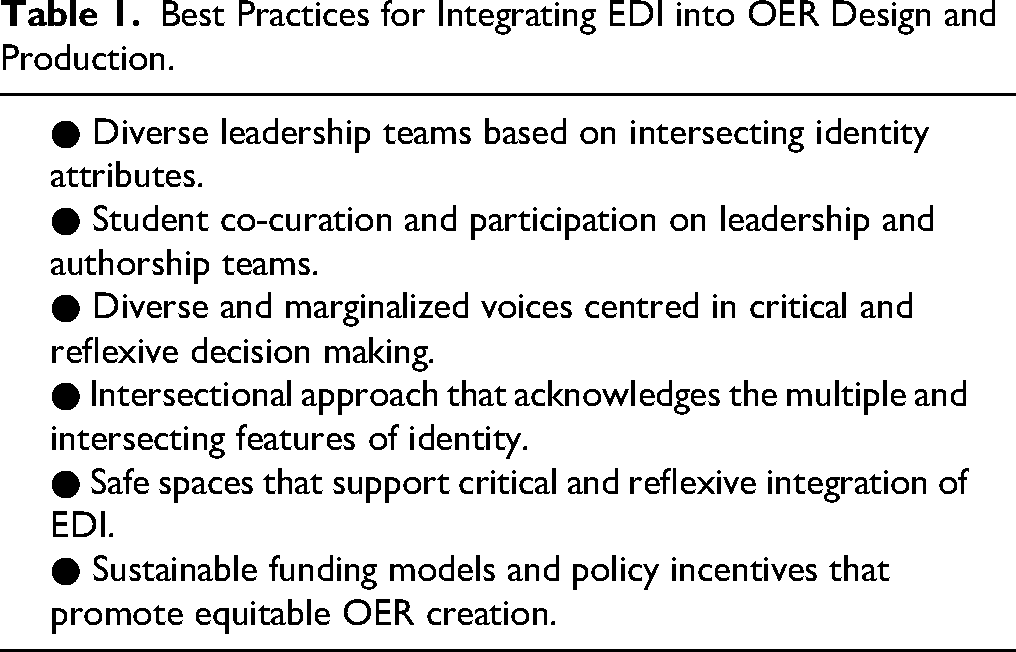
This research is based on the experiences of members from four leadership teams within three institutional academic sites. Based on their experiences, see Table 1 for best practices for integrating EDI into OER design and production. It is important to consider context-specific insights when considering the transferability of these best practices and how this research may be relevant to plans one may have in designing and producing nursing-related OER.
Best Practices for Integrating EDI into OER Design and Production.
Conclusion
Othering is subtly entrenched in nursing-related learning resources such that it can be difficult to see and thus, requires intentional efforts to overcome. As educators, it is our responsibility to interrogate these learning resources and reimagine them in ways that do not reproduce an Othering discourse. In our research, we found that it is crucial for leadership teams to integrate EDI into nursing-related OER in ways that focus on: diversifying design and production; centring social justice; and nuancing inclusion. The design and production of OER shaped by EDI must include rich, vibrant, and diverse voices and team members who are focused on social justice. This approach offers ways to create space for the beauty of human difference, the nuances of inclusion, and the flourishing and growth of learners. Although we may never produce resources that fully embrace inclusion and belonging, we are confident that diverse and critical voices will shift us closer to centring social justice in nursing education.
Footnotes

Ethical Approval and Informed Consent Statements
Full ethical approval was received from Ryerson University Research Ethics Board (REB 2020-405), The Centennial College Research Ethics Board (#2020/21-10), and George Brown College Research Ethics Board (#6004735). Written informed consent was obtained from participants. Prior to signing the consent form and agreeing to participate in the study, all participants had the opportunity to read the consent form and ask any questions they had. This form described the study purpose, expectations, risks and benefits, conflict of interest, voluntary participation and withdrawal, and confidentiality and data storage.
Author Contributions
Lapum: Lead role on the study as principal investigator. Involved in conceptualizing the study and developing the methodology, submitting for ethics, leading the analysis and data collection, supervision of project and project management, writing the original draft and responsible for editing and submitting.
St-Amant, Hughes, and Garmaise-Yee: Co-investigator role. Involved in conceptualizing the study, reviewing ethics submission, participating in all analysis and drafting parts of the manuscript, and revising and editing the manuscript.
Funding
The authors received no financial support for the research, authorship, and/or publication of this article.
Declaration of Conflicting Interests
The authors declared no potential conflicts of interest with respect to the research, authorship, and/or publication of this article.
Data Availability Statement
n/a