




Abstract
Purpose
Colonial frameworks remain embedded within nursing education, mandating a critical and ethical response to the Truth and Reconciliation Commission's Calls to Action to integrate diverse knowledge systems into curricula and pedagogical practices. This paper aims to provide settler educators with a structured framework to decolonize educational practices and fostering culturally safe and reciprocal learning environments.
Methods
This framework integrates decolonial approaches from scholars and collectives, adapting them to local Indigenous contexts and institutional initiatives. The framework's five-phase process — (1) Grounding, (2) Interrogation, (3) New Learning, (4) Commitment, and (5) Rebuilding— was used to guide the critical examination and transformation of curriculum and pedagogy.
Conclusion
This study highlights how engaging in a minor reform, can become a catalyst for broader decolonization efforts, but true transformation requires sustained commitment, critical self-reflection, and institutional accountability. Decolonizing nursing education is a collective responsibility, that involves dismantling colonial frameworks and actively prioritizing Indigenous knowledges within nursing pedagogy and practice.
Keywords
Background and Purpose
In 2007, Canada faced a class-action lawsuit from Indigenous Peoples who had survived the cultural genocide of the residential school system and the intergenerational traumas it caused, prompting public sectors to reflect on their roles in past harms (Government of Canada, 2015; Symenuk et al., 2020). The nursing profession was complicit in historical assimilation and violence through its central role in Indian hospitals, and the apprehension of children from Indigenous families during the “Sixties Scoop”, including forced sterilizations and numerous cases of physical, sexual, and psychological abuse and homicide (Lafrenière, 2022; Symenuk et al., 2020). The tragic case of Joyce Echaquan, an Atikamekw woman who died from anti-Indigenous racism in a Quebec hospital, highlights these issues, leading to the establishment of Joyce's Principle for culturally safe healthcare for Indigenous Peoples (Henzi, 2022; Shaheen-Hussain et al., 2023).
Nurses must embrace diverse knowledges and decolonize healthcare practices to build just and sustainable systems. This requires a deep commitment to dismantling and reconstructing the colonial pillars that sustain the institutions in which we operate. Decolonization must first be settler work, requiring settlers within institutions to take responsibility for challenging and transforming the systems that uphold colonialism. The Truth and Reconciliation Commission of Canada (TRC) issued 94 Calls to Action in 2015 to address the Canadian Government's orchestrated harms and the resulting damage to relationships with Indigenous communities (Government of Canada, 2015; Truth and Reconciliation Commission of Canada, 2015). Mandatory Call to Actions 20, 23, and 24, recognize the distinct health needs of Métis, Inuit, and off-reserve First Nations peoples, increase the representation of Indigenous healthcare professionals, and require skills-based training for healthcare professionals in conflict resolution, human rights, anti-racism, and cultural safety (Canadian Nursing Association, 2021). Nursing higher education, shaped by the legacy of white settler dominance, must respond to the TRC's Calls to Action (2015) by integrating diverse knowledge systems into our curriculum and teaching practices, while actively dismantling colonial structures (Cukier et al., 2021; Hamzavi & Brown, 2023; Martel, 2015; Sandhu & Liao, 2024).
Before engaging with Indigenous knowledges, healthcare and academic institutions must undergo a process of decolonization (George, 2019; Tuck & Yang, 2012). Marie Battiste (2013) describes academic decolonization as critically examining and dismantling Eurocentric frameworks in education, addressing biases, and validating Indigenous Knowledges (Battiste, 2013). Decolonization work requires settlers to actively decolonize their minds, challenge internal biases, and critically reflect on the colonial systems and privileges they may uphold. (Brunette-Debassige et al., 2022; Tuck & Yang, 2012). In nursing education, this involves naming and addressing the epistemic injustices entrenched within curriculum, pedagogy, and research, and elevating Indigenous voices and epistemologies alongside western ways of knowing. To ethically engage in this work, nurse educators must first decolonize their minds and practices, creating space for Indigenous knowledges to be authentically embraced and respected within the academy free from the devaluation imposed by colonial structures (Ermine, 2007; Grafton & Melançon, 2020).
The authors outline their experiences in decolonizing their pedagogy and nursing curricula offering practical recommendations for educators, including inclusive assessment and course reconstruction. The goal is to provide settler educators with a roadmap, based on the authors’ approach and lessons learned, for decolonizing practice and fostering culturally responsive educational environments.
Methods and Procedures
This paper applies a local decolonization framework articulated by author Heather Campbell, a white, cisgender settler-librarian and educational developer at Western University (Campbell, 2023; Campbell & Sich, 2023). The framework adapts and amalgamates approaches from Indigenous and decolonial scholars including Pōkā Laenui (2000), the Gesturing Toward Decolonial Futures Collective (Stein et al., 2021), and the University of Capetown's Curriculum Change Working Group (2018). This approach was tailored to the unique contexts of Western's local communities and aligned with Indigenous teaching and learning initiatives already underway at Western University (Campbell, 2023). Drawing from these sources, academic decolonization unfolds through a five-phase process (Figure 1) designed to challenge and dismantle harmful practices in curriculum, pedagogy, and research.
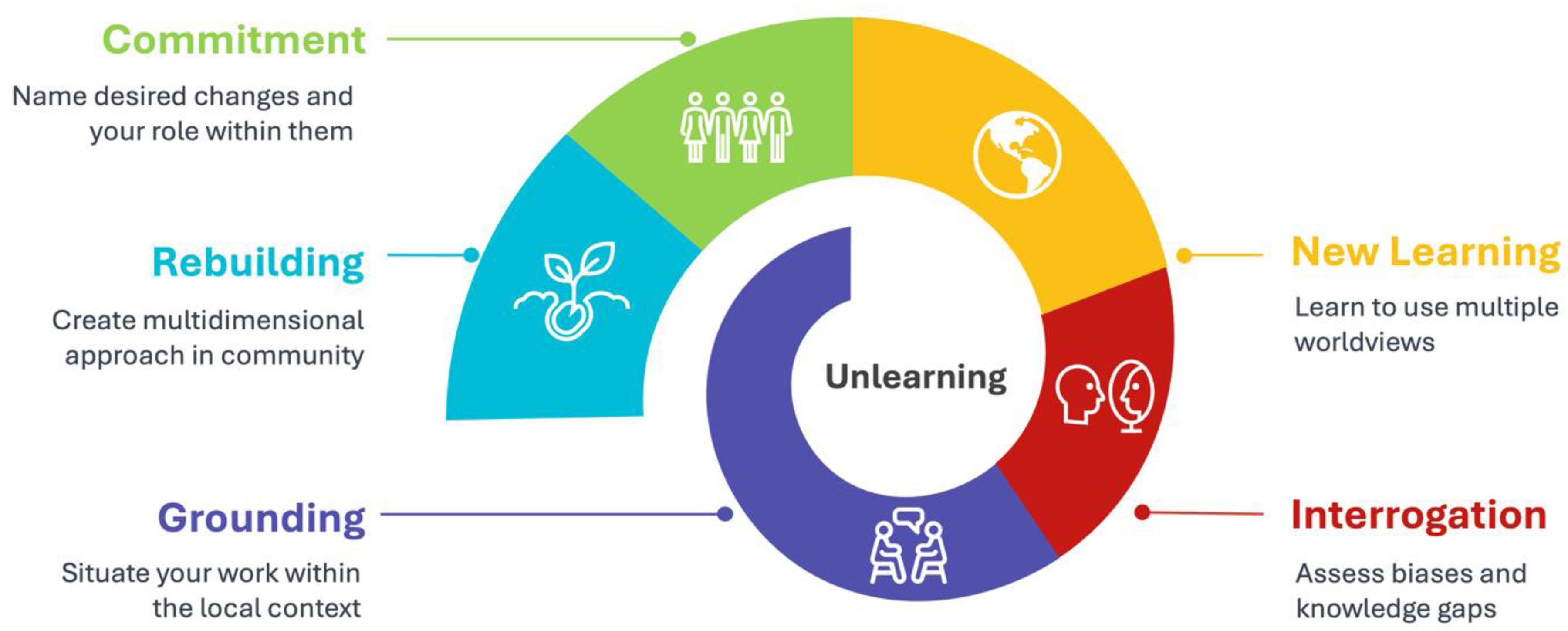
Decolonization Framework. Adapted by Heather Campbell (2023) from: Developing Stamina for Decolonizing Higher Education (Stein et al., 2021), the University of Capetown's Curriculum Change Framework (Curriculum Change Working Group, 2018), and Poka Laenui's Processes of Decolonization (Laenui, 2000).
Phase 1 (Grounding) requires settlers to personally situate themselves within their local context, learn about the specific decolonization work needed, and articulate how it connects to the TRC Calls to Action (2015) and other justice initiatives. Phase 2 (Interrogation) involves the examination of one's discipline for its historical and current role in othering and silencing diverse voices. Phase 3 (New Learning) centres on actively learning from epistemologies beyond nursing's Euro-Western traditions, and reflecting on how decolonization benefits everyone, regardless of their positionality. In Phase 4 (Commitment), individuals identify areas on which to focus their decolonization and reconciliation efforts, reflecting on where they have power to influence change. In the final phase (Rebuilding), settlers enact this commitment, ultimately creating new, decolonized curricula, policies, pedagogies, or educational practices (Campbell, 2023; Campbell & Sich, 2023).
A critical element of decolonization is positioning oneself in the work, and exploring one's biases, privileges, and preconceptions especially as they relate to settler-colonialism (Brunette-Debassige et al., 2022; Sultana, 2019; Tuck & Yang, 2012). Ashley McKeown is a white, cisgender, heterosexual settler of Irish and Scottish descent, who works on the lands of the Anishinaabek, Haudenosaunee, Lūnaapéewak and Chonnonton Nations. She strives to deepen her colonial consciousness through critical reflexivity related to her positionality in teaching and research practices. As the instructor of the course being discussed, her membership in the Indigenous Learning Bundles’ Community of Practice at Western University gifted her opportunities to learn from Elders, engage in local Indigenous events, and deepen her understanding of Indigenous ways of being and doing (2022, personal communication). McKeown has dedicated significant time to the decolonial phases discussed below, focusing on unlearning colonial perspectives and expanding her understanding of diverse knowledge systems and the epistemic injustices that exist in the academy.
Shokoufeh Modanloo, a migrant woman from the Middle East, brings lived experiences of displacement, marginalization, and structural inequities that critically inform her engagement with Indigenous ways of knowing and being in both research and teaching. Her intersectional identity, encompassing race, gender, religion, immigration status, and socioeconomic positioning, compels her to critically interrogate dominant knowledge systems and advocate for epistemic justice. As an educator, she is committed to dismantling colonial epistemologies that have historically erased, delegitimized, and misappropriated Indigenous Knowledges. Her scholarship with displaced communities—who, like Indigenous peoples, continue to endure the violences of colonial power—is deeply rooted in an understanding of historical, intergenerational, and contemporary colonial legacies. The profound honour of being recognized as a “relative” by Indigenous communities in Canada further reinforces her commitment to anti-colonial solidarity, land-based healing, and transformative pedagogy that resists assimilationist and extractive academic practices. Living and working on the lands of the Anishinaabek, Haudenosaunee, Lūnaapéewak, and Chonnonton Nations, she remains engaged in the continuous process of decolonizing knowledge and practice. In striving to be a good relative, she recognizes that decolonization is not metaphorical but rather a material, structural, and deeply personal imperative, one that demands sustained critical engagement and accountability.
Britney Glasgow-Osment is a Black Caribbean settler of Vincentian descent, privileged to learn and grow on the traditional territory of the Mississaugas of the Credit First Nation, and currently resides near the Mississaugas of Scugog Island First Nation, within the Williams Treaty territory. Coming from a heritage that values traditional practices, she often finds it challenging to navigate educational spaces where knowledge sharing is siloed, and culturally rooted practices are undervalued. This has shaped her research philosophy, which embraces the existence of multiple truths and diverse pathways for sharing and receiving knowledge. She actively seeks opportunities to engage with diverse ways of knowing beyond the Eurocentric paradigm and her own, prioritizing inclusive and collaborative approaches. Beginning in 2023, McKeown and Modanloo applied the decolonization framework articulated by Campbell to the undergraduate nursing courses Health in a Global Context and Enacting Social Justice and Equity in Nursing Practice. This paper will outline the application of the five phases of the Decolonization Framework (Figure 1) in undergraduate nursing education. The results section will describe how McKeown and Modanloo progressed through each phase and the insights gained. Using a theory of decolonization ensures that curriculum decolonization is not just about incorporating diverse content or improving instructional methods but about redistributing power, reclaiming knowledge, and structurally transforming education. While scholarship of teaching and learning research approaches can complement pedagogy, they lack the critical lens needed to disrupt colonial structures in academia.
Heather Campbell's Scottish and Irish ancestors came to Canada after receiving lands associated with Treaty 45 1/2 (Saugeen Tract Purchase) and the Robinson Huron Treaty. Still a newcomer and learner in decolonization work, Campbell strives to remain accountable to the communities whose knowledge and lands her work touch. She approaches decolonization as a relational and collective process, one that requires humility, discomfort, and care.
Results
Grounding Phase
The initial grounding phase involves identifying decolonization goals and values, while also clarifying the work's connections to related concepts such as reconciliation, social justice, diversity, equity, inclusion, and accessibility (Campbell, 2023; Smith et al., 2021). For the authors, grounding work involved a deep engagement with the TRC Calls to Action (2015) and critical reflection on decolonization responsibilities named there as they relate to College of Nurses of Ontario (CNO) Entry-to-Practice Competencies for Registered Nurses (2019). During this phase, we expressed our commitment to fostering opportunities for nursing students to develop their practice of cultural humility, enhancing their ability to create culturally safe healthcare spaces for Indigenous Peoples.
Grounding work was also undertaken within the context of a local community of practice (CoP) led by Candace Brunette-Debassige (2022, personal communication). The CoP encouraged members to complete Module 1: Decolonize the Academy and Module 2: Towards a Decolonizing Pedagogy in the Indigenous Teaching and Learning Series (Brunette-Debassige, 2023a, 2023b). These modules expose faculty to “the structural ways that settler colonialism has shaped the university system, its disciplines and teaching practices” (Western University, 2023). They also “offer Indigenous perspectives on decolonial change and introduce…four guiding principles that can help instructors start to move toward decolonizing their pedagogies” (Western University, 2023). The CoP also facilitated an intentional discussion about epistemic injustice and its connection to the knowledge work occurring within academic institutions. Epistemic injustice occurs when individuals are harmed in their capacity as knowers, due to prejudice related to social identity aspects, such as race, gender, or class. (Fricker, 2007; Mansueto, 2022). Gaile Pohlhaus (2012, p. 716) expands on this concept with the idea of willful hermeneutical ignorance where dominant groups, despite possessing the resources and opportunities to engage with diverse perspectives, actively marginalize them. This can lead to epistemicide, the “killing, silencing, annihilation, or devaluing of a knowledge system” (Patin et al., 2020, p. 2). In Canada, these injustices historically and currently impact Indigenous Peoples exemplified by the 1876 Indian Act, which outlawed Indigenous cultural and wellness practices, and the Indian Residential School system which inflicted deep intergenerational trauma and cultural genocide (Government of Canada, 1985; Truth and Reconciliation Commission, 2015). These grounding discussions, therefore, centred around our shared commitment to deepen our colonial consciousness and continue our ongoing process of learning and unlearning. It was in this phase that the Health in Global Context and Enacting Social Justice courses were first identified as focal points for our decolonization work.
Interrogation Phase
In this phase, the origins of the field of nursing were explored, examining its epistemology and ontology. The purpose of this interrogation exercise is not to devalue or undermine the important contributions of the nursing field but to recognize our power to influence change by questioning the status quo (Andreotti et al., 2015; Campbell, 2023; Curriculum Change Working Group, 2018). Questions that academics can work through during the interrogation phase include:
What are the origins of our discipline? Who created it and why? Where and when were they from? How is knowledge defined within our discipline? What do we ‘know’ and how did we come to know it? Who is allowed to be knowledgeable or ‘an expert’ in our field? How does one become an expert? How is knowledge cared for? How is knowledge shared in our discipline? How do Black, Indigenous, racialized individuals, 2SLGBTQIA+, women and gender non-conforming, and disabled members of our discipline experience our field? What impact does our field or discipline have on equity-deserving groups beyond academia and the university? (Campbell, 2023).
In the interrogation phase, we reflected on nursing's shift from marginalized acceptance to a recognized domain within health sciences. This evolution aligned the field with the scientific community's preference for empirical, systematic methods, validating nursing's perceived legitimacy (Georges, 2003; Thorne & Sawatzky, 2014; Young & Ryan, 2020). However, this quest for legitimacy concurrently marginalized diverse ways of knowing, especially those rooted in holistic and humanistic values (Hall et al., 1994; Holmes et al., 2006). This cycle is ingrained in nursing history, beginning with Florence Nightingale's focus on Western biomedical knowledge and statistical methods, which devalue the knowledges of Black, Indigenous, and racialized peoples (D’Antonio, 2022; Hamzavi & Brown, 2023). Historical champions of epistemic justice, like Edith Anderson Monture, and Mary Seacole, represented Indigenous and Afro-Caribbean perspectives in nursing, pushing back against the profession's homogeneity. Yet, nursing academia has continued to elevate figures like Nightingale, reinforcing colonialism and white dominance (Deer, 2019; Hall, 2021; Hamzavi & Brown, 2023). Nursing as a discipline sought to broaden its scholarship and challenge conventional knowledge hierarchies through postmodern feminist discourse. By the 1990s, nursing curricula and journals embraced postmodernist concepts, emphasizing socially constructed truths and knowledge, marking a brief triumph for epistemological diversity (Georges, 2003; Holmes & Warelow, 2000; Watson, 1995). Barbara Carper's (1978) work on nursing's “patterns of knowing” advocated for integrating empirical, aesthetic, personal, and ethical knowledge to provide holistic, patient-centred care (Carper, 1978; Porter, 2010). However, evidence-based medicine remains a dominant paradigm in health science education, shaping nursing knowledge generation, validation, and application in practice, driven by the ongoing pursuit of scientific validation (Thorne, 2020; Young & Ryan, 2020).
Applying this learning and the interrogation questions listed above to our Health in a Global Context and Enacting Social Justice courses, we reflected on the course construction, readings, lecture content, assessments, and our pedagogies. In reviewing existing course assessments, students were exclusively evaluated using a Euro-Western paradigm, requiring knowledge demonstration through traditional scientific forms such as written expression. Assessing students solely through empirical measures that overemphasize grades reinforces Eurocentric approaches and hinders deep meaningful learning and personal engagement with the curriculum (Chamberlin et al., 2023; Correa, 2006; Tannock, 2017). Traditional metric-based grading tools, for example, cannot be used to evaluate students’ engagement with Indigenous knowledges. After reviewing the course readings and evaluation requirements, it was found that peer-reviewed sources dominated the resource lists and were the sole type of source required for written assessments. This signaled to students that empirical, Euro-Western expressions of knowledge were the most valid sources of information.
At this point, we recognized that our assessment methodologies did not honour Indigenous ways of knowing and doing and we were not incorporating or privileging voices from diverse perspectives. Beadwork, dreams, ancestral knowledge, and story are all important forms of knowledge in many Indigenous cultures, for example, but fall outside the limits of multiple-choice exams, or academic papers that only allow for the use of peer-reviewed journal articles. Nurse educators must create holistic opportunities that address the physical, emotional, spiritual, and cultural dimensions of learning, a path that was unknown to us (Claypool & Preston, 2011).
New Learning
The goal of this phase is to step outside disciplinary traditions and actively learn from diverse epistemologies, particularly those that are silenced and othered in mainstream discourse (Campbell, 2023). New learning allows settlers to engage with different ways of knowing and being, requiring openness to unexpected transformation in worldview (Stein, 2019). Such learning requires open-minded reflection to avoid selectively privileging those perspectives or concepts that reinforce one's epistemological grounding (Stein, 2019; Stein et al., 2021). Ethically prioritizing the TRC Calls to Action (2015) requires centring new learning alongside, and with, local Indigenous communities, following the principle of ‘nothing about us without us.’ However, Indigenous Peoples within the academy are often unethically overburdened by institutional demands of decolonization work (Brunette-Debassige, 2024), resulting in the exploitation of unpaid and unrecognized labour that perpetuates deep systemic injustices. At this crossroad, we found guidance in the Indigenous Learning Bundles CoP, which became an essential space for new learning.
“Maatookiiying gaa-miinigoowiziying,” meaning “sharing gifts” in Ojibwe, are local Indigenous-created learning bundles focused on specific topics in the form of a digital repository (Western University, 2022). Inspired by a similar programme at Carleton University (2018), the intention of the bundles is to introduce learners to Indigenous Knowledges, privileging Indigenous conceptions, theories, ways of knowing, and epistemologies (Western University, 2022). Through the bundles, learners are supported in reimagining and transforming their school of thought (Western University, 2022). Integration of specific bundles into Western University courses is supported by a CoP. McKeown and Modanloo Authors deeply engaged with the bundles to individually support their new learning.
McKeown, a member of the CoP, engaged with important teachings, readings, discussions, and reflections on the transformative power of storytelling as pedagogy, the importance of engaging with Elders, and the privilege and sacrality of participating in ceremonies. Led by Candace Brunette-Debassige and Sara Mai Chitty, McKeown was invited into the CoP, which safely nurtured participant epistemological transformations to see and honour Indigenous ways of doing and being (2022, personal communication). By integrating the bundle “Orientation to Indigenous Knowledges” into the Health in a Global Context course, McKeown learned alongside students, about the shift from privileging an empirical post-positivist perspective alone to honouring Indigenous and diverse knowledge systems. This experience in worldview transformation was healing for McKeown, renewing hope for the profession of nursing and subsequently deepened her dedication for applying an epistemic justice lens throughout the nursing curriculum.
As a newcomer to the region and a new faculty member, Modanloo recognized the necessity of reorienting herself to local Indigenous lands, knowledges, and histories. Engaging with the “Lands, Places, and Spaces” bundle alongside students in the Enacting Social Justice course deepened her understanding of Indigenous place-based epistemologies and reinforced the importance of land-based teaching in nursing education. This process illuminated how Indigenous identity is inherently land-based and relational, varying across territories and communities. Having lived in both eastern and western Ontario, and worked with diverse Indigenous communities, she came to understand that scholarship must resist homogenization and instead uphold the sovereignty of Indigenous peoples over their lands, knowledges, and governance systems. This experience reaffirmed to Modanloo that decolonization is an ongoing, embodied practice that demands continuous engagement, critical reflection, and unlearning.
Commitment
In this phase, the results of new learning and disciplinary interrogation inform the identification of personal and concrete decolonization responsibilities (Campbell, 2023). This phase involves acknowledging a lifelong unlearning process due to entrenched white supremacy and the pillars of global capitalism, settler colonialism, and heteropatriarchy that sustains it (Grande, 2018a, 2018b; Tuck, 2018). Questions to support commitment include:
Which specific decolonial reform(s) must I complete? From which harmful practices must I move away? (Campbell, 2023; Stein et al., 2021) Where do I hold power and influence? How must I use my power and privilege to advocate for equity-denied groups? (Campbell, 2023; Stein et al., 2021).
The intention of these self-reflective questions is to spark an “aha” moment, essential for deepening one's colonial consciousness and commitment to decolonization work. Brunette-Debassige introduced us to the scholarship of the Gesturing Toward Decolonial Futures Collective to guide our progress through the commitment phase. The collective outlines different stages of academic decolonization work, framed within various theories of change (Andreotti et al., 2015; Stein, 2019). Sharon Stein (2019), a central figure in this work, asserts that institutions which only incorporate Indigenous learning or engagement events without addressing deeper systemic reforms are simply reinforcing the ‘status quo’. In the context of this project, it's not enough to simply introduce Indigenous Learning Bundles into course content; we must also transform assessment practices and course learning outcomes. Deepening our decolonization commitments requires fundamentally rethinking our pedagogical approaches.
When engaging with decolonization responsibilities, efforts often focus on inclusion or increasing resources within the existing system. Changes tend to occur at the level of the individual, such as one-off professional development or course revision (Brunette-Debassige et al., 2022). These types of reforms are considered to be ‘minor reforms’ and do not disrupt underlying structures and systems (Stein, 2019). However, if minor reform is what can be accomplished given one's power for change, it should not be cause for discouragement. While we aim for larger change, combined minor reforms can be emergent strategies (brown, 2017) by driving major change, with collective contributions building toward broader transformation.
Ultimately, decolonization is recognized as a shared responsibility, with efforts focused on disrupting and reforming systems, processes, and understanding. In exercising our commitment to decolonization, we should transition our efforts towards ‘major reform’ work, which seeks to disrupt harmful systems (Stein, 2019). Major reform activities, like programme and curriculum level change, are community responsibilities that move institutions toward decolonization (Andreotti et al., 2015; Brunette-Debassige et al., 2022; Stein, 2019; Tuck & Yang, 2018).
However, achieving decolonization at a level that goes beyond reform cannot be envisioned within the existing walls of the academy (Stein, 2019). The neoliberal commodification of knowledge and existing neocolonial academic governance structures create opaque barriers that obstruct our vision of true reconciliation (Smith & Smith, 2018). However, guiding frameworks, like a “Two-Eyed Seeing” approach, centre Indigenous ways of knowing alongside Euro-Western knowledge system, and may support this re-envisioning (Andreotti et al., 2015; Brunette-Debassige et al., 2022; Gaudry & Lorenz, 2018, september; Smith & Smith, 2018; Stein, 2019).
As settlers and nurse educators, we are responsible for committing to this decolonization work so that the institutions in which we operate dismantle and reconstruct the colonial structures that underpin them. While these changes will likely not occur in our lifetimes, diverse teaching and learning systems are necessary to heal the wounds imparted by colonial violence on our current educational systems. It is to this work that we stay committed, as part of our decolonization efforts.
Rebuilding
The Rebuilding phase calls on settler-nurse educators to enact their commitment through concrete decolonial reform within their locus of control (Campbell, 2023). Within this project, our rebuilding efforts targeted minor reforms to our pedagogical approaches where we had power to make changes. Integrating Indigenous Learning Bundles into mandatory undergraduate courses –Health in a Global Context and Enacting Social Justice in Nursing –ensures all graduates engage with diverse ways of knowing. Beyond inclusive course content transformations, we rebuilt by redesigning our assessment approaches to evaluate students beyond traditional Eurocentric frameworks. The Aesthetic Reflection Assignment was developed and implemented to facilitate meaningful student engagement with Indigenous Knowledges, address the TRC Calls to Action (2015) that registered nurses are accountable to, and align assessment approaches to honour diverse ways of knowing. Prior to completing the Aesthetic Reflection Assignment, students were asked to complete the Indigenous Learning Bundle Orientation to Indigenous Knowledge (Brunette-Debassige, 2024) and engage with artistic renditions of Indigenous health experiences. After identifying an artwork that resonated with them, students created their own expression in any medium of their choice. Following the creation, they wrote or audio-recorded a critical micro-reflection on the meaning of the experience. (See Table 1 for Assignment Instructions and Rubric).
Indigenous Health Aesthetic Reflection Assignment.
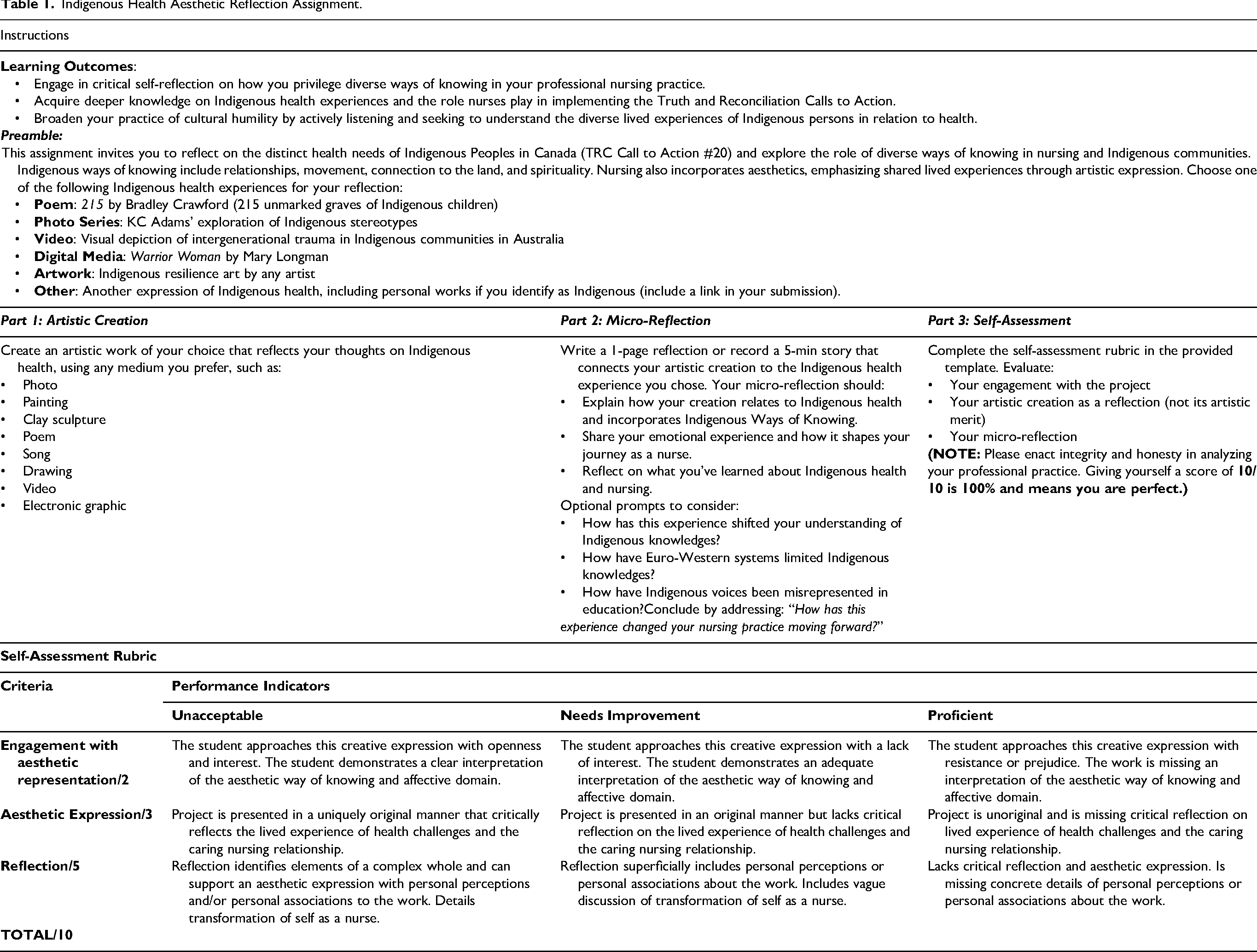
The goal with this pedagogical reform was to create a critical space where students can connect with Indigenous ways of knowing and being while learning to understand their personal responsibilities to the TRC Calls to Action (2015). A self-assessment grading approach was selected as it incorporates decolonization principles into evaluation practices and recognizes that there is no singular ‘correct’ way to engage. While acknowledging, again, that this is an example of minor reform, it serves as a foundational step towards broader, major reform projects, that involve shared curricula decolonization responsibilities among all faculty.
Discussion
The decolonization of nursing curricula is a multifaceted yet imperative endeavour, as outlined in the TRC's Calls to Action (2015). This undertaking necessitates that settlers engage with Indigenous Knowledges and engage in critical introspection regarding their own preconceptions and biases. A dedication to the processes of unlearning and relearning is paramount in transcending superficial reforms towards substantive, transformative changes (Stein et al., 2021). This section provides insights gained from applying Campbell's academic decolonization framework including (1) individual pedagogical transformations and their impact on course content, (2) re-evaluation of assessment methodologies, and (3) the ripple effect leading to broader curriculum decolonization. As this paper is reflective in nature, the research evaluation of this project, including detailed student feedback, will be published separately.
Decolonizing Teaching and Learning Pedagogy for Individual Settler Educators
Engaging in meaningful decolonization work requires settlers to first decolonize their minds, committing to ongoing unlearning. In this project, this was facilitated through learning opportunities such as We Have What We Need: A Practical Guide for Decolonizing Our Work (Campbell, 2023), the Indigenous Teaching and Learning Series [Brunette-Debassige, 2022], engagement with the Indigenous Learning Bundles CoP, and building relationships with campus leaders in Indigenous education. These commitments help navigate the complexities of decolonizing courses within colonial institutions, while the integration of Indigenous Learning Bundles into course content deepened awareness of colonial frameworks, revealing the continued dominance of Euro-Western paradigms. Initially, our pedagogy privileged Euro-Western knowledge, leaving students ill-prepared to engage with the Bundles. In response, a re-evaluation of course reading lists was undertaken to include more diverse voices and perspectives.
Longstanding epistemic injustices in nursing exclude and devalue knowledge systems that emphasize relationships, the body, land, and spirituality –essential domains for honouring Indigenous Knowledges (Bell, 2021; Tran, 2023; TRC, 2015). To address this, the nursing discipline must prioritize the creation of culturally safe spaces that respect and amplify diverse ways of knowing, being, and learning in the classroom. In action, this looks like meaningful integration of diverse knowledge systems that reflect the lived experiences, and ways of knowing of various communities. However, caution and intention must be exercised, as integrating Indigenous content into settler-taught courses carries the risk of superficial tokenism, which can inadvertently reinforce colonial structures and dilute the transformative potential of decolonial frameworks (Tran, 2023). Applying ethical considerations in integrating Indigenous knowledge, as guided by Ermine's Ethical Spaces of Engagement (2007), is crucial to avoiding tokenism and reinforcing colonial structures. Embracing Two-Eyed Seeing, a framework gifted by Mi'kmaq Elder Albert Marshall, fosters mutual respect and validity for both Indigenous and Euro-Western knowledge systems, creating a balanced, transformative educational environment (Bartlett et al., 2012).
Commitment to Valuing Diverse Knowledges in Student Evaluation
In their ongoing decolonization efforts, authors McKeown and Modanloo have sought to decolonize assessment practices, as exemplified by the Aesthetic Reflection Assignment. Decolonizing assessments challenges entrenched practices that dictate what counts as knowledge within settler-colonial institutions. It's vital to assess all forms of knowledge equitably, dismantling the divide between Euro-Western sciences and Indigenous Knowledges (Turnbull, 1997). To foster this shift, educators must model diverse ways of knowing in their assessments, developing methods that value multiple knowledge systems instead of privileging Euro-Western approaches. When assessments rely solely on written exams, educators inadvertently communicate that only empirical knowledge matters. By diversifying assessment methods, educators can honour and celebrate the varied strengths that students bring to their learning.
One way to apply a Two-Eyed Seeing approach in curricular reform is through knowledge co-production (KCP) models, which emphasize pluralistic, goal-oriented collaboration grounded in relational and reciprocal perspectives (Norström et al., 2020; Yua et al., 2022). Effective KCP requires acknowledging and dismantling power imbalances rooted in epistemic injustices and knowledge hierarchies within academic structures. These imbalances manifest in student-faculty dynamics and the exploitation of Indigenous faculty and scholars’ free labour, despite their essential role in decolonization efforts. Co-creation methods, such as actively involving Indigenous partners in decision-making, ensure assessments honour diverse knowledge systems. An example of KCP is the Students-as-Partners (SaP) model, which empowers students as co-creators of knowledge, challenges traditional authority, and fosters collaborative learning. When working towards assessment decolonization, a SaP approach to co-creation is suggested; this also engages students in their responsibility to address the TRC's Calls to Action (2015).
Transitioning to Major Reform: Curriculum Transformation
For meaningful decolonial change in nursing education, isolated pedagogical shifts are insufficient; a transformative approach requires a systemic, curriculum-wide re-evaluation. This project led to the mapping of Indigenous Learning Bundles across the undergraduate curriculum, generating a detailed report shared with faculty responsible for relevant courses. These faculty were called to integrate the bundles ethically, requiring both grounding and unlearning of dominant epistemologies. Embedding Indigenous Knowledges throughout the programme signals a departmental commitment to valuing diverse ways of knowing. Beyond diversifying readings, content and assessments, this work has driven broader curricular changes, including new course development. Decolonizing nursing education involves critically assessing existing courses and identifying gaps. At Western University, this work has led to plans for creating a required epistemic justice course and a new fourth-year consolidation course where students will implement evidence-based practice projects at their clinical placement sites using Two-Eyed Seeing approaches.
This initiative also highlights the importance of relational leadership, aligning with Indigenous ways of knowing. As co-chairs of the Decolonization, Anti-Racism, and Anti-Oppression Committee, authors McKeown and Modanloo foster meaningful partnerships with academic and community allies. Collaboration with teaching teams has laid the foundation for a two-year curriculum decolonization initiative in partnership with the Centre for Teaching and Learning led by author Campbell. This team-based effort applies the project's guiding framework to co-create the epistemic justice course mentioned above, advancing nursing education that prioritizes epistemic plurality, relational accountability, and transformative learning.
Conclusion
This project began with recognizing gaps in nursing education and critically reflecting on the ways we were taught and, in turn, teach nursing. Integrating Indigenous Learning Bundles into our courses initially seemed like a minor reform, but it became a catalyst for broader decolonization efforts. Each step taken reinforced the need for deeper engagement, revealing how even small changes can challenge entrenched structures. While minor reforms can lead to significant change, this transformation is never passive—it requires dedication, intentional action, and a deep commitment to decolonizing one's mind and practice.
Decolonizing nursing education is a collective responsibility, not one solely borne by Indigenous scholars or students. Educators, researchers, and institutional leaders must critically assess whose knowledge is prioritized, whose voices are silenced, and whose healing is ignored. True decolonization requires more than symbolic inclusion—it demands dismantling colonial structures that have shaped healthcare systems, nursing curricula, and policies. Nursing must confront its role in erasing Indigenous practices, delegitimizing knowledge systems, and perpetuating violence in healthcare. This work is challenging, often met with resistance and discomfort, but these obstacles are calls to persist. Whether inspired by this paper, a colleague, or a sense of duty, you’ve already taken the first steps toward change. Now, the question is not if but how deeply this work will shape nursing education and practice. The time to act is now.
Footnotes
Acknowledgements
The authors extend their deepest gratitude to the members of Western University's Indigenous Learning Bundles Community of Practice, especially Candace Brunette-Debassige and Sara Mai Chitty, whose generosity and wisdom made this journey possible. Their unwavering support created a space for us to both learn and unlearn, profoundly reshaping our understanding of Indigenous ways of knowing and being. This journey has not only transformed our pedagogical approaches but has fundamentally changed who we are as individual human beings. Through their remarkable work, we were entrusted with knowledge that allowed us to learn alongside our students, shaping the perspectives of future nurses and fostering a deeper commitment to reconciliation in nursing education. Their generosity, guidance, and encouragement extended far beyond the classroom, and for these gifts, we are profoundly grateful.

Funding
The authors received no financial support for the research, authorship, and/or publication of this article.
Declaration of Conflicting Interests
The authors declared no potential conflicts of interest with respect to the research, authorship, and/or publication of this article.