




Abstract
Equity, diversity, and inclusion (EDI) can serve as an epistemological framework for conducting qualitative research. As it receives unprecedented attention, detailing how EDI is being incorporated into research may be particularly important, so that it is recognized as credible and may be reproduced. While the principles of EDI are well-defined, the exact methodological processes for applying them to qualitative research design and execution remain somewhat unclear. With the present paper, the authors share an approach to meaningfully incorporate EDI into qualitative research via methodologically reflexive practice to generate an intersectional sex- and gender-based analysis plus.
Keywords
Equity, diversity, and inclusion (EDI) are receiving unprecedented attention. Despite current politics around equity and inclusion, the historical realities of diverse populations who experience more barriers to accessing resources and ongoing social injustices have never changed; therefore, it is arguably more important than ever to detail how principles of EDI are being incorporated into research so they are recognized as credible and can be reproduced. Informed by the authors’ experiences, strategies for building and applying an EDI lens as a dynamic tool in qualitative research will be shared. We propose a practical and epistemologically grounded approach to meaningfully integrating EDI principles into qualitative health research methodologies across the research cycle. We develop and introduce an EDI-focused lens that operationalizes intersectionality through the sex- and gender-based analysis plus (SGBA+) framework to substantiate its application as a tool for qualitative researchers. Our goal is to offer a methodologically reflexive lens that supports socially responsive research practices.
Background
EDI is an acronym that stands for equity, diversity, and inclusion. Although other acronyms such as IED and DEI are used to refer to the same set of concepts, we have chosen to use EDI for a few reasons. First, we prioritize equity because we conceive of diversity and inclusion as parts of enacting equity. From this viewpoint, equity serves as the foundation upon which diversity and inclusion efforts ought to be built. Second, EDI-focused work is inherently situated and contextual. Our team is rooted in Canada; we research, teach, and live within Canadian contexts, and our choice of terminology reflects this. In addition, the acronym EDI is widely used across Canadian institutions, including postsecondary and research organizations (Universities Canada, 2022). This usage is also represented at the federal level. For example, the Government of Canada uses EDI in its Guide on Equity, Diversity, and Inclusion Terminology (2025), as does the Canadian Institute for Health Research in its official glossary of terms (2023). Other federal research organizations, such as the Natural Sciences and Engineering Research Council of Canada, have also adopted this acronym (2021). The consistent use of the EDI acronym among universities, research institutions, and federal departments indicates a coordinated effort to standardize terminology and promote equitable practices throughout education, research, and public service. This is an effort in which we are committed to participating. Beyond the scope of this paper, readers are invited to contextualize EDI within the settings in which they conduct research. The application of institutional, governmental, and other relevant practices presented here—practices that shape our efforts to enact equity throughout the research cycle—is intended to serve as a guide to support the reader in this endeavor.
When researchers state that they employ EDI lenses or frameworks, they convey a commitment to systematically incorporating principles of EDI into their work. EDI contributes to the advancement of human rights and is understood to be a shared, society-wide responsibility (Fisher et al., 2024; Xuan & Ocone, 2022). It is worth noting that, in the current North American and international political climate—one which includes recent attacks on research practices prioritizing EDI principles (The White House, 2025)—it is crucial that we not only re-affirm the critical importance of EDI principles in research but also clarify how exactly we are applying them, for which purposes, and toward which ends. In his second term, US President Donald Trump’s administration has been systematically dismantling EDI protections in America. This includes eliminating EDI-related positions, programs, and initiatives; terminating grants that support EDI-focused research and projects; and censoring academic, scientific, and scholarly discourse on these topics (“Trump on DEI And Anti-Discrimination Law,” American Civil Liberties Union, n.d.; “Trump’s Executive Orders on Diversity, Equity, and Inclusion, Explained,” The Leadership Conference on Civil and Human Rights, 2025).
EDI is never a project completed but rather requires continual reassessment so that its application remains relevant and useful toward its emancipatory aims (Fisher et al., 2024). As such, the principles of EDI can guide the research process, including gap identification and literature review, question formation, team composition (recognition of resources and expertise needed for the research project), study design, data collection and analysis, dissemination of findings, and impact assessment (Government of Canada, 2021; Grasenick et al., 2021). Embedding EDI principles is meant to include not only consideration of EDI but also close and critical examination of the ways in which these considerations (and their intersections) impact each element of the research process. This embedding can happen by applying a lens that has a three-fold goal: first, to produce research which is useful and relevant for the groups to whom it is meant to apply; second, to uncover complexities of these populations’ lived experiences which have otherwise been obscured (Parson, 2019); and third, to place emphasis on groups who have been structurally and historically marginalized or excluded due to socially and institutionally imposed barriers (Beard et al., 2023).
The term equity connotes material, institutional, and political agendas of groups whose interests are often upheld by authorities, and is thus fluid, contextual, and relational (Johri, 2023). Equity in research includes recognizing systemic marginalization, committing to their dismantling, and promoting strengths-based approaches that actively respond to historical and structural factors impacting the research process (Beard et al., 2023; Johri, 2023). Diversity in research refers to attempts to capture a range of human experiences and conditions, including ontologies, epistemologies, and axiologies. Diversity holds transformative potential when it is understood critically—as a complex set of variables, including the number of individuals belonging to certain groups and describing them using cultural markers, as well as something that has economic benefits—and operates within stratified social hierarchies (Johri, 2023). In practice, this may include specific methods of data collection, although these are not well described in the literature (Beard et al., 2023). Lastly, inclusion in research is defined as significant engagement with a wide variety of groups, particularly those who have been denied equity (Beard et al., 2023). Inclusive research is conducted by those who pose critical questions that unravel histories and sociopolitical contexts that cause disconnections between a study’s intent and its impact when left unexamined (Johri, 2023). Taken together, these three considerations comprise EDI lenses (and/or “frameworks”). Whatever the goal, the ethical reasons for embedding EDI principles are of critical importance, particularly when “diversity is being lauded as a beacon for innovation” (Johri, 2023, p. 222).
The exact methodological processes for applying EDI lenses to research design and execution, however, remain unclear. This ambiguity may arise from challenges in application or insufficiently detailed approaches. The literature appears largely to contextualize EDI lenses among already established critical methodologies, perhaps to lend the methodological coherence required to produce actionable, applicable, or truly emancipatory research (Booysen et al., 2018). Notably, there are significant gaps in how qualitative research addresses EDI principles, and there is often a lack of explicit focus on EDI in study designs. According to a recent methodological review study, many qualitative studies implement a generic approach rather than explicitly focusing on EDI issues. For example, a study found that out of 43 qualitative reviews, only six justified their population focus in terms of EDI-related concerns, and only one included a knowledge user, indicating deficiencies in interest holder involvement (Don, 2024; Evans et al., 2025).
We acknowledge the weight and importance of traditions like critical qualitative inquiry (CQI), including those of Johnson and Parry (2016), Canella et al. (2015), and Pasque and Salazar Pérez (2015), and contend that the EDI-focused lens we propose here represents a distinct approach. CQI and EDI-informed approaches share several qualities, such as a commitment to interrogating power structures and bringing those from equity-denied groups to the fore. CQI is rooted in critical theory and, as such, emphasizes epistemological critique, deconstruction of dominant paradigms, and the pursuit of social justice through transformative inquiry (Denzin, 2015; Denzin & Giardina, 2016). In contrast, the lens we develop in this paper is grounded in policy and practice-level concerns and designed to be applied across all stages of the research process in ways that strengthen methodological rigor thereby driving actionable change.
Practicality is particularly salient in health research contexts, where EDI efforts are increasingly and rightfully required by funding bodies, institutional review boards, and government entities. In health research, EDI can go beyond commitment, constituting a procedural imperative. CQI largely commits to the realm of critique and theoretical engagement, while EDI approaches must translate into concrete methodological decisions about what is actionable in policy, procedure, education, and employment. We do this by adopting the federally endorsed SGBA+, a widely recognized approach that makes our structured approach to operationalizing intersectionality accessible, customizable to context, and consistent with government efforts to prioritize EDI in research, practice, and policy.
Moreover, while both CQI and EDI-informed research may pursue emancipatory goals, we see differences in their orientations and applications. CQI may center macro-level critiques of ideology and discourse, whereas EDI approaches in health research are frequently oriented toward improving access, representation, and outcomes for equity-denied populations within specific institutional and policy contexts. Where CQI approaches may critique neoliberal underpinnings informing healthcare systems, an EDI-focused approach may attend to issues of adequate representation in clinical trials or the meaningful incorporation of Indigenous knowledges into health policy and interventions. Both aims are invaluable and distinct in terms of how they serve different purposes and operate at different levels of abstractions and application.
Similarly, while social justice is a shared foundational value for both CQI and EDI-focused approaches, the two can advance distinct goals in health research. Social justice approaches in qualitative health research often emphasize resistance, activism, and larger, systemic transformation (Giacomini, 2010). EDI-focused approaches, particularly in the context of health research, may be more likely to attend to procedural fairness, inclusive representation, and mitigation of harm within existing systems and structures. A social justice model may seek to decenter or even dismantle biomedical models. An EDI-focused approach would acknowledge the harmful reproduction of cultural supremacies of biomedical models but work within that model to ensure that ethno-racialized patients are not excluded from care pathways or that data collection does not reproduce ableist assumptions. The two are not mutually exclusive but represent different strategies and institutional engagement.
As Booysen et al. (2018) emphasize, the integration of EDI principles within critical methodologies has at times lacked the explicit methodological clarity needed to ensure rigor and trustworthiness. The EDI lens we offer here is meant to be a pragmatically embedded methodological tool capable of producing actionable, contextually grounded insights. By positioning EDI principles as a means by which an intersectional SGBA+ can be generated from the onset of a study, we offer a feasible, replicable approach that is grounded and methodologically coherent for embedding these principles into qualitative health research processes.
Booysen et al. (2018) also provide an in-depth discussion on the integration of EDI principles within established critical methodologies. They emphasize the need for more explicit and detailed approaches in qualitative research to effectively incorporate EDI principles and address enduring issues of establishing rigor and trustworthiness in research. They argue that without these detailed approaches, the potential impact of EDI-focused research is undermined, and the research may fail to produce actionable and emancipatory outcomes. Therefore, since there appears to be no standalone EDI methodological lens, the present authors propose contextualizing the principles of EDI within an SGBA+ framework that operationalizes the concept of intersectionality. As intersectionality captures domains of power operating across multiple forms of oppression (Collins & Bilge, 2020), this approach offers a feasible application of EDI principles in qualitative research that generates an intersectional SGBA+. It is also particularly relevant because SGBA+ is an established analytical process used to advance EDI (Health Canada, 2017). By integrating EDI principles within SGBA+, researchers in Canada can ensure a more comprehensive and intersectional approach, addressing the unique experiences and needs of various populations using language that reviewers will recognize. This will hold true in other contexts where funding bodies encourage the integration of sex and gender in health research.
Sex- and Gender-Based Analysis
The SGBA+ framework operationalizes the concept of intersectionality, which emerges from Black feminist scholarship and connects identity categories with domains of power, including “the fundamental structures of social institutions such as job markets, housing, education, and health” (Collins & Bilge, 2020, p. 7) and “the increasing significance of ideas and culture in the organization of power relations” (Collins & Bilge, 2020, p. 9). The framework underscores a need to incorporate intersectionality into scientific methods (Bailey et al., 2019; Bowleg et al., 2023; Chan & Henesy, 2018; Fine et al., 2021; Guan et al., 2021) and highlights the importance of engaging broader systems of power that mutually constitute and reinforce structural inequalities within social systems and institutions (Collins, 1990).
The philosophical application of intersectionality, and the politics of identity, is called Intersectionality Theory and can be used to examine contextual operations of power (Collins & Bilge, 2020). Specific disparities, such as homelessness among military veterans, interpersonal violence among sexual and gender minorities, and Queer Youth of Color who use substances, have been addressed in the literature (Eichler, 2021; Eichler et al., 2021; Eisenberg et al., 2022; Subirana-Malaret et al., 2019). However, the historical practice of conducting research on homogenous sample populations (i.e., predominantly white males) reveals how errors, inaccurate conclusions, and irreproducible results set the stage for mistrust among populations that are not represented or prioritized by dominant cultures (e.g., white supremacist patriarchal cultures) (Dresser, 1992; Underwood, 2000; White et al., 2021). Dresser’s (1992) critical analysis highlights such a context (i.e., a patriarchal white supremacy), where the white male research subject prototype goes unquestioned. This occurrence, in itself, signifies the operation of power relations in social contexts within which research as such has been conducted. Select participation (or lack thereof) continues to shape research teams and the lens through which research questions are asked, studies are designed and funded, and methods are used (Fine et al., 2021; Fisher & Kalbaugh, 2011; Woitowich et al., 2020). This legacy continues to create blindspots within the research process that may contribute to historical injustices, a lack of understanding surrounding the harms that researchers can cause, and the significance of the SGBA+ framework.
Sex- and gender-based analyses were introduced as part of an international agreement; the United Nation’s Beijing Declaration and Platform for Action states an intent to promote progressive change by achieving equality for women and girls (Health Canada, 2017; UN Women, 2014). Despite the widespread acknowledgement of intersectionality by political activists, community organizations, corporations, academics, researchers, and governments (Hankivsky & Mussell, 2019; Manning & Levac, 2022), progressive change has been hindered by intersecting structural inequalities that are inextricably linked to gender inequality. The Government of Canada’s “sex- and gender-based analysis plus” (SGBA+) incorporates intersectionality into health research, policies, programs, and services to increase inclusivity and acknowledge gaps to improve resources and outcomes (Government of Canada, 2017). As such, social problems rooted in identity-related differences can be contextualized (Collins, 1990; Crenshaw, 1989).
The application of intersectionality in research promotes the production of knowledge from intersections of oppression by paying attention to social distinctions, structures, and institutions through which power operates (Collins, 1990; Collins & Bilge, 2020). However, for the most part, Intersectionality Theory is not critically embedded in SGBA+ approaches (McCarthy et al., 2017). This may, in part, be due to the prioritization of sex and gender by using a “+” to ostensibly represent all other social categories (e.g., race, Indigeneity, sexual orientation, disability, citizenship, and age) (Hankivsky & Mussell, 2019). Analyses that truncate the operationalization of intersectionality thus undermine meaningful inclusion, potentially obscure important differences, impede opportunities to examine social hierarchies that uphold cultural supremacies, and risk perpetuating historical injustices (Cameron & Tedds, 2022; Hankivsky & Mussell, 2019). Explicit application of EDI principles to the SGBA+ analytic framework can unravel the complexities that arise from intersections of oppression and privilege to avoid reductive pitfalls.
Building an EDI Lens
Intersectionality Theory can be used to integrate EDI principles into research design through SGBA+ incorporation for critical engagement and reflection, necessarily promoting consideration of who is involved in its methodological application and practical employment. An EDI lens is epistemological and not restricted in its use, but a team who understands the complexity of a concept like intersectionality may be more equipped to bring together EDI methods and intersectional methodology due to practice and their perspectives.
Acknowledging Positionality
Positionality statements are increasingly common in several areas of research, although they have a much longer and more established presence in qualitative social sciences research (Darwin Holmes, 2020). Such statements are meant to transparently acknowledge that all research is conducted by people with subjectivities and whose sociocultural positions necessarily impact their work (Savolainen et al., 2023). Positionality statements are commonly contextualized within standpoint theories, which argue that all knowledge is generated from power positions and are resultant from life experiences (da Silva & Webster, 2018). The spirit of positionality statements is often to trouble the notion that research can never be truly neutral, objective, or value-free (King, 2024) and to resist the academy’s “focus on positivism, objectivity, and […] white normative framework[s]” (Harris, 2021; King, 2024, p. 1). Positionality statements vary considerably in length and format but typically include information about authors’ professional and personal demographics as well as their social positioning vis à vis the topics addressed (King, 2024).
Several authors have persuasively criticized positionality statements in their common current form: “box-checking” lists of identity categories with which authors may or may not meaningfully engage (Martin et al., 2022, p. v). These types of lists miss the point, and decontextualize and depoliticize positionality statements by over-individualizing what are meant to be understood as “historically shared, group-based experiences” (Hill Collins, 1997, p. 375). Further, Gani and Khan (2024) argue that positionality statements may not fulfill their stated emancipatory goals but might instead serve to reproduce inequitable power relations by continuing to center those from privileged positions (e.g., white, male, and straight). Moreover, Martin et al. (2022) point out that, for some researchers, there may be personal and professional risks associated with disclosure of positionalities in these statements. We concur with fellow scholars that positionality statements should instead represent a part of a much deeper reflexive process with which the team engages at each step of the research process (Martin et al., 2022; Milner, 2007; Secules et al., 2021). We believe that an EDI lens can help to support and strengthen researchers’ reflexivity at every point in the research process and, ultimately, lead to more meaningful acknowledgement of their positionalities.
Bringing the Team Together
Assembling a diverse team via an intentional process of considering the phenomenon and population being studied is an advisable first step. Teams that represent the diversity that exists within the populations they are studying are best suited to conducting respectful research because the capacity to responsibly represent issues that they personally face also exists “in house” and is not solely being contracted out to those with relatively less power. This is a strategy that can be used to avoid placing a burden on team members who belong to equity-denied groups and may be called on to speak on behalf of the “marginalized” or teach other members of the team about issues or concerns that are beyond the limitations of their knowledge. Instead, a diverse team would collectively champion EDI and, through their rich experiential knowledge, integrate EDI into research design and guide a sustainably inclusive research environment.
One way the concept of intersectionality can be operationalized to carry out power-focused context-specific investigations (Bowleg & Bauer, 2016; Cho et al., 2013) is to construct an EDI lens that integrates intersectionality into research design, and thus all aspects of a study, including the SGBA+. This can be done by considering a study’s broader social context and adopting relevant identity-related categories as the building blocks of an EDI lens. Initial decisions about the contextual relevance of identity-related categories and how differences within each (i.e., intragroup differences) will be managed (McCall, 2005) can be made by the research team, which further highlights the advantage of having diversity among its members.
How an EDI lens is developed depends on various factors such as team size, study setting, and funding. For example, a rudimentary design may involve a simple questionnaire answered by potential participants (Lane, 2023). Robust instruments can also be developed and may serve different purposes, even in the same study. Such an instrument was developed and is currently being used in a mixed-methods general population study (Lane et al., 2024).
Lane et al. (2024) built a study-specific EDI lens. The process began with discussions between the principal investigator and members of a large team whose composite positionality reflected the diversity that exists within the study population. This resulted in the adoption of an initial set of identity categories and subcategories. After these initial discussions, the identity categories and subcategories were used to create a set of sociodemographic questions that all prospective participants would eventually be required to answer. The relevance of the identity categories and subcategories was explored with members of various equity-denied groups via a series of community networking events that were led by research team members belonging to said groups. Those who attended were asked to answer the questions and provide feedback on their inclusiveness and respectfulness in terms of capturing all important aspects of identity-related health-determining factors. The feedback was used to revise the sociodemographic questions after each event, and changes were iteratively made to the EDI lens. The questions coincided with identity categories and the answer options with identity subcategories. The final EDI lens includes 12 identity categories (i.e., age, appearance, beliefs, belonging, citizenship, disability, gender, place, race and ethnicity, sex, sexual orientation, and socioeconomic class). By operationalizing intersectionality, identity categories were adopted in a way that will generate an SGBA+ that upholds EDI principles. In this general population study, the EDI lens will inclusively and equitably unravel the sample population’s diversity.
Using an EDI Lens
Data collected using sociodemographic questions (that mirror a context-specific EDI lens) can inform recruitment strategies, support purposive sampling, promote the achievement of maximum variation across identity categories, and create points of comparison that become the grist for generating an intersectional SGBA+ that captures the complex interrelations of power operating within the broader context of the study (Charmaz, 2014; Lane, 2021, 2023; Lane et al., 2024). Establishing these points of comparison by way of a diverse sample population enhances data collection; however, the degree to which this happens depends on the effectiveness of strategies to recruit a diverse sample population that represents as many differences as possible, within and across identity-related categories that comprise an EDI lens. It is advisable to engage in robust recruitment efforts to ensure the number of people who express an interest in participating in a study exceeds the target sample size. This allows the researcher to select participants in such a way that a sample population represents as many differences as possible within and across identity-related categories.
Additionally, an EDI lens can be applied to a variety of settings where power and structural harm is possible, such as healthcare, education, and governmental organizations. Shah et al. (2024) demonstrate that using EDI-based programs in healthcare education and the assessment of healthcare professionals is correlated with higher levels of professionalism for healthcare providers across disciplines. Thus, utilizing such principles at an educational level has the potential to reshape healthcare, government, and society more broadly.
Methodological Reflexivity
Continued, collaborative, and complex practices through which researchers’ positionalities impact the research process are referred to as methodological reflexivity (Olmos-Vega et al., 2023). An EDI lens can serve to address researchers’ own positionality and acknowledge how it may impact the research process. As such, when researchers use an EDI lens, they can be more informed about where their expertise begins and ends, and when to yield to those with lived experience. As a framework for locating where knowledge is situated (Haraway, 1988), an EDI lens can be used to define who “we” are and be relied upon by researchers to avoid inadvertently prioritizing data, concepts, and themes emerging from subjective positions that are privileged or centered within the broader context of a study and thus coincide with normative or dominant perspectives. For example, researchers can apply an EDI lens to question why they are raising the significance of certain concepts and themes. If a concept or theme feels particularly significant, then an EDI lens can be utilized to explore similarities and differences in positionality between the researcher(s) and the participant(s). If subject positions are similar, then caution in raising concepts or themes that resonate with the researcher(s) may be warranted.
Further confirmation of significance may be obtained from other participants through such actions as member checks (Morse, 2015), perhaps ideally with participants in different subject positions, when possible. Ensuring team members who belong to equity-denied groups are not only involved in data analysis but that their interpretations are given equitable consideration is a way that the risk of introducing imbalanced power relations into the research process can be mitigated. When different opinions are held by those who belong to equity-denied groups, especially when they are outnumbered, then traditional consensus among members of the research team might have to be reconsidered to avoid reproducing oppressive viewpoints. An EDI lens could serve as a tool for justifying alternative approaches.
Prompts to Guide the Use of an EDI Lens.
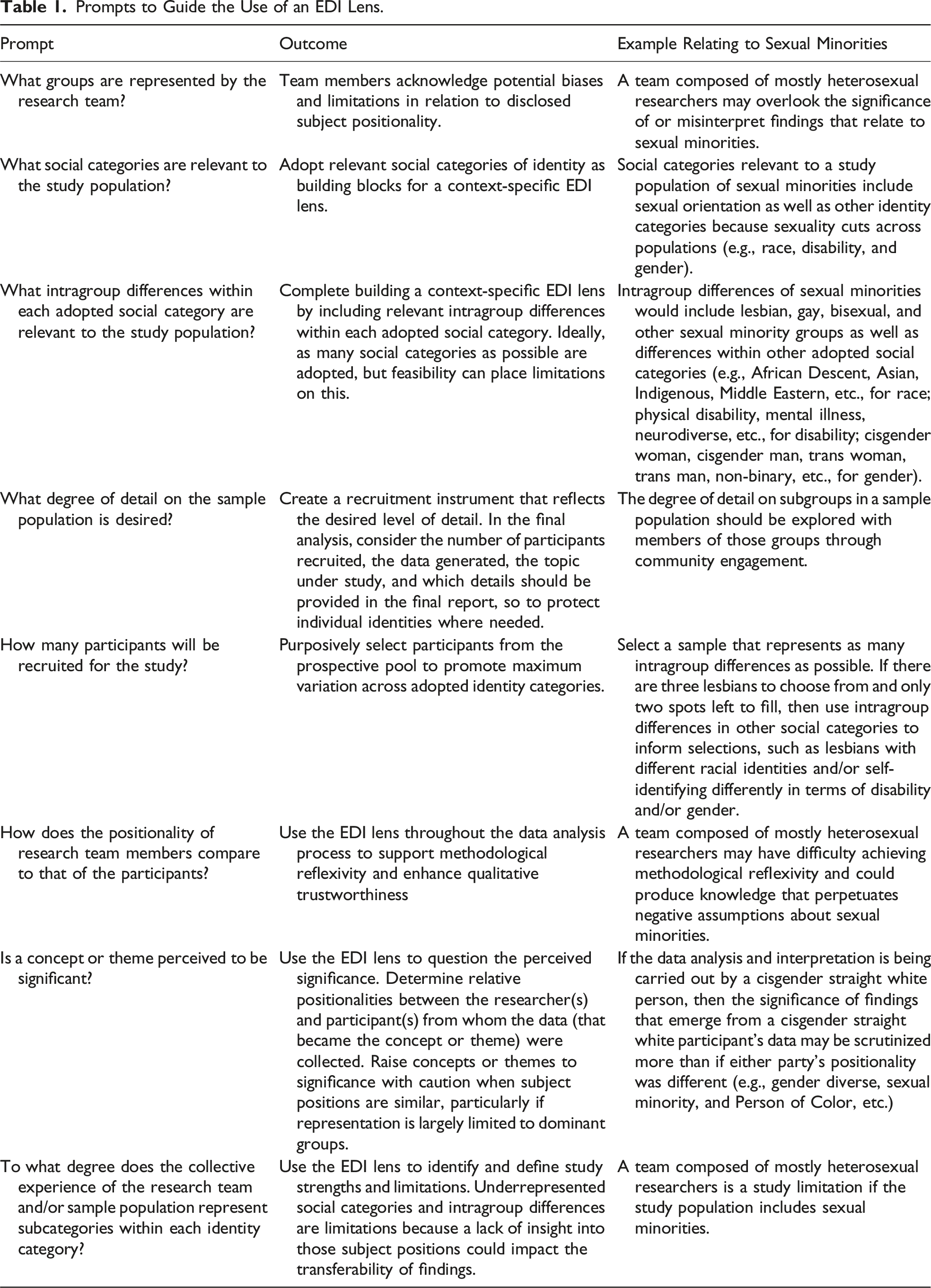
An EDI lens can also be used to define study limitations in terms of the extent to which subcategories within each identity category are represented by the team and/or sample population. Conversely, if the data represent diverse experiences and perspectives, then this could be identified as a study strength. As such, an EDI lens can be used to contextualize findings within larger social forces that may cause narrow understandings of the topic being studied. Moreover, transparency regarding transferability may also be enhanced by an EDI lens. Deficiencies in team representation might be seen as a flow of power in and of itself that may have implications, including a lack of capacity to recognize power-based risks that are disproportionately experienced by those who belong to equity-denied group (participants and team members). These perceived risks could influence individuals’ decisions to contribute, the choices they make around what they will disclose, and, ultimately, qualitative trustworthiness and uptake of findings. Institutions can thus demonstrate a commitment to EDI principles by supporting diverse participation in research. This could be done by developing and implementing equitable and inclusive policies that address and support social distinctions as well as challenge structural inequalities that negatively impact people who belong to equity-denied groups for the benefit of those belonging to historically prioritized groups.
Conclusion
The exact use of EDI lenses will depend on the specifics of the qualitative research being done. In all cases, they can serve as approaches for conducting more equitable and inclusive research, particularly with diverse study populations. When there is a lack of lived experience with subject positionalities among members of a research team and/or sample populations, an EDI lens may be particularly helpful in building an awareness around how power relations in the broader context could influence the research process. Nevertheless, it is wise to engage a diversity of perspectives when building and applying EDI lenses to consider the degree to which power imbalances may be inadvertently introduced by way of lived experiences and systemic inequalities. Teams that lack such diversity should ask themselves whether their claim to conducting equity-related research is legitimate, and if so, how they will ensure they do it equitably.
Footnotes

Funding
The author(s) disclosed receipt of the following financial support for the research, authorship, and/or publication of this article: This project is funded by a Canadian Institutes of Health Research Catalyst Grant (#529435), Research Nova Scotia New Health Investigator Grant (#2023-2857), and Dalhousie University, Faculty of Health (Establishment Funds, Research Development Grant, and SSHRC Explore).
Declaration of Conflicting Interests
The author(s) declared no potential conflicts of interest with respect to the research, authorship, and/or publication of this article.