




Abstract
This article explores the intellectual origins of the Anglo-Dutch Caribbean by focusing on the Leiden humanist Johannes de Laet (1581–1649). De Laet, born in the Southern Netherlands, had strong religious and kinship ties to the London merchant community. In the early 1620s, when he became one of the founding directors of the Dutch West India Company, his extensive intelligence network enabled him to develop into the leading chronicler of Dutch ambitions and achievements in the Atlantic world. De Laet's two main publications are contemporary masterpieces, but they are surprisingly underrepresented in current scholarship in Atlantic history, even though they are at the roots of the sugar and slave societies that the English established on Barbados and across the Caribbean from the 1640s onwards. English diplomats and intellectuals recognized the significance of De Laet's ideas. In September 1641, on the eve of the Civil War, Parliament invited the Leiden humanist to Westminster to instruct them in matters of trade and colonisation in the Western hemisphere.
Introduction
‘The years between 1604 and 1640’, in the words of Richard Dunn, constituted ‘the great age of Dutch commercial expansion, and the Hollanders turned the Caribbean almost into a Dutch lake’. 1 This verdict still amounts to what can be considered a scholarly consensus – it was precisely for this reason, after all, that Wim Klooster recently dubbed the period between 1620 and 1670 ‘the Dutch moment’ in Atlantic history. 2 In the remainder of his seminal book, however, Dunn's focus is firmly on the English activities of trade, plantation and enslavement, with the Dutch playing merely a supporting role. This article puts the early Dutch presence in the Atlantic world centre stage and argues that the ideological origins of the Dutch and English sugar and slave societies in the West Indies that Dunn examined were much more closely connected than has so far been assumed. In building this argument, I focus on the person I consider to be the most important voice in the effort to design a Protestant empire in the early seventeenth-century Caribbean – the Leiden humanist Johannes de Laet (1581–1649). 3
De Laet was among the most learned men of his age (Figure 1). His extensive intelligence network enabled him to become the leading chronicler of Dutch ambitions and achievements in the Atlantic world. His two main published works – Nieuwe Wereldt ofte Beschrijvinge van West Indien (1625) and Historie ofte Iaerlijck Verhael van de verrichtingen der geoctroyeerde West-Indische Compagnie (1644) – are contemporary masterpieces, but they are surprisingly under-represented in modern historical scholarship. Two extensive manuscripts in De Laet's hand, moreover, preserved in archives in the United States since the late nineteenth century, are practically never used in Atlantic history, or, indeed, in research on De Laet himself. The first, which must probably be dated to around 1620, is a compilation of all the available strategic information on the Atlantic world at the moment the Dutch, at the end of the Twelve Years’ Truce with Habsburg Spain, set their sights on the Americas. 4 The second, dated 1636, is an introduction to Dutch Brazil for its designated governor general, Johan Maurits of Nassau-Siegen, reflecting the elevated status of De Laet within the West India Company boardroom and Dutch society more broadly. 5
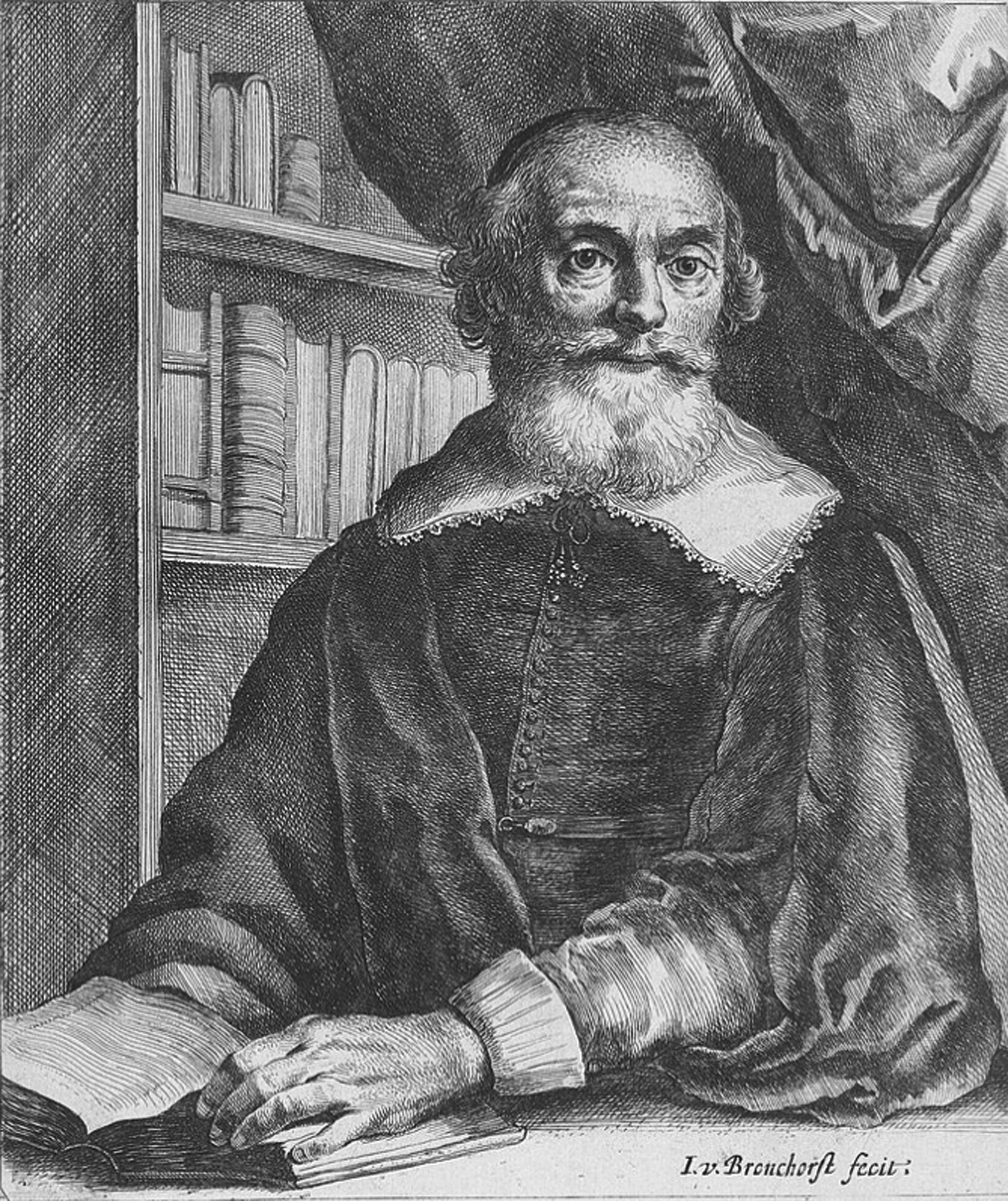
Jan van Bronckhorst, Portrait of Johannes de Laet, c. 1642.
This article offers preliminary observations on De Laet's importance for the emergence of a Protestant Atlantic world, which could be described as both ‘anti-Spanish’ and, perhaps more productively, ‘Anglo-Dutch’ in nature. Although scholarship on De Laet has placed him firmly in the proto-imperial historiography of the Dutch Atlantic, I argue that it is more accurate to regard De Laet as an ideologist of the combined Anglo-Dutch imperial emergence in the Caribbean. In what follows, I first focus on De Laet himself – on his position within the West India Company, and his network of English merchants, humanists and politicians. I investigate what lessons the Dutch, inspired by De Laet, learned from the English in the early 1620s, and what lessons the English in turn could have learned from Dutch expeditions in the 1620s and 1630s, to seek the ideological roots of the sugar and slave societies they established on Jamaica and Barbados, and across the Caribbean, from the 1640s onwards. Finally, the article critically examines Richard Dunn's implied claim that there was an early Anglo-Dutch divergence of ideas between maritime and territorial ambitions, and explores why the English – and not the Dutch – succeeded in realizing De Laet's intellectual designs by applying the knowledge they gathered from their erstwhile Protestant allies.
De Laet and Anglo-Dutch designs
In 1585, Johannes de Laet was only four years old, but the Fall of Antwerp would turn out to be a life-changing event all the same. De Laet's family, led by his father, the cloth trader Hans de Laet, migrated to Amsterdam, where Johannes quickly developed into the archetypical mercator sapiens. 6 At Leiden University, he became the favourite pupil of the celebrated classicist Joseph Scaliger. After his graduation, De Laet went to England. He married Jacomijntje van Loor at Austin Friars, the city's Dutch church, and obtained his letter of denization in August 1604, suggesting that his future would lie in the sizeable Anglo-Dutch merchant community in London, where his in-laws had ties to prominent figures such as Sir Edward Powell and Sir Charles Caesar. 7 Misfortune struck, however, as De Laet's wife died two years later. His personal connections to England would remain strong – he would still be involved in the appointment of ministers at London's Dutch church 25 years later – but he returned to the Dutch Republic, remarried and eventually settled in Leiden. In 1610, De Laet bought a house along the town's main canal, the Rapenburg, from the staunchly Calvinist professor of theology Franciscus Gomarus, with whom he had lodged as a student. In the Arminian controversy that would follow, De Laet sided with Gomarus, whose Counter-Remonstrant Party would gradually gain the upper hand. De Laet's intellectual qualities, as well as perhaps his personal connection to Gomarus, explain why he was elected by the local consistory to represent Leiden at the foundational Synod of Dordt in 1618–1619. 8
Until this point, there is little indication that De Laet showed an interest in the Americas. In October 1607, he had participated for one-eighth part in a trading expedition of two ships to the West Indies, but there are no further details and there is no reason to believe that he followed up on this investment. 9 Around 60 Puritans, who would depart for New England on the Mayflower in 1620, literally lived round the corner from his house in Leiden and, given the strict theological interpretation of the Christian faith they shared, it is very likely that De Laet personally knew John Robinson and his followers, who had arrived in Leiden at around the same time as he had – but no evidence for this has survived. Did their departure, and the promise of a Protestant haven across the ocean, somehow kindle De Laet's interest in the Americas? What is truly striking is how De Laet, the classic homo universalis with many different qualities and interests, appears to have dropped everything he was working on around 1621 – even the assignment he had earlier accepted to write for posterity the definitive account of the foundational Synod he had attended – to devote his energy single-mindedly to the Dutch West India Company, which was founded that same year. 10
In the preface to Nieuwe Wereldt, De Laet explained that, in order to succeed, a merchant company needed two things above all: capital and information. 11 De Laet provided both. Before the first fleet of the Company set sail, he travelled around the province of Holland, going door to door to attract subscribers in the joint-stock company. As the third-largest single donor, he invested the astronomical sum of 54,000 guilders himself, more than enough to obtain a seat as bewindhebber (‘director’) in the Company's powerful Amsterdam Chamber. His voice must have been one of the most important at both the local and federal levels because, in spite of his Leiden domicile, he was often chosen to represent the Chamber of Amsterdam in the Heeren XIX – the Company's federal board – where he served until his death, with only a short three-year interruption between 1639 and 1642. 12 The board of the West India Company was divided into two factions, usually referred to as the trade faction – insisting on a maritime strategy that focused on shipping and trade – and the settlement faction – which advocated for the colonization of parts of the Americas. De Laet, like many of the more ardently Calvinist shareholders, belonged to the latter group. Together with four other major investors, he participated in the patroonship scheme in New Netherland. Although his own manor along the Delaware never came to fruition, he did play a very active role in developing the patroonship of his Amsterdam colleague Kiliaen van Rensselaer along the Hudson River, until the two men fell out over the nature of land ownership and De Laet sold his (one-fifth) share in the colony. 13
Despite his deep pockets, the information on the ‘lands and people’ of the Atlantic world that De Laet provided was of arguably even greater value. His first printed volume on the Americas, Nieuwe Wereldt, was meant to quench the thirst for knowledge of the Dutch West India Company, but remained one of the most authoritative general works on the Atlantic world until the end of the seventeenth century. As late as 1699, when Scottish colonists briefly settled in Darien, Members of Parliament in Westminster requested the translation of relevant sections in Nieuwe Wereldt to grasp the geopolitical significance of the Isthmus of Panama. 14 De Laet's treatise had truly encyclopaedic qualities, combining historical events and intelligence on Spanish colonial positions with detailed nautical information about inlets, bays and anchoring grounds along the entire coastline of the Americas. Although his book contained a concise list of sources, De Laet was not particularly forthcoming in explaining how exactly he had obtained his information. Fortunately, a manuscript in the New York Public Library, which served as the blueprint for his book, tells us more about the knowledge system underlying his work in the early 1620s. More than any other seventeenth-century document I know, this manuscript demonstrates that the Dutch and English perspectives on the West Indies were inextricably intertwined, and cannot be properly understood in imperial isolation. 15
The main source and prototype that De Laet used for his Nieuwe Wereldt, the manuscript reveals, was Antonio de Herrera y Tordesillas’s multivolume Historia general de las Indias (or Décadas, 1601–1615). The majority of the geographical chapters in the manuscript begin with extensive translations of the relevant parts of Herrera's work, with occasional references to the work of other Spanish cosmographers, such as José de Acosta and Gonzalo Fernández de Oviedo. Herrera's comprehensive catalogue of local, commercial and geographical knowledge reflected the daunting size of the challenge the West India Company faced. But the manuscript provides sparks of hope, too. Many of the chapters contain references in the margins – scribbled notes in the same hand but possibly added later by the author – to the attempts of English ships to undermine the Spanish monopoly in the Americas. De Laet appears to have been extremely well informed about English activities in the Atlantic world. His main source of information was the three-volume second edition of Richard Hakluyt's Principal Navigations (1598–1600). De Laet's employment of the information in this collection reveals his conviction that if any rival were to be successful in breaking the Spanish stranglehold on the West Indies, they would have to follow in the footsteps of Elizabethan privateers and adventurers.
That it was Dutch rather than English ships which would take on the Habsburg monarchy in the West Indies was at least partly due to the momentum created by entrepreneurs like De Laet. In his 1620 manuscript, he interrupts Herrera's narrative time and again with reminders of naval and geopolitical opportunity. Two examples can be presented here as representative of the author's method, and of his subsequent influence on the West India Company’s strategy. After a lengthy description of the audiencia of Santo Domingo on Hispaniola, De Laet added in the margins that ‘Robert Thomson writes that in the year 1555 there were not more then 500 Spanish families here’ – a clear check on Herrera's account of the situation. The English had briefly taken possession of the town of Ocoa in 1591 under Christopher Newport, De Laet continued – ‘a mile inland from the shore, it has forty or fifty houses with a sugar mill’. The Dutch would never apply the same focus on the Greater Antilles, but there are interesting Anglo-Dutch parallels all the same. De Laet described the famous expedition of Francis Drake, which had captured Santo Domingo in 1586 particularly meticulously. Its strategy to avoid an all-out naval attack on the well-fortified town, and to put a force of more than 1,000 soldiers ashore 10 miles further west, could well have served as a source of inspiration for the Dutch invasion of Olinda in north-east Brazil (1630), when, faced with the same problem, the West India Company captured the town in essentially the same manner. 16
One of the key targets in the Spanish Indies was the town of Cartagena. De Laet mentioned Drake's sack of the town in 1586, but also noted that it was difficult for large vessels to enter the bay. For the West India Company, with its maritime focus, this served as a warning. Strategically placed islands such as Manhattan or Curaçao were the preferred options for settlement and, with this in mind, De Laet singled out the tiny island of Santa Marta 40 leagues east of Cartagena. He quoted from a report by the Italian engineer Bautista Antonelli, who explained that the fortifications at Santa Marta were important because the convoys carrying silver for the Spanish Crown from Peru would gather there before setting sail for Havana to meet up with the New Spain fleet. Despite the Spanish efforts to fortify the island, however, it remained strategically vulnerable because its port was surrounded by accessible hills. Here, again, English expeditions pointed the way for the Dutch. In 1595, De Laet recounted in the margins of Antonelli's text: ‘Santa Marta was captured by Sr. Francis Drake and burned down’. Based on Drake's final voyage, De Laet explained how ships attacking the island were supposed to navigate the small bay in which the island was located. ‘In 1596’, De Laet added, ‘it was captured again by Sr. Anthony Shirley, whose troops had anchored two miles west of the town and then marched downhill’. 17 Three decades later in 1630, as the Dutch West India Company tried to position itself for attacks on the annual Spanish treasure fleets, it too raided Santa Marta in a similar fashion, albeit without obtaining the ultimate prize of capturing silver.
Brazil, sugar and slaves
The States-General, the highest political body in the Dutch Republic, thoroughly appreciated De Laet's information. It described Nieuwe Wereldt in July 1623 as ‘very good and written with great care’, but initially considered that De Laet's reference to some of the French and English land claims could cause legal obstacles for Dutch ambitions. During the meeting, however, it came to the conclusion that De Laet mentioned only that these nations made these claims, not that they were legitimate. 18 On its publication in January 1625, the States-General purchased 20 copies of the book, and rewarded the author with a medal and a sum of 100 guilders for his efforts. 19 De Laet’s book would be translated into Latin (1633) and French (1640), but only after the West India Company had launched its first waves of attacks in the Atlantic world. In England, too, Nieuwe Wereldt appears to have enjoyed a favourable reception: in the summer of 1633, Edward Powell – the son of De Laet's former brother-in-law – presented a copy to Charles I. 20 Around the same time, De Laet reignited his connections with England as he began to develop an interest in the etymology of the Anglo-Saxon language. In the early years of his life, De Laet had corresponded about linguistic issues with Scaliger and, in England, with William Camden; in the 1630s, he began to write letters to John Morris, a learned descendant of a Protestant Netherlandish family in London who shared De Laet's interest in languages, and to Sir William Boswell, the Stuarts’ ambassador in The Hague.
Judging by this correspondence, De Laet appears to have been preoccupied mainly with his studies. Archival evidence, however, reveals otherwise, as De Laet corresponded extensively with Kiliaen van Rensselaer about the future of their patroonship along the Hudson River. 21 The minutes of the board of the Amsterdam Chamber of the West India Company from the 1630s reveal the prominence of De Laet within the local chamber, as well as on the federal board. 22 And, in 1636, De Laet revisited his role as information broker when he composed a guide to Dutch Brazil for the newly appointed governor general, Johan Maurits of Nassau-Siegen. The Company's decision to attack the Habsburg Empire in Brazil appears to have turned the spotlight away from the Anglo-Dutch ‘lake’ in the Caribbean, but the sugar and slave society that the Dutch built in Pernambuco would become the model for English plantation societies from Barbados to Jamaica.
The import of enslaved labour to Brazil's sugar plantations had long been an uncomfortable issue for the Heeren XIX. In the 1620s, choosing the moral high ground, the directors had declared that the forced migration and exploitation of Africans was inhumane – something that only Catholics did. The Company, however, did attempt to capture the Portuguese castle at Elmina (Ghana) in 1624, and it was only the failure of this campaign that delayed Dutch participation in the transatlantic slave trade. By 1637, the Company had gained control over north-east Brazil and opted to attack Elmina again, this time successfully. The definitive decision to put moral issues aside had been taken two years earlier during a federal board meeting where De Laet represented the Chamber of Amsterdam. Perhaps for this reason, De Laet did not address the issue at length in his manuscript for Johan Maurits, just like he had not done in his draft for Nieuwe Wereldt in the early 1620s. He speculated that runaway Africans ‘from Guinea and Angola’ would be persuaded by native Brazilians to assist the Dutch against the Portuguese. But he was by no means naïve – in the Antwerp diaspora, an intimate knowledge of Atlantic slavery had circulated for generations. Elsewhere in the same text, De Laet argued in a more matter-of-fact way that the capture of Angola, too, would be very beneficial for the West India Company: ‘Angola would provide us with a considerable number of slaves, yes, in due course every single one they could spare, because the Portuguese buy 6 or 7.000 annually, who are then brought [to Brazil] and sold there’. 23 In August 1641, Maurits did invade Luanda, giving the West India Company a de facto monopoly over enslaved labour in the South Atlantic.
By the early 1640s, Dutch military and commercial success in Brazil, supported by forts or small settlements on Curaçao, Bonaire, Tobago, St Martin and St Christopher as well as at various points along the West African coast, stood in sharp contrast to the lack of progress the English had made in the Atlantic world – their most recognizable presence south of Virginia being the troubled settlement at Providence Island. A glance at De Laet's personal library reflects this discrepancy. 24 As someone with a strong interest in English books – he possessed around 150 titles large and small in English at a time when very few humanists on the continent even read the language – it is striking to note how few English texts on the Atlantic world he owned. The only printed books in English he appears to have purchased after completing his first manuscript on the Americas were a 1632 edition of John Smith's Generall Historie of Virginia and Luke Foxe's 1635 account of his search for a Northwest Passage. The titles in Dutch in De Laet's library, although fewer in total, include a more substantial number devoted to global shipping and trade. The Dutch information deficit of the early 1620s had clearly been overcome. De Laet himself, moreover, spent most of the early 1640s composing his Iaerlijck Verhael, which discussed in great detail the achievements of the West India Company during the first 15 years of its existence. 25 This time, English sources played no role in De Laet's information-gathering. As a director of the Company, he used his access to unpublished journals and letters to put together his magnum opus in 1644.
In the years leading up to the publication of Iaerlijck Verhael, De Laet temporarily resigned as a director of the West India Company. In a letter to Boswell, he explained that his decision to step down as a director of the West India Company ‘was a most convenient thing for me, for I will be more free to be with my family and to conduct my studies; and I will not so often be an exile from my home’. 26 There were probably other factors that informed his decision to step down. Perhaps the disagreement with Kiliaen van Rensselaer that surfaced in 1639–1640 played a role. 27 The turmoil around the Company’s monopoly in the face of pressure from Amsterdam merchants advocating ‘free trade’ in 1638 could have informed De Laet's decision as well – several years later, he would be one of the few directors arguing for a liberalization of the slave trade. 28 Another founding director in the Amsterdam Chamber, Samuel Blommaert, continued in his administrative role, but this did not prevent him from privately exploring the Delaware estuary for the Swedish Crown in precisely these years, leading to the colony of New Sweden. 29 There is no reason to presume that De Laet had a split agenda too, but it is evident that discord reigned in the West India Company’s boardroom.
De Laet and the Anglo-Dutch West Indies
De Laet appears to have re-established closer ties with friends and relatives across the North Sea around the time of his temporary withdrawal from the boardroom of the West India Company. In January 1638, he visited England and, in the same year, his son Samuel followed him (he would later marry into the London merchant community like his father had done 40 years earlier). Although De Laet corresponded with his friends John Morris and William Boswell primarily to develop his interest in compiling an Anglo-Saxon dictionary, the letters reveal that the Atlantic world continued to attract his attention. A complete exploration of De Laet's intellectual relationships is hampered by the rudimentary survival of his correspondence: only letters from Morris to De Laet have survived, with just one exception; in the case of Boswell, only letters sent by De Laet, and not those he received, can be consulted. De Laet wrote regularly to Boswell in The Hague about ongoing developments in the war in Brazil between the Dutch and the Habsburgs – the main geopolitical conflict in the Atlantic world in the second quarter of the seventeenth century. 30
In August 1640, De Laet told Boswell that he had heard rumours about plans in England to establish a West India Company in the mould of the Dutch West India Company. This was by no means a new initiative. English strategists with links to the London merchant community had argued for the transition from Caribbean privateering to a joint-stock company from the moment when Anglo-Spanish relations had started to deteriorate under James I. As early as 1618, rumours of a joint Anglo-Dutch company were circulating, and the Venetian ambassador to the Dutch Republic wrote in December 1620 that, in Amsterdam, ‘some think that [the English] are [here] to investigate opinions upon the affairs of the West Indies, and if they make a company they would like to do so in conjunction with the English’. 31 In February 1621, Robert Rich, Earl of Warwick, the most ardent proponent for aggressive Atlantic privateering and a leading figure in the Virginia Company, pushed in the House of Commons for a ‘forbearance of Trade to the West Indies, which in the Queenes tyme was very frequent’, but these plans faded after the Dutch decided to go their own way and the Dutch West India Company was founded in June. 32
Although some of the discussions in Westminster coincided with De Laet's intelligence-gathering from English sources for his Nieuwe Wereldt, there is no evidence that he took part in any Anglo-Dutch dialogues. What is clear is that, after 1621, any English company's purpose and function was to be modelled on the Dutch example. In sharp contrast to Dutch maritime developments in the later 1620s, however, English privateering in the West Indies would remain ‘haphazard, spasmodic and highly individualistic’ for some time. 33 Warwick and his supporters opted to focus their attention on Providence Island, a Puritan settlement at the heart of the Spanish Indies that served as a base for privateering expeditions from the early 1630s onwards. The Dutch West India Company was still being held up as a model – understandably so, because by then the Dutch effectively monopolized the transatlantic trade in sugar and slaves. 34
Unlike in the 1620s, however, we have evidence that English designs kept De Laet occupied, and may have even prompted his self-imposed sabbatical from the Amsterdam boardroom. 35 In 1637, six pre-eminent London courtiers, led by Sir Thomas Roe and all investors in English Atlantic ventures, petitioned Charles I to establish a company ‘to sease some fitt Port, and rendevous in the Indyes’, and use ‘the oportunitye of the seasons, by invade by Land, and to make Prise at Sea’. One investor suggested quite explicitly that in order to be successful in bringing harm to Spain, the company needed to ‘fall in with the Hollanders’. 36 In this context, it is perhaps no coincidence that De Laet travelled to London in the winter of 1637–1638. 37 In the years that followed, occasional initiatives in the Atlantic world, instigated by the English from Providence Island, pointed to greater anti-Spanish cooperation between the English and the Dutch. In the spring of 1639, a combined Anglo-Dutch fleet under Nathaniel Butler raided Trujillo in Honduras, and rumours circulated in Madrid that Anglo-Dutch rapprochement might even culminate in an attack on Havana. 38
Spanish forces from Cartagena finally removed the English planters from Providence Island in May 1641, but, as Karen Kupperman has shown, even this forced surrender did not lead the investors to abandon their commitment to ventures in the Caribbean. If anything, the loss of their only modest settlement in the West Indies, combined with Spanish harassment of English shipping at Calais, encouraged the Warwick circle to apply themselves with renewed vigour to the idea of an English West India Company in September that same year.
39
This time, unlike in 1637–1638, we have solid evidence that De Laet was invited to Westminster by Roe, Sir Simonds d’Ewes and Warwick himself to provide Parliament with advice on an English West India Company built on the Dutch model.
40
Prince Charles I Louis, the exiled Elector Palatine and Charles I's nephew, was also present at top-level deliberations. De Laet reported to Boswell in June 1641 from London that: we have had considerable discussion about the American Company, which will be established, under parliamentary authority, in this kingdom, in the name of that illustrious Prince [Charles I Louis] … The aim of our deliberations was that the Prince might impose upon me certain points required to begin the project for the good organization of the company. I have accepted the condition and have completed what I was bidden to do. Next Monday we shall meet together again.
41
Soon, the Civil War would be an insurmountable obstacle to any English plans. De Laet appears to have tried to salvage what was left of the new designs: on his return to Leiden in October 1641, he wrote a letter to Charles I urging moderation and recommending that he resist the bad influence of some of his advisors. Several months later, he would write a similar letter of warning to Parliament, but his efforts were in vain. 45 It is striking to note that even in subsequent years, amidst the smoking ruins of internal conflict, De Laet retained a strong interest in English ambitions, and tried to save what was left of his deliberations about an English West India Company in the summer of 1641. This can be read between the lines of the letters from John Morris to De Laet. Both men never corresponded about the Americas beyond a basic exchange of news, so when they suddenly did so, in August 1646, there must have been a compelling reason. In this case, it was a book. De Laet appears to have asked Morris for a printed account of the privateering expedition of Captain William Jackson to the Caribbean – a publication Morris could not find for him in London, despite his connections at the Stationers’ Company. 46
Why would De Laet have asked Morris for a copy of this book? At the time of writing, he was editing a natural history of the Americas, compiled in Brazil by Georg Marcgraf and Willem Piso, and it is unlikely that a privateering voyage would have provided him with information on the flora and fauna of the Caribbean that he could not have obtained elsewhere. 47 It is far more realistic to assume, I think, that Jackson's quest for treasure, departing from England in July 1642, was a direct result of the conversations De Laet had had with members of the Warwick circle during his visit to London the year before. The expedition, ‘in the spirit of Drake’, as Kris Lane has called it, had all the attributes of the early Dutch ventures into the Caribbean that, as we have seen, were in turn informed by the English raids of the late Elizabethan era. 48 But apart from an allusion to a shared Anglo-Dutch past, the campaign may also have been considered the possible start of a new, collaborative future in the Caribbean. By the time Jackson returned to Europe, De Laet realized that the Dutch West India Company alone could not bring about the collapse of Spanish America. De Laet's Iaerlijck Verhael, reflecting on the first 15 years of the Company's existence, was in fact a long, deft argument that, despite the declining share price, ‘a weak company’ had succeeded in its initial goal of dealing a blow to Spanish interests in the Atlantic world. But the treatise was also, as De Laet put it in the preface, a plea for a ‘bigger company’ to truly hurt the interests of the Spanish monarchy. 49
The Dutch West India Company's charter expired in 1647, and the political question on the table was one of continuation or change. Historians of the Dutch Atlantic world have traditionally regarded De Laet's candid remark from three years earlier as the opening gambit of negotiations on a merger between the Dutch East India Company and the Dutch West India Company – negotiations that did indeed take place and were concluded with the same geographical and institutional division that they started with. 50 The life of the West India Company was hence prolonged, but it was also fundamentally undermined by a lack of support in Amsterdam and a looming peace treaty with Spain. 51 The Dutch, then, would never be able to match their Atlantic feats of the 1620s and 1630s, and, on his deathbed in 1650, De Laet must have realized that his Anglo-Dutch ambitions would remain a pipe dream. But given his mercantile diplomacy in Anglo-Dutch circles, his plea in the preface of Iaerlijck Verhael six years earlier can also be read as a final attempt at an Anglo-Dutch Protestant company that could really make inroads into Spanish America.
Ultimately, following the English Civil War, Anglo-Dutch interests rapidly diverged. In Europe, the 1651 Act of Navigation led straight to the first of three Anglo-Dutch wars in quick succession. In the West Indies, as Kupperman has argued, the memories of the Jackson expedition, which culminated in the brief capture of Jamaica, were conserved and employed to convince Oliver Cromwell that the Spanish Empire was corrupt and vulnerable: ‘The veil is now drawn aside, & their weakness detected by a handful of men’. 52 It put the Commonwealth on a path towards the Western Design, which finally saw the realization of unilateral dreams of the English West Indies. The 1655 expedition to Hispaniola and Jamaica, regardless of its many flaws, succeeded in helping the English surpass the Dutch as the main rivals to Spain in the Caribbean. Subsequent developments, as well as teleology and imperial historiography, have resulted too readily in the assumption that the sugar and slave societies of the late seventeenth- and eighteenth-century West Indies were quintessentially English, and that the Dutch West India Company, with its maritime campaigns in the Caribbean and its sugar plantations in Brazil, had merely pointed the way. Johannes de Laet, an Anglo-Dutch humanist and early ideologue of Protestant settlement in the Atlantic world, gives us good reason to put some of these imperial assumptions into question once again.
Footnotes
Acknowledgements
This article is an edited version of a paper I presented at a virtual conference in June 2021 to celebrate the fiftieth anniversary of Richard Dunn's 1972 seminal work, Sugar and Slaves: The Rise of the Planter Class in the English West Indies, 1624–1713. I would like to express my thanks to Alison Games and Trevor Burnard for inviting me to participate, and to those present for their suggestions and comments.
Declaration of conflicting interests
The author declared no potential conflicts of interest with respect to the research, authorship and/or publication of this article.
Funding
The author received no financial support for the research, authorship and/or publication of this article.

Notes
Author biography
Michiel van Groesen is Professor of Maritime History at Leiden University, the Netherlands. He is the author of two books: The Representations of the Overseas World in the De Bry Collection of Voyages, 1590-1634 (Brill, 2008) and Amsterdam's Atlantic: Print Culture and the Making of Dutch Brazil (Penn Press, 2017). He is currently completing a monograph on the circulation of news and information in the early modern Atlantic world.