




Abstract
Youth from socially marginalized populations are at increased risk of experiencing adolescent dating violence (ADV), since they are often directly impacted by root causes of violence (e.g., homophobia, racism). Because structural inequalities impact youth’s experience of ADV, ADV is a social justice issue. In this paper, we describe a symposium series that taught education and social work students about their role in preventing ADV through a social justice lens. We present a pilot evaluation of the symposium series using survey (n = 34) and interview (n = 7) data. Results of this study (quantitative and qualitative) suggest students showed an increase in willingness and confidence to prevent and respond to ADV through a social justice lens after completing the symposium series. This work highlights the importance of incorporating critical theory into ADV prevention efforts, especially as it relates to serving youth who are marginalized and for promoting social justice in schools.
Introduction
All youth have basic rights to not only survival, but also development to the fullest (Britto & Ulkuer, 2012; Government of Canada, 2024; UNICEF, 1990). As a society, it is our responsibility to ensure youth have these rights protected. Youth from marginalized populations experience disparities in a variety of spheres, including education systems. One way to address inequities is to work for social justice, defined by Bell (2013) as “. . .full and equal participation of all groups in a society that is mutually shaped to meet their needs. Social justice includes a vision of society in which the distribution of resources is equitable, and all members are physically and psychologically safe and secure” (p. 21). Children’s rights and social justice are thus inherently connected (Shriberg & Desai, 2014). In this paper, we address an important children’s rights and social justice issue for adolescents—dating violence—and describe a symposium designed to prepare future teachers and social workers to respond to dating violence in equitable and rights-centered ways.
Adolescent Dating Violence Through a Social Justice Lens
Adolescent dating violence (ADV) refers to physical, sexual, and/or psychological violence, and stalking, experienced in dating and/or sexual relationships during adolescence (Centers for Disease Control and Prevention, 2014). ADV is prevalent (Exner-Cortens et al., 2021; Wincentak et al., 2017) and problematic, as it is associated with negative health outcomes, including experiencing violence again later in life (e.g., Exner-Cortens et al., 2013, 2017).
Although youth have a right to optimal development, systems of oppression in the United States and Canada have consistently created harmful developmental conditions. This means that certain groups of youth have historically been (and continue to be) more likely to face adverse experiences that compromise their rights and safety. Specifically, youth from marginalized populations are impacted by systems of oppression (e.g., homophobia, transphobia, racism, sexism, ableism, and their intersections) that serve as root causes of ADV, increasing risk of experiencing negative outcomes. For example, girls and gender diverse youth in the U.S. and Canada are more likely to experience ADV victimization (Debnam & Temple, 2021; Exner-Cortens et al., 2021; Wincentak et al., 2017), because they live in a patriarchal, heteronormative society. Moreover, racial and gender discrimination intersect to predict risk of experiencing ADV (Roberts et al., 2018). There are also disparities related to help-seeking behaviors for ADV; for example, sexual and gender minority youth have difficulty help-seeking due to limited understanding of 2SLGBTQIA+ (referring to Two-Spirit, lesbian, gay, bisexual, transgender, queer and/or questioning, intersex, asexual, and other diverse sexual and gender identities) experiences of violence, stigma, and systemic inequities among service providers (Calton et al., 2016; Scheer et al., 2020). In addition, many ADV prevention programs are facilitated by school teachers, but school systems in the U.S. and Canada often have primarily White educators, meaning racially minoritized students lack the opportunity to be taught by teachers who understand their lived experiences (La Salle et al., 2020). In sum, ADV is a social justice issue as systemic inequalities impact both the likelihood of experiencing it and prevention and intervention opportunities for socially marginalized individuals (Coker, 2016).
Adolescent Dating Violence Prevention
A common way to approach primary (i.e., stopping the violence before it starts) and secondary (i.e., prevention work with individuals at higher risk) ADV prevention is to help build individual youths’ skills and capacities for healthy, violence-free interpersonal relationships through school-based curriculum (Crooks et al., 2019; Pepler, 2012). Schools are ideal locations to implement ADV prevention programs (Temple et al., 2013), as schools reach large numbers of youth. Many ADV primary prevention programs are designed for school contexts (e.g., The Fourth R, Wolfe et al., 2009; Safe Dates, Foshee et al., 2005), and the limited secondary prevention research has in part drawn on the school setting (Arrojo et al., 2024; Exner-Cortens et al., 2020). Within school settings, teachers and social workers are in an ideal position to assist with ADV prevention efforts, as they naturally form relationships with students in their own unique, role-appropriate ways (i.e., teachers through education, social workers through support services, and psychoeducation). Although ADV has not always been treated as a social justice issue in schools, it is critical that ADV prevention is approached through a social justice lens, so inequities that put marginalized youth at disproportionate risk for experiencing ADV are addressed.
Relevance to the Practice of School Psychology
Drawing on principles of critical theory and pedagogy (Darder et al., 2017; Sensoy & DiAngelo, 2017), we argue that the practice of promoting social justice has a place within schools—including as part of ADV prevention—such that teachers and social workers can engage in critical discussions on topics like power, privilege, and oppression (Diemer et al., 2016; Philpott & Dagenais, 2012), and connect these discussions to ADV. Guided by principles of equity literacy (Gorski, 2016b), connecting structural inequalities and ADV allows teachers and social workers to recognize and respond to inequities, and sustain bias-free and equitable schools that provide safe and violence-free environments. Although this intentional work is imperative, it is also rare. Therefore, it is critical to equip teachers and social workers who work in school settings with the skills and knowledge needed to recognize, respond to, and support youth who may be experiencing ADV. This approach needs to be grounded in an understanding of structural inequalities and ADV, so that teachers and social workers can use ADV prevention as a social justice tool (Darder et al., 2017; Gorski, 2016b; Sensoy & DiAngelo, 2017). An optimal time to equip teachers and social workers with these skills is before they enter the school setting. This is because finding time for professional development and training once “in service” is challenging due to resource and time constraints (Exner-Cortens et al., 2020). If all teachers and social workers are trained in social justice ADV prevention early on in their training, we may increase the likelihood of better outcomes in ADV prevention reach and impact. Importantly, this can address students’ risks using a structural (as opposed to a deficit) lens (Gorski, 2016a).
One theoretical framework that can help us understand what impacts teachers’ and social workers’ willingness to engage in ADV prevention work, as well as confidence to prevent and respond to ADV from a social justice lens, is Bandura’s Social Cognitive Theory (SCT; Bandura, 2013). The overarching goal of SCT is to explain how people regulate their behavior in a social context; thus, we assess “moral disengagement,” a cognitive process by which individuals justify their reasons for doing (or not doing) something (Bandura, 2002). In this study, moral disengagement is conceptualized as ways adults might justify not wanting to be part of prevention efforts (i.e., a lack of willingness). Moreover, SCT explains behavior in terms of people’s past experiences, the social context in which they perform the behavior, and what behaviors get reinforced. The most commonly utilized construct of SCT to assess potential behavior change is self-efficacy (Islam et al., 2023), defined as someone’s confidence in their ability to perform a behavior. In this study, we assess self-efficacy to prevent and respond to ADV.
Current Study
In this paper, we describe the development of a symposium series designed to teach undergraduate students in education and social work (i.e., “pre-service” teachers and social workers) about ADV prevention, as it relates to supporting marginalized youth through a social justice lens. Second, we present a pilot evaluation to assess if the symposium series increased undergraduate students’ willingness and confidence to prevent and respond to ADV from a social justice lens. As this is a pilot study, we focus on assessing the utility (i.e., if the symposium was useful for increasing willingness and confidence) and acceptability of the intervention (i.e., if students liked the ways in which the symposium content was delivered) (Kistin & Silverstein, 2015).
To assess utility, we conducted pre- and post-test surveys to assess change in moral disengagement for violence prevention (a measure of willingness) and in self-efficacy for (a) teaching healthy relationships skills and (b) responding to youth disclosures of ADV (measures of confidence). We hypothesized that symposium series participants would report a decrease in moral disengagement (H1), an increase in self-efficacy to teach healthy relationships skills (H2), and an increase in self-efficacy to respond to youth disclosures of ADV (H3) from before (pre-test) to after (post-test) the symposium series. Second, to assess acceptability and utility, we interviewed a sub-group of participants after they completed the symposium series. Students were asked questions regarding their knowledge of healthy youth relationships, preventing ADV, social justice in school contexts, and any insights they gained from attending the symposium series.
Method
Participants and Procedures
Participants in this project were eligible for the study if they were (a) enrolled in either the Bachelor of Education or Bachelor of Social Work program at a large university in a Western Canadian province, and (b) were enrolled in the symposium series (entitled Advancing Healthy Relationships and Social Justice; see below for detailed information).
To recruit participants for the evaluation project (i.e., surveys and interviews), we used convenience sampling. Specifically, at the start of the first day of the symposium series (late January 2019), research assistants came to the room to give all attendees the opportunity to participate in the symposium series evaluation. Research participation was voluntary and was not required to attend the symposium series. In addition, so as to not influence participation, individuals who facilitated the symposium left the room during recruitment.
Research consent forms explained the project to students, and asked if they wanted to participate in surveys, interviews, both, or neither. If students agreed to participate in the surveys, they then completed their pre-test survey on the first day of the symposium series while facilitators were outside the classroom. As both potential participants and non-participants were present, during survey administration time (approximately 20 min), students had the option to: (a) complete the survey as research data if they had consented to this part of the project; (b) complete the survey for internal evaluation purposes if they had not consented to research; or (c) do an alternate activity. Students who consented to research participation received a link to an online post-test survey (15 min) via email after the symposium series finished (early February 2019). A secure, web-based platform was used to collect and manage data (REDCap; Harris et al., 2019). Twenty students who completed both the pre- and post-test surveys were entered in a draw to win a FitBit. Full demographics for the survey sample are presented in Table 1 (N = 34).
Full Sample Demographics (N = 34).
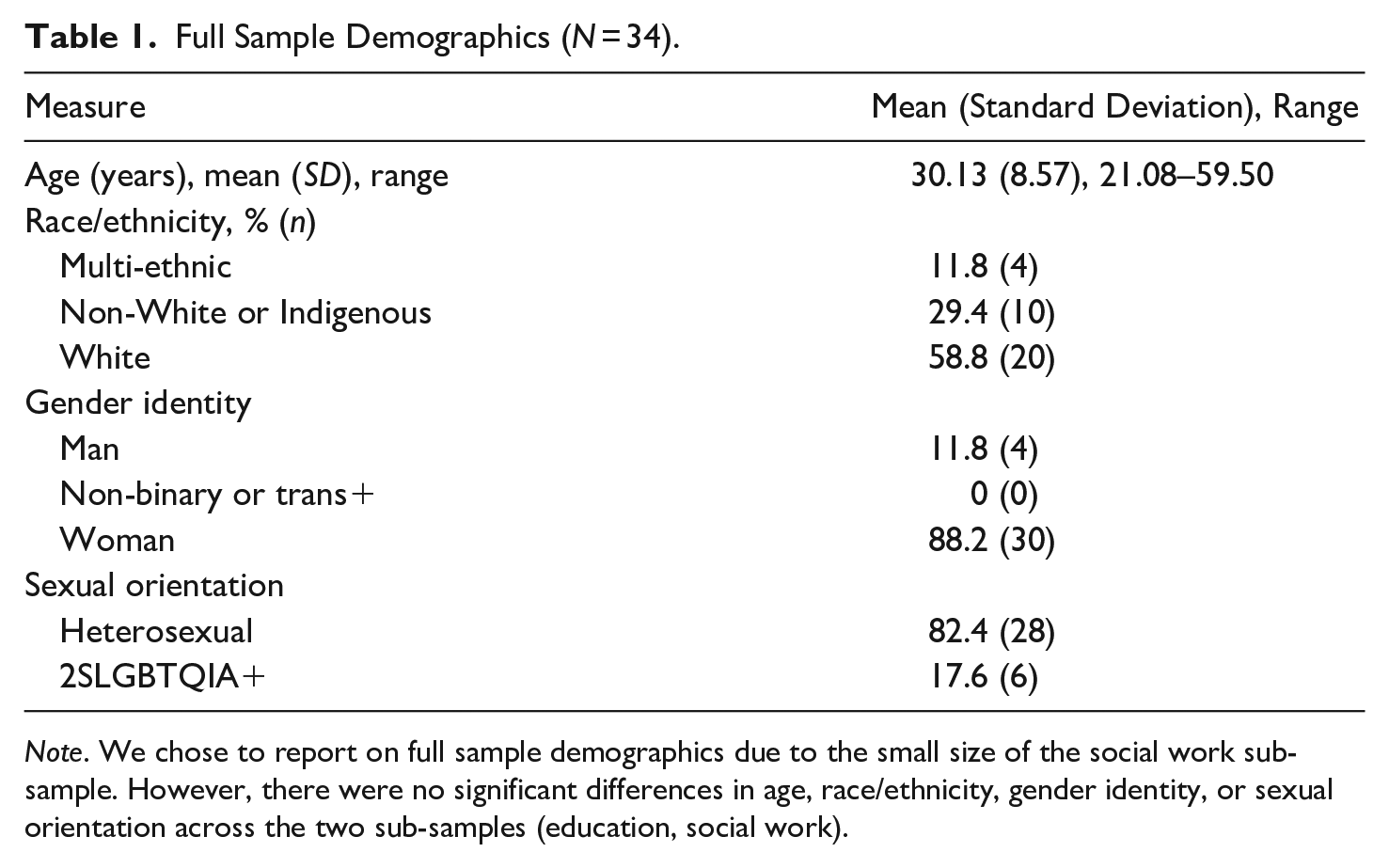
Note. We chose to report on full sample demographics due to the small size of the social work sub-sample. However, there were no significant differences in age, race/ethnicity, gender identity, or sexual orientation across the two sub-samples (education, social work).
On the consent form, seven individuals 1 agreed to also complete an interview to discuss their experiences in the symposium series following the conclusion of the series in February 2019 (85.7% of these participants were White). Interviews were conducted by a graduate research assistant and lasted between 15 and 30 min. All interviews were held in-person in a private space on the University campus, audio-recorded, and transcribed verbatim. The research project was reviewed and approved by a university research ethics board.
Measures
Surveys
Moral Disengagement
As a measure of willingness to engage in ADV prevention, we assessed moral disengagement, which is a cognitive process by which individuals justify their reasons for doing (or not doing) something (Bandura, 2002). In the context of ADV prevention, moral disengagement would be conceptualized as ways adults might justify not wanting to be part of prevention efforts (i.e., a lack of willingness). To assess this, we used the 10-item Moral Disengagement for Adolescent Dating Violence Prevention (MD-AVP) scale, which has demonstrated evidence of reliability and construct (convergent and divergent) validity (Baker et al., 2022). The scale also demonstrated adequate reliability in this sample at pre-test (α = .75) and post-test (α = .86). The items on the MD-AVP are specific to teachers, and thus these items were only asked of respondents in the education sample, and not of respondents in the social work sample. Items were answered on a Likert scale, from 1 = strongly disagree to 5 = strongly agree. For this study, items were averaged to create a total score, such that higher scores represent greater moral disengagement.
Adolescent Dating Violence Prevention-Related Self-Efficacy
To assess confidence related to ADV prevention, a measure was developed by the investigative team. In this study, we used two subscales of this larger measure: (a) self-efficacy to teach healthy relationships skills (e.g., “I am confident I can teach youth conflict resolution skills”; five items, α = .86 at pre-test, α = .77 at post-test) and (b) self-efficacy to respond to youth disclosures of dating violence (e.g., “I am confident I know how to handle youth disclosures of physical dating violence”; five items, α = .96 at pre-test, α = .95 at post-test). On these two subscales, items were answered from 1 = strongly disagree to 5 = strongly agree. Items were averaged for each scale, such that higher scores represent greater self-efficacy. ADV prevention-related self-efficacy items were asked of all individuals in the sample (education and social work students).
Demographics
We collected data on participant age; race/ethnicity (using Statistics Canada categories); gender identity (man, woman, non-binary, and/or transgender/genderqueer/genderfluid); and sexual orientation (straight/heterosexual, gay/lesbian, bisexual, queer/pansexual/polysexual, Two-Spirited, questioning, prefer not to disclose). Education participants were also asked at what level they planned to teach (preschool, elementary, middle school, and/or high school) once they completed their degree.
Interviews
The interview guide consisted of nine questions which aimed to assess participants’ knowledge gained (if any) after attending the symposium series, and how they might apply this knowledge in their future practice (see full interview guide in Supplemental Material).
Analysis
Surveys
Data for the pre-post analyses (N = 34) were drawn from the sample of undergraduate students in education (n = 27) and social work (n = 7) who participated in the symposium series in winter 2019, and provided survey data at both pre- and post-test. Quantitative analyses were conducted in SPSS V24. To assess mean level changes in moral disengagement and ADV prevention-related self-efficacy, we conducted paired samples t-tests. Sample size varied across t-tests, due to differences in missing data across measures (i.e., t-tests were only conducted for participants who had data at both pre- and post-test for the measure of interest). We also calculated effect sizes (Cohen’s d; J. Cohen, 1988). Due to small sample size, we did not conduct multivariate analyses.
Interviews
Data for individual interview analyses were drawn from the seven participants who agreed to complete this part of the project. Participants (85.7% White) were enrolled in either the Bachelor of Social Work (n = 4; all female-identified) or Bachelor of Education (n = 3; 2 female-identified, 1 male-identified) program.
Interviews were recorded then transcribed verbatim by a research assistant and uploaded to Dedoose (Dedoose, n.d.). Our analysis followed the six phases for thematic analysis outlined by Braun & Clarke, 200, 2021a. These phases include: (1) Familiarization of the interview data, (2) Generating initial codes across the data, (3) Identifying themes, (4) Reviewing themes, (5) Defining and naming themes, and (6) Producing the report. Codebook thematic analysis was used for theme development, meaning the authors used a structured coding framework to develop and document the analysis (Braun & Clarke, 2021b). In Codebook analysis, themes are developed and refined early on, and throughout engaging with the interview data (Braun & Clarke, 2021b). Additionally, throughout the analysis, the authors actively engaged with their assumptions, biases (see positionality statement below), and professional experiences (Braun & Clarke, 2021b). When using Codebook thematic analysis inductively, it is critical to report the assumptions informing analyses, as we can only attempt to ground themes in the data—and not assume they are created without bias (Braun & Clarke, 2021b).
After reviewing the dataset, the second author created an initial codebook (Step 1 in Braun & Clarke, 2006) that was uploaded to Dedoose for development. The second and fourth authors then further developed and tested the reliability of the codebook through five rounds of interrater reliability testing and codebook revision (Step 2 in Braun & Clarke, 2006). They reached an interrater reliability of 0.74, indicating good agreement (Landis & Koch, 1977). At this stage, the second and fourth authors coded all interview transcripts, and made notes about disagreements. These two individuals met to resolve disputes and come to a consensus. The larger team analyzed the coded data using code co-occurrence to identify commonly overlapping codes. The team then built initial themes from these commonly overlapping codes (Steps 3–5 in Braun & Clarke, 2006, 2021a; Clarke & Braun, 2016). Over 5 weeks, the larger team iteratively reviewed and themed the excerpts, then met to determine the most salient themes (presented here; Step 6 in Braun & Clarke, 2006).
Positionality
We acknowledge that the authors’ lived, training, and professional experiences affect the lens (and biases) that guided this project. The first five authors on this study are cisgender women settlers trained within the Western scientific tradition. The sixth author was a cisgender man also trained within the Western scientific tradition and who dedicated his career to social justice and youth advocacy. All authors come from a variety of professional backgrounds (research, counselor, faculty, social worker, teacher), and have various research interests (ADV prevention, promoting social justice, community, and school-based violence prevention). Although all authors have worked closely with schools in some capacity, only one author had worked as a full-time teacher in the K-12 setting. Thus, the interpretation of our findings is largely derived from an outsider perspective. As researchers we recognize an overarching bias which influenced the conceptualization and interpretation of this study is that we believe everyone can have a role in ADV prevention efforts. We also believe in promoting social justice for marginalized peoples through our prevention work.
Results
Development of the Symposium Series
The symposium series, entitled Advancing Healthy Relationships and Social Justice, was co-developed by Shift: The Project to End Domestic Violence and the Werklund School of Education, both at the University of Calgary. Development was guided by critical theory and critical pedagogy (Darder et al., 2017; Sensoy & DiAngelo, 2017), emphasizing the need to invite future educators and social work practitioners to critique structures of power and oppression to address social issues. A socio-ecological approach was used to recognize the importance of creating safe and protective school and community environments to prevent ADV (L. Cohen & Swift, 1999). The symposium series was designed to bring education and social work students together, to encourage multidisciplinary work. Finally, practice experience from the fifth and sixth authors influenced symposium series development, as they recognized a gap in both future education and social work students’ curriculum on ADV prevention.
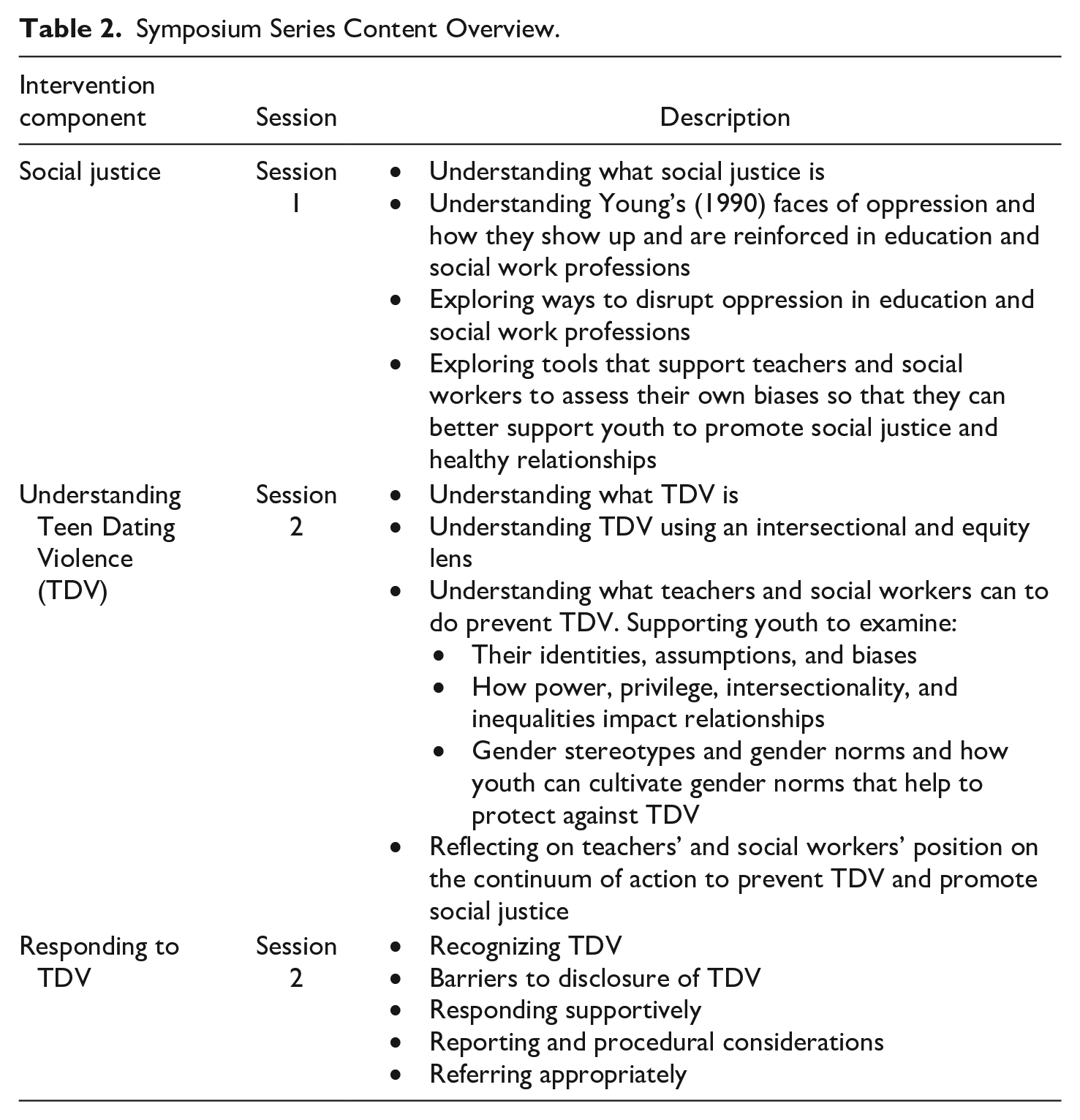
The symposium series was first piloted in 2017. Feedback from this pilot was used to modify the symposium series to increase feasibility and acceptability (e.g., condensing the symposium’s content into two events; providing more practical examples of how to prevent ADV). In 2019, the revised symposium series was offered and evaluated in the present study, where it consisted of two sessions (each lasting 3.5 hr), approximately 1 month apart (see Table 2). The event was free for all undergraduate students in education and social work. The goals of the symposium were to (1) enhance pre-service teachers’ and social workers’ understanding of the roles they could play in advancing social justice through ADV prevention in schools and communities, (2) strengthen knowledge, skills, and confidence to foster healthy youth relationships and prevent ADV, and (3) examine ways attendees could support the well-being of the youth they work with (now and in the future).
Symposium Series Content Overview.
Pilot Evaluation of the Symposium Series
Survey Data
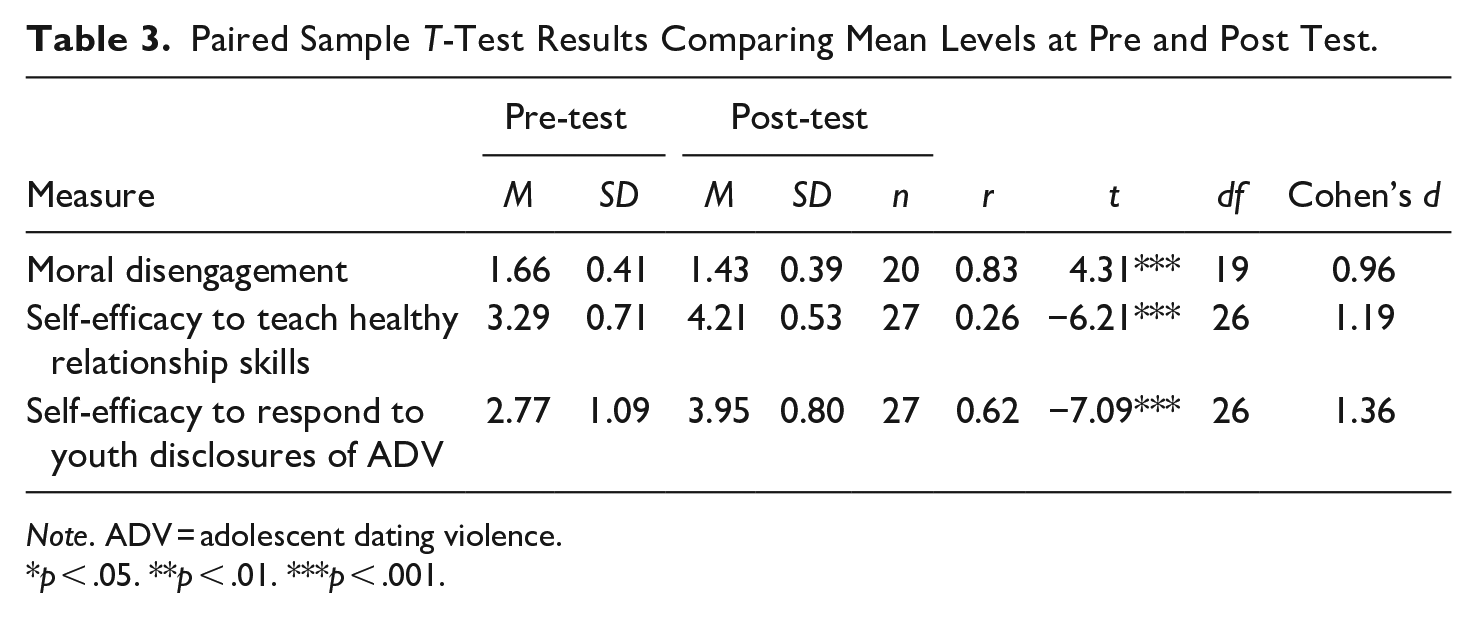
To understand the utility of the symposium series in achieving its goals, we examined changes in participants’ willingness and confidence to prevent ADV before and after attending the symposium series. To test our hypothesis that students would report a decrease in moral disengagement from pre-test to post-test (H1), we conducted a paired samples t-test (Table 3). Results confirmed our hypothesis (t (19) = 4.31, p < .001), such that moral disengagement was significantly higher at pre-test (M = 1.66, SD = 0.41) as compared to post-test (M = 1.43, SD = 0.39), suggesting preliminary evidence for utility of the symposium series, and its ability to increase students’ willingness to engage in ADV prevention efforts. The difference between pre- and post-test represented a large effect size, using standard benchmarks (Cohen’s d = 0.96; J. Cohen, 1988).
Paired Sample T-Test Results Comparing Mean Levels at Pre and Post Test.
Note. ADV = adolescent dating violence.
p < .05. **p < .01. ***p < .001.
To test our hypothesis that students would report an increase in self-efficacy to teach healthy relationship skills from pre-test to post-test (H2), we conducted a paired samples t-test (Table 3). Results confirmed our hypothesis (t (26) = −6.21, p < .001), such that self-efficacy to teach healthy relationship skills increased from pre-test (M = 3.29, SD = 0.71) to post-test (M = 4.21, SD = 0.53), providing preliminary evidence for utility of the symposium series and its ability to increase students’ confidence to prevent and respond to ADV. The difference between pre and post-test represented a large effect size, using standard benchmarks (Cohen’s d = 1.19; J. Cohen, 1988).
Finally, to test our hypothesis that students would report an increase in self-efficacy to respond to youth disclosures of ADV from pre-test to post-test (H3), we conducted a paired samples t-test (Table 3). Results again confirmed our hypothesis (t (26) = −7.09, p < .001), such that self-efficacy to respond to youth disclosures of ADV increased from pre-test (M = 2.77, SD = 1.09) to post-test (M = 3.95, SD = 0.80), providing further evidence for utility of the symposium series in terms of its ability to increase students’ confidence to prevent and respond to ADV. The difference between pre and post-test represented a large effect size, using standard benchmarks (Cohen’s d = 1.36; J. Cohen, 1988).
Interview Data
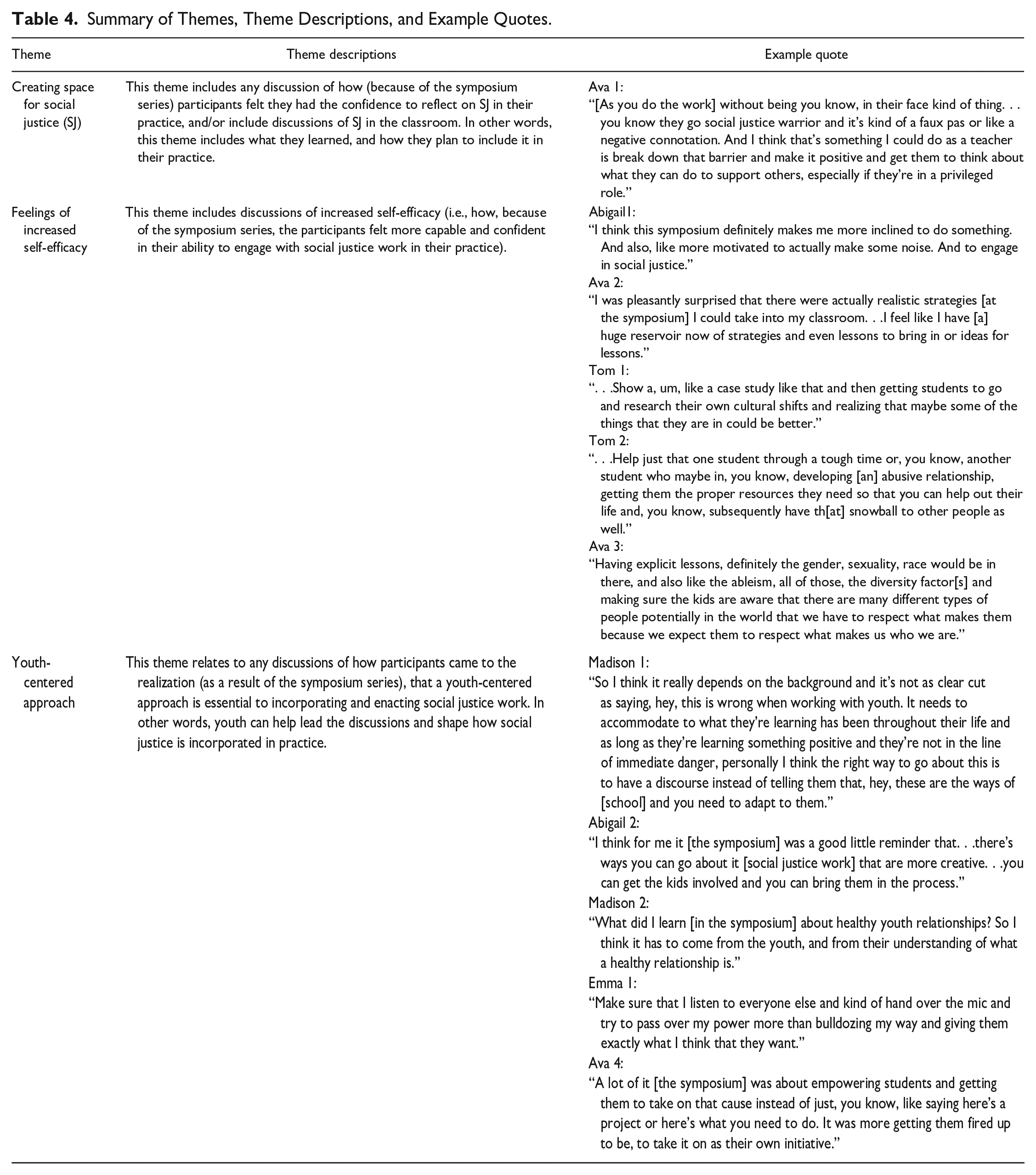
We identified three themes (see Table 4) in the interview data: (a) creating space for social justice, (b) feelings of increased self-efficacy, and (c) taking a youth-centered approach to ADV prevention/healthy relationships promotion.
Summary of Themes, Theme Descriptions, and Example Quotes.
Creating Space for Social Justice (SJ)
Two of the four participating social work students discussed how the symposium series influenced their perspectives on creating space for SJ. Following the symposium series, both realized that SJ wasn’t just about “phone calls and letters and emails and Facebook groups and protests and all that stuff” (Abigail), but that there was more to SJ work in their role in schools, specifically by teaching about healthy relationships and consent. Following the symposium series, the two respondents also saw healthy relationships as a “larger social justice issue” (Zoe). Particularly, Zoe described that the symposium helped them realize “that there is a space for it [social justice] in schools,” and that their social work training could advance SJ work in schools (e.g., by advocating for curriculum on consent).
All three of the participating education students also discussed their perspectives on creating space for SJ following their attendance at the symposium series. Although their discussion contained less explicit SJ talk as compared to social work attendees, they too described a changing perspective on what SJ can look like in a classroom, including “setting ground rules within a classroom and. . .showing students what healthy is” (Tom). Ava shared that she learned that incorporating SJ work into everyday activities and discussions can help remove barriers
Following the symposium series, both education and social work students also identified increased intention to bring critical thinking and inquiry forward in their roles as future educators and social workers, respectively. Education students specifically discussed the role of modeling SJ in classrooms and engaging in conversations that deconstruct gendered norms or beliefs, thereby creating space for students to practice critical thinking and questioning the status quo. Participants identified that SJ can be enacted in small, feasible, and impactful ways, with Tom (education student) adding that there is room for SJ work in schools. After the symposium series Zoe (social work student) recognized that creating space for social justice in schools is possible, by shifting the lens from macro-level social justice work (which can feel overwhelming) to student-focused efforts (which can be an easier way to initially introduce SJ concepts and practices). This speaks to utility, as students were able to identify important first steps for incorporating SJ into their work after attending the symposium series.
Feelings of Increased Self-Efficacy
All interviewees addressed increased self-efficacy to engage with youth around healthy relationships and social justice following the symposium series. For social work students, all participants noted an increase in motivation, knowledge, and ability to implement SJ action in schools following the symposium series. For example, two social work participants discussed that the symposium series motivated them to take action (
The three education participants also discussed feelings of increased confidence and competence to incorporate strategies to teach youth about healthy relationships in the classroom. These respondents ascribed this increase in confidence to the hands-on focus of the symposium series, including case studies and suggested resources, which we feel speaks to content acceptability
In addition, two of the three education participants discussed methods of transferring the knowledge gained during the symposium series into their future classrooms. This potential for translation was directly related to increased feelings of competence, and the hands-on nature of the symposium. One respondent described how they could do this in the social studies curriculum
In sum, both social work and education participants valued gaining actionable strategies from the symposium series. These strategies for education students helped increase participants’ self-efficacy in their ability to model SJ in the classroom and set classroom expectations for students and youth. Participants emphasized that information alone is not enough to make a change. Instead, participants need strategies and activities to bring SJ and healthy relationship modeling into the classroom in a meaningful way. Taken together, this theme highlights that the symposium series provided useful and acceptable ways to increase social work and education students’ self-efficacy to engage in social justice-focused ADV prevention and healthy relationships promotion work.
Youth-Centered Approach
This theme was driven in the social work sample by two of the four participants, who discussed how it is important to take a youth-centered approach to healthy relationships promotion in the school setting. Madison stated that she learned how to assess who the youth’s support system is after attending the symposium series
All of the education respondents discussed that after attending the symposium series, they learned the importance of including youth in healthy relationships promotion work and discussed strategies to engage youth in discussions around healthy relationship promotion in the future. Two education respondents confirmed the importance of using a youth-centered approach
Discussion
The purpose of this study was to (a) describe the development of a symposium series that aimed to teach undergraduate students in education and social work about their role in preventing ADV through a social justice lens and (b) evaluate the symposium’s utility and acceptability to increase willingness and confidence to prevent and respond to ADV. Findings from both the quantitative and qualitative portions of this study suggest the symposium series successfully increased students’ willingness and confidence to do this work, and that the symposium series was an acceptable way to offer this information.
Changes to Willingness
After the symposium series, both education and social work students indicated an increased willingness to prevent and respond to ADV through a social justice lens. During interviews, students discussed wanting to intentionally create space for social justice in their future practice, and ways they could do this (e.g., modeling social justice in the classroom). Students said the symposium series helped them realize they could create space for enacting social justice related to healthy youth relationships in “small” ways, which made the action of enacting social justice feel more feasible. Quantitative data also supported a change in willingness to become involved in ADV prevention. Specifically, education students reported a decrease in moral disengagement related to ADV (i.e., the ways in which people justify not wanting to be part of ADV prevention efforts) after completing the symposium series. This speaks to the utility of the symposium series to increase willingness to engage in this work. This is important as willingness to become involved with ADV prevention is a predictor of teacher trainees’ future adoption and implementation of ADV prevention resources (Crooks et al., 2017). Furthermore, willingness to create space for this work is an important first step in promoting changes to the structural conditions that drive ADV (McQueeney, 2016).
Changes in Confidence
Participants indicated increased confidence to prevent and respond to ADV through a social justice lens following the symposium series, providing further evidence for the utility of our approach. During interviews, education students indicated that they had increased confidence to take the skills they learned into the classroom, and social work students indicated that they now knew what to do if youth disclosed ADV. Importantly, students made it clear they attributed their increased self-efficacy with regard to enacting these behaviors to the symposium series.
One important change in confidence for enacting behaviors was related to participants’ understanding of engaging youth as leaders in healthy relationships/ADV prevention and social justice work. By centering youth voice, education and social work students can become more aware of what to look for and how to respond in inclusive ways that prioritize the youth perspective. This increased focus of using youth-centered approaches is in opposition to the “banking” concept of education, where educators simply deposit information (like a bank teller depositing money) instead of engaging with students; it is argued that the “banking” concept is a characteristic of oppression in education systems (Freire, 2018). Instead, the participants in this study learned to foster a learning environment where youth have agency, which can help to reinforce healthy relationships education (Darder et al., 2017).
Quantitative data also supported a change in confidence. Students reported an increase in self-efficacy/confidence in both teaching youth healthy relationships skills and in responding to youth disclosures of dating violence after attending the symposium series, with large effect sizes. This is promising, as individuals’ confidence to implement intervention strategies (including one’s own beliefs surrounding confidence) is a critical component of implementation success (Fixsen et al., 2005).
Implications
Future implementation of the symposium series should continue to provide a balance between theory and practical strategies (see Table 2). Often, training will focus on the latter because strategies are concrete, but our study shows that we can build future teachers’ and social workers’ competencies by ensuring the practical strategies are framed within theories that examine power, privilege, and systems of oppression, and how they show up in everyday practices. Next, future symposium series should include an explicit focus on advancing a cross-sector approach to effectively preventing ADV as this was not explicitly addressed in interviews. For example, by encouraging the two groups of students (education and social work) to talk with one another to better understand how to work together for ADV prevention in schools (e.g., building empathy and understanding for each other’s distinct but complementary roles).
Finally, ADV prevention efforts are still largely focused on changing individual and family level behaviours (Debnam & Temple, 2021). Existing ADV prevention efforts minimize the structural determinants of health (Claussen et al., 2022). To address this, we recommend ADV prevention efforts explicitly incorporate critical theory, which allows for a comprehensive prevention effort that promotes social justice; by doing this, we can better serve marginalized youth who are at higher risk for ADV (Exner-Cortens et al., 2021).
Limitations and Future Research
There were several limitations to this study. First, our interviews and survey samples consisted of almost all White heterosexual women, which likely resulted in a lack of diversity in perspectives. Thus, future evaluation of this series with more diverse samples is needed. Furthermore, although we did detect large change from pre- to post-test in this sample, we did not conduct surveys or interviews with students who had not taken the symposium series. Thus, we interpret our findings as promising, but a more rigorous outcome evaluation is still needed. Our sample size was also small, reflecting the capacity of the symposium series. We also realized in hindsight that our measure of sexual orientation included Two-Spirit, which is a form of gender and not sexual diversity. However, no one in our sample selected this option and so results were likely not impacted by that error. Finally, this study did not examine changes in behaviors once students were practicing within schools. At this point, we do not know if the changes reflected here translated to behavior change in practice. Future research should include long-term follow up assessments to measure this.
Conclusion
In this paper, we described the development of a symposium series that taught education and social work students about their role in preventing ADV through a social justice lens. Furthermore, we provided a pilot evaluation of the utility and acceptability of this symposium series. Quantitative and qualitative results suggest students showed an increase in willingness and confidence to prevent and respond to ADV through a social justice lens after completing the symposium series. This work highlights the importance of incorporating critical theory into ADV prevention efforts, especially as it relates to serving marginalized youth and promoting social justice in schools.
Supplemental Material
sj-docx-1-cjs-10.1177_08295735241273952 – Supplemental material for Adolescent Dating Violence Prevention: Teaching Social Justice Oriented Skills and Strategies to Undergraduate-Level Teachers and Social Workers
Supplemental material, sj-docx-1-cjs-10.1177_08295735241273952 for Adolescent Dating Violence Prevention: Teaching Social Justice Oriented Skills and Strategies to Undergraduate-Level Teachers and Social Workers by Elizabeth Baker, Emily Matejko, Deinera Exner-Cortens, Alysia Wright, Lianne Lee and Darren Lund in Canadian Journal of School Psychology
Footnotes
Acknowledgements
We would like to thank the participating teacher and social worker trainees, and the research assistants who supported this project. Thanks to Prof. Lana Wells, Claire Crooks, PhD and Wendy Craig, PhD for their contributions. Thank you also to Rahim Pira who conducted the interviews.
Author Note
Darren Lund is deceased, date of death: November 10, 2021.
Declaration of Conflicting Interests
The author(s) declared no potential conflicts of interest with respect to the research, authorship, and/or publication of this article.
Funding
The author(s) disclosed receipt of the following financial support for the research, authorship, and/or publication of this article: This research was supported in part by funding from the Public Health Agency of Canada (1718-HQ-000788).
Ethical Guidelines
All ethical guidelines were followed as required for conducting human research.

Supplemental Material
Supplemental material for this article is available online.
Notes
Author Biographies
References
Supplementary Material
Please find the following supplemental material available below.
For Open Access articles published under a Creative Commons License, all supplemental material carries the same license as the article it is associated with.
For non-Open Access articles published, all supplemental material carries a non-exclusive license, and permission requests for re-use of supplemental material or any part of supplemental material shall be sent directly to the copyright owner as specified in the copyright notice associated with the article.
