




Abstract
The current study examined the trainee teachers’ attitudes toward technology adoption and use in tertiary engineering education. The Computer Attitude Scale (CAS) was extended by including the social influence component, to examine whether social norms affect the acceptance of technology by teachers. Findings from 110 trainee-teachers revealed that their attitudes toward technology are positive. These attitudes constitute the way they like and intend to use technology, their perception of its usefulness in their daily tasks, and the control they perceived to have over technology while using it in engineering disciplines. The findings also confirm that social influence is an important predictor of trainee teachers’ attitudes toward using technology. Overall, the study provides a new influential factor (social) that could be merged with the other four major components (affect, perceived usefulness, perceived control, and behavioral intention) of CAS in conducting future research. The results of this study further provide useful knowledge that extends prior arguments concerning teachers’ attitudes toward using technology in teaching with respect to age, gender, and disciplines. More specifically, the study, theoretically, contributes to research practice in technology acceptance, by extending the computer attitude scale (CAS), with social influence as an additional important factor to be considered when conducting future research. Therefore, an extended CAS is established for exploring newer research in this domain. Policymakers and designers of teacher professional development will be informed of these findings that will accelerate initiatives of technology integration of engineering education in developing countries and other similar contexts.
Introduction
The dynamics of today’s evolving technology are influencing nearly every aspect of human life and are still changing the way we do almost everything. The increasing involvement of human-technology interaction in everyday tasks has led to occupational and personal success (Bonina et al., 2021; Papanastasiou et al., 2019; Reis et al., 2018; Yildiz Durak, 2021). For students of today’s digital age to succeed in their quest for knowledge and skills, there is a need for educational planners, policymakers, and practitioners to embrace modern technology (Uerz et al., 2018). It is also imperative that classroom experiences be adequately equipped to provide equitable and unbiased access to technological tools for students regardless of gender or ethnicity (Sahin et al., 2016; Teo, 2008).
In doing so, teachers are the motivational force through which technological tools can be introduced, implemented, and adopted (Almerich et al., 2016; Ifinedo et al., 2020). For example, Yarbro et al (2016) opined that as educators use technology to improve students learning, the most important role in technology integration is providing a learning environment that will support learners with active, hands-on, and authentic learning activities for offering enhanced myriad learning experiences. Ultimately, teachers play a key role in arranging technology-enhanced learning spaces (S. H. Khan, 2015). Teachers, in a broader perspective, play a pivotal role in realizing successful changes at all levels of education (Van der Heijden et al., 2015). In relation to technology integration, a significant number of studies had explored the positive impact of technology in the learning environment. Some of these include the research work of M. S. H. Khan et al., (2019) on the use of mobile devices in higher education in Bangladesh, which yielded five ways of using mobile devices in their learning that could have a positive impact on student learning. Henderson et al (2017) conducted a study on how university students perceive the usefulness of digital technologies in their learning. Their results revealed a wide range of distinct digital benefits; such as flexibility of time, ability to communicate and collaborate at different places and locations, as well as retrieving, reviewing, and researching information. However, regardless of evidence that shows the positive impacts of technology on educational practice, teachers’ resistance to its application at the instructional level still exists in many cases (Seufert et al., 2021).
Effective pedagogical use of technology among teachers remained negligible in Bangladesh where this research was conducted (Fahadi & Khan, 2022). The government of Bangladesh however, has shown its political will through various intervention programs aimed at promoting access to technology, and its acceptance among teachers and students (Obaydullah & Rahim, 2019). As part of the effort to strengthen gender equity in digital literacy, the government made ICT a mandatory subject for all students from K6 through K12 and established a program that will ensure e-learning capacity among all female teachers by the year 2023 (Z. Hossain et al., 2019). However, having a technology-enabled learning environment, as well as training teachers, does not guarantee effective pedagogical integration unless the teachers’ technological perceptions and attitudes are positive (Farjon et al., 2019; Khan & Hasan, 2013). Even though technology integration is guided by government policies, teachers still hold the autonomy to decide when and how to use it (Teo, 2011). It, therefore, becomes imperative to have an insight into the teachers’ attitudes toward technology, so that progress related to possible successful technology integration can be obtained. Moreover, true insight can best be sought from trainee-teachers, who are in the making, and whose attitudes are less likely to be swayed by the old pedagogical trends.
There is a global outcry for the need to support skill-building for students in science technology engineering and mathematics (STEM) to enable them to thrive in today’s technology-driven era (Rifandi et al., 2019). This has given birth to the urgent need to investigate the technological attitudes of trainee-teachers in this segment of education, particularly engineering education trainee-teachers. This study focuses on the attitudes toward the technology of engineering trainee-teachers in a developing country. This research may be crucial for further improvements in engineering education teacher professional development programs (ETPD), in Bangladesh and other countries with similar contexts.
Related Literature
Engineering Education and the Evolving Pedagogical Needs
Engineering education consists of a synthesis of core mathematics and scientific principles, design concepts, and cutting-edge technologies relevant to industry and research jobs. It comprises the development of skills that will persist for more than a few years after graduation and will serve as the basis for lifelong learning, enabling graduates to have a significant impact on society beyond graduation and for many years to come (Schor et al., 2021). It is also about mastering a variety of critical skills for managing cross-disciplinary projects. Engineering faculties all over the world are frequently revising and modifying their curricula in response to evolving trends, industry feedback, accreditation organizations, and a variety of other factors to ascertain that their graduates are equipped for an ever-changing world (Schor et al., 2021).
Engineering education is crucial for humanitarian, social, and economic development, and its graduates must be prepared to address the everchanging sustainability concerns. The fourth industrial revolution, which is currently on the political and industrial agenda, involving a widespread integration of technologies such as automation, the Internet of Things (IoT), artificial intelligence (AI), robotics, neuro-technologies, and virtual and augmented realities, is a more recent challenge (Hadgraft & Kolmos, 2020). A combination of these technologies intertwin in applications to transform industrial processes into systems that are more connected, reliable, predictable, and robust, with a high degree of certainty (Gupta, 2020).
As a result, “engineering education is experiencing a paradigm shift from teacher-centric to the student-centric teaching-learning process, content-based education to outcome-based education, knowledge-seeking to knowledge sharing classrooms, teachers to facilitators, traditional engineering disciplines to interdisciplinary courses, chalk and board (lecture-based) learning to technology-driven learning” (Pavai Madheswari & Uma Mageswari, 2020, p. 01). This paradigm shift results in a new era of engineering education known as “Engineering Education 4.0” (Frerich et al., 2016). Engineering Education 4.0 involves the implementation of current and emerging technologies combined with innovative pedagogical approaches inspired by the fourth industrial revolution (IR4.0) for flawlessness, satisfaction, time-saving, skill development, and efficiency enhancement in engineering education (Gupta, 2020). While acknowledging the fact that the students of today’s engineering education are born in the digital age, and are normally referred to as generation Z (Opri & Ionescu, 2020), which makes them capable of withstanding technological challenges posed by the evolving fourth industrial revolution (IR 4.0), there are various factors outside the control of the students, such as digital divide issues related to access to technology and more importantly conservative pedagogical approaches adopted by instructors (Gonçalves & Capucha, 2020; Salem & Mohammadzadeh, 2018), the latter of which has become a major concern in technology integration studies (Arkorful et al., 2021; Pamuk, 2022; Papadakis, 2018; Raman et al., 2015; Sánchez-Prieto et al., 2019; Shah et al., 2020; Shodipe & Ohanu, 2021; Wijnen et al., 2021; M. Xu et al., 2021; S. Xu & Zhu, 2020; Yildiz Durak, 2021). It is therefore important than ever, for engineering education teachers and instructors to embrace and use the evolving technology-driven pedagogical approaches, with the goal of improving students’ engagement and content delivery, so that students can achieve the feat essential for evolving engineering practice.
Teachers’ Attitudes Toward Technology Use
The attitudes and beliefs of teachers toward technology are crucial for school leaders to understand as schools shift toward modern digital pedagogy (Mou, 2016; Shah et al., 2020). Subdomains of attitudes toward technology include perceived usefulness, control, liking behavioral intention, and confidence (Mahajan, 2016). Other factors include age, gender (Hrtovnová et al., 2015; Teo, 2014), technology confidence (Miller et al., 2017), anxiety (Chiu & Churchill, 2016), and self-efficacy (Brantley, 2018). Baturay et al. (2017), in a study on “the relationship among pre-service teachers’ computer competence, attitude toward computer-assisted education, and intention of technology acceptance,” found a significant and positive correlation among these factors. This finding was also validated by Nikou and Economides (2017), whose study revealed that effective attitudes, general usefulness, effort expectancy, and perceived playfulness are significant determinants of behavioral intention to use technology. Teo (2008), reported a linkage between years of technology experience and a positive attitude toward its acceptance and use while suggesting no variation in terms of age or gender. More so, Hrtovnová et al. (2015), argue that age and gender do not impact the acceptance of e-learning. Li (2016), in a survey study of participating teachers of a statewide professional development in China, acknowledged that the effectiveness of technology integration can be influenced by the gender-based perspective before and after teachers’ involvement in professional development. He argued that male teachers have shown more enthusiasm and better attitudes regarding technology integration in the classroom than their female counterparts, but less significant after professional development. However, the same article reports more significant integration on behalf of the female teachers after the teachers participated in professional development activities geared toward technology integration. Abbasi et al. (2021), in their study using surveys and interviews, found that undergraduate English teachers had a favorable attitude toward ICT integration. They also discovered no significant differences in the use of ICT tools by teachers based on their gender or educational qualifications. The only variation identified between lecturers was attributed to their competence, which is normally accumulated over time, thus implying the impact of years of technology use on its efficient use. Recently, Shodipe and Ohanu (2021), surveyed 418 electrical and electronic technology teachers in higher education about their attitudes, engagement, and disposition toward mobile learning. They discovered a positive correlation between teachers’ perceived ease of use and actual use of mobile learning, as well as a positive correlation between teachers’ disposition and perceived ease of use, which forms the foundation of human attitude and behavior (Shodipe & Ohanu, 2021). In addition, Saefuddin et al. (2019), reported an overall positive attitude toward technology by science teachers surveyed in the southeast province of Indonesia. However, the study identified a small percentage of the teachers who do not agree that technology is an efficient communication and presentation tool for effective teaching and learning activities. S. Xu and Zhu (2020), identified key factors that affect teachers’ acceptance and integration of technology as attitude and technology beliefs, and self-efficacy with respect to technology use. They also identified a positive correlation between attitude and technology belief and intention to integrate technology in teaching. In research conducted by Farjon et al. (2019), on the technology integration of pre-service teachers, it was revealed that although access to technology has an impact on pre-service teachers’ technology integration, their attitudes and views about technology integration remain a major factor in its successful integration. These findings were corroborated by a recent study of 401 K-12 teachers by Yildiz Durak (2021), on their TPACK level and technology integration, which suggested a significant correlation between teachers’ attitudes toward technology and its integration in their teaching-learning activities. The study further suggested establishing teachers’ positive views be the focal point of technology integration techniques in teachers’ education programs. However, establishing positive views of teachers on technology requires an understanding of the factors that facilitates the development of such views. While prior studies emphasize influencing factors that are inherent in the teachers themselves, which are related to personal beliefs and views about technology integration, understanding other contextual factors such as social norms and cultural beliefs are equally important for establishing positive views and attitudes of teachers toward technology integration. Thus, the current study explored the implications of social influence on technology attitudes of engineering trainee-teachers and its variability with respect to gender.
Moreover, while some studies reported significant differences in these attitudes among teachers in terms of age, gender, experience, anxiety, and subject domain, others reported non-significant differences in these variables. However, none of these studies was conducted to investigate the trainee teachers’ attitudes in the engineering discipline. The present study, therefore, aimed to investigate the trainee teachers’ attitudes toward technology in the engineering discipline by modifying the computer attitude scale (CAS) in relation to measuring the social influence factor. It has been assumed that the attitude of trainee-teachers of engineering education will provide valuable insights on the status of technology integration in the engineering discipline so that necessary improvement can be provided.
Social Influence and Its Impact on Teachers’ Technology Acceptance
Social influence is referred to “the degree to which an individual perceives that important others believe he or she should use the new system” (Venkatesh et al., 2012, p. 159). Important others mean people within the social circle of a person that he or she considers important, such as family members, friends, and colleagues. It, therefore, implies the extent to which a person is influenced, encouraged, or motivated to use a particular system such as technology, by family members at home, friends at a social gathering, or colleagues at a workplace. While the use of digital devices within family and friends’ circles involves the social and personal life of a person, an individual’s perception of the use of such devices can easily intertwin with job-related use. In any case, social norms prescribe what is considered acceptable behavior among various groups in the society, such as age, gender, and ethnicity, and this obviously includes who has access to digital technology and how it should be used (Hernandez, 2019). This means positive or negative perceptions of technology use due to societal norms can affect acceptance and use of such technologies at a professional level. For example, in Bangladesh where social norms led male family members to limit female members’ access to digital devices and/or monitor their usage to preserve family reputation (Hernandez, 2019), female acceptance and use of digital technologies at the institutional level can hardly be accomplished without facilitating a shift in cultural norms. The social circle at the institutional level can help in reshaping the perceived cultural limitations (Huang et al., 2019), as highlighted by Kocaleva et al (2015), that teachers who already appreciate the relevance of technology at higher institutions can persuade and influence others to accept and apply it to their pedagogical activities. More so, Durodolu (2016), claimed that one of the important factors that encourage teachers change their behavioral intention to use technology is when they perceive the need from their fellow teachers. However, those who self-internalized their limitations may find it difficult to break the barrier, even after realizing the potential benefits attributed to the use of digital technologies. For example, Croxson and Rowntree (2017), conducted a study in Bangladesh on lower- and middle-class literate young adults aged 25 to 35, regarding mobile internet use. Though the participants ascribed positive attributes to internet users, they do not however relate themselves as aspiring users, rather “often said things like the internet is not for someone like me” (p.11). Similarly, a global study on girls’ access and usage of mobile devices found that girls who undergo social restrictions on access to digital technology are susceptible to internalizing the idea that those devices are not safe and girls cannot be trusted with them (Girl Effect & Vodafone Foundation, 2018). Thus, continuous reform of social norms related to technology use, especially in the rural areas is much needed. While the government established various programs, policies, and strategies to ensure digital inclusion in Bangladesh (Mou, 2016), there is a need to understand whether progress is being made with respect to the efforts that are put in place.
At the moment, and to the best of our knowledge, no empirical study has been conducted to investigate engineering education trainee teachers’ attitudes toward technology acceptance and use, in developing countries, or elsewhere. Technology, in this study, is considered as all sorts of information and communication technologies (ICT) that are used in the teaching and learning contexts of engineering education. For example, computers (laptop and/or desktop), mobile phones, iPad, tablets, multi-media projectors, interactive smartboards, software, and other tools that are connected and used for teaching and learning in engineering education. This is where the need of the present study becomes apparent, which is necessary for effective engineering education teacher preparation and training. The purpose of the study, therefore, was to examine the trainee teachers’ attitudes toward technology use in tertiary engineering education in Bangladesh, one of the developing countries in the world. After carefully analyzing the need of conducting the present study and to fill the current knowledge gap in the literature, the following research questions were formulated:
What are the overall attitudes of engineering education trainee-teachers?
Is there any variation in the attitudes with respect to age, gender, engineering specialization, perceived confidence, and years of experience in technology use?
Research Method
In this study, a quantitative approach through a cross-sectional survey research design was applied to investigate the attitude toward technology use of engineering trainee teachers in Bangladesh. A cross-sectional survey design is commonly applied while collecting self-reported data such as opinions, attitudes, and values (Battaglia et al., 2008). Moreover, this survey design has been widely used in technology integration studies in prior literature (Admiraal et al., 2017; M. A. Hossain & Sormunen, 2019; Ifinedo et al., 2020; Reguera & Lopez, 2021; Teo, 2008; Wei et al., 2016). A survey questionnaire with a 5-point scale, measuring five constructs of the Extended CAS (Affective, Perceived Usefulness, Perceived Ease of Use, Behavioral Intention, and Social Influence) was used to collect data from only those trainee teachers who completed their first year of the training program. A detailed explanation of the participants’ sample, data collection procedure, the instrument used, and data analysis technique is given in the following sub-sections.
Procedure
The study was conducted during the 2017 to 2018 academic year. Initially, the instrument for data collection was developed using four components of the computer attitude scale with the addition of the social influence component. After seeking permission to conduct the study from two selected universities in Bangladesh (Islamic University of Technology and Dhaka University), a cohort of 110 engineering trainee-teachers with prior experience in technology use were purposefully selected. The two universities were selected being the only universities offering engineering teacher education programs as of the year 2017 when the research was conducted (see detailed discussion in section 3.2). At first, a pilot study was conducted with 30 participants for an instrument reliability check. After that, data was collected from the whole sample using a self-reported survey questionnaire (see detailed discussion in section 3.3). At all times during the data collection, one of the authors was present to respond to possible queries that may arise from the participants. It took about 20 minutes on average for the participants to complete the survey questionnaire. Participants were also informed that their participation is voluntary and they are free to withdraw their participation at any time. The responses were tabulated in an MS Excel sheet and then transferred into IBM SPSS and AMOS for data screening and further analysis (see detailed discussion in section 3.4). Besides, information related to participants was kept confidential and remained anonymous without any direct link to the respondents.
Sample
Participants were trainee teachers of two higher education institutions in Bangladesh. These two universities were selected because they are the only universities that provide teacher training programs with engineering backgrounds in Bangladesh. The participants were drawn from four areas of specialization. These include Computer Science and Engineering (CSE); Civil and Environmental Engineering (CEE); Electrical and Electronic Engineering (EEE); Mechanical and Chemical Engineering (MCE). The number of questionnaires returned with no missing data is 110, with 66 male and 44 female participants. A total of 62 participants are between the age group (15–24), 41 are between the age group (25–34), while 7 participants are between were age group (35 and above). Table 1 indicates the demographics of the participants.
Demographics Data (N = 110).

Instrument
The instrument used in solving the research questions of this study was Computer Attitude Scale (CAS), adopted from Selwyn (1997), which has been reported by several researchers to be a reliable instrument for measuring prospective teachers’ attitudes toward computer-related technologies. For example, Sexton et al. (1999) used CAS in their study on prospective teachers and reported the CAS to have a high-reliability coefficient (alpha = .90). More so, Teo (2008), claimed that CAS possesses a high-reliability coefficient (alpha = .86). However, other significant variables that influence computer attitudes such as subjective norms and facilitating conditions are excluded in CAS, which may limit the true interpretation of the participants’ attitudes (Teo et al., 2008). In this study, the CAS was modified by adding one more variable from the subjective norms, to observe whether it has a significant influence on the attitudes toward computer-related technologies. The survey instrument used during data collection comprised three sections. The first section contained participants’ demographic data, such as age, gender, nationality, study program, and specialization. The second section contained participants’ years of technology experience and perceived confidence. The third section collected the participants’ responses to 24 items drawn from five constructs. The first four constructs were adopted from CAS namely: affect; perceived usefulness; perceived control; behavioral intention (Selwyn, 1997), while the fifth construct Social Influence generated from subjective norms of TAM (Venkatesh & Davis, 2000) was included to modify the CAS. Participants’ years of technology experience were obtained from the number of years the respondents claim to have been using technology. Perceived confidence was measured with 5-point scale (very confident = 1; confident = 2; neutral = 3; timorous = 4; very timorous = 5). The degree to which the participants agreed on the 24 items of the five constructs was also obtained using the same 5-point scale (strongly agree = 1; agree = 2; neutral = 3; disagree = 4; strongly disagree = 5).
Data Analysis
IBM SPSS and AMOS version 24 were employed during the data analysis. The scores from each item were aggregated to provide a corresponding score for each construct. In the case of constructs with negative items, a reverse coding was performed so that meaningful analysis could be done. Exploratory Factor Analysis (EFA) was then conducted, to make sure further analysis with the data set is feasible. After that, Structural Equation Modeling (SEM) approach was then employed to access the measurement model using maximum likelihood estimation (MLE). Prior to the analysis, data screening was conducted and cases with missing data values were removed to avoid complications, due to the sensitivity of MLE to missing values. However, the final data set (N = 110) met the criteria for performing MLE (Ding et al., 1995). To observe the variations of the respondents with respect to their age, gender, subject specialization, and years of technology use, one-way MANOVA on the five constructs was performed for each independent variable (age, gender, subject specialization, and years of technology use). Wilk’s lambda (Λ) was reported in the analysis at a significant alpha level (.05). During MANOVA analysis, when an independent variable shows a significant difference among the participants on the combined dependent variable, it means that variation exists on one or more dependent variables among the combined. Then, to discover which dependent variable(s) contributed to the statistically significant result, ANOVA analysis was further conducted for each individual dependent variable. A bivariate correlation analysis was also performed between years of technology use, confidence in using technology, and overall attitudes toward technology, to investigate whether a significant correlation exists between them.
Results
Overall Attitude Toward Technology
The descriptive statistics of all the 24 items of the instrument were presented based on five constructs in Table 2. Perceived usefulness has the highest mean score (4.40) followed by affective (3.90). The scores for behavioral intention and perceived control are nearly the same (M = 3.66 and 3.60) while the social influence sub-scale has the lowest mean score (M = 3.33). These scores show the participants’ perception of the usefulness of technology was higher than their perception of control and behavioral intention. It was also revealed that the participants’ affective perception was less than that of their perception of usefulness. However, in the social influence sub-scale, the participants appear to be least positive compared to their affective, intention to use, as well as their perception of usefulness and control of the technology. In general, the participants’ overall attitude toward technology was positive, with a mean score of 3.95.
Descriptive Statistics.

Attitudes Toward Technology With Respect to Age, Gender, Subject Specialization, and Years of Technology
Age groups
The result of one-way MANOVA shows significant difference between age groups when considered on the combined dependent variable Wilk’s lambda (Λ) = .741, F(15, 281) = 2.161, p = .008, partial eta-squared (η2) = .095. To determine which of the component(s) contributed to the statistically significant result, an ANOVA was performed against each individual dependent variable at a significant alpha level of .5. It was revealed from the result that, a significant variation exists on perceived usefulness: F(3, 106) = 4.03, p = .009, partial eta-squared (η2) = .102 with age group 35 to 40 (M = 4.75) scoring highest, followed by age groups 25 to 35 (M = 4.59), 15 to 25 (M = 4.27), and the lowest was scored by 40 to 45 (M = 4.00); behavioral intention: F(3, 106) = 4.573, p = .005, partial eta-squared (η2) = .115 with the corresponding scores of the participants of the age groups following the same fashion as that of perceived usefulness, such as age group 35 to 40 (M = 4.25) scored highest among all, followed by 25 to 35 (M = 4.05), and then 15 to 25 (M = 3.44) whereas the least was scored by 40 to 45 (M = 2.33). It was also evident from the result that, no significant variation exists on how much they liked technology (affective): F(3, 106) = 0.422, p = .738, partial eta-squared (η2) = .012, their perceived control, F(3, 106) = 0.496, p = .686, partial eta-squared (η2) = .014, and how much they were influenced to use technology by the society (social influence), F(3, 106) = 0.701, p = .554, partial eta-squared (η2) = .019. The resulting effect of significant variations on perceived usefulness and behavioral intention aggregated to a significant variation on the overall attitude on technology by age.
Gender
A MANOVA analysis for gender on the combined dependent variable shows that, a significant variation exists on at least one of the combined dependent variables: Wilk’s lambda (Λ) = .879, F(5, 104) = 2.858, p = .018, partial eta-squared (η2) = .121. To further examine which of the combined dependent variables exhibit the significant variation, and whether its magnitude influence the overall attitude, a separate ANOVA was performed. The result from the ANOVA analysis shows that a significant variation exit on social influence only: F(1, 108) = 8.703, p = .004, partial eta-squared (η2) = .075, in which the female participants (M = 3.608) score higher than male participants (M = 3.121), and that does not affect the overall attitude. No significant variation exists on the affective: F(1, 108) = 1.421, p = .236, partial eta squared (η2) = .013, perceived usefulness: F(1, 108) = 0.697, p = .406, partial eta squared (η2) = .006, perceived control: F(1, 108) = 0.156, p = .693, partial eta squared (η2) = .001, and behavioral intention: F(1, 108) = 0.995, p = .321, partial eta squared (η2) = .009. In general, the effect of significant variation realized between males and females on social influence does not result in a significant variation on the overall attitude on technology with respect to gender.
Subject specialization
A one way between groups MANOVA result shows a significant variation between subject specialization on combined dependent variables: Wilk’s lambda (Λ) = .666, F(15, 282) = 2.980, p < .0001, partial eta-squared (η2) = .127. An ANOVA was then performed against each dependent variable. A significant variation was observed among the four groups of specializations, on the extent of their technology liking, F(3, 106) = 4.265, p = .007, partial eta squared (η2) = .108, in which Civil Engineering trainee-teachers scored highest (M = 4.57), Computer Science and Engineering trainees-teachers scored second highest (M = 3.90), followed by Mechanical and Chemical engineering trainee-teachers (M = 3.83), and then the least scored by Electrical and Electronic Engineering trainee-teachers (M = 3.76). Similarly, there was a significant difference in how they perceived the usefulness of technology (perceived usefulness): F(3, 106) = 4.719, p = .004, partial eta squared (η2) = .118, with Civil Engineering trainee-teachershaving the highest score (M = 4.79), followed by Computer Science and Engineering trainee-teachers (M = 4.70), then Electrical and Electronic Engineering trainee-teachers (M = 2.33) and the least scored by Mechanical and Chemical Engineering trainee-teachers (M = 4.25). Their perception also differ on perceived control, F(3, 106) = 5.722, p = .001, partial eta squared (η2) = .139. In the same way, Civil Engineering scored highest (M = 4.29), Computer Science and Engineering (M = 3.90), Mechanical and Chemical Engineering trainee-teachers (M = 3.52), and lastly Electrical and Electronic Engineering trainee-teachers (M = 3.43). There was no significant difference found between subject specializations on behavioral intention: F(3, 106) = 1.477, p = .225, partial eta squared (η2) = .040, and social influence: F(3, 106) = 2.695, p = .050, partial eta squared (η2) = .071. The cumulative effects of these significant differences resulted in a significant variation in the overall technology attitude in terms of subject specialization.
Correlation Analysis Between Years of Technology Use, Perceived Confidence, and Attitude Toward Technology
To evaluate correlations between technology attitude, years of technology experience and confidence, a bivariate correlation was performed. The result revealed a significant correlation (r = .19, n = 110, p = .043) between technology experience and confidence. More so, significant correlations were evident between technology attitude and experience (r = .240, n = 110, p = .011) and level of technology confidence (r = .204, n = 110, p = .033). The mean years of technology use was (M = 7.22, SD = 4.16), level of confidence (M = 3.91, SD = .629), and the overall attitude (M = 3.96, SD = 0.612).
Exploratory Factor Analysis (EFA)
To evaluate the factor structure of the modified CAS, all the 24 items of the scale were subjected to EFA. The Kaiser-Meyer-Olkin measure confirmed that the sample was adequate, KMO = 0.730. Bartlett’s test of sphericity χ2 (276) = 3,230.380, p < .001. This indicates a satisfactory correlation structure for factor analysis. A five-factor solution was extracted using ML factor analysis, which accounts for 75.26 of the total variance (see Table 3). The threshold factor loadings used was 0.4, and Kaiser eigenvalue >1, as recommended by Field (2009) and Johnson et al (2001). Remarkably, four of the five factors attained the same factor structure as the previous study (Teo, 2008), except one item of the affective factor (hesitation to use technology in front of other people) that loaded on behavioral intention. However, the item perfectly fits its new factor, since people’s perception of the objective circumstances of a situation controls their psychological components in charge of their affect, cognition, and behavior (Halevy et al., 2019). The resulting factors from EFA are: (i) Perceived control with six items, eigenvalue = 5.49, and percentage variance of 22.87%. (ii) Affective component with five items, eigenvalue = 3.97, percentage variance of 16.53%. (iii) Perceived usefulness with five items, eigenvalue = 3.38 percentage variance of 14.11%. (iv) Behavioral Intention with five items, eigenvalue = 12.25, percentage variance = 12.25%. The new fifth factor introduced in this model; (v) Social influence, has three items with eigenvalue = 2.27, a percentage variance of 9.48%. These results suggest that the participants in Bangladesh perceived the same structure of the CAS found among the Singapore survey participants with the additional inclusion of the social influence factor (three items).
Exploratory Factor Analysis of 24 Items.
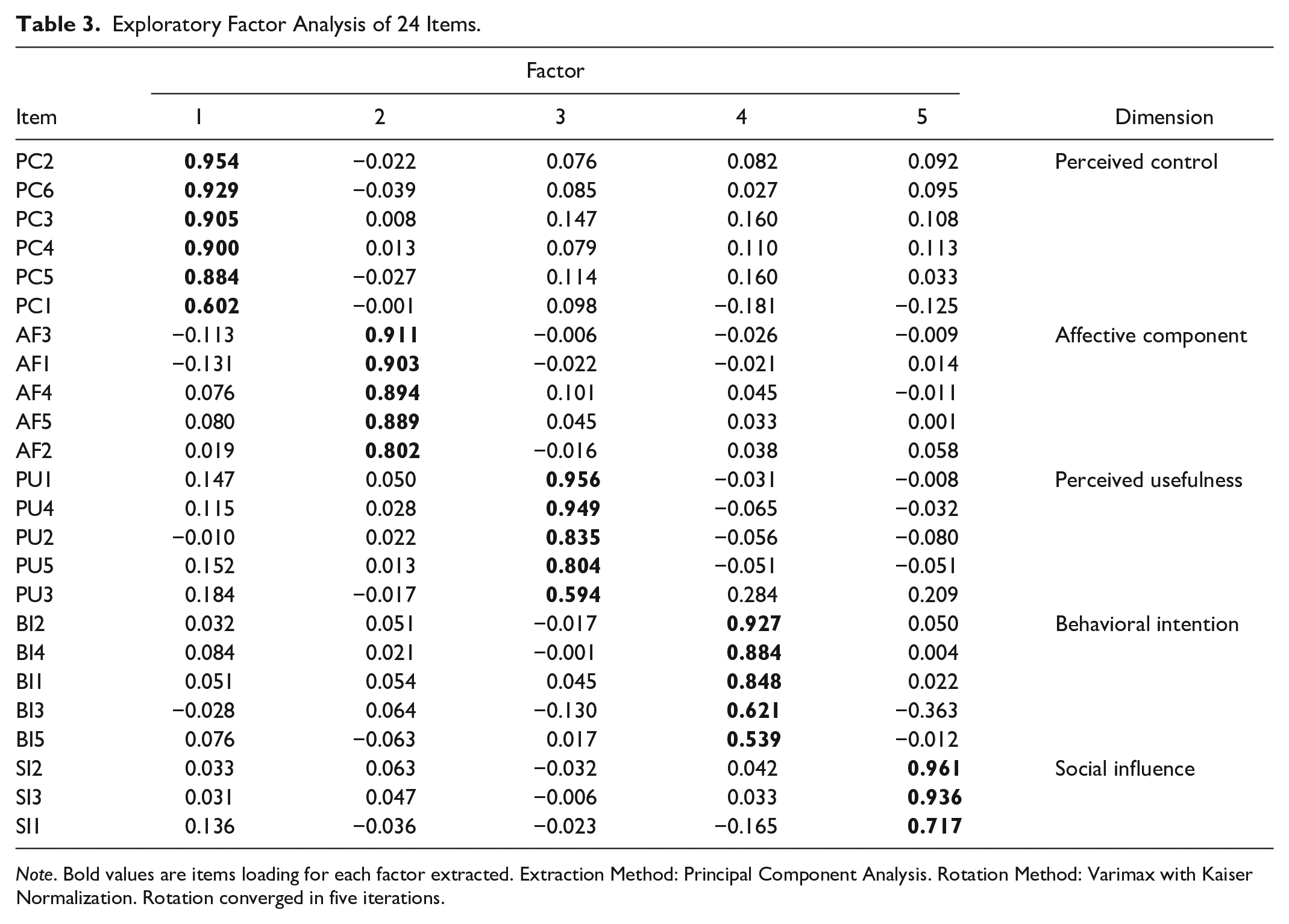
Note. Bold values are items loading for each factor extracted. Extraction Method: Principal Component Analysis. Rotation Method: Varimax with Kaiser Normalization. Rotation converged in five iterations.
Normality Test
To evaluate univariate normality, values of skewness and kurtosis for all the data set variables were examined. The skewness values observed range from −0.695 to −0.141 while that of kurtosis ranges from −0.971 to 1.647 respectively. The results indicated that the sample achieved a normal distribution based on the criteria ≤3 for skewness and ≤8 for kurtosis (Kline, 2015). For assessing multivariate normality, Mardia’s coefficient, which was 249.794 in this study was compared with the computed value: 624 using the formula p(p + 2), where p represents the number of items in the data set. Having Mardia’s coefficient lower than the computed result from the formula indicates that multivariate normality was also achieved (Mardia, 1970; Raykov & Marcoulides, 2008).
Confirmatory Factor Analysis (CFA)
Test of the measurement model
The model was also assessed by employing CFA. In this analysis, the convergent and discriminant validity, as well as the overall goodness of fit, were assessed. For the evaluation of convergent validity, composite reliability (CR), average variance extracted (AVE), and Cronbach’s alpha (α) were observed. The recommended adequate value for both CR and AVE is .5 or higher, and that of α should be greater than .70 (Fornell & Larker, 1981; Hair, 2010). The observed values in this analysis range from .84 to .95 for CR, .54 to .79 for AVE, and .840 to .935 for α, demonstrating that convergent validity was achieved (see Table 4). To access the discriminant validity, the square root of AVE for each factor was compared with its inter-factor correlation. A particular factor is assumed to have discriminated from other factors when the value of the square root of its AVE is larger than all the values of its inter-factor correlations. (Fornell & Larker, 1981). It can be observed from Table 5 that, the value of the square root of AVE of each factor (highlighted) exceeds all its inter-factor correlation values, suggesting that discriminant validity for all the factors was confirmed.
Convergent Validity.

Composite reliability =
Average variance extracted = Σ(λ)2/n, (λ = standardized factor loading, n = number of items).
Accepted threshold value.
Discriminant Validity.

Note. Bold values are square roots of AVE from observed variables. Non-bold values are correlations between constructs. PC = perceived control; PU = perceived usefulness; AF = affective; BI = behavioral intention; SI = social influence.
The overall fit of the model was assessed by observing both absolute and incremental fit indices. These include: normed Chi square (χ2/df); root mean square error of approximation (RMSEA); standardized root mean square residual (SRMR); comparative fit index (CFI); and Tucker Lewis Index (TLI). Corresponding values for theses indices in this model were (χ2/df = 1.65; CFI = 0.96; TLI = 0.95; RMSEA = 0.07; SRMR = 0.07), which indicates that, an acceptable model fit was achieved based on recommended threshold values by Hu et al. (2009): (χ2/df < 3; CFI > 0.90; TLI > 0.90; RMSEA < 0.08; SRMR < 0.08).
Discussion
In general, the study revealed that the participants showed an overall positive attitude toward technology, being that each subscale attained a mean score above the midpoint. The attainment of a positive attitude toward technology by the participants in this study could have been developed over time, due to government efforts to install technological culture among the citizens, through various initiatives such as “Access to Information (A21),” for over a decade, to enhance technology use at various levels of education in Bangladesh (Mou, 2016). There are also several projects and programs that are geared toward training teachers and trainee-teachers on how to integrate technology into classroom instruction (Karim et al., 2017; Shohel & Kirkwood, 2012; Shohel & Power, 2010).
On the overall attitude toward technology, the current research does not reveal a significant variation between male and female participants. This contradicts earlier studies that reported significant differences in attitudes toward technology between males and females (Padilla-Meléndez et al., 2013; Teo et al., 2015; Tezci, 2011). Other studies also revealed that, in technological abilities and perceived ease of technology use, males rated themselves in different ways significantly, with males rated higher than females (Teo, 2014). A recent study on library and information science students in Bangladesh also reported males with better technology skills than females (M. A. Hossain & Sormunen, 2019). The absence of significant variation between males’ and females’ attitudes toward technology in this study is consistent with studies that reported non-significant gender variation in attitudes toward technology (Bakr, 2011; Wong et al., 2012). For example, Bindu (2017) in a study on attitude toward ICT among Indian teachers reported non-significant differences by gender. Hrtovnová et al. (2015), also reported gender among several factors that had no statistically significant impact on technology acceptance by teachers.
The positive attitude of females in this study could be spurred by the social influence factor, being that the result in this study shows a significant variation by gender in the way participants feel about societal encouragement on technology use, with females being more influenced to use technology by their social circle than males. This development according to Teo (2008), could be attributed to the changing socialization of females in today’s digital age, and the urgency to have a sense of belonging. This could eventually lessen the barriers to technology acceptance among females.
Participants from different engineering specializations varied in their perception of affect, perceived usefulness, and perceived control components. This variation could result from the fact that, in each specialization, there are exclusive applications that may dictate how the participants feel about the technology user interface, and thus result in varied perceptions of the three components which are directly connected to the real use of technology. However, their perception of behavioral intention and social influence was the same. This can be understood from the fact that behavioral intentional, as well as a social influence, are external to the real use of the technology. Among all specializations, participants from civil engineering and computer science and engineering liked and perceived technology as useful for their daily tasks more than participants from mechanical engineering and electrical and electronic engineering. The result also shows that participants from civil engineering and computer science engineering possessed the required skills to use technology without the need for support, more than participants from mechanical engineering and electrical and electronic engineering.
The differences found among students in different subject specializations in this study are consistent with previous literature. For example, Fakomogbon (2014) reported a significant difference in technology attitudes among secondary school teachers with different subject domains. It could be possible that their perceptions were shaped by their job expectations (Teo, 2008). Trainee-teachers who expect to use technology more frequently in their future carrier might have perceived technology as more useful, and that they have more control over it, relative to those who expect less encounter with technology in their teaching profession. In general, participants from all subject specializations liked using technology and believed it has a positive impact on their work. The findings of this research also indicated that frequent use of technology over time leads to the gradual development of confidence by the user, and consequently spurs a positive attitude toward technology. The higher the number of years of technology use, the higher the level of confidence of the user. This signifies that technology use over time increases the level of confidence of the user, thereby resulting in a more positive attitude toward technology. This finding corroborated the result of previous research conducted by Wei et al (2016). More so, Teo (2008) claimed that one’s more frequent use of technology leads to one’s attainment of varied technological skills, thereby promoting one’s overall knowledge of technology. This widens one’s learning potential and prospects, which will consequently promote a positive feeling toward technology.
Another major aim of the research was to investigate whether social norms influence trainee-teachers attitudes toward technology, which was not included in previous studies that employ CAS (Grover, 2016; Teo, 2008; Tezci, 2011). The findings of this research discovered that social influence has contributed toward shaping the attitudes of trainee-teachers toward technology use, especially among the female participants. The result of the factor analysis also indicates that social influence accounts for 9.48% of the variance, from the five factors extracted. It is therefore important to consider this additional factor when conducting studies with CAS.
Implications
This study provides useful knowledge toward theory, practice, and existing literature. More specifically, the study, theoretically, contributed to research practice in technology acceptance, by extending the computer attitude scale (CAS), with social influence as an additional important factor to be considered when conducting future research. Therefore, an extended computer attitude scale (CAS) is established for exploring newer research in this domain. In practice, the findings of this study may serve as an insight into the progress made so far, against the goals that are set to be achieved in technology integration, especially in tertiary engineering education, where technology impact both pedagogical practice and professional practice of the learners as well. For example, the attainment of an overall positive attitude by both genders in the present study signified the positive impact of government efforts to provide equal access to technology for both genders (Z. Hossain et al., 2019). It has also become apparent that societal norms should be one of the important aspects to be handled for effective technology integration in Bangladesh and similar developing countries.
The research also provides important information for teacher trainers to consider for the course design of training programs for pre-service teachers. In this way, trainee-teacher can be best prepared on how to adopt technology in their teaching carrier. To existing literature, the study provides an insight into a new segment of trainee teachers’ attitudes toward technology (Engineering Education) which has not been reported in prior literature.
Limitations
In general, there are three basic limitations to the current study. First, the collection of data was done through self-reports from trainee-teachers, such that there is the potential for self-response bias that may sway the true associations between variables, though this is common in all survey research. To limit this potential bias, a combination of positive and negative items was used in the instrument to ensure that true responses are received. The negative items were then reverse coded after data collection to ensure meaningful analysis. Secondly, the participants in this study were engineering education trainee-teachers and the sample size was relatively small, and therefore, the generalization of the findings is rather limited. However, the sample size had reached the minimum threshold recommended for the MLE analysis technique employed in this study (Ding et al., 1995). Moreover, future studies may consider larger sample size. Thirdly, the variables used in the instrument were basically determined by Computer Attitude Scale (CAS), though one important variable (social norms) was included. However, other significant variables that may influence attitudes toward technology were excluded and, may consequently lead to limited understanding of the trainee-teachers attitude toward technology. Other limitations peculiar to the inclusion of the social influence component in the study include: the number of male participants was higher than the number of female participants. This is a general variation in the engineering education of Bangladesh where male students enrolling in engineering programs always outnumber female students (Jahan et al., 1998). Furthermore, the significance of social norms on technology acceptance and use obtained in this study is limited to trainee teachers, and may not be generalized to other groups such as in-service teachers and students, since their perception of the importance of their social circle may differ from that of trainee teachers. Hence, more validation studies need to be conducted with samples from segments other than trainee teachers. Finally, both universities where the study was conducted are located in the capital city, and social norms in the rural areas might influence technology acceptance in a different way. Future studies may consider samples from universities located in both rural and urban areas.
Conclusion
The current study provides a glimpse of trainee-teachers attitudes toward technology acceptance and uses in tertiary engineering education, and how these attitudes are mediated by factors such as age, gender, subject specialization, confidence, and years of technology use. The analysis revealed a strong association between these factors and the way trainee-teacher perceive their ability to control technology and its usefulness in their instructional activities. Their perceived control of technology tends to spur their perception of its usefulness and subsequently, stimulate their intention to use it. There was no gender variation in the overall positive attitude realized among the participants in this study. However, the findings from the analysis show that social influence is a vital construct, in addition to the four variables of the computer attitude scale (CAS), that influences the acceptance and intention to use technology by gender. Females’ attitudes in this regard were more likely swayed by their societal norms than males. Further research may be conducted with a larger sample size. A Longitudinal design may also be employed to examine how the trainee teachers’ attitudes and experiences change over time. While the additional variable (social influence) could be adopted for conducting other research with the computer attitude scale (CAS), other variables such as facilitating conditions and technological complexity may also be explored.
Footnotes
Acknowledgements
The authors wish to thank Professor Timothy Teo, Murdoc University, Australia for sharing his validated tool.
Declaration of Conflicting Interests
The author(s) declared no potential conflicts of interest with respect to the research, authorship, and/or publication of this article.
Funding
The author(s) received no financial support for the research, authorship, and/or publication of this article.
