




Abstract
Once in the workforce, teachers are often asked to participate in school-based adolescent dating violence prevention efforts. However, our understanding of how willing and able future teachers are to engage in dating violence prevention is limited. This may be due, in part, to the lack of available measurement tools. Understanding willingness before teachers are in the classroom is key to exploring how to help future teachers be more ready and able to engage in prevention efforts once they are in the classroom. Thus, the purpose of the current study was to develop and test a measure that assesses one aspect of teacher trainees’ willingness to engage in dating violence prevention efforts: moral disengagement. Using two independent samples of teacher trainees (N = 400; 64.5% White, 75.0% female, 84.5% heterosexual), we explored the factor structure of the Moral Disengagement for Adolescent Dating Violence Prevention (MD-ADVP) scale. We conducted exploratory factor analysis (Sample 1, n = 222) and confirmatory factor analysis (Sample 2, n = 178), and also examined the factor structure across sub-groups and assessed internal consistency reliability and construct validity evidence. Analyses suggest the MD-ADVP is unidimensional, and that this factor structure holds across sub-groups. We found strong evidence of both reliability and construct (convergent and divergent) validity. As hypothesized, scores on the MD-ADVP demonstrated significant negative bivariate associations with scores on three measures of adolescent dating violence prevention-related beliefs, and no association with scores on a measure of weight bias. The MD-ADVP will advance research investigating teacher preparation for adolescent dating violence prevention efforts. For example, use of the MD-ADVP can illuminate whether teacher trainees’ moral disengagement is an indicator of future implementation success. Further testing of this measure in racially and gender diverse samples is needed.
Introduction
The experience of dating violence (including physical, emotional, and/or sexual violence and stalking) occurs in a substantial minority of romantic and sexual relationships in adolescence. For example, a recent meta-analytic review found one in five adolescents have experienced physical dating violence, and roughly one in 10 have experienced sexual dating violence (Wincentak et al., 2017). Adolescent dating violence (ADV) is also associated with a range of negative health outcomes, including depressive symptomatology, suicidal ideation, as well as intimate partner victimization later in in life (Exner-Cortens et al., 2013, 2017). Given the prevalence of ADV and negative health outcomes, prevention is a critical task.
To date, the majority of prevention efforts have focused on individual youth, by helping them build the knowledge and skills needed to form and maintain healthy relationships (Exner-Cortens et al., 2021; Wolfe et al., 2009). While individual-level programs are important, social-ecological understandings of violence point to a number of other factors at the interpersonal, school/community, and macro levels that are also required for effective dating violence prevention (Krug et al., 2002). Within the school setting, teachers are ideally positioned to be part of ADV prevention efforts: teachers interact with their students on a daily basis and as a result of these frequent interactions, form relationships with many students throughout the school. Teachers are also critical to the implementation of (a) many existing individual-level ADV prevention programs (where they are asked to teach adolescents about healthy relationships; e.g., The Fourth R, Wolfe et al., 2009; Safe Dates, Foshee et al., 2005), (b) the two available evidence-based school-level prevention approaches (Dating Matters, Niolon et al., 2019; Shifting Boundaries, Taylor et al., 2015), and (c) school-based bystander intervention programs (e.g., Edwards et al., 2021; Edwards, Rodenhizer, et al., 2020). Although a large amount of ADV prevention work rests on the shoulders of teachers, little is known about teachers’ attitudes toward and willingness to engage in ADV prevention efforts. We are aware of one recent study that investigated perspectives on ADV prevention in a national sample of school principals, finding the majority of participants lacked formal training on ADV prevention, and the largest barrier to assisting student victims was a lack of training (Khubchandani et al., 2017). In addition, Edwards, Sessarego, et al. (2020) conducted qualitative research with a predominately White sample of school personnel (counselors, nurses, social workers, teachers) from New Hampshire, finding that lack of skills and time for helping were key barriers to ADV bystander intervention. This suggests there may be key implementation capacity issues for both individual- and school-level ADV prevention approaches, but overall, very little is known about teachers’ willingness to engage in these efforts, either before or once they are in the classroom. Thus, the purpose of this study was to develop a measure to assess an important aspect of willingness to engage in prevention efforts—moral disengagement—in order to support future school-based ADV prevention program implementation and evaluation.
Moral Disengagement
One factor that may play a key role in willingness to engage in prevention efforts is moral disengagement, which is a cognitive process by which individuals justify their reasons for doing (or not doing) something (Bandura, 2002). Moral disengagement is often used to explain why someone would do something that is wrong or why someone would fail to take action against a wrongdoing. It is a multi-faceted construct, including euphemistic labeling (using certain words to make a harmful action seem more acceptable), disregarding consequences (minimizing the seriousness of a harmful action), displacement of responsibility (distorting facts so the individual sees their actions as caused by following the orders of a higher authority, and does not take individual responsibility, that is, “not my fault, I was just following orders”), and diffusion of responsibility (believing there are others who will take responsibility for preventing the harmful action).
In the context of teachers and ADV prevention, moral disengagement would be conceptualized as ways teachers might justify not wanting to be part of prevention efforts. For example, teachers may convince themselves that ADV is just teenagers having disagreements (euphemistic labeling), is a normal part of growing up/not a serious issue (disregarding consequences), their job is to teach academic subjects and not dating violence prevention (displacement of responsibility), or that other people (e.g., school counselors, parents) are responsible for addressing it (diffusion of responsibility). Thus, when individuals morally disengage, they will likely be less willing to become part of ADV prevention efforts.
However, the relationship between current and/or future teachers’ moral disengagement and willingness to engage in ADV prevention is theoretical at this point, and no empirical research (to our knowledge) has investigated this association. Nevertheless, future teachers’ moral disengagement has been studied with regard to prevention efforts in a related area: bullying. Crooks et al. (2017) measured 212 future teachers’ (i.e., students in a Bachelor of Education program) moral disengagement by asking them to indicate how strongly they agreed with statements such as, “Most bullying is really just two kids having a disagreement” and “There are so many roots to violence that there is not much that individual teachers or schools can do to stop violence.” After completing the assessment, all teacher trainees completed a course that covered the topic of bullying/safe schools and the ways teachers could become involved in prevention efforts. Decreases in moral disengagement from pre- to post-test were related to increases in knowledge scores about bullying, concluding that “specifically targeting moral disengagement by fostering a sense of personal responsibility, increasing optimism that teachers can have a positive impact, and promoting empathy for victims of bullying and other forms of violence may increase the likelihood of appropriate responding” (Crooks et al., 2017, p. 62).
Working With Future Teachers
As noted above, surprisingly little is known about teachers’ ability and willingness to engage in school-based dating violence prevention, despite their critical role in prevention program success. The limited research that has been conducted, however, suggests that school personnel are generally not prepared to engaged in ADV prevention and intervention (Edwards, Sessarego, et al., 2020; Khubchandani et al., 2017), and that once teachers are in the classroom, they have very limited time to engage in ADV training (Exner-Cortens et al., 2020). Thus, there have been recent efforts to move dating violence prevention training into the teacher education setting, so teachers are ready to engage in ADV prevention work once they are in the classroom (Exner-Cortens et al., 2021). Specifically, by receiving ADV prevention training during their teacher education, it may be much more likely that these future teachers will actually enact behaviors that support ADV prevention efforts once in the classroom, since behavior often follows from beliefs, attitudes, and intentions (Ajzen & Fishbein, 2005). Per this rationale for embedding ADV prevention training as part of teacher education, it is also then fruitful to focus on assessing the attitudes of teachers before they ever set foot in a classroom (Olson & Kendrick, 2008). Thus, in this study, we focus on developing a tool that assesses moral disengagement around ADV prevention among teacher trainees (i.e., students in a Bachelor of Education program).
The Current Study
Moral disengagement may be an important factor for understanding willingness to engage in violence prevention efforts, including ADV prevention. However, there is not an existing measure to assess moral disengagement as it pertains to ADV prevention. Thus, the aim of this paper is to establish a measurement tool to assess moral disengagement regarding ADV prevention, the Moral Disengagement for Adolescent Dating Violence Prevention (MD-ADVP) scale, in a sample of teacher trainees. By developing an empirically validated measure, researchers can investigate whether this construct is important for informing future implementation of prevention efforts. The specific aims of this study are to (1) explore the factor structure of the MD-ADVP in a sample of teacher trainees; (2) confirm the factor structure using data from a different sample of teacher trainees; (3) understand how the MD-ADVP performs across sub-groups; and (4) provide internal consistency reliability and construct validity evidence for the MD-ADVP.
Method
Participants
Data for these analyses were drawn from two samples of teacher trainees. These participants were all in the final semester of their Bachelor of Education program at a large, research-intensive university in a Western Canadian province, and were enrolled in a mandatory course on comprehensive school health. Participants in this sample were either completing an elementary (grades K-6) or secondary (grades 7-12) specialization track. Full demographics for both samples are presented in Table 1. This study was approved by the university’s research ethics board.
Sample Demographics.
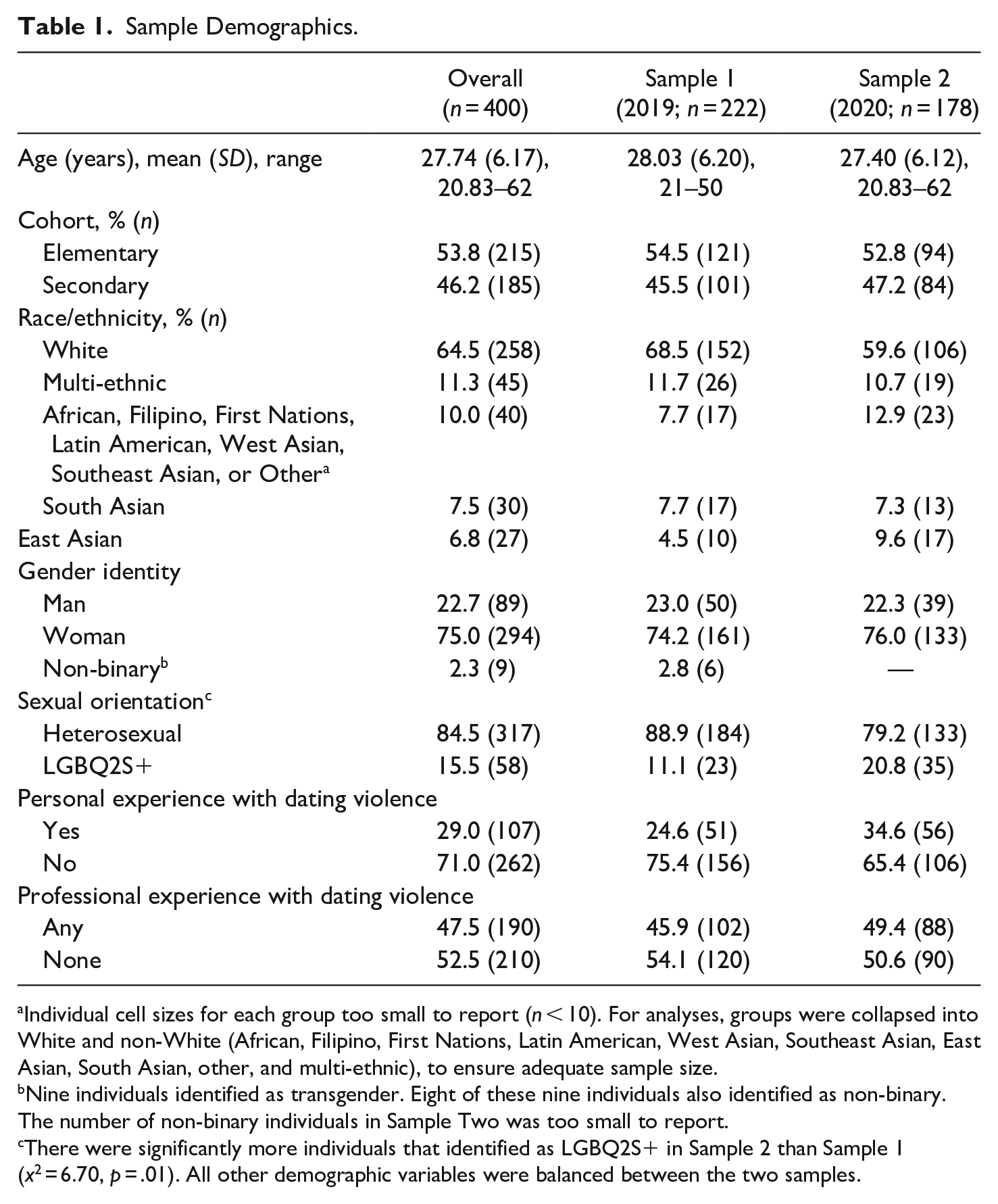
Individual cell sizes for each group too small to report (n < 10). For analyses, groups were collapsed into White and non-White (African, Filipino, First Nations, Latin American, West Asian, Southeast Asian, East Asian, South Asian, other, and multi-ethnic), to ensure adequate sample size.
Nine individuals identified as transgender. Eight of these nine individuals also identified as non-binary. The number of non-binary individuals in Sample Two was too small to report.
There were significantly more individuals that identified as LGBQ2S+ in Sample 2 than Sample 1 (x2 = 6.70, p = .01). All other demographic variables were balanced between the two samples.
Sample 1
Sample 1 included 222 participants. Sample 1 participants were surveyed in January 2019. Sample 1 was 74.2% female and 68.5% White, with a mean (SD) age of 28.03 (6.20; Table 1). Just under half (45.9%) had received any prior training on dating violence prevention.
Sample 2
Sample 2 included 178 participants. Sample 2 participants were surveyed in January 2020. Sample 2 was 76.0% female and 59.6% White, with a mean (SD) age of 27.40 (6.12; Table 1). Approximately half (49.4%) had received any prior training on dating violence prevention.
Procedures
The overall goal of the larger project from which these data are drawn was to assess whether participation in a new, mandatory comprehensive school health course was associated with improvements to comprehensive school-health related knowledge, attitudes, and beliefs. On the first day of the course in both 2019 and 2020, all students present were given the opportunity to participate in the course evaluation. The study was introduced to the class by the second author, who was not involved with course delivery or assessment. Course instructors and teaching assistants were out of the room during recruitment and survey completion. Students then completed research consent forms and baseline surveys (paper-and-pencil), taking approximately 20 minutes. During survey administration time, students could either: (1) complete the survey as research data if they had consented to this part of the project; (2) complete the survey for internal evaluation purposes only if they had not consented to this part of the project; or (3) do an alternate activity. Students who consented to participate in the research received a follow-up survey via email approximately 5 weeks later. Students who completed both the baseline and follow-up survey were entered in a draw to win 1 of 20 FitBits. Data for the present study are taken from the 2019 and 2020 baseline (pre-test) assessments only (i.e., before students received any training as part of the course).
Measures
Moral disengagement
The moral disengagement items for this study were adapted by the investigative team (see Acknowledgments) from the 21-item scale developed by Crooks et al. (2017) to assess responses to bullying behavior. To adapt items, references to bullying behavior were changed to indicate ADV victimization (e.g., “Being bullied at some point during the school year makes youth better equipped to handle tough situations in the future” became “Being a victim of dating violence at some point in adolescence makes youth better equipped to handle tough situations in the future”). Seven items from the original scale were dropped that were either more relevant to bullying behavior or did not load strongly on the original scale, leaving us with 14 items. The 14 items were reviewed with dating violence researchers on the investigative team for face validity. Items on the Moral Disengagement for ADV Prevention (MD-ADVP) scale are listed in Table 2. Moral disengagement items were asked of all respondents in both Samples 1 and 2.
Moral Disengagement for Adolescent Dating Violence Prevention (MD-ADVP) Scale Items.
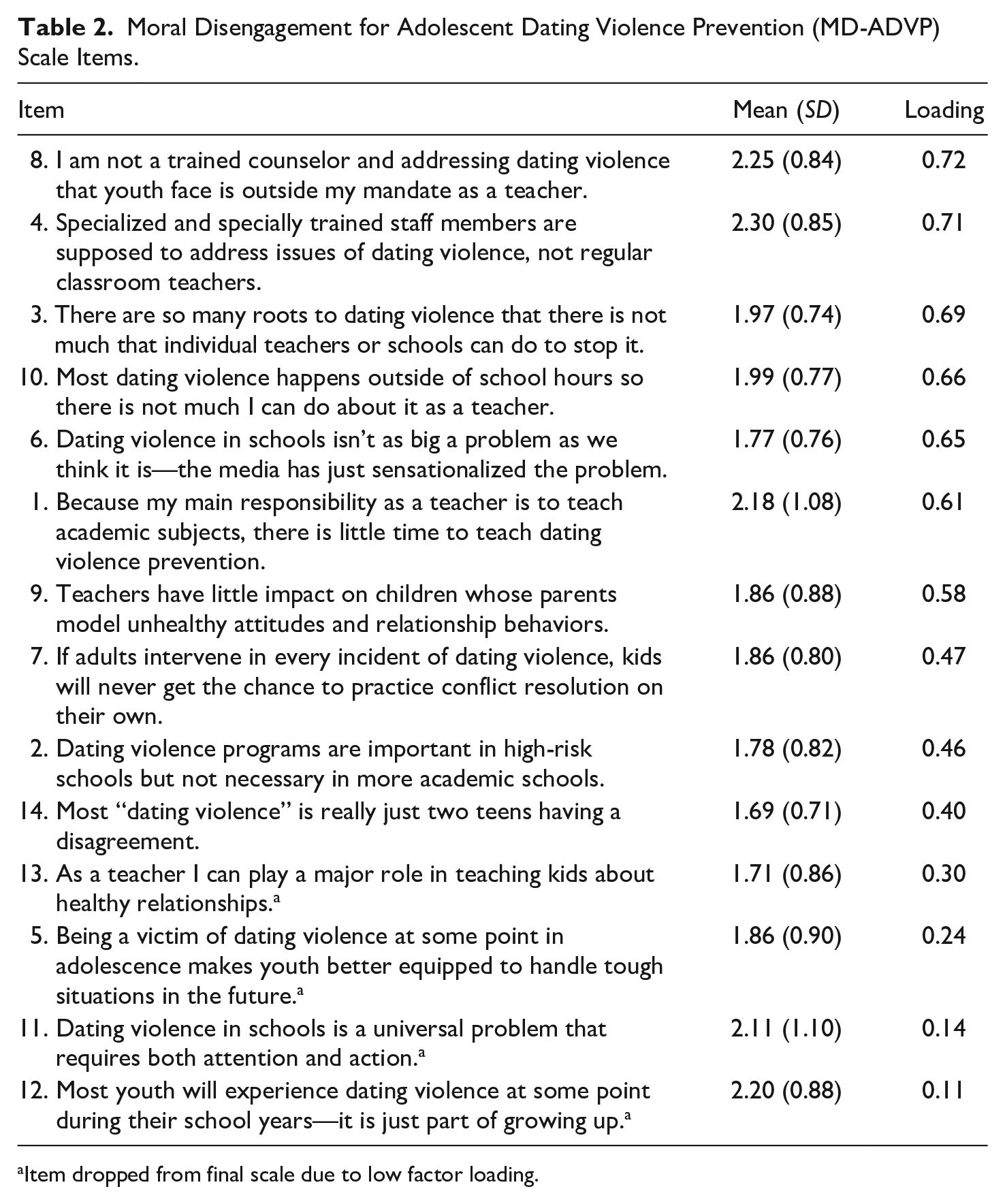
Item dropped from final scale due to low factor loading.
Adolescent dating violence prevention-related beliefs
To assess evidence of construct (convergent) validity, we included three measures of ADV prevention-related beliefs from the baseline survey. Items were developed by the investigative team (see Acknowledgments). Specifically, participants were asked (a) their beliefs about the importance of ADV prevention (e.g., “Dating violence prevention should be taught/discussed in high schools”; eight items, α = .90); (b) their beliefs about the perceived seriousness of ADV (e.g., “Physical violence and abuse in romantic relationships is a significant issue among adolescents in Canadian schools”; four items, α = .83); and (c) their self-efficacy to teach healthy relationships skills (e.g., “I am confident I can teach youth conflict resolution skills”; five items, α = .84). Items were answered from 1 = strongly disagree to 5 = strongly agree. Supplemental Material lists all items. Items are averaged, such that higher scores represent greater agreement with the scale topic. If teachers hold attitudes and beliefs that bullying is serious, they will be more likely to intervene; alternatively, if teachers do not see bullying as serious, they will be less likely to intervene (Blain-Arcaro et al., 2012; Kochenderfer-Ladd & Pelletier, 2008). Thus, we hypothesized that beliefs about the seriousness of ADV would also be important for teacher trainees’ potential preventive actions. Similarly, teacher trainees’ willingness to become involved in ADV prevention efforts may be associated with the belief that ADV prevention programs are needed in schools. Indeed, hundreds of studies have highlighted the importance of this belief for a variety of prevention approaches (Durlak & DuPre, 2008; Fixsen et al., 2005; Forman et al., 2012). Finally, self-efficacy (how confident teachers are in their ability to talk with students about healthy relationships) is another important prevention construct. Specifically, if teachers have higher levels of self-efficacy to teach healthy relationships skills, they may be more willing to become involved in preventive efforts, as is the case for bullying (Greytak & Kosciw, 2014). ADV prevention-related beliefs items were asked of individuals in the secondary (grades 7–12) specialization track only in both Samples 1 and 2.
Weight bias
To assess evidence of construct (divergent) validity, we included a measure assessing weight bias, a construct we hypothesized would be unrelated to the MD-ADVP. We used the Universal Measure of Bias-Fat version (UMB-Fat; Latner et al., 2008) to assess weight bias. The UMB-Fat is comprised of 20 statements that measure participant attitudes toward individuals in larger bodies. For our study, we adapted the language to person-first language (i.e., by changing the phrase “fat people” to “individuals with obesity”). Items (e.g., “People with obesity tend toward bad behavior”) were rated on a scale where 1 = strongly agree to 7 = strongly disagree (α = .90). Items are summed, and higher scores on the UMB-Fat indicate greater weight bias (i.e., more negative attitudes toward individuals living in larger bodies). The UMB-Fat has demonstrated evidence of convergent validity and internal consistency reliability (Latner et al., 2008; Puhl et al., 2014). This scale was asked of all respondents in both Samples 1 and 2.
Demographics
To explore demographics, we collected data from all participants in both samples on race/ethnicity (using Statistics Canada categories); gender identity (man, women, non-binary, and/or transgender/genderqueer/genderfluid); sexual orientation (straight/heterosexual, gay/lesbian, bisexual, queer/pansexual/polysexual, two-spirited, questioning, prefer not to disclose); personal experience with physical and/or sexual dating violence (e.g., have experienced violence in their own romantic relationships, current, or past); and professional experience with physical, sexual, and/or electronic dating violence (e.g., have received training, have worked as a crisis center volunteer).
Analyses
Aim 1
We first aimed to identify the factor structure of the moral disengagement items by conducting exploratory factor analysis (EFA) and parallel analysis in R, using Sample 1 data. Given that items were adapted from a unidimensional measure assessing moral disengagement for bullying, we hypothesized the items assessing moral disengagement for ADV prevention would also be unidimensional. However, we explored one, two, three, and four factor solutions using parallel analysis, as the items may theoretically tap into the previously mentioned components of moral disengagement. If any subscales were to emerge, they would likely be related to one another; thus, we ran EFA under oblique rotation (Pedhauzer & Schmelkin, 1991). To decide on the optimal factor structure, we used data from the parallel analysis (Costello & Osborne, 2005). The factor structure that contained eigenvalues from the actual data (the sample correlation matrix) that were larger than the 95th percentile from the random data eigenvalues (the parallel analysis) was the factor structure that was retained.
Aim 2
To cross-validate the factor structure, we conducted confirmatory factor analysis (CFA) in R under maximum likelihood estimation using Sample 2 data. We used the Chi-Square test of model fit (χ2/df), the comparative fit index (CFI; Bentler, 1990), the Tucker-Lewis index (TLI; Tucker & Lewis, 1973), the standardized root mean square residual (SRMR; Jöreskog & Sörbom, 1981), and the root mean square error of approximation (RMSEA) as indicators of goodness of fit. Adequate model fit is indicated by CFI and TLI ≥ .95, SRMR ≤ .08, RMSEA ≤ .06 and χ2/df < 2.0 (Hu & Bentler, 1998; Marsh et al., 1988).
Aim 3
We next examined whether the factor structure identified in Aims 1 and 2 held by gender and race/ethnicity using multi-group CFA with Sample 2 data. Though we originally planned to also conduct multi-group CFA by sexual orientation, we were unable to as the sample size for those who identified as LGBQ2S+ was too small (n = 58). We hypothesized that the MD-ADVP factor structure would hold across gender and racial/ethnic groups. We used χ2/df, CFI, TLI, SRMR, and the RMSEA as indicators of goodness of fit.
Aim 4
To assess reliability evidence for the MD-ADVP, we calculated internal consistency reliability (Cronbach’s alpha) for the final factor structure. To assess convergent validity evidence for the MD-ADVP, we examined bivariate correlations between scores on the (a) MD-ADVP and (b) ADV prevention-related beliefs scales (importance of ADV prevention; perceived seriousness of ADV; self-efficacy to teach healthy relationships skills). Based on past research (Crooks et al., 2017), we hypothesized that MD-ADVP scores would be moderately and negatively (r = −.30) correlated with beliefs about seriousness and importance, and strongly and negatively (r = −.50) correlated with self-efficacy to teach healthy relationships skills scores. Specifically, we hypothesized that teacher trainees who exhibited less moral disengagement for ADV prevention would also report that ADV prevention is more important, report a greater perceived seriousness of ADV, and report a higher level of ADV prevention self-efficacy. To assess discriminant validity evidence, we examined bivariate correlations between MD-ADVP scores and weight bias scores. We did not expect that concerns about weight would be related to moral disengagement for ADV prevention, and thus hypothesized small (r < |.10|) and nonsignificant associations between weight bias scores and scores on the MD-ADVP.
Results
Sample Descriptives
Detailed sample descriptives are presented in Table 1. Overall, the sample was fairly evenly split between elementary (53.8%) and secondary (46.2%) teacher trainees. The majority of teacher trainees in our sample identified as White (64.5%), female (75.0%), and heterosexual (84.5%). Approximately half of the teacher trainees in our sample (47.5%) had some sort of professional experience with dating violence (e.g., attending workshops on dating violence) and approximately one in four (29%) had personal experience with dating violence. There were no significant differences between Samples 1 and 2 on any of the descriptive variables, with the exception of sexual orientation. Specifically, teacher trainees in Sample 2 were more likely to identify as LGBQ2S+ as compared to teacher trainees in Sample 1 (χ2(1, 375) = 6.70, p = .01).
Aim 1: Exploratory Factor Analysis
To identify whether teacher trainees’ moral disengagement scores were unidimensional (as hypothesized), we conducted an exploratory factor analysis (EFA) in R using Sample 1 data. The Kaiser, Myer, Olkin (KMO) measure of sampling adequacy suggested the data were appropriate for factor analysis (KMO = 0.85). Furthermore, Bartlett’s test of sphericity suggested there was significant correlation in the data for factor analysis (χ2 = 787.20, p < .001). Thus, we proceeded with EFA. We used promax rotation to explore factor solutions ranging from one to four, and used parallel analysis to determine the optimal factor structure. In this analysis, the adjusted eigenvalues for a one factor solution were larger than the random eigenvalues for a one factor solution. However, adjusted eigenvalues for a two, three, or four factor solution were not larger than the random eigenvalues for the respective solution. This indicated that a one factor solution best fit the data, supporting our hypothesis that teacher trainees’ moral disengagement scores would be unidimensional. A closer inspection of factor loadings suggested that four items should be removed as they loaded at a value <.32 (Table 2; a factor loading <.32 indicates less than 10% of variance was explained by the variable; Pituch & Stevens, 2016). Thus, the final MD-ADVP scale was one factor with 10 items (α = .81; Table 2). The mean (SD) score on this scale was 1.98 (0.51), with a range of 1 to 3.70 (on a scale were 1 = strongly disagree and 5 = strongly agree). Based on both visual inspection and skewness and kurtosis values, the scale was approximately normally distributed (skewness (SE) = .14 (.12); excess kurtosis (SE) = −0.095 (0.24)).
Aim 2: Confirmatory Factor Analysis
To further assess the factor structure identified using Sample 1 data, we conducted confirmatory factor analysis (CFA) in R using Sample 2 data on the one-factor structure. As shown in Figure 1, all items loaded onto the latent variable. Model fit indices were adequate (χ2 = 118.61, p < .001; CFI = .78; TLI = .71; SRMR = .09; RMSEA = .12). Based on this and the results of the EFA, we used the one-factor structure to explore Aims 3 and 4.
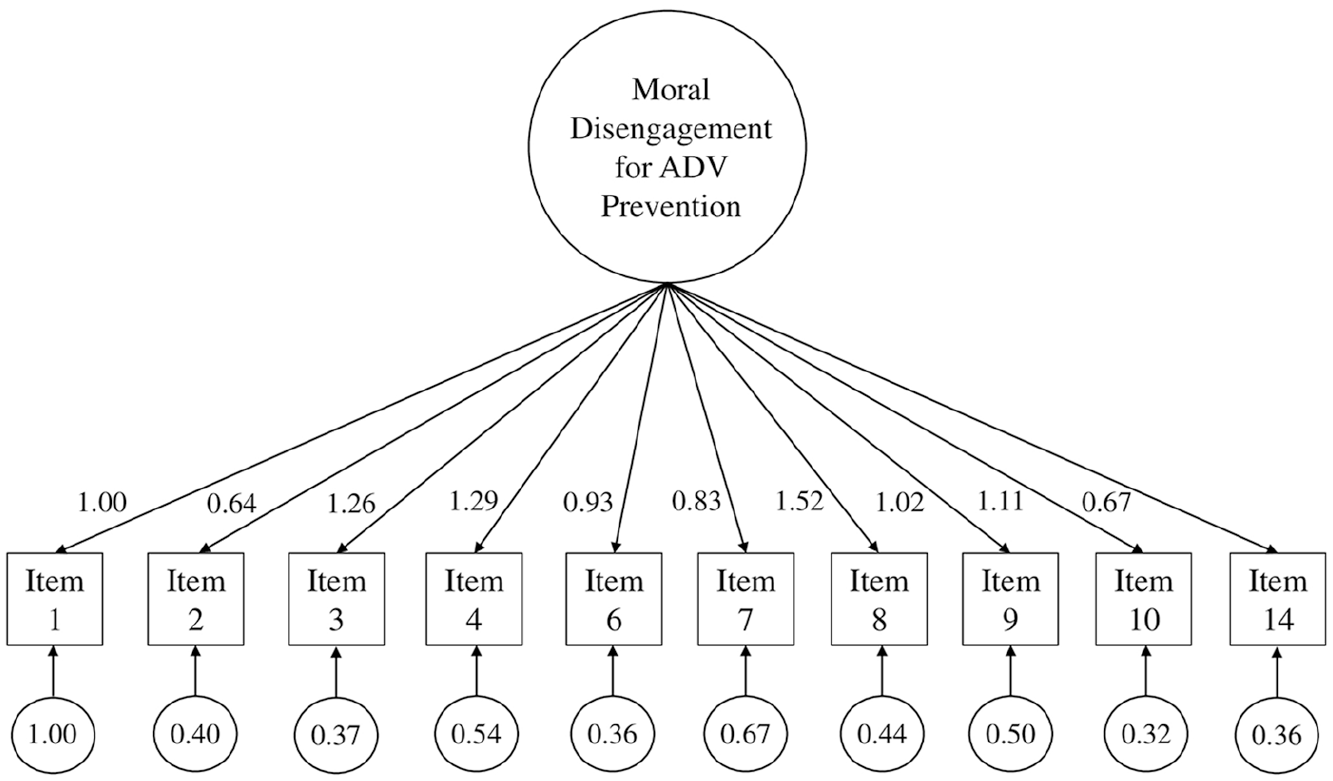
Confirmatory factor analysis for the moral disengagement for ADV Prevention (MD-ADVP) scale.
Aim 3: Examining Factor Structure by Gender and Racial/Ethnic Group
We next examined whether the one-factor structure held by gender (male vs. female—we were unable to include non-binary and/or transgender/genderqueer/genderfluid participants in this analysis due to small sample size) and race/ethnicity (White vs. non-White), by conducting separate CFAs for each group. As hypothesized, we found that the unidimensional factor structure with 10 items held for teacher trainees by gender and race/ethnicity. Model fit indices were adequate for females (χ2 = 115.52, p < .001; CFI = .88; TLI = .85; SRMR = .06; RMSEA = .09) and males (χ2 = 94.56, p < .001; CFI = .79; TLI = .74; SRMR = .10; RMSEA = .14), and for individuals who identified as White (χ2 = 143.989, p < .001; CFI = .84; TLI = .79; SRMR = .07; RMSEA = .11) and non-White (χ2 = 63.12, p < .01; CFI = .91; TLI = .89; SRMR = .07; RMSEA = .08).
Aim 4: Reliability and Validity Evidence
Internal consistency reliability for the final, one-factor scale with 10 items was good (α = .81; Kline, 2000). To provide evidence of convergent validity, we examined bivariate correlations between participant’s scores on the MD-ADVP and scores on scales assessing (a) the importance of ADV prevention, (b) the perceived seriousness of dating violence, and (c) self-efficacy to teach healthy relationships skills. Our hypotheses that moral disengagement would be significantly and negatively associated with all of these constructs were confirmed (Table 3). In addition, we hypothesized that MD-ADVP scores will be moderately and negatively (r = −.30) correlated with beliefs about seriousness and importance, and strongly and negatively (r = −.50) correlated with self-efficacy. However, we found that MD-ADVP scores were instead moderately and negatively correlated with self-efficacy scores (r = −.40; Table 3), and strongly and negatively correlated with scores on scales about seriousness and importance (r = −.50 for both scales; Table 3).
Correlations Between MD-ADVP and Adolescent Dating Violence Prevention-Related Beliefs Scales.
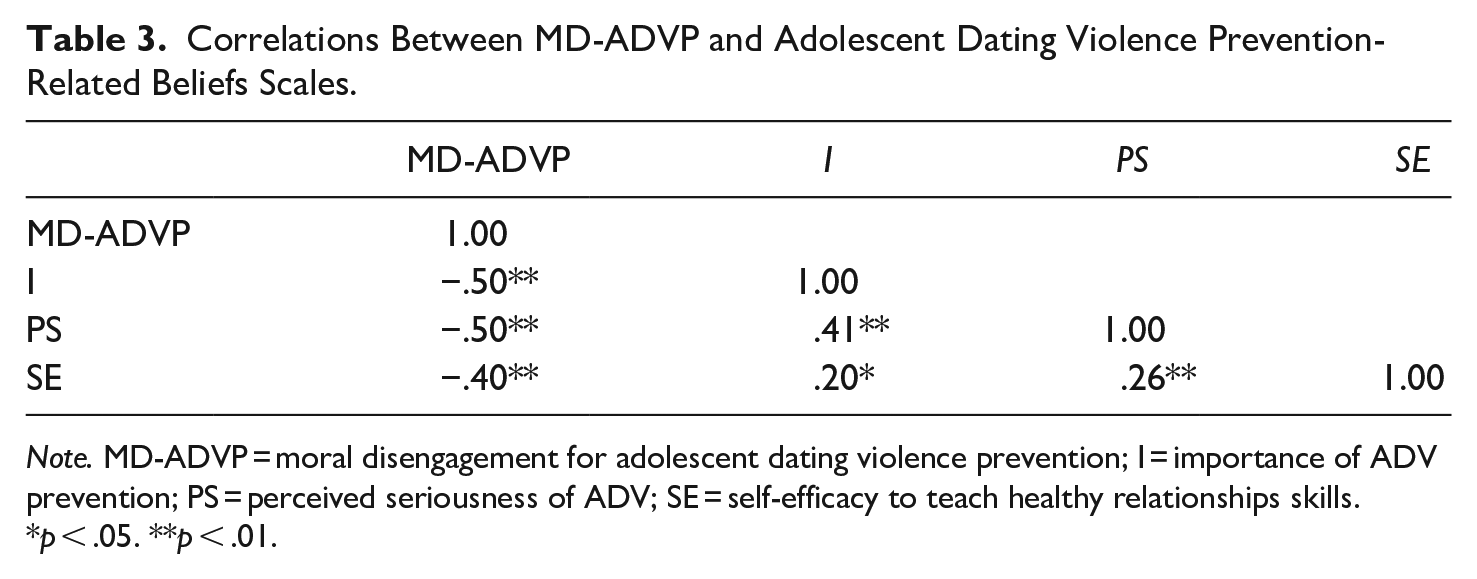
Note. MD-ADVP = moral disengagement for adolescent dating violence prevention; I = importance of ADV prevention; PS = perceived seriousness of ADV; SE = self-efficacy to teach healthy relationships skills.
*p < .05. **p < .01.
To provide evidence of divergent validity, we examined bivariate correlations between moral disengagement and a construct thought to be unrelated (weight bias). As hypothesized, we found a small (r < |.10|) and nonsignificant association between scores on these two measures (r = −.04, p = .43).
Discussion
Teachers are key to the implementation of school-based ADV prevention efforts, yet little is known about their willingness to engage in this work, either before or once they are in the classroom. In part, this is due to the lack of any psychometrically-evaluated measures that assess aspects of willingness, such as moral disengagement (i.e., a cognitive process by which individuals justify their reasons for doing [or not doing] something; Bandura, 2002). Although moral disengagement has been explored as it pertains to bullying prevention, no prior work has examined the implications of moral disengagement for ADV prevention. This paper aimed to address this key gap by reporting on a new 10-item scale—the Moral Disengagement for ADV Prevention (MD-ADVP) scale—and examining internal consistency reliability and construct validity evidence for this scale in two samples of teacher trainees.
In exploratory factor analysis (Aim 1), we found a 10-item, unidimensional structure for the MD-ADVP. This was in line with our hypothesis, as the scale our measure was adapted from also fit a one-factor structure. The fit of this one-factor structure as explored using CFA was adequate (Aim 2). Because CFA fit values depend on sample size, and the size in our CFA sample was fairly small (n = 178), we hypothesize that the lower fit statistics are a result of this smaller sample size. Thus, further testing of this scale with a larger sample is warranted. Fit of the one-factor structure was also similar by gender (male vs. female) and racial/ethnic group (White vs. non-White; Aim 3).
Finally, we aimed to provide evidence of reliability and validity for the MD-ADVP (Aim 4). Evidence of internal consistency reliability was assessed for the one-factor structure using Cronbach’s alpha, indicating good reliability (α = .81), especially given the short length of the scale (Kline, 2000). Skewness and kurtosis values also indicated an approximately normal distribution of scale scores. We assessed evidence of validity for the one-factor structure by examining construct validity (convergent and divergent). We found strong evidence of both, such that scale scores correlated as anticipated with ADV prevention-related beliefs items, but not with a measure of weight bias. For convergent validity, we found a strong and inverse level of association between scores on the MD-ADVP and scores on scales tapping the importance of ADV prevention and perceived seriousness of ADV, and a moderate and inverse level of association between scores on the MD-ADVP and scores on a scale assessing self-efficacy to teach healthy relationships skills. Because moral disengagement and self-efficacy are related constructs (Hinrichs et al., 2012), we had anticipated a stronger correlation between scores on the MD-ADVP and scores on the self-efficacy to teach healthy relationships scale. It is possible the correlation was only moderate because scores on the self-efficacy scale had a broader focus on healthy relationships (e.g., “I am confident I can teach youth conflict resolution skills”), while items on the MD-ADVP are more narrowly focused on ADV specifically.
Limitations
Our study has several limitations. First, while a strength of the study is the use of two independent samples, the sample size in both was somewhat small. Both samples were also primarily White and female; however, multi-group confirmatory factor analysis indicated the scale had similar fit by racial/ethnic group and gender, which may somewhat address this concern. We were, however, not able to assess scale fit by sexual orientation due to the small sample size, which is a further limitation as participants in Sample 2 were significantly more likely to identify as LGBQ2S+ as compared to participants in Sample 1. Future testing with more diverse samples of teacher trainees is thus needed. In terms of reliability evidence, as this study used baseline data from a within-groups (i.e., no comparison group) evaluation project, we were only able to assess internal consistency reliability, and not test-retest reliability. An investigation of predictive validity (e.g., if MD-ADVP scores predict implementation of ADV prevention tools) would also be useful.
In an ideal situation for evaluating convergent validity, there is a well-established body of literature showing what other constructs (with established measures) should be associated with the measure of interest (Furr, 2018). However, since the investigation of adults’ beliefs and attitudes toward ADV prevention is so new, there were no established measures available to us to assess convergent validity. Thus, we had to use a measure created by the investigative team that had not itself been tested. While this is a limitation, the ADV items used for convergent validity analysis in this study were reviewed by school-based ADV prevention experts for face validity, and also demonstrated adequate internal consistency reliability.
In sum, given these limitations, we acknowledge this study is a first step in assessment of the MD-ADVP, and that future research needs to be conducted to establish other empirically validated tools that assess ADV prevention attitudes among diverse adults. Finally, while it is useful to assess and target willingness of teacher trainees to engage in ADV prevention, it is also critical to understand how the measure performs with in-service teachers (i.e., those who are in the classroom and actively teaching). Thus, evaluation of the MD-ADVP with in-service teachers is also needed.
Research Implications
The results of the current study suggest the MD-ADVP is unidimensional. However, theory suggests that moral disengagement consists of four separate, but related, constructs (i.e., euphemistic labeling, disregarding consequences, displacement of responsibility, diffusion of responsibility). Thus, future research could explore whether additional items could be added to the MD-ADVP to identify a robust four-factor solution that taps into these potential subscales. By doing so, future research could investigate which components are most important in predicting intentions and behaviors as it pertains to the implementation of ADV prevention efforts. Finally, future research is needed to test the predictive validity of the MD-ADVP, and to establish reliability and validity evidence in more racially/ethnically and gender diverse samples and with in-service teachers.
Relevance to School Psychology
Although it is the role of school psychologists to intervene with students, they often rely on teachers to know which students need help, and to implement Tier 1 supports. Indeed, many school-based universal ADV prevention programs are implemented by teachers (e.g., Edwards et al., 2021; Edwards, Rodenhizer, et al., 2020; Niolon et al., 2019). Willingness to engage in ADV prevention is a construct that is likely amenable to change and is also a predictor of teacher trainees’ future adoption and implementation of ADV prevention resources (Crooks et al., 2017). Thus, school psychologists could use the MD-ADVP as part of needs and/or readiness assessments, prior to ADV prevention program implementation. Assessing readiness for intervention implementation is critical to successful prevention program roll-out (Fixsen et al., 2005). School psychologists can also contribute to future use and testing of this scale in violence prevention program evaluations that involve teachers and teacher trainees.
Footnotes
Acknowledgements
We would like to thank the participating teacher trainees, and the research assistants who supported this project. Thanks to Claire Crooks, PhD and Wendy Craig, PhD for their contributions, as well as the other members of the project co-investigative team (Dr. Melanie Dirks, Dr. Brett Holfeld, Dr. Shelley Hymel, Dr. Chiaki Konishi, Dr. Darren Lund, Dr. Alexa Martin-Storey, and Prof. Lana Wells).
Author Note
All ethical guidelines were followed as required for conducting human research.
Declaration of Conflicting Interests
The author(s) declared no potential conflicts of interest with respect to the research, authorship, and/or publication of this article.
Funding
The author(s) disclosed receipt of the following financial support for the research, authorship, and/or publication of this article: This research was supported in part by funding from the Public Health Agency of Canada (1718-HQ-000788).
