




Abstract
School psychologists serve the learning needs of students through assessment, intervention, and consultation. The school psychologist can often be the only mental health professional who travels into rural communities. In an effort to adapt to this context of clinical isolation, rural school psychologists develop specialty competencies to serve their clients. This study explores the competencies required among school psychologists practicing in rural regions of Saskatchewan. Eight rural school psychologists participated in a thematic Delphi process to describe the competencies needed in rural school psychology. The participants engaged in three rounds of data collection and collective data analysis and arrived at a strong level of agreement on the final outcomes. The findings describe rural school psychology knowledge (i.e., community knowledge, generalist knowledge, and system knowledge), skills (i.e., relationship skills, core psychologist skills, efficiency skills, and communication skills), attitudes (i.e., flexibility, openness, and compassion), and behaviors (i.e., being responsive, being empowering, being available, and being procedural). The present study results contribute to better defining and understanding the multiple roles and practices of rural school psychologists. Recommendations of the study invite psychologists, clinical supervisors, and psychology training programs to incorporate an emphasis on interpersonal relationships, a generalist approach to psychological services, and consider creative practices of rural practitioners to the initial training and ongoing professional development of school psychologists.
The practice of school psychology is challenging, as psychologists are often expected to have a wide range of areas in which they are clinically competent (Harowski et al., 2006). Specifically, they must have broad knowledge, skills, attitudes, and behaviors (KSABs) to be effective. School psychologists support the learning needs of students in a multitude of ways, including conducting psychological assessments, assisting with program development, informing intervention services, and providing consultation to staff who work with diverse students (Saklofske et al., 2007). The provision of school psychology services is further complicated in rural contexts. Rural schools, while having the same need for supports for students (Edwards & Sullivan, 2014), have fewer mental and behavioral health specialists practicing locally (Malone, 2012), impacting on both the students themselves and resulting in school psychologists not having access to local and in-person collegial support who work in a similar context. To date, the complexities of the practices of rural school psychologists have not been examined in depth, be it in terms of the nature, scope, and professional context of their work.
Literature Review
School psychologists are trained to support the learning needs of students within the context of schools and other institutions of learning (National Association of School Psychologists [NASP], 2010). While this may seem straightforward at first, the practice of school psychology includes elements from multiple disciplines within psychology, including educational psychology (e.g., the psychology of learning); developmental psychology (e.g., how individuals change and adapt through the lifespan); clinical psychology (e.g., assessment of and intervention for psychopathology); counseling psychology (e.g., intervention to produce change); community psychology (e.g., creating psychologically healthy environments); and behavioral psychology (e.g., assessment and intervention of observable behavior; NASP, 2010; Saklofske et al., 2007; Sheridan & Gutkin, 2000). Some believe that school psychologists are defined by where they work rather than how they were trained (Johnson & Zwiers, 2016). However, given the generalist nature of the training offered to school psychologists, psychologists trained within school psychology paradigms are also found to be working in health regions, private practice, government, industry, and correctional systems (Saklofske et al., 2007). While many may consider assessment the only function of the school psychologist (Johnson & Zwiers, 2016), the school psychologist has a generalist capacity to be proactive in the betterment of learning and mental health issues through intervention and consultation (Corkum et al., 2007; Johnson & Zwiers, 2016), and in supporting the needs of both exceptional and typically developing learners. School psychologists support individuals toward their goals (e.g., academic, vocational, social, or personal) and, therefore, need to be incredibly versatile in the services they can provide, making them ideal for working within rural contexts. For this reason, several researchers have explored the issues that underlie psychology in rural settings (Campbell & Gordon, 2003; Clopton & Knesting, 2006; Curtin et al., 2016; Edwards & Sullivan, 2014; Goforth et al., 2017; Harowski et al., 2006; Malone, 2012; Osborn, 2012; Owens et al., 2013; Pelling & Butler, 2015; Schank et al., 2010; Sutherland & Chur-Hansen, 2014; Sutherland et al., 2017; Wihak & Merali, 2007).
How one defines a rural area is the subject of some debate (Edwards & Sullivan, 2014; Goforth et al., 2017), and consensus has not been reached in the literature. Statistics Canada provides limited guidance on the issue, indicating that a rural town or village is any that has a population of less than 10,000, having a postal code where the second digit is “0” (i.e., indicating no direct postage available), or be considered a non-metropolitan region if living outside an urban center of 50,000 people or more (du Plessis et al., 2001). Thus, depending on the metric used, the rural population of Canada is estimated at between 22% and 38% of Canada’s population, and within Saskatchewan, between 37% and 62% (du Plessis et al., 2001). Given the difficulty of defining rural, it also stands to reason those rural regions are diverse across geographies, populations, sociocultural factors, sustainability, student success, and public health (Edwards & Sullivan, 2014). The differences can be stark if considering rural across comparisons to urban, suburb, town, rural fringe (e.g., near a center of 10,000), rural distant (e.g., within driving distance of a center of 10,000), or rural remote (e.g., fly-in or ice-road communities; Edwards & Sullivan, 2014; Sutherland et al., 2017). As such, what is considered within research contexts as “rural” is self-declared primarily by the researcher and the respondents (Malone, 2012).
Within the existing rural school psychology literature, three overarching recurring themes are (1) isolation (both social isolation as well as isolation from the psychological community); (2) role confusion (including ethical dilemmas); and (3) burnout (limited access to supports for both the psychologist and the client; Hargrove, 1986; Owens et al., 2013). The issue of isolation relates to the lack of other mental health practitioners whose duties overlap with those of the rural school psychologist to provide additional support to clients. Isolation also refers to the social isolation that can occur when a school psychologist enters a tight-knit community as a newcomer (Edwards & Sullivan, 2014; Pelling & Butler, 2015). Isolation is mainly problematic for practitioners in two ways. First, it means little or no professional support of colleagues, which is important for any psychologist’s or healthcare practitioner’s wellbeing. As well, being the sole, or indeed one of very few, healthcare professionals in a rural area can lead to community expectations that one psychologist be all things to all people, which, in turn, can quickly lead to role confusion and even burnout. Rural psychologists often serve in a position of authority within a rural community, and being sought out for advice on all manners of psychological issues (Campbell & Gordon, 2003) can result in “rural psychologists [having] a higher tolerance for blurring of personal and professional boundaries” (Campbell & Gordon, 2003, p. 432), or perhaps providing a service to a client in an area where they do not have sufficient competency. Subsequently, burnout is often experienced by rural psychologists (Samios, 2017) in addition to precarity in terms of their ethical obligations. The relative age and experience level of rural psychologists are low, given high turnover within the discipline in general and, despite reporting a reasonable level of job satisfaction, (Goforth et al., 2017; Perkins et al., 2007), many psychologists leave work in rural areas after a relatively short time engaged in such practice.
Thus, this present study seeks to extend the present literature by exploring and describing the specialized competencies required by rural school psychologists. Through this exploration, this research will identify in which ways the practice of rural school psychology is unique and connects within the broader field of psychology; identify the competencies highlighted within rural school psychology contexts; and consider ways that rural school psychologists attain, maintain, and sustain clinical competency over their careers. In this way, addressing the concerns regarding issues of isolation, role confusion, and burnout that continue to be prevalent among rural school psychologists.
Method
A collective case study (Schram, 2006; Yin, 2014) was employed in order to explore how clinical competency is identified and described within the defined bounded system of rural school psychologists who practice in Saskatchewan. A collective case study involves examining multiple cases and then subsequently drawing learnings from the collection of cases to more fully understand a phenomenon from a variety of perspectives (Goddard, 2010). The present study explored how this collective group described the competencies required of rural school psychologists. More specifically, competencies are the knowledge, skills, attitudes, and behaviors (KSABs) needed to be a proficient practitioner. Through a novel Delphi analysis process (Barker, 2020), the participants developed a consensus construction of the KSABs required of competent rural school psychologists.
Case studies are used when the study is defined by its focus on an “individual event, activity, episode, or other specific phenomena” (Schram, 2006, p. 106). A case study format allows for a more adaptive design (Yin, 2014) and a more varied grouping of data collection and analysis methods. Suter (2012) suggested that a case study approach is useful when a particular condition is evident or access to sufficient information on a particular case is available, which is consistent with the context of the present study. Case studies “describe the real-life context in a causal chain, illustrate specific constructs, and illuminate a situation when outcomes are not clear” (Suter, 2012, p. 366). Case studies provide a detailed description of the setting and the case itself. While the findings of case studies are not directly generalizable (McKellar et al., 2014), they can be applied to the degree to which others use the ideas presented within the studies and, as Suter (2012) pointed out, “usefulness may be more important for case studies than wide generalization” (p. 266). Case studies can also allow for research questions to be explored within a particular setting or context and can often facilitate testing of theory (Suter, 2012). The reflexive and reflective nature of case studies allows for a research design that can adjust to the research context.
For the present study, participants engaged in 1:1 interviews with the lead investigator, who was also a practicing school psychologist from a rural region at the time of the study. A semi-structured interview format was utilized. The questions used for the present study are outline in Table 1. The interviews were conducted in-person whenever possible, with the lead investigator traveling to the participant whenever possible. When not possible, interviews were conducted by phone (two of eight interviews were conducted by phone). The interviews were audio recorded, and transcribed for analysis purposes. The interview data was analyzed using NVivo version 12 software (QSR International Pty Ltd., 2018).
Interview Questions.
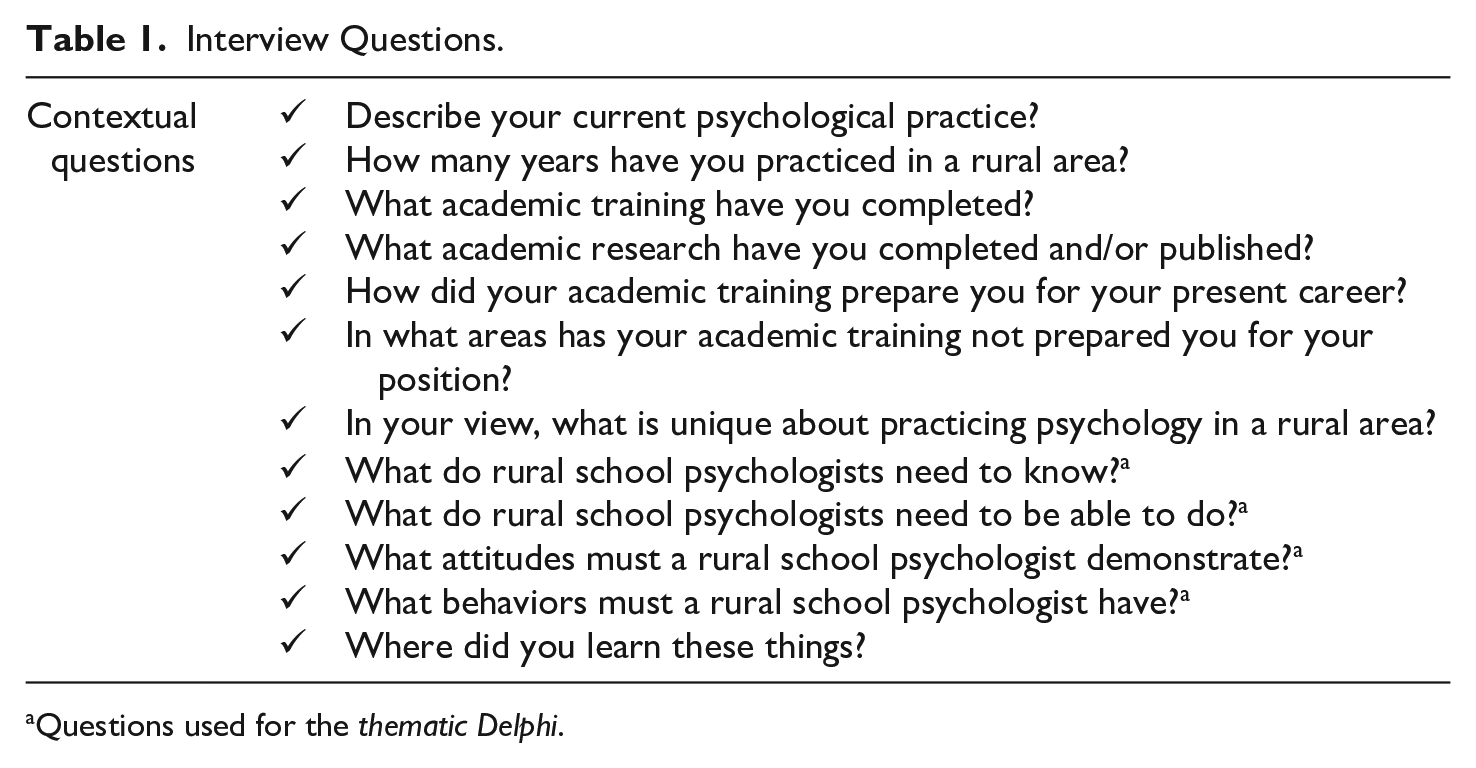
Questions used for the thematic Delphi.
Analysis Procedures
The research responses were analyzed using a hybrid of two analysis procedures. Following the individual interviews, the first form of analysis was qualitative content and thematic analysis, which is an effective strategy in qualitative research (Braun & Clarke, 2006; Creswell & Creswell, 2017; Sandelowski, 2000). During the interview process, meanings were generated through candid discussions between professional colleagues. These meanings were distilled into statements about clinical competency in the practice of rural school psychology.
The second form of analysis involved the participants developing and expanding on the statements generated in the first phase. Previous research examining the competency of psychologists (i.e., Atkinson et al., 2015) employed the Delphi method of analysis. In this method, the same questions are asked of a panel of experts (Hasson et al., 2000; Powell, 2003), and the responses are used to structure group discussion and consensus development among the said group of experts (Goodman, 1987). An integral component of the Delphi technique involves providing each expert with the anonymized responses of the other experts in an effort to eliminate interpersonal biases. According to Hasson et al. (2000), the Delphi method bases its validity on the notion that it is more likely that many people will get the right answer instead of the wrong one. The current study did not employ a traditional Delphi, but rather a modified version that was focused on expansion and exploration of themes and concepts rather than distilling to consensus response the individual answers to the research questions. This approach, which the researcher has termed Thematic Delphi Analysis (Barker, 2020), combines the steps of thematic analysis with a group approach that is manageable and workable within a group of professionals. The Delphi method used in the present study involved three phases of review and feedback: (1) transcript and thematic review (i.e., participants reviewing their own transcripts and initial thematic review completed by the researcher); (2) theoretical review (i.e., participants reviewing the themes generated by all participants and providing feedback); and (3) consensus review (i.e., participants reviewing the final themes and indicating their level of agreement). At each stage of the Delphi review, the participants were asked if they wished to remove, add, or change any response. As the purpose of the Delphi review was to come to the most comprehensive response, requests for removals (beyond the initial transcript and thematic review) were treated as disagreements.
Participants
The research took place in Saskatchewan, Canada. Saskatchewan is an ideal context to begin an exploration of rural psychology given its large geographic area (588,244 km2), roughly the same size as France, and relatively small population (1.1 million) comparable to many major cities in North America (Statistics Canada, 2017a, 2017b). Roughly half of the population lives outside of the major urban centers of Saskatoon and Regina (Statistics Canada, 2017b). The agricultural and natural resource economic history has resulted in the development of 420 communities (i.e., cities, towns, and villages outside of the major urban areas; Hall & Olfert, 2015), where 561 of the 771 provincially funded schools are located (Government of Saskatchewan, 2017). Saskatchewan also has the largest road network (26,211 km) per capita in Canada (Ministry of Highways and Infrastructure, 2019), with which rural psychologists are familiar as they travel from one site to another in the region they serve. Saskatchewan is significantly rural, and as such, an ideal context to study rural opportunities and challenges. For the purposes of this study, rural was considered to include communities outside of the two major urban centers of Saskatoon and Regina. At the time of this research, there were 547 psychologists practicing in Saskatchewan, with 35% declaring practices in a rural context and 45% of psychologists in Saskatchewan practicing in school psychology (Saskatchewan College of Psychologists, 2018). While the specific data was not available, it was estimated that there were approximately 85 rural school psychologists practicing in Saskatchewan at the time of the research study. Invitations to participate in this study were sent to all members of the Saskatchewan College of Psychologists and the Psychology Association of Saskatchewan. Fifteen (15) individuals indicated interest in participating. Purposive sampling was utilized to approximate a representative sample across geographic location, practice area (in schools, health regions, private practice), and stage of career.
The present case included eight psychologist-participants from across Saskatchewan: three (3) from Southwest Saskatchewan, one (1) from Southeast Saskatchewan, three (3) from Northwest Saskatchewan, and one (1) from Northeast Saskatchewan. One participant worked in multiple settings (i.e., private practice and school). Overall, 63% (n = 5), worked in school settings, 25% (n = 2) worked in health settings, and 25% (n = 2) worked in private practice. The average years of practice were 7.1 years (SD = 7.14) with a range of 1 to 22 years of practice. In terms of service delivery, 100% (n = 8) of the sample indicated that they provided assessment services, 50% (n = 4) provided counseling services, 38% (n = 3) provided some form of behavioral intervention services, and 25% (n = 2) provided consultation services.
In terms of academic background, all participants had a Master of Education degree. Only 1 (13%) of the participants held a Bachelor of Education degree, and the rest had Bachelor of Arts degrees in Psychology (88%; n = 7). Thus, only one school psychologist had teaching experience prior to becoming a psychologist. Most participants had completed graduate research (75%; n = 6) related to topics which include: bullying and cyberbullying anxiety and perfectionism, decision making, sex offenders, grade retention, career education and transitions, and working with minority groups.
Results
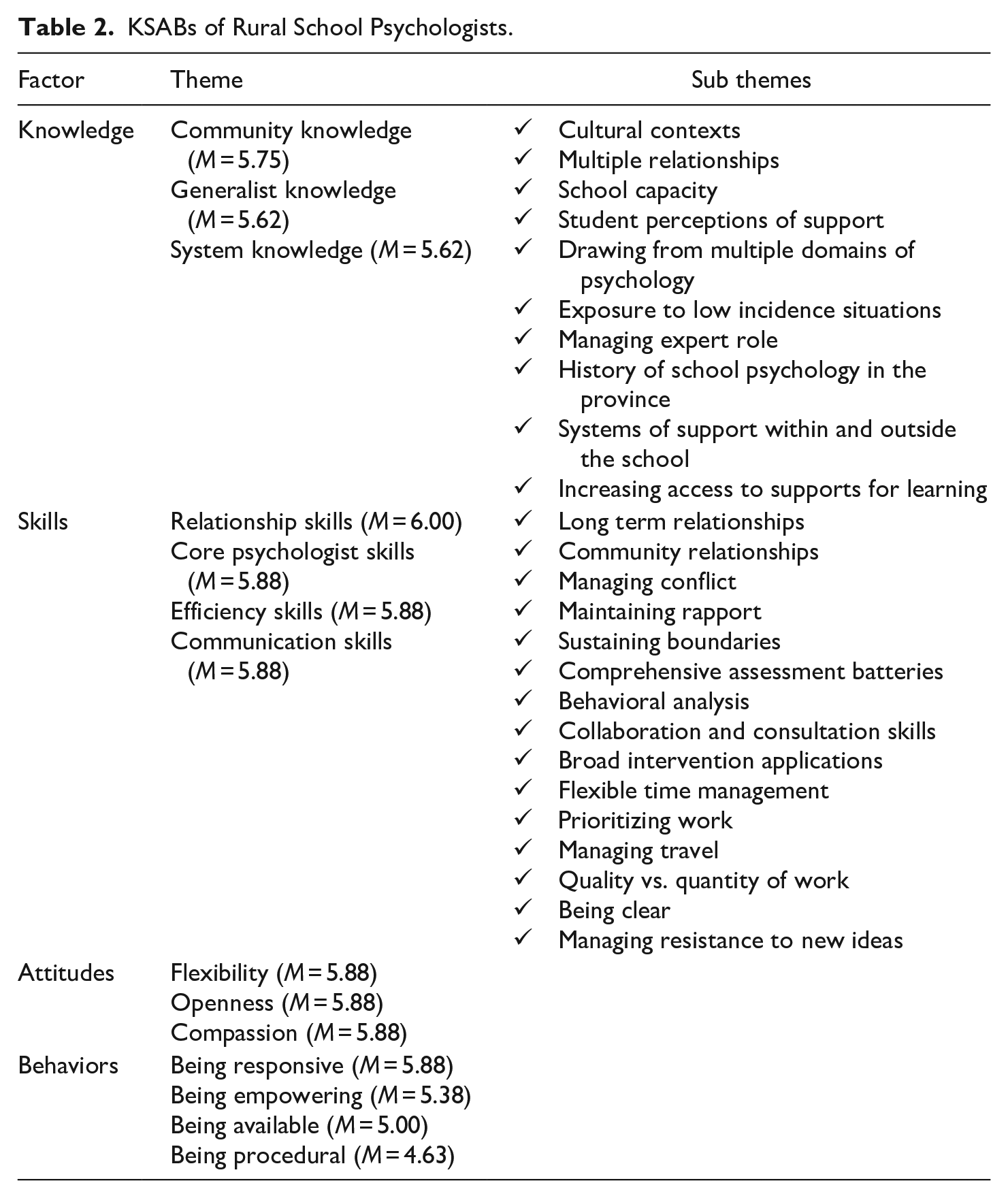
The following section summarizes the agreed-upon themes as they relate to the research question. During the consensus review round, each participant was asked to rate their agreement with the developed theme on a 6-point Likert scale. The mean results of the participants are described, with a score of 6 signaling absolute agreement, scores above 5 indicating strong agreement, and scores above 4 indicating moderate agreement. Scores below three indicated disagreement with the statement. A summary of the themes and the specific scores are described in Table 2. Then, each factor will be described in some detail.
KSABs of Rural School Psychologists.
Knowledge
The knowledge factor includes the concepts that a practitioner of psychology needs to know and understand in order to be competent. When the respondents’ answers as they related to knowledge were explored, the themes of community knowledge, general knowledge, and systems knowledge were highlighted, by the participants in the present study, as necessary specialty competencies among rural school psychologists.
The participants voiced strong agreement (M = 5.75) with the statement, “Rural school psychologists need to have knowledge about the communities they serve.” Participating psychologists emphasized that rural school psychologists must be aware of the cultural context in which they are working understand the history of the area, in terms of the settlement, religious affiliation, family systems, and cultural practices and understandings and their implications on day-to-day practice in school psychology. Many rural communities may be homogenous unto themselves but are often heterogeneous as compared to each other (Pelling & Butler, 2015); thus, these individual differences can be significant. Background knowledge can provide insights into the particular values of community members, including parents and teachers, toward education and the roles of public schools. Furthermore, rural school psychologists need to be aware of the multiple and layered relationships that occur within rural communities, including family ties, roles within the community, power dynamics, and multiple relations within the community. Rural school psychologists also must be aware of the school’s capacity for supporting student needs, understanding the gaps of experience that may impede the integration of inclusive practices in the classroom.
The participants indicated strong agreement (M = 5.62) with the statement “Rural School Psychologists need generalist knowledge.” The participants identified that rural school psychologists are behavioral and mental health specialists and, oftentimes, the only mental health specialists who regularly travel out to their communities. Thus, the expectation is that rural school psychologists be generalists, drawing upon and integrating knowledge from multiple domains of psychology. The participants describe their practices as involving assessment, counseling, consulting, and intervention services. Rural school psychologists need to have a broader knowledge base of psychology as students and their families may not have access to specialized services, or travel may be a significant barrier to accessing services. Being viewed as a generalist practitioner has its challenges; thus, it is important for rural psychologists to understand the limits of their knowledge and competency. Likewise, it is equally important to have the ability to creatively use psychological knowledge to support student success in a variety of contexts.
Finally, the participants expressed strong agreement (M = 5.62) with the statement, “Rural School Psychologists need to have knowledge of the support systems in place in rural communities.” Rural school psychologists also require knowledge of the systems of which they are apart. An initial component of that knowledge includes the history of school psychology in the province and, more specifically, the ways in which educational funding influences service delivery models. Outside of school systems, rural school psychologists must be aware of the associated support services that are available to students and families. These resources may be available online, within the community, or may require travel. Support services include physicians, health region services, non-profit organizations (e.g., Learning Disabilities Association of Saskatchewan), community agencies, library supports, social services, justice and police services, and municipal government programs. Finally, rural school psychologists need to understand how students access specific programs or services. Often, rural school psychologists have the “power of the pen” to make recommendations or diagnoses in order to increase access to community supports, as their signed reports and consultations result in access to additional supports, programs, or different interventions provided by teachers or other allied professionals. Knowing how, when, and why to do this in order to support the needs of children is a vital role of the rural school psychologist and ensures that their actions respect the ethical guidelines of their profession.
Skills
The skill factor includes the ways in which a practitioner of psychology needs to apply their knowledge. Skills can be defined as “the ability to use one’s knowledge effectively and readily in execution or performance; a learned power of doing something competently: a developed aptitude or ability” (Vallera & Bodzin, 2016, p. 107). Components of this factor emerged from the respondents’ answers to questions about the nature of specialty psychological skills required for practice in a rural context. The themes of core psychologist skills, efficiency skills, relationship skills, and communication skills were highlighted as necessary specialty competencies among the participants in the present study.
The participants indicated absolute agreement (M = 6.00) with the statement, “Rural School Psychologists need to have well-developed relationship skills.” As one participant remarked, “Interpersonal skills [are] big, especially because of how much small towns talk. You have a bad experience [. . .], everybody’s hearing about it.” One of the unique skills required of rural school psychologists is the ability to maintain relationships with schools and families over the long term. Rural school psychologists also must be adept at managing conflict. Rural school psychologists must also be flexible in their relational skills knowing when to act as the expert, the counsellor, the advocate, or to disengage, depending on the situation and context. One final relational skill required of rural school psychologists is the ability to maintain and sustain boundaries within their social lives in the community and to manage the multiple relationships as the school’s psychologist and still be an actively contributing community member.
The participants showed strong agreement (M = 5.88) with the statement, “Rural School Psychologists need to have well-developed core psychologist skills.” Within a rural environment, there are few specialized practitioners (e.g., clinical psychologists, neuropsychologists, and developmental psychologists). As such, a rural school psychologist requires a broad ability to determine student learning needs, including students who present with rare presentations (e.g., multiple diagnoses) or very low abilities. An emerging need in the field is for rural psychologists to be involved in behavioral analysis and behavior intervention plans. Particularly as it applies to behavioral intervention, psychologists must be able to provide psychological consultation with different stakeholders (e.g., parents, teachers, administrators, and other health professionals), recognizing that many do not have the background that the rural psychologist has in behavior management and treatment planning. Further, given the context of rural schools often serving Kindergarten to Grade 12 students, rural school psychologists need a broad repertoire of assessment and intervention skills that can apply readily to multiple age groups and levels of academic achievement.
The participants demonstrated strong agreement (M = 5.88) with the statement, “Rural School Psychologists need to have efficiency skills.” Rural school psychologists need to be able to manage their time well and make the most of slower moments. A high degree of organization and an ability to make the most efficient use of time spent at each school, especially if the school is many hours away from the school division office. Rural school psychologists often have multiple tasks to accomplish or complete at one site in order to minimize the number of trips needed to that particular school, all the while striving to be present and supportive of the school-based staff, which may, at times, result in doing fewer of the planned tasks. These travel and logistical issues can bring about tension for rural school psychologists as they often have to balance doing quality work with the amount of time available. Despite the time constraints, they must accomplish the necessary work to best support students, teachers, and the school community.
The participants reported strong agreement (M = 5.88) with the statement, “Rural School Psychologists need to have well-developed communication skills.” Rural school psychologists need to have excellent communication skills. They must be able to explain technical information (e.g., psychometrics, theories of cognition, brain structures, etc.) so that it is accessible to stakeholders. Psychologists must provide clear communication, be succinct with their language, and have strategies to gauge whether they have been understood. The rural school psychologist must find a delicate balance by avoiding being overly candid or simplifying to the degree that makes their findings or recommendations too general. Ensuring they do not use too much technical jargon, which could be off-putting to stakeholders who may not understand terms specific to the school psychology profession. Rural school psychologists also must manage resistance to new ideas from stakeholders, including teachers, parents, and school administrators. Many times, there are “traditional” or “common sense” views that are held by the community (e.g., a student misbehaves primarily to get attention, if a student cannot read it is because they do not want to, punishment strategies, including corporal punishment, are the most effective to teach good behavior), which can lead to certain ideas/interventions presented by the psychologists being met with resistance as they go against the dominant discourses in the school and community.
Attitudes
The attitude factor includes the personal qualities of a competent practitioner of psychology. Attitudes are defined as the values displayed by individuals who are successful in psychological practice. This factor explores the respondents’ answers and is coded across the themes of flexibility (M = 5.88), openness (M = 5.88), and compassion (M = 5.88), which emerged from the statements of the rural school psychologists who participated in the present study. Flexible attitudes are needed to adapt to a variety of workspaces, school capacities, and unequal access to resources to respond to referral questions and complete psychological work. Rural school psychologists display openness to their rural communities, respecting their role as an outsider role, that is, someone who is held at arm’s length in the community while remaining rooted in evidence-based practices. Further, a compassionate approach is needed to understand and advocate for services for students, families, and schools so as to engage strategies and resources that will bring success.
Behaviors
The final factor, behavior, includes the observable abilities demonstrated by practitioners of psychology. Behavior is defined as the actions displayed by psychologists consistently in their work. This factor explores the respondents’ answers across the themes of being responsive (M = 5.88), being empowering (M = 5.38), being available (M = 5.00), and being procedural (M = 4.63). Being responsive involves acting quickly in response to student and teacher needs and being in the room when working with students, families, and schools. Rural school psychologists are empowering, acknowledging that students, families, and schools are often frustrated and tired, and the interventions provided must be framed in hope, drawing from the strengths and resources within these stakeholders. Being available involves being present both physically in schools and communities, engaging in hallway and staff room consultations, and accessible through school communications. Finally, being procedural describes the sequential nature of psychological practices, particularly in assessment, but assuring that events like informed consent, assessment, reporting, and debriefing occur in the proper sequence to avoid problems that can arise when working too quickly or on their feet.
Discussion
This research describes the specialty competencies (Rodolfa et al., 2005) of rural school psychologists as conceptualized by rural school psychologists in Saskatchewan. Specialist competencies expand from the foundational competencies required of all psychologists (i.e., interpersonal relationships, assessment and evaluation, intervention and consultation, research, ethics and standards, and supervision, as stipulated by the Canadian Psychological Association (CPA, 2001). While foundational competencies are essential to the practice of rural school psychologists, they were not the primary focus of research. Rather, the present study endeavored to define and describe the specialized aspects of psychological practice within rural contexts. Specialty competencies describe the competencies required for successful practice in specific contexts over and above the pre-defined foundational competencies. The specialty competencies are described across: knowledge (i.e., cognitive understandings), skills (i.e., sequential processes used to accomplish tasks, actively engaged), attitudes (i.e., values and beliefs), and behaviors (i.e., habits and ways of being in the world), as illustrated in Figure 1 below.
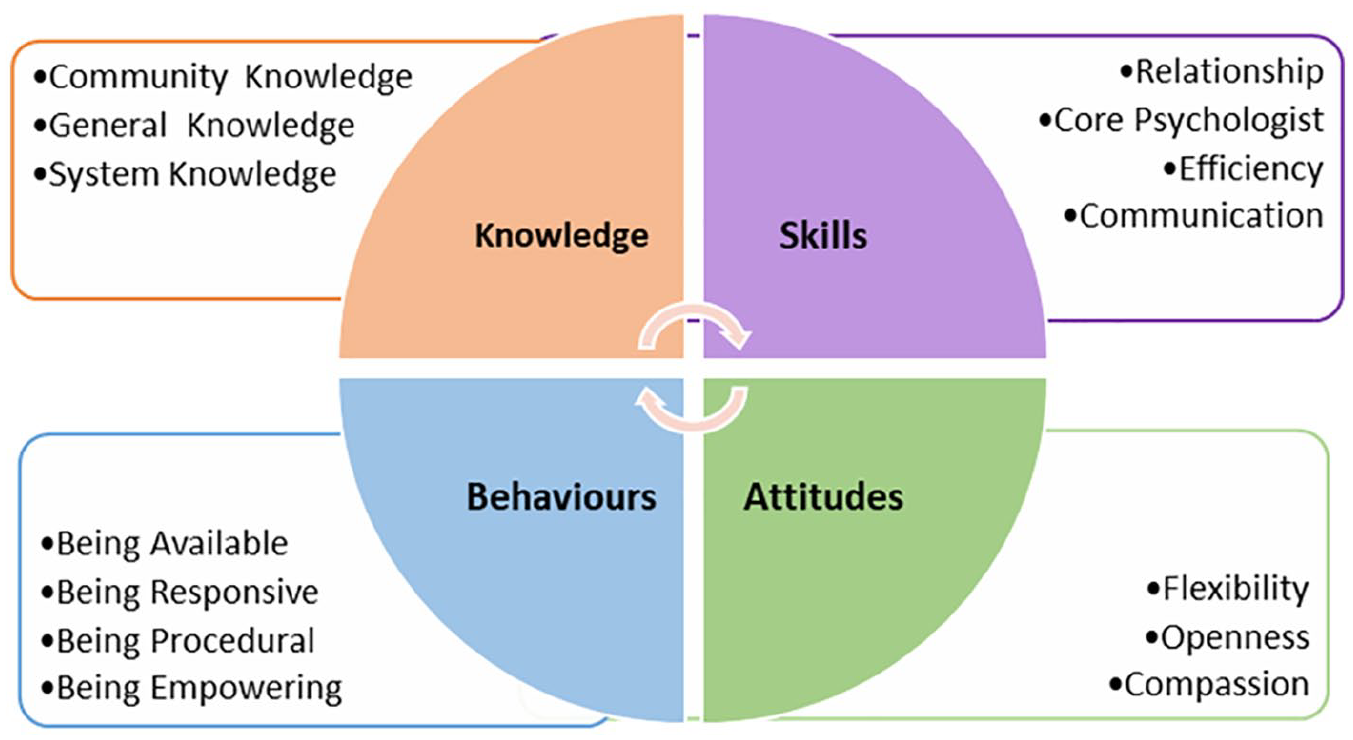
Specialty competencies of rural school psychology.
What Is Special About Rural School Psychology?
The results from the present study demonstrated that the practice of rural school psychology demands a heightened emphasis on personal and professional relationships for competency to be achieved. Rural school psychologists must know their communities and understand the multiple systems that impact their particular context, and understand how these multiple systems interact and relate. These systems include the multiple relationships that are present within the rural community, the roles and responsibilities of individuals within school districts, and the availability of community and government supports local to the community or within reasonable geographic distance. In order to work competently, rural school psychologists must have superior relational skills and be knowledgeable, particularly in managing multiple relationships. Managing these multiple relationships is, in fact, a key feature of rural psychological practice since, as one of our participants emphasized, small towns talk. Indeed, through engaging with these relationships, the rural school psychologist develops greater trust and capacity within the rural community. Being available, responsive, and empowering assist the rural psychologist with developing and sustaining relationships over the long term with rural communities, along with a high degree of openness and compassion. Similar explorations have occurred in the United States (Goforth et al., 2017) and in Australia (Sutherland & Chur-Hansen, 2014; Sutherland et al., 2017), however, this research is the first to describe the competencies of rural psychologists in Canada, and the first to explore competencies among rural school psychologists. Through the engagement in the thematic Delphi, we were able to attain an agreement between psychologists of varying regions of the province, in clinical, school, and private practice settings, and ranging in experience from 1 to 22 years to agree on the complete set of competencies described.
Engaging rural school psychologists in defining and exploring their clinical practice is an important step toward resolving the ongoing issues with isolation, role confusion, and burn out. First, the methodology used in the present study allowed practitioners, who may not work together directly, to have the opportunity to gather and discuss issues of professional and clinical importance, thus combating the isolation felt by several members. By identifying, describing, and coming to a sense of agreement around the speciality competencies, the role of the rural school psychologist becomes clearer and more defined, reducing role confusion. Finally, through participation in a community of practice, with a clear description of competency, rural school psychologists can engage with colleagues in professional development to prevent potential burn out.
This research signals that rural school psychologists need to be generalists in their clinical practice. Rural school psychologists need skills beyond a basic clinical assessment of learning and knowledge of a wide span of literature relating to child psychology, development, and behavioral functioning. A rural school psychologist needs to be open in their case conceptualization, often thinking beyond what they might have been exposed to in their graduate training, often pulling from multiple fields of psychological research. Rural school psychologists need to be capable of performing comprehensive evaluations, have the cognitive flexibility and openness to develop a thorough case conceptualization, and have a substantive repertoire of recommendations for interventions that can be delivered within the school or community environment.
The reality in rural school psychology practice settings is that the needs are high, and the barriers to accessing specialist services are significant (Baker & Dash, 2022). Beyond a generalist approach to rural school psychology, rural school psychologists may further engage in creative practices within psychology. Wenger-Trayner and Wenger-Trayner (2015) described this practice as working in spaces of knowledgeability. While ethical codes assert that psychologists only practice within spaces in which they are competent (Saskatchewan College of Psychologists, 2019), the reality within rural spaces is that the psychologist cannot be fully competent in all of the ways they need to be in order to meet the needs that may be present. Thus, the rural school psychologist needs to be comfortable taking what they know through a process of taking time, accessing supports, and trying something (Barker, 2019) and further monitoring outcomes. Through this process, creative applications of psychological theory can emerge, which can not only improve an individual psychologist’s practice but can bring innovation to the broader field of psychology.
Implications from this study of rural competencies impact the training and regulation of psychologists. Current training and regulation informed by the MRA competencies (CPA, 2001) currently focus on knowledge and skills, which are easier to assess and evaluate. There are more nuances and complexities involved in teaching and evaluating attitudes and behaviors, which serve to make the rural school psychologist more effective. Increased involvement, practicum, and participation in established rural communities of practice by graduate students and early career psychologists could foster these skills. Further, seminar opportunities that focus on attitudes and behaviors could help instill these important elements of competent and effective clinical practice for psychology trainees involved in the practice of school psychology in rural areas.
Limitations and Future Research
As with all case studies, this research is limited in terms of its generalizability to all rural practices of psychology. This study was conducted within the bounded system of rural school psychologists who practice in Saskatchewan, and speaks to the specific ways competency is identified within this group. A direct comparison to urban school psychologists, other psychology practice areas (e.g., clinical or counseling psychology), or even rural psychologists in other jurisdictions has not been made but would be an interesting follow up to clearly define and delineate shared practices in other contexts, and what other competencies may be valued.
The purpose of this study was to comprehensively define competency among rural school psychologists in Saskatchewan. Further research using the thematic Delphi may assist in finding the similarities and differences among different practices of psychology. Such further rich descriptions of competency informed by practitioners in the field may assist in the refinement and development of training and regulation standards for the broader field of psychology.
Relevance to the Practice of School Psychology
This article explored the specialty competencies that are described among rural school psychologists from Saskatchewan. The present study identified that rural school psychology practice requires attention to community relationships, generalist practices, and creative innovation. Specific challenges to practicing in rural spaces exist, given the professional isolation, the role that increases in complexity, and ultimately burnout leading to fewer psychologists practicing in rural settings. Conversely, there are opportunities to engage in a generalist practice of psychology as a rural school psychologist and the opportunity to develop innovations within rural spaces. Insights from this study pertaining to specialty competencies required of school psychologists can support students enrolled in school psychology programs, early career psychologists, supervisors, and trainers of psychologists in identifying and developing these skill sets in rural school contexts.
Footnotes
Declaration of Conflicting Interests
The author(s) declared no potential conflicts of interest with respect to the research, authorship, and/or publication of this article.
Funding
The authors disclosed receipt of the following financial support for the research, authorship, and/or publication of this article: This article draws on research supported by the Social Sciences and Humanities Research Council, and financial awards from the Faculty of Graduate Studies & Research at the University of Regina.
