




Abstract
The self-determination theory (SDT) has been used to understand students’ motivation at school in general as well as in various school subjects. This literature review conducted on a number of SDT studies showed that (1) autonomous types of extrinsic motivation as well as intrinsic motivation leads to positive consequences for students; (2) the types of goals and the regulation behind them are also important to predict school outcomes; (3) when the psychological needs for competence, autonomy and relatedness are satisfied this leads to autonomous motivation or autonomous goals endorsement; (4) autonomy supportive practices by parents and teachers are important catalyzers of needs’ fulfillment; (5) intervention programs designed for teachers or parents focusing on these psychological needs usually lead to greater autonomous extrinsic motivation and intrinsic motivation and better adjustment outcomes. The implication of this theory for school psychologists is underscored as well as its implications for the practice of teaching.
Self-Determination theory (SDT) is a theory of human motivation where individuals are viewed as proactive (Ryan & Deci, 2017). The meta-theory overseeing SDT is that all human beings are born with tendencies toward growing, mastering challenges, and integrating new experiences in a volitional manner. These developmental tendencies do not, however, operate in isolation, and require an environment that will support them. Unfortunately, in many social contexts, school included, these tendencies are thwarted, leading to a lack of compliance, oppositional behaviors, and disengagement. For example, many high school students decide to leave school each year before obtaining their diploma because they feel as though schools are prisons, or because they feel incompetent (Vallerand et al., 1997). Thus, for SDT, the interaction between individuals and their social contexts explains how their development unfolds. SDT comprises six mini-theories articulated to explain a set of phenomena. Therefore, each addresses one facet of motivation or personality functioning. In this paper, some concepts embedded in these mini-theories are covered, namely regulation types, goals, psychological needs, and autonomy supportive behaviors. Because the theory has been elaborated in the very first place to help individuals to have a fulfilling life, a special emphasis was put on intervention programs at schools designed to support students’ psychological needs and autonomous regulations. Finally, the relevance of SDT to the practice of school psychology is outlined.
Autonomous Versus Controlled Motivation at School
Students may have different reasons to perform school work. In SDT, these reasons underlying behavior are fundamental in that they do not lead to the same quality of outcomes. It is possible to distinguish among various types of reasons (or hereafter motivation) that differ in terms of self-determination (i.e., the extent to which a behavior originates from the self). Some of them are thus autonomous, and others are controlled (see Figure 1). Intrinsic motivation is autonomous and refers to performing an activity for its own sake, for the pleasure and satisfaction it provides (Ryan & Deci, 2000). For example, students who enjoy reading are said to be intrinsically motivated for this activity. Extrinsic motivation refers to performing an activity for instrumental reasons rather than for its intrinsic qualities. According to SDT, various types of extrinsic motivation exist and they differ in their degree of self-determination or autonomy. From low to high autonomy, these are external regulation, introjected regulation, identified regulation, and integrated regulation (Ryan & Deci, 2000). External and introjected regulations are classified as controlled reasons for acting, whereas identified and integrated regulations are autonomous. SDT thus categorizes some extrinsic motives as volitional, meaning that students who are not intrinsically motivated for a school subject could nevertheless experience positive cognitive, affective, and behavioral outcomes if these extrinsic motives are coherent with their “self.”
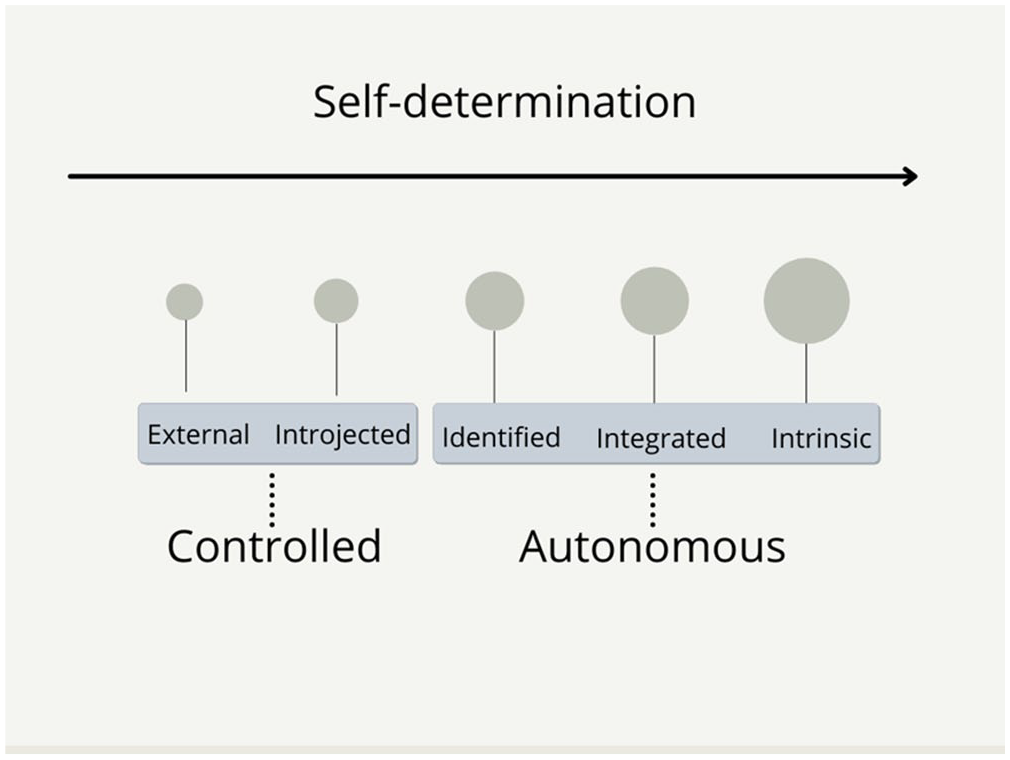
Self-determination continuum.
External regulation occurs when a behavior is motivated by the desire to obtain a reward or avoid punishment. For example, students who are motivated to follow their science courses in order to obtain their driver’s license as promised by their parents at the end of their high school studies are said to be externally motivated. Introjected regulation refers to behaviors performed in response to internal pressures, such as obligation or guilt: the individual somewhat endorses the reasons for doing something, but in a controlled manner. Students who go to school to not feel guilty is an example of introjected regulation. Identified regulation occurs when individuals identify with the reasons for performing a behavior, or when they personally find it important. This is an autonomous form of extrinsic motivation, because the behavior originates from the self in a non-contingent manner. For example, though not interested in maths, some students might find this school subject important because it will help them to pursue a career in a field that they like. Integrated regulation occurs when the identified regulation is congruent with other values and needs. The behavior is therefore performed because it is part of who the person is. However, this form of regulation requires individuals to have formed a coherent identity (Deci et al., 1996), such that they can identify with the importance of a behavior and reciprocally assimilate that identification with other aspects of their life. An example of integrated regulation is when persons find that being a student define themselves and this identity is fully integrated with other identities or aspects of their lives. Recent systematic reviews and meta-analyses indicate that integrated regulation and intrinsic motivation share conceptual properties that make them difficult to distinguish empirically (Vasconcellos et al., 2020). Consequently, this type of extrinsic motivation is rarely assessed in studies on children and adolescents whose identity is still developing.
In SDT, motivation types are located along a self-determination continuum reflecting motivational quality, rather than motivational intensity (see Figure 1). Motivation types are therefore expected to relate to each other in a quasi-simplex-like pattern, with stronger positive correlations between adjacent motivations than between distant ones. For example, identified regulation and intrinsic motivation should be positively and moderately correlated, and this correlation should be stronger than the one between intrinsic motivation and introjected regulation. In previous research, the autonomy continuum was supported (Guay et al., 2016; Otis et al., 2005; Ryan & Connell, 1989). Furthermore, this continuum also reflects how each motivation type affects various school outcomes. The more autonomous the motivation is, the more it should lead to positive consequences for students.
Howard et al. (2021) have conducted a meta-analysis on 344 samples comprising more than 200,000 students from different countries. Findings highlight that intrinsic motivation is related to student success and well-being, whereas identified regulation is particularly related to persistence. Introjected regulation was positively related to persistence and performance goals, but also positively related with indicators of anxiety. External regulation was not associated with performance or persistence but was associated with decreased well-being.
Most school professionals are familiar with the mastery/performance goals literature. Consequently, it is worth mentioning how motivation types proposed by SDT are interrelated with these goals. Ciani et al. (2011) have shown that autonomous motivation predicts both mastery approach (the student tries to increase his or her own skill level) and mastery avoidance (the student strives to avoid learning less than what is possible and/or an incomplete understanding of the course material). However, autonomous motivation did not predict the two types of performance goals, namely performance approach (the student approaches success compared to others) and avoidance (the student tries to avoid doing poorly compared to others). In other words, autonomous motivation does not prevent students from setting performance goals, but at least this motivation helps them to set mastery ones. Thus, within SDT autonomous motivation is seen as an antecedent of students’ mastery and performance goals.
In sum, the more students have pleasure or value learning activities, the more they experience positive outcomes at school. Using contingent rewards or punishment as a motivational source appears useless to help students.
Autonomous and Controlled Goals
Research on autonomous vs. controlled types of motivation has mainly focused on regulation for academic activities without closely looking at goals students have for pursuing their studies. However, students’ goals are also important to understand students’ behaviors (Wentzel, 2000). SDT classifies personal goals into two broad categories, namely autonomous (e.g., striving for and valuing self-acceptance, affiliation, contributing to one’s community, and health) and controlled (i.e., seeking financial success, social recognition, and attractiveness for wellness). Kasser and Ryan (1996) showed that when emerging adults endorse autonomous goals they are more likely to experience wellness. In contrast, endorsing controlled goals undermined their wellness. Vansteenkiste et al. (2004) extended these finding on goal content to learning. In various experimental studies, the learning of text material or physical exercises was framed in terms of intrinsic (community, personal growth, health) versus extrinsic (money, image) goals. Results showed that intrinsic goals, in contrast to extrinsic ones, lead to greater depth of processing, test performance, and persistence. These relations were explained by the students’ autonomous motivation. In other words, intrinsic goals lead to greater autonomous motivation which is in turn related to more positive outcomes. Autonomous goals not only lead to more positive cognitive and behavioral outcomes, but also to affective ones. For example, a diary study conducted among university students showed that students who set autonomous goals at the beginning of the day experience more positive emotions during the day whereas students who set controlled goals in the morning experience more negative emotions (Ketonen et al., 2018).
In sum, pursuing autonomous goals is more beneficial for students’ autonomous motivation, and consequently their learning (also see Sommet & Elliot, 2017) and emotional experience. Extrinsic goals distract students from these outcomes that are of the utmost importance to succeed later in life. Hence, in addition to supporting autonomous motivation for learning activities, school professionals should also pay attention to the nature of the goals fixed by students. For example, a student with the goal of performing well in school could display this behavior to attain an intrinsic goal (mastering the content of the lesson), but also to attain an extrinsic one (being famous in the class). The latter type of goals will backfire in the end.
Basic Psychological Needs
To understand why some students are autonomously motivated, motivated by controlled reasons or have autonomous or controlled goals, SDT has introduced the concept of psychological needs. This theory proposes three psychological needs: competence, autonomy, and relatedness (Ryan & Deci, 2017). In SDT, these needs are conceived as universal rather than as individual subjective differences. Thus, SDT posits that (a) the degree to which individuals are healthy and effective is understood in terms of the degree to which these needs have been satisfied; (b) deprivation of psychological needs leads to ill-being and psychopathology and; (c) these needs are fundamental across age, gender, culture, and socioeconomic status (Deci & Ryan, 2000, 2012).Thus, psychological needs are not learned, but are universal sources of satisfaction that promote students’ optimal functioning within schools. Thwarting these needs will eventually lead to controlled goals and reasons for action. To this end, the social context surrounding students (parents, teachers, peers) is quite important to these needs’ fulfillment.
Competence
The need for competence is understood as the desire to interact effectively with one’s environment (White, 1959). This need leads students to seek challenges that are slightly beyond their current capacities and to practice activities to eventually enhance their aptitudes. It is not, however, the level of aptitude per se that a student acquires that is important, but rather the phenomenological experience of perceiving oneself to be competent. Because its satisfaction is directly related to performance (Guay, Marsh et al., 2003), it clearly has adaptive consequences for students. Without this need, students would be less inclined to act in ways that surmount barriers. For example, Guay et al. (2004) have shown that elementary school children who perceive themselves competent at school attain a higher educational degree 10 years later on. Satisfaction of the need for competence is thus an essential prerequisite for full functioning at school.
Relatedness
The need for relatedness refers to the necessity for close and secure emotional bonds with significant others and to feeling part of collectives (Ryan & Deci, 2017). Without this need, it would be hard to explain why people would so readily internalize ways of interacting effectively and harmoniously with others in their groups. Satisfaction of the need for relatedness also helps students develop their potential. For example, a talent for mathematics is likely to emerge in an environment where children feel supported by their parents, whereas conditional regard or cold parents are more likely to stifle this potential (Ryan et al., 2006).
Autonomy
The need for autonomy is defined as the necessity of experiencing a sense of choice, willingness, and volition as one behaves. Students will feel like the initiators of their actions and will act in ways that are coherent with their interests and values (Deci et al., 2013). The need for autonomy is thus intertwined with the “self” which is the active center of integration, initiation, and spontaneous engagement within the social context. Within SDT, the integrative process is at the heart of self, which integrates new functions, values, experiences, and propensities (Ryan & Deci, 2017). When able to experience support for their autonomy, students behave with more autonomy (Guay & Vallerand, 1996) and thoroughly internalize aspects of the education context that allow them to volitionally adopt school rules and expectancies. In SDT, autonomy does not equate with independence. People can be autonomously independent, but they can also be autonomously dependent on others. Moreover, it is not a stage of development, but is instead considered important from the beginning of life until its end. Finally, autonomy is not synonymous with being detached or separated from significant others. In fact, many studies have shown that feeling accepted and related to significant others is associated with a greater feeling of autonomy (e.g., Guay et al., 2008).
Bringing the Three Needs Together
The three psychological needs do not operate in isolation but rather interdependently and should thus be considered in combination rather than separately. For example, in a research conducted among adolescents from secondary schools, Earl et al. (2019) used a person-centered approach and showed distinct profiles of needs’ satisfaction. Among the uncovered 5 profiles, students in the satisfied profile (having high scores on the three needs) were those experiencing the most vitality, positive affect, and achievement, as well as the lowest academic stress and negative affect comparatively to the dissatisfied profile. These results therefore attest the necessity for the interventions to focus on all three needs and not only on a single one, leading to the most beneficial impact on students’ outcomes.
Autonomy Supportive Behaviors
Autonomy-supportive behaviors encompass behaviors where someone takes into account the perspective of others, provides them with opportunities to act within certain guidelines, and offers meaningful rationales to explain why they must do less interesting activities. This enables the individual to support the need for autonomy, but also the need for competence and relatedness. Competence and relatedness could also be supported respectively by an adequate structure and a high degree of involvement (Guay et al., 2020). However, because more research has been conducted on autonomy support, this article reviews solely work on this concept for two sources: parents and teachers.
Parents
Parents are the primary agents of socialization in their child’s life and consequently a significant influence on students’ autonomous motivation (Pomerantz et al., 2005) and psychological needs. Researchers have frequently used students’ perceptions to assess the degree of autonomy support provided by parents (Grolnick et al., 1991). Most of the research on parental autonomy support has considered either the mother’s parenting style or the combined styles of both parents. In this field of research, parental autonomy support has been associated to many positive outcomes directly or indirectly through the satisfaction of psychological needs or through autonomous motivation. Examples of these outcomes are school persistence (Vallerand et al., 1997), school performance or achievement (Guay & Vallerand, 1996), career indecision (Guay, Senécal et al., 2003), school adjustment (Ratelle et al., 2021), and vocational exploration (Gagnon et al., 2019).
Certain factors could moderate the positive relationship between parents’ autonomy support and the child’s development of autonomous motivation. First, it is arguable that the influence of autonomy support would diminish as children grow up. It is known that as children mature, they become more independent from their parents when performing academic tasks. However, studies focusing on children in elementary school (Grolnick & Ryan, 1989; Grolnick et al., 1991), high school (Vallerand et al., 1997), college, and university (Ratelle et al., 2004, 2005; Vansteenkiste et al., 2005) have shown that autonomy support by parents is instrumental for the development of autonomous motivation. Thus, even young adults continue to benefit from having autonomy-supportive parents. The effect could be even stronger during times of stress, such as the transition to high school or college (Grolnick et al., 2000; Ratelle et al., 2004, 2005). For example, results revealed that students’ perceptions of autonomy support by parents were associated with more autonomous motivation trajectories during the transition to college (Ratelle et al., 2004).
We might also contend that parental autonomy support benefits only students whose development is “typical” or those living in Western cultures. More specifically, we would expect students with emotional handicaps or learning problems to function more effectively in settings where their behaviors are regulated by reinforcements (Maag, 2001; see Deci et al., 1992, for a discussion). In addition, we would expect students from cultures that emphasize interdependence among their members to benefit less from an autonomy-supportive parenting style compared to students from more individualistic cultures. Nevertheless, studies have demonstrated many advantages associated with autonomy support, for both students with learning problems (Deci et al., 1992) and students in collectivist cultures such as China (D’Ailly, 2003; Vansteenkiste et al., 2005) and Russia (Chirkov & Ryan, 2001).
These findings converge toward a clear message: parents from various cultural and socioeconomic backgrounds can offer a bulwark against the pervasive effects of pressure students face in the environment (failures, learning difficulties) by avoiding putting additional pressure on them and nurturing their psychological needs. In doing so, students will experience better outcomes will live more fulfilling and productive lives as a result.
Teachers
Teachers are the primary adults who interact with children at school and exert a significant influence on children’s autonomous motivation. Like parents, autonomy-supportive teachers foster autonomous motivation in their students (Reeve, 2002, 2006). It is noteworthy that this conclusion has been drawn for students in elementary school (e.g., Ryan & Grolnick, 1986), high school (e.g., Trouilloud et al., 2006), college, university (e.g., Williams & Deci, 1996) and even at the doctoral level (Litalien & Guay, 2015). In addition, the same conclusion was drawn for students with severe behavioral problems (e.g., Savard et al., 2013). Again, like parents, and irrespective of education levels or children’s problems, teachers adopting an autonomy-supportive teaching style contribute to more autonomous motivation in their students. Although most studies have assessed students’ perceptions of teaching styles, similar results have been obtained using teachers’ perceptions (e.g., Deci et al., 1981). Moreover, the advantages of teachers’ autonomy support for students’ autonomous motivation do not appear to be culture-dependent, as similar results have been found in non-Western cultures such as Russia (Chirkov & Ryan, 2001) and China (Hardré et al., 2006).
A recent study indicates that teachers’ autonomy support could reduce students’ tendency to compare themselves with their classmates (Gilbert et al., 2021). Specifically, students compare themselves to other students to find out how competent they are in various school subjects (Buunk et al., 2005). Marsh (1987) coined the “big-fish-little-pond effect” (BFLPE) to explain social comparison taking place in schools or classrooms. According to the BFLPE, students compare their individual achievement with the average performance of their peers in the same school/classroom to form their academic self-concept (ASC). The BFLPE proposes that students who attend schools with less-able peers (lower average achievement) should make more favorable comparisons and form a more positive ASC than their equally able counterparts educated in high-ability school/classroom (Marsh, 1987). The study by Gilbert et al. (2021) demonstrates that the BFLPE is no longer significant when teachers use need supportive practices including autonomy support. These results suggest that autonomy support did moderate the BFLPE. It thus seems that promoting an autonomy supportive context encourages students to focus on their own success to form their self-concept rather than on the performance of their classmates.
School Intervention Programs
Self-determination theory (SDT) has guided the development of intervention programs designed to develop more autonomous school motivation, and consequently improving students’ perseverance and academic achievement. Below are some examples of such programs in which the focus is on needs per se or on specific school subjects.
Need Focused Interventions
First, some intervention programs have targeted autonomy support by teachers in order to foster more autonomous motivation in students (Su & Reeve, 2011). In general, studies have shown that interventions designed to educate teachers on how to support autonomy in their students result in higher student perceptions of autonomy support (e.g., Amrita, 2011; Cheon et al., 2012; Reeve et al., 2004). Furthermore, the impact of these interventions is not limited to students’ perceptions. For example, Reeve et al. (2004) developed a program to enhance engagement in high school students by showing teachers how to support students’ autonomy. Teachers in the experimental group received autonomy support training. In a series of classroom observations, the judges assessed the autonomy support provided by each teacher and their students’ engagement in academic tasks. Trained teachers showed significantly more autonomy-supportive behaviors compared to control teachers. In addition, the more teachers used autonomy-supportive practices in class, the more engaged their students were in their tasks. Similarly, Kaplan and Assor (2012) developed a teacher training program focusing on the importance of having autonomy-supportive talks and discussions with high school students. The program was implemented in 18 classes of Grade 7 students (420 students). Results showed that having autonomy-supportive talks and discussions with students was associated with higher positive emotions in students, more positive perceptions of the teacher, and fewer negative emotions and violence in class.
In their meta-analysis, Su and Reeve (2011 shed light on the conditions liable to foster more effective intervention programs to develop autonomy support. Such programs would be most effective when they: (a) cover several elements of autonomy support (e.g., providing meaningful rationales for tasks, acknowledging students’ perspectives and feelings, offering choices, nurturing motivational resources, and using non-controlling language); (b) are given over a period of about 1 to 3 hours in a laboratory setting, where nuisance effects can be controlled; and (c) engage teachers in knowledge—and skill—based activities using a variety of media (e.g., paper and electronic). In addition, these programs appear to be more effective when they are offered to teachers rather than principals and other school administrators, or when they are offered to novice teachers just beginning their career.
Interventions Focusing on Specific School Subjects
Other multiple-element intervention programs have been developed to promote more autonomous motivation in students and to enhance their competence in various school subjects. To illustrate this type of program and the outcomes for students, we present two programs that were developed for elementary school reading and writing. First, the Reading within Family and School program (LiFuS; for German-speaking children in Switzerland) was developed by Villiger et al. (2012) to promote reading in fourth year elementary school children. The study examined the effects of a family – school intervention program designed to create family and school environments that support motivation to read, and hence improve students’ reading motivation and text comprehension (n = 713). In order to determine the specific contribution of the family environment, the program was administered to a group without (n = 244) and with (n = 225) parents’ participation. Results showed that the family—school intervention had significant effects on students’ reading enjoyment and curiosity. In addition, the effect on reading enjoyment remained at the 5-month follow-up. These results might be explained by the fact that psychological needs of students were satisfied. Moreover, they underscore the importance of promoting autonomous reading, not only at school but in the family as well. This program is also in line with other existing motivational programs. For example, Concept-Oriented Reading Instruction (CORI) has been successful in enhancing different-aged students’ autonomous motivation for reading and comprehension of information texts (Guthrie et al., 2013).
The CASIS-Écriture training program (cooperation, authentic activities, support for autonomy, involvement, and structure) was designed to help elementary school teachers increase their students’ motivation in writing (Guay et al., 2016). The program aims to develop five pedagogical practices: cooperation, meaningful activities, autonomy support, engagement, and structuring. An evaluation study (Guay et al., 2016) conducted with 18 teachers and 273 students in second-year elementary school revealed that students of teachers who received the CASIS training (experimental group) improved significantly over the school year in autonomous writing motivation compared to control students (whose teachers did not receive CASIS training), who showed decreased autonomous writing motivation. Moreover, students in the experimental group performed better than controls on a dictation at the end of the school year, while controlling for ability at the beginning of the school year. In light of these results (and despite the small sample), it appears that enriching teaching practices through professional training would be an effective way to motivate students to write, and therefore to improve their writing skills. In two subsequent studies, Guay et al. (2020) provided support for the effects of the CASIS training program on preservice and inservice teachers’ pedagogical practices, but the effects were unfortunately more limited on children’s autonomous motivation.
Learning and Behavior Problems
Various SDT-related intervention programs have been created and evaluated in an effort to intervene more effectively with at-risk students (see Burke et al., 2020). For example, Konrad et al. (2007) reviewed studies that evaluated SDT-based intervention programs for students with either or both learning problems (LP) and attention deficit hyperactivity disorder (ADHD). Results showed that autonomy-supportive interventions have been the most frequently studied, followed by interventions combining autonomy support and one or several other SDT-related components. In their meta-analysis, Shogren et al. (2004) investigated the efficacy of using choice-making as an intervention to reduce problem behavior. Results showed that, overall, providing choice opportunities to students resulted in clinically significant reductions in problem behavior. Moreover, the meta-analysis of Burke et al. (2020) showed that among students with disabilities, interventions to promote autonomy can be effective across grade levels, disability labels, and settings (mean effect size of 0.41).
In sum, an impressive number of SDT-based intervention programs have emerged in recent years, and the research has demonstrated their overall effectiveness in helping students (from elementary to high school and college, and with a variety of learning and behavioral problems) to develop more autonomous school motivation. In addition, many training programs for parents and educators have emphasized autonomy-supportive practices.
Relevance to the Practice of School Psychology
In light of these various findings, what are the practical implications for the practice of school psychology? Several suggestions could be proposed, but we will focus herein only on four of them. First, regarding children’s evaluation, it is important that school psychologists take into account how students’ psychological needs are satisfied in the school context. To this end, the evaluation could be made by asking students to respond to questionnaires on the fulfillment of their psychological needs (see https://selfdeterminationtheory.org/ for such scales) and to complete this evaluation with other informants such as parents and teachers. If such evaluation reveals that some needs are thwarted, this could lead to remedial interventions. For example, many students have disruptive behaviors at school that compromise not only their learning, but also their classmates’ learning. It has been shown that compromising students’ psychological needs could explain these problematic behaviors (Aelterman et al., 2019). In light of these findings, school psychologists could discuss with teachers but also with parents about how to react when children emit disruptive behaviors. Teachers and parents using controlling means to stop these behaviors will not resolve the problem. On the contrary, it will lead to more disruptive behaviors at the end. Being autonomy supportive might be more helpful to reduce these problematic behaviors.
Second, school psychologists are mandated to consult teachers and to support them in the implementation of classroom-wide interventions that address the learning, social, emotional, and behavioral difficulties of their students. School psychologists may thus serve an important role to propose and adapt existing SDT intervention programs to their school realities. For example, it is important to cultivate intrinsic motivation in the classroom. This might sound obvious, but it is frequently noticed that teachers use tedious pedagogical activities thereby having the unfortunate consequence of not nurturing children’s intrinsic curiosity (e.g., overuse of rote learning instead of focusing on rich educational tasks). Hence, teachers are invited to create educational tasks that are authentic or meaningful for children. This could be achieved by knowing more about students’ interests and preferences. Of course, the realities of the classroom suggest that certain mundane tasks could not be avoided (e.g. grammar rules). The question of balance is thus important where these mundane tasks are introduced in students’ learning without neglecting significant ones who should be more frequent.
Third, school psychologists may help teachers to provide efficient feedback that fosters students’ perceived competence and autonomous learning. According to Hattie and Timperley (2007), the main purpose of feedback is to diminish the gap between students’ current performance and their expected performance. This gap can be reduced when the teacher provides feedback clarifying the objective and success criteria, informing students about their current performance in direct and concrete terms, and guiding them toward goal achievement. Grades given to students on different evaluations could be used as a starting point to give this feedback. In this way, grades will not be utilized to convey a message about how students perform relative to others, but as a way to increase students’ competencies in a given school subject. In this way, students will feel more autonomously motivated and will pursue more learning goals than performance ones in subsequent learning situations.
Fourth, research on SDT provide valuable advices on the use of rewards that are prevalent in schools and at home. Teachers and parents use these rewards to motivate children to behave or perform well at school. However, it has been shown that external regulation led to no positive outcomes (Howard et al., 2021) and could even decrease intrinsic motivation (Deci et al., 1999) and mental health. Given these negative consequences teachers and parents should avoid these rewards as much as possible. They should be replaced by more positive need supportive behaviors such as autonomy support, structure, involvement, significant activities, and collaboration (see Guay et al., 2020). Such proposition is also in line with recent findings indicating that parents do not perceive rewards positively because they produce, in their view, students’ anxiety, encouraged dependence, and oppressed students’ personalities (Kowalski & Froiland, 2020). Such results should thus be disseminated and discussed among school professionals.
Conclusion
We have presented an overview of education studies based on self-determination theory (SDT), revealing a number of relevant observations. First, the more that students’ motivation is autonomous, the better their academic performance, the longer they persist, the better they learn, the greater their satisfaction is, and the more positive their emotions at school are. Second, parents and teachers who support students’ autonomy (as well as other psychological needs) can foster autonomous motivation. Third, we must emphasize that certain intervention programs appear to be effective in fostering students’ autonomous motivation. However, further intervention studies are needed to definitively determine whether the benefits of these programs are felt across diverse student populations (e.g., disadvantaged parents, different ethnic groups). Taken together, the findings of the studies reviewed here provide support for the various postulates of STD. We hope that this brief overview will inspire new research directions and innovative intervention programs. In addition, we encourage educators to draw on the available research in an effort to improve their pedagogical and educational practices in order to help students realize their full potential.
Footnotes
Declaration of Conflicting Interests
The author declared no potential conflicts of interest with respect to the research, authorship, and/or publication of this article.
Funding
The author received no financial support for the research, authorship, and/or publication of this article.
