




Abstract
The control-value theory (CVT) of achievement emotions is a well-established theoretical framework which delineates the predictive relationships among distal and proximal antecedents, academic emotions, and student engagement and achievement. Although most research anchored in CVT is conducted by educational psychologists, the theory is arguably applicable to the field of school psychology. In this article, we first provide a brief overview of the theory, with a specific focus on the proximal antecedents (i.e., cognitive appraisals), as well as academic emotions and performance. Given that school psychologists are often consulted with strategies regarding students’ emotional challenges exhibited in the classroom, we then discuss empirical evidence of control- and value-based interventions (e.g., attributional retraining, utility-value), both of which can be posited to address the cognitive appraisals of achievement emotions. Lastly, we discuss the implications of CVT and control- and value-based interventions to school psychologists’ work.
Keywords
Introduction
School psychologists offer a wide range of services in educational settings, including, but not limited to, assessment, intervention, consultation, in-service training, and research (Canadian Psychological Association; CPA, 2007). While graduate programs in school psychology typically prepare students and future practitioners in conducting psycho-educational assessment, individual and group intervention, and consultation (CPA, 2014), specific training on academic emotions in standalone courses is not common. In CPA (n.d) description for the role of school psychologists, tiered intervention is highlighted and social-emotional learning (SEL) is offered as an example; however, there is little elaboration on academic emotions. SEL indeed is a framework encompassing five broad areas, each of which includes narrow subcategories (Collaborative for Academic, Social, and Emotional Learning, 2021). It is understandable that school psychology training has to cover a vast and diverse knowledge base (e.g., advanced assessment, therapy, clinical diagnosis, and bio-social knowledge of children’s and adolescents’ behaviors) as was proposed by Montreuil (2016) in the Canadian Journal of School Psychology’s Special Issue, and consequently, academic emotion and intervention may not be a priority. On the other hand, academic emotions permeate many aspects of learning, such as feeling anxious before a science test, getting bored in a music class, and being proud after giving a presentation. Hence, a deeper understanding on how these emotions are manifested and maintained can provide school psychologists with the tools they need to consult with teachers, make recommendations, and prepare assessment reports. In practice, it is not uncommon for school psychologists to be asked how to better support students who express intense emotions (e.g., frustration and anger) or who avoid certain learning tasks. While conducting behavioral assessments, for example, may shed some lights on these issues, it is equally important to explore academic emotions as a starting point. In this article, we provide a brief review of the Control-Value Theory (CVT) of Achievement Emotions, discuss CVT-related interventions, and address the relevance of CVT for professional practice in school psychology.
Control-Value Theory of Achievement Emotions
With the increasing emphasis of school psychologists’ support (e.g., universal intervention on social-emotional wellbeing and consultation) beyond the traditional assessment role, CVT may be a helpful theoretical framework to assist school psychologists in their professional work. Specifically, CVT posits that students’ cognitive appraisals of an achievement outcome or activity are proximal antecedents of emotions experienced in achievement-related situations (Pekrun, 2000). Figure 1 shows the core element in CVT and the associated interventions. While students feel many different emotions, such as expressing empathy to a classmate who loses a pet or feeling jealous of a classmate’s success, not all emotions are considered achievement emotions. Specifically, CVT focuses on the emotions experienced while students are involved in an achievement activity—such as feeling bored when conducting a science experiment, as well as the emotions that arise as an outcome of an achievement activity—such as succeeding or failing (Pekrun, 2000; Pekrun & Stephens, 2010). The distinguishing feature is whether an activity or performance outcome has an inherent quality that focuses on competency (Pekrun & Stephens, 2010).
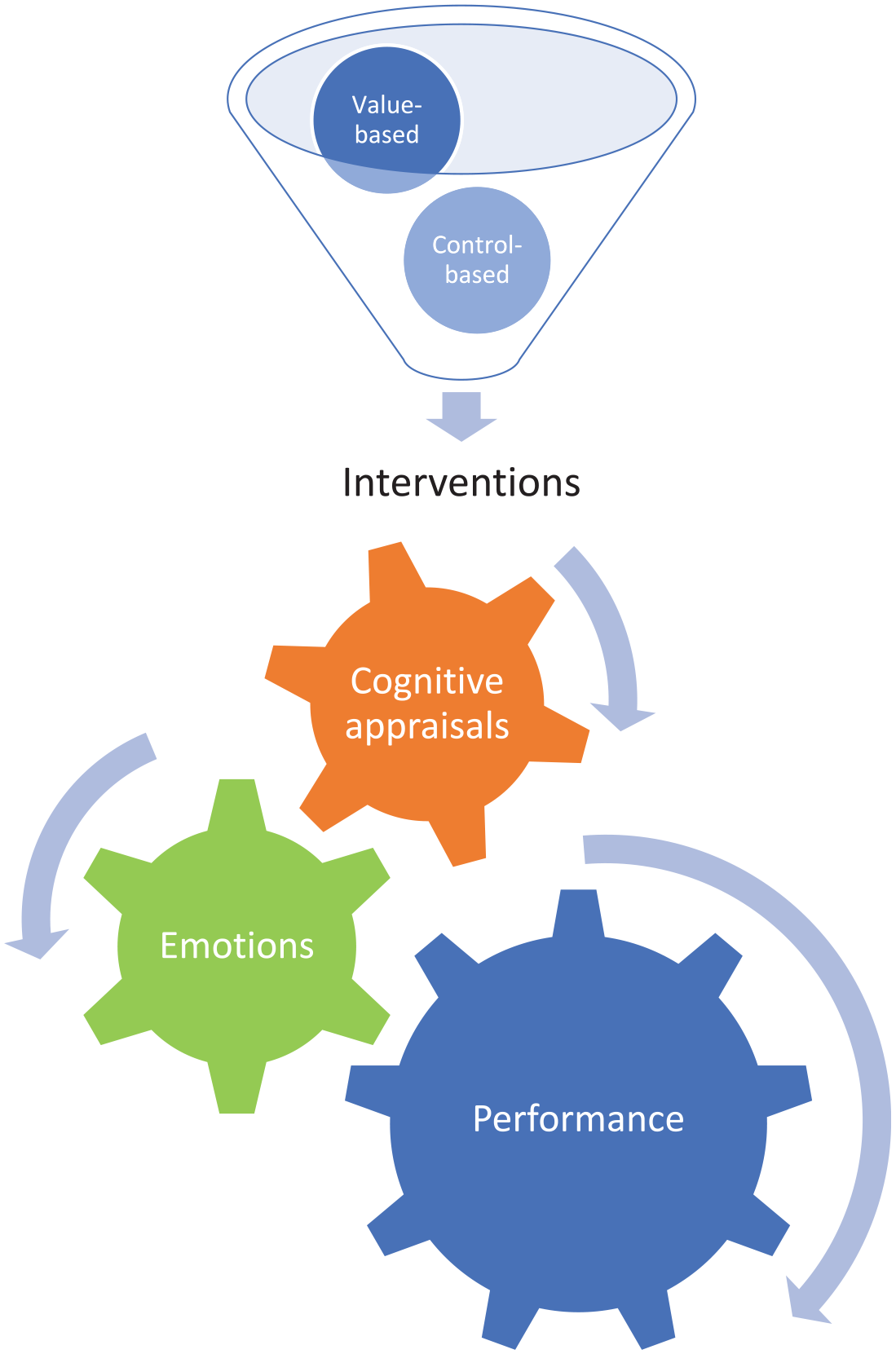
The image illustrates the proposed CVT-related (control- and utility-based) interventions that target important cognitive appraisals to help enhance achievement emotions and performance.
In the CVT, achievement emotions are classified based on three dimensions: (1) valence (positive vs. negative); (2) activation (activating vs. deactivating); and (3) focus (activity, outcome in the future vs. performance happened in the past; Pekrun & Perry, 2014). What achievement emotion is instigated depends on the proximal cognitive antecedents—perceived control and value appraisals—which are the core foci in the CVT (Pekrun, 2000). The emphasis on these cognitive appraisals for achievement emotions is due to the fact that competency and standard of achievement is a social-cultural defined construct (Pekrun, 2000), thus, how students think about their learning activities and performance is conceptualized to induce different emotions.
Perceived Control and Value
Emotions relating to achievement activities are assumed to depend on the perceived controllability of the activity and on its value. If the activity is seen as being controllable and valued positively, enjoyment is instigated. Positive, pleasant achievement emotions are posited to be a multiplicative function of the perceived controllability and positive values of activities or outcomes. Perceived control involves the various, casual attributions for, and expectancies over, a given activity or outcome (Pekrun et al., 2007). The former focuses on explaining what causes an outcome, whether it is favorable or not, and the latter focuses on the subjective evaluation regarding possible causes of future outcomes (Pekrun & Perry, 2014). When an achievement outcome occurs, control appraisals determine who or what is responsible (internal or external) for the outcome (Pekrun & Perry, 2014). Pekrun and his colleague explain that by attributing a favorable outcome (or unfavorable outcome) to internal or external causes, different achievement emotions will be instigated.
When an achievement outcome is expected to occur in the future, control appraisals take the form of causal expectancies. There are three types of causal expectancies: (1) an action-control expectancy refers to one’s expectation that one can engage in or perform an achievement-related activity (e.g., learning); (2) an action-outcome expectancy refers to the expectation that one can attain or avoid certain achievement-related outcomes (e.g., good grades); and (3) a situation-outcome expectancy refers to the expectation of achievement-related outcomes (e.g., good grades) without one’s involvement (Pekrun et al., 2007). Arguably, situation-outcome expectancies are less frequent in achievement settings since students are normally required to put in effort and be part of the learning process (Pekrun, 2006; Pekrun et al., 2007). Thus, the first two expectancies may play a more prominent role in defining the perceived control of outcome emotions (Pekrun, 2006). In addition to attributions and expectancies, CVT also considers that self-concept of ability, a subjective judgment of one’s abilities, has a role in influencing an individual’s evaluation of perceived control (Pekrun & Perry, 2014).
Regarding perceived value, there are two distinct types—intrinsic and extrinsic (Pekrun et al., 2007). Intrinsic value is described as the valuing of an achievement activity and outcome itself (Pekrun & Perry, 2014). For example, a student is interested in solving math puzzles (activity) and seeing a resolved puzzle (outcome) itself is rewarding. By contrast, extrinsic value refers to the utility of being involved in an activity and being successful (Pekrun et al., 2007; Pekrun & Perry, 2014). For example, a student is interested in completing a science project (activity) if there is a prize associated with completion (outcome).
Instigating Different Emotions
As we noted previously, the emotion felt during a given achievement-related activity or toward an outcome (that has happened or will happen) depends on the student’s cognitive appraisals. The following section illustrates how different emotions are instigated based on the CVT.
Prospective emotions
When a student has high perceived control, and is focused on being successful in the future, anticipated joy is experienced. For example, a high school student who believes she has strong math and scientific abilities (high control) will likely experience joy about the possibility of passing the entrance requirements for a prestigious STEM program. By contrast, having little perceived control over an outcome can result in feeling hopeless. A middle school student who thinks he is not reacting fast enough to block a puck from entering his team’s net (low control) may feel hopeless in becoming the goalie for next year’s high school hockey team. The above examples illustrate the focus on an anticipated achievement outcome paired with either high or no/low perceived control.
When the subjective evaluation of control is uncertain, it will likely lead to different kinds of emotions depending on the possibility of success or failure. Take for example, an elementary school student who is representing her class to give a speech at an upcoming event. She is uncertain about her capability of speaking in front of a big crowd for the first time. Her hope is to give a well-prepared and articulated speech but is anxious she will stutter. This example highlights the possibility of oscillation between feeling hopeful and anxious when the level of control is uncertain. As Pekrun and Stephens (2010) explain, whether an emotion is instigated also depends on the perceived value. Thus, if a student feels capable of creating a beautiful art piece (high control), he may feel more anxious when he is in the final stage of a highly valued competition (high value) compared to if he is drawing in his English notebook to pass time (low value).
Retrospective emotions
If the high school student from the earlier example expects to get into a prestigious STEM program but does not get accepted, this unfavorable outcome will likely generate a feeling of disappointment. By contrast, if the middle school student who did not expect to make the high school hockey team is selected, he will likely experience relief. Other kinds of retrospective emotions include feeling pride over a successful achievement outcome or feeling shame over a poor performance as a result of low ability.
Activity emotions
When an elementary school student dreads going to gym class (low value), regardless of whether they are capable of shooting a basketball or not (high or low control), the student will likely feel bored. However, if a high school student is interested in chemistry (high value) and considers herself capable of making a battery in a science experiment (high control), this student will likely enjoy the class.
Stipulated Influence of Achievement Emotions
Classifying achievement emotions by valence and activation results in four categories: positive activating, positive deactivating, negative activating, and negative deactivating. Each category can impact learning processes and subsequent performance differently (Pekrun & Stephens, 2010). Positive activating emotions (e.g., enjoyment) are expected to have a positive effect on performance via devoted cognitive resources on tasks, enhanced motivation, and self-regulation of learning (Pekrun & Perry, 2014). For example, Luo et al. (2016) found that math enjoyment positively predicted effort in doing math homework. By contrast, positive deactivating emotions (e.g., relief) may have less consistent effects on performance due to the student’s reduced attention and motivation on the current tasks but preserved energy for later tasks (Pekrun & Perry, 2014; Pekrun & Stephens, 2010). For negative deactivating emotions (e.g., boredom), CVT stipulates a negative impact on achievement through reduced cognitive resources, motivation, and the use of superficial learning strategies (Pekrun, 2006; Pekrun & Stephens, 2010). In Luo et al.’s study, boredom was found to negatively predict effort in doing math homework. The effects of negative activating emotions (e.g., anxiety and anger) are considered more complex (Pekrun, 2006) because of competing forces exerted by reduced interest and less available cognitive resources but possible stronger external motivation (Pekrun & Stephens, 2010, 2012). For example, Putwain et al. (2021) found that anxiety negatively predicted students’ math scores, whereas Luo et al. found a positive prediction of anxiety on effort in doing math homework.
Reciprocity and Intervention
As specified in the CVT, the relationships among cognitive appraisals, emotions, learning, and performance are dynamic and they can be reciprocal. This means that while perceived control and value can instigate specific discrete emotions (e.g., enjoyment), the reverse can happen where engaging in learning and performing well can provide feedback for the student that they are capable of completing the work (control) and have the desire to learn more (value; Pekrun, 2006). Pekrun and Loderer (2020) recently proposed the concept of achievement emotion disorders when an achievement emotion becomes persistent and has excessive impact on students’ academic learning and social aspects. Although there are no formal disorders identified for achievement emotions yet, when an achievement emotion has a persistent adverse impact on a student’s wellbeing, intervention should be considered to alleviate the negative influence. For example, interventions based on CVT could target detrimental emotions, their proximal antecedents, and help with skill building and situation modification (Pekrun & Loderer, 2020).
Review of Intervention Research
In the following section we will discuss interventions that target and assess achievement emotions, or that address components that are likely to influence emotions. Notably, however, there appears to be limited empirical research that considers these interventions from a CVT perspective despite the fact that there is accumulated empirical evidence supporting the theoretical relationships specified in CVT. As a result, we consider CVT interventions a novel and exciting direction for future research.
Interventions with CVT Framework
Research by Krispenz et al. (2019) examined the effects of a longitudinal quasi-randomized intervention on reducing test anxiety. In this pilot study they drew from CVT to investigate the effects of an inquiry-based stress reduction (ISBR) intervention that focused on cognitive appraisals to target the emotion of anxiety. According to CVT, test anxiety can result when perceiving low-to-moderate levels of control over an achievement activity, but having high value for it (e.g., an important exam; Pekrun, 2006). Thus, Krispenz et al. (2019) reasoned that these kinds of control appraisals would induce anxiety when students believed they were not fully in control (e.g., think they cannot do well on the exam). Their study looked at 40 participants who were given the ISBR intervention and 31 who were in the control group. All participants were asked to identify their “worry” thoughts about a specific frightening testing scenario in an initial 3-hour seminar. Following this, intervention recipients then explored these thoughts using a three-step ISBR procedure in an additional seminar; which allowed them to reflect on their initial appraisals in order to modify negative emotions (e.g., anxiety) that came about from their initial thoughts about their frightening testing scenario. In contrast, the control group did not attend the additional ISBR seminar (intervention).
The intervention was successful in that, relative to the control participants, ISBR recipients reported lower test anxiety and procrastination. The findings are interpreted in light of CVT since the ISBR intervention helped recipients change their cognitive appraisals about their test anxious thoughts, and consequently, lowered their test anxiety. Similar anxiety-reducing effects were found in an earlier ISBR study but these effects were not tested longer than 2 days (Krispenz & Dickhauser, 2018). Other studies have focused on reducing anxiety in schools using cognitive, behavioral, and cognitive-behavioral interventions (see Von der Embse et al., 2018 for a review; Ramirez & Beilock, 2011), but limited studies have looked at interventions targeting achievement emotions using a CVT framework.
One exception involves recent research conducted by Raccanello and Hall (2021) who focused on enhancing individuals’ knowledge about achievement emotions as well as emotion regulation strategies. In this study, 62 middle school students enrolled in native language lessons were assigned to either an experimental (n = 33) or control (n = 29) condition. The students in the experimental condition went through two phases that involved: (1) learning about using a psychological lexicon to describe certain achievement emotions; and (2) learning about emotion regulation strategies for negative emotions. Based on CVT, the intervention addressed various positive/negative, activating/deactivating emotions, as well as strategies for emotion regulation. Findings revealed those in the experimental (vs. control) condition increased their knowledge of emotions and strategies. They also indicated fewer negative domain-specific (native language) emotions, like anger and anxiety, after each phase. Overall, their results showed some effectiveness of the intervention that was in line with both CVT and emotion regulation theories.
Control and Value-Enhancing Interventions
Despite the fact interventions with the express purpose of changing emotions are missing from the CVT literature, there are other types of interventions that focus on enhancing “control” or “value” components in learning contexts that influence certain achievement emotions. These interventions do indeed align with CVT by targeting the critical antecedents. Hulleman and Barron (2016) discuss a wide range of motivation interventions in education settings that are designed to target various constructs such as perceived control and value. In a review on improving educational outcomes, Harackiewicz and Priniski (2018) consider targeted interventions, which are intended to address important problems such as closing achievement gaps or helping first-year students transition to university. Several of these interventions directly, or indirectly, impact achievement emotions.
Attributional retraining (AR) is one example of a motivation intervention with the goal of enhancing perceived control in academic settings. The intervention is based on attribution theory (Weiner, 1985, 2010, 2018), whereby reframing the way people attribute causes for important and negative outcomes can impact how much control they feel, as well as other cognitions, emotions, and motivated behavior, that in turn, influence performance. The premise is that when a significant event is experienced (e.g., negative test result), changing attributions for that outcome from stable and uncontrollable (e.g., “I’m not good at writing”) to unstable and controllable (e.g., “I didn’t study enough”) can elicit adaptive achievement emotions (e.g., hope) and motivated behavior (e.g., better performance, see Perry et al., 2014). Recent AR approaches employ procedures that typically involve (a) pre-treatment activation, such as asking recipients to think about causes for specific outcomes; (b) treatment induction, such as the delivery of the treatment content; and (c) consolidation, such as asking recipients to deeply process the treatment content and apply it to their own lives (see Perry & Hamm, 2017).
A wealth of empirical studies highlights AR’s utility to promote achievement in students with academically at-risk profiles (e.g., Haynes Stewart et al., 2011; Perry et al., 2010). Some of these studies examined AR’s influence on certain achievement emotions. For example, two versions of AR helped students feel more academic hope and less shame compared to non-AR recipients (Hall et al., 2004). In another study, Hall et al. (2007) examined two versions of AR where one involved the AR treatment being followed up with a cognitive-based writing assignment and the other was followed up with an affective-based writing assignment. Their study found that only for students who scored high on a cognitive elaboration measure, AR (cognitive-based) lowered negative emotions (anger, apathy, shame); and for students with low cognitive elaboration, AR (affective-based) lowered these negative emotions and increased positive emotions (happiness, pride, hope) compared to those in the control condition. In addition, students characterized as failure ruminators, who had high failure preoccupation and low perceived control, had more adaptive levels of emotions (i.e., high hope, low helplessness) for those who received AR versus no-AR (Hamm et al., 2014). Other AR studies find achievement emotions play a mediating role in explaining AR’s effects on performance (Hamm et al., 2017; Parker et al., 2018).
In terms of value-based interventions in education, there are many that are grounded in expectancy-value theory. The premise of expectancy-value theory is that students can be best motivated if they believe they can achieve success and have value for their academic tasks and activities. For example, utility-value interventions are situated within an expectancy-value framework (Eccles, 1983) with the purpose to assist students in finding the importance and relevance of their academic learning material (e.g., Hulleman & Harackiewicz, 2009). Utility-value interventions have a strong record of promoting performance, persistence, and utility value or interest (Canning et al., 2018; Hulleman et al., 2010; Kosovich et al., 2019).
In course-specific contexts, one utility-value intervention that involved having students complete two writing assignments helped low-performing students develop more interest in their psychology course and increase their intention to major in their field (Hulleman et al., 2010). Another study found a utility-value intervention helped low-performing students, particularly men with low initial exam scores, increase interest in the psychology field and attain better final exam performance. Another utility-value intervention delivered to STEM students was effective in increasing biology course performance and enrollment in another biology course, as well as persistence in their plan to major in a STEM field (Canning et al., 2018).
In a recent utility-value study (Rosenzweig et al., 2019), researchers examined whether students given more autonomy over their intervention activities (writing assignments) yielded better academic outcomes. They found students given more choice in the intervention exercises indicated higher utility value and interest in a biology course relative to students given less choice and students in the control condition. In another study, Weidinger et al. (2020) found specific demographic background factors, such as having a migration background and parents with no university entrance certificate, made German ninth graders particularly receptive to the utility-value intervention. In sum, these value-based intervention findings make important contributions to the field of education showing ways to instill academic value (i.e., utility, task-value) and improve educational performance and persistence, depending on the intended recipients. However, there is very little evidence to suggest how these interventions explicitly impact achievement emotions.
As we mentioned previously, CVT posits that varying levels of perceived value and control in school outcomes/activities should generate various achievement emotions (Pekrun & Stephens, 2010). Thus, value-based interventions would intuitively be playing a role in influencing emotions. In expectancy-value theory, Eccles (1983) describes the perceived value of a task is more or less likely to be engaged in depending on four key components, two of which have emotional ties: (1) that engaging in the activity should be enjoyable (intrinsic/interest value); (2) that engaging in the activity can have negative perceived aspects (negative emotions; Eccles, 1983, 2005). These descriptors support the idea that perceived value is connected to achievement emotions. In CVT, Pekrun et al. (2007) also suggests that positive activating emotions (enjoyment) are posited to elevate both interest and motivation. Thus, although value-based intervention research has not measured specific achievement emotions, they are presumably interconnected and this presents a strong area for future research, particularly in the practice of school psychology.
Relevance to the Practice of School Psychology
Notably, school psychologists’ roles have now gone beyond assessment of individual students. Specifically, the CPA (n.d.) highlights that a role of growing importance for school psychologists is the Tier 1 prevention programs which support all students by promoting learning, social, emotional, and behavioral well-being. Given the focus of CVT on academic emotions, the theory and pertinent interventions are arguably relevant to school psychologists’ consultation and development of Tier 1 prevention programs. More importantly, teachers are in favor of this as a role for clinicians and want support from their school psychologists to implement evidenced-based interventions to promote well-being and adaptive learning/study habits for their students (Egan et al., 2019). Specifically, Egan found that teachers prefer interventions that are supported by the mental health professionals and put highest importance on social-emotional outcomes. Additionally, teachers prefer that interventions are class-wide as opposed to pulling struggling students out of class (Egan et al., 2019). This preference suggests that teachers recognize that all students can benefit from intervention and prevention measures implemented by mental health clinicians. Thus, CVT serves a solid guiding foundation for school psychologists to explore ways to support teachers in enhancing students’ perceived control and value in learning.
Research has shown that broadly applied interventions and preventions can support multiple students and can even reduce the need for some students to receive individualized, more intensive supports (Gion et al., 2020). Programs such as Zones of Regulation, a class-wide curriculum intended to teach awareness of feelings and tools/strategies to regulate behavior (Kuypers & Winner, 2011) demonstrate that entire classrooms of students increase their ability to focus and learn following these interventions (Gion et al., 2020). Class-wide teaching of regulation skills, such as self-talk and monitoring one’s bodily needs, improves the use of such skills in children. By directly teaching and reinforcing children to self-monitor and apply the skills themselves to address their needs, we increase their ownership and perceived control toward their learning behaviors. Zones of Regulation also links calm “ready-to-learn” behaviors with positive emotions. Artino and Jones (2012) highlight that positive emotions are related to self-motivated behaviors. Thus, linking these “ready-to-learn” behaviors with positive emotions may help students increase their perceived value or motivation to learn.
Implications of CVT in the Classroom
While it is true that some children will need additional interventions (e.g., Learning Disability [LD], Attention-Deficit/Hyperactivity Disorder [ADHD], emotion regulation difficulties, cognitive or executive functioning deficits), children without said emotional challenges may still struggle in the classroom. Achievement-related emotions such as boredom, relief, pride, joy, and value are vitally important to consider in student motivation and achievement in educational settings. While interventions for students with skills deficits generally focus on reducing cognitive load or increasing skill ability without targeting motivation directly (Berkeley et al., 2011), the importance of addressing motivation has not been prioritized. For example, gifted students who lack motivation often do not achieve to their highest abilities on academic tasks (Rea, 2000). These control and value appraisals, and associated achievement emotions, are not to be overlooked as they can be heavily influential for all students.
As discussed earlier, AR can help to influence the likelihood students will succeed and enjoy their learning. Previous research on interventions that target learning deficits, as well as use AR techniques, are shown to have larger and stronger effects than when they only address learning deficits (Berkeley et al., 2011). This seems to be because of the increase in student’s perception of control over their learning. Often, students with LD hold maladaptive beliefs about their ability to learn, including beliefs that they have low control over their outcomes (e.g., Nelson & Manset-Williamson, 2006). In addition, they are likely to hold low self-esteem which negatively impacts their motivation and effort (Berkeley et al., 2011). While more intense intervention is designed to target skills deficits, these students still frequently hold beliefs such as “I am not smart” and such beliefs would further decrease their practice of the skills (Chodkiewicz & Boyle, 2014). Although these students may learn effective strategies to support their learning following Tier 3 interventions, which is typically a pull-out intervention in a one-on-one format provided to support a student’s specific needs, they may continue in a cycle of low achievement because of these negative attributions in addition to their original learning difficulty. It becomes clear these remedial strategies form part of the equation to close the achievement gap, and the other possible half might involve helping students identify the impact of negative self-talk (e.g., low ability) on learning.
By teaching students with LDs that success includes their effort in using the strategy alongside that strategy itself, school psychologists can better help students to learn and achieve to their highest capability. A strategy applied with little effort will not be as beneficial as one applied with careful consideration and effort. As shown by Berkeley et al. (2011), when school psychologists helped students to retrain their thought process to focus on their efforts and not their ability, students performed better than those who simply learned the same strategy. The larger effect size suggests that it is the combination of increasing feelings of confidence, while reducing feelings of helplessness, and the strategy itself that is important to support students with LD. In this way, students can have a sense of ownership over their success: they can attribute their success or failure not to their LD or the effectiveness of the strategy alone, but rather to the effort they apply in using the strategy to overcome their deficits.
AR helps to improve student success and promote a sense of ownership over achievement, but what about enhancing other aspects, such as interest or value in learning? Not surprisingly, students are more likely to increase their effort when they are highly motivated, interested, and value the material being taught (Macher et al., 2012). Additionally, the opposite is also true; when students are not interested, unmotivated, and do not value the class materials, they frequently lower their effort and are less likely to achieve to the best of their abilities. The implication of CVT for school psychologists is that they could play a vital role to support interventions for all students, those with and without the need for Tier 3 interventions, in increasing their value of learning processes and content materials, as well as their perceived control over their outcomes that can highly impact learning and success.
Liebendörfer and Schukajlow (2020) found that showing students how to connect theory to real world scenarios helped them see the utility of these theories, and ultimately, increased their overall interest and motivation to learn. In other words, when teachers help students connect the material to a situation in the real world which requires theoretical learning to solve the problem, student achievement and motivation increased (Hulleman & Harackiewicz, 2009; Liebendörfer & Schukajlow, 2020). Thus, when students have their own internal reasons to want to learn (i.e., value), they are likely to put in more effort and achieve to the best of their ability. Thus, any chance an educator has to work with a student’s intrinsic motivation, would be beneficial.
Knowing the importance of how perceived control and value affect emotions and learning, school psychologists can then utilize these as talking points in consultation with teachers. Broad-scale interventions could be considered that enable students to engage in their learning and help them identify value in different subjects and tasks. The ability to cognitively re-appraise a situation becomes important as more and more students go on to higher levels of education (Statistics Canada, 2020) where courses become required and more specialized. By supporting early-to-senior years school teachers to help students modify cognitive appraisals and try meaningful utility-value exercises, these students will be better equipped to handle different learning situations as they develop. By the same token, when students graduate and acquire jobs, some entry-level work and associated tasks may not always seem meaningful. Because students will not always have teachers or leaders willing to spend time and effort to make the work intrinsically motivating, it will be important to have the skillsets to manage negative emotions and perseverance to succeed in the job. By supporting teachers in adopting achievement and motivation intervention strategies, school psychologists can support all students to achieve to their maximum potential. Whether these students also need to circumvent cognitive or processing deficits or not, providing them with these emotion strategies will help them be better prepared to maintain their effort throughout their future postsecondary education and careers.
With this theory in mind, school psychologists can first incorporate control-based interventions in their consultation with teachers who reach out to them for classroom-wide support. Helping educators in teaching students to recognize what behaviors they have control over may help these learners apply effort to reach their goals, as well as building in control-based intervention strategies as part of their classroom environment. Second, school psychologists may consider supporting teachers to build value-based interventions in their regular teaching practices. For example, before giving out a math problem-solving task, students could be challenged to first identify various ways the math lesson is valuable or can be used in different contexts. Third, school psychologists can collaborate with resource teachers to co-create group sessions focusing on perceived control and value for students who are impacted by negative achievement emotions (e.g., anxiety and shame).
Conclusion
As the roles of school psychologists become more diverse, additional attention is being paid to professional consultation as a way to empower teachers to implement evidence-based strategies in classroom settings. Our article considers CVT as a timely addition in the field of school psychology because it (1) provides an empirically-supported theoretical lens to assess achievement emotions; and (2) identifies ways to address antecedents of common emotions that arise in achievement settings (e.g., anxiety, anger, frustration, hopelessness, boredom, etc.) via control- and value-based interventions. As Pekrun and Loderer (2020) suggest, since most academic emotions can be elicited within the sub-clinical range not meeting any formal diagnosis criteria, CVT thus provides school psychologists a solid theoretical framework to help improve students’ emotion and motivation in learning.
Footnotes
Declaration of Conflicting Interests
The author(s) declared no potential conflicts of interest with respect to the research, authorship, and/or publication of this article.
Funding
The author(s) received no financial support for the research, authorship, and/or publication of this article.
