



Abstract
Boredom is a commonly experienced emotion that is detrimental to student performance. This study piloted Phase 2 of the Boredom Intervention Training (BIT) program which used cognitive restructuring to alter students’ boredom misbeliefs. The sample consisted of 149 students from a midwestern Canadian University. We identified participants’ boredom misbeliefs at baseline and employed McNemar tests to determine if students reported fewer boredom misbeliefs after viewing a psychoeducational training video. Our results revealed students reported fewer boredom misbeliefs post-video compared to pre-video (all p’s < .025). Implications of Phase 2 of the BIT program for university students are discussed.
Keywords
Although academic boredom is widespread, universally experienced, and hinders achievement (Pekrun et al., 2010), there is evidence to suggest that students do not have a broad understanding of boredom as a scholarly construct (Parker et al., 2021). This implies that students may hold a variety of boredom misbeliefs which may make it difficult to effectively manage boredom on their own. The goal of the present study was to test the effectiveness of a video-based cognitive restructuring intervention to change students’ misbeliefs about boredom.
Theoretical Framework
According to the control-value theory (CVT) there are three dimensions that can classify achievement emotions: valence, activation, and focus (Pekrun, 2006). An emotion may be positive or negative, arousing or deactivating, and can differ in focus (e.g., activity or prospective/retrospective outcomes). From this perspective, boredom is not simply apathy toward something, but rather an activity-related emotion that is experienced as an “unpleasant, physiologically deactivating state” (Pekrun et al., 2010, p. 545) that occurs in response to situations that are either low or high in perceived control (Pekrun et al., 2010). As a negative and deactivating emotion, boredom adversely impacts the extent to which students engage in learning with deleterious consequences for overall academic achievement and success, motivation, effort, grades (Pekrun et al., 2010), and a desire to learn (Tze et al., 2016).
Importantly, research is emerging that boredom gets worse over time and may not naturally resolve (Tze et al., 2014, 2016) meaning it may benefit from intervention like other negative emotions. The Boredom Intervention Training (BIT) program is a multi-phase online intervention designed to help students learn strategies to cope with boredom. The first phase of BIT showed that students could be taught about boredom through a psychoeducational video (Parker et al., 2021). The second phase of BIT was designed to address boredom misbeliefs through cognitive restructuring.
Cognitive Restructuring
Cognitive behavioral therapy (CBT) challenges dysfunctional and biased thinking (Beck & Weishaar, 1989). Cognitive restructuring is an integral component of CBT and works to alter “maladaptive thoughts, appraisals and beliefs that maintain psychological disturbance” (Clark, 2014, p. 2) by consciously and repeatedly challenging misbeliefs with beliefs that are adaptively based in evidence. Cognitive restructuring has helped reduce negative emotions such as stress (Lowe & Wuthrich, 2021) and may be useful in altering students’ misbeliefs about boredom; although, this study is the first to pair the two.
Method
We used a single group pretest-posttest design to gather pilot quantitative data on the effectiveness of Phase 2 of the BIT program. Our primary research question was: Does a cognitive restructuring video decrease students’ boredom misbeliefs?
Participants
Consenting undergraduate students (N = 149) were recruited from the Educational Psychology participant pool at a large midwestern Canadian university and were granted 1% course credit for participation. Participants ranged in age from 19 to 53 years (M = 24.7, SD = 5.68), 107 participants identified as female, 40 as male, and 2 as non-binary. The study was approved by the Institution’s Research Ethics Board.
Procedure
Participants completed BIT Phase 2 two weeks following BIT Phase 1. Phase 2 consisted of four parts all of which were accessed through a Google website. First, participants completed a survey assessing boredom and misbeliefs. Second, participants watched a video that addressed unrealistic beliefs about boredom by employing cognitive restructuring principles. Third, participants completed two consolidation exercises. Fourth, participants completed post-video items on boredom misbeliefs (Figure 1).

Boredom Intervention Training Phase 2 procedure.
Materials
Independent Variable: BIT Phase 2 Cognitive Restructuring Video
The video was designed to teach participants how to alter misbeliefs about boredom based on cognitive restructuring principles (Clark, 2014). The video was 3 min and 23 s long, narrated, animated, and presented different scenes pertaining to boredom and boredom misbeliefs. For example, a student was drawn and various thoughts, feelings, and actions related to boredom were presented and identified as adaptive (e.g., I should have gotten more sleep last night) or maladaptive (e.g., This instructor is so boring). The video addressed components of cognitive restructuring by discussing different factors including identifying boredom and its outcomes, boredom misbeliefs and other reasons for boredom, and changing boredom in the future.
BIT Fidelity Check
Immediately after viewing the video, participants completed an 8-item self-report sorting exercise and a 6-item sequencing exercise as (a) consolidation tasks and (b) a fidelity check to assess whether the video content was viewed. For the sorting exercise, participants were asked “what is the highest [and lowest] number of correct sorting you got?” and “how many times did you try the sorting game?” For the sequencing exercise, participants were asked “what is the highest [and lowest] number of matches you got?” and “how many times did you try the sequencing game?” See Figure 2 for screenshots of the consolidation exercises.
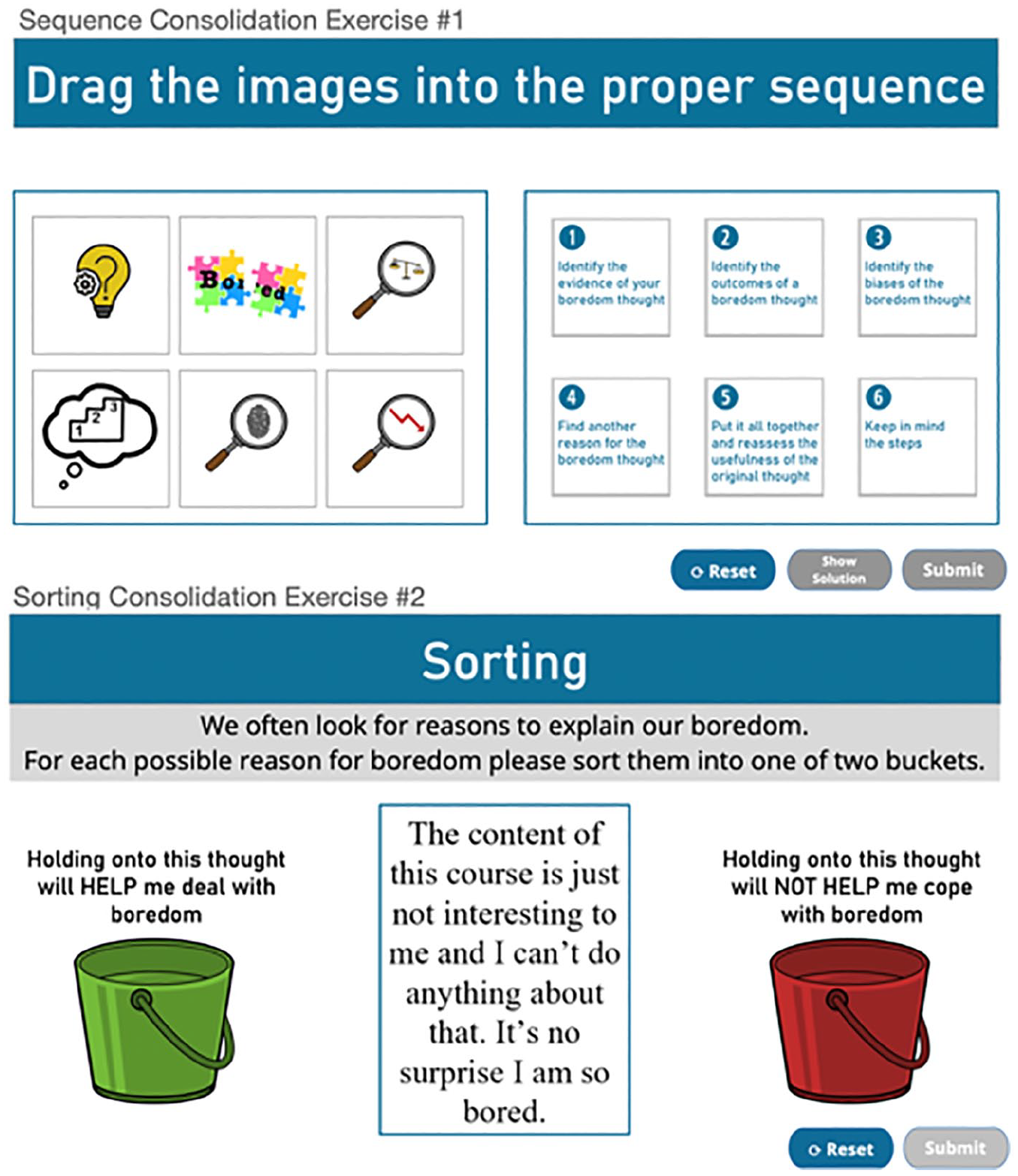
Screenshots of the consolidation exercises.
Dependent Variable: Boredom Misbelief Items (Pre-and Post-Video)
Participants responded to nine questions reflecting common misbeliefs about boredom based on research team expertise. The items were dummy coded whereby selecting an incorrect response (i.e., reflecting a boredom misbelief) was given a score of 1, and selecting a correct response (i.e., reflecting an accurate boredom belief) was given a score of 0. Thus, higher scores on this measure reflected greater boredom misbeliefs. The exact item wording is presented in Table 1 with the main results.
Significance of Changes in Boredom Misbeliefs from Pre-video to Post-video.
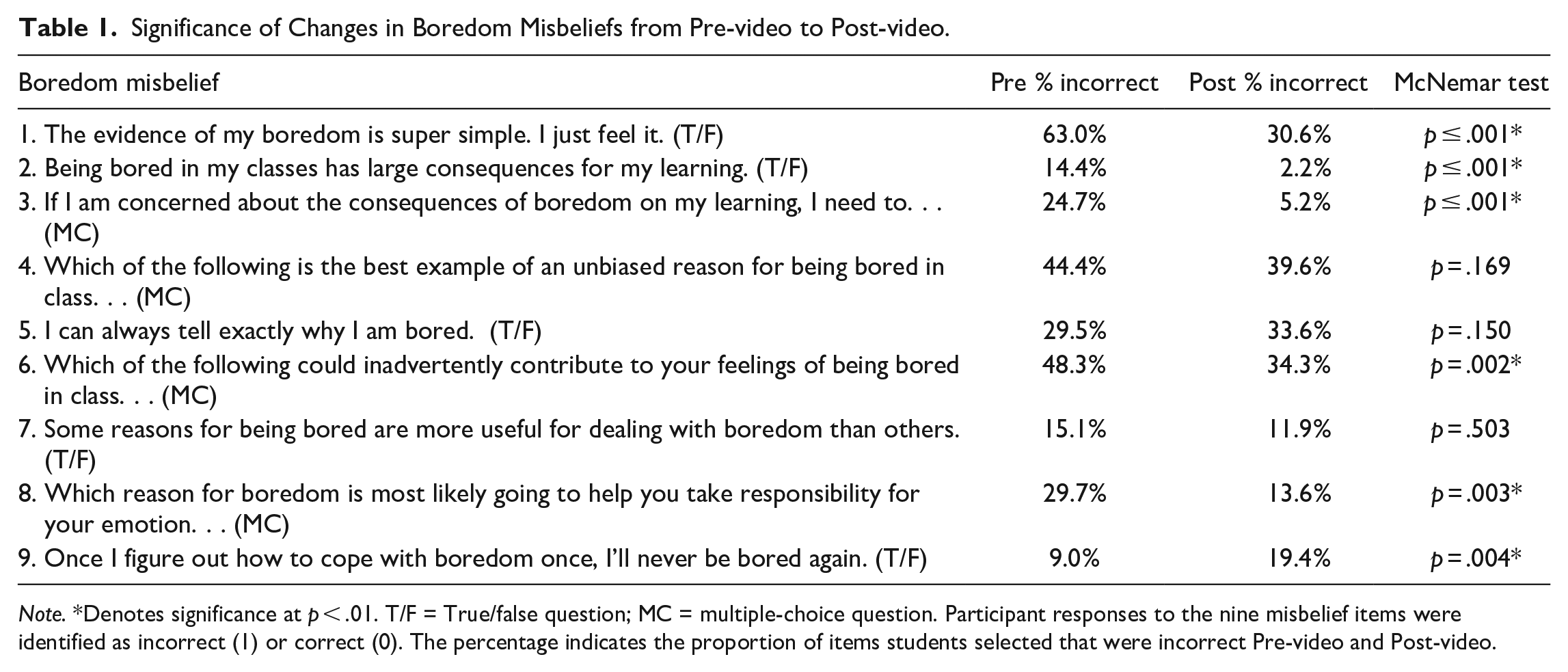
Note. *Denotes significance at p < .01. T/F = True/false question; MC = multiple-choice question. Participant responses to the nine misbelief items were identified as incorrect (1) or correct (0). The percentage indicates the proportion of items students selected that were incorrect Pre-video and Post-video.
Analyses Plan
First, we examined the response rates for the manipulation check to ensure that participants adequately attended to the video. Second, we ran nine McNemar tests to determine if the cognitive restructuring video significantly lowered participants’ boredom misbeliefs immediately after viewing the video and completing the consolidation activity. We adjusted our p-values to <.01 to control for Type I error due to multiple comparisons.
Results
Fidelity Check
The majority of participants correctly completed the sorting exercise on their first attempt (89%) and the sequencing exercise on their first or second attempt (84%) suggesting they attended closely to the video. In terms of accuracy in the activities, participants tended to correctly sort between 91% and 95% of the items and correctly sequence between 74% and 93% of the items.
Boredom Misbeliefs
According to nine separate McNemar tests (Adedokun & Burgess, 2011), the proportion of misbelief responses before and after the training were significantly different for six out of the nine items (Table 1): five of these became more correct after the video and one less correct. For example, for boredom misbelief 1, “the evidence of my boredom is super simple, I just feel it,” the proportion of students who responded more incorrectly (vs. correctly) was significantly lower post-video compared to pre-video, p ≤ .001. However, boredom misbelief 9, “once I figure out how to cope with boredom, I’ll never be bored again,” was responded to significantly more incorrectly post-video, p = .004.
Discussion
The purpose of this study was to pilot the effectiveness of the BIT Phase 2 cognitive restructuring video on reducing students’ boredom misbeliefs. Overall, the video was effective in decreasing the number of boredom misbeliefs students held. For example, five of the nine misbeliefs were answered significantly more correctly after the video. These five items reflected a change in students’ perceptions about boredom, including a better understanding of the evidence of boredom and the consequences that classroom boredom has on their academic trajectory. For example, the significant decrease in misbelief 2 and 3 post-video indicated that students learned it was important to take responsibility for their role in their classroom boredom and change their preconceptions about boredom. This change in thinking demonstrates that the students understood and absorbed content taught in the video, particularly content related to identifying evidence and consequences of boredom in the classroom of which they have control (Pekrun, 2006).
Notably, three boredom misbeliefs (4, 5, and 7) did not convey any statistical change from pre-to-post-video, and one misbelief (9) showed a reverse direction. In other words, boredom misbelief 9 was answered significantly more incorrectly after watching the cognitive restructuring video. One possible explanation for this finding is that response bias (Bradburn et al., 1978) was at play, whereby students wanted to ensure the researchers that the intervention was “working” in a way that they would be able to avoid feeling bored again in the future.
Study Implications
There are several implications based on these results for theory and practice. The full BIT program is guided by the control-value theory of emotions, which posits that boredom is often associated with feelings of low perceived control (Pekrun, 2006). The BIT Phase 2 cognitive restructuring video may play a role in promoting perceived control over managing boredom. Although future research is needed to test this, such a consideration is especially important in academic settings, such as classroom lectures, where students may not have the opportunity to employ other tactics to change their experience of boredom. Furthermore, we argue this training can provide students with an adaptive cognitive toolkit to help them alter their boredom experience by correcting misbeliefs. Additionally, there are important practical implications for the development of the larger BIT program. By ensuring each BIT phase is effective in meeting its stated purpose (Parker et al., 2021), the entirety of the intervention increases in rigor and trustworthiness. While the participants in this study were university students, school and guidance counselors are well-positioned to support all levels of students, such as those transitioning from Grade 12 to university who may have well-formed boredom misbeliefs. Our findings are useful revealing how BIT can help students learn about boredom and that students should not be expected to manage boredom on their own. Further, a full online BIT intervention is in progress (see Tze et al., in press), and a promising future tool for school psychologists and individuals desiring to equip students with skills to combat boredom.
Limitations and Future Research
This pilot study was not designed to directly examine whether the cognitive restructuring video would alter students reported levels of boredom, because BIT Phase 2 is part of a larger online intervention which in its totality is designed to reduce boredom itself. Importantly, the current results show that Phase 2 can be expected to function as intended in the larger intervention to help students use cognitive restructuring to reduce boredom misbeliefs. Like all BIT phases, the cognitive restructuring video was designed to be completed fully online and independently. The video itself was brief, animated, and engaging—which proved adequate in keeping students’ attention as evidenced by strong performance on the consolidation exercises.
As this was a pilot study, we chose a convenience sample and single group design without a control group thereby precluding causal inferences to the video specifically. Nonetheless, the changes noted herein are sufficient to continue designing BIT sessions. It will be important that the full intervention use a robust randomized control trial. This design will allow for the comparison between treatment and control conditions and provide more reliable evidence of the effectiveness of this training program. Adding a longitudinal element to the full intervention design will also be important to determine if the intervention benefits are maintained long-term.
Conclusion
This study tested if a cognitive restructuring video could impact students’ misbeliefs about boredom. The results provide confidence that Phase 2 of the Boredom Intervention Training (BIT) program was effective in modifying students’ misbeliefs of academic boredom. These findings have positive implications for academic institutions and student populations, especially given that all BIT program sessions are highly accessible and suitable for widespread delivery.
Footnotes
Declaration of Conflicting Interests
The author(s) declared no potential conflicts of interest with respect to the research, authorship, and/or publication of this article.
Funding
The author(s) disclosed receipt of the following financial support for the research, authorship, and/or publication of this article: This work was supported by a SSHRCC IG grant awarded to the first author [Grant # 435-2020-0363].
