




Abstract
ADHD is one of the most prevalent neurodevelopmental disorders, and the numbers only continue to rise. Ontario has implemented play-based FDK in the last decade, thus it is imperative that the perceived effectiveness of the program for children with ADHD is studied. In conducting this study, the researchers present and interprets educators’ perceptions of the FDK program and the perceived effectiveness of FDK for children with ADHD. Using an Ecological Systems Theory lens, semi-structured interviews were conducted with kindergarten teachers and early childhood educators from multiple cities throughout Southwestern Ontario to obtain their perceptions of Play-Based FDK and ADHD. The data were analyzed using Thematic Analysis (TA) and three themes emerged: (1) Knowledge and Understanding, (2) Benefits and Challenges of Play-Based FDK for Children with ADHD, and (3) Strategies Used to Promote Success. These themes encompassed the general lived experiences and knowledge that educators have on the effectiveness of the FDK program for children with ADHD. Limitations of the study and future areas of research are discussed.
Keywords
Attention-Deficit/Hyperactivity Disorder (ADHD) is one of the most prevalent neurodevelopmental disorders. With a prevalence rate of 6.1% in Ontario (Statistics Canada, 2010), those with ADHD experience varying symptoms which can affect working memory, cognitive flexibility, and self-regulation (Brocki et al., 2019; Gottfried & Little, 2017). Thus, children can find traditional classroom settings challenging (Gwernan-Jones et al., 2016). As of 2010, Ontario began transitioning schools to a play-based Full-Day Kindergarten (FDK) program, which has shifted the focus from meeting academic standards toward development of the whole child (Youmans et al., 2017).
Because the play-based FDK environment can impact a child with ADHD in many ways, the Ecological Systems Theory (Bronfenbrenner, 1994) is used as a theoretical framework to describe how various relationships and environments can impact the development of a child. Children with ADHD are affected by their direct environment, their relationships with their parents, teachers, and peers, and the relationship that their parents and educators have with one another (Corcoran et al., 2016; Rogers et al., 2015).
There is only one Canadian study to date that examines teachers’ experiences of ADHD in a play-based FDK classroom (see Miller & Brooker, 2017). All other studies originate in the US and/or do not disclose whether the FDK classroom was play-based. The current research also focused on teacher and Early Childhood Educators (ECE) perspectives of ADHD in a play-based FDK classroom.
Literature Review
Attention-Deficit/Hyperactivity Disorder and Full-Day Kindergarten
ADHD is characterized by specific behaviors that interfere with development and functioning, and are consistent over time (American Psychiatric Association, 2013). Although there is some disagreement as to when ADHD can be reliably diagnosed, most researchers suggest it can be no earlier than 4 years of age (e.g., Brown, 2019; Danielson et al., 2017). Typically, there are gender differences in how ADHD symptoms present; however, in children aged 3 to 6, the symptoms displayed by both boys and girls tend to be hyperactive in nature (Grskovic & Zentall, 2010). Once girls turn 6, they are more likely to show symptoms of inattention (Grskovic & Zentall, 2010), though some may continue to show hyperactive/impulsive symptoms (Mowlem et al., 2019). When material is engaging, children with ADHD demonstrate sustained or selective attention (i.e., hyperfocus) and a diminished perception of non-relevant stimuli, with the result that task performance improves (Ashinoff & Abu-Akel, 2019). Hyperfocus is experienced by people with ADHD more so than their neurotypical peers (Hupfeld et al., 2019). Hyperfocus can also be problematic as children often do not want to leave what they are doing, which can disrupt class transition time.
Executive functions (e.g., self-regulation, working memory, and cognitive flexibility), play a significant role in our ability to manage ourselves and our resources to achieve a goal. Self-regulation is one of the most important executive functions, and these skills are essential for positive social interactions, emotional control, attention, and focus (Ministry of Education [MOE], 2016). Self-regulation is a skill that begins to develop during early childhood, and difficulty with this is one of the earliest indicators of ADHD in young children (Brocki et al., 2019; Shuai et al., 2017). There are several other indicators of ADHD in kindergarten-aged children, including being more likely to play alone and changing activities frequently (Alessandri, 1992), motor restlessness, delayed development, and social difficulties (Harpin, 2005). Children with impaired social skills may have trouble making or keeping friends, experience peer rejection, and face social isolation (de Boo & Prins, 2007; Murphy & Barkley, 1996). In fact, de Boo and Prins (2007) found that children with ADHD are quickly labeled by their peers as disruptive, unpredictable, and aggressive.
The classroom environment can often exacerbate ADHD symptoms due to expectations for children to sit still, be quiet, and concentrate for long periods of time (Gwernan-Jones et al., 2016). The children in Gwernan-Jones et al.’s study described feeling frustrated, angry, and imprisoned in the classroom, and found it challenging to concentrate, especially with the distractions of peer interactions, noise, and movement in the classroom. Children with ADHD tend to function best in a highly structured and supportive learning environment with specific directions and consistent demands (McGoey et al., 2002).
Play-Based Full-Day Kindergarten
The Ontario MOE first introduced the play-based FDK program in 2010 (Lynch, 2014). The program was designed to give children a head start in school by providing engaging learning throughout the day based on children’s natural desire for play (MOE, 2016). The MOE created the FDK program to demonstrate that all children are competent, capable, and ready to learn, and aimed to help children grow physically, emotionally, socially, and intellectually. In an Ontario FDK classroom, there is usually one registered teacher and one registered ECE who work together for the benefit of the children through sharing the planning and implementation of activities. The program also values the bi-directional interactions between family, environment, and educators. Overall, the program aims to be child-driven and bases activities on the interests of the children so that they are fully engaged in learning while also having the freedom to explore and experiment on their own.
The limited research available on FDK suggests a number of advantages and disadvantages. The FDK program has been associated with improved physical health and well-being (MOE, 2013), and to be more responsive to the needs of younger children by providing support for self-regulation and development of the whole child (Youmans et al., 2017). FDK educators have also found the play-based model to be more developmentally appropriate because of the reduced focus on academic demands (Lynch, 2014). Further, children who completed an FDK program were more likely to complete high school, less likely to be involved in criminal activity, and had fewer teen pregnancies (Brownell et al., 2015). These positive effects were especially true for children from low socioeconomic (SES) backgrounds. Alternatively, Brownell et al. (2015) found that initial improvements in academic and social skills was lost by the end of grade three (Brownell et al., 2015). Moreover, the presence of two educators in the classroom can lead to confusion about each educator’s role, thereby causing tension and disruption to the teamwork that is essential for the program’s success (Lynch, 2014; MOE, 2013). FDK class size may also be an issue as the MOE has not limited classroom size (Lynch, 2014; MOE, 2013). Large classes can pose problems for the quality of education and for those with special needs because of less one-on-one time between educator and child (Hacıibrahimoğlu & Kargin, 2017).
Play-Based Full-Day Kindergarten and ADHD
In FDK, many children benefit from actively exploring their environment, learning through experimentation, and developing necessary social and emotional skills (MOE, 2013). However, for children with ADHD, who need a more structured and consistent environment (McGoey et al., 2002), the hours of unstructured time and freedom in the classroom can negatively impact their learning. Although there are no current studies that describe the challenges faced by a child with ADHD in a play-based FDK classroom, two American studies investigated how children with disabilities fare in FDK. Gottfried and Le (2016) found that the social-emotional skills of children with disabilities decreased when they were enrolled in FDK classrooms. In another study, Gottfried and Little (2017) found that FDK was associated with improved executive functioning skills for children with learning and communication difficulties, but not for children with emotional or behavioral difficulties. As children with ADHD have been found to demonstrate increased emotional and behavioral difficulties (Gwernan-Jones et al., 2016; Moore et al., 2017; Russell et al., 2016), it is likely that a child with ADHD would not experience the same benefits of FDK.
Ecological Systems Theory
Ecological Systems Theory (EST) is based on the concept that “human development takes place through a process of progressively more complex reciprocal interactions between the people, objects and symbols in one’s immediate environment” (Bronfenbrenner, 1994, p. 38). EST consists of five interrelated systems, all of which interact with one another and influence the development of an active, evolving person at the center: (a) the microsystem, consisting of a child’s direct relationships with significant others; (b) the mesosystem that is made up of multiple microsystems; (c) the exosystem indirectly affects the child; (d) the macrosystem, that includes the cultural values, traditions, and laws; and (e) the chronosystem, which is made of environmental events and transitions in a child’s life (Bronfenbrenner, 1994; Harkonen, 2007; Rogers et al., 2015).
Ecological systems theory applied to full-day kindergarten and ADHD
The underlying premise of EST that children develop because of the interactions between their personal characteristics and their environment, aligns with the play-based FDK program, which encourages learning based on individual differences and the provision of an environment where children can flourish (MOE, 2016). Given that the microsystem is considered to be the most directly influential system for children, the FDK program aims to provide a good foundation for children to develop holistically and successfully. This is especially important for children with ADHD as they have been found to struggle to develop good social skills and relationships with their peers (de Boo & Prins, 2007) and with their educators (Rogers et al., 2015).
Parental involvement in school is essential for children’s success (Gwernan-Jones et al., 2015; MOE, 2016), especially for children with ADHD (Corcoran et al., 2016; Rogers et al., 2015). In the play-based FDK program, this mesosystem is highly encouraged (MOE, 2016). The macrosystem is also relevant because of the high value placed on children’s education in Ontario, and Canada as a whole. In relation to the chronosystem, the FDK program promotes consistency over time by providing children with the same educators throughout the 2 years they are enrolled in the program (MOE, 2016), which allows educators to build a strong bond with the children setting the stage for healthy development and success.
Method
Participants
Purposive sampling was used to recruit participants who had personal experience teaching children with ADHD in play-based FDK. Recruitment was done using a flyer that was posted to the study’s Facebook and Instagram pages. Participants responded by email to the flyer. A total of nine participants (five teachers and four ECEs who all identified as female) completed the interview. Five participants were recruited through social media, and four were recruited through word of mouth from teachers and participants. The educators represented four Southwestern Ontario public and catholic school boards, they had been educators for 12 to 30 years with 2 to 9 years of experience in FDK.
Since few children have ADHD diagnoses in kindergarten, the participants reflected on their entire career as kindergarten educators and thus were not discussing specific students. Since specific children were not observed in the study, the gender makeup of the children the educators discussed is not known. The educators knew the children they were discussing had ADHD, were suspected of ADHD, or in the process of receiving an ADHD diagnosis through parental disclosure. Each educator had experience teaching at least four children diagnosed or suspected of ADHD in FDK in their careers.
Measures
Demographic questionnaire
The demographic questionnaire addressed: (a) how long the educators had been teaching; (b) how many years had been in FDK classrooms; (c) how many children they taught had ADHD; (d) their level of education; (e) whether they completed Ontario Additional Qualification courses in special education; and (f) if they had attended any courses, workshops, or webinars related to ADHD.
Interview protocol
The semi-structured interview began by asking the participants about the nature of ADHD as they have seen it expressed in the children they have taught. Questions then went into more detail concerning the FDK program including participants’ understanding of the program and the experiences of children with ADHD in the program. Subsequently, the interview asked about the parent/educator relationship and how each participant facilitates their relationship with parents. The semi-structured interview questions are available upon request.
Procedure
Participants were interviewed using Skype due to COVID-19 restrictions. Each interview lasted approximately 60 minutes. Following research ethics requirements, the interviews were recorded using the built-in Skype feature as well as on two digital audio recorders and deleted after transcription. At the end of each interview, the participant was thanked, given a $10 e-transfer, and asked if they would like a summary of the results emailed when available.
Data Analysis
The data were analyzed using Thematic Analysis to identify patterns within and across data concerning participants’ lived experiences, views, perspectives, practices, and behaviors (Braun & Clarke, 2006) using an inductive (i.e., “bottom up”) approach with open coding. Once codes were made for each set of data, the researcher looked for themes within the data and created a “thematic map” (Braun & Clarke, 2006). Two independent raters coded the data to ensure inter-rater reliability with any disagreements resolved before refinement. Following this, the map was refined to fewer themes that encompassed more data and continually revised until a final map was completed, removing themes with insufficient support. The resulting themes were analyzed, named, and examined for the relationship between the identified themes and EST.
Results
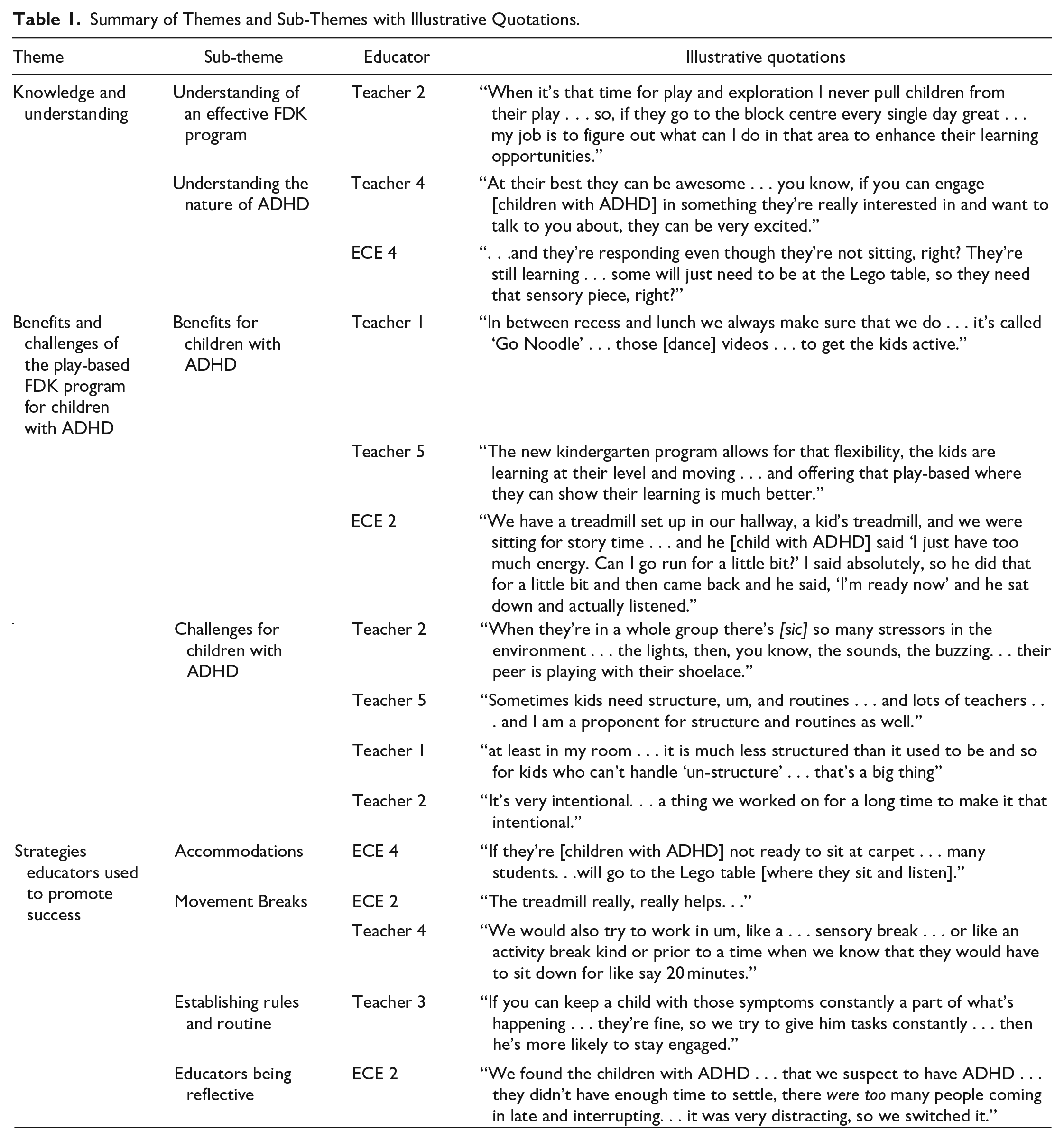
Three overarching themes emerged that related to the perceived effectiveness of play-based FDK for children with ADHD: (a) knowledge and understanding, (b) benefits and challenges of play-based FDK for children with ADHD, and (c) strategies used to promote success (see Figure 1). Table 1 presents an overview of themes with illustrative participant quotes.
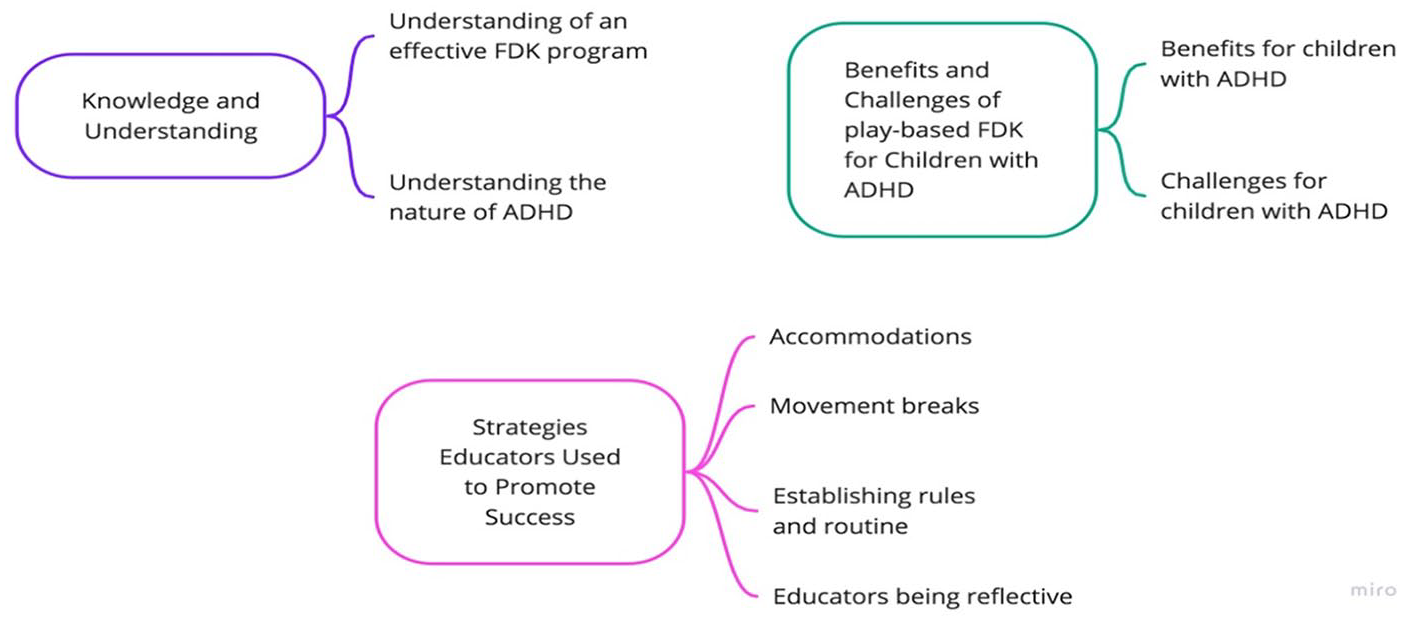
Thematic map of the effectiveness of play-based FDK for children with ADHD.
Summary of Themes and Sub-Themes with Illustrative Quotations.
Knowledge and Understanding
All of the teachers, and 75% of the ECEs demonstrated knowledge about how the play-based FDK program is intended to be run, as they emphasized the importance of providing an open-ended, inquiry-based environment based on children’s interests with educators as facilitators. The educators also understood the typical behaviors a child with ADHD might demonstrate (e.g., motor restlessness, intent interest in one area, and social difficulties) and were aware of the beneficial and challenging aspects of ADHD. All of the teachers and 50% of the ECEs explained how some children with ADHD can focus for long periods of time when they are interested in something, which has been termed “hyperfocus” (Sedgwick et al., 2018). The educators also noted that there can be challenges to managing children with ADHD in the classroom with disruptiveness and impulsiveness being the most challenging behaviors, both in relation to classroom management and interactions with peers. The educators’ awareness of these traits allowed them to better address the needs of children with ADHD.
Benefits and Challenges of FDK
The second theme emerged in direct relation to educators being asked about the benefits and challenges they have experienced with children with ADHD in the program. All of the educators believed that the play-based program was beneficial for children with ADHD for several reasons: (a) the program allows for movement and exploration within the classroom; (b) it provides open-ended and choice-making opportunities; (c) short instructional periods; and (d) the nature of the program helps children to develop social/emotional skills. All of the educators agreed on two aspects of the FDK program that are challenging for children with ADHD in the classroom: (a) distracting stimuli and busyness and (b) lack of structure.
Strategies for Success
All of the educators provided various accommodations for their students to help them learn more effectively, such as different seating options (i.e., wiggle cushion, sitting on a chair, carpet square), calming spaces, noise canceling headphones, visual schedules, rewards, and fidget toys. These accommodations also provided choices to the children, which can be especially important for children with ADHD. The provision of proactive movement breaks and warnings ahead of transition time were also essential to the success of children with ADHD. Another key strategy the educators used was to establish rules and routines for children with ADHD. Two educators from the same classroom noted that giving children jobs to do helped them stay focused during large group circle. Other educators reported having specific spots for children with ADHD to sit to decrease the chance of distraction. Lastly, educators acknowledged they were reflective in their teaching practice, which enabled them to use appropriate accommodations and strategies.
Discussion
Positive Attitudes Toward Children with ADHD
Children with ADHD can influence educators’ perceptions of ADHD and in turn, educators’ attitudes toward children with ADHD can influence their practices and have an effect on children’s success (Rogers et al., 2015). In this study, the majority of educators maintained a positive attitude toward children with ADHD, even when describing the challenges they encountered. Most educators viewed these challenges as resulting from the lack of the children’s social skills and their environment. In the only previous study of ADHD and Ontario’s FDK program, Miller and Brooker (2017) observed that educators experienced a certain amount of strain in their relationships with children having ADHD. In contrast, educators in the current study saw a strong child-educator relationship as a way to help children with ADHD become more successful. The differences found between these studies may be a result of methodology, as Miller and Brooker used surveys rather than interviews, making it difficult to explore participants’ perceptions in greater depth. Overall, it appears that educators’ positive attitudes toward children with ADHD are helpful in creating a successful learning environment for children with ADHD.
The Importance of the FDK Play-Based Component
Since Ontario’s play-based FDK program has been implemented relatively recently, there is no research, to our knowledge, that explores the effectiveness of the play-based component for children with ADHD. However, the educators’ perceived benefits of the program for children with ADHD in the current study suggests that there is focus being placed on the development of the whole child (MOE, 2016). All of the educators seemed to feel that the play-based nature of the FDK program was particularly beneficial for children with ADHD. This perception was evident as the educators listed numerous benefits of the program for these children with very few drawbacks. These findings contrast the results of Lynch’s (2014) study, which found that only a few play-based FDK teachers found play-based learning to be beneficial for children, most did not understand the play-based model, and they preferred to teach using the old model (i.e., with an academic focus). The differences between the findings of the current study and those of Lynch’s (2014) study may also be a result of the types of training the educators received. Specifically, in Lynch’s study it was not mentioned whether the teachers had any training related to ADHD, whereas the current study had a number of educators with ADHD training. The present study also included ECEs, which added unique perspectives regarding the effectiveness of FDK for children with ADHD.
Through retroactive recall, the majority of the educators in the current study reported that children with ADHD demonstrated improvement in their social/emotional and self-regulation skills while in FDK. In contrast, previous studies found negative effects of the FDK program for children with disabilities including a decrease in social-emotional skills, poorer self-control, and no overall improvement in executive functioning (Gottfried & Le, 2016; Gottfried & Little, 2017). These differences may be because the two studies mentioned above are American and there was no mention of whether their FDK was play-based.
Differences Between the Play-Based FDK Curriculum and Its Implementation
Some educators were concerned that the execution of the play-based FDK program varies across schools, and that it is not always implemented in the way it was intended. This difference was evident as each educator described their classroom and routine differently. For example, the FDK document details that children’s success should be measured by whether they can hold a book the right way up and begin to recognize the difference between letters and words (MOE, 2016); however, in Teacher 1’s school, her administrators required children to meet specific reading benchmarks. This finding is important as educators who focus on academics may see fewer benefits of play-based FDK for children with ADHD because it is not truly play-based.
Limitations and Future Research
Although the results of the current study demonstrate that educators perceived the play-based FDK program as beneficial for children with ADHD, there are a number of limitations. First, the study had a small sample size (n = 9) and as such it is unlikely these findings represent the perceptions of all Ontario educators. To address this limitation, future research should include a larger and more diverse sample of Ontario educators. Another limitation of this study was the lack of parental views. Research that compares parent and educator perceptions of children with ADHD within the play-based FDK program would provide another lens with which to investigate the effectiveness of the program.
Additionally, some of the participants may have been more invested in the research topic since three educators either had ADHD themselves, had children with ADHD, or both. While the educators’ personal experience with ADHD may have been beneficial to this research, it also may not represent the perceptions and experiences of the majority of Ontario educators. Finally, it would also be informative for future research to explore how children with ADHD fare in the play-based environment compared to a more structured environment, such as that used in a Montessori approach (Bennetts, 2018).
Lastly, conducting interviews can lead to several biases. To try and avoid as many of these as possible, the interviewer tried to remain objective as to not partake in interviewer bias and looked at the results objectively as to not conform to confirmation bias. Social desirability is also possible within interview approaches, which must be considered when interpreting the results and their generalizability.
Relevance to the Practice of School Psychology
The current study has several implications for the practice of school psychology. First, it highlights the importance of educators’ perceptions and attitudes toward children with ADHD, which in turn influences the effectiveness of the play-based FDK model for children with ADHD. This understanding can better inform the consultation of school psychologists with educators in that working to help educators understand ADHD, hold a positive attitude, and implement the best strategies, will likely lead to improved success for children with ADHD and better child-teacher relationships. School psychologists can also use these findings to support the play-based model of FDK and to help educators both understand the model and implement it correctly within the classroom.
Although there continues to be debate regarding the proper age of diagnosis for ADHD, the current findings lend support for early diagnosis and intervention. When children are diagnosed early with ADHD and educators fully understand and appreciate what ADHD means for a child then they are better equipped to properly support that child within FDK.
Footnotes
Declaration of Conflicting Interests
The author(s) declared no potential conflicts of interest with respect to the research, authorship, and/or publication of this article.
Funding
The author(s) received no financial support for the research, authorship, and/or publication of this article.
