




Abstract
Collective-Memory Work (CMW) is a method of research and learning that relies on a group working together on a topic of shared interest. It aligns with other qualitative approaches such as participatory and feminist research methods, collaborative auto-ethnography, narrative inquiry, and emancipatory adult learning. In CMW participants write short stories from their own memory on a theme agreed in advance. The stories are subsequently scrutinized by the group via detailed textual analysis and recursive discussion. Due to COVID restrictions in 2020, a planned CMW workshop at an Irish higher education institution had to be delivered online. The purpose of this case study is two-fold: first it provides an overview of the CMW approach and how it is implemented in practice, detailing the concrete activities carried out in the workshop. Second, the case study provides insight into running a workshop of this kind online, and the perceived benefits identified by participants of adopting such an approach. We argue that CMW generates an egalitarian group dynamic, encourages active listening, and enables the co-creation of textual analysis in a spirit of collectivity and mutual respect. We suggest that CMW is a versatile method that can be usefully deployed within and beyond academic settings.
The term Collective Memory-Work (CMW) is open to misunderstandings. It is a method of research and learning that relies on a group
1
working together on a topic of shared interest. In contrast to history workshops in which the focus is on engaging with collective (cultural) memory, CMW aims at
To begin, we situate CMW in its epistemological context. CMW was developed by German sociologist and philosopher Frigga Haug and the group Frauenformen in the 1980s at the intersection of the feminist movement, social science and Marxist theory. Haug et al., 1987 foregrounded human agency focusing on how we participate actively in the formation of our own lived experiences. Centring the everyday experiences of participants in CMW-projects as the starting point, CMW developed as a practical critique of traditionally male-dominated science. Since its inception CMW has been adopted by researchers in a variety of disciplines including sociology, political science, education, business studies, gender studies and in a number of regional pockets in the USA, Austria, Scandinavia, Australia, New Zealand and the UK.
Frauenformen sought a process of transformation that involved (a) integrating subject/object in research; (b) defining research as a collective process; and (c) understanding research as a political process that enhances the capacity for action. Each of these premises are now briefly explored. CMW in common with other interpretivist approaches, challenges the positivistic standpoint in the social sciences that tends to render individuals as objects rather than subjects in the research process. The latter’s determinism denies our own role in constituting the very social relations that form us. In contrast, Haug et al., note that: “(…) memory-work is only possible if the subject and the object of research are one and the same person” (1987:35). This is a radical vision of humans as part of the research interaction, engaged in co-creation and fully present in our inter-subjectivity. The CMW epistemological stance resonates with the pioneering work of Dorothy Smith (1987) who also critiqued sociological and philosophical assumptions and practices in her development of feminist standpoint theory. Dissolving the categories of researcher and researched immediately transforms research into an emancipatory learning project and learning itself into research.
Haug’s second premise is that CMW is a group process that has at its core the expansion of knowledge about “modes of societalisation of women” 2 and the intention of increasing the capacity to act of participants. It is important to note that the method is not intended to function as individual therapy “but rather a kind of politicizing research process in groups” (Haug and Hauser, 1986:60).
Thirdly, the aim in using CMW is not the production of knowledge for its own sake. Instead, it is explicitly understood as a political project directed towards an increase in what Critical Psychology terms generalised action potence. Generalised action potence is collective; it exists for one and all. It refers not to personalities, positions, or classes. Rather it is a capacity that inheres within the generalised network that includes subjective grounds and possibilities for action. It may be helpful to think of this in contradistinction to restrictive action potence. The latter operates at the individual level only where the actions taken are beneficial to that particular individual. Such action is not without costs to them, and crucially implies a cost to others and to society as a whole (Tolman, 1994). This phenomenon is something with which most of us are familiar often expressed in the well-known adage: “If you can’t beat ‘em, join ‘em.” But here there is an important contradiction: “On the one hand, restrictive action potence is subjectively functional for individuals in a society like ours. On the other hand, to one degree or another it constitutes a denial of the true social interest, and to that degree, owing to the fact that in the final analysis our individual interests are identical to the collective societal interest, it puts us in a position of hostility towards ourselves” (Tolman, 1994:116).
Recent events provide an instructive example. The SARS-CoV-2 pandemic has brought the clash between generalised action potence and restrictive action potence into sharp relief. For public health measures to work effectively, we must all recognise the generalised usefulness of our individual behaviours. Those who choose to disregard public health advice in pursuance of individual freedom act against the collective societal interest, potentially creating deleterious outcomes for themselves and for others.
What is looked for in CMW is an expansion of the capacity for action for participants towards generalised action potence. Capacity for action here refers to the individual engaging with existing social relations in the direction of an increasing and collective appropriation of structures that determine life instead of blindly surrendering to them (Haug and Hauser, 1986:79). This has the potential to produce radical outcomes. A good example of such action is the collective efforts of teachers and academics to de-colonise the curriculum in schools and institutions of higher education, as a way to challenge power asymmetries in how stories of existing social relations have been told. 3
CMW builds on the strengths of consciousness-raising groups, but it extends their scope. Experiences are not only shared, and stories told by participants; they are also used as material for a systematic and rigorous analysis making critical reference to pre-existing theory. This means taking experience as a point of departure and working back toward generating theoretical explanations: “It raises self-consciousness to know that one is not alone with different experiences. But there comes the point where it doesn't lead any further, stories start to turn in circles, no-one likes to listen any more. . . . Our proposal to work with memories and everyday experiences, to theorise them, tries to employ the joy of starting with experience and connect it with the burden of intense theoretical work” (Haug, 1990: 53-4).
Overcoming the agency/structure distinction through engaging with texts
Central to CMW is the analytic engagement with self-generated text/s. These are memory-scenes, short accounts of remembered experiences. The analytic approach deployed is underpinned by four basic assumptions: the construction of one’s own personality; the tendency to eliminate contradictions; the construction of meaning and the politics of language. Each of these is briefly explored in turn.
We are actively involved in the process of constructing our personality in historically antecedent social circumstances. What we (as of today) understand to be our personality “. . . has a history, a past. We attach meaning to our personas and use this meaning, or understanding of our personality, to determine the steps we take in the near present and distant future” (Haug, 2008: 28-9).
This process is interminable, ongoing and an integral part of our social existence. It includes the negotiation and appropriation of categories of legitimacy for our actions. Haug’s observation aligns closely with other sociological theories that suggests our personalities are shaped both by structuring forces (social and historical) and our own capacity to generate meaning through social interaction (e.g. Bourdieu [1972]2019).
An essential aspect in the analytic work done in CMW is the engagement with contradictions. As humans we tend to disregard that which does not accord with the unified image that we present to ourselves and others. For Haug “this mostly semi-conscious act of eliminating contradictions may become transparent in the written experiences as we document the details that do not fit” (2008:28). Deconstruction work undertaken in the analysis of the memory-stories aims to draw out contradictions in our experiences, and cast them in a new light.
Meaning is not inherent in things, acts, words. It rests on a process of assigning this meaning. For meaning to be valid it “requires agreement by others. Meaning occurs in the first place through language” (Haug, 2008:28). This recalls symbolic interactionist theorising which emphasises the capacity of humans to create and use symbols. Moreover, because we have the capacity to agree on the meaning of vocal and bodily gestures, and interpret those accordingly, humans can effectively communicate and interact. Blumer noted that interaction is distinct in the human context because human beings interpret or ‘define’ each other’s actions instead of merely reacting to each other's actions. Our responses are not made directly to the actions of one another but instead are based on the meaning which we attach to such action (Blumer, 2002).
Finally, we describe and interpret things within the taxonomy that our language/culture provides. However, a language that has evolved in patriarchal culture will inevitably reinforce patriarchy. Prevailing norms influence language and normative language shapes the cognitive world-view.
4
This accounts for the necessity to critically scrutinise what we say or write: “[Language] is not simply a tool that we may use according to our liking. Rather, in the existing language, politics will speak through us and regulate our construction of meaning. Thus, culturally a number of ready meanings lie around . . . they push themselves on us when we write and dictate what we might not even have wanted to express. This happens when we less reflectively and more naively use language” (Haug, 2008:29).
The Frauenformen collective views the acquisition of a particular form of individuality (e.g. to be “a woman”) as an inter-active process of societalisation. The individual is not only a passive receiver of a predetermined and unchangeable socialisation, but an active co-creator of “woman”. It follows that a woman doesn’t simply behave in the way a woman is supposed to behave in her culture because she knows the norms and passively adheres to them. Rather she learns over time to behave in that way because it is a useful adaptation to her surroundings/circumstances. This does not preclude testing the boundaries of the norms at certain points and retaining only those aspects of being a “woman” that suit her.
In the conceptual framework of CMW, history is understood as the concrete lived practice of people with (explicable) interests. Historical conditions in which we find ourselves are the result of earlier struggles, negotiations on societal terrain that are reflected in established structures and institutions, as well as in specific constructions of meaning and constructions of self. In this sense, at any given time what we understand as ourselves can also be seen as a temporary identity-balance (Wellendorf, 1973:48) in a process of continuous identity-bargaining or societalisation. This occurs against the background of the social matrices imposed on us by historical social relations. Biographically we cannot escape an educational process that guides us towards a general acceptance of the ‘chances’ offered according to our social position and with respect to identity patterns. But we can – and do – negotiate our position in this process. 5
CMW foregrounds a lucid and dialectical understanding of agency/structure relations, integrating micro and macro sociological standpoints. In our respective (personal) constructions of meaning and of personality we are always involved as active agents. At the same time we find the margins of space for negotiations is determined by historical conditions. There is not an indefinite set of possibilities for us in these construction processes. We are always bound by the historically possible spectrum of attribution of meaning. To start with we have to use the existing forms of thought and of action. We can put them together in new compositions, and try to develop them further, but we cannot discard them completely. Consequently what we experience as an act of individual construction of meaning and personality is more than a unique creation. It is at the same time an act that we share with, and in which we are connected, to others in the same historical-spatial context.
CMW enables the concretisation of this process giving us practical insight into the agency/structure dialectic. Crucially, the analysis of memory-scenes written by group members starts from the premise that it is possible to make conscious the trajectories of constructions of meaning that determine our own respective lived practice. This includes new insights that eventually offer the option for re-constructing meaning structures and perspectives of self, thus increasing the capacity for action. Implicit in this assumption is the idea that human action can be changed via processes of unlearning and (self-)reflection.
Collective memory-work methodology
In a fully-fledged CMW project writing and analysing texts proceeds through a number of procedural steps. Group participants agree on a topic for their project on the basis of questions (a problematic) originating in the concrete spheres of lived experience. They clarify amongst themselves what presuppositions in relation to the topic they bring into the project. Comparing existing theories to the participants’ experiences and presuppositions helps to define the scope of the project. For this purpose a field review of such theories may take place. Based on the defined scope a guiding question (or questions) 6 are formulated. The group agrees on a writing topic (a trigger word, sentence, heading). Participants write their memory-scenes. The self-generated texts are used as material for text-analyses. During text-analysis the existing theory provides a pool of references that can be tapped into as required. In addition to the pure textual work it is possible to include other resources as material to inform the topical discussions. After the text-analyses are concluded the results of the subsequent discussions are brought together and compared to the original presuppositions and relevant theories. The insights gained in this process build the basis for a concluding project report in which a re-formulation of theories is possible.
The key outcome is the production of knowledge through research and learning that involves intentional engagement and being fully a part of the group project. Eventually, the new insights are transferred into the lived reality of participants. New perspectives, changed perceptions, transformed comprehension lead to different positioning and ideally, to an increased capacity for action. Figure 1 below provides a prototypical outline of the CMW process which may be helpful, particularly for groups working with the method for the first time. It may also be beneficial for groups composed of members from different disciplines, with different traditions of thought or world-views. It is not, however, intended as a template to be rigidly applied. The group members are the masters of the method which must be adapted to the group’s own interests, objectives, ideas, activities and so on. The group determines how to cover the steps outlined. The prototype may be adapted in every practical application of the method. There are many openings for adjustments, e.g. the mode of topical introduction (by rounds of verbal story-telling), the inclusion of elements of acting out of scenes (image theatre), the writing of revised versions of the memory-scenes. Collective Memory-Work as a method is deliberately “inchoate and therefore alive” (Frigga Haug, personal communication, July 7, 2019). Adaptations to local interests and situatedness are necessary to ensure that the core tenets of CMW are fruitfully integrated in any given project. For a discussion of adaptations see Hamm (2021a, 2021b).
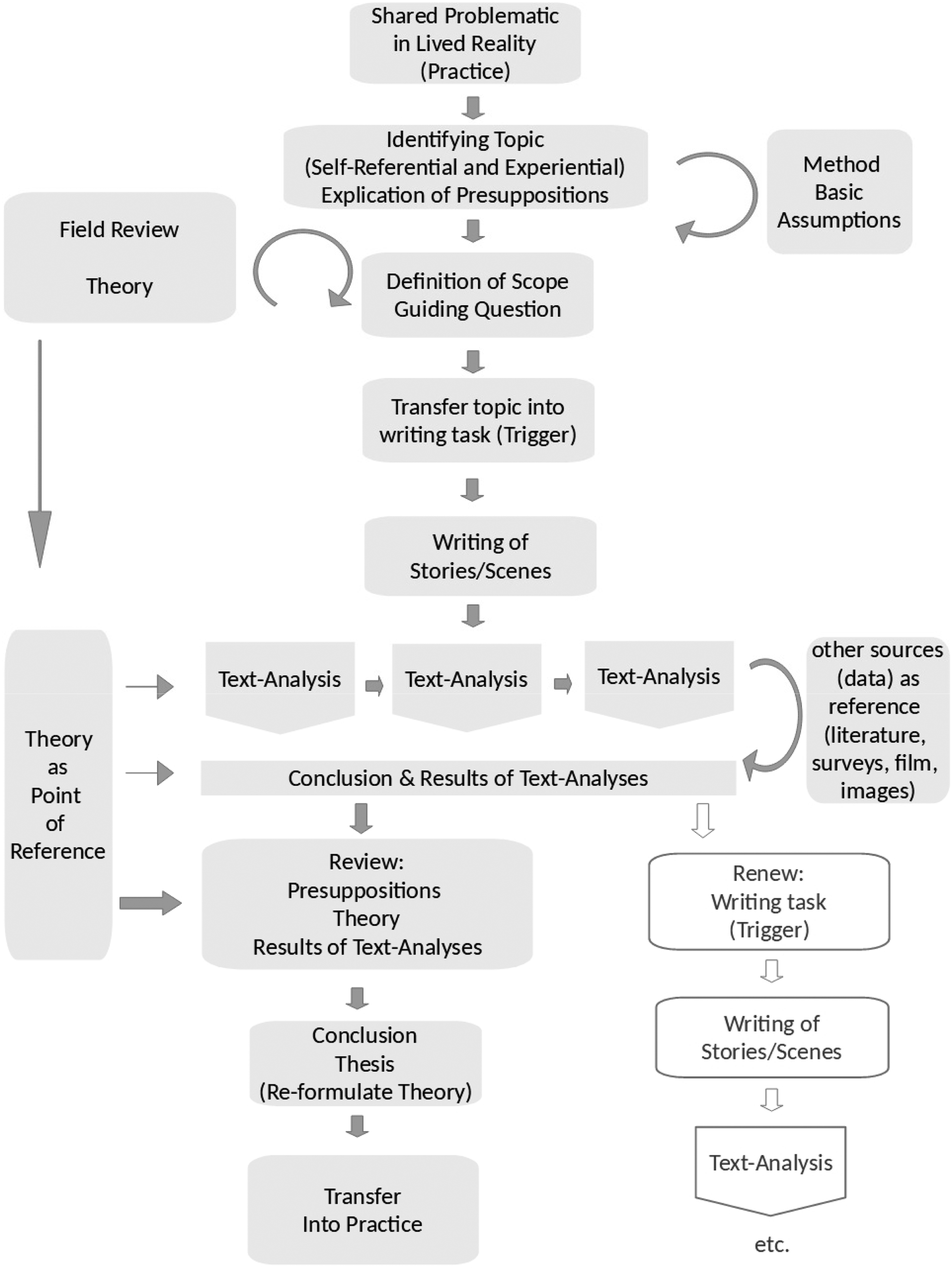
Prototypical process of a collective memory-work project.
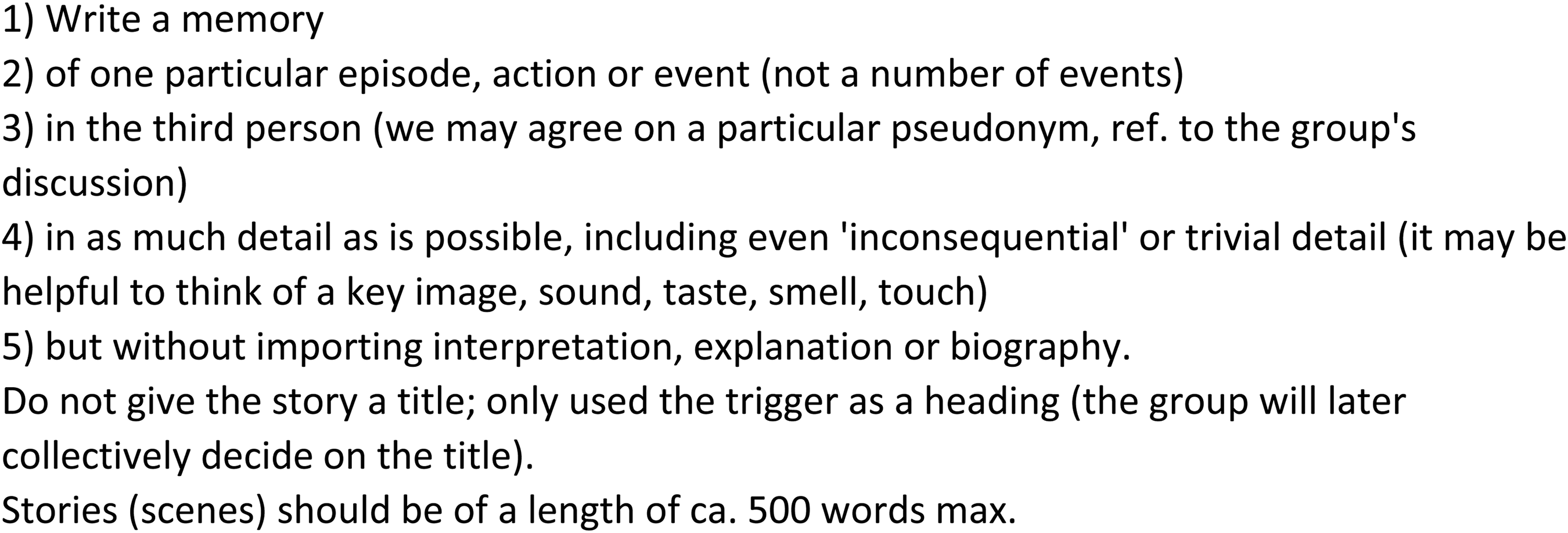
How to write a memory scene.
Doing collective memory-work online: A step-by-step approach
The case study under discussion here began with an invitation from a Visiting Scholar at Maynooth University, Robert Hamm, circulated to University staff and students to join an online-Seminar titled: A topical introduction to the method of Collective Memory-Work. CMW workshops are normally conducted in person, but we were in the midst of pandemic in Autumn 2020, and Robert took the decision to experiment with teaching the method online. The starting point of the workshop was designated in advance as “school experiences.” The aim was to explore personal experiences of school through the CMW workshop and collectively arrive at a point where we could connect those experiences to societal influences, structures and processes. Participants did not need to have prior knowledge of the method. The only requirements were to have a stable internet connection, working camera and microphone and to be available for five online workshops, each lasting three hours and spread over five consecutive weeks. 7
The workshops were planned as a facilitated, interactive learning experience in which the essential steps of CMW were practically applied and reflected upon. The group consisted of ten participants (three male, seven female) from different disciplinary backgrounds: sociology, applied social studies, education, and early childhood and teacher education. Of the ten participants two were undergraduate students, one postgraduate student and the remainder were full-time academics in a range of positions (post-doctoral fellow, lecturer and professor). All participants (but one) grew up and went to secondary school in Ireland. The age of participants ranged from early 20s to early 60s. As will become clear below, these types of classifications were deliberately put into the background as far as they could be, so that they did not translate into status positions within the group. They were however considered in understanding differences in the events and experiences described by participants in the workshops, and in the reflections on the construction of self and others in the stories generated. For instance, in a discussion about experiences in puberty/adolescence in schools, different sexual orientations of participants accounted for different impressions and evaluations of written memory-scenes. Also, the contrast between life in a rural school environment and an urban school environment was discussed. 8
To begin the process each participant was asked:
To think of an experience you had in secondary school that you would be happy to share with the group and talk about in the seminar (ideally this experience should relate to something that [still] ignites questions or 'perplexity' in you); To find a picture that relates to this experience (in whatever way). This can be a photograph of you or others, it can be a picture that you find on the internet that reminds you of the experience, any picture that in your opinion is related to or represents the experience; To think of a few (four to six) key terms that capture the topics that play a role in the experience.
These priming tasks allowed for mental preparation grounded in the lived experience as remembered by participants, and served as the workshop’s point of departure. The sharing, discussion and analysis of the texts of self-generated memory-scenes is the crucial experiential element linking the five workshops held online. Though the group never met as such, a strong esprit de corps emerged very early on, leading us ultimately to reflect not just on the method which we had practiced, but also on the group experiences of the online process of “doing CMW.” These are discussed in the last section of the article.
The five online meetings unfolded in the following sequential manner:
First online meeting
Brief welcome and introduction to the workshop. Agreement on the practical organizational matters
Gathering of participant questions some of which were answered immediately and others were earmarked to be answered as the workshops unfolded (these mainly concerning methodological questions, or questions that would be answered by practically doing CMW in the group)
We used the pictures that were collected in advance to tell a story of our own school experiences. After each story we did a short 'resonance-round' eliciting reactions from others in the group to the story that was told.
Based on the stories verbally recalled in our group and the subsequent feedback, we identified
For writing memory-scenes we agreed to use the trigger word: “Uniform”.
Between the first and second meeting each participant wrote a scene of an event in their own life which they remembered, and that related to the term “Uniform”. For writing the scenes we used a format informed by Crawford et al. (1992):
Second online meeting
Recap on first session, interim thoughts and question gathering and answering (as in previous meeting) new questions. These were mostly about the “nuts and bolts” of the method.
We selected
We did another two empathic readings of memory-scenes in smaller groups of five participants
Brief conclusion with immediate feedback on empathic reading. (For details on empathic reading and the other terms used in this summation, see Steps 1,2,3,4 below)
Third online meeting
Recap on last session, interim thoughts, and new questions. (For example, we discussed basic assumptions, character of text-analysis, what would the workshop outcome be?)
Text-analysis (Step 1 Empathic understanding & Step 2 Distanced Analytic Understanding)
We selected another one of the memory-scenes to extend the text-analysis moving from empathic reading to a deconstruction of the text
Immediate feedback on text-analysis
Between the third and fourth meeting the facilitator formulated a provisional 'reconstruction' (see Step 3 below) and sent it to all participants.
Fourth online meeting
Recap on last session, interim thoughts, and new questions (including questions concerning the practicalities of 'doing' text-analysis in a group, and a discussion on ‘common sense’ theories)
In two sub-groups of five, we did two further Text-analyses (Step 1 Empathic understanding & Step 2 Distanced Analytic Understanding & Step 3 Reconstruction)
We collated the results of the two sub-groups in a plenary at the end of the meeting
Brief conclusion with immediate feedback on process during text-analysis, and questions about ethical issues in CMW
Fifth online meeting
Topical Transfer (we looked back at our discussions during the seminar (pictures chosen, story-telling-round, definition of key terms of reference, trigger for story writing, writing process, empathic reading of memory-scenes, distanced understanding with deconstruction and reconstruction) and identified trajectories of thought for further investigation
Reflection on method
We returned to questions that were asked during the five workshops and discussed the following:
In what fields could people use CMW?
How could the method be adapted for wider use of CMW?
Where is CMW situated on the spectrum of qualitative research methods?
Potential transfer of CMW to areas beyond research, e.g., restorative practices?
Next, we explain how CMW text analysis works in practice. As with the structure of the five workshops, we followed a formal protocol that guided our text analysis. The method is structured around four key steps (carried out across Workshops 2-5) that are covered sequentially below:
Step 1 empathic understanding
The text is read aloud (by the author or another group member). The group listens and lets the text sink in. The author is positioned as a silent witness as the participants discuss the story, taking care to avoid naming the author and focusing only on the text. Participants approach this with sentences starting “What I see the protagonist saying is….” “What I understand the author is trying to tell me is..” The deliberations around what the author meant occurs solely amongst the other participants in the group. First impressions are recorded in brief terms under the following headings:
Context of the scene Message of the author (What is s/he trying to say …) Common Sense Theory (proverbial, everyday knowledge) The Title that the group wishes to give the story
Step 2 deconstruction (distanced analytic understanding)
Next we worked with the printed text/s to deconstruct them using a simple matrix. The rationale for this step is to create some distance from the story and begin to see it in terms of its constituent parts.
Figure 3 Textual Deconstruction (about here)
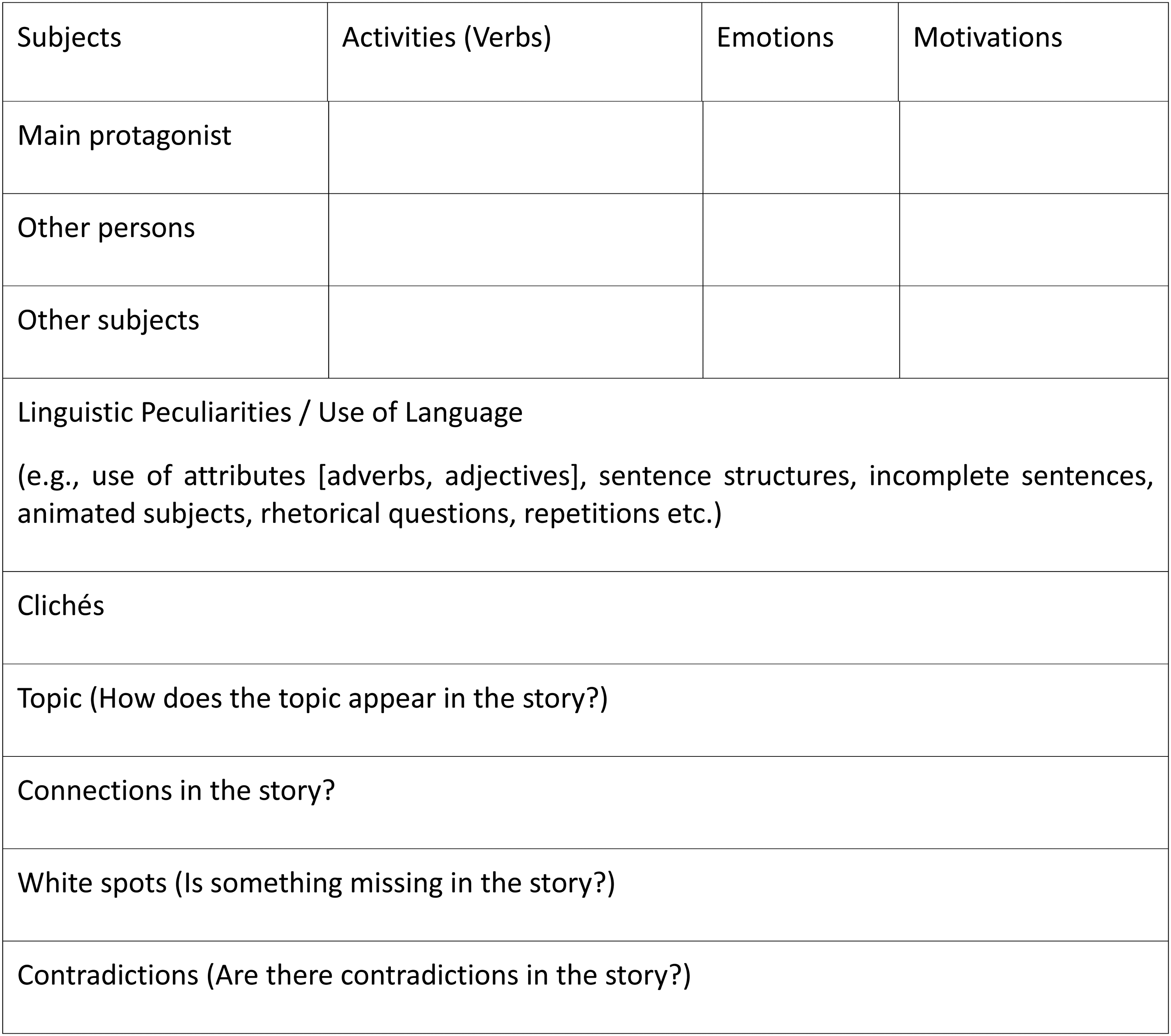
Textual Deconstruction
Step 3 reconstruction (abstracting)
In the third step, we focus only on the content that we have put into Figure 3 (at this point the original text/s of the stories should be set aside to avoid constantly re-visiting them).
First we try to answer the question of how the author constructs themselves and the other Then we try to formulate the We may compare the results of our deliberation with the initial impressions offered during the empathic understanding exercise (undertaken at Step 1 above).
Step 4 topical transfer (shifting the problem)
Taking the outcome of Step 3 as a starting point we try to refer back to the key terms
In this case study, as everyone but the facilitator was new to the method, we were very reliant on his guidance throughout the process. The time-limited nature of the online workshops impacted what we could reasonably do: (a) we could only select some stories for text-analysis and (b) we did not attempt to come to a ‘result’ in the form of a joint conclusion or a final report on our topic, as we did not have time to attend sufficiently to the topical transfer as a group. Nevertheless, the story-telling component of the workshop, followed by the close analysis of selected texts, despite misgivings, proved revelatory as evidenced by the observations of two participants:
9
“The doing of the deconstruction seemed at times to be a technical, even tedious task. However, when we reviewed the stories from the perspectives provided through the template, it became immediately apparent that new insights abounded. I loved how we found that gesture replaced overt emotion, or how in many instances, the story involved a dyadic relationship with a kind of Greek chorus providing the backdrop.”
“Exploring the power struggles, the exclusions and inclusions and dynamics of school life and its formations and deformations was very revealing I thought. I don’t really think I can do the process justice here or properly express all my ideas… the stories related by each member of the collective, all concerned relationships. These included relationships with teachers, parents, other pupils and even an unfortunate bus driver! The process highlighted, if I needed reminding, that education is all about relationships, but it also provoked ideas for me about how power flows, about the subtle limitations that schools place on some bodies within it but not others (or less so some others).”
Despite the time limitations, we collectively identified many pertinent starting points from our successive discussions to drive the investigations of the lack of descriptions of other people (besides the main protagonists) in stories the construction of dyads (relationships/interactions of two people) in the stories the exercise of power dynamics in the stories the question of 'roles’, teacher, student the question of school memories being reproduced as tainted (“good”, “bad”) the differences in time and location the framing of (research) question/s as influential factors on what memories are evoked, or selected for (re-)production
For readers who are interested in gaining an insight into the outcomes of such further engagement please refer to the links to resources in the Appendix.
In the final section of this article, we reflect on the research and learning potentials of CMW both within the university and beyond. We also document the elements of CMW which particularly captured our imaginations and led us to positively evaluate the experience of participating in the workshops. Specifically, we explore the group dynamic that emerged enabling us to give voice, to listen actively and to co-create textual analysis in a spirit of mutual respect.
CMW as a social leveller
During the five consecutive workshops we periodically discussed our reflections on the CMW process. We considered the nature of our interactions in this unusual setting. We may have assumed, for example, that differentials between students, lecturers, early-career academics and professors would manifest in our CMW interactions as much as they might in any other university setting (lectures, classrooms, administrative meetings). Other differences like those of gender, age and personality may have been expected to shape or at least impact the power distribution in our interactions. However, group members effectively bracketed the roles we inhabited in ordinary, everyday contexts, and operated on the basis of parity of esteem: “I loved the democracy of the group dynamic. For the purposes of CMW we were all equals and I found that I learned much from the interactions we had with each other. Status and position were entirely irrelevant to the task at hand.”
“I love the gentle tone and atmosphere that Robert created and how we all participated in that. I especially loved how we spoke with each other, there was an inherent respect that shone through each interaction.”
“It somehow felt safe from the start to choose to tell a story (even a slightly intimate one) to a group of colleagues most of whom I didn’t know well (and students who I didn’t know at all!).”
Humility and humour were both on display, with members contributing equally to discussion and being acknowledged equally. From the perspective of the students who participated, it was surprising and validating to have an attentive audience of academics for our ideas; and for lecturers it was a novel opportunity to gain insight into students’ perspectives without an explicit power dynamic in play. Student participants demonstrated their capacity to be fully active agents in the CMW, an opportunity which is not always available/taken up in more conventional classroom settings.
The format of CMW is reminiscent of restorative circles that deliberately organise group interactions to manage the effects of hierarchy. Lyubansky and Barter (2019), for example, have discussed restorative practices and the relational benefits of power sharing in a school setting. Considering universities have power hierarchies similar to those of schools, it may be reasonable to expect similar relational benefits were such power-sharing approaches to be implemented in third-level settings. Organising people in a literal or metaphorical circle (a square on zoom!), assigning the identical roles to every participant, and ensuring equal rights-to-speak contributed to the social levelling effect: “I must say I enjoyed learning in the format facilitated… which was, I suppose, a learn-by-doing type approach which was in itself an impactful experience for me… my own imagination would not have been engaged so well in a traditional lecture as it was in this participatory seminar…my own enjoyment and the social aspect, I think made learning easier.”
“I loved the technique of handing from one participant to the another. We moved carefully and attentively through each task with curiosity.”
Our facilitator acknowledged some deliberate steps he took in consideration of these issues. By starting straight into the tasks without introductions, there was no opportunity to establish and recognise any hierarchy based on (supposed) merits or status outside of the actual workshop. Instead, we were thrown straight in and required to complete tasks as a collective. This allowed a work-oriented dynamic to emerge as the primary focus of the group, rather than general social hierarchies being recognised and figured out first as a means to organise group structure. We had all contributed an equal amount of material before the workshops commenced underscoring our equal stake in the process.
We have emphasised the levelling effects experienced in our group as an extraordinary achievement, and highlighted the deliberate efforts made to reach this goal. The structural elements at work, however, must also be acknowledged. Essential in this regard is the voluntary nature of participation, and the absence of any sort of institutional, professional, monetary or other reward for participating. Every participant joined solely on the basis of interest in the topic and method. The mode of entry was as simple as can be. Register in response to an email invitation, receive confirmation and that's it. There was no formal setting, no exam, no subjugation under an institutionally mediated power. It is in the combination of these structural elements and the deliberate personal efforts on the part of the facilitator and the participants that the levelling effect could materialise.
CMW and therapeutic effects
The relationship of CMW to therapy has been addressed in a number of publications (e.g. Burman, 2002; Hamm 2021a). Haug was at pains to clarify that: “… [m]emory-work is not intended to provide therapy for suffering persons. This is not cynically meant, but the formulation is derived from the opinion that therapy uses expert knowledge to help people who cannot help themselves. If increases in self-recognition, knowledge about socialization processes, competence about language and meaning, and critique of theory are fundamental and prerequisites for the growing ability to act, memory-work aims at such an outcome” (Haug, 2008: 38)
From the outset it is clear that CMW is not therapy and it is not meant to be. Nevertheless, in our discussions and written reflections some participants noted effects for which they used the term 'therapeutic': “The non-hierarchical nature of CMW made the experience therapeutic, confidence-building, and led to feelings of connection with other people or shared experience or mutual affinity or recognition or solidarity or what I’m calling community-building.”
Another way in which this was expressed was in the absence of judgement and the active listening adopted by the group: “We represented our values and biases in our memories and we remembered our past as a group but yet I never once felt judged or that anyone else was judged.”
“I feel like we suspended judgement in the spirit of participation.”
“Thinking back on the workshops I see that we had to listen to each other quite intently and respectfully and negotiate our collective responses to story narratives. That sort of listening was much deeper and more demanding than ordinary, everyday listening.”
While Haug’s focus in the quotation above relates to the outcomes of a CMW project, the reflections that referred to therapeutic effects in our group related to the process. The careful adoption of an egalitarian ethos from the opening workshop allowed the group to develop a norm and practice of reciprocal respect which underpinned all of our interactions.
That this experience is labelled therapeutic says as much about the process itself as it does of the contrasting experiences that we usually have in our everyday working environments (as students or lecturers), and it is an indicator of the backgrounds of participants. Hamm reports how students in a business class in Vienna who, in their reflections on participating in CMW-projects, refer to extraordinary teamwork and group experiences (2021a: 124). The language that people use in reflections (not only) on their experiences with CMW, reflects their respective discursive field. In the case of the business students: “[i]n their community of practice therapy is not relevant. Business is not therapy. What counts is what can be counted, success is based on efficiency and measurable (monetary) outputs” (Hamm, 2021a: 139f.)
Consequently in the descriptions of their experiences no-one draws a connection to therapy. In contrast, in the course of a postgraduate programme in gender studies in Sweden where one of the days was reserved for an adapted version of CMW at “different stages during the day, the students returned to the comparison with therapy” (Liinason, 2009: 81).
This repeated reference to therapy (re)-affirms a particular version of feminist history in which the equation of working with experiences and therapy as a path to liberation is self-evident. In this context it would be strange and in fact frowned upon to speak in the lingua of business studies, or mechanical engineering.
Thus for our own group the use of the adjective “therapeutic” as a descriptor of the experiences is not too surprising, given the background of all participants in social studies, education and sociology. We are just as much influenced and determined in our use of language by our personal-social history and embeddedness in a given discursive field.
Doing collective memory-work in a pandemic
We equally considered the role that our personal situations at the time may have had in reinforcing the sense of a cohesive group dynamic devoid of hierarchy. Ireland was experiencing its second wave of the coronavirus pandemic in the depths of Autumn 2020. Computer-mediated communication free of the constraints of time and place, intensified dramatically during the pandemic. The question arises as to whether the online format contributed to the sense of egalitarianism which prevailed throughout the workshops. The context of the coronavirus pandemic meant that the workshops were delivered online and all of our interactions were mediated by a screen. There did seem to be a certain derealisation
11
that stemmed from sitting at home in a bedroom and calling into a meeting. The mediated quality of our interactive space (literally we were physically removed from each other yet were together in digital space) may have allowed all of us to speak more freely than we would have in the physical and embodied space of the university. Moreover, it felt great to engage with one another in this highly focused yet socially distanced way in the depths of lockdown: “Doing the CMW was in fact a really positive thing that I did- for myself- during lockdown. I would have preferred obviously to do it a co-present situation, but the fact that it was possible to do online made me feel a little more benign toward technology in general, and MSTeams, in particular!”
One participant wrote that having been through a difficult time personally, the regularity, structure and focus of the CMW workshops as they unfolded over five weeks, helped in getting a sense of structure back into their life. For all of us, a palpable sense of connection formed as we worked together: “I liked the feeling of community. We were one group. We had our little Wednesday evening meeting. It felt safe.”
“There are parallels between the CMW method and the modus operandi of community development working in groups, engaging in meaningful and deep participation.”
Some members of our group suggested that the community-building effects were particular to the context of the pandemic. The weekly meetings were a tonic for the unusual level of isolation. However, others felt that the isolation induced by the pandemic may be analogous to the isolation experienced by people in other contexts such as those experiencing social marginalisation, stigma, or those experiencing isolation due to the pervasive individualism and acceleration that characterised contemporary capitalist societies (Bauman, 2000; Rosa, 2015). We suggest that CMW has therapeutic effects as a consequence of its community-building capacity that counters isolation in a very practical way. Attributing such a therapeutic effect to CMW depends on the assumption that all isolation is the same, on a level that can be similarly impacted by the kind of community-building produced in a CMW workshop. We enter the proviso that these effects should be tested outside of a pandemic and with different kinds of isolated groups. Social scientists (social workers, educators, community and youth workers, restorative practitioners) working with groups who are socially isolated may be interested in employing CMW to purposively assess its community building aspect.
There is a certain ambiguity here: can we be recommending wider use of Zoom and other computer-mediated communication tools, when we were simultaneously longing for the in-person collegiality of the physical campus? It is something we feel requires further consideration. It may be a mistake to neglect the role of the body in social interactions including the signalling from clothing, body language, position in a room, ableness in different situations, etc. in establishing a micro hierarchy and in influencing the way we interact with one another. The exhaustion we were feeling in lockdown may also have had a disinhibiting effect on interactions. We were so weary and starved of social interaction we may have neglected to play our roles appropriately and formally, straying widely from pro-forma scripts (Goffman, 1959). There is also the point that social norms for zoom meetings had to be established ad hoc as opposed to employing the pre-existing norms of on-campus interactions. Further exploration could help establish what components of the CMW method’s design produced what effects. Mindful of Haug et al.’s (1987) original intention that CMW build capacity for collective action among subjugated groups in society such as women under patriarchy, we suggest that there are times when encouraging online CMW may be desirable. For instance, in efforts to include students and teachers in co-designing curricula, or in capacity-building with marginalised, geographically dispersed groups.
CMW’s potential to overcome the researcher/researched divide
The social levelling dynamic of CMW may be most purposeful in an education setting, particularly at this time when efforts are being made to include students as peer-designers in the development of educational approaches (Vaugh et al., 2018). It seems possible that a method that produces a form of social levelling could be useful to those seeking co-equal participation from students in research and design for improved educational approaches. The growing popularity of the concept of universal design for learning suggests an increased demand for qualitative research methods that can account for human variation and nuance. Bereiter (2002) for instance, describes a ‘design research’ for education that doesn’t fit neatly into a quantitative-qualitative dichotomy. Rather, it is better defined by its own attributes such as not being distanced from its subject and being ‘interventionist’. Not only is CMW not distanced from its subject, but it aims to collapse the researcher/researched divide entirely. In CMW the researcher gives over directorial control to the group (of which they are a member) allowing research priorities to be chosen collaboratively rather than by a distinct ‘researcher’ who is separated from ‘the participants.’ In the context of the range of disciplines now committed to the co-creation of knowledge, and peer-led research and teaching, CMW presents itself as a more useful methodological approach than more standard emic approaches. We would suggest that groups with a strong commitment to co-creation consider adapting CMW as a versatile method that works effectively online. The group is empowered through the guidance of a skilled facilitator to collectively “invent” the research question, create data, analyse that data and generate compelling, evidence-informed explanations of the topic under discussion.
One issue with conventional qualitative methods deployed in the education context is that they tend to involve the collection of in-depth data from students. These data are then taken away to be analysed by those who are not themselves service users. Yet they are expected to empathise with these detached data and to imagine a service which meets the needs of the data-providers. As noted above, there is an increasing move towards including participants as peer researchers and co-creators of knowledge (Vaugh et al., 2020; Marder et al., 2021). Peer perspectives may be infinitely more valid in their interpretation of data and their ability to imagine solutions than those coming from a more etic perspective. The possibility for CMW to complement service design could be explored further. The involvement of both service users and service providers working together in the process also facilitates the kind of empathy and mutual recognition which is core to design principles.
Epistemology and CMW
The design of the method has some apparent epistemological advantages worth reflecting on briefly here. The core difference in terms of research design between CMW and other methods, aside from those factors already mentioned, lies in the act of ongoing collective analysis alongside collective data generation. Interpretivist critiques of data analysis note that different researchers can observe the same data and describe it differently. Sceptics might suggest that so long as researchers employ parsimonious descriptions of data, without imbuing meaning that is not a direct description of the observed data, such differences should be minimal. Moreover, they would suggest that differences in descriptions will be superficial with meaning being exchangeable across interpretations.
However, researchers who are interested in minimising the risk of conflicting descriptions, and who want to safeguard against unwitting biases shaping the interpretation of data, may be attracted to the collective aspects of the CMW approach to data analysis. Other conversations about the collective aspect of CMW have discussed the tendency for CMW to be aligned with the political left and to come from critical feminist perspectives that influence the nature of analysis. But participants in collectives are afforded the opportunity to have their understandings of concepts challenged constructively by those who come from a very different point of view (Onyx et al., 2021). The benefits of an organic, intersubjective approach may be in the possibility for collectives to come across some ideas that are agreed upon, and others that have not hitherto been recognised. These convergences and divergences may be more difficult to discover by a single researcher eliciting data from passive participants. In this sense CMW aligns with other group-based research activities (Johnson, 2018). For a critical appraisal of the effects of practical adaptations of CMW to a focus group model see also Hamm (2020, 2021a).
The parallel processes of data analysis and data generation in CMW aligns well with the principles of grounded theory (Charmaz, 2017). The researcher gives over directorial control to the group (of which they are a member) allowing research priorities to be chosen collaboratively rather than by a distinct ‘researcher’ who is separated from ‘the participant.’ It is still relatively rare to come across social research in which there are democratic processes underpinning the selection of what gets researched, and how it gets researched (although Participant Action Research strives toward such a goal). In CMW there is also a feedback loop between data generation and analysis with multiple stages of data generation punctuated by collective analysis alongside components of simultaneous data analysis and generation.
A final advantage of the CMW research design is multi-dimensional data generation. First, the written memories and photographs or other initial data elicitation tools which form the basis of the work, offer data for analysis. This is followed by the generation of another level of data by the group reflection on the memories, and their collective deconstruction. Additionally, there is a kind of meta data generated through the group’s notes observing how the group interacts and how the collective work develops. In some ways CMW resembles an experimental ethnographic method. Instead of observation in the wild, a group is purposively put together with the possibility of their progression as a group being observed and analysed collectively and reflexively. Meanwhile they collect their memories much as they would be collected through other qualitative methods such as biographical interviewing and narrative inquiry. Except participant-researchers in the CMW context collect rather than be collected.
CMW may also function akin to a collective auto-ethnographic method offering a unique kind of group emic perspective through the individual’s participation in the collective, each as researcher and as participant, with the possibility of a simultaneous etic perspective in the intersubjective dialectic between participant-researchers coming from different world-views. For example, one participant-researcher coming from a different background may offer a different perspective to another participant-researcher on their observations giving a kind of etic exchange. On the other hand, participant-researchers share insider, emic perspectives on those constructs they experience in common. Weiner (2021) reports his effort to theorise social psychological dynamics at play in higher education settings using participant observation and in-depth interviews but notes the potential benefits of an intersubjective approach such as that offered by CMW in this kind of theorising.
Conclusion
The aim of CMW is to enhance the capacity to act in terms of generalised action potence. An individual memory can be deconstructed and reconstructed by the group through a structured protocol that reveals the universal in the particular. Participants are situated as active agents, interacting with others on the basis of parity of esteem to develop analytical, linguistic and interpretive skills. In this case study, the nature of the method which foregrounded participation, the style of the facilitator who did not stand on ceremony guiding the process gently and firmly, and the computer-mediated context─ together played a role in equalising power relations, producing a striking sense of equality and mutuality in the group. The egalitarian group dynamic that emerged enabled us to give voice, to listen actively and to co-create textual analysis in a spirit of collectivity and mutual respect. In doing so we moved beyond the subject/object dichotomy that inheres in other social science methodologies. We suggest therefore, that paying more attention to these constituting factors in other contexts could help to attenuate hierarchy and disparity in social interactions. This would be particularly useful in the context of co-creating collectively, such as in research, teaching or in the development of a political movement for which the method was originally intended. CMW is a useful and productive research method that can potentially be used in a wide range of settings including academic, civil society, community, and restorative practice initiatives.
Footnotes
Acknowledgements
The Collective Memory-Work project that led to this article received funding from the Irish Research Council and from the European Union's Horizon 2020 research and innovation program under the Maria Sklodowska-Curie agreement No. 713279
Declaration of conflicting interests
The author(s) declared no potential conflicts of interest with respect to the research, authorship, and/or publication of this article.
Funding
The author(s) received no financial support for the research, authorship and/or publication of this article.

Notes
Appendix
Resources and further information on CMW can be found on the dedicated webpage www.collectivememorywork.net including an extensive bibliography, open access articles, and the two recent open access e-books The Potential of Collective Memory-Work as a method of learning: applications and adaptations and Reader Collective Memory-Work.