




Abstract
This paper presents findings from an Irish qualitative study of postgraduate, female, international students. It focuses on their narrations of internationalisation, in respect of events leading them to become international students, and their reflections on their academic, interpersonal and societal experiences in Ireland. International students are generally understudied and marginalised as metaphorical ‘others’ within global education policies, often being reduced to mere recruitment and financial targets and units of analysis. However, this study shows that international students transcend widespread but static assumptions about them being in academic and social deficit when transitioning to life in another country and negotiating new educational contexts. Significantly, our interviewees discursively positioned themselves in multifarious ways in relation to Irish higher education curricula, drawing on various discourses to define their internationalisation journeys. Although the sample size is small and confined to female postgraduates, our data suggests that university policies in Ireland and internationally largely overlook the multidimensionality of international doctoral students’ experiences. In our conclusion, we tentatively suggest ways in which international students’ academic and intercultural experiences could in the future be enriched, and how international students themselves could more fruitfully contribute to Irish higher education.
Introduction
This paper focuses on findings from a qualitative study conducted in 2016, on international PhD students’ narratives about why they studied abroad and their expectations and everyday experiences in an Irish university and Irish society. In Ireland, international students are an under-researched group (O’Reilly et al., 2013). However, more research is slowly emerging (e.g. Dunne, 2009; Wang, 2020), partially due to the increasing prominence accorded to internationalisation in Irish higher education (HE) (Clarke et al., 2018) and the development of global critical scholarship on the topic. This emergent research has begun to investigate the opportunities/challenges that international students negotiate on entering new learning environments. These include acculturation stress (McLachlan and Justice, 2009), forging friendships with ‘home’ students (Dunne, 2009), relationships with teaching staff (O’Reilly et al., 2013), racism (Boucher, 1998) and university supports fostering smoother transitions into tertiary education (Coate and Rathnayake, 2012). That said, in Ireland, more research is still required on these students’ relationships with each other, university staff and Irish students; on their perceptions about internationalisation and culturally prevalent views that they are in deficit, in terms of university experiences, academic abilities, cross-cultural engagement and overall learning experiences (Coate and Rathnayake, 2012). Despite government investments attracting international doctoral researchers to Ireland, there is sparse research on their experiences of learning and teaching, relationships and feelings of belonging. These under-researched issues are nonetheless significant for teaching and research and are addressed in this paper.
Initially, internationalisation in Irish and international HE policy and research is analysed and prominent factors influencing the development of international education policy in Ireland, as well as extant intersections in international policy trends, are outlined. The second section evaluates current and past research on international students and their experiences. The research methodology is then explained and prefigures the main findings presented in Part Four. The final part of the paper offers some conclusions and recommendations for Irish social scientific research and policy with reference to Ethical Internationalisation and other perspectives.
Internationalisation: Global trends, policies and discourses
The concept of internationalisation is contested, with multiple definitions in academic, policy and Higher Education literature (De Wit et al., 2015). In relation to Higher Education, internationalisation encompasses several dimensions of learning and teaching. These include incorporating international case-studies of globalised companies into modules and curricula, enhancements in language provision, using terms like ‘international’ in global branding, study abroad opportunities, increased staff mobility, forging relationships between universities and students in different countries and international student recruitment. Internationalisation of the Curriculum attracts considerable attention in contemporary literature (Clifford and Montgomery, 2014; Ryan et al., 2020). This is ‘the process of incorporating international, intercultural and global dimensions into the content of the curriculum as well as the learning outcomes, assessment tasks, teaching methods and support services’ (Leask, 2015: 9). Knight (2004: 12) defines internationalisation as ‘the process of integrating an international culture or global dimension into the purpose, functions and delivery of Higher Education’. However, it has been argued that internationalisation in relation to increased overseas recruitment perpetuates neo-liberal imperatives potentially undermines ‘caring’ dimensions of HE (Lynch, 2010). Several authors argue for the importance of capturing international doctoral candidates’ opinions about PhD study, thus showing the multifarious and contested cultural terrains international students negotiate when completing doctoral research abroad (cf. Elliot et al., 2015; Lazarte-Elliot et al., 2016). Evans and Stevenson (2011: 1–2) address the following questions that are significant for effective PhD supervision with both home and international students, particularly those negotiating new and unfamiliar university surroundings: What is it like to try and achieve the highest possible academic award in an unfamiliar context? Is the PhD programme what students expected? What are the challenges? How useful and relevant is the doctorate perceived to be? How can supervisors and other doctoral educators, best support this student group?
Competing definitions of international students appear in the literature which is partially due to convergence and confluence in international legal/regulatory frameworks with regard to students from EEA and non-EEA territories. We adopt definitions from the UNESCO Institute for Statistics (UIS) 1 and the Global Education Digest (GED) 2 which define international students as mobile students who leave their country/territory of origin and move to another country to study. Until recently, Ireland was not a significant global player in internationalisation, although policy commitments to internationalisation have existed in Ireland for over 20 years (Clarke et al., 2018: 6). However, the proportion of international undergraduate and postgraduate students registered in Irish HEIs is increasing steadily (O’Brien, 2019). The Department of Education and Skills (DES, 2016: 18) documented 21,440 non-EU students and 11,678 EU students in Ireland in 2014/2015. 3 O’Brien (2019) charts a 42% increase in international students from outside the EU from 2015 to 2018. Similar rises in first-time residence permits issued to international students entering Ireland are discernible from 2013 (9300) to 2017 (13,500). China was the main country of origin for non-EEA students entering Ireland between 2013 and 2017 and Malaysia had the second highest number of non-EEA students coming to Ireland for the same period (Groarke and Durst, 2019: 19). The USA, Canada, India and Saudi Arabia all feature in the top six countries for students coming to Ireland during 2016–2018 (Groarke and Durst, 2019: 20). 4 Approximately 5000 EU students were also registered for study in Ireland in 2019 (ICEF Monitor, 2019). However, in 2019, there was a discernible drop in university and college applications from British students, partially due to Brexit uncertainties and rising rental costs, especially in Dublin (Mahon, 2019). 5 In 2018/2019, over 20,000 non-EU students were registered in Ireland. Outward mobility has also increased; in 2011/2012, 10% of students registered on NFQ Level 8 courses studied or did placements abroad which is in line with EU averages (Clarke et al., 2018: 6). 6 There are gaps in Irish data on international students generally (Clarke et al., 2018); however, HEA (2020) documents increases in non-EU and EU students completing doctoral research in Ireland from 2007/2008 to 2019/2020. 7
The economic and socio-cultural benefits of internationalisation are well documented in policy-related and academic literature (Groarke and Durst, 2019). As per the literature, potential advantages include language and cultural learning, forging friendships, self-discovery and development of international research and teaching links (Stier, 2003). However, the advantages of internationalisation extend well beyond individuals to academic departments, quality assurance and to society, potentially advancing global citizenship, intercultural awareness and graduate attributes for employability (Jones and Killick, 2013). Significantly, negative outcomes of student mobility are cited in the literature too, including ‘brain drain’/‘lost talent’ when students leave their countries of origin (Groarke and Durst, 2019: 1), lack of support and intercultural understanding in universities, and the prioritisation of university revenues above international students’ needs (Clarke et al., 2018). Studies underline that internationalisation of informal and formal HE curricula are pivotal to intercultural learning which is frequently reported as one of the main advantages of internationalisation, through mentoring programmes, intercultural events, group work and sports (Leask, 2009). However, accomplishing intercultural learning is not a fait accompli of enhanced student mobility. Rather, it must be actively supported within and across institutions (Leask and Carroll, 2011).
While the non-economic benefits of increased student mobility to students, universities and the economy, are increasingly recognised in Ireland and elsewhere (Sawir, 2013), economic motives drive internationalisation policies globally. For example, Coate (2009: 273) quotes a report by the Higher Education Policy Institute (HEPI)
8
(2004) which claimed that international students were an ‘extremely significant export industry’ to the UK economy even ‘outstripping the value of alcoholic drinks’. In Australia, international education is now the third biggest export category after iron and coal, generating average annual revenue of $32 million AUS (Maslen, 2018). Coate (2009: 273) argues that contemporary international students are conceptualised in ‘stark terms of commodification’ ‘(students, wool, beer… it’s just business)’ which are underpinned by free trade visions of HE (Coate, 2009: 275). Such financial imperatives are interspersed with imperialist concepts of ‘otherness’ in western universities, while economies of recruitment are linked to underlying power dynamics and colonial discourses of ‘them’ and ‘us’ (Sidhu, 2006). The expansion of ‘branch campuses’ of Western universities across Asia is an extension of imperialist logics pertaining to East/West dichotomies, and the pre-dominance of knowledge associated with distinctively European societies; most notably, Western science (Khoo, 2011). Significantly, Coate (2009) reflects on a seemingly everyday occurrence in a university classroom which she argues, reflects the predominance of Westernised views of otherness, which shape and reflect students’ interactions with each other. Coate (2009) takes the reader on a journey into that classroom with students from various countries; Britain, Germany, Sri Lanka, Ghana and Indonesia. A question from a German student; ‘where do we go when we step outside?’ (Coate, 2009: 272) inspires Coate to ask ‘where we go’ when we encounter otherness. A young British woman is eager to lead in sharing her notes with this international group. A Sri Lankan student volunteers initially but backs down when he sees the British girl’s enthusiasm. Coate (2009) writes that this dance of international and domestic students oscillating, moving backwards and forwards in their responses is emblematic of encounters between ‘others’ and broader colonial legacies; The eagerness of the British student to take the lead in the discussion was, somewhat paradoxically, her form of hesitating before taking responsibility for the other: she does not have to be confronted with ‘the other’ if she can manage to speak to her notes for 20 minutes. Or, conversely, is she benignly ‘helping’ the others by ensuring they do not have to speak? Either way, her reluctance to engage collaboratively is apparent but it is not her fault: she does not wish to ‘step outside’ and she has not been compelled to do (Coate, 2009: 273).
Internationalisation policy in Ireland: An overview
In Ireland, market-based imperatives drive internationalisation policies. The flagship document of current Irish policy frameworks on internationalisation, The International Education Strategy 2016-2020; Irish Educated, Globally Connected 9 (DES, 2016) explicitly frames internationalisation with regards to income generation, capital investment and entrepreneurship, stating it generates approximately €1.58 billion to the national economy in 2014/2015. In Ireland, as in other countries, international education is ‘big business’; of the €1.58 billion accrued to the Irish Exchequer, international students contributed approximately €217 million to publicly-funded universities, Institutes of Technology (IoTs) and privately-funded HEIs nationally in 2014/2015 (DES, 2016: 56). Similar corporatist logics were entrenched in its antecedent International Education Strategy 2010–2015 Investing in Global Relationships (DES, 2010), which focused on global competitiveness, and promoting and rebranding ‘Education Ireland’ (DES, 2010: 33–64). Both documents explicitly operationalize distinctively business-oriented visions of internationalisation. The earlier document (DES, 2010) focuses on increasing international student numbers, alongside strategies for creating globally competitive HEIs. Comparably, DES (2016) emphasises strengthening connections to entrepreneurship to ‘support national economic ambitions’ and build world-class learning networks for economic investment (DES, 2016: 23, 30). DES (2016: 24) alludes to ethical dimensions of internationalisation, albeit to a much lesser degree than market forces. DES (2016: 24) acknowledges ‘the temptation for more advanced nations’ to view ‘developing’ nations as mere ‘mass markets for low-cost learning’. That said deploying concepts of ‘developing nations’ simultaneously legitimise discourses of ‘otherness’ without redressing underlying existing power imbalances. The transformation of university education from a ‘public’ to a ‘private good’ and ‘edubusiness’ based on primarily consumerist logics and rationales (Coate and Rathnayake, 2012), the diminution of the notion of care in Higher Education (Lynch, 2010), and the ‘reduction’ of international students by national government and HEIs globally to mere targets and units of analysis, are well documented internationally (Marginson, 2012; Metselaar, 2005).
Research perspectives on international student experiences of overseas study
Despite a historical paucity of research on international students in Ireland, recent studies investigate HE staff members’ views on internationalisation of the curriculum (Ryan et al., 2020), and international students’ experiences of peer learning and living in Ireland (Idris et al., 2019). Comparable to other countries, O’Reilly et al. (2013) underline challenges faced by international students in Ireland which include negotiating socio-cultural differences, language and religious differences. Furthermore, as per O’Reilly et al. (2013), several students reported isolation, depression, homesickness, discrimination, feeling unable to cope with academic and social pressures, language and accommodation challenges. University staff interviewed by O’Reilly et al. (2013) also commented that Irish students are generally uninterested in engaging with international students, which impacted significantly on peer learning. However, Clarke et al. (2018) shows that Irish university staff valued international students for cultural enrichment, broadening learning experiences and international dimensions of discussions. International students interviewed in Clarke et al. (2018) also commented that they valued Irish HE as more courses in Irish HEIs encompassed international dimensions (p. 57).
Dunne (2009) notes that Irish student’s perspectives on intercultural contact and perceived cultural differences are under-researched. Focusing on full-time undergraduate students, aged between 18 and 23 years, in an Irish university, Dunne (2009) underlines the complexity of students’ motivations for forging contacts with students they perceive as culturally different; in this case, mature students 10 and international students. Significantly, Dunne (2009) found Irish students were anxious about intercultural relationships, and often had instrumental reasons for forging deeper contacts with mature and international learners, such as garnering information for assignments. However, Irish students were also critical of perceived lack of supports for fostering better relationships with international students, advocating that relationship-building should happen from day one, through co-operative learning that emphasise intercultural similarities and differences. This highlights the multi-dimensionality of students’ relationships and the significance of individual and cultural barriers to intercultural exchange. Significantly, Dunne (2009) shows that we need to understand the complexity of international students’ relationships that are interlinked with culture, history, institutional narratives and power.
Jones (2017) categorises factors affecting international students into four milieus; institutional, personal, national and familial, thus showing ‘the multiplicity of influences on that experience and emphasising heterogeneity’ (p. 936). The level of study impacts markedly, and for doctoral students, the extent that s/he is part of a research team, in a structured/unstructured PhD programme and feels supported by supervisors is very significant. Supportive relationships with supervisors and peers have been shown to impact positively on feelings of belonging and on the motivation of international PhD candidates (Cole, 2010). Evans and Stevenson (2011) focused on international, nursing PhD students, studying in the UK. Issues they identified that affected doctoral students’ PhD experiences and academic transitions thereafter were the quality of supervisor–student relationships (McClure, 2005) differences in expectations around supervision, programme structure, language difficulties, lack of familiarity with teaching approaches, feeling separate from the research/teaching life of departments and different disciplinary backgrounds (Deem and Brehony, 2000). Similarly, Lee (2008) illuminates different approaches to research supervision (e.g. functional, emancipatory, critical thinking) that indelibly affect relationships with supervisory teams and supervision practice. In universities, doctoral science students frequently tend to be part of larger research teams which (often) positively affects their integration into university and team-building. However, students in Humanities subjects often find transitions more difficult as their PhD experiences tend to be more solitary. Significantly, Evans and Stevenson (2011) found that many students found it difficult to adjust to the level of critical thinking in PhD programmes, whilst others said they enjoyed finding their own voices during the journey, thus showing the variety in PhD student experiences. Some international recommendations for universities as per Evans and Stevenson (2011) include discipline-specific language training; clarifying expectations and, different supervision approaches (e.g. professional versus personal) and building staff/student relationships. Jones (2017), however, argues that merely providing language supports for international students overlooks the heterogeneity of students’ experiences generally and entrenches ‘deficit’ views of international students (Heng, 2018). In this regard, Jones (2017) purports that we also need to rethink institutional structures and understand more about commonalities in domestic and international student experiences and needs, as well as differences. Broadly speaking, this corresponds to Internationalisation at Home research which argues for transcending static ‘international’ versus ‘home’ categorisations, asserting many broad similarities in students’ experiences (Eisenchlas and Trevaskes, 2003).
Some extant research and policy acquis regularly invokes deficit views of internationally mobile students and the academic contributions of international students to the curriculum, in terms of their input to university teaching, are rarely acknowledged by HEIs (Jones, 2017; Sawir, 2013). Literature also unpicks power dynamics that frequently conceptualise international students as a mainly homogenous group, and as ‘non-actors’ and ‘non-agentic’ (Coate and Rathnayake, 2012; Khoo, 2011). Sawir (2013) asserts that international students are frequently ‘invisibilised’ in curricula and university policy planning, showing how HEIs (largely) interpret international students as ‘marginal’. Furthermore, ignoring how international students positively impact on HE research/teaching overlooks their agency in actively shaping their own futures, and internationalised education (Marginson, 2012, 2013). Comparably, extant literature reveals that most institutions provide sparse opportunities for international students to discuss how they conceptualise internationalisation, their relationships with so-called ‘host’ students and staff, and supports they require (if any) (Coate and Rathnayake, 2012). Coate (2009) also argues hidden binaries distort our thinking about internationalisation, evident in ‘every day’ language deployed to categorise, classify and/or ‘rank’ students, such as ‘our students’, ‘home students’ and ‘international students’, language which renders both ‘international’ and ‘home’ students largely unknowable. Coate (2009) subsequently challenges us to unravel the ‘political foundations’ of our thinking which is central to understanding our roles as educators and our positionalities in the deeply unethical practices that often pervade international students’ educational realities. Jones (2017) argues that traditional dichotomies of ‘home’ and ‘international’ students are increasingly difficult to sustain, given they often need similar supports. Instead, we need to work laterally and in and across all levels in institutions to properly support all students, regardless of country of origin.
Methodology
This research took place in an Irish university with a population of approximately 18,000 students including 3000 international students from over 100 countries. The University is ranked among the top 1% of universities internationally, according to QS University World Rankings, and the Times Higher Education. The university offers support services to all students, and targeted services for incoming/outgoing international students, including campus orientation programmes, visa and immigration support, healthcare and English language programmes. However, this and some other Irish universities embraced internationalisation relatively recently, as a response to falling rankings in international league tables in 2006/2007, contracting HE budgets and decreasing private investment, suggesting financial imperatives were crucial.
The Biographical Narrative Interpretive Method (BNIM) interviewing technique was utilised to elicit biographical information and uncover ordinary occurrences, and notions of internationalisation as a ‘lived’ experience. Our interview materials underline the multidimensionality of international students’ narratives, encompassing discussions about relationships, interactions with staff and learning how to live in a new country, illuminating diverse internationalisation journeys. BNIM focuses primarily on capturing ‘small stories’ (Bamberg, 2006) about people’s every day or seemingly ‘mundane’ experiences. It is concerned with the sequencing of events throughout individual narrations (e.g. when particular events are spoken about, how and why) (Wengraf, 2001).
BNIM is a psycho-social method concerned with detailed texturing of storytelling, emphasising how past events and previous subjectivities shape how participants conceptualise their present and future selves. This desire to enter into people’s experiences is reflected in the three BNIM sub-sessions. In sub-session one, participants are asked to respond to the SQUIN (Single Question Used to Induce Narrative). Typically, data elicited in sub-session one is both chronological and descriptive. We used a ‘partial-life SQUIN’ focusing mainly on participant’s experiences of studying in Ireland. As you know, I’m a researcher who is interested in internationalisation and international student experiences. Can you tell me about your life as an international student, your experiences of studying at the university; things that work well for international postgrads and things that don’t? I won’t interrupt. I’ll just take notes.
In sub-session two, events/details relayed in the first sub-session are discussed in detail. During sub-session two, the researcher ‘pushes for PINs’, Personal Incident Narratives. 11 However, per Wengraf (2001) ‘pushing’ for PINs must be completed in the exact sequence that events were relayed in sub-session one. In sub-session two, questions should include the following phrase; ‘can you give me some more detail about that and how that all happened?’ to elicit narratives. Sub-session three is optional and compares to a semi-structured interview where the researcher asks questions about specific issues that participants did not discuss in previous sub-sessions.
Sampling
The six participants were recruited through snowball sampling because an email sent on the researcher’s behalf to all international postgraduate students, through the International Office at the university, elicited only two responses. All participants who took part were conducting PhD research in social scientific/cognate disciplines and were female. While the lack of heterogeneity may be a weakness, in terms of the overall representativeness of the findings in relation to international students, it may give strength to this research. All participants were female PhD students studying in the same faculty, at the same university, so their experiences could justifiably be compared and contrasted. Furthermore, although the sample size is small, most BNIM studies have a sample size of 10 persons or less and the richness of data is significant to the approach.
The research received full ethical approval from the University Research Ethics Committee and supports were available to students if they became distressed during or after interviews. 12 All interviews were recorded on an electronic device and transcribed and then analysed using Thematic Analysis (TA). This involved extracting key themes from which subthemes were later generated (Jovchelovitch and Bauer, 2000). The rationale for using TA instead of BNIM analysis (Wengraf, 2001) 13 was that TA was a quicker and less complex process and could be conducted by the researchers without any outside involvement.
Findings
This section presents the principal findings, showing that despite challenges, international students interpret internationalisation positively; as a significant life event for improved career prospects, language skills and interculturalism. Interviewees valued their own research and teaching contributions to the university in small-group teaching and research, but commensurate with previous research findings (Marginson, 2012), they felt underappreciated by academic staff and students (O’Reilly et al., 2013). These findings are significant as previous research indicates that Irish university staff value international students for curriculum enhancement (Clarke et al., 2018). Although we did not interview staff, comparing our findings to Clarke et al. (2018) illuminates possible differences in how international PhD students might be valued by lecturers and others, compared to how they think they are viewed by them. This is significant for understanding how international PhD students see themselves as ‘fitting into’ departments and as contributing to university teaching and research. Participants spoke regularly about barriers they negotiated to come to Ireland initially (visas and immigration) and across their learning journeys. Our findings thus indicate that changes to university supports for international students need to take account of age, language, programme, levels of study and amount of time spent in Ireland. Some supports provided by the university were seen as inadequate by PhD students, such as campus orientation programmes and targeted at undergraduates rather than tailored to the demands and rigours of researcher development.
The findings correspond to life story approaches that participants adopted during interviews. Some interlinking themes generated in discussing internationalisation were: (i) reasons for becoming international, (ii) relationships with Irish staff and students and (iii) perceptions about university and social supports. Otherness featured prominently in relation to these themes. Given gaps in knowledge about international students’ experiences in Ireland, particularly postgraduate and PhD students, these findings contribute to existing literature. They also suggest the need for further research, more generically on international students and also specifically with doctoral students, to ascertain group differences and similarities in experiences, and required support. However, we make no claims to representativeness, given our sample was small, taken from one University at one period in time, and involved female doctoral students from social scientific disciplines.
Discourses of ‘becoming’ international: Internationalisation as lived experience
Our findings reveal that participants’ interest in becoming international stretched back to childhood and adolescence. Participants regularly discussed how interconnected life events led them to consider studying abroad. Internationalisation was discussed in several ways: as developing international thinking, relationships with new friends, and in relation to mundane conversations and chance encounters that incited thinking about international study. Charlotte dreamt about travelling abroad as a teenager; she thought about what her life would be like, beyond the small town where she was born. Like other respondents, she defined ‘international thinking’ as ‘thinking bigger, thinking beyond’, and global citizenship, which was seen as a transformative dimension of student mobility (cf. Yemini, 2017). ‘I wanted to move away and be independent. I thought of what I could learn in another country, language and culture. And global citizenship, my experiences as an international PhD student, it transformed me’.
The processes of mastering English and learning new cultural symbols were important elements of internationalisation. Cultural learning is exiting familiar cultures and entering new ones characterised by internalising different rules, expectations and experiences. Much research focuses on ‘culture shock’ and adaptation, particularly when international students arrive in new countries (Brown and Holloway, 2008). While some participants commented that they felt ‘shocked’ especially at the beginning of their internationalisation journey, their experiences were more multidimensional than ‘culture shock’ which purports that adaptation is the pinnacle of intercultural learning and the process to achieving it proceeds in (mainly) linear stages (Zhou et al., 2008). Maria-Theresa alluded to ‘culture shock’ in intercultural learning; however, her narrative (and that of other interviewees) illuminates that cultural learning is negotiated, dynamic, fluid and non-linear: I couldn’t believe that you drank tea with milk. Back then, I couldn’t imagine it. I also couldn’t believe the cars and the shopping they have express tills at Tesco. I never saw that. My friends come and they say ‘the cars, the tea and the shopping’ and I shrug ‘it’s different’. Learning is gradual and I think I went backwards and forwards in how I learned. Thought I knew something but then ‘No’.
Katherine’s narrative made several references to childhood experiences in Honduras and symbols of European culture. Katherine spoke of the ‘elegance’ of Queen Elizabeth II who was a powerful symbol throughout her childhood, alongside pictures of Parisian ladies, both of which strongly influenced her perceptions about European culture. Katherine believed that her home in Honduras was seen as ‘primitive’ and ‘nothing’ and said she ‘wanted to escape to civilisation’. As a teenager, she aspired to the elegance which she viewed as synonymous with Europe. Her decision to move to Ireland was motivated by subverting colonial notions about ‘developing’ nations which were linked to the predominance of East/West dichotomies. However, she wished to adopt a ‘sophisticated European persona’ which she saw as synonymous with the British Queen and regularly used colonial discourse (e.g. ‘wild vs. sophisticated’). This is indicative of the complexity of international students’ experiences, motivations for leaving home and competing understandings of identity every day. Her early memories of Queen Elizabeth II evoked notions of refinement and sophistication: ‘I saw pictures of the Queen and she was so elegant… When you look at her clothes, the lapels were so perfect. She looks so perfect. The clothes… That was Europe for me… elegant and refined’.
Katherine’s narrative is comparable to Coate’s (2009) analysis of a photograph entitled ‘the Queen and I’, which featured an international scholar meeting Queen Elizabeth II, an image replete with the juxtaposition of East and West and them and us dichotomies. At the time, she was working at an English university for a Japanese company that sends students to England. When her university won the Queen’s Award for International Enterprise, she was presented in traditional, Japanese dress. In the photograph, the Queen has on a striking blue suit and hat, the student has on a beautiful, deep red kimono. They are facing each other, and in that single snapshot they are a vivid portrayal of an encounter between the ‘other’ and the ultimate signifier of the former Empire, together celebrating the successes of international trade. It is difficult not to see the binaries in this photograph: East/West, Oriental/Western, and… ultimately, Them/Us (Coate, 2009: 274).
For Katherine, the opportunity to study in Europe was a ‘long-held wish’ and reaffirmed her status of being ‘the intelligent one’, which she saw as the converse valued position to ‘not being the pretty one’. Her narrative was replete with desires to be ‘worth something’ and ‘being the best’ in the eyes of others, which affected her decision to pursue PhD study. The interviews provided here illuminate how identity is embedded in internationalisation discourses (Clifford, 2009; Tsouroufli, 2015). I was the smart one. I was the one teachers said would be most successful. I’d think, ‘hello intelligent person here’ (laughs). I needed to be seen as something because beauty was unobtainable. So the only thing I had was to excel academically. I wanted to be the best so the PhD was the option.
Building better lives and relationships as motivations for PhD study
Other prevalent reasons for embarking on PhD study included building ‘better lives’ and family and intimate relationships. Maria-Theresa’s childhood on a rural, Peruvian farm motivated her to move abroad to improve her employment and education prospects. Her overarching narrative centred on ‘fighting for education’ and her self-identity as ‘a fighter’ who perpetually ‘fights to achieve’: Peru, it’s not a rich country. My family were not rich farmers and letting houses for very little… I want to forge a better future … I’m fighting for education, fighting against the system, the people who told me I’d never make it. It’s been tough.
Increased career and earnings opportunities were important to all interviewees. Overseas PhD study was regularly associated with ‘better lives’, ‘prosperity’ and ‘opportunities for advancement’. The cost of living in Ireland influenced Alexandra’s reasons to move to Ireland (among others). She recalled a conversation with a friend about the benefits of living in Ireland vs. London. I remember calling a friend and I said to her ‘London is too expensive, I can’t stay’ and s/he said, ‘What about Ireland? You learn English, good universities, it’s cheaper and it’s Euros! So I moved to Cork then and subsequently, PhD.
Romantic relationships featured strongly in some participants’ reasons for overseas study and for remaining in Ireland. Elizabeth’s decision to come to Ireland was motivated by a chance meeting with a man at a train station, who ended up being her romantic partner. Charlotte’s relationship with her partner ended and her ‘stop gap job’ in a café finished unexpectedly at the same time. Her PhD was a ‘new chapter’ in life, moving on from the past towards a better future: The letter came and I thought, I get to do my PhD and move to Ireland which is what I need, a break from all of this and a new chapter in my life where there were no more memories of Peter, my ex-partner. He abusive and there was a lot of power but it was normal to me.
Past and future life trajectories and development of PhD researcher identity
Participants’ previous life experiences affected the development of their PhD researcher identity, how they approached their PhD research and their assumptions about doctoral study. Katherine pursued what she called ‘an emotionless pathway’ to be seen as ‘strong and sophisticated’. This adversely affected her transition to Ireland, forging friendships with students and staff, researcher identity and belonging. Katherine spoke about ‘holding back’ from others, as she did not want others to see her as ‘needy and lesser because of Western perceptions’ which she said affected her research approach of being very formal with and trying to adhere to strict objectivity with her interview participants. All the students acknowledged that Humanities PhD journeys were often lonely and solitary (Evans and Stevenson, 2011), compared to scientific peers. Katherine and others commented that previous life experiences had affected their work and learning ethos which was central to how they interpreted their researcher identity. Alexandra said; ‘it was built into me to learn. I’ve loved learning since my History teacher. She sparked interest in me to think critically and research’. Researcher identity attracts considerable attention in social scientific research on power, identity and positionalities (Thomson and Gunter, 2011) and it featured strongly in interviews here. As per the literature, participants conceptualised it as multifaceted and multidimensional: as linked to methodological and theoretical learning, disciplinary socialisation and belonging. The quality and continuity of strong supervisory relationships, informal contacts with other staff, relationships with other PhD students and alignment in expectations about their PhD research and their experience of doing it, were critical factors in fostering belonging, feelings of ownership and expert knowledge on one’s own topic. Despite initiatives in university departments such as guest lectures, teambuilding, welcoming parties, and targeted methodological learning sessions, notions of ‘otherness’ in the university frequently pervaded interviewee’s accounts about researcher identity. This identity developed slowly and incrementally over time. Several participants spoke about wider factors that affected how this developed positively and/or negatively at different stages of their PhD journeys, including relationships with flatmates, accommodation and financial worries, all of which impacted markedly on how they conducted their research. This is evident in Katherine’s narration: My shopping bag broke. I didn’t know it rained so much {in Ireland} and I didn’t make the connection with the rain and the brown [paper] bag. And the stuff went everywhere. I looked down at my coat which was tatty and I thought ‘this isn’t what I thought would happen and it doesn’t look like what the Queen is wearing’… And I didn’t know if I should gather the food up, is that what people do? Also, I was the PhD student so I had some authority in the house. One day, there were used condoms in the sitting room. Used condoms on the floor! And I thought this isn’t what I thought it would be like at all. I remember thinking ‘The dream is over’ and ‘Crash and burn. I’m not a credible academic and I never will be’. I couldn’t sleep or write for weeks after that.
Relationships with Irish University staff and students and cultural loneliness
All interviewees stated that their friendships with Irish students were not strong ones and they regularly felt lonely, but more so when they first came to Ireland. This emanated from language difficulties, social isolation and variations in everyday social conventions. Alexandra enjoys Irish people’s company, but she conducts her friendships much more casually with Irish people than Swiss friends, which she says relates to ‘the casual nature of friendship [in Ireland]}’: In Switzerland, life is regulated and if you say you’re going, you’re going. If I was tired, I just went but the Irish girls didn’t say they wouldn’t be there. I thought I’d let everyone down if I didn’t go, even when I didn’t want to. Now I don’t show up when I don’t want to. When I’m here I do things the Irish way but I switch in Switzerland.
Elizabeth said that Ireland’s geographical location as an island and its colonial history renders it ‘inward looking’, which reinforced her feeling of cultural loneliness. Significantly, all interviewees said that international students are ‘outsiders’ in Irish HEIs. Elizabeth said; ‘Ireland as an island, you think a bit more locally. The students think locally, don’t socialise beyond what they know’. Similar to Alexandra, she said that communicative conventions regulating conversations in Ireland renders it difficult for many international students to forge friendships with Irish PhD students and Irish people generally: The Irish are very nice, the friendliest people but like onions… You have to go very deep to understand them… You peel the layers…. They don’t speak directly. We are very direct, we say what we mean. You don’t say what you mean. What you mean is sometimes different to what you say. That’s not dishonesty. It’s just the way you are.
All participants, bar one, had strong relationships with their supervisors which impacted positively on transitioning to life in Ireland. Some interviewees attended pre-Christmas dinner at their supervisors’ homes and said the supervisor looked out for them, giving them career advice and help with teaching when needed. However, they regularly stated they are ‘on the periphery, the margins’ in university and Irish society generally. Despite pursuing an ‘emotionless journey’, Katherine referred to a university administrator as her ‘Irish mother’, speaking regularly about the woman’s family and meeting outside the university, signifying deep personal bonds. All interviewees said they were treated fairly by university administrators, departmental lecturers and technical staff with regard to teaching hours allocation but that they were understood better by international staff and people who had lived abroad. Most of the relationships they forged with university staff (e.g. administrators, lecturers) in and outside their departments happened outside the university; in choirs, musical societies, theatre groups and cinema clubs. Elizabeth (and other interviewees) attributed this to neo-liberal dynamics in contemporary universities and lack of care for students generally: ‘Everyone is so busy and I think care for the student, where is it? They don’t get time to care and money. The university is a business’.
Racism, stereotyping and discrimination
All participants commented that they experienced racism, discrimination and stereotyping. This is comparable to international findings on undergraduate and postgraduate overseas students’ experiences in the UK (Brown and Jones, 2013), in the US and other countries (Lee, 2006). It also corresponds to Irish research by Boucher (1998) and Wang and King O’Riain (2006) on Chinese students’ experiences of direct and indirect discrimination. Furthermore, it invokes notions of ‘everyday racism’; micro-aggressions and practices which unfairly discriminate between people, based on race, ethnicity and skin colour (Naughton, 2016). Maria-Theresa relayed several instances when she was unfairly discriminated due to nationality, skin colour and accent, particularly with regards to housing: ‘Landlords in Ireland, they say, “you’re the exact type of person we would rent to” but then don’t because I’m foreign and have an accent’. She also related a story about an interaction with painters which left her feeling ‘patronised and humiliated’ which (perhaps) underscores the intersectionality of sexism and racism here: Calling us the little girls and mimicking my accent. And one of them said ‘you clean up now little girls’ in my accent. I thought ‘are they all like that here?’ and ‘what will the university be like?’ I’m very aware of whom I am and I never had to actively think about my colour in any other country. But here, because you were colonised, it plays out. One man commented on my skin colour and called a dirty foreigner and asked what social welfare I was getting on the street. I didn’t even know them.
Charlotte changes her behaviour to offset racist behaviours. She adopts an Irish accent when she feels she will be discriminated against as a ‘foreigner and as a woman’. She relates this below: I adopt an Irish accent when people come to the house, plumbers and such because they would see me as the foreigner, as different and as someone to manipulate. It happened to me many times. Almost like stupid…. There is a strong sense of that in Ireland. I change how I speak to be seen as Irish.
All participants displayed resilience in coping with discrimination and stereotyping. Amy ‘learned to live with people’s perceptions’ of her as a ‘dumb blonde American’ and challenged a fellow male student that she would write her PhD quicker than he did ‘because I was fed up with the American stupidity comments’. Maria-Theresa said she ‘cried only once and then tried to move on’. However, these experiences left a long-lasting impact on many participants and foregrounded their ‘wariness towards Irish people and trusting them’ which was reiterated in several interviews.
Attitudes to informal and formal university supports
All interview participants mentioned the importance of formal/informal supports such as friendships with peers in assisting with cultural adjustment, particularly when they initially entered Ireland. Social support is economic and non-economic supports which enable people to cope with adverse circumstances and/or manage everyday situations (Frey and Rothlisberger, 1996). Charlotte spoke about developing friendships with other international students in her PhD programme, which enabled her to overcome stressors like lack of finances, accommodation and loneliness: We set it up, the group and we were nearly all international. It made a difference because we were going through the same stuff with our PhDs. And we were on our own most of the time because we had our own space to work in so it was a support.
Elizabeth also spoke of the importance of informal supports during her PhD, stating that support from international colleagues (as opposed to Irish people) ‘got me through’. Elizabeth discusses what she called ‘cultural distancing’ between Irish and international students, saying that ‘shared consciousness’ develops in international students’ groupings as they are viewed as outsiders and as ‘homogenous’ by Irish students. However, Elizabeth’s narrative below (amongst others) also suggests that international students distance themselves from Irish students, due to perceptions about shared experiences. This ‘double distancing’ affects sense of belonging in university departments and knowledge-sharing in PhD research teams: We internationals smell each other. There was shared knowledge we didn’t have with the Irish students. We’re outsiders … The Irish students were friendly but there are things you talk about that we don’t know about and things we know. They keep us at a distance. We distance ourselves… One girl an Irish PhD on my team, we don’t talk to each other about the projects but they’re similar. It’s not I don’t like her, we don’t know each other. We talk to the supervisor individually and she hangs around with the Postdocs but little engagement with me or me with her. We seem to stay distant.
Katherine’s narrative was replete with everyday events that reinforced her outsider status. She did not feel accepted in her PhD workspace where there were only three other international doctoral students. Her decision to pursue ‘an emotionless’ learning pathway focusing primarily on academic excellence was a strategy she used throughout her life to avoid being hurt emotionally by others. When analysing these quotations, we questioned the extent that Katherine wanted to engage with fellow students as she adopted similar strategies before she came to Ireland. However, as the sample size was small, we cannot know if Katherine’s lack of belonging is more or less attributable to her way of being with others, or the attitudes of her colleagues: You aren’t an equal partner, an equal player. You aren’t accepted. They can’t position you, the Irish on the map where you’re from and they can’t position you any other way either, you know in terms of borders. You’re an outsider… But I did it before since I was a child, distancing. It’s a way of feeling powerful and not getting hurt or rejected.
Significantly, none of the interviewees accessed targeted university services during the initial settling in period (e.g. immigration, international office) and all of them expressed negative attitudes about these services. However, some students accessed services later like counselling. Charlotte acknowledged that some services worked better than others like student health; however, there needed to be more dedicated spaces for international research students across the university to meet each other. Significantly, interviewees’ perceptions about international students’ services relate to how they conceptualised these services as promoting ‘deficit’ views of international students. For example, Katherine wanted to prove to her family that she could overcome emotional and intellectual challenges and from her perspective, accessing university supports contravened this. She (and others) alluded to deficit views of international students in her narratives on supports: ‘I wouldn’t access them because I’m strong. We’re already seen as vulnerable and less than non-internationals and they do denigrate us, I think the ones that are for us alone’.
Elizabeth commented that some university services are ‘demeaning and contradict what internationalisation is about’, which in her view is to develop ‘learning opportunities, knowledge-exchange and becoming independent, critical learners’. They are crap…. Date nights and pizza nights, but that’s not what internationalisation is about… They are weak attempts at student engagement, tick box exercises. They demean students because they don’t give credence to our opinions or how we add to the campus. They don’t give us an opportunity to learn a new skill or add to our knowledge and half the people there were mainly undergrads.
The international office was important for assisting with visas and fees, but all interviewees said they would turn to family members and supervisors if they had other problems like accommodation or loneliness. This partially related to insider/outsider discourses as per Charlotte below: ‘I wouldn’t go to them because international students are not equal. I don’t want to be positioned as different. A lot of us feel like that’.
All participants commented on the paucity of supports for international PhD students per se, commenting that services provided were mainly for undergraduates. When asked what recommendations they would make, all participants spoke of supports for international and Irish doctoral students, including departmental and cross-faculty reading groups, that encourage deeper engagement with students in ‘hard science’ disciplines (e.g. physics, chemistry) and in other Humanities subjects: ‘They should encourage reading and interaction across faculties. Like, why should scientists not be encouraged to read something from social science? And why should language students not share their learning? Surely, it should be more collaborative?’
When asked if they think the institution values them or not, Katherine said they felt ‘completely undervalued’ adding ‘we are cash cows’. Significantly, all interviewees said they would like international students’ contributions to research and teaching to be accorded greater recognition. They spoke of novel ways that international students’ profiles could be raised such as language and cultural events run by and for Irish and overseas PhD students, which could be organised in conjunction with university language departments: I’ve taught here but I feel invisible. As a group, we don’t matter. The things we set up are never acknowledged. I set up a writing group and it’s not acknowledged. I asked my head about setting up a language class but they never got back to me.
When asked if the university had an ‘internationalised’ curriculum, all interviewees said no. Elizabeth said that she envisaged that her PhD experience would be more culturally enriching and through the curriculum the university ‘would erode barriers between them and us’. When asked what an internationalised curriculum would look like, she responded as follows: Where we have more opportunities to meet others and there is recognition for what we teach and how people who aren’t Irish contribute to Irish society and the world. For me, where there is no racism and where we are invited into classes across the university and share knowledge about our country and teach a language and are valued.
Discussion and conclusions
This paper corresponds to and extends extant Irish research on international students’ experiences of study in Ireland and contributes markedly to global and national research on doctoral students’ experiences of internationalisation. Commensurate with existing research on postgraduate and undergraduate students, the findings corroborate themes in recent literature on institutional discourses of internationalisation (Seeber et al., 2020), international students’ experiences including loneliness, language difficulties, social resources and connection to host institutions (Arthur, 2017) relationships with ‘home’ students and resilience (Ploner, 2017), Internationalisation at Home (IaH) and experiences of racism and discrimination (Brown and Jones, 2013). Until recently, research on international postgraduate and undergraduate student experiences in Irish universities and society was generally sparse, although recent work contributes important insights around bridging social capital and job seeking among international graduates in Ireland (Wang, 2020), peer learning and international students in Irish universities (Idris et al., 2019) and IoC (Ryan et al., 2020). The opinions of Irish university staff members with regard to factors that help and hinder international student learning (O’Reilly et al., 2013), and staff engagement with IoC in Ireland (Ryan et al., 2020) is a significant theme in recent Irish research. This reflects current directions in international literature on international student–staff relationships (Mercer-Mapstone and Bovill, 2019), IaH (Heffernan et al., 2019) and institutional and social supports for international students’ placements and transitions (Conroy and McCarthy, 2019). However, in line with research developments internationally, more Irish sociological research on postgraduate and doctoral candidates’ experiences of learning and teaching, would contribute substantially to extant research. Narrative and biographical research approaches which emphasise flexibility (Moran et al., 2021), reflexive biography-making (Caetano, 2017), researcher positionalities (Byrne and O’Mahony, 2012) and reflection on self and other (Cronin, 2020) constitute appropriate approaches.
Significantly, this paper illuminates that international PhD students’ conceptualisations of internationalisation are both contextual and complex; decisions to study abroad are grounded in personal experiences, and oftentimes, routine conversations and happenings that sparked initial interest in exploring overseas study. Broadly speaking, findings correspond to existing work on the ubiquity and contested nature of internationalisation discourses, including Clifford (2009) and Buckner and Stein (2019), whose work underlines the complexity of internationalisation in relation to power, inequalities and ethics. Similar issues are explored in Ethical Internationalisation research which advocates for new ways of knowing and understanding the self, transcending discourses of ‘otherness’ (Coate, 2009; Pashby and Andreotti, 2016), as do social cartographic approaches (Andreotti et al., 2016; Khoo, 2012). They both open up novel conceptual avenues for future Irish research on internationalisation and international students’ experiences per se, illuminating the socially constructed and contextual dimensions of policy-based interpretations of internationalisation which intersect and diverge from students’ discourses. From a policy perspective, EI offers scope to Irish HEIs in instilling care for all students (Lynch, 2010) and emphasises commonalities in student experiences and support needs, thereby transcending static, dichotomous interpretations of ‘international’ and ‘home’ students, which are imbued with multiple power relations. Fundamental principles of EI including dissent, sustainable development, intelligibility and solidarity extend far beyond corporatist logics of internationalisation which belie much Irish educational policy acquis (Lolich, 2011), revealing cultural nuances in students’ discourses of internationalisation and ethical considerations. Furthermore, the closer incorporation of EI-concepts into extant policies would be a significant step towards transforming narrow perceptions of international students in terms of economic utility, as income boosters for cash-strapped universities. As highlighted in this paper (among others), more governmental leadership and reform is required in terms of prioritising international students’ voices in HE curricula (Kearney and Lincoln, 2017) in fostering ethical conceptualisations of international students in (inter)-national policy arenas and reframing perceptions about student mobility away from economic discourses and concerns.
Significantly, the findings presented underline that international students’ attitudes to university services are exceptionally complex, linked to otherness, power, and neo-liberal discourses in Irish HE (Khoo, 2012). Commensurate with research from other countries, international students reported feeling invisibilised and ignored in Irish HE curricula (cf. Marginson, 2013; Sawir, 2013). Although the sample size is small, our findings are significant, pointing to the need for more research on graduate student experiences per se, and their positionalities in HE curricula. Despite recent studies which suggest that international students see Irish curricula as internationalised (Clarke et al., 2018), findings presented here imply that international PhD students desire greater personal and professional engagement with departments and cross-faculty relationships within universities. This is critical to IOC and to building stronger inter-professional collaborations, research capacity and inter- and intra-departmental teaching opportunities. As per Leask (2015) and others, IOC is not a fait accompli of internationalisation and requires conscious and continuous engagement by all students and staff to create a truly internationalised university experience, which benefits learning, teaching and wider community engagement. As suggested in our findings, more direct engagement with Irish students and international postgraduate and undergraduate students is required to devise initiatives that accord greater emphasis to how international and home students contribute to Irish society and university life, which connect to how they conceptualise international study, in relation to employment opportunities, cultural enrichment, social learning and creating educational futures for themselves and their families. As the sample was comprised of PhD students only, we do not know if (and to what extent) undergraduate students support initiatives which the university offered to international students at the time of data collection (e.g. Pizza Nights). However, all participants expressed strong, negative opinions about these initiatives. They also cited a lack of opportunities for deep engagement with university staff and Irish students, outside of supervision and some occasional departmental occasions. These findings are highly significant for university departments and services staff, illustrating that more recognition for international student voices on what they want, and more culturally appropriate ways of working, are required.
Information on research participants. All were aged from 23 to 38 years of age. Some had professional backgrounds, whilst others had always been full-time students and they had lived in Ireland for between two and nine years. All were completing structured PhD programmes and had completed at least two years of doctoral research.
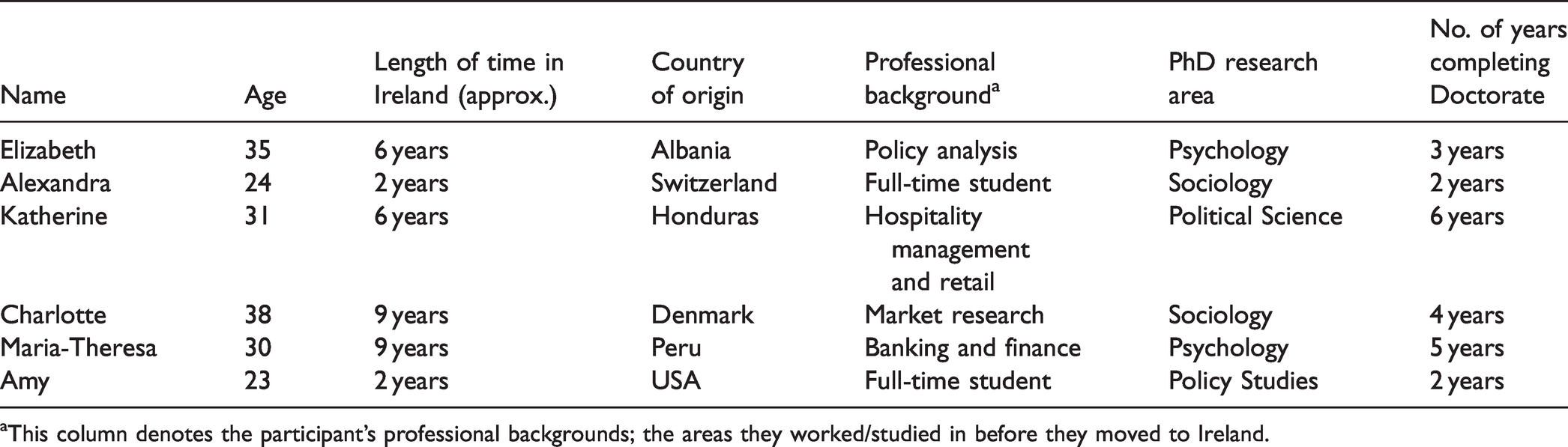
aThis column denotes the participant’s professional backgrounds; the areas they worked/studied in before they moved to Ireland.
Footnotes
Acknowledgments
The authors are grateful to Dr Iain Mac Labhrainn, Director, Centre for Excellence in Learning and Teaching (CELT), NUI Galway; Dr Sharon Flynn, Irish Universities Association (IUA) (formerly CELT, NUI Galway) and Prof Kelly Coate (University of Sussex, formerly CELT, NUI Galway) who co-ordinated the MA in Academic Practice with Dr Simon Warren, which was the impetus for this research.
Declaration of conflicting interests
The author(s) declared no potential conflicts of interest with respect to the research, authorship, and/or publication of this article.
Funding
The author(s) received no financial support for the research, authorship, and/or publication of this article.
