




Abstract
This article delineates the methods of the author's PhD in Criminology, carried out at the University of Cambridge from 2019 to 2023. The main aim of the PhD was to explore the pathways between maternal exposure to violence and the behavioural development of two-to-three-year-old children in Tirana, Albania. To achieve this, the author spent 10 months in Tirana collecting data from a sample of 328 mothers and 59 nursery teachers in eight diverse socio-economic research sites. The purpose of this article is to reveal the details of the methodological approach, the meticulous planning, as well as the obstacles faced when implementing the PhD project. It provides a thorough description of the research design, sampling strategy, measurement tools, ethical considerations, data collection challenges, and fieldwork experiences.
Introduction
Article 25, paragraph 2 of the Universal Declaration of Human Rights (1948) states that motherhood and childhood are entitled to special care and assistance. Despite this milestone document being a global foundation for national and international laws and standards, research shows that more than half of children in Albania are subjected to violence in the home or witness violence against their mothers both in their lifetime and in the preceding year (Haarr, 2013; Mijatović, 2018; Peshevska et al., 2016; UN Committee on the Rights of the Child, 2012). Previous evidence suggests that exposure to violence during the first years of life interferes with the child's neurological and socio-emotional development and is associated with further victimisation and violence perpetration (Fry et al., 2018; Moffitt, 2013; Till-Tentschert, 2017). This comes with an enormous burden to society, both in human and economic terms (Fang et al., 2017; Fearon and Hoeffler, 2014; Hsiao et al., 2018; Willems, 2012).
Research also shows that early interventions, encompassing the first few years of life, can bring about long-lasting improvements in the development of children and can break the continuity of violence from one generation to another, a phenomenon that has become known as the cycle of violence (Britto et al., 2017; Widom and Wilson, 2015). A healthy early childhood prevents a range of social, health, economic, and legal problems and offers opportunities to make long-term savings in public spending (Allen, 2011; Grille, 2008). The implementation of preventive policies informed by data has been proven to contribute to the reduction of violence against children and to its individual and social consequences (World Health Organisation, 2010). However, these evidence-based preventive efforts tend to be limited to affluent countries (Murray et al., 2018). Even though low-and-middle income countries (LMICs), such as Albania, are disproportionately affected by this phenomenon when compared to high-income countries (HICs), they currently lack the knowledge and capacity to tackle it (Cyr and Alink, 2017; de Ribera et al., 2019; Ward et al., 2016). Scientific debate on the mechanisms behind the intergenerational continuity of violence from parents to children in Albania is very recent and remains isolated (Sado et al., 2018).
The purpose of the PhD I carried out at the University of Cambridge from 2019 to 2023 was to address this gap in research by exploring the pathways between maternal exposure to violence and behavioural development among 2–3-year-olds in Tirana, Albania (see Ramaj, 2023a, 2023b; Ramaj and Eisner, 2023). To the best of my knowledge, this is the first type of empirical research to have ever been conducted in the region of Western Balkans, an area in which domestic violence is a particularly common problem and where services to counteract it are weak (Lilyanova, 2018). The purpose of this article is to describe the methodology employed in my PhD study. The article starts by thoroughly delineating the research design and sampling strategy of the PhD. It then provides information on the choice of measurement tools, their translation procedures, and piloting. It subsequently describes the data collection process, including challenges regarding participant recruitment and questionnaire delivery mode. The article further elaborates on institutional and practical ethical considerations as well as qualitative reflections on the fieldwork experiences.
Research design
The study took place in Tirana, Albania. Tirana is the capital and most populous city in Albania (INSTAT, 2018). With an area of 41.8 square kilometres, it is located in the centre of the country, and it is the leading economic, financial, political, and trade centre in Albania (see Figure 1). Albania is a small country with a population estimated at 2.83 million inhabitants (INSTAT, 2021) and a land area of 28,748 square kilometres (12% of the size of the UK, 5% of the size of France). Located in the Western Balkans, it borders Montenegro to the northwest, Macedonia to the east, and Greece to the south, with the Mediterranean Sea making up the entire western border of Albania. According to the latest census (INSTAT, 2011), most of the population (53.7%) lives in urban areas. Albania is one of the poorest countries in Europe with a gross domestic product (GDP) per capita at purchasing power parities of US$ 15,646 (World Bank, 2021). As of 2012, 40% of Albanians live below the international poverty line, which amounts to US$ 1.90 per day per person (World Bank, 2019a).
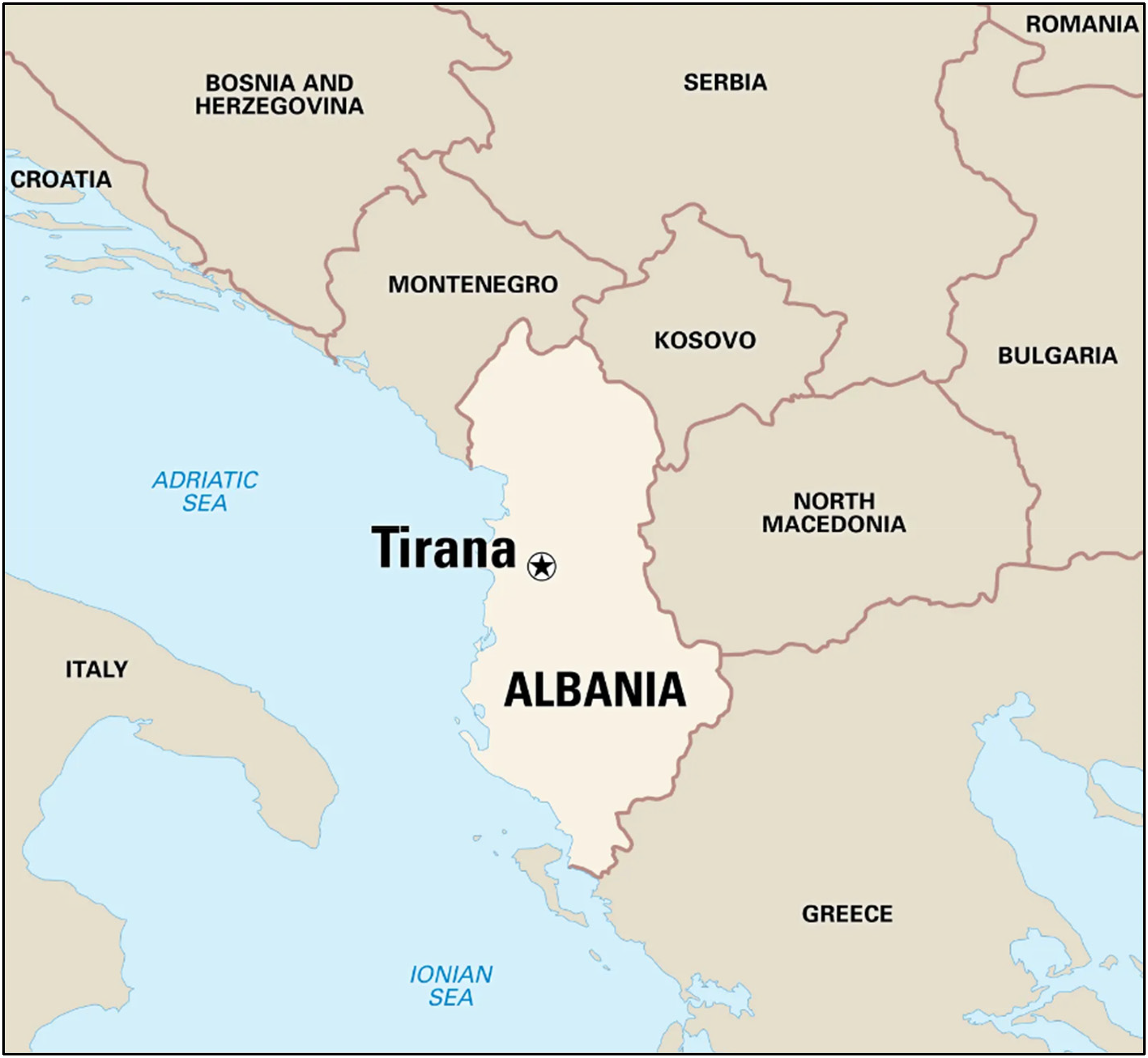
The map of Albania and geographical position of Tirana (taken from Encyclopaedia Britannica, 2024).
Albania is a country in transition following 45 years of communist dictatorship, which was a period characterised by autocracy, repression, and isolation from the world's socio-economic and political community (Bideleux & Jeffries, 2006). Following its opening up in 1991, Albania was faced with mass poverty, unemployment, corruption, socio-economic inequality, emigration, and organised crime (World Bank 2019b). A particular set-back was the collapse of an elaborate and fraudulent system of pyramid schemes in 1997, bankrupting a large share of Albanian households as well as leading to national civil disorder and rebellion (Biberaj, 2019). Women and children are the social groups most negatively affected by poverty in Albania (Social Watch, 2012). After the collapse of communism in the 1990s, female participation in the labour market dropped by nearly a half, from 78% in 1989 to 46% in 2005 (INSTAT, 2006). Data from the Albanian Demographic and Health Survey (DHS) 2017–2018 show that almost 60% of women were not employed and had never been employed in the 12 months preceding the survey (INSTAT, 2018).
Even though considered ‘the youngest country in Europe’, 17.7% of children in Albania live in absolute poverty (Peshevska et al., 2016). According to UNICEF (2016), Albanian households with children aged 0–5 years old have the highest poverty rate and live in the worst economic conditions when compared to the rest of Albanian households: the former have the highest number of jobless household members, less than one room per person, and an increased likelihood of mothers staying away from the labour market. There is also an association between poverty and child mortality, with data from the Albanian Living Standards Measurement Survey (INSTAT, 2005) showing that the probability of death among children under 5 years of age in high income families was a quarter of that in families from the middle and low strata.
Following the collapse of communism in the 1990s, Tirana has had a large influx from other parts of the country increasing its population from 280,000 inhabitants (INSTAT, 1989) to more than 850,000 inhabitants (Bashkia Tiranë, 2020). Despite this massive internal migration, research has shown that the rural exodus towards Tirana following communism was mainly a step-wise movement towards foreign countries (Lerch, 2014; 2016). Hence, it is arguable whether Tirana's population can be considered representative of national levels of socio-economic and cultural diversity. Given its central geographic position, demographic structure, and higher developmental level compared to other parts of the country, it is thus not possible to conclude that Tirana is entirely representative of Albania.
The target population of this study were children aged two-to-three years old, who were enrolled in Tirana's public nurseries. There are three groups of children in each public nursery in Tirana, based on their age: six months to one year old; one year old to two years old; two years old to three years old. This study focuses on the third age-group for two main reasons. First, in comparison to the two previous groups, this age-group constitutes the largest population in almost every public nursery (data retrieved from formal correspondence with the General Directory of Nurseries and Kindergartens, Municipality of Tirana). Second, according to most internationally recognised instruments and guidelines consulted, toddlerhood is the period when one can start to measure early problematic behaviour most accurately (e.g., Achenbach and Ruffle, 2000; Boggs et al., 1990; Carter et al., 2003; Goodman, 1997; Sparrow et al., 1984; Tremblay et al., 1987).
While it is not realistic to assume that toddlers registered in public nurseries represent all two-to-three-year-olds in Tirana, data from the Albanian Demographic Health Survey (DHS) 2017–2018 show that 73% of Albanian children aged 24–59 months attend an organised early childhood education programme (INSTAT, 2018). Data from the same source indicate that the proportion of Albanian toddlers attending organised early preschool education has increased over the last 10 years by nearly 20%. Hence, through the recruitment strategy of public nurseries, it was possible to obtain a very good coverage of toddlers in Tirana. Nevertheless, it is of worth to note that there are also private nurseries and kindergartens in Tirana, some of which providing unregistered (and thus illegal) childcare. It was not possible to obtain official statistics on private nurseries as they are not under the supervision and/or monitoring of the Municipality of Tirana. Consequently, the sample of the present study consists of two-to-three-year-olds enrolled in Tirana's public nurseries. Under the design heuristic of data-box developed by Cattell (1966), this study takes a variable-over-person slice, which results in a two-way data matrix. 1 This design is also referred to as cross-sectional (Molenaar and Nesselroade, 2015).
Many scholars argue that the best way to assess children's behavioural functioning in the first two-to-three years of life is through their primary caregivers, and particularly mothers (Brownwell et al., 2015). Hence, apart from the mothers’ own characteristics and experiences, including their socio-demographic information, adverse childhood experiences (ACEs), intimate partner violence (IPV) experiences, social support networks, mental well-being, individual characteristics, and parenting practices, mothers were also asked to report on the internalising and externalising behavioural tendencies of their toddler. Nevertheless, due to social desirability bias (Posada et al., 1995) or biases related to the socio-emotional and cognitive characteristics of the mother (Najman et al., 2001), measuring the children's behaviour solely through the mother's point of view does not capture the full picture.
In high-quality developmental research, it is standard that researchers collect data on child behaviour from multiple sources (Eisner and Malti, 2015). That is because combining information from different sources results in more valid and reliable estimates of the underlying behaviour and allows for a better understanding of children's adjustments (Sternberg et al., 2006). Since child development entails adaptation across a wide range of settings and children may display different behaviours in different contexts, multiple informants can provide a more thorough insight into socio-emotional competence than a single informant. For children that are more engaged with others outside the family, childcare providers and educators become key informants about children's behaviours and experiences, using questionnaires that parallel those for parents (Brownwell et al., 2015).
Regarding the mothers’ reporting of their victimisation experiences, it is worth noting that there are two main sources of data in studies concerning domestic violence: informant-based and self-report based (Stoltenborgh et al., 2015). Due to its advantage of gathering multi-faceted and publicly hidden information, this project takes the approach of a self-report study. Informant studies tend to rely on data from official files, with such data representing solely the tip of the iceberg. Regarding IPV, due to stigma or fear of retaliation, many women do not reveal their experiences to public officials (Shoham et al., 2010). As far as child maltreatment is concerned, informant studies usually cover a one-year period and include cases of maltreatment in which someone considered that action should be taken – mainly based on reports by professionals to child protection services (Stoltenborgh et al., 2015; Schelbe and Geiger, 2017). Hence, self-report studies have the advantage of covering long periods of childhood and of including cases in which abuse has not been recognised by anyone, or even if recognised, has not yet been brought to the attention of the authorities.
The participants of this study thus consisted of mothers and nursery teachers of two-to-three-year-olds. The target sample size prior to starting the data collection process was agreed to be that of 300 mothers. 2 As claimed by Czaja and Blair (2005), when it comes to sample size, there are no right or wrong decisions that must be made. According to them, the more participants we can recruit, the more confidence we can place on the results, other things being equal. 3 Similar to this notion, Bachmann and Schutt (2017) argue that the larger the sample size, the more confident we can be that the sample represents the population from which it was drawn, with the fraction of the total population that a sample contains not affecting the sample's representativeness. When deciding on the final sample size of mothers, a compromise had to be drawn between what was feasible within a PhD project given the restricted time and resources as well as what would be ideal for conducting regression models.
Sample size is one of the key determinants that guides the number of independent variables that can be entered into a multiple linear regression analysis. A practical rule is to include one independent variable for every ten observations (see Kleinbaum et al., 2013: 389–390). The a-priori conceptual models that were going to guide the empirical articles of the PhD dissertation were planned to have 15 to 25 independent variables each. In line with these guidelines as well as given the limitations of how many participants one can recruit as a single individual under time constraints, it was decided that the sample size of 300 mothers would be a realistic target sample size and sufficient for carrying out the initially planned data analyses. A further advantage of the study that justified the choice of the target sample of 300 mothers was the fact that the obtained data were a good representation of neighbourhoods with different socio-economic developmental levels in Tirana (see the following section).
Sampling strategy 4
One of the main critiques of studies on violence against women and children is the use of weak sampling techniques, including convenience or opportunity samples (Schelbe and Geiger, 2017). The rigour of sampling methods is however key for the quality of survey data (UNICEF, 2014). In order to achieve gains in precision (see Kalton, 2021) and to enhance the quality of existent studies on domestic violence, this study aimed to employ a stratified random sample procedure with two stratification factors, taking into account the socio-economic status (SES) of the geographical area in which the nurseries were located in as well as the nurseries’ size. The main benefit of proportionate stratified sampling is that it allows for the number of elements selected from each stratum to be in exact proportion to their representation in the population (Bachmann and Schutt, 2017). This approach would thus help generate data that were representative of two-to-three-year-old children enrolled in public nurseries in Tirana and their mothers, make quasi-generalisations about the broader population of toddlers and their mothers in Tirana, and as a result better inform potential policy decisions.
The first stratum that was taken into consideration consists of Tirana's four developmental clusters (see Figure 2). Tirana has 11 administrative units (see Figure 3), which Dumani and others (2018) have grouped into four main clusters, based on these units’ socio-economic development. 5 Three main steps were followed to select the final target sample of eight nurseries. 6 First, all the 34 public nurseries in Tirana (see Figure 4) were grouped by administrative units. Second, the nurseries were allocated the cluster score of the unit they were located in. Each developmental cluster was given a number from one to four. Third, two nurseries per cluster were selected through systematic random sampling, 7 with the sampling fraction per cluster being calculated by dividing two with the total number of nurseries in each respective cluster (see Figure 5). The selection of the final nurseries through systematic random sampling was done by hand, with no randomisation tool being used.

Ranking of Tirana's administrative units by factor of economic and social development (taken from Dumani et al., 2018: 103).
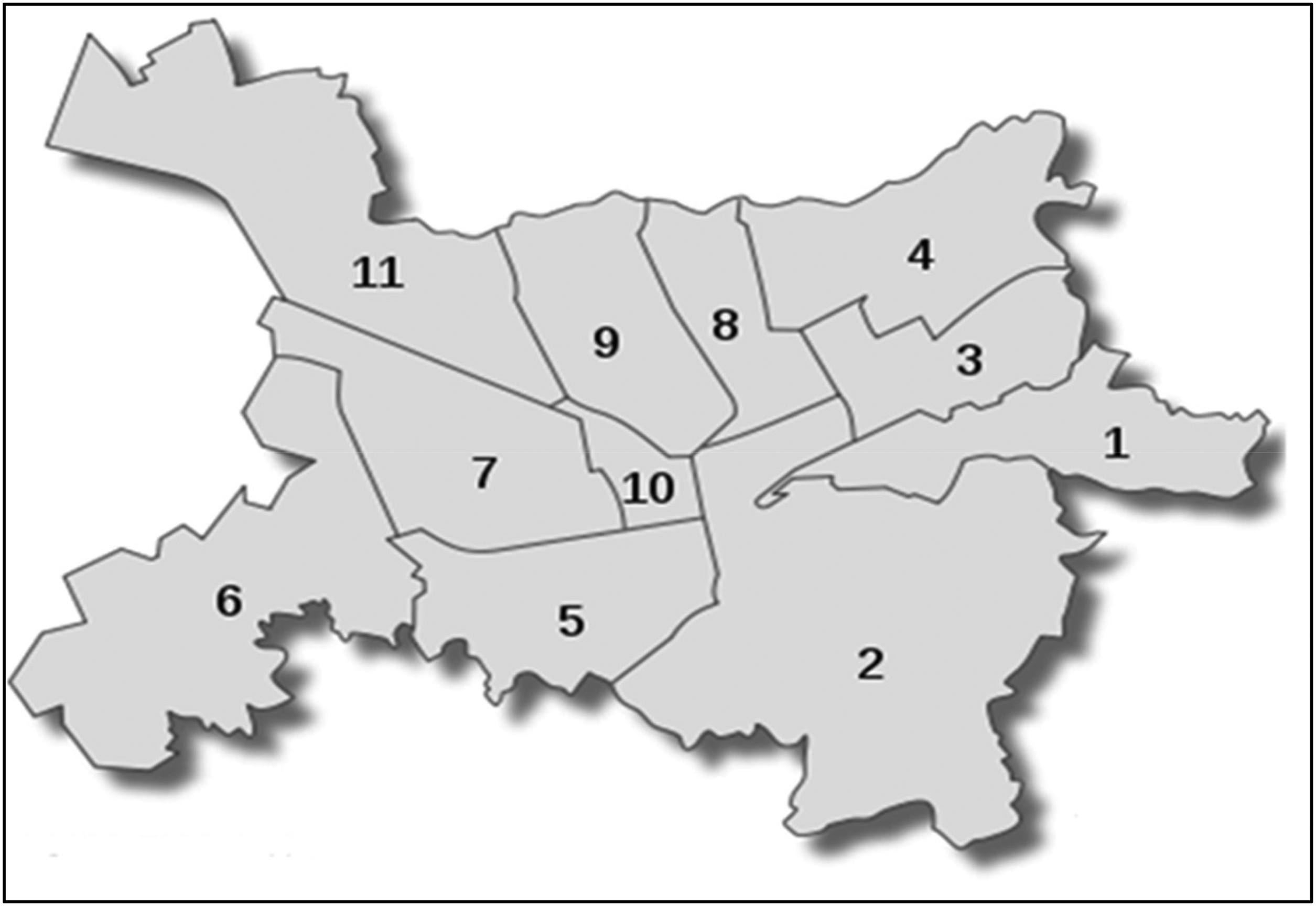
Administrative units in Tirana (taken from Dumani et al., 2018: 95).
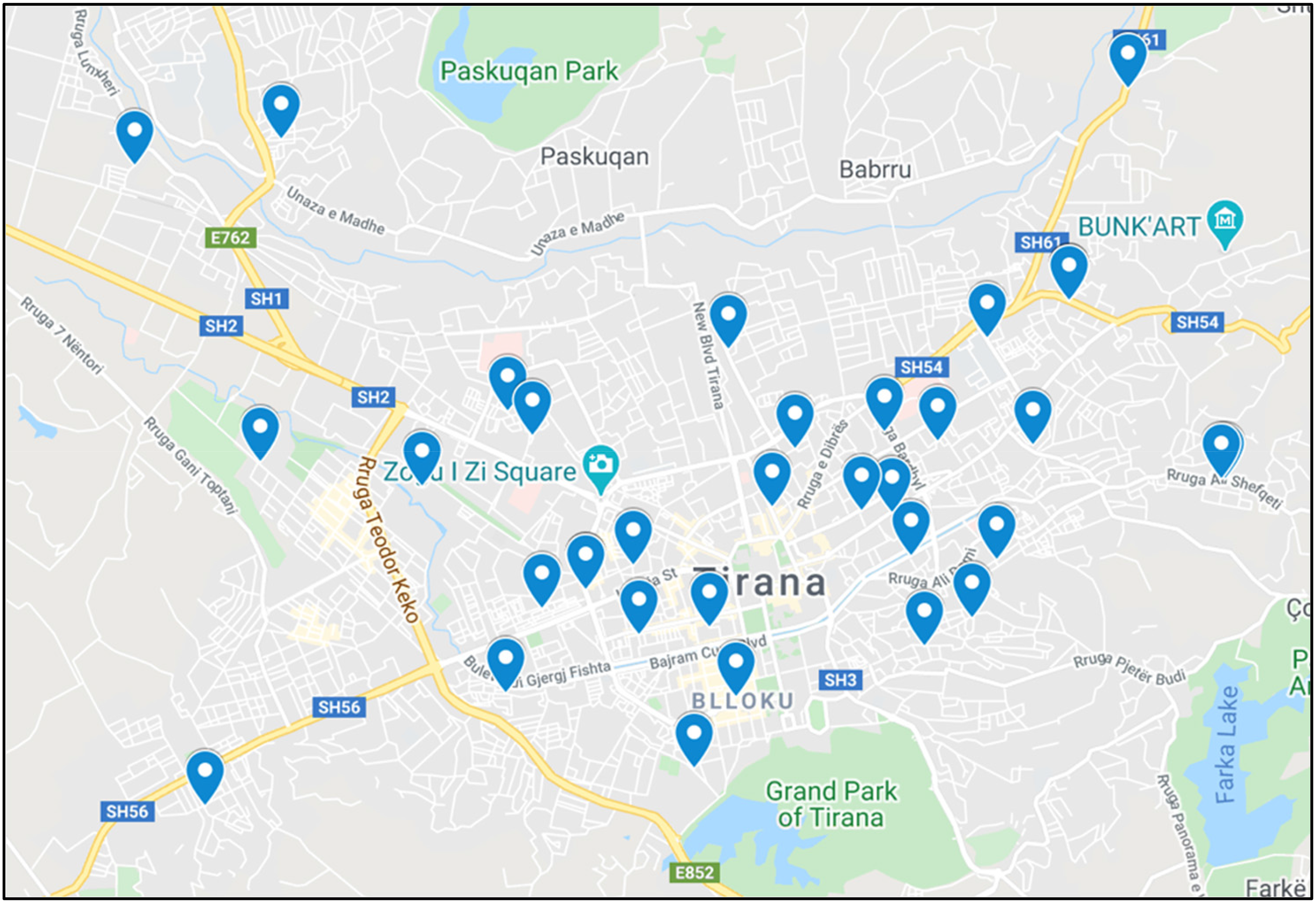
Geographical distribution of all public nurseries in Tirana (the pin symbols in the map represent the geographical location/ addresses of all the 34 public nurseries in Tirana, which were mapped on google maps by the author).
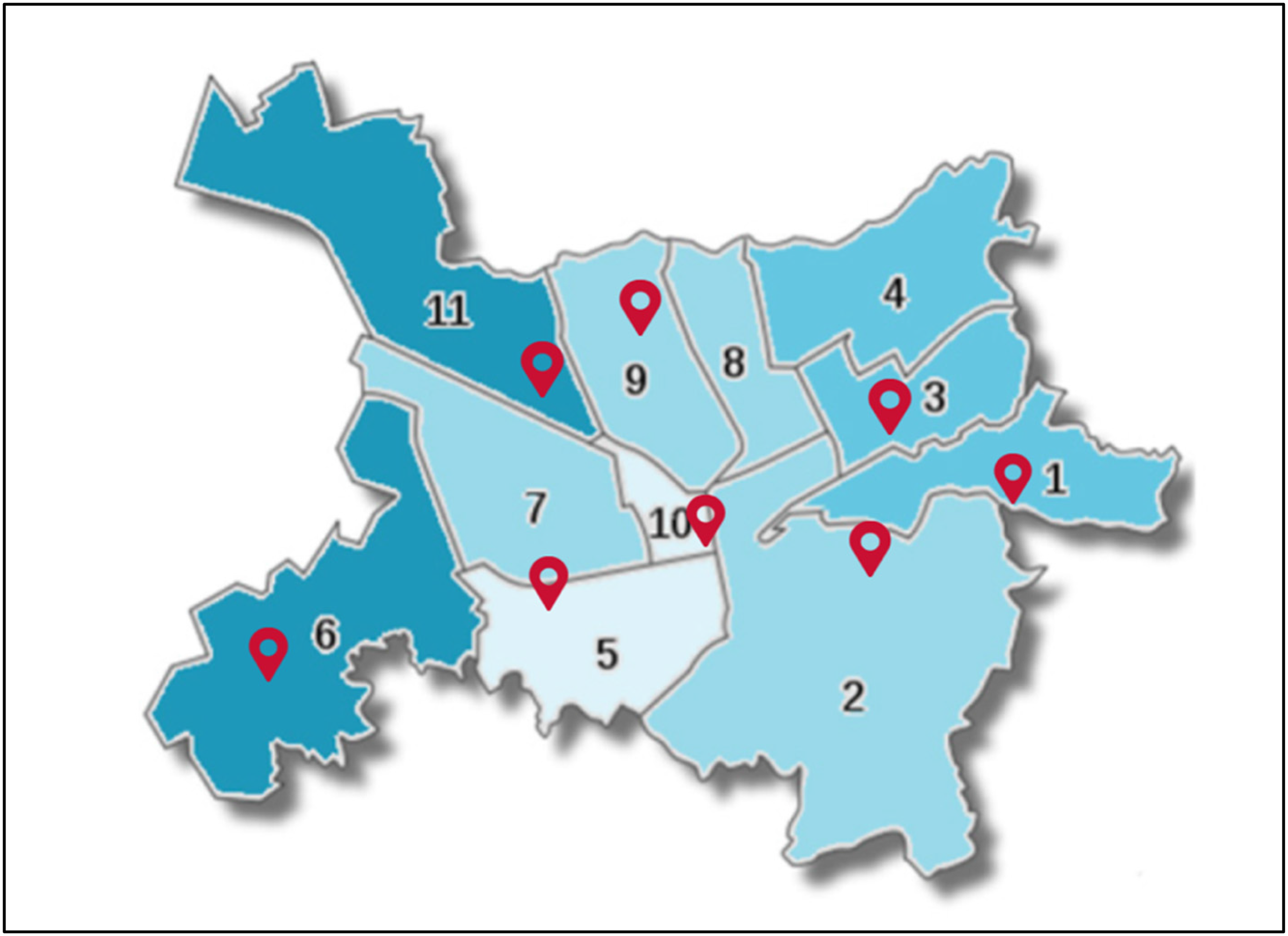
Tirana's administrative units according to SES. The Lighter the Colour of the Unit, the Higher the SES [(taken from Dumani et al., 2018: 105). The pin symbols were added by the author and represent the final chosen nurseries].
The second stratum consists of the eight chosen nurseries. In order for the target sample of 300 mothers to be representative, 8 three other steps were needed. First, the total number of toddlers 9 in the chosen nurseries was calculated for each developmental cluster. Second, the representative number of toddlers that should be chosen per nursery was determined based on the number calculated in the previous step and the target sample of 75 toddlers per cluster. 10 Third, the uniform sampling fraction – through which the toddlers’ mothers in each of the eight nurseries would be selected – was calculated by dividing the final chosen number of toddlers per nursery with the total number of toddlers in every chosen nursery. As Figure 6 shows, the sampling approach resulted in an oversampling of toddlers in the lowest and the highest quartile of neighbourhood SES, which means that the study was better able to capture variation across the entire spectrum of SES. 11 No sampling strategy was followed for the nursery teachers.
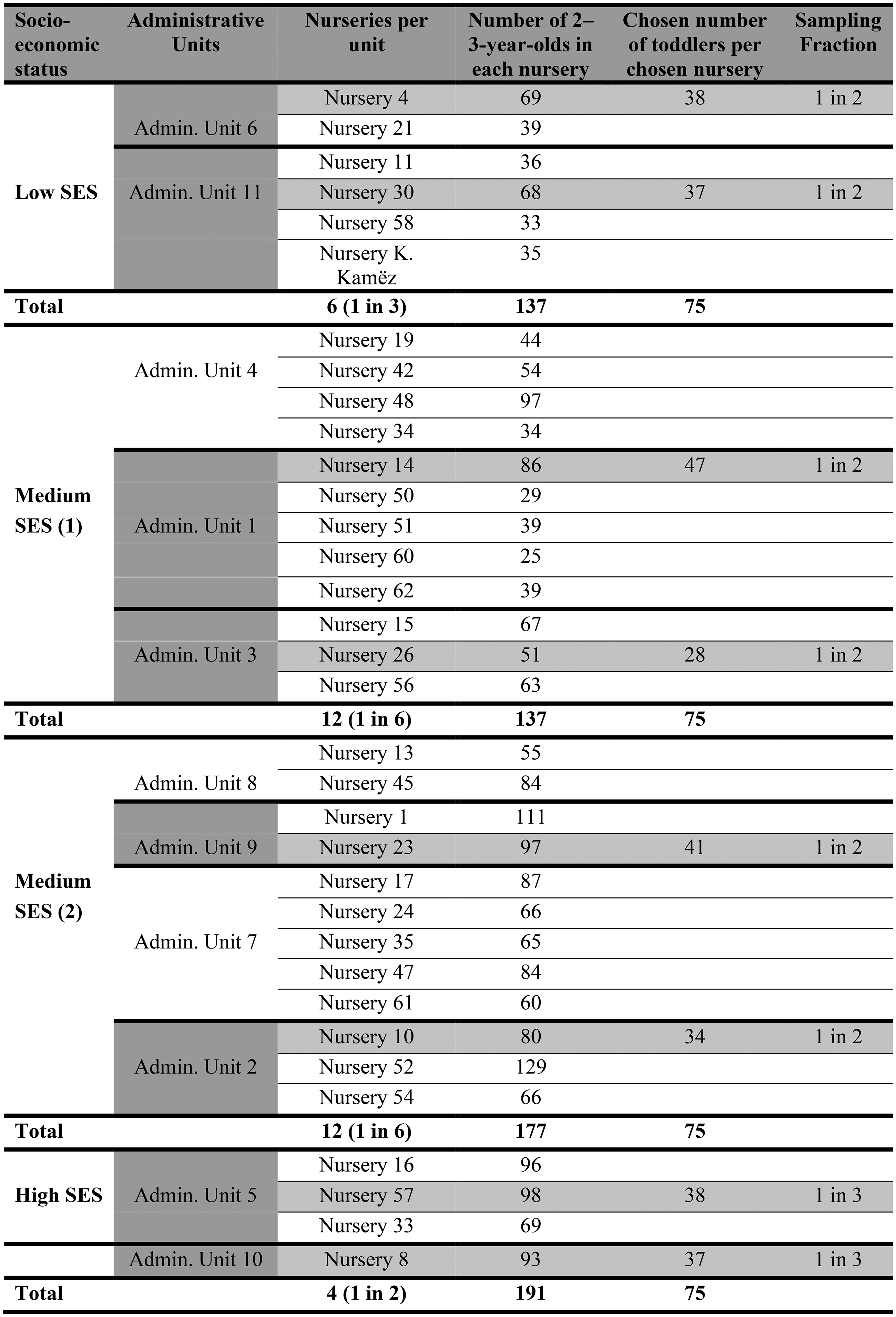
Sampling Strategy Based on Administrative Units' SES and Nursery Size (the table was developed by the author).
Measurement tools, translation, and piloting
Measurement instruments
The mother's questionnaire consisted of 10 sections, each measuring the following: 1) the socio-demographic characteristics of the mother, the father, and the target child; 2) the mother's mental-well-being and individual characteristics; 3) the mother's substance use; 4) the mother's social support; 5) the mother's exposure to violence in the neighbourhood; 6) the mother's ACEs; 7) the mother's IPV experiences; 8) the mother's parenting practices and maternal warmth; 9) the mother's sense of parenting competency and her attitudes towards child maltreatment; 10) the child's behavioural tendencies. The same questionnaire measuring the child's behavioural tendencies was also administered to each child's nursery teacher.
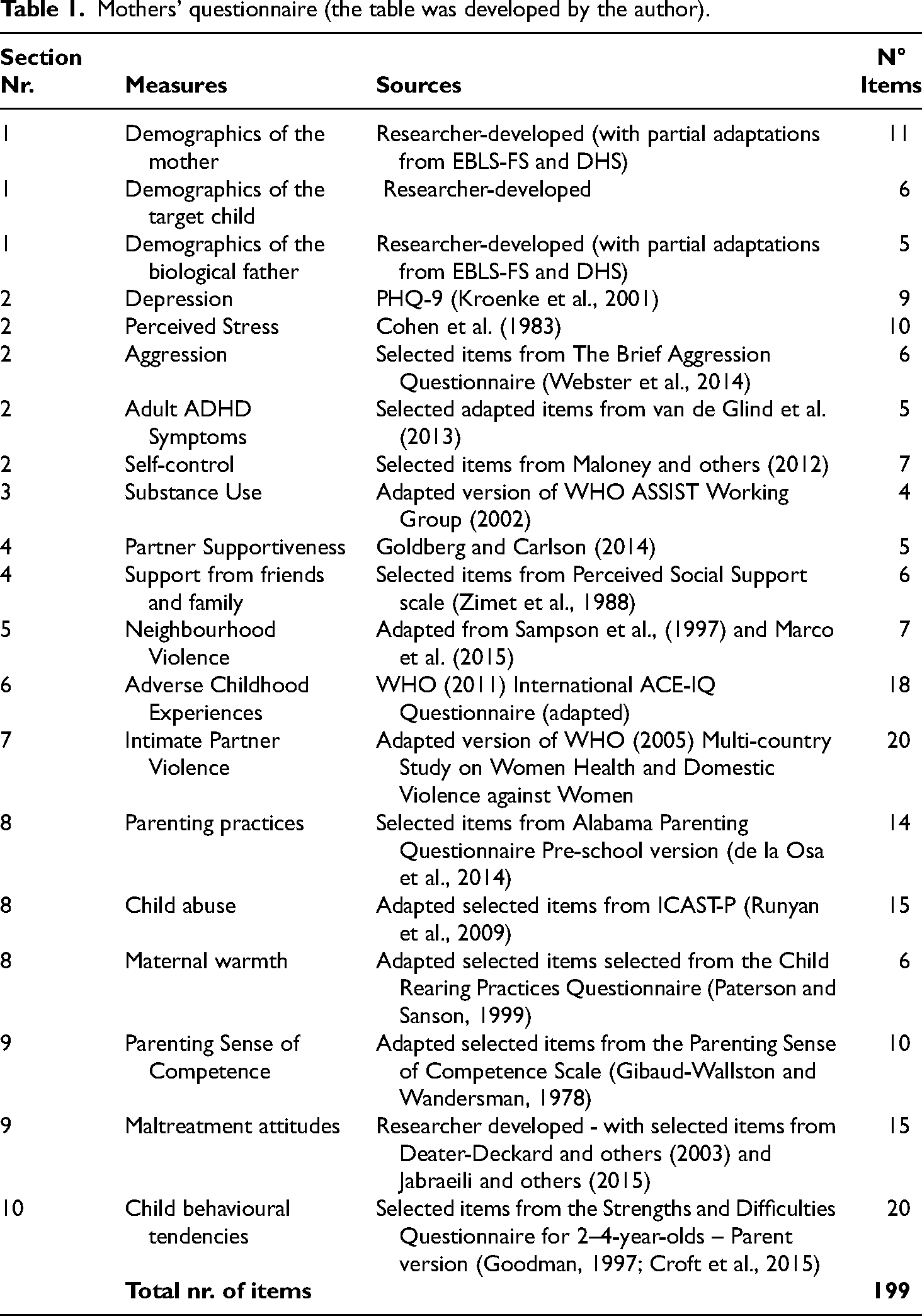
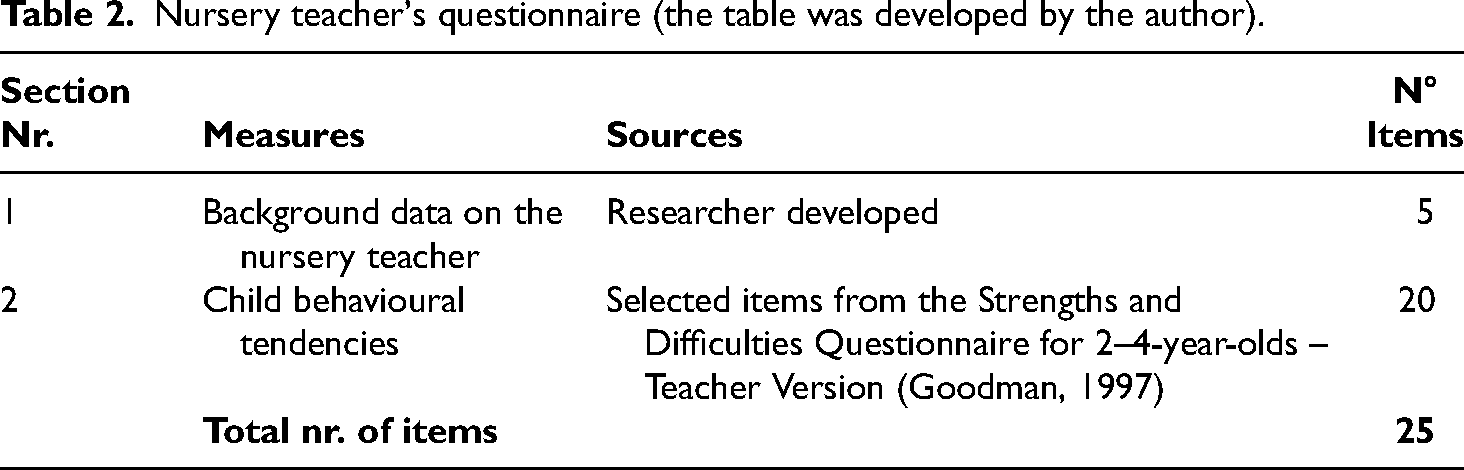
Bachman and Schutt (2017) posit that the best strategy for achieving consistent results in a study is to employ measures that are psychometrically sound and whose reliability and validity have been established in other contexts. Moreover, asking the same questions allows researchers to compare the results in their survey area with results from previous research (Czaja and Blair, 2005). For these reasons, this PhD study employed existing and validated measures that had been tested in various academic studies as well as in international large-scale surveys, such as those conducted by the World Health Organisation (e.g., the Multi-Country Study on Women's Health and Life events). While the mothers’ questionnaire encompassed 199 items, the nursery teachers’ survey involved solely 25 items (see Table 1 and 2 for a list of the selected measures, their sources, and the number of items per measure). The choice of the instruments for this PhD study was partially informed by the Foundational Study (FS) of the Evidence for Better Lives Study (EBLS), which took place in 2019. The EBLS-FS explored the well-being of 150 pregnant women and their new-born children in eight diverse LMICs. With some adaptations, the instruments from Section 1 to Section 7 are analogous to EBLS-FS (see Valdebenito et al., 2020). The choice of measures from Section 8 to Section 10 was based on own review of the psychometric literature that attempts to capture the related parenting and child behaviour constructs of interest. 12
Mothers’ questionnaire (the table was developed by the author).
Nursery teacher's questionnaire (the table was developed by the author).
The translation process
All the scales were translated from English to Albanian based on the main guidelines suggested by the World Health Organisation (2016), the EBLS protocol, and several academic sources. Among the academic sources that were consulted before starting the translation process are the following book chapters and articles: Sousa and Rojjanasrirat (2011); Ziegler and Bensch (2013); Behr and Shishido (2016); Toma and colleagues (2017). The questionnaire was translated in whole by four individuals. Apart from myself, three independent native Albanian speaker translators who were also proficient in English were selected. In the selection of translators, familiarity with psychometrics and the health sector was prioritised. 13
The translators were provided with a document defining the measured constructs and the concrete items used to measure each construct. Additionally, they were given guidance to use wording that was simple, clear, concise, and to try to be sensitive to the gender, age, and characteristics of the participants. Translators were further advised to aim for conceptual equivalence that is socio-culturally valid, more than literal translation. The translators received an Excel sheet where they could record the main translation, alternative possibilities, and their comments. After engaging in individual work, myself and the three other translators met via Teams on September 10th 2020, to discuss all the four translated versions. We went through a consensus-building process and arrived at a final version of the questionnaire. The whole process of translation was documented in detail, in order for it to be traceable at later stages.
Even though back reverse translation is often considered as the gold standard in the social sciences, cross-cultural psychology, and health research (Acquardo et al., 2008; Bolfosu, 2022; Brislin, 1970), in the present study the aforementioned approach to translation was adopted for two main reasons. The first reason is related to limited time and resources. Second, back translation has been the subject of criticisms by quite a few academics (e.g., Behr, 2017; Epstein et al., 2014, 2015). The arguments against back translation include the fact that back translation fosters a too literal translation and is inappropriate for cultural adaption, it increases the costs of the translation process, it generates large volumes of text which can be very difficult to manage, and in some instances, it has shown similar psychometric properties to forward translation.
Piloting the questionnaires
The final translated version of the questionnaire was pre-tested with a convenience sample of 10 mothers via cognitive interviews (see Bachmann and Schutt, 2017; Collins, 2015; Czaja and Blair, 2005; Miller et al., 2014). Participants were first administered the instrument and then probed with follow-up questions to learn how they understood the questions. They were asked to critique the instruments, pointing out confusion or misunderstanding, and perhaps suggesting more proper wording or issues to be explored (Hagan, 2010). During the interviews, I also tested whether the participants would remember the answer options for each scale (e.g., Never, Sometimes, Often, Always) by only reading the answers once at the beginning of each scale. However, this proved not to be the case since the mothers were constantly asking me to repeat the answers they could choose from after each item.
The recruitment of mothers for the pilot interviews started at the end of August 2020. The cognitive interviews started on September 11th and finished on September 16th 2020. The 10 mothers that participated in the pilot study were recruited via acquaintances and via the social media page of an Art School for toddlers in Tirana. The main criteria for inclusion in the pilot study was the women having at least one child between the ages of two and five. The average length of the cognitive interviews was 58 min. Several locations were used to conduct the cognitive interviews, ranging from the mothers’ workplaces to cafés. Regarding the mode of data collection, six interviews were carried out online, five via WhatsApp videocalls, and one via Skype. In two cases, the mothers completed the questionnaires on their own – once in my presence and once online. The cognitive interviews were transcribed in Albanian and then translated into English. Thematic analysis was used to analyse the transcriptions of the cognitive interviews. Results from cognitive interviews were used to improve the survey design and implementation plans.
Face-to-face interviews at one single location proved to be the most convenient mode of data collection. It reduced the time spent on traveling and it increased the quality of data. 14 The questionnaire underwent several changes following the pilot interviews (see Appendix 3 for a list of all the changes), with the main ones being the inclusion of the Partner Supportiveness Scale (Goldberg and Carlson, 2014), the modification of the ‘Perceived Social Support’ scale (Zimet et al., 1988) by removing the items on the “special person”, and the inclusion of the controlling items on the WHO ‘Intimate Partner Violence’ scale. Data from the pilot interviews were translated and entered manually on Microsoft Excel. Even though they were not included in the final study, this process helped with the development of a coding scheme which proved to be useful later on. It also allowed me to see initial patterns in the answers and in item non-response. As also argued by Campanelli (2012), pre-test results are used to improve the survey design as well as implementation, coding, and data analysis plans.
Data collection
Participant recruitment
All the directors of the eight chosen nurseries agreed for their nurseries to participate in the study (see Figure 7 for the time spent in each nursery). Each nursery director was contacted one week before the planned start date, 15 for the purpose of explaining my background, the purpose of the study, how their nursery was selected, the number of mothers expected to be interviewed in their nursery, the amount of time I planned on spending in their nursery, as well as asking for their collaborative support and offering them to meet in person prior to the start of fieldwork. The nursery directors were also sent the official approval of the study by the General Directory of Nurseries and Kindergartens of the Municipality of Tirana.
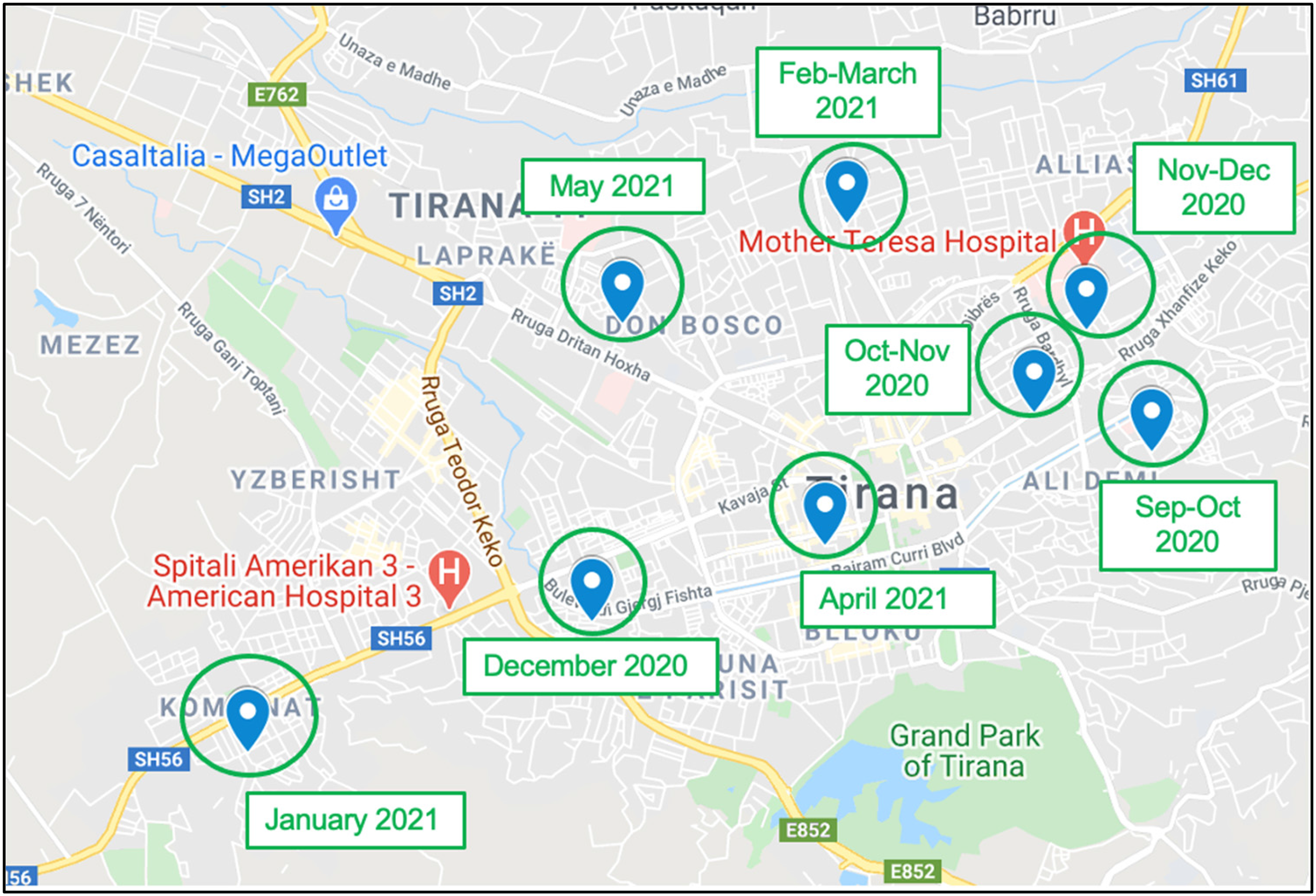
The amount of time spent in each nursery (this map was prepared by the author and portrays a visual representation of the location of the chosen nurseries as well as which month the author spent in each nursery).
The final number of participants consisted of 328 mothers and 59 nursery teachers (the ratio teacher to child ranged from 1:5 to 1:10). The number of toddlers for whom teacher assessments was obtained is the same as the number of mothers (328), implying that teacher assessment was obtained for all children. In the few cases where the mother had more than one child aged 2–3 years old registered in the nursery at hand (such as twin pairs), mothers were asked to answer questions on only one child and were given the space to choose the child they wanted to include in the study freely. The final sample size of mothers was slightly higher than the originally planned sample size of 300 mothers, mainly because of the availability and participating interest of numerous other mothers. Including additional mothers in the study was deemed advantageous given the benefits of having a large sample size, such as an increased statistical power as well as a minimisation of Type II error and/or false report probability (see e.g., Szucs and Ioannidis, 2017).
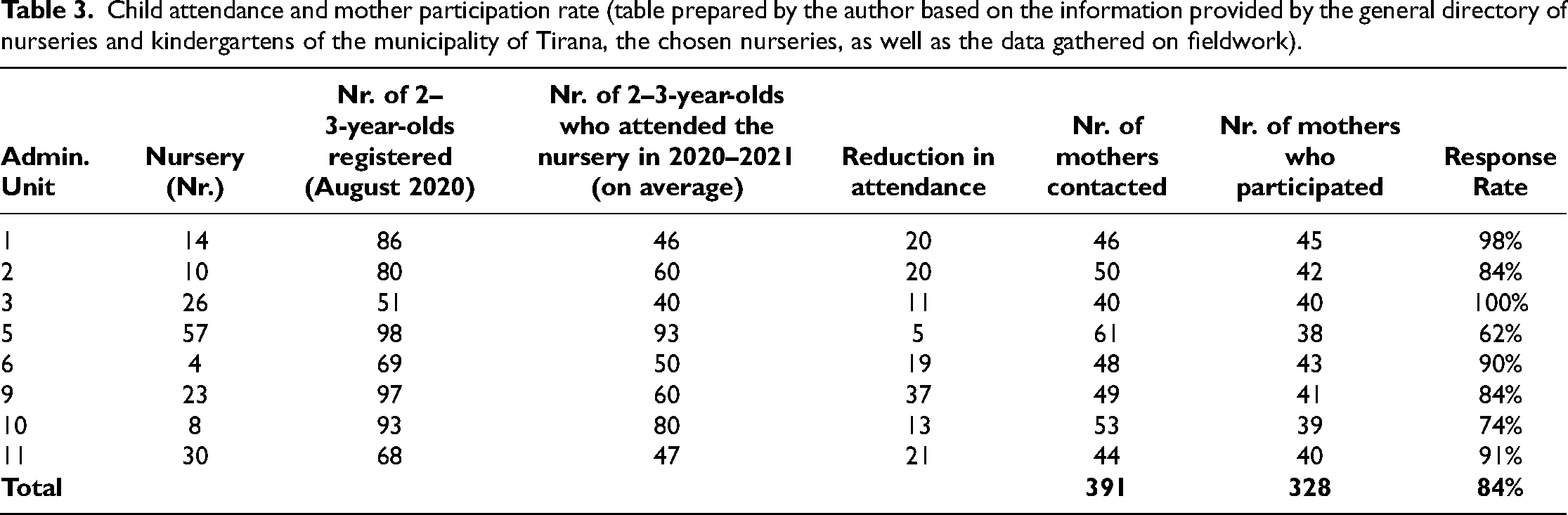
The total participation rate in all eight nurseries was 84% (see Table 3). The original plan was to recruit the mothers using the sampling frame of children provided by the Office of Nurseries and Kindergartens at the Municipality of Tirana. Even though an updated list on the number of registered children in each chosen nursery was provided before the start of fieldwork (August 2020), the number of toddlers attending the nursery was in fact much lower than the number of registered toddlers, with the reduction in attendance ranging from 5 to 37. 16 Hence, in the end, the mothers in each nursery were recruited based on convenience and eligibility, rather than on the initially aimed sampling fraction. In order to reach the target sample size, two to four mothers were recruited per day. 17 The mean length of the structured interviews for the main study was 43 min 18 with the earliest starting time being 07:18 and the latest ending time being 20:28. Four inclusion criteria guided the recruitment of mothers in the main study: 1) They had to live in the same administrative unit as the nursery at hand; 2) They had to have at least one child aged two-to-three years old; 3) Their two-to-three year old toddler had to be registered in the nursery at hand; 4) The mother had to be older than 18 years of age.
Child attendance and mother participation rate (table prepared by the author based on the information provided by the general directory of nurseries and kindergartens of the municipality of Tirana, the chosen nurseries, as well as the data gathered on fieldwork).
Delivery mode
There is a growing consensus among scholars that face-to-face interview is the best way to conduct a survey (Bachmann and Schutt, 2017; Loosveldt, 2012; Touliatos et al., 2000). In spite of being costly and time-consuming, in-person interviews have several advantages. The participation rates are higher, the response bias is lower, respondents are less likely to skip questions, the questionnaire can be long and complex, the physical and social circumstances of the interview can be monitored, and the respondents’ interpretation of questions can be probed and clarified (Czaja and Blair, 2005; Goodwin and Goodwin, 2013). For these reasons, data collection mode for all participating mothers was aimed to be in the form of structured face-to-face paper-and-pen interviews (PAPI). Despite the advantages of Computer-Assisted Personal Interviews (CAPI), the use of PAPI still persists in developing countries given the limitations in technology and internet access (Campbell et al., 2014). Even on its own, PAPI has several advantages, such as being less costly and/ or allowing for a shorter period of data collection when compared to CAPI (Caeyers et al., 2010; Lavrakas, 2008). It is of worth noting that face-to-face interviews can be faced with hesitancy from participants, particularly when sensitive topics (such as ACEs or IPV) are addressed (see Czaja and Blair, 2005). To account for these potential limitations and to yield more reliable and valid data, mothers were offered to complete Section 6 (ACEs) and Section 7 (IPV) of the questionnaire on their own.19,20
As also supported by many methods books (e.g., Heaney, 2013; Shaffir and Stebbins, 1990; Streiner and Sidani, 2010), the implementation of research plans rarely goes as planned. Two main deviations from initial research plans were encountered during the data collection process. First, while the mothers who were interviewed face-to-face were offered to complete Sections 6 and 7 on their own, there were occurrences when they refused to do so either because they did not mind opening up about their traumas, felt too lethargic to read the sections on their own, or found the discussion of their exposure to violence with someone who would not judge them a healing process. For three mothers, Sections 6 and 7 were read out loud because they were illiterate (in these cases, the information sheet, consent form, and debriefing form were also read out loud).
Second, due to issues such as a lack of availability or concerns regarding the COVID-19 pandemic, many mothers expressed reluctance to spend 40–50 min of their time being interviewed in proximity. In these cases, they were offered to either conduct the questionnaire over the phone or to fill it in at their own time and then return it within a few days. Out of 328 questionnaires, 170 were completed through face-to-face PAPI structured interviews (51.8%), 116 were self-completed paper-and-pen (P&P) surveys (35.4%), 41 were carried out via the phone (12.5%), 21 and 1 via a WhatsApp videocall (0.3%). The mode of data collection was coded as a variable so that it would be possible to examine whether delivery mode had affected the responses of the core outcome measures. While it would have been ideal for the data to have been collected consistently, adaptations had to be made in accordance with the situation.
Previous studies have investigated the impact that the mode of administration can have on measures such as self-reported victimisation and offending (Cantor, 2000; Gomes et al., 2019; Lucia et al., 2007). In this PhD study, the influence that the delivery mode of the questionnaire (face-to-face vs. self-completed vs. online interview) could have had on the validity of the collected data was examined for the following main constructs: mothers’ occupational prestige (as indicated by the ISEI score – see Ganzeboom et al., 1992; Ganzeboom, 2010), maternal depression, perceived stress, aggression, ADHD symptoms, self-control, substance use, partner support, support from friends and family, neighbourhood violence, ACEs, IPV, child abuse, maternal warmth, parenting sense of competence, maltreatment attitudes, child conduct problems, prosociality, emotional problems, hyperactivity, and peer problems (as measured by the mother), developmental level of the neighbourhood in which the mother resides, mother's age, mother's birthplace (as coded by Albanian regions), mother's education, and her employment status. Participating mothers were classified into three groups: face-to-face interview (n = 170); self-completed (n = 116), and online interview (n = 42).
One-way ANOVAs were conducted to determine if the means of the continuous constructs differed depending on the modes of administration (see Table 4). Statistically significant differences between groups at the 1% and 0.1% level were found for all continuous constructs, apart from maternal warmth and child prosociality. Tukey post-hoc tests revealed that undesirable outcomes such as depression, aggression, ADHD symptoms, substance use, neighbourhood violence, ACEs, IPV, child abuse, maltreatment attitudes, child conduct problems, emotional problems, hyperactivity, and child peer problems were in general significantly higher in the ‘Face-to-face interview’ group and the ‘Online interview’ group when compared to the ‘Self-completed’ group. On the contrary, desirable outcomes such as self-control, partner support, support from friends and family, and parental sense of competence were overall significantly higher in the ‘Self-completed’ group. ISEI scores were significantly higher in the ‘Online interview’ group when compared to the ‘Face-to-face interview’ group. These results suggest that mothers with higher occupational prestige were more likely to conduct the interview over the phone than face-to-face. This could be because these mothers were more occupied with work-related responsibilities and/ or they had more access to technology.
Means, standard deviations, and one-way analyses of variance of key continuous constructs according to the mode of delivery (table prepared by the author based on statistical analyses conducted on STATA IC release 16).
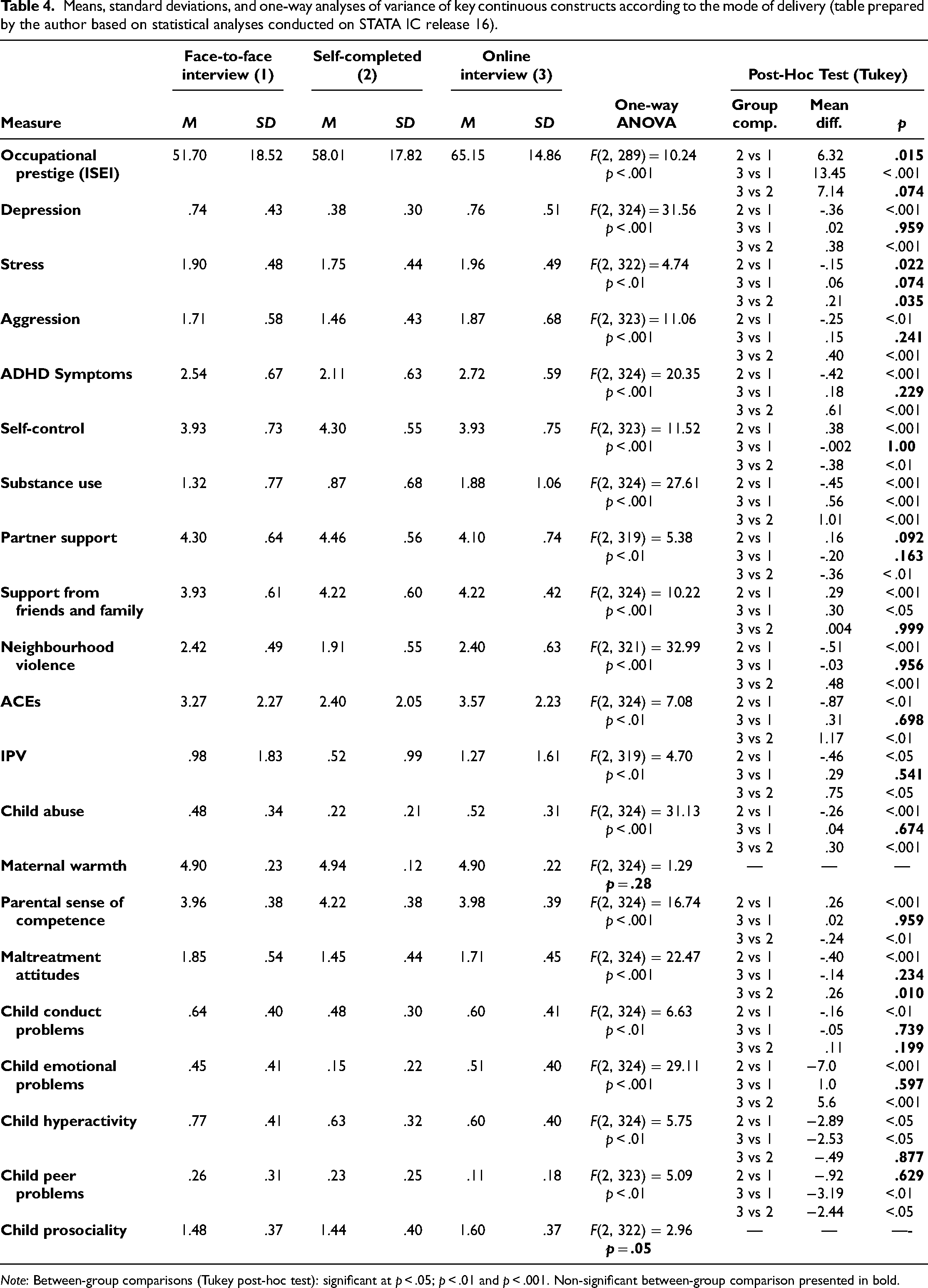
Note: Between-group comparisons (Tukey post-hoc test): significant at p < .05; p < .01 and p < .001. Non-significant between-group comparison presented in bold.
Chi-square tests of independence were run to check if the counts and percentages of the categorical constructs differed depending on the different modes of administration (see Table 5). Significant associations at the 1% and 0.1% level were found between the mode of delivery and neighbourhood SES [χ2 (6, N = 328) = 17.37, p < .01] and between the mode of delivery and mothers’ employment status [χ2 (2, N = 328) = 16.19, p < .001]. Mothers from a high SES neighbourhood were more likely to be interviewed face-to-face, while mothers from a low and medium (1) SES neighbourhood were more likely to opt out for self-completion. Mothers who were unemployed were more likely to be interviewed face-to-face (83.33%) as compared to mothers who were working (47.95%). This might be explained by the fact that mothers who were unemployed were more available and had less commitments than employed mothers.
Counts, percentages, and Chi-square statistics of key categorical constructs according to the mode of delivery (table prepared by the author based on statistical analyses conducted on STATA IC Release16).
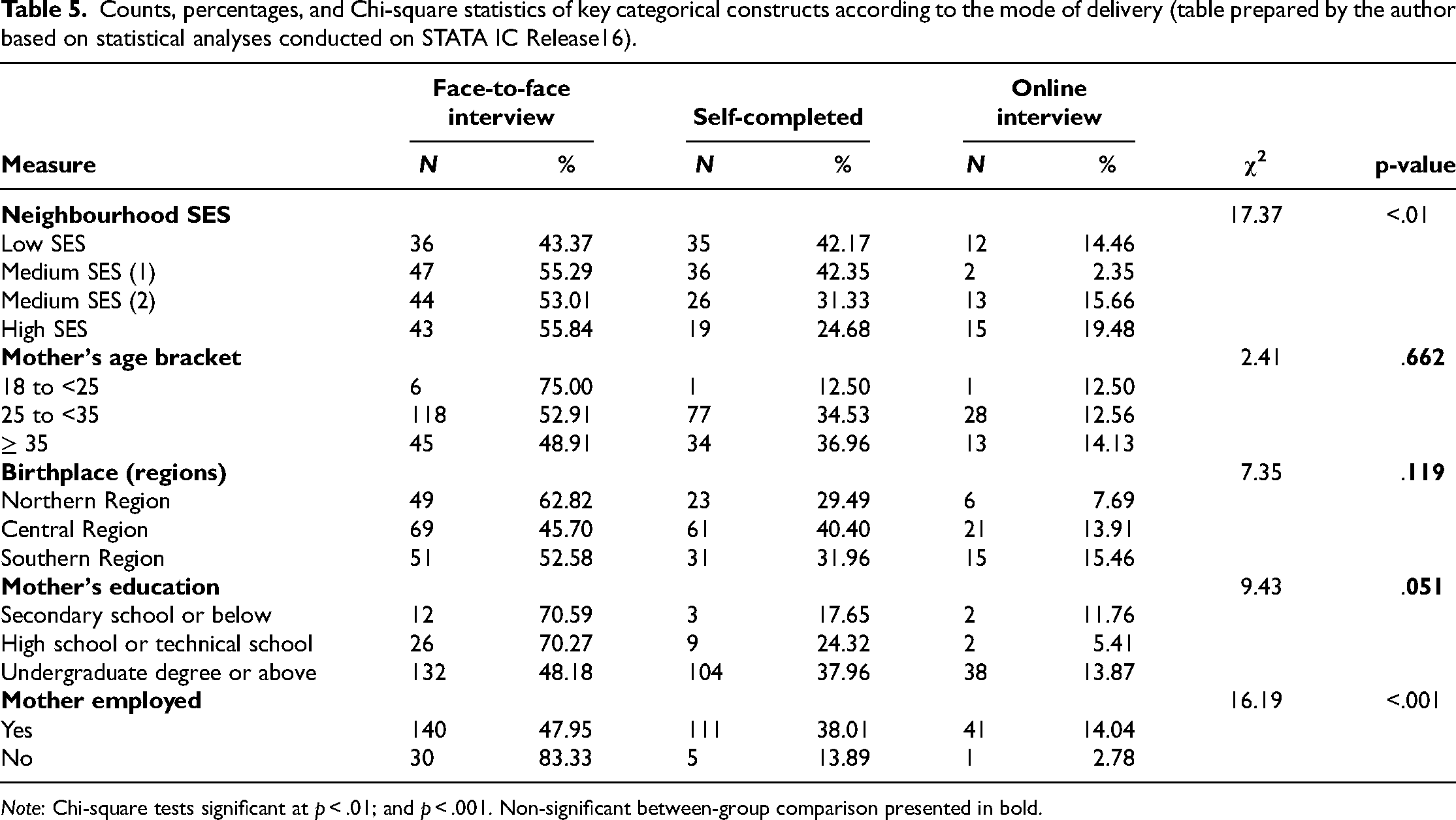
Note: Chi-square tests significant at p < .01; and p < .001. Non-significant between-group comparison presented in bold.
The results above suggest that mothers were less likely to disclose undesirable outcomes and more likely to report high desirable outcomes when the mode of administration of the questionnaire was self-completed. In general terms, there is little consistent evidence regarding the differences in disclosure rates of sensitive information among the different modes of questionnaire administration, with most recent studies finding either few differences or higher disclosure rates in anonymous questionnaires as compared to face-to-face interviews. For example, a systematic review and meta-analysis on the comparison of the types of screening tool administration methods used for the detection of IPV found no significant differences when women were screened in face-to-face interviews as compared to self-administered questionnaires (Hussain et al., 2015). Another recent systematic review carried out by Gomes and colleagues (2019) found no significant differences between data collected with face-to-face interviews versus self-completed questionnaires. Contrastingly, other recent studies have found higher prevalence estimates of victimisation in self-completed questionnaires as compared to face-to-face interviews (e.g., Devries and Meinck, 2018; Kapur and Windish, 2011; Kubiak et al., 2012). A few more dated studies report higher detection rates of sensitive information in face-to-face approaches as compared to written surveys (e.g., Bradburn and Sudman, 1979; McFarlane et al., 1991). It is of worth to note however that most of these individual studies and/ or the studies included in the cited systematic reviews have been conducted in HICs (such as, in the USA, Canada, Germany, Finland, or Switzerland). The only identified study on the impact of delivery mode on the disclosure of sensitive information in LMICs was that conducted by Ward and colleagues (2018) in South Africa, who found higher disclosure rates of child maltreatment in self-completion than in interviewer-based data collection modes.
Seven main reasons might have influenced the outcomes in this PhD study. First, during the in-person and/ or online interviews, the mothers had the space to develop trust and an emotional connection with me. The lack of a trustworthy human connection might have propelled the mothers into feeling more suspicious or embarrassed to disclose the truth in the self-completed version of the questionnaire. It can be argued that the presence of an interviewer encourages respondents to feel relaxed and therefore more forthcoming (e.g., Lee, 1993; Sykes and Hoinville, 1985). Second, during the interviews, the mothers might have felt that they had the time to reflect on their answers and their experiences while also having the opportunity to require more explanation or clarity. In the self-completed version however, the mothers might have filled in the survey inattentively, haphazardly, and/or hastily without reading the items properly and reflecting on them thoroughly. It is additionally of worth to note that mothers completed the questionnaire at home or at work (while being advised to be alone), not in the presence of an interviewer. The ‘uncontrolled’ setting could have also played a role in the mothers’ responses. As noted by Anduiza and Galais (2017), self-administered surveys without supervision from an interviewer increase the likelihood of participants rushing through the questionnaire and choosing responses at random. Third, contrary to most other studies, in the current study, the self-completed version was not entirely anonymous as the mothers handed in both the completed survey and the signed consent form simultaneously. Thus, they were aware that it was possible to make the link between the respondent and the answers (even though they were reassured that these forms would be stored separately). A review of the literature on the factors influencing self-disclosure of sensitive behaviours conducted by Gnambs and Kaspar (2015) found that motivated misrepresentation tends to decline for anonymous surveys that limit personal interactions with an interviewer or remove the interviewer entirely from the survey process.
Fourth, cultural reasons could have also explained the results. Being a tight-knit collectivist society and having a communist past, whereby persecution due to espionage even by close relatives was common, Albanians struggle with building trust and providing personal information to outsiders (Malltezi, 2015). During the interviews, my presence and constant reassurance that the results would be used for study-purposes only might have positively influenced the mothers’ trust and hence their disclosure of sensitive information. Fifth, the outcomes could have also been impacted by the ‘interviewer effect’ (see de Leeuw, 2005), whereby the mothers might have presumed that I had certain expectations from the interview and was searching for data that looked a particular way. Sixth, since the participants were not randomly assigned to each mode of delivery group, there could have been an inherent difference in the characteristics of the participating mothers that opted out for telephone interview versus self-completed questionnaire versus face-to-face interview. In social sciences, randomised controlled trials are considered the standard for studying causal relationships between an intervention and an outcome given that randomisation eliminates much of the bias inherent with other study designs (Hariton & Locascio, 2018). Seventh, participants in the face-to-face and telephone interview conditions might have exaggerated the extent of the undesirable outcomes in the hope of receiving sympathy or emotional support, an argument also put forth by Newman and colleagues (2002: 296). To account for concerns regarding validity, the mode of delivery was used as a control variable in the multiple regression models and mediation analyses carried out as part of the PhD.
Fieldwork challenges
As Sanders (1980) has suggested, one cannot hope to ‘learn the ropes’ of being a field researcher without suffering from ‘rope burns’. Doing fieldwork research in developing countries, particularly on sensitive topics and amidst a global pandemic proved to be a more challenging task than initially planned. Various obstacles were encountered while in the field, which were predominantly related to convincing the mothers to participate in the study, finding a suitable location to conduct the interview following COVID-19 restrictions, as well as other pragmatic challenges tied to living and working in developing countries.
Convincing the mothers to participate in the study was not an easy task. Most mothers had a very long list of commitments, ranging from housework; caring for their children, parents, and in-laws; and having to maintain a nine-to-five job or to run a business. Thus, the interview timetables had to be adapted repeatedly to fit the schedules of the participants. For mothers, this entailed that I had to wake up as early as 05:00 to interview them before they went to work or that I had to wait to interview them until 19:00 after they came back from work; and for nursery teachers this entailed waiting for their lunch break (13:00–13:30) to ask them to fill in the surveys. As argued by Gray (1980), participants tend to go through a cost-benefit analysis before agreeing to participate in a research study, weighing the costs and rewards of participating. Some mothers agreed to participate because they wanted to help me obtain a PhD from the University of Cambridge, some mothers hoped that my study would help contribute to building better supportive programmes for parents, other mothers assumed that data from the study would help re-shape policy-making, while another sub-group of mothers participated because they found the interview to be a therapeutic process.
During the first year of the PhD, permission was received from the General Directory of Nurseries and Kindergartens at the Municipality of Tirana to conduct the interviews at the social worker's or psychologist's office within each nursery. Nevertheless, given government-imposed COVID-19 restrictions, parents were not allowed inside the nursery. Even though the office could be used during the day (e.g., to safeguard my personal belongings or to work on my laptop), other arrangements had to be made regarding interview locations. Most often, the interviews were conducted at the nursery's gardens, usually sitting on a bench that was relatively isolated from the crowds of other parents and nursery staff. 22 In cases of rain or bad weather, the interview was carried out standing under the nurseries’ shields. Rarely, the interview took place either at the mothers’ workplaces or in cafés. In the latter case, measures were taken to ensure that the participating mother felt comfortable. The owner of the café was asked prior to the interview for access to a secluded area and/or to lower the music volume.
Apart from issues related to participant recruitment and interview location, there were also numerous logistic obstacles. While living and working in a developing country, one faces many pragmatic challenges that may be inconceivable in the West. There is a lack of infrastructure, efficiency, accountability, and competence, with most relationships and conversations in the workplace taking a personal nuance rather than a professional one. To illustrate, traveling to each nursery proved a challenge: public transport was slow and overcrowded, while private transportation services were often late and unreliable. Living conditions were additionally negatively impacted by the level of noise, traffic, air pollution, homelessness, and inequality. Moreover, when in the field, there were numerous cases where there was no electricity or heating, which became challenging particularly during the winter (December 2020 – February 2021).
Ethical considerations
Access
According to Shapiro (1987), being granted access to a research site brings about the risk of trusting a stranger in a situation where the outcome of the relationship is uncertain. This risk can be controlled in two ways: 1) either the relationship can be proceduralised, that is the parties can formally agree to be governed in their dealings by a set of explicit procedures; or 2) it can be personalised, that is they can convert their impersonal relationship into an interpersonal one. While procedural ethics involves seeking approval from a relevant ethics committee to undertake research involving humans, ethics in practice refers to everyday ethical issues that arise in the doing of research (Guillemin and Gillam, 2004).
Ethical approval and institutional access for the current study was obtained from the Institute of Criminology, University of Cambridge and the General Directory of Nurseries and Kindergartens at the Municipality of Tirana during the first year of the PhD, in early 2020. While these approvals allowed for a formal access to the research sites, as argued by Reeves (2010), being granted access is not the same as gaining entry. Consistent with previous literature (e.g., Jones, 2014; Roesch-Marsh et al., 2012), access to participating mothers and nursery teachers was not a one-off event. It was rather an ongoing process that needed to be renegotiated at every stage of the research and with each new participant. As Bosk (1996: 130) puts it: “gaining my initial entree was a multi-staged diplomatic problem. Each interaction was a test and access was the result of continual testing and retesting”. During this process, the support from gatekeepers (in the present case, nursery staff) proved beneficial into gaining access to the participants. Fitting in, building trust, and building rapport with the nursery staff helped increase my credibility in the field.
Having a temporal routine (e.g., 07:30–17:00) on site, being Albanian, being a female in an all-women environment, as well as presenting myself in a casual yet professional manner were all aspects that helped me fit in the research setting. The time outside of the interview setting was invested in building a trustworthy rapport with the nursery director, nursery teachers, psychologists, social workers, medical doctors, cooks, and cleaning staff. Explaining my research background and the importance of my PhD topic in a non-technical language was beneficial in gaining their trust, appraisement, as well as their support in participant recruitment. As put forth by Van Maanen and Kolb (1982: 14): “Most field-workers would probably agree that gaining access to most organisational settings is not a matter to be taken lightly, but one that involves some combination of strategic planning, hard work, and dumb luck”. While I put a lot of work into planning the fieldwork strategically, I was lucky insofar that all nursery staff and quite a few mothers were supportive and believed in the potential impact of my research. I was humbled and grateful to have been welcomed in the communities of each of the eight diverse neighbourhoods that were included in the study with encouraging words, praises, blessings, as well as emotional and practical support. Several staff members went out of their way to help me with participant recruitment and with finishing data collection on time. The nursery teachers’ collaboration is clearly evident by the fact that teacher assessments were obtained for all the 328 toddlers.
When interacting with potential participating mothers, developing a “chameleon” character (see Shenton and Hayter, 2004: 228) proved to be an effective recruitment strategy. Given the diversity of the mothers’ socio-economic backgrounds, different ‘hats’ had to be ‘worn’ and different terminology had to be used when presenting the study to each potential participating mother. 23 When mothers had low levels of education, each item had to be repeated several times, examples had to be provided, or simpler terms had to be used for items that were not easily understandable by someone with no prior education (see Appendix 3 for a list of examples and changes to the items). To make up for the time dedicated to the study, all participating mothers were provided with a modest financial compensation, the amount of which was proportional to Albania's average hourly salary. The nursery teachers’ financial compensation was proportionate to Albania's national average salary for nursery teachers.
While it was explained to the participating mothers that the small amount of money offered to them was a reimbursement for the time they had taken out of their work and/ or daily tasks to participate in the study, this financial compensation was not always met with approval. Some mothers claimed to be offended by this offer as, according to them, the reason why they were participating in the study was to help me with my PhD and/or advance scientific knowledge, rather than for monetary purposes. Other mothers offered to donate the money to the nursery. In one of the nurseries a small fund was created with all the donated financial compensations, which was then used to buy equipment that – according to the nursery director – was missing in the nursery (in this case, a vacuum cleaner). Most mothers were however happy to accept the compensation and did not assign emotional significance to it; they rather claimed that they would use it to buy their child snacks and/or a small gift. At the last fieldwork day in each nursery, the staff were given desserts and postcards as a sign of ‘thank you’.
Indeed, offers of payment to research participants have been described by institutional review boards as one of the most controversial ethical problems in research settings with humans (Largent & Lynch, 2017). Empirical research with participants of a longitudinal cohort study in Philadelphia, United States on their attitudes towards financial compensation found that the respondents’ reactions were mixed (Devlin et al., 2022). Arguments in favour of financial compensation were related to the time, effort, and risk undertaken by study participants. Arguments against were concerned with the fact that compensation may differentially impact low-income populations and induce them to consent to participating without thoroughly considering the implications of their decision. Participants also mentioned that financial compensation may invalidate study results if participants knowingly provide false information to be considered eligible for the study.
Participants’ and researcher's well-being
As mentioned earlier, before starting the data collection process, all participants were given information sheets in Albanian, which they were able to keep, and were given the opportunity to ask any questions they had regarding the study. They were then asked to sign an informed consent form in Albanian. During the informed consent session, emphasis was put on matters surrounding data confidentiality, voluntary participation, and the right to withdraw from the study at any point without consequences. The participants were also informed that if they preferred, they could ask to skip specific questions. Since both the mother's and nursery teacher's questionnaires included data collection on the child, mothers were also asked to consent on behalf of their toddler. The Belmont principles of ethics involving human subjects – such as privacy, confidentiality, anonymity, honesty, and transparency – were rigorously followed during each step of the data collection process (see Commission for the Protection of Human Subjects, 1978).
The mothers who decided to take the questionnaire at home were given little packages that included an information sheet, a consent form, the printed questionnaire, and the debriefing form. Mothers were advised to fill in the survey on their own, when they were alone. They were given the financial compensation after they returned the completed questionnaire at the nursery. The completed questionnaire was usually returned a few days after having received it. Mothers who decided to complete the interview over the phone were given the information sheet to keep and were asked to sign the consent form while at the nursery. For these cases, Sections 6 on ACEs and 7 on IPV were read to the mothers over the phone. Before starting Section 6, mothers were warned that sensitive topics would be discussed in the next two sections and were asked whether they were doing fine up until that point. Prior to starting the interview on the phone, mothers were advised to be in a place where they were alone as well as where they felt safe and comfortable. They were advised to not put the telephone conversation on ‘loudspeaker’ mode to preserve confidentiality and they were given the opportunity to skip questions as well as to interrupt the interview and/or the phone call in case they felt uncomfortable. Each mother was sent a picture of the ‘Access to Local Services sheet’ following the phone interview, mainly through WhatsApp. There was only one case where the interview was carried out via WhatsApp video call rather than via telephone. In that case, the mother was wearing earphones and was alone in the office of her private business. The mothers were given the financial compensation at the nursery, the working day following the telephone interview.
It was anticipated that evoking experiences of victimisation and exposure to domestic violence could provoke discomfort in participating mothers, particularly during the face-to-face or online interview. Hence, prior to commencing the study, relevant literature on interviewing women was consulted and deliberations were made with regards to issues such as re-traumatisation, vicarious trauma, vulnerability, objectification of participants as sources of data, as well as power-dynamics, expectations, and boundaries in the interview setting (e.g., Cotterill, 1992; Lee, 1993; Coyle and Wright, 1996; Church, 2010; Finch, 1984; Garcia-Moreno, 2001; Goodwin and Goodwin, 2013; Minikel-Lacocque, 2018; Oakley, 1981; Reinharz and Chase, 2002; Riessman, 1987). During the interviews with the mothers, I experienced several challenges and ethical dilemmas. There were instances of mothers becoming restless, fearful, critical, judgmental, suspicious, compulsive, or sometimes aggressive. There were also occasions where the interview had to be interrupted due to the insistence of in-laws for the participating mother to get back home or due to the pressure of a verbally violent and controlling husband. According to the Emergency Protocol developed prior to starting the study, intimate partner violence would be reported to the police when someone is at immediate risk of harm. The respective mothers were asked whether they felt safe or whether they wanted the police to be contacted. In all cases the mothers stated that they were fine and that calling the police would put them in a much greater risk.
In other less extreme cases, mothers would share with me aspects of their lives that they had not shared with anyone else before. While doing this, I have seen mothers in desperate, stressful, and helpless situations, with some crying, their voices trembling, and their hands shaking. While I wanted to empower and encourage these mothers to break the cycle of violence and self-blame, Minikel-Lacocque (2018) advises that it is not ethical for researchers to undertake the therapist's role as this could create false expectations on the interviewee's side. Henceforth, I made sure to remain distant and expressionless during these challenging encounters. As previously mentioned, at the end of the interview (or following the completion of the questionnaire), all mothers were given a debriefing form, detailing information on how to access specialised services such as counselling, legal assistance, or women's shelters in cases of domestic violence. Another challenge faced was witnessing instances of child maltreatment (physical and verbal), neglect, and differential treatment of toddlers based on gender. Given my external position I could not intervene, despite my wish to do so. Such cases were instead reported to the nursery's psychologist and/or social worker. It is important to mention that the cases reported were outside the interview setting, but took place within the territory of the nursery (including the entrance area). The approach of reporting such cases to the nursery psychologist/ social worker was in line with the Emergency Protocol developed prior to starting the study. The number of cases reported was not recorded, but based on memory it did not exceed 15 in total. There is no information with regards to whether these cases were pursued formally by the nursery.
Collecting all the data single-handedly was beneficial in terms of increasing the reliability of the data and avoiding potential fieldworker data fabrication (see for example Finn and Ranchhod, 2013). Nevertheless, given the large number of interviews that had to be conducted per day and the heaviness of the topic, the interview process was mentally and emotionally draining for myself too. Even though I tried to draw boundaries and act professionally, there were mothers who became attached to me, wanted to become friends, or would treat me as their psychotherapist. While it was explained that my role was confined to that of a researcher, I had to work on feelings of guilt for not being able to offer any help, as well as not to let the outcome of interviews impact my personal life. Even though we tend to look at research as being mechanical, fieldwork proved to be equally emotional as physical and mental labour. In the words of Fine and Shuman (2009: 181): “We must be friendly, patient, and not too explicit about our intentions. We must act interested when bored…We must nod our heads with polite eyes but bored ears at verbose informants and wait for chances to redirect the conversation.” During fieldwork, I recognised that taking care of my well-being and taking time off from the field was as important for the quality of the data as taking care of the participants’ well-being. As underlined by Lofland and Lofland (1995), researchers need to undertake a level of self-care so that they are not negatively influenced by the work they do.
Qualitative reflections
In order for the fieldwork to proceed as planned and in order to achieve the intended target sample size, I had to spend 10 to 12 h in the field on most days. Spending entire days in the field was not only beneficial for participant recruitment, but it also helped me gain a more enriching perspective on the dynamics inside Albanian families, child caretaking mindset in Albania, as well as approaches towards domestic violence. For these reasons, I started keeping a research diary since my initial experiences in September 2020 at Nursery 14. Qualitative data were entered on the research diary systematically, at the end of each week during my time on fieldwork. This sub-section outlines the main themes emerged from the notes in my research diary as well as several quotes that illustrate the mothers’ experiences beyond statistical evidence. During the interviews, it was inevitable for the mothers to share more about their lives other than the limited response options for each item.
One of the main themes that has emerged from my diary notes is the cognitive appraisal and attitudes towards IPV and child abuse. There was a sub-group of mothers who were clearly in a healthy relationship with their partners, showed signs of opposition towards IPV items, and were adamant that they would never tolerate violence: “Wow! Those items on violent partners are horrible. Do these things really happen? I am personally better off eating raw bread rather than living amidst violence, with no peace.” Three types of defence mechanisms were prevalent among mothers who had been abused by their partners. One strategy was laughter and humour: “My husband is a police-man …he tends to put his loaded gun in my head when we are fighting, but it is unlikely that he would ever pull the trigger. He only threatens to do that, as a joke mainly [laughs].” Minimising the seriousness of domestic violence through jokes and laughter was also present while I was ensuring that the interview was not negatively impacting the mothers’ well-being: “All these ethical guidelines…it seems like this interview was made for people living abroad. We are used to experiencing difficult things here in Albania, you don’t have to check on me so often. We are tough as rocks here.”
A second strategy was that of helplessness and passivity. Mothers who were abused refused to believe that they had agency and could leave the abusive relationship they were in if they wanted to, very often citing ‘fate’ as the reason behind their toxic relationship: “Having him as a partner was my fate, I have accepted it, I just tell myself that I need to be strong and embrace what God decided for me….” A third strategy was for mothers to normalise and justify their partners’ behaviour by ascribing it to the male gender, hence removing any personal responsibility and free will from their partners: “That's how men are Klea, I am telling you. They are violent and aggressive; they don’t bring you any good. Us, Albanian mothers, put up with it for the sake of the children.” Interestingly enough, I realised that mothers who were abused by their partners (and often in-laws) found the interview to be a safe place to vent, rant, reflect, express their anger against the patriarchy, rebel, reveal their true hidden thoughts and emotions, as well as feel heard and empowered.
The same patterns of normalisation and justification were also present when mothers would reflect on their ACEs: “Have my parents hit me? As much as you want! I mean, who wasn’t hit back then? But I would not say this constitutes abuse, I do not come from an abusive family.” Some other mothers were more reflective towards their childhoods and accepted the fact that they grew up amidst abuse. However, even in these cases, they tried to justify their parents’ abusive behaviour by blaming the difficult socio-economic conditions and political turmoil in Albania while they were growing up, such as the change of the systems from communism to democracy in 1990 or the civil disorder in 1997. Regarding abuse towards their own children, mothers who did not embrace such approach and who were raised in non-violent environments themselves, found violence against children to be incomprehensible: “How could anyone abuse their child? These children only want love…being abused by those who are supposed to protect you and care for you…ah, my heart aches.” For mothers who did embrace child abuse, the justifications were tied mainly to the perception that children tend to get out of control if not punished: “If you don’t beat them, they’ll climb up your neck.”
Given that I was interacting with the mothers, as much as I was interacting with their toddlers and nursery staff, I was able to see first-hand how the children's world was shaped in various ways by the familial and communal environments they were placed in. Children who had received love, attention, and care, reflected solar and positive energy – they were smiley, social, interactive, and at ease. On the other hand, I was also able to perceive children who had absorbed their mothers’ exhaustion and psychological distress. Children of mothers who had no support, were under-paid, stressed, had experienced violence, and showed clear signs of depression, were quiet, inactive, timid, and not socially engaged. As mothers were opening up to me about their life stories and complaining about the problems experienced in their family life, I came to the realisation that for a considerable number of women that participated in my study, marriage and childbearing was primarily a compulsive decision, influenced by familial pressures, economic reasons, and socio-cultural structures, rather than a reflected, conscious, and well-thought-out choice.
As I was travelling from one research setting to the next, I could also discern the impact that the developmental level of each neighbourhood had on community characteristics. Even though each neighbourhood had its own varied communities, an evident pattern in more developed neighbourhoods was that mothers tended to be more well-read and informed on child development. Amidst the communities in low SES neighbourhoods, I noticed that material poverty was also reflected in limited intellectual, emotional, spiritual, and behavioural diversity. While doing fieldwork in these neighbourhoods, there have been instances when I have interviewed mothers who were so pale that they did not remember the last time they ate. These mothers would make a living by relying on casual daily cash generated through unstructured manual jobs, such as selling cans found in trash or cleaning apartments. Material poverty implied that the opportunities for investing in other aspects of life were limited, with the focus being primarily on surviving and covering basic needs.
I have seen first-hand cases of extreme neglect, with toddlers depending solely on nursery food, not being bathed or clothed, not having their diapers changed, not being taken care of. Given the lack of effective child protection mechanisms in Albania, I saw community initiatives, mainly through financial contributions by nursery staff and parents of other toddlers, coming to fruition to help these children. The lack of structural support was also evident for children who had physical or mental impairments. There were instances of mothers who had tetraplegic children or children with rare genetic conditions who had to carry all this responsibility on their own shoulders given the lack of proper governmental support for such cases. Another phenomenon which was prevalent, particularly amidst mothers who had toddlers with clear signs of autism and lacked structural guidance, was that of denialism: “My child is fine. Plus, I fear that labelling my child would prevent him/her from attending university in the future. Without higher education, you cannot make a living these days.”
Conclusions, limitations, and recommendations
This article described the research design, methodological tools, data collection processes, ethical considerations, and implementation challenges of the author's PhD in Criminology, carried out at the University of Cambridge from 2019 to 2023. Significant differences were found in mean levels of the variables measuring sensitive information among the three modes of questionnaire delivery. Undesirable outcomes, such as victimisation experiences, adverse mental well-being, ineffective parenting practices, and problematic child behaviour were in general significantly higher in the ‘Face-to-face interview’ group and the ‘Online interview’ group when compared to the ‘Self-completed’ group. On the contrary, desirable outcomes, such as maternal self-control, partner support, support from friends and family, and parental sense of competence, were overall significantly higher in the ‘Self-completed’ group. The qualitative reflections discussed themes regarding attitudes toward IPV and child abuse, denialism, helplessness, poverty, and mindsets shaped by socio-cultural structures.
The findings from this PhD study call for initiatives that promote public engagement, awareness, and funding towards mental health services in Albania; changes in cultural and social norms that normalise domestic violence; the implementation of educative measures that favour gender equality and lobby against the use of violence as a conflict resolution strategy; the organisation of support groups, the development of mentoring programmes, and the provision of therapeutic interventions for parents who are deemed at risk for abusing their children; the promotion of education initiatives that foster independent thinking, autonomy, self-empowerment, and creativity from an early age; as well as the strengthening of the child protection system in Albania. It would be further interesting for future studies to explore the role of religion in explaining matters related to women's conditions and family dynamics.
With regards to the research design, it is advisable for future empirical research in the field of mental well-being and domestic violence to consider administering solely one mode of data collection to allow for consistency in results as well as for higher validity and reliability of findings. A further recommendation for future research on methodological issues would be to examine the impact that the mode of questionnaire delivery can have on self-reported sensitive information, for example, through conducting rigorous randomised controlled trials or propensity score matching. It would be particularly of worth to investigate these methodological issues in LMICs given that most identified studies to date on the impact of delivery mode on the reporting of sensitive information have been conducted in HICs.
As far as the reliability of the data is concerned, an additional suggestion for future research would be to increase the sample size and to conduct rigorous, well-informed power calculations before agreeing on the targeted sample size. A possibility is that in studies with a small or moderate sample size, standard errors will be high and statistically significant estimates will be large, even if the underlying effects are small (see Loken & Gelman, 2017). Another possibility is that studies with small or moderate sample sizes are not able to detect significant results, even when such effects are present. It has in fact been increasingly recognised that limited statistical power is a common concern in empirical research (Ioannidis et al., 2014).
An additional issue regarding reliability that could be addressed in future research concerns representativeness. It is recommended for future similar research on child development in Albania to aim for a population sample that is representative of all two-to-three-year-old children and not only of toddlers registered in public nurseries, and for the data collection process to be in exact line with planned sampling strategies. Moreover, it would be useful to consider expanding the study in other Albanian cities in addition to the capital city Tirana.
In conjunction with study expansion, another recommendation regarding research design would be the employment of several research assistants that would help with participant recruitment, data collection, data entry, data management, as well as with various menial tasks such as printing and transporting the questionnaires, applying for fieldwork funding compensation, exchanging currency and so forth. It is recommended that the research assistants receive extensive training in advance in order for the work carried out to be consistent and of high quality. Conducting all the data collection, administrative, and research tasks on my own proved to be unnecessarily burdensome and time-consuming.
Further avenues for research are related to encouraging researchers to be more transparent and honest with regards to ethical dilemmas faced while doing research in sensitive topics and challenging circumstances. This would help the scientific community better understand how fieldwork challenges might or might not influence the participants’ wellbeing, the researchers’ wellbeing, and the accuracy of the data collection process. Discussions with regards to strategic and effective responses to ethical dilemmas while on fieldwork would also benefit researchers facing similar challenges in the future.
Supplemental Material
sj-pdf-1-bms-10.1177_07591063241276753 - Supplemental material for Maternal exposure to violence and early child behavioural development in Tirana, Albania: Methods, challenges, and fieldwork reflections
Supplemental material, sj-pdf-1-bms-10.1177_07591063241276753 for Maternal exposure to violence and early child behavioural development in Tirana, Albania: Methods, challenges, and fieldwork reflections by Klea Ramaj in Bulletin of Sociological Methodology/Bulletin de Méthodologie Sociologique
Footnotes
Acknowledgements
I would like to thank the General Directory of Nurseries and Kindergartens of the Municipality of Tirana as well as the staff members of all the eight nurseries that participated in this study for their support and collaboration. I further wish to thank all the participating mothers and nursery teachers for their trust and for finding the time to take part in my PhD study. Additionally, I am grateful to the journal editors and anonymous peer reviewers for their detailed feedback, which has certainly helped improve the quality of this manuscript.
Declaration of conflicting interests
The author declared no potential conflicts of interest with respect to the research, authorship, and/or publication of this article.
Funding
The author disclosed receipt of the following financial support for the research, authorship, and/or publication of this article: This study was funded by Cambridge International Trust and Newnham College (Full PhD Scholarship). The Open Access Publication fees will be covered by Manchester Metropolitan University, which is the author's current institutional affiliation.
Supplemental material
Supplemental material for this article is available online.
Notes
References
Supplementary Material
Please find the following supplemental material available below.
For Open Access articles published under a Creative Commons License, all supplemental material carries the same license as the article it is associated with.
For non-Open Access articles published, all supplemental material carries a non-exclusive license, and permission requests for re-use of supplemental material or any part of supplemental material shall be sent directly to the copyright owner as specified in the copyright notice associated with the article.
