




Abstract
Adolescent maturation is associated with delays of the endogenous circadian phase. Consequently, early school schedules may lead to a mismatch between internal and external time, which can be detrimental to adolescent sleep and health. In parallel, chronotype is known to play a role in adolescent health; evening chronotype adolescents are at higher risk for sleep problems and lower academic achievement. In the summer of 2008, Kénogami High School (Saguenay, Canada) was destroyed by fire. Kénogami students were subsequently relocated to Arvida High School (situated 5.3 km away) for the 2008-2009 academic year. A dual school schedule was implemented, with Arvida students attending a morning schedule (0740-1305 h) and Kénogami students an afternoon schedule (1325-1845 h). This study aimed to investigate the effects of such school schedules and chronotype on sleep, light exposure, and daytime functioning. Twenty-four morning and 33 afternoon schedule students wore an actigraph during 7 days to measure sleep and light exposure. Academic achievement was obtained from school. Subjects completed validated questionnaires on daytime sleepiness, psychological distress, social rhythms, school satisfaction, alcohol, and chronotype. Overall, afternoon schedule students had longer sleep duration, lower sleepiness, and lower light exposure than morning schedule students. Evening chronotypes (E-types) reported higher levels of sleepiness than morning chronotypes (M-types) in both morning and afternoon schedules. Furthermore, M-types attending the morning schedule reported higher sleepiness than M-types attending the afternoon schedule. No difference was found between morning and afternoon schedule students with regard to academic achievement, psychological distress, social rhythms, school satisfaction, and alcohol consumption. However, in both schedules, M-type had more regular social rhythms and lower alcohol consumption. In summary, this study emphasizes that an early school schedule is associated with detrimental effects in terms of sleep deprivation and daytime sleepiness, even for M-types. Furthermore, irrespective of school schedule, E-type adolescents face an increased risk for poor daytime functioning.
Keywords
A landmark study by Carskadon et al. (1980) several decades ago established that sleep need remains constant at approximately 9 h per night throughout puberty. Later, a series of elegant studies (Carskadon et al., 1997; Carskadon et al., 1993) demonstrated that adolescent maturation is associated with a delay in the circadian timing system, instrumental in the sleep-wake phase delay observed concomitantly with the onset of puberty (Laberge et al., 2001). A major change in sleep patterns that occurs as children enter adolescence is that they tend to stay up later at night and to sleep later in the morning than do prepubescent children. Also, the delay of the sleep period is more important on weekends than on schooldays (Wolfson and Carskadon, 1998). On schooldays, the timing of the sleep period is strongly determined by the school schedule. More specifically, adolescents go to bed earlier and wake up much earlier to attend class and, as a result, typically exhibit an even greater sleep deficit on schooldays than on weekends. Indeed, 87% of U.S. high school students are getting less than the recommended 8.5 to 9.5 h of sleep on school nights (National Sleep Foundation, 2006). Chronic insufficient sleep in adolescents has been associated with a host of potential deleterious consequences, including impairments in mood, behavioral control, and cognitive performance as well as drowsy driving-related car accidents (Carskadon, 2011; Dahl, 2008; Pasch et al., 2010). With regard to educational attainment, sleep deprivation may also entail decreased academic performance, higher rates of tardiness and absenteeism, and lower school motivation (Beebe, 2011; Curcio et al., 2006; Dewald et al., 2010; Fredriksen et al., 2004).
It has long been suggested that school districts may delay their start times so that students are more likely to obtain the rightful amount of sleep. In this respect, several studies have compared high school students with earlier versus later school start times and revealed that earlier school schedules were associated with extended negative consequences, such as shorter sleep duration, increased daytime sleepiness levels, higher school absenteeism, more behavior problems, and higher difficulty concentrating (Boergers et al., 2014; Carrell et al., 2011; Dexter et al., 2003; Hansen et al., 2005; Hinrichs, 2011; Owens et al., 2010; Perkinson-Gloor et al., 2013; Wolfson et al., 2007). Lower academic functioning associated with earlier school start times has been less consistently noted, with some studies showing no significant improvement in grades after delayed start times (Hinrichs, 2011; Wahlstrom, 2002) and others revealing improvements in academic performance associated with later school start times (Carrell et al., 2011; Edwards, 2010; Wolfson et al., 2007). In addition, 2 actigraphic school transition studies in high school students have respectively compared the effects of a 1-h delay of school start times on sleep and cognitive performance (Lufi et al., 2011) and of a 1-h advance of school start times on sleep patterns and daytime sleepiness (Carskadon et al., 1998). Consistent with the above-mentioned studies that measured sleep by means of questionnaire, it was found that later school start time was associated with increased sleep duration and attentional levels (Lufi et al., 2011), while an earlier school start time was associated with significant sleep deprivation, greater daytime sleepiness, and a delay in melatonin secretion (Carskadon et al., 1998). More recently, Anacleto and colleagues (2014) compared sleep/wake patterns and light exposure of Brazilian schoolchildren respectively attending morning and afternoon classes using actigraphy. As expected, it was found that students attending morning classes were exposed to bright light earlier in the morning than those attending afternoon classes. On the other hand, students did not differ with regard to levels of light exposure received after sunset (Anacleto et al., 2014).
In parallel, many authors believe that adolescence is a crucial period for identifying young individuals with an evening chronotype to promote academic success and implement preventive health programs (Díaz-Morales et al., 2007; Díaz-Morales et al., 2012; Digdon, 2010; Gau et al., 2007; Tzischinsky and Shochat, 2011). Chronotype refers to an individual’s preference in the timing of sleep and wake, such as “larks” and “owls” (Roenneberg et al., 2003). Irrespective of the measurement instrument used, a shift in chronotype or circadian phase preference from more “morning” type to more “evening” type was repeatedly found during the age of puberty (Carskadon et al., 1993; Randler, 2008). Also, numerous research results have stressed that adolescents with an evening tendency are at higher risk of lower academic achievement (Giannotti and Cortesi, 2002; Preckel et al., 2011) and behavioral, mental, and physical health problems than other chronotypes (Gau et al., 2007; Randler, 2011; Urban et al., 2011). To meet societal demands, individuals with an evening chronotype must strive toward maximizing their level of functioning in the morning to perform daily living activities despite the fact that they are not optimal at this particular time of the day (Díaz-Morales and Escribano, 2014). In their 2006 article, Wittman and colleagues proposed the notion of social jetlag to delineate the discrepancy between an individual’s biological and social timing or, in other terms, the misalignment of sleep phase preference and work (or school) schedule. Accordingly, social jetlag is most frequent in adolescents who have a tendency to be much later chronotypes than other age groups (Roenneberg et al., 2004). If students shift their time-of-day preferences to eveningness and school starts early, this school jetlag should be taken into account since it concerns the large majority of the adolescent population in industrialized countries (Díaz-Morales and Escribano, 2014).
The recent policy statement on school start times for adolescents by the American Academy of Pediatrics has highlighted that additional research is needed to examine specific factors that increase or decrease the likelihood of positive outcomes associated with changes in school start times (Adolescent Sleep Working Group, Committee on Adolescence, and Council on School Health 2014). To our knowledge, no study comparing school start times has yet considered chronotype. Such studies may namely inform decision makers as to whether the relative benefits associated with morningness apply for later school schedules and, conversely, whether the disadvantages of having an evening preference disappear with later school start times. During the summer of 2008, Kénogami High School, situated in the Saguenay-Lac-Saint-Jean region (Québec, Canada), was destroyed by fire. As a result, students who attended this latter school were relocated to Arvida High School (located about 5 km away from Kénogami High School) for the 2008-2009 academic year. Since Arvida High School had a limited number of classrooms available, a morning (0740-1305 h) and afternoon (1325-1845 h) school schedule was implemented. This scenario provided a unique opportunity to gain a better understanding of the potential effects of school schedule and chronotype on sleep, light exposure, and daytime functioning (school, behavior, and health) in high school students attending morning and afternoon school shifts.
Methods
Sample
Twenty-four Arvida students attending morning classes (41.7% boys; mean age [± SEM] = 14.5 [0.5] years; range, 12-17 years) and 33 Kénogami students attending afternoon classes (39.4% boys; mean age [± SEM] = 15.3 [0.3] years; range, 12-17 years) participated in the study.
Procedures
Around 30 classrooms were visited and students were given an information sheet briefly describing the project. Also, they were advised to ask their parents to join the research team by phone if they were interested in participating in the study. A structured telephone interview was then carried out to verify whether subjects were in good physical and mental health and to exclude current use of psychoactive agents or other drugs that may affect the sleep/wake cycle, alertness/sleepiness, or circadian parameters; sleep disorders and other concurrent medical disorders; and having experienced a transmeridian flight within the past 3 months. This study was carried out in accordance with the Declaration of Helsinki and was approved by both an institutional research ethics committee (Université du Québec à Chicoutimi) and by the ministry of health research ethics committee (Comité central d’éthique de la recherche du ministre de la Santé et des Services sociaux). All subjects and their parents provided written informed consent.
Measures
Actigraphy
Subjects’ ambulatory activity was monitored in their natural environment by actigraphy for 7 consecutive days to measure light exposure (in lux) and activity (both recorded in 30-sec epochs). This period comprised a complete school week with 5 school days and 2 weekend days. Subjects were instructed to wear the actigraph (Philips/Respironics, Bend, OR, USA) on their nondominant wrist 24 h/d (except while bathing and during aquatic activities) and to keep the actigraph uncovered by clothes. Ambulatory monitoring was performed during the school year (May-June 2009; i.e., about 8 months after the relocation).
Questionnaire
Academic achievement (French and mathematics grade point average [GPA]) was obtained from school. All subjects completed an 8-item school satisfaction scale (course content, teaching methods, amount of work, teacher-student relationship, relationship with headmaster/principal, equipment and teaching materials, class hours) to evaluate the positiveness of their school experiences (Perron et al., 1999). School satisfaction items ranged from 0 (not satisfied) to 3 (very satisfied), and cutoff scores based on the top (fourth) quartile of the score distribution (i.e., >17.2) were indicative of a high level of school satisfaction. Also, subjects completed the Social Rhythm Metric (SRM) (Monk et al., 1990) during the week of actigraphy to assess the regularity of social rhythms and to collect sleep-wake log information. Each log page of the SRM diary contains the same 17 items, which are in fact 17 activities considered social zeitgebers. Each day, subjects noted the time when they completed these activities (e.g., meals, school, rest, etc.). A validated algorithm was applied to the data collected each week to compute a score of social rhythms regularity, ranging between 0 and 7, with a higher SRM-17 score indicating greater regularity of daily lifestyle (Monk et al., 1990). In addition, subjects filled out the 10-item Morningness-Eveningness Scale for Children (MESC) (Caci et al., 2005; Carskadon et al., 1993). MESC scores range from 10 to 43. Cutoff scores for morningness and eveningness, based on the outer quartiles of MESC scores, were 31 and above for morning types (M-types) and 23 and below for evening types (E-types). Daytime sleepiness was assessed by the 8-item Pediatric Daytime Sleepiness Scale (PDSS) (Drake et al., 2003). Responses range from 0 (never) to 4 (always); total scores could range from 0 to 32, with higher scores indicating higher levels of sleepiness. Psychological distress was measured using the 14-item Indice de Détresse Psychologique de l’Enquête Santé Québec (IDPESQ), an adaptation of the Psychiatric Symptom Index (Boyer et al., 1993; Ilfeld, 1976). Scores ranging between 14 and 56 are transformed into scores from 0 to 100 by linear transformation. A high level of psychological distress was defined as symptom ratings falling into the highest quintile (Laberge et al., 2011). Finally, consumption of alcohol was assessed using items from the DEP-ADO (Detection of Alcohol and Drug Problems in Adolescents) (Landry et al., 2004).
Ambulatory Monitoring Analysis
Sleep parameters (sleep onset, sleep offset, sleep duration, and sleep efficiency based on time-in-bed) were calculated using Actiware-R software version 5.0 (Philips/Respironics, Bend, OR, USA). Two additional measures of sleep-wake schedule regularity were derived: weekend oversleep (the difference between weekend sleep duration and schooldays duration) and weekend delay (the difference between weekend sleep onset and schooldays sleep onset). Sensitivity of the Actiware-R’s algorithm to detect sleep/wake was set to medium. Each participant’s actigraphy data were visually inspected in light of “go-to-bed” and “out-of-bed” times reported in the SRM. These self-reported “go-to-bed” and “out-of-bed” times were used to analyze actigraphic data of the main sleep periods. We also used the item on occurrence of naps of the diary (SRM) to score naps. Nights with missing data were excluded from the sleep analysis; overall, 5 of 57 subjects missed 1 night of actigraphy (2 weekend nights, 3 school nights). Light and sleep data collected when the monitor was not worn (as reported in the SRM) were excluded. For instance, occurrences of periods of dim light during daytime that did not match with the information written in the diary as well as data spent <.1 lux were considered artifacts caused by the actigraph being covered by clothing and, therefore, excluded from light analysis. Also, periods during daytime for which no activity was recorded for longer than 30 min were excluded, except for subjects who reported taking a nap in their diary. Each day required at least 90% of valid data to be considered for light analyses. Overall, 15 subjects had 1 day excluded from the light analysis, and 2 subjects had 2 days excluded from the light analysis. Light readings on each monitor were compared with a calibrated research photometer (IL-1700; International Light Technologies, Peabody, MA, USA) after exposure to 12 different light intensities. Since all actigraphs underestimated light levels, light data were linearly adjusted with the differences found with the photometer (Dumont and Beaulieu, 2007).
Light Data Analysis
Light exposure was first log-transformed to normalize the distribution. Daily means of bright light exposure (i.e., exposure ≥1000 lux) were calculated. The mean number of minutes spent at ≥1000 lux was then averaged individually over each period (sleep offset to 12 h, 12-16 h, 16-20 h, 20 h to sleep onset) and then averaged per group. Each period had to include more than 45 valid minutes to be considered in the analysis as per Martin et al. (2012).
The mean duration of time spent under light of 5 different intensity ranges was also computed: dim indoor light (<15 lux), dim to moderate indoor light (15-99 lux), moderate to bright indoor light (100-499 lux), moderate to bright indoor light (500-999 lux), and bright light (≥1000 lux) (Martin et al., 2012). To examine light exposure during the day in formal clock time, a 24-h pattern was first created with hourly means of light data containing more than 30 valid minutes. A second light exposure pattern was considered according to light levels received after sleep offset, with each hourly mean adjusted to subjects’ sleep-wake schedule and depicted with respect to their sleep offset. After a closer look at the distribution of sleep durations, we chose to consider the 14 consecutive hours after sleep offset to avoid potential artifacts caused by an overlap of sleep periods. This approach was used to analyze the pattern of light exposure to minimize the potential bias caused by interindividual differences in sleep-wake behaviors. Further details regarding the methodology used are published elsewhere (Martin et al., 2012).
Statistical Analysis
Comparisons between groups for continuous variables (age, sleep parameters, and time spent under different ranges of light intensities) were performed using 1-way analysis of variance (ANOVA) or Student t tests as appropriate. Tukey’s multiple comparison tests were used for post hoc analysis. Comparisons between groups for ordinal and nominal/categorical variables (sex, school, and daytime functioning) were carried out using Pearson’s chi-squared tests or Fisher’s exact tests as appropriate. Finally, repeated ANOVAs with compound symmetry were used to compare patterns of hourly light exposure (24-h light exposure pattern and pattern of light exposure during wake hours) among chronotypes, as well as bright light exposure per day. Statistical analyses were performed using SPSS version 17.0 for Windows (SPSS, Inc., an IBM Company, Chicago, IL, USA).
Results
Relationship of School Schedule to Sociodemographic, School, Behavioral, and Health Variables
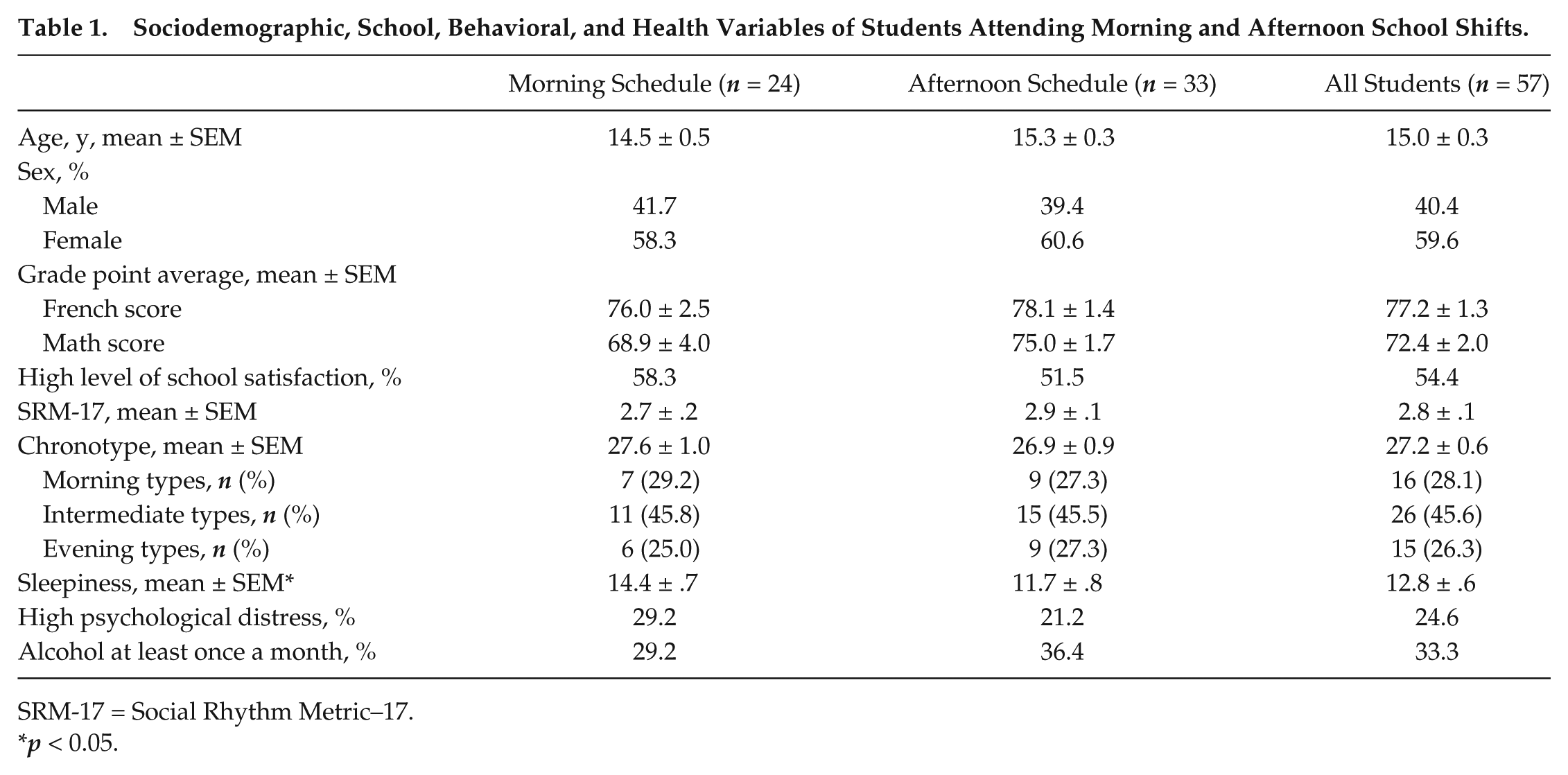
Table 1 presents sociodemographic, school, behavioral, and health variables of high school students attending morning and afternoon school shifts. No difference between the 2 groups was observed in terms of age, sex, academic achievement, school satisfaction, social rhythms regularity (SRM-17) score, chronotype, psychological distress, and alcohol consumption (Table 1). However, morning schedule students reported higher daytime sleepiness scores than afternoon schedule students (14.4 vs. 11.7, p < 0.05).
Sociodemographic, School, Behavioral, and Health Variables of Students Attending Morning and Afternoon School Shifts.
SRM-17 = Social Rhythm Metric–17.
p < 0.05.
Relationship of School Schedule to Sleep Variables
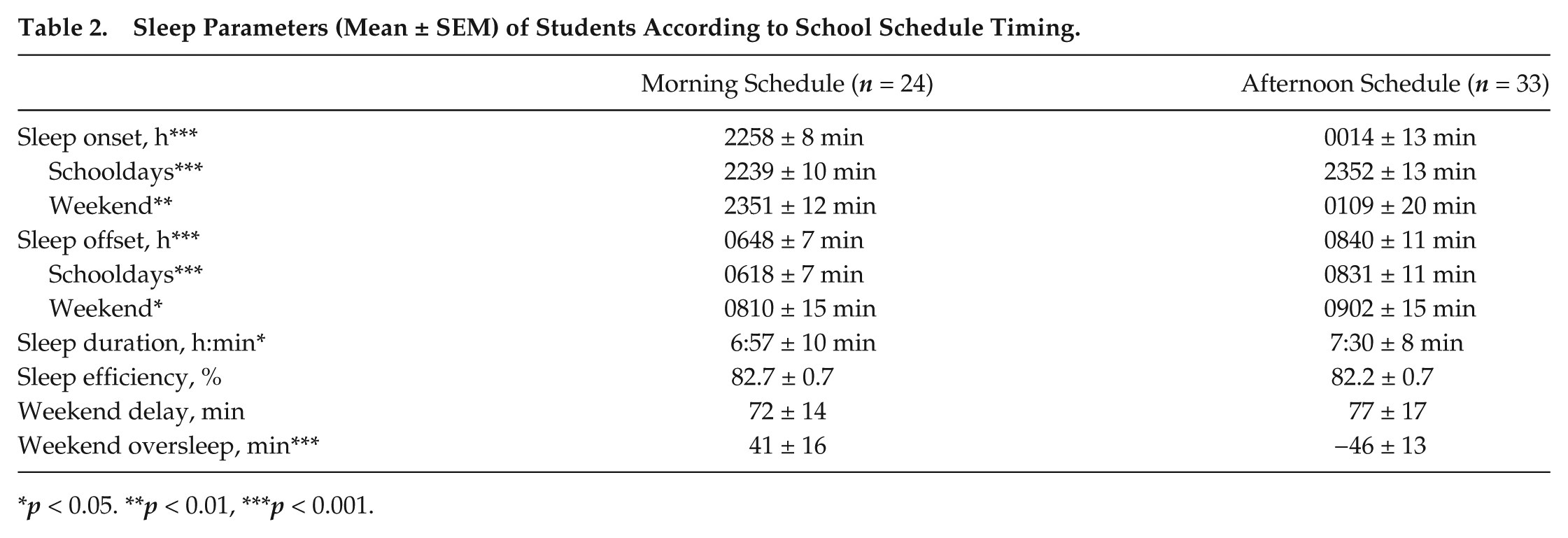
Table 2 presents sleep variables of high school students attending morning and afternoon school shifts. More particularly, it shows that students attending school in the afternoon exhibited a delay in the timing of their sleep onset and sleep offset compared to morning students, both on schooldays (p < 0.001) and on weekends (p < 0.05). In addition, students on the afternoon school schedule presented longer sleep duration (p < 0.05) and lower weekend recovery sleep (p < 0.001) than morning students. On the other hand, sleep efficiency as well as the delay of sleep onset times on weekends did not differ between groups.
Sleep Parameters (Mean ± SEM) of Students According to School Schedule Timing.
p < 0.05. **p < 0.01, ***p < 0.001.
Relationship of School Schedule to Light Exposure Variable
Figure 1A presents hourly mean light intensity (in log lux) averaged with respect to formal clock hours over the 7 days of actigraphy for students attending morning and afternoon school shifts. Group comparisons revealed that students attending the morning schedule were, on average, exposed to more light than afternoon students (F = 6.122; p < 0.05). Furthermore, group-by-time comparisons revealed that students attending morning classes were exposed to higher light intensity levels between 0600 h and 1100 h and to lower light intensity levels between 2100 h and 0100 h than those attending afternoon classes (F = 22.633; p < 0.001). However, students attending morning and afternoon school schedule shifts did not differ regarding mean bright light exposure (≥1000 lux) (41.2 vs. 37.9 min, ns) or the duration of bright light exposure according to the period of day (data not shown).
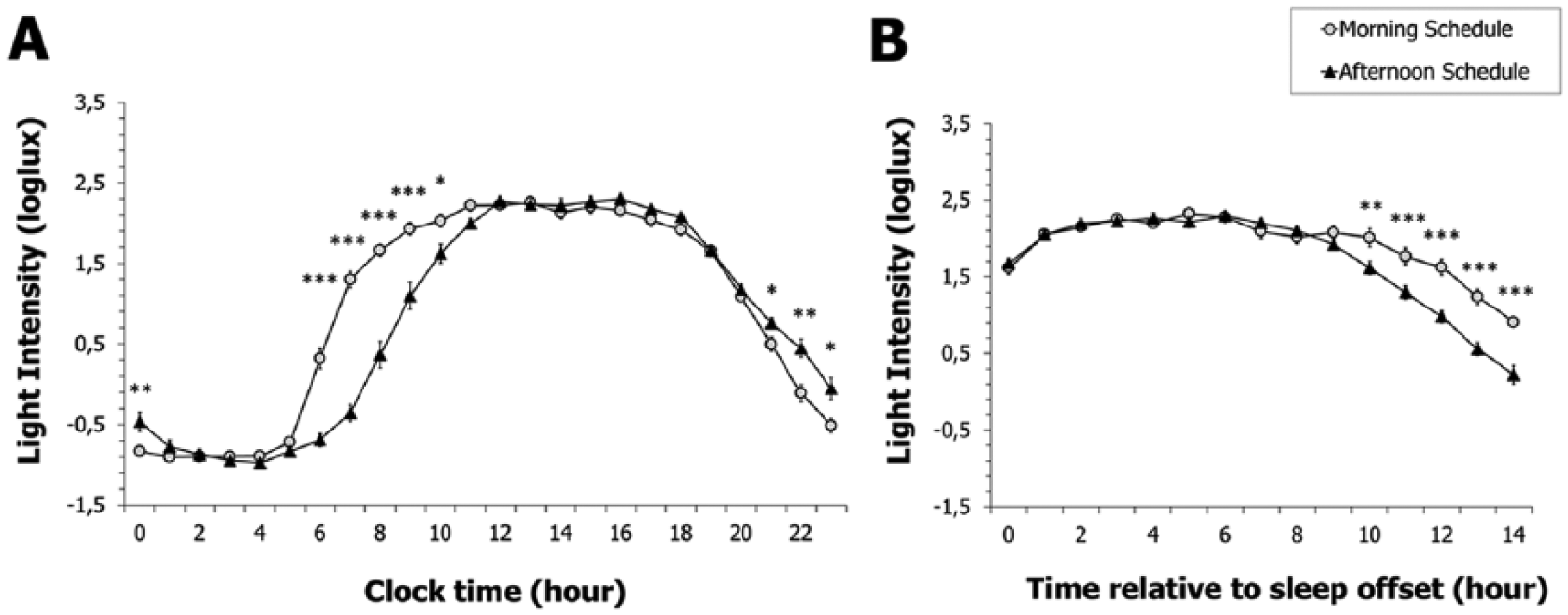
Comparisons between school (morning vs. afternoon) schedules of hourly patterns of light exposure (A) over 24 h, relative to clock time and (B) during waking hours, relative to sleep offset (0 = sleep offset; 1 = 1 h after sleep offset; 2 = 2 h after sleep offset, etc.). Asterisks indicate significant intergroup difference (*p < 0.05, **p < 0.01, ***p < 0.001).
Figure 1B presents hourly mean light intensity (in log lux) received during waking hours, in hours relative to sleep offset for students attending morning and afternoon school shifts. Group comparison indicated that students attending morning classes were exposed to higher levels of light during the waking hours compared to afternoon students (F = 4.525; p < 0.05). Group-by-time comparison further revealed that morning students were more exposed to light than afternoon students between 1000 h and 1400 h after sleep offset (F = 9.259; p < 0.001). Interestingly, peak times of exposure to bright light levels were observed around 1700 h and 2100 h for morning students compared to 1900 h to 2300 h for afternoon students (data not shown).
Relationship of Chronotype to Sociodemographic, School, Behavioral, and Health Variables
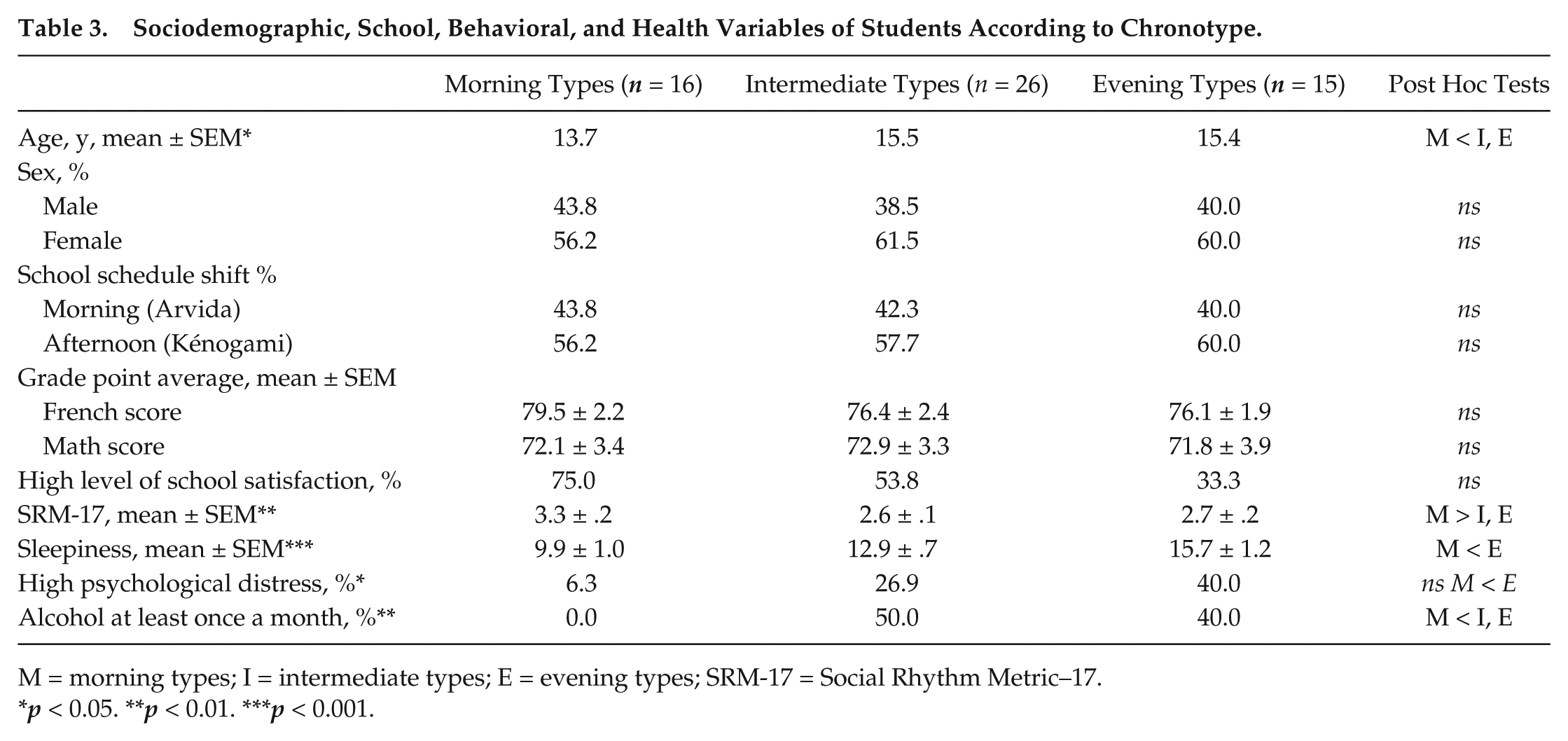
Results further demonstrate that no difference between chronotypes was observed in terms of sex, school schedule shift, academic achievement, school satisfaction, and psychological distress (Table 3). However, E-types and intermediate types (I-types) were older than M-type students (p < 0.05). Also, E-types and I-types exhibited more irregularity in their social rhythms compared to M-type students (p < 0.01). In addition, E-type students reported higher levels of sleepiness than M-types (p < 0.001). Finally, more E-type and I-type than M-type students reported consuming alcohol at least once a month (p < 0.01).
Sociodemographic, School, Behavioral, and Health Variables of Students According to Chronotype.
M = morning types; I = intermediate types; E = evening types; SRM-17 = Social Rhythm Metric–17.
p < 0.05. **p < 0.01. ***p < 0.001.
Relationship of Chronotype to Sleep Variables
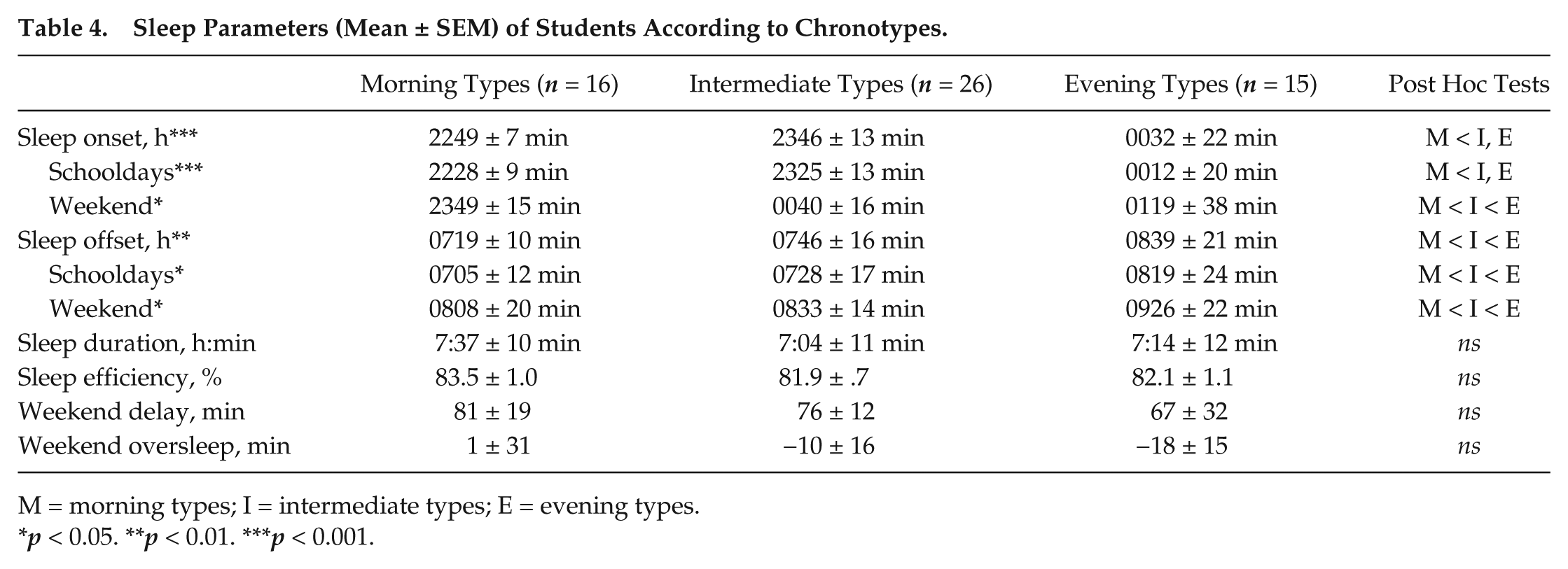
Table 4 presents sleep variables of high school students by chronotype. E-type students showed later sleep onset (p < 0.001) and sleep offset (p < 0.05) than M-types, both on schooldays and on weekends. However, no difference was observed between chronotypes in terms of sleep duration, sleep efficiency, weekend delay of sleep-onset times, and weekend oversleep.
Sleep Parameters (Mean ± SEM) of Students According to Chronotypes.
M = morning types; I = intermediate types; E = evening types.
p < 0.05. **p < 0.01. ***p < 0.001.
Relationship of Chronotype to Light Exposure Variables
Figure 2A presents hourly mean light exposure (in log lux) averaged with respect to formal clock hours over the 7 days of actigraphy by chronotype. Group comparison revealed no difference between chronotypes with regard to the average level of light exposure across the 24-h day. Nevertheless, group-by-time comparison indicated that M-types received higher levels of light than E-types between 0800 h and 1000 h, and both M-types and I-types had higher levels of light than E-types between 1000 h and 1100 h. M-types also presented lower light intensity levels than both E-types and I-types between 2200 h and 0000 h and lower light intensity levels than E-types between 0000 h and 0300 h (F = 5.292; p < 0.001). However, M-type, I-type, and E-type students did not differ regarding mean bright light exposure (≥1000 lux) (46.4 vs. 36.5 vs. 36.4 min, ns) or the duration of bright light exposure according to the period of day (data not shown).
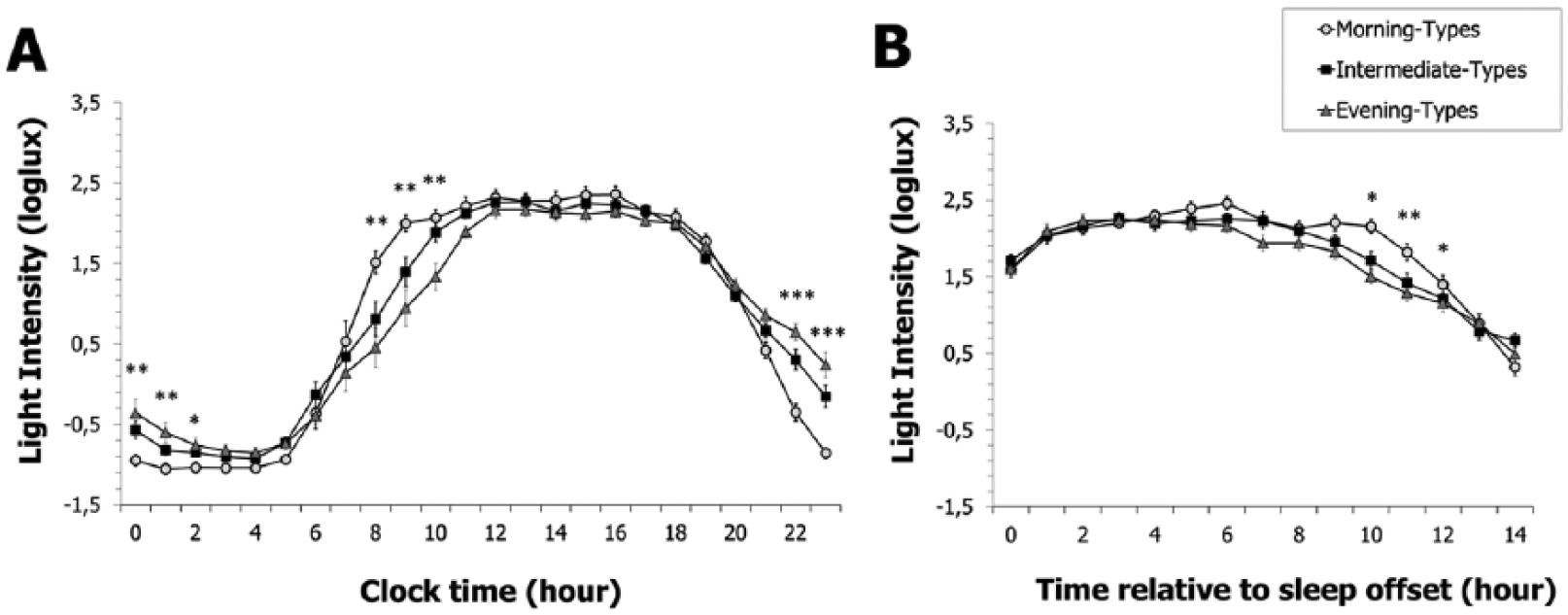
Comparisons between chronotypes of hourly patterns of light exposure (A) over 24 h, relative to clock time and (B) during waking hours, relative to sleep offset (0 = sleep offset; 1 = 1 h after sleep offset; 2 = 2 h after sleep offset, etc.). Asterisks indicate significant intergroup difference (*p < 0.05, **p < 0.01, ***p < 0.001).
Figure 2B presents hourly mean light intensity (in log lux) received during waking hours, in hours relative to sleep offset for chronotypes. Group comparison revealed no difference between chronotype with regard to overall light exposure levels during the waking hours. Group-by-time comparison indicated that M-types received higher levels of light than E-types between 0900 h and 1000 h after sleep offset and higher levels of light than both E-types and I-types between 1000 h and 1100 h after sleep offset (F = 2.005; p < 0.01).
Comparisons of M-Types and E-Types by School Schedule Shifts
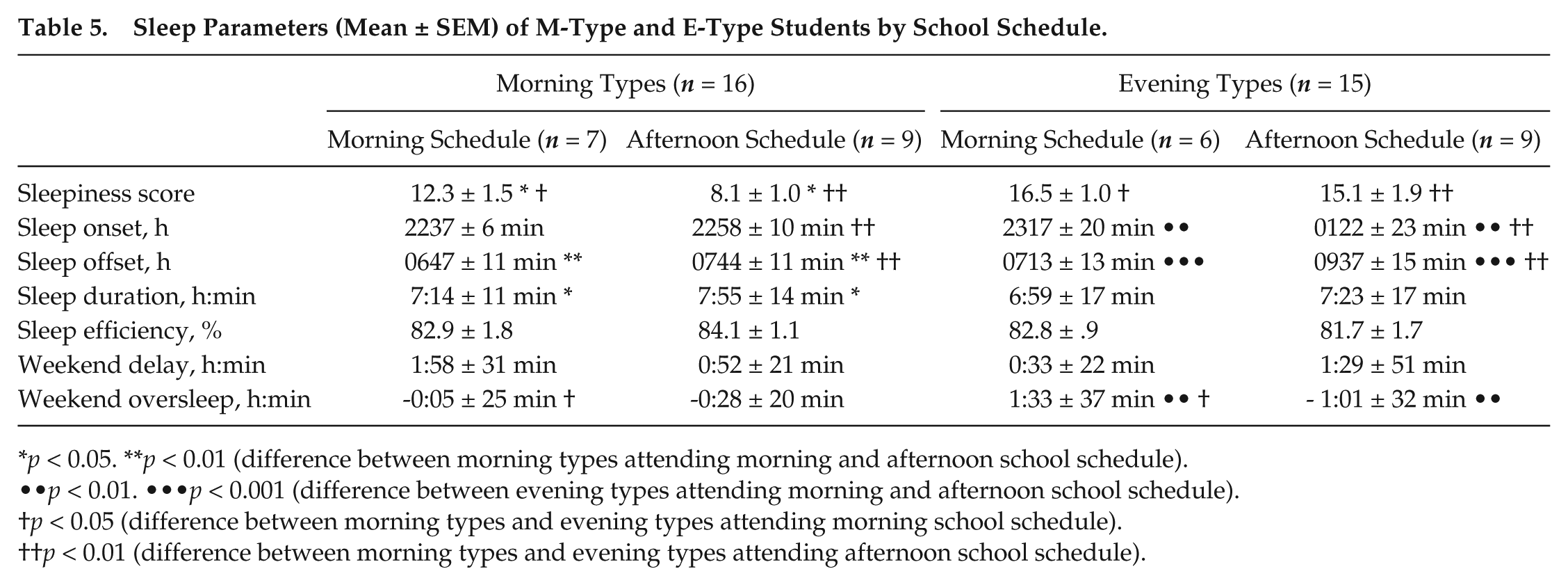
M-types attending morning and afternoon school shifts did not differ relatively to age, sex, academic achievement, school satisfaction, social rhythms regularity, chronotype, psychological distress, and alcohol consumption (data not shown). However, M-types attending a morning school schedule reported higher levels of sleepiness than those attending afternoon school schedules (12.3 vs. 8.1, p < 0.05; Table 5). Also, E-types attending morning and afternoon school shifts did not differ relatively to age, sex, academic achievement, school satisfaction, social rhythms regularity, chronotype, daytime sleepiness (see Table 5), psychological distress, and alcohol consumption.
Sleep Parameters (Mean ± SEM) of M-Type and E-Type Students by School Schedule.
p < 0.05. **p < 0.01 (difference between morning types attending morning and afternoon school schedule).
p < 0.01. •••p < 0.001 (difference between evening types attending morning and afternoon school schedule).
p < 0.05 (difference between morning types and evening types attending morning school schedule).
p < 0.01 (difference between morning types and evening types attending afternoon school schedule).
Table 5 also compares sleep parameters of M-types who attended either morning or afternoon schedules shifts and of E-types who attended either morning or afternoon schedules shifts, respectively. It first shows that M-types who attended afternoon classes had later sleep offset (0744 vs. 0647 h, p < 0.01) and slept longer (7:55 vs. 7:14, p < 0.05) than M-types who attended morning classes. In a similar vein, Table 5 reveals that E-types who attended afternoon classes exhibited later sleep onset (0122 vs. 2317 h, p < 0.01) and sleep offset (0937 vs. 0713 h, p < 0.001) than E-types who attended morning classes. Finally, weekend oversleep of E-types who attended afternoon classes was shorter than those who attended morning classes (–1:01 vs. 1:33, p < 0.01). As a corollary, E-types who attended afternoon classes slept longer on schooldays than on weekends.
Moreover, Table 5 allows one to respectively compare M-type and E-type students who attended the morning schedule with M-type and E-type students who attended the afternoon schedule. While M-types and E-types attending morning classes did not differ with regard to sleep onset (2237 vs. 2317 h, ns) and offset (0647 and 0713 h, ns), M-types attending afternoon classes exhibited earlier sleep onset (2258 vs. 0122 h, p < 0.01) and offset (0744 vs. 0937 h, p < 0.01) than E-types. In addition, M-types attending morning classes exhibited shorter weekend oversleep than E-types attending morning classes (–0:05 vs. 1:33, p < 0.05). Finally, E-types reported higher levels of sleepiness than M-types in both morning (16.5 vs. 12.3, p < 0.05) and afternoon (15.1 vs. 8.1, p < 0.01) schedules.
Discussion
Consistent with the bulk of studies comparing high school students with earlier and later school schedules (Boergers et al., 2014; Carrell et al., 2011; Dexter et al., 2003; Hansen et al., 2005; Hinrichs, 2011; Owens et al., 2010; Perkinson-Gloor et al., 2013; Wolfson et al., 2007), actigraphic data revealed that high school students attending later classes (from 1325 to 1845 h) exhibited a longer sleep duration and reported lower levels of daytime sleepiness than those attending earlier classes (from 0740 to 1305 h). In this study, E-types did not have worse grades, which is inconsistent with a recent study from van der Vinne and colleagues (2015) and other previous reports (Carrell et al., 2011; Edwards, 2010; Wolfson et al., 2007); this finding is, however, consistent with other studies that noted no significant improvement in academic performance when school schedule was delayed (Hinrichs, 2011; Wahlstrom, 2002). Also, results show that high school students slept slightly more than 7 h per night, much less than the recommended 9 h of nightly sleep. Interestingly, sleep duration of M-types attending school in the afternoon was still below 8 h, although they had the opportunity to sleep more. Also, the absence of weekend oversleep suggests that they obtained a sufficient amount of sleep even though it is below the sleep duration recommended by the National Sleep Foundation (2006). Only E-types attending morning classes seemingly presented the weekend recovery sleep schedule typical of adolescence. Moreover, both students attending morning classes and afternoon classes show the typical delay of circadian sleep-wake rhythm between schooldays and weekend nights. As expected, the sleep period of students attending the afternoon school schedule was delayed compared to that of students attending the morning school schedule. Interestingly, the longer sleep duration of the former is primarily attributable to their later sleep offset on schooldays. Indeed, students attending afternoon classes slept about 45 min more on schooldays than on weekends (Table 2). Unlike morning class students, who exhibited the expected weekend recovery sleep, students attending afternoon classes seemingly “drifted” toward their preferred later wake time on schooldays (Mindell and Owens, 2010). In other words, there seems to be no “recovery” process on weekend nights in high school students attending afternoon classes, implying no compensation for an accumulated school-week sleep debt.
Irrespective of the school schedule attended by students, E-types as a group exhibited a phase delay in sleep onset and offset compared to M-types (Giannotti and Cortesi, 2002; Martin et al., 2012; Monk et al., 2004; Tzischinsky and Shochat, 2011). This finding, though, may be partially explained by the fact that E-types were older than M-types. In agreement with previous studies (Gau et al., 2007; Giannotti and Cortesi, 2002; Urban et al., 2011; Wittmann et al., 2006), E-types also reported poorer health-related behaviors, including greater psychological distress and alcohol use, than M-type students. Even though chronotypes did not differ regarding sleep duration, E-types in both school schedules reported higher daytime sleepiness levels. Again, these results could be partly attributed to age since an age-related increase in these latter behaviors/symptoms is typically found during adolescence (Ayotte et al., 2009; Blackburn et al., 2008; Carskadon et al., 1980). In this respect, it should be recalled that weekend oversleep is reportedly stable at approximately 1.5 h between 13 and 19 years old (Crowley and Carskadon, 2010; Wolfson and Carskadon, 1998). In the studies by Gianotti and Cortesi (2002) and Tzischinsky and Shochat (2011), all high school students slept more during weekends, irrespective of their chronotype.
Data further suggest that classes starting at 0740 h can be even detrimental to M-types. Indeed, M-types attending the morning school schedule did not differ from those attending afternoon schedules with regard to sleep onset (2237 vs. 2258 h, ns; Table 5), but they had to curtail their sleep time to attend morning classes (0647 vs. 0744 h, p < 0.01). Accordingly, they exhibited a shorter sleep duration and reported higher daytime sleepiness levels than M-type students attending afternoon classes. Unlike M-types attending morning and afternoon classes who did not differ regarding their sleep onset, E-types attending morning classes fell asleep significantly earlier than those attending afternoon classes (2317 vs. 0122 h, p < 0.01; Table 5). As E-type students attending morning classes showed the typical discrepancy in sleep-wake patterns between school and weekend nights (sleep onset 1.5 h later than schooldays) (Crowley and Carskadon, 2010; Wolfson and Carskadon, 1998), those attending afternoon classes slept 1 h less on weekends than on schooldays (Table 5), whereas E-types attending the morning schedule overslept by 1:33 h on weekend nights. The practice of weekend oversleep (i.e., sleeping in for about 2 h on weekend mornings to catch up) is believed to suggest that schoolday sleep duration is inadequate (Mindell and Owens, 2010). It should further be noted that E-types attending morning and afternoon classes were comparable in terms of both sleep duration and daytime sleepiness levels. One may posit that there is no weekend oversleep in E-types attending afternoon classes due to a better alignment between their preferred and required sleep-wake schedule. Conversely, the significant weekend oversleep in E-types attending morning classes (>1.5 h) may result from a mismatch between the timing of their circadian system and their sleep-wake cycle. Furthermore, it is relevant that E-types attending morning classes did not differ from M-types attending morning classes with regard to sleep onset, sleep offset, and sleep duration. These results altogether strongly suggest that an early school schedule may entail deleterious effects for E-type high school students and that the phenomenon of weekend oversleep in adolescents is largely ascribed to school start times.
On the other hand, our results extend the findings of other studies that monitored light exposure in the natural environment. First, the low values of bright light exposure found in the present study (<1 h per day) are in line with previous research performed at the same latitude (Guillemette et al., 1998; Hebert et al., 1998; Martin et al., 2012). Results also show that students attending morning classes received overall higher levels of light exposure, not only when considering the whole 24-h light pattern (in clock time) but also when considering the light pattern during the waking hours, in which light was plotted relative to sleep offset. Further group-by-time comparisons also revealed that the shapes of the curves of light exposure were different in both 24-h light pattern and pattern of light during waking hours. More specifically, when looking at the 24-h light pattern, students attending morning classes were exposed to higher light intensity levels in the morning (between 0600 h and 1100 h) compared to students attending afternoon classes, which concurs with that observed by Anacleto and colleagues (2014). Conversely, students attending afternoon classes were exposed to greater levels of light intensity than morning class students between 2100 h and 0100 h. Furthermore, when examining the pattern of light during waking hours, we found that students attending morning classes were exposed to higher levels of light intensity than afternoon students 10 to 14 h after sleep offset. These results could probably be explained by the fact that waking hours of the morning and afternoon groups occurred at different times of the light-dark cycle. The morning group was more likely to receive high levels of light at later circadian phases as they woke up and were exposed to greater light levels at the end of the day than the afternoon group. Also, the morning group was likely to be exposed to natural light exposure between 10 and 14 h when returning home, whereas the afternoon group was probably exposed to much lower levels of indoor light at that time. Since the dim-light melatonin onset (DMLO) typically occurs after 14 h of wake time (Burgess et al., 2003; Martin and Eastman, 2002; Mongrain et al., 2004), one may consider that these higher levels of light exposure in the evening took place in the 4 h preceding the DLMO for the morning group students. According to the light-induced phase response curve (PRC) theory, this pattern of light experienced by morning class students may foster a circadian phase delay (Khalsa et al., 2003; St Hilaire et al., 2012). Such a hypothesis is interesting since morning class students slept less and reported more sleepiness than afternoon students; as morning students woke up about an hour before going to school, their only option to “catch up” on lost sleep was to go to bed earlier. Yet, their mean sleep onset was at 2258 h, which is only ≈1 h earlier than that in afternoon class students. As discussed above, there is a strong possibility that these morning students had trouble falling asleep early, as it is well established that adolescent maturation is accompanied by a delay in circadian phase (Carskadon et al., 1997; Carskadon et al., 1993; Laberge et al., 2001). When considering the light patterns during waking hours, it seems that environmental light exposure may also contribute to phase delay in those adolescents or at least participate in preventing an adaptation to the early school schedule. Therefore, this morning school schedule might not only produce a mismatch with the endogenous circadian phase by being “too early” but could also involve a pattern of light exposure aggravating the underlying sleep-phase delay.
When comparing light exposure patterns between chronotypes, we found that M-types received higher levels of light exposure than E-types during morning hours (0800-1200 h) and lower light exposure during evening and night hours (2100-0300 h), concurrent with previous studies (Emens et al., 2009; Goulet et al., 2007; Martin et al., 2012). Also, it is of interest to note that the pattern of light during waking hours indicates that M-type students were exposed to higher light intensity levels than E-types between 9 and 11 h after sleep offset. This suggests that E-types may have received lesser light levels than M-types during late afternoon or early evening in internal time. A lower level of light during the internal evening has previously been hypothesized to help E-types maintain entrainment to the 24-h day (Emens et al., 2009), as E-types are generally acknowledged for their longer (Duffy et al., 2001) and later circadian period (phase) (Mongrain et al., 2004) compared to M-types. As previously mentioned, lower light exposure in the evening should theoretically limit the magnitude of the phase delay shift, thus preventing a greater misalignment between biological and social time (i.e., social jetlag). Yet, in our study, E-types experienced more sleepiness than M-types, in both school schedules, while being exposed to a putatively protective—or at least less potentially deleterious—pattern of light exposure during their waking hours. The difference in sleepiness levels between E-type and M-type students cannot be explained by differences in mean levels of light and bright light across the 24-h day.
Limitations of the study, however, should be considered when interpreting our results. Some conclusions are based on indirect evidence (e.g., sleep deprivation and circadian misalignment) in a cross-sectional and relatively small sample. Also, this study includes a number of self-report measures, which might be prone to memory and response biases. This study may also have underestimated weekend oversleep, as data on alarm clock use during weekends were not assessed. Moreover, the time of day when the exams were performed is unknown, which has recently been demonstrated to affect school achievement depending on chronotype (van der Vinne et al., 2015). Furthermore, the external validity to other adolescent populations is questionable since the morning and afternoon school shifts are a quite rare occurrence.
In summary, this study adds to a growing body of evidence suggesting that an early school start time (0740 h) is associated with detrimental effects in adolescents in terms of sleep deprivation and daytime sleepiness, even for those with a morning-type preference. The afternoon school start time seemingly allowed high school students to drift toward their preferred sleep schedule and did not entail weekend recovery sleep. Further studies should assess longitudinally how consistent is the academic performance when school schedule is advanced or delayed. The effects of a higher level of light exposure in the internal evening of students attending morning classes and/or having a morning-type preference must be further specified and substantiated.
Footnotes
Acknowledgements
The authors thank the participants and their parents for their keen participation, as well as the directors and teachers of both Kénogami and Arvida high schools (Saguenay, Quebec, Canada) for their collaboration. Technical support from Dr. Diane B. Boivin, Julie Auclair, Hélène Simard, Marie-Ève Bouchard, and Dr. Marc Hébert is gratefully acknowledged. This study was supported by the Chaire UQAC–Cégep de Jonquière sur les conditions de vie, la santé et les aspirations des jeunes (VISAJ).
Conflict of Interest Statement
The author(s) have no potential conflicts of interest with respect to the research, authorship, and/or publication of this article.