




Abstract
Circadian clocks of adolescents typically run late—including sleep times—yet adolescents generally are expected at school early in the morning. Due to this mismatch between internal (circadian) and external (social) times, adolescents suffer from chronic sleep deficiency, which, in turn, affects academic performance negatively. This constellation affects students’ future career prospects. Our study correlates chronotype and examination performance. In total, 4734 grades were collected from 741 Dutch high school students (ages 11-18 years) who had completed the Munich ChronoType Questionnaire to estimate their internal time. Overall, the lowest grades were obtained by students who were very late chronotypes (MSFsc > 5.31 h) or slept very short on schooldays (SDw < 7.03 h). The effect of chronotype on examination performance depended on the time of day that examinations were taken. Opposed to late types, early chronotypes obtained significantly higher grades during the early (0815-0945 h) and late (1000-1215 h) morning. This group difference in grades disappeared in the early afternoon (1245-1500 h). Late types also obtained lower grades than early types when tested at the same internal time (hours after MSFsc), which may reflect general attention and learning disadvantages of late chronotypes during the early morning. Our results support delaying high school starting times as well as scheduling examinations in the early afternoon to avoid discrimination of late chronotypes and to give all high school students equal academic opportunities.
School achievements determine academic opportunities and can have life-long consequences, for example, in terms of salaries (Geiser and Santelices, 2007; Baum et al., 2013; French et al., 2014). Both sleep timing and duration are important factors influencing school performance (Curcio et al., 2006; Diekelmann and Born, 2010). According to the two-process model, sleep is regulated by the interaction between a homeostat and the circadian clock (Borbély, 1982; Daan et al., 1984). The homeostat refers to sleep pressure accumulating during wakefulness and decaying during sleep. While the circadian clock promotes wakefulness during the biological day, especially in its second half, it promotes sleepiness primarily in the second half of the biological night. Our chances to fall asleep are optimal when sleep pressure is high and the circadian clock decreases its wake promotion. In turn, we wake up most easily when sleep pressure has dissipated and when the circadian clock ceases to promote sleep.
Like most biological traits, sleep timing varies between individuals. This variance is thought to reflect differences in how individual circadian clocks synchronize (entrain) to the light-dark cycle (Roenneberg and Merrow, 2007). Environmental signals to which circadian clocks entrain are called zeitgebers (Aschoff, 1965). Light is the most important zeitgeber for humans (Wever, 1979; Roenneberg et al., 2007b), who vary in how early or late their circadian rhythms establish a stable “phase of entrainment” in reference to the light-dark cycle (e.g., to dawn), resulting in different “chronotypes” (Roenneberg et al., 2007b). Besides being modified by light exposure, chronotype depends on genetic background and development (Roenneberg et al., 2007a).
The Munich ChronoType Questionnaire (MCTQ; Roenneberg et al., 2003) assesses chronotype using simple, short questions about sleep timing on both workdays and work-free days. Chronotype is calculated from the midpoint of sleep on work-free days (MSF), corrected for sleep debt accumulated on workdays (MSFsc). Chronotype can be used to estimate an individual’s internal time in reference to external (social) time (Kantermann et al., 2012a; Vetter et al., 2012).
Chronotype of adolescents is typically later than in all other age groups, resulting in later sleeping times (Roenneberg et al., 2007a). Thus, early school starting times lead to chronic sleep deficiency in high school students (Carskadon et al., 1998; Gibson et al., 2006; Roberts et al., 2009), a phenomenon that is associated with lower performance (Wolfson and Carskadon, 2003; Meijer, 2008; Lo et al., 2012; Philip et al., 2012; Perez-Lloret et al., 2013). The condition of chronic sleep deficiency associated with early work or school hours and late sleep onset has been called social jetlag (SJL; Wittmann et al., 2006). SJL quantifies the mismatch between internal and external time and correlates positively with chronotype (Wittmann et al., 2006). Increased SJL has been associated with lower academic achievement (Genzel et al., 2013; Haraszti et al., 2014), and late chronotypes obtain lower grades than early types (Borisenkov et al., 2010). The same correlation is found when diurnal preferences are assessed by the Morningness-Eveningness Questionnaire (MEQ; Horne and Östberg, 1976): Again, evening types achieve lower grades than morning types (Randler and Frech, 2006; Bes,oluk et al., 2011; Escribano et al., 2012; Preckel et al., 2013).
The time of day at which examinations are taken could also influence examination outcomes because cognitive functions, including attention, fluctuate during the day (Higuchi et al., 2000; Knight and Mather, 2013; Escribano and Díaz-Morales, 2014; Haraszti et al., 2014). When different chronotypes are tested at the same external time, they are actually tested at different internal times. We therefore predict a chronotype-dependent time-of-day effect on grades. Here, we collected 4734 grades from Dutch high school examinations performed between 0815 and 1500 h and assessed how school performance depends on external and internal time. To our knowledge, this is the first detailed description of chronotype-dependent fluctuations in grades across a typical school day.
Methods
This study was performed at a local high school in Coevorden, the Netherlands (52° 40’ N, 6° 45’ E). Our study was done according to the principles of the Medical Research Involving Human Subjects Act (WMO, 2012) and the Declaration of Helsinki (64th WMA General Assembly, Fortaleza, Brazil, October 2013). Research that does not subject people to procedures or does not require people to follow rules of behavior is an exemption to this WMO act. In addition, retrospective research/patient file research (as our collection of grades here) does not fall under the WMO act. Based on the Dutch national regulations, our study was not invasive of participants’ integrity, and it was performed during regular school hours. We also obtained written consent from the school principal confirming that our study was performed according to the principles of the Declaration of Helsinki. School grades from randomly distributed examinations in 16 subjects (art, biology, chemistry, Dutch, economics, English, French, geography, German, Greek, history, Latin, management, math, physics, sociology) were collected between September and November 2013. Grades were collected together with the time of day that each examination was taken during eight 45-min lessons scheduled between 0815 and 1500 h or during examination weeks with modified schedules. Time-of-day dependent examination performance was assessed by comparing grades for all 8 regular lessons.
Data collection performed in this study was done by simultaneously collecting 2 databases: one of examination grades and another with MCTQs. In the first half of October 2013, 741 students (364 male and 377 female; mean age 14.1 ± 1.7 SD; age range 11-18 years) filled in the MCTQ (Roenneberg et al., 2003). Of these, 700 were associated with at least 1 examination grade in the database, reflecting a large overlap of our 2 databases. The MCTQ provided information about sleep timing on work/schooldays and work-free days, as well as demographic information (age and sex). Each student’s chronotype (MSFsc), SJL (absolute difference between mid-sleep on work-free days and on work/schooldays), and sleep duration on work/schooldays (SDw; Roenneberg et al., 2003) was determined from the subjective entries to the MCTQ. Because MSFsc, SJL, and SDw showed nonlinearity, categorical analyses were applied ranking all students for each of these 3 variables separately and divided these into 5 equal-sized groups. Additionally, regression analyses were performed for all 3 variables to ensure that significant differences observed in the categorical analyses did not result from the subgroup selection.
The interaction between time of day and chronotype on grades was investigated by subdividing the population into 2 groups of early (MSFsc < 4) and late (MSFsc > 4) chronotypes. This cutoff was estimated in a preliminary analysis as the optimal critical MSFsc of a 2-line regression fit using a constant grade for MSFsc < critical MSFsc and a constant slope for MSFsc > critical MSFsc. For the 2 groups, we compared grades obtained in the early morning (0815-0945 h), late morning (1000-1215 h), and early afternoon (1245-1500 h). We note that the first time slot (90 min) differs in length from the other 2 time slots (135 min each), which was necessary so that breaks fall in between and not within these time periods. To assess the effect of internal time on performance, local examination times were converted to “hours since MSFsc”.
The Dutch grading system ranges from 1 (lowest) to 10 (highest). Grades of 5.5 or higher are needed to pass an examination. Grades in the current study were clustered around an average of 6.5 (<5.5, 12.2%; 5.5-6.5, 38.5%; 6.5-7.5, 34.3%; >7.5, 15%; International Recognition Department of Nuffic, 2013). Restricted maximum likelihood (REML) fitted mixed models with “individual” (student ID), “subject”, and “school year” as random factors were used in all analyses. These factors had a significant effect on grade, while “sex” and “age” were excluded as co-factors because their effect did not reach significance. Age and school year were strongly correlated with grades. Because Dutch school grades tend to decline by school year as a reflection of increasing performance standards, school year was included in the statistical model.
All statistical analyses were performed using SAS JMP 7.0 software. Tukey HSD post hoc tests were applied to perform pairwise comparisons for categorical variables. Error bars in all figures represent standard error of the mean derived from the statistical model.
Results
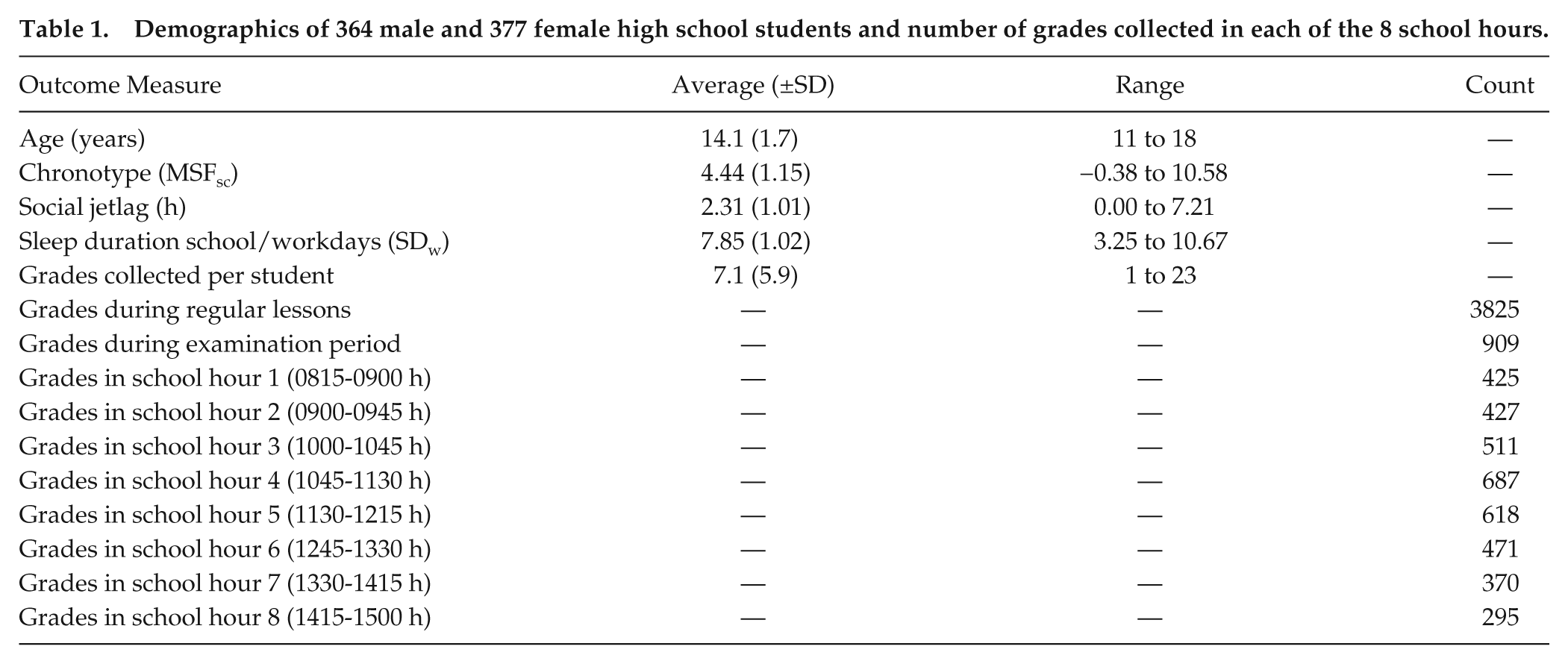
The demographics of our study population and the number of examinations collected in each of the 8 lessons are shown in Table 1. The average number of grades collected per student was 7.1 ± 5.9 SD (range 1-23). On the whole, later chronotypes obtained significantly lower grades compared with earlier types (544 students, 4492 grades, F4,520.6 = 3.864, p = 0.0042; Fig. 1A). The average grades obtained by the 5 SJL subgroups used in our analysis were not significantly different (544 students, 4492 grades, F4,520.4 = 2.299, p = 0.0578; Fig. 1B). Short sleep on workdays (SDw) was also significantly associated with lower grades (580 students, 4719 grades, F4,546.6 = 4.615, p = 0.0011; Fig. 1C). When analyzed as continuous variables instead of being categorized into 5 groups, MSFsc (544 students, 4492 grades, F1,601.1 = 11.25, p = 0.0008), SJL (544 students, 4492 grades, F1,586.1 = 8.585, p = 0.0035), and SDw (580 students, 4719 grades, F1,586.6 = 9.212, p = 0.0025) were each significantly associated with grades.
Demographics of 364 male and 377 female high school students and number of grades collected in each of the 8 school hours.
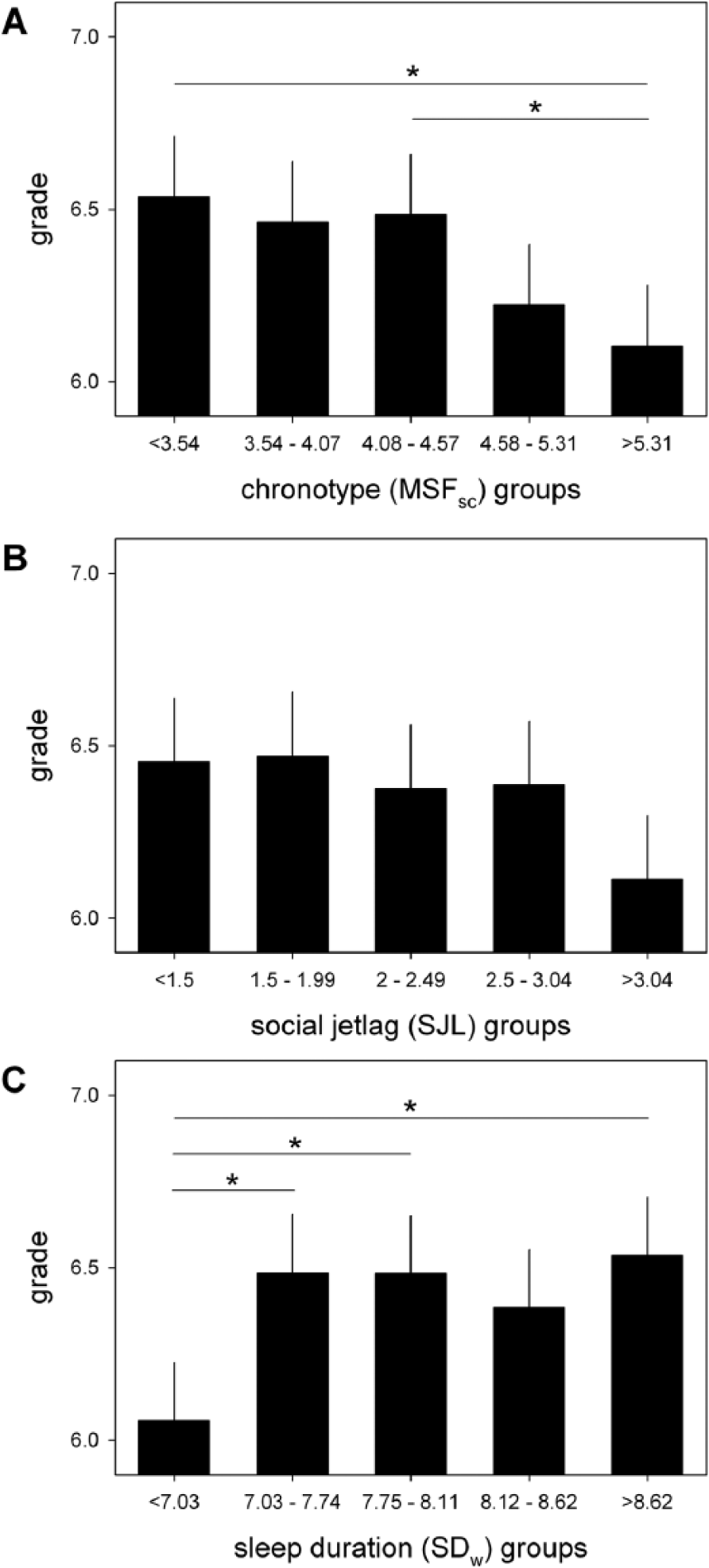
Effects of chronotype (MSFsc), social jetlag (SJL), and sleep duration (SDw) on grades. MSFsc, SJL, and SDw are each grouped in 5 equal-sized groups (cutoffs provided under each bar). (A) Chronotype affected grades significantly. The latest 20% chronotypes obtained significantly lower grades compared with the earliest and middle 20%. (B) SJL did not significantly affect grades. (C) SDw significantly affected grades. Students sleeping fewer than 7.03 h on schooldays obtained significantly lower grades compared with students sleeping longer. Examination grades vary between 1 (lowest) and 10 (highest), with 70% of grades between 5.5 and 7.5; >5.5 represents a passing grade. *p < 0.05.
Time-of-day effects on school performance were assessed for all grades obtained for examinations during regular lessons (excluding grades from examination weeks with modified schedules). Average grades varied significantly with school hour (525 students, 3804 grades, F7,2773 = 6.150, p < 0.0001; Fig. 2A). Grades from examinations taken during the first and eighth (last) school hour were significantly lower compared with grades from examinations taken during the second and seventh school hour. Grades obtained in the early morning (0815-0945 h), late morning (1000-1215 h), and early afternoon (1245-1500 h) were assessed to investigate the overall influence of time of day on grades. Without taking chronotype into account, examination times did not affect school grades (525 students, 3804 grades, F2,2108 = 0.194, p = 0.8239), but a time-of-day effect was significant when comparing early and late types (494 students, 3639 grades, F2,3551 = 4.171, p = 0.0155; Fig. 2B). Early types obtained significantly higher grades during the early (0815-0945 h) and late (1000-1215 h) morning, but this difference disappeared in the early afternoon (1245-1500 h). The average difference in grades between early and late chronotypes disappeared in the early afternoon (early morning difference, 0.39; late morning, 0.26; early afternoon, 0.001), indicating that early and late types obtained similar grades in the early afternoon. Analysis of time-of-day as a continuous variable supported these findings (time of day: 525 students, 3804 grades, F1,1283 = 0.219, p = 0.6397; chronotype × time-of-day: 494 students, 3639 grades, F1,3559 = 7.676, p = 0.0056).
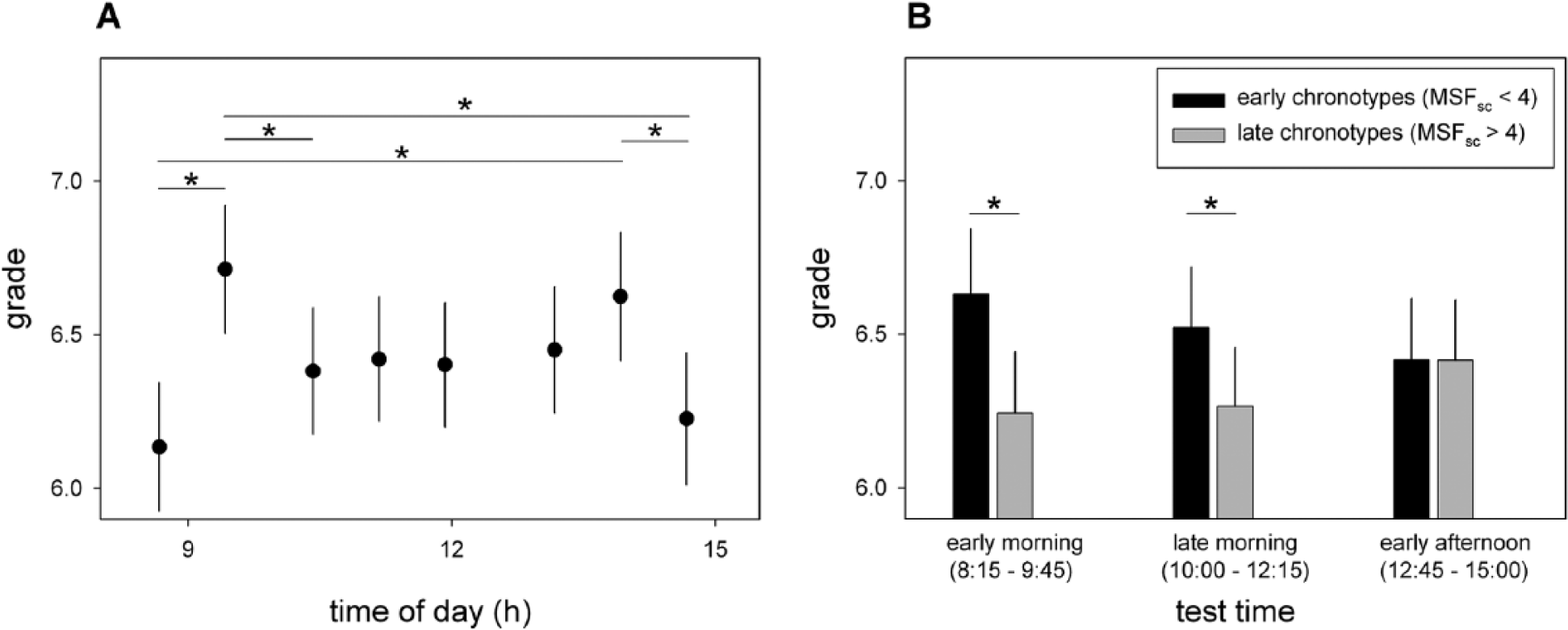
(A) Grades of examinations taken in the first and eighth (last) hours were significantly lower compared with grades of examinations taken in the second and seventh hours. (B) The influence of time of day on grades was significantly different between early and late chronotypes. Late types obtained significantly lower grades in the early and late morning compared with early types. This difference disappeared in the early afternoon. Examination grades vary between 1 (lowest) and 10 (highest), with 70% of grades between 5.5 and 7.5; >5.5 represents a passing grade. *p < 0.05.
Because chronotype varied in our population, examinations were taken at different internal times (i.e., local examination times converted to hours after MSFsc). Late types were examined at significantly earlier internal times compared with early types (early group, 8.6 h; late group, 7.0 h; F1,346 = 344.1, p < 0.0001). The correlations between grades and internal time differed significantly between early and late types (494 students, 3639 grades, F1,3627 = 9.656, p = 0.0019; Fig. 3) and revealed a negative slope for early types (205 students, 1704 grades, F1,468.1 = 4.386, p = 0.0368, slope = −0.049 h−1) and a positive slope for late types (289 students, 1935 grades, F1,895.3 = 6.746, p = 0.0095, slope = 0.055 h−1).
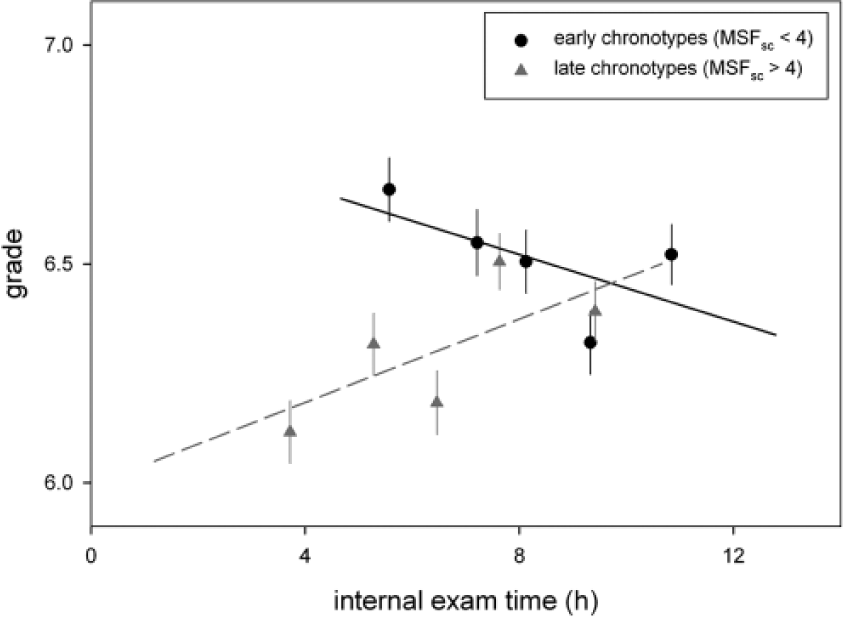
The internal examination time affected school grades differently in early and late chronotypes. The regression lines are based on the analysis of raw examination grades and the associated internal examination time. The range of internal examination times of the raw data is the same as the range covered by the regression lines. The regression analysis is based on the raw data points. The data points summarize average values and SEM for consecutive 20% data subsets per chronotype group. The late-type group had significantly earlier internal examination times compared with the early-type group. The relationship between internal examination time and grade was significantly different in early and late types. Performance of early types decreased while that of late types improved at later internal times. Examination grades vary between 1 (lowest) and 10 (highest), with 70% of grades between 5.5 and 7.5; >5.5 represents a passing grade.
Discussion
Our results show that both short sleep on schooldays and being a late chronotype predict decreased school performance (lower grades). In addition, early and late chronotypes show opposite time-of-day effects on performance. Sleep deficiency is common in adolescents, especially in late chronotypes (Carskadon et al., 1998; Touitou, 2013). Previous studies showed that both sleep deficiency (Wolfson and Carskadon, 2003; Meijer, 2008; Perez-Lloret et al., 2013) and being a late chronotype (Borisenkov et al., 2010) affect school achievements negatively. However, how time of day alters the relationship between chronotype and academic achievements has received limited attention. Haraszti and colleagues (2014) showed that late chronotypes underperformed early chronotypes only when tested at 0800h but not at 1400 h. Here, we examined the relationships between external time, internal time (chronotype), and performance (examination grades) across a typical Dutch school day, from 0815 to 1500 h, showing significant differences between the early and late chronotype groups. While early types performed significantly better in the morning, early and late types performed indistinguishable in the early afternoon. The lowest grades we observed in the first and last (eighth) school hours might be a result of additional differential effects of sleepiness in early and late chronotypes. Especially students sleeping fewer than 7 h per school night had lowest grades, which involved 18% of our participants. This effect, in turn, might be strongest in late chronotypes who—in addition to the short sleep—performed their tests too early in their internal day. The reverse pattern was observed for the early chronotypes, performing worse when tested later in their internal day, which again might result from increased sleepiness in the early types in their last school hour. These findings confirm those of Haraszti et al. (2014). Interestingly, early afternoon often is associated with a “post-lunch dip” in performance (Bes et al., 2009). However, here we can only speculate that the post-lunch dip might be milder or absent in younger students and/or that it appears at a later time point due to the overall later circadian physiology in adolescents (Carskadon and Dement, 1992; Monk et al., 1996).
The results of our study add to the accumulating evidence that chronotype should be taken into account in assessments of performance (Schmidt et al., 2007; Borisenkov et al., 2010; Haraszti et al., 2014). In our study, examinations scheduled during the first 2 school hours were taken by the latest chronotypes (MSFsc > 5.31 h) on average 3.1 h after their MSFsc. Assuming an average of 9 h of sleep need for most adolescents per night (Owens, 2014), this finding means that the latest chronotypes took their early school examinations during their biological night. This is supported by a constant routine experiment, showing significant cognitive impairment after awakening during the biological night (Scheer et al., 2008). In addition, beyond its impact on cognitive and academic performance, a mismatch between internal and external time (social jetlag) also significantly compromises health and well-being (Wittmann et al., 2006; Levandovski et al., 2011; Kantermann, et al., 2012b; Roenneberg et al., 2012). Our student population on average had 2.3 h of social jetlag, which is in line with previous studies showing that about 69% of the general working population show at least 1 hour of social jetlag and one-third suffer from 2 h or more (Roenneberg et al., 2013). Albeit not statistically significant, grades in our study were lowest in those students with more than 3 h of social jetlag, which involved 21.5% of our study population. Therefore, future studies should incorporate the assessment of social jetlag in their study design to explore its impact on school performance in more detail.
A limitation of our study is the correlational approach, making conclusions regarding causality difficult. This shortcoming could be addressed in future studies, for example, assessing how changing school starting times affects sleep and grades. In addition, future research should more rigorously control for potential confounders in the assessment of sleep timing, including potential influences of attention-deficit hyperactivity disorder or other attention/learning disorders and also seasonal variations in sleep timing (Allebrandt et al., 2014).
Taken together, our findings emphasize the need for significant amendments to current school legislature. A few schools have managed to implement later school start times and report significant improvements of students’ sleep and daytime functioning (Owens et al., 2010; Boergers et al., 2014). In addition, tailored interventions to reduce especially short wavelength (blue) light in the evenings and/or to increase light exposure in the mornings could help to synchronize the students’ circadian clocks to their school schedules. The circadian clock is most sensitive to short wavelengths (Brainard et al., 2001), and studies have shown that especially blue light from computers and televisions interferes with sleep and the circadian rhythm (Wood et al., 2013; van der Lely et al., 2014). However, such behavioral interventions are as difficult to achieve on a population level, as are changes in school start times. Therefore, as a first step, we suggest a shift of examination schedules to the early afternoon to at least secure equal examination conditions for all chronotypes.
Footnotes
Acknowledgements
We thank Wab Boekelman for his help with the data collection. Our work is supported by the Technology foundation STW grant P10-18/12186 and the University of Groningen.