




Abstract
Because the circadian clock in the mammalian brain derives from a network of interacting cellular oscillators, characterizing the nature and bases of circadian coupling is fundamental to understanding how the pacemaker operates. Various phenomena involving plasticity in circadian waveform have been theorized to reflect changes in oscillator coupling; however, it remains unclear whether these different behavioral paradigms reference a unitary underlying process. To test whether disparate coupling assays index a common mechanism, we examined whether there is covariation among behavioral responses to various lighting conditions that produce changes in circadian waveform. Siberian hamsters, Phodopus sungorus, were transferred from long to short photoperiods to distinguish short photoperiod responders (SP-R) from nonresponders (SP-NR). Short photoperiod chronotyped hamsters were subsequently transferred, along with unselected controls, to 24-h light:dark:light: dark cycles (LDLD) with dim nighttime illumination, a procedure that induces bifurcated entrainment. Under LDLD, SP-R hamsters were more likely to bifurcate their rhythms than were SP-NR hamsters or unselected controls. After transfer from LDLD to constant dim light, SP-R hamsters were also more likely to become arrhythmic compared to SP-NR hamsters and unselected controls. In contrast, short photoperiod chronotype did not influence more transient changes in circadian waveform. The present data reveal a clear relationship in the plasticity of circadian waveform across 3 distinct lighting conditions, suggesting a common mechanism wherein individual differences reflect variation in circadian coupling.
Keywords
A circadian pacemaker in the suprachiasmatic nucleus (SCN) of mammals orchestrates daily rhythms in physiology and behavior (Klein et al., 1991). The SCN is entrained with a predictable phase to the solar day through the phase-resetting actions of light, and changes in circadian function can affect entrainment patterns. At the molecular level, transcriptional, translational, and posttranslational interactions among a number of clock genes and their protein products generate an approximately 24-h cycle in cellular activity (Ko and Takahashi, 2006). Mutations in clock genes can yield large changes in circadian period that translate into altered phases of entrainment (Spoelstra et al., 2004). Among out-bred animal species and humans, there may be considerable interindividual variation in entrainment chronotype (e.g., larks versus owls) and in free-running period, some of which is likely heritable (Brown et al., 2008; Xu et al., 2005).
Pacemaker function is also affected by changes at the network level. In isolation, SCN neurons express a broad range of period lengths (Herzog et al., 2004; Welsh et al., 1995). To form a functional central pacemaker with a coherent circadian period, these oscillators must interact (i.e., couple) to synchronize with one another (Bouskila and Dudek, 1995; Enright, 1980). Moreover, the coupled network encodes a circadian waveform as an emergent property of the phase relations among SCN neurons, which is thought to control system-level responses to photoperiod (Inagaki et al., 2007; Rohling et al., 2006). Although circadian waveform is widely recognized to reflect a central organizational dimension of pacemaker function, an understanding of its mechanistic basis has lagged behind that of circadian period and phase.
Daylength-encoding variation in circadian waveform is a principal mechanism by which nonequatorial mammals adjust their physiology and behavior to be appropriate to the season. Short-lived rodents, for example, commonly suppress reproduction and molt to a thicker pelage under autumn and winter photoperiods (Goldman, 2001). In many rodent species, however, a subset of animals fail to inhibit reproductive function in short photoperiods (Nelson, 1987). The population frequency of photoperiodic nonresponsiveness is responsive to artificial selection, indicating that this trait is under genetic control (Kliman and Lynch, 1992; Puchalski and Lynch, 1986). In Siberian hamsters, Phodopus sungorus, short photoperiod nonresponsive (SP-NR) individuals fail to express the long activity duration (α) and long interval of melatonin secretion necessary to induce the suite of winter-typical traits displayed by short photoperiod responsive (SP-R) hamsters. Individual differences in short photoperiod responsiveness are posited to reflect variation in the strength of SCN coupling (Margraf et al., 1991; Puchalski and Lynch, 1994).
Other circadian phenomena reflecting plasticity in circadian waveform are likewise thought to involve coupling among SCN oscillators. Prolonged constant light can induce either arrhythmia or “splitting” of locomotor activity rhythms into 2 distinct components (Pittendrigh and Daan, 1976), which reflects temporal dissociation of SCN oscillators (de la Iglesia et al., 2000; Ohta et al., 2005; Yan et al., 2005). Phase-advancing light pulses commonly produce transient shortening of subjective night, putatively reflecting changes in the phase relations of coupled and differentially shifted evening and morning oscillators (Pittendrigh and Daan, 1976; Elliott and Tamarkin, 1994; Sumova and Illnerova, 1998). Also, hamsters and mice can be readily and reliably induced to bifurcate their activity rhythms under 24-h light:dark:light: dark (LDLD) cycles (Gorman and Elliott, 2003), and the antiphase activity bouts that emerge under LDLD correspond to temporally dissociated SCN oscillators (Watanabe et al., 2007; Yan et al., 2010). After release from LDLD into constant conditions, the component oscillators quickly rejoin under the influence of mutual coupling (Evans et al., 2010).
Despite the common use of “coupling” as an explanatory concept in multiple circadian paradigms, it is unknown whether the underlying mechanisms are empirically related. In one previous study, SP-NR Siberian hamsters were less likely than SP-R hamsters to exhibit split rhythms in constant bright light (Puchalski and Lynch, 1988), which is compatible with the view that individual differences under both lighting conditions are influenced by a common coupling mechanism. In the present study, we systematically examine covariation of circadian waveform responses across 5 distinct lighting conditions to assess whether these different “coupling” paradigms are influenced by a common process. We posit that high covariation across multiple conditions would argue for a common mechanism of coupling, whereas no covariation would suggest that there are independent mechanisms through which circadian waveform is altered. We find that plasticity in circadian waveform is highly related under a subset of these lighting conditions, suggesting that these responses index a common coupling mechanism that differs among individuals.
Materials and Methods
Procedures
Animals and initial conditions
Male and female Siberian hamsters (Phodopus sungorus) were bred from stock maintained at the University of California, San Diego since 1994. At weaning, hamsters were group-housed in clear polycarbonate cages (27 cm × 20 cm × 15 cm, 2-4 hamsters/cage). Temperature was maintained at 22 ± 2 °C, with ad libitum access to water and food (Purina Chow no. 5015). The breeding colony was maintained on a 14-h light and 10-h dark light: dark cycle (LD14:10; lights-on: 0600 h PST, lights-off: 2000 h PST) with completely dark nights. Under both colony and experimental conditions, illumination within cages during the photophase was 50-100 lux. Under experimental conditions, the daily scotophase was either completely dark or dimly lit (see below) with narrowband, green light-emitting diodes (LEDs, 0.03 W, peak λ = 560 ± 23 nm half bandwidth) of an intensity comparable to that of dim moonlight (<0.05 lux, <9.0 × 10⁻⁹ W/cm2, <2.5 × 10¹⁰ photons/cm2 sec).
Overview of procedures
Siberian hamsters were exposed sequentially to a number of lighting conditions that produce changes in the waveform of locomotor activity rhythms (Fig. 1, Suppl. Fig. S1). As described in detail below, the measured behavioral responses were (1) increases in activity duration (α) after transfer from long to short photoperiods, (2) incidence of bifurcated entrainment under 24-h LDLD cycles, (3) acute changes in α after release from LDLD into constant dim illumination, (4) transient α compression during bright-light resetting, and (5) incidence of arrhythmia under long-term constant dim illumination.
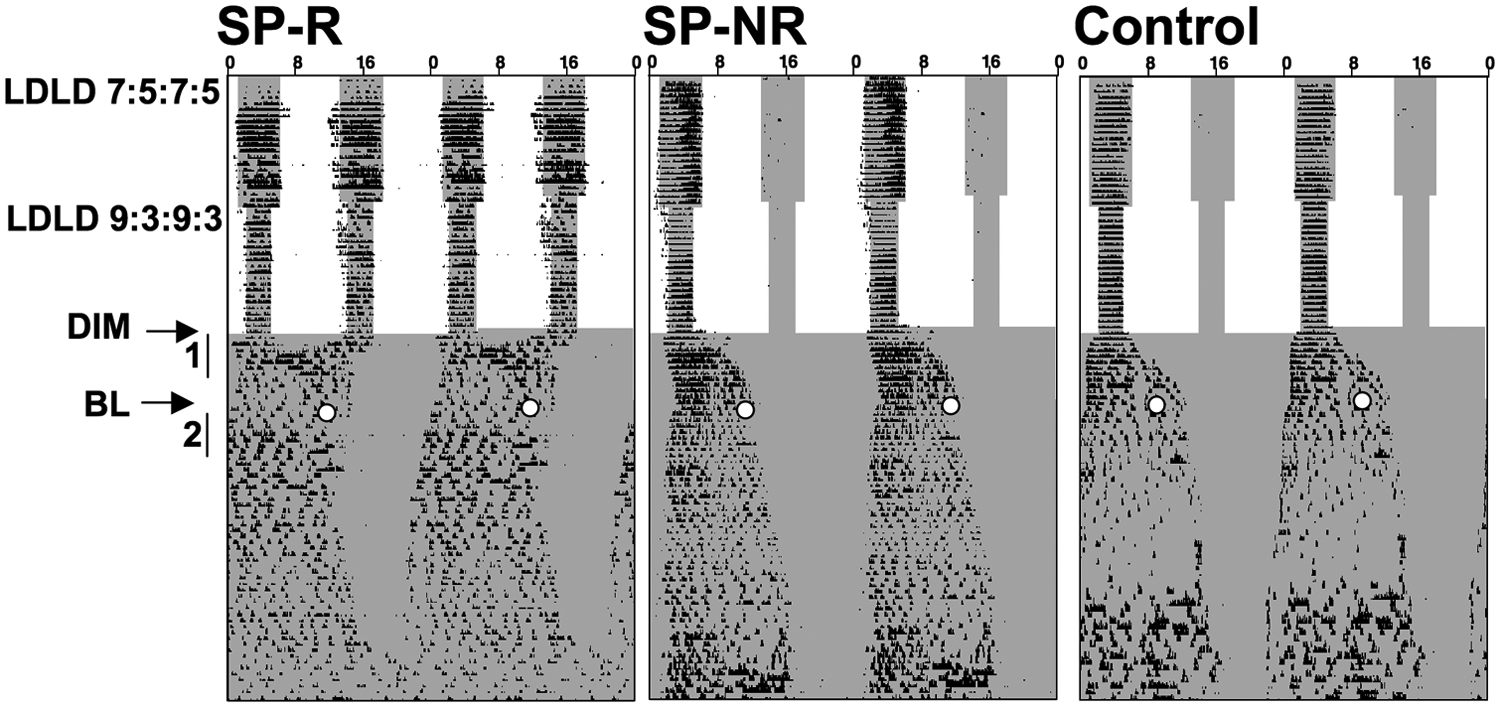
Representative double-plotted actograms illustrating the lighting conditions to which Siberian hamsters were exposed. Changes in internal shading represent changes in lighting conditions, with dim nighttime illumination present throughout. Wheel-running rhythms (scale 0-75 wheel revolutions/6 min) were recorded after hamsters were transferred to LDLD and released into constant DIM illumination (indicated by DIM and arrow on left). After 2 weeks under constant DIM, hamsters were provided 15-min bright light pulses (indicated by BL, arrow at left, and white circle within actogram). Numbered sections of record indicate intervals used to measure changes in activity duration after release into DIM (1) and after bright light pulses (2). Note that the SP-R hamster, like all other SP-R hamsters, displays a bifurcated rhythm with an activity component in each scotophase starting on Day 3 of LDLD, whereas the SP-NR hamster and control hamster, like the majority of hamsters in these 2 groups, fail to display 2 activity components for the entire duration of LDLD.
Short photoperiod chronotypy
Since short photoperiod nonresponsiveness in this species requires initial exposure to day lengths ≥16 h (Goldman and Goldman, 2003; Gorman and Zucker, 1997), group-housed hamsters (N = 156, 6-10 weeks of age) were held for 6 weeks under LD19:5 (lights-on: 0600 h PST, lights-off 0100 h PST) and then subsequently exposed to LD10:14 (lights-on: 0800 h PST, lights-off: 1800 h) to distinguish short photoperiod responders from nonresponders (see criteria for chronotypy below). For logistical purposes, hamsters remained group-housed for the first 10 weeks under LD10:14 before transfer to individual cages so that locomotor activity could be recorded for chronotyping (Suppl. Fig. S1). Up until this point, scotophases were completely dark since dim nighttime illumination prevents the induction of short photoperiod nonresponsiveness in this species (Gorman and Elliott, 2004). Two weeks later, hamsters were exposed to dim nighttime illumination for 6 weeks and rechronotyped in an attempt to equalize entrainment patterns across hamsters (Suppl. Fig. S1). Finally, chronotyped hamsters were entrained to LD19:5 for 12 days to homogenize entrainment state prior to LDLD.
Bifurcated entrainment in LDLD
To test whether short photoperiod chronotype predicted the incidence of rhythm bifurcation, all chronotyped hamsters were next transferred to cylindrical cages (21 cm diameter), equipped with a running wheel (17 cm diameter). Transfer coincided with the “daytime” scotophase of LDLD7:5:7:5 (lights-off: 1000 h PST, lights-on: 1500 h PST, lights-off: 2200 h PST, lights-on: 0300 h PST) with dim nighttime illumination (same as above). A separate sample of hamsters (n = 14) was transferred from LD14:10 to identical LDLD conditions to serve as unselected, age-matched controls. For all hamsters, the photocycle was changed 3 weeks later to LDLD9:3:9:3 (lights-off: 1100 h PST, lights-on: 1400 h PST, lights-off: 2300 h PST, lights-on: 0200 h PST). After 3 more weeks, hamsters were transferred from LDLD into constant dim illumination (DIM) at the beginning of the nighttime scotophase.
Bright light–induced resetting transients
After 2 weeks of constant DIM, free-running hamsters were transferred within their home cage to a separate chamber and given a 15-min, 350-lux light pulse. To account for differences in α, light pulses were initiated three-fourths of the way through each animal’s active phase, which is a phase at which light is expected to elicit advances in all hamsters (Puchalski and Lynch, 1991a). After the bright light pulse, hamsters were returned to the housing chamber and left to free-run for 7 weeks under constant DIM.
Constant DIM-induced arrhythmia
With prolonged exposure to constant DIM, many hamsters in the present study became arrhythmic. To assess whether arrhythmia was produced by dim illumination or another factor (e.g., age, hormonal status), approximately half the hamsters within each chronotype group were exposed to constant complete darkness (DARK) by extinguishing the LEDs. After 7 weeks under constant DARK, constant DIM was reinstated for an additional 7 weeks by repowering the LEDs.
Data Collection and Analyses
During the last 8 weeks under LD10:14 and the subsequent 12 days under LD19:5, general locomotor rhythms were monitored with passive infrared motion detectors (Coral Plus; Visonic, Bloomfield, CT) mounted on filter tops. Upon transfer to LDLD, activity rhythms were monitored through the use of home cage running-wheels. Both passive infrared and wheel-running counts were recorded and compiled into 6-min bins by VitalView (Mini Mitter, Bend, OR). Activity rhythms were plotted and analyzed using ClockLab (Actimetrics, Evanston, IL).
Short photoperiod chronotypy
SP-R and SP-NR hamsters were identified by monitoring behavioral and physiological indices associated with a winter phenotype. All hamsters were weighed at 2- to 4-week intervals, starting with transfer to LD10:14 and ending immediately before transfer to LDLD. Additionally, male hamsters were lightly anesthetized with isoflurane vapors (Aerane, Fort Dodge, IO) so that the length and width of the left testis could be measured externally with calipers. The product of testis length multiplied by squared testis width was used to produce estimated testis volume (ETV), which yields a reliable index of testis size (Gorman and Zucker, 1997). To assess circadian patterns of general locomotion for each hamster, a 24-h activity profile was produced by averaging activity counts in each 6-min bin over 7 days of the following experimental intervals: over the final week of LD10:14 with dark nights (Suppl. Fig. S1), over the final week of LD10:14 with dimly lit nights (Suppl. Fig. S1), and over the final week of LD19:5, which preceded transfer to LDLD. For each activity profile, activity onset was identified as the first bin after 1600 h PST above overall daily mean levels, followed within 30 min by at least 3 bins likewise above this threshold and preceded by at least 6 h of activity below this threshold. Activity offset was the last time point preceded by a bin exceeding this threshold and followed by at least 6 h of activity below threshold. The time difference between activity offset and onset was used to calculate α. Similar to conventions used in previous studies (Gorman and Zucker, 1997; Prendergast and Freeman, 1999), hamsters were categorized as SP-NR if they displayed α < 9 h, whereas SP-R hamsters were classified as those that exhibited α > 11 h (Suppl. Table S1). Due to limited recording space, hamsters that displayed arrhythmia or intermediate α values (9 h < α < 11 h) under LD10:14 with dark nights were removed from the study. The addition of dim nighttime illumination after the 12th week under LD10:14 increased α in only a minority of SP-NR hamsters. Those hamsters that increased α by at least 3.5 h under dimly lit nights were classified as SP-Converters (n = 6; Suppl. Fig. S1, Suppl. Table S1).
Bifurcated entrainment in LDLD
Consistent with previous reports (Gorman and Elliott, 2003, 2004), there was no ambiguity in classifying rhythms as bifurcated or unbifurcated. Activity rhythms were categorized as bifurcated if, for a minimum of 5 consecutive days, hamsters expressed 2 separate wheel-running bouts, one associated with each scotophase and each lasting longer than 30 min.
Acute α changes in constant DIM after LDLD
As discussed in (Evans et al., 2010), it is difficult to visually identify the exact cycle on which bifurcated rhythms become fused, but latency to the fused state may be operationalized as the number of cycles until circadian waveform stabilizes. To quantify changes in circadian waveform under free-running conditions, day-to-day measures of α were calculated on each of 23 consecutive days, starting with the day before LDLD release into constant DIM. Activity onset was identified by the first 6-min bin exceeding 5 counts/min and preceded by at least 6 h of activity below threshold, and activity offset was identified by a similar but opposite rule. Day-to-day changes in α were analyzed as percentage of α displayed on the day before the experimental manipulation (i.e., either release from LDLD or exposure to the 15-min bright light pulse).
Bright light–induced phase shifts
While α is positively correlated with phase shift magnitude (Pittendrigh et al., 1984; Puchalski and Lynch, 1991a), it is not known whether either of these variables influences the degree to which α changes during phase-advancing transients. To determine whether analyses of phase-advancing transients would need to account for differences in α, we assessed whether phase shift magnitude was related to α displayed before the light pulse. A phase shift was measured for each animal by the displacement between regression lines fit to 5-7 consecutive activity onsets before and after the 15-min bright light pulse, excluding the first 2 postpulse days to allow for initial transients. The slope of the prepulse regression line was also used to measure free-running period length under DIM conditions.
Arrhythmia in constant DIM
Hamsters were categorized as arrhythmic if they displayed no subjectively discernible inactive phase (i.e., subjective day) over at least 3 consecutive days of constant DIM. Determinations were conducted by 2 different observers unaware of short photoperiod chronotype. Free-running period length under DARK conditions was measured by the slope of a linear regression line fit to 7 consecutive activity onsets during the 5th week under DARK, which was a time at which all hamsters were rhythmic.
Statistical analyses
Statistical analyses were conducted with JMP 5.0 software (SAS Institute, Cary, NC). Male and female hamsters did not differ in the response to most lighting manipulations, although a greater number of females displayed arrhythmia under constant DIM conditions (
Results
Short photoperiod chronotypy
To identify short photoperiod responsive (SP-R) and nonresponsive (SP-NR) individuals, hamsters were exposed to LD10:14 with dark nights for 12 weeks. In the 12th week of LD10:14 with completely dark nights, 27% and 26% of hamsters were categorized as SP-R (α > 11 h) and SP-NR (α < 9 h), respectively (Suppl. Table S1, Suppl. Fig. S1). SP-R and SP-NR hamsters were then provided LD10:14 with dim nighttime illumination for 6 weeks (Suppl. Fig. S1) in an attempt to equalize entrainment patterns between groups (Gorman and Elliott, 2004). However, the addition of dim nighttime illumination increased α in only 6 SP-NR hamsters, which were classified as SP-Converters (Suppl. Fig. S1). In addition to α, physiological measures also distinguished SP-R and SP-NR hamsters (Suppl. Table S1). All SP-R, SP-NR, and SP-Converters were reentrained to LD19:5 to equalize entrainment state before the next lighting manipulation. Under LD19:5, α decreased and did not differ between chronotype groups (SP-NR: 6.14 h ± 0.27 h, SP-R: 6.42 h ± 0.57 h, SP-Converter: 7.65 h ± 0.82 h; F2,31 = 1.6, p > 0.2).
Bifurcated entrainment in LDLD
To determine whether short photoperiod responsiveness would predict differences in circadian waveform under other lighting conditions, hamsters were transferred next to LDLD. Rhythm bifurcation was induced in 54% of hamsters within 3 weeks of LDLD7:5:7:5 and in an additional 6% (3 more hamsters) in LDLD9:3:9:3 (Figs. 1, 2). Notably, 100% of SP-R hamsters and 83% of SP-Converters displayed bifurcated entrainment under LDLD, compared to only 35% of SP-NR hamsters and unselected controls (Fig. 2;
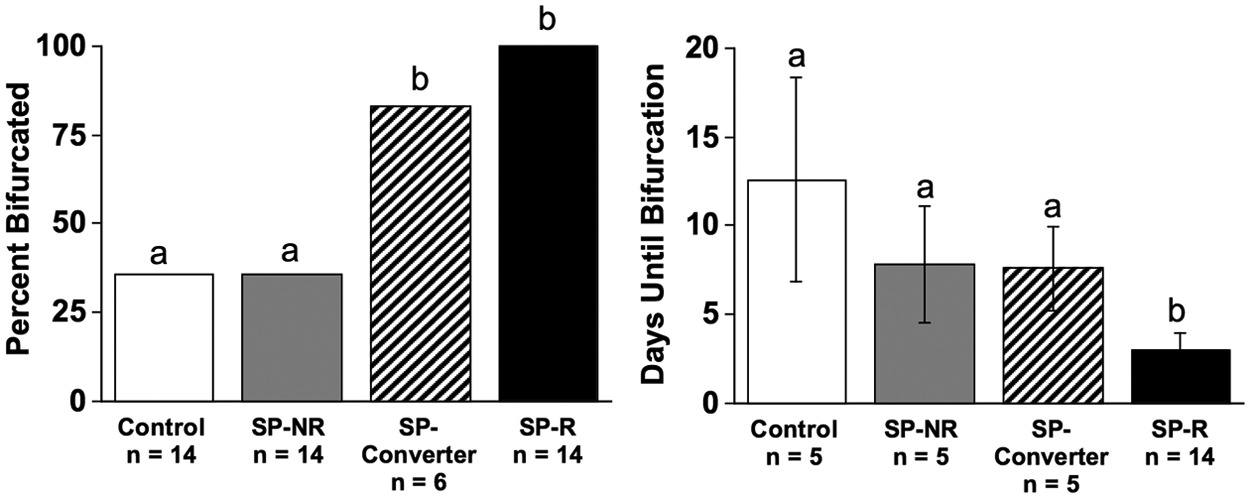
Incidence (percentage) and timing (mean ± SEM) of bifurcated entrainment under LDLD. Sample sizes are indicated below each bar. Distinct letters above each bar distinguish groups that differed in post hoc pairwise χ2 tests (p < 0.05).
Release from LDLD and bright light–induced resetting transients
To determine whether short photoperiod responsiveness would predict differences in changes in circadian waveform under free-running conditions, hamsters were next released from LDLD and provided with bright light pulses. As expected, values of α after release were influenced by LDLD entrainment state (Suppl. Fig. S2; LDLD Entrainment State: F1,43 = 93.1; p < 0.0001; Time: F7,37 = 4.5, p = 0.001; LDLD Entrainment State × Time: F7,37 = 11.6, p < 0.0001). However, the pattern of change in percentage of α was not influenced by short photoperiod chronotype for either the previously bifurcated group (Suppl. Fig. S2; SP-Chronotype: F3,24 = 1.9; p = 0.16; Time: F7,18 = 1.7; p = 0.18; SP-Chronotype × Time: F7,20 = 1.4, p = 0.95) or the unbifurcated group (Suppl. Fig. S2; SP-Chronotype: F1,15 = 0, p = 0.99; SP-Chronotype × Time: F6,10 = 0.37, p = 0.71).
At the time of the bright-light resetting manipulation, prior entrainment effects of LDLD were still evident (Suppl. Table S2), and hamsters with previously bifurcated rhythms displayed longer α (F1,44 = 18.6, p < 0.0001) and larger bright light–induced phase shifts (F1,44 = 6.6, p < 0.05). Among hamsters with previously bifurcated rhythms, short photoperiod chronotype did not influence α (F3,24 = 1.4, p = 0.27) or phase shift magnitude (F3,24 = 0.2, p = 0.88). Among hamsters without bifurcated rhythms, SP-NR hamsters had a shorter α than unselected controls (F1,15 = 5.6, p < 0.05) but did not differ in phase shift magnitude (F1,16 = 0.02, p = 0.89). When α was used as a covariate, phase shift magnitude was no longer significantly affected by LDLD entrainment state (F1,33 = 1.0, p = 0.32). No group differences were evident in free-running period under constant DIM (Suppl. Table S3, F4,17 = 0.37, p = 0.69).
Following phase-advancing bright light pulses, α decreased for several cycles and returned to steady-state values within 1 week (Suppl. Fig. S2). Changes in α during phase-advancing transients were influenced by LDLD entrainment state (LDLD Entrainment State: F1,43 = 27.3, p < 0.0001; Time: F7,37 = 6.0, p = 0.0001; LDLD Entrainment State × Time: F7,37 = 1.1, p = 0.39). However, the pattern of change in percentage of α was not influenced by short photoperiod chronotype for either the previously bifurcated group (Suppl. Fig. S2, SP-Chronotype: F3,24 = 2.0, p = 0.15; Time: F7,18 = 2.6, p < 0.05; SP-Chronotype × Time: F7,20 = 1.0, p = 0.47) or the unbifurcated group (Suppl. Fig. S2, SP-Chronotype: F1,15 = 2.16, p = 0.16; Time: F6,10 = 9.73, p < 0.0001; SP-Chronotype × Time: F6,10 = 2.85, p = 0.07).
Long-term exposure to DIM
After several weeks under constant DIM, 54% of hamsters developed arrhythmic activity patterns characterized by the lack of a discernible inactive phase (Fig. 3). Hamsters that displayed arrhythmia did not differ in free-running period under DIM (t20 = −0.88, p = 0.39), nor was DIM period related to the day on which arrhythmia emerged (r2 = 0.02, p = 0.65). In contrast, latency to arrhythmia was negatively correlated with α displayed during the last week under LD10:14 (r2 = 0.24, p = 0.01). Consistent with this, short photoperiod chronotype influenced the incidence of arrhythmia (
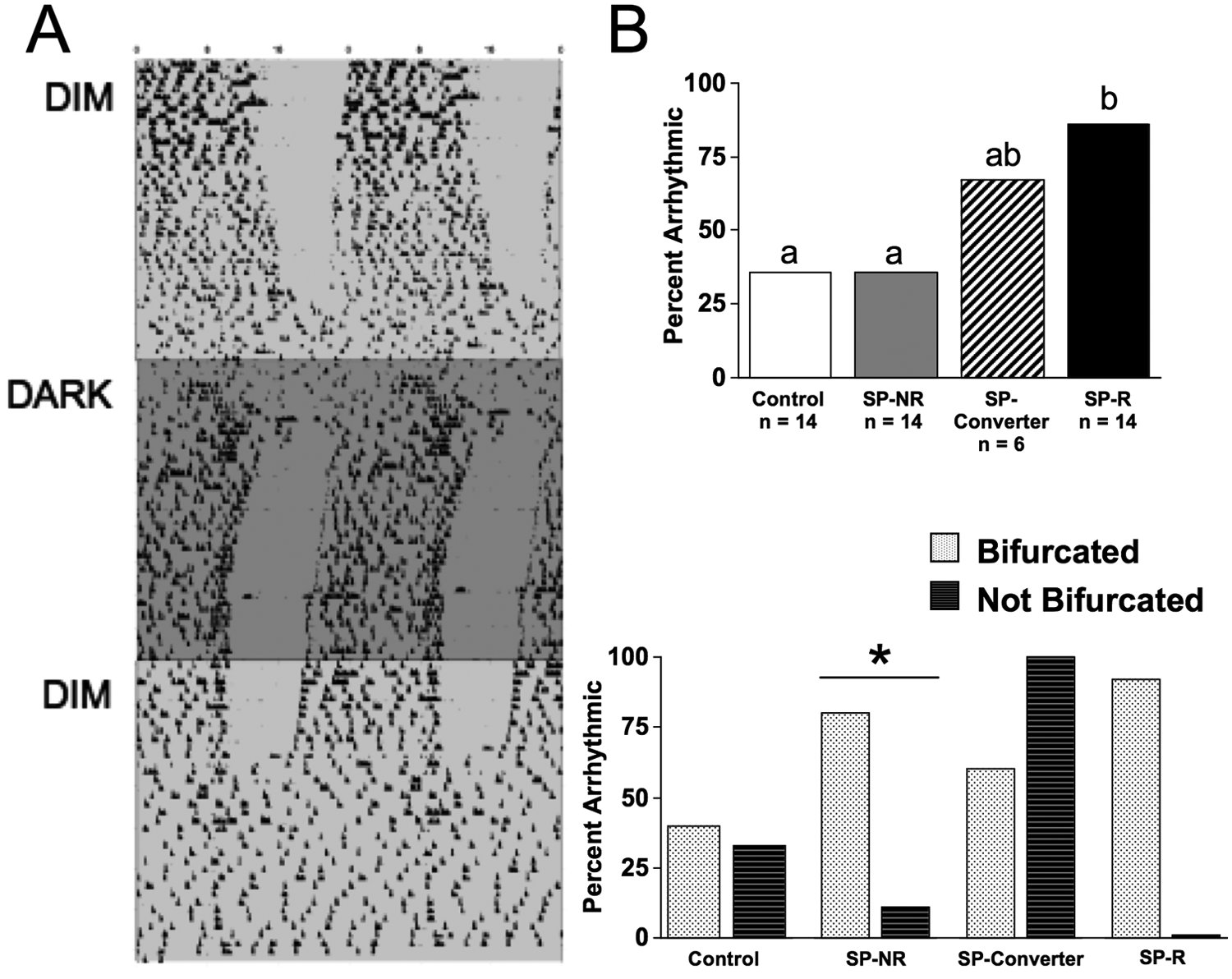
(A) Representative wheel-running record of an animal that developed an arrhythmic activity pattern under constant DIM. When constant DIM was extinguished (constant DARK), a rhythmic activity pattern rapidly developed. (B) Incidence of constant DIM-induced arrhythmia differed by short photoperiod chronotype (top, conventions as in Fig. 2) and entrainment state (bottom). *p < 0.01.
After 7 weeks under constant DIM, half of the hamsters were transferred to constant DARK to determine whether arrhythmia was produced by dim illumination. Within 2 weeks under constant DARK, clear circadian rhythmicity emerged in 12 of 16 arrhythmic hamsters (Fig. 3), which was a larger proportion compared to hamsters that remained in constant DIM (
Discussion
Circadian arrhythmia, LDLD-induced rhythm bifurcation, and photoperiodic regulation of α each entail changes in circadian waveform that are associated with a temporal reorganization of oscillators within the central pacemaker (Ohta et al., 2005; Watanabe et al., 2007; Yan et al., 2010; Inagaki et al., 2007). The present data demonstrate a robust empirical relationship between interindividual variation in the plasticity of circadian waveform as measured across these 3 different lighting conditions. Compared to SP-NR hamsters, SP-R hamsters were more likely to display bifurcated rhythms under LDLD and reversible arrhythmia under constant dim light. In contrast, the response to short photoperiods did not predict differential changes in circadian waveform during light-induced phase advances or after transfer from LDLD to constant conditions. This is one of only a few studies that demonstrate that interindividual differences in mammals influence a diverse collection of entrained and free-running responses (e.g., Puchalski and Lynch, 1988, 1991b; Ruby et al., 2004). As described in detail below, the pattern of results suggests that the responses that covary index a common coupling mechanism that differs among individuals.
Why should the circadian response under one of these paradigms predict the circadian response in another? One possibility is that there is a shared and stable trait that varies between individuals to differentially influence circadian waveform under each of the 3 related paradigms. Alternatively, because we used a longitudinal design, the prior entrainment state of an animal could condition it to respond in a particular fashion to the subsequent lighting manipulation. Our intention was to exclude the latter possibility by testing hamsters in one paradigm, return them to a homogeneous circadian state, and then expose them to the next entrainment challenge. Specifically, because photoperiod nonresponsiveness was virtually eliminated in an earlier study with dimly lit scotophases (Gorman and Elliott, 2004), we hoped to reverse the nonresponder phenotype with dim nighttime illumination and thereby deliver all hamsters to an equivalent entrainment state. Contrary to this expectation, dim nighttime illumination reversed short photoperiod nonresponsiveness in only a handful of hamsters, suggesting that dim illumination only prevents nonresponsiveness when provided from the beginning of the screen. Because of this unexpected outcome, we exploited the rapid photoperiodic reentrainment that occurs following transfer to longer day lengths (Sumova et al., 1995). Consistent with expectation, exposure to LD19:5 eliminated the difference in α between SP-R and SP-NR hamsters, but yet these 2 groups still displayed a large difference in the incidence of rhythm bifurcation under LDLD. Accepting the caveat that photoperiodic history effects may not have been eliminated fully, this finding suggests that entrainment history alone does not produce the correlated response to LDLD. Likewise, differential rates of DIM-induced arrhythmia emerged months after hamsters were initially chronotyped and after various intervening lighting manipulations. This suggests that covariance in the plasticity of circadian waveform is influenced by a circadian trait rather than determined exclusively by entrainment history.
Any of several intrinsic factors are potential mediators of the correlated responses, including differences in free-running period and phase-resetting responses. SP-NR hamsters reportedly have longer free-running periods than SP-R hamsters, which could contribute to the aberrant entrainment under short photoperiods (Freeman and Goldman, 1997; Kliman and Lynch, 1991). However, the free-running period of SP-R and SP-NR hamsters used in this study did not differ under either DIM or DARK constant conditions. Phase resetting responses to bright light have also been reported to differ between SP-R and SP-NR hamsters, with the latter having a smaller amplitude phase response curve (Puchalski and Lynch, 1991a) and a higher light intensity threshold for LL-induced splitting (Puchalski and Lynch, 1988, 1991b). However, after adjusting for the effect of α on phase shift magnitude (Pittendrigh et al., 1984), we find no evidence that chronotype groups differ in the response to bright light pulses. This indicates that individual differences in the plasticity of circadian waveform relate to a circadian parameter other than period length or photic phase resetting.
The 3 circadian responses shown here to covary are all modulated by a common extrinsic factor—namely, dim illumination. In previous studies using this species, provision of dim nighttime illumination prevented the induction of short photoperiod nonresponsiveness (Gorman and Elliott, 2004), accelerated the expansion of α under a short photoperiod (Gorman and Elliott, 2004), and facilitated the induction of bifurcated entrainment under LDLD (Gorman and Elliott, 2004). The present study extends the effects of dim illumination to include the loss of rhythmicity under constant conditions. Arrhythmicity of locomotor activity is known to arise in the Siberian hamster under a variety of conditions: following a phase shift of the LD cycle (Barakat et al., 2005), after exposure to very long day lengths (present study; Gorman and Zucker, 1997; Prendergast and Freeman, 1999), and following prolonged exposure to constant bright light (Puchalski and Lynch, 1988, 1991b). In contrast to the conditions described above, in which arrhythmicity follows reductions in α, arrhythmicity under constant dim light emerged gradually as α became progressively longer. Arrhythmicity in the present study was related to dim illumination rather than age or some uncontrolled factor, because overt circadian rhythmicity returned with the removal of dim illumination and disappeared once more in the majority of hamsters when dim light was provided a second time. Since modulation of circadian waveform is markedly altered by dim illumination in each of these paradigms, interindividual variation in sensitivity to dim light could mechanistically underlie the correlated responses. However, the initial designation of hamsters as SP-R or SP-NR was conducted in the absence of dim nighttime illumination and thus must be independent of individual variation in sensitivity to it.
In aggregate, the results lend empirical credence to the idea that a fundamental circadian parameter related to coupling within the central pacemaker varies between individuals and that individual differences in this parameter influence plasticity under a variety of lighting conditions. Many of the seemingly disparate uses of the term coupling in the literature may reference a common mechanism, and further research should investigate its underlying physiological and molecular basis. The circadian responses that did not covary with short photoperiod responsiveness—changes in circadian waveform during phase advances and after release into constant conditions—also have been argued to represent coupling dynamics between oscillators (Elliott and Tamarkin, 1994; Evans et al., 2010; Meijer and De Vries, 1995). The failure to covary here with the other measured responses suggests either that these responses are independent of circadian coupling or that they index a mechanistically distinct aspect of oscillator coupling. The latter possibility would indicate that circadian waveform is modulated by multiple coupling mechanisms. Although neural mechanisms are beyond the scope of the present study, the results predict that manipulation of any specific coupling factor (e.g., VIP or GABA; Aton and Herzog, 2005) should produce similar patterns of effects across the behavioral assays shown to covary here.
Although several circadian responses were treated in the present study as categorical and dichotomous (SP-R versus SP-NR; bifurcated versus unbifurcated; arrhythmic versus rhythmic), there may be continuous variation in the underlying circadian mechanisms. Selection experiments have demonstrated that short photoperiod nonresponsiveness displays additive genetic variation consistent with a threshold circadian response (Freeman and Goldman, 1997; Goldman et al., 2000; Kliman and Lynch, 1992). We selected extremes in short photoperiod responsiveness in order to maximize statistical power for a given sample, but even so, we uncovered additional levels of individual variation in the short photoperiod nonresponsive group (SP-NR) after the incorporation of dim nighttime illumination (i.e., the identification of SP-Converters). The observation that unselected, control hamsters—a group representing the full range of individual variation in response to short photoperiods—were generally more similar in their response to SP-NR hamsters suggests that in this species, bifurcated entrainment and arrhythmia emerge predominantly in a subset of highly responsive individuals.
In summary, these findings establish that a dimension of circadian organization varies between individuals to modulate the plasticity of circadian waveform under multiple lighting conditions. Conceptually distinct and less studied than other circadian parameters (i.e., period, phase, amplitude), rhythm waveform may be equally significant in the regulation of behavior and physiology. The interindividual variation in circadian organization that exists in out-bred species (Labyak and Lee, 1997; Smale et al., 2001) mirrors the genetic variation within human populations that likely contributes to individual differences in human entrainment (Roenneberg et al., 2003). A deeper understanding of circadian waveform, the underlying coupling mechanisms, and individual differences in this parameter may yield novel strategies for manipulating circadian clocks for human benefit.
Footnotes
Acknowledgements
This work was supported by NSF grant IBN-0346391 and NIH grant NICHD-36460. We thank Antonio Mora and Tony Mora for providing excellent animal care and David Piecarski and Tristan Shuman for technical assistance.
Conflict of Interest Statement
The author(s) have no potential conflicts of interest with respect to the research, authorship, and/or publication of this article.
Notes
References
Supplementary Material
Please find the following supplemental material available below.
For Open Access articles published under a Creative Commons License, all supplemental material carries the same license as the article it is associated with.
For non-Open Access articles published, all supplemental material carries a non-exclusive license, and permission requests for re-use of supplemental material or any part of supplemental material shall be sent directly to the copyright owner as specified in the copyright notice associated with the article.
