




Abstract
The energy sector is the largest contributor to global carbon dioxide emissions. To address the current climate emergency, however, energy market actors (e.g., energy providers, nongovernmental organizations, policy makers) try to make individual consumers take responsibility for achieving an overall net balance of zero greenhouse gas emissions. The purpose of this research is to understand this process of responsibilization and its implications. The research method is a narrative discourse analysis of hundreds of public documents by energy market actors. The findings show that market actors try to shape ordinary consumers into “net-zero heroes” with responsibility for reducing emissions but end up creating a tragedy when these market actors translate their collective agenda into a metanarrative. These findings have implications for consumer responsibilization specifically and the conversion of agendas into action more generally. Theoretically, this research shows (1) the influence of the translation stage in the agenda-to-action chain, (2) the way market actors attempt to form net-zero heroes, and (3) the limited usefulness of the hero narrative. Practically, the research explains the implications of making consumers solely responsible for reducing emissions.
It is critical that we all - governments, business, civil society, youth and many more are working together in this critical moment for the #climatecrisis.
—Jennifer Morgan, German State Secretary for International Climate Action (@climatemorgan, October 31, 2023, https://x.com/climatemorgan/status/1719352045449175523)
Humankind is facing an existential climate emergency, a depletion of natural resources, and an upset of the ecological balance (Ripple et al. 2020). Defined as an overall net balance of zero greenhouse gas emissions, achieving net-zero emissions plays a vital role in limiting the effects of this multifaceted crisis (Intergovernmental Panel on Climate Change 2023). To do so, emissions reduction and removal must completely offset emissions production, as set out in the Paris Agreement (United Nations Framework Convention on Climate Change 2018). Globally, more than 40% of all human-produced carbon dioxide emissions come from the production of energy. Industry is the largest user of energy, burning more than one-third of global fuel (International Energy Agency 2023b). The larger, systemic contributions to “ecocide” by energy providers and industrial users are therefore more significant than any eco-restorative role consumers could play (Sands et al. 2021). In response to the call for net-zero emissions, however, many energy market actors have directed effort to consumer responsibilization—that is, creating language and frameworks that shift responsibility, and blame, for adverse outcomes to consumers (Shamir 2008). The term “consumer” in the sector (and this research) refers to any household using energy that produces greenhouse gas emissions. We define an institution as a “market actor” if it can affect the availability and implementation of particular practices, products, and technologies at the market level. Market actors in this context thus include consumer representatives, corporate lobbyists, government policy makers, market operators and regulators, the ombudsman, and energy researchers.
In the 1970s, Coca-Cola and the beverage industry were the first to responsibilize consumers. They convincingly argued that individual consumers, not regulators, should take responsibility for waste disposal (Elmore 2012). Their language and frameworks contributed to the current global plastic crisis. Not only do for-profit market actors responsibilize consumers, but so do other market actors that claim to be trying to help (Giesler and Veresiu 2014). Paradoxically, given its commitment to reducing consumers’ carbon-based energy usage, this phenomenon is particularly prevalent in the contemporary energy sector. Despite being the origin of most emissions, energy market actors end up shifting responsibility the same as companies like Coca-Cola. For example, BP has issued the world's first individual carbon footprint calculator because the company wants consumers to examine their own carbon footprint—and not BP's (Doyle 2011).
The focus of this article is to examine consumer responsibilization for achieving net-zero emissions. Sitting at the intersection of macro-level agenda setting by powerful market actors and micro-level consumer behavior, it raises critical questions about the dynamics of responsibility and power in environmental sustainability efforts. To deepen our understanding of this duality, we draw on concepts from actor-network theory (Latour 2005), which allows us to explore the roles of various actants and the interplay of politics, power dynamics, and responsibility in this context. We also utilize Howlett, Ramesh, and Perl’s (2020) “how-to” guide for understanding the stages of public policy, from agenda setting to implementation. This serves as an essential backdrop for our study, particularly in understanding the translation of policy agendas into consumer actions, a critical stage, as it bridges the gap between policy development and the enactment of consumer responsibilization.
Research on consumer responsibilization considers either development of multilateral economic policy agendas (Doyle 2011; Giesler and Veresiu 2014; Shamir 2008) or specific consumer actions (Buerke et al. 2017; Caruana and Chatzidakis 2014) in response to a vast array of social issues. A more recent review of the literature states that prevalent approaches to responsibilization for sustainability often fail (Gonzalez-Arcos et al. 2021). Thus, the conditions under which a responsibilizing agenda succeeds in responsibilizing consumers are still unclear. However, researchers have so far ignored the way agenda setting is postulated to connect with “responsible” self-management (McNay 2009). Translation is the critical connective tissue. Here, market actors try to decode and convert the policy agenda into a specific subject position and metanarrative. A subject position captures the way a person should behave in a specific situation (e.g., consumption; Karababa and Ger 2010). At an operational level, a metanarrative is a common-sense, discursive, normative story that prescribes how a subject should take responsibility for a problem (Lyotard [1979] 1984). Metanarratives may shape individual acceptance of responsibility for problems (Van Laer, Ruyter, and Cox 2013). Despite this potential influence, scant research has explored how market actors translate policy agendas through narrative (Taylor et al. 2013) and how translation links to consumer action (Winter and May 2001).
The purpose of this article therefore is to answer the following research questions: How is a responsibilizing agenda set up for translation (RQ1)? Why does the creation of a subject position and metanarrative fail to discursively shift responsibility for achieving net-zero emissions to consumers (RQ2)? What are the implications of this process for microstories of green consumerism (RQ3)? Our research enriches the responsibilization literature in three ways. First, we redress the oversight of the translation stage in consumer responsibilization research. We improve on previous attempts to connect agenda to action by unearthing the translation stage and examining the operative factors through which it unfolds: its subject position and metanarrative. Second, we show how the “net-zero hero” is created. Inspired by Boehm (1999) and the hero myth, we abductively derive and define this subject position. Being in the subject position of a net-zero hero means being committed and loyal to the cause of reducing emissions to net zero. Third, we examine the characteristic conditions of the metanarrative, which allows us to show the implications of the translation process for consumer-level narratives about sustainable behavior, and market actors’ disregard of their own responsibility (Moisander and Pesonen 2002; Muir and Ruggiero 1991). The net-zero hero fails to triumph. Market actors’ disregard of their own need to act alongside consumers instead creates a tragedy.
Conceptual Background
Consumer responsibilization captures “the consumer's charmed transformation” (Zwick, Bonsu, and Darmody 2008, p. 167) from a perceived passive recipient of messages and commodities to an active interpreter and maker. Market actors consider responsible consumers active participants in the economy, valuable not only for the economic capital they provide by consuming but also for their position as uniquely skilled workers who can supply free affective, cultural, social, and technological labor (Zwick, Bonsu, and Darmody 2008). These transformed and empowered consumers then supposedly engage in the competitive marketplace to create value for both themselves as individuals and others in the market—ultimately playing a dual role as both consumer and producer.
Agenda Setting Versus Consumer Behavior Research
Consumer responsibilization has grown in prominence in contemporary academic and industry texts. The literature stretches across marketing and consumer research, management, psychology, and sociology. Two dominant research streams have appeared: a macro perspective focusing on the attribution of responsibility through agenda setting (Doyle 2011; Giesler and Veresiu 2014; Shamir 2008) and a micro perspective centering on the individual motivations of consumers to take responsibility (Buerke et al. 2017; Caruana and Chatzidakis 2014; Gonzalez-Arcos et al. 2021).
The first stream specifically examines consumer responsibilization using an agenda-setting lens. Here, agenda setting refers to market actors collectively developing multilateral, shared policy perspectives on issues, including net-zero emissions, and potential resolutions, such as consumer responsibilization (Cobb and Elder 1972). This definition ascribes three conceptual components to an agenda: (1) a perspective (e.g., regarding consumers as responsible subjects), (2) a problem at which the perspective is targeted (e.g., achieving net-zero emissions), and (3) a group of market actors that shares the perspective toward the problem (e.g., governmental agencies, nongovernmental organizations [NGOs], utility companies). The “image” of achieving net-zero emissions among market actors—how it is named, which viewpoint is (dis)claimed and framed, and who is blamed for its existence—heavily influences the articulation of its resolution (Baumgartner and Jones 2009). One result is the transformation of achieving net-zero emissions from an environmental and social health and welfare issue to one of personal responsibility. By pressuring consumers into playing an active role in their own self-management, a responsibilizing agenda particularly constructs and controls the framing of the problem in a way that obscures the destructive practices of market actors (Shankar, Cherrier, and Canniford 2006). Responsibilizing consumers for the climate emergency is of special interest to market actors such as the United Nations and the World Economic Forum. These institutions regularly publish reports on climate change, making recommendations that are widely followed around the world (Burdick, Oxhorn, and Roberts 2009). Specifically, they set the agenda on reducing emissions that market actors in turn must translate into language and frameworks under the Paris Agreement, including metanarratives told about subject positions (Arnould and Thompson 2005; Giesler 2008). Giesler and Veresiu (2014) show the significance of this stage in their investigation of the World Economic Forum's development of a policy agenda that positions subjects to actively manage and respond to environmental and other issues through their individual behaviors and, thus, to take on a primary role as engaged consumers.
In the second stream, researchers focus on individual consumers’ experiences and relationship with responsibilization. Specifically, acting as a responsible consumer is considered a personal life story, driven by an individual's moral values, desire to do good, attitudinal changes, and increased awareness of environmental issues (Caruana and Chatzidakis 2014). However, Moisander and Pesonen (2002) and Autio, Heiskanen, and Heinonen (2009) show how individuals adopt diverse microstories of green consumerism. Moisander and Pesonen (2002) find three consumer motivations to act sustainably: (1) they are aesthetically and spiritually oriented; (2) they are individualist, rational, well-informed citizens; and (3) they are asocial and fanatic activists. Autio, Heiskanen, and Heinonen (2009) further this work by distinguishing Finnish green consumerism stories, depending on their personal beliefs and political stance. Their findings uncover the emergence of three microstories: the traditional hero, the archetypal villain, and the broad anarchist. The hero works proactively in the market to reduce their ecological footprint and work toward a “better world” (Autio, Heiskanen, and Heinonen 2009). The villain does not believe that reducing emissions can sway the course of the climate crisis and concludes that their individual actions have limited to no impact. Ease, comfort, and convenience drive these consumers’ behavior. Finally, the anarchist rebels against mainstream consumer culture and tries to avoid interactions with big business and immoral market practices. While hero, villain, and anarchist are all acutely aware of the climate emergency, we raise critical questions about who is not included in the frame of individualistic notions of environmental responsibility and why. The self-exclusion of these agenda-setting market actors speaks to the broader responsibility for efforts to reduce emissions, suggesting that green consumerism, as conceived here, may not fully succeed in achieving net-zero emissions.
Actor-Network Theory and Responsibilization
Actor-network theory (ANT; Latour 2005) offers a nuanced framework to examine the interplay between macro and micro perspectives by focusing on the networked nature of agency. In ANT, actants (both human and nonhuman) are interconnected in networks, and these networks enable the distribution of agency. This approach challenges the simplistic attribution of responsibility to individuals, instead highlighting the complex web of influences and interactions that shape behavior. In the network of consumer responsibilization, various actants play crucial roles. Market actors (e.g., energy companies, policy makers) use their power to set the agenda and shape the discourse. Consumers, influenced by these discourses, are positioned as responsible agents. “Punctualization” refers to this process by which a network of actants is constructed and treated as a single, coherent entity (Law 1992). Power dynamics within this network are critical. Market actors often leverage their position to shift responsibility onto consumers, thus depoliticizing their own role in emissions production and mitigation. By examining these dynamics through the lens of ANT, we can better understand how power is exercised and responsibility is ascribed within the network.
The Missing Translation Stage
Howlett, Ramesh, and Perl (2020) explain that the translation stage is critical for connecting policy agendas to consumer actions. In ANT, translation involves the negotiation and alignment of interests among various actants to stabilize a network. Consumer responsibilization for achieving net-zero emissions suggests a special challenge for ruling groups, including governments, corporations, NGOs, and the like: to create a discursive environment in which “consumers qua workers can effectively apply and enhance their knowledge for the benefit of everyone” (Zwick, Bonsu, and Darmody 2008, p. 172). While agenda-setting market actors assume that autonomous markets give consumers the freedom to choose alternative and/or reduced options to satisfy their self-interested needs while responding to the world's environmental concerns (Autio, Heiskanen, and Heinonen 2009), differences in the way environmental issues are framed affect individuals’ engagement (Gifford and Comeau 2011). Framing them as the responsibility of consumers often has “the unintended consequence of generating consumer resistance, undermining their effectiveness” (Gonzalez-Arcos et al. 2021). Consumers find responsibilization physically, psychologically, and/or philosophically challenging. They correctly believe they cannot entirely eliminate greenhouse gas emissions without support from market actors, which leaves them to tinker with options that barely scratch the surface of the problem. By focusing on the case study of the plastic bag ban in Chile, Gonzalez-Arcos et al. (2021) illustrate how such interventions, while beneficial, are not sufficient on their own to drive the deep, systemic changes needed to significantly cut down on plastic use. The ban is seen as a step in the right direction but is also an example of how focusing solely on consumer behavior overlooks the complex interplay of factors that sustain plastic use at a market level. The systemic issues that constrain consumer agency include economic barriers (Stern 2014) and the overwhelming influence of market actors on the responsibilizing agenda (Newell and Paterson 2010). Stern (2014) comprehensively analyzes the economic impact of climate change and identifies economic barriers to sustainable development, including the lack of investment in green technologies and the high up-front costs of transitioning to a net-zero economy. Newell and Paterson (2010) discuss the complex relationships between capitalism and climate change policy. They examine how market actors, including large corporations and the fossil fuel industry, often influence the responsibilizing agenda while themselves prioritizing economic growth over reducing emissions. The agenda's legitimization is thus lost in translation. In response to the difficulties of translation, market actors try to control narrative resources as effectively as they control other resources by creating a metanarrative that tells how net-zero emissions must come into being, which may include a single action but typically spans several and ends with a conclusion. Developing a metanarrative has been discussed as a crucial stage in effectively communicating agendas, engaging audiences, and prompting action (Bublitz et al. 2016). Effective metanarratives intertwine individual consumers’ microstories with the collective agenda of market actors. This synergy between personal microstories and the overarching metanarrative fosters a deeper connection and commitment among consumers (Bublitz et al. 2024). However, scholars have yet to assess what makes a cohesive and powerful metanarrative that aligns agenda setting with individual microstories and inspires action.
Possible Green Metanarratives
Several scholars (Boyd, Blackburn, and Pennebaker 2020; Reagan et al. 2016; Van Laer et al. 2019; Vonnegut 2005) show that diverse types of metanarratives can be distinguished according to their dramatic arcs. A hero who “works toward a good ethico-political end” (Lyotard [1979] 1984, p. xxiv) is “punctualized” (Law 1992) as the subject of one of the most compelling metanarratives (Preece, Daskalopoulou, and Schau 2022). The hero's journey is Campbell's ([1949] 2008) label to describe its cross-cultural dramatic arc. The traditional hero's journey involves a dramatic arc that first rises, then falls, then rises again. First, the hero receives the “call to adventure”: A disruption in the world has occurred, and the hero is called to the task—to fight villains, to slay dragons—to achieve a vital ethical end. Second, heroes obtain helpful guidance and enter the “belly of the whale”: the greatest threat conceivable. Third, heroes join a supportive band of companions and receive invisible aid from divine forces to survive the ordeal, seize the reward, and return victorious. While the term “hero” evokes ancient associations with physical courage and muscle, Orazi and Van Laer (2023) suggest that heroes embody not only physical but also moral virtues; heroes are not saints but have room for improvement. They evolve, and the transformation is moral. They may go from blindness to sight, from confusion to understanding, from polluting to offsetting.
However, Campbell's ([1949] 2008) hero's journey is but one possible dramatic arc. The other five basic types are progressive, regressive, comedy or “[hu]man in [and out of] a hole,” tragedy, hero's journey, and “Oedipus” (Boyd, Blackburn, and Pennebaker 2020; Reagan et al. 2016; Van Laer et al. 2019; Vonnegut 2005). In a progressive metanarrative, the position continuously improves for the subject over the course of the dramatic arc, while in a regressive metanarrative, the position declines over the course of the dramatic arc. The final three metanarratives involve dramatic arcs where, similar to the hero's journey, the protagonist's experiences alternate between positive and negative events or “[hu]man in [and out of] a hole” is a dramatic fall followed by a dramatic rise. The opposite of this metanarrative is the tragedy. On a tragic arc, the position first improves but then declines. Thus, a tragedy is a dramatic rise followed by a dramatic fall. “Oedipus” is the mirror image of the hero's journey. This metanarrative, in which subjects are brought low, almost attain their goal, and then are brought low again, bears the name “Oedipus” because of this character’s dramatic fall, rise, and fall.
The innate configurations of human storytelling (Van Laer et al. 2014) raise the possibility that tragedy, as captured by Autio, Heiskanen, and Heinonen’s (2009) villain's microstory and the plot of Don’t Look Up, is the best-fitting metanarrative of consumer responsibilization for net-zero emissions. A leading theory of humanity's sluggish response to climate change also explains that consumers cannot deal effectively with the climate crisis because net-zero emissions do not form a classic hero's journey (Center for Research on Environmental Decisions 2009), which may be why only a minority of Hollywood productions address the climate crisis in a meaningful way (Schneider-Mayerson et al. 2024). The hero's journey hooks consumers by dealing with clearly defined heroes and villains and dramatizing clear and present dangers; it is not a geophysical process that unfolds at a receding glacier's pace. Such a complex process defies simple narrative resolution. This complexity is further articulated through the role of consumption in impacting the climate. While Humphreys and Thompson (2014) show that telling a story about villainous BP oil executives and heroic environmental activists is possible, the main players are difficult to characterize. In addition to the abstract forces of geophysics, consumers may be heroes, villains, or anarchists.
Integration and Synthesis
The interplay between agenda setting and consumer behavior, viewed through ANT (Latour 2005), reveals a deeper theoretical problematization of responsibilization. It challenges the notion of isolated agency and highlights the distributed nature of responsibility across a network of actants. This perspective calls for a reconsideration of how policies are formulated and implemented, emphasizing the need for a more integrated approach that acknowledges the roles and influences of all actants within the network. By incorporating ANT concepts, we can critically examine the limitations of current responsibilization efforts and explore the interplay between agenda setting, translation, and consumer behavior. The translation stage is essential for connecting policy agendas to consumer actions. This stage involves market actors decoding and converting policy agendas into specific subject positions and metanarratives. In the context of the current climate emergency, the translation stage is where the agenda to achieve net-zero emissions is transformed into a metanarrative of a specific subject position. Market actors attempt to punctualize (Law 1992) the consumer as a clear and singular subject responsible for reducing emissions. This metanarrative will not only exemplify how market actors attempt to shape consumer behavior but also reveal the challenges and limitations of this approach. Effective emissions reduction may require a balanced approach that includes both consumer responsibilization and systemic changes supported by market actors. However, researching public information about the larger social and economic trends in the energy market is necessary to truly understand the issue (Giesler and Thompson 2016). As Giesler (2008) argues, markets are “theatrical stages” that “actors” use to try to tell a certain metanarrative to a desired “audience.” Thus, we examine the collective “script” of these market actors.
Method
This study employs narrative discourse analysis to examine how energy market actors punctualize a responsible consumer subject. This method involves collecting and analyzing public reports and media releases from Australian energy market actors to understand the translation of policy agendas into a metanarrative of consumer responsibilization.
Context
Our context answers the call for perspectives beyond those from the United States (Martin and Scott 2021) by examining the Australian energy sector. We focus on the energy sector because it seeks to absolve itself of responsibility despite being the origin of most of the country's emissions (International Energy Agency 2023b). Australia holds a vast array of natural resources, including coal and gas, helping fuel its energy sector and economy. Among developed countries, it has the highest per capita emissions (14.51 tons/capita), followed by the United States (13.64) and Canada (13.14) (Organization for Economic Cooperation and Development 2022). Australia's energy sector produces 47.3% of these emissions, followed by transportation (24.3%), industry (24.3%; often to produce steel and cement), and residential and commercial buildings (3.8%) (International Energy Agency 2023b). Think tank InfluenceMap (2024) finds that 65% of Australia's 95 largest companies and most influential industry associations are failing to translate their agenda on net-zero emissions into positive and strategic engagement with climate action. Australia's geographical isolation has contributed to a sense of separation from problems such as COVID-19 and the climate emergency, delaying its response. The notion of “Fortress Australia” refers to the country's ambivalence toward engaging with global issues (Dick and Rimmer 1996). Due to the influence of powerful corporate and media interests and the “Fortress Australia” mentality, the shift away from coal and other fossil fuels toward renewable energy has been sluggish. However, large fossil-based sources are reaching the end of their life spans, and technology is fast advancing, with a substantial proportion of renewable sources entering service. Local real estate owners are also improving energy efficiency (Commonwealth Scientific and Industrial Research Organisation [CSIRO] 2022).
Data Set
The choice of data set corresponds to the type of data collected in previously reviewed research on consumer responsibilization. We manually downloaded the public reports (n = 128) and media releases (n = 175) from the websites of 44 Australian energy market actors published between the most up-to-date National Energy Productivity Plan for Australia (Council of Australian Governments [COAG] 2015) and the 2022 United Nations Climate Change Conference. We included in our data set all domestic organizations, regulators, and representative groups that are official stakeholders of the Australian Energy Regulator (2023) as well as the Australian Academy of Science, Climate Change Authority, and CSIRO. In the Web Appendix, we give more specific details about the data set, including a concise description of the market actors, their history and purpose, and the total number of texts taken from each.
Research Process and Data Analysis
Informed by our first read of the literature on discourse and the energy market context, we formulated a research question on the structure of the energy market's discourse. After making a tentative plan to investigate this question, we collected the previously described documents published between 2015 and 2020 by the 41 Australian Energy Regulator's stakeholders. Initial data analysis involved a priori and emergent coding (Miles, Huberman, and Saldaña 2014) and abductive reasoning (Belk and Sobh 2018). The data supported only the a priori codes related to “heroism” and “narrative.” However, emergent coding revealed unanticipated codes related to “blame” and “responsibility.” These codes pertained to shifts in policy stages and in responsibility from governments and/or corporations to individuals. They showed that we could uncover something novel about metanarratives of responsibilization by continuing to gather and analyze data from the context. Consistent with theoretical sampling, we then purposely updated and diversified our corpus, adding texts published between 2020 and 2022 as well as by the three previously mentioned energy research organizations (i.e., market actors that may have a smaller stake in the energy market and may responsibilize consumers less).
We went through a cycle of narrative discourse analysis before arriving at a theoretical account. In line with this analytical approach, our focus was on the narrative features, forms, and functions of the texts as opposed to studying individual authors or specific organizations (Van Laer and Izberk-Bilgin 2019). We applied several narrative alternatives (e.g., deconstruction, metanarrative, microstoria, intertextuality; Boje 2001) to the corpus and analyzed in-depth the texts that illustrated any. Building on our previous analyses, we then turned to the texts that blended features of microstories with those associated with metanarratives. We also considered the energy market narratives from a mythological perspective. In the next section, we report the findings of our narrative discourse analysis.
Findings
This section draws on ANT (Latour 2005) to provide a robust analysis. Here, market actors (e.g., energy providers, NGOs, policy makers) and their discursive practices are seen as key actors in the network. The findings aim to uncover how market actors set a responsibilizing agenda up for translation, why punctualization of the net-zero hero subject position and metanarrative fails to discursively shift responsibility for achieving net-zero emissions to consumers, and what this process implies for consumer microstories.
How Is a Responsibilizing Agenda Set Up for Translation?
We critically examined the strategic purpose of setting a responsibilizing agenda within the energy market through three lenses: (1) the underlying motivations for market actors to promote consumer responsibilization, (2) the influence of the concept of “presumption,” and (3) the implications of framing responsibility for net-zero emissions as a matter of individual moral significance. First, we considered the potential benefits that energy market actors might derive from responsibilizing consumers. According to the Australian Energy Market Operator’s (2021, p. 6) annual report, the energy market must become “more decarbonised, decentralised, digitalised and democratised.” In this context, the word “democratised” does not have the lay meaning of the introduction of democratic principles, such as simple access for everyone. Instead, addressing a global consortium of energy market leaders, Paul Smith (2014), then chief executive of the Australian Energy Market Commission, outlined an agenda to “set the conditions for greater participation in energy markets by consumers, so that their preferences could drive energy market development.” He called it “a democratisation of the energy market.” This discursive redefinition not only reminisces Australia's compulsory voting system but also mirrors the neoliberal ideal to pressure consumers into playing a more active role in the market (Shankar, Cherrier, and Canniford 2006). As the Climate Change Authority (2020, p. 6) notes, governments should “empower people to act” to “enhance their decision making when it comes to reducing emissions and managing the risks of a changing climate.” Market actors may indeed promote consumer responsibilization to align with broader societal values such as empowerment. This alignment can enhance corporate reputation, mitigate regulatory pressures (Caruana and Chatzidakis 2014; Hoffman and Bazerman 2007), and foster a market where emphasis on consumer choice and empowerment becomes the differentiated value proposition. However, positioning consumers in a space where their value is contingent on their engagement raises significant concerns about consumer autonomy and the equitable distribution of power within market structures. Moreover, the shift in responsibility for net-zero emissions to consumers also deflects attention from the need for substantial systemic reforms.
Second, we probed into how encouraging consumers to become “prosumers” might shape public understanding of environmental accountability. The Energy and Water Ombudsman of the state of New South Wales (EWON 2016, p. 9) tries to define responsible consumption as one of prosumption, or the coexistence of production and consumption in space and time: Participating in the energy market increasingly means taking a more active role in choosing among products and services and understanding, monitoring and managing consumption. Many consumers are transforming into so-called “prosumers” – consuming energy, but also producing and selling it. The availability of home battery storage and … development of new trading mechanisms may soon open up … avenues for trade, allowing producer-consumers to sell the energy … not only back to the grid, but also to … tenants and neighbours.
This market actor claims that consumers can be redefined as prosumers, because consumption can include production (Cova and Cova 2012). The promotion of presumption can significantly impact public perception of environmental accountability. An Energy and Water Ombudsman of the state of Victoria (EWOV 2021, p. 78) report acknowledges prosumption as not without problematic implications: “Ask[ing] householders to consider their collective impact on the grid” presents “a significant shift.” When consumers are framed as key actors in a policy transition, it may lead to an overemphasis on individual responsibility while overshadowing the critical role of systemic changes (Anderson et al. 2016). This perspective creates a metanarrative that individual action is sufficient for addressing the climate emergency, reducing pressure on industries and governments to implement more comprehensive environmental policies and structural changes. Although production and consumption may be concurrent within the same consumer, they are neither conceptually coincidental nor reducible to the same action (Cova and Cova 2012).
Third, we examined the implications of framing the climate emergency as a moral issue that individuals can address through their consumption choices. Consumers are supposed to be “changing the ways they use energy and the services they choose and … becoming the driving force in the market” (COAG 2015, p. 6). The moral significance of individual actions in responsibility for net-zero emissions is a complex issue. On the one hand, the COAG (2015, p. 14) explains under the heading “Encouraging more productive consumer choices” that with rights come responsibilities: Australia's total energy use is the sum of many choices of energy users, large and small. It's made up of millions of decisions to switch equipment on and off, purchase buildings, vehicles, appliances and equipment, and select individual energy products and services.
On the one hand, individual actions, when aggregated, can have a significant impact on greenhouse gas emissions, promoting a sense of moral obligation to adopt renewable energy (Gardiner 2006). If consumers are also acting as producers, it is reasonable to expect them to assume the responsibilities that come with the subject position. On the other hand, the COAG describes a mythical market made up of small-scale energy consumers in which everyone's use is just as important a contribution to total emissions, regardless of size. Its sole focus on individual morality diverts attention from the systemic changes necessary to address the net-zero emissions challenge. This emphasis on consumer responsibility serves as a deflective tactic, minimizing the accountability of larger entities that have a more substantial impact on environmental degradation (Maniates 2001).
In summary, while consumer responsibilization and the promotion of prosumption offer potential benefits to market actors in terms of engaging individuals in efforts to achieve net-zero emissions, there is a critical need to balance this focus with efforts to address systemic aspects of environmental degradation. Instead, the discourse in the energy market characterizes the setting of a responsibilizing agenda. Market actors try to put the responsibility for emissions reduction to net zero on consumers and, similar to Giesler and Veresiu (2014, p. 845), tie “the adjustment of public and private policies to the exigencies of shared responsibility with heightened moral significance while rendering social-protectionist calls for legalistic intervention into unrestrained economic practice inherently immoral.” While Giesler and Veresiu leave the question of this discursive sleight of hand's effectiveness unanswered, this metaphor underscores the deceptive simplicity with which responsibility is shifted onto consumers, obscuring the complex interplay of systemic issues that hinder effective climate action. By drawing parallels to Giesler and Veresiu, we critique the overly simplistic portrayal of consumer empowerment in efforts to reduce emissions, which can mislead consumers about their actual impact. Our empirical findings support Anderson et al.’s (2016) suggestion that an overemphasis on individual responsibility detracts from the urgent need for systemic changes, underscoring the strategic purpose behind setting a responsibilizing agenda. We next analyze its effectiveness in being translated into a subject position and metanarrative.
Why Do the Creation of a Subject Position and Metanarrative Fail to Discursively Shift Responsibility for Achieving Net-Zero Emissions to Consumers?
The stage at which market actors attempt to translate the responsibilizing agenda, as outlined by Latour (2005), involves converting high-level policy agendas into specific consumer actions. The translation stage finds itself “at the centre of policy, program and product design” (Energy Consumers Australia 2020, p. 14). We abduce that as part of the translation stage, market actors “create a new role for [consumers] within the broader energy system … embedded in specific social and political contexts” (EWOV 2021, p. 78), which we coin the “net-zero hero.” This subject is positioned in the gentle ethic of communalism and egalitarianism with the environment and other living beings. In addition, net-zero heroes look after their own interests, in line with Darwinism and other heroic subject positions (Luchs, Phipps, and Hill 2015). Market actors tell a metanarrative about the net-zero hero that considers the individual choices of consumers essential to reduce emissions to net zero. We analyzed our data to assess which metanarrative alternative fit best.
Dramatic rise
The net-zero hero's metanarrative is punctualized to simplify the complex issue of climate change, presumably making it relatable and actionable for individual consumers (Law 1992). It begins the same way as the heroes on Campbell's ([1949] 2008) journey. It calls formerly naive consumers (net-zero heroes hereinafter) to adventure, instructing them that emissions must reach net zero. Consumer representative Energy Consumers Australia (2020, p. 45) explains that the “balance of power … is shifting to consumers.” Net-zero heroes must prepare to meet the first of many thresholds across which the potentially unattainable boon (net-zero emissions) awaits, obtain helpful guidance, and enter the “belly of the whale.” Market actors first call on net-zero heroes to sleuth out clues that will help them reach net zero and brave the criticism of skeptics as they spread the news. However, consumers confront this newly instilled responsibility for emissions reduction with detachment and indecisiveness. Consumer Action Law Centre (2016, p. 5) shows that they “reject the call”; they are “not engaged in the energy market” and do not “make the decisions expected of them.”
Remedial attempts focus on the introduction of guidance that directs the subject toward a position of successful emissions reduction. The Australian Energy Market Commission (2019, p. 9), for example, welcomes “the entry of global battery providers like Tesla and Sonnen” that can take consumers “on a journey to the future” (Energy Consumers Australia 2019, p. 90). From market actors’ perspective, this guidance helps direct the ideal behaviors of net-zero heroes and legitimize the potential for a transformative journey.
Dramatic fall
Net-zero heroes access the belly-of-the-whale phase of their metanarrative through an experience of conditions devoid of creature comforts, which contributes to the otherworldliness of the experience. Energy Consumers Australia (2020, p. 11) describes this moment of transition in the metanarrative. Net-zero heroes should try “switching off appliances and lights when they’re not in use, using off-peak hot water, as well as buying more energy-efficient appliances and installing solar panels.” The passage is not only otherworldly but also futuristic and alluring. Energy Consumers Australia (2019, p. 105) explains that achieving net-zero emissions is “part of the future.” “Things that may happen in the future” include the alluring possibility that net-zero heroes can offer “services that are valued by the market” (Energy Networks Australia 2020, p. 16).
If this metanarrative followed a traditional hero's journey structure, our heroes would embark on this journey through unfamiliar territory with a band of companions who both support and chide them, and they would receive invisible aid from divine forces. While market actors tell them to overcome similar trials and tribulations, net-zero heroes do not have a band of companions, and if they receive intervention, it is not of the divine but the diabolical kind. Consumer Action Law Centre (2015, p. 43) reports the lack of accompanying market actors: “Energy retailers are failing to provide adequate customer service generally, and hardship services more specifically,” with hardship programs “not yet accepted as standard practice across the retail sector, and some retailers still do not have comprehensive models for working with vulnerable customers.” The 2019 National Energy Market report by the St Vincent de Paul Society titled “The Umpire Strikes Back” presents the diabolical intervention. The pun draws an intertextual bridge between the metanarrative of the net-zero hero and the well-known Star Wars sagas. The wordplay not only enriches the net-zero hero's associations and meanings beyond its metanarrative (Kristeva 1986) but also connects this intervention by a market actor with an umpire striking back. The report quotes Joanne, a single parent of seven children, who had her electricity disconnected after not paying her $700 bill and whose story featured in the Daily Telegraph under the headline “Powerless Against Bill Shock”: “There was absolutely nothing I could do about it” (Boyd and Airth 2018). Facing such trials without any support creates a “complex web” (Queensland Council of Social Service 2017) that presents “a risk” to net-zero heroes taking responsibility for emissions reduction through prosumption because “traditional energy consumer protections do not apply to innovative business models” (Consumer Action Law Centre 2016, p. 6).
It is at the end of this phase of the metanarrative that net-zero heroes fail to move past fear. Without market actors to accompany or intervene supportively, net-zero heroes feel “overwhelmed and hopeless, driving them to give up and disengage” (Energy Consumers Australia 2019, p. 102). They express their frustration “with a perceived energy leadership deficit” as their “personal commitment to climate action” is “not sufficiently reflected by (current) government policy settings and industry offerings” (EWOV 2021, p. v). The Climate Change Authority (2020, p. 132) concludes, “Overall, it appears that barriers to implementing energy efficiency are not overcome by current policies.”
In summary, the tragedy metanarrative best reflects consumer responsibilization for net-zero emissions. A tragedy is a progressive slope concluded with a regressive slope. Drama first improves but then declines. Its heroic subject tries to reach their goal, but a systemic lack of support and aid brings them low. An alternative metanarrative would acknowledge that the journey toward net-zero emissions is complex and multiagent, involving a diverse array of actors. This metanarrative includes the adoption of renewable energy as a foundational step toward decarbonizing the energy system. Some governmental market actors, such as the International Energy Agency (2023a, 2023b), have long advocated for the expansion of renewable energy as crucial to achieving net zero emissions. Corporate commitments also play a critical role in this alternative metanarrative. Elkington's (1997) seminal concept of the “triple bottom line” underscores the importance of businesses operating in a manner that is environmentally sustainable, socially equitable, and economically viable. More recently, a comprehensive meta-analysis (Friede, Busch, and Bassen 2015) has shown the integration of environmental, social, and governance criteria into corporate strategies to not only reduce emissions but also drive financial performance. This alternative metanarrative repositions the consumer within a broader context of collective action and shared responsibility (Pellandini-Simányi and Conte 2021). It draws on the foundational work of established market actors to emphasize the importance of collaboration, policy innovation, and corporate leadership in achieving net-zero emissions. Next, we describe that while some consumers truly believe the net-zero hero's responsibility to reduce emissions, most prefer one of two alternative microstories.
What Are the Implications for Microstories of Green Consumerism?
True believers
Our first microstory is about “true believers,” who are “deeply committed to environmental action, almost irrespective of cost” (EWOV 2021, pp. iv–13). They make choices for the good of the environment and out of moral principles. This microstory appears indistinguishable from the metanarrative of the net-zero hero. Consumer representative St Vincent de Paul Society (2022, p. 4) finds “an increasing appetite in the community to be part of the ‘green shift.’” The Australian Energy Market Commission (2019, p. 14) further specifies that true believers are “interested in renewable energy and want to help fight climate change.” In their efforts to reduce emissions, true believers invest “significant time, effort and funds into researching, choosing and configuring their technology” (EWOV 2021, pp. iii–iv), with “residential green energy practices” manifesting in “the installation of rooftop solar panels, solar hot water systems, more energy efficient construction and appliances as well as batteries to store self-generated electricity” (St Vincent de Paul Society 2022, p. 5). A desire to have a positive social impact is also part of this microstory. In research on Australian household energy use, the CSIRO (2020, p. 55) finds that many true believers are willing to complete surveys because of a “desire to help and contribute [to a] sustainable energy future.” As exemplified in these excerpts, true believers think deeply about their decisions and behavior and actively work to reduce their own and others’ emissions. Incrementally more activist than Autio, Heiskanen, and Heinonen’s (2009) traditional hero, true believers “model the importance of environmentalism and climate action” in the hopes that “their new technology purchases [will] have a [demonstratable] effect among others” so as to “hasten their diffusion” (EWOV 2021, p. 16). We emphasize the importance of not just technology diffusion but also ensuring effective use through continuous engagement and commitment. Drawing on the concept of practice diffusion (Akaka, Schau, and Vargo 2021), we highlight that the success of climate action depends on the integration of these technologies into true believers’ lives, thereby ensuring a more profound and lasting impact on emissions.
Pale greens
A second microstory is about “pale greens,” or consumers who are conscious of the climate emergency but believe their individual actions are unable to effect change. They are willing to support the environmental cause, but only (especially) when it comes with a financial return (EWOV 2021, p. 13). Ease, comfort, and convenience are the primary influences driving their consumption behavior. Specifically, in a media release Energy Consumers Australia (2021) estimates that 30% of consumers would reduce energy use to secure systems reliability during times of high demand “only if there was a financial incentive.” Market actors often perceive consumers as not engaging in the energy market to the extent expected of them because of a perceived lack of knowledge and education or poor experiences with retailers and other market actors. For example, in its energy market report the Essential Services Commission (2021, p. 11) notes that energy bills are low on consumers’ priority lists, only increasing in salience in instances of “bill shock” when a household's total energy cost would abnormally increase between billing moments. Otherwise, reflections on energy use or considerations of “switching” providers do not motivate pale greens given beliefs of the difficultly in doing so and the number of options causing them to feel “overwhelmed.” Consumer representative Consumer Action Law Centre (2016, p. 10) supports this view of “inertia within the energy market” and concludes that “consumers don’t trust … almost always preferring the status quo and feeling that choices in the energy market are too confusing, too much ‘hassle’ or not genuine as the products all seem the same.” Taking part in the energy market seems a burden as individual action finds little reward, so pale greens tend to choose the easiest, most convenient option available. They seem to make a trade-off between the long-term need to achieve net-zero emissions and the short-term financial and other costs of getting there. Incrementally more multifaceted than Autio, Heiskanen, and Heinonen’s (2009) archetypal villain, pale greens prioritize financial and other needs over environmental consciousness.
Radicals
“Radicals,” which comprise the third microstory, are “disconnect[ed] entirely from the main network – or [avoid] connection to it in the first place,” “remarkable growth in embedded networks,” which EWON (2016, pp. 10, 15) interprets as a “more radical manifestation of decentralisation trends.” Radicals believe that the grid has failed and that they can achieve net-zero emissions independent of energy market actors. In its report, the EWOV (2021, p. 15) describes radicals as “dubious” and suffering from “deep frustration” with the lack of transition in the energy market,” in alignment with the discourse in the fast fashion market, where microstories are equally emotionally charged (Mickelsson, Van Haren, and Lemmink 2023). Analyzing texts written by Finnish consumers, Autio, Heiskanen, and Heinonen (2009) call the “anarchist” a microstory that is extremely critical of broad consumer culture and believes for-profit market actors are highly immoral agents. In our Australian dataset, by contrast, the anarchist is absent. Radicals feel that they “have had to find creative ways to ‘go it alone’” (EWOV 2021, p. 78) and act on their political discontent narrowly with attempts to leave the energy grid, without rejecting their capitalist consumer role in other markets, similar to American boycotters and buycotters (Liaukonytė, Tuchman, and Zhu 2023) and Swedes ashamed of flying (flygskam; Mkono, Hughes, and Echentille 2020) but unlike Finnish anarchists.
In summary, we find that consumers adopt three distinct microstories related to green consumerism similar to Autio, Heiskanen, and Heinonen (2009); yet several subtle but critical differences exist, and only the true believer subscribes to the metanarrative of the net-zero hero.
Discussion
General Summary
Our study of the energy market has led to the discovery of new ways of thinking about consumer responsibilization through market actors’ collective discourse. Table 1 illustrates the different concepts identified in the texts.
Concepts and Themes: Representative Articles and Illustrative Excerpts.
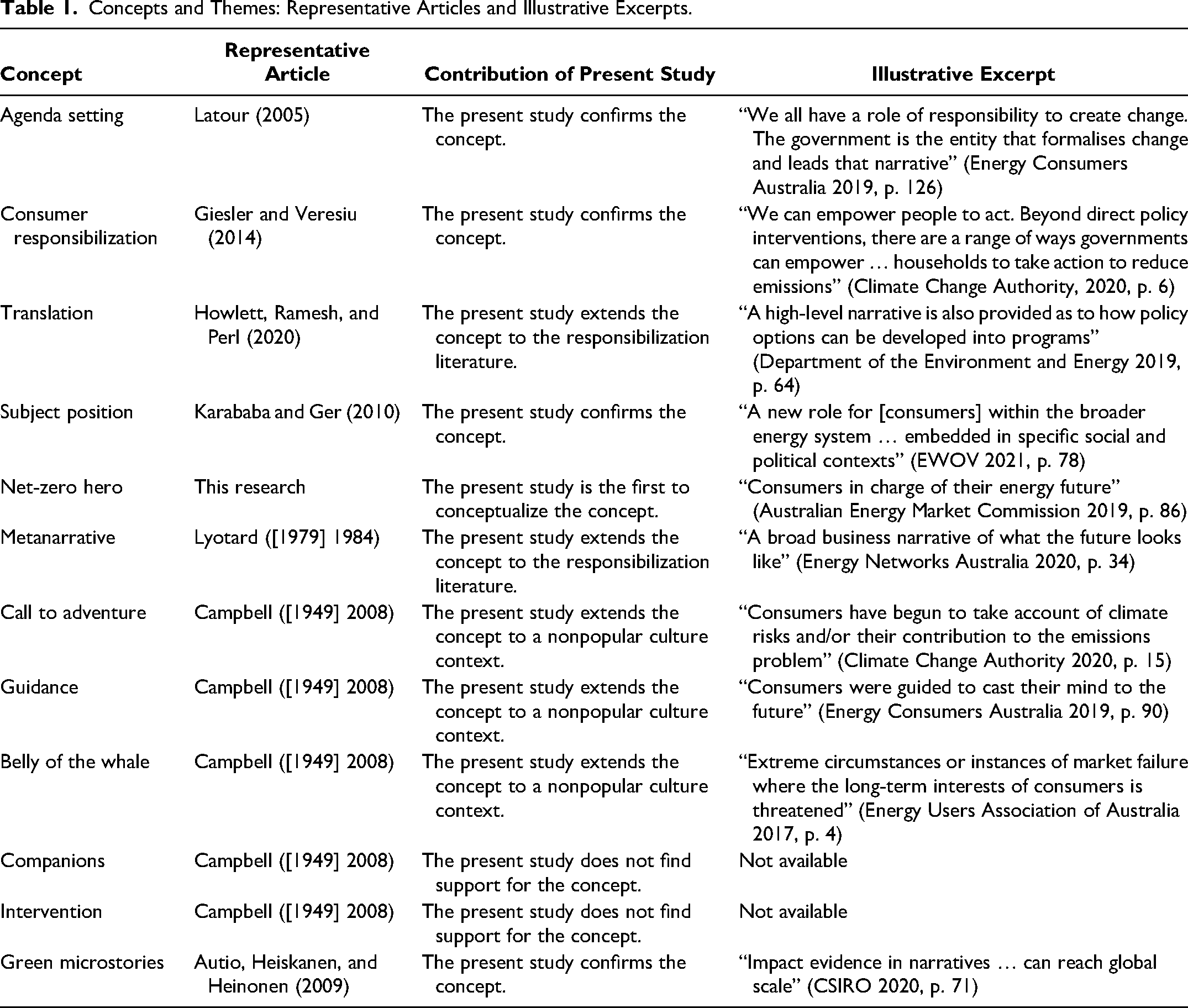
Figure 1 summarizes our findings. The first stage sets the agenda to transform consumers from suppliers of economic capital to subjects responsible for the emissions produced from their consumption. Next, we uncover how market actors translate the broader agenda into a metanarrative to try to responsibilize consumers. To do so, they punctualize the net-zero hero. However, market actors’ storytelling fails because it does not follow the journey that empowers the hero to succeed, including providing support and interventions. Instead, they create a tragedy and three distinct microstories of green consumerism. In answering our research questions, we broaden the current conceptualization of responsibilization and shed light on the limitations of the net-zero hero as a workable subject position.
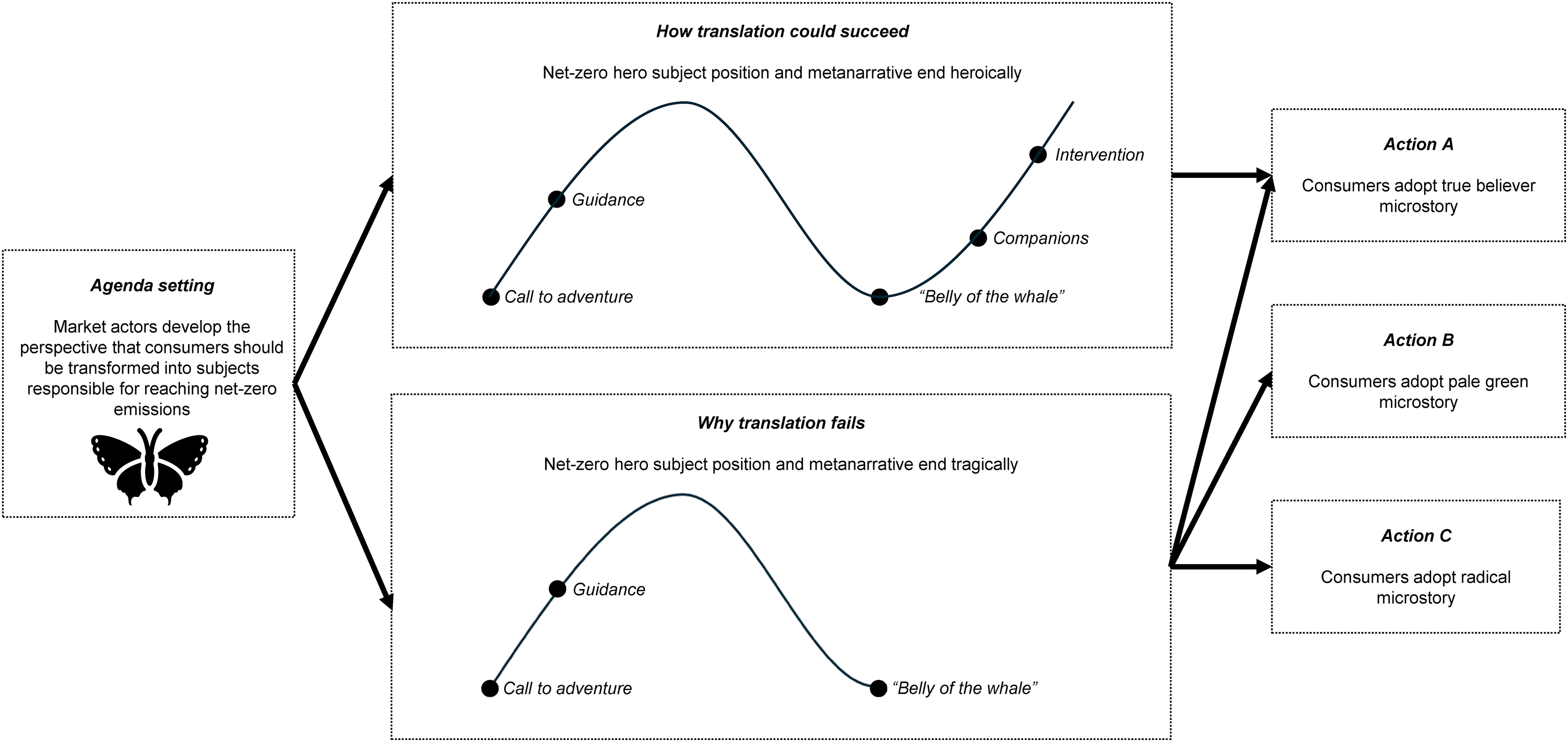
How the Net-Zero Hero Is Punctualized.
Theoretical Contributions
The findings contribute to the literature on consumer responsibilization in three ways. First, we provide deeper insights into the translation stage's influence on responsibilization. Prior research has focused either on agenda setting dominated by big business, supranational governing bodies, and multinational NGOs (Giesler and Veresiu 2014) or on consumers’ lived experiences captured by their microstories (Buerke et al. 2017; Caruana and Chatzidakis 2014; Gonzalez-Arcos et al. 2021). However, translation is the critical connective tissue between these two stages. This stage has been underexplored in previous studies. Extending prior research by Bublitz et al. (2016, 2024), we create a high-resolution image of this stage, showing how market actors try to translate the broader agenda into metanarratives to form a responsible subject position. By detailing the mechanisms of this stage, the research offers a more comprehensive framework for understanding how policies influence consumer behaviors through metanarrative construction.
Second, we find that market actors punctualize the subject position of the net-zero hero. Previous works have discussed the use of metanarratives to shape consumer behavior but have not adequately examined their formation or the implications of specific subject positions like the “net-zero hero” (Lyotard [1979] 1984; Van Laer et al. 2019). A central problem-solving agent (Luchs, Phipps, and Hill 2015), this neoliberally ideal responsible consumer is a new construct we abductively derive and define as being tasked with reducing emissions to net zero. Brown (1990) argues that market actors marginalize and subjugate microstories. Our findings align his respective position with a consumer responsibilization perspective. We show how the net-zero hero diffuses into a set of less dominant stories. At the root of the true believer's voice is the net-zero hero. It is by teasing out that dominant construct that less privileged microstories become noticeable too, however. Autio, Heiskanen, and Heinonen (2009) describe various microstories such as the hero, the villain, and the anarchist, based on motivations and actions. The present research refines these categories by providing the more granular understanding that the diversity within green consumerism reflects a pitfall of consumer responsibilization.
Third, we show that given market actor's failures to act, specifically a lack of support and interventions, the net-zero hero's arc is destined to fall short of lofty transformation; instead, it ends in tragedy. Self-management is supposed to spring from an epic story of the subject position's “emancipation from everything that prevents it from governing itself” (Lyotard [1979] 1984). However, consumers can use as many paper straws as their hearts desire and recycle and travel by train until the end of time, but unless market actors themselves act, humanity cannot save the planet. Therefore, the conceptualization of the net-zero hero challenges the efficacy of heroic narratives in marketing discourse (Preece, Daskalopoulou, and Schau 2022), arguing that without adequate systemic support, these narratives lead to consumer disillusionment and failure. In addition to critiquing the viability of the net-zero hero as a responsible subject position, we question the extent to which consumer responsibilization alone can succeed in sufficient emissions reduction. We rebuke the net-zero hero's metanarrative for presenting a transformative myth while ignoring “the continued failure to solve the world's energy problems” (Lyotard [1979] 1984, p. 7). In other words, putting the responsibility on individual consumers is an ineffective approach without supportive market actor companions or interventions. Tragedy arises from the market actors’ failure to act, thus jeopardizing collective efforts toward net-zero emissions. While consumer action is crucial, the transformative potential of market actors’ commitments remains paramount.
Another problem with the net-zero hero is that it leads to an inherently deactivating subject position. The advantage that stories have over other forms of communication is that they generate powerful emotion (Van Laer et al. 2014). The tragic metanarrative identified in this study emphasizes that net-zero emissions evoke deactivating emotions, such as despair. Deactivating emotions are physically draining; they move people toward inaction. Despair makes people want to crawl under the covers and hide (Brady et al. 2017; Hamby and Brinberg 2016; Vosoughi, Roy, and Aral 2018). The net-zero hero position evokes deactivating emotions that cause consumers to fall silent. Existing theories often simplify consumer roles into active participants who can drive significant change through individual actions (Zwick, Bonsu, and Darmody 2008). Even if heroic tales about climate change could engross people, the scale of the problem is so vast and the obstacles market actors construct so enormous that finding ways for net-zero heroes to ever solve it is nigh impossible.
Finally, it's crucial to address the ethical implications of responsibilizing consumers without adequate support or realistic pathways to success (Caruana and Chatzidakis 2014). Integrating ANT into the analysis of consumer responsibilization adds this valuable layer of complexity (Latour 2005), highlighting the interconnectedness of actants and the distributed nature of responsibility. This theoretical problematization has underscored the need for comprehensive strategies that go beyond individual consumer actions, addressing the systemic and networked dimensions of environmental sustainability. An ethical approach would involve creating a metanarrative and policies that empower consumers with genuine choices and control over their impact on greenhouse gas emissions. This could involve codesign of policies that distribute responsibility more equitably across consumers and market actors, including those with greater influence on emissions reductions (Thøgersen and Crompton 2009). Public policy can play a pivotal role by ensuring accountability, transparency, and the provision of support structures that enable consumers to make meaningful contributions to net-zero goals. Additionally, fostering collaboration between consumers, corporations, and governments could create a more holistic and effective approach to addressing the climate emergency as all actors share a willingness to act (Young et al. 2010).
Policy Implications
Our study offers powerful policy implications. Although achieving net-zero emissions is the aim, we show that the net-zero-hero subject position raises critical issues—its metanarrative's current tragic ending makes it untenable. However, someone must take responsibility to resolve the problem of reducing emissions, and a sound policy framework will ensure that this is not only ordinary consumers.
Hood and Margetts (2007) classify policy tools according to their primary resource use. Policy tools use five broad categories of governing resources: information, authority, treasury, organization, and evaluation. Effective policy frameworks ideally involve tools from each category. So, the effectiveness of consumer responsibilization is linked to mixing tools appropriately. Table 2 presents the tool mix on which an effective net-zero hero's metanarrative relies.
Possible Tool Mix for an Effective Net-Zero Hero's Metanarrative.
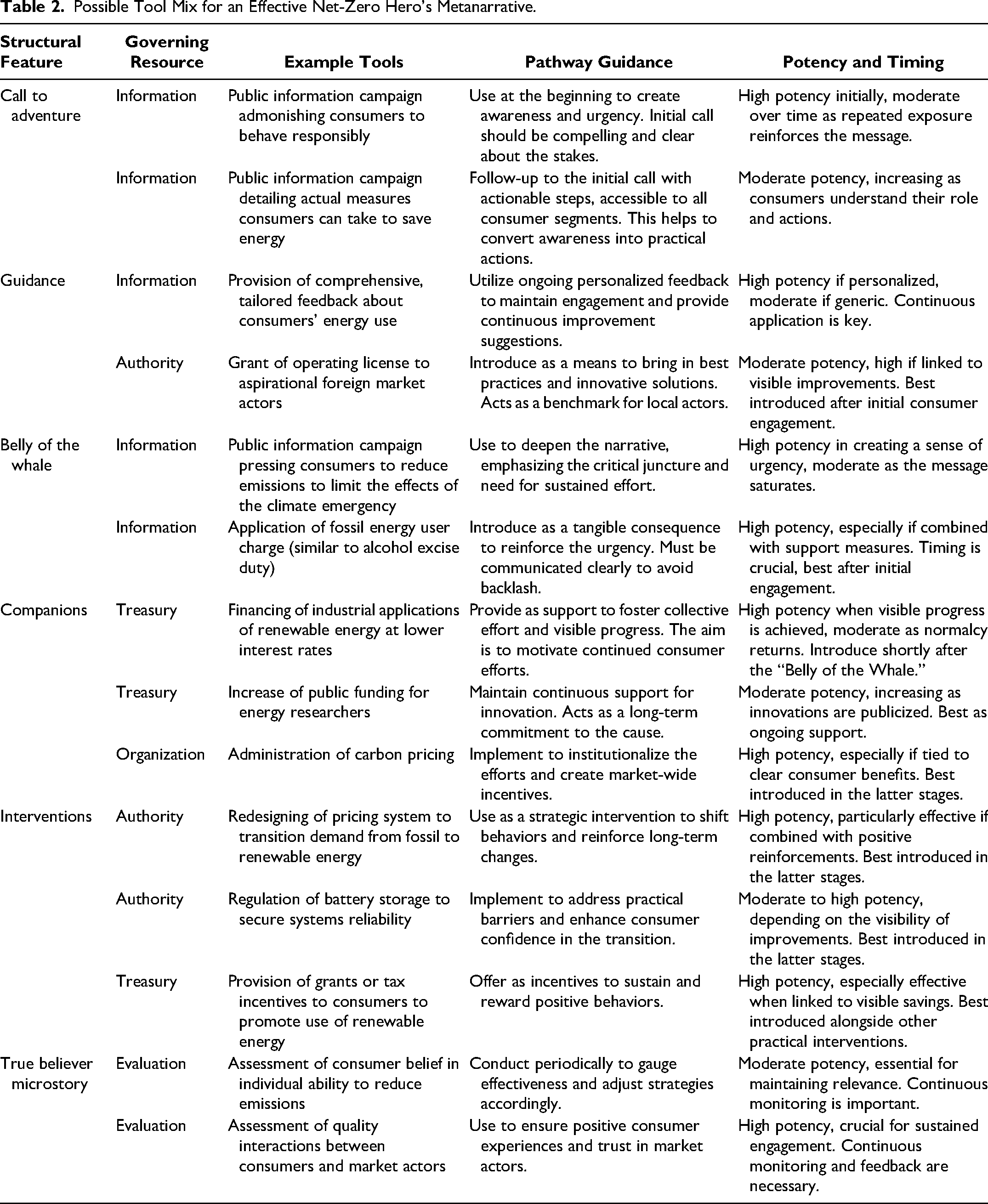
As mentioned, the lack of supportive market actor companions and interventions is currently preventing the effective deployment of the net-zero hero's metanarrative. In terms of companions, governments could raise and disburse funds as well as (re)organize the market. They could incentivize companies to accompany the net-zero heroes and reduce emissions by only financing industrial applications of renewable energy at low interest rates. In addition, energy researchers with a strong focus on low-cost technologies to trap carbon in forests, pastures, plantations, soils, and woodlands could be allowed easy access to public funding. Administering carbon pricing could put market actors under cost pressure to search for alternatives to generating greenhouse gas emissions (Boom 2001).
In terms of supportive interventions, government policy makers could use regulation and market (re)organization. They could design a pricing system that is effective in shifting demand in ways that reduce emissions. They could also secure systems reliability through regulated battery storage. In addition, grants or tax incentives could be issued to ration access to limited fossil stocks and promote renewable energy resources by market mechanisms (Townsend, McColl, and Young 2006). If administered well, the policy framework would allow the construction of a competitive energy supply system that delivers net-zero emissions.
Limitations and Future Research Directions
This study creates several new opportunities for further research. First, we adopted a discursive perspective that assumed that no singular hegemonic discourse dominates consumers. Market actors collectively produce discourse through which normative subject positions are punctualized, institutionalized, and legitimized. Their shared discourse thoroughly infuses and penetrates subject positions and concomitant metanarratives. These powerful stories structure consumer agency. However, consumers can always show agency to resist a dominant narrative even if that means subordination to another. Future research could delve into more nuanced examinations of consumer agency. Investigating the limits and potential of consumer empowerment could yield deeper insights into responsibilization language and frameworks.
Second, although we found ample textual evidence to support that the translation of the broader agenda into a compelling metanarrative necessitates the formation of the net-zero hero to try and shift responsibility for emissions reduction to consumers, further empirical research is necessary to establish direct connections. Other readings and interpretations of a text are always possible though, as the rich reader-response tradition in marketing research shows (Van Laer, Visconti, and Feiereisen 2018). Future studies could employ experimental methods to trace the impact of policy translations on actual consumer behaviors, providing more empirical data on these strategies.
Third, we did not consider how policy documents relate to other forms of discourse found in popular culture, though we report one form of intertextuality in our findings: the way the 2019 National Energy Market report by St Vincent de Paul Society referenced a popular Star Wars film using a pun. We took the decision to restrict the scope of the study and to make the topic manageable from a methodological standpoint. However, examining the relationship between policy documents and the general cultural, intellectual, and moral climate of the era, as shown in the novels and movies that surrounds them, would be useful in the future, as popular culture texts have the potential to provide a great deal of insight into the different narratives told by public policy. Achieving net-zero emissions needs more parables of what is possible. Global warming has featured thus in popular films, from Mad Max and Waterworld to The Day After Tomorrow. An entire genre of speculative climate fiction—“cli-fi”—also calls heroes to face the challenges of climate change. Tragedy clearly is not the only dramatic arc available to humankind. An engaging story has the power to change the world (Van Laer et al. 2014), and narratives can help people imagine a better future (Bertele et al. 2020), but, as Morgan (2023) writes in the epigraph, all actors must work together to make these stories a reality.
Supplemental Material
sj-pdf-1-ppo-10.1177_07439156241300997 - Supplemental material for Responsibilizing the Net-Zero Hero? Creation and Implications of a Tragic Subject Position
Supplemental material, sj-pdf-1-ppo-10.1177_07439156241300997 for Responsibilizing the Net-Zero Hero? Creation and Implications of a Tragic Subject Position by Tom van Laer and Morgan E. Smith in Journal of Public Policy & Marketing
Footnotes
Authors Contributions
The authors thank the JPP&M review team, Christine Moorman, and the Energy Consumers Australia staff for their suggestions on a previous version of the article. Morgan Smith contributed to this article in her personal capacity. The views and opinions expressed in this article are her own and do not necessarily represent the views or positions of M&C Saatchi or affiliated businesses.
Joint Editors in Chief
Jeremy Kees and Beth Vallen
Associate Editor
Hope Jensen Schau
Declaration of Conflicting Interests
The author(s) declared no potential conflicts of interest with respect to the research, authorship, and/or publication of this article.
Funding
The author(s) received no financial support for the research, authorship, and/or publication of this article.

References
Supplementary Material
Please find the following supplemental material available below.
For Open Access articles published under a Creative Commons License, all supplemental material carries the same license as the article it is associated with.
For non-Open Access articles published, all supplemental material carries a non-exclusive license, and permission requests for re-use of supplemental material or any part of supplemental material shall be sent directly to the copyright owner as specified in the copyright notice associated with the article.
