




Abstract
Inspired by the work of Slavoj Žižek, critical marketing theorists have identified how ideological fantasies support the capitalist status quo by operating as unconscious fetishes that are difficult to dispel. While these studies suggest that fetishisation is a formidable challenge to critical thought and activism, this think piece considers how fetishistic reversal may provide a means to redirect the ideological fantasies of capitalism towards more critical ends. This line of thinking is pieced together by drawing Žižekean theories alongside the topical example of Net Zero. It is argued that Net Zero is not a politically-neutral target but rather an ideological fantasy that can be interrogated for fetishistic disavowals, inversions and ticklishness. However, it is added that renouncing Net Zero as an ideological fantasy is likely to be unproductive, or even counter-productive. Instead, critical marketing scholars should proceed by reversing fetishistic effects. Developing Žižek’s notion of Less Than Nothing, it is suggested that Net Zero should be transposed with the more radical target of Less Than Net Zero. This piece concludes by thinking about the application of fetishistic reversal to other socioecological issues in order to push critical marketing theory further towards a more optimistic horizon.
Keywords
Introduction
‘The first reaction is one of ideological denial: there is no fundamental disorder; the second is exemplified by explosions of anger at the injustices of the new world order; the third involves attempts at bargaining (‘‘if we change things here and there, life could perhaps go on as before’’); when the bargaining fails, depression and withdrawal set in; finally, after passing through this zero-point, the subject no longer perceives the situation as a threat, but as the chance of a new beginning’ (Žižek, 2010, p. xi).
After decades of climate deniers arguing with angry environmentalists, Bradshaw and Zwick (2016) suggest that mainstream marketing is now in a stage of collective bargaining when it comes to sustainability, trying to make enough symbolic changes to keep businesses running as usual. Arguably critical marketing scholarship is in a more depressive phase. Carrington et al. (2016) argue that the project of encouraging consumers to act more ethically is doomed to failure, and that market actors perpetuate the individualised fantasy of closing the ‘ethical consumption gap’ only in order to distract attention away from the inherent destructiveness of an inequitable and exploitative capitalist system. Structural changes are necessary to save the day, they conclude. Unfortunately, Cronin and Fitchett (2021, p. 5) explain that consumers and other market actors prefer to believe in the fantasy of market-driven solutions to social and ecological problems, which is problematic because ‘market freedoms stifle the felt requirement for individuals to articulate their sovereignty through political demands’.
All three studies draw on the Marxist-psychoanalytic 1 perspective of Slavoj Žižek and his concept of ideological fantasies. For him, fantasies are unconscious, protecting the ego by acting as fetishes that assuage anxieties and develop desires, but also ideological, serving vested societal interests by misdirecting thought and action (Žižek 2009). This is why Bradshaw and Zwick (2016, p. 278) can assert that many people sincerely believe in the notion of business sustainability, as this unconscious ideological fantasy ‘permits its participants to act as if they are doing something of significance in the face of clear evidence to the contrary’. The final point about contrary evidence is important to labour. It shows how fantasies are fetishistic rather than symptomatic, operating imperceptibly in the unconscious rather than emerging as object of conscious reflection (Žižek, 2009). Fantasies are difficult to dispel not because subjects are duped but because they are subliminally seduced, with fantasies forming the very foundation of subjective experience (Zwick and Bradshaw, 2016).
For Žižekean marketing theorists the crucial question is how to convince those who are trying to consume more contentiously to accept that ethical and existential crises like climate change are consequences of contemporary capitalism as a system, and thus that they remain complicit through consumption? For Bradshaw and Zwick (2016, p. 278), ‘the onus of analysis shifts from exploring external consumers and producers… turning the gaze inwards… to probe for unconscious destructive impulses’. It is only by understanding the (self-)destructive unconscious that critical scholars begin ‘to refocus their investigation’ to ‘the underlying capitalist structures that predicate and benefit from’ ideological fantasies (Carrington et al., 2016, p.33). Yet, do these calls not denote the kind of depressive withdrawal that Žižek, (2010) describes? Campbell et al. (2019, p.725) provide a particularly acute example of this moribund mood when they claim that it is already too late to stop climate change, so all that is left is to ‘learn how to die in a way that is a creative and just foreclosure of the Earth’s organizational forms’. Against this one might ask: where is the optimistic horizon that Cova et al. (2013) once discerned in the work of Žižek and other communist thinkers? How might critical marketing theory be made more optimistic and how might this optimism be maintained in the face of fetishes that seem to thwart critical thinkers at every turn (Cluley and Dunne, 2012; Zwick and Bradshaw, 2016)?
This think piece proposes fetishistic reversal as a means through which ideological fantasies might be redirected rather than renounced. While Žižekean marketing scholars have explained how subjects ignore troublesome truths through fetishistic disavowal (Bradshaw and Zwick, 2016), fetishistic inversion (Cronin and Fitchett, 2021), and fetishistic tickling (Ulver, 2021), this piece thinks about the possibility of using these same Žižekean ideas to seduce subjects towards criticality. This thinking is pieced together through the illustrative example of Net Zero, the oft-touted target of reducing and reabsorbing carbon emissions so that the net result in a given time frame is zero. Often presented as an apolitical target, a Žižekean perspective might treat Net Zero it as a neoliberal ideological fantasy that functions through fetishistic disavowal, inversion, and tickling. Drawing on Žižek’s (2012) notion of ‘less than nothing’, which describes physical but also psycho-political systems where something operates imperceptibly in an ostensible void, it is argued that this fetishisation may be reversed in favour of critical alternatives by calling for Less Than Net Zero.
This think piece serves as a topical intervention, given the prominence of Net Zero in popular discourse, but also a theoretical one, illustrating where Žižekean marketing theory might go next. While this piece thinks through the specific concept of fetishistic reversal, it adds another piece to Žižekean marketing thought by challenging the somewhat ‘depressive’ (Žižek, 2010) tone of recent discourse in order to conduce more optimistic theory-building (Cova et al., 2013). This think piece offers an alternative positon for those critical marketing theorists who have found Žižek’s work to be philosophically transmuting but practically torpefying. Rather than regard the fetishistic function of ideological fantasies as an impediment to political intervention, fetishistic reversal offers a means to accept the troubling conclusions of Žižekean ideas without relinquishing the ambition (fantasy?) of successfully transforming the ideological infrastructures of market societies. Yet, this is not to restrict the potential of fetishistic reversal to critical marketing theorists who follow Žižek – all critical thinkers may consider the possibility that the problematic market phenomena they deconstruct may be the very means through which to reconstruct a better alternative.
Zeroing in on the problem with Žižek
‘In our allegedly “post-ideological” era, ideology functions more and more in a fetishistic mode… the fetish is the embodiment of the Lie which enables us to sustain the unbearable truth… in this sense, a fetish can play the very constructive role of allowing us to cope with a harsh reality’ (Žižek, 2009, p. 65).
For Žižekean thinkers, ideological illusions cannot be dispelled through critical interrogation. Indeed, the unconscious potency of a fetish ‘only increases the more we tunnel into its hidden reality’ (Cluley & Dunne, 2012, p. 255). For instance, fetishistic disavowal describes instances where informed subjects continue to act as if they are unaware of the truth (Bradshaw & Zwick, 2016; Cluley and Dunne, 2012). Some go further, with fetishistic inversion denoting cases where subjects act as if the opposite were the truth (Cronin and Fitchett, 2021). More recently, Ulver (2021, p. 17) has identified the complex case of fetishistic tickling, where subjects accept there is no true solution to a given problem but continue to negotiate the tensions created by it because it ‘tickles so good’. 2 Critical marketing scholars have deconstructed these fetishistic effects in order to demonstrate how they function in favour of the capitalist status quo. This piece thinks about a related, but distinct, problem: how might fetishes be ‘reconstructed’ to promote ‘universal, egalitarian and revolutionary ideals’ (Cova et al., 2013, p. 219)?
Žižek (2006a, p. 137) once wrote that sometimes ‘the very way we perceive a problem is an obstacle to its solution’. This suggests that solutions can emerge from reformulated problems, what Žižek (2010, p. xi) would later describe as the process of ‘passing through this zero-point’. In Less Than Nothing, a lengthy treatise on Hegel and his legacy, Žižek (2012, p. 17) describes this process more philosophically: ‘the most elementary figure of dialectical reversal resides in transposing an epistemological obstacle into the thing itself as its ontological failure’. One example of dialectical reversal is Žižek’s (2012, p. 18) own attempts at ‘reading Hegel through Lacan (and vice versa)’, through which ‘my wager was (and is) that, through their interaction… psychoanalysis and Hegelian dialectics mutually redeem themselves, shedding their accustomed skin and emerging in a new unexpected shape’.
The wager of this think piece is that critical scholars may shed their customary struggle against capitalist ideologies by finding ways to reverse fetishistic effects and allow fantasies to remerge in more critical forms. Inspired by the phrase ‘dialectical reversal’ (Žižek, 2012, p. 17) and the established Žižekean focus on fetishisation (Bradshaw and Zwick, 2016; Carrington et al., 2016; Cluley and Dunne, 2012; Cronin and Fitchett, 2021; Ulver, 2021; Žižek, 2009), this process is described as fetishistic reversal. This phrase encapsulates how the effects of capitalist fetishes might be reversed towards more critical ends, but also how critical scholars might reverse how they think about fetishes, treating them more ambivalently as both pernicious foes and potential friends. These theoretical arguments are now advanced through the example of Net Zero.
Casting the net further and wider
‘Net zero carbon dioxide emissions are achieved when anthropogenic CO2 emissions are balanced globally by CO2 removals over a specified period’ (Pineda and Faria, 2019, p. 9).
Although ‘there is no commonly agreed definition of what constitutes net zero emissions’ (Stephens, 2019, n. p.), a number of governments, corporations, and other organisations have committed to the target of Net Zero carbon emissions by 2050 or earlier (e.g. Milman, 2019; Shepheard, 2020). It is increasingly ‘a target around which much of the world is coalescing’ (Roberts, 2020). Yet, Net Zero targets have been critiqued for being almost impossible to achieve (Baez, 2019), and insufficient even if achieved (Dyke et al., 2021; Hancock, 2021). One reason for this is that Net Zero targets are too ‘vague’ to be effective (Rogeljet al., 2021). Yet, from a Žižekean perspective, it might be said that this vagueness is strategic rather than accidental. Because the ‘zero’ of Net Zero is a relative measure, the term becomes a moving target. As Figure 1 illustrates, it can be moved upwards by increasing carbon capture, reducing the perceived necessity to reduce consumption-related carbon emissions overall. How increasing carbon capture can reduce the perceived need to reduce consumption.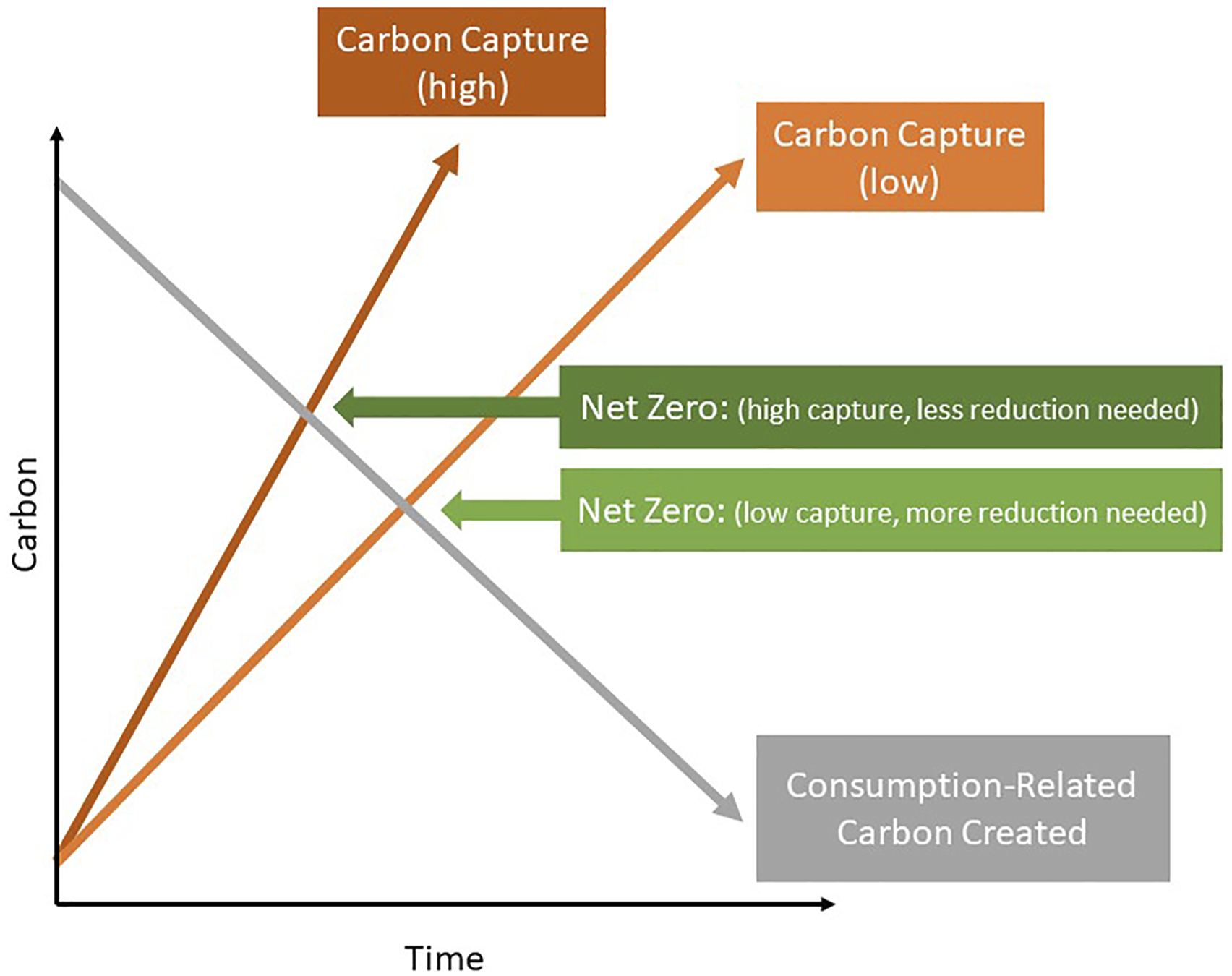
In this sense, Net Zero can be understood as a variation on the ethical consumption gap, where the ostensible objective is to ‘close the gap’ but the implicit ideological imperative is to avoid changing the underlying capitalist system (Carrington et al., 2016). Those who fetishise the gap blame consumers for failing to reduce their carbon-intensive consumption, rather than the consumerist system for being harmful in the first instance. Net Zero contributes to this fetishisation by suggesting that an alternative solution might be to ramp up carbon capture instead – if consumers cannot be trusted to reduce their consumption-related carbon emissions, then perhaps the best solution is to increase capture rather than perpetuate a failed narrative of non-consumption? From this perspective, one reason that tree-planting programmes and other sequestration schemes are popularised is that they afford opportunities to ‘offset’ carbon rather than avoid consumption. These offers function as a form of fetishistic disavowal (Bradshaw and Zwick, 2016; Cluley and Dunne, 2012), allowing consumers (and marketers) to act as if the absolute harm of the system is zero just because the relative harm of the immediate consumption act is offset to net zero. Yet, while offsetting a flight may capture a specific amount of carbon, it does little to challenge the carbon-intensity of the wider market system, let alone the considerable water use, plastic produce, labour exploitation, and other ‘externalities’ of economic activities.
A corollary consequence is that even if the ambitious target of Net Zero is achieved then ‘closing the gap’ will not negate the underlying contradictions of the capitalist system (Carrington et al., 2016). If carbon sinks continue to increase after Net Zero has been reached then this allows consumption-related carbon emissions to increase also, with no net harm to the environment (Figure 2). This can be thought of as a fetishistic inversion, where subjects act as if the opposite of the truth were correct (Cronin and Fitchett, 2021). While environmental arguments often shade into calls to reconsider socioeconomic systems (e.g. requests to recognise the resource limits of the Earth), they can easily be mobilised to further the neoliberal agenda of endless economic growth. Previously this has been achieved by shifting the focus from the system and macro-market actors onto individual consumers, as in the case of British Petroleum introducing the ‘carbon footprint’ as an individualistic measure (Doyle, 2011). Net Zero can individualise environmental issues, but it also contributes a novel fetishisation by reframing ecologies as expandable systems. Earthly limits are not ignored, but their consequences are inverted by the seductive fantasy of limitless sequestration. Ideologically, this fantasy is an act of ‘dabbling in the symbolic as opposed to confronting the real of capital accumulation’ (Bradshaw and Zwick, 2016, p. 278). At the level of the individual unconscious, the unresolved but symbolically ‘unimportant’ tensions between economic systems and ecological systems may provide a ‘ticklish’ pleasure for consumers, marketers, and other subjects (Ulver, 2021). How economic expansion may resume after net zero is reached.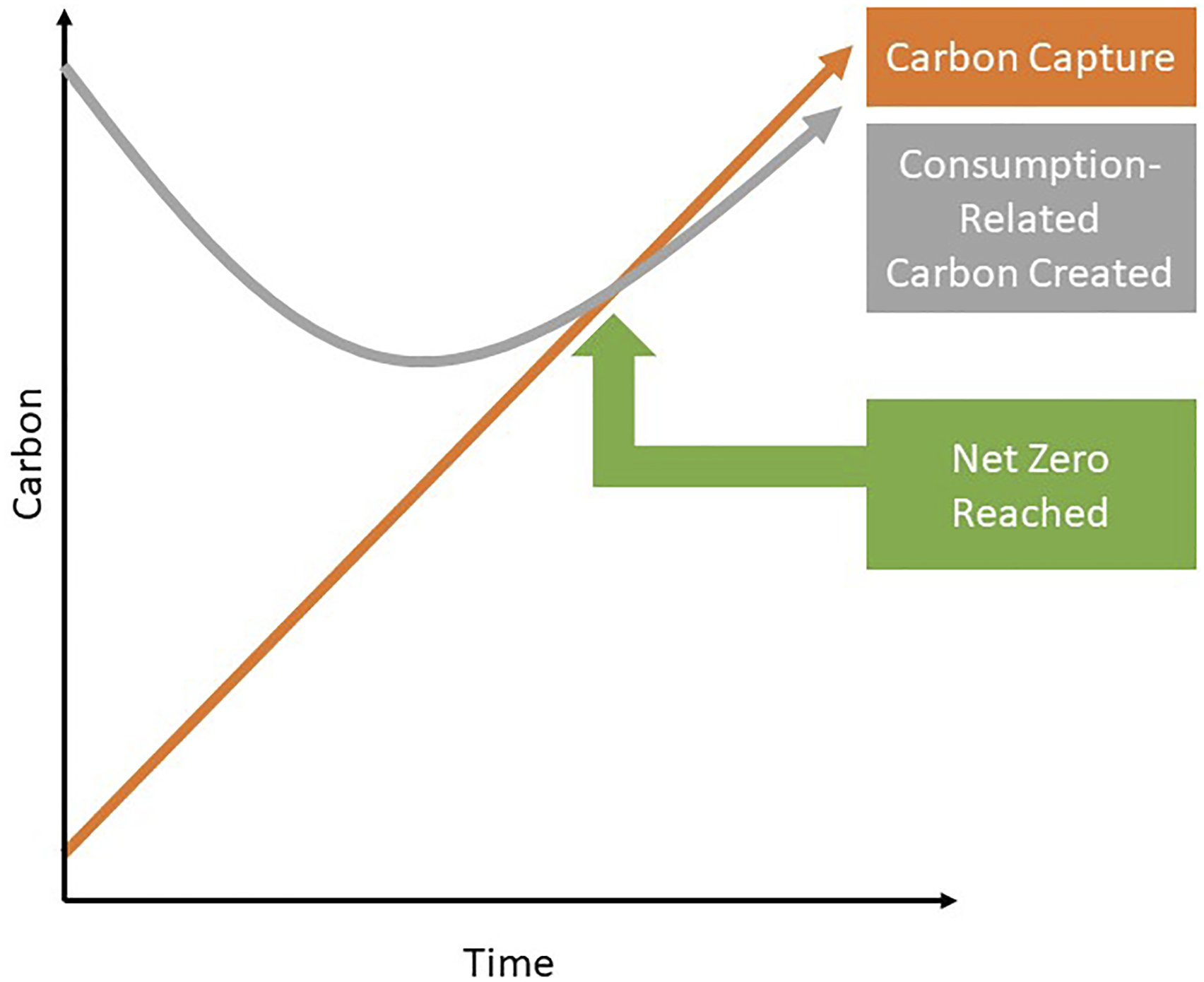
So far, so familiar. Yet, although extant critical marketing theory can be useful in deconstructing the fetishistic functions of Net Zero as an ideological fantasy, this leads to a depressive position where real change appears difficult, if not impossible. This runs the risk of scholarly withdrawal into analyses that are interesting and important, but ultimately renounce the ambition to influence the subjects that they so expertly analyse. Following Cova et al. (2013), critical marketing scholars might need to take further inspiration from Žižek in order to reconstruct an alternative to Net Zero that may point towards a critical horizon. In Less Than Nothing, Žižek (2012, p. 945) writes that ‘something is cheaper than nothing’ wherever there is ‘a pre-ontological “something” which is less than nothing’. As discussed in the next section, these philosophical phrases can form the foundation of a fetishistic reversal that may transpose the implicitly neoliberal narrative of Net Zero with an explicitly critical alternative, Less Than Net Zero.
Fetishistic reversal: From net zero to less than net zero
‘In order for Something to emerge, the pre-ontological Nothing has to be negated, has to be posited as a direct/explicit emptiness, and it is only within this emptiness that Something can emerge’ (Žižek, 2012, p. 945).
In quantum physics vacuums can be created through the use of machines, ‘sustained by a certain amount of energy expenditure’, or by a Higgs field ‘in a state of inactivity, of absolute repose’ (Žižek, 2012, pp. 944–5). Here the Higgs field is a pre-ontological ‘something’ that gives rise to the phenomenon of nothingness, demonstrating that when a system comes close to zero there is an inflection point where ‘energetically, something is cheaper than nothing’ (Žižek, 2012, p. 945). The same may be said of ideological fantasies, which are something but function as fetishes to appear as nothing (or pre-ontological). Furthermore, Žižek (2006b) follows Lacan in arguing that unmediated access to the Real is impossible, so the subjective screen of ideological fantasies cannot be defetishised entirely, only refetishised by reversing the means of a fantasy towards novel ideological ends. Replacing one ‘pre-ontological something’ with another, by explicitly deconstructing one ideological fantasy as ‘nothing’ and then reconstructing the fantasy around a new ideology, is therefore ‘cheaper’ that trying to sustain an ideology-free worldview.
These logics can be applied to Net Zero. This target is presented as a moment where the impact of consumer culture would be ‘nothing’. This is especially true for subjects socialised into the consumerist logic of ‘more for less’ (Žižek, 2012, p. 990). Carbon capture is the ‘pre-ontological something’ that allows Net Zero to function as an ideological fantasy where carbon could be reduced to ‘nothing’ without having to reduce consumption to non-consumption. Working towards the ‘nothing’ of non-consumption is economically and emotionally costly (Chatzidakis et al., 2021), often requiring people to reject mainstream (consumer) society altogether by living in alternative socioeconomic spaces, such as ecovillages (Casey et al., 2020; Vicdan and Hong, 2018), or undertaking more time- and labour-intensive activities like home farming (Bettany and Kerrane, 2018). Many of these alternatives are predicated on a pre-existing level of social, cultural and economic capital. Understandably, the promise of carbon capture emerges as ‘cheaper’ than non-consumption (i.e. as an easier and more enjoyable option). However, insofar as these ideological implications are rarely perceived, let alone explicitly stated, carbon capture is also the ‘pre-ontological something’ of Net Zero, ripe for critical deconstruction.
A Žižekean deconstruction may explicitly mark Net Zero as an ideological fantasy whose promises are empty because they perpetuate, rather than truly resolve, the absolute harms of capitalism. Empirically, it may critically analyse products, services, or brands that claim to be ‘carbon neutral’ or even ‘carbon negative’, using these as examples to explicate fetishistic ideological fantasies at work. However, Žižekean marketing scholars have shown that identifying an ideology is not enough to inspire subjects to think or act differently (Bradshaw and Zwick, 2016; Carrington et al., 2016; Cluley and Dunne, 2012; Cronin and Fitchett, 2021; Ulver, 2021; Zwick and Bradshaw, 2016). So what is needed is ‘Something’ new to enter the empty intellectual space created through this process of deconstruction. This Something is the act of fetishistic reversal where one less-than-nothing is replaced with another. In the case of Net Zero, this may be taken rather literally. As argued above, Net Zero is reached by reducing consumption-related carbon emissions and increasing carbon capture. When Net Zero is reached, the trajectory of consumption may turn upwards to join carbon capture, affording capitalist accumulation without a net gain or loss for the environment. Alternatively, these trajectories might be allowed to converge, pass through the zero-point, and then diverge once more (Figure 3). How less than net zero may create a socioecological surplus.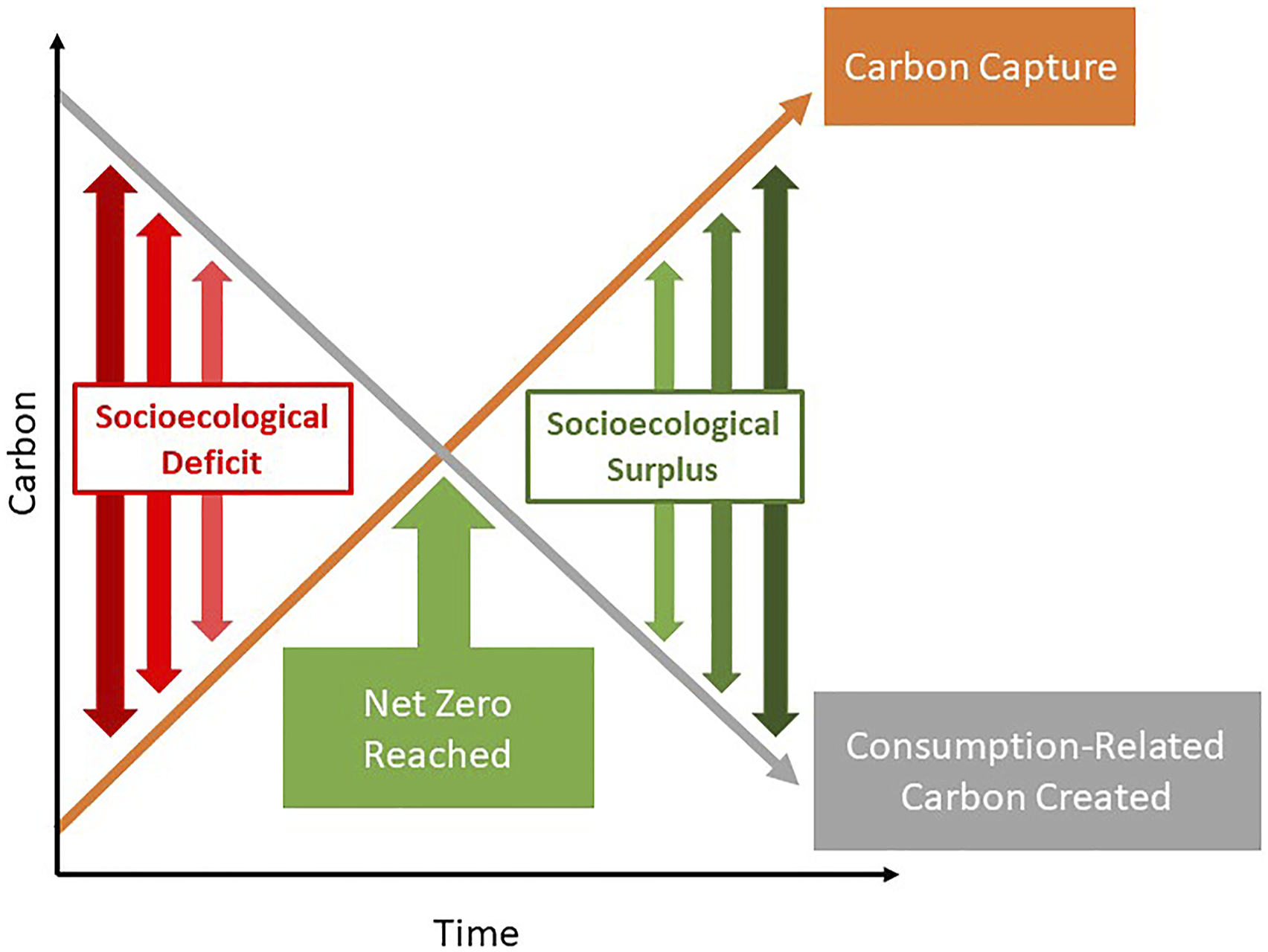
Rather than treat Net Zero as an end target, after which business-as-usual can resume, Less Than Net Zero treats this as the starting point for a new beginning, an empty space in which Something novel might emerge. This might be dubbed the socioecological surplus, describing a net gain to social and ecological systems rather than continued capitalist cumulation, but this is a matter for future research. The objective of this piece is to think about the benefits of tweaking a trope like Net Zero, rather than traducing it, in order to seduce consumerist subjects into more critical trajectories. This process has been described as fetishistic reversal, and may be applied by critical marketing scholars to all manner of ideological fantasies. Less Than Net Zero is but one example of a more optimistic response to the troubling consequences of Žižekean thought: if you cannot beat an undesirable fetish, why not enjoy enjoining it? More generally, this piece has thought about the critical-creative power of taking ideological fantasies at face value. Critical marketing scholars should continue to deconstruct the claims that market actors make, unconsciously or otherwise, but also recognise that the fetishistic power of these can be put to critical use. It might be said the Žižekean position promoted here contrasts somewhat with Audre Lorde’s (1984) argument that the house of the master cannot be dismantled with the master’s tools. Maybe mastery of ideological tools can enable critical thinkers and activists to begin reversing climate change and other ethical and existential threats. At the very least, fetishistic reversal may buy more time for other tools to be found.
Footnotes
Declaration of conflicting interests
The author(s) declared no potential conflicts of interest with respect to the research, authorship, and/or publication of this article.
Funding
The author(s) received no financial support for the research, authorship, and/or publication of this article.
