




Abstract
Extant literature considers marketing activities as instrumental for postwar recovery and peace-building. However, war is an ongoing lived experience for numerous societies across the world. Focusing on the role of marketing during war, this article presents a study examining how and why people living in war adversity deploy, perceive, and respond to war-related marketing activism actions (MAA). War-related MAA are acts through which brands/organizations and consumers create or draw on marketing meanings to convey and to enact stances and experiences related to war. This study adopts a multimodal qualitative methodology integrating photo elicitation and in-depth interviews with consumers and with marketing and management professionals in Ukraine, the country enduring invasion and war by Russia at the time of this article’s publication. Analyses through a community resilience theoretical lens generate a conceptualization that demonstrates how war-related MAA are harnessed and serve as a medium in community dialogues concerning envisaged resilience trajectories (survival, creativity and growth, and recovery). The article advances understanding of marketing activism during war by illuminating its potential and boundary conditions for serving as a community resilience resource. It also offers public policy development directions for marketing practice, organizations, and governments.
Keywords
Nascent studies examining marketing in war contexts have mostly considered marketing activities as a mechanism contributing to peace-building and postwar recovery (DeQuero-Navarro et al. 2020; Shultz 1997). Yet, marketing's role in relieving ongoing war effects for civilian populations during war is seldom considered. This is a critical gap: with 32 countries currently designated as “countries at war” (World Population Review 2024), 1 for a significant proportion of the world population war is a protracted lived experience. We address this gap by focusing on Ukraine as the country currently enduring a war by Russia.
Civilian populations living in war adversity are at heightened risk of psychological distress, which may manifest in generalized anxiety, depression, and avoidance (Kimhi and Shamai 2004). Distress can vary in severity with the level of adversity experienced (e.g., being a victim of warfare vs. being near warfare vs. being exposed to warfare media coverage). Nevertheless, even “lower-intensity” adversity, such as infrequent direct or indirect (via media) exposure to warfare, can heighten distress (Summerfield and Toser 1991). As a lived experience, war can be understood as a cycle of loss of resources (including psychosocial, material, and structural resources such as institutions and organizations; Hobfoll et al. 2007). These losses, in turn, deplete individual and collective efficacy, impeding affected populations’ postwar rehabilitation (Somasundaram and Sivayokan 2013).
Extant literature concerned with informing war relief policies highlights that the strengths and abilities of affected populations to mobilize toward withstanding war adversity are overlooked (Agani, Landau, and Agani 2010; Nuwayhid et al. 2011). However, lay community members—that is, people and groups who are (1) not professionally trained for war relief, in contrast to disaster relief workers, or (2) not formally involved in war relief, unlike government officials—can play an important role in creating and providing resources for their communities’ resilience (Hobfoll et al. 2007). Leveraging such community-initiated resources can advance war relief policies and programs.
Marketing activities and their outputs (products, brands, advertising) are marketplace resources that community members and organizations can utilize in activism to express stances and actions concerning social, political, and market ideologies, events, and practices (Izberk-Bilgin 2012; Korschun, Martin, and Vadakkepatt 2020). It is thus valuable to examine the role of marketing activities and outputs in war adversity. Ukraine is a contextual setting where war-related marketing activism actions (MAA)—which we define as acts through which brands/organizations and consumers create or draw on marketing meanings to convey and enact stances and experiences related to war—have emerged prominently. To illustrate, consider examples of chocolate figurines satirically depicting Russia's head of state as Napoleon or a prisoner under the brand line “Beware, Putin!” observed in 2015 and jigsaw puzzles depicting destroyed historical buildings of Ukraine observed in 2022. Examining such MAA as a marketplace resource available to war-affected populations is theoretically and practically relevant for informing war relief policy frameworks.
This article pursues a twofold aim: (1) characterizing war-related MAA, and (2) examining why and how war-affected communities create, deploy, perceive, and respond to war-related MAA. We present an exploratory, grounded theory–informed qualitative inquiry prompted by two authors’ organic observations of war-related MAA in Ukraine emerging in response to Russia's invasion, started in 2014. Findings identify three categories of meanings conveyed by war-related MAA: (1) mitigating symbolic threat; (2) affirming connectedness and common identity; and (3) facilitating collective resistance. In a subsequent analysis of the perceptions of and responses to these meanings of MAA by marketers/managers and consumers, we draw theoretical linkages between meanings of war-related MAA and three community resilience trajectories: survival, creativity and growth, and recovery (Kimhi 2016). We integrate the findings into a conceptualization of the role of war-related MAA in community resilience during war. Our empirically derived conceptualization contributes to research on marketing and war, marketing activism, and war relief policy by illuminating how people in war-affected societies deploy, perceive, and respond to war-related MAA as a community resilience resource.
We follow the guidelines for presenting grounded theory–based studies (Gioia, Corley, and Hamilton 2013). We first present contextual insights into our inquiry ground, Ukraine, and summarize the literature on the concepts informing our theorizing. Next, we present the study design, followed by findings and conceptualization of the role of war-related MAA in community resilience during war. We note that, while presented in a conventional structure, the theoretical perspective supporting the conceptualization emerged through empirical data–literature iterations. We conclude by discussing our findings and conceptualization in light of contemporary events in Ukraine and offer theory and policy implications.
Ukraine: A Brief History of Statehood and Origins of the Current War
Ukraine's status as an independent state was internationally declared, recognized, and ratified in 1991 (Commission on Security and Cooperation in Europe 1991; 2 Verkhovna Rada of Ukraine Resolution 1991). But Ukraine's journey to statehood has been complex. For most of its history, various regions have been part of powerful empires: the Austrian Empire of the Habsburgs and Austria-Hungary; the Ottoman Empire; Poland-Lithuania and Poland; Moskovya, the Russian Empire, and, finally, the Soviet Union. 3
The 2014 Russian invasion was triggered by the Euromaidan (or “Maidan protests,” hereinafter “Maidan”), referred to as the Revolution of Dignity in the official Ukrainian narrative (Onuch and Sasse 2016). The Maidan (November 21, 2013–February 21, 2014) began with students peacefully protesting the refusal of Ukraine's former president, Viktor Yanukovych, to sign a cooperation agreement with the European Union one week before the November 2013 European Summit following seven years of negotiations (Onuch and Sasse 2016). Demonstrators feared that the “Yanukovych regime would now consolidate itself under Russian protection” (Wilson 2015, p. 348) and protested for a change of life in Ukraine (Kyiv International Institute of Sociology 2014). Police violence toward the demonstrators evoked a nationwide protest movement, leading Yanukovych to flee the country. Russia perceived the Maidan as a mass disorder of the state; hoping for a coup d’état, it annexed Crimea and initiated warfare in the Donetsk and Luhansk regions (Wilson 2015).
The Maidan and subsequent events spurred significant changes to Ukraine's identity. Since the 1991 declaration of independence and up to the Maidan, Ukraine was characterized as a state “without clear-cut identities” (Torbakov 2011, p. 212) or with “mixed identities” (Kuzio 2015, p. 164), undergoing a process of unmaking from the influence of empires, particularly the Soviet Union (Wilson 2015). In a society defined by the copresence of Ukrainian (or anti-Soviet) and post-Soviet (or Soviet) identities, the Maidan hastened sociopolitical and cultural transformations toward renegotiated identity (Rafalskyi et al. 2022). Specifically, the events of 2014 facilitated Ukrainians beginning to acquire a sense of identification in terms of civic understanding, extending beyond ethnic-cultural boundaries (Riabchuk 2015) to a “pan-Ukrainian” value-driven identity (Razumkov Ukrainian Centre for Economic and Political Studies 2016, p. 20). Dignity and democracy values came to the fore (Kulyk 2016; Kuzio 2015). The transformation to pan-Ukrainian identity has manifested, among other ways, through the reappropriation of national symbols as representations of the postindependence identification. As Wilson (2015, p. 354) explains, “national flags and symbols, once controversial, were also more universal, as a symbol of support for a state under siege.”
The freshly minted Ukrainian unity evolved mostly horizontally, via civic engagement with cocitizens rather than the government or organizations (Onuch and Sasse 2016; Kudlenko 2023). The Maidan emerged as a new grassroots institution embodying a voluntary self-organizing network of citizens (Shapovalova and Burlyuk 2018). Two factors explain horizontal engagement prevalence. First, Ukrainians’ centuries-long silent opposition to old rulers translated into low trust in their governments (Wilson 2015). In contemporary realities, this encompasses a stance for minimal state interference in people's lives, prevalent even in the face of the full-scale war (Kucheriv Democratic Initiatives Foundation 2022). Second, Ukrainians’ high sense of autonomy from the state formed traditions of reliance on informal networks, as exemplified by Ukrainian terms “hromada—a community that is built on horizontal and decentralized relations” and “toloka—a community effort to complete a large urgent task” (Kudlenko 2023, p. 521). These factors created an informal civil society “that manifests itself when needed most” (Zarembo 2022, p. 55); exemplifying its manifestation nationwide, 69% of Ukraine's population believes that the Maidan was made possible by interregional solidarity (Komisarova 2021).
From 2014, Ukraine's statehood and identity development occurred alongside the ongoing warfare in the Donetsk and Luhansk regions (Center for Preventive Action 2023). On February 24, 2022, Russia launched a full-scale invasion of Ukraine, with the war ongoing as of the writing of this article. A fifth of Ukraine, including the area surrounding the country's capital city, Kyiv, was occupied by troops. All regions have experienced and continue to experience bombing raids, causing significant civilian fatalities and damage to critical infrastructures (Center for Preventive Action 2023). As of this article's writing, 54% of the territory occupied in 2022 has been restored to Ukraine's control; fighting is ongoing in many areas, and bombing raids continue across the country 4 (Britzky 2023).
When Russia launched the 2022 invasion, Ukraine was widely expected to fall. Defying expectations, Ukraine mounted a strong defensive response, supported by—in addition to military actions—the resilience of the civilian population (O’Brien and Cooper 2023). We next summarize the literature we drew on to understand this resilience conceptually and to inform theorizing of its links with war-related MAA.
Conceptual Foundations
Community Resilience
The term “resilience” has become ubiquitous, expanding beyond academic circles into the media. Given its wide use, conceptual complexity exists (Matarrita-Cascante et al. 2017) as the term is multiscalar (e.g., individual vs. community vs. national resilience) and multidimensional (e.g., biophysical vs. social resilience). The concept originates from biophysics, where it refers to an ecological system whose functioning is impacted by a stressor in the form of an external threat (e.g., an earthquake) or a human-driven event (e.g., an armed conflict). Resilience was extended to the social sciences to describe the response of human systems to adversity-triggered change (Berkes and Ross 2013).
We draw on a comparative analysis of resilience definitions in recent literature and focus on community resilience, a form of social resilience specific to human or social systems. The term “community” conceptually denotes “collective units”—constituent populations with certain shared characteristics, including common identity, culture, behavior, or concern, and psychological ties to each other and to a specific locality (Korosteleva and Petrova 2022; Nuwayhid et al. 2011). While initially sharing ties to a geographical locality encompassed a core characteristic of community, the changing spatial scope of social interactions and ties broadened the variety of community forms (Smith 1999). Examples of contemporary communities include geographically bound units (neighborhoods), nongeographic units (transnational diasporas), and communities bound by a shared concern (civil society movements) or interest (brand communities).
Community resilience is an evolving domain (Eshel and Kimhi 2016). Consensus exists whereby community resilience is conceptually understood as a process linking sets of dynamic resources with trajectories of positive adaptation and functioning of a given community in the context of significant adversity (Norris et al. 2008). Extant literature characterizes three possible trajectories encompassing the development of abilities or capacities for (1) survival—the ability to absorb a shock; (2) recovery—the ability to resume the rhythms of daily life after a shock; and (3) creativity and growth—the ability to advance to a different level of functioning after a shock (Kimhi and Shamai 2004).
The positive functioning of a community during adversity requires resources: material (e.g., objects, infrastructure) as well as psychosocial and cultural (e.g., meanings, narratives, institutions, connections, and cooperation). Resource availability and their dynamic properties—the extent to which they can be modified and adapted to offset or mitigate adversity—link resources to the community resilience process (Norris et al. 2008). Modifications of resources harness them as constitutive elements that provide (1) a shared vision of a “good life,” including narratives of dignity and freedom that express the essence of a community and enable people to “keep carrying on” (Flockhart 2022, p. 181); (2) a sense of social embeddedness, including a socially visible, tangible, and thus resilient collective identity (Babayev and Abushov 2022); and (3) communal support infrastructures, including (in)formal ties and constructive behaviors enabling action while dealing with within-group challenges, such as getting along and coping with divisions (Nuwayhid et al. 2011).
As a process, community resilience must be explored while accounting for its evolution over time and for context, since it informs mobilization of resources (Murray and Zautra 2012). In the case of war, community resilience should be examined both during and after wartime. War is characterized by extreme political violence (Matarrita-Cascante et al. 2017), making resources such as sense of safety, calm, and communal efficacy critical (Hobfoll et al. 2007). War also represents a temporal cycle of immediate and gradually worsening resource loss/deterioration (Norris et al. 2008). The severity and duration of resource deprivation are important determinants of postwar recovery (Hobfoll et al. 2007). Since the possibility or speed of external interventions during wartime is often limited, communities’ ability to harness resources from within is important for their resilience and rehabilitation.
While community resilience is neither “the simple summation of individual resiliencies, nor […] the reverse of vulnerability” (Nuwayhid et al. 2011, pp. 506–07), it is interconnected with the ability of lay community members to actively harness resources (Hobfoll et al. 2007; Otsuki, Jasaw, and Lolig 2018). Harnessing resources toward mitigating everyone's suffering provides a social group with “a sense of belonging to and involvement in a place, a community, information, and communication” (Ben-Atar 2018, p. 597), mobilizing communal coping (Baker and Hill 2013; Korosteleva and Petrova 2021). The interplay between the actions of lay community members and community resilience has important implications for policy development, since it brings into focus the inside-out and bottom-up nature of community resilience (Eshel, Kimhi, and Marciano 2020). Such focus emphasizes the importance of fostering and leveraging grassroots capacities for withstanding adversity rather than relying on an outside-in and top-down approach by trained relief professionals and formal (e.g., state-led) rescue operations (Korosteleva and Petrova 2022).
Community resilience is a fitting theoretical lens for our inquiry since it does not definitionally integrate a community's interactions with, and trust in, state institutions as resilience factors (Kimhi 2016). The dominance of horizontal engagement characterizing Ukraine’s societal response to war aligns with this perspective. The high resilience of Ukraine's civilian population, evidenced alongside high distress following the full-scale war escalation in 2022, did not emerge suddenly (Kimhi et al. 2023). Its evolution runs through the war's present and past, starting with the 2014 invasion (Kudlenko 2023). To place war-related marketing activities in this context theoretically, we turn to the literature on war and marketing.
War and Marketing
Scholarship exploring marketing in war contexts is limited (Shultz et al. 2020). We categorize extant studies based on their temporal focus. First, studies exploring recent/current wars take a macromarketing perspective to examine the effects of war on interactions between policy, markets, marketing processes, and consumer outcomes. They focus on advancing the conceptualization of marketing as a system that prioritizes constructive engagement (Shultz 2016) and humanitarian values (Shultz et al. 2020) contributing to postwar recovery and peacemaking while protecting the most vulnerable. Barrios et al. (2016) examine the Colombian civil war to develop a theoretical framework that explains the peacemaking role of marketing systems in conditions of long-standing violent conflict and war economies’ dominance. DeQuero-Navarro et al. (2020) explore the case of Lebanon as a host country for (Syrian) war refugees, to offer a systemic framework for sustainable development.
Second, studies examining the role of marketing communications during past wars draw on archival data for insight into the use of marketing for reflecting war-triggered societal changes and promoting political ideas. Stole (2012, 2013) consolidates a historical account of the U.S. advertising industry during World War II, illustrating the significant role played by the (War) Advertising Council, working with the government, in promoting initiatives such as food rationing or war bonds. Zakharov, Leontyeva, and Leontyev (2019) study the provincial press in Russia at the beginning of World War I, concluding that patriotic and political appeals in advertisements played “the role of an ideological tool to motivating the population for the struggle” (p. 62). Last, Bernays (1942, p. 236) discusses “marketing for propaganda” to explain how governments promoted national aims to different audiences during wars, including people in affected territories, in enemy or neutral spaces.
Both literature streams commonly note that the social context of war contains physical and discursive gestures (Desmond 1997). Bernays (1942), discussing advertising and communications during war, argues that “arms and armaments are not the only weapons, […] ideas are weapons too” (p. 236). Shultz et al. (2005, p. 29) elaborate on how brands can “serve as links to estranged people and groups” in postwar contexts. Examining territories in former Yugoslavia, they illustrate retail spaces and brands bringing segregated adversarial ethnic groups together as they shop from the same outlets and remain loyal to the same former Yugoslavian brands even after those were acquired by Croatian companies, showing brands’ role in rebuilding relationships, value chains, and societies (Shultz et al. 2005).
The extant literature offers valuable insights for establishing the contextual relevance of examining marketing systems and outputs of marketing actions (e.g., advertising and brands) in war adversity. However, we note the limited focus on the active role that individual actors in war-affected regions can play in mobilizing marketing for expressions of views and experiences. Hence, we integrate marketing and sociopolitical activism literature.
Marketing and Sociopolitical Activism
While not explicitly discussed in relation to war, the literature theorizing engagement in sociopolitical discourses or events via marketing outputs and/or actions is valuable. An integrative review of this literature (Web Appendix A) identifies this engagement to be broadly understood as marketing sociopolitical activism, tracing its roots in two phenomena that emerged earlier: political consumerism and social marketing.
Political consumerism, defined as people's “choices among producers and products with the goal of changing objectionable institutional or market practices” (Micheletti 2003, p. 2), denotes convergence of sociopolitical actions and marketing manifested in acts by consumers. This phenomenon occurs in various contexts, including Turkish consumers ascribing “infidel” meanings to global brands in resistance to “crises posed by modernity and globalization […] to recreate the Golden Age of Islam” (Izberk-Bilgin 2012, p. 663), and U.S. consumers engaging in buycotting (i.e., intentional buying) and boycotting (i.e., abstention from buying) specific products for political reasons (Fernandes 2020).
Conversely, social marketing, first defined as the “explicit use of marketing skills to help translate present social action efforts into more effectively designed and communicated programs that elicit desired audience response” (Kotler and Zaltman 1971, p. 5), encapsulates convergence of marketing and sociopolitical actions manifested in acts by marketers. Stole (2013) argues that social marketing was pioneered by the U.S. Advertising Council during World War II before being distinguished as a phenomenon and a disciplinary subfield. Stole explains that, following the U.S. government's promotional assistance request, the Advertising Council coordinated advertisers nationally to incorporate war-related messages of a societal nature, such as encouragement to salvage scrap metal or eat nutritional food, into regular advertising. Since Kotler and Zaltman's (1971) definition, social marketing evolved to be used, at least in the Western world, by (non)profit and governmental organizations to influence positive transformation of social behaviors (see Hill and Moran 2011).
Wymer (2010) further explores marketing’s engagement with socially significant ideas and practices and questions whether it represents a form of activism. Subsequent literature conceptualizes such marketing activities as brand- or organization-driven activism. These studies theorize forms and motivations of brands and organizations mobilizing sociopolitical meanings to articulate and engage with ideologies and citizen consciousness in marketing rhetoric. These are termed brand activism (Mukherjee and Althuizen 2020; Vredenburg et al. 2020), brand political activism (Moorman 2020), corporate activism (Eilert and Cherup 2020), corporate political activism (Smith and Korschun 2018), or corporate sociopolitical activism (Bhagwat et al. 2020), all defined as a company taking a stance on a political issue to create societal change. Korschun, Martin, and Vadakkepatt (2020) characterize marketing activism as a dialogue between brands/organizations and citizens and political entities. This dialogical nature of marketing activism suggests that it can invoke sociopolitical action emerging from both the bottom-up (grassroots) and top-down (policy) levels, while social marketing predominantly invokes social action guided by established policy.
Contemporary conceptualizations of brand, marketing, or corporate activism emphasize that driving change from the status quo is a key societal impact of marketing activism. This is opposite to war settings, where a devastating change to the status quo has already occurred. Yet, extending marketing activism concept into war settings can help examine a different potential societal impact: its contribution toward resilience. Through a community resilience lens, marketing represents a resource that is available (via the marketing capability of brands/organizations) and modifiable—for example, marketing can be harnessed by brands/organizations, as institutional community members, to evoke and mobilize meanings related to war adversity. Whether these meanings mitigate adversity for communities depends on whether other members (e.g., consumers) draw perceptual linkages between marketing activism and community resilience trajectories (survival, creativity and growth, and recovery). Extending Korschun, Martin, and Vadakkepatt’s (2020) perspective on the dialogical nature of marketing activism, we define war-related MAA as acts through which brands/organizations and consumers create or draw on marketing meanings to convey and enact stances and experiences related to war.
In introducing the concept of war-related MAA, we place emphasis on marketing activism evolving from meanings invoked by brands/organizations and being contingent on multilateral reactions of other marketplace stakeholders. Brands/organizations deploy marketing activism to enter a dialogue with stakeholders by signaling that they take stakeholders’ perspective and respond to expectations of engagement in matters of societal concern (McDonald, Laverie, and Manis 2021; Vredenburg et al. 2020). In turn, consumer stakeholders act on marketing activism via communications (such as word of mouth) and (non)buying behaviors (Costa and Azevedo 2023; Sobande 2019). Hence, the concept of war-related MAA enables the study of the role of marketplace actors other than brands/organizations in harnessing marketing activism toward community resilience.
We further distinguish our definition of war-related MAA from the notion of marketing as a war propaganda tool. This distinction is necessary given that prior studies concerned with marketing actions during war (e.g., Bernays 1942; Stole 2012, 2013; Zakharov, Leontyeva, and Leontyev 2019) present examples of advertising's engagement in war-related dialogues with governments and war-affected populations mainly as propaganda. Indeed, as Baines and O'Shaughnessy (2014, p. 2) highlight, “the question of how and in what ways propaganda is distinct from mere advocacy, or a cultural artefact that happens to be constructed around some social or other message, is an open one.”
We suggest two characteristics differentiating propaganda from war-related MAA. First, propaganda “is created and disseminated systematically and does not invite critical analysis or response” (Huckin 2016, p. 126). While Bernays (1928, p. 22) considers propaganda to be a “perfectly legitimate form of human activity” to disseminate the truth, the term has evolved to mainly hold negative connotations (Baines and O'Shaughnessy 2014). For instance, Cunningham (1992, p. 233) refers to propaganda as an “ominous term,” “fraught with intentional deception.” In extremis, war propaganda can be considered a form of legally punishable terrorism (Baines and O'Shaughnessy 2014; Kiper 2015). Of note, some scholars highlight that propaganda is not a pejorative term in all cultures (e.g., Lin 2017). Second, propaganda is employed to reproduce the interests of the state and gather public consent and support for engaging in wars (Scriver 2015). Conversely, through the lens of resilience, marketing reflects the experiences shared by individual (consumers) and institutional (brand/organization) civilian actors affected by war. This observation served as a platform for theorizing our findings. Before presenting them, we outline our methodology.
Methodology
Approach and Data Collection
Our study was instigated by two authors’ observations of several war-related MAA emerging in Ukraine following Russia's invasion in 2014. These MAA took form of products and brands evoking war-related meanings in their design and communications. We conducted an exploratory multimodal study, incorporating visual data (photographs) and photo elicitation in-depth interviews with consumers and marketing and management professionals (hereinafter “marketers” as an abridged reference to them as marketing decision-makers).
Multimodality encompasses the use of multiple semiotic modes and their interactions. Modes convey context-specific, culturally defined, and symbolically facilitated meanings. Whether used strategically or subconsciously, modes take various forms, including spoken language, writing, sound, image, 3D models, action, and color (Kress 2013). Modes come together in written or visual artifacts. Thus, multimodal research illuminates meaning generation in ordinary settings (Rossolatos 2015). Multimodality can evoke cognitive or emotional reactions from recipients (Boxenbaum et al. 2018). We reason that exploring people's rationalizations of war-related MAA as multimodal visual artifacts containing meanings put forth in the marketplace will enable us to capture perceptions of these meanings’ role in community responses to war adversity. Interpretations of marketing efforts govern responses, which can be expressed in various attitudinal and behavioral forms, including (dis)liking of and (dis)engagement with advertisements or products (Kress 2013).
Two authors conducted the data collection in Kyiv, across November–December 2015. Kyiv is a fitting setting for our inquiry since, during and following the Maidan, it represented a city community within a national community—that is, a city whose residents provided emplaced support to the nationwide resistance (Komisarova 2021). At the time of data collection, Kyiv's population was experiencing war in “lower intensity” (infrequent direct or indirect exposure to warfare; Summerfield and Toser 1991), with all physical warfare contained in some areas of the Donetsk and Luhansk regions.
We collected visual data through photography to identify representations of war-related MAA. The authors immersed themselves in Ukraine's marketplace by walking around Kyiv's public places (e.g., streets, parks, underground) and marketplace spaces (e.g., cafes, malls). We photographed war-related MAA as we came across them in situ (advertising) or via purchase (products), collecting 11 photographs of 10 MAA. Of these, one was sourced following its mention by one study participant and was added to the sample since it represented a distinct form of MAA from those initially sourced. To ensure that we sourced MAA typical to Ukraine's marketplace, we compared our sample (Web Appendix B) with mentions of war-related MAA in local and social media (Web Appendix C).
The same two authors subsequently conducted in-depth interviews with marketers (n = 5) and consumers (n = 8). We reasoned that marketers can offer multifaceted insights as individuals sharing war experience with other civilian actors and as experts with knowledge and perspectives to rationalize war-related MAA from brands’/organizations’ viewpoints. The latter consideration was confirmed by some marketers sharing that their brands/organizations utilized MAA similar to those in our photo sample. We used snowballing from one author's personal contacts in recruitment, broadening democratic validity via maximum variation sampling (Ozanne and Saatcioglu 2008). Sampling sought variation in participants’ professional standing for marketers and demographics (gender, age) for consumers (see Table 1 for participant profiles). All interviews began with broad open questions about current life experiences; we also asked consumers about experiences with marketing activity outputs (i.e., “What are your experiences with products, shopping, or services such as banking or leisure?”).
Interview Participants’ Profiles.
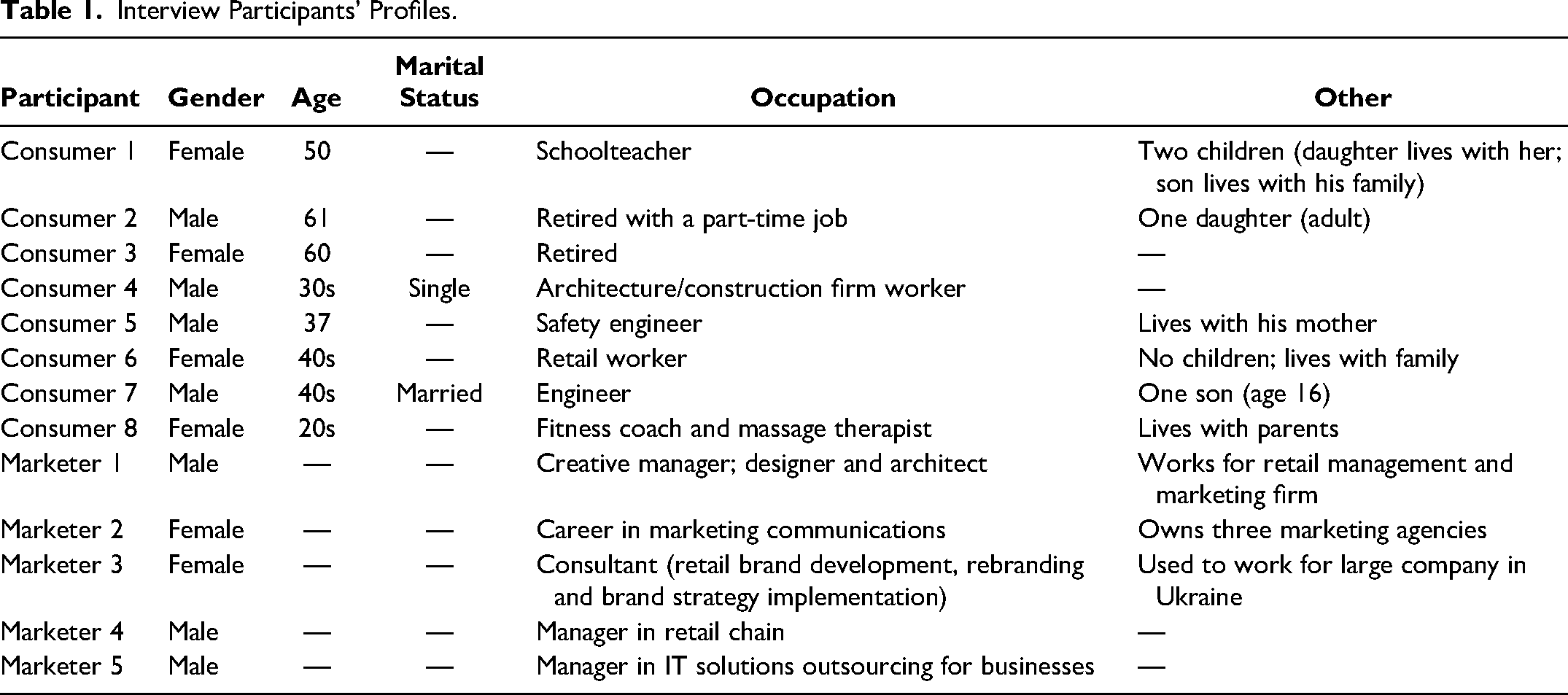
Mindful of our study’s sensitivity, we utilized researcher-generated photo elicitation (Banks 2001). We showed all participants the sourced photographs, asking for their views to elicit reasonings and perceptions of war-related MAA. Visual (including photo) elicitation is a technique suitable for research in vulnerable settings, as shown in prior consumer studies in (natural) disaster contexts (Sayre 2006). One author led all interviews in Russian (their native language and commonly spoken in Ukraine at the time); the second author, a Ukrainian–Russian bilingual, took part in all interviews, offering probing prompts in Ukrainian. Interviews were audio-recorded with participants’ consent and anonymity assurance.
Data Analysis
Analysis of visual artifacts (photographs)
We first sorted the visual artifacts by utilized modes—that is, forms of semiotic meaning generation, such as language, images, or action (Kress 2013; Rossolatos 2015). Identifying the mode(s) as the first step in the analysis distinguishes what generates the meaning of an artifact. We then examined the modes via rhetoric analyses. Rhetoric is the art of persuasion through effective communication (West and Turner 2021). Rhetorical devices serve specific purposes and are strategically applied to persuade an audience; thus, analyzing them enables objective determination of the intended persuasive purpose of the modes deployed (Peeples 2015; Zulkipli and Ariffin 2019). We subsequently converted the visual artifacts of war-related MAA into codes describing their meaning. We grouped the codes into themes for comparative analysis with each other and with the interview data and conceptually related the themes to the literature. One author led the visual analysis; another conducted initial sorting of data into modes, rhetorical devices, and codes. All authors reviewed, discussed, and agreed on the themes and interpretations.
Analysis of participants’ interviews
Interview recordings were translated and transcribed into English by a professional agency, yielding 61 pages of single-spaced text. We followed guidelines for a systematic approach to qualitative data analysis (Gioia, Corley, and Hamilton 2013). The two authors involved in data collection subjected the transcripts to open coding, analyzing marketer and consumer interviews separately (Strauss and Corbin 1998). This stage involved developing in vivo codes that encapsulate the reasonings (marketers) and perceptions (consumers) of the meanings that the war-related MAA convey. The authors conducted open coding independently and then cross-checked, discussed, and reconciled disagreements. Next, using the constant comparative method (Glaser and Strauss 2006), we examined the in vivo codes for differences and similarities within and between transcripts. All authors then conducted axial coding, regularly discussing interpretations and consulting literature to derive theory-grounded themes.
Findings and Conceptualization
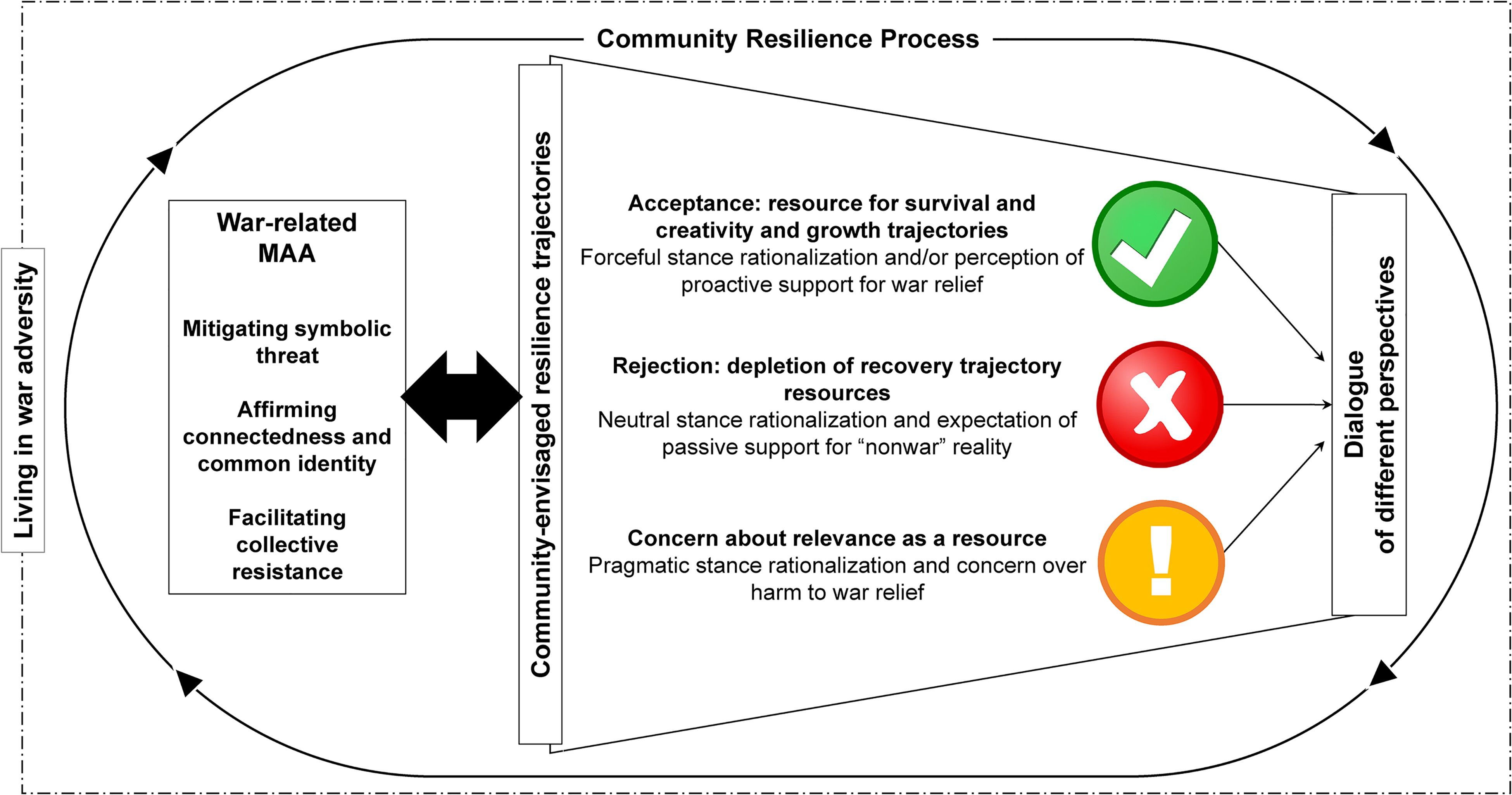
Data analysis and theorization reveal that war-related MAA intentionally evoke and are rationalized to convey meanings related to war adversity. Civilian populations draw perceptual linkages between war-related MAA and psychosocial and cultural resources of community resilience. Yet, they hold differing views on the capacity of war-related MAA to serve as a resource in a particular community resilience trajectory (survival, creativity and growth, and recovery). Triangulating our findings with literature, we show how war-related MAA are harnessed in the community resilience process and facilitate community dialogues concerning resilience trajectories. Figure 1 graphically represents our conceptualization of the role of war-related MAA in community resilience during war. We next provide an overview of the conceptualization; detailed presentation of the findings follows.
A Conceptualization of the Role of War-Related MAA in Community Resilience During War.
A Conceptualization of the Role of War-Related MAA in Community Resilience During War
The analysis of visual artifacts illuminates three forms of meanings evoked by war-related MAA (depicted by the left box in Figure 1). Considered through the community resilience theoretical lens, these meanings represent the following psychosocial and cultural resources for withstanding war adversity: (1) mitigating symbolic threat (Hobfoll et al. 2007); (2) affirming connectedness and common identity (Babayev and Abushov 2022); and (3) facilitating collective resistance (Nuwayhid et al. 2011). The interview data analysis corroborates that both marketers and consumers perceptually link war-related MAA to community resilience in war context (Norris et al. 2008). All participants reported living in war adversity (depicted by the outer line in Figure 1) as a distressing impact on their lives, serving as a backdrop against which war-related MAA are created and interpreted. They uniformly explicated the visuals of war-related MAA as instances of brands/organizations harnessing marketing to generate meanings engaging Ukraine’s peoples’ sociopolitical consciousness.
The analysis also illuminates differences in how participants rationalize the creation of and response to war-related MAA. We categorize these views as acceptance, rejection, and concern. Aligning with the war adversity stances that participants hold and consider war-related MAA to represent, rationalizations of the purpose of these MAA reflect three political positions of marketing activism (Smith and Korschun 2018): (1) forceful (unequivocal and proactive expression of position, given close alignment with values); (2) pragmatic (expression of position, given the issue's significant relevance to brand/organization performance rather than alignment with values); and (3) neutral (abstention framed as a nonpolitical stance, when the issue is neither aligned with values nor relevant to performance).
Acceptance of war-related MAA (depicted with a check mark in Figure 1), expressed by most participants, was reasoned by considering these MAA as one of the means available to civilians for expressing a forceful citizenship stance of defiance, solidarity, and drive toward a new future (Smith and Korschun 2018). We theorize these reasonings to represent perceptual linkages of war-related MAA to the “survival” and “creativity and growth” trajectories of community resilience (Norris et al. 2008). These trajectories require resources to relieve the distress from the lost/deteriorating prewar ways of living and for social action to build new ways of living from the destroyed status quo. Thus, war-related MAA are rationalized and perceived as a resource to be harnessed by marketers and deployed by consumers for resisting aggressors’ threat and power, enacting solidarity, and materializing a reimagining of “good life” and identity (Hobfoll et al. 2007; Kimhi et al. 2023).
Participants who expressed rejection of war-related MAA (depicted with an “x” in Figure 1) distanced themselves from the political reality of war and thus disagreed with marketing being harnessed to imbue the marketplace with war-related meanings. We theorize these views to link war-related MAA (or rather, their absence) with the “recovery” trajectory of community resilience (Norris et al. 2008). This trajectory encompasses seeking to resume ordinary (e.g., nonwar) daily living or a semblance thereof (Kimhi and Shamai 2004), which—in the context of ongoing war—requires resources for maintaining a neutral stance and inaction on war matters (Smith and Korschun 2018). Here, war-related MAA are rationalized and perceived as a depletion of resources for recovering the prewar status quo, manifesting in passive disengagement from these MAA.
The data also illuminated selected participants harboring unresolved concern over the relevance of war-related MAA to community mobilizing in war response (depicted with an exclamation mark in Figure 1). We theorize these concerns as perceiving war-related MAA to be driven by pragmatic intentions that can harm community resilience (Smith and Korschun 2018). Such perceptions manifested in (1) marketers anticipating war-related MAA to be short-term, instrumental, “trend-targeting” activities from brands/organizations that can detract citizens’ attention from the war relief responsibilities of political entities, and (2) consumers considering whether war-related MAA have the capacity to detract communal action from more meaningful resilience resources.
Finally, as Figure 1 depicts, the three views on war-related MAA encompass a form of civic dialogue that contributes to the resilience process despite differences in opinions. Survival, creativity and growth, and recovery are neither linear nor mutually exclusive community resilience trajectories: individual community members respond differently to challenges; thus, varying understandings of resilience can emerge (Kirmayer et al. 2009). Kulyk's (2023) findings on deliberations regarding the content of Ukrainian identity occurring in the period following the Maidan and the 2014 invasion evidence the emergence and interplay of these varying understandings. The strengthening social narrative of the primacy of protecting (survival) and further developing (creativity and growth) Ukraine's new nationhood stands in juxtaposition with a narrative on war as a “senseless” political conflict that should not disrupt the (post-)Soviet “friendly” relationships with Russia's people (recovery). The acceptance versus rejection views on war-related MAA reflect this dialogue.
Contrarily, the views of acceptance versus concern regarding war-related MAA reflect a dialogue on market-based governance—marketplace practices by which actors (brands and consumers) express self-understanding in terms of societally responsible ideas and behaviors (Giesler and Veresiu 2014). Watson and Ekici (2020), in the context of alternative economies, show that individual actors’ shared understandings and commitment toward a common goal can advance market-based social progress initiatives. They also highlight a dark side to market-based governance: some narratives by brands/organizations can shift the burden of societal responsibility away from formal governance structures and mechanisms and place it on individual consumers (Watson and Ekici 2020). Similarly, our findings point to deliberations regarding the potential goals and governance consequences of brands/organizations and consumers deploying (or not deploying) war-related MAA.
That war-related MAA facilitate the preceding dialogues is important because coping with divisions and preserving the sense of cohesion are components of the constructive communal behaviors foundational to resilience (Nuwayhid et al. 2011). That is, the ability to invoke, express opinions on, and effect action via engagement in (or inaction via disengagement from) consumption of war-related MAA provides an outlet for balancing individual and community agency in civilians’ response to war adversity (Otsuki, Jasaw, and Lolig 2018). Of note, Kulyk (2023) demonstrates the progression of the dialogue reflected in acceptance versus rejection views: By 2017, civic attachment had emerged as a new Ukrainian identity feature shared between otherwise differing perspectives, with confrontation abating such that the salience of national (Ukrainian) identity increased among those originally harboring post-Soviet identity, while the inclination to identify mainly in national terms decreased among those harboring anti-Soviet (postindependence) identity. We elaborate on the findings in the following sections.
Meanings of War-Related MAA in Visual Artifacts
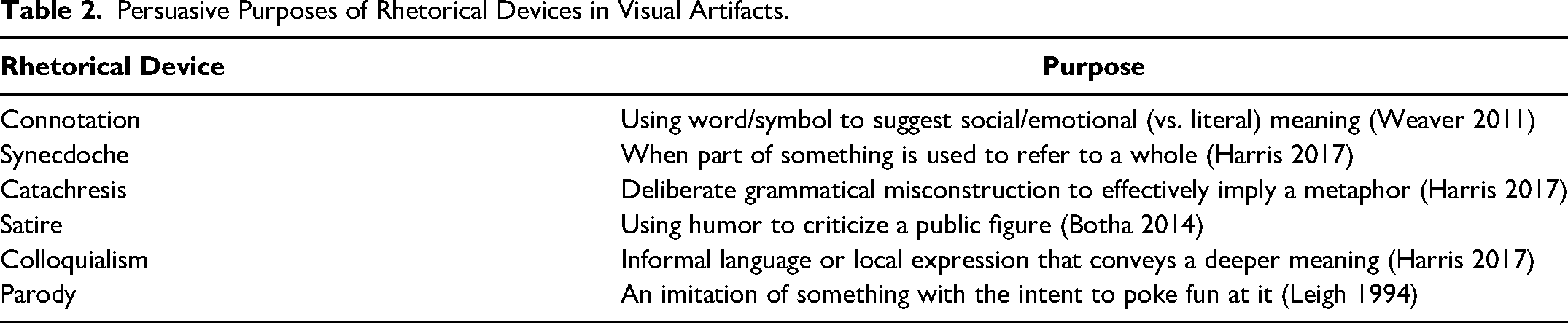
Three themes emerged from the analysis of visual artifacts. Each theme encapsulates a form of meaning evoked by war-related MAA in our sample via utilized action and language modes. “Action mode” refers to practical actions endogenously produced and performed by ordinary social actors to accomplish tasks, conversations, and practices (Dicks 2014). Actions are not accompaniments to textual or verbal practices, but distinct resources effecting meaning (Dicks 2014). In our analysis, actions entail the use of marketing techniques. “Language mode” refers to the use of discursive practice to construct social reality (Rossolatos 2015). Identifying actions and language enabled us to categorize the rhetorical devices employed and their persuasive purposes (see Table 2 for a summary).
Persuasive Purposes of Rhetorical Devices in Visual Artifacts.
All artifacts used a range of actions evoking war-related meanings. These include symbolic references to Ukraine—via designs depicting “vyshyvanka” patterns, a distinctive embroidery feature of a traditional shirt symbolic to Ukraine (Cherednychenko 2024), culturally significant mundane objects (e.g., dill, an herb prominent in Ukrainian cuisine), and Ukrainian flags—and to Russia, via depictions of Russia's head of state or flags. Three artifacts also utilize language. Themes illustrated with selected artifacts are presented next. Web Appendix B presents the visual data and analyses in full.
Mitigating symbolic threat
Meanings captured in this theme were conveyed via the development of brand elements (name—language mode; design—action mode) that drew on the rhetorical devices of satire (Botha 2014), parody (Leigh 1994), connotation (Weaver 2011), and colloquialism (Harris 2017). The “Oberejno Putin!” (“Beware Putin!”) chocolate figurine offers an example of a satirical depiction of Russia's head of state (Figure 2). Satire is a form of aggressive humor that can be used to offer social support (Fritz 2020). Considered in context, this example of war-related MAA conveys ridicule of the Russian state as the war aggressor, pursuing the intent of mitigating the social threat posed by the aggressor and preserving a sense of safety (Hobfoll et al. 2007; Kimhi et al. 2023). The branding of “Ukrop Style” mayonnaise (Figure 3) also employs humor but in a self-enhancing and affiliative form (Fritz 2020). In its primary, literal meaning, “ukrop” translates as “dill,” an herb traditional to Ukrainian cuisine. With the beginning of the war, the term “Ukrop” was used in a public campaign in Russia as a derogatory, “othering” term for Ukrainians (Riabchuk 2016), drawing on the colloquial similarity of both terms’ starting letters (i.e., Ukr[ainian]/Ukr[op]). Self-enhancing and affiliative humor diminish psychological distress (Fritz 2020). Hence, in Ukraine's marketplace during the war, the use of MAA with “Ukrop” as an element of the brand name (language mode) and dill images on packaging (action mode) intends to convey defiance and alleviate the ridicule directed at Ukrainians from Russia by reappropriating the term “Ukrop” (Hobfoll et al. 2007).
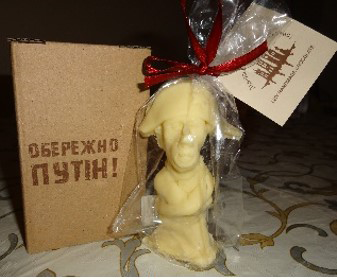
Photograph of “Oberejno Putin!” (“Beware Putin!”) Chocolate Figurine.
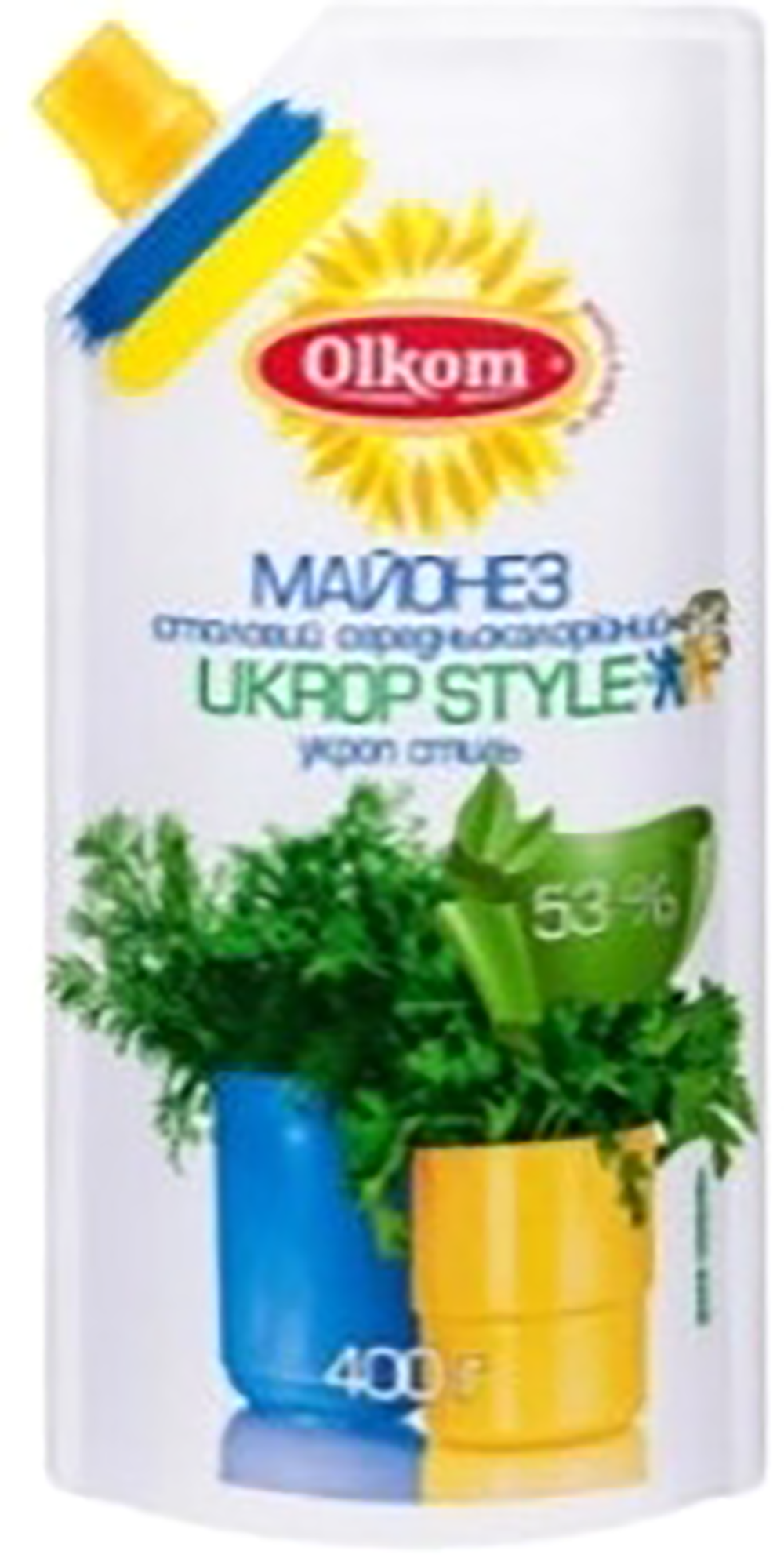
Photograph of “Ukrop Style” Mayonnaise.
Affirming connectedness and common identity
The meanings captured in this theme were conveyed via incorporating vyshyvanka images or patterns into product and marketing message designs (taglines—language mode; product designs, images in advertising—action mode). As a prominent cultural symbol (Cherednychenko 2024), the word “vyshyvanka” has recently been used in reference to both the traditional shirt and the embroidery pattern. The rhetorical devices employed include synecdoche and catachresis (Harris 2017). An outdoor Samsung advertisement (Figure 4) exemplifies this group of war-related MAA, depicting vyshyvanka images and patterns, and the tagline “Evolution is beautiful,” which—in the context of the 2014 Revolution of Dignity—represents a wordplay on “revolution.” The period following 2014 has seen the reappropriation of symbols for visualizing the emergence of a pan-Ukrainian identification, where ethnic-cultural symbols became signifiers of civic belonging and engagement. Hence, in the context of the ongoing war, MAA incorporating vyshyvanka designs aim to assert vyshyvanka as a distinct symbol of this new identity and connectedness via civic values (Babayev and Abushov 2022) and a collective vision of “good life” (dignity and freedom that express the essence of a community; Flockhart 2022).
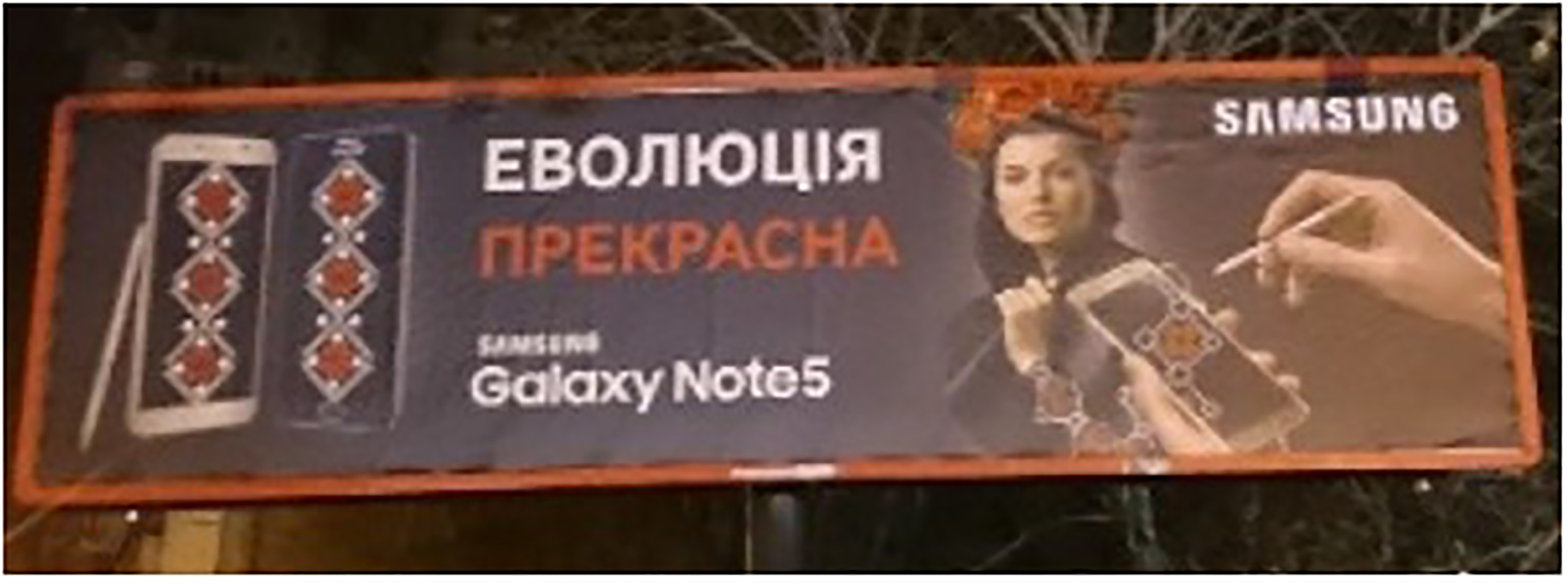
Photograph of Samsung’s Outdoor Advertisement.
Facilitating collective resistance
This theme captures meanings conveyed by retailers via marking the origin of Russian versus Ukrainian products with national flag images displayed next to the brand information and price tags (action mode). All instances of MAA in this theme utilized one rhetorical device: connotation (Weaver 2011). The shelf display in a retail space with the brand “Tyoma” marked with a Russian flag and the brand “Agusha” marked with a Ukrainian flag 5 exemplifies this meaning (Figure 5).
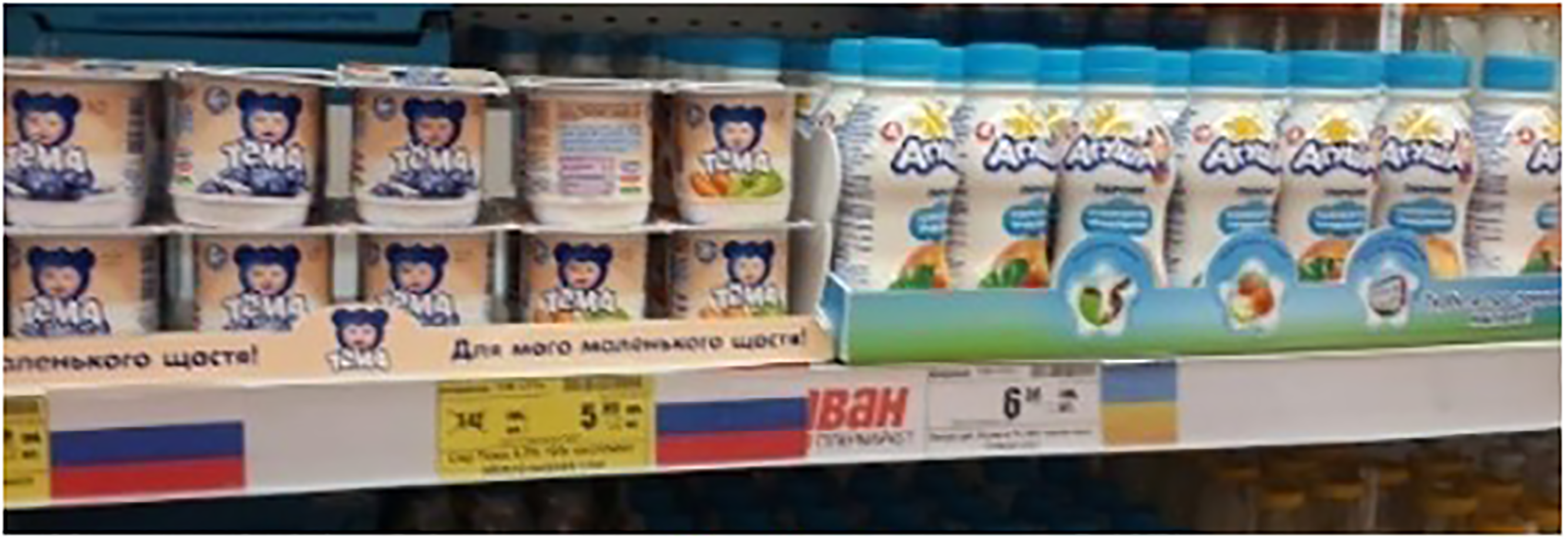
Photograph of a Retail Shelf Display Marking Product Origins with Images of National Flags.
Prior studies document consumers’ use of product origin in boy-/buycotting (Fernandes 2020). Our findings show a different use of product origin whereby marketing actions explicitly promote origin information to consumers. These MAA convey acknowledgment of the potential significance of boy-/buycotting for consumers, intending to enable collective action, which here takes the form of resistance to the aggressor's economic power (Nuwayhid et al. 2011).
Marketers’ and Consumers’ Perceptions of War-Related MAA
Analysis of interview data elicited four themes theoretically linked to community resilience as a process of positive adaptation and functioning by Ukraine as a community experiencing war (Eshel and Kimhi 2016; Norris et al. 2008). Themes are presented with exemplar excerpts from the data as illustrations. 6 Web Appendix D provides extended quotes.
Living in war adversity
Consistent with the literature on the psychological impacts of war in civilian populations, most participants manifested a state of distress. Some manifested generalized anxiety (Kimhi and Shamai 2004) over uncertain present, future, and economic hardships resulting from the war and impacting their quality of life. Consumer 2 explains how uncertainty is a lived experience shared by all citizens: “Life became somehow uncertain in a way, that is, it is not clear what one could hope for, what to rely on, what will happen tomorrow or the day after tomorrow. […] Not only me, but, as far as I can see, everybody else. […] And you know yourself, that the worst thing in life is uncertainty […] it's a rather stressful state.” Some participants expressed a belief that hardship is a worthy price to pay for freedom and hope for a better future: “For the last two years I would say that the majority of the population had to tighten their belts and concerning freedom, it became much easier to breathe, and there is hope for the future” (Marketer 5). Others expressed hopelessness: “I personally supported it [Maidan], also went to Maidan, but now […] I am disappointed. […] The living standards have fallen. Everything is aimed at survival” (Consumer 7).
Distress also emerged as an expression of avoidance behaviors—that is, distancing from war (Kimhi and Shamai 2004). Some participants discussed war as a political event that does not translate into interpersonal relationships between Ukraine's and Russia's citizens, as Consumer 8 exemplifies: “I don’t watch TV and do not listen to these things much, and I have a totally different opinion about this. I treat all people normally, no matter from what country they come from, what has happened to them. Even if it is Russia, no matter what the conflict is now, I’ll communicate with them normally.” Marketer 1 expressed similar views concerning work relationships: “[Discussing product origin markings] I am not a proponent of this. [Interviewer: Why?] Because here, as I’ve already said, I just have acquaintances in Russia […] and because we communicate at international festivals and competitions, we understand that there is a lot in common between ordinary people of our countries.” Participants’ lived experiences in war adversity influence their reasonings regarding and interactions with war-related MAA, as shown next.
Acceptance of war-related MAA as a resource for the “survival” and “creativity and growth” community resilience trajectories
Most participants considered war-related MAA to have a role in society's response to war and rationalized them as a proactive response to war adversity (Smith and Korschun 2018). However, their opinions differed on the substance of the meanings evoked by specific MAA.
Reflecting linkages to the community resilience “survival” and “creativity and growth” trajectories (Kimhi and Shamai 2004), participants regarded MAA representing the “mitigating symbolic threat” meaning distilled in visual analysis to materialize and support the defiance of war adversity by transforming the aggressor's narratives with humor. Marketer 2, commenting on “Oberejno Putin!” chocolate, exemplifies a view that these MAA harness aggressive humor to ridicule—and thus minimize—the aggressor (Fritz 2020; Kimhi et al. 2023): “Oh, this [the chocolate] is mockery. I think this is not even humor, it's just mockery […] it's more like some emotional discharge. […] Someone is going to smile, others will react otherwise, and someone will buy and eat it. […] Ukraine is rather positive in principle, as a country. Historically, I think, people laugh more than cry.” Consumer 4, commenting on “Ukrop Style” mayonnaise, explains their positive response by elaborating that MAA harnessing self-enhancing and affiliative humor do so to provide psychological relief (Fritz 2020; Hobfoll et al. 2007): “I like it [the mayonnaise]. [Interviewer: And why?] Why? Because it makes life more joyous. (Laughs.) […] When I pay attention to people's faces, in the morning on the taxi-bus or metro, people used to communicate, and now everyone is sitting staring fixedly down. Maybe it's the weather … But usually, well, people have changed a bit. The information depresses psychologically, it works subconsciously, that everything is bad, bad, bad ….” In sum, these participants regard MAA as resources relieving the sense of threat exerted by the aggressor and preserving the sense of safety and calm (Hobfoll et al. 2007).
Participants’ reasonings of positive responses to MAA identified in visual analysis as representing the “affirming connectedness and common identity” and “facilitating collective resistance” meanings indicate that these MAA reinforce the new “pan-Ukrainian” identity and mobilize communal solidarity (Babayev and Abushov 2022; Razumkov Ukrainian Centre for Economic and Political Studies 2016). For example, Marketer 3 explains these MAA as representing a multiactor action in the marketplace, whereby corporate organizations, comprised of Ukraine's citizens, harness available means to relieve war adversity for community members (Otsuki, Jasaw, and Lolig 2018) while consumers also drive these actions as they seek means of enacting new communal identity and connectedness (Babayev and Abushov 2022; Ben-Atar 2018): Many [business] owners […] are patriots in a good sense of the word, rational patriots, who try to do something for the country, for the army, for development on the whole by some concrete actions and not only in this fashion. And these elements are their way of showing that […] these marks, saying “Made in Ukraine” and “Made in Russia,” decoration of cars [with vyshyvanka patterns] and various Ukrainian symbols in the elements of design, now it's no longer a fashion or an expression of marketing, it's one of the necessary elements. […] Even though the consumers act very rationally now, they started to look very attentively at the producer country, there can be no doubt about it. And the other aspect is […] the emotional consumer, who has already got immersed into the idea of the national self-identification.
Consumer participants echoed the latter sentiment, articulating that MAA representing themes of “affirming connectedness and common identity” and “facilitating collective resistance” visualized the “remaking of Ukraine”—a metaphorical expression used by one of the participants. This metaphor encapsulates the emergence of collective imaginaries, narratives, and actions reflective of community resilience elements such as “good life” (Flockhart 2022) and visible, shared (and thus resilient) identity (Babayev and Abushov 2022; Ben-Atar 2018). Consumer 2 exemplifies how war-related MAA enable expressions of dignity and freedom through resisting the aggressor's economic power: “There is this undeclared war going on, so this is done in order not to support the aggressor, not to strengthen its economy. It's an expression of displeasure […] to express this, maybe in a passive manner, but express it all the same.” Consumer 4 highlighted that war-related MAA symbolizing the pan-Ukrainian identity emerged in response to war adversity, noting that they are developed and deployed by brands and organizations as a gesture of communal solidarity: “People of different nationalities [ethnic groups] unite when there is a disaster. Maybe not so much due to their goals but rather because of resentment, that is, the way, how they were treated. […] It does not matter where you grew up and what your nationality is, what is important is what are you thinking and how you’ve been brought up. [… Interviewer: So, then, what do these elements, embroidered shirts, what do they symbolize?] […] That one lives here, that one was born here. […] This [marking of origins] gives nothing to politicians, it's rather businessmen, it's business that gets the blow. […] It's a remaking of something.” Together, these quotes highlight a perception shared by marketers and consumers alike of war-related MAA as grassroots resources for enduring and defying war adversity to create a better future together, rather than state instruments of propaganda (Kimhi 2016; Norris et al. 2008; Scriver 2015).
While positively perceiving war-related MAA generally, a subset of participants expressed dislike of specific forms of MAA, acknowledging this as personal aesthetic, not moral preference. Consumer participants considered other marketplace resources more appropriate to evoke war-related meanings: “[Commenting on MAA utilizing vyshyvanka] my attitude is that ‘if they like it, let them do it,’ I will not do this. If I’m going to like some pattern, maybe I’ll buy […] a T-shirt with such a pattern. But I don’t really like this” (Consumer 8); “I do not need to buy Persil in order to have an embroidered shirt. I’d rather choose an embroidered shirt that I like and buy it” (Consumer 7). These critiques highlight that consumer evaluations of a given example of MAA in terms of utility for community resilience were underpinned by critical considerations of actions (product design, advertising visuals, and messages) and rhetorical devices harnessed in execution (Zulkipli and Ariffin 2019). Marketer 3 cautioned that a lack of marketing sophistication could unintendedly evoke adverse responses: “The national idea, national self-identification. […] People just need a different presentation of it. […] Neither producer, nor retailers have used any specific, competent marketing moves. The majority of producers only go as far as painting it in the colors of the national flag, drawing the Coat of Arms, writing ‘Made in Ukraine,’ and basically … ah, and they would also produce an embroidered shirt, and here it all ends. In certain cases, this leads to the opposite result, when this is done too ostensibly, and in my opinion, not sincerely.”
Such reflections illuminate the importance of marketers recognizing that consumer interpretations of and responses to war-related MAA are guided not only by the proactive political position expressed, but also by how this position is conveyed (e.g., with what actions and rhetorical devices).
Rejection of war-related MAA as a disruption to the recovery community resilience trajectory
A subset of participants expressed negative views of war-related MAA. While also rationalizing these MAA to represent a proactive, forceful response to war adversity (Smith and Korschun 2018), consumer participants in this subset harbored a preference for a neutral position, which translated into a preference for brands/organizations to remain silent on war adversity. That is, these participants perceived war-related MAA as potentially destabilizing routine activities in the marketplace, considered a space for daily life rather than political actions. Commenting on “Oberejno Putin!” chocolate, Consumer 6 offered an individual perspective: “Protest. […] I am a peaceful little person, I don’t care, I am not for or against anything, I live my own life, and that's it.” Such response is representative of avoidance behavior whereby one distances from war as a lived reality, enacted in the context of the marketplace and consumption (Kimhi and Shamai 2004).
Consumer 8, commenting on origin markings, expressed a view that the war as a political event should not impact the relationships between the civilian populations of two countries (Ukraine and Russia), reflective of a post-Soviet perspective (Rafalskyi et al. 2022): “I am not concerned whether it's Russia or Ukraine, if I like a product, […] I’ll buy it. […] It's not our fault that we’ve found ourselves in such a situation because of our governments. Let them fight between themselves, I don’t think that we should fight.” Through the community resilience lens, these perceptions can be understood as a disruption to resuming the rhythms of daily life, characteristic of the recovery trajectory of resilience—in our context, envisaged as the return to or maintenance of the prewar status quo (Kimhi and Shamai 2004). Hence, consumer participants’ rejection of (disengagement from) war-related MAA is explicated by the perception that these MAA are misaligned with their favored trajectory and potentially depleting resources available for it.
One marketer expressed a reactive stance in relation to consumers’ differing perspectives on war-related MAA, coupled with active resistance to government interference in community members’ freedom of choice to engage with or disengage from war-related discourses in the marketplace: “We said that the buyers will decide, and to make their choice conscious, on each product we’ll write the country of its origin, so we have the country marked on the price tags. […] The local authorities, and I’ll reiterate that this is not altogether legal, they demanded to place Russian products on a separate shelf so as to mark them in this way. But what we’ve done was to mark the country of origin on each product. In essence, we said that the decision will be made by the consumer” (Marketer 4). Of interest, this viewpoint is also reflective of a neutral position (Smith and Korschun 2018) taken by a brand/organization as well as the high autonomy from government characteristic of Ukrainian society and the community resilience concept (Kimhi 2016; Kudlenko 2023). However, marketer and consumer participants’ discussions of war-related MAA in this theme highlight an important difference in how they understand the meaning of marketing being neutral. Consumers perceive neutrality as brands/organizations enabling consumers to avoid war considerations in decision-making. Marketers perceive neutrality as dispassionate transparency to enable consumers’ freedom in whether to engage with war considerations in decision-making.
Concern about relevance of war-related MAA as a community resilience resource
The final theme encapsulates selected participants harboring concerns about the motivations of war-related MAA being purely instrumental, designed to advance the brands’/organizations’ standing in the marketplace (Smith and Korschun 2018). The presence of these war-related MAA in the marketplace was considered as having the potential to harm the resilience effort. Marketer participants rationalized deployment of war-related MAA by brands/organizations as a means for boosting sales, a short-term marketing trend set to disappear. Marketer 4’s comment on “Oberejno Putin!” chocolate illustrates this view: “At present I understand that this is one of the niches, which allows [businesses] to sell more and earn more. It does not matter that this has some aspect, which is caused by all those moods and protests, which are present in society at the moment. However, if there is no business logic in all this, it will stop very quickly.” This view is reflective of a practice of pragmatically capitalizing on trends in the public's social consciousness, akin to woke-washing (Sobande 2019).
Importantly, while not necessarily regarding war-related MAA as woke-washing, some consumer and marketer participants shared a concern about these MAA “replacing” the sense of responsibility for participating in war relief efforts. Consumer 5 expressed concerns about the ethics of organizations continuing to sell Russian-origin brands: “I cannot explain this marketing move, but as they [retailers] explained this to us, a person has a choice, whether to buy a Ukrainian product or a Russian product. But in fact, why do they buy them in Russia to sell them here, to us, what for?” Marketer 1 highlighted concern over the government delegating responsibility for boycotting decisions to citizens: “We have hung this out, and now, in essence, it’s not you who is making a decision to buy this product or not, but as you approach it, you are already dominated by the general situation in the country, by the general tendency, that Russia is an aggressor and Ukraine suffers some … Well, on the political level this is what is indeed happening, but on the economic level—for me it would seem right to stop all economic relations on the State level.” In sum, concerns expressed by our participants suggest the relevance of safeguarding against misuse or appropriation of war-related MAA by both marketers and other marketplace actors.
Discussion and Implications
The process of community resilience pierces the present and the past of the war (Kudlenko 2023). It is therefore valuable to consider how war-related MAA are situated in the evolution of community resilience. To this end, we continued to observe war-related MAA in Ukraine—originally hoping to arrive at a postbellum perspective. While the timing of the war’s end remains uncertain, our observations highlight that—contrary to the predictions made by the marketers interviewed in 2014—the deployment of war-related MAA is growing. Private brands/organizations, identified in our study as the sole initiators of war-related MAA, continue to deploy them, broadening their forms. After the 2022 full-scale war launch, we also noted other types of organizations and political entities, including social enterprises, public organizations, and government officials, joining in the development of or engagement with war-related MAA (see Web Appendix E for examples). The conceptualization of the role of war-related MAA in community resilience during war (Figure 1) drawn from our findings, considered alongside observed entrenchment of war-related MAA in Ukraine, offers contributions with several theory and practice implications.
Implications for Theory
The article makes three theoretical contributions. First, we extend the literature on marketing and war (e.g., Barrios et al. 2016; DeQuero-Navarro et al. 2020) by theoretically and empirically illuminating the value of the community resilience concept for enriching the understanding of the role marketing can play for war-affected people. The macromarketing perspective prevalent in this nascent stream (e.g., Shultz 2016; Shultz et al. 2020) conceptualizes marketing as an institutional mechanism mitigating the vulnerability of war-affected populations. Taking a microlevel view, our study and conceptualization portray marketing outputs (e.g., war-related MAA) as a resilience resource deployed by war-affected populations, despite their contextual propensity for vulnerability.
In so doing, we join calls for a multidimensional consideration of vulnerability versus resilience of distressed populations. In consumer research, a pertinent argument is offered by Baker (2009, p. 116), who draws on the context of communities affected by natural disasters to caution against perspectives on these communities’ vulnerability that “[limit] human potential and [marginalize] individuals in those groups.” In other fields, too, literature advocates for converging resilience and vulnerability perspectives in disaster relief frameworks and policies to nurture resilience and mitigate vulnerabilities, depending on the prevalence of one or the other in communities’ experiences (Eshel and Kimhi 2016; Miller et al. 2010). Our findings corroborate that communities affected by human-made (war) disasters are capable of effecting prosocial outcomes.
Taking a community resilience lens is also important because communities are often overlooked in favor of a focus on state actors although “state actors represent communities and peoples on the ground and are an outcome of the local milieu” (Kalra 2022, p. 238). The community resilience lens brings nonstate actors (in our case, informal civil society) into sharper focus. By examining the dynamic interactions of civilian populations with marketing activities as they experience and survive wars, we highlight the emergence of war-related MAA as a marketplace manifestation of a horizontally evolving notion of citizenship, complementing research into citizen consumer responsibilization (Coskuner-Balli 2020).
Second, we contribute empirical insights to the growing body of marketing activism literature (e.g., Moorman 2020; Vredenburg et al. 2020), taking a unique contextual perspective of sociopolitical conditions this literature has not yet considered—war. We show that the range of objectives that marketing activism can pursue is broader than its original conceptualization as a drive for positive social progress from an established status quo (Eilert and Cherup 2020). Our study adds the perspective of marketing activism pursuing societal survival and recovery, as well as creativity and growth in response to war adversity where the status quo is destroyed or significantly damaged. Our findings also extend conceptually derived characterizations of different political positions by brands and organizations (Moorman 2020; Smith and Korschun 2018). Specifically, we contribute two important insights on the underlying drivers of consumer response to expressions of these positions. First, we provide evidence that what determines how consumers judge marketing activism is not only the political position but how (e.g., with what actions and rhetorical devices) this position is conveyed. Second, our data underscore that pragmatically capitalizing on a community's sociopolitical mobilization may generate short-term outcomes but can backfire in the long term if the community comes to understand marketing activism as insincere and purely instrumental.
Finally, our findings make an interdisciplinary contribution. By showcasing the role played by war-related MAA as resources of community resilience, we highlight the value of integrating community resilience and marketing activism research in the development of frameworks designed to support people affected by sociopolitical disasters. Extant community resilience frameworks (e.g., Korosteleva and Petrova 2021; Norris et al. 2008) identify visions and narratives of “good life,” organizational linkages, and enacted social support as components of resilience. We show that war-related MAA contribute to these components, although, thus far, they are not recognized in community resilience frameworks.
Implications for Policy Development
Policies concerned with war relief are called to leverage resources for community resilience (Nuwayhid et al. 2011). Our empirically informed conceptualization of the role of war-related MAA in community resilience during war (Figure 1) opens several public policy development directions for marketing practice, organizations, and governments.
For marketing policy development, the most important implication stemming from our study is that marketing can positively impact war-affected people and communities during war, by providing them with resources that they can mobilize. Deprivation of psychosocial, material, and structural resources for withstanding war adversity impacts the postwar rehabilitation outlook for affected populations (Hobfoll et al. 2007; Somasundaram and Sivayokan 2013). Marketing capability, if available within communities, can and should be harnessed and adapted quickly for creating war-related MAA, thus providing resources for mitigating the suffering of communities as they experience war.
We stress that a mindful and cautious approach to war-related MAA is paramount. As our findings highlight, these MAA can only be leveraged for war relief when their meanings are perceived as sincere and dissociated from pragmatic sales and market-share pursuits. These findings add war-contextualized insight to the broader discourse on the potential dark consequences of market-based governance (Giesler and Veresiu 2014). Extant literature advocates for mitigating these consequences via (1) brand-level policies and industry-standard guidelines, to facilitate social tuning of marketing activism; and (2) building networks and partnerships involving marketers and members of the public to broaden marketers’ exposure to and consideration of divergent sociopolitical beliefs (Costa and Azevedo 2023; Schmitt, Brakus, and Biraglia 2022). Mitigation strategies are recommended to address societal concerns such as cause misrepresentation and woke-washing (Sobande 2019). Such concerns are particularly pertinent to address in the development of MAA invoking meanings associated with political violence. Recent brand activism studies (e.g., Johnson, Li, and Mitchell 2024; Mwencha and Njuguna 2023) highlight that, in the fallout of violence-associated crises, invoking wrong meanings and remaining silent is equally risky for brands/organizations since contemporary consumers actively convey disapproval.
By considering these broad guidelines alongside our conceptualization, we offer several policy development recommendations for war-related MAA. Marketing training/education governing bodies and providers can produce development materials to expose marketing professionals to the community resilience capacity of war-related MAA and impart skills for responsibly approaching their use. Similarly, international and Ukraine-based marketing associations and bodies that develop industry standards can provide guidelines for conduct. A related direction concerns organizational self-regulation, particularly important if war-related MAA grow and evolve as a phenomenon in and beyond Ukraine. Private organizations could introduce internal procedures for critically sense-checking which forms and rhetorical devices to utilize when ascribing their brands with meanings of war-related MAA. In these considerations, private organizations can draw on social media listening and sentiment analysis to examine consumer perceptions of and responses to existing war-related MAA. Global organizations should play a major supporting role here; they can conduct these analyses and share findings in open sources. Critical sense-checking should entail a comprehensive consideration of the full variety (positive/negative/doubtful) of consumer views to recognize the complexity and nuances of lived experiences in war adversity.
The development of the aforementioned policies is crucial since failures or misappropriation of war-related MAA can have grave consequences. Failures by private organizations to authentically convey war relief intentions may result in war-related MAA becoming (or being perceived as) an instrument for promoting the interests of economic elites—an underexplored, yet distinct, form of propaganda (Herman and Chomsky 1988). More widely, public and state-owned entities’ failure to consider and distinguish whether they represent war relief meanings emerging from the community or the government/state risks war-related MAA morphing into a warfare propaganda tool. One example of an action advanced by a state-owned organization is provided by Ukrposhta, Ukraine's state postal service. Ukrposhta released a stamp featuring the “Russian ship go f**k yourself!” expletive, which became a symbolic call of defiance in the early days of the 2022 invasion 7 (Harding 2022). While in Ukrposhta's case the evoked meaning emerged from the community, war-related MAA deployed by state-owned organizations or for state-evoked narratives is reminiscent of Bernays’s (1942) vision of marketing's role in wars. Should such deployment evolve into a prevalent trend, the distinction between marketing activism and propaganda may become blurred. Notwithstanding the debate about propaganda as a phenomenon, given historically ingrained connotations of its nefarious goals (Scriver 2015), perceptual links between war-related MAA and propaganda may pose risks to the community resilience capacity of MAA. Hence, organizational procedures should prompt interrogation of the content of MAA and consideration of the potential unintended consequences of their deployment.
Consequently, to preserve the capacity of war-related MAA as a community resilience resource, government entities must be mindful of the difference between empowering versus misappropriating marketing capabilities. The emergence of war-related MAA as a community resilience resource in Ukraine was contextually enabled by Ukraine's informal civil society, which is highly capable of self-organizing and deploying marketing (Kudlenko 2023). Indeed, alongside social transformations, the Maidan served as a powerful driver of Ukraine's marketplace and marketing system development. In the 2014–2022 period, research highlights a significant growth of economic and cultural projects to support entrepreneurial activities, startups, the creative community, and advancement of marketing capabilities facilitated by platforms for small businesses (Pesenti 2020). This growth and the self-organizing capacity of the informal civil society appear to have created conditions that empowered marketers in harnessing war-related MAA. To this end, alongside empowering the informal civil society (Kudlenko 2023), government policies nurturing creativity and marketing capabilities can be valuable since war-related MAA serve as a resource for bottom-up community response to disasters. These policies should explicitly consider whether government entities initiating war-related MAA might disempower bottom-up processes and disable the capacity of war-related MAA as a dialogical resource within communities.
In sum, we provide evidence for the idea of heightened human rights due diligence offered by the United Nations Working Group on Business, Human Rights and Conflict-Affected Regions, which states that “even if business does not take a side in the conflict, the impact of their operations will necessarily influence conflict dynamics” (United Nations 2020, p. 10). Hence, stakeholders must be engaged in due diligence. The community-based perspective is a fruitful source for informing contextual policies by both transnational and state government entities and organizations. Alongside stakeholders, due diligence will benefit from marketing professionals’ input, particularly in outlining ethical considerations for marketing activism.
Limitations, Future Research Avenues, and Concluding Remarks
Our study has limitations opening future research directions. Since community resilience is context-bound, our insights are limited in generalizability across all war-affected locations. Gaining a more all-encompassing understanding of the role of war-related MAA in community resilience requires further deeply contextualized studies in other locations. We examine war-related MAA in a country with a developed, functioning marketing system. Extending into war contexts where marketing systems are less developed, or have been destroyed, can nuance our knowledge. Future research should consider linkages of war-related MAA to other forms of social resilience, such as national resilience. Community and national resilience are not mutually exclusive (Kirmayer et al. 2009); thus, examining how war-related MAA situate in these processes simultaneously is valuable. We also note that our study was geographically limited to one city in Ukraine (Kyiv). Hence, nationwide studies are needed. Further, we opted not to conduct member (participant) checking of our findings given the practical complexity of doing so in war settings and ethical considerations of participants’ distress. While member checks are less relevant to theory development goals, as is the case of our study, future research pursuing theory validation and refinement can consider participatory and collaborative methods to incorporate member checks (Thomas 2017). Finally, studies of war-related MAA in postwar contexts are needed since some of their meanings (such as safety; Hobfoll et al. 2007) can be theoretically expected to lose relevance after the war. It is necessary to identify salient postbellum community resilience components and examine whether war-related MAA are relevant to these components. In our view, the most pertinent research avenue remains the development of evidence-based theories explaining how war-related MAA can contribute to the resilience of war-affected populations while safeguarding against the potentially harmful effects of their misuse.
Supplemental Material
sj-pdf-1-ppo-10.1177_07439156241262983 - Supplemental material for The Role of War-Related Marketing Activism Actions in Community Resilience: From the Ground in Ukraine
Supplemental material, sj-pdf-1-ppo-10.1177_07439156241262983 for The Role of War-Related Marketing Activism Actions in Community Resilience: From the Ground in Ukraine by Eva Kipnis, Nataliia Pysarenko, Cristina Galalae, Carlo Mari, Verónica Martín Ruiz and Lizette Vorster in Journal of Public Policy & Marketing
Footnotes
Acknowledgments
The authors would like to express their sincere thanks to all participants in this project for generously sharing their insights. The authors also would like to thank the JPP&M review team for their very helpful recommendations on the earlier versions of this article.
Author Contributions
Author order reflects the following author involvement: the first two authors, who coled the conceptualization and empirical work on this article, are listed in order of contribution; all remaining authors, who contributed in equal proportions to conceptualization and writing of this article, are listed in alphabetical order.
Joint Editors in Chief
Jeremy Kees and Beth Vallen
Special Issue Editors
Clifford J. Shultz, José Antonio Rosa, and Alan J. Malter
Declaration of Conflicting Interests
The authors declared no potential conflicts of interest with respect to the research, authorship, and/or publication of this article.
Funding
The authors disclosed receipt of the following financial support for the research, authorship, and/or publication of this article: This article is an outcome of a research project that received internal funding from Coventry University, which was the institutional affiliation of Eva Kipnis at the time of funding.
Notes
References
Supplementary Material
Please find the following supplemental material available below.
For Open Access articles published under a Creative Commons License, all supplemental material carries the same license as the article it is associated with.
For non-Open Access articles published, all supplemental material carries a non-exclusive license, and permission requests for re-use of supplemental material or any part of supplemental material shall be sent directly to the copyright owner as specified in the copyright notice associated with the article.
