




Abstract
Following the outbreak of the war in Ukraine in February 2022, many global brands took a stand on the crisis, which often elicited polarized consumer responses. This study explores this phenomenon—peace brand activism (PBA)—by conducting an inductive analysis of global brands’ responses to the Russia–Ukraine war as disclosed on social media channels across three different platforms: Facebook, Twitter, and Instagram. The analysis highlights the range of PBA tactics that global brands employ, revealing diverse action- and statement-based forms that they can adopt, including instances of pseudo-activism. In addition, this study identifies seven key characteristics of PBA: substantiality, nature, side-taking, location specificity, responsiveness, persistence, and diversity, each manifesting across spectra of differential ends. This work elucidates the evolving role of businesses in promoting peace and offers valuable guidance for managers navigating the complex terrain of PBA, emphasizing the importance of brands being cognizant of the various PBA options and thoroughly weighing the implications of taking a stand on sensitive geopolitical issues. The findings bear important policy implications, suggesting that policy makers must consider PBA's impact on bilateral relations and collaborate with brands to develop informed, strategic PBA initiatives. Finally, the authors outline important avenues for future research.
Following the outbreak of the Russia–Ukraine War in February 2022, many global brands publicly took a stance against the conflict. As brands turned to social media to disclose their initiatives, their communications ranged from making mere statements to notifying stakeholders of various actions, including donations, humanitarian aid, and reductions, interruptions, or divestments of their business operations in Russia (Marketing Week 2022). For instance, McDonald's permanently exited the Russian market (Marketing Week 2022), while Nike, BP, Apple, and Google undertook various forms of divestment from Russia (Financial Times 2022). These activities fall under the broad umbrella of brand activism, reflecting efforts to express stances on divisive sociopolitical matters that affect society at large (Mukherjee and Althuizen 2020) and “shape policy in ways that favor one group over another” (Weber et al. 2023, p. 79)—in this case, promoting peace over war and violence. We refer to this form of firm-level sociopolitical activism as peace brand activism (PBA); 1 that is, promoting peace or opposing conflict or violence. We treat nonviolent brand stances in response to ongoing wars and geopolitical conflicts as activism for peace in the face of such conflicts. 2 This approach aligns with a considerable portion of peace research focused on wars, conflicts, and their prevention or elimination, also known as negative peace activism (Gleditsch, Nordkvelle, and Strand 2014). 3
The literature establishes that brand activism, regardless of the issues it advocates, has fundamental consequences on consumer behavior, firm performance, and society (Hambrick and Wowak 2021); however, PBA is unique and bears key implications, necessitating its separate study. Geopolitical conflicts have severe and life-threatening consequences that disrupt everyday activities, including business operations (Gleditsch et al. 2002). Consequently, wars and conflicts that disrupt peace demand greater urgency than less disruptive sociopolitical issues and garner considerable public attention, eliciting increased consumer demands that relevant stakeholders, including marketplace actors, respond to the atrocities and irregularities caused by violence (Tosi and Vitale 2009). Accordingly, companies often align their brands—whether voluntarily or because of consumer pressures—with collective actions advocating for peace in the form of the cessation of violence and mitigation of societal losses, suffering, and injustices engendered by wars and conflicts (Clark 2009). Importantly, PBA is distinct from activism on other issues in that it often utilizes and adapts private sector and governmental foreign policy tools such as humanitarian aid and economic sanctions, merging the domains of brand activism with public diplomacy and corporate foreign policy, amplifying or distorting the intended effects in unpredictable ways (Parella 2023). Therefore, unlike corporate social responsibility (CSR) and brand activism, PBA can influence international affairs and threaten the balance of relationships among countries.
Other compelling reasons emphasize the importance of exploring PBA. First, there is no universal agreement on whether and how companies and brands should engage in sociopolitical matters, as such political acts by brands are often subject to questions of authenticity and consumer opposition (Mirzaei, Wilkie, and Siuki 2022). Second, geopolitical conflicts are highly complex and evoke a substantial diversity of viewpoints, as there is disagreement regarding the instigator of a conflict, the underlying causes, and whether the conflict should be resolved nonviolently. Global reactions to the Russia–Ukraine War have been mixed. Whereas many Western countries and consumers have attributed the initiation of the conflict to Russia, some nations in the Global South have been ambivalent about the conflict or even support Russia (Statista 2023). Beyond this, several Russian social media influencers negatively engaged with Chanel's decision to cease product sales in Russia, publicly expressing their dissent by destroying Chanel bags (Chirinos 2022). These examples suggest that despite the widespread appeal of peace (Velez and Gerstein 2021), PBA can evoke opposing responses (Nam et al. 2023). Accordingly, for brands catering to global audiences, venturing into and taking a stance on international conflicts is risky and polarizing, and has unique and potentially enduring implications. Accordingly, PBA is conceptually and practically distinct from CSR activities, falling within a broad spectrum of brand activism (Hambrick and Wowak 2021). Considering these factors, we contend that studying PBA extends beyond examining brand activism within a specific context. Rather, it involves investigating a unique form of activism with nuanced features and characteristics.
Although there is a rich literature on corporate sociopolitical activism (e.g., Eilert and Nappier Cherup 2020; Hambrick and Wowak 2021; Vredenburg et al. 2020), little has been said about how corporate entities engage in peace-oriented stances in response to international conflicts. Therefore, we aimed to attain a more comprehensive understanding of PBA. We argue that clarifying PBA is essential because the absence of a clearly developed conceptual apparatus limits efforts to comprehensively examine both its causes and outcomes. Accordingly, we seek to address two related concerns: (1) How do brands engage in PBA? and (2) What are the characteristics of PBA? We consider the answers to these two questions as an important first step in advancing research on this phenomenon.
To address these critical questions, we employed an inductive approach and analyzed our data using thematic content analysis. We conducted a comprehensive mapping of PBA by conducting an extensive, empirically driven analysis of PBA disclosures on social media by global brands, as presented in their official social media channels across three key platforms—Facebook, Twitter, 4 and Instagram—with the Russia–Ukraine War serving as the context for our investigation. Although brands can use other media platforms to communicate their stances, in recent years, social media has become a key vehicle for disclosing stances on key social issues to stakeholders (Batista et al. 2022). This is because of the ubiquitous use of social media by consumers and its potential to track consumer reactions in real time (Batista et al. 2022).
Our findings identify various action- and statement-based forms of PBA that emerge from a range of tactics that global brands employ and delineate seven key characteristics that shape PBA. We draw on these findings to highlight the range of theoretical, managerial, and policy making implications of our work. Regarding theoretical implications, we highlight the linkages between PBA and brand activism, public diplomacy, and peacemaking literature, and we enhance the knowledge of how the marketplace potentially contributes to peacemaking (Barrios et al. 2016) through activities designed to resolve conflict, minimize war losses, and restore peace (Clark 2009). We also highlight key considerations for brands and policy makers regarding brand involvement in international conflicts. Following our investigations and discussions, we conclude with a comprehensive future research agenda designed to guide further investigations into the nascent topic of PBA.
Theoretical Background
Brand Activism
Traditionally, because of concerns about alienating customers, brands have been reluctant to engage in discourse on contentious social or political issues (Hydock, Paharia, and Blair 2020; Vredenburg et al. 2020). However, companies have recently increased their involvement in such issues, which are sometimes unrelated to their bottom lines (Hoppner and Vadakkepatt 2019). Brand activism is a form of firm-level sociopolitical activism, otherwise referred to as advocacy (Weber et al. 2023), that revolves around “business efforts to promote, impede, or direct social, political, economic, and/or environmental reform or stasis with the desire to promote or impede improvements in society” (Sarkar and Kotler 2018, p. 34). It materializes through a range of activism tactics, including statements, communication campaigns, internal reforms (e.g., supplier boycotts), and tangible contributions to support the issues advocated, such as in-kind or monetary donations (Bhagwat et al. 2020; He, Kim, and Gustafsson 2021; Moorman 2020). Fundraising has also been highlighted as a form of online activism, particularly in times of conflict (Lewis, Gray, and Meierhenrich 2014). Brand activism has important consequences, influencing outcomes such as firm value and performance (e.g., Bedendo and Siming 2021; Bhagwat et al. 2020) and customer-level outcomes including perceptions, intentions, choices, and brand outcomes (e.g., Klostermann, Hydock, and Decker 2022; Mukherjee and Althuizen 2020; Schmidt et al. 2022). The outcomes of activist initiatives are not just financial or related to consumer behavior (e.g., Hambrick and Wowak 2021). Stance-taking through brand activism also impacts society, as it helps legitimize the issues advocated (Hoppner and Vadakkepatt 2019).
While related to other ways of affiliating with societal issues, such as cause-related marketing, CSR, or philanthropy, brand activism is distinct, owing to its controversial nature (Vredenburg et al. 2020). This makes brand activism more radical than CSR (Sibai, Mimoun, and Boukis 2021). The chief difference between traditional CSR and brand activism is the extent to which the focal issues are widely favored, as is the case with CSR, rather than being partisan, as happens with brand activism (Bhagwat et al. 2020). Thus, brand activism often results in polarized reactions (Eilert and Nappier Cherup 2020) and sometimes negative outcomes (e.g., Weber et al. 2023). How consumers perceive brand activism is largely influenced by their agreement or disagreement with the advocated stances (Mukherjee and Althuizen 2020) and their assessment of its authenticity (Mirzaei, Wilkie, and Siuki 2022) or the sincerity of the underlying motivation of the brand (Atanga, Xue, and Mattila 2022).
At the most basic level, brand activism can be categorized based on the focus of an issue. Issues explored in the literature include immigration (e.g., Mukherjee and Althuizen 2020; Weber et al. 2023); (anti)abortion (e.g., Mukherjee and Althuizen 2020); governmental opposition (Bedendo and Siming 2021); social justice, equality, and diversity (e.g., Thomas and Fowler 2023; Weber et al. 2023); gender equality (Atanga, Xue, and Mattila 2022); LGBTQ+ rights (Hydock, Paharia, and Blair 2020); climate change (Koch 2020); Brexit; gun control (Hydock, Paharia, and Blair 2020); antidefamation and hate speech (e.g., He, Kim, and Gustafsson 2021); COVID-19 (Atanga, Xue, and Mattila 2022); and support for war victims (e.g., Thomas and Fowler 2023). Some studies examined brand activism without focusing on the issue advocated (e.g., Sibai, Mimoun, and Boukis 2021), whereas others focused on a single issue (e.g., Hesse et al. 2021) or explored several issues concurrently or at different stages of the study (e.g., Mukherjee and Althuizen 2020; Thomas and Fowler 2023; Weber et al. 2023). The issue of focus can be assessed based on characteristics such as issue topicality or divisiveness (Nam et al. 2023), novelty, and controversy (Atanga, Xue, and Mattila 2022). Further differentiation occurs based on whether the issues advocated by the firm are neutral, progressive, or conservative (Vredenburg et al. 2020).
Business entities can implement their activism initiatives at the corporate (e.g., Eilert and Nappier Cherup 2020), firm (e.g., Mirzaei, Wilkie, and Siuki 2022), and CEO/CMO levels (e.g., Hambrick and Wowak 2021) or use their brands as vehicles for activism initiatives (e.g., Vredenburg et al. 2020). Influencers can also embrace activism (e.g., Özturan and Grinstein 2022). Two major forms of activism have been unanimously identified in the literature: statements and actions (e.g., Bhagwat et al. 2020; Klostermann, Hydock, and Decker 2022). In line with this categorization, Chatterji and Toffel (2018) offer a purpose-focused typology of CEO activism related to raising awareness and exerting economic influence. Accordingly, raising awareness corresponds to activist statements, whereas exerting economic influence corresponds to action. Thomas and Fowler (2023) described statements and actions as citizenship and direct support behaviors, respectively.
The literature conceptualizes corporate sociopolitical activism, including brand activism, in several ways. An essential component of brand activism lies within its incidence, and several studies have examined whether activism occurs (e.g., Bedendo and Siming 2021) or whether it is likely to occur (Hoppner and Vadakkepatt 2019). Other studies characterize activism and its different forms—actions and statements—in terms of the commitment of the firm to the brand activism initiative (e.g., Bhagwat et al. 2020; Klostermann, Hydock, and Decker 2022). The latter is otherwise referred to as strength (Hoppner and Vadakkepatt 2019) and is connected to the extent to which the firm dedicates resources and effort to activist initiatives. These notions are closely related to what Hambrick and Wowak (2021) call “activism vividness,” which they examine at the CEO level and identify as an overarching characteristic of activism. According to this work, activism vividness is determined by its deviation from a firm's core business, its focus on societal issues and their corresponding divisiveness, its unexpectedness, riskiness, coexistence with similar attempts by other firms, and speed.
More recent research also acknowledges the speed at which firms disclose their activism following the rise of specific sociopolitical incidents (Nam et al. 2023), their co-occurrence with other activism initiatives advocating the same issue (Klostermann, Hydock, and Decker 2022), and the persistence of brand activism initiatives (Thomas and Fowler 2023). Another element of brand activism is primarily concerned with and is often judged on the basis of its alignment with the brand's purpose and values (Vredenburg et al. 2020) and the perceived sincerity of its motives (Mirzaei, Wilkie, and Siuki 2022). At the brand level, a combination of systematic communication of activist efforts with actions may signal a greater degree of authenticity (Vredenburg et al. 2020). Finally, an alternative conceptualization of activism offered by Eilert and Nappier Cherup (2020) at the corporate level pertains to its strategic composition and includes persuasive or disruptive means to achieve bottom-up or top-down change at various institutional pillars. Web Appendix A provides an overview of how key studies in the literature conceptualize sociopolitical activism at various levels of analysis (e.g., brand activism). These studies provide valuable insights into brand activism and several of its consequences at the general level; however, none have focused on the nuanced applications and implications of activism when applied to the issue of peace. Therefore, PBA has yet to undergo a comprehensive investigation.
Brand Activism Disclosures
Despite its riskiness, firms engage in and disclose sociopolitical activism for various reasons: based on values and ideology (Vredenburg et al. 2020), to shape social policy (Weber et al. 2023), to differentiate themselves from competitors, because managers believe there is a responsibility to influence social matters, and because consumers command it (Schmidt et al. 2022). Firms and brands engage in prosocial activities to meet financial, sociopolitical, and environmental goals, thereby providing value to a variety of stakeholder groups and gaining legitimacy (Russo and Perrini 2010). Additionally, brands can derive value by acting as agents of social good on behalf of consumers by satisfying their expectations of taking stances on sociopolitical matters (Koch 2020).
Brand activism disclosures display prosocial behavior and can decrease consumer skepticism toward such activities (Du and Vieira 2012). Among the various means through which brands communicate, in recent years, social media has emerged as a core outlet for communicating their prosocial initiatives (Batista et al. 2022), as it enables a two-way involvement communication strategy and provides a dynamic space for consumers to interact with and evaluate brands’ initiatives (Lyon and Montgomery 2015). Indeed, the literature reports that when social media platforms, such as Twitter, are used to disclose activism initiatives, consumer engagement behaviors are stimulated (Özturan and Grinstein 2022).
The CSR literature emphasizes that disclosures beyond the channel(s) employed to communicate them can convey varying degrees of symbolic or substantive prosocial activities. Activities that involve the incorporation of internal resources or reforms are more substantial (Wickert, Vaccaro, and Cornelissen 2017). Conversely, mere verbal communication is often seen as more symbolic and may prompt consumers to question the alignment between a company's rhetoric and its actions (Winkler, Etter, and Castelló 2020). The notion of symbolic versus substantive prosocial disclosure is aligned with the effort, strength, or level of vividness of brand activism—all pointing to higher commitment (e.g., Hambrick and Wowak 2021). Accordingly, symbolic activism disclosures tend to entail firm statements, whereas more substantial disclosures of initiatives may be connected to actions, as indicated in the corresponding sociopolitical activism literature (Bhagwat et al. 2020).
PBA as a Form of Peacemaking
Peace is a polysemous concept that encompasses notions ranging from states of tranquility to the absence of violence and war. 5 Individual and corporate peace efforts involve both positive and negative peace initiatives. Positive peace efforts relate to initiatives not directly connected with war and violence, such as promoting societal well-being, community harmony, and development (Oetzel et al. 2010), as well as the alleviation of suffering—aspects that indirectly create conflict-discouraging conditions (Wilberq 1981). Negative peace efforts include all aspects of dealing with the termination or moderation of existing hostile activities, including the reduction or end of war (Clark 2009).
Peace activism, albeit often an activity in response to wars or violence, also known as antiwar activism, is a nonviolent activity that seeks to promote peace in its various forms, end violence, resolve conflicts, encourage collaboration among different stakeholders, and address injustices, including those emerging as side effects of wars or conflicts (Brutz and Allen 1986), such as providing aid to war victims and helping displaced refugees. The multifaceted scope of peace activism is reflected in the variety of goals set by numerous pacificist and antiwar organizations (Vasi 2006). Such groups (e.g., the various organizations affiliated with the Network for Peace [O’Dwyer and Beascoechea Seguí 2023]) engage in various activities, including organizing marches and protests to voice opposition to armed conflicts and aspects related to them (e.g., nuclear weapons, the arms trade; Ruzza 1997), advocating peaceful resolutions, promoting diplomacy and negotiation, and providing support to affected communities through various means, including donations.
While some studies focus on individual peace activism (Shnabel, Belhassen, and Mor 2018), others address peace activism by a range of group actors, for instance, governments, religious groups, political actors, or other groups, such as feminists (De Alwis 2009; Ruzza 1997). The few studies on the role of the marketplace in promoting peace indicate that businesses may also promote peace to satisfy their stakeholders or attract investor attention; however, while doing so, they may contribute to reduced global conflict and general societal welfare (Oetzel et al. 2010). Firms’ peacemaking activities can include promoting justice, law, economic development, community spirit, and diplomacy; supporting victims of conflicts; and exerting influence in areas of conflict through business choices (Oetzel et al. 2010). However, with recent escalations of major conflicts leading to war outbreaks, such as the Russia–Ukraine war, regardless of the motivations behind their PBA initiatives, firms—often through their brands—have emerged as peace activism actors, raising their voices in response to the disruption of peace and acting in ways consistent with those of peace activists. Accordingly, brands have employed a variety of tactics, either simply drawing attention to the conflict and advocating for peace or acting in ways that entail resource commitment. For example, these tactics are evident in Ben and Jerry's campaign supporting the Refugee Council in the United Kingdom, which raised awareness and funds for refugees fleeing the conflict in Ukraine (Refugee Council 2022).
Brands that engage in PBA frequently inform their stakeholders and the public through disclosures that not only communicate their activities but also promote peace as an issue, further enabling consumer engagement and, therefore, activation (Hamelberg et al. 2024). Thus, PBA serves as an important way through which the marketplace advocates peace and as an avenue through which brands, representing the marketplace, seek to inform and empower citizens and influence stakeholders, including policy makers (Barrios et al. 2016). Despite this, studies in the business research domain that investigate peace as a context for activism or peace activism by brands remain at an early stage. Three recent investigations have examined the consequences of influencer and firm activism related to the war in Ukraine: Thomas and Fowler (2023), Nam et al. (2023), and Hamelberg et al. (2024). However, these studies focus on the links between brand or CEO activism's occurrence, speed, and repetition and various outcomes, such as consumer perceptions, attitudes, sentiment, purchase behavior, engagement, and activism effects, without fully exploring the breadth of PBA. The lack of an in-depth understanding of PBA and how brands can be agents of peace in the face of conflict renders a comprehensive investigation imperative. To address this gap, we embarked on a comprehensive exploration of PBA, using the war in Ukraine as the context for our study.
Methodology
Data Collection
We conducted a qualitative study to gain a deeper understanding of PBA and its characteristics as disclosed on global brands’ social media channels across platforms. Our data captured the activities of 150 of the most valuable global brands in response to the war in Ukraine, as identified through Interbrand's Top 100 Best Global Brands (Interbrand 2022) and the Global 500 Brandirectory's Brand Rankings 2022 (Brandirectory 2022). The Russian–Ukraine war marks a key turning point as the first conflict to attract vibrant discourse on brands’ social media platforms. This makes it an ideal context for our study because it provides rich and dynamic insights into the ways in which brands become activists for peace amid wars and conflicts. Global brand activities allow for the investigation of PBA because, all else being equal, larger brands often have a larger audience on social media and, as such, are more likely to communicate their stances on these platforms.
For each brand, we manually identified the primary (i.e., most followed) Facebook, Twitter, and Instagram accounts, where these were available, as some brands did not have an account on all three platforms (Deng et al. 2021). The respective public social media timelines of brands’ posts were retrieved via Tweet API v.2 (using Twarc2 software 6 ) and for Instagram and Facebook via Meta's CrowdTangle platform, 7 following established research practices and ethical online research guidelines. To facilitate the study of posts pertaining to how global brands engaged in PBA during the war in Ukraine, all data were filtered to include posts from January 1, 2022, onward, and all posts were screened for mentions of Russia, Moscow, Putin, Ukraine, Kiev, and Zelensky. 8 This resulted in 89 brands, which posted about either Ukraine or Russia between January 1, 2022, and June 27, 2022 (when data were collected; Table W2 in Web Appendix B).
We observed that 41% (61 of 150) of the brands did not explicitly mention conflicts during the study period. This highlights that the conflict and invasion of Ukraine have not been universally or explicitly addressed by top global brands on their social media. Although it may be interesting to explore the patterns of nonposting brands (see Web Appendix B, Figures W1 and W2), this is beyond the scope of this study. As our expanded sampling frame includes 150 brands, including non-Western brands, we believe this aspect of our data collection design to be fairly inclusive. Nevertheless, there is clear attention being paid across sectors and social media platforms. We purposefully chose the time frame to cover the rising tensions and the reported planned Russian invasion just before the actual event, with approximately four months following the invasion, providing a meaningful time frame that allows us to capture immediate reactions of global brands.
Data Analysis
First, we broadly structured our analysis according to the classification of brand activism as statements and actions. Following Bhagwat et al. (2020), we defined statements as simple verbal or written declarations regarding the war in Ukraine, and actions as initiatives incorporating some reform in brands’ behavior, often linked to or involving a degree of resource commitment. Subsequently, as we sought to understand PBA as an uncharted concept, our approach was inductive, without preconceived views, and hence deeply situated in the data itself, following an interpretivist epistemological research philosophy rooted in qualitative research traditions (Carminati 2018). We analyzed the data through thematic content analysis—a suitable approach for reducing and describing data (Stemler 2001). Thematic content analysis enables researchers to inductively identify frequently occurring themes based on common data patterns to obtain a comprehensive theoretical understanding of a concept (Corbin and Strauss 1990).
Following previous social media research (e.g., Wu et al. 2022), all authors read social media posts to provide a general overview of the thematic content of the brand messages. In addition to categorizing brand activism into action and statement tactics, our content analysis followed an inductive approach that involved open, axial, and selective coding. Open coding is an unrestricted coding process with no a priori assumptions regarding major themes or issues present in the data. Thus, the initial assessment involved a descriptive and inductive approach to assess each message and code various brand activism initiatives. The research team coded, consistently compared, and created conceptual codes to group the brand activism messages into similar themes. We devised new categories whenever a brand message did not match any previous category and resolved divergent categorizations by consensus. The findings were axially coded to identify commonalities and second-order themes. Finally, using selective coding, we arranged the themes hierarchically.
Findings and Discussion
In line with our goal of comprehensively mapping PBA, our analysis revealed a variety of PBA tactics that global brands have employed following the outbreak of the war in Ukraine in February 2022. We categorized brand activism tactics into actions and statements and then inductively revealed the diverse forms that PBA takes. Second, we uncovered various PBA characteristics that offer a comprehensive understanding of this phenomenon. Figure 1 presents an overview of the key themes that emerged from our analysis.
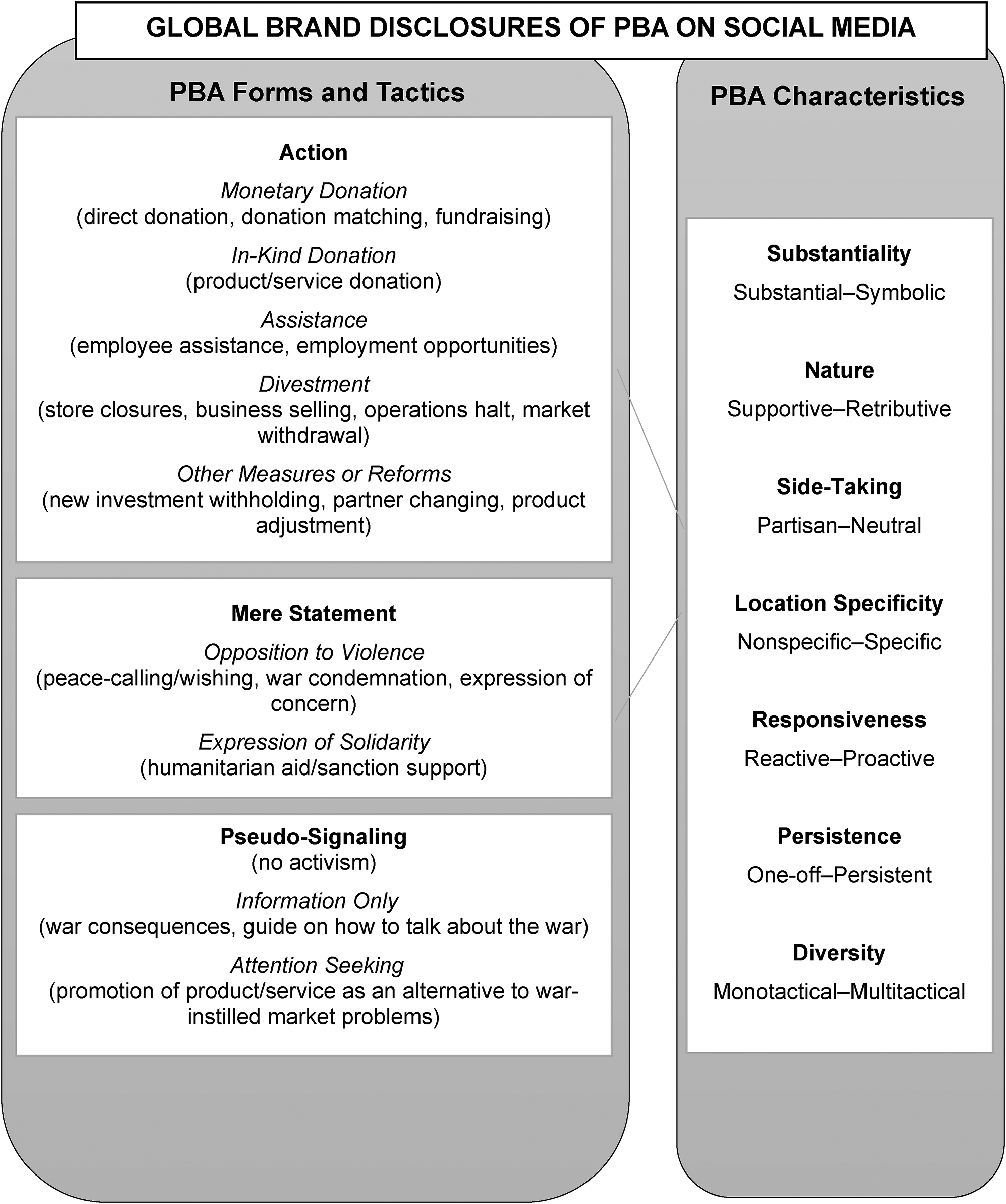
A Comprehensive Conceptualization of PBA.
PBA Tactics
Activist tactics are methods used by individuals or groups to promote, impede, direct, or intervene in social, political, economic, or environmental reform with the goal of making changes in society (Della Porta and Diani 2015). While specific activism tactics vary, boycotts, social media campaigns, and fundraising or sending aid to affected individuals or groups (Murthy 2018; Vredenburg et al. 2020) are among the several peaceful activism tactics that can be used by both grassroots movements and corporations. We sought to reveal the range of PBA tactics disclosed by global brands in response to the war in Ukraine, intending to delineate how PBA can manifest. In our analysis, we observed various specific tactics reported by brands. Through our coding process, we traced and categorized them into actions and statements, building on the categorization of the existing literature. In addition to the actions taken by the brands in response to the crisis and positional statements indicating their stance but stopping short of reporting any action, a third category emerged that corresponded to pseudo-activism, the latter comprising nonpositional statements that referred to the crisis but did not take any stance. Table 1 summarizes the identified PBA tactics and serves as a comprehensive guide for the following discussion.
PBA Forms, Tactics, and Illustrative Examples.
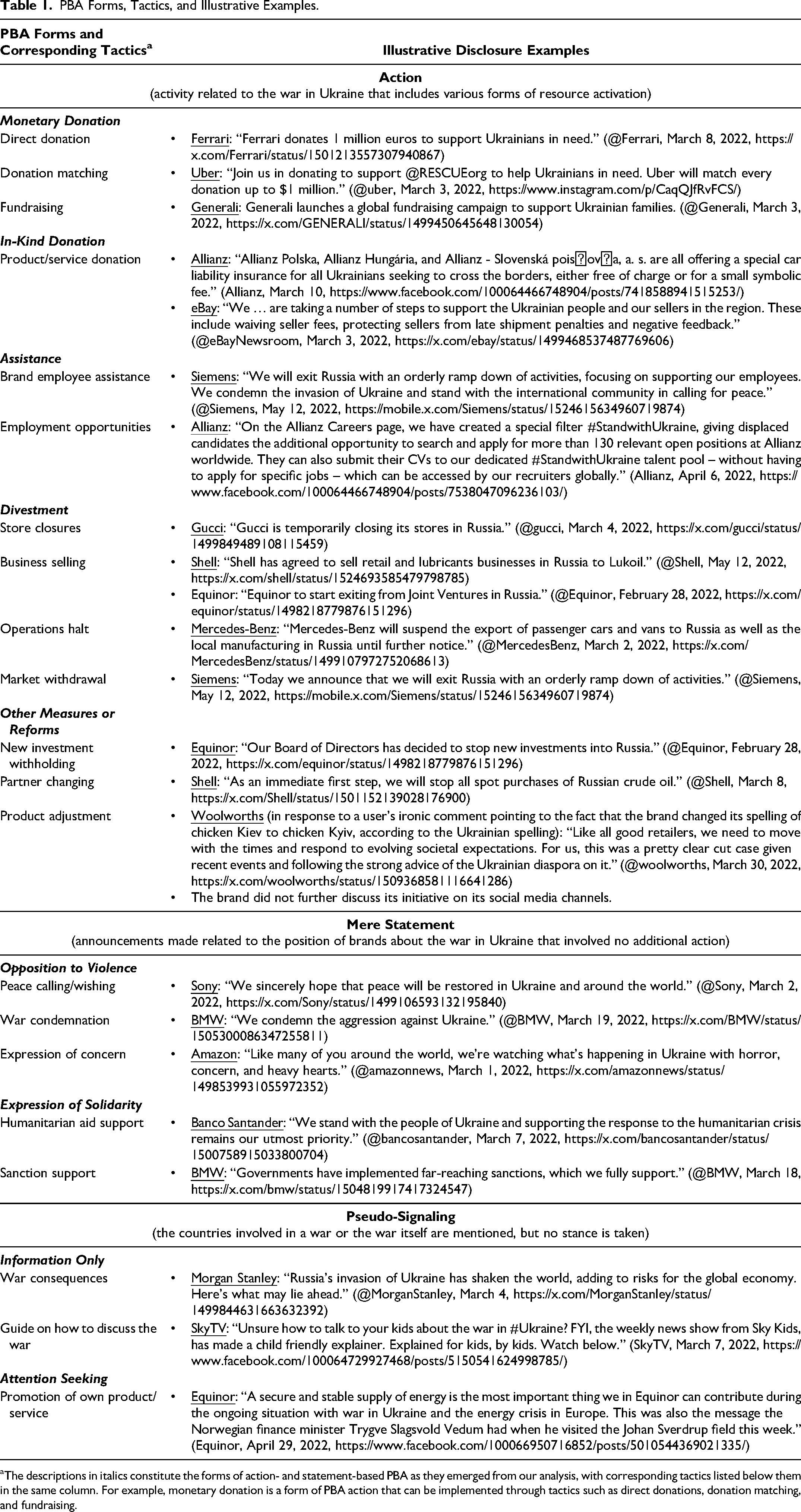
The descriptions in italics constitute the forms of action- and statement-based PBA as they emerged from our analysis, with corresponding tactics listed below them in the same column. For example, monetary donation is a form of PBA action that can be implemented through tactics such as direct donations, donation matching, and fundraising.
Actions
Actions represent PBA initiatives that commit to firm resources or incorporate restructuring or reform. We identified five main forms: monetary donations, in-kind donations, assistance, divestment, and other measures or reforms.
Donations of resources included monetary donations, donation matching, fundraising, and in-kind donations. Money donations involved brands offering direct monetary support to the citizens of a country and/or an organization to provide humanitarian aid to those affected by the war. Examples include Ferrari's €1 million donation to support Ukrainians and Louis Vuitton's partnership with UNICEF: Existing funds within Louis Vuitton for UNICEF's partnership are being made available now to respond as quickly as possible to the war in Ukraine. One million (euros) will be donated immediately to UNICEF to help children and families touched by the conflict in Ukraine. (@louisvuitton, Instagram, March 3, 2022, https://www.instagram.com/louisvuitton/p/CaqBbJGqAvU/)
Donations sometimes involved a simultaneous fundraising effort through the promise of a donation match, as in the case of Uber, which announced that it would match the donations made to a fund created to help affected Ukrainians. Other times, the peace activism initiative included a fundraising effort in addition to a direct monetary donation, as was the case with the global insurance provider Generali. 9
In-kind donations are another prominent form of PBA action. Frequently, brands offer their own products or services to help those affected by war, inside or outside war zones. For instance, global health care brand Roche tweeted that it would send “donations of essential #medicines and #diagnostics equipment” to Ukraine. 10 In-kind donations also aimed to assist affected businesses. For example, eBay waived Ukrainian seller fees, 11 O2 removed roaming fees in Ukraine, 12 and PayPal extended its services and waived fees for funds sent to or received by Ukrainian PayPal accounts. 13
Brands further assisted their employees when (and where) they were somehow affected by the conflict or provided employment opportunities to victims of the war. For example, Prada highlighted its priority of supporting its employees in Ukraine before announcing its various donations,
14
whereas EY expressed its support to its Russian employees and partners following its restructuring and the dropping of its Russian firms: This is heart-breaking as we have over 4,700 colleagues in Russia. … As we go through this change, we will work to support those colleagues, as well as our clients in fulfilling our legal obligations and commitments. (@ey_global, March 7, 2022, https://www.instagram.com/p/CazBoJttL1U/?img_index=4)
An additional assistance action that we noted entailed offering employment opportunities to displaced war victims, specifically Ukrainian refugees, by creating a CV pool that enables recruiters to identify and hire them. 15
Brands engaged in a range of divestment activities (i.e., reduction of business activities or withdrawal from the market [Benito and Welch 1997]) in response to the war in Ukraine, namely reducing operations by closing stores and ceasing business selling, temporarily halting operations, and withdrawing completely from the Russian market. For example, in an attempt to reduce their presence in Russia, Gucci temporarily shut down its stores located in Russia, 16 Shell sold its retail and lubricant business, 17 and the Norwegian energy multinational Equinor announced its intention to withdraw from its joint ventures with Russian firms. 18 Some brands further proceeded to a complete operational halt, as was the case for Mercedes-Benz, which suspended the export of vehicles and halted local manufacturing in Russia. 19 Finally, other global brands adopted more holistic measures and announced a complete market exit. Siemens constitutes an example, as it announced a complete and orderly exit from the Russian market. 20
The final form of action captures various tactics, including withholding additional investments, restructuring supply chains to stop purchasing from Russian partners, and changing products. In this context, we noted that Equinor refrained from making new investments in the Russian market and Shell stopped buying Russian crude oil. Australian supermarket chain Woolworths adjusted one of its products by making minor label modifications, changing the spelling of chicken Kiev to Kyiv (the Ukrainian spelling) to show respect to the Ukrainian community. 21
Mere statements
Our analysis of PBA disclosures further reveals two forms of mere statements made in relation to the Ukrainian war, expressing either opposition to violence or solidarity. Several statements acknowledged the crisis by broadly expressing opposition to the conflict by calling for peace, condemning war, or expressing concern for those affected by it. For example, Sony tweeted wishing for peace, 22 BMW condemned aggression, 23 and Amazon disclosed concerns about the situation. 24 Another set of PBA statements communicated the brands’ accordance with the measures undertaken in response to the situation, such as humanitarian support measures or sanctions imposed. For example, Banco Santander declared solidarity with Ukrainians and made efforts to help them, 25 and BMW expressed support for sanctions. 26
Notably, statements rarely occurred without accompanying actions, often in the same post. To illustrate, a war-condemning statement made by BMW in response to a critical comment that it received, stated that “due to the current situation, we are discontinuing our production and exports in Russia.” 27 Conversely, when KPMG tweeted “We condemn the Russian government's military invasion of Ukraine in violation of international law,” 28 without declaring any action, it received intense consumer reactions urging it to stop operating in Russia. Five days later, the company announced that Russian and Belarus firms would stop participating in the network. 29
Pseudo-signaling
A small number of global brands made nonpositional statements that referred to the crisis, yet did not constitute PBA tactics, as they simply provided information related to the conflict or mentioned it in what appears to be a bid to get attention.
Informational statements appeared to circulate reports on the war and its effects on the economy. For example, Morgan Stanley tweeted to highlight the risks that war imposes on the global economy. 30 Similarly, the posts of other brands in the banking sector, such as the Commonwealth Bank, oftentimes mentioned the war in Ukraine to refer to its various economic effects. 31 SkyTV provided information resources to help parents explain the war to their children. 32
Attention-seeking PBA, the second form of nonpositional statement, seeks to capitalize on the popularity of the crisis via social media attention. Equinor, for instance, emphasized the importance of the European market's energy coverage amid the war-inflicted energy crisis. 33 Unsurprisingly, brands adopting this approach have been accused of exploiting the situation to promote their business offerings and make a profit (Lawson 2023).
PBA Characteristics
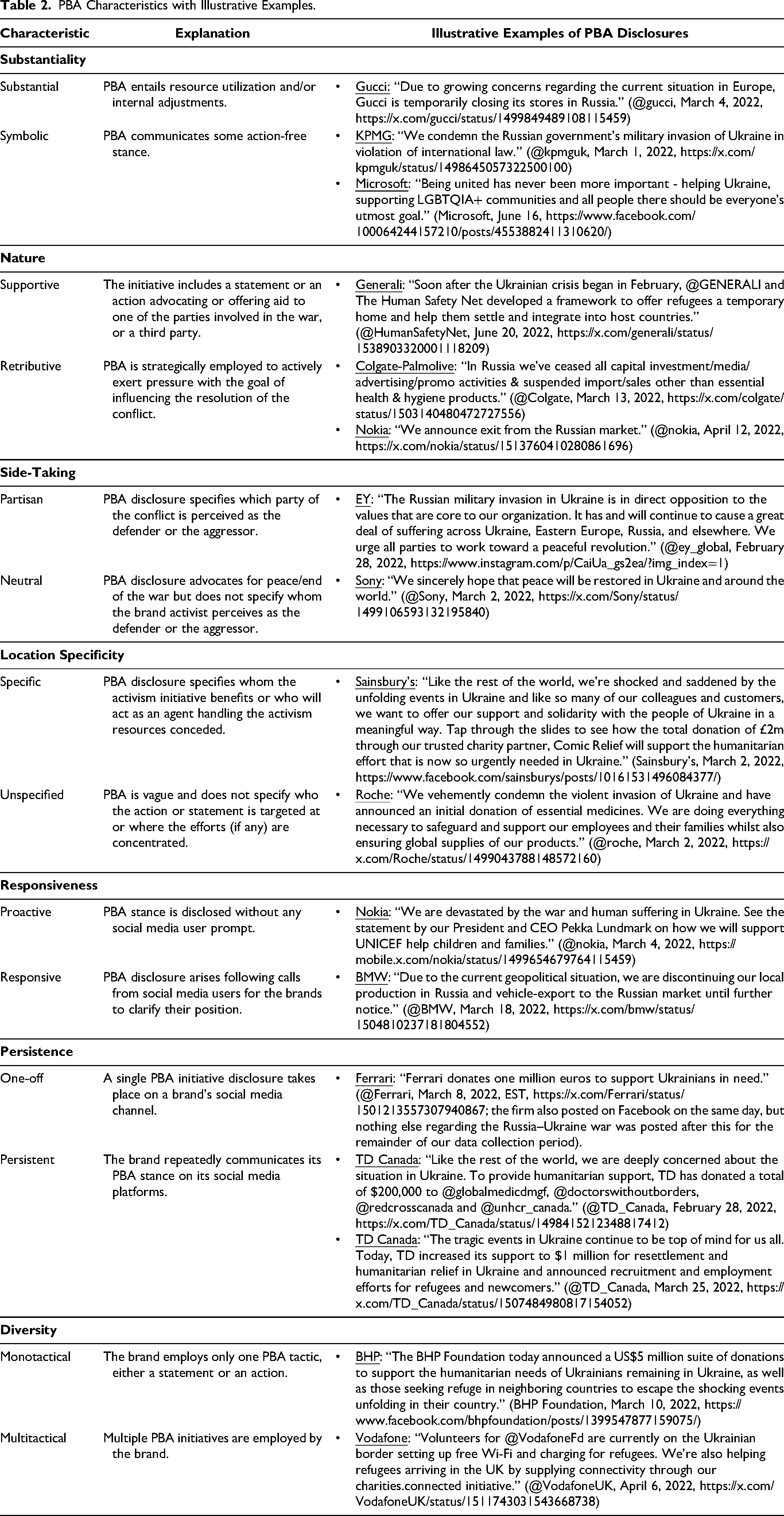
After describing the range of PBA tactics and revealing their actions and statement-based forms, including the two forms of PBA pseudo-signaling, we conducted further analysis to address our second research question and identify the characteristics of PBA. We discovered seven key PBA characteristics: substantiality, nature, side-taking, location specificity, responsiveness, persistence, and diversity. We outline the characteristics of PBA on continua of opposing ends, utilizing a semantic differential approach, as illustrated in Table 2, which serves as the main guide for the discussion provided in the following sections.
PBA Characteristics with Illustrative Examples.
Substantiality: Substantial to symbolic PBA initiatives
The first characteristic of PBA, which can be gleaned from global brands’ social media posts, is the substantiality of PBA initiatives. We identify substantiality as a pivotal PBA characteristic that spans the spectrum from substantial to symbolic. Substantial PBA initiatives are resource-intensive or require some sort of brand transformation. This aligns with extant studies on corporate political activism that discuss this component as strength, effort, and degree of commitment, and link it with actions rather than statements (e.g., Bhagwat et al. 2020). In the context of peace activism, substantial initiatives may yield benefits or disadvantages for one or more parties involved in a conflict. Accordingly, we argue that disclosures of PBA actions, insofar as they entail resource employment and/or internal reforms (Wickert, Vaccaro, and Cornelissen 2017), represent more substantive forms of PBA than action-free stands, as they come with greater financial commitment (Ahmad, Guzmán, and Kidwell 2022). When brands donate their monetary resources or offer products to those affected by a war, they make a degree of commitment. This is not the case when they simply call for peace or prayer for those affected by war, as was the case with Microsoft, which called for unity in supporting Ukrainians as well as other communities, such as the LGBTQIA+ community. 34
As a rule of thumb, action-based PBA such as donation and divestment approaches are more substantial than mere statements. The latter, which is more symbolic and less substantial, would normally come with little to no immediate cost to brands and can be generally associated with lower risk (Hambrick and Wowak 2021). However, because of the affordances available on social media platforms, users can challenge brands. When disclosed on social media, PBA initiatives constitute involvement communication strategies that allow users and stakeholder groups to engage with and challenge brands, promoting accountability and potentially affecting future approaches (El-Bassiouny, Darrag, and Zahran 2018). Thus, social media enables consumers to call out companies that appear to use their PBA initiatives to signal that they are “woke” (i.e., “awake or alert to critical social issues, discrimination, and injustice” [Mirzaei, Wilkie, and Siuki 2022, p. 1]). When there is a decoupling between an entity's words and actions, meaning that brands fail to “walk the talk,” social media reactions command the ability to establish recoupling (Lyon and Montgomery 2015). Such an example can be found in EY’s statement, which originally merely condemned the war, without announcing any concrete action. 35 Instagram users pressured EY to terminate its business in Russia, an action the brand announced a few days later. 36
Another option is to combine statements and actions, which often results in more substantial PBA initiatives than statements alone. Prada's Facebook post serves as an example: The war in Ukraine is very worrying and a source of great concern. The Prada Group's priority is our colleagues and their families in the country. The Group is joining forces with the Camera Nazionale della Moda Italiana (CNMI) and providing a donation to the UNHCR Italia–Agenzia ONU per i Rifugiati. We continue to monitor this tragic situation and remain hopeful that a peaceful solution can be found. To contribute to the UNHCR… (Prada, March 3, 2022, https://www.facebook.com/Prada/photos/the-war-in-ukraine-is-very-worrying-and-a-source-of-great-concern-the-prada-grou/4624721907632722/)
However, it is possible to further differentiate forms of action in terms of substantiality. First, since substantiality is relative to the resources allocated to PBA, smaller donations are more symbolic than larger (and thus more substantial) ones. To illustrate, store closures are more resource-intensive than donations, as the former combines resource allocation in the form of monetary funds with internal reforms and signals higher commitment (Bhagwat et al. 2020) and, accordingly, substantiality. A similar situation occurs when comparing withholding new investments with exiting a market, as the latter indicates that existing committed resources need to be sacrificed to uphold the advocated stance. We also observed differences in substantiality among the different PBA action-based forms. For example, brands reported divestment activities ranging from reducing operations to temporarily suspending operations, all the way to withdrawal. The latter (withdrawal) is more substantial than the former (suspending operations) because it requires a more intense transformation. Similarly, temporary measures, such as Gucci's store closures, emerged as less substantial than permanent ones, such as KPMG's dropping of its Russian and Belarus firms from its network.
Concerning donation tactics, an important aspect that determines substantiality levels is whether the brands activate their own resources or simply orchestrate fundraising campaigns. The latter is less expensive and requires fewer brand resources, including monetary funds. In most cases, brands accompany their fundraising efforts through other donations or actions. For example, in addition to calling for donations, Allianz posted an announcement of a series of other PBA tactics, including its own monetary donations, recruitment opportunities, and various statements of support. 37
The nature of PBA: Supportive to retributive
Another crucial characteristic of PBA pertains to the nature of the tactics employed, determined by whether their purpose is to provide support or exert pressure to influence the resolution of the conflict. Thus, PBA can be either supportive or retributive. Supportive PBA involves brands taking a stance in supporting peace and those affected by war. Donations in money or in-kind and PBA assistance, as described previously (Table 2), are examples of supportive peace activism that global brands employ. In turn, retributive PBA aims to exert pressure on peace in the form of conflict resolution (i.e., negative peace [Clark 2009]) or to impose punishment, typically on the party perceived as the aggressor in the conflict. Retributive PBA tactics represent a form of economic sanction, including embargoes, typically serving as mechanisms designed to exert pressure toward the resolution of armed conflicts, albeit often with the added complication of harming civilians (Rohner 2023). The manifestations of this characteristic were evident in our sample through the implementation of complementary employee assistance initiatives for their employees in Russia, or through justifications for maintaining certain business operations in Russia, as was the case for Nestlé: Our business in Russia is limited to essential food, like infant food & medical/hospital nutrition. We’ve also halted all non-essential imports and exports. (@Nestle, March 23, 2022, https://x.com/nestle/status/1506607313804791814)
In our sample, we could only discern the retributive PBA initiatives that applied pressure on Russia. Divestment initiatives, such as store closures in Russia or refraining from working with Russian suppliers and partners, illustrate examples of retributive action–oriented PBA. Similarly, position statements either conveyed support and solidarity with the victims of the war or took a retributive stance by condemning a party involved in the crisis or expressing agreement with the implemented sanctions. The supportive or retributive nature of PBA is related to but distinct from generally expressing support or opposition to an issue, as discussed in the various definitions of brand activism (e.g., Bhagwat et al. 2020; Mukherjee and Althuizen 2020). That is because PBA is a position in favor of peace and/or against conflicts but may also involve either trying to exert pressure on the perceived conflict-inflicting party with retributive tactics or providing support to parties affected by the conflicts.
However, retributive PBA actions may have unintended side effects. For instance, divestment measures impose economic pressure on those identified as aggressors of a conflict to eliminate violence but may also threaten the peace of civilians in those countries. This is because such actions can exacerbate economic hardships, deteriorate societal well-being, and escalate tensions in the same way that sanctions have been accused of exerting a negative influence on societal peace (Parella 2023). Thus, brands must consider the broader implications of different PBA initiatives. Most retributive actions entail commitment or reform from the company; for example, when exerting pressure on the economy of the perceived aggressor by switching suppliers. This constitutes a key approach. When divesting their business from the party that they identify as an aggressor, brands may inadvertently impact their own businesses and profits, for instance, by forfeiting lucrative markets. This reflects the willingness to make sacrifices and extend beyond the primary business interests. As such, it introduces additional layers of risk and, consequently, substantiality into their PBA endeavors (Hambrick and Wowak 2021). Comparisons of supportive and retributive PBA initiatives in terms of their substantiality are not always straightforward, as a large monetary donation might be more substantial than temporarily halting exports for a few days or months if the latter has a negligible effect on a brand's business or profits. Nevertheless, actions offering humanitarian support and statements supporting peace appear to involve a simple allocation of resources (or none at all) and can be connected with lower commitment and higher symbolism.
We also observed an occasional pattern in which brands initially engaged in supportive PBA and later complemented their efforts with retributive measures in response to consumer calls to cease business operations in Russia. For example, the technology brand Nokia initially took measures to support families affected by the war 38 and subsequently adopted divestment tactics. 39 Hence, the supportive and retributive PBA approaches are not mutually exclusive.
Side-taking: Partisan to neutral PBA
Side-taking has emerged as the third most salient PBA characteristic. We note that both action- and statement-based PBA tactics can be partisan, expressing clear stances pertaining to whom the brands identify as the aggressor or victim of the war, or neutral, more vaguely advocating in favor of peace. Partisan stances support the perceived victim or denounce the perceived aggressor. For instance, while Ferrari's €1 million donation named Ukrainians as the victims of the war, Ford explicitly declared Russia as the aggressor and suspended operations in the country,
40
and EY issued a statement condemning the violence inflicted by Russia, thereby identifying Russia as the aggressor.
41
However, it is also possible that PBA maintains a degree of neutrality, limits itself to supporting civilians affected by the conflict or opposing the war, and stops short of assigning conflict initiators, aggressors, or victim status to either party of the conflict. In fact, neutrality can be witnessed in actions that focus on providing humanitarian aid, such as Volvo's donation initiatives: We’re following the impacts of the war in Ukraine and helping those affected. This includes SEK 5 million each to @save_children and @unicef and matching our colleagues’ donations up to SEK 2 million. (@VolvoCars, March 4, https://x.com/volvocars/status/1499784406789144583)
Additionally, neutrality can be maintained through statements that call for peace without taking a clear side, as can be seen in a peace-wishing disclosure made by Sony. However, we observed statements that varied in their side-taking, such as KPMG's symbolic disclosure condemning “the Russian government's military invasion of Ukraine in violation of international law” 42 appeared more partisan.
Clear side-taking can be linked to two opposing factors. Partisan PBA might be more polarizing and, therefore, riskier (Bhagwat et al. 2020). Activism for peace in the face of war conflicts, as is the case for brands taking stances in relation to the war in Ukraine, can be identified as a low-divisiveness issue (Nam et al. 2023), as peace and social harmony are widely embraced and desirable values (Velez and Gerstein 2021). However, while peace might appear less divisive than other highly controversial sociopolitical issues, such as Black Lives Matter (Atanga, Xue, and Mattila 2022), war introduces an additional element of divisiveness: the two opposing sides. As such, stakeholder groups might support one side of a war that others perceive as an aggressor and react to partisan PBA initiatives accordingly. To illustrate, we can revisit the example of Russian influencers who burned Chanel bags in reaction to the brand's divestment tactics. While our sample indicates that partisan PBA disclosures deemed Russia the aggressor, not everyone agrees that Russia initiated the conflict. PBA partisanship could be much more divisive, such as in the case of the longstanding conflict between Israel and Palestine and the Israel–Gaza War, which elicits polarized reactions across countries, ages, and political identities (Conboye and Smith 2023).
Neutral stances incorporate a degree of vagueness that might signal lower substantiality and trigger consumers to question the commitment and motives of peace brand activists and, correspondingly, question their authenticity (Vredenburg et al. 2020). This is particularly relevant when comparing partisan to neutral statements. For example, EY's partisan statement quoted previously received, in addition to calls for more substantiality owing to its symbolic nature, some approval by social media users along with calls for the brand to stop being political—reactions that might mask opposition to the side that EY had taken. The literature indicates that lower issue divisiveness is not only safer but also linked to better-perceived motives and positive consumer attitudes (Atanga, Xue, and Mattila 2022). However, the overall effect of the controversy of PBA side-taking on consumer reactions has yet to be examined.
Location specificity: Unspecified versus specified PBA locus
Location specificity has emerged as an additional characteristic of PBA. Some brands provide location-specific information about the targets of their PBA initiative, in which the effort will be concentrated, and who will benefit from or handle the resources they allocate toward this initiative. Specified targets of PBA initiatives include countries participating in the war; their citizens; and third parties such as organizations offering humanitarian aid, refugees, firms hit by the conflict, and other countries. Examples include, but are not limited to, the solidarity with Ukraine expressed by eBay, KPMG's condemnation of the Russian invasion, the delivery of water purification packets to Ukrainians by FedEx, 43 and Sainsbury's donation to Comic Relief. 44 Other brand actions or statements can be vague from a locus perspective and cannot specify the recipients of efforts of PBA or the resources allocated to them, if any. Examples of PBA initiatives with unspecified locations include information about helping organizations that offer relief to victims of war or announcing humanitarian actions without specifying the recipients or their location. For example, Roche disclosed donations of essential medicines without providing additional information about the recipients. 45
Although the locus of the activity cannot be directly connected to substantiality, when a location-specific PBA incorporates an element of partisanship, it might also bear a higher risk (Bhagwat et al. 2020). Further connecting location specificity with the nature of PBA, we notice that all the observed location-specific retribution actions appear to identify Russia as the aggressor in this conflict. Thus, they constitute side-taking PBA initiatives. Examples of locus-specific retributive PBA include the variety of PBA divestment tactics adopted by IKEA,
46
Vodafone, EY, Maersk,
47
and Nokia,
48
to name only a few. Supportive—yet non-side-taking—statements and actions also targeted Russia, as was the case with expressions of concern about brand employees experiencing divestment measures. For example, EY expressed a clear concern for its colleagues in Russia,
49
and Nestlé justified its continued business activities in Russia based on supplying the market with essential products: As the war rages in Ukraine, our activities in Russia will focus on providing essential food, such as infant food and medical/hospital nutrition—not on making a profit. (@Nestle, March 23, 2022, https://x.com/Nestle/status/1506596191169089542)
Additionally, in one instance, locus-specific support entailed suggestions on how those affected by financial sanctions against Russia could be helped. Specifically, DBS Bank tweeted: As a result of the Russia–Ukraine crisis, the US and its allies have imposed sanctions on Russia, cutting them off the SWIFT network. #Bitcoin emerged as the unconventional savior. (@dbsbank, April 5, 2022, https://x.com/dbsbank/status/1511507734801301511)
Notably, locus-specific PBA carries additional risks, even in the presence or absence of clear partisanship. This risk arises from potentially attracting opposition from those who disagree with assistance. For instance, when brands choose to slowly phase out operations in Russia to protect their employees, this triggers backlash and substantiality concerns in a subset of consumers. Similarly, in the case of location-specific humanitarian aid, offering help through cause-specific third parties rather than directly to the warring countries themselves might mitigate any confusion between providing support that alleviates suffering and taking sides.
PBA responsiveness: Proactive to responsive PBA disclosures
We also characterize PBA in terms of how its disclosure emerges, namely, whether it is proactive and occurs without any prompt or responsive social media user. Specifically, we describe a responsive PBA as a disclosure that seems to arise as a result of external pressure from stakeholders—in this case, customers and social media users. Some positional statements from brands are a direct response to consumers urging them to take a stand on the conflict, often pressuring the identified aggressor to stop the violence. Responsive PBA appears to be more common on Twitter than on other platforms. This dynamic is possibly influenced by the nature of the platform, on which consumers can publicly expose brands and brands can publicly address consumer comments. In some instances, a brand's reference to conflict responds to online criticism from Twitter users.
For example, when consumers accused BMW of funding the war by doing business with Russia, the brand responded with 93 tweets to individual users, showcasing a highly responsive approach. 50 Nestlé, 51 Cartier, 52 and Colgate 53 only posted tweets disclosing their PBA initiatives after being prompted by social media users. In contrast, Woolworths did not proactively disclose PBA on social media, despite changing the spelling of its product's name in response to the war. However, Woolworths only posted about this move in response to a user who addressed a relevant comment. 54
Proactive disclosures may correspond to higher PBA speed, an aspect that Nam et al. (2023) have highlighted as relevant to low-divisiveness issues, such as the war in Ukraine. Speedy brand activism may be associated with first-mover advantages but also exposes the brand to increased visibility (Hambrick and Wowak 2021) and, therefore, scrutiny. This may explain why responsive measures tend to incorporate the communication of more substantial action-based forms of PBA, which can be supportive or retributive and are usually side- and location-specific. To illustrate, BMW's responses to consumer social media prompts tended to emphasize the range of its substantial, retributive, and side-taking divestment PBA tactics. These measures were aimed at connecting consumer demands for action that were expressed because of a perceived mismatch between the brand’s statements and actions.
Persistence of PBA: One-off to persistent PBA disclosures
We also differentiate PBA disclosures in terms of their persistence across brands’ social media channels. Accordingly, we distinguish between single, one-off disclosures and PBA disclosures made by a brand repeatedly on its social media channels. PBA persistence aligns with the characterization of influencer activism as temporary versus sustained, as identified by Thomas and Fowler (2023), and is linked to perceived authenticity and the cultivation of positive consumer attitudes. Over the period in question, brands such as Ferrari and Sony were one-time social media activists. They kept their activist profile low, with Ferrari announcing a donation 55 and Sony making a single disclosure referencing the conflict and announcing its initiative. 56 Allianz, Roche, Shell, and TD Canada are only some of the brands that have emerged as persistent peace brand activists. An interesting observation can be made about Amazon, another brand that adopted a persistent approach toward PBA yet chose not to emphasize it on its social media channels. The brand chose to provide a link to a constantly updated web page where all its PBA activities were disclosed (until December 1, 2022). 57
Such a choice allows consumer activist groups to trace a brand's PBA activities when searching online. However, it potentially keeps the chances of brands’ efforts being consistently questioned or criticized at low levels. This further enables the disassociation of the brand from a potentially misaligned activist image that could arise with higher visibility. Lowered activism visibility can enable brands to moderate the risk of alienating or threatening certain stakeholder groups (other than customers), such as investors, which could result from being too political (Bhagwat et al. 2020). Conversely, persistent PBA disclosures trigger increased visibility and may thus signal higher authenticity (Vredenburg et al. 2020), commitment, and substantiality (Bhagwat et al. 2020).
Persistence sometimes manifests when brands, following mere statements or other less substantial tactics, intensify their PBA through, for example, more substantial action-based forms of PBA (e.g., donations, assistance measures) or retributive and partisan initiatives. Nokia is a representative example of this, as its initial disclosure condemned the war and offered humanitarian support to its victims through a donation to UNICEF. 58 It later followed this approach with responsive disclosures of retributive and partisan PBA initiatives, including several divestment tactics. 59 However, not all persistent efforts have displayed an escalating PBA substantiality. For example, eBay displayed a consistently supportive PBA profile by repeatedly disclosing donations and fundraising efforts. 60
PBA diversity: Monotactical to multitactical PBA
The final characteristic of PBA that we identify is the diversity of the tactics employed by the brand. PBA diversity pertains to whether an individual brand employs only one PBA (monotactical PBA) or a few different tactics (multitactical PBA) of the same or different forms. While some brands limited their actions to a single tactic, most communicated using multiple tactics. An example of a monotactical PBA approach can be found in the Australian mining and natural resources brand BHP, which announced a donation across its social media channels, but did not disclose any additional PBA involvement. 61 Multitactical PBA initiatives were disclosed either in the same post or in different posts at different time points. Diversity is inherently linked to higher substantiality, as it entails the sum of multiple statements or actions, increasing the overall commitment of the brand and the visibility of PBA (Hoppner and Vadakkepatt 2019). For example, a symbolic statement combined with a small, low-substantiality, one-off donation is more substantial than a statement alone. As the incorporation of multiple PBA tactics typically introduces layers of specificity, increased diversity is often location-specific, even if it is not partisan and lacks specific patterns pertaining to nature, responsiveness, or persistence.
Summary of Findings
Our research adopts an inductive approach to investigate how global brands engage in PBA on social media and provides a comprehensive understanding of PBA. We offer a conceptual map that elucidates the diverse tactics brands can employ. This map enabled us to establish a range of action- and statement-based forms of PBA and their characteristics. The first stage of our analysis reveals monetary donations, in-kind donations, assistance, divestment, and other measures or reforms as the primary PBA forms of action. Additionally, mere statements include opposition to violence, and expressions of solidarity. We also discover intriguing attempts at pseudo-activism. In the second stage of our investigation, we concentrate on further delineating the conceptual nuances of PBA and identifying its core semantic differential characteristics: substantiality, nature, side-taking, location specificity, responsiveness, persistence, and diversity. We examine the various PBA options available to firms and their connections to PBA characteristics. Our discussion connects our findings with the existing literature on brand activism, peace, and peace marketing (where applicable), and explores the interrelationships among these characteristics. We contend that our data-based conceptualization marks an initial and robust stride toward a comprehensive understanding of how brands can promote peace within the context of ongoing armed conflicts. We make a series of theoretical, managerial, and policy making contributions and build a foundation for future research.
Theoretical Contributions
This study contributes to the literature in three ways. First, we enrich the corporate sociopolitical activism literature with one of the first large-scale thematic content analyses of brand activism initiatives amid an ongoing armed conflict. To date, a few noteworthy empirical attempts have been made to document firms’ responses to the war in Ukraine, such as the comprehensive database at Yale University (Yale School of Management 2022) which records firms’ cessation or continuation of activities in Russia. However, these are largely descriptive, atheoretical, and narrow in focus, as firms’ PBA extends beyond operational activities. We provide a theoretical appraisal of brand activism, extending its extant classification to actions and statements (e.g., Bhagwat et al. 2020) by unveiling the diverse forms and corresponding tactics of actions and statements for peace in the context of conflicts and how they can be differentiated in terms of important, often interrelated, semantic differential, and PBA characteristics. These characteristics include emergent brand activism—nature, side-taking, location specificity, and diversity—as well as characteristics similar to those identified in the literature, such as substantiality, which resembles commitment (e.g., Bhagwat et al. 2020), and persistence, which is similar to sustained activism (Thomas and Fowler 2023).
The PBA forms and characteristics identified in this study may be applicable to other brand activism contexts. However, our work reveals the intricacies associated with the forms, tactics, and characteristics of PBA compared with other brand activism foci. For example, for many other sociopolitical issues, key actors are not as clearly defined as they are in the context of a conflict (e.g., Russia and Ukraine are clearly named actors in the war between them). This means that there are potentially more idiosyncratic ways for brands to take a stance in the context of PBA. We can see brands that take a neutral stance relating to who is right in a conflict yet advocate for peace, as well as brands that take a partisan stance in their advocacy for peace. While the retributive PBA measures in our sample often translate into actions in the form of exiting the Russian market, they were also applied when brands boycotted Facebook as their advertising supplier in response to the #StopHateForProfit campaign (He, Kim, and Gustafsson 2021). However, the locus of retribution in the case of PBA can be a whole country versus a single company, organization, or a group of people. Consequently, the implications of PBA can be much larger, affecting other involved parties, such as innocent civilians. Accordingly, as some PBA forms and characteristics may be relevant to other contexts of brand activism, our study underscores the importance of understanding corporate activism in diverse settings with varying interrelationships and consequences for brands. In summary, our research, by delving into brand activism in the realm of peacemaking, establishes a foundation for investigating the drivers and outcomes of different PBA initiatives while also clarifying corporate activism.
Second, our study contributes to the literature on peace and peace activism. War can have terrible consequences for consumers, marketers, and society. The limited body of knowledge pertaining to the transformative potential of marketing suggests that business activities serve as mechanisms for achieving peace (Barrios et al. 2016; Oetzel et al. 2010). Our study advances this idea and highlights the potential of PBA as peace marketing tools. Our conceptualization of PBA shows how firms’ PBA activities contribute to peace in two ways: (1) by undermining the legitimacy of who they consider the aggressor in the conflict and (2) by minimizing the effects of the conflict.
Third, our study contributes to theoretical inquiries related to the direct involvement of businesses in international affairs. We show how PBA occupies the nexus between corporate activism, CSR, and corporate foreign policy. Our conceptualization of PBA highlights its conceptual link to corporate foreign policy (Parella 2023). Although PBA sometimes involves tools of pressure often used by governments in foreign policy (e.g., aid, sanctions), it also encompasses broader elements of consumer-directed advocacy focused on achieving peace. Further, while some of the tactics we define as PBA are compatible with CSR, PBA and CSR are conceptually and practically distinct constructs. First, PBA focuses on influencing conflict resolution. In this sense, PBA operates within time constraints heightened by the urgency to address ongoing conflicts during which atrocities are unfolding. Second, CSR involves “positive actions” in support of a cause, whereas PBA can involve both positive and negative actions designed to affect a conflict. Consequently, although CSR and PBA may entail similar tactics, their underlying objectives differ. Finally, CSR initiatives often focus on causes that are noncontroversial. In contrast, involvement in a conflict, as extensively described in our introduction, involves controversy.
Managerial and Policy Making Implications
This study has critical managerial and policy implications. First, it provides firms with a framework to appraise PBA activities. Specifically, our conceptualization can help managers audit their firms’ PBA activities. Such auditing can be crucial in helping firms adjust their PBA initiatives in a way that best addresses the expectations of different stakeholders. This framework can also be useful in identifying PBA initiatives that complement those that firms may already be undertaking. For example, using our framework, firms can assess the consistency of their PBA activities. This is critical for firms that operate internationally and may have decentralized communication departments. Consistency in how different departments or channels in different countries frame PBA messages can be an issue for most types of corporate activism; nevertheless, it takes on added salience in PBA. For instance, as international standardization and adaptation (i.e., consistency or changes) of marketing communications bear important business consequences (Mandler et al. 2021), a brand will need to carefully consider the potential effects of standardizing its side-taking PBA framing. This is because countries might have strong stances—and therefore, strong reactions—related to who is on the right side of the conflict; however, consumers also have global accessibility to information on what brands are doing in different markets, and inconsistent messages might reveal insincerity. If their business models allow, or if, indeed, the standardization of their PBA approach is a goal, firms can take steps to ensure that their PBA initiatives are consistent. Following this, firms will need to consider whether their business models and entry mode choices enable them to standardize their PBA initiatives across markets. For example, firms that operate a franchise model may find it more difficult to centralize their PBA activities and may appear inconsistent in their approaches. In this study, we analyzed only one social media account for each brand. Therefore, we were unable to assess the consistency of the brands using their PBA approaches.
Second, our framework can assist firms in benchmarking their PBA activities against key competitors’ PBA initiatives. Our analysis suggests that firms may be pressured by customers and the public to match the substantiality of competitors’ PBA efforts. However, firms are more likely to be appraised positively if they proactively engage in PBA. Our conceptual apparatus can help firms track and evaluate competitors’ actions and thus provide information or a knowledge canvas to help competitive PBA decision-making.
From a policy perspective, PBA has potentially more wide-ranging implications than other brand activism foci, such as gender rights and race and ethnicity equality. This is because PBA, especially for large, highly visible global brands, may have consequences for bilateral relationships between countries. For example, the incorporation of brand operations in a country may be met through retaliation. Accordingly, governments and public bodies must consider how different forms and characteristics of PBA may affect bilateral relationships with conflicting parties. Importantly, when brands use tools that are often the preserve of national governments, there is a potential for synergies as well as conflict, as the actions of the government may be affected by PBA (and vice versa). For example, the effect of governmental actions (e.g., sanctions) may be amplified beyond their intentions because of firms’ prior or supplemental PBA initiatives. Policy makers often cannot control or predict supplemental PBA activities. Accordingly, they must account for the interaction between PBA and government activities when deciding how to react to conflicts.
By understanding how businesses engage in PBA, policy makers can identify initiatives by which governments (and other public entities) can collaborate with private companies (e.g., by providing complementary resources) in the formulation and implementation of successful PBA initiatives. Conversely, they can identify potential tensions between the interests of businesses and governments because brands—as independent entities—may move in directions or at a speed that governments may consider problematic. For instance, considering the characteristics of proactiveness, our research shows that some firms might commence PBA activities before governments formulate a clear diplomatic response to the conflict. By understanding PBA, policy makers can seek to align the interests of governments with those of businesses. For example, with the knowledge that some firms may have a tendency toward a proactive PBA, they can liaise with them (where they consider it necessary) to slow down certain PBA activities.
Another implication for policy makers is the management of the information environment surrounding conflicts. Firms’ PBA activities often reflect the information that brands possess at that time. However, during conflicts, the context is dynamic and changes rapidly compared with slower-moving issues such as racial inequality and LGBTQ+ rights. This fluidity challenges brands engaging in PBA, as they may act on outdated or misleading information. In this context, policy makers and governments can support brands and the public by providing accurate and timely information about a conflict, so that the brands’ strategic PBA choices are informed and optimal. Education on the nuances and complexities associated with specific conflicts can shape how firms engage in PBA. It can also assist firms in deciding whether to continue advocating for peace or (de)escalate their efforts.
Limitations and Future Research Directions
This research has some limitations, discussed in the context of future research. First, our work uses data from one empirical setting: the Russia–Ukraine War. Owing to the idiosyncrasies of this conflict, including its location and the (in)direct involvement of several other countries, further research could explore additional empirical settings, such as other ongoing international conflicts, to clarify the prevalence of various elements of PBA and how outcomes may vary accordingly.
Second, as this study aimed to provide a comprehensive understanding of how PBA is manifested, the social media engagement implications of the diverse forms of PBA and their characteristics were not investigated. Future studies should quantitatively explore the multifaceted effects of PBA on brands. Our research lays the groundwork for the operationalization of PBA. Subsequent research could leverage the map of PBA possibilities identified here, examine the impact of PBA tactics on key outcomes such as how consumers respond to brands that engage in different PBA tactics (online and offline), and investigate how different PBA characteristics shape those outcomes. Similarly, future research could analyze whether consumer responses to specific PBA initiatives differ across brands based on different geographies (e.g., firms based in North America vs. Europe vs. Asia). These topics were examined using a quantitative approach (to empirically assess causality).
Third, the sample comprised large global brands. Hence, the insights obtained here may have different levels of relevance in the context of smaller brands; for example, the fewer financial and human resources they have at their disposal. Future research should focus on smaller brands to further validate the findings of this study.
Fourth, our sample follows a long-tailed distribution, with many brands making only a few posts and 41% not posting anything directly related to Ukraine/Russia during the study period. Future studies could involve an extended analysis of brands that refrain from engaging in PBA compared with brands that do, and investigate what influences less publicly vocal brands.
Finally, as our work focuses on PBA, it solely examines nonviolent brand responses to conflicts, omitting any exploration of stances that endorse the continuation of conflict, such as providing arms or resources to any party involved. The potential ramifications of such actions, both for the firms involved and conflict outcomes, merit further investigation.
A series of additional research questions arise in relation to PBA, which we outline below, in the hope that future studies will contribute to the advancement of knowledge in this area:
How does PBA (its tactics and characteristics) and its implications compare with other issues of brand activism, such as race and ethnicity, environment, immigration, and gender roles? Although many brands abstain from brand activism, their silence on certain issues (e.g., Black Lives Matter, transgender issues) may not be interpreted as culpability. In the current context, there is a tendency to perceive the continuing operations in Russia as support for the conflict. For instance, the “Visit Ukraine” website labels brands that continue to work in Russia as “sponsors of the war” (Visit Ukraine 2023). What are the comparative effects of different forms and tactics of PBA on firms? For example, what kinds of donations are better, and is it better to give money or an in-kind donation? In addition, what are the effects of different PBA characteristics? For example, what is the effect of proactive versus responsive PBA? How do different direct and indirect stakeholders react to the different forms of PBA initiated by organizations? How do reactions vary worldwide? What are the salient characteristics of firms that make them susceptible to external pressure to engage in PBA? For example, one would assume that large global brands might attract more visibility and, therefore, consumer pressure. What are the expectations of the various stakeholders regarding PBA? Our study provides evidence that some consumers urge firms to take a stance during crises. However, more research is needed to understand what different stakeholder groups (e.g., shareholders, suppliers, competitors, governments) think about PBA and its various manifestations. What are the key drivers of PBA? We observe that PBA may be proactive or responsive, as our evidence shows that brands engage in PBA because of consumer pressures. For example, in the context of the Russia–Ukraine war, Ukrainian government officials used Twitter to publicly shame businesses operating in Russia and to praise other businesses for assisting with humanitarian relief. Did this drive some PBA activities observed in our sample? Are competitive issues at play? Do firms engage in PBA as a reaction to competitors doing so? What drives firms’ decision-making regarding the type of PBA to pursue and the corresponding level of intensity? Stemming from the previous example, in addition to consumers, what other stakeholders influence PBA, and in what ways? Why do some brands not engage in PBA? Advancing the debate in this area requires a certain degree of focus on nonengagers. What are the key impacts of PBA on parties involved in specific conflicts? How does PBA affect perceived aggressors versus perceived defenders? Firms in conflict regions affect the dynamics of conflict through their actions, such as the distribution of resources to one party and the legitimization of actions performed by some groups (Anderson 2008). The effect of more symbolic PBA forms on the parties involved in conflicts is less clear. Similarly, how does PBA affect the efforts of other external stakeholders such as competitors and governments? What makes a particular conflict attractive for firms engaging in PBA (Parella 2023)? This is an important question, as each conflict is unique, and answering this question can help policy makers anticipate PBA involvement in PBA.
Concluding Remarks
Using a qualitative analysis of social media data from 150 of the most valuable global brands and the Russia-Ukraine war as an empirical setting, this study clarifies PBA by charting the spectrum of tactics available to global brands, exploring how they link to different action- and statement-based forms of PBA initiatives, and elucidating their distinctive characteristics. Accordingly, our study highlights the manifold ways in which global brands can engage in peace activism through their disclosures on social media channels across different platforms. We hope that managers and public policy makers will find this work useful in their endeavors to sustain peace and end conflicts worldwide. Our research enhances the understanding of PBA during an ongoing crisis, thus facilitating further theoretical development grounded in the phenomena we discuss.
Supplemental Material
sj-pdf-1-ppo-10.1177_07439156241289079 - Supplemental material for Peace Brand Activism: Global Brand Responses to the War in Ukraine
Supplemental material, sj-pdf-1-ppo-10.1177_07439156241289079 for Peace Brand Activism: Global Brand Responses to the War in Ukraine by Eleni Tsougkou, Martin Sykora, Suzanne Elayan, Kemefasu Ifie and João S. Oliveira in Journal of Public Policy & Marketing
Footnotes
Acknowledgments
The authors express their gratitude to MSc student Meng He for curating the brand list employed in this study. They would also like to extend their gratitude to the JPP&M review team for their invaluable support and insightful recommendations throughout the revision process.
Joint Editors in Chief
Jeremy Kees and Beth Vallen
Special Issue Editors
Clifford J. Shultz, José Antonio Rosa, and Alan J. Malter
Declaration of Conflicting Interests
The authors declared no potential conflicts of interest with respect to the research, authorship, and/or publication of this article.
Funding
The authors received no financial support for the research, authorship, and/or publication of this article.

Notes
References
Supplementary Material
Please find the following supplemental material available below.
For Open Access articles published under a Creative Commons License, all supplemental material carries the same license as the article it is associated with.
For non-Open Access articles published, all supplemental material carries a non-exclusive license, and permission requests for re-use of supplemental material or any part of supplemental material shall be sent directly to the copyright owner as specified in the copyright notice associated with the article.
