




Abstract
The relevance of marketing for public policy has been questioned because its focus on dyadic exchanges does not consider the dynamism and complexity of public problems. Public service-dominant logic, as a new lens for public policy and management, does not address this limitation, because its focus remains on delivering services to the end user. Integrating recent developments in service-dominant logic and related research, this article proposes applying a service ecosystems lens to public policy. Five propositions guide the application of this lens to public policy analysis and design. Public policy is conceptualized as a means to enable service by coordinating multiple actors’ value cocreation activities to address public problems. Inherent in this conceptualization is the multilevel nature of policy analysis, which includes the users’ value creation process (micro level), the context (meso level), and the broader value constellation (macro level). Policy design, in turn, includes the identification and support of emergent solutions driven by different actors. Policy makers therefore need to consider problem–conditions–solution combinations across the value constellation and the effect of public interventions on these constellations. The article concludes by presenting policy makers with marketing and design practices that can assist in the analysis of service ecosystems and engage relevant stakeholders in change initiatives.
The marketing discipline can play an important role in assisting policy makers in analyzing the dynamism and complexity of markets (Vargo and Lusch 2017); better understanding consumer behavior, business practices, and societal needs (Stewart 2015; Verplanken and Wood 2006); and evaluating potential responses to government interventions (Shultz et al. 2012). Yet the relevance of marketing for public policy has been questioned because of its predominant focus on the exchange paradigm, which, according to Hill and Martin (2014, p. 18), “fails to consider the systemic realities and challenges people face on a daily basis.” This paradigm, which others refer to as a “goods-dominant logic” (Vargo and Lusch 2004a, 2008a) or a “manufacturing logic” (Osborne et al. 2013), assumes that public resource allocation is unidirectional. Value, from this perspective, is seen as being embedded in goods or services and delivered to end users in a static world where decisions are made by rational actors (Lusch 2007).
A different marketing perspective is required to help policy makers more effectively address public problems, defined as “conditions the public widely perceives to be unacceptable and that therefore require intervention” (Kraft and Furlong 2017, p. 5). Related concepts and methods must go beyond the exchange focus and consider the complexity of policy analysis (i.e., problem framing) and design (i.e., efforts to address specific problems affecting citizens; Hill and Martin 2014; Stewart 2015). This extension is relevant because actors do not passively accept government actions (Skålén, Aal, and Edvardsson 2015) and are not all autonomous and competent marketplace agents (Anderson et al. 2016).
Service-dominant (S-D) logic is a perspective that studies the complex multiactor nature of value cocreation through the lens of ecosystems (Lusch and Vargo 2014) and institutions (Vargo and Lusch 2016). Since its introduction in 2004, S-D logic has been applied, elaborated, and extended by scholars within numerous disciplines, including public sector management. One prominent framework resulting from the integration of S-D logic into the field of policy analysis and design is public service-dominant logic (PSDL; Osborne, Radnor, and Nasi 2013; Osborne, Radnor, and Strokosch 2016). According to Osborne, Radnor, and Nasi (2013, p. 40), PSDL represents “the way forward” for public policy and management, largely because it avoids the “fatal flaw” of focusing on administrative processes or intraorganizational management to maximize efficiency without considering whether societal needs and problems are addressed effectively.
However, the integration of S-D logic has led to some misconceived ideas being put forward. For example, PSDL explicitly focuses on (1) what makes (public) services different from tangible goods and (2) whether coproduction is unavoidable or optional in organizational production. Therefore, inherent in PSDL is the view that services are intangible products that are produced and consumed simultaneously and result in the delivery of (public) value to the end user (Osborne et al. 2015; Osborne, Radnor, and Nasi 2013). This view contradicts S-D logic in its foundational premise that value is not delivered but rather is created in use (Vargo and Lusch 2008a) and is uniquely determined according to the context (Edvardsson, Tronvoll, and Gruber 2011).
Moreover, the dyadic focus of PSDL does not recognize that value is cocreated between multiple actors. Recent studies have shown that these premises appear to be fundamental to understanding human behavior and decision making in society (Skålén, Aal, and Edvardsson 2015; Viswanathan et al. 2012) and capturing the dynamism of markets in interplay with the government (Hill and Martin 2014; Vargo and Lusch 2017). Focusing public policy solely on dyadic exchanges and the resulting implications for delivering public services arguably fails to account for possible macro-level effects and the influence of end users as value cocreators. It leads to the adoption of a citizen-centered philosophy without considering the effects on society and markets (Grube 2013). Possible consequences of this narrow focus might include wide-reaching policy failures, the inefficient application of increasingly constrained public resources, and the dissatisfaction of the broader citizenry.
Drawing on these observations, our aim is to analyze the foundations of PSDL in close relation to recent developments in relevant research strands, including S-D logic (Vargo and Lusch 2016) and service science, management, and engineering (SSME; Maglio and Spohrer 2008), together with studies exploring collective–conflictual perspectives on value cocreation (Edvardsson, Tronvoll, and Gruber 2011; Laamanen and Skålén 2015). As a result, our purpose is to (1) evaluate the degree to which a service ecosystems lens, as an evolving marketing perspective introduced by S-D logic, can be applied to public policy and (2) outline the implications that follow if this perspective is privileged over the conventional exchange paradigm. This study is timely because public sector scholars, in the main, still appear reluctant to adapt marketing-related concepts, possibly because of the erroneous belief that marketing theory has a transaction-based focus—a belief underpinned by conventional “to-market” and “market(ing)-to” philosophies (Lusch 2007), which are largely incompatible with the public sector environment (Hill and Martin 2014; Walsh et al. 2011).
In contrast, this study proposes that S-D logic is highly relevant to public policy analysis and design because it presents a lens that acknowledges that value is cocreated between multiple actors in many different ways. In developing this argument, we discuss the extension of the value cocreation concept from an individualistic orientation, which generally befits private sector applications, toward a more holistic, systemic, and collective stance appropriate for public sector applications. The consideration of collective value is fundamental to the public sector, yet this topic remains underdeveloped in marketing research (Laamanen and Skålén 2015).
Five propositions presented within this study highlight the importance of applying a service ecosystems lens to public policy. On an abstract level, a key element of public policy is the coordination of the collective, multiactor, and systemic phenomenon of value cocreation activities, which, in turn, are influenced by institutions and institutional arrangements. From this perspective, public policy is conceptualized here as service for service, that is, the coordination of resources that enables value cocreation activities between multiple actors within the broader service ecosystem. This macro-level abstraction, which is closely linked to the five axioms of S-D logic (Vargo and Lusch 2016), provides the basis for defining (micro-level) implications for public policy makers.
Understanding the users’ value creation process is fundamental to public policy analysis and design because it allows for the determination of the most suitable configuration of resources for individuals and the collective citizenry to integrate and operate on. The matter at stake should therefore not be the way in which public policies lead to improvements in service delivery, but how appropriate stewardship can address a specific public problem. This stewardship includes the identification and support of emergent solutions driven by different actors (Viswanathan et al. 2012). Furthermore, in contrast to the current incarnation of PSDL, coproduction is not viewed as something unavoidable; rather, it represents one of many possible ways to cocreate value. This repositioning is important because it gives policy makers the flexibility—even when proposing “one size fits all” solutions—to design coproduction experiences that improve well-being outcomes among the broader citizenry or selected user groups (Mende et al. 2017). Finally, this study contributes to the effort to integrate the foundations of S-D logic and related research strands with public policy on both abstract and practical levels. In so doing, it responds to calls for new perspectives that consider the complex interplay between markets and government, and the many ways in which a society can provide for its needs (Hill and Martin 2014; Stewart 2013; Vargo and Lusch 2017).
Because of the prominence of PSDL in the public sector literature, the next section provides a brief review of PSDL, particularly with respect to its conceptual underpinnings and implications for public policy. As an outcome of this review, we identify conceptual arenas that require elaboration through the integration of relevant but hitherto largely disconnected research strands. This integration establishes the basis for the application of a service ecosystems lens to public policy and for the development of five propositions. We conclude the study by discussing important policy implications and the role of marketing in relation to them.
A Brief Review of Public Service-Dominant Logic
Public service-dominant logic evolved as a response to the inherent limitations of new public management (NPM), a suite of quasi-private sector reforms originally labeled as such by Hood (1991). In particular, PSDL critiques NPM’s overt focus on administrative processes, or intraorganizational management aimed at designing and delivering public services in an efficient manner (Osborne, Radnor, and Nasi 2013). A significant critique is that, despite NPM’s recognition of the growth of the managerialization of public services, its implications were largely drawn from the experience of the manufacturing sector (Osborne 2010). This manufacturing logic was rightly regarded by Osborne, Radnor, and Nasi (2013) as problematic because it defines value (private and public) as something embedded in units of output and delivered to consumers or end users. This logic is particularly problematic when we consider that many failures in public policy are a result of (1) failure to consider the complexity of social problems and (2) the assumption that citizens passively accept government actions (Hill and Martin 2014; Stewart 2015).
One alternative to the manufacturing logic is the so-called new public governance framework, introduced by Osborne (2006). This framework integrates concepts from service research and marketing with the intention of exploring new perspectives that avoid the NPM paradigm’s flaw of relying on theory emanating largely from the manufacturing sector (Osborne 2010). In the wake of this integration, Osborne, Radnor, and Nasi (2013) developed PSDL. This logic has led to important implications for public policy making, as we describe subsequently.
The Integration of Service Research and Resulting Implications
Public service-dominant logic builds on two service research streams: service as a “category of market offerings” and service as a “perspective on value creation” (Edvardsson, Gustafsson, and Roos 2005, p. 118). The first stream defines services as a specific product category using the characteristics of intangibility, heterogeneity, inseparability, and perishability (IHIP; Sasser, Olson, and Wyckoff 1978; Zeithaml, Parasuraman, and Berry 1985). Services are regarded as intangible, their production and consumption occur simultaneously, they are heterogeneous in every transaction, and, unlike goods, they cannot be stored (e.g., Lovelock 1983). Because of these four characteristics, Osborne, Radnor, and Nasi (2013) suggested that the public sector needs to develop a different logic for delivering public services as opposed to manufactured goods. This suggestion aligns with early developments in services marketing, especially the attempt to adjust the design, management, and delivery of services according to their specific characteristics (Berry 1980; Lovelock 1980; Shostack 1977).
The second service research stream shifts the focus from services as units of output to a perspective on value creation. Most prominent in this shift is S-D logic’s proposal that value cannot be predefined or delivered but is created in use (Vargo and Lusch 2004a). This perspective holds that value is experientially determined by the user on the basis of the specific context (Vargo 2008). Service-dominant logic is underpinned by 10 foundational premises (see Vargo and Lusch 2008a, p. 7), which have recently been updated to 11 premises, 5 of which have been consolidated into a smaller set of axioms (Vargo and Lusch 2014, 2016). An important extension within these updates was the integration of a systems and institutional lens recognizing that actors cocreate value “through holistic, meaning-laden experiences in nested and overlapping service ecosystems, governed and evaluated through their institutional arrangements” (Vargo and Lusch 2016, p. 7).
Although the foundational premises of S-D logic have not been explicitly integrated into PSDL, Osborne, Radnor, and Nasi (2013) recognize that production is a process of knowledge transformation rather than of tangibility, thus implicitly referring to the importance of operant resources (Chandler and Vargo 2011; Skålén and Edvardsson 2015). The resulting implication is that “both the citizen and user are situated as essential stakeholders of the public policy and public service delivery processes and their engagement in these processes adds value to both” (Osborne, Radnor, and Nasi 2013, p. 143). The need to engage external stakeholders led to the adoption of a relationship marketing approach that focuses on the governance of reciprocal or ongoing transactions and relationships. Osborne et al. (2014, p. 170) argue that such an approach is more effective because “sustainable [public service organizations] are dependent upon building long-term relationships across service systems rather than seeking short-term discrete and transactional value.” This argument points to the need to broaden the traditional focus on intraorganizational management to emphasize the governance or stewardship of interorganizational and even cross-sectoral relationships.
Finally, by linking early developments in S-D logic, Osborne and Strokosch (2013) suggested a substantial change to the coproduction concept as initially introduced to public management by Parks et al. (1981). With the attempt “to produce a more holistic theory of the coproduction of public services,” Osborne, Radnor, and Nasi (2013, p. 146) proposed the following: “By taking a public service-dominant approach, coproduction becomes an inalienable component of public services delivery that places the experiences and knowledge of the service user at the heart of effective public service design and delivery” (emphasis added). In line with this proposition, Osborne, Radnor, and Nasi (2013) argue that coproduction cannot be regarded as something added into or external to service delivery, for example, by inviting end users into planning and production processes (e.g., Brandsen and Pestoff 2006; Mende et al. 2017; Pestoff and Brandsen 2013). Instead, according to Osborne, Radnor, and Nasi (2013), coproduction is unavoidable because public service production directly affects consumption, thereby making the end user a coproducer. This view implies, as Osborne, Radnor, and Nasi emphasize (2013, p. 145), that the role of the user is different for public services than it is for manufactured goods; thus the question for policy makers is not how to “add in” coproduction, but rather “how to manage and work with its implications for effective public service delivery.”
Observations
The brief review suggests that PSDL predominantly draws on early developments in services marketing and S-D logic with the intention to distance public policy from the manufacturing logic of NPM. Although these developments provide an important starting point, PSDL still focuses on resource allocation as a process that is unidirectional (through tangible goods) or dyadic (through coproduction of intangible services). Table 1 summarizes the key tenets of and differences between PSDL and S-D logic.
Key Tenets of PSDL and S-D Logic.
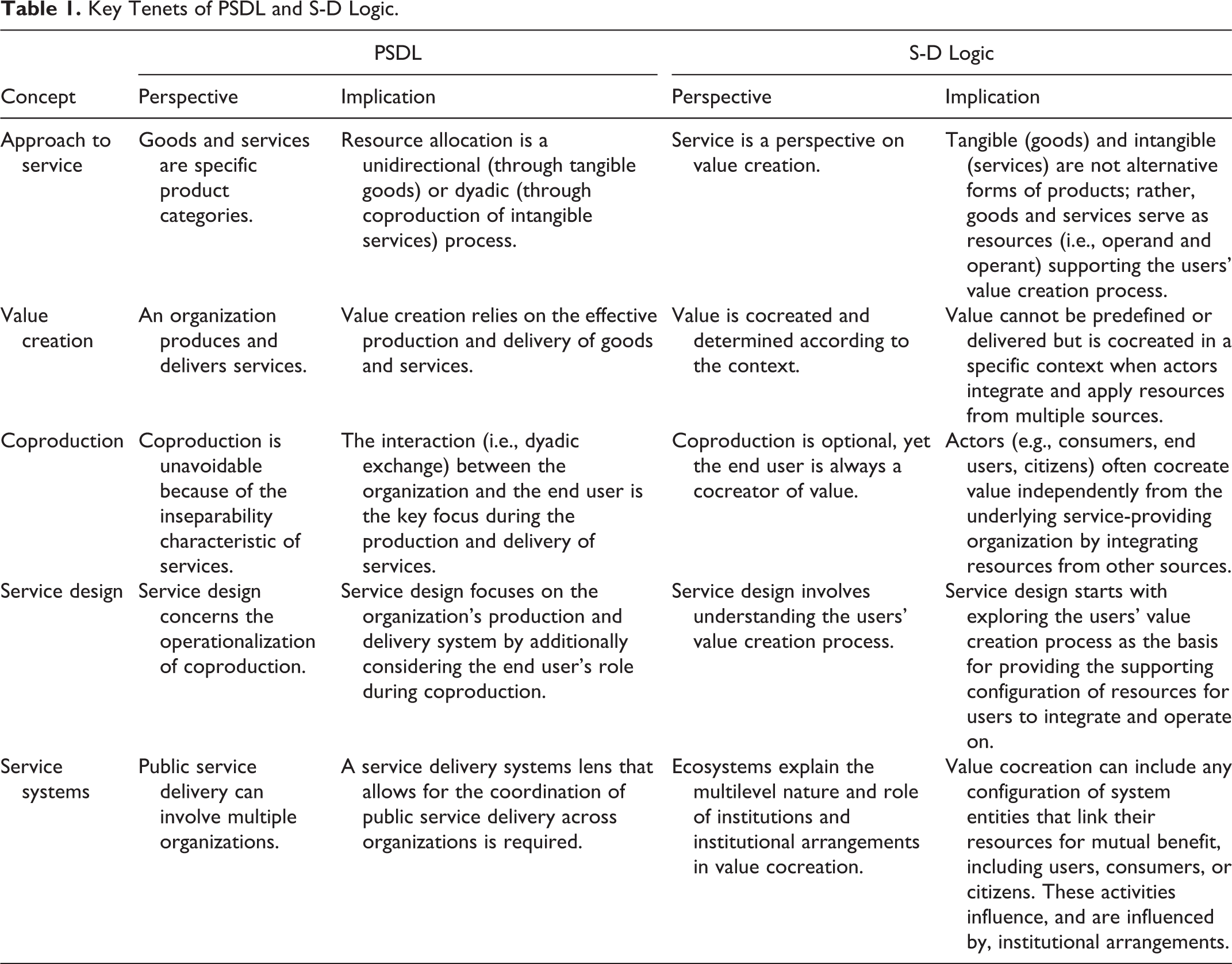
We argue that public sector research needs to continue to retreat from the narrow transactional stance and instead recognize that value is cocreated within constellations involving many actors. For policy making, this perspective implies a service ecosystems lens underpinned by the notion that value is not always simply coproduced between an organization and its users but is cocreated by multiple actors, often in complex ways (Vargo and Lusch 2017). To extend PSDL and allow public policy to embrace this systemic stance, theoretical clarifications in the following three areas will be required: The approach to distinguish (public) services from goods does not align with the current thinking in the marketing field (Gummesson 2007; Lovelock and Gummesson 2004) or with S-D logic (Vargo and Lusch 2004b). Importantly, the current approach limits the analysis and design of public policies regarding the production and delivery of value, which, when delivered in form of a service, is coproduced with the end user. Drawing on S-D logic, this study argues for a service ecosystems lens that recognizes the collective, multiactor, and systemic nature of value cocreation. The conceptualization of coproduction as an inalienable component of public service delivery contradicts developments in S-D logic, in which coproduction is defined as optional but value is seen as always being cocreated (Lusch and Vargo 2006; Vargo and Lusch 2006). This misconception of coproduction has led to confusion with respect to its implications for public policy making (Brandsen and Honigh 2016). To avoid costly policy failures resulting from the assumption that coproduction is inherent in all services, this study undertakes further analysis with respect to how this concept, and the role of end users as coproducers, can be defined. The current approach to conceptualizing public sector organizations as part of service delivery systems is based on research investigating the contribution of service blueprinting (Radnor et al. 2014). Service blueprinting, however, is limited to analyzing the production and delivery of services as units of output and the end user’s role as coproducer within this process (Shostack 1984). This view again reflects a dyadic stance and, more importantly, does not account for value constellations that encompass multiple systems (Maglio, Kwan, and Spohrer 2015; Patrício et al. 2011), or the interplay between markets and government (Stewart 2015). To account for the complexity of interactions within society and markets, and to develop effective policies regarding these interactions, we argue for a multilevel approach that (1) defines users’ value creation process as the central unit of analysis and (2) extends beyond the organization’s boundaries to consider value cocreation from a service ecosystems perspective.
The following section elaborates on these three areas through the integration of recent developments in S-D logic, SSME, and related research on collective value cocreation. This integration underpins the application of a service ecosystems lens to public policy and allows us to discuss the resulting implications of this application.
Moving Beyond the Service Delivery System
The Approach to (Public) Service
The traditional approach to classifying services as a specific product category (e.g., by drawing on the IHIP characteristics, as occurs in PSDL) has faced extensive criticism. For example, in their influential article, Lovelock and Gummesson (2004) contend that the claim that services need to be treated differently from goods, based on the four specific IHIP characteristics, is not supported by evidence. These characteristics are merely theoretical constructs subject to ambiguous interpretation and are therefore termed “The Four Service Marketing Myths” (Vargo and Lusch 2004b). Importantly, the traditional approach does not adequately inform public policy because it assumes that value is embedded in and delivered by means of goods or services (Vargo and Lusch 2008b). As a result, public policy analysis—even when taking a user-centered approach—would traditionally take a unidirectional or dyadic focus and not account for the wider value constellation involving multiple actors. Thus, while implications for organizations delivering services to end users might be well established in the design of new policies, the effect of the policies on the many actors within society and markets might, at worst, remain guesswork. These considerations lead to the following question: How can service be defined so as to provide a more useful lens through which to approach public policy analysis and design?
S-D logic and a service perspective on value creation provide a promising starting point from which to address this question. Foremost of all, in S-D logic, tangible (goods) and intangible (services) are not suggested as alternative forms of products (Vargo and Lusch 2004a; Vargo and Lusch 2008b); rather, goods serve as alternatives to direct service provision, while service represents the general case of the exchange process. A key assumption therefore is that value is not embedded in and delivered by means of goods or services; rather, it is cocreated in specific contexts when resources—both operand and operant—are integrated and used by multiple actors, including the end user (Chandler and Vargo 2011; Skålén and Edvardsson 2015). In other words, resources by themselves hold no inherent value, but only potential value that can be integrated by and across actors to cocreate value. Thus, value cocreation is a collective action including actors, interactions, practices, and outcomes (Laamanen and Skålén 2015). Despite the collective perspective on value cocreation, Vargo and Lusch (2016, p. 8) assert that “value is always uniquely and phenomenologically determined by the beneficiary” because the referent beneficiary at the center plays a key integrative and evaluative role in all instances.
Service as a perspective on value creation is widely accepted in the literature, including studies conducted in the public sector (e.g., Anderson et al. 2016; Elg et al. 2012; McColl-Kennedy et al. 2012). Yet the classification that distinguishes between services and goods, as well as the conceptualization of the user or citizenry as the recipient of outputs, still guides the development of policy implications for public service organizations. For example, Alford (2014, p. 308) argues that “while many public services entail delivering services as opposed to goods, more than a few organizations will be delivering a mixture of the two—which has significant implications because these two types of offerings have differing logics.” The same approach is taken by Osborne et al. (2015, p. 2) in PSDL, particularly in their suggestion that goods can improve operant resources, thus resulting in better services: “Public service organisations are not producing technically designed and manufactured products but rather are delivering intangible services that require attention to the processes of service delivery and to relationships with service users, and not simply to service design.”
When S-D logic is adopted, a distinction is not needed between goods and services. Instead, both serve as types of resources (i.e., operand and operant) that support actors, such as consumers, citizens, volunteers, and nongovernmental organizations (NGOs), in creating value. This approach is significant because it shifts the focus from the transaction of value being delivered by the organization to the end user toward that of value being created through the application of resources. Resources are thereby integrated from various sources, which implies that multiple actors engage in value cocreation (Vargo and Lusch 2016).
Policy analysis therefore needs to start by understanding the specific circumstances surrounding the users’ value creation process as the basis for designing public policies. This understanding then enables policy makers to ensure that the appropriate configuration of resources is in place for relevant actors to integrate and operate on. In fact, from this perspective, public policy could be conceived of as a service in itself, that is, “the application of specialized competences (operant resources—knowledge and skills),” which, in the form of a resource configuration, supports the actors’ integration and operation (Vargo and Lusch 2008b, p. 26). Specifically, from a S-D logic perspective, public policy could well be conceived of as a service for service because its fundamental aim should be to coordinate value cocreation activities between relevant actors as part of a broader effort to address public problems (Talukdar, Gulyani, and Salmen 2005; Viswanathan et al. 2012).
For example, in Australia, one societal challenge for policy makers is to tackle binge drinking behavior early by proactively addressing alcohol consumption among young consumers (Australian National Prevention Health Agency 2014). As a result, compulsory alcohol education programs were introduced in high schools across Australia with the aim to educate young people about the risks associated with binge drinking. The programs were based on traditional one-way didactic approaches, delivered by teachers to students in a classroom setting. Yet the programs had little success because (1) the learning objectives were determined without a clear understanding of why young consumers engage in excessive drinking, and (2) the program’s delivery was defined without understanding how users (i.e., students and teachers) create value based on the provided resources (Dietrich et al. 2015, 2017). Through codesign sessions, in which representatives of the target audience participated as experts of their experiences, researchers found that adolescents did not lack knowledge about alcohol consumption per se but instead could not develop effective strategies to cope with peer-pressure scenarios, where they feel pressured to engage in excessive consumption. In addition, teachers did not feel comfortable discussing and were not trained to discuss sensitive topics, such as alcohol education, openly. These insights led to a new program in which students attend a virtual house party, where they face different peer-pressure scenarios and experience the repercussions of their decisions (Durl, Trischler, and Dietrich 2017). Engagement in this simulation enabled participants to develop the relevant knowledge to make informed decisions, and as a result, the students became more resilient to peer-pressure scenarios.
This simple example, which involves a pressing topic in numerous countries (Hogan, Perks, and Russell-Bennett 2014), illustrates the importance of adopting a systems lens as the basis for effective public policy analysis and design. Policy analysis starts with understanding the value creation process, specifically by exploring the users’ Lebenswelt, which refers to an individual’s lived experience and the social context in which value is created (Helkkula, Kelleher, and Pihlström 2012). Then, on a macro level, the value constellation can be analyzed by identifying relevant actors having a (potential) effect on the problem–solution combination. Without this micro/macro systemic analysis, policies might fail to support actors in effectively addressing the underlying problem, and resources integrated by the government and other public sector organizations will, as a result, be wasted. Furthermore, the example shows that the question of whether the program is actually a tangible good (e.g., a textbook) or an intangible service (e.g., a lecture) is less relevant than the question of how the program can successfully support actors during their value creation process (e.g., students in developing strategies to resist peer pressure, instructors in meeting learning objectives). From this viewpoint, public policy is clearly a service, its aim being to assist with the application of operant resources that different actors integrate and operate on to address a specific problem.
The following sections elaborate on this lens, especially with respect to distinguishing between and differentiating the concepts of coproduction and value cocreation, as well as expanding on the role of systems and institutions in value cocreation activities. We hope that this elaboration will generate a clearer picture of the implications that follow from the application of a service ecosystems lens to public policy.
Coproduction and Related Concepts
In the public sector literature, particularly that relating to PSDL, the concept of coproduction is regarded as being at the “heart of public service delivery [because] one cannot have (public) service delivery without co-production” (Osborne and Strokosch 2013, p. 36). The same authors add that coproduction “is the essential and intrinsic process of interaction between any service organization and the service user at the point of production of a service” (p. 36). This argument is supported by the foundational premise of S-D logic, namely that the customer is always a coproducer (Vargo and Lusch 2004a). In fact, this premise has created much discussion in the public sector literature with respect to how end users might be defined and/or involved as coproducers (e.g., Alford 2014, 2016; Pestoff and Brandsen 2013; Voorberg, Bekkers, and Tummers 2015). However, only a few scholars within this domain (e.g., Hardyman, Daunt, and Kitchener 2015) recognize that the concept of coproduction has long been refined and enhanced through the introduction of “value cocreation” (Vargo and Lusch 2006, 2008a). Value cocreation in this context is conceptually different from its regular usage in design, where it refers to an act of collective creativity (Sanders and Stappers 2008), and innovation, where it refers to active engagement of customers in a firm’s innovation process (Trischler, Pervan, and Scott 2017). The ongoing confusion of coproduction and value cocreation leads to the following question: How does coproduction differ from value cocreation, and how can these ideas be conceptualized to inform public policy effectively?
To address this theoretical question, the concepts of value cocreation, coproduction, and value-in-use (which is inherent in value cocreation) are defined and discussed in detail. Clarifying these concepts is important because, as we describe in this section, they guide public policy analysis and design. Specifically, value cocreation zooms out to enable a holistic analysis of the value constellation by considering the many possible resource-integrating and service-for-service exchange activities between actors. In contrast, coproduction zooms in to focus on specific interactions between two actors. Value-in-use, in turn, defines the focus of policy design, that is, policies that ensure that the right resource constellation is in place to enable actors (e.g., NGOs, firms, end users) to address a specific public problem.
Coproduction, according to Ranjan and Read (2016, p. 292), “consists of direct or indirect ‘coworking with customers’ or participation in the product/service design process.” The same authors add that coproduction might be seen as part of a “facilitation role at the periphery of a firm’s processes” or could be evidenced as “an active role through the application of knowledge and sharing of information with the firm” (p. 292). Applied to the public sector, this conceptualization of coproduction aligns with the definition recently developed by Brandsen and Honingh (2015, p. 431): “Coproduction is a relationship between a paid employee of an organization and (groups of) individual citizens that requires a direct and active contribution from these citizens to the work of the organization.”
By way of contrast, value cocreation goes beyond coproduction to include value-in-use. Value-in-use is “derived from the user’s use context and processes…on the basis of the specificity of their usage” (Ranjan and Read 2016, p. 293). Thus, value might not only be derived through a dyadic interaction with the organization, but also may be completely independent of the organization’s intervention or exchange. For example, users might cocreate value in the broader context of their Lebenswelt (Helkkula, Kelleher, and Pihlström 2012). Hereby, value cocreation generally takes place between collective organized actors who often have different interests, which means that value cocreation activities are not always harmonious and uniformly favorable undertakings but can include conflictual elements, such as coercion, cooptation, contention, or compromise (Echeverri and Skålén 2011; Laamanen and Skålén 2015).
The distinction between coproduction and value cocreation is important because it recognizes that value creation “always involves a unique combination of resources” (Vargo and Lusch 2008a, p. 8; emphasis in original). Value cocreation is therefore a second-order construct for both coproduction and value-in-use because it extends beyond production to include the process whereby actors cocreate value through the combination of resources on the basis of the specificity of their usage (i.e., value-in-use; McColl-Kennedy et al. 2012). Accordingly, Vargo and Lusch (2008a, p. 8) posit that “the involvement in ‘co-production’ is optional and can vary from none at all to extensive co-production activities.” In specific terms, they state:
At the heart…is the concept of “value cocreation,” not in the normative sense of suggesting a service beneficiary should be included in production processes (e.g., Moeller 2008)—what we call “co-production” (Vargo 2008)—or in the restricted meaning of direct, dyadic, one-on-one (i.e., business–customer) interaction (e.g., Gronroos and Voima 2013), but in the sense that it accommodates, if not necessitates, recognition of the full range of the cumulatively coordinated resource-integrating and service-for-service exchange activities of the multiple actors always involved in every instance of value creation. (Vargo and Lusch, 2016, pp. 18–19; emphasis in original)
While this position stands in clear contrast to PSDL, it aligns with the definition of coproduction provided by Brandsen and Honingh (2016). We agree that coproduction is an optional process, whereas value cocreation is not. Regardless of whether coproduction takes place, the user cocreates value through the integration of resources and service-exchange activities from many sources (Vargo and Lusch 2014, 2016). This value cocreation occurs in the user’s sphere and is influenced by the specific context and processes, including time, location, or uncertain conditions (Chandler and Lusch 2014). Importantly, users might, depending on their specific context, also cocreate value completely independently from the underlying service provider by integrating resources from multiple sources (McColl-Kennedy et al. 2012). This context-specific cocreation includes the possibility that actors may contest dominant structures with the aim of improving their own and others’ well-being (Skålén, Aal, and Edvardsson 2015).
For example, a patient with Type 2 diabetes might participate in administering treatments, redesigning treatments, or reconfiguring the medical team. All these actions would make the patient a coproducer because the patient’s resources are integrated into the provider’s “production” process. At the same time, the patient also cocreates value by integrating resources and applying specialized knowledge and skills on the basis of the specific use context. However, the patient might decide to cease treatment or, alternatively, continue the treatment at home by using alternative treatment methods, making dietary changes, accessing complementary therapies, or seeking assistance from friends and relatives. Moreover, the patient might blame the government for not protecting consumers from persuasive advertising campaigns and might start an initiative mobilizing support from other actors (e.g., authorities, celebrities, interest groups, academics) to pressure the government and selected corporations (e.g., Coca-Cola, PepsiCo, McDonald’s) to change their practices and take action (e.g., introduction of a sugar tax, better disclosure of ingredients, restrictions on drink sizing).
This example shows that coproduction between two actors (e.g., a public service organization and its users) represents a narrow perspective and is only one of many possible resource integration activities. Thus, to capture the entire value constellation, policy makers need to zoom out and analyze how value cocreation takes place between collective organized actors with possibly different interests. More importantly, policy makers need to consider that value cocreation can occur independently or beyond coproduction with the underlying service provider (e.g., as an ongoing or preceding value creation process).
Value Cocreation in (Public) Service Ecosystems
As illustrated in the previous section, value cocreation is not limited to dyadic organization–user interactions but results from the integration and application of resources from multiple actors. This perspective implies a systems approach (Maglio and Spohrer 2008; Vargo and Lusch 2016).
A systems approach is also applicable in PSDL and in the propositions that public services should be regarded as “systems,” rather than merely “organizations,” and that these systems need to be governed as such (Osborne et al. 2015). With respect to this observation, Osborne et al. (2015), however, refer to “service delivery systems” that include an array of human, organizational, and technical elements and processes. In this context, Radnor et al. (2014) suggest blueprinting as a key technology to address the complexity of public service delivery systems and operationalize coproduction with end users. Yet recent studies have shown that the applicability of blueprinting is, for the most part, limited to a dyadic exchange between the organization and the service user (Pinho et al. 2014; Teixeira et al. 2017). Moreover, it does not account for the possibility that value cocreation frequently involves multiple entities, including the end user and multiple other actors beyond a simple dyadic context (Maglio, Kwan, and Spohrer 2015). We therefore ask how the systems approach can be extended beyond immediate service delivery to account for various instances and the multiactor nature of value cocreation.
We propose that insights from SSME (Maglio and Spohrer 2008), together with the ecosystems perspective of S-D logic (Lusch and Vargo 2014), should be integrated into our understanding of how these systems work. This integration provides the basis for an approach that can cater effectively to contexts beyond a simple exchange of resources, which will likely improve policy design and the subsequent application of public resources.
With S-D logic as the theoretical foundation, Maglio et al. (2006) introduce service systems as the basic unit of analysis of service. Service systems are value cocreation configurations of people, technology, and value propositions connecting internal and external service systems, together with shared information (e.g., language, laws, measures, and methods; Maglio and Spohrer 2008). Internal structure refers to economic entities consisting of collections of resources (i.e., people, technologies, organizations, and shared information). The four types of resources are resources with rights (people and organizations), resources as property (technology and shared information), physical entities (people and technology), and socially constructed entities (organizations and shared information). Together, these entities form a service system that interacts with other (external) service systems to cocreate value (Maglio and Spohrer 2013).
To cocreate value, a provider entity and a user entity must, at a minimum, interact either directly or indirectly. Yet Maglio, Kwan, and Spohrer (2015) note that, in today’s society, value cocreation often emerges from the interaction of many entities, rather than simply dyadic interaction. These entities may be people, organizations, or even nations, and they must be able to grant each other access to some set of physical or nonphysical resources (Maglio and Spohrer 2013). In line with these considerations, goods are simply mechanisms by which service system entities package their knowledge to easily distribute and share their capabilities with others across space, time, and scales (Maglio and Spohrer 2013). Likewise, technology contributes to the cocreation of value by enabling the sharing of information within and across service systems.
Service-dominant logic’s conceptualization of ecosystems advances the SSME approach by broadening the scope of technology and providing a view of value cocreation and innovation that enables oscillation between micro-, meso-, and macro-level perspectives (Akaka and Vargo 2014; Vargo, Wieland, and Akaka 2015). A service ecosystem can therefore be understood as “a relatively self-contained, self-adjusting system of resource-integrating actors connected by shared institutional arrangements and mutual value creation through service exchange” (Vargo and Lusch 2016, pp. 10–11). Self-contained refers to a structure of repeated interactions and exchanges over time (i.e., most actors exchange or interact to solve a problem or pursue an opportunity and repeat these interactions when successful; Simon 1990). Yet the system structure is relative because systems are typically nested within or are part of a larger system, with these systems often influencing each other (Kast and Rosenzweig 1972). Furthermore, a system has the ability to self-adjust to the changes resulting, for example, from integrated resources from nested subsystems or overlapping systems (Kast and Rosenzweig 1972).
Importantly, because ecosystems are nested and overlapping, each instance of resource integration and value creation changes the nature of the system and thus alters the context for the next iteration and determination of value creation (Wieland et al. 2012). The implication is that (public) value cannot be conceptualized as something delivered as an output of a closed production system. Nor is value created individually or dyadically; instead, it is cocreated through the integration of resources provided by many sources, including private and public actors. In addition, and unlike the SSME approach, the ecosystems lens emphasizes the central role of institutions and defines technology as an institutional phenomenon. In S-D logic, technology is not seen as a material artifact or outcome of human actions but as an operant resource (i.e., useful knowledge) capable of acting on other resources to create value (Akaka and Vargo 2014). Policy makers need to consider the central role of technology; for example, by supporting radical innovations that replace or lead to more effective ways to employ operand resources (e.g., irreplaceable natural resources), as well as by proactively addressing challenges surrounding information privacy, cybersecurity, and artificial intelligence.
In turn, institutions are fundamental to the understanding of value cocreation processes, as defined in the following foundational premise of S-D logic: “Value co-creation is coordinated through actor-generated institutions and institutional arrangements” (Vargo and Lusch 2016, p. 18). The same authors thereby distinguish between an “institution” (i.e., a relatively isolatable, individual rule, such as a norm, meaning, symbol, law, or practice) and “institutional arrangements” (i.e., interrelated sets of institutions that together constitute a relatively coherent assembly that facilitates coordination of activity in value cocreating service ecosystems). This extension of S-D logic is significant because it provides “the building blocks for increasingly complex and interrelated resource-integration and service-exchange activities in nested and overlapping ecosystems organized around shared purposes” (Vargo and Lusch 2016, p. 18). For policy makers, this conceptualization points to the importance of considering the influence of existing institutions (e.g., existing regulations, norms, or rules) and institutional change (e.g., new regulations) on value-creating actions and interactions between actors within society and markets (e.g., consumer habits, business practices).
We suggest that the service ecosystems lens, together with the foundational premise of institutions as used in S-D logic, can make an important contribution to public policy because it goes beyond the immediate service delivery system and accounts for instances of value cocreation. Our suggestion also aligns with Alford’s (2016, p. 680) view of public value being “consumed [by] the collective citizenry, mediated through the political process,” and facilitated through “institutions that enable the market and the broader society to function.” In fact, we argue that public policy design is more often than not influenced by institutions and that institutional change is put forward by politicians, lobbying groups, the media, and the citizenry. For example, Skålén, Aal, and Edvardsson (2015) show how information technology allows multiple actors within the service system to organize and challenge existing institutions. Moreover, it accounts for collective value (Laamanen and Skålén 2015), together with the possibility that value cocreation can include different outcomes, such as coercion, with government imposing obligations on some users (such as prisoners) for the benefit of others (such as the broader citizenry). Most importantly, the service ecosystems lens underlines that value creation is neither singular nor dyadic but rather a multiactor phenomenon involving dynamic and complex value constellations consisting of citizens, volunteers, nongovernmental partners, and others.
Five Propositions for the Application of a Service Ecosystems Lens
So far, this study has evaluated whether a service ecosystems lens, as an evolving marketing perspective introduced by S-D logic, can be applied to public policy. We propose that indeed it can, especially through recent extensions that consider in more nuanced detail the collective notion of value cocreation and the role of institutions and institutional arrangements. Table 2 outlines the foundations for applying a service ecosystems lens to public policy and the implications that follow from this application. This section elaborates on Table 2, specifically in terms of discussing the changes to public policy analysis and design that would be required if this service ecosystems perspective is privileged over the conventional exchange paradigm. The discussion includes the development of five propositions that might guide future thinking about the application of a service ecosystems lens to public policy.
Applying a Service Ecosystems Lens to Public Policy.

Conceptualizing a Service Ecosystems Orientation for Public Policy
On an abstract level, we propose that public policy requires a service ecosystems lens that focuses on identifying and providing a suitable resource configuration for actors to integrate and operate on to address a specific problem. Three arguments underpin our position. First, this lens recognizes that value is not embedded in goods and services and delivered as outputs; rather it is cocreated when resources are used. The role of government is therefore as a coordinator of value cocreation, which (when possible) supports emergent solutions (Viswanathan et al. 2012). Second, the lens underscores that users, consumers, or citizens are not passive actors but are resource integrators and thus value cocreators. Policy making thus requires a clear understanding of why and how actors coordinate themselves around specific value cocreation activities (Skålén, Aal, and Edvardsson 2015). Third, the lens conceives of public policy as a service for service, that is, the application of resources to support, guide, or incentivize value cocreation activities between actors and markets. In fact, and based on the ecosystems and institutional perspective of S-D logic, we contend that public policy establishes an important basis for institutional arrangements that coordinate markets and a society composed of multiple actors with different interests.
To illustrate this abstract conceptualization, we note that a government does not deliver public safety but supports various actors to address problems surrounding safety. Public policies play a central role in coordinating value cocreation activities between multiple actors. For example, organizations can use intelligent video analytics (e.g., redaction and facial recognition analytics) only when other actors (e.g., network and information security agencies) ensure the security of the data. Furthermore, policies might include the support of volunteer programs (e.g., neighborhood watch), the regulation of businesses and markets (e.g., clubs, restaurants, accommodation providers, transportation providers, private security agencies), and the enabling of effective communication between citizens and law enforcement bodies (e.g., different communication channels to increase access to incident and emergency management centers). On a macro level, public policies take a central role in supporting cutting-edge research and development in areas continuously contributing to safety, such as innovations in cybersecurity, urban planning, crowd management, and safety programs.
Furthermore, policy design is influenced by institutions and institutional change that can be initiated by various actors. These integrated clusters of institutions (e.g., institutional arrangements around safety standards, norms, and regulations) influence, and are influenced by, value cocreation activities between multiple actors across different levels of the service ecosystem (e.g., individual businesses, interest groups, industry sectors, markets). Public policy therefore plays an essential role in (1) coordinating these influences and (2) accounting for institutional change being driven by conflicts between “incumbents” and “challengers” within spaces of contention, such as when actors organize themselves to contest current regulations (Blocker and Barrios 2015; Skålén, Aal, and Edvardsson 2015). This viewpoint highlights the need for policy makers to take a systemic perspective and understand the complex interactions and forces that underpin society and markets, and the influence of government actions on these interactions and forces (Hill and Martin 2014; Stewart 2015). At a macro level of abstraction, we therefore propose the following:
Multilevel Policy Analysis
P1 implies that policy analysis needs to begin by generating a clear understanding of the users’ value creation process, including the multiple factors affecting this process. This step includes the consideration of people’s uniqueness and heterogeneity (Viswanathan et al. 2012), as well as the collective and contested nature of value cocreation (Laamanen and Skålén 2015). Policy makers must therefore go beyond consideration of the delivery system and gain an understanding of the entire value constellation, including how individual users and the collective citizenry cocreate value in their specific use contexts. It follows that policy analysis cannot simply be a user-centered process, but instead represents a multilevel approach that considers the context together with the multiple actors involved in value cocreation.
A way to achieve this understanding is to model service ecosystems at different levels of analysis. The starting point should be the micro level because this level of analysis facilitates determining how an individual actor integrates and operates on resources provided by another actor (Chandler and Vargo 2011). However, the analysis cannot be limited to a coproduction logic (i.e., exchange between two actors); it additionally needs to consider the context (i.e., meso level) in which any exchange takes place. This consideration is necessary because, even in the narrow sense of a dyadic provider–user exchange, the value creation process is influenced by the specific context, such as time, location, institutions, and societal structures (Chandler and Lusch 2014). Building on the previous example, we can posit that problems associated with public safety might be not only associated with the different actors involved but also completely different in rural areas than in metropolitan areas, during the day instead of the night, and so on. In short, because value is a contextually contingent concept (Vargo and Lusch 2008a), understanding the context in which value is created is essential for policy analysis.
After beginning with this narrow stance, the analysis can then zoom out to the macro level to capture the entire value constellation, which involves multiple actors. The macro-level analysis is important because it considers a wide range of influencing value cocreation activities that occur independently from, or beyond coproduction with, the underlying service provider (i.e., independent, ongoing, or preceding activities). This multilevel and systemic analysis sets the starting point for designing policies that support actors in effectively addressing the underlying problem. Thus, we propose the following:
With the micro-level analysis, exploratory methods provide in-depth insights into individuals’ specific motivations, needs, and preferences. These methods might include qualitative marketing research methods (e.g., observations or phenomenological interviews; Gummesson 2005), approaches drawn from social sciences (e.g., anthropology; Talukdar, Gulyani, and Salmen 2005), and tools borrowed from empathy design (e.g., personas and walkthroughs; Kouprie and Visser 2009; Suri 2003). In the macro-level analysis, fuzzy-set qualitative comparative analysis can be useful for investigating possible problem–conditions–solution combinations across the complex and multilateral interactions of the value constellation (Tóth, Henneberg, and Naudé 2017). Alternatively, computational models (e.g., agent-based modeling) can allow policy makers to simulate value cocreation activities between multiple actors over time and test the possible effects of different policy scenarios on these activities (Farmer and Foley 2009).
Policy Design for Emergent Solutions
In policy design, a key challenge is to walk the fine line of setting laws, rules, and regulations with universal applicability while, at the same time, considering and acknowledging relevant differences between individuals. This process often includes the development of “one size fits all” solutions for a heterogeneous society or market. One possible way to approach this challenge is to support emergent solutions; that is, policy makers should proactively identify actor-driven solutions and, where appropriate, provide stewardship, thereby allowing both public and private actors to address the underlying problem collaboratively. This support includes creating awareness of the active role that end users and other actors can play in addressing the underlying problem (Blocker and Barrios 2015) or realizing behavioral change (Sciandra, Lamberton, and Reczek 2017).
The following example illustrates this approach. On the Gold Coast, Australia, more than 167,000 of 204,000 commuters travel daily to work using a private motor vehicle, while only 9,000 use public transportation and 2,000 use a bicycle (City of Gold Coast 2017). Seeking to address the increasing congestion problems, the state government started to invest heavily in infrastructure to ensure an adequate transportation network. This investment included the introduction of new public transportation modes (e.g., light rail), combined with reduced fares. However, the roads remain congested. In response to these ongoing challenges, various actors (e.g., local employers, schools, bicycle retailers, NGOs) have started to explore opportunities for increasing the use of bicycles for medium-to-short distance journeys. For example, a number of employers have started to provide changing facilities, while NGOs and retailers have hosted events promoting bicycle use, including information sessions, bicycle expos, and ride-to-work challenges, and a social media campaign advocating the benefits of cycling has been launched (Bicycle Queensland 2017). However, the usage of bicycles remains low. This outcome can be attributed to the fact that bottom-up initiatives are unlikely to lead to behavioral changes for those with strong habits (e.g., toward car usage) in the absence of government interventions supporting this change (Verplanken and Wood 2006). A failure to collaborate effectively with relevant actors therefore stifled the initiative to reduce private vehicle dependency; that is, policy makers failed to provide effective support for a possible emergent solution to the public problem of traffic congestion.
Furthermore, while policies might have universal applicability, flexibility will be the key to whether they support individual actors and the collective citizenry to address a specific problem. For example, various levels of government may be providing resources that can be integrated and operated on by end users, with the citizens preferring one offering or suite of these resources. If so, the government’s resource allocation involves redundancy and therefore inefficiency. Take, for example, a government service, such as one pertaining to health information or preventative medicine for at-risk groups, offered by local government a suburb away from where the user lives. The user might choose to forgo this local government service if the federal or state government provides a web-based service dealing with the same issue that can be used in the privacy and comfort of the citizen’s own home.
This admittedly simplistic example demonstrates that an informed understanding of how the modern citizen takes advantage of government-provided or government-facilitated services (or does not take advantage of them) would result in a more efficient allocation of resources, particularly given the observation, implicit in S-D logic, that value cocreation or coproduction generally takes place closest to the end user. Here again, analytic techniques, such as fuzzy-set qualitative comparative analysis or quality function deployment, can help policy makers evaluate problem–solution combinations systematically. The application of such techniques is particularly beneficial because they allow for equifinality, that is, the possibility of several “recipes for success” rather than one best solution (Tóth, Henneberg, and Naudé 2017). This aspect of policy making is essential in a dynamic society and markets characterized by value cocreation activities between multiple actors. A sole focus on the production–delivery relationship overlooks these alternatives and could result in inefficient resource application and costly policy failures. In fact, the shift from a service-delivery focus to consideration of the entire value constellation is essential because end users, consumers, or citizens are also resource integrators and thus value cocreators. This fact leads to the following proposition:
Designing in Coproduction Experiences
As part of policy design, policy makers should consider coproduction as a means to address individual users’ needs. For example, policy makers can purposefully design “coproduction experiences” that foster well-being outcomes, such as eustress, literacy, or compliance among marginalized or vulnerable consumer groups (Engström and Elg 2015; Mende et al. 2017). This approach, however, requires that coproduction be viewed as an optional process (Brandsen and Honingh 2015) that could occur, for example, in the form of user participation during the “production” process (Mende et al. 2017) or service design processes (McColl-Kennedy et al. 2012). Thus, the move from conceptualizing coproduction as inevitable to viewing it as optimal opens new possibilities for policy makers with respect to providing a suitable supporting configuration of resources for individuals and the collective citizenry to integrate and operate on.
Yet regardless of whether users are involved in coproduction, they are always value cocreators (Vargo and Lusch 2016). We argue that recognition of this fact is especially important in the public sector, where direct interaction between the service provider (e.g., government agencies, regulation bodies, authorities) and the citizenry is often limited. Without this understanding, policy makers might build the wrong expectations of user involvement into service processes. In fact, recent studies point out that the shift of functions and risks from providers to users, commonly termed “responsibilization,” has become increasingly common in governmental services and sectors such as finance and health (Anderson et al. 2016; Giesler and Veresiu 2014). This shift can be problematic, particularly when users lack control or are ill equipped to coproduce (e.g., because of low financial or medical literacy), which can lead to a perception of overburden, self-blame, or stress (Anderson et al. 2016; Carrington, Zwick, and Neville 2016). Therefore, users should be given choices about their coproduction workload, and the effects of involving users in coproduction should be investigated over time. Noting the importance of distinguishing between coproduction and value cocreation for public policy design, we propose the following:
Engaging Those Affected
As proposed in P1, a systems perspective is fundamental to enable public policy to account for various instances and the multiactor nature of value cocreation (Vargo and Lusch 2016). Mapping techniques adopted from service design and information systems can assist policy makers by transforming systems or value constellations into visible dimensions. Representation tools, such as service maps and process models, provide clarity about how value is cocreated within and between service systems (Patrício et al. 2011), and these tools support process innovation and redesign (Figl and Recker 2016). Recent frameworks that help to capture the entire value constellation include Multilevel Service Design (Patrício et al. 2011), customer experience modeling (Teixeira et al. 2012), Process-Chain-Network Analysis (Sampson 2012), and the MINDS (management and interaction design for service) method (Teixeira et al. 2017). These visual representations are important for communicating insights to relevant stakeholders, as well as for providing a platform for collaboratively ideating possible problem–solution combinations (Blomkvist and Segelström 2015).
In addition, approaches are required that allow selected users and arguably other stakeholders to participate actively in policy design. Because policy effects cannot be fully planned, a core design fundamental is to understand possible futures by gaining insights into users’ motivations, drivers, and needs (Wetter-Edman et al. 2014) and by incorporating new theories and models to derive predictions (Lopez-Vega, Tell, and Vanhaverbeke 2016). During this process, the public sector agency’s close collaboration with users, citizens, and other stakeholders is important because they are experts of their experiences and can contribute valuable knowledge of, and innovative solutions to, public problems (Sanders and Stappers 2008). For example, the Design Council in the United Kingdom continuously collaborates closely with end users, as well as with leaders and decision makers in local organizations, on the development of possible solutions to a variety of public problems including health, poverty, and housing (Design Council 2017). Crowdsourcing presents another approach to tap end users as a valuable and active resource (Schemmann et al. 2016). End users’ input is particularly important because decisions based on the views or votes of a large group of individuals are often more accurate than decisions made by an elite few (Surowiecki 2004). In fact, studies show that user involvement through codesign (Trischler et al. 2018), or even by enabling users to take over innovation activities traditionally performed by professionals (Mahr, Lievens, and Blazevic 2014), can help to overcome the fundamental problem of users’ needs being sticky, difficult to transfer, and difficult to articulate.
Finally, the active involvement of end users is important in light of their role as cocreators rather than passive actors. Cocreation assumes that end users have agency, that is, the capacity to act independently and make free choices (Sewell 1992) and to contest current structures (Emirbayer and Mische 1998). On the one hand, this agency implies that various actors can alter the institutional framework within which they are nested, which can put pressure on markets and governments to change their practices (Vargo, Wieland, and Akaka 2015). If public policy ignores this pressure, the consequence would be episodes of contention in which actors repeatedly challenge the institutionalized system to realize change in their favor (Skålén, Aal, and Edvardsson 2015). On the other hand, specific user groups, such as vulnerable or marginalized consumers, lack agency and thus might be worse off after an institutional change favoring a few dominant actors (Anderson et al. 2013; Skålén, Aal, and Edvardsson 2015). Public policy makers therefore need to identify and protect such user groups in a systematic fashion. The active involvement of these users in the development of potential new solutions can additionally enable them to step out from everyday life and reflect on their current situation (Dietrich et al. 2017). This reflection can increase users’ agency (awareness of their role in society) and lead to the awareness of new possibilities (knowledge of how to change the status quo; Blocker and Barrios 2015). Noting the importance of close collaboration with end users and other actors in public policy design, we propose the following: P5: End users, and arguably other stakeholders, are an important resource in public policy reforms, change initiatives, and service design.
Conclusion and Future Research Opportunities
Through the integration of recent developments in S-D logic and related research streams, this article proposed a service ecosystems approach to public policy analysis and design. This approach distances itself from the exchange paradigm of marketing, which is largely incompatible with the public sector environment (Hill and Martin 2014; Stewart 2013). In contrast, the present approach clearly recognizes that value cocreation arises from complex and interrelated resource-integration and service-exchange activities by private and public actors in nested and overlapping ecosystems. We propose that public policy should take the central role of coordinating value cocreation activities between various actors, including caretaking or stewardship, to address public problems. Such an approach also acknowledges that individual users as well as the collective citizenry do not want, in general, to be co-opted; rather, they want to be supported in a way that makes them feel empowered and ensures that their views are respected—all of which will mean that (public) value is effectively cocreated via their own involvement as resource integrators. Value cocreation, in this context, can occur independently from the traditional service provider in specific use contexts, while coproduction can be seen as an optional process. This distinction is highly relevant for public policy, which still tends to concentrate on dyadic exchanges.
Based on the current analysis, a number of important avenues for future research present themselves. Although S-D logic and its implications for practice are widely researched within the private sector literature, its extension to the public sector, and public policy in particular, is lacking. In fact, as shown herein, S-D logic and related concepts still seem to be insufficiently understood across disciplines, thus leading to misconceptions and potentially inappropriate applications to practice. We hope that the theoretical advancements and propositions introduced in this study will motivate scholars to further explore the application of a service ecosystems lens to the public sector.
Specifically, additional research is required to explore the application of S-D logic, and the service ecosystems lens as proposed here, to different policy contexts. The public sector is typically seen as being distinct from the private sector because it operates in a political rather than economic marketplace. This view manifests itself in concerns about governance structures (Ostrom 2015), public ordering (Buchanan 1987), and politics as mechanisms that enable people to cooperate and make choices beyond the individualism of the market (Hartley et al. 2015; O’Flynn 2007). In other words, public value creation relies on a politically mediated expression of collectively determined preferences, that is, what the citizenry determines is valuable (Moore 1995). The collective determination of value points toward the importance of coordinating actor-generated institutions and institutional arrangements for value cocreation purposes, as is central to S-D logic. A possible consideration for future research is to evaluate how the systems lens, as presented here, can provide a suitable framework for addressing the challenges and complexity of managing legitimacy, together with capacities for achieving public value outcomes. This area of future research includes an exploration of the building blocks of increasingly complex and interrelated resource-integration and service-exchange activities in the public sector.
While the current study proposes that S-D logic might well be applied to public policy, further in-depth investigation is required to evaluate the propositions underpinning this standpoint. In particular, future research should determine whether the key tenets of PSDL (i.e., the exchange paradigm, coproduction, service delivery systems) are more suitable for public policy analysis and design than an S-D logic lens. In addition, S-D logic may be further developed as a universal service logic as a result of being better informed by the public rather than private context, which would obviate the need for a public-sector-specific logic such as PSDL.
Footnotes
Acknowledgments
The authors thank Stephen Vargo, Robyn Keast, and the JPPM review team for their valuable comments and feedback on previous versions of this article. Jerome Williams served as associate editor for this article.
Associate Editor
Jerome Williams served as associate editor for this article.
Declaration of Conflicting Interests
The authors declared no potential conflicts of interest with respect to the research, authorship, and/or publication of this article.
Funding
The authors disclosed receipt of the following financial support for the research, authorship, and/or publication of this article: This research was funded by Paper Province 2.0 (Vinnova)—En storskalig demonstrator för skogsbaserad bioekonomi, grant #2016-04227.