




Abstract
While service design has been highlighted as a promising approach for driving innovation, there are often struggles in realizing lasting change in practice. The issues with long-term implementation reveal a reductionist view of service design that ignores the institutional arrangements and other interdependencies that influence design efforts within multi-actor service systems. The purpose of this article is to build a systemic understanding of service design to inform actors’ efforts aimed at intentional, long-term change in service systems. To achieve this aim, we inform the conceptual building blocks of service design by applying service-dominant logic’s service ecosystems perspective. Through this process, we develop four core propositions and a multilevel process model of service ecosystem design. The conceptualization of service ecosystem design advances service design theory by illuminating previously taken for granted aspects; explaining how intentional, long-term change emerges; and expanding the scope of service design beyond projects. Furthermore, this research offers a foundation for future research on service design that involves extending the systemic conceptualization of service design, conducting more holistic empirical investigations, and developing practical methods and approaches for the embedded, collective processes of designing.
Keywords
By shadowing and interviewing patients with diabetes, Olivia recognized how some patients developed strategies for stabilizing their glucose levels that would benefit others. Over the next several months, Olivia and her service design team worked to carefully craft the touchpoints for a new type of group medical appointment where patients with diabetes could meet each other and discuss what it is like living with their condition. When they prototyped this new service, all of the patients who participated said that they preferred the group appointment over an individual one and that they gained valuable strategies for managing their diabetes from other patients. However, when it came time to implement the group medical appointment, the doctors at the clinic resisted, saying that the group appointment made them feel more distant from their patients. In the end, the clinical team agreed to hold some group appointments, but because they were difficult to fit into the regular workflow and billing was a challenge, the offer of a group appointment eventually fizzled out over time.
This story, inspired by real-life examples from service design practice, helps to highlight some of the challenges faced by actors when employing a traditional approach to service design. While service design has been put forward as a promising approach for catalyzing innovation (Ostrom et al. 2015), there are often struggles around how the newly developed services can be implemented in practice (Almqvist 2018; Overkamp 2019). Despite promising outcomes during prototyping, new service concepts are all too often left collecting dust on a shelf or, when these concepts are implemented, the original intention is slowly eroded over time by conventional ways of working. A number of failed projects show that service design approaches need to be adapted to avoid naïve solutions and support enduring change (Hillgren, Seravalli, and Emilson 2011).
At the heart of this problem is a narrow understanding of service design that does not account for actors’ shared rules, norms, and beliefs that need to be transformed to enable long-term change in service systems (Stuart 1998). Furthermore, there is a need for service design to more actively attend to the challenges of multi-actor dynamics and interdependencies in complex service systems (Sangiorgi, Patrício, and Fisk 2017). These issues shed light on the reductionist view of service design that ignores institutional arrangements, and other interdependencies, that influence service design efforts within multi-actor service systems. At present, most accounts of service design reinforce a linear process that focuses on tweaking parts of the service system in isolation rather than working with the complexity of the system as a whole.
Where complexity has been considered in service design literature, the focus has been on developing methods that work with service systems as an object of design (e.g., Grenha Teixeira et al. 2017; Patrício et al. 2011, 2018). However, the issues of long-term implementation are symptoms of a problematic underlying reasoning and stress a need to rethink the understanding of service design itself in the context of complexity. In order to move away from a reductionist understanding of service design, there is an urgent need for the advancement of conceptual frameworks that embrace complexity to guide this practical domain (Patrício, Gustafsson, and Fisk 2018; Sangiorgi 2009; Wetter-Edman et al. 2014). Without conceptual frameworks, the practice of service design risks perpetuating the development of superficial solutions to complex systemic problems and catalyzing a plethora of unintended negative consequences.
While service design literature has been actively integrating early service-dominant (S-D) logic research (see, e.g., Akama and Prendiville 2013; Kimbell 2011; Meroni and Sangiorgi 2011; Wetter-Edman et al. 2014), its conceptual evolution does not yet reflect the more recent development in S-D logic toward the service ecosystems perspective (Vargo and Lusch 2018). The service ecosystems perspective emphasizes that value is cocreated within multi-actor exchange systems in which shared and enduring institutional arrangements—interrelated rules, roles, norms, and beliefs—guide resource integration and service exchange (Vargo and Lusch 2016). In addition to providing a systemic and institutional understanding of value cocreation, this perspective also offers important insights into how actors can intentionally influence long-term change within the complex service ecosystems they are a part of (Mele et al. 2018; Nenonen, Gummerus, and Sklyar 2018).
As such, the purpose of this article is to build a systemic understanding of service design to inform actors’ efforts aimed at creating intentional, long-term change in service systems. Through an analysis of the last three-and-a-half decades of literature on service design in service research, we show a gradual extension of the understanding of service design across four conceptual building blocks: purpose, materials, processes, and actors. We then reconceptualize these building blocks by informing them with S-D logic’s service ecosystems perspective to build a systemic conceptualization of service design, which we term service ecosystem design. We define service ecosystem design as the intentional shaping of institutional arrangements and their physical enactments by actor collectives through reflexivity and reformation to facilitate the emergence of desired value cocreation forms. We then formulate four core propositions and develop a multilevel process model that depicts the embedded, emergent, and collective nature of service ecosystem design. The process model illuminates the interactions among multiple design and non-design processes in which focal design efforts are situated and the nature of the resulting feedback loops that influence actor’s efforts to create intentional, long-term change in service systems.
By building a systemic conceptualization of service design, this article contributes to the evolving discourse on service design in four principal ways. First, this research illuminates aspects of service design that have been previously taken for granted, building a more holistic understanding that can help reduce the risk of unintended consequences and failed interventions. Second, the framework of service ecosystem design explains how the emergence of intentional, long-term change happens in service ecosystems—a critical understanding that has been absent in previous literature. Third, this research reveals the nature and dynamics of a plurality of processes residing outside of service design projects that influence the long-term outcomes of service design. Fourth, this research builds an agenda for future conceptual and empirical research on service design that contributes to a more systemic service design practice, including the development of new methods and approaches for the embedded, collective processes of designing.
The Evolving Conceptualization of Service Design
To position the development of the systemic conceptualization of service design informed by S-D logic’s service ecosystem perspective, we map and present the gradual extension that has taken place in the conceptualization of service design during the last 35 years. Importantly, there has been a shift in focus, from an emphasis on the design of services to design for service (Kimbell 2011). The principal difference between the two understandings is that the design of services conceptualization views service as an intangible market offering, denoted by the term services (plural), whereas design for service views service as the fundamental basis of exchange, denoted by the term service (singular). As such, the evolving understanding of service design has become increasingly aligned with the early work on S-D logic (Vargo and Lusch 2004, 2008). The design of services conceptualization originated from Shostack’s (1982, 1984) foundational work in the early 1980s, while the design for service conceptualization has grown in popularity over the last decade (e.g., Meroni and Sangiorgi 2011; Wetter-Edman et al. 2014). To unpack how service design has evolved over time, we show the gradual extension in the understanding of the four conceptual building blocks of service design: purpose (why), materials (what), processes (how), and actors (who). Online Appendix 1 summarizes the previous research in relation to each of these building blocks, drawing links to the early conceptual shifts from goods-dominant (G-D) logic to S-D logic.
Purpose of Service Design
In the literature, there is a clear broadening of the purpose of service design beyond its early focus on new service development (Holmlid, Wetter-Edman, and Edvardsson 2017). Contributing to the design of services conceptualization, service design was first introduced as a way of enabling more rigorous analysis and control when developing new service offerings, with the hopes of better addressing service failure and ensuring quality (Shostack 1982, 1984). This intention is echoed in the literature that followed, as Edvardsson and Olsson (1996) highlighted: “one of the major tasks in developing new services is to build in the right quality from the start” (p. 141). Although the focus on service offerings has continued, some later studies have begun to account for the growing complexity of service offerings in the service design process (Patrício et al. 2018).
As the design for service conceptualization emerged, service was reframed from an end in and of itself toward “an engine for wider societal transformations” (Sangiorgi 2011, p. 30). From this view, service design became focused on “proposing and creating new kinds of value relation” (Kimbell 2011, p. 42). Here, the purpose of service design was to create the conditions for value-in-use rather than designing service offerings directly (Meroni and Sangiorgi 2011). This reflects a shift from thinking about services as intangible exchange outputs, as is the assumption in G-D logic, to understanding service as a perspective of exchange that enables value-in-use, aligned with early S-D logic assumptions (Vargo and Lusch 2004). As this line of thinking continues, scholars suggest that the purpose of service design needs to continue to evolve toward interpreting service systems and reconfiguring systems to create value within a given situation (Wetter-Edman et al. 2014; Windahl and Wetter-Edman 2018). However, discussions about the purpose of service design leave unanswered questions about issues of control as actors seek to influence the cocreation of value amid complex contexts (Sangiorgi, Patrício, and Fisk 2017).
Materials of Service Design
The understanding of the materials of service design has evolved over the last three and a half decades, from a focus on touchpoints and interfaces in the design of services conceptualization toward sociomaterial configurations in the design for service conceptualization. Early on, Shostack (1982) stressed the importance of a customer’s journey, highlighting “service evidence,” or the tangible proof of a service, and the role of operational elements unseen by customers. Bitner (1992) further emphasized the effect of the physical surroundings of services on customers and employees, suggesting that the physical dimensions of a servicescape were like a package similar to those of products. Advancing this discussion, Clatworthy (2011) highlighted touchpoints, the contact points between service providers and customers, as an important material of service design. Furthermore, Secomandi and Snelders (2011) emphasized the service interface as the object of service design, which is mostly intangible but needs to be made tangible through physical materials and bodily perception.
Moving toward a design for service conceptualization, Blomkvist, Clatworthy, and Holmlid (2016, p. 1) suggest that “by examining service as a material, design has to transcend the tangible, and enter into a discussion of materials in a more abstract sense” (italics in original). Kimbell (2011, p. 48) reinforced this duality and interconnection, suggesting that “far from being intangible, a service can be thought of as both social and material.” Taking this one step further, Blomberg and Darrah (2015) examined service from an anthropological perspective and suggested that service is “assembled from fragments of practices, institutions, lifestyles, technologies, and networks” (p. 127). As such, there has been an extended understanding of materiality in the design for service conceptualization, highlighting the importance of both the concrete and the abstract, as well as the tangible and intangible elements of service. This shift in what is understood as service design materials aligns with the change in thinking from G-D logic, that value is embedded in outputs, to the S-D logic understanding that actors exchange to obtain knowledge and skills (Vargo and Lusch 2004). However, while there have been references to the important role of institutional arrangements in service design (e.g., Kurtmollaiv et al. 2018; Vink et al. 2019; Wetter-Edman, Vink, and Blomkvist 2018), there has not yet been any conceptual work done in service design in relation to the institutional nature of its design materials.
Processes of Service Design
Some of the early literature building the design of services conceptualization positioned service design as a phase in the new service development process between project formulation and implementation, which focuses on creating prerequisites for a service offering (Edvardsson 1997; Edvardsson and Olsson 1996). However, other literature warned against such linear manifestations of service design, highlighting the messiness of the process and its iterative nature, which must involve assessing the impact of a new service on the service system (Tax and Stuart 1997). Increasingly, the service design process has focused on understanding the customer experience (Bitner, Ostrom, and Morgan 2008) and orchestrating those experiences through clues, sensory design, and crafting interactions with employees and other customers (Zomerdijk and Voss 2010). These processes have also been extended to support the customer experience across multiple levels of service systems (Patrício et al. 2011).
Taking this even further, the design for service understanding has recognized the ongoing nature of service design, which is reflected through increasing use of the verb “designing” rather than “design” in order to stress its iterative nature (e.g., Akama and Prendiville 2013; Kimbell 2011; Sangiorgi and Prendiville 2017). This change mirrors the shift in thinking from G-D logic, where value is understood as being embedded in outputs along a value chain, toward the understanding in S-D logic that firms can only make value propositions and customers are active participants in coproduction (Vargo and Lusch 2004). Through this perspective, the importance of appreciating and incorporating existing design legacies inherited from previous generations in organizations has been noted as critical to service design (Junginger 2015). Aligned with this thinking, building organizational capabilities through service design has increasingly become central to the service design process (Karpen, Gemser, and Calabretta 2017; Malmberg and Wetter-Edman 2016). Furthermore, there has been a growing emphasis on service design as a reflective practice that involves a gradual evolution of the visible and invisible elements of systems (Kurtmollaiev et al. 2018; Vink et al. 2019; Wetter-Edman, Vink, and Blomkvist 2018). In addition, this perspective has led to developments in service design approaches to enrich the understanding of customers’ value determination (Sudbury-Riley et al. 2020). However, there is still a strong need for further conceptualization of these service design processes amid complex service systems (Patrício, Gustafsson, and Fisk 2018; Windahl and Wetter-Edman 2018).
Actors in Service Design
Early on, the design of services conceptualization highlighted marketers (Shostack 1982) and service designers as leaders in the process, stressing that “process design is management’s responsibility” (Shostack 1984, p. 139). Almost a decade later, in her foundational work on servicescapes, Bitner (1992) suggested that design should be influenced by managers across departments with direct input from service users. It has been increasingly acknowledged that customers and staff should be included in the service design process to best satisfy their needs and expectations (Edvardsson and Olsson 1996). This discussion also resulted in a broadening of the actors who lead the service design process, for example, the use of multidisciplinary teams (Grenha Teixeira et al. 2017; Patrício et al. 2018).
The design for service conceptualization has continued to extend actor participation, stressing the importance of a co-design approach in which staff and customers are involved in key aspects of the service design process (Steen, Manschot, and De Koning 2011; Trischler et al. 2018). This evolution echoes the shift from thinking about value being determined by the producer with customers as the recipient of exchange (G-D logic) toward the S-D logic understanding that value is always cocreated, including by the beneficiary (Vargo and Lusch 2004). Although more and more actors are recognized as integral to the service design process, professional designers and managers remain central to its facilitation (Kimbell 2011). However, the importance of the emancipatory and participatory approaches of service design is increasingly stressed (Holmlid 2009). Recent research has stressed the need for a broad participatory service design process that emphasizes the involvement of extended networks of both customers and providers (Patrício et al. 2018). However, despite a broadening of the actors who are considered to be a part of the service design process, the legacies of the firm-customer dyad remain inherent in how different roles in the service design process are understood.
In general, the shift from the design of services conceptualization toward the design for service conceptualization has resulted in the conceptual building blocks of service design becoming increasingly aligned with S-D logic. Save for a few exceptions (e.g., Vink et al. 2019; Wetter-Edman, Vink, and Blomkvist 2018; Windahl and Wetter-Edman 2018), these developments generally reflect early S-D logic work (Vargo and Lusch 2004, 2008) rather than S-D logic’s more recent turn toward a service ecosystems perspective (Vargo and Lusch 2016, 2018). As such, there remains a pressing need for further conceptual development of service design in the context of complex service systems (Patrício, Gustafsson, and Fisk 2018; Sangiorgi, Patrício, and Fisk 2017).
Conceptualizing Service Ecosystem Design
To develop a systemic understanding of service design, we reconceptualize the building blocks of service design by informing them with insights from the service ecosystems perspective (Lusch and Vargo 2018; Vargo and Lusch 2011, 2016). The service ecosystems perspective has been identified as one of the most important conceptual developments of S-D logic (Vargo and Lusch 2017; Wilden et al. 2017). This perspective is grounded in the concept of a service ecosystem, defined as a “relatively self-contained, self-adjusting system of resource-integrating actors connected by shared institutional arrangements and mutual value creation through service exchange” (Vargo and Lusch 2016, pp. 10–11), and it highlights the complex, dynamic, and multi-actor nature of value cocreation (Vargo and Lusch, 2011). As such, this perspective has resulted in a major turn toward a systems orientation in S-D logic (Vargo and Lusch 2018). This perspective also emphasizes the importance of institutional arrangements—assemblages of enduring rules, norms, meanings, and symbols—in guiding value cocreation by defining appropriate behavior as well as enabling and constraining social action (Vargo and Lusch 2016).
The service ecosystems perspective not only provides a more systemic and holistic understanding of value cocreation but also offers important insights into how actors are able to influence value cocreation within the service ecosystems they are a part of. Like natural ecosystems, service ecosystems exhibit the quality of emergence and are, therefore, beyond the full control of any individual actor (Chandler et al. 2019). However, actors are able to intentionally influence, at least partially, how service ecosystems evolve (Mele et al. 2018; Nenonen, Gummerus, and Sklyar 2018). This is usually done through reconfiguring the institutional arrangements that are guiding value cocreation within service ecosystems (Koskela-Huotari et al. 2016; Vargo, Wieland, and Akaka 2015). The service ecosystems perspective can, therefore, inform the conceptual building blocks of service design in a way that supports a better understanding of actors’ efforts to influence intentional, long-term change in service systems.
As the service ecosystems perspective stems from the metatheoretical narrative of S-D logic, it can be used to explain a broad range of phenomena on a high level of abstraction (Vargo and Lusch 2017). Following a similar process of theorizing as Brodie and colleagues (2019), we combine the domain-specific research from service design with the most recent developments in S-D logic to build a systemic conceptualization of service design. Table 1 summarizes the main insights from the service ecosystems perspective and aligned theories, such as institutional theory and systems theory, which are used to reconceptualize the building blocks of service design. What emerges from this theorization process is the conceptualization of service ecosystem design, defined as the intentional shaping of institutional arrangements and their physical enactments by actor collectives through reflexivity and reformation to facilitate the emergence of desired value cocreation forms.
The Foundation for the Conceptual Building Blocks of Service Ecosystem Design.
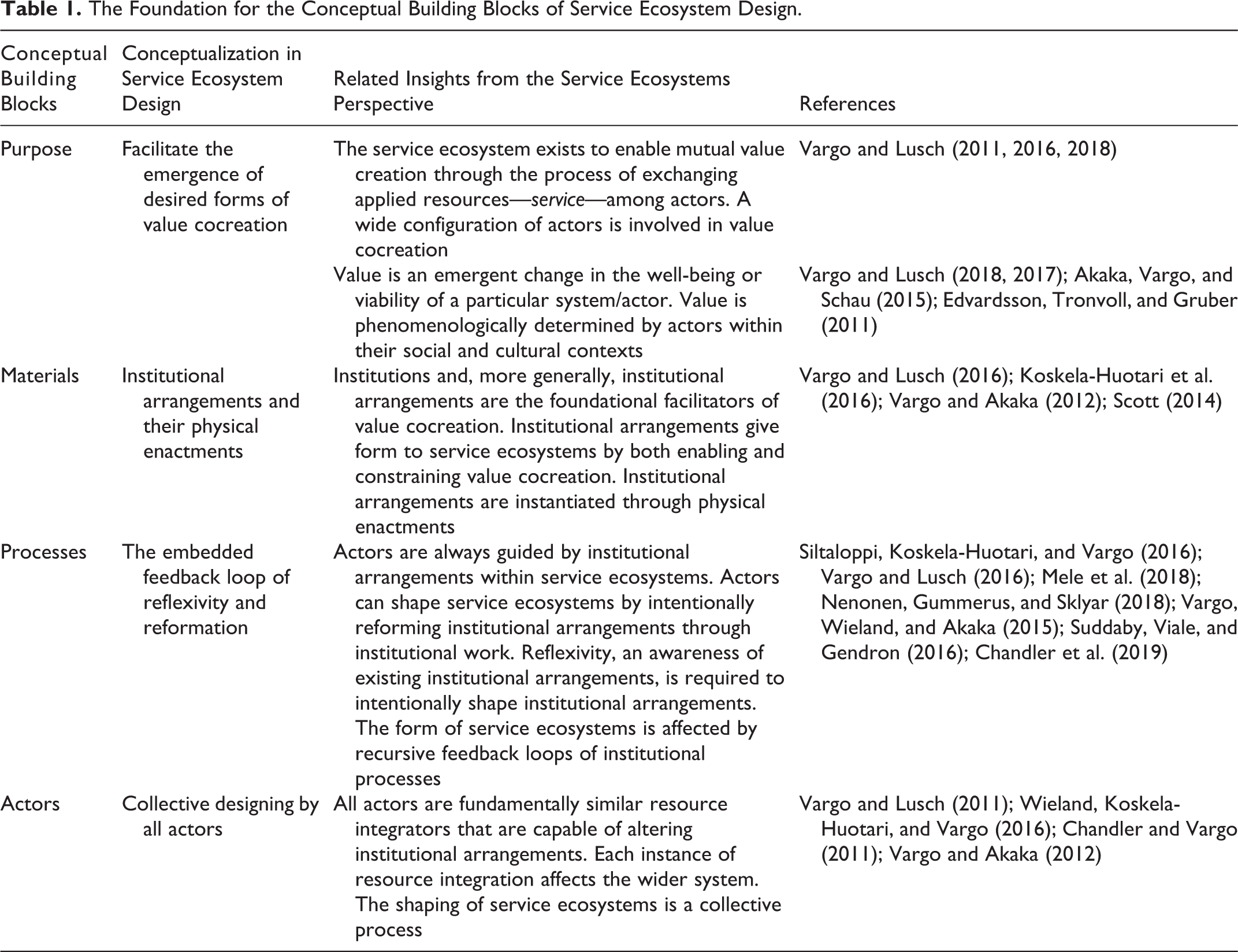
Figure 1 summarizes how the conceptualization of service ecosystem design extends the conceptual building blocks of service design further than previous conceptualizations. Service ecosystem design reframes the purpose of service design to facilitate the emergence of desired forms of value cocreation and, therefore, acknowledges the uncontrollable, phenomenological, and cocreated nature of such outcomes. Regarding design materials, service ecosystem design reconciles the tension within the existing perspectives on service design between the social and material by recognizing institutional arrangements, which include both physical enactments and invisible social structures as the central design materials. In terms of process, the conceptualization of service ecosystem design highlights the embedded nature of the core design processes—which include reflexivity, an awareness of existing institutional arrangements, and reformation, intentionally shaping institutional arrangements—in the ongoing reproduction of service ecosystems. With regard to actor involvement, service ecosystem design recognizes the agency of all actors, highlighting that many actors are already involved in an ongoing process of collective designing. Each of these core building blocks and the theoretical argumentation that underlies them are further detailed in the next section.
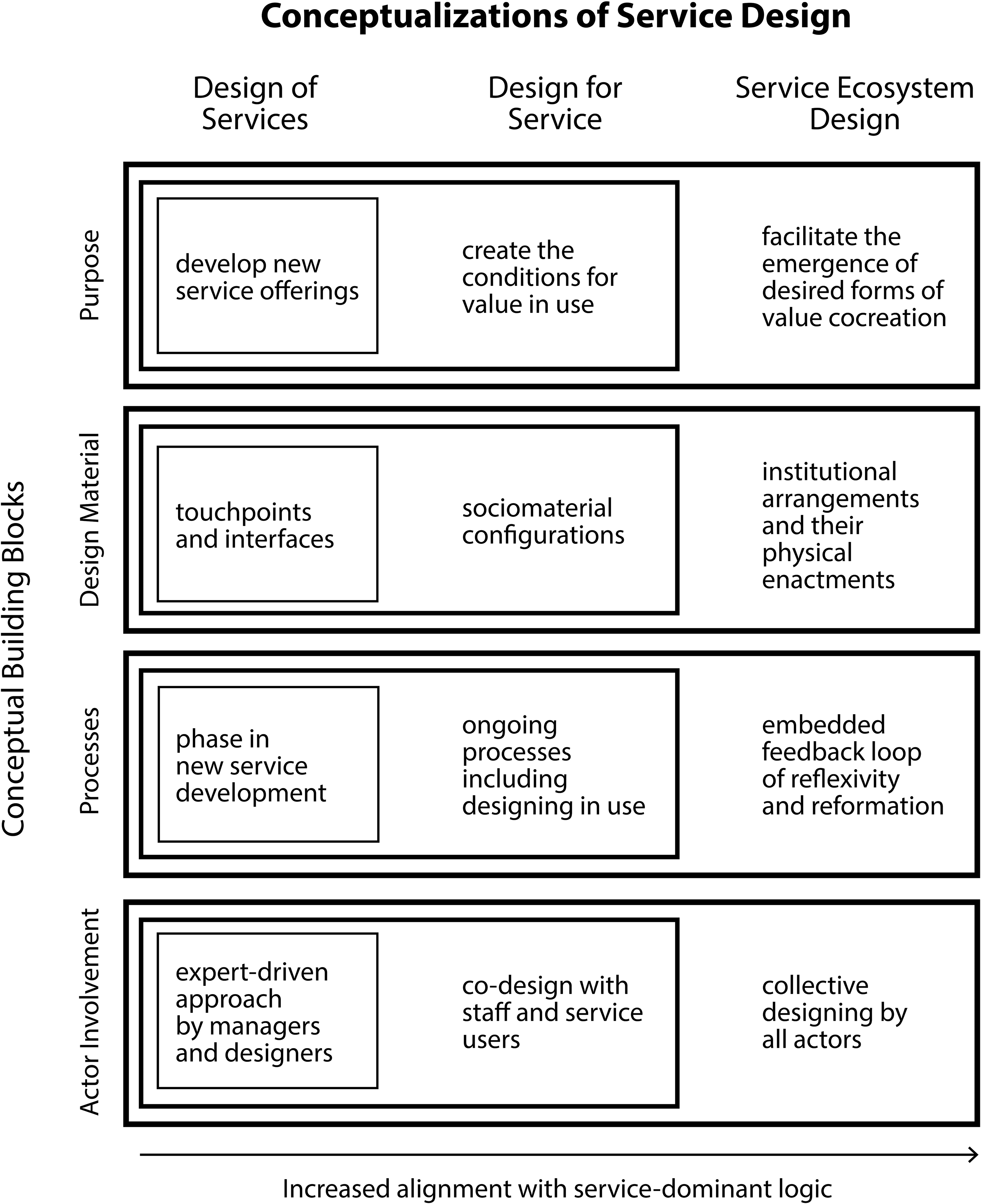
The extension of the conceptual building blocks of service design through the perspective of service ecosystem design.
Four Core Propositions of Service Ecosystem Design
To explain the rationale behind the reconceptualization of the building blocks of service design, we draw insights from S-D logic’s service ecosystems perspective and formulate four core propositions of service ecosystems design. We also use empirical illustrations from the healthcare context to contextualize the new concepts and their relationships.
The Purpose of Service Ecosystem Design
Intentionality, or purposefulness, is at the heart of design (Nelson and Stolterman 2012). The idea of intentionality can be found in many foundational definitions of design as they refer to goal-directed actions (Rittel and Webber 1973), how things ought to be (Simon 1969), or creating a desired system (Banathy 1996). S-D logic’s service ecosystems perspective informs the goal of intentionality by emphasizing that the underlying reason service ecosystems exist is value cocreation (Vargo and Lusch 2011, 2018). This perspective suggests that value creation involves the integration of applied resources from various sources through service exchange and, thus, is cocreated by multiple actors (Lusch and Vargo 2014; Vargo and Lusch 2016). The outcome of this process—value—can be defined as an “emergent, positively or negatively valenced change in the well-being or viability of a particular system/actor” (Vargo and Lusch, 2018, p. 740). Actors perceive value phenomenologically according to their unique social and cultural contexts (Akaka, Vargo, and Schau 2015; Edvardsson, Tronvoll, and Gruber 2011), meaning that their perceptions of value can vary subjectively over time. As value is an emergent property (Vargo and Lusch 2017), it can only come into existence through the evolving dynamics between actors and their changing contexts. Combining S-D logic’s understanding of value cocreation as the central purpose of service ecosystems with design’s emphasis on intentionality, service ecosystem design is focused on facilitating the emergence of actors’ desired forms of value cocreation.
Recognizing that the forms of value cocreation are emergent means that these forms only come into being through the spontaneous development of a new property (de Haan 2006). This new property arises from fluctuations in the interactions of the parts of a system, which enable the enactment of qualitatively different forms that are amplified to the extent that they can no longer be absorbed by the existing system (Capra and Luisi 2014). Ecosystems do not have an equilibrium steady state but rather adapt to instabilities by enacting forms that are uncertain and unpredictable (Gunderson and Holling 2002). Furthermore, in recognizing the cocreated and phenomenological nature of value, it is not enough to focus on a single actor category (e.g., the user or the customer), but rather, there is a need to zoom out to understand the configurations of a multitude of interconnected actors who might all perceive the outcomes differently. In this way, actors may be purposeful in the forms of value cocreation they wish to influence, but they can never truly control or predict the outcomes of service ecosystem design. The first proposition of service ecosystem design summarizes the argument related to this insight.
This proposition can be contextualized through an example from the healthcare context, where the goal of actors is to improve the health and well-being of patients. A service ecosystems perspective reinforces that health is not something that can be “delivered” by an individual actor; rather, health is cocreated by patients, family members, healthcare professionals, and a wide network of connected actors. Furthermore, the health of patients is not something that can be fully controlled but is an emergent property of their interactions with other actors, resources, and their environment. “Health” is perceived very differently by different actors who are part of the cocreation process. Recognizing that reciprocal social interaction contributes to health, the purpose of service ecosystem design in this context might be to encourage a specific form of value cocreation, for example, regular in-person visits to isolated patients from other community members. However, the outcomes of facilitating such visits will be influenced by the actions and perceptions of a multitude of actors and cannot be fully predicted.
The Materials of Service Ecosystem Design
Design is characterized as a process of transforming the materials of a situation (Schön 1992). As such, when building a theoretical foundation for service design, there is a need to better understand what constitutes the materials of service (Blomkvist, Clatworthy, and Holmlid 2016). The service ecosystems perspective informs the understanding of the materials of service ecosystem design by recognizing institutions (rules, roles, norms, beliefs, and similar aides to collaboration) and institutional arrangements (interdependent assemblages of institutions) as the foundational facilitators of value cocreation (Vargo and Lusch 2016). By both enabling and constraining how value is cocreated through resource integration, institutional arrangements give service ecosystems their form (Vargo and Akaka 2012) and become the central materials of service ecosystem design. The critical role of institutional arrangements in design is also reinforced in early design literature. The notion of institutional arrangements as design materials was reinforced by Burckhardt, who in 1980, described the invisible components of design that make up taken for granted aspects of hospitals, households, and workplaces (Fezer and Schmitz 2016).
A focus on institutional arrangements as the materials in service ecosystem design does not deny the importance of traditional service design materials, such as touchpoints and interfaces. Rather, a service ecosystem perspective enables the reframing of traditional design materials as the physical enactments of the invisible institutional arrangements (Scott 2014). In other words, the generally unobservable institutional arrangements, such as enduring rules, norms, and meanings, are instantiated and become visible through symbols, artifacts, activities, and interactions (Scott 2014). As such, the invisible institutional arrangements and physical enactments are mutually constituted and inseparable. In this way, seeing institutional arrangements as design materials does not negate the traditional understanding that emphasizes physical artifacts and interactions as materials but rather expands the understanding of these materials and their interdependencies in service ecosystems. Furthermore, work by Scott (2014) suggests that both the invisible institutional arrangements and their physical enactments are comprised of regulative (e.g., rules and laws), normative (e.g., roles and norms), and cultural-cognitive (e.g., beliefs and frames) institutional pillars. It is recognized that institutional arrangements are generally very enduring, taken for granted and widely shared, making it challenging to quickly reshape them (Greenwood et al. 2008). Based on this understanding, the argument behind the materials of service ecosystem design is summarized in the second proposition as follows:
Again, this proposition can be contextualized through an example from healthcare. If the actors’ goal is to shift the forms of value cocreation in doctor-patient appointments within a primary care clinic, the materials to consider might include symbols, such as the written and visual language used in appointment reminders, and artifacts, such as the tables and chairs that the doctors and patients use during their appointment. The doctors’ and patients’ activities and interactions are also important physical enactments, such as shaking hands when introducing themselves at the beginning of an appointment and making eye contact during the visit. Furthermore, service ecosystem design highlights that doctors and patients are also guided by invisible institutional arrangements in these appointments, such as the regulations regarding the privacy of health data, norms around patients going to the clinic individually for care, and beliefs, such as “the doctor knows best.” Among the physical enactments, some artifacts reinforce existing regulations, such as a doctor’s locked filing cabinet with patient notes, while others are involved in upholding normative standards, such as the medical certificate posted in the doctor’s office. Together, these physical enactments and institutional arrangements, along with many others in the extended service ecosystem of the primary care clinic, make up the design materials in this example.
The Processes of Service Ecosystems Design
According to the service ecosystems perspective, actors are always guided by institutional arrangements (Siltaloppi, Koskela-Huotari, and Vargo 2016; Vargo and Lusch 2016). This means that, without any awareness of these often taken-for-granted institutional arrangements, actors simply reproduce routinized behaviors implied by their institutional arrangements with limited variations (Greenwood et al. 2008). However, actors have the ability to intentionally shape service ecosystems (Mele et al. 2018; Nenonen, Gummerus, and Sklyar 2018) by reconfiguring the institutional arrangements that are guiding them (Koskela-Huotari et al. 2016; Vargo, Wieland, and Akaka 2015). As such, the service ecosystem perspective informs the processes of design by highlighting that it is embedded within the ongoing reproduction of the existing institutional arrangements and is focused on reshaping those arrangements.
Recognizing the embedded nature of service ecosystem design within institutional reproduction, for actors to be able to intentionally change institutional arrangements, they must first become aware of them in a process called reflexivity (Suddaby, Viale, and Gendron 2016). Reflexivity enables actors to critique their social context and recognize its mutability (Voronov and Yorks 2015). This awareness is enabled by ongoing institutional complexity (Greenwood et al. 2011), which is the multiplicity of institutional arrangements confronting actors with conflicting prescriptions for action. Institutional complexity activates actors’ conscious actions in service ecosystems (Siltaloppi, Koskela-Huotari, and Vargo 2016). Building awareness of conflicting institutional arrangements through reflexivity rests on actors’ sensory and aesthetic capacity to interpret the world around them (Creed, Taylor, and Hudson 2019). As such, service ecosystem design begins through a process of reflexivity that leverages actors’ embodied ways of interacting in the world to become aware of the invisible aspects of existing institutional arrangements.
It is only because of this awareness that the process of reformation, which involves intentionally reshaping institutional arrangements, can happen (Vargo and Akaka 2012). Reformation occurs through institutional work: purposefully creating, disrupting, and maintaining institutional arrangements (Lawrence and Suddaby 2006). Although reformation involves changing institutional arrangements, it also requires actors to intentionally maintain existing institutional arrangements in order to build legitimacy and ensure that the transition is less abrupt (Hargrave and Van de Ven 2009; Koskela-Huotari et al. 2016). The means for creating, disrupting, and maintaining institutional arrangements include symbolic work that uses symbols, identities, and language to influence institutions; material work that leverages the physical artifacts of environments to advance social outcomes; and relational work that builds interactions to support social ends (Hampel, Lawrence, and Tracey 2017). As such, reformation involves a process of actors thoughtfully altering physical enactments to intentionally influence the intertwined institutional arrangements.
These interlinked processes of reflexivity and reformation make up one of the many recursive feedback loops that can influence the self-adjustment of service ecosystems and forms of value cocreation (Chandler et al. 2019). This feedback loop is aligned with the design processes described by Schön (1992) who talks about design as a reflective conversation with the materials of a situation where actors see, move, and then see again. The conceptualization of service ecosystem design makes it explicit that this process is one of seeing the institutional arrangements (reflexivity), moving them by altering physical enactments (reformation), and then seeing the institutional arrangements again (reflexivity). The argument for these processes of service ecosystem design is summarized in the following proposition:
One example of reflexivity in the context of healthcare might be seen when a doctor’s child gets ill and she experiences the hospital system through the perspective of a patient’s family member. In doing so, she becomes aware of some institutional arrangements that she normally takes for granted in hospital operations, like regulations limiting the scope of care of nurses, norms around referrals to specialists, and the belief that the patient is passive. Based on this experience, the doctor then tries to work at reshaping these institutional arrangements through her work, in a process of reformation, to enable a better patient experience in the hospital. She starts advocating for changes in the scope of nursing practice through her physician association, directly phoning specialists when making a referral to support a smooth transition, and vocally applauding her colleagues whose actions reflect more of a partnership with their patients. This example highlights the processes of reflexivity and reformation in an actors’ everyday life. Such processes can also be staged by other actors, such as designers, to catalyze an intentional change in the service system (Wetter-Edman, Vink, and Blomkvist 2018).
The Actors in Service Ecosystem Design
The service ecosystems perspective argues that all actors are fundamentally similar resource integrators (Vargo and Lusch 2011) who can influence the institutional arrangements guiding value cocreation (Wieland, Koskela-Huotari, and Vargo 2016). Applied to service design, the service ecosystems perspective aligns with emerging design literature that suggests that everyone designs (Manzini 2015). In this way, service ecosystem design is carried out not only by professional designers or a selected group of actors but by all actors within and affected by service ecosystems (Banathy 1996). Service ecosystem design acknowledges that design is a fundamental human tradition (Nelson and Stolterman 2012). In essence, all actors are continuously shaping institutional arrangements through their actions, and when they do so intentionally, they are involved in the processes of service ecosystem design. While actors adapt institutional arrangements through unconscious reproduction (Czarniawska and Joerges 1996), and this contributes to the form of service ecosystems, reflexivity is needed to enable intentionality for these activities to be classified as design.
Furthermore, the actor-to-actor orientation of the service ecosystems perspective zooms out from the dyadic focus of firms and customers to appreciate a wider configuration of actors involved in value cocreation (Vargo and Lusch 2011). This more dynamic systems orientation suggests that value cocreation takes place in collectives in which each instance of resource integration affects the wider system (Chandler and Vargo 2011). The service ecosystems perspective further infers that the shaping of service ecosystems involves collective processes (Vargo and Akaka 2012). This thinking aligns with Latour’s (2018, p. 21) sentiment that “all designs are ‘collaborative’ designs—even if in some cases the ‘collaborators’ are not all visible, welcomed or willing.” As such, in service ecosystem design, all actors are already involved in the ongoing processes of collective designing in their everyday lives. Collective designing infers that service ecosystem design is a cocreated, multi-actor process that is realized through the cumulative effect of actors’ actions in service ecosystems. Within service ecosystems, the design processes of different actors have close interaction and interdependence, displaying qualities experienced only in aggregation through ever-unfolding uncertainty (Nelson and Stolterman 2012). Furthermore, the intentions of different actors’ design processes are not always aligned, and thus, collective designing involves dynamic, multi-directional processes. The fourth proposition summarizes the argument regarding the involvement of a broad span of actor constellations in service ecosystem design.
To illuminate the dynamics at play amid the messy processes of collective designing, consider the following example. A local clinical team is working to enable remote follow-up appointments through video conferencing. During this process, the team has become aware that the billing regulations and norms around patients traveling to the clinic need to be reshaped. In their clinic, they have worked to educate patients about the benefits of doing follow-up visits from home and have helped both patients and healthcare professionals learn how to use the video conferencing software. They also use evidence from their trial projects to advocate for changes in the national billing codes. The work of this clinic has influenced other clinics to test out similar remote care models. However, these developments have also sparked some backlash within the physicians’ association, as many actors within this group are actively fighting to maintain historical billing practices to protect their own interests. As such, the lack of change in regulations around billing is limiting large-scale change toward remote follow-up visits.
A Multi-Level Process Model for Service Ecosystem Design
Building on the overall conceptualization and the four core propositions, we develop a multi-level process model for service ecosystem design that offers a more nuanced understanding of the complex processes that bring life to intentional, long-term change in service ecosystems. Using oscillating foci (Chandler and Vargo 2011), the process model presented in Figure 2 provides insights into the nature and dynamics of the processes at play on the micro, meso, and macro levels of aggregation while maintaining the understanding that actors do not have full control over the self-adjustment of service ecosystems or the long-term changes that will take place.
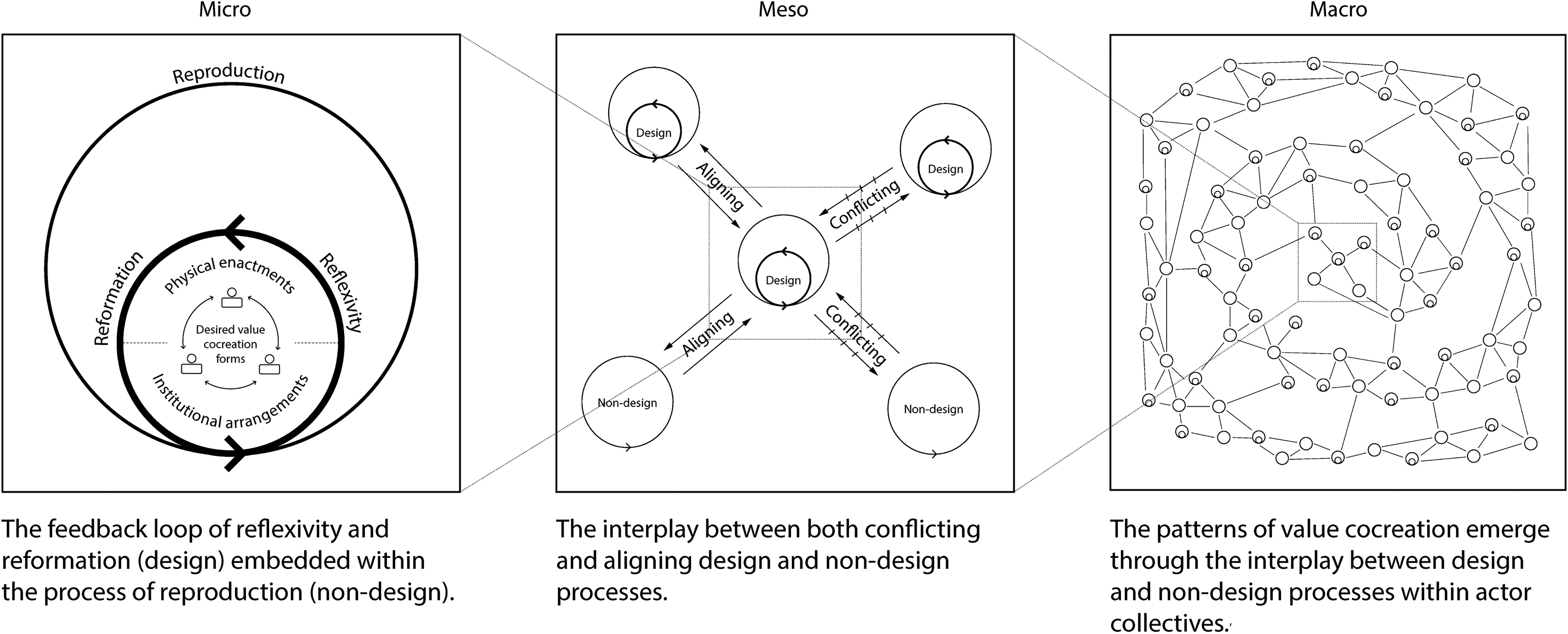
The multi-level process model of service ecosystem design.
The micro level of the process model zooms into a focal instance of service ecosystem design. Here, the core design processes of reflexivity and reformation present as an embedded feedback loop in the ongoing reproduction of institutional arrangements. This feedback loop enables actors to intentionally shape institutional arrangements and their physical enactments to facilitate the emergence of desired value cocreation forms.
The meso level of the process model depicts the dynamic interplay between the focal design process and other design (reflexivity and reformation) and non-design (reproduction) processes within the service ecosystem. More specifically, the process model shows that the intention of the focal design process (i.e., the desired form of value cocreation) maybe aligning with the other design or non-design processes but also may be conflicting with the intentions of these processes, resulting in different kinds of feedback loops that influence the ability of the focal design process to create long-term change. In this way, the context of the service ecosystem has a situating effect (Storbacka et al. 2016) on the focal actors’ design efforts.
The macro level of the process model further contextualizes the dynamic interplay between actors’ design and non-design processes. It is here that the emergent patterns of value cocreation can be seen through the aggregate effects of actors’ design and non-design processes in relation to the slow-to-change but ever-evolving institutional arrangements in service ecosystems. A new institutionalized form of value cocreation only emerges if the enactment of this new form is amplified by actors such that the influence of the focal design efforts and aligned processes outweighs the conflicting forces of other design and non-design processes. Alternatively, over time, the conflict between desired forms of value cocreation can reduce or negate the influence of the focal design processes within a service ecosystem.
Figure 3 further clarifies the dynamics between the focal design process and other design and non-design processes as well as the nature of the resulting feedback loops at the meso level. The figure shows that alignment between the intentional actions of the focal design process and another related design process can create a positive feedback loop of collaboration that may amplify the focal process in creating lasting change. For example, imagine that the focal design process involves a small clinical team’s efforts to establish a new role of health coaches within primary care teams to help patients maintain a healthy lifestyle. Because the intention of their design process is aligned with the national government’s efforts to intentionally reform the health system to support prevention, the government’s design processes will likely contribute to amplifying the work of the team, helping to spread the role of health coaches in the long run. However, there may also be other design processes that conflict with the intentions of the team; for example, a patient organization may be working with the clinic and advocating for it to develop more offerings to support patients with serious illness rather than focus on prevention. Such a dynamic between conflicting design processes can create a negative feedback loop of competition that may hinder the clinical team from establishing this new role.
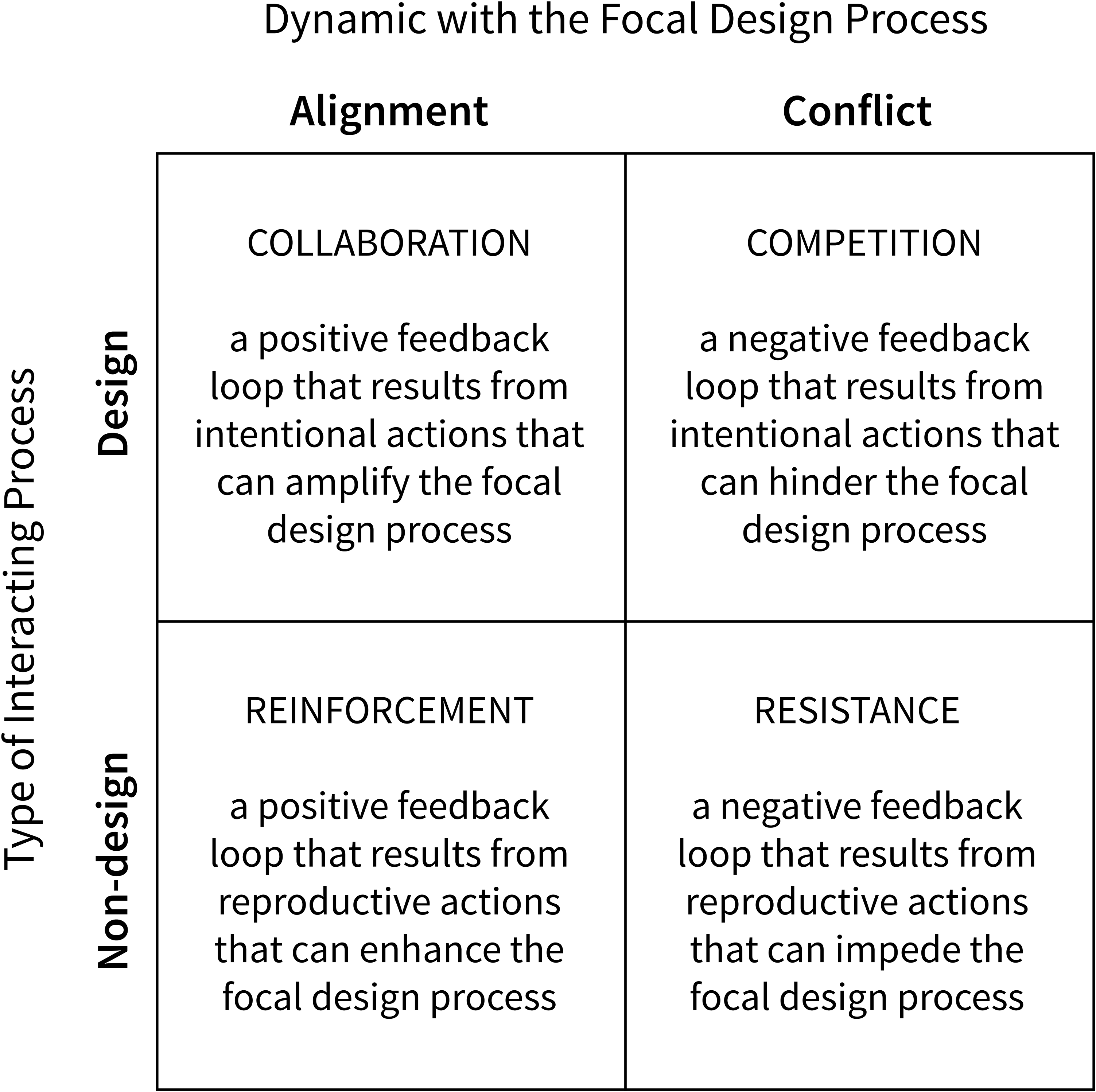
Feedback loops resulting from the interactions between a focal design process and other design and non-design processes.
In addition, there is interplay between the clinical team’s design process and other non-design processes in which actors are reproducing existing institutional arrangements. There may be alignment between the clinical team’s intention to create the new role of health coaches and nurses’ reproduction of the belief that patients should be seen as whole people, leading nurses and the clinical team to see this new role as a win-win. This interplay can create a positive feedback loop of reinforcement that may enhance the clinical team’s work to create health coaches. On the other hand, there may be non-design processes that conflict with the desire for health coaches, such as the entrenched role of physicians in treating those who are ill. Based on their leading clinical role, physicians may perceive the work of health coaches as being out of the scope of clinical practice. This can create a negative feedback loop of resistance that may impede the role of health coaches from gaining traction within the clinic.
As such, the multi-level process model of service ecosystem design helps us to see that, although each actor has the potential to intentionally shape institutional arrangements, the effects of their efforts on the self-adjustment of service ecosystems can only be understood in context and in relation to the ongoing, collective design and non-design processes that they themselves and others are a part of. The process model also highlights that it is only through the core processes of reflexivity and reformation, which then influence and are influenced by the actions of other actors over time, that new institutionalized forms of value cocreation can emerge within a service ecosystem, and lasting changes in the desired forms of value cocreation can be realized.
Implications of Service Ecosystem Design
The conceptualization of service ecosystem design in this article offers a systemic understanding of service design that explains not only the complexity of the object of design but also the complexity of service design itself. As such, this conceptualization has three important implications for service design research. First, the conceptualization of service ecosystem design helps to reduce the risk of unintended consequences and failed interventions by better acknowledging aspects of service design that have been traditionally taken for granted. Second, by bringing forward the core processes of reflexivity and reformation, this conceptualization explains how intentional, long-term change through service design emerges, which has been previously undertheorized. Third, this conceptualization expands the scope of service design beyond projects by recognizing the plurality of design and non-design processes that influence the long-term outcomes of service design. Below we explain each of these three implications in more detail.
Illuminating Aspects of Service Design that Have Been Taken for Granted
By reconceptualizing the building blocks of service design, this research reveals a number of critical, but taken for granted, aspects of service design. In particular, it highlights the emergent, unpredictable nature of service design outcomes. This recognition lies in contrast to the more assured claims in academic literature about how service design leads to, for example, improved customer experience (Andreassen et al. 2016) or profitable new services (Ostrom et al. 2015). In addition, much of the existing service design literature focuses on how actors can tweak isolated components of service systems, such as touchpoints and interfaces, through linear design processes (see, e.g., Clatworthy 2011; Grenha Teixeira et al. 2017; Patrício et al. 2011; Secomandi and Snelders 2011; Zomerdijk and Voss 2010). By conceptualizing how physical elements of service are intimately intertwined with the invisible institutional arrangements of service ecosystems, this research contributes to a shift away from a reductionist view of what is being designed toward a more holistic understanding of materiality in service design. In doing so, this research builds a more comprehensive understanding of service design processes that incorporates the cultural aspects of service systems that are often viewed as externalities to the service design process (Stuart 1998).
In the same vein, the process model of service ecosystem design moves beyond the linear double diamond model (U.K. Design Council n.d.) or phases typically used to portray the process of service design (e.g., Costa et al. 2018) to acknowledge the circular nature of design processes, their embeddedness in reproduction, and the feedback loops that result from their interactions within service ecosystems. Furthermore, the process model also points to how the past influences the present through institutionalization and how actors’ thoughts and actions when designing are enabled and constrained by existing institutional arrangements. By recognizing that service design involves ongoing and collective processes, this research highlights the plurality of design processes that have previously been ignored when studying only a focal design process. Ignoring these aspects may have inadvertently contributed to service design’s limited ability to bring forth intentional, long-term change (as discussed in, e.g., Stuart 1998). Thus, this extended understanding of the building blocks of service design can aid service design scholars and practitioners in working with, rather than against, complexity, helping reduce the risk of undesirable consequences and the development of naïve solutions.
Explaining How Intentional, Long-term Change Emerges through Service Design
The conceptualization of service ecosystem design and identification of the core processes of reflexivity and reformation explains how intentional change, including that which diverges from the status quo, can come about within service ecosystems. In particular, this research explains service design’s distinct role in cultivating the intentionality of embedded actors while they are being influenced by existing institutional arrangements. While a great deal of existing research connects service design with innovation (e.g., Bitner, Ostrom, and Morgan 2008; Ostrom et al. 2015; Sangiorgi and Prendiville 2015), it tends to ignore the ongoing influence of institutional arrangements on actors’ thoughts and actions. In doing so, it fails to specify how actors might actually come to “think outside the box,” which requires the foundational process of reflexivity—an awareness of the very institutional arrangements that guide their thinking in the first place. Without attention to the core processes of reflexivity and reformation in service design, actors may unknowingly end up reproducing existing ways of working.
The process model strengthens existing discussions about institutional work in service ecosystems (e.g., Koskela-Huotari et al. 2016; Vargo, Wieland, and Akaka 2015) by explaining how novelty can emerge in the first place. While much of the existing literature that draws on institutional work builds an understanding of how novel forms of value cocreation can be intentionally scaled up and replicated (e.g., Fehrer et al. 2020), the conceptualization of service ecosystem design details how they can be intentionally brought forth by clarifying the important role of reflexivity and reformation. Furthermore, the process model of service ecosystem design details interactions between the focal design process and other design and non-design processes and delineates critical dynamics that influence whether the desired forms of value cocreation resulting from the focal process will lead to long-term change within the service ecosystem. Awareness of these core processes and the dynamics of service design in service ecosystems can inform what scholars attend to when studying service design and how practitioners work to intentionally influence the emergence of long-term change.
Expanding the Scope of Service Design Beyond the Project
The systemic conceptualization of service design developed in this research sheds light on the importance of zooming out beyond traditional service design projects as the unit of analysis to appreciate the pluralistic design processes of collectives as a whole. In doing so, this research repositions traditional understandings of service design that emphasize the efforts of designers and managers in the development of new service offerings (e.g., Edvardsson and Olsson 1996; Patrício et al. 2018; Shostack 1982) as a special case of service ecosystem design, which focuses more generically on intentionally shaping emergent patterns of value cocreation. Service ecosystem design recognizes the agency of actors more broadly, including those who are not engaged in service design projects, as well as their potential to intentionally shape the emergent forms of value cocreation. This understanding calls attention to the diversity of service design approaches that exist in service ecosystems, challenging the singular, homogeneous view of service design, often referred to in the common definition of service design as “a human-centered, creative, iterative approach to the creation of new services” (Blomkvist, Holmlid, and Segelström, 2016 as cited in Ostrom et al. 2015, p. 136; emphasis added).
The understanding of actors’ involvement in collective designing suggests that their intentions to influence value cocreation through short-term, invitational codesign activities, such as workshops (e.g., Trischler et al. 2018), may not be adequate to significantly influence the multidirectional, often conflicting, processes of service ecosystem design and reproduction being enacted in their everyday lives. This does not imply that these more narrowly focused service design efforts, or the work of trained service designers, in facilitating intentional change do not have an important role to play in influencing the ongoing self-adjustment of service ecosystems. Rather, this understanding implies that the goals and activities of trained designers and these short-term codesign processes should be seen in the context of, and in relation to, the larger processes of collective designing.
Future Research Agenda for Service Design
Service ecosystem design offers a systemic foundation for future research within service design. Based on this foundation, we delineate future research for advancing service design within three interconnected research areas: (1) extending the systemic conceptualization of service design, (2) conducting more holistic empirical investigations into service design, and (3) developing practical methods and approaches for embedded, collective designing.
Extending the Systemic Conceptualization of Service Design
Service ecosystem design illuminates a number of important concepts and relationships within service design that have been insufficiently understood and underresearched. For example, there is a need for a more nuanced understanding of the characteristics of institutional arrangements as design materials and the implications of those characteristics on how actors can intentionally shape them. There is also a need to enrich the understanding of the dynamics between different design and non-design processes in service ecosystems, how they affect each other, and how their dynamics contribute to emergent patterns of value cocreation.
Due to its grounding in the metatheoretical framework of S-D logic, the conceptualization of service ecosystem design is aligned with, and open to being further informed by, the wider literature within institutional theory and systems thinking. The application of institutional theory to support conceptual developments in service design can help ensure that there is adequate recognition of the embedded nature of actors when designing (e.g., Emirbayer and Mische, 1998). Further integration of systems thinking (e.g., Capra and Luisi 2014; Gunderson and Holling, 2002) can aid service design scholars in ensuring that they always examine the parts in relation to the whole and adequately account for the interconnections and feedback loops when designing within service ecosystems. Integrating these theories with design theory (e.g., Schön, 1992) and literature on systemic design (e.g., Jones, 2013; Nelson and Stolterman 2012) could also help to build a richer contextual understanding of the dynamics of actors’ core design processes.
Additionally, to further position, develop, and refine the conceptualization of service ecosystem design, scholars are encouraged to cross-pollinate with literature in other domains of service research that draw on the service ecosystem perspective of S-D logic. For example, recent developments in actor engagement that detail the reciprocal, social, and collective nature of engagement (Alexander, Jaakkola, and Hollebeek 2018) and discuss actors’ dispositions to invest resources in their interactions with other actors (Brodie et al. 2019) could help build an understanding of the dynamics of collective designing. In addition, developments in literature on market shaping (e.g., Nenonen, Storbacka, and Windahl 2019) could inform how novel forms of value cocreation that are brought to life through service design can be strategically scaled within service systems. Furthermore, research about institutional complexity (Siltaloppi, Koskela-Huotari, and Vargo 2016) and institutional feedback loops (Chandler et al. 2019) as drivers of innovation in service ecosystems is relevant for service design scholars looking to contribute to a more nuanced understanding of reflexivity in future research.
Conducting More Holistic Empirical Investigations into Service Design
Service ecosystem design highlights the need for deeper, longer empirical studies in service design that adopt multiple perspectives and employ oscillating foci. Scholars highlight the importance of comprehensive, longitudinal analysis when utilizing institutional analysis, for example, by gathering many months of qualitative data across all key actors (Baron et al. 2018; Vit 1996). This is congruent with system thinking, which stresses the importance of examining patterns and events in a larger context over time (Meadows 2008). Furthermore, because institutional arrangements are often taken for granted, they can be challenging to study (Koskela-Huotari, Vink, and Edvardsson 2020). As such, empirical studies of service design that adopt institutional analysis require creative, reflective techniques to expose the changes in hidden rules, norms, roles, and beliefs that guide actors, for example, through ethnography and action research (Hampel, Lawrence, and Tracey 2017; Lawrence, Leca and Zilber 2013).
The service ecosystem design framework also highlights the need for service design scholars to adopt oscillating foci, which involves examining the phenomenon of interest at different levels of aggregation by zooming in and out (Chandler and Vargo 2011). In addition, taking multiple perspectives when doing empirical research rather than, for example, solely focusing on the customer perspective is critical when building a more systemic understanding. This requires participation from a diversity of actors within the study and also benefits from the perspectives of multiple researchers with diverse backgrounds to help challenge potential institutional biases. Furthermore, the framework of service ecosystem design would benefit from testing, challenging, and refining assumptions through longitudinal empirical studies of service design processes. In addition, there is a great deal of potential learning about the core processes of service design by studying diverse service design processes outside of traditional projects.
Developing Practical Methods and Approaches for Embedded, Collective Designing
Considering the strong emphasis in service design on practical methods and approaches (Sangiorgi 2009), there is a need to develop hands-on approaches that enable actors to work together more intentionally within complexity and grapple with the influence of institutional arrangements. To advance more systemic service design approaches that recognize the embedded nature of design, future research should assess the relevance of existing service design methods (e.g., Stickdorn and Schneider 2011) to the core processes of service ecosystem design and develop a plurality of new service design methods focused explicitly on encouraging reflexivity and reformation in different contexts. In addition, to enhance the intentionality of collective designing in service ecosystems, new approaches are needed to build actors’ capabilities (Karpen, Gemser, and Calabretta 2017; Malmberg and Wetter-Edman 2016) in relation to reflexivity and reformation. Building capability for reflexivity and reformation is a promising area for meaningful, action-oriented research in service design. Additionally, in service design practice, there should be alternative formats of exploration that are not limited by the traditional project structure, that can more strategically leverage the diversity of design processes within actor collectives, and that encourage alignment while acknowledging conflicting processes.
While there have been some important methodological developments in service design to support actors working on complex service systems (e.g., Grenha Teixeira et al. 2017; Patrício et al. 2018, 2011; Sudbury-Riley et al. 2020), the service ecosystem design framework highlights the need for further research on practical approaches that recognize that actors are working within service systems by appreciating the constraining and enabling role of existing institutional arrangements. Knowing that the full consequences of service ecosystem design can only ever be experienced through emergence, there is a need to develop practical service design methods to help actors design with emergence in mind (van Alstyne and Logan 2007) and better account for the unintended consequences of institutional processes (Pawlak 2011). The embedded, collective and emergent nature of service design requires new formats that support ongoing service design processes rather than one-off projects or interventions.
A New Chapter of Service Design Research
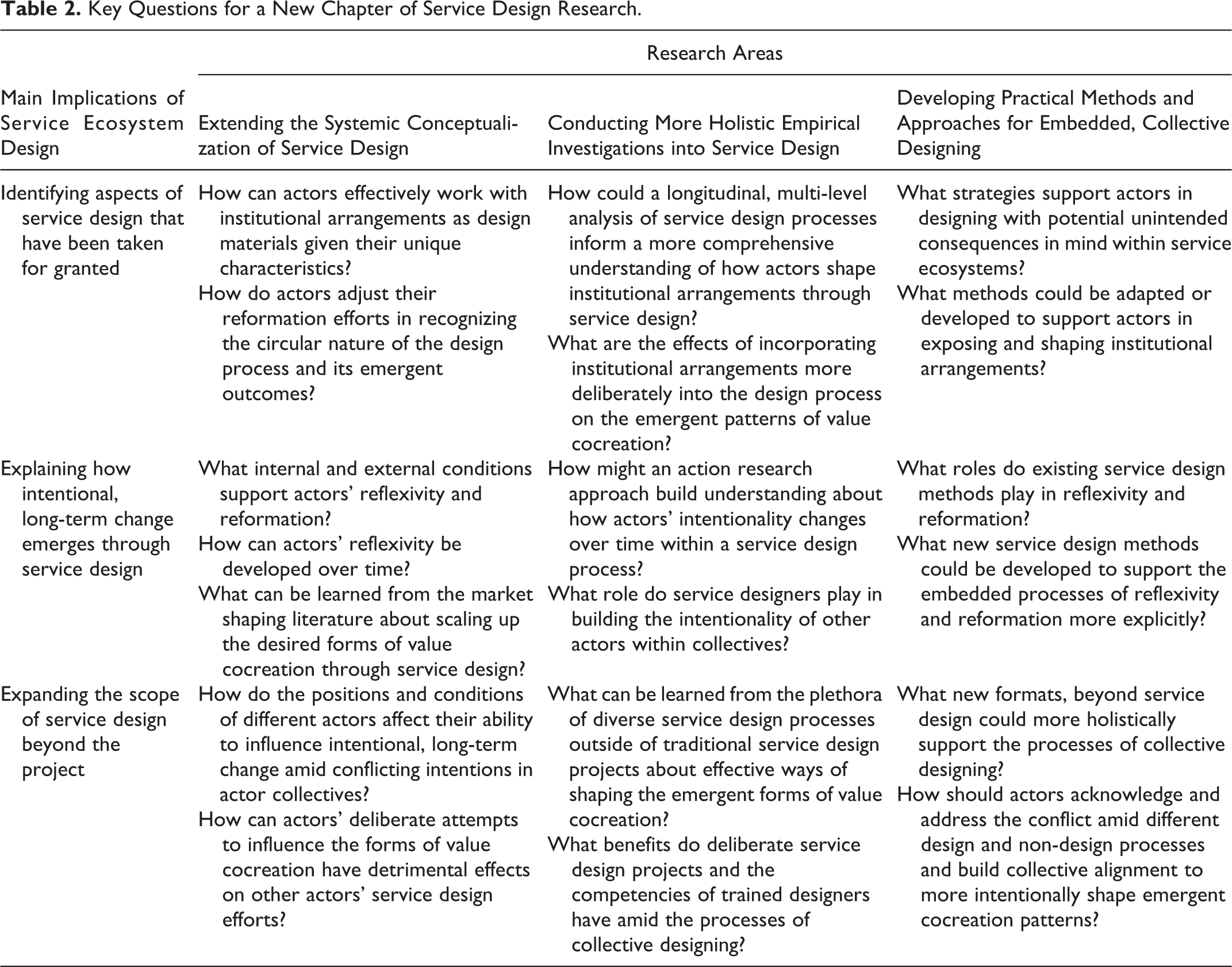
Service ecosystem design provides an inclusive conceptual basis on which the evolution toward a systemic understanding of service design can continue with greater clarity and a common language. As such, it paves way for a new chapter of service design research that is simultaneously bolder and humbler, as well as more nuanced in its assumptions about how actors create intentional, long-term change in complex service systems. To guide this development, Table 2 identifies specific research questions within the three future research areas highlighted above. Our hope is that this new chapter of service design research will be characterized by a collective effort to further develop a systemic conceptualization of service design that can strategically inform practitioners as they navigate the complexities of catalyzing intentional, long-term change in service systems. We envision this next chapter to bring a heightened attentiveness to the reductionist understandings of service design as they play out in practice through critical examinations of service design projects in context. Furthermore, our hope is that upcoming studies involve a larger breadth of empirical investigations to better appreciate and learn from the plurality of service design processes already ongoing in service systems around the globe. In addition, our ambition is that this chapter brings forth a new wave of more systemic service design methods and approaches that support embedded actors to work more intentionally with institutional arrangements, acknowledge related design and non-design processes, and build collective alignment around their desired value cocreation forms. Together these developments make it possible to unlock the full potential of service design as a truly transformative force within service systems. There is undoubtedly a great deal of work ahead to build and hone more systemic and inclusive theories and practices of service design, but, at the same time, the future of this field has never looked brighter.
Key Questions for a New Chapter of Service Design Research.
Supplemental Material
Supplemental Material, SED_executive_summary_final - Service Ecosystem Design: Propositions, Process Model, and Future Research Agenda
Supplemental Material, SED_executive_summary_final for Service Ecosystem Design: Propositions, Process Model, and Future Research Agenda by Josina Vink, Kaisa Koskela-Huotari, Bård Tronvoll, Bo Edvardsson and Katarina Wetter-Edman in Journal of Service Research
Footnotes
Authors’ Note
Bo Edvardsson is also affiliated with Department of Marketing, Inland Norway University of Applied Sciences, Elverum, Norway.
Acknowledgments
The authors would like to thank Steve Vargo for the influential discussions and feedback throughout the development of this article; Manuela Aguirre for sharing her wisdom and references related to design in complex systems; Laurel Anderson for her helpful guidance on the positioning of this article; and Christopher Pearsell-Ross for his support with the figures and suggestions on the manuscript. We are also grateful to Michael Brady for his direction as editor as well as the associate editor and three anonymous reviewers for their constructive feedback throughout the review process.
Declaration of Conflicting Interests
The author(s) declared no potential conflicts of interest with respect to the research, authorship, and/or publication of this article.
Funding
The author(s) disclosed receipt of the following financial support for the research and/or authorship of this article: This project has received funding from the Research Council of Norway through the Center for Connected Care (C3) and the European Union’s Horizon 2020 research and innovation program under the Marie Skłodowska-Curie Grant Agreement No. 642116.

Supplemental Material
Supplemental material for this article is available online.
References
Supplementary Material
Please find the following supplemental material available below.
For Open Access articles published under a Creative Commons License, all supplemental material carries the same license as the article it is associated with.
For non-Open Access articles published, all supplemental material carries a non-exclusive license, and permission requests for re-use of supplemental material or any part of supplemental material shall be sent directly to the copyright owner as specified in the copyright notice associated with the article.
