



Abstract
This four-wave longitudinal study examined bidirectional associations among pupils’ social status (preference and popularity) and teacher–child relationship characteristics (quality, support, satisfaction, and conflict) in special education. Participants included 586 pupils (86% boys) initially attending Grades 4 and 5 (Mage Wave 1 = 10.82 years, SD = 0.86) and their teachers. Reports of teacher–child relationships were collected from teachers and pupils through questionnaires. Peer nominations were used to assess preference and popularity. Autoregressive cross-lagged models indicated that preference predicted changes in satisfaction between school years. Conflict in the teacher–child relationship predicted preference, and preference and popularity predicted conflict within and between school years. Bidirectionality of the associations depended on the aspect of the teacher–child relationship and the dimension of social status. Conflict was more robustly related to social status than satisfaction, support, and pupil-reported relationship quality. The associations within school years were not more robust than associations between school years.
Pupils with emotional and behavioral disturbances (EBD) are at an increased risk of adverse outcomes, such as academic underachievement, school dropout, substance abuse, and employment difficulties (Bradley, Doolittle, & Bartolotta, 2008). High-quality teacher–child relationships (TCRs) are an important protective factor in the school context, which have been consistently linked to academic, socioemotional, and behavioral outcomes of pupils (Hamre & Pianta, 2001; Sabol & Pianta, 2012). Pupils with high-quality relationships with their teachers also tend to be well liked by their peers (Hughes, Cavell, & Willson, 2001). Most theoretical accounts indicate that teachers directly and indirectly influence classroom social dynamics through their use of various classroom management strategies (Farmer, Lines, & Hamm, 2011). However, empirical studies have consistently found bidirectional associations between TCRs and pupils’ social status. That is, TCRs are associated with changes in social status, and social status is associated with changes in TCRs (De Laet et al., 2014; Hughes & Chen, 2011). To date, research has exclusively examined associations between TCRs and social status of pupils in regular education classrooms. A substantial number of pupils with EBD attend special education schools (Bradley et al., 2008). Yet, it remains unclear whether these bidirectional associations generalize to teachers and pupils in special education. The present study addresses this gap by investigating whether social status is concurrently and prospectively linked to positive and negative TCR characteristics.
Bidirectional Associations Between TCRs and Social Status
Not unlike other types of close relationships, TCRs may be characterized by positive and negative relationship features (Sabol & Pianta, 2012). Positive TCRs are generally described in terms of warm and supportive relationships (Sabol & Pianta, 2012). Features of positive TCRs include instrumental and emotional support, and relationship satisfaction (Ang, 2005). Negative features of TCRs include high levels of conflict and a lack of rapport (Ang, 2005; Sabol & Pianta, 2012). Pupils’ social status within the peer group is also a multifaceted construct that includes two distinct forms: social preference and perceived popularity. Social preference, which has also been referred to as peer acceptance or likeability, is an interaction-based status measure describing the degree to which an individual is liked by his or her peers (Gifford-Smith & Brownell, 2003). Perceived popularity, on the contrary, is a reputation-based measure of status describing the degree to which an individual is socially dominant and visible within the peer group (Cillessen & Mayeux, 2004). The present study includes both measures of social status and four measures of TCRs, namely, teacher reports of conflict, satisfaction, and support, and pupil reports of the overall quality of interactions with their teacher.
Several theoretical accounts emphasize TCRs as predictors of social status. Farmer and colleagues (2011) describe the active role teachers have in guiding and facilitating peer interactions in the classroom. By interacting with their pupils individually, and with the classroom as a whole, teachers directly and indirectly influence classroom social dynamics and the social position of pupils in their classroom. A related perspective comes from social referencing theory, which posits that pupils obtain information about the characteristics and likeability of peers from watching the interactions of peers with the teacher (Hughes et al., 2001). Viewing supportive interactions of teachers with a specific pupil leads classmates to view this pupil in a positive light (see also Hendrickx, Mainhard, Boor-Klip, Cillessen, & Brekelmans, 2016). Although it has not gained as much attention in the literature, teachers may also obtain information about pupils based on their peer interactions, and interact with pupils based on their social status (Mercer & DeRosier, 2008). Although theoretical accounts of social status as a predictor of TCRs are not well documented, these prospective associations are consistent with a transactional framework. From a transactional perspective, child development is a product of bidirectional interactions of the child within—and also between—increasingly complex systems (Bronfenbrenner & Morris, 2006). So, TCRs may affect social status through teachers’ influence on classroom social dynamics or by teachers role as a social referent. Social status may also influence TCRs by teachers providing more support, satisfaction, or having conflicts with specific pupils based on the pupil’s social status.
Most empirical studies investigating links between social status and TCRs have examined preference. For example, cross-sectional studies have consistently reported that pupils experiencing more teacher support were more preferred by peers (Hughes et al., 2001; Hughes, Zhang, & Hill, 2006). Longitudinal studies examining associations between TCRs and preference across school years have generally found that positive aspects of TCRs are linked to increases in preference, and that preference is linked to changes in positive aspects of TCRs (De Laet et al., 2014; Hughes & Chen, 2011; Kiuru et al., 2015). However, studies that investigated changes within school years indicate that preference is a better predictor of changes in TCRs than vice versa (Leflot, van Lier, Verschueren, Onghena, & Colpin, 2011; Mercer & DeRosier, 2008). Fewer studies have investigated associations between TCRs and popularity. A cross-sectional study by Moore, Shoulberg, and Murray-Close (2012) found that popularity was negatively related to teacher’s satisfaction with the relationship, especially for boys. A longitudinal study by De Laet and colleagues (2014) reported that higher levels of teacher–pupil conflict were associated with increased popularity across school years. Conclusions from both of these studies indicated that defying the teacher is a way by which pupils gain and maintain popular status in the classroom. In general, these studies provide some evidence for transactional associations between TCRs and both forms of social status in regular education.
TCRs and Social Status in Special Education
In the Dutch educational system, schools for special education can be distinguished into four clusters, namely, (a) visual impairment, (b) deaf and speech-language pathology, (c) moderate intellectual disability and physical disability, and (d) EBD. Our study focusses on this last category. Just as in other countries, government policy in the Netherlands promotes placement of pupils with EBD in regular education (Smeets, 2007). Nonetheless, a substantial proportion of pupils with EBD are eventually placed in special education (Bradley et al., 2008; Lane, Wehby, Little, & Cooley, 2005; Smeets, 2007). In the Netherlands, these schools are characterized by segregated settings with small classes (on average 10–15 pupils) and highly trained teachers. Boys are overrepresented (Smeets, 2007).
In special education, associations between TCRs and social status of pupils may be stronger than regular education due to the specialized training of special education teachers and the fewer number of pupils in special education classrooms. Unlike most teachers in regular education, special education teachers are specifically trained in behavioral management techniques and in enhancing pupils’ social skills (Lane et al., 2005). This training could strengthen teachers’ impact on the social dynamics in the classroom and increase the effect of TCRs on pupils’ social status. The smaller class sizes in special education could also lead to more individual social interactions between teachers and pupils, and less between peers (Blatchford, Bassett, & Brown, 2011), which may also increase the effect of TCRs on pupils’ social status (see also Skalická, Belsky, Stenseng, & Wichstrøm, 2015). On the contrary, relationships with teachers may have less of an impact on special education pupils’ social status because of pupils’ difficulties in interpreting social information due to attention problems (e.g., Gardner & Gerdes, 2015) or social deficits (e.g., Blacher, Howell, Lauderdale-Littin, Reed, & Laugeson, 2014). Difficulties with interpreting social information could lead pupils to obtain less information about peers in general, and to obtain less information about teachers and classmates through the use of social referencing.
One study was conducted in special education, with 5- to 13-year-old pupils (Breeman et al., 2015). Although it was not the main goal of the study, associations between TCRs (satisfaction and conflict) and preference were studied within one school year. These associations were not statistically significant when externalizing behavior was also taken into account. However, more research is needed to gain understanding about how TCRs can contribute to the social status of pupils in the classroom, and how teachers are influenced by their pupils’ social status in special education.
The Present Study
The aim of the present study was to investigate prospective associations between TCRs (quality, support, satisfaction, and conflict) and pupils’ social status (preference and popularity) in special education classrooms. Three research questions were addressed. First, are TCRs associated with changes in pupils’ social status, and is social status associated with changes in TCRs? Based on previous studies, we expected to find bidirectional associations between social status and TCR characteristics. Second, do the associations between TCRs and the two status measures follow different patterns? We expected preference to be positively associated with overall quality, support, and satisfaction and negatively associated with conflict, and popularity was expected to be positively associated with conflict (De Laet et al., 2014). Third, do associations differ within and between school years? We expected that associations within the school year would be of higher magnitude than associations between school years (Mercer & DeRosier, 2008).
Method
Participants
The sample consisted of 586 pupils (86% males, Mage = 10.82, SD = 0.86) and 79 teachers (81% female, age range = 22–62 years) from 13 special education schools located throughout the Netherlands. Pupils and teachers were included in this study if they participated in at least one of the four biannual assessments: February 2015, June 2015, February 2016, and June 2016. The total number of participating pupils ranged from 419 to 488 at each assessment. Specifically, there were a total of 419 pupils at Time 1 (T1), 422 pupils at Time 2 (T2), 488 pupils at Time 3 (T3), and 477 pupils at Time 4 (T4). Pupils were enrolled in classrooms with the same teacher within school years. When a classroom had two teachers during the week, the teacher who was responsible for the classroom the majority of the time completed the questionnaires. The composition of classrooms was less stable between school years (15% of participants at T2 had the same teacher at T3).
Setting
The participating special education schools were all segregated educational settings for pupils with EBD. Most pupils in these settings initially started in regular education schools or regular child care. When regular schools cannot adequately fulfill their needs at some point during the school career, a local committee judges whether a pupil is eligible for special education. The participating schools generally permitted pupils with normal intellectual ability and EBD. We did not gather additional demographic information about the pupils, for example, with regard to diagnoses.
Procedure
University approval for the study was obtained in November 2015. School administrators were initially contacted for participation in the study. After that, meetings with school officials were organized to inform them about the design and purpose of the study. Parents were informed with a letter about the studies’ purposes and the handling of the data (e.g., confidentiality). Written parental consent was initially obtained (“active” consent) for 85% of the pupils. Pupils were verbally instructed at each wave about the purposes of the study and informed that their answers would remain anonymous.
Trained researchers administered the surveys digitally (on personal computers) to subgroups of three pupils at a time. Pupils were given general instructions about the survey. When pupils had severe reading problems (e.g., comorbid dyslexia), researchers read the survey questions out loud for them. Researchers were available to give behavioral instructions (e.g., help pupils to focus, or to reduce frustration). Pupils completed the surveys in 20 min. The teachers spent 60 to 90 min filling out the survey.
Measures
TCR characteristics
Teachers’ perceptions of their relationship with individual pupils in the classroom were assessed at each wave by a Dutch translation of the Teacher–Student Relationship Inventory (TSRI: Ang, 2005). The initial translation of the TSRI items was made by a bilingual scientist in the research group. This English-to-Dutch translation was then modified by a bilingual expert committee (Epstein, Osborne, Elsworth, Beaton, & Guillemin, 2015). The TSRI consists of 14 items rated on a 5-point Likert-type scale (1 = almost never true to 5 = almost always true) and comprises three subscales. Support consists of five items describing the willingness of the pupil to approach the teacher for support or advice (e.g., “If this student needs help, he or she is likely to ask me for help”). Satisfaction consists of five items describing the extent to which the teacher experiences the relationship with the pupil as positive and satisfactory (e.g., “I enjoy having this student in my class”). Conflict consists of four items describing the degree to which the teacher experiences a negative and conflictual relationship with the pupil (e.g., “This student frustrates me more often than most other pupils in my class”). Subscale scores at each assessment were calculated by summing the relevant items. All three subscales demonstrated good internal consistency at each of the four assessments: support (α = .78–.82), satisfaction (α = .84–.86), and conflict (α = .85–.88).
Pupils’ perceptions of the quality of their relationship with the teacher were assessed at each wave with an abbreviated version of the Class Climate Scale (Donkers & Vermulst, 2014). Quality of teacher–child interactions consists of 11 positively formulated items (e.g., “I like this teacher”; “This teacher is interested in the pupils”; α = .85–.88), rated on a 4-point Likert-type scale (1 = almost never to 4 = often). The scores on the items were summed to create a score on the subscale.
Preference and popularity
Peer nominations (Marks, Babcock, Cillessen, & Crick, 2013) were used to obtain measures of preference and popularity. Each pupil could nominate an unlimited number of classmates (Marks et al., 2013) as “most liked,” “least liked,” “most popular,” and “least popular.” They were not allowed to nominate themselves. A randomized list of all participating classmates was created for each classroom. Individual preference scores were computed by subtracting the received nominations for least liked from the received nominations for most liked. Popularity scores were computed in the same manner using the most popular and least popular nominations. The preference and popularity scores were then standardized within classrooms to account for differences in classroom size.
Preference and popularity scores were only computed for pupils in classrooms in which 60% of all classmates participated in the study. This criterion has been empirically justified (Cillessen & Marks, 2011) and was used to ensure that preference and popularity scores were based on nominations from a majority of classmates. A total of 80% of the classrooms met this requirement.
Data Analyses
Four autoregressive cross-lagged structural path models were performed with the lavaan package (Lavaan version 06-3; Rosseel, 2012) in the R statistical program (version 3.4.3; R Core Team, 2013) to examine bidirectional associations between each aspect of TCRs and each of the two measures of social status (preference and popularity) within and between school years (see Figure 1). Each model included both measures of social status and one of the four TCR measures. This analytic strategy was used to simultaneously estimate interindividual stability in each construct and the prospective associations between constructs across all four assessments while accounting for concurrent correlations between the constructs. As pupils were nested in classrooms, a robust estimator was used to adjust the standard errors of parameter estimates and the chi-square test statistic to account for the degree of nonindependence (“clustering” in R). Classroom membership at the first measurement wave was used as the clustering variable. Full information maximum likelihood estimation was also used to account for missing values. The fit of each estimated model to the observed data was evaluated using the Yuan-Bentler-scaled chi-square test statistic and four global fit indices. Because robust maximum likelihood estimations were used and to correct for nonnormality in the data, robust estimates of the fit indices were used (missing = “ml.x” in R; Brosseau-Liard & Savalei, 2014; Brosseau-Liard, Savalei, & Li, 2012): comparative fit index (CFI), Tucker–Lewis index (TLI), standardized root mean residual (SRMR), and root mean square error of approximation (RMSEA). CFI and TLI values of .90 and above, SRMR value of .06 or less (Hu & Bentler, 1999), and an RMSEA value of .08 or less (Browne & Cudeck, 1993) indicate adequate fit. Each model was also performed using listwise deletion (i.e., complete cases) to demonstrate the robustness of parameter estimates obtained using full information maximum likelihood estimation.
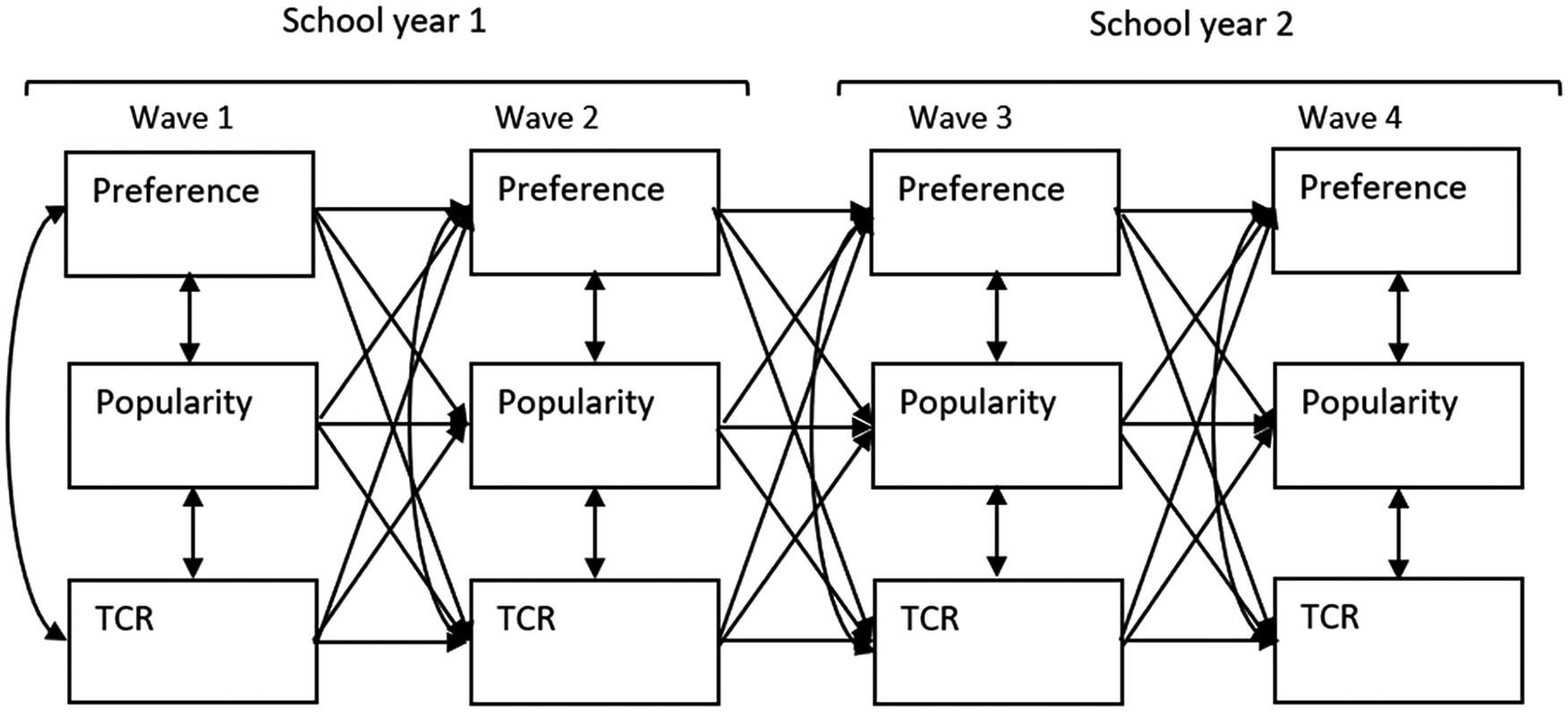
Example of cross-lagged panel model of the associations between preference, popularity, and TCRs, from Wave 1 to Wave 4.
Results
Descriptive Statistics
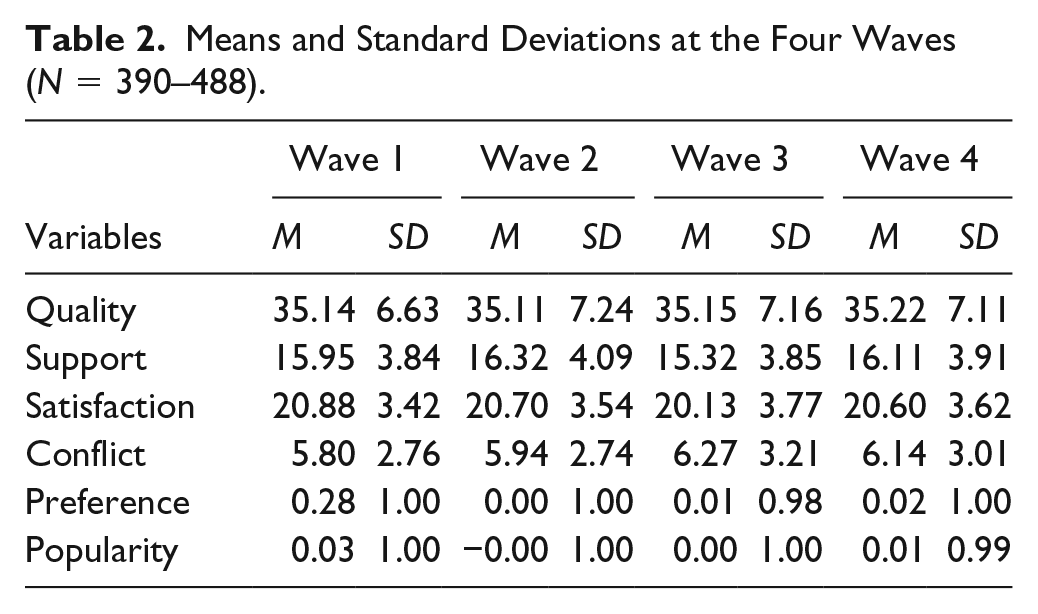
Concurrent correlations between variables are reported in Table 1. Pupil reports of relationship quality were positively correlated with teacher-reported satisfaction and negatively correlated with teacher-reported conflict. Teacher-reported satisfaction was positively associated with teacher-reported support and negatively with teacher-reported conflict. Preference was positively correlated with teacher-reported satisfaction and negatively with teacher-reported conflict. Popularity was positively correlated with preference, but was not associated with any of the four measures of TCRs. Table 2 presents the means and standard deviations of all study variables.
Concurrent Correlations Between the Variables at the Four Waves.
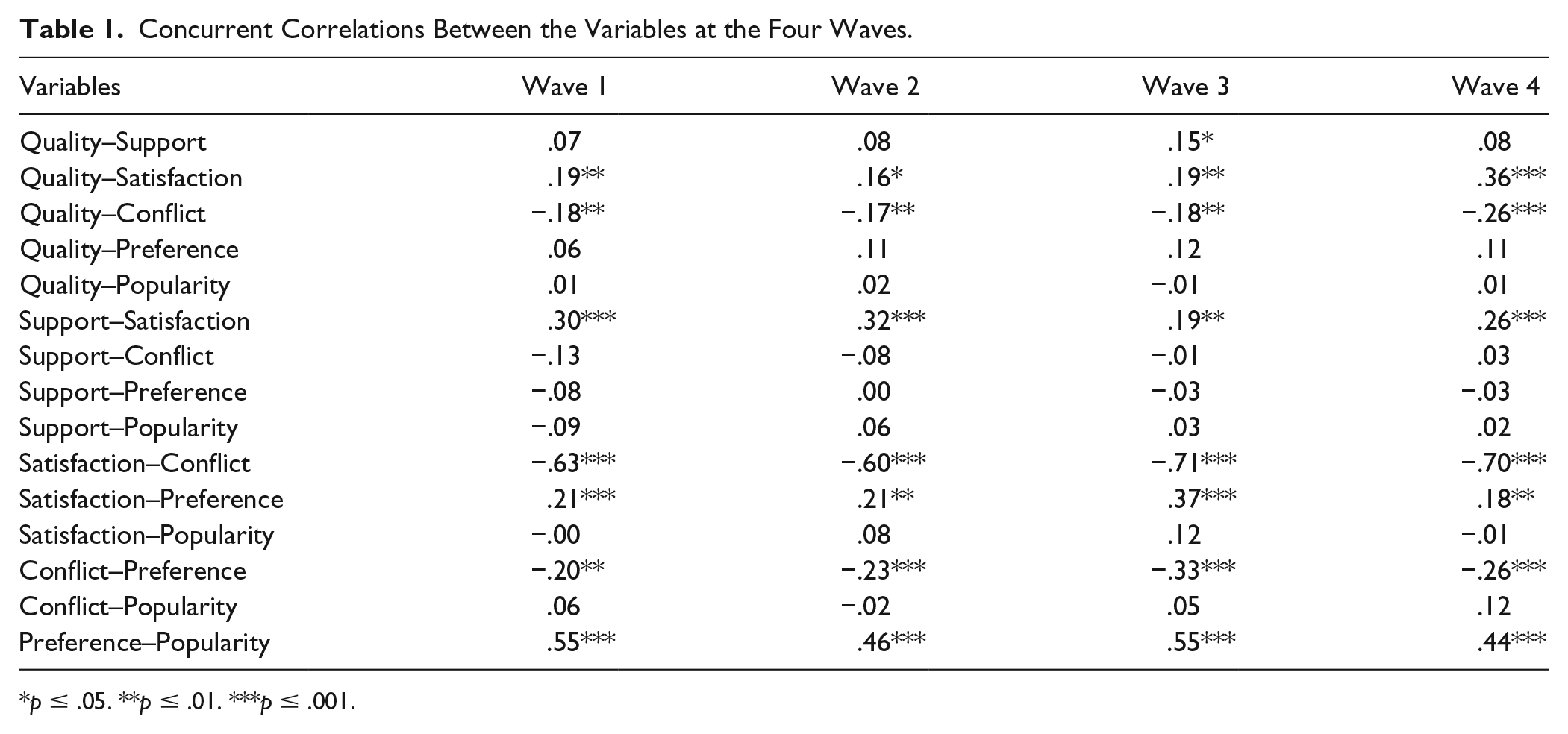
p ≤ .05. **p ≤ .01. ***p ≤ .001.
Means and Standard Deviations at the Four Waves (N = 390–488).
TCR Quality Model
Standardized regression weights for the TCR Quality model are presented in Table 3. The model adequately fit the observed data, χ2(27) = 102.62, p < .001, CFI = .97, TLI = .92, SRMR = .05, RMSEA = .07 [0.057, 0.086]. The model explained 41%, 14%, and 47% of the variance of quality, 52%, 32%, and 64% of the variance of preference, and 56%, 43%, and 67% of the variance of popularity, from Wave 1 to 2, from Wave 2 to 3, and Wave 3 to 4, respectively. While all interindividual stability paths were positive and statistically significant (p < .001), no statistically significant cross-lagged paths involving TCR quality were detected within or between school years. An identical pattern of results was obtained from a model estimated with the 259 pupils with complete data.
Standardized Regression Weights for Associations Between Preference, Popularity, and TCR Quality/Support.
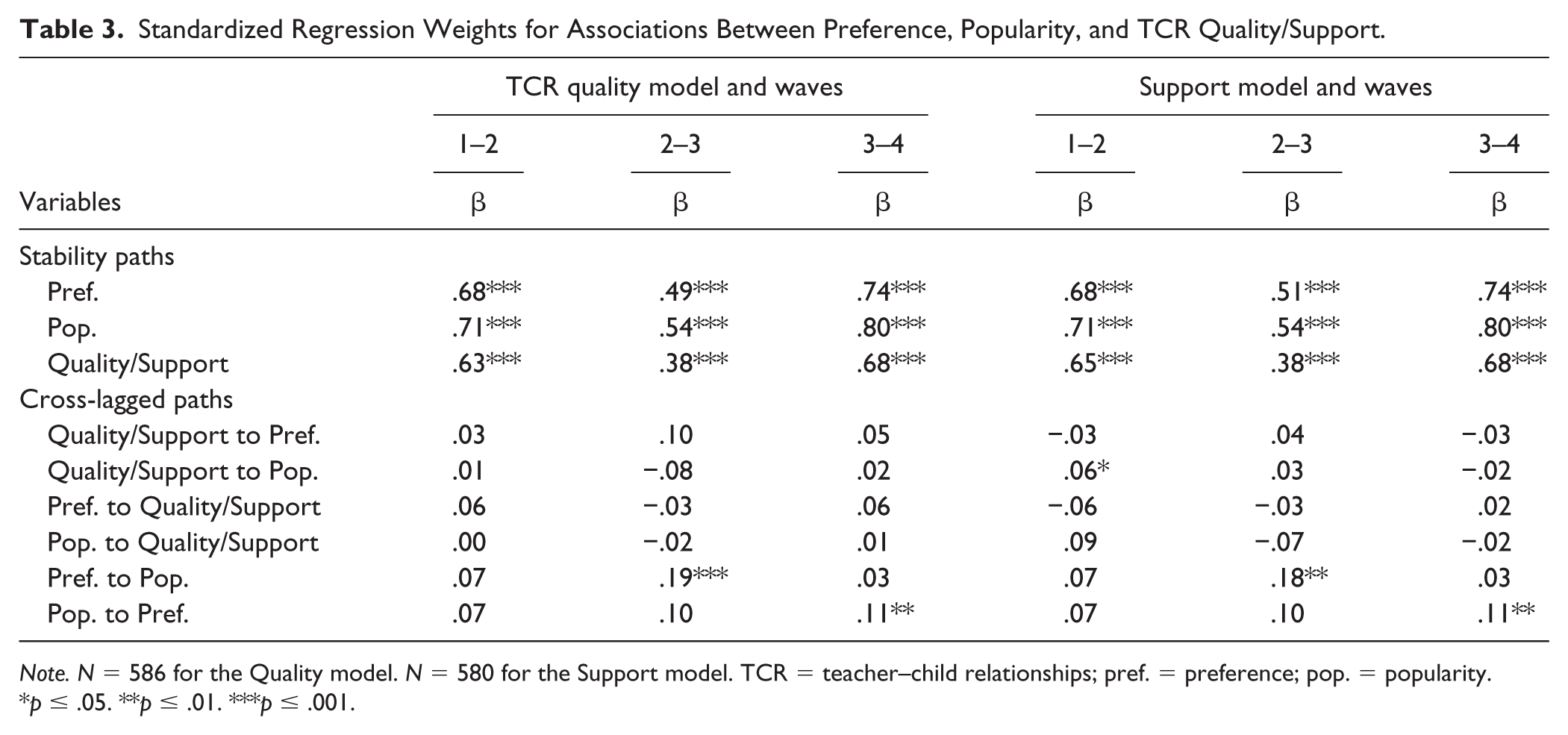
Note. N = 586 for the Quality model. N = 580 for the Support model. TCR = teacher–child relationships; pref. = preference; pop. = popularity.
p ≤ .05. **p ≤ .01. ***p ≤ .001.
Support Model
Standardized estimates for the support model are also presented in Table 3. This model also adequately fit the observed data, χ2(27) = 110.90, p < .001, CFI = .97, TLI = .92, SRMR = .05, RMSEA = .07 [0.060, 0.088]. The model explained 44%, 16%, and 47% of the variance of support across waves. Variance explained of both social status measures was almost identical as that reported for the first model. The interindividual stability paths were positive and statistically significant (p < .001). While no cross-lagged paths involving preference emerged as statistically significant, one statistically significant cross-path involving popularity was detected. Specifically, support at T1 predicted popularity at T2, indicating that higher support was related to increases in popularity within the first school year. This association did not reach statistical significance in a model estimated from 240 pupils with complete data.
Satisfaction Model
Standardized regression weights for the model including satisfaction are presented in Table 4. The model adequately fit the observed data, χ2(27) = 132.83, p < .001, CFI = .96, TLI = .91 SRMR = .05, RMSEA = .08 [0.065, 0.092], and explained 39%, 8%, and 50% of the variance of satisfaction across waves. Interindividual stability paths were all positive and statistically significant (p < .001), but only one cross-lagged path emerged as statistically significant. Preference at T2 predicted satisfaction at T3, meaning that higher preference was related to increases in satisfaction between school years. This association was also statistically significant in a model estimated from 240 pupils with complete data.
Standardized Regression Weights for Associations Between Preference, Popularity, and Satisfaction/Conflict (N = 580).
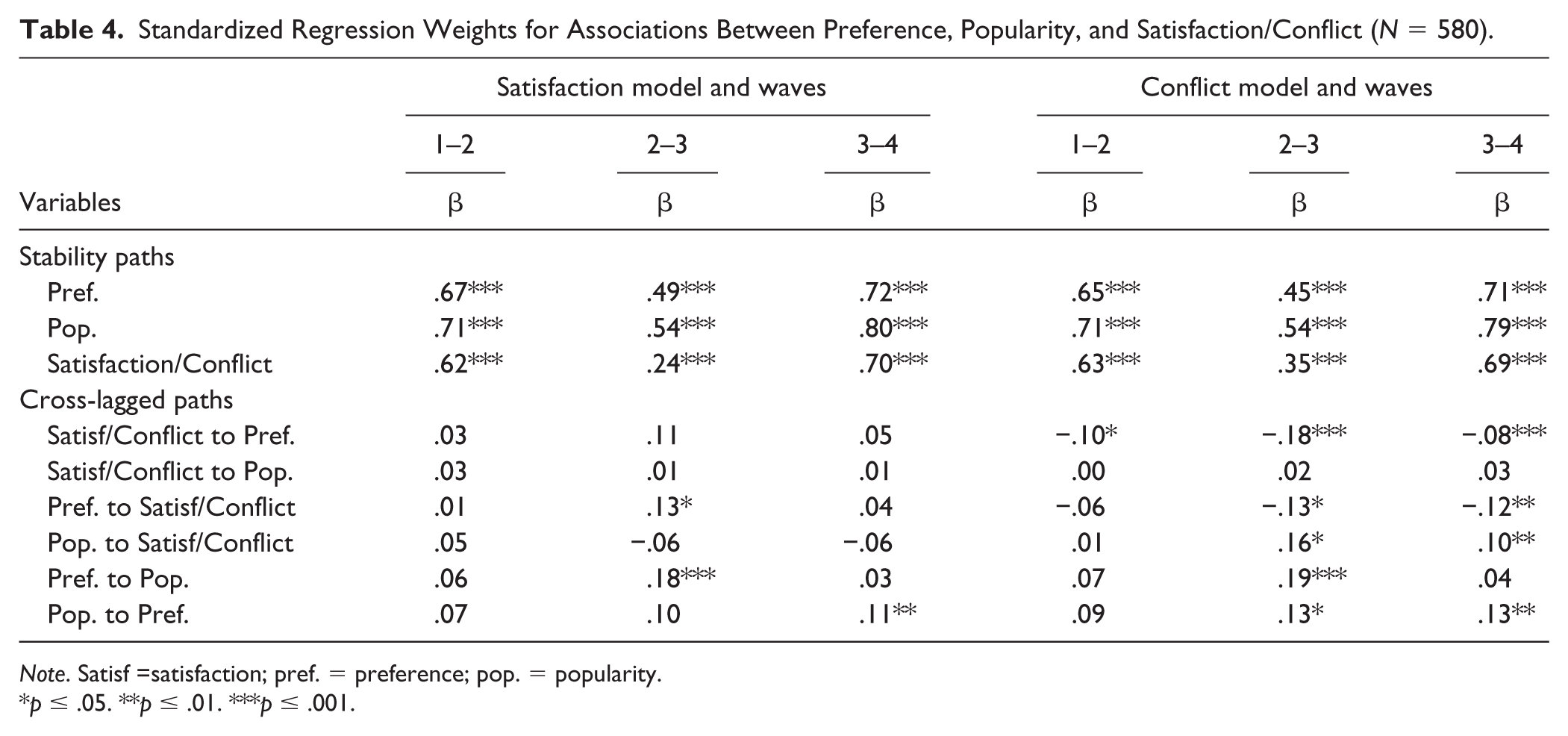
Note. Satisf =satisfaction; pref. = preference; pop. = popularity.
p ≤ .05. **p ≤ .01. ***p ≤ .001.
Conflict Model
The standardized estimates for the model involving conflict are presented in Table 4. The model for conflict fit the observed data, χ2(27) = 106.24, p < .001, CFI = .97, TLI = .93, SRMR = .05, RMSEA = .07 [0.057, 0.085]. The model explained 42%, 16%, and 55% of the variance of conflict. Interindividual stability paths were all positive and statistically significant (p < .001). This model yielded bidirectional associations between conflict and preference within the second school year (T3–T4) and between the school years (T2–T3). There were no bidirectional associations with popularity. For preference, five of the six cross-lagged associations with conflict were statistically significant. Across all waves (within and between school years), increases in conflict were linked to decreases in preference. In the second school year and between school years, the associations were bidirectional, which indicated that increases in preference were also linked to decreases in conflict later in the second school year. With regard to popularity, two of the six associations emerged as statistically significant. Popularity was related to increases in conflict between school years (T2–T3) and in the second school year (T3–T4). A similar pattern of results was obtained from a model that included the 240 pupils with complete data.
Discussion
The aim of the present study was to investigate prospective associations between TCRs and pupils’ social status in special education classrooms. We examined associations between four characteristics of relationships between teachers and their pupils (quality, support, satisfaction, conflict) and two types of social status (preference and popularity). In contrast to some studies in regular education (Hughes & Chen, 2011; Kiuru et al., 2015), our findings provided limited support for prospective associations between positive aspects of TCRs and social status within or between school years. Teacher-reported conflict, on the contrary, was associated with both forms of social status. In line with previous research (De Laet et al., 2014), the valence of associations involving preference and popularity did differ. For instance, preference was negatively associated with changes in conflict and popularity was positively associated with changes in conflict. Somewhat unexpectedly, associations within school years were not more robust than associations between school years.
Bidirectional Associations
Our first research question concerned whether there were bidirectional associations between TCRs and social status in special education. Although previous studies in regular education have consistently reported bidirectional associations between positive features of TCRs and peer preference (e.g., Kiuru et al., 2015; Mercer & DeRosier, 2008), our findings indicated that bidirectional associations in special education are limited to negative features of TCRs. Specifically, preference predicted changes in teacher reports of conflict within and between school years and vice versa. No statistically significant bidirectional associations involving the three positive features of TCRs (quality, support, and satisfaction) or associations involving popularity were detected.
Our finding that teacher reports of conflict were associated with decreases in pupils’ preference, and pupils’ preference scores were associated with decreases in conflict supports a transactional perspective. According to “social referencing theory” (e.g., Hughes et al., 2001), this indicates that teachers’ interactions with their pupils in the classroom have a “modelling” function for the other classmates. When classmates view conflictual interactions, such as their teacher correcting or reprimanding a pupil, this may contribute to a more negative opinion about this pupil. Similarly, the finding that preference predicted changes in conflict may indicate that teachers also use social referencing when interacting with their pupils. Teachers may view pupils who are less preferred by classmates in a less favorable way (Mercer & DeRosier, 2008). An alternative explanation is that pupils who are less preferred also are less engaged in the classroom or exhibit more severe behavior problems, which may lead to more corrections and more conflicts with the teacher (see also Hughes & Chen, 2011). Our findings are not completely in line with results from the study by De Laet and colleagues (2014), which reported preference was associated with changes in conflict, but not the other way around. However, the comparability of both studies is limited, as we conducted assessments within and between school years and the study by De Laet and colleagues (2014) only investigated associations between school years. Altogether, additional research is needed, as these results suggest that bidirectional associations between TCRs and social status not only depend on which aspect of TCRs and social status are investigated, but also depend on the context (e.g., regular or special education) in which these measures are assessed.
Contrasting Patterns for Preference and Popularity
Our second research question involved the valence of associations between TCRs and both measures of social status. Previous research in regular education has consistently found that positive aspects of TCRs (e.g., support) are positively associated with preference (Leflot et al., 2011; Mercer & DeRosier, 2008), and that negative aspects of TCRs (e.g., conflict) are negatively associated with preference and positively associated with popularity (De Laet et al., 2014). In general, the valence of associations reported in this study is in line with results reported from studies investigating these links in regular education. That is, preference was positively related to teacher-reported satisfaction and negatively related to conflict, and popularity was positively related to conflict. However, unlike previous work in regular education (e.g., Leflot et al., 2011; Mercer & DeRosier, 2008), our results provided stronger support for associations involving negative aspects of TCRs compared with positive aspects. Not all studies differentiate between positive and negative aspects of TCRs, opting instead for a general measure of TCR quality incorporating positive and negative characteristics (e.g., Hughes & Chen, 2011; Kiuru et al., 2015). Considering the different patterns of associations reported here and in previous work, it seems especially important to separate positive from negative aspects of TCRs to unravel their individual contribution to pupils’ social status.
The prominence of negative aspects of TCRs in special education may be explained by the educational context. Especially for pupils with EBD, conflictual TCRs may be a salient aspect within classrooms. Pupils with EBD experience more difficulties in their relationships with teachers (Lane et al., 2005). Clustering pupils with EBD in special education classrooms may inherently result in classrooms in which conflictual interactions between teachers and pupils are more common than in regular education (Little & Kobak, 2003). The increased prevalence of conflict in special education classrooms may lead to an increased importance of conflict compared with more positive aspects of TCRs for the social dynamics in these special education classrooms.
Although the associations between preference and conflict may be explained through social referencing, social referencing has been less explicitly considered as an explanation for the associations between popularity and conflict. However, the associations of increases in popularity with increased conflict with teachers may well be related to teachers viewing popular pupils in a less favorable light. Regular education studies point out that it is not necessarily popularity that instigates a less favorable opinion or increases of corrections by teachers, but the aggressive behavior of popular pupils directed at peers (De Laet et al., 2014). Popular pupils are known to use aggression toward peers to acquire and maintain their social position within the peer group (e.g., Cillessen & Mayeux, 2004). We cannot rule out that the link between popularity and increases in teacher–pupil conflict is also mediated by aggression in special education. Interestingly, regular education studies show that not only aggression toward peers relates to maintaining a social position, but also that conflict with the teacher is related to gaining popular status among peers (De Laet et al., 2014; Moore et al., 2012). The conflictual interactions of pupils with the teacher may also be interpreted as ways to defy the teacher’s authority, which, in the eyes of classmates, may enhance the reputation of these pupils and increase their social position in the classroom hierarchy (De Laet et al., 2014; Moore et al., 2012). We did not find that conflict with teachers enhances popularity in special education. So, in special education, gaining popularity may be primarily driven by (aggressive) interactions with peers, which may increase conflicts with teachers. In summary, while teacher–pupil conflict may be more prevalent in special education compared with regular education classrooms, the valence of the associations between TCRs and both forms of social status does not seem to differ between the two different educational contexts.
Within and Between School Years
The third research question involved the magnitude of the associations within and between school years. We expected that within school year, associations would be of higher magnitude than associations between school years (see Mercer & DeRosier, 2008). Our results did not confirm this expectation. We did find that the TCRs and social status of pupils within school years were more stable than between school years, which can be explained by changes in teacher and classroom composition from one school year to the next. There was no consistent pattern with regard to the magnitude of associations when comparing associations within and between school years for the four TCR characteristics. This is surprising when considering the high degree of instability in classroom composition between school years as well as the fact that a vast majority of pupils in our sample had attended classrooms with different teachers in each school year (see also Mercer & DeRosier, 2008). The lack of a clear difference in the magnitude of associations within and between school years raises questions about the underlying mechanisms that explain the associations between TCRs and pupils’ social status.
The overall pattern of associations found in this study and in previous work suggests that social referencing may at least partly explain how TCRs contribute to pupils’ social position and vice versa (De Laet et al., 2014; Hughes & Chen, 2011). However, this theoretical idea seems less well suited when explaining associations between school years when both the classroom composition and the teacher change. In the present study, data were collected in approximately halfway through the school year (i.e., February) and at the end of the school year (i.e., June), so the “new” classmates and teacher had enough opportunities to interact with the participants. So, while social referencing seems more conceptually relevant for explaining associations within a school year, the design of the current study does not preclude the possibility that social referencing is also the mechanism that explains associations between school years.
Strengths and Limitations
This study had several strengths. First, data were collected from a large representative sample of pupils in special education schools, which improves the generalizability of the results to the population. Second, the inclusion of four assessments allowed us to examine changes in associations between TCRs and social status not only within school years, but also between school years. Third, two dimensions of social status (preference and popularity) were included in the study. Both have a unique relationship to classroom social dynamics. Finally, multiple measures of TCRs were reported by teachers and pupils. The use of multiple measures provided a more nuanced understanding of the specific associations between different aspects of TCRs and both forms of social status.
This study also had some limitations. First, we elected to use a design-based approach to deal with the clustering of data within classrooms. Although this is an appropriate strategy to deal with clustered data, the dynamic nature of the clustering in this study (changes in classroom membership) was not dealt with in the estimation of parameter estimates. Furthermore, we did not include latent variables in our models (which would have reduced measurement error), due to the high number of indicators involving the pupil-reported TCR quality measure. Second, this study did not consider specific behaviors of pupils. TCRs and social status are both associated with pupil behavior (e.g., Hamre & Pianta, 2001; Ladd & Troop-Gordon, 2003), and omitting behavioral measures could have led to an overestimation of the association between TCRs and social status in our study. Ample evidence suggests, however, that pupil behavior notwithstanding, there is an interrelation between TCRs and pupils’ social status (De Laet et al., 2014; Leflot et al., 2011; Mercer & DeRosier, 2008). As yet, this result was not replicated in special education research, as, in a 1-year study, TCRs and preference were not related when pupils’ externalizing behavior was included in the study (Breeman et al., 2015). Third, because our sample consisted primarily of boys, reflecting the population of special education, our conclusions generalize mainly to boys in special education. The number of girls in the study was too small to make separate inferences about the associations between the variables. More research is needed, with a sample including more girls to make more accurate statements about how TCRs and social status of girls influence each other. Fourth, we were not able to provide more detailed demographic information of our sample (e.g., diagnosis, ethnicity, and socioeconomic background), because this information was not obtained in the study. The link between social status and TCRs could differ depending on the specific diagnosis of pupils. When judging peers, for instance, pupils with autism spectrum disorders could be less influenced by looking at TCRs, because of their more severe social deficits. We did not include the diagnosis in the study, however, because grouping these pupils with often comorbid disorders is difficult (Breeman et al., 2015).
Implications
Teachers in special education classrooms have a hard job, trying to foster learning and social-emotional development of pupils with EBD. Although our study is correlational in nature and we cannot imply causality, our findings suggest that not only the challenging behavior of these pupils (e.g., Lane et al., 2005), but also their social status is related to conflictual relationships with teachers. Conflicts with teachers, in turn, seem to be related to being less preferred by classmates. While reducing negative interactions between teachers and pupils is important in all educational contexts, this may be even more important for special education teachers. In regular education, teachers’ attunement has been identified as one way in which teachers can improve classroom social dynamics, such as reducing conflicts among pupils, and intervening in bullying and victimization (Norwalk, Hamm, Farmer, & Barnes, 2016). Attunement may also help special education teachers to more effectively identify the social processes (e.g., social status) in the classroom and better assess the most effective way to respond to those processes, which may reduce conflictual teacher–pupil interactions. Therefore, next to enhancing attunement, teachers also need to have the tools necessary to intervene in the classroom social dynamics. These interventions may range from applying behavioral techniques grounded in social learning theory, to creating opportunities for pupils to interact positively (group dynamical processes) and guide social interactions between pupils (Farmer et al., 2011).
Conclusion
The results of this study indicate that in special education classrooms, negative aspects of TCRs (i.e., conflict) are more robustly associated with pupils’ social status than positive aspects of TCRs. While this pattern of associations differed from what is commonly found in regular education classrooms, the valence of the associations was quite similar in special and regular education. Preference was positively associated with positive TCR characteristics and negatively with conflict, and popularity was negatively associated with conflict. Taken together, our findings provide a more nuanced understanding of the importance of TCRs and the dynamic association between these relationships and pupils’ social status in special education classrooms.
Footnotes
Declaration of Conflicting Interests
The author(s) declared no potential conflicts of interest with respect to the research, authorship, and/or publication of this article.
Funding
The author(s) disclosed receipt of the following financial support for the research, authorship, and/or publication of this article: This research was supported by Entrea Youth Care, Special Education and Research, and PI7 Consortium. For their work on the design of the study and the data collection, the authors are grateful to the researchers of the project group, Heleen van der Stege, Esther van Efferen, and Koen van Zoest. They would like to thank all teachers and pupils in the special education schools that participated in the study.
