



Abstract
Stimulating adults to learn is a significant challenge, particularly for vulnerable groups with limited education, socioeconomic disadvantages, or marginalized backgrounds. While research highlights barriers and motivations for adult learning, less attention has been given to the transitions adults undergo and the factors shaping these processes. Based on 69 interviews with underrepresented learners in the Netherlands and informed by the capability approach, this study identifies three key movements: learning imposed, driven by coercion; learning through agency development, primarily enabled by external factors; and learning through agency, mainly initiated by intrinsic motivation. These movements are shaped by different combinations of agency factors, life events, and social or institutional support. The findings provide a framework to understand these transitions and inform policies for inclusive adult learning.
Motivating adults to learn who lack interest in or perceive that learning has no value remains a key challenge for modern societies (European Commission, 2017; OECD, 2020). Learning is essential to navigate shifting labor market demands, technological advancements, and societal pressures (OECD, 2019). This is particularly critical for vulnerable groups. Yet, evidence suggests that lifelong learning policies often fail to engage or empower these groups effectively (OECD, 2020), exacerbating social and economic inequalities between those who embrace learning and those who do not (Boeren, 2009; Boyadjieva & Ilieva-Trichkova, 2021).
Although extensive research has explored barriers and motivations for adult learning (e.g., Boeren et al., 2012, 2023; Cabus et al., 2020; Eurostat, 2022), as well as reasons for nonparticipation (e.g., Kalenda et al., 2024; Kalenda & Kočvarová, 2022), little is known about why at the individual level some adults begin learning, after some time of inactivity related to learning, with minimal support while others remain disengaged despite substantial (financial) incentives. 1 Related to this, less is known about what adults themselves experience as stimuli and barriers in their (micro)context and the interplay of these factors compared to conditional system-related (macro)characteristics that stimulate or hamper learning (Boeren, 2017; Boeren et al., 2023; Boyadjieva & Ilieva-Trichkova, 2021). Understanding the individual pathways adults take from nonlearning to learning, alongside the patterns of factors that encourage or hinder these transitions, can inform more inclusive and effective policies.
For the purposes of this article, adult learning refers to activities where adults are learning or developing specific knowledge, skills, and attitudes, associated with proactively developing their qualities to sustainably contribute to society, work, their own health, and happiness (Kuijpers et al., 2025). This can range from following a formal education program, literacy training in a library, or sheltered work experiences (i.e., a protected environment for individuals who, due to disabilities or other significant barriers, are not able to participate in the open labor market under typical conditions). In this article we focus on starting a learning process, irrespective of the kind of learning. Hence, it is less relevant what kind of learning is pursued by the adult. Vulnerability or a disadvantaged position to learning refers to whether a person is confined first by a less favorable past. Second, by less favorable present circumstances to learn, and third, by an imaginary future that shows fewer opportunities in which the person sees learning as something valuable (Broek et al., 2023).
The theoretical framework for understanding transitions toward learning is based on a capability approach (Sen, 1999). This capability framework is chosen as it allows a deeper holistic analysis of why people act or not (for instance, compared to a barrier-related paradigm; Cross, 1981; Roosmaa & Saar, 2017). The framework not only includes the degree of equality of learning opportunities among adults, but it also focuses on the opportunities to value learning in the context of adult learning. A capability approach initially considers whether people have equal opportunities to value learning, focusing on aspects such as freedom and functioning. Subsequently, the approach examines the conversion factors that enable adults to transform a functioning, such as a positive evaluation of learning, into actual learning. In line with this theoretical approach, Broek et al. (2023) presented a conceptual framework that allows mapping transitions adults experience in their adults’ journeys from not learning to learning (see Figure 1). In this figure, transitions are represented by crossing dotted lines. Each transition reflects a different process: moving from a disadvantageous position (D) to an advantageous one (A) signifies enabling—making something possible or easier (Cambridge Dictionary, 2025); transitioning from A to self-motivated learning (S) represents empowering—to encourage and support the ability to do something (Cambridge Dictionary, 2025); shifting from D to imposed learning (I) reflects coercion—the use of force to persuade someone to do something that they are unwilling to do (Cambridge Dictionary, 2025); and moving from I to S indicates internalization—the action of accepting or absorbing an idea, opinion, belief, and so on, so that it becomes part of your character (Cambridge Dictionary, 2025).

Starting positions, transitions and end positions related to learning.
In line with the theoretical approach, Broek et al. (2023) presented as outcomes of an extensive narrative literature review, a mapping of the factors influencing the transitions. This identified agency-related factors that allow seeing learning as something valuable; conversion factors that allow realizing learning (or that hold adults back from learning); and benefits and results of learning (e.g., adults have equal opportunities to benefit from adult learning participation). An overview of the identified factors is provided in Table 1.
Factors Influencing the Transitions.

Following these conceptual explorations, this article explores three main research questions: (1) What transitions do adults experience when moving from not learning to learning, and how can adults be categorized based on their transitions? (2) What factors facilitate and hinder these transitions? (3) What policy implications arise to better support these groups to start learning? To answer these questions, the study examines how adults, who successfully engaged in learning, made the transitions from a disadvantaged starting position (i.e., being in a less favorable position related to past experiences, current circumstances and future aspirations to see learning as valuable) toward actual learning (how agency factors and conversion factors interact to facilitate this process). Subsequently we analyzed how the factors can be influenced by policy interventions. In other words: what can we learn to provide better support for those adults to engage in learning?
Method
To address the research questions, 69 interviews were conducted in the Netherlands using a card-sorting method that focused on adults in vulnerable or disadvantaged positions in which learning does not present itself as something valuable, but who despite this, started learning (i.e., a deviant-case approach; Flyvbjerg, 2006). Proxies for vulnerability relate to having limited (initial) education, facing socioeconomic challenges, or being in an unstable/unfavorable employment position. Recruitment of interviewees involved intermediary organizations across three regions: Rotterdam, Groningen, and Achterhoek, with test interviews in Utrecht, Heerlen, and Hengelo. Regional entities, such as employment services and educational institutions, facilitated participant outreach. Ethical approval was granted by the Open Universiteit of the Netherlands, and participants provided informed consent after receiving study information. The background characteristics of the interviewees are presented in Table 2.
Overview of Interviewees by Region and Movement.

Note: Interviewee quotes are coded by region (ACH, RZ, GR, OTH), organization (O + number), and interviewee (I + number).
The semistructured interviews, conducted face-to-face between October 2022 and January 2024, lasted 30 to 90 min. Three researchers conducted the interviews independently, ensuring consistency through initial calibration and regular consultations (Patton & Patton, 2002). The interviews explored participants’ learning journeys, focusing on decision-making processes, background, recent learning activities, barriers, facilitators, and outcomes. Interviews covered personal backgrounds, benefits, and outcomes of recent learning activities, and included a card-sorting exercise to identify key facilitators and barriers to engagement. Following Brent et al. (2021) and Conrad and Tucker (2019), a card-sorting method was applied, using cards with explanatory text and an image representing stimulating and hindering factors (Table 1). Participants arranged and adjusted cards based on perceived importance in hindering or stimulating learning, with interviewers prompting reflection. Participants were given the opportunity to introduce new cards (by writing a new concept on a blank card). Eight participants used this opportunities, referring usually to individual situations that can be linked to life events (e.g., paternity, sickness). Finally, participants also reflected on potential policy interventions to support learners in similar situations.
Interviews were audio-recorded, with card arrangements photographed, and thematic analysis (Braun & Clarke, 2006) combined with grounded theory (Glaser et al., 1968) was applied. Data were coded against a preexisting framework (Broek et al., 2023) while allowing emergent themes to surface. Based on how respondents positioned the factor cards on the playing board, the perceived importance in terms of hindering and stimulating was also codified (from “0”: no role, to “3”: important role), allowing classifications into the level of importance. The transcripts were used to classify the interviewees by their end-position (learning imposed or self-desired learning) by assessing the attitude and sentiment expressed to how the current learning trajectory came about and whether there were strong external pressures to learn or whether the interviewee reported a more self-initiated effort to start learning. The analysis, guided by the capability approach (Broek et al., 2023; Sen, 1999), allowed categorizing of participants by their learning orientation (imposed/self-driven), and transitional movements, allowing revealing patterns and relationships among factors, learning activities, and transitions.
Results
Reasoning further based on this conceptual framework, three key pathways from a disadvantaged-not learning position to learning are outlined: (1) learning imposed, where individuals are compelled to learn (D to I), potentially followed by internalizing this learning and developing intrinsic motivation (I to S); (2) learning through agency development where individuals are externally encouraged before they themselves value learning (D to A) and start learning (A to S); and (3) learning by agency empowerment, where individuals already value learning (moved from D to A) and only need an additional push to start learning (A to S). The interviewees were classified by these three movements (Table 2). The remaining of this section details each of the three movements, covering the transition, hindering, and stimulating factors, and suggested policy interventions to support similar adults. While the discussion of the three movements is predominantly based on qualitative analyses of the interview transcripts, we also use frequency words (“often,” “many”) to indicate that what we describe is illustrative for more than one participant. The Appendix includes a frequency table of stimulating and hindering factors being mentioned by the members of each of the three movements.
Movement 1: Learning Imposed (Transition by Coercion)
This movement involves adults who neither wish nor are able to learn but do so due to coercion (bottom left to top left in Figure 1). The sample includes seven adults (aged 30–50), mostly in sheltered employment (i.e., protected work environment for people facing challenges in regular work environments), with three Dutch and four from migration backgrounds. Four participants are situated in the region of Rotterdam-Zuid, where more work-related organizations participated in the study.
Adults in this group often lack intrinsic motivation to learn due to socioeconomic struggles and personal challenges. Many, like those with histories of imprisonment, seek structured work for stability: “Last year, I was incarcerated. I encountered many problems and kept running into obstacles. When I was released, I immediately sought help from an organization that could also provide shelter. That's when I ended up on benefits and was asked to come work here, as a kind of daytime activity” (RZ_O03_I01). Barriers such as chronic health issues further impede participation: “I forget a lot… I stay up all night because of the pain” (RZ_O05_I01). Negative experiences reinforce beliefs that learning is not for them, with one participant stating she felt “too old to learn” in her 30s (OTH_I07). Learning occurs incidentally through supported work experience rather than deliberate educational efforts. As RZ_O03_I02 explained, “I’m mainly here to help others and keep myself occupied,” while RZ_O03_I01 noted, “I don’t need support; I’m independent and just here to keep busy.”
In terms of stimulating factors for these adults, supported work experience fostered growth by providing structure and encouragement, building confidence and self-esteem: “The people here respect me a lot… They trust that I can do it” (OTH_I09). Managers often support development through training or challenging assignments: “My team leader suggested internal training to help employees with low literacy” (OTH_I07). Some participants found dissatisfaction with roles motivated change: “This job helped me realize I needed to explore other options” (ACH_O01_I01). Overall, organizational support played a pivotal role. A job coach's belief in one participant's abilities proved transformative: “When people believe in you… it's positive” (OTH_I09). Municipal support stabilized lives, enabling focus on education: “The municipality helped me get my life back on track” (RZ_O03_I01). Community organizations provided financial and vocational guidance, helping participants find suitable pathways: “They reviewed my finances and suggested work that better suits my situation” (ACH_O01_I01). Competence and autonomy act as both barriers and enablers. While low confidence initially hinders learning, imposed learning can build confidence and foster growth. One participant reflected, “I always thought I couldn't do anything… Now, everyone says: ‘[name interviewee], you're such a nice person'” (OTH_I09).
Participants benefit most from increased social interaction and societal participation. RZ_O03_I01 noted, “I meet new people from different backgrounds. Sometimes you can learn from each other.” Engagement also supports mental and physical health, with RZ_O07_I02 describing tasks as “a kind of physical training… It makes me feel good, mentally and physically.”
Policy interventions supporting this movement emphasized external encouragement, tailored support, and fostering self-confidence. Mentors, job coaches, and institutions played crucial roles, providing guidance and financial support to ease transitions. External belief often unlocked potential, with one participant noting, “The trust my director and job coach had in me played a big role” (OTH_I09). Targeted guidance was also crucial in aligning tasks with personal interests: “They actively worked with me to find what suited me best” (ACH_O01_I01). Financial support also helped alleviate barriers: “Here, they really invest in you. Everything you achieve is yours” (RZ_O07_I02). These interventions reduced pressure and encouraged reflection, enabling participants to explore what worked best for them.
All in all, adults coerced into learning by organizations often begin from an attitude of disinterest or perceived inability to learn. Benefits of learning, as reported by participants, include expanded social networks, improved mental and physical health, and increased societal participation. Socially nonconducive environments and lack of self-reflection, together with a lack of self-confidence hindered them to start learning. On the other hand, factors like coercive support and guidance, supportive workplaces, and organizational encouragement fostered engagement, building self-confidence and skills to learn.
Movement 2: Learning Through Agency Development (Transitions of Enabling and Empowering)
This movement occurs when an adult transitions from being not in the position to learn to a more conducive position and begins learning (bottom left to top right via the bottom right corner in Figure 1). This group's disadvantaged circumstances initially suppressed motivation for further education, with priorities on survival or family responsibilities. This group was encouraged by others to see the value of learning to overcome disadvantaged circumstances. The group includes 24 adults, mostly aged 30–50, engaged in diverse learning settings (work, education, welfare, library, or language education), and almost half having a migrant background.
For many adults in this group, learning was not initially seen as valuable or achievable. This mindset was often shaped by past experiences, social environments, and emotional struggles, which contributed to feelings of inadequacy and low self-worth. These internalized beliefs, combined with external pressures, created a cycle of hesitation and self-doubt that hindered educational engagement. A key issue was the belief that learning was not meant for them. GR_O01_L1 explained, “In my country, I didn’t learn much… Sometimes I think it's too hard for me,” reflecting a deeply rooted sense of educational exclusion. Others questioned their capabilities due to limited prior schooling. RZ_O06_I02, who had only 2 years of primary education, admitted, “I learn but forget quickly, so I lose motivation.” Similarly, OTH_I01 recounted how negative school experiences shaped his view of learning: “If it's not good from the start, people think, ‘Forget it, I can’t do it.’” This lack of confidence was often paired with guilt and a sense of unworthiness. As RZ_O01_I01 expressed, “I lack confidence. I do a lot, but I feel guilty about everything.” These feelings were magnified by external conditions. RZ_O04_I03 said, “I hesitated so many times before starting my course; taking the first step was the hardest part.” Social environments also played a discouraging role. RZ_O04_I01 shared, “People in my circle didn’t understand why I wanted to study. They said, ‘You’re already too busy.’” These experiences show how not seeing learning as worthwhile or within reach held many adults back, until encouragement, support, or changing circumstances enabled a shift in perspective.
For adults in this group, the decision to start learning was shaped less by internal drive alone and more by external encouragement and support. These learners required significant involvement from their social environment to initiate both the enabling and empowering transitions. Friends, family members, mentors, and local organizations played essential roles in helping them to see learning as valuable and achievable. Family support often served as the foundation for action. One participant shared, “My family encourages me to keep learning. My son helps with ICT questions for my course, and my husband takes care of our daughter when I work. He really does his best” (RZ_O01_I01). Learning alongside others proved equally powerful: “My friends are also doing the course with [organization]. The fact that we’re doing it together keeps me motivated” (RZ_O01_I01). Social encouragement extended beyond immediate circles. RZ_O12_I02 recalled, “My friend told me about a course… She said, ‘Let's try it together. You have nothing to lose.’ Her encouragement made me think I could do it.” Similarly, RZ_O04_I03 described how encouragement at school helped her recognize her potential: “People around me motivated me to take a course. They told me I had a gift for working with children.” Organizational support, such as financial aid, transportation, and coaching, also helped overcome practical barriers. “They handled the costs. Without that, I couldn’t have attended” (GR_O06_L1), while RZ_O01_I02 explained, “My coach pushed me to start learning, even when I doubted I could do it.” Finally, life transitions like divorce or migration triggered reflection and action. “After 15 years of giving everything to my family, I thought, ‘Enough, it's time to do something for me’” (RZ_O01_I02). These external triggers, emotional, social, and practical, were crucial in helping this group move from doubt to participation in learning.
For this group, the most significant benefits of learning lie in personal development, increased confidence, and a greater sense of social participation. Many learners described how education helped them regain self-worth and develop life skills. As one participant noted, “For me, it was about personal development. I wanted to improve myself… it helped me in other areas, like managing finances and feeling proud of what I achieved” (OTH_I01). Learning also opened up pathways to further education. “After improving my Dutch, I earned several diplomas. Now, I’m studying for a vocational education and training (VET) horticulture degree” (OTH_I03). Others echoed this progression: “This course is just the beginning. I now want to pursue VET4 and see where that takes me” (ACH_O04_I04). Beyond individual growth, learners felt more connected to their communities. “I used to feel invisible. Now, I’m seen, heard, and I participate in society, […] it's about belonging” (GR_O06_L1).
Adults in similar situations benefit most from policies that combine financial accessibility, cultural sensitivity, and community-based support to develop confidence and agency. Free courses and subsidies help remove financial barriers. As RZ_O12_I02 explained, “The courses were free, which made it possible for me to join.” Trusted professionals and role models can serve as essential entry points. “My psychologist suggested I get involved with [name organization]. That gave me a reason to start” (GR_O01_L1). Policies that recognize cultural dynamics are especially effective. One learner shared, “In my culture, women don’t do many things independently. Here, I learned that I can learn and work” (GR_O01_L1), underlining the need for culturally responsive approaches. Additionally, grassroots networks and practical learning environments boost confidence and engagement. “You learn through practice, and through connections, I understood how to keep going” (GR_O04_L3). Effective policy, therefore, must support accessible, socially rooted, and culturally aware learning pathways, enabling sustained participation and growth.
All in all, wide-ranging external factors (e.g., family, social, institutional, life events) triggered the learning more than the self-activation of the learner. Social environments, organizational offerings and incentives, and life events gave the final push to pursue learning, learning mainly to personal development, increased self-confidence, and a willingness to continue learning.
Movement 3: Learning by Agency Empowerment (Transitions of Enabling and Empowering)
This group includes adults starting learning from a disadvantageous position, mainly triggered by their own motivation and then supported through other factors removing specific barriers (bottom left to top right via the bottom right corner in Figure 1). These adults face learning barriers but value it for personal and career growth, seeking favorable conditions to pursue it. It consists of 38 adults, mostly aged 30–50, engaged in diverse learning settings (work, education, welfare, library, or language education), with a large number (11) in formal education, two-thirds having a native Dutch background.
Despite a strong intrinsic motivation to improve their lives, adults in this group often face a complex web of barriers that delay or prevent them from engaging in learning. Cultural expectations, caregiving responsibilities, financial hardship, and initial low self-confidence emerge as recurring themes that undermine even the most determined learners. Cultural norms shaped many learners’ early perceptions of education. One woman recalled being told in childhood, “As long as you marry, nothing else matters,” which deeply impacted her belief in her own educational potential (OTH_I06). Similarly, RZ_O12_I01 reflected on her community's indifference to formal learning: “Many people think speaking [Dutch] a little is enough. Learning isn’t necessary because we manage with Turkish shops and neighbors.” Such attitudes discouraged learners from pursuing education, despite their curiosity and desire to grow. For many women, caregiving responsibilities created substantial time and energy constraints. GR_O04_L1 explained, “Everything I had to do at home kept me from pursuing learning,” while RZ_O09_I01 shared, “I have many roles within my family… it leaves little time for my own learning.” These daily demands left little room for personal development. Emotional barriers also weighed heavily. RZ_O04_I02 admitted, “At the start, I found it scary. Looking back, I ask myself, why did I wait so long?” Learners like GR_O04_L4 wrestled with self-doubt: “Part of me could rely on my abilities, but another part was hesitant, which held me back.” Structural issues further compounded these personal challenges. GR_O07_L2 described the disruptive effects of bureaucratic instability: “You get a new coach three or four times a year… Each time, I have to explain my whole story from scratch.” These combined barriers made learning seem unattainable, even for those with a deep internal drive to succeed.
For adults in this group, the decision to engage in learning was driven by a combination of self-reflection, future aspirations, and institutional support. Their learning journeys required two key transitions: the enabling transition, achieving a realistic position to learn, and the empowering transition, taking action to begin learning. Across both, self-motivation and clarity of personal goals emerged as consistent driving forces. Many learners were prompted by the desire for personal growth and a better future. GR_O08_L3 reflected, “The more you understand yourself, the more you realize what you want to achieve,” while GR_O0#_L1 sought to break generational cycles: “I want to be a better example for my children than my mother was for me.” Others, like GR_O07_L2, demonstrated perseverance despite lacking qualifications: “I know I don’t have enough certificates, but I would really like to earn them and start somewhere.” Learners’ personal determination was often forged through hardship. A Somali woman shared how fear initially held her back, but she eventually took action: “The third time, I thought, ‘eyes closed, just go for it’” (RZ_O04_I02). Similarly, a Yemeni nursing graduate acknowledged, “The main key is the Dutch language” (RZ_O09_I01), using that understanding to guide his integration and volunteering efforts. Institutional support played a critical role in the empowering transition. GR_O08_L3 highlighted how a job coach equipped her with materials: “He helped me with a laptop and course materials.” Free community resources made learning accessible: “The computer classes are free, the laptops are free, even the pens are free” (OTH_I13). ACH_O06_I03 added, “My advisor connected me with organizations that help newcomers in healthcare. They sent me a letter, and I immediately said yes.” Together, future-oriented goals, self-reflection, and institutional facilitation helped these adults transition from intention to action, demonstrating the importance of internal drive coupled with external support.
For this group, the benefits of learning, as reported by participants, are strongly rooted in personal development expanded social engagement. Socially, learning reduced isolation. GR_O07_L1 noted, “These courses gave me the strength to socialize again,” while ACH_O06_I03 added, “I had very few friends, but now I have many contacts.” The learning experience also sparked curiosity and ambition. “I’ve learned so much already, and it makes me wonder, ‘What else can I do?’” said GR_O08_L2. Learning allowed learners to invest in themselves despite demanding family roles. As one participant shared, “I’m always busy with my children and the household. This course, I’m doing it for myself” (RZ_O04_I02). Another shared, “I never thought I’d do this. It's so empowering. I’m not there yet, but I’ve come this far” (ACH_O02_I02). Learners gained new self-awareness and resilience: “Learning involves a lot of self-reflection. You face yourself and realize how to grow” (GR_O04_L2), and “I’ve learned to handle setbacks better and let go of victimhood” (GR_O04_L4).
To effectively support adults in similar situations, who already have a desire to learn, policies must prioritize removing structural barriers to learning. Financial accessibility is a critical starting point. As GR_O01_L2 shared, “I couldn’t have done other things without support,” highlighting how subsidized programs make learning feasible for low-income learners. Similarly, ACH_O02_I03 noted, “Regional subsidies covered my books and laptop,” showing how targeted financial aid enables participation. Safe, low-threshold spaces, such as libraries, community centers, and workshops, allow learners to explore interests without pressure. GR_O04_L1 appreciated this approach: “I joined a course that was not only about learning philosophy but also about how I view myself.” Social support networks also play a key role. Encouragement from family, friends, or professionals helps adults take the first step. “My family encourages me to keep learning” (GR_O01_L2), and “I put on my coat and just went to school. I didn’t think twice” (OTH_I02) reflect this momentum. Together, accessible resources, financial support, and social encouragement form the backbone of effective policy interventions.
All in all, this group of adults transitioned from nonlearning to learning by their own self-motivation and reflection on that learning would benefit them. Earlier hindrances such as cultural challenges and family related challenges were mitigated by their motivation to learn, support from mentors, organizations, and community programs, empowering them to overcome challenges and actually start learning, leading mainly to personal development and further learning benefits.
Discussion and Implications
This study aimed to uncover (1) the transitions adults go through when moving from not learning to learning; (2) the accompanying stimulating and hindering factors; and (3) the suggested policy implications. The study resulted in identifying three distinct groups, each with unique combinations of hindering and stimulating factors and suggested supportive policy interventions. Table 3 provides a summary of these key characteristics allowing a comparison.
Summative Table Groups of Adult Learners and Their Movement Toward Learning (N = 69) Together With the Indicative Score per Factor (Between −2 [Hindering] and 2 [Stimulating]).
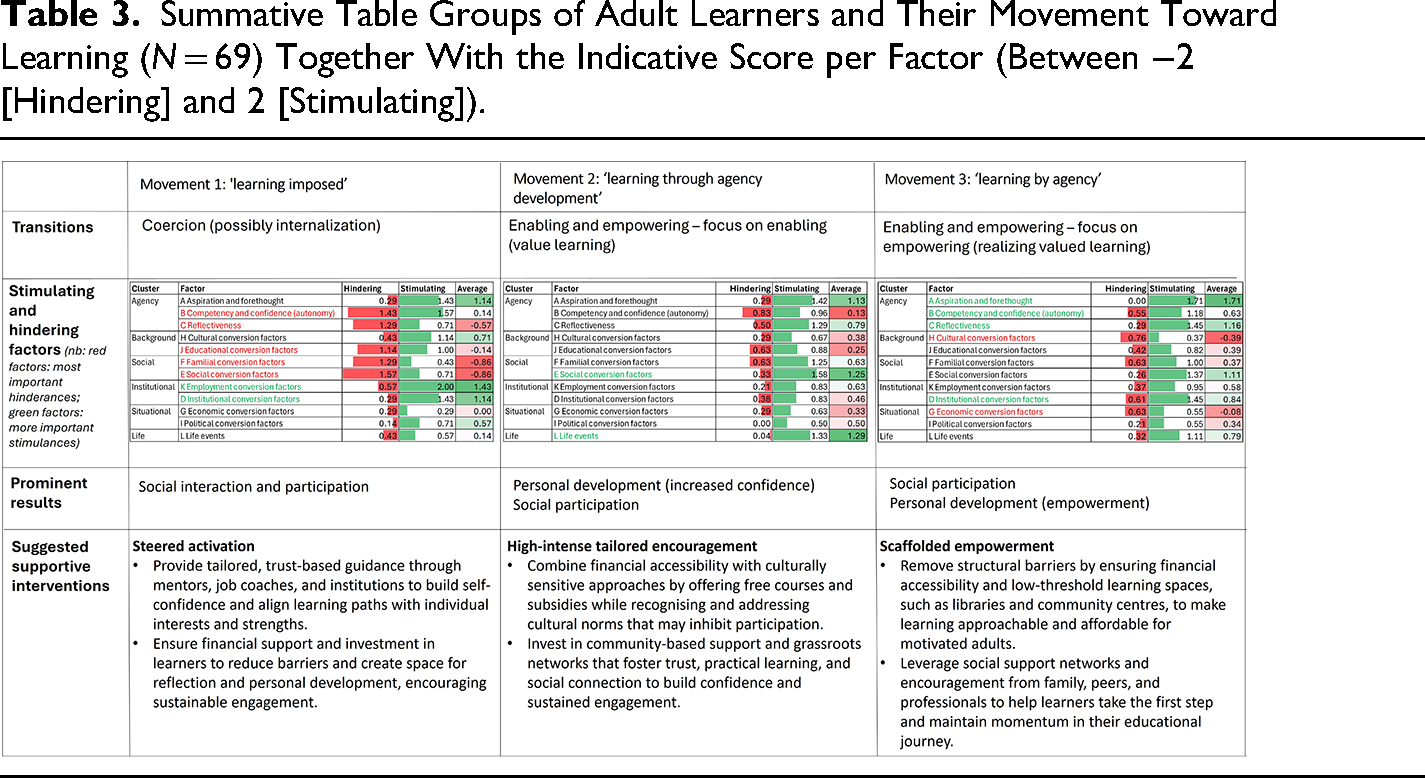

The study identified different movements of adults toward learning. Movement 1 reflects coercion-driven engagement, where individuals are pushed into learning due to external pressures. Movement 2 involves adults who first develop agency and a positive valuation of learning, subsequently removing practical barriers. Movement 3 represents adults with an already developed learning agency who proactively seek learning opportunities. What can be observed is that each movement has its own particular pattern of stimulating and hindering factors. For the first movement the negative emphasis is on the factors close to the person (agency, background, and social environment); for the second movement the positive emphasis is on social and life event triggers; and for the third movement the positive emphasis is mainly on agency factors. This also impacts the suggested supporting interventions, ranging from more steered activation (movement 1) to high-intense tailored encouragement (movement 2) and scaffolded empowerment (movement 3).
In the existing literature there is—to our knowledge—no other classification available that looks at the trajectories of adults. There are however other interesting more static classifications available that can be linked to our more dynamic classification into movements. Discussing these links allows further operationalization of the cluster and potentially increase its applicability for research and policy development. One recent classification looked at attitudes toward adult learning (Kalenda et al., 2024). This study, using cluster analysis of survey data from 1,200 respondents in Czechia, identified four adult learning attitude clusters aligning with the model presented in our research (Figure 1). The first cluster, negative attitudes, low participation, includes adults who neither value nor engage in learning (bottom left corner in our model). The second, positive attitudes, high participation, comprises adults who view learning positively and actively participate (top right corner). The third, public value, low participation, consists of adults who recognize the societal value of learning but do not engage themselves (bottom right corner). Finally, the fourth cluster, obligation, low participation, represents adults who feel pressured to learn but lack intrinsic motivation and rarely participate (top left corner). These clusters highlight the diverse attitudes influencing adult learning participation. While Kalenda et al.'s work highlights the connection between participation and entrenched attitudes, it does not explore how attitudes shape perceptions of learning as a valuable option. Our study provides deeper insights into the dynamics of participation and nonparticipation indicating what factors support making transitions toward learning.
Looking more closely at specific stimulating and hindering factors as found in literature (Broek et al., 2023), the results indicate that some are more prominent than others. A recurring theme in all groups in the interplay between self-agency (or self-directedness) and the hindering/stimulating power of the social environment, consisting of family, friends, community, and institutional/professional support. Especially, the social context proves for all groups an essential hindering or stimulating factor confirming various theoretical perspectives, among others the self-determination theory (Ryan & Deci, 2000), bounded agency theory (Evans et al., 2013), and the capability approach (Boyadjieva & Ilieva-Trichkova, 2021). Another prominent factor is formed by life events triggering learning. Our study demonstrates that specific life events (especially in movement 2) can make learning appear relevant and valuable to adults. These findings suggest that individuals are often motivated to learn when their routines are disrupted, prompting self-reflection and allowing them to envision alternative futures where learning holds significance. Our results, therefore, support Jarvis’ concept of “disjuncture” as a key trigger for learning (Jarvis, 2012). Furthermore, a recurring theme across movements is that organizations and support structures often fail to take the right actions, lack an understanding of the adult's situation, or are unable to genuinely connect with them to effectively initiate the learning process. Although not devaluing “agency” factors and self-directedness, the discussed prominent factors (social environment, life events, organizational support) indicate that for many adults and in many of the movements identified, the activation is triggered by an external context that is impactful in the eyes of the adult. For other adults (especially the third group) however, the individual aspiration and reflection (i.e., self-agency) are key factors to learn. This finding resonates well with other research focusing on adult learners having the intrinsic abilities to pursue higher education programs (Laming et al., 2019).
This study finally aimed to derive policy implications tailored to the needs of various groups, with the goal of enhancing support for adults in similar circumstances. Our grouping of adults based on the transitions they went through opens new routes to explore what type of policy interventions could best support specific groups of adults to start learning. Compared to other research on clustering and grouping adults, our study provides deeper insight into the dynamics of participation and nonparticipation. For instance, while Kalenda and Kočvarová (2022), based on clustering nonparticipating adults, suggest rather shallow practical strategies to promote adult learning, our work offers a more nuanced and tailored perspective on policy implications. There are clear differences in the suggested support systems per group, differing in the prominence of financial support, guidance, exposure to adult learning services, and the role of social support. While adults in movement 3 need interventions to encourage them to start accessible learning opportunities, others need a more forceful steered activation (movement 1), or high intense-tailored encouragement (movement 2) taking into account the manifold (life) challenges these adults face before learning presents itself as something valuable.
Overall, the study found that the social environment is for movements 2 and 3 crucial to engage with learning, even for those adults where the learning is principally self-triggered; even they might need an encouragement from people they value. Given this perspective, this calls for interventions that are more long term and takes into account the social environment of the adults and uses this to build a more conducive, and hence realistic, position for an adult to learn, once he or she sees it as something valuable and hence feasible to pursue. This suggests bringing the social environment into the interventions and facilitating family, friends, neighbors, or more broadly the wider society to look after each other in terms of stimulating learning. This could be fostered through public awareness campaigns, but also by appointing roles of specific community figures that can fulfill a “bridge” function toward learning (IDEA Consult, 2024).
In terms of limitations, the study did not take into account organizational perspectives and how interventions are shaped to support adults. Including these organizational perspectives on what helps people start learning would provide additional insights into how the different groups can best be supported to engage with learning. This information is being gathered as part of the broader research program and will be analyzed in future studies. In addition, with regard to future research, based on the qualitative approach taken and the results obtained, it would be beneficial to further develop a quantitative approach to allow adults (both nonlearners and learners) to be grouped according to the movement they completed or that they would need to complete toward learning. This could test the hypotheses expressed in this article concerning the dominant patterns of stimulating and hindering factors per movement. Further exploration is needed on scaling the card-sorting method, potentially using artificial intelligence to facilitate large-scale (online) data collection. Additionally, linking the dynamic classification of adult learners to other frameworks (among others, Kalenda et al., 2024; Kalenda & Kočvarová, 2022) could enhance its policy relevance, addressing what works for whom. Together, these steps would refine the movement model, estimate group sizes, and combined with stimulating factors, support the development of a monitoring approach to inform tailored policy actions.
Footnotes
ORCID iDs

Funding
The authors disclosed receipt of the following financial support for the research, authorship, and/or publication of this article: The research was funded by the Netherlands Initiative for Education Research (NRO) through grant 40.5.21955.006, project title “Fostering Learning! A development-oriented monitor for more lifelong development (LLD) through improved self-direction.”
Declaration of Conflicting Interests
The authors declared no potential conflicts of interest with respect to the research, authorship, and/or publication of this article.