




Abstract
Digital literacies are critical for adults from migrant and refugee backgrounds as they settle in a new country. However, institutions, leaders, and teachers often feel uncertain about how to teach digital literacies. Using the notions of digital literacy practices and assemblages, this article reports on a qualitative case study and explores how 30 adults from migrant and refugee backgrounds navigated challenging digital literacy practices related to settlement in Australia. This research found that to deal with challenges, the participants brought together different personal, social, material, symbolic, temporal, and spatial resources. However, sometimes the required resources were not available, which constrained the participants’ practices. Some participants were aware of the need to find new solutions but they often did not know how this might be done. In contrast, some participants were reluctant to take a risk. The article concludes with implications for EAL practice by suggesting strengths-based pedagogies for digital literacies.
Keywords
Introduction
In Australia, there has been rapid growth in the use of digital technologies in different domains of life such as workplace, finance, education, healthcare, transport, leisure, and communication. These technologies have become integral to people's lives; however, accessing and unlocking their potential requires digital literacies which we view as “practices of communicating, relating, thinking, and ‘being’ associated with digital media” (Jones & Hafner, 2021, p. 17). Digital literacies are increasingly important for adults from migrant and refugee backgrounds. As people settle in a new country, they need to access essential services and information, participate in learning programs, find a job, establish new connections, join new communities, reconnect with families and networks, and engage in independent English language learning (Andrade & Doolin, 2016; Shariati et al., 2017). These digital literacy practices can be daunting because they require many complex skills, knowledge, understanding, and dispositions in relation to language, technology, and socio-cultural contexts within which they happen (Lankshear et al., 2000).
There are several Australian Government programs that include a focus on digital skills and support migrant and refugee entrants. 1 The Department of Home Affairs is responsible for the Adult Migrant English Program (AMEP) which offers some opportunities for learning digital skills (Department of Home Affairs, 2022a). The Department has been also proactive in identifying and responding to the challenges of emergent digital culture and practices which includes a number of important initiatives such as developing online learning modules AMEPOnline (Department of Home Affairs, 2022b) and supporting the provision of mixed modes of the AMEP delivery during the pandemic (LWA, 2021). There are also programs offered by the federal Department of Education, Skills and Employment that include the development of digital skills (Department of Education, Skills and Employment, 2022a, 2022b). Furthermore, The EAL Framework (State of Victoria, 2018) makes explicit references to digital technologies, digital texts, and digital skills across a number of EAL courses.
While there is some emphasis on the digital technologies, skills, and literacies within federally-funded programs, previous research suggests that institutions, leaders, and teachers in the adult English as an Additional Language (EAL) sector often feel uncertain about how digital literacies can be taught to meet the demands of this complex digital environment (Tour et al., 2021, 2022). This challenge is exacerbated by the very limited research knowledge about digital literacies related to settlement (Bletscher, 2020). Our research project AMEP Digital Literacies Framework and Guide: Supporting Pedagogies for Digital Literacies in the Adult EAL Contexts, funded by the Australian Government Department of Home Affairs, was designed as a response to the need for research in this area. This article reports aspects of our project and explores the following research question: How do adults from migrant and refugee backgrounds navigate different challenges in their digital literacy practices as they settle in Australia?
By exploring this research question, we aim to understand what helped participants successfully navigate challenges and what constrained their success in some circumstances. This knowledge about digital literacy practices associated with settlement can help to advance practices in adult EAL programs.
Literature Review
In recent years, there has been significant research interest in how people from migrant and refugee backgrounds use digital technologies for settlement. Informed by a range of theoretical perspectives, this body of research draws attention to broader issues associated with the use of technology as part of settlement. However, in critically considering the existing literature, we note a lack of research exploring the specificities of digital literacies as meaning-making practices. Previous research has highlighted the essential role digital technologies play in settlement across contexts. There is a strong consensus that digital technologies, especially mobile phones, are crucial for accessing information and news both in new and old homes (Alam & Imran, 2015; Andrade & Doolin, 2016; Borkert et al., 2018; Dekker et al., 2018) as well as facilitating pathways to learning and employment (Alam & Imran, 2015; Bletscher, 2020). Another significant theme in the literature is maintaining strong connections with ethnic diasporas in a new country, friends, and family transnationally (Bletscher, 2020; Borkert et al., 2018; Donà & Godin, 2019; Netto et al., 2022). Some scholars have also drawn attention to the important role of digital technologies for enhancing wellbeing and sustaining a sense of belonging (Donà & Godin, 2019; Netto et al., 2022).
Much research has pointed to the challenges that people from refugee backgrounds experience. One of them is the issue of access. Researchers have noted a persistent digital divide that includes demographic variables such as age, income, employment status, education levels, gender, English language proficiency level, and country of origin (Alam & Imran, 2015; Bletscher, 2020; Donà & Godin, 2019). Other issues include limited capacity to identify mis-/disinformation online (Bletscher, 2020; Borkert et al., 2018); the shortage of digital skills (Alam & Imran, 2015); complexity of online systems (Bletscher, 2020); language and literacy barriers (Alam & Imran, 2015; Bletscher, 2020); and personal willingness to use technologies (Alam & Imran, 2015). This literature has tended to focus on the enduring challenges of migration.
However, a growing body of literature has taken a strengths-based perspective positioning adult from refugee backgrounds as active agents rather than passive victims who struggle to cope (Andrade & Doolin, 2016; Borkert et al., 2018; Dekker et al., 2018; Duran, 2017; Netto et al., 2022; Vollmer, 2017). Drawing on a literacy perspective, Duran (2017) and Vollmer (2017) reported that adult refugees actively sought for different learning opportunities in their digital literacy practices. Andrade and Doolin (2016) found that participants used technologies to exercise their agency, develop relevant capabilities and, thus, improve their sense of well-being and experience of social inclusion. In the face of challenging circumstances refugees have been shown to work together to develop complex problem-solving strategies. For example, Borkert et al. (2018) noted a high level of awareness about misleading information online amongst the participants which encouraged them to seek help with searching legitimate information. Dekker et al. (2018) found that refugees developed a range of strategies to successfully maintain access to digital resources, avoid government surveillance and validate information on social media. Bletscher (2020) reported a high level of independence amongst some adult participants from migrant and refugee backgrounds as they navigated different challenges with digital technologies, although, as reported, some of the strategies were not always sustainable (e.g., throwing a broken phone away).
In sum, the literature showcased the complexity of experiences in using digital devices by people from migrant and refugee backgrounds, illuminating the need for suitable and responsive learning programs that draw on adult learners’ strengths and empower them. To support the development of such programs there is a need for detailed research into people's existing experiences as they navigate the digital landscape. Coming from different cultural, linguistic, and educational backgrounds, having rich pre-migration histories and resiliently settling in a new country, people are likely to engage in digital literacy practices and navigate emerging challenges in unique and idiosyncratic ways. These detailed insights are currently missing in the field.
Conceptual Framework
The digital literacy practices of people from migrant and refugee backgrounds are complex phenomena. Thus, we have adopted two conceptual lenses: a socio-cultural theory of literacy (and digital literacies) and assemblage theory.
Digital Literacies: A Socio-Cultural Perspective
The notion of digital literacy practices is central to this research as it offers a way to conceptualize how people engage with digital technologies. The notion points to the relationship between practices and the social structures in which they happen. This concept originates from a socio-cultural theory of literacy offered by Literacy Studies (Barton & Hamilton, 2000; Gee, 2015; Street, 2009) – the field which arises and incorporates at the same time many perspectives from work by Vygostky, Leont’ev, Bakhtin, and some others scholars emphasizing the importance of the “social”. Within this theory, literacy (including digital literacy) is understood as a set of meaning-making practices that are situated in the domains of life. As different domains reflect particular socio-cultural norms and expectations, they require diverse forms of literacy and modes of expression. Hence, the term “literacy” should be understood in the plural sense rather than being singular and universal (Barton & Hamilton, 2000). Furthermore, the theory also brings attention to the different modalities involved in meaning-making afforded by digital technologies (Kalantzis et al., 2016). Accordingly, digital literacy practices are defined as “culturally and socially shaped ways of using, producing, and understanding information in multiple formats from a range of sources when it is presented via the electronic screens of digital technologies” (Snyder, 2009, p. 143). These are diverse and dynamic, rather than static, because of shifts in society, technologies, and expectations within discourse communities (Gee, 2015).
Importantly, sociocultural studies of literacy emphasize that “literacy is something one actively does [emphasis in the original], in concert with other humans (who may or may not be physically present) and the material, social, and symbolic world” (Bartlett, 2007, p. 53). Thus, literacy practices involve multiple constituent elements related to who reads/writes, in what context, and for what purpose (Barton & Hamilton, 2000; Hamilton, 2000). In this research, we were especially interested in the different constituents or resources that people from migrant and refugee backgrounds bring to their digital literacy practices. Furthermore, in conceptualizing literacy as a process, it was also important to understand what they do with these resources and how they employ them strategically for problem-solving in their digital literacy practices. This focus helps to identify what enables and constrains digital literacy practices in new socio-cultural, linguistic, and technical environments. While the field of Literacy Studies draws attention to the different resources that might be present in everyday practices, gaining insights into the ways that participants use resources to meet their literacy needs requires an additional conceptual tool. The notion of an assemblage seemed to be particularly useful for exploring how different resources are mobilized (or not) within situated digital literacy practices.
Assemblages
While we were not able to identify any research about digital literacies using the notion of an assemblage, assemblage theory has been widely used across the social sciences to generate new ways of thinking about the complex, contested and interwoven nature of social reality (Buchanan, 2015).
The idea of an assemblage was first developed in the early 1950s in art theory to refer to an artistic process, where a composition is made by combining objects and ideas together into a novel and sometimes ground-breaking whole that pushes conventions (Rizvi & Lingard, 2011). In recent social theory, the concept of assemblage, as conceived by Deleuze and Guattari (1987), has received much attention due to its potential for disrupting binary relations between structures and categories in society and human agency, and conceiving of the necessary interrelationality of all parts that make up human engagement with the world. An assemblage is formed through an “arrangement [that] connects certain multiplicities” (Deleuze & Guattari, 1987, p. 25). The arrangement of multiple parts is brought together through the desire to make sense of the world and form meaningful connections (rhizomes) that are directed to a personal goal or desire. A rhizome is a metaphor drawn from the notion of the complex interconnections of roots and shoots of a tree (Robinson & Maguire, 2010).
Sometimes this desire is about resisting paradigms (be they forms of thinking, categories of distinction, authorized practices or established structures) and finding ways (lines of flight) out of conventional notions of being through force of agency and creative action. Assemblages reshape through lines of flight and are thus always moving toward new possibilities (Guattari, 2015). The forming of an assemblage is therefore contingent on human agency and forms only as agency is shown in action.
In extending the theoretical development of assemblage, new materialist scholars have focused on how assemblage theory can be helpful in breaking through the dominant binary structures between human/non-human and animate/inanimate. It enables a conception of agency that adds the agency of the material to human action or what Bennet (2010) called the material agency of assemblages. For example, the tools humans use to create and produce as well as the spaces in which they live affect the ways that humans are able to interact with the world. This new material perspective is important in understanding the place of digital technologies, and other material objects, in the assembling of resources. Thus, an assemblage has both human and technological features, and such material features both afford and constrain human action.
Together with digital literacy practices, we have utilized the notion of an assemblage as a conceptual frame because it helps us account for the multiplicities that emerge as our participants engage in digital literacy practices in a new country. The forming and reforming of purposeful assemblages through rhizomatic connections might be conceived as a way to find solutions to issues with technologies. An assemblage, thus, becomes the totality of resources that a person brings to a problem. Assemblages may not always solve problems, so a new line of flight leads to the re-forming of an assemblage.
Research Design
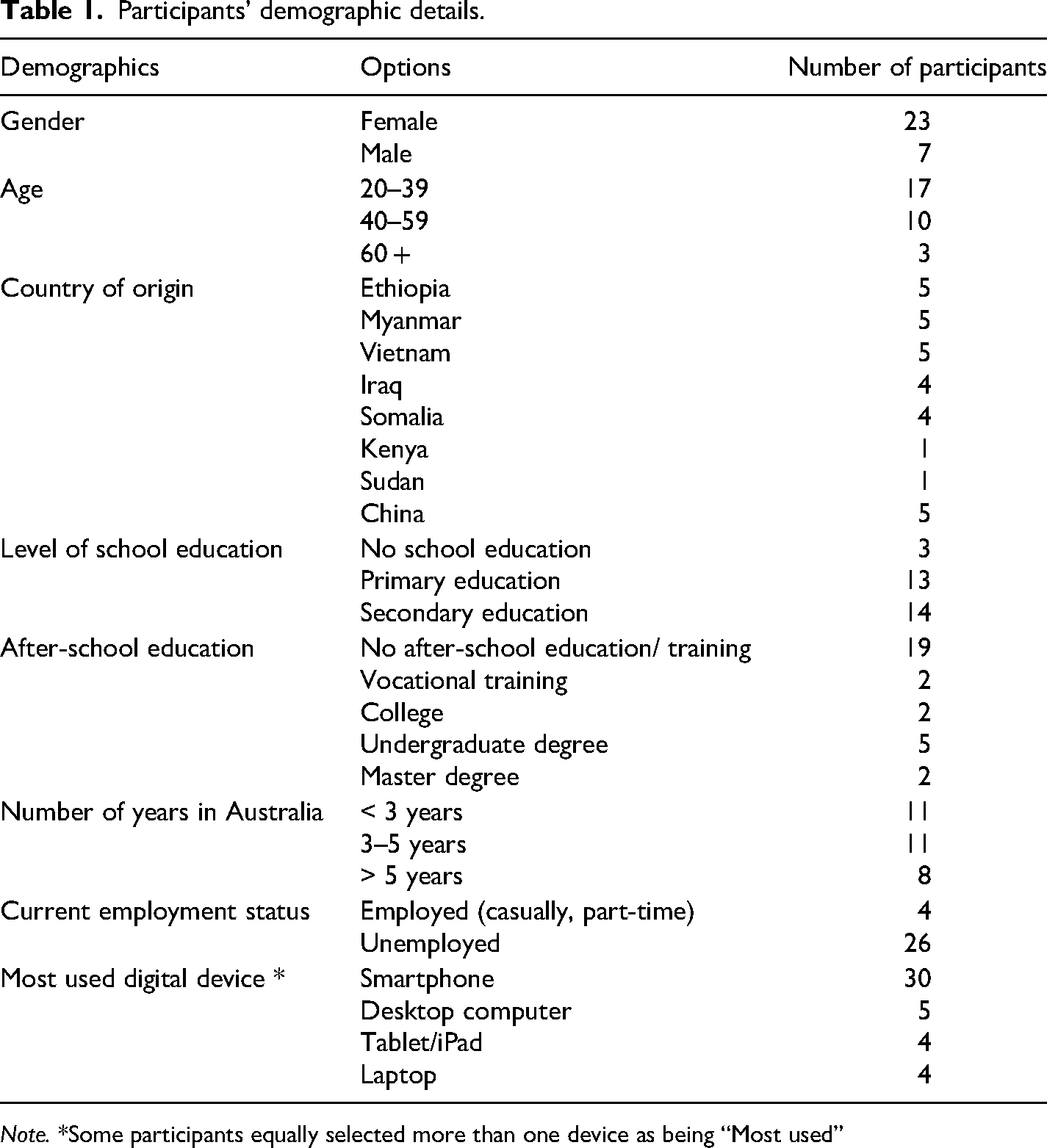
To offer in-depth insights into everyday digital literacy practices of research participants, we used a case study approach. A group of 30 adults enrolled in an Adult Migrant English Program (AMEP) and six EAL teachers working with them was considered a case – a discrete system bounded by time and place (Hamilton & Corbett-Whittier, 2013). The participants were recruited through two AMEP providers located in metropolitan Melbourne. According to their course enrolment statuses, their EAL proficiency ranged from pre-literate (Course in Initial EAL) to consolidating EAL skills to access vocational programs (Certificate III in EAL (Access)). In this article, we only draw on learners’ data to present findings. The demographic details of the participating learners are presented in Table 1.
Participants’ demographic details.
Note. *Some participants equally selected more than one device as being “Most used”
Due to Covid-19 restrictions in Melbourne at the time of conducting the project, all data was collected online using Zoom. Research assistants speaking Mandarin, Burmese, Vietnamese, Arabic were recruited to collect data in home languages. The participants from Oromo and Somali groups were interviewed with the assistance of certified translators. The data was then transcribed and translated into English by the recruited research assistants and transcription/translation services. There were two research methods in this study:
Demographic questionnaire. The participating learners completed a demographic questionnaire (Axinn et al., 2011) which collected information about their life in a home country, levels of education, employment experience, migration histories, settlement details and access to digital technologies (Table 1). The completion of the demographic questionnaire, translated into home languages, was done orally at the beginning of the zoom session: the research team member shared the screen with the participant, asked the questions and recorded the responses. Semi-structured interviews. Upon completion of the survey, the learner-participants took part in one individual 30-min semi-structured interview inviting them to share their experiences in relation to four broad themes: (1) favorite experiences with technology; (2) most challenging experiences with technology; (3) technology for settlement and work in Australia; and (4) learning about/with technology. Within each theme, the participants were prompted with a number of open-ended questions intended to reveal details of the practices.
The data was analyzed thematically drawing on Brooks’ (2015) approach to coding and identifying themes. Using a priori codes drawn from the conceptual framework (such as digital literacy practices, assemblages, resources, and lines of flight), the researchers coded the data separately before comparing their results. A deductive approach to coding enabled both efficient and targeted identification of the features of how participants navigated their digital worlds. This was important for selecting examples for analysis to answer the research question. Selected participant data reflecting this coding practice was analyzed discursively in the findings section. Each lens of the conceptual framework is employed where it can best serve the analysis to understand the phenomenon of digital literacy practices, their resources and purposeful assemblages.
Findings
Reflecting on their experiences of moving to Australia, the participants noted the extensive digitalization of most aspects of life. Nafisa 2 said: “[E]verything in the country [Australia] has been linked to technology… You cannot work or do things without technology”. The participants reported that on a daily basis they had to engage in many digital literacy practices to organize and manage their lives. Those practices were related to house management, shopping, using public transport, accessing healthcare, and other government services, managing finances, participating in English language classes, engaging with schools and childcare centers, doing work and seeking employment, maintaining social and familial relationships, and pursuing hobbies and interests. All participants reported that they faced different difficulties in their practices arising from language barriers, technical issues, and unfamiliarity with socio-cultural contexts.
Nevertheless, the participants sought solutions to deal with these challenges. As we discuss in the sections below, the participants brought different resources and used them to construct assemblages to resolve issues. In some instances, a single assemblage was formed and this helped the participants to accomplish their practices making them feel satisfied with the outcome. However, some participants, driven by the line of flight or a desire to find new ways of doing things, sought opportunities to re-form their assemblages into new ones and these multiple assemblages provided rich learning opportunities leading to the participants’ autonomy in digital literacy practices. In some circumstances, however, certain resources for their assemblages were not available and this constrained the participants’ practices. Some participants were aware of the need to reform their assemblages but they often did not see clearly how this might be done. In contrast, a number of participants were reluctant to take a line of flight towards a new assemblage and felt stuck in their practices.
Single Assemblages to Get Things Done
The data analysis suggested that the participants often formed an assemblage of different resources and it was an efficient way to deal with different challenges in their practices. For example, one of the participants, Phan, recalled how he wanted to buy a McDonald's meal using the phone app: As I use McDonald's app and I want to buy a Big Mac for five dollars, so I need to type or locate such information in the app, right? But I don’t know how to do it, mainly because I don’t know English and then I do everything wrong. So what I usually do is to give my smartphone to staff and ask them for help.
To make an online order, Phan strategically used a number of personal, material, social, and spatial resources: a smartphone, the McDonald's app, his haptic skills to access the app, concept of McDonald's, its space and menu, conversational oral English, and the McDonald's staff member. All these resources came together as an assemblage built on the rhizomatic connections between resources (Figure 1) which helped Phan to accomplish the digital literacy practice and resolve the digital purchasing issue.
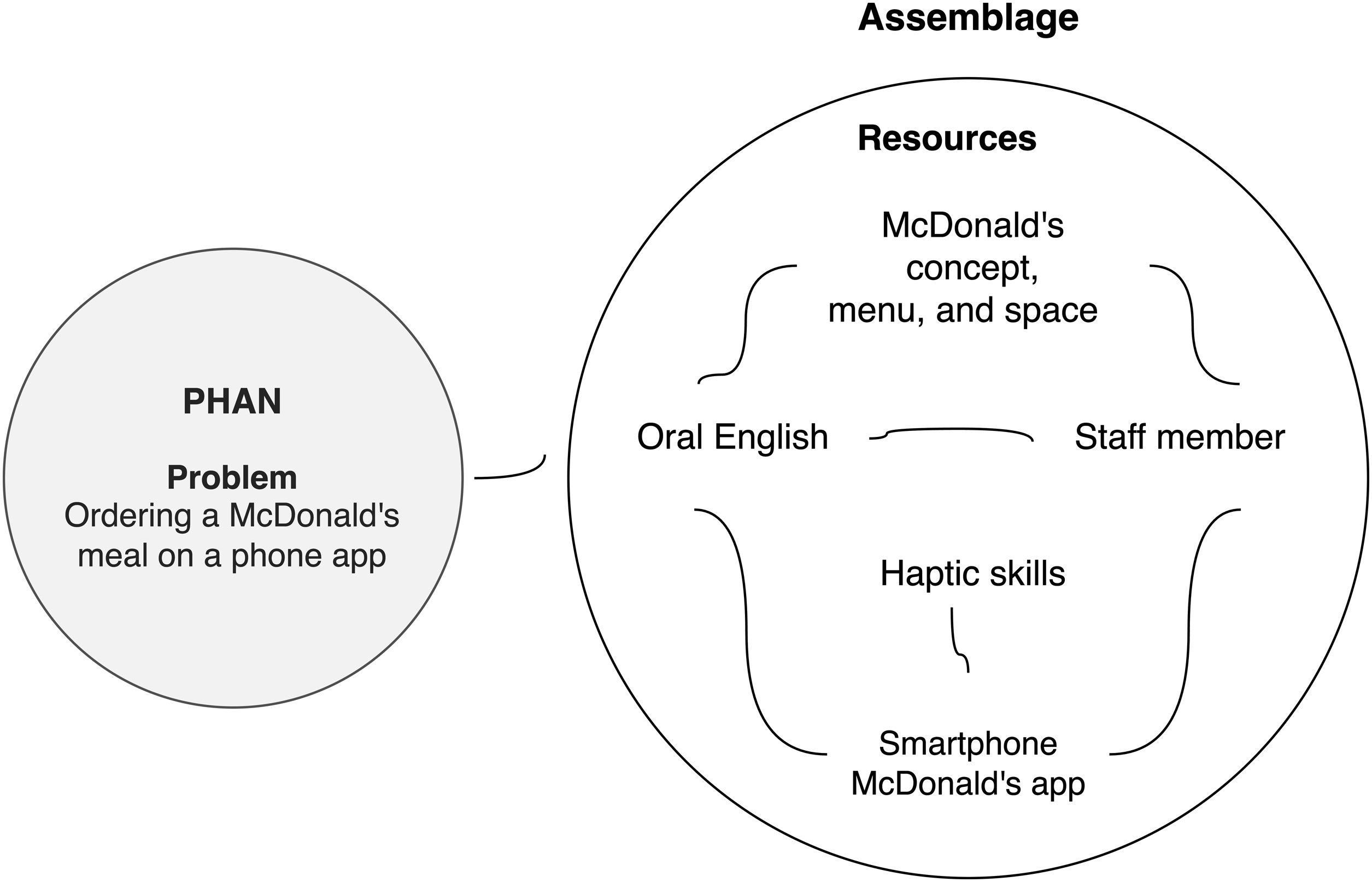
Phan's assemblage.
Similar experiences were observed amongst other participants who mobilized a number of resources to navigate challenging digital literacy practices. For example, they often sought assistance from family members, friends and personnel to pay bills online, use banking apps, access government services platforms and navigate self-service devices in public places. Clearly, the participants understood the level of assistance needed and, as part of their assemblages, they leveraged other people as a valuable resource to solve difficulties with digital practices.
Multiple Assemblages to Learn
While single assemblages formed by the participants helped them to get things done, data analysis revealed that some practices were supported by multiple assemblages and those had a long-term effect on digital literacy practices. For example, Minh reported frequent digital literacy practices associated with online banking on her mobile phone. However, to navigate banking systems on the phone, she often used her desktop computer at the same time to access Google translate: I created the bank account by using my phone [but] using Google Translate on my phone was not easy because I needed to move from one site to another. So I have the habit of working on a desktop [at the same time]… For example, if I want to use or check something, I can use translation.
Minh's initial assemblage (Figure 2) for using the banking app consisted of several personal and material resources: a smartphone, a banking app, haptic skills, knowledge of banking practices, and some English. However, when she faced some language barriers, she took a line of flight towards a new assemblage which moved away from the usual singular way of working with a banking app. The new assemblage included additional material resources woven into an existing rhizome: a desktop computer with its accessories (e.g., mouse) and Google translate. It also included new personal resources such as her home language and desktop computer knowledge and skills as well as temporal resources – time (simultaneous use of technologies). In her situated problem-solving, Minh assembled a range of new resources through her desire for success and re-formed an existing assemblage into a new one to learn and progress in her practice. Demonstrating her learning through this experience, she seemed to be comfortable with using online banking independently which is significant given the importance of privacy in banking practices.
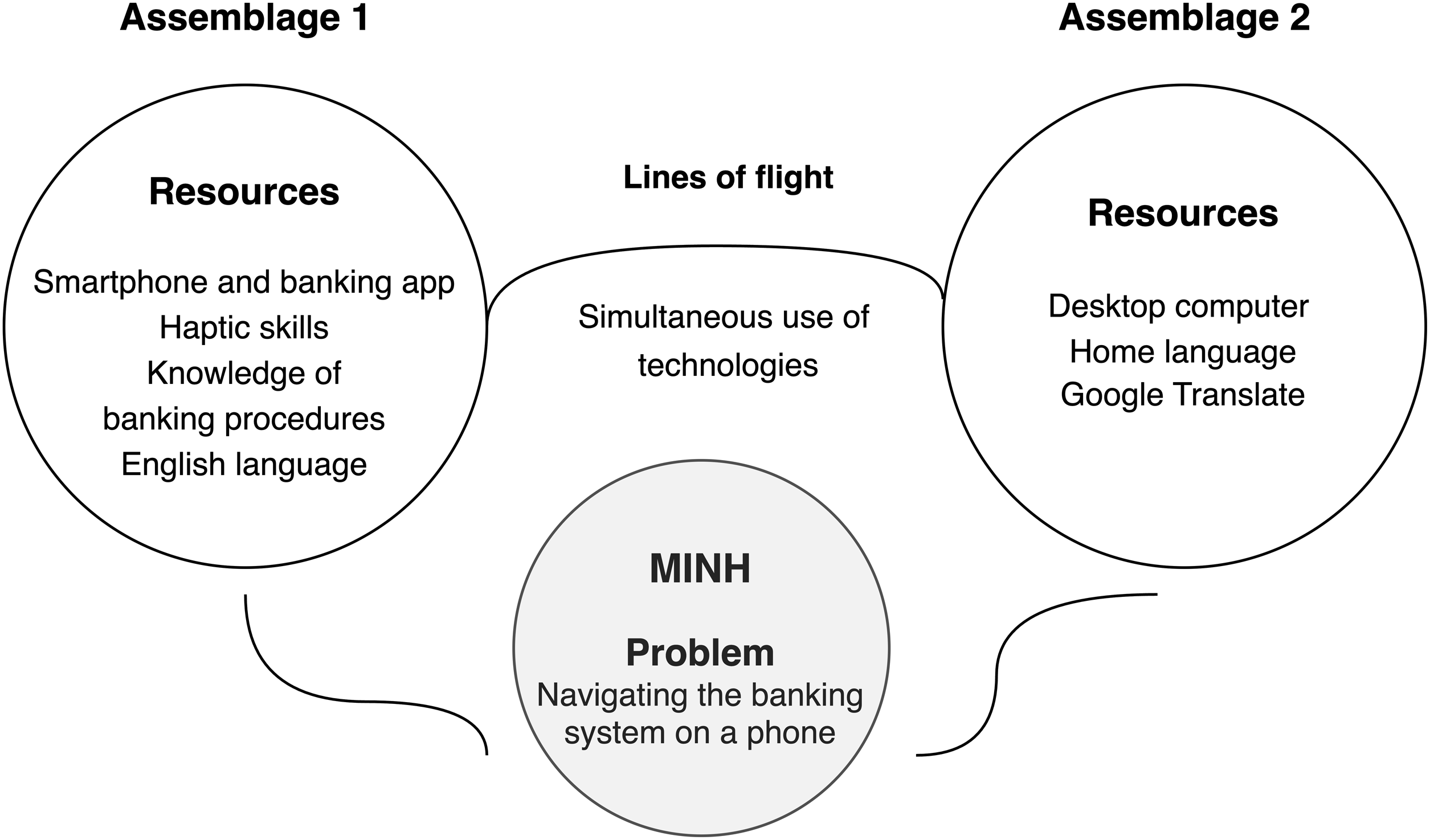
Minh's assemblages.
Several other participants used a similar strategy, although they identified other digital resources such as Google, online dictionaries, dictionary apps, and Youtube. The participants were fluidly moving between different devices and applications as part of their digital literacy practices. These resources (e.g., other devices, Google, Google translate, online dictionaries, dictionary apps, and Youtube) were assisting with multidimensional aspects of their practices. For instance, the use of translation tools was especially useful for overcoming language barriers while the use of Youtube and Google often helped with technical or operational challenges (e.g., video tutorials or step-by-step instructions for changing settings on the device).
Nafisa took a similar approach when using a self-service checkout in the supermarket but her experience was more complex as it was scaffolded by several of assemblages unfolding across time and space: I can remember an embarrassing situation in relation to shopping that I came across during the early days of my arrival to Australia. I was trying to use a self-service machine and I looked at people and did the same…The machine did not beep when I scanned items and I didn’t know how to deal with it. Eventually, I realized that the machine was not working! [laughing]… Luckily, the person in charge came [a check-out assistant] and turned on the machine for me…The next day I came with a friend to the same shopping center and she showed me how to use that machine. So I managed to use that machine from that day.
Nasifa's initial assemblage consisted of three resources: material (a self-service device), personal (her knowledge of shopping practices (e.g., need to scan the item)) and symbolic (her attempt to perform a scanning procedure repeating the physical actions of other people at the self-checkout). When these attempts did not work she took a new line of flight towards social resources using body language to attract the attention of the checkout assistant who, in turn, became another strategic resource in her new assemblage. This worked temporally but did not satisfy her desire to be independent in this practice longer term.
She persisted with this digital literacy practice on another occasion. As part of this new assemblage, Nafisa again used another social resource in her digital literacy practice (her friend) but this time it was further strengthened by friendship as an additional social resource to model and explain the digital practice. Furthermore, Nafisa deliberately brought into her assemblage a temporal resource such as time (“the next day”) and a spatial resource (the physical space of the supermarket) which made the practice authentic and thus, meaningful. As Nafisa and her friend both spoke Arabic, her home language became another personal resource central to her assemblage alongside English used in the self-service device. This complex combination of resources that Nafisa used is illustrated in Figure 3 below:
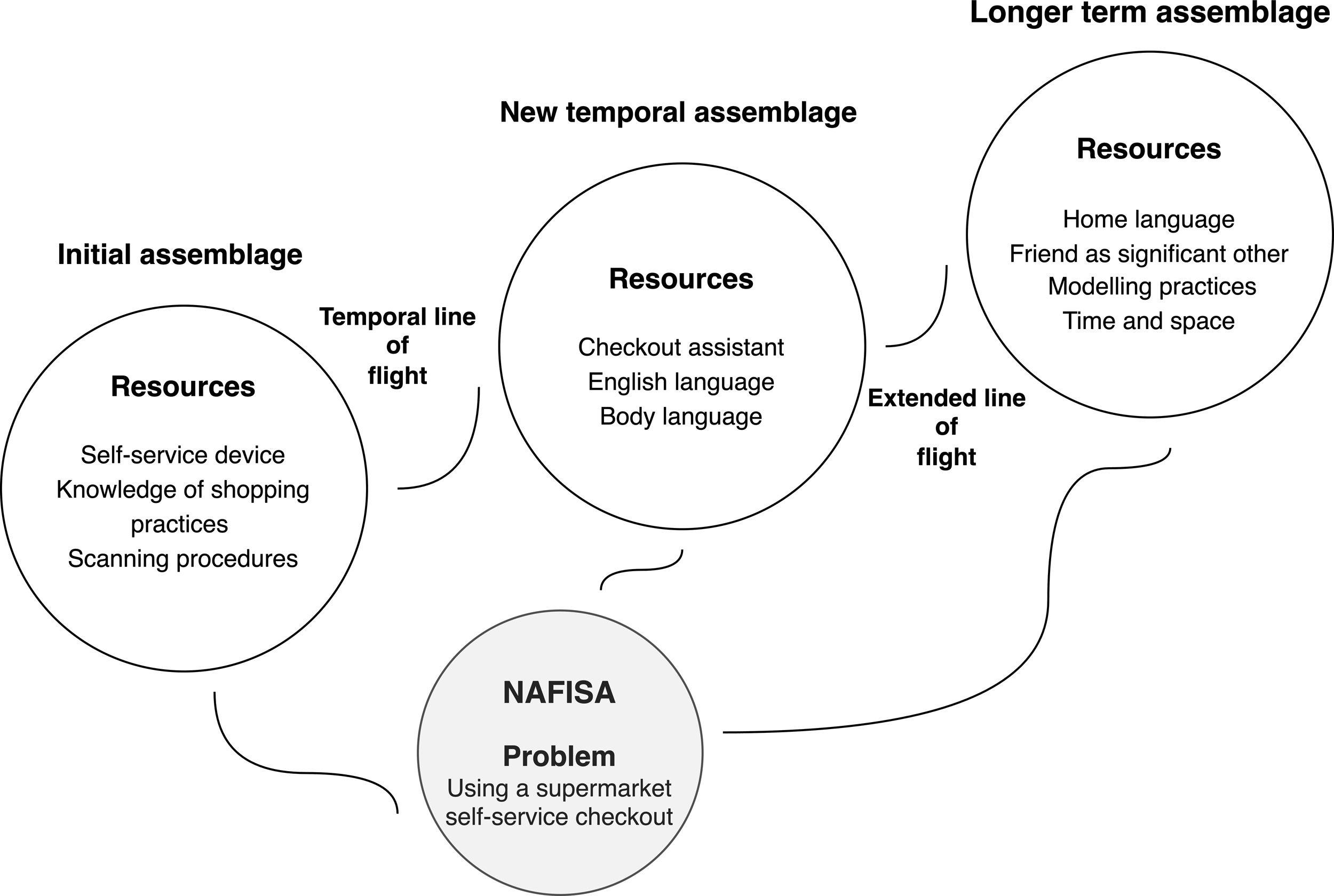
Nafisa's assemblages.
Reconfiguring her assemblages and forming a new one helped Nafisa to accomplish the digital practice but her line of flight to re-constructing an assemblage also led to learning. She was drawing upon productive and effective resources demonstrating the strength of self-awareness: a sense of reflexivity about her own learning and what she needed to do to become independent in this digital literacy practice central to everyday life.
Constraints Within Assemblages
As discussed above, some assemblages were highly effective, and participants reported solving problems and moving on with their lives, with developing digital literacies. There was a sense that they were successfully adjusting to new circumstances. In some instances, however, the sense of struggle was more evident. For instance, Nafisa described her frustration with an automated teller machine (ATM) while Minh talked about being unable to create a MyGov
3
account: … I am not familiar with using [ATM]. Nobody has taught me how to use it. It is not very common back home in Sudan. I feel it [is] very difficult to use for us Sudanese… I find this machine complex. I remember once I myself used it one time but I found it difficult and I didn’t know how to use it so I quit it and I didn’t use it again… Maybe if someone has shown me how to use it [ATM], I will be able to use it. (Nafisa)
I tried to create a MyGov account on my desktop and smartphone but I couldn’t move to the second step. So, it has been difficult for me and I am waiting to see if I can ask anyone…I haven’t [asked yet] because we are under the lockdown 4 … So yesterday, I thought I could do it but I was still unable to do it (laughing)…I need to try my best and find a way to use technology in English. (Minh)
While the participants brought a number of useful resources to form assemblages such as digital devices, some English, technical skills, some understanding of banking practices, and knowledge of how to create an online account, these were insufficient to resolve particular issues. The participants were well aware of what would be useful for an effective assemblage. Both Nafisa and Minh referred to other people as a potential resource that would assist their digital literacy practices. However, due to lockdowns in 2021, they could not involve other people in their practices. Indeed, all the participants in this study often experienced moments when they did not have the resources they needed within their assemblages to successfully deal with challenges. However, interestingly, Nafisa and Minh did recognize the need for new solutions and re-forming assemblages when being stuck. Minh's use of “I need to try my best and find a way to use technology in English” is especially illustrative of her desire to take a line of flight although she did not have a clear plan on how to do it.
Similarly, another participant, Ayad, said: “The one who will help you today, he may not be available tomorrow…Of course, you need to help yourself”. In this quote, Ayad emphasized a need to re-think the existing assemblages that he deployed and find alternative ways to engage in practices. He demonstrated the strength of self-awareness and engaged in reflexivity about resources within his assemblages. The data suggests that while some participants were aware of the need for new solutions and new lines of flight to work through practical challenges, they did not usually see clearly what other resources they could use to re-from their existing assemblage to support practices.
In contrast, some participants did not seem to consider a new line of flight to break out of the ineffective assemblage. For example, Rita reflected on her challenges with changing some settings on her mobile phone: I cannot do anything. Before the lockdown, I ask those who lived here longer and have understanding and they fix for me. But now due to Corona [Covid-19] lockdown I cannot do anything. I just do nothing. (Rita)
Rita's preferred sources were not available. Clearly, she needed a line of flight to another assemblage, but she was stuck in transacting this. Rita's repeated use of “I cannot do anything” and “I just do nothing” suggests that she did not try to develop a vision of what else could be done. Clearly, in constructing effective assemblages to resolve issues, Rita needed new resources, beyond those that she typically relied on.
Discussion
In this article, we explored how adults from migrant and refugee backgrounds navigated different challenges in their digital literacy practices and what led to success. Reflecting previous research (Alam & Imran, 2015; Bletscher, 2020; Borkert et al., 2018), our study found that the participants engaged in a wide range of digital literacy practices as they were establishing new lives in Australia. They were willing to develop their digital literacies but they also found engaging in digital literacy practices very challenging in a new sociocultural, technological, and linguistic landscape.
Their digital literacy practices required constant problem-solving. Thus, the participants actively employed and, importantly, wove together different resources to establish strategic assemblages to enable effective digital literacy practices to meet their needs. Some continuously identified and employed new resources if the old assemblage did not work. As was noted in the literature review, the digital literacy practices of adults from migrant and refugee backgrounds have not been the subject of much research. Nor are there many studies that examine these digital literacy practices in situ, considering the uniqueness of these experiences in a new setting. Employing the concept of assemblage, we offer insights into the digital literacy practices of people from migrant and refugee backgrounds to illuminate the importance of different resources and their unique interplay. These resources that become part of assemblages for situated problem-solving might include:
The combination and interplay of the resources within assemblages was often dependent on the unique circumstances of participants and the aspects of practices they struggled with particular moments. Extending understanding of literacy practices offered by literacy scholars (Barton & Hamilton, 2000; Hamilton, 2000), these findings provide further insights into the digital literacy practices of the participants from migrant and refugee backgrounds. In particular, we point out to the important role that such resources (and the assemblages they form) play in digital literacy practices of this group of participants. Rhizomatic connections between the resources with the assemblages scaffold the practices. Without them, meaningful digital literacy practices in a new socio-cultural and digital environment may not be possible.
Some participants constructed multiple assemblages that were continuously unfolding and reconfiguring from new lines of flight. They were changing across time and space with new resources. Such assemblages generated active learning about digital literacies and led to more autonomy in practices. Recently, research in the field has attempted to understand refugees’ learning with and about digital technologies (Netto et al., 2022; Shariati et al., 2017). Contributing to this body of research, our findings highlight the formative role of such assemblages in developing digital literacies and, importantly, the line of flight which drives them. For example, Nafisa reported full autonomy with the use of a self-service check-out device after creating multiple purposeful assemblages to solve her problem, while Phan was likely to ask someone to buy him a meal online again. In contrast, Rita felt stuck and unable to move in her practice. This finding is significant because it suggests that for people from migrant and refugee backgrounds who usually face numerous technical, linguistic, socio-cultural, and critical challenges in their digital literacy practices, risk-taking (e.g., taking lines of flight) and construction of multiple purposeful assemblages needs to become a conscious process and a way of thinking.
As illustrated in this research, in some circumstances the resources required to support participants’ digital literacy practices were not available which became especially evident during the Covid-19 pandemic and associated restrictions. As the participants often relied on their personal networks, lack of human connection caused by the pandemic constrained learning for many. While some participants recognized a need to re-think initial assemblages and engage in new lines of flight, they did not always know what other resources and possibilities were available. Borkert et al. (2018) found that people from refugee backgrounds had good levels of awareness about their digital issues. However, Bletscher (2020) argued that their practical strategies to address these issues are not always sustainable. Building on these findings, our research suggests that having awareness is useful but insufficient. There is a need for a rich repository of personal, social, material, symbolic, temporal, and spatial resources for assemblages and people from migrant and refugee backgrounds may need targeted help with extending their repository of resources and building their assemblages.
Amongst the participants, there was a determination to engage in digital literacy practices required for settlement. Whether they constructed single or multiple assemblages to support their digital literacy practices, they did this in active, interrogative, and thoughtful ways, coming up with effective and sometimes unique combinations of resources within their assemblages. This finding draws attention to the participants’ agency echoing the findings by Dekker et al. (2018), who characterized their participants as “smart refugees” (p. 9) for being able to develop “smart strategies” of migration. Previous research has emphasized the need to direct more attention to the strengths of people from migrant and refugee backgrounds (Bletscher, 2020; Dekker et al., 2018; Netto et al., 2022). Our findings support this conclusion.
While Andrade and Doolin (2016) argued that people from refugee backgrounds use technologies to exercise their agency, our study noted that agency helped the participants to solve problems. However, exercising it to re-form new assemblages was not ongoing for everyone. Thus, we argue that people from migrant and refugee backgrounds need an ongoing sense of agency to engage in digital literacy practices which, for this group, by default require constant problem-solving and risk-taking. An ongoing sense of agency may help them face “failures” in a more productive way and persevere in a challenging practice. Our research also points to the need to further empower those who, like Rita, are hesitant to take lines of flight or, in other words, take risks in their practices.
Implications and Conclusion
In this article, we have focused on digital literacy practices of adults from migrant and refugee backgrounds. Although there are some limitations of this research such as participants’ self-selection to participate in the study, their self-reported practices, the constraints in data collection due to Covid-19 restrictions, and the accuracy of translation, the findings reported in this article have useful implications for practice in adult EAL programs. Previous research recognized that learning programs should “go beyond pushing buttons” (Peromingo & Pieterson, 2018, p. 33) if they aim to empower adult EAL learners but what exactly this might entail was not explored. We argue that the notion of assemblage in this research seems to be particularly useful in examining the available resources, personal strategies and practicalities of enacting digital literacies. It offers a strengths-based approach to teaching digital literacies which can help adult learners become more agentic, independent and confident in their digital literacy practices by including considerations of (1) resourcefulness, (2) problem-solving, and (3) agency. While, in recent years, research literature emphasized the importance of recognizing refugees’ strengths in literacy and EAL education (e.g., Choi & Najar, 2017), our study specifies what a strengths-based approach to teaching digital literacies entails.
Strengths-based teaching needs to pay more attention to the resources and assemblages that support and constrain adult learners’ digital literacy practices. Engaging in dialogue with learners might be a useful starting point to understand what resources learners already use in their practices and identify those that are hardly considered by them. Using this knowledge, educators can introduce new resources and help learners develop a richer repository of resources. The examples of resources documented in this study (e.g., personal, social, material, symbolic, temporal and spatial) can be used to guide educators’ exploration.
A strengths-based approach to digital literacies suggests that when teaching digital literacies, it would be more useful to move away from (or at least add to) the typical skills-focused training to problem-solving strategies. It further unpacks how teaching problem-solving might look in practice. Learners would benefit from learning how to problem solve with digital technologies (e.g., construct effective assemblages and engage in thinking about new lines of flight) and what resources within their assemblages can be useful when they face technical, linguistic, socio-cultural, and critical challenges in their digital literacy practices. Asking critical questions such as “what is possible?” and “what else can be done?” can be useful for engaging learners in problem-solving. Problem-solving in a supportive classroom environment is less threatening which may help adult learners to be more open to risk-taking when experimenting with different resources within their assemblages. No learning program or course can teach everything that people may require in the course of their lives. These digital needs also continue to change at different stages of life and across a range of contexts. From this perspective, problem-solving needs to become central to digital literacies pedagogies.
The learners would also benefit from learning how to re-form existing assemblages into new ones – in a way that Nafisa approached a self-service machine in the supermarket. It is important to encourage learners not to rely on a routine combination of resources or be discouraged by failures but be prepared to continuously re-think and re-work their assemblages through new lines of flight. Another important focus here is learning to construct assemblages that support greater independence in digital literacy practices. This brings attention to the importance of learners’ agency and the need to further support its development in classrooms – another dimension of strengths-based pedagogies for digital literacies.
Our research offered detailed insights into how these the participants dealt with different challenges in their digital literacy practices revealing an important role of lines of flight for problem-solving and ongoing agency. Pedagogies for digital literacies adult EAL settings need to consider and capitalize on these practices while at the same time extending adults learners’ repertoires of resources, capacities to problem-solve and empowerment.
Footnotes
Acknowledgements
The Monash University research project team would like to thank the Department of Home Affairs, LWA, the AMEP teachers and learners who contributed to the research project reported in this article.
Declaration of Conflicting Interests
The author(s) declared no potential conflicts of interest with respect to the research, authorship, and/or publication of this article.
Funding
The author(s) disclosed receipt of the following financial support for the research, authorship, and/or publication of this article: This work was supported by The Australian Government Department of Home Affairs.
