



Abstract
Language skills are central to refugee integration and the availability of language courses could thus be a limiting factor. We explore how the most important provider of language courses in Germany, adult education centers (VHS), adapted their course supply to the refugee wave of 2015/2016. Our results highlight two channels through which the local environment can affect opportunities for participation in adult learning: First, exploiting the quasi-random allocation of refugees to counties, we causally estimate by how much VHS scaled up their German language course (DAF) supply as a reaction. Moreover, we show that DAF courses were created almost exclusively at the cost of other courses, that is, by crowding out. Second, we uncover heterogeneities in scaling success. VHS with more prior DAF course experience and larger VHS adapted better, which shows the relevance of initial conditions in course offers.
Introduction
In 2015 and 2016, over 1.1 million refugees applied for asylum in Germany (BAMF, 2020, p. 15). Most of them came from Syria, Iraq, and Afghanistan (BAMF, 2020, p. 23) where they fled armed conflicts and persecution. The large majority of them were granted protection, offering the opportunity for these persons to stay in Germany for a long time with many of them eventually becoming permanent members of society. Therefore, it is important to foster their integration into the host society. One of the most important success factors for economic and social integration is mastering the language of the new home country (e.g., Adamuti-Trache, 2013; Aldashev et al., 2009; Hochman & Davidov, 2014).
Based on this insight, the so-called “integration courses” were introduced already in 2005. They address immigrants who do not possess a basic level of German language skills. 1 Courses consist of 400–900 h of language classes and 100 h of cultural and legal basics (BAMF, 2020, p. 129). A course is considered successful if a participant reaches the B1 language level. Participation in an integration course is generally mandatory for immigrants without basic German skills receiving social benefits, which stands in sharp contrast to the rest of adult education that is completely voluntary.
Germany's adult education system is characterized by its nationwide coverage of public adult education centers (Volkshochschulen, VHS). VHS offer both voluntary and mandatory “German as a foreign language” (Deutsch als Fremdsprache, DAF) courses, the latter of which have existed far longer than integration courses (see, e.g., Pehl & Reitz, 1992, pp. 38–40). VHS have been the most important supplier of integration and language courses for immigrants, consistently offering about one-third of all integration courses (BAMF, 2020, p. 137). In addition, Reichart et al. (2020) note that for every integration course in a VHS about one additional DAF course is hosted that is not an official integration course.
Facing the tremendous increase in the number of refugees in 2015 and 2016, VHS massively increased their DAF course supply (Appendix Figure A1). Consequently, VHS are among the most relevant actors for integrating new arrivals into society by providing German language courses in (almost) every county. In addition, while there are numerous actors involved in the integration of refugees and immigrants, the prominent position of the VHS helps to provide a reliable assessment of the short-term adaptation potential that exists in society.
Regarding integration, language classes serve (at least) two functions. One is gaining language skills, which directly influence labor market success (see, e.g., Aldashev et al. 2009 and the sources cited therein). The other is meeting people and forming new network ties. Adam et al. (2019) point out that teachers of integration courses are often important for refugees to get help or access to other networks, as are to some extent other course participants. This is in line with other research on the role of networks and especially loose ties (Granovetter, 1973) for the economic success and integration of refugees (Beaman, 2012; Stips & Kis-Katos, 2020).
To understand why and to what extend (language) courses and, ultimately, integration, are successful, it is important to consider the regional context of refugees for two reasons. First, from the perspective of the receiving society, it is important to acknowledge that integration is not a one-way street (Ager & Strang, 2008). Instead, both refugees and receiving society adapt to each other and change in the process of integration. This is especially true for institutions of adult education, which have to adapt to refugees and their needs, as refugees often become participants in language courses and possibly later on in remedial or work-related education. Second, regional conditions have a strong influence on refugees and their integration success. For example, Aksoy et al. (2020) find that refugees are more likely to be in education or training, and earn more in employment, if they are allocated to regions with a lower initial unemployment and a higher initial openness to foreigners. Analogously, Boeren et al. (2010) point out in their integrated model of participation in adult education that the local situation defines which (learning and integration) opportunities are available. It thus determines participation possibilities, not only for the refugees but for all (potential) learners.
Against this backdrop, this paper wants to illuminate the adaptation of a central institution in Germany for both refugee integration and adult learning in general, the VHS, and point out some implications for both integration and adult education policy. The contribution is twofold: First, our study is related to the works by Käpplinger (2018) and Käpplinger and Reuter (2019) documenting adaptions in program structure due to refugee migration and asylum seekers, but we add a quantitative perspective and consider all VHS. In particular, we estimate how the significant inflow of refugees that German counties experienced in 2015/2016 influenced VHS’ course offers. We analyze developments in all VHS courses, open VHS courses, and DAF courses to document how VHS—as an important representative of the host society—adapted their offers for both refugees and non-refugees to offer language integration for the new refugees. This yields insights into the adaptation and integration capacities of adult education in Germany, that is, the supply side of adult education, as well as its consequences for the local population, that is, the demand side.
Our second contribution is highlighting factors for successful upscaling by exploiting preexisting regional heterogeneities. In this regard, Martin et al. (2021) and Meisel (2019) point out that shortages exist within VHS that limits the expansion of courses. While Meisel (2019) documents that insufficient financing, staff, and rooms have all been identified as hampering open course offers, Martin et al. (2021) point out that, at least for DAF courses, financing should not pose a problem as integration courses are directly financed by the responsible Federal Office for Migration and Refugees (BAMF). We add to the discussion by showing that prior resources of VHS were indeed important for scaling up for most VHS. In doing so, we present a recent and societally relevant example of how regional differences (or “meso level factors” according to Boeren et al., 2010) influence the availability (and therefore indirectly also the success) of adult learning opportunities.
Our analysis is related to a small number of studies that investigate how program structure and subjects changed qualitatively and quantitatively in response to migration. Käpplinger (2018, 2020) and Käpplinger and Reuter (2019) emphasize that the recognition of necessary integration of migrants by offering adult education programs led to an extension in specific courses. They argue that the increase in staff and other resources observed during the 2000s and 2010s may likely result from these transitory changes, potentially affecting (and maybe harming) the organization and quality of VHS education overall (Käpplinger & Reuter, 2019). They interpret their evidence that the migrant-oriented courses did not crowd out established course areas, but compensated for structures already in stagnation or decline. Relatedly, Martin et al. (2021) look explicitly at possible crowding out effects of DAF courses on other courses and participation in other courses, and quantify them.
Our study validates their findings using a different approach and enhances them. First, our analysis adds a broader perspective on the crowding out phenomenon. It links the changes within VHS to an external and exogenous event, the refugee influx. We quantify how VHS used their limited resources to contribute to mastering the societal challenge that the refugee influx of 2015/2016 posed, and we a discuss explanations for the observed effects. In doing so, we answer the call by, for example, Käpplinger and Reuter (2019) and Käpplinger (2020), for a more fine-grained analysis with regard to both indicators and regional heterogeneity. Second, we uncover heterogeneities between VHS, which are important to consider in both discussions about adult education as well as integration policy. Third, using the quasi-experimental allocation of refugees to German counties, we provide a setting that allows for the causal interpretation effects and can be seen as a complement to earlier studies.
Our results show that VHS reacted strongly and quickly to the refugee influx. Interpreted at the mean, a county took in approximately 2,500 additional refugees and offered 61 additional DAF courses in 2016, which translates into an absolute DAF course growth of 62%. However, this remarkable expansion came at the cost of offering fewer other courses. It, therefore, reflects a partial crowding out effect. At the mean, a VHS experienced a tiny plus of five additional courses, which corresponds to a growth of about 0.3%. At the same time, about 56 fewer non-DAF courses were offered, which equals a shrinkage of about 4%. This illustrates a remarkable flexibility of VHS in reallocating their resources. It also shows that the overall resources in the adult education system are limited at least in the short term, for example, by shortages of qualified teachers, organizational resources, or by space constraints. To understand which type of resources is important for successful course expansion, we conduct a heterogeneity analysis. Our results uncover the importance of initial conditions and ensuing path dependency. We find that VHS with more resources (more staff) and more prior experience in organizing DAF courses scaled up more strongly. Moreover, we investigate the upscaling behavior of different types of VHS by conducting sample splits. We find that VHS below the median size of staff and below the median of offered DAF courses could not leverage their respective scarce resources to offer additional DAF courses, while above-median VHS profited from both, staff advantages and prior experience. We interpret these findings as threshold conditions, that is, a minimum amount of resources or experience must exist to profit from them. This also implies path dependency, as prior resources predict present results. On the one hand, these efficiency differences could justify a reallocation of resources to the more efficient places to offer integration at the societally lowest costs. On the other hand, these inequalities of integration opportunities can be (interpreted as) problematic since equal learning opportunities across regions are a societal goal. Moreover, since refugees are usually cut off from their former networks, language teachers often represent important “bridging ties” who help refugees to find their way into the new society (Adam et al., 2019). The lack of these bridges without alternatives will hamper successful integration.
Theoretical Considerations and Research Hypotheses
The intention of integration courses is to teach German language skills as well as a basic knowledge of the German legal and ethical norms. The idea that refugees as newcomers are deficient and must be educated to become functional members of society has been widely criticized (see, e.g., Fejes et al., 2020). Although this is partly true (Käpplinger, 2018), many authors see the necessity to rethink the framework, structure and content of integration courses. They demand less of an assimilationist and deficit-oriented “pedagogy for the public” (Biesta, 2012) and criticize the role of instructors (Heinemann & Sarabi, 2020). Instead, they argue for more open and respectful approaches, such as those found in transformative learning (Eschenbacher, 2020), or a pedagogy of dreaming and a pedagogy of courage (Heinemann & Monzo, 2021), which also imply that host societies reflect upon their own assumptions and values (Wildemeersch, 2017). Related to that, Robak (2015) notes that Germany is lacking an integration concept with respect to adult education.
Given the empirical focus of this paper, we cannot do the topic justice here but invite the reader to refer to the sources cited for a more thorough discussion. We investigate two hypotheses. Given the existing VHS structures, scaling up language course supply should have been possible at lower marginal costs for VHS than for new organizations, since VHS already have locations and qualified staff. This would translate to lower average costs of offering DAF courses if fixed costs (such as localities and administration) were distributed among all VHS course offers. For that reason, VHS may provide languages courses more efficiently (and cheaper) relative to other suppliers, without affecting course quality.
However, this is only true if VHS did not work completely efficient, that is, at full capacity, beforehand. If they did, it would make costly extensions necessary, like renting more rooms and hiring new staff. VHS would only be willing to invest in these capacity extensions if they expected a sustainable increase in demand. Therefore, if additional investments were not sensible from the VHS perspective, organizing additional language courses could induce crowding out effects. In this case, the total number of courses that a VHS offered would remain constant but the composition of courses would change. This could happen if, for example, rooms or staff were reassigned from other courses to DAF courses. In this case, VHS would still have an efficiency advantage over other suppliers. However, it would imply a competition between the VHS’ tasks of fostering (language) integration and of providing everyone (else) in society with (adult) learning opportunities.
In a more general setting, the latter channel was analyzed by Martin et al. (2021), who investigate the relationship between DAF and (open) non-DAF courses between 2007 and 2017. They find that VHS that offer more DAF courses reduce other course offers although the effect reverses for participations. This leads us to expect crowding out effects in our setting as well. Since the resources and characteristics of VHS were heterogeneous already before the refugee influx, we would expect different speeds of adaptation. However, it is a priori unclear, which VHS features matter for successful upscaling. We hypothesize that size and prior experience matter. Large VHS scaled up more strongly because they already had experiences with organizing (DAF or related) language courses and could probably reallocate resources more easily. VHS with more experience in organizing DAF courses scaled up more because they faced lower marginal costs of doing so, that is, it was easier for them than for VHS without a lot of DAF experience.
Our results have important implications for resource allocation in the adult education system. For example, if larger VHS are able to adapt more efficiently, should they play a larger role in integrating refugees or foreigners? If instead a more equitable distribution of refugees were important for political reasons, would this not call for additional funds to smaller VHS to ensure quantitatively and qualitatively comparable offers across regions? How can the preferences of adult learners in other courses be included?
Data Description
Data Set
We use data from the German VHS statistics for the years 2013 and 2016. We aggregate the VHS statistics to the level of 386 counties and independent cities (in borders of 2017) to merge it with regional data from the German federal statistical office (Destatis). 2 For our main analysis, we focus on the refugee wave of 2015/2016 and use data for the years 2013 and 2016. 2013 is chosen as the baseline year for three reasons. First, the number of refugees started to rise from 2014 onwards. Therefore, 2013 is the last year in which the incoming refugees influenced neither VHS characteristics nor regional characteristics. Second, from 2016 onwards, all newly recognized refugees were subject to a so-called “residence regulation” (Wohnsitzauflage). This regulation stipulated that recognized refugees had to stay in their assigned county of residence for 3 years. Since the majority of asylum claims were only decided in 2016 (BAMF, 2020, p. 52), this applied to most refugees in our sample. It also aides the identification of causal effects (see below) since it prevented sorting into potentially more welcoming regions. This implies that the self-selection of refugees can be largely ruled out. Third, the composition of refugees changed considerably during this refugee wave. While beforehand the majority of asylum seekers came from Yugoslavia, Iraq, Afghanistan, and Turkey, the 2015/2016 wave consisted mostly of persons from Syria, Iraq, and Afghanistan (BAMF, 2020, p. 23). 2016 is chosen as the end year because the inflow of refugees declined substantially after March 2016, when the main route over which refugees came to Europe and Germany was closed for political reasons.
Variables
To analyze the VHS’ adjustment to the influx of refugees, we define different indicators on course supply covering both absolute and relative supply. We focus on course offers (rather than participations) because this supply-side metric is under the control of the VHS. 3 The outcome variables are (a) all VHS courses, (b) all non-DAF courses, and (c) all DAF courses to depict the perspective of the VHS. In addition, we examine the importance of crowding out effects from the participant (i.e., the demand side) perspective. For this purpose, we calculate ratios (per mille capita) of outcomes (a) to (c), that is, divide by 1,000 inhabitants.
Our first explanatory variable is the number of refugees from the federal registry of foreigners (Ausländerzentralregister, AZR), provided by Destatis. The second set of explanatory variables is VHS characteristics. We use the number of all VHS employees (regular and freelance employees) as a proxy for the size of the VHS and the number of DAF courses in 2013 as a proxy for the prior experience with organizing courses for refugees. Third, we add a several economic fundamentals, also provided by Destatis, to capture differences in prosperity of the counties (gross domestic product, GDP, per capita and unemployment rate) and thus indirectly differences in capabilities to provide integration offers. The share of persons receiving housing benefits is added because it approximates the competition for affordable housing, the lack of which suggests potential integration challenges on the local level. Fourth, several variables control for the county structure. The shares of the different age groups capture differences in the population structure. The number of inhabitants and the population density approximate the size of the county. Both are included as second-order polynomials (i.e., linear and quadratic terms) in the regression to take account of a decrease in marginal supply in larger counties due to the larger population size. In the cross-sectional analysis, we also add an East/West Germany indicator and an indicator for urban versus rural areas provided by the Federal Institute for Research on Building, Urban Affairs and Spatial Development (BBSR, n.d.). An urban area is either an independent city (kreisfreie Stadt) with at least 100,000 inhabitants or an urban county (städtischer Kreis) with a population of at least 150 inhabitants per square kilometer. The remaining regions are considered rural. Summary statistics and a more detailed description are presented in Appendix B: Data Appendix.
Empirical Strategy
Adaptability Model
The first aim of the analysis is to document the contribution of VHS in providing access to (language) integration and to analyze potential crowding out effects (Hypothesis 1). Most refugees are obligated to attend an integration course due to insufficient language skills (BAMF, 2017, p. 116). Thus, the more refugees are assigned to a county, the higher the number of DAF course participants will be.
4
Since approximately 270,000 refugees who came to Germany in 2015 were only correctly registered in 2016 (Destatis, 2020, p. 9), the refugee numbers for 2015 should not be used for analyses. Therefore, we follow Gehrsitz and Ungerer (2018) and employ a first-difference model, measuring how the influx of refugees between 2013 and 2016 changed the course supply in the same period:

To consider potential capacity limits in the supply of DAF courses and to approximate the large differences in values better, we consider third-order polynomials that allow capturing these nonlinear effects. A linear term would imply that the DAF supply can be scaled indefinitely, which is not plausible. Instead, one would expect that with rising refugee numbers, it would become increasingly difficult to find suitable teachers and rooms until at some point all available resources would be used. At this point, additional refugees would not lead to additional DAF course offers anymore. Consequently to model this capacity constraint, we assume that the marginal growth rate of DAF courses in response to refugees is falling, that is, the more refugees come to a country, the lower the relative growth rate of DAF courses will be with respect to the additional refugees.
Causal Identification of the Adaptability Model
Because the allocation policy for refugees did not take into consideration the (potential) supply of DAF courses, the refugees’ inflow can be interpreted as an “exogenous shock” to VHS to which they had to adapt. This is important because it allows us to isolate the VHS’ causal responses rather than just describing correlations. 5 To strengthen the claim of causality, we conduct two checks. First, Figure 1 examines whether there are patterns that would imply systematic differences between counties. In sum, it illustrates that neither refugees nor DAF supply per refugee was evenly distributed across Germany. It also suggests that there were no clear-cut regional disparities, which strengthens the claim to causal identification (see Appendix C: Methodology Appendix for a detailed description). Second, we check whether VHS characteristics in 2013 can predict the refugee inflow between 2013 and 2016, conditional on regional control variables. We find no indication that our causality condition could be violated (see Appendix C: Methodology Appendix for further details).
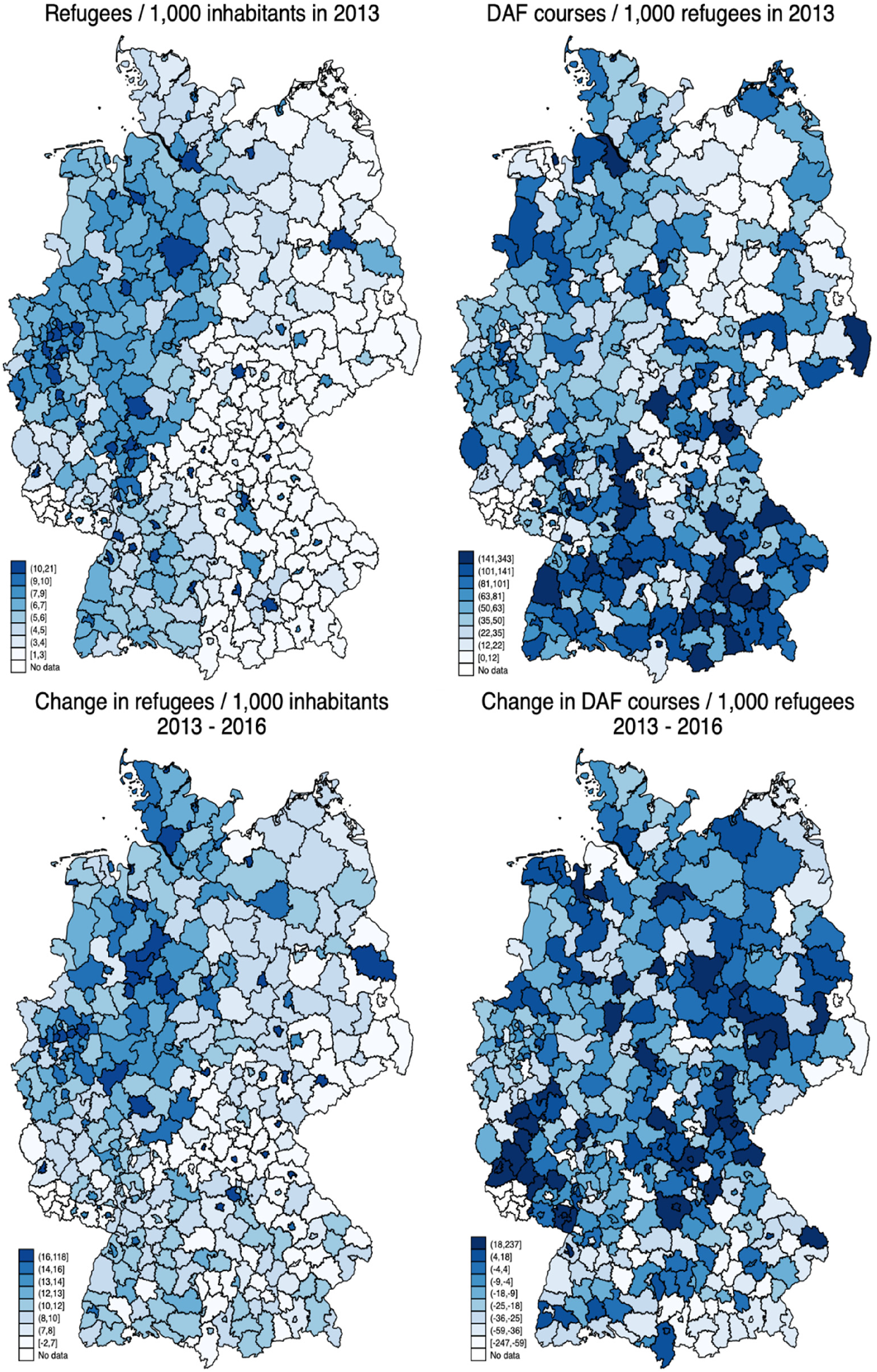
Distribution of Refugees and DAF Courses.
Initial Conditions Model
The second aim of the analysis is to investigate which VHS characteristics predict how quickly a VHS scaled up (Hypothesis 2). To understand the determinants of the scaling process, we fix the levels of our independent variables at values of 2013, that is, before the change. This is necessary because we are interested in the variation between units at a certain point in time. In contrast, a standard first-difference (or fixed effects) model uses only the change in variables within units between periods. Consequently, we modify the first-difference estimator:

The vector
Results
Adaptability: Expansion or Crowding out?
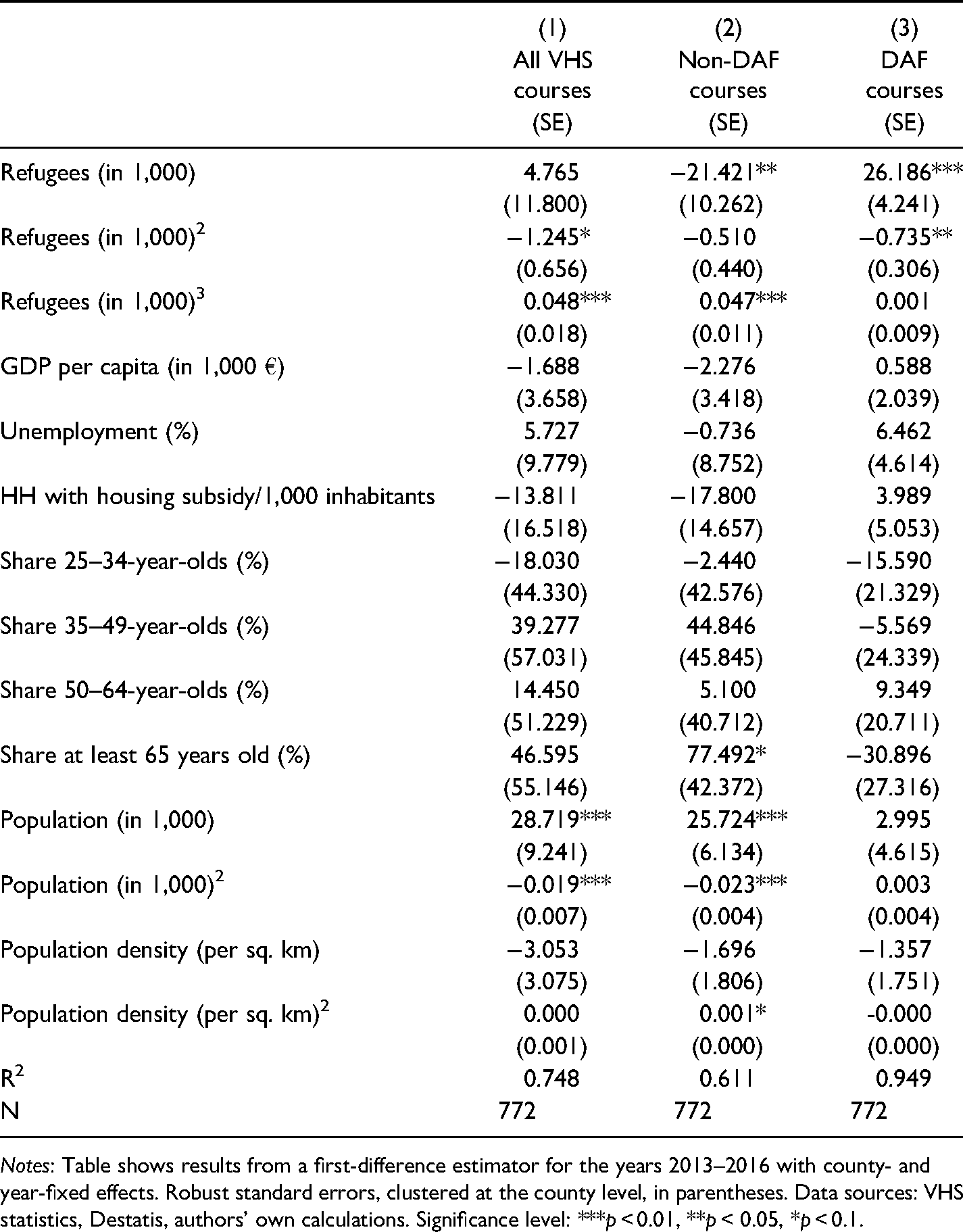
The estimation results in Table 1 show the causal effect of the refugee influx between 2013 and 2016 on different VHS course measures. We are interested in the average effects and thus present the interpretation at the mean value. For this purpose, we use the mean number of additional refugees per county in the polynomial to calculate the average effects of the refugee influx. Additionally, to understand the spread of the effect size better, we also interpret the results at the 25th and 75th percentiles. The respective refugee numbers are approximately 2,500 additional refugees at the mean, 1,015 additional refugees at the 25th percentile, and 2,870 additional refugees at the 75th percentile.
Effects of Refugees on VHS Course Offers—Absolute Numbers.
Notes: Table shows results from a first-difference estimator for the years 2013–2016 with county- and year-fixed effects. Robust standard errors, clustered at the county level, in parentheses. Data sources: VHS statistics, Destatis, authors’ own calculations. Significance level: ***p < 0.01, **p < 0.05, *p < 0.1.
Column (1) shows that changes in the number of refugees had a nonlinear effect on the sum of VHS courses. The shape of the polynomial corresponds to an inverted U-shape where up to the 60th percentile of the refugee inflow the overall number of VHS courses steadily increased before the marginal decrease set in, finally becoming negative just below the 90th percentile (see Appendix Figure A2). At the mean, a VHS experienced a tiny plus of about five additional courses, which corresponds to a growth of about 0.3%. At the 25th (75th) percentile, 3.6 (4.6) additional courses are expected which corresponds to a growth of 0.6% (0.25%). This indicates that the refugee influx did not limit the overall course supply. However, since there was no substantial course expansion either, changes must have happened within the VHS course offers. Column (2) shows that a higher number of refugees lowered the number of non-DAF courses. The polynomial corresponds to a downward sloping line, that is, the larger the refugee influx, the larger the shrinkage in the non-DAF course supply, although the effect diminishes minimally with more refugees. At the mean, about 56 fewer non-DAF courses would be expected, which equals a shrinkage of about 4%. At the 25th (75th) percentile, 22.2 (64.6) fewer non-DAF courses are expected which corresponds to a shrinkage of 3.9% (3.7%). Lastly, column (3) shows that more refugees led to a higher supply of DAF courses. The polynomial has the shape of a rising line that is slightly curved upwards, that is, the growth was slightly lower at higher refugee numbers. At the mean value, 61 additional DAF courses are expected, which translates into a DAF course growth of 62%. The respective numbers for the 25th (75th) percentile are 25.8 (69.1) additional DAF courses which correspond to a growth of approximately 172% (62%).
To summarize, there was a strong reaction to the influx of refugees. DAF courses were mostly created by crowding out non-DAF courses, and only to a very small degree by offering a higher overall number of courses. These results are in line with Hypothesis 1. They also imply that VHS operated (almost) efficiently beforehand and thus had hardly any idle capacities.
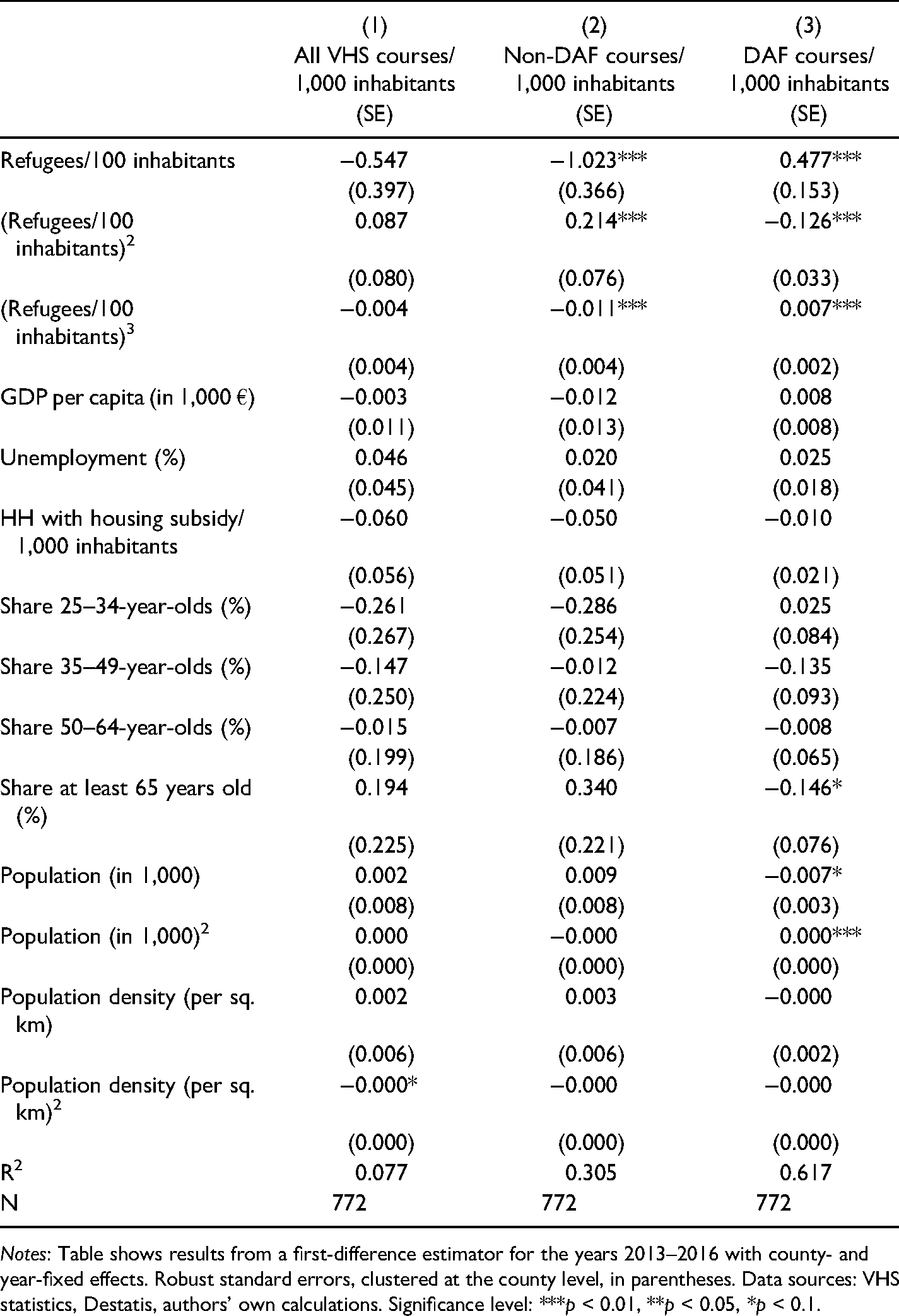
Table 2 shows the perspective of potential participants. It examines whether the changes in course offers caused by refugees were actually notable from their perspective. For this, we look at changes in course supply ratios in reaction to changes in the refugee density. Appendix D: Results Appendix describes the analysis in more detail. In conclusion, the analysis from the participant perspective confirms the baseline analysis. It adds to the findings that the change in the number of non-DAF courses was likely substantive enough to be noticed by potential participants. As a result, we cannot reject Hypothesis 1. The results suggest that the allocation of refugees happened independently of potential integration capacities of counties. As a result, the VHS had to create integration capacities by shifting their existing resources. This necessitated deciding which types of courses were more important to provide at that moment. On the one hand, this may have lowered acceptance for the “newcomers” as they were allocated resources from other course offers. On the other hand, this could be interpreted as a signal that VHS considered DAF courses more valuable for society at that moment, and thus increased the overall welfare by reallocating resources to DAF courses. We will return to these aspects in the discussion below.
Effects of Refugees on VHS Course Offers—per Capita.
Notes: Table shows results from a first-difference estimator for the years 2013–2016 with county- and year-fixed effects. Robust standard errors, clustered at the county level, in parentheses. Data sources: VHS statistics, Destatis, authors’ own calculations. Significance level: ***p < 0.01, **p < 0.05, *p < 0.1.
Initial Conditions: Success Factors of Scaling
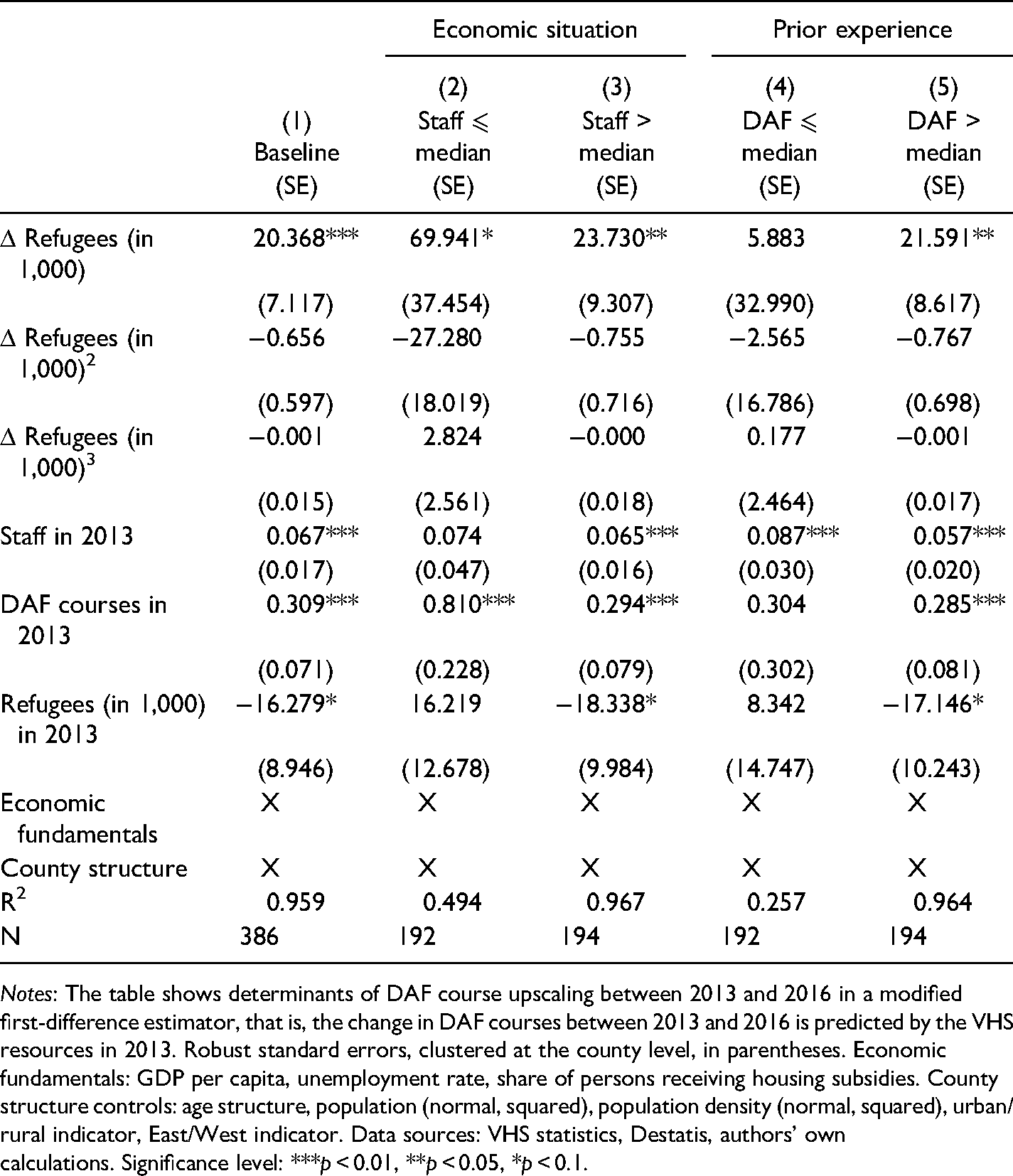
We now turn to the potential heterogeneity in the VHS reaction to refugee influx. Table 3 shows which factors predicted a higher growth of course supply between 2013 and 2016. To test Hypothesis 2, we include potential determinants in the form of the number of VHS staff in 2013 and the number of DAF courses in 2013. 6 Column (1) shows our baseline estimation. Both expected proxies for size and prior experience are statistically highly significant. For every additional staff member in 2013, 0.067 additional DAF courses were offered in 2016. This indicates that VHS with more resources scaled up faster. One additional DAF course in 2013 corresponded to 0.309 additional DAF courses in 2016, that is, about three DAF courses in 2013 corresponded to one additional DAF course in 2016. This implies that prior experience with DAF courses was important.
Determinants of VHS Course Adjustments.
Notes: The table shows determinants of DAF course upscaling between 2013 and 2016 in a modified first-difference estimator, that is, the change in DAF courses between 2013 and 2016 is predicted by the VHS resources in 2013. Robust standard errors, clustered at the county level, in parentheses. Economic fundamentals: GDP per capita, unemployment rate, share of persons receiving housing subsidies. County structure controls: age structure, population (normal, squared), population density (normal, squared), urban/rural indicator, East/West indicator. Data sources: VHS statistics, Destatis, authors’ own calculations. Significance level: ***p < 0.01, **p < 0.05, *p < 0.1.
To understand the role of initial characteristics and potential path dependencies better, the remaining columns consider sample splits at the 2013 median of the two main explanatory variables. With these splits, we want to analyze how smaller VHS fared relative to larger VHS, and how less experienced VHS relative to more experienced VHS. Column (2) shows how smaller VHS adapted, that is, those with fewer staff members than the median VHS of 375 employees. For small VHS, the impact of additional staff members is hardly significant and there is no impact of additional refugees in 2013. Both observations support the hypothesis that smaller VHS had more difficulties in scaling up. On the other hand, the marginal effect of additional DAF courses more than doubles relative to the baseline, that is, one additional DAF course in 2013 corresponded to 0.81 additional DAF courses in 2016. This is in line with the hypothesis that prior institutional experience was advantageous. Column (3) only considers VHS with more than the median number of employees. Here, the effects sizes are very similar to the baseline.
Columns (4) and (5) differentiate between counties below and above the median of 46 DAF courses in 2013. For counties below the median (column 4), the only variable with any predictive power is the number of staff. One additional staff member in 2013 is associated with 0.087 additional DAF courses in 2016, which is larger but still similar to the baseline. Intuitively, it implies that counties with few DAF courses could react by reassigning staff members but they had no advantages from having administered DAF courses earlier. In contrast, VHS above the median in (column 5) could benefit from both their staff and their prior DAF experience. This implies that a certain minimum of experience with DAF courses facilitated scaling.
In sum, our subsample analysis indicates that path dependencies exist, that is, those VHS that were better equipped and those that already had experience with DAF courses, adapted best to additional refugees. Our analysis is therefore consistent with Hypothesis 2.
Discussion
When discussing potential implications from our study, it is important to keep in mind some limitations. First, we have no data on other integration course providers. Thus, even though VHS are the most important language course providers in Germany, our description of the adjustment process is necessarily incomplete. Moreover, if VHS systematically interacted with other language course providers, for example, by mutually adapting their course offers, then our analysis would measure the combined effect of the refugees and the supply by other organizations. Second, due to data limitations, we cannot quantitatively analyze the reasons and internal mechanisms of how the upscaling took place, that is, we do not know whether it was due to proactive engagement of VHS, financial incentives associated with these courses, or other factors. Our analysis, therefore, refers to the aggregate and average effects. We also have no information about course participants. While it seems plausible that the number and share of refugees in the DAF courses increased, most DAF courses were open for everyone to enroll. Therefore, we cannot make any statement about the number of refugees that actually profited from DAF courses. We also refrain from any interpretation of the actual or normative appropriateness of integration courses, and recommend the discussions by Biesta (2012), Wildemeersch (2017), Käpplinger (2018), and Fejes et al. (2020), besides others.
Despite the limitations, this study hopes to contribute to the adult education literature in several ways. First, it explored how VHS, which are the most important DAF course providers in Germany and thus central actors for integration, adapted their course supply in response to the refugee influx of 2015/2016. Due to its extensive data set and quasi-experimental design, it offers a relevant extension over earlier studies that quantitatively analyze the VHS role in integrating refugees. In doing so, it documents the adaptation and integration capacities of adult education in Germany as well as the consequences for other adult education courses. Second, this is the first study pointing out determinants of a successful upscaling in DAF course supply. We show that prior resources of VHS were indeed important for scaling up. This emphasizes the role of regional factors for participation behavior and opens up the discussion of how to allocate resources within adult learning. Our results let us draw four main conclusions:
First, VHS and thus the most important supplier of public adult education are able to adapt to new circumstances quickly. The large-scale adjustment of course offers is even more remarkable given the autonomy and regional diversity of the VHS. This is an encouraging finding.
Second, DAF courses grow by crowding out other courses. Earlier studies have shown this already and we support this finding using a different methodology. Additionally, we use data on the refugee allocation to argue that these crowding out effects are a sign of efficient operations, which is desirable from a societal point of view. As autonomous organizations, VHS have the freedom and the obligation to determine what suits societal needs best. This is in line with the VHS’ self-concept as actors on behalf of the public interest rather than economic actors (Schrader, 2011). Given the temporary nature of the refugee influx and thus the time-limited demand for additional integration courses, it was probably not reasonable from the VHS’ point of view to increase their staff and number of rooms permanently, because this would permanently increase the costs, too. Assuming that VHS know the local situation best, their decisions would reflect shifting societal priorities. This seems plausible, given the time-sensitive need of refugees to learn the local language as quickly as possible.
Although it is beyond the scope of this paper, it seems appropriate to mention potential second-round effects of offering more DAF courses, which would influence a cost–benefit analysis. DAF course participants could become participants in other courses if VHS courses addressed their needs, for example, in the area of work-related training. Participation has been shown to confer both monetary and nonmonetary benefits to the individual (Ruhose et al., 2019, 2020). In addition, integration courses are an important opportunity for refugees to build a network in their new home country (Adam et al., 2019). This will likely extend to other courses and could thus foster the integration of refugees on a second level. It would also contribute to the VHS’ goal of serving all strata of society. Some studies have explicitly discussed how such a “cross-over” can be achieved (Brose, 2013; Lücker & Mania, 2014; Zimmer et al., 2015). At the most basic level, if more persons participate in DAF courses, the unconditional likelihood of such cross-overs rises, which could improve societal welfare in the future.
Third, there seem to exist path dependencies in DAF course offers. Both the size of a VHS and prior experience in organizing DAF courses turn out to be strong determinants of scaling up successfully. On the one hand, these efficiency differences could justify a reallocation of resources to the more efficient places to offer integration at the societally lowest costs. On the other hand, this finding is worrisome, if equal learning opportunities across regions are a societal goal, both from the perspective of language acquisition and from the perspective of building new networks in the host society.
Fourth, our results also showed that the supply mechanisms of other VHS courses are not easily explained by VHS characteristics or regional determinants. However, there may be a differentiated picture if other course areas are investigated individually. Given that many refugees would profit from acquiring additional labor market-relevant skills and that VHS seems a suitable place to teach those, observing how schooling- and work-related courses develop in the next years could add important insights into the VHS’ role in fostering integration. It would also be important to investigate whether path dependencies also exist in certain types of courses other than DAF. This may imply unequal learning opportunities across different regions, not only for refugees but also for all participants if the resources of VHS diverged too much. Thus, further investigating the existence (and development) of regional heterogeneity in resources and its consequences will be a fruitful research topic in the future.
Supplemental Material
sj-docx-1-aeq-10.1177_07417136211068861 - Supplemental material for Scaling up and Crowding out: How German Adult Education Centers Adapted Course Offers to Refugee Integration
Supplemental material, sj-docx-1-aeq-10.1177_07417136211068861 for Scaling up and Crowding out: How German Adult Education Centers Adapted Course Offers to Refugee Integration by Stephan L. Thomsen and Insa Weilage in Adult Education Quarterly
Footnotes
Acknowledgments
We are grateful to the German Institute for Adult Education (Deutsches Institut für Erwachsenenbildung, DIE) for providing the VHS statistics, as well as to Daniela Imani, Andreas Martin, and an anonymous referee. The study has benefitted from discussion at the research seminar of the Faculty of Economics and Management, Leibniz University Hannover.
Declaration of Conflicting Interests
The author(s) declared no potential conflicts of interest with respect to the research, authorship, and/or publication of this article.
Funding
The author(s) received no financial support for the research, authorship, and/or publication of this article.

Supplemental Material
Supplemental material for this article is available online.
Notes
Author Biographies
References
Supplementary Material
Please find the following supplemental material available below.
For Open Access articles published under a Creative Commons License, all supplemental material carries the same license as the article it is associated with.
For non-Open Access articles published, all supplemental material carries a non-exclusive license, and permission requests for re-use of supplemental material or any part of supplemental material shall be sent directly to the copyright owner as specified in the copyright notice associated with the article.
