



Abstract
This study explored disciplinary writing in grades 4-6 and the potential of writing to learn and learning to write across the curriculum to prepare the pupils for their future writing. Using Ivanič’s discourses of writing as an analytical framework, observation protocols from 104 observers in 374 lessons in 76 Swedish schools were analyzed exploring school writing in the different curriculum subjects. Analysis of the data reveals that in most lessons the teachers required their pupils to write with a single focus on reinforcing learning, enacting three of Ivanič’s seven discourses of writing: thinking and learning discourse, skills discourse, and social practices discourse. Much less frequently overall but commonly in language lessons, teachers required their pupils to write with a dual focus, developing writing proficiency while reinforcing learning. In these cases, all of Ivanič’s discourses were enacted. The results suggest potential for a dual focus on writing to learn and learning to write to further develop the pupils’ writing across the curriculum.
A broad view on writing is “the key to both academic success and the success in the world which education is meant to allow” (Donahue, 2021, p. 30). For example, from early schooling onward, a pupil’s ability to write academic texts sufficiently well is important in accessing higher education (cf. Blåsjö, 2004; Donahue, 2021). In today’s mass writing society (Brandt, 2015), writing competence is, also, a question of being a participating member of a democratic society as well as the workplace. For these reasons, the responsibility for the teaching of writing in compulsory school is important. However, writing is complex, and differs over time, text, and context. Therefore, to prepare the pupils for their future life, the teaching of writing needs to be holistic, crossing over school subjects (cf. Applebee & Langer, 2013), genres, languages, and views of writing (Ivanič, 2004). To be able to discuss such holistic writing questions—and contribute to change—we need more knowledge about the current teaching of writing in different schooling contexts. This article investigates how writing is taught in grades 4-6 in Swedish schools.
Teachers of writing hold varied beliefs about what writing is, how it should be taught, and its connection to learning (Ivanič, 2004). For the sake of analysis, these perspectives may be divided into beliefs about writing to learn (WTL)—ideas about how writing supports learning—and learning to write (LTW)—ideas about how writing should be taught. Perspectives on WTL and LTW are central to the understanding of writing across the curriculum because they inform how writing is taught in various academic contexts (Applebee & Langer, 2013). Earlier studies indicate that text-focused WTL views are founded on context-focused views in mother tongue education (Blikstad-Balas et al., 2018; Sturk & Lindgren, 2019; Sturk et al., 2020). Further, findings from earlier studies in other school subjects indicate a need for strategies that help pupils to understand and write within disciplines (Shanahan & Shanahan, 2008), and that there is need for teaching of writing in all subjects to equip pupils with writing proficiency for future academic studies and workplace writing (Applebee & Langer, 2013; Westman, 2013). This article sets out to explore writing across the curriculum in school years 4-6 in a Swedish context by observing school writing. Questions about the potential of the teaching of writing across the curriculum are discussed.
Theoretical Background and Earlier Studies
Writing in different school subjects, disciplinary writing, helps pupils to make sense of content, promote engagement, and improve understanding (Applebee & Langer, 2013). Taking a social constructivist perspective, disciplinary literacy can be described as an increasing specialization of literacy development. In the view of writing in the disciplines, the disciplines have differences in how to create, disseminate, and evaluate knowledge, manifested in the use of language. These differences are manifest in different text types and different textual practices in different disciplines (Shanahan & Shanahan, 2008). As a result, the role and nature of subject-specific language need to be explicitly taught (cf. Coffin, 2013; Myhill, 2019). Writing can also be a powerful source of learning disciplinary subject content. Therefore, writing in the disciplines focuses both on learning (Writing to Learn, WTL) and on Learning to Write within a school subject, hereafter referred to as LTW.
Disciplinary Writing: Writing to Learn and Learning to Write
Several research projects on disciplinary writing have been conducted in a Nordic context. In the Swedish project, students encounter with different texts in school (Liberg et al., 2002) focused on the school subjects Swedish, Social Sciences, and Science in grades 5 and 8. Swedish studies on disciplinary writing have been conducted in Science (af Geijerstam, 2006; Bergh Nestlog, 2017; Hipkiss, 2014; Randahl, 2014), Social Sciences (Lindh, 2019; Staf, 2019; Walldén, 2019), Home and Consumer Studies (Hipkiss, 2014), and Physical Education and Health (Norberg, 2021). In Norway “the writing wheel” includes expectation for writing competence in different grades and subjects (Berge et al., 2016), further developed in the NORM project (Matre et al., 2021). In Denmark, the research project “Writing to Learn, Learning to Write” focused on literacy in Danish upper secondary education (Christensen et al., 2014).
A main conclusion drawn from earlier Nordic studies on writing in different disciplines relates to the importance of a structured teaching of writing (Ledin et al., 2013), and that the teaching of writing is important for pupils’ development of their writing proficiency (Bergh Nestlog, 2009, 2012; Nyström Höög, 2010; Tjernberg, 2013; Yassin Falk, 2017). Like studies conducted outside the Nordic context, however, researchers have found that writing across the curriculum focuses more on short writing exercises than extended writing (Applebee & Langer, 2013), and writing often includes answering questions (cf. Tanner, 2014), retelling facts in short texts, reproducing short texts (Christensen et al., 2014; Lindh, 2019), answering multiple-choice questions, filling in blanks, providing short answers to questions, and taking or copying notes (af Geijerstam, 2006; Applebee & Langer, 2013), all aiming for a test (cf. Christensen et al., 2014; Lindh, 2019). The teaching of writing in theoretical subjects is rare, and teachers have limited tools for teaching the writing of subject-specific texts (Applebee & Langer, 2013; Lindh, 2019; Staf, 2019). As a result, pupils neither develop their potential to learn through writing nor acquire a metalanguage to talk about their writing (af Geijerstam, 2006).
In response to such gaps in pupils’ writing education, Hipkiss (2014) suggests scaffolding (Bruner, 1978) for the pupils’ writing development and strategies for writing (see also Beacco et al., 2016). Such approaches could lead to advances in understanding where writing contributes to learning through cognitive mechanisms or a relationship between writing and conceptual understanding. An explicit teaching of writing enables a “use of writing in the teaching of subject content which enables communicative actions, reflexive knowledge and active forms of democratic citizenship” (Lindh, 2019, p. 329). Further, the characteristics of texts in different subjects suggest that the pupils need to learn a different variety of written language in each subject—and this can be explicitly taught (Coffin, 2013; Myhill, 2019).
Theories of WTL and LTW are helpful in understanding how writing is taught in school contexts in order to address gaps in pupil’s writing education. In theories on WTL (Tynjälä et al., 2001), influenced by cognitivism (Hayes & Flower, 1980), writing can be used as an effective tool for content learning (Tynjälä et al., 2001). Further, WTL can be seen in two dimensions: writing to learn content and writing to learn language (Manchón, 2011). Writing to learn content is used to advance expertise through content learning and, ultimately, through the process of creating new content. From a writing to learn language perspective, the attention is drawn to linguistic processing and language learning, including grammar and vocabulary (Manchón, 2011). In contrast, in theories on LTW, there is a focus on teaching students how to produce texts accurate to the school subject studied, connected to theories on Writing in the Disciplines (Shanahan & Shanahan, 2008). Beside these distinctions, the way in which teachers take different use of writing, in a single focus on learning, or in a dual focus on learning content and developing pupils’ writing proficiency is explored in relation to discourses of writing. In this study, school writing is understood from a social practices perspective, which takes account of the context, where expectations, norms, and contexts are understood to affect the writing and the text (cf. Lea & Street, 1998). Moreover, teachers’ inferred beliefs about learning to write enacted in discourses of writing will be discussed.
Discourses of Writing in the Teaching of Writing
In this article, discourses of writing are defined as knowledge of writing conventions and learning to write practices that affect teachers’ teaching of writing. Originally Ivanič’s framework included six discourses: skills discourse, creativity discourse, process discourse, genre discourse, social practices discourse, and sociopolitical discourse (Ivanič, 2004). At a symposium in Umeå (in 2017), Ivanič expanded her framework, adding a seventh discourse for thinking and learning, which points toward a writing across the curriculum perspective on the teaching of writing. Ivanič identified different aspects of writing and teaching of writing that make discourses of writing and learning to write recognizable and distinguishable from each other. Ivanič’s model is a multilayered view of language including the text, the cognitive processes, the writing event, and a sociocultural and political context (Figure 1). Ivanič argued that discourses about writing and learning to write affect approaches to teaching and assessment criteria (Ivanič, 2004) and, thus, also the identity of the writer (Ivanič, 2017).
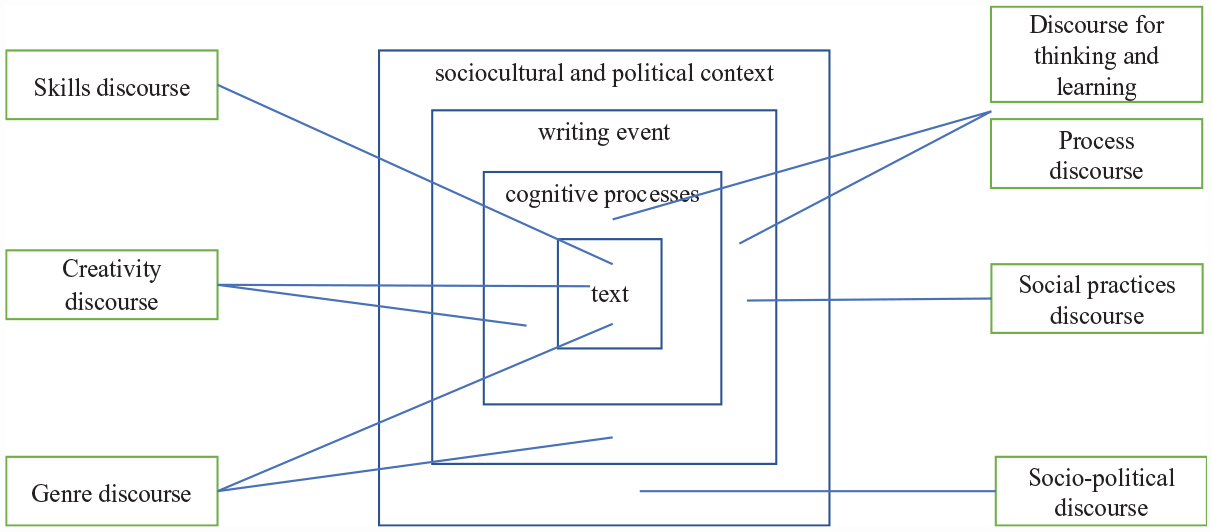
Discourses of writing related to aspects of writing (redrawn by the researcher, from Ivanič, 2004, 2017).
Based on Fairclough’s (1989) multilayered view of language, Ivanič (2004) describes a holistic view of writing in layers. The inner layer consists of the written text and linguistic aspects, and discourses including this layer include skills in form and correctness, genre characteristics, and creativity in content and style. The second layer consists of the cognitive processes in the mind of the writer. Besides a creativity discourse, a process discourse and discourse for thinking for clarifying thoughts and learning subjects across the curriculum are also included in this layer. The third layer, the writing event, where writing is used in a social context, is connected to purposes for writing, social interaction, and time and place. This layer could be described as the context of situation (Halliday, 2004), in which writing to communicate and make meaning is reflected in a genre discourse or in a social practices discourse, or described as organization of the writing situation (Smidt, 2010), reflected in a process discourse. Finally, the fourth layer consists of the sociocultural and political context for writing, identified in a sociopolitical discourse, also including relations of power and patterns of privileging.
Ivanič’s framework has been used to identify discourses of writing in school policy documents (cf. Jeffery & Parr, 2021; Peterson et al., 2018), teaching and learning material (cf. Gustafsson, 2013; Pulls, 2019; Veum, 2015), and pedagogic practice (Blikstad-Balas et al., 2018; McCarthey et al., 2014; Randahl, 2012; Sturk & Lindgren, 2019; Sturk et al., 2020). Results reveal a predominance of text-centered discourses, as well as discourses concerned with cognitive processes and the writing event. However, a social practices discourse focusing on communication between writer and reader are less common, and there is a lack of a sociopolitical discourse enacted.
Ivanič did not elaborate on writing across the curriculum in her framework from 2004. However, she invited elaboration on the usefulness of the framework, and disciplinary writing was included in the 2017 framework. The framework has proved useful to describe the teaching of writing in mother tongue education. In this study, it will be used to explore writing across the curriculum.
Aim and Research Questions
The aim of this study was to explore writing across the curriculum in grades 4-6. In order to discuss the potential of the teaching of writing across the curriculum, the study was informed by the following research questions:
How is writing distributed across the curriculum?
To what extent do teachers use WTL and LTW across the curriculum?
What discourses of writing are enacted across school subjects?
In a social practices perspective on literacy (Karlsson, 2011), close to the ideological model (Street, 1984), writing is framed by its social, cultural, and political contexts. In this article, writing is considered to be affected by its contexts in different school subjects. Subjects across the curriculum are understood as offering different literacy practices, and the teachers’ teaching of writing is understood as observable literacy events (cf. Barton, 2007). Which aspects of writing are expressed in Swedish schooling literacy events was investigated through a framework for discourses of writing and learning to write (Ivanič, 2004, 2017) that informed analysis of when teachers’ conscious and unconscious beliefs about writing were made visible in their teaching of writing.
Methods
To investigate what use teachers make of writing and what discourses of writing are enacted, an observational method was developed for collecting data. The data were analyzed in relation to teaching with a focus on writing to learn and learning to write, and a framework for discourses of writing.
Setting
This article focuses on writing events in school years 4-6 in all school subjects. Swedish compulsory school is divided into three stages: preschool and school years 1-3 (ages 6-9), 4-6 (ages 10-12), and 7-9 (ages 13-15). Commonly, there are one or two mentor teachers in each stage, so there is a pedagogical shift between grades 3 and 4 and between grades 6 and 7. Taking a literacy perspective, the transition toward increasing text-focused education and more abstract school terminology during school years 4-6 are of interest in this study (cf. Egelström, 2019). In grades 3, 6 and 9 there are compulsory Nationella prov (translated as National Tests) in Swedish, English and Mathematics, and optional National Tests in other subjects. From school year 6 the pupils are graded in all subjects. The teachers commonly are generalist teachers, but there are also subject teachers. In contemporary teacher education, the Degree of Master of Arts in Primary Education school years 4-6 includes Swedish, English, Mathematics and either Science, Social Sciences, or a practical-aesthetical subject. 1
Data Collection
To get a broad and representative picture of the teaching of writing across the curriculum, observational data of 374 lessons were collected by student teachers as observers. Student teachers conducted the observations as part of their compulsory course work.
The design of the observation protocol
An observational protocol was designed to capture systematic identification and coding of the teaching of writing discourses across the curriculum, enabling comparison between lessons in different subjects (cf. Klette & Blikstad-Balas, 2018). The protocol included two parts: general information about the lesson observed and aspects of writing (Appendix 1). The first part collected general information about the lesson observed, such as what the students were writing. The second part was organized around four aspects of writing: (1) Views on writing; (2) Teaching of writing; (3) What happens with the text? and (4) What is most important in writing? (Appendix 1).
Figure 2 shows the second part section of the observational protocol for aspects of writing. The four aspects of writing (Figure 2A) built off Ivanič’s framework for discourses of writing and included two to four observation points (Figure 2B) for each of the seven discourses (Ivanič, 2004, 2017) (Appendix 2). The discourses were later coded as LTW or WTL. A 4-point scale (Figure 2C) was filled in during the observation. Observers used the 4-point scale to document the amount of evidence observed concerning a specific instructional practice based on evidence for a given aspect. The final column was left for the observers’ own reflections and notes.
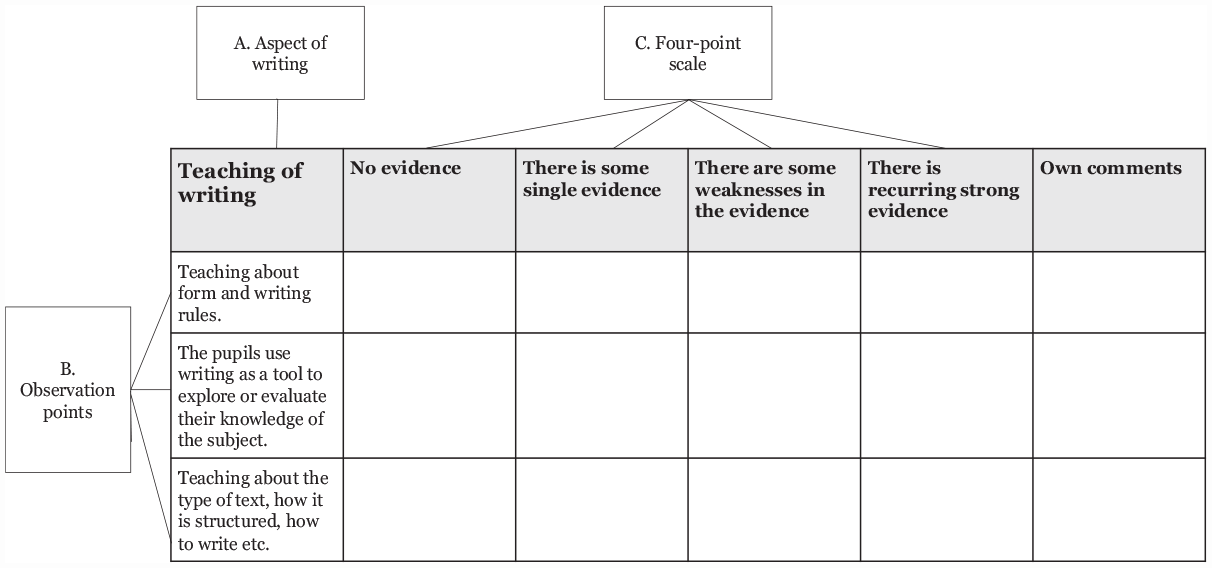
Excerpt from observation protocol.
The protocol was piloted by two teachers and a researcher. In the pilot study, 34 students at the teacher training program were observed in pairs during a school day. One protocol was used for each teacher. In preparation, observers read and had a lecture on Ivanič’s model and observed a recorded lesson to practice using the protocol. Their protocols were analyzed by the researcher for interrater reliability, which showed a total agreement of between 71% and 80%, which is good according to Cohen’s kappa (Landis & Koch, 1977; Mahmud, 2010). On the 4-point scale (2C), most mismatches were in adjacent bands, for example, between “There is some single evidence” and “There are some weaknesses in the evidence,” rather than nonadjacent, for example, between “There is some single evidence” and “There is some recurring strong evidence” (Table 1).
Pilot Study: Interrater Reliability in Observation Protocols in Pairs in the Same Classes, Divided by Subjects.
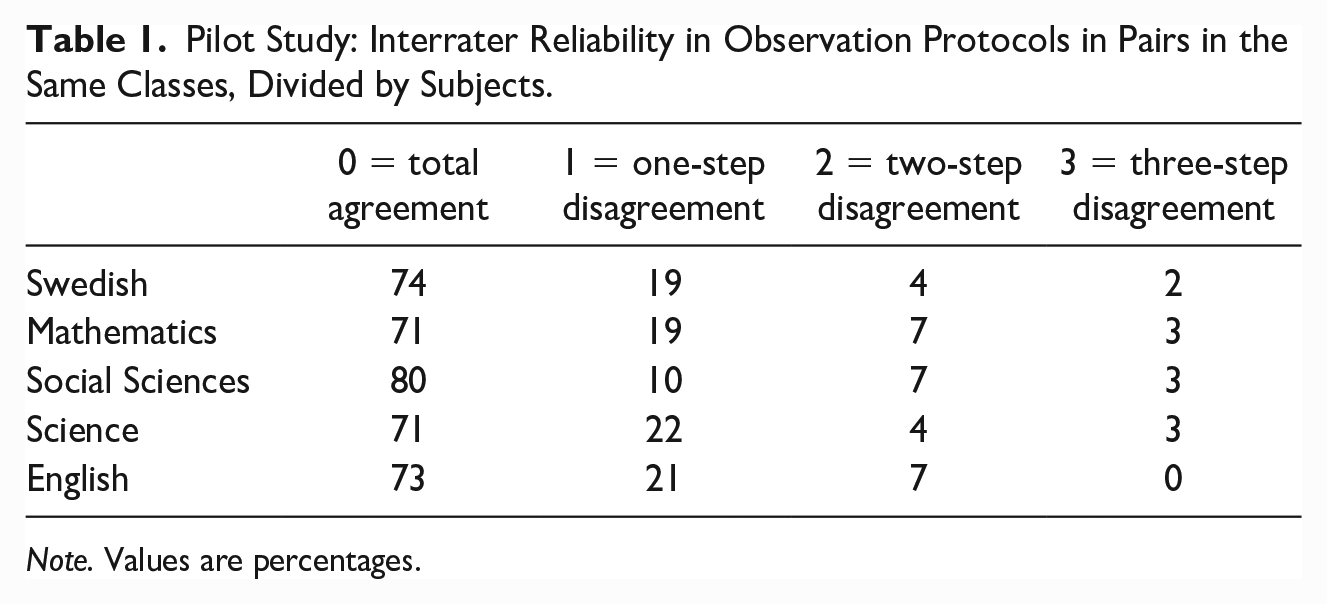
Note. Values are percentages.
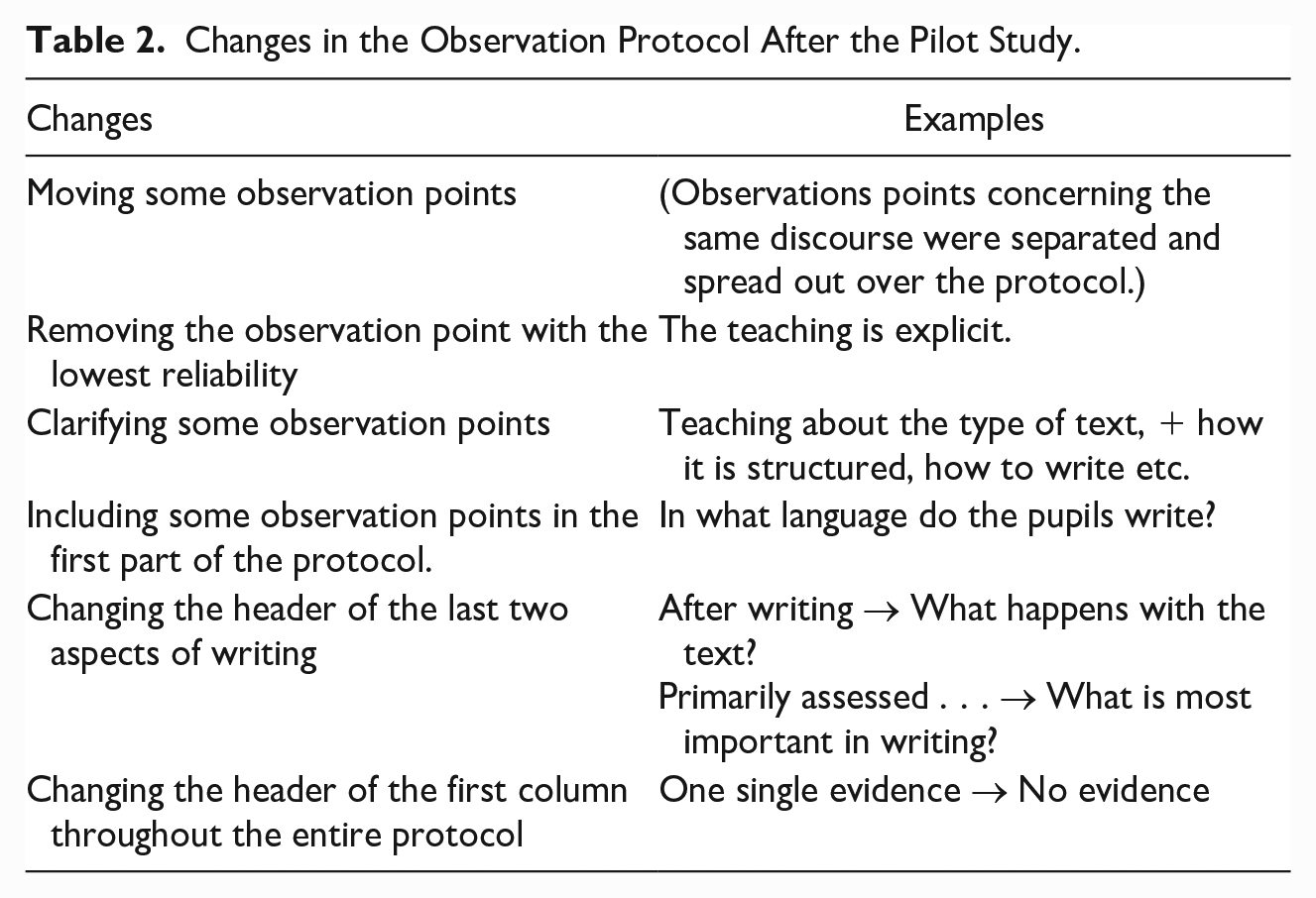
In the practical-aesthetical school subjects, no interrater reliability was calculated because of the low numbers of observations. A major change related to the 4-point-scale, in which the first point was changed from “One single evidence” to “No evidence.” Revisions to the protocol were made based on feedback from the pilot, as shown in Table 2.
Changes in the Observation Protocol After the Pilot Study.
In addition to the pilot study, the researcher and a teacher used the protocol in an observation study in two fourth-year classes. This 2-week observation period had dual benefits: (1) the observation protocol proved to be reliable and effective for its purpose, and (2) the researcher got a deep understanding of the data collection tool and situation, which was helpful when teaching the observers at the teacher education program.
Recruitment and training of observers
The observers were student teachers at the teacher education program for School Years 4-6. As part of a course, all student teachers completed training according to the Reflective Observation of School (ROS) writing model, a model for reflective observation of school writing including reading, lectures, observations, and a seminar (Figure 3). The ROS model included six parts: (1) Ivanič’s (2004) Discourses of writing; (2) a recorded lecture (14.55 minutes) on the discoursal framework including empirical examples from Sturk and Lindgren (2019); (3) a practical lesson on the framework and on classroom observations, such as their purpose, how to implement them, and the role of the observer; (4) individual observation in school practice; (5) reflective seminar with follow-up scaffolding of the observations, online or at the university with the researcher; and (6) follow-up in the teacher education program.
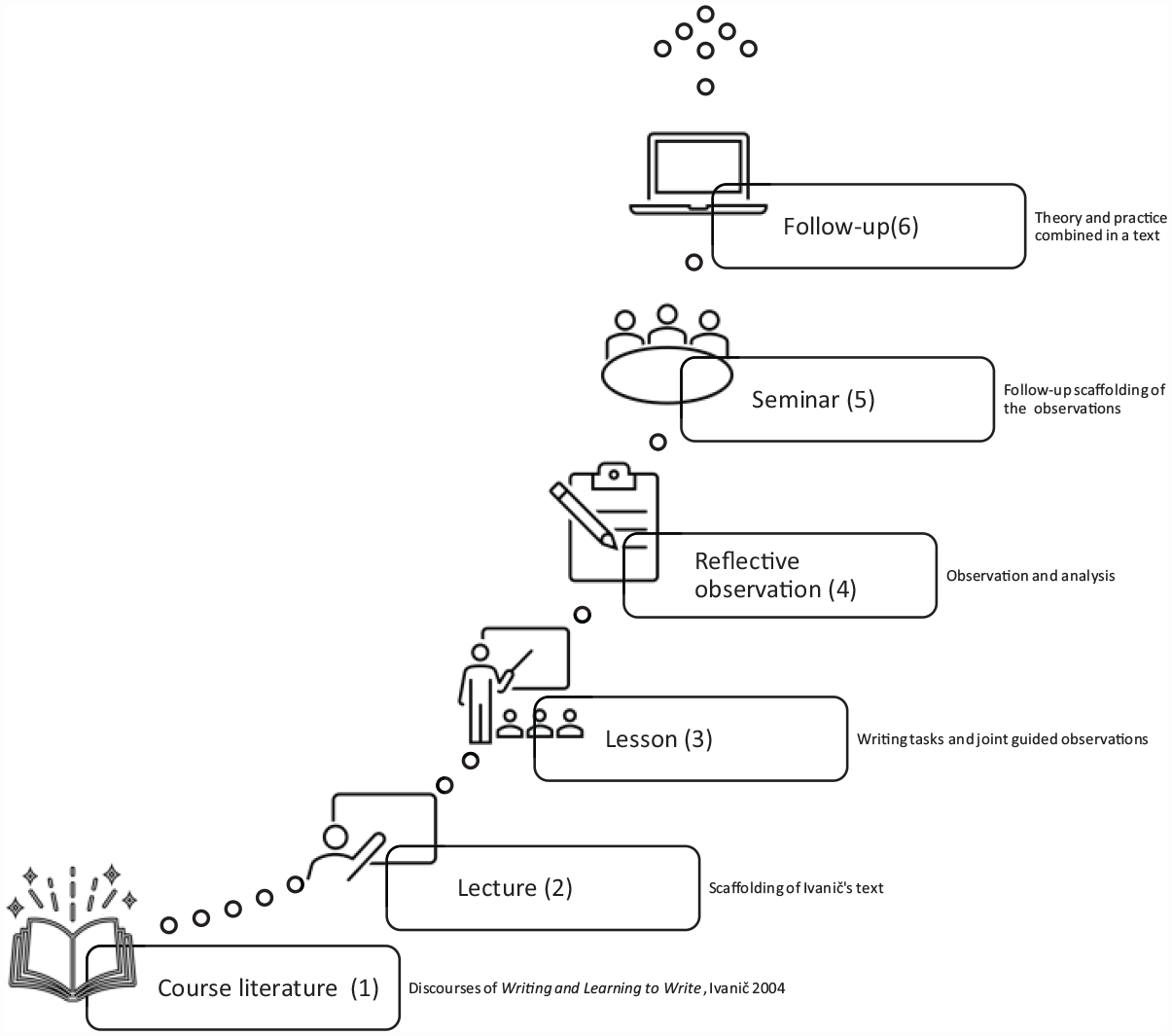
The model for reflective observations of school writing, the ROS-model.
In the practical lesson on the framework and on classroom observations, the observation protocol was reviewed thoroughly, and the research team discussed how to fill in the observations (Appendix 3). Together with the researcher, the student teachers tested the observation protocol, observing a film on the teaching of writing in a classroom (Skolverket & Linnéuniversitetet, 2015). After the film, the students and the researcher discussed the results and the observation procedure, giving examples of how to evaluate an observation point. With examples from the film, they could calibrate scoring evidence—for example, a lecture on how to write a specific text type, a model text, examples on the classroom whiteboard, and pupils writing a specific type of text could be understood as recurring strong evidence for a focus on Teaching about the type of text and some single evidence for Linguistic correctness is in the focus in the pupils’ texts if the teacher commented on spelling when talking about one of the pupil’s text. Challenging cases on filling in the 4-point scale were specially discussed by the research team. The lesson also included a lecture on ethics in observation in classrooms.
For the individual observation in school practice, many student teachers observed at the school where they carried out their teaching practice, arranged by themselves or by the teacher education program—the course of action differed between universities due to the different universities’ agreements with schools.
All parts of the ROS model were mandatory for the student teachers, though taking part in the research study was voluntary and they did not get paid. Student teachers who wanted to take part in the research study (hereafter referred to as observers) provided written and informed participation consent from themselves and the teachers they observed together with the observation protocols.
Data Collection
The data from 374 lessons in all school subjects in 88 classes in 76 schools across the school year were collected by 104 observers from five different universities in Sweden during a period of 1½ years (Table 3). The schools were geographically and demographically spread to cover a range of schools in urban and rural areas. The teachers observed varied in age and years of teaching experience.
Representation of Universities, Schools, and Student Teachers.
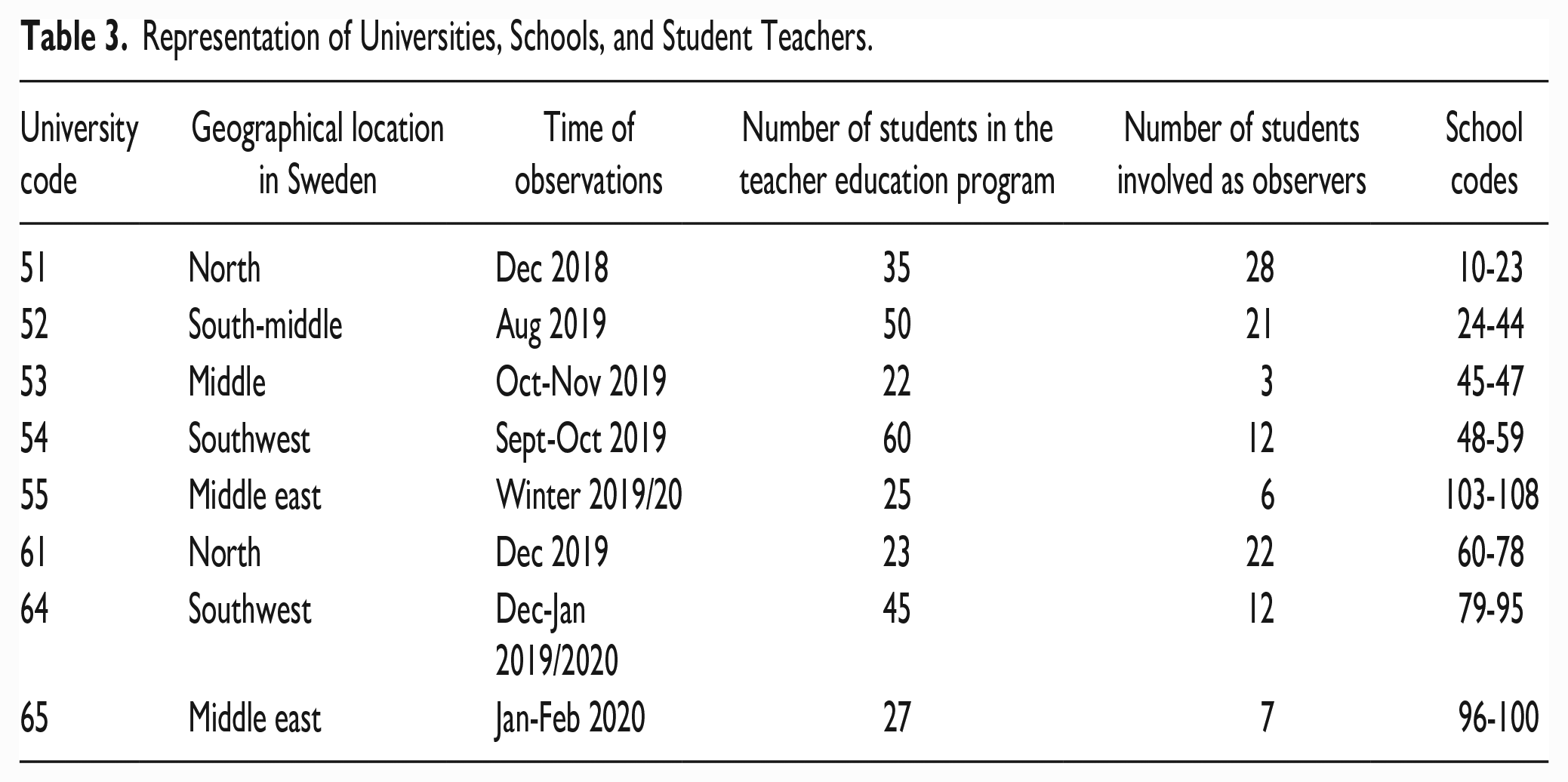
Each observer followed a class in School Years 4-6 during a school day in all subjects. During the observation the observers used the cells in the protocol to keep a tally of instances or examples of the feature in the observation points (Figure 2, B) in the left-hand column. The observers used the 4-point scale (Figure 2, C) to mark the frequency of occurrences, commonly with a cross or tick marks for each occurrence (e.g., || for two, |||| for four). Many of the observers also took notes in the protocol, including notes on the content, structure of the lesson concerning the teaching of writing, and quotations from the teachers. Some observers also collected teaching material used during the lesson observed, such as writing tasks, copies from schoolbooks, pupils’ logs for self-reflection, and evaluation forms. In the reflective seminar, the observers presented and discussed their observations and reflected on the teaching of writing in relation to the theoretical framework (Ivanič, 2004, 2017), and the researcher took notes.
Organizing and Interpreting the Data
The notes on the observers’ protocols, together with the researcher’s notes from the seminars, were typed into Word files, one for each school subject, and organized together with copies of teaching material (n = 27) collected during observations, with the aim of gaining a thorough understanding of the data. The qualitative data were analyzed and coded in four steps. First, lessons were coded as including writing or not including writing. Second, lessons that included writing were coded as to whether they focused on WTL or LTW or both. Different perspectives for writing across the curriculum were identified through codes for WTL, LTW, or a combination of WTL/LTW in relation to what the teacher did during the lesson observed. Additional analysis of WTL as including both a WLC (content) and a WLL (language) perspective was also conducted. Third, the text-types the teachers asked the pupils to write were identified and categorized. Fourth, lessons that included writing were content-analyzed to identify dominating, supportive, and occasional discourses of writing.
Writing events coded as having a single focus were identified in answering questions, taking tests, note-taking, and learning vocabulary and terminology relevant for the subject. This single focus could reveal either a focus on content learning, WLC, or a focus on language learning, WLL (see Manchón, 2011). WLC is illustrated in Example 1a where the focus of writing was on content learning about Vikings. The data from Example 1b reveals writing as a tool to support learning. A single focus on language learning, WLL, is illustrated in Example 1c.
Example 1a: “The aim with the lesson is to learn what a thrall is, and how a Viking ship was built. The pupils take notes and write keywords from a text they have read. The teacher encourages the pupils to read their notes to see what they have learnt.” (Social Sciences)
Example 1b: “The teacher lectures about anti-Semitism. The pupils copy the text from the PowerPoint.” (Social Sciences)
Example 1c: “Dictation on spelling.” (Swedish)
Teaching with a dual focus included writing events that were coded as having focus on a combination of WTL and LTW—the teacher focused both on writing to learn and on developing the pupils’ writing proficiency. A dual focus was commonly identified when pupils were required to write narratives, letters, factual texts, reports, and argumentative texts. The learning-to-write component of these lessons could include different stages of writing, from planning to final revision, writing different parts of a text, and different amounts of writing instruction. In Example 1d, the teacher gave the pupils a structure to follow when writing to learn about the environment.
Example 1d: “The pupils are writing an argumentative text, reasoning and arguing about how choices of food can affect the environment, a topic they have knowledge about from earlier lessons. The teacher asks the pupils to write a specific text-type and gives the pupils a structure to follow. The teacher will assess both content and the pupils’ ability for written argumentation.” (Social Sciences)
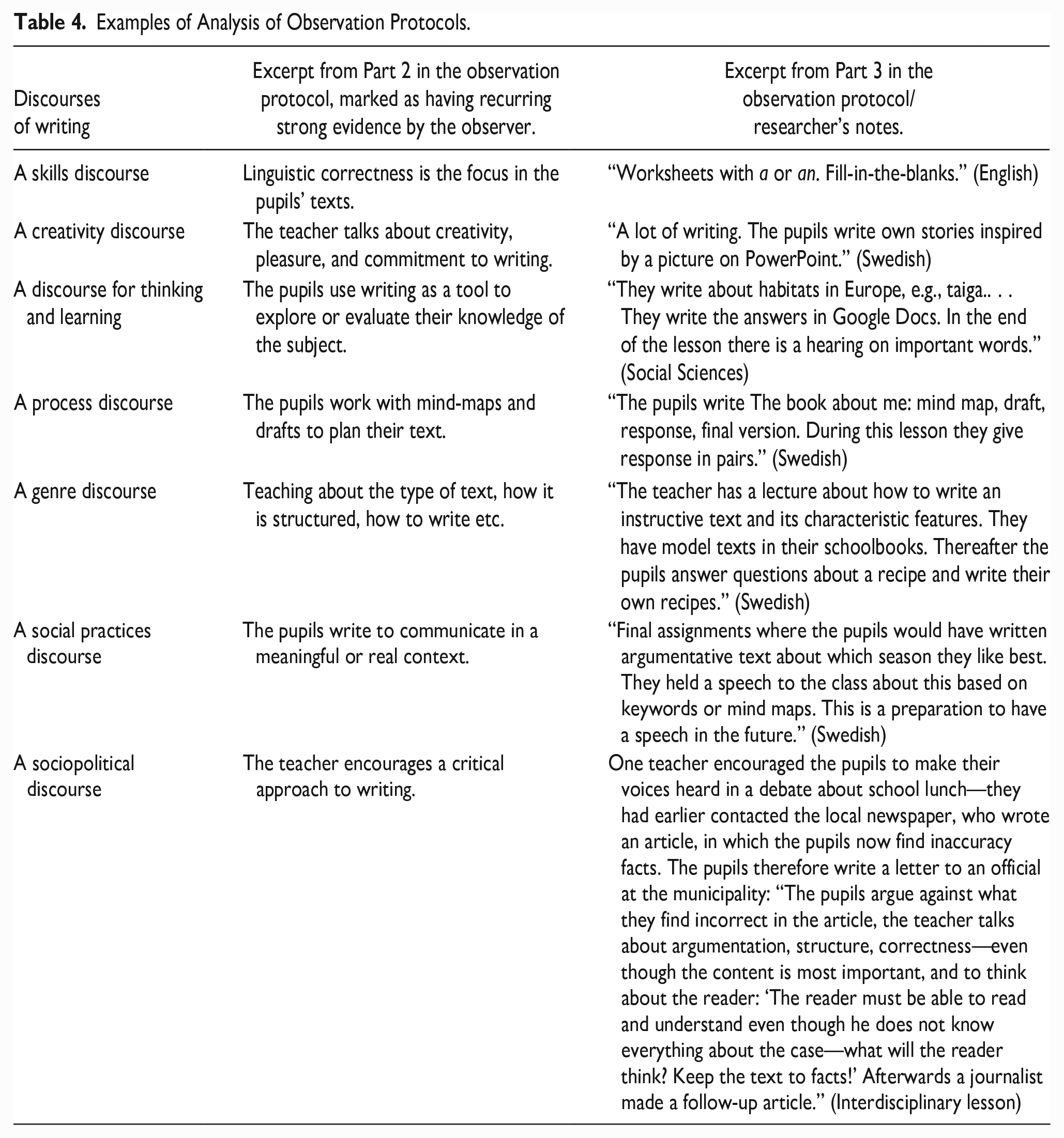
In the fourth coding step, Ivanič’s framework of discourses of writing and writing to learn was used to understand what beliefs about writing are foregrounded across school subjects. Discourses were coded according to which discourse or discourses were enacted during the lessons. This coding process allowed for the identification of dominating or hybrid discourses of writing to be identified in teaching with either a single or a dual focus. In Table 4, discourses of writing enacted in the lessons are illustrated with excerpts from one observation protocol for each of the enacted discourse of writing.
Examples of Analysis of Observation Protocols.
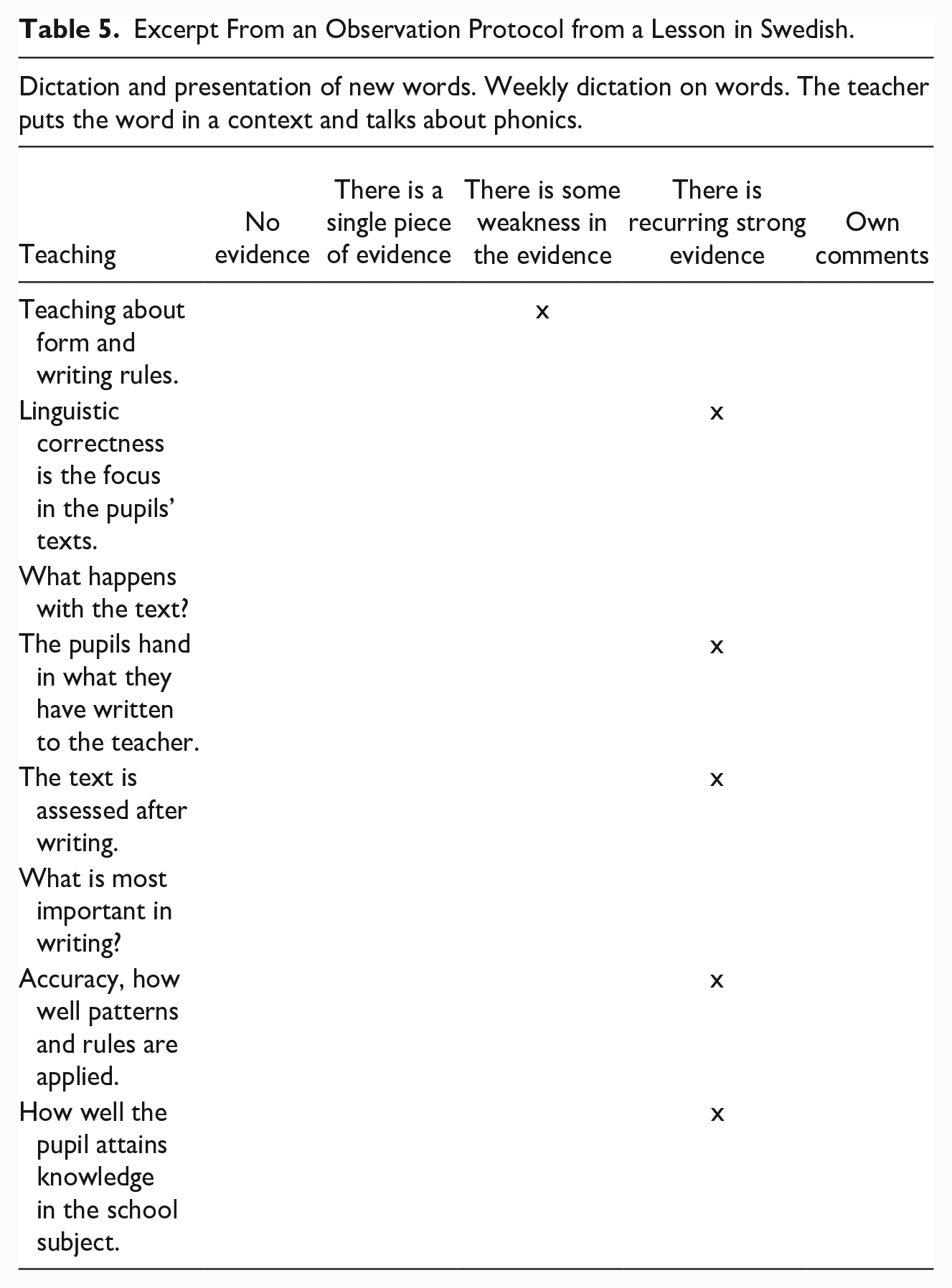
To illustrate the analytic process, one observation from a lesson in Swedish is presented (Table 5). In this example the lesson included a weekly dictation on words. In the protocol, the observer has marked evidence on form, writing rules, and recurring strong evidence on correctness in education. Further, the observer noted that the text was to be handed in and assessed by the teacher who stressed accuracy in writing. This lesson was interpreted as enacting a dominating skills discourse with a single focus on WLL.
Excerpt From an Observation Protocol from a Lesson in Swedish.
Results
In the following section, the descriptive results of lessons, including writing and discourses of writing enacted, are presented. Lessons including teaching with a single focus are described and related to discourses of writing enacted. Results from lessons including teaching with a dual focus are described and related to discourses of writing enacted.
Descriptive Results
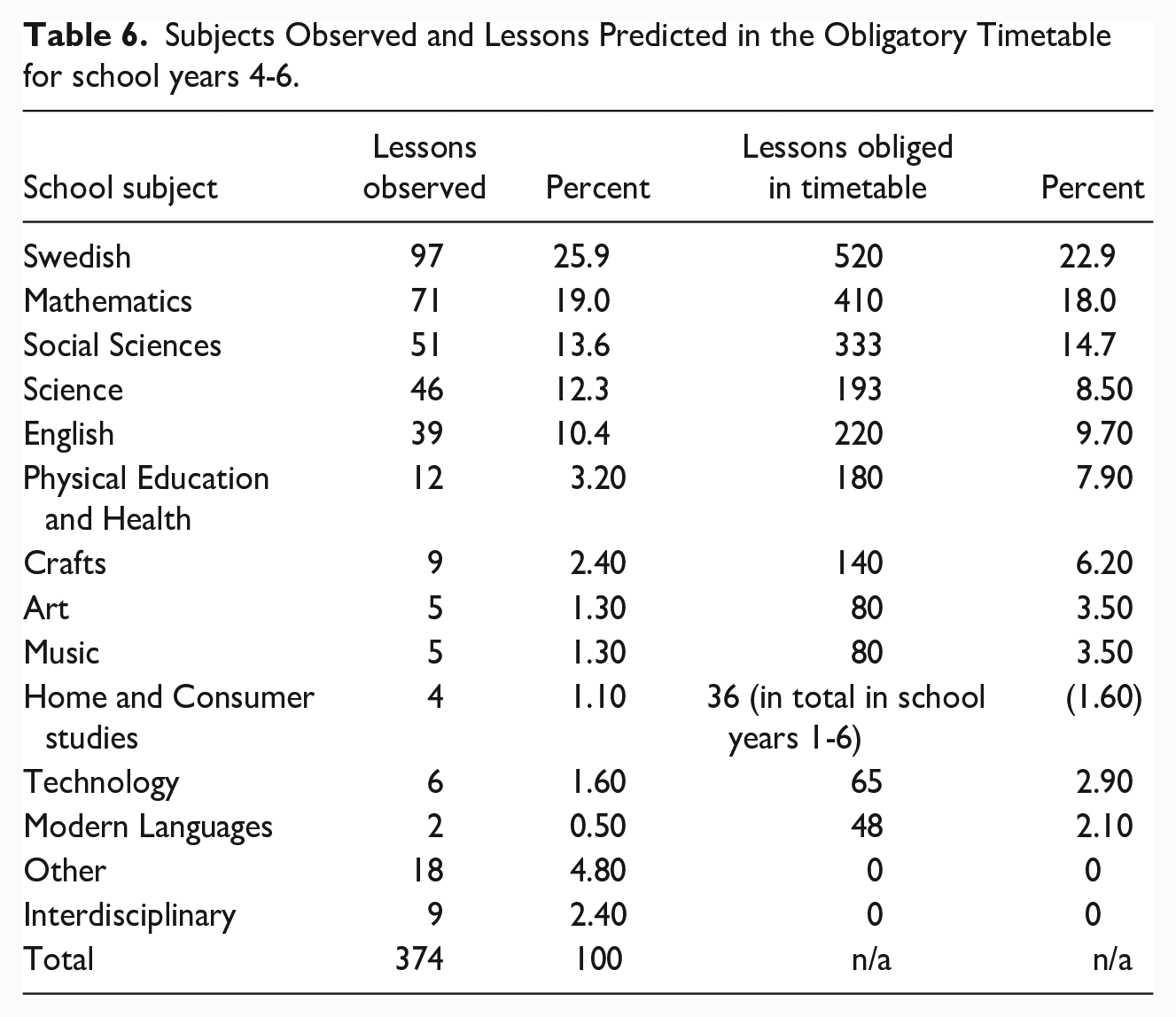
The 374 lessons observed well reflect the obligatory timetable (i.e., number of hours obliged in different school subjects) in Sweden in relation to how the observations were spread over different subjects (Table 6). Most observations were conducted in Swedish, Mathematics, Social Sciences, Science, and English. Some lessons were categorized as “Other” (e.g., lessons with a focus on finishing assignments in different subjects or class council lessons) and “Interdisciplinary,” mostly with Swedish in combination with another subject.
Subjects Observed and Lessons Predicted in the Obligatory Timetable for school years 4-6.
In 278 of the 374 lessons observed, the pupils were required to write. In Swedish, Social Sciences, Science, and English, most lessons included writing. In Mathematics, the number of lessons with writing was lower than the number of lessons without writing. This result can be explained by the coding principle: the data only included lessons with orthographic writing, where letters and not only numbers, are used. Writing in practical-aesthetical subjects differed from no writing in Physical Education (PE), to writing in almost all lessons in Crafts. Further, the categories “Other” and “Interdisciplinary” predominantly had lessons that included writing (Figure 4).
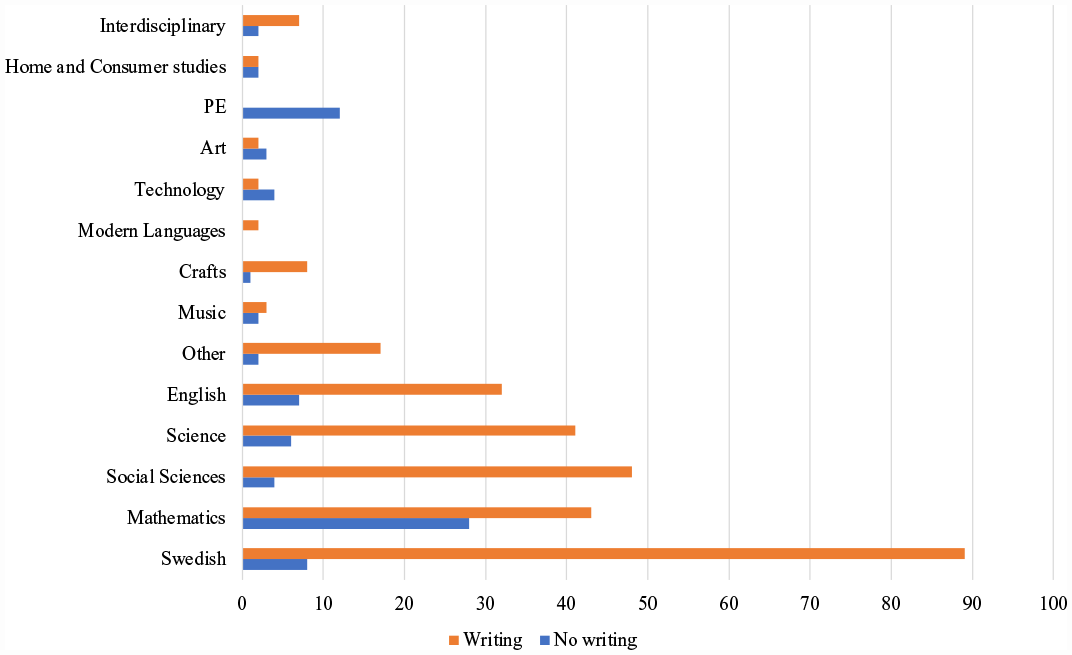
Frequency of lessons including and not including writing in different subjects.
The pupils mostly wrote in Swedish in all lessons, except English and Modern Languages where they commonly wrote in the language studied. Further, in four lessons some pupils in the class wrote in another language.
Teaching With a Single Focus and a Dual Focus
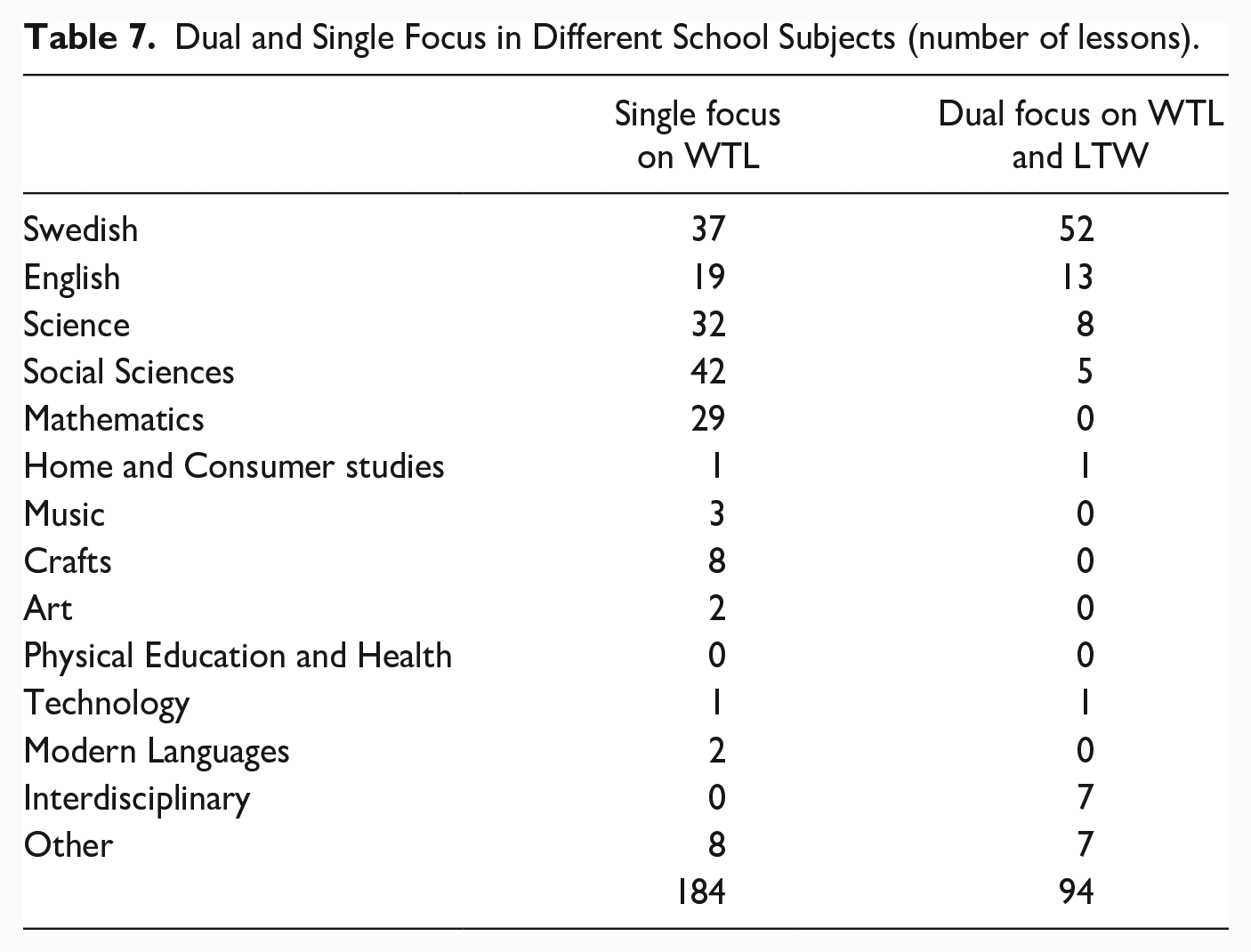
In 184 of the observed lessons, the teachers had a single focus on WTL, and in 94 of the lessons a dual focus on WTL and LTW (Table 7). The observers frequently commented on the lack of writing and teaching of writing 2 :
Dual and Single Focus in Different School Subjects (number of lessons).
It wasn’t the kind of writing I had expected, not so much cognitive processing for the pupils, more search and answer, search and answer. Mostly just short answers, two or three words /. . ./ They write incredibly little!
In the lessons including writing, there was a difference between the teachers’ single or dual focus in the school subjects. All lessons devoted more time to single focus than to dual focus with the exception of Swedish and the lessons coded as “Interdisciplinary.” In Mathematics, the teachers never were observed to have a LTW perspective.
Discourses of Writing
The most common discourse was a discourse for thinking and learning, identified predominantly as both dominating and supportive. Subsequent common discourses included skills discourse, social practices discourse, genre discourse, process discourse, creativity discourse, and sociopolitical discourse. As shown in Table 8, skills discourse and sociopolitical discourse are the discourses most occasionally identified.
Discourses of Writing Identified as Dominating, Supportive, and Occasional.
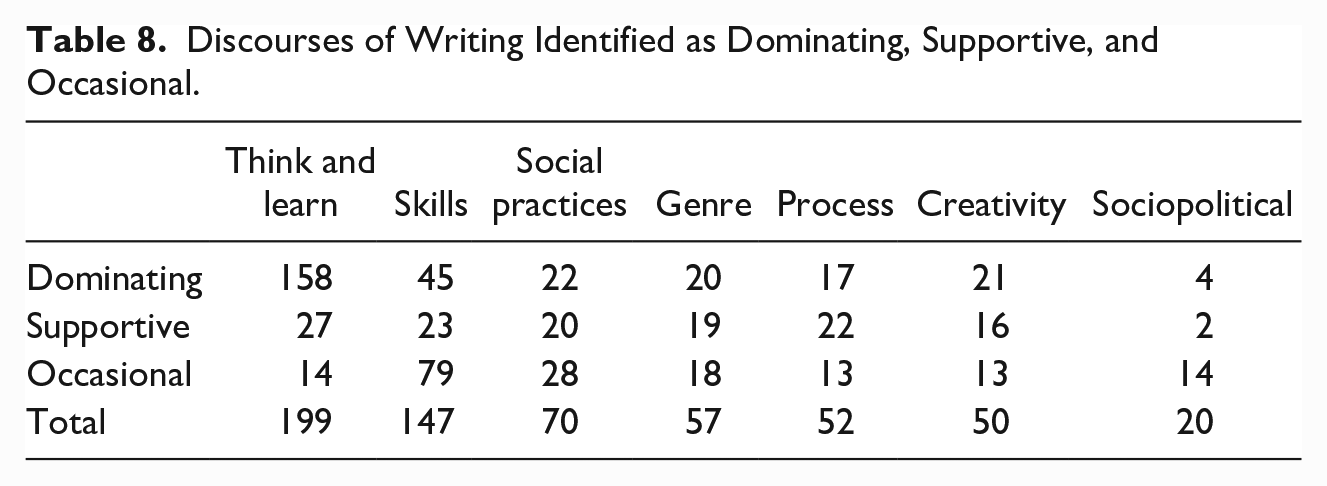
As pointed out by Ivanič (2004) observable pedagogic practices can be discoursally hybrid, drawing on two or more discourses. In this study, hybrid discourses with two equally enacted discourses in combination were identified foremost in a combination of a process and a genre discourse. Further, a combination of dominating, supportive, or occasional discourses was identified. In a dominating discourse, there was recurring strong evidence for the teacher enacting the discourse. In a supportive discourse, there was some evidence for the teacher enacting the discourse together with a dominating discourse. In an occasional discourse, there was some single evidence for the teacher enacting the discourse as part of the lesson or in the writing assignment.
Further, the same task can enact different discourses by teachers, consciously or unconsciously underpinned by certain ways of conceptualizing writing and how writing can be learnt (Ivanič, 2004). For example, writing letters enacted different discourses and was interpreted as enacting a skills discourse when the teacher talked about sentence structure, punctuation, and paragraphing; a combination of a process and a genre discourse when the teacher scaffolded models and structures for letters and scaffolded the writing process giving feedback during writing; and a social practices discourse when the pupils wrote letters to another class.
Teaching With a Single Focus on WTL
A single focus on writing to learn commonly embodies “show-you-know” writing, enabling the pupils’ content (WLC) or language (WLL) knowledge. As shown in Table 9, there was a concentration on content learning (80%) in all subjects but language subjects, in which, for example, the focus was on language learning (20%) through grammar or spelling activities.
WLC and WLL Across the Curriculum in a Single Focus on WTL.
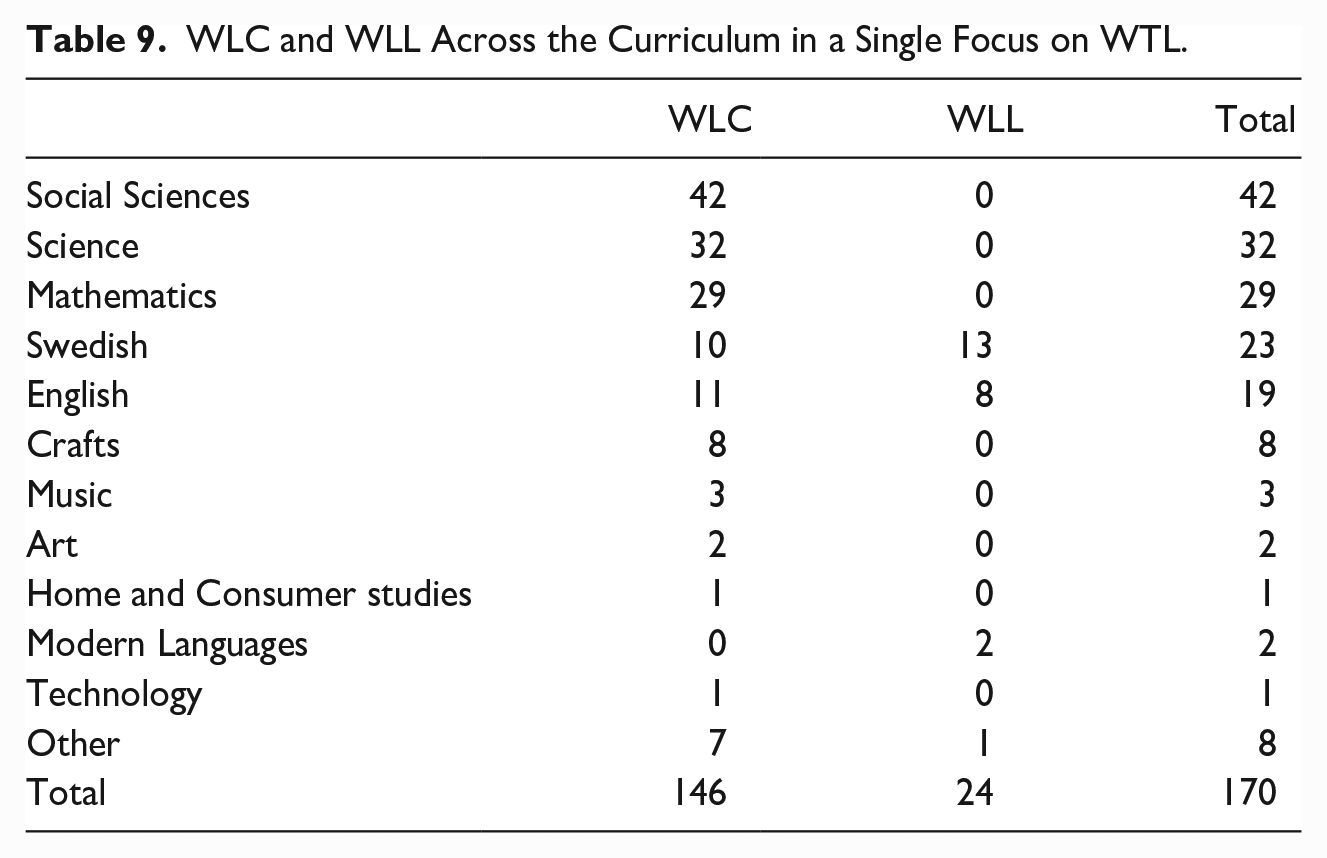
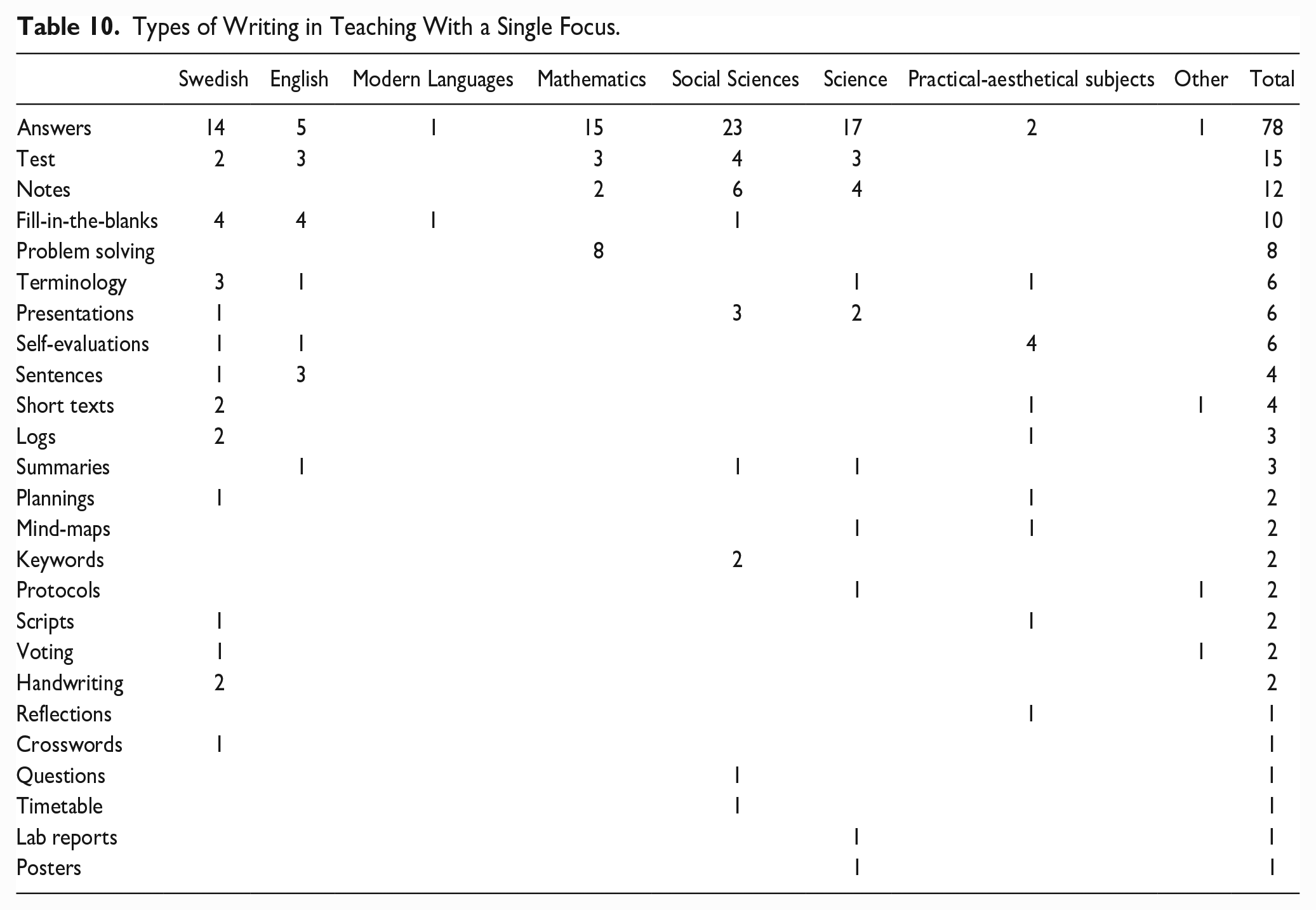
In a single focus on WTL, the teachers asked the pupils to write short texts or single words. Most common was writing answers to content questions, for example, in their workbooks (Table 10). Furthermore, taking notes, writing tests, terminology, fill-in-the-blank, and writing keywords were common activities in Language subjects, Mathematics, Science, and Social Sciences. In the practical-aesthetical subjects, writing self-evaluations and plans were most common. In some observations, the teacher consciously focused only on content learning, ignoring writing skills: “Correctness in the written text will not be assessed” (Crafts).
Types of Writing in Teaching With a Single Focus.
Discourses Enacted in Teaching With a Single Focus on WTL
When the focus was on WTL, three discourses of writing were regularly enacted as dominating (Figure 5): thinking and learning discourse, skills discourse, and social practices discourse. Occasionally, a creativity discourse and a sociopolitical discourse were enacted. In a single focus, hybrid discourses appeared less than in a dual focus.
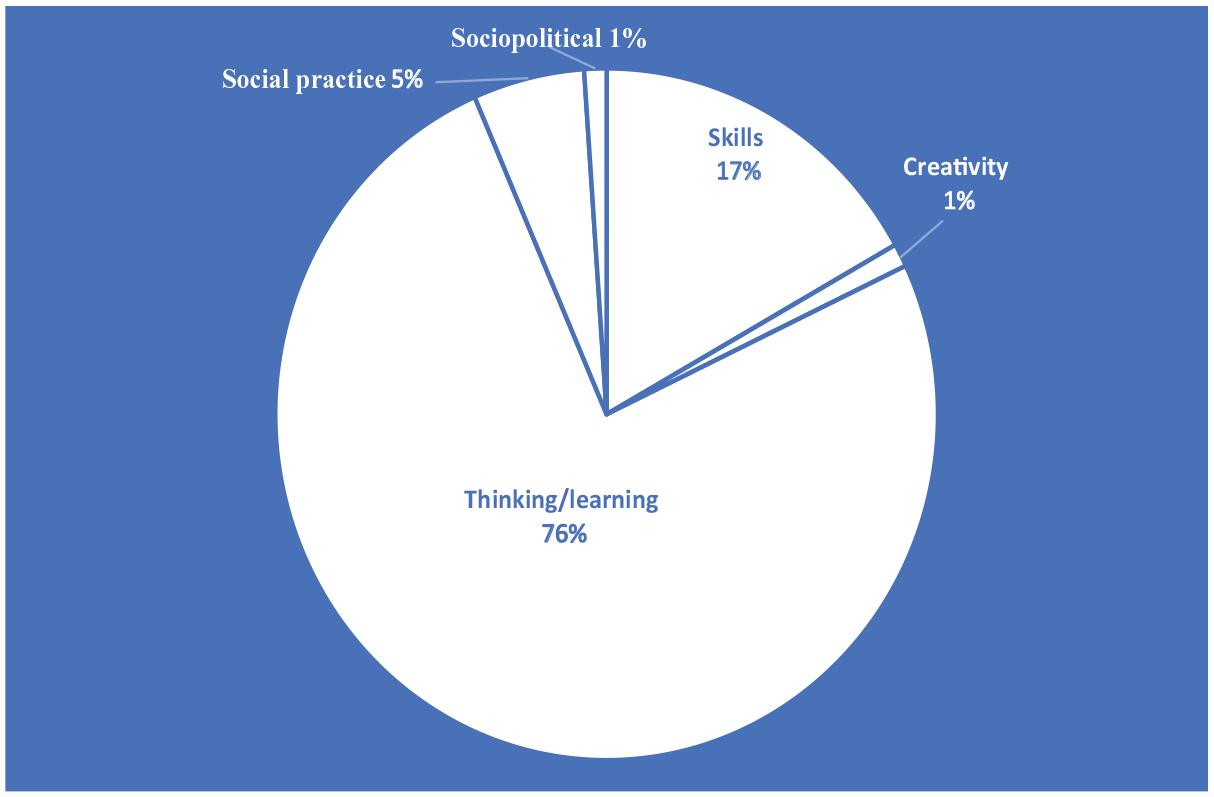
Discourses of writing enacted as dominating in lessons with a single focus.
Lessons where the teachers focused on writing for content learning, WLC, were strongly connected with a discourse for thinking and learning, especially in the school subjects Mathematics (100%), Social Sciences (89%), Science (80%), and practical-aesthetical subjects (93%). The teachers had a strong concentration on content learning and little focus on writing instruction, primarily asking their pupils to answer questions—for example, “Answer questions about the Alps. Short answers” (Science). In English and Swedish, a discourse for thinking and learning was enacted when the pupils wrote for content learning, including, for example, to practice reading and listening comprehension. Further, as shown in Table 9, the practical-aesthetical subjects had a stronger focus on reflections on the learning process, identified as “thinking” in discourse for thinking and learning, including writing planning, and self-evaluations, and reading logs.
Teachers in Science, Social Sciences, Swedish, and some practical-aesthetical subjects enacted social practices discourse when writing had a purpose for communication of content. Writing for sharing content within the classroom predominantly included preparing presentations and appeared in collaborative writing for content learning.
Writing for language learning, WLL, was identified in English, Swedish, and Modern Languages in relation to a dominating skills discourse. The pupils wrote mostly answers “with focus on correctness, sentence structure and punctuation” (Swedish), dictations and fill-in-the-blank exercises: “Worksheets with a or an. Fill-in-the-blanks” (English).
Teaching With a Dual Focus
A dual focus, concerned with both content knowledge, WTL, and the development of pupils’ writing proficiency, LTW, was rare in most subjects. Sixty-nine percent of the lessons with a dual focus were found in language subjects: Swedish (52 lessons) and English (13 lessons). A dual focus was also found in Science (8 lessons), Interdisciplinary and Other (7 lessons each), and Social Sciences (5 lessons) but was rare in the practical-aesthetical subjects (2 lessons).
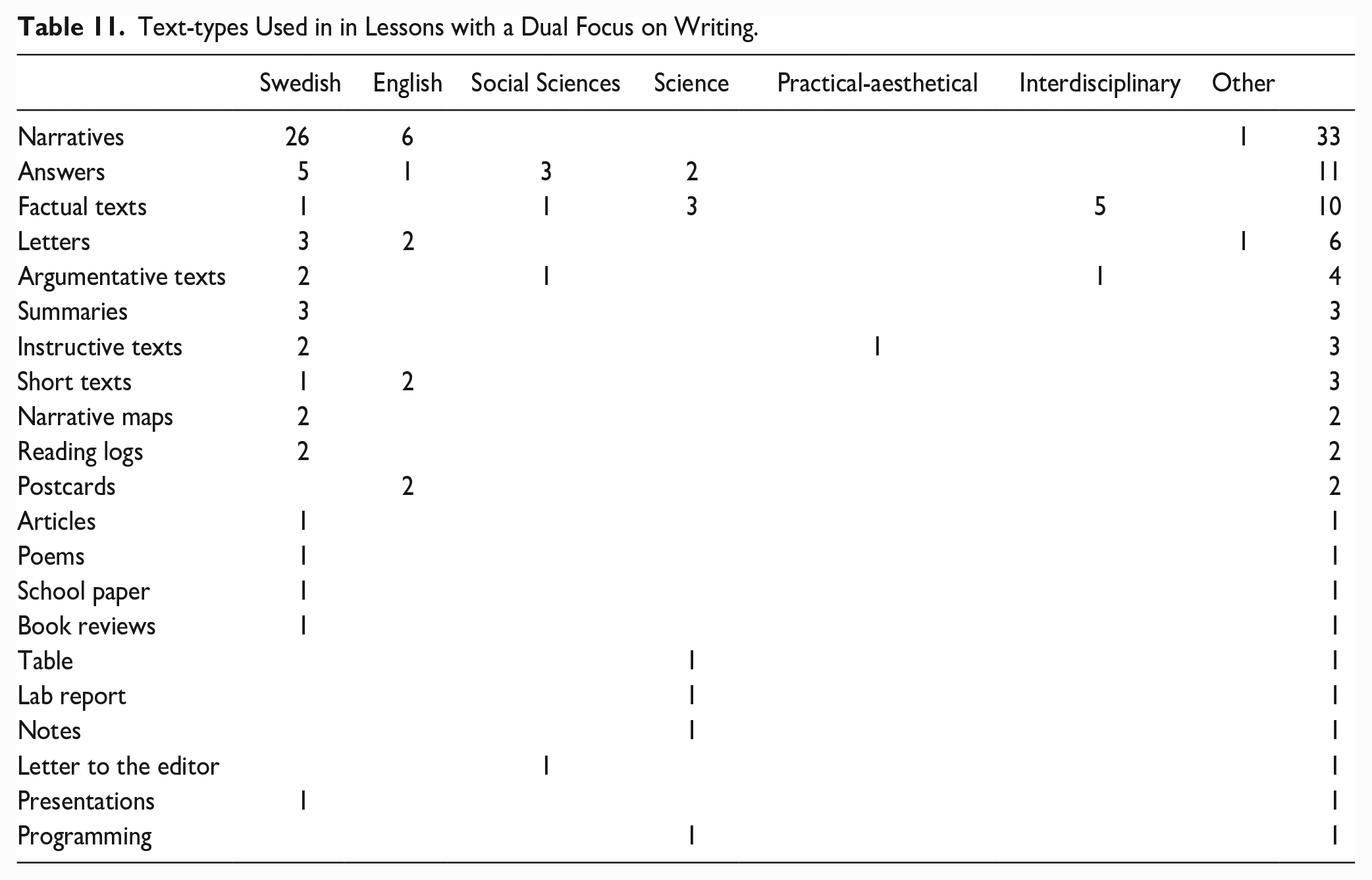
Similar to the single focus lesson, the dual focus lessons included many different text-types, as presented in Table 11. However, there was a great variation of distribution of text-types across subjects, with Swedish including the greatest variation of text-types. In language subjects, narrative texts were most common; in Social Sciences and Science, factual texts predominated, and the writing of longer texts was identified in most subjects: factual texts, argumentative texts, and letters. In a dual focus there were also examples of shorter texts—answers, notes, programming, and tables—where the teacher explicitly focused on developing pupils’ writing proficiency.
Text-types Used in in Lessons with a Dual Focus on Writing.
Discourses Enacted in Teaching With a Dual Focus
In teaching with a dual focus, all discourses of writing were enacted, and the dominating discourses were distributed quite evenly (Figure 6).
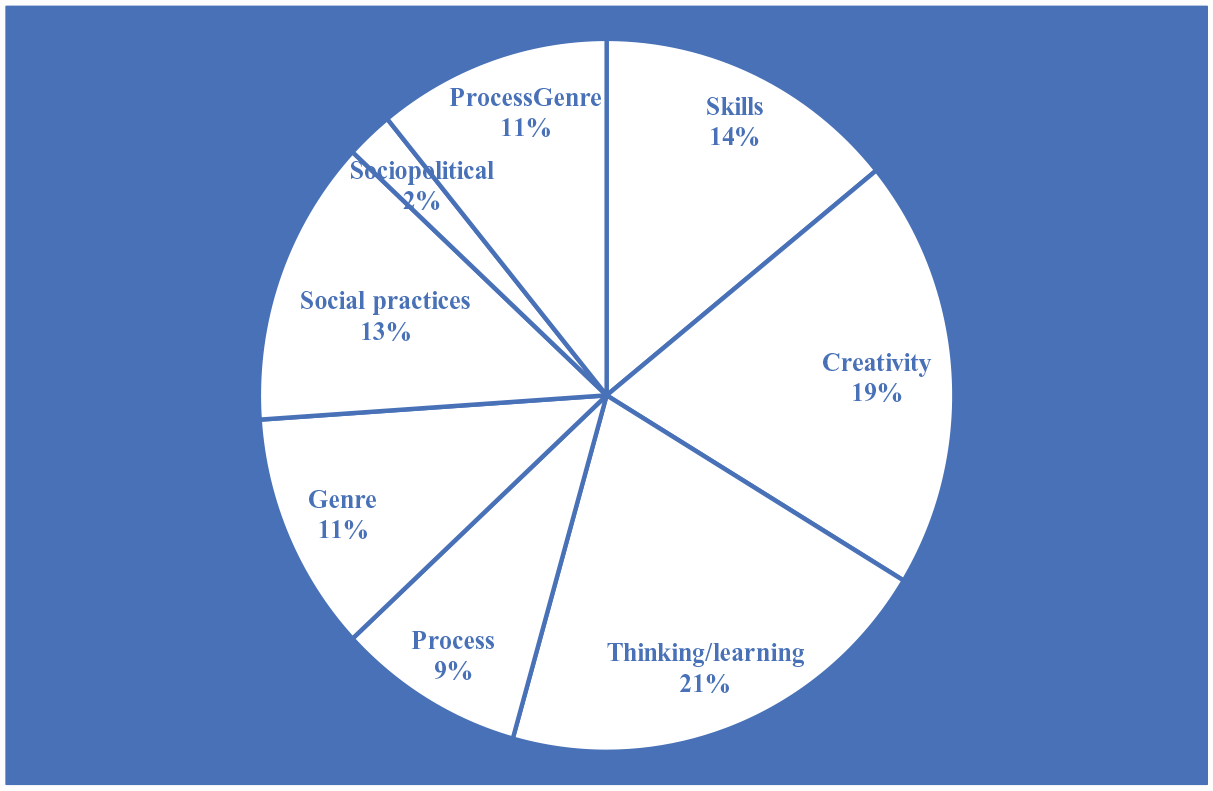
Dominating discourses visible in lessons with a dual focus.
In contrast to teaching with a single focus, teachers combining writing to learn and learning to write in their teaching predominantly enacted a hybrid of discourses—as a combination or as a hybrid of dominating, supportive, and occasional discourses. Commonly enacted was a combined dominating process and genre discourse, when teachers’ explicit instructions in writing strategies included a process approach to plan and models to revise to understand genre conventions.
A process and a genre discourse, or a combination thereof, were commonly enacted in Swedish and Interdisciplinary lessons, but also in English, Science, Social Sciences, and practical-aesthetical subjects. In Swedish and Interdisciplinary lessons, a process and a genre discourse were predominantly enacted in writing narratives, either as dominating or as supportive of a creativity discourse: “How the text-type is structured is explained and visualized in a model text. The pupils plan their texts using mind maps” (Swedish). A process discourse was identified in Swedish, English, Social Sciences and Interdisciplinary lessons as dominating when a practical writing process was executed, commonly in narratives but also in factual texts. A genre discourse was identified in Swedish, English, Science, and practical-aesthetical lessons when the teachers had a focus on how to write different text-types with appropriate form and language, explicitly taught by reading model texts.
Writing development incorporated into subject teaching that focused on clarifying thoughts and learning across the curriculum was interpreted as a discourse for thinking and learning. Content learning was salient in these lessons as was disciplinary knowledge, for example, literary analysis and reading comprehension (cf. Applebee & Langer, 2013). In Social Sciences and Science, the teachers commonly enacted a discourse for thinking and learning. Predominantly the pupils wrote factual texts, and answers to questions were also identified.
A discourse for thinking and learning was also enacted in Swedish and English, although most of the lessons with a dual focus on writing included writing narratives, primarily enacting creativity discourse. The teaching of writing was underpinned by beliefs that “writing has value in its own right” (Ivanič, 2004, p. 229) and that you learn to write by writing: “A lot of writing. The pupils write own stories inspired by a picture” (Swedish), and is seen as a mental process of meaning-making.
A skills discourse was enacted as dominating, supportive, and/or occasional discourse in all but practical-aesthetical subjects. A skills discourse was identified as dominating in Swedish, English, and Science lessons when the focus was on text, form, correctness, and development of writing skills on different levels. For example, in Science, a skills discourse was enacted when the pupils wrote answers or filled in tables and the teacher concentrated on how to write: “They cannot write short answers; they must give explanations and write full sentences and correctness (spelling, punctuation) is in focus” (Science).
A social practices discourse was enacted as dominating and supportive in English, Swedish, Science, and one practical-aesthetical lesson and one Interdisciplinary lesson. The pupils wrote to communicate and make meaning in real or simulated contexts—for example, letters to another class, their teacher, and Santa. English lessons often enacted a social practices discourse, and the written text was used in a classroom community, for example, presentations and collaborative writing. Hybrid discourses were identified in lessons with functional approaches and purposeful communication, e.g., when the pupils wrote letters and a school newspaper, they were scaffolded in their writing and the teacher corrected the texts before publishing them; the teachers were enacting a genre and a skills discourse.
In a multilayered view of language, the fourth layer is included only in a sociopolitical discourse, identified as dominating in a total of four lessons when pupils wrote to reason about sociopolitical questions. A sociopolitical discourse was most commonly identified in Social Sciences connected to subject content where writing put aspects of power and identity in the center.
Discussion
Exploring the teaching of writing across the curriculum, this study reaches three main conclusions. First, in the Swedish schools observed in this study, writing is used for content learning across curriculum, commonly with a single focus on WTL. Second, in a dual focus lesson with elements of both WTL and LTW, the pupils are offered a more holistic view of writing across the curriculum. The results reveal that discourses of writing that are rare in earlier studies in mother tongue education are more visible in other school subjects. Third, the teaching of writing is the concern of language teachers. In what follows, these findings will be discussed and reflected upon.
Based on an analysis of the observational data, the results show that writing is a common activity in the Swedish middle school classroom; pupils in grades 4-6 wrote in three of four lessons. Pupils wrote in most subjects, though the teaching predominantly had a single focus on writing to learn content and language, rather than a dual focus on writing to learn and learning to write, including both writing to master curriculum content and to develop writing proficiency. Hence, relatively little lesson time was devoted to activities designed to develop pupils’ writing proficiency. In line with earlier studies, single-focus writing activities in this study emphasized short writing activities, rehearsing and reproducing knowledge (cf. af Geijerstam, 2006; Applebee & Langer, 2013; Lindh, 2019), which contributes to discipline knowledge, but arguably gives less understanding than more challenging exercises (cf. Applebee & Langer, 2013; Coffin, 2013). Hence, writing in school predominantly is a writing for school activity (cf. Berge, 1988). Further, lessons with a single focus predominantly enacted a discourse for thinking and learning, which does not focus on writing per se but rather on using writing as a tool for content learning. Therefore, this single-focus dominance enacted by a discourse for learning in all subjects except for language subjects where a skills discourse dominated might be understood in relation to a teaching paradigm with connections to a test regime, where evaluation of students’ knowledge is foregrounded and teachers are bound to “teach-to-the test” (Krogh & Penne, 2015; Lindh, 2019; Sturk et al., 2020). In addition, teaching with a single focus seems to contribute to a narrower view of writing, where the context and the rhetoric situation as well as the writer’s identity and voice is downplayed. Further, in lessons with a single focus, one discourse was identified, while lessons with a dual focus visualized both a dominating discourse and supportive discourses (cf. Blikstad-Balas, 2018; Ivanič, 2004; McCarthey et al., 2014; Sturk & Lindgren, 2019).
This application of Ivanič’s framework across the disciplines identifies a more holistic use of writing and more challenging writing exercises when the teachers had a dual focus on writing—that is, where learning to write was combined with content learning across the curriculum. It has been argued that writing as a powerful tool for learning requires struggling with texts (Bazerman, 2009). When writers struggle to say something in a text, the work of formulating, reformulating, and reconfiguring can move the writer to a new stage of thinking, provide new perspectives, and develop learning (cf. Bazerman, 2009). As a result of this struggle, new ideas can be made more explicit and new connections drawn to the learning content (cf. Applebee & Langer, 2013). Still, few lessons observed in this research involved struggling with texts in subjects other than language subjects. Nevertheless, in Science and Social Sciences and some other subjects, there were examples of teachers having a dual focus on writing, enacting different discourses, commonly in combination. The results also reveal that the teachers draw on different discourses in different subjects. We will discuss two examples of such discoursal writing. First, in contrast to earlier studies on mother-tongue education, where a social practices discourse has scarcely been enacted (McCarthey et al., 2014; Sturk & Lindgren, 2019), a social practices discourse was more widely enacted, mostly in lessons in English, but also in Swedish, Social Sciences, and Science. This can be understood in relation to the curriculum; the syllabi in English and Science include writing for communication. Second, practical-aesthetical subjects have been theorized with knowledge demands on understanding and reflecting (Skolverket, 2018). In this study, the teachers in practical-aesthetical subjects commonly enacted a discourse for thinking when writing was included in the lessons, offering the pupils cognitive and metacognitive strategies that can enable learning during writing (Bangert-Drowns et al., 2004). This kind of writing is argued to help students maintain their knowledge outside school (cf. Behrman, 2004). Pupils also wrote in lessons where interdisciplinary education was focused. In these lessons, a dual focus on writing dominated. However, interdisciplinary writing merits further investigation. Furthermore, in this study, teachers having a dual focus commonly enact a combination of discourses.
A salient combination, especially in mother-tongue education, is a merger of a process and a genre discourse (cf. Blikstad-Balas et al., 2018; Smidt, 2009). This combination can be understood in relation to the curriculum and school material as important aspects for the construction of the teaching of writing. In the Swedish curriculum a process discourse is declining in favor of a genre discourse, and in schoolbooks a genre and a process discourse are commonly combined (Sturk et al., 2020). Further, a commonly enacted skills discourse is supported by a spectrum of discourses. In recent research in relation to participatory writing, skills such as spelling and grammar are emphasized as important writing competences for being a trustworthy writer (Boström et al., 2022). In this study, this is reflected by teachers when their pupils will be published or read by someone except the teacher. Previous studies have stressed that a stronger focus on a skills discourse that targets grammar and other areas of linguistic usage could be used to enhance the teaching of writing in subjects other than Swedish (cf. Coffin, 2013; Myhill, 2019).
However, coinciding with earlier research, the results reveal that sociopolitical aspects are seldom foregrounded in the teaching of writing, and a sociopolitical discourse is rarely enacted (cf. Sturk et al., 2020). In the Swedish curriculum, democratic aspects are emphasized as fundamental values in overall goals and aims, though not explicitly in relation to writing and core content and knowledge requirement. This has consequences for the pupils, when education is more concerned with learning about democracy than learning through democracy, developing critical writing skills (cf. Berge & Stray, 2012).
The results show that teachers across the curriculum use a dual focus on writing regardless of subject, though not as common as in language subjects. When pupils meet a dual focus on writing, they are offered a broad repertoire of writing—as text, as cognitive processes, as writing event, and as communication in a sociopolitical context—and opportunities to develop their writing proficiency and writer identities (Ivanič, 2017). Scaffolded writing occurred mostly when the pupils wrote narratives, factual texts, and argumentative texts—texts that Applebee and Langer (2013) identify as longer texts. There are, however, also examples of a dual focus on structured notetaking, strategies for writing short answers, and strategies for writing summaries aiming at developing the pupils’ writing of those types of texts. Hence, also by struggling with shorter texts, the writer finds ways of thinking, and ultimately remaking knowledge in the subject and about genre-specific writing within the subject. In relation to an increasing text focus in school year 4 (Egelström, 2019; Chall & Jacobs, 2003), there is a potential in the examples of teachers having a dual focus found in different subjects, where the teachers not only tell the pupils what to write but also focus on how to write within the subject (cf. Applebee & Langer, 2013; Coffin, 2013; Westman, 2013).
As I have already emphasized, the teaching of writing and teaching to develop writing proficiency is predominantly done by teachers in language subjects. The teachers’ use of writing can be understood in relation to policy “to steer teachers’ decisions regarding what, when and how to teach writing” (Jeffery & Parr, 2021, p. 5). In accordance with the curriculum, the pupils wrote less in practical-aesthetical subjects and most in language subjects. Furthermore, in line with recent research, the teachers in this study seem to attribute different functions to writing in different subjects, and to connect different types of writing to different subjects (Egelström, 2019). In Sweden, teachers in early years are generalist teachers, that is, they teach most subjects in their classes. In school years 4-6, there are both generalist teachers and subject teachers. Earlier studies indicate that the more holistic view of the teaching of writing among teachers in school years 1-3 is linked to their status as generalist teachers (Sturk & Lindgren, 2019). To what extent this explanation is valid also in school years 4-6 across the curriculum needs further investigation.
In sum, the findings have implications for the curriculum, teacher education, and teachers themselves. For teachers in all subjects, a stronger focus on development of pupils’ writing in the curriculum, in teacher education, and in teachers’ disciplinary work could facilitate a fruitful use of a dual focus on writing.
Limitations
The study design has limitations with many observers, generating different angles of the classrooms. Concerning quality of the observations, there is a risk of inconsistence with so many observers involved. To strengthen the reliability of observer scores, all student teachers were trained by the researcher. Fidelity must be seen in relation to the link between the observers who observed a teacher who had been their field placement teacher. Further, as they were part of a course, the observers were obliged to observe within a time frame of a few days, and some classes had nontypical school days. On the other hand, some of the observers reported that the teachers had done their best to show as much teaching of writing as possible. In studying the teaching of writing during a school year, all these perspectives provide useful data. With this said, the practical-aesthetical subjects had a smaller sample; thus, their validity was lower. From the results given, with the relatively low frequency of a dual focus, further investigation is needed to explore detailed information on what things teachers do when they teach writing. One methodological limitation of this study is the lack of textual data in the form of student writing. Future research could explore the teaching of writing further by going into classrooms, recording lessons and writing activities, and collecting samples of pupils’ texts. Further analysis might be useful to explore the limitations of teaching with a single focus and the benefits of a dual focus.
Conclusions
This study points out the potential of middle school teachers having a dual focus on writing across the curriculum, focusing both writing to learn and the pupils’ writing proficiency development. The study reflects suggestions on how to achieve a dual focus across the curriculum in Swedish compulsory school. First, writing is rarely mentioned in the curricula for nonlanguage subjects: teachers can reasonably claim that they are doing what the curriculum requires. If writing proficiency is an entrance ticket to higher education (cf. Donahue, 2021), it needs to be more pronounced in the Swedish curriculum. Further, the method used with student teachers as observers has benefits for student teachers who gained insights in how writing is enacted across the curriculum, and tools to reflect on practice from a theoretical framework (Ivanič, 2004, 2017; cf. Staal Jenset & Blikstad-Balas, 2021). Hence, development of the teacher education program with a focus on the teaching of writing across the curriculum is relevant. Moreover, moving the teachers in practice from single focus to dual focus involves a challenge to discipline conventions and a change of mindset for the teacher. If this could be accomplished, writing across the curriculum could enhance the teachers’ awareness of the relation between learning and writing and the possibility of enabling learning and understanding content by struggling with writing texts—giving the pupils access to further education and a democratic right to be a writing member in society (cf. Brandt, 2015; Donahue, 2021). Finally, when writing in school becomes writing for school rather than a teaching of writing promoting thoughtful and participating citizens, “no democracy can remain stable” (Nussbaum, 2012, p. 10). We need a school where writing is the norm across the curriculum to foster thoughtful citizens with critical thinking and writing ability who are prepared for higher education, work, and future citizenship.
Footnotes
Appendix 1
Declaration of Conflicting Interests
The author declared no potential conflicts of interest with respect to the research, authorship, and/or publication of this article.
Funding
The author disclosed receipt of the following financial support for the research, authorship, and/or publication of this article: Umeå University and The Swedish Reserach Council (VR 2018-3779).
