



Abstract
Various forms of proofreading of student writing take place in university contexts. Sometimes writers pay freelance proofreaders to edit their texts before submission for assessment; sometimes more informal arrangements take place, where friends, family, or coursemates proofread. Such arrangements raise ethical questions for universities formulating proofreading policies: in the interests of fairness, should proofreading be debarred entirely or should it be permitted in some form? Using questionnaires and semistructured interviews, this article investigates where three university stakeholder groups stand on the ethics of proofreading. Content lecturers, English language tutors, and students shared their views on the ethics of various lighter-touch and heavier-touch proofreader interventions. All three parties broadly approved of more minor interventions, such as correcting punctuation, amending word grammar, and improving sentence structure. However, students were found to be more relaxed than lecturers and language tutors about the ethics of more substantial interventions at the level of content. There were outliers within each of the three groups whose views on proofreading were wide apart, underscoring the difficulty of formulating proofreading policies that would attract consensus across the academy. The article concludes by discussing the formulation and dissemination of appropriate, research-led proofreading guidelines and issues for further exploration.
Introduction
This article explores the perspectives of three parties—university content lecturers, English language tutors, and students—on the ethical acceptability of various types of “proofreading,” from light-touch highlighting of typographical and grammatical errors at one extreme to substantial rewriting and content interventions at the other.
In the UK context in which this study is situated, university student writers may seek the help of a third-party “proofreader” to improve their text before submission for assessment. As Harwood et al. (2009) describe the situation in the United Kingdom, writers may be encouraged by lecturers to have their work proofread, or they may themselves feel the need to have their work read. Whichever is the case, in many universities, proofreaders’ adverts can be found around campus. Alternatively, some universities offer a free in-house proofreading service, such as the one in the University of Essex’s sociology department described in Harwood et al. (2009). Furthermore, although classic university writing center policy debars proofreading (see North, 1984), some writing centers offer it in some form (see Liu & Harwood, 2022a, 2022b). Students may additionally access proofreading from friends, peers, and relatives, or use one of the many paid-for proofreading services available online.
Researchers have focused on various perspectives and issues in their investigations of proofreading to date. For instance, there have been investigations into proofreaders’ practices working with writers seeking to publish their work (e.g., Bisaillon, 2007; Burrough-Boenisch, 2003; Lillis & Curry, 2010; Luo & Hyland, 2016, 2017; Mauranen, 1997; Willey & Tanimoto, 2013, 2015), a different context from the student writing context in focus here. Focusing squarely on the student writing context, there have been investigations of the work of commercial proofreading agencies, the knowledge and competence of proofreaders, and the types of (frequently unethical) intervention requests students make of proofreaders (Lines, 2016). And there have been investigations located in university writing centers, which traditionally claim to eschew proofreading (see Brooks, 1991; North, 1984), to determine the extent to which writing center tutors do or should in fact proofread (Clark & Healy, 2008; Eckstein, 2013; LaClare & Franz, 2013; Mack, 2014; Moussu, 2013; Moussu & David, 2015; Liu & Harwood, 2022a, 2022b).
Of particular relevance to the present research, however, are investigations concerning the degree to which understandings of “proofreading” are stable and consistent—in particular, those studies that solicit the views of proofreaders as to how far they should and do intervene, and which examine samples of their interventions. Evidence of proofreaders’ varied practices is also found in other contexts. For instance, in Kruger and Bevan-Dye’s (2010) South African questionnaire-based study, the authors described a range of lighter to heavier interventions under four headings (copyediting, stylistic editing, structural editing, and content editing, following Mossop, 2007), asking proofreaders of student writing how acceptable these interventions were. While there was broad agreement that the majority of the copyediting and stylistic editing tasks were acceptable and that the majority of structural and content editing interventions were not acceptable, there were disagreements with regard to the acceptability of proofreading reference lists, reordering sentences and paragraphs, and deleting content. The greatest disagreement concerned “rewriting sections of the text to improve the style” (p. 161).
Such differing practices have implications for the formulation of proofreading policies, as the studies cited above show that some proofreaders are prepared to intervene far more than others. Yet policymakers will also wish to understand the views of other relevant stakeholders regarding the ethics of proofreading in general, and regarding a range of different interventions in particular. Hence we would do well to ask: What degree of consensus is there between and among stakeholder groups, and how straightforward or problematic will formulating consensual proofreading policy be? The framing of this article around the ethics of proofreading, then, references the fact that different proofreaders may decide to intervene in a text more than others, offering writers differing degrees of feedback. Given that writers will subsequently submit their work for assessment, different proofreaders’ help could have a greater or lesser impact on the grade awarded, leading to questions about fairness and to debate about the extent to which it is permissible for third parties to intervene in (purportedly) single-authored work.
Before looking more deeply at pro- and anti-proofreading arguments and at previous empirical research on proofreading, I add a word on terminology here for clarity. Although some practitioners and researchers differentiate between what they would see as lighter-touch forms of intervention (“proofreading”) and heavier-touch “editing” (see Flower et al., 1986; Haugen, 1990), it is clear from the discussion so far that “proofreading” can serve as a shorthand but nebulous and contested term for a range of lighter- to heavier-touch interventions in student writing. Given the weight of evidence pointing to widely varying practices carried out in the name of “proofreading,” I adopt Harwood et al.’s (2009) broad definition of “third-party interventions (entailing written alteration) on assessed work in progress” (p. 166). I also retain the contested terms “proofreader” and “proofreading” as terms of convenience as they are the most commonly used labels to describe third parties and their textual interventions in the UK context of the present study (see Harwood et al., 2009, for evidence of this). Choosing such a broad definition that encompasses light- and heavy-touch interventions alike is appropriate when previous research suggests that respondents may have different conceptualizations of what it is ethically acceptable for proofreaders to do.
Arguments For and Against Proofreading
In this section, I draw upon two particularly pertinent publications, Harwood (2019) and McNally and Kooyman (2017), to sum up various arguments for and against proofreading. Those who take an anti-proofreading stance point to the expectation that students graduating from an English-medium program will possess a good level of English language competence and will be able to communicate their ideas clearly. Associated with anti-proofreading views, therefore, are the ideas that proofreaders inflate grades and mask students’ inadequate writing ability (see Baty, 2006; McKie, 2019; Scurr, 2006).
Furthermore, critics of proofreading point out that services are unregulated and that there are many unscrupulous operators (see Aitchison & Mowbray, 2016, and Lines, 2016, for worrying evidence of the proliferation of parties offering substantial rewriting and ghostwriting). Indeed, McKie (2019) raises the possibility of proofreading services serving as “gateways” to ghostwriting services. There are also unsettling anecdotal accounts of L2 students providing “proofreaders” with essays in their first language for translation into English (see Matthews, 2013).
Those harboring anti-proofreading views worry that all of these interventions will impact markers’ assessment of writers’ work: will markers be able to detect (or prove) the hand of a third party in the text? If not, the marker will in effect be assessing the proofreader’s work in combination with the writer’s: . . . the final reader/marker, unaware of the nature and degree of external intervention in the final version, will award a grade that does not accurately reflect the student writer’s real ability. (McNally & Kooyman, 2017, p. A-147)
And given that research like Harwood (2018) and Kruger and Bevan-Dye (2010) shows that different proofreaders intervene to differing degrees, there is much potential for different writers to have their work proofread differently, with tangible effects on the grades they receive: those students employing a proofreader prepared to intervene more radically may experience a greater uplift in their mark compared to a fellow student who employs a proofreader who is only prepared to engage in lighter-touch interventions. However, even if the proofreader has only taken a light-touch approach to interventions, merely cleaning up problematic grammar and syntax, she or he could still impact the assessment, since some marking criteria reference accurate language and diction, and some disciplines/disciplinary assessment rubrics appear to place more emphasis on correct language use than others (Errey, 2000; McKie, 2019).
Finally, critics of proofreading worry that students will fail to reflect upon and learn from their proofreader’s interventions. Students may want the proofreader to quickly fix their work and may anticipate they will be presented with a polished product that requires no further work or reflection: as one of the proofreaders interviewed by Harwood et al. (2012) claimed, “People pay a proofreader to make mistakes go away, not necessarily to learn from them” (p. 577; and see Corcoran et al., 2018, who speak of students who resist attempts to make proofreading educative). Those students buying their way to fluency (Scurr, 2006) may successfully graduate only to run into difficulties upon securing employment in English-speaking workplaces, where they will be without the support of a proofreader and be unable to write to the required standard. 1
In contrast, those sympathetic to proofreading often see it as potentially educative, arguing that many of today’s student writers are in need of enhancement of their academic literacy. McNally and Kooyman (2017) claim the fact that Western universities are admitting students with lower levels of academic literacy than were formerly required means these institutions have a responsibility to offer a substantial program of support. Rather than writing centers debarring proofreading, thereby encouraging students to approach unscrupulous “proofreaders” external to the university, writers could be offered an in-house, safe space where they can benefit from proofreading founded on educative principles (Corcoran et al., 2018). Using this formative approach, proofreaders could then educate writers not only about points of grammar and syntax but also about academic and genre conventions. Hence one of the roles a proofreader can play is that of teacher (Harwood et al., 2012). Rather than allowing the writer to play a passive role in the proofreading process, hitting “Accept all” in response to the proofreader’s interventions delivered via Microsoft Word’s Track Changes, proofreading can be conducted in a pedagogically focused manner: Proofreading as part of a collaborative process can reveal gaps and weaknesses in the writer’s grammar and syntax, and offer “teachable moments” and learning opportunities that provide valuable individualised feedback. (McNally & Kooyman, 2017, p. A-149)
Extending McNally and Kooyman’s argument, we can envisage various types of educative interventions. For instance, proofreaders may choose only to correct a part of the writer’s text and have the writer attempt to correct the rest. Alternatively, proofreaders could decide to use indirect or metalinguistic correction techniques rather than direct ones (see Ellis, 2009): rather than merely supplying the correction, the proofreader could use correction symbols, underlining, and/or insert grammatical guidance about the use of the language point that is causing the writer to make errors. The onus would then be on the writer to develop his or her understanding of this language and remove the errors when revising the text.
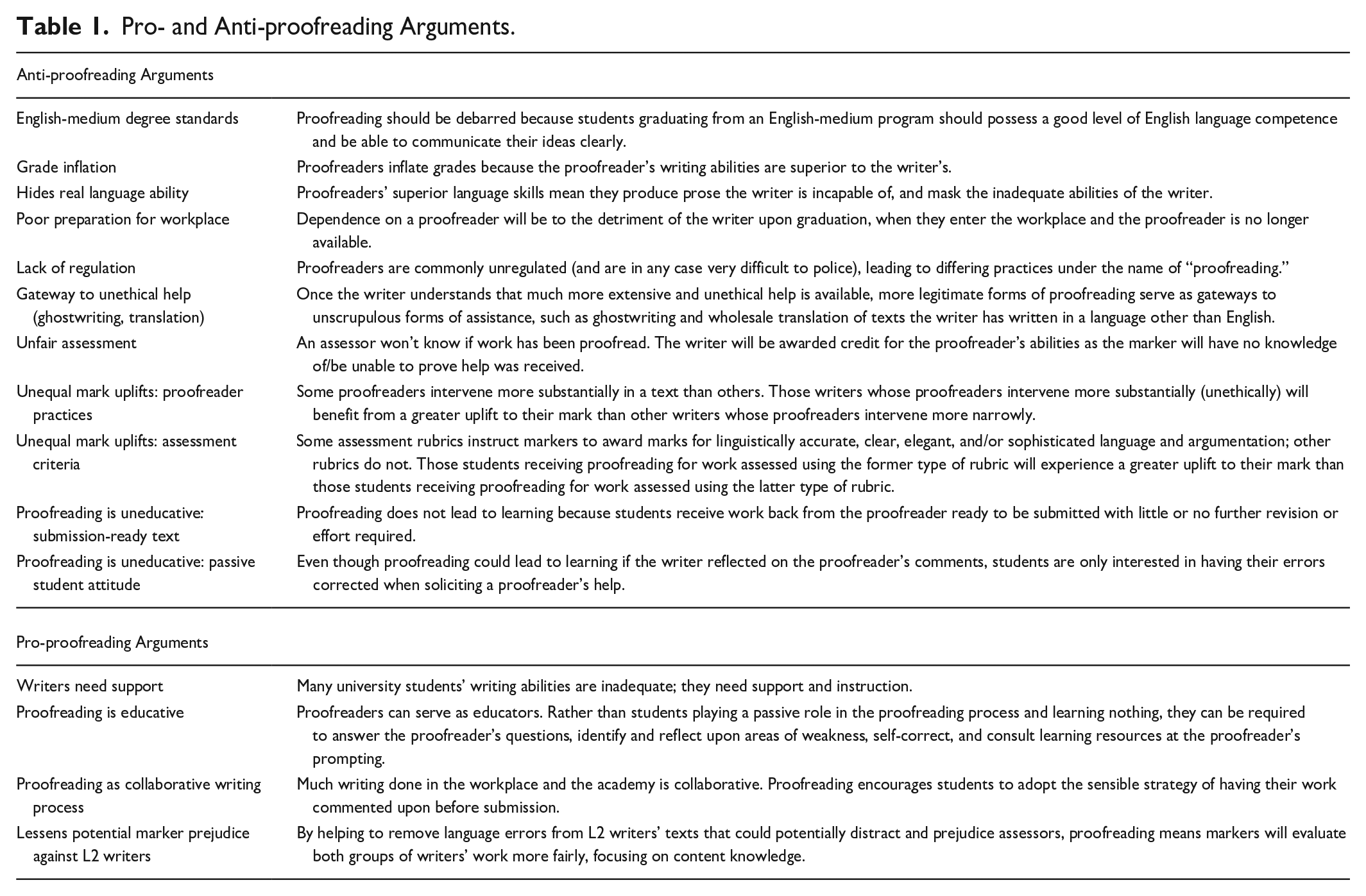
Other pro-proofreading arguments include the idea that proofreading is really a form of collaborative writing, providing good preparation for the experience of workplace writing, where texts are commonly authored in teams. And Budenz (2007) asks why, if some writers can ask their “kind native-speaking friend” to look over a text, other writers who have no access to such a friend should be denied the opportunity to pay a proofreader to do the same thing? Indeed, such thinking promotes the idea of the proofreader as “leveller” (see Harwood et al., 2012), helping L2 students access proofreaders who are outside of their social networks and lessening their disadvantage in comparison to L1 writers. Similarly, another pro-proofreading argument commonly made is that academics looking to publish work may ask colleagues to proofread work pre-submission, and therefore to debar students from doing the same can seem unjust. The various pro- and anti-proofreading arguments described above are summarized in Table 1. In sum, both pro- and anti-proofreading views have attracted support, and we shall explore these views further in a more detailed review of the literature below.
Pro- and Anti-proofreading Arguments.
I next review key empirical studies of proofreading, concentrating on work that investigates the perspectives of the three groups in focus in my own research—lecturers, English language tutors, and students. For reasons of relevance and space, my review of the literature focuses on research on the proofreading of student writing, rather than including research on the editing of writing by L2 scholars for publication. For examples of research on the latter, see for instance Burrough-Boenisch (2005); Flowerdew and Wang (2016); Li (2012); Lillis and Curry (2010); Luo and Hyland (2016, 2017); Martinez and Graf (2016); and Willey and Tanimoto (2012, 2013, 2015).
The Views of Lecturers, English Language Tutors, and Students on Proofreading: Empirical Studies
I begin this section by reviewing important studies that compare and contrast the views of two or more university stakeholder groups on proofreading.
Kruger and Bevan-Dye’s (2013) study compares the views of South African proofreaders and postgraduate supervisors on the ethically appropriate parameters of proofreading. The same questionnaire-based approach was used as for Kruger and Bevan-Dye’s (2010) study of proofreaders’ attitudes cited above. Lecturers and proofreaders mostly agreed that more substantial structuring and content interventions were inappropriate for proofreaders to make. But there was disagreement about lighter-touch copyediting and stylistic changes, lecturers being “much more conservative” (p. 888) as to how far proofreaders should go. Furthermore, there were varied opinions within each group as to the ethical acceptability of both lighter- and heavier-touch interventions, including correcting reference lists, reordering sentences and paragraphs, checking for plagiarism, checking facts and statistics, and deleting unnecessary content. Proofreading interventions that both parties agreed were acceptable were “extremely restricted . . . , limited only to the most basic copyediting tasks” (p. 894). In sum, then, only the lightest-touch interventions would seem likely to secure the approval of lecturers, different stakeholders may have differing opinions as to the most ethically acceptable form of proofreading, and these differences manifest themselves both within and between groups, raising important—and knotty—considerations for university policy makers. A limitation associated with Kruger and Bevan-Dye’s study is that they did not interview their respondents, meaning we cannot ascertain why their respondents felt the way they did. An alternative research design, therefore, would be a mixed methods approach that combines the insights provided by a quantitative investigation of views on proofreading with a qualitative approach, enabling in-depth exploration of stakeholders’ attitudes toward proofreading.
McNally and Kooyman (2017) compared and contrasted the views of lecturers, language tutors, and students (the three parties that I focus on in this article) at a private Australian university, providing examples of proofreaders’ interventions for respondents to rate in terms of appropriacy. Their questionnaire was completed by 59 students and 30 academics (a combination of disciplinary faculty and English language tutors). Minor copyediting interventions, such as proofreaders pointing out missing commas, proved uncontroversial. There was also broad agreement when it came to less directive interventions, where the proofreader merely indicated a problem but stopped short of supplying the writer with the answer, with large proportions of each group feeling these interventions did not go far enough. However, students were more relaxed than the lecturers/English language tutors about directive comments in which the proofreader suggested rewrites (“This is confusing. Do you mean, ‘affected by prolonged high temperatures because fewer people participate . . . ’?” p. A151). In sum, then, the results suggest that while lecturer/tutor and student views “are not radically divergent” (p. A155), “there is still significant confusion and dissent over what level of proofreading is acceptable” (p. A154). Like Harwood et al.’s studies (e.g., Harwood et al., 2010, 2012), these disagreements suggest the boundaries of the proofreading term are contested and that “‘proofreading’ is a fluid and flexible word that can ultimately encapsulate a range of activities,” meaning that there is a need “for clarity in defining the exact parameters of proofreading at an institutional level” (p. A154).
There are a number of limitations associated with McNally and Kooyman’s study, however. McNally and Kooyman’s results for disciplinary faculty and English language tutors were combined for analytical purposes, meaning the researchers do not investigate whether the views of these two parties align. Furthermore, participants were shown only 10 examples of proofreader interventions, limiting the insights obtained. And although participants were provided with example proofreader comments, they were not provided with the relevant excerpts from the writers’ texts that proofreaders were responding to. Hence, a fuller context is lacking, meaning respondents were obliged to make their judgments in something of a vacuum. Finally, as with Kruger and Bevan-Dye’s study, because McNally and Kooyman rely on the questionnaire method, we are not provided with deeper, richer insights into the respondents’ attitudes or reasoning that alternative methods, such as interviews, could provide.
More differences between and among lecturers and students can be seen in another questionnaire-based study conducted by Kim and LaBianca (2018). The researchers asked 64 staff and 96 international L1 and L2
2
students at their American university to judge the ethicality of students’ behavior in various hypothetical situations, including some involving proofreading. Quantitative responses were obtained using a Likert scale format, but some qualitative responses were also obtained by including “an optional comment box” after each situation in which respondents could explain their reasoning. Kim and LaBianca also compared student responses by controlling for nationality, and found that East Asian (Chinese and Korean) students believed some situations to be ethically more acceptable than Western students, which suggests cultural factors may explain some of the divergence in students’ opinions regarding the acceptability of various types of proofreading help. However, there were also disagreements among lecturers as to how far proofreaders should go, as in a scenario that describes a more substantial form of proofreading, where the proofreader “reorganizes the writing, tightens up the flow of argument, and rephrases sentences for clarity and accuracy” (p. 57). There was also evidence of ethical unease among lecturers about proofreading, as seen in the response below from a lecturer who allows L2 PhD supervisees to seek paid-for proofreading but has misgivings about doing so: Honestly, I often accept this from ESL participants who are writing [theses], but I am not comfortable with it. In my view, earning a PhD means that a student becomes capable of conducting adequate research projects independently, including writing them up for publication. (Kim & LaBianca, 2018, p. 54)
The same unease on the part of disciplinary faculty is also found in Alkhatib’s (2019) study of lecturers’ stances toward proofreading in five different UK universities. The majority (83%) of lecturers declined to require their L1 and L2 postgraduate students to seek out proofreading because of (a) the financial burden of paying for the service; (b) ethical concerns that the proofreader would change the writer’s intended meaning; and (c) the wish for students to self-proofread and improve their literacy themselves.
Bringing together qualitative data mainly consisting of interviews and focus groups from the UK tertiary context, and from international online forum posts, Turner (2011, 2018) describes contrasting perspectives on proofreading by lecturers, language tutors, and students. There were differences of opinion around lecturers’ views of proofreading. On the one hand, some lecturers were content for students to have their work proofread to make the texts easier to mark or read (Indeed, some lecturers insist on this; see Alkhatib, 2019; Starfield, 2016). However, Turner also quotes Knight (1999), who points out that some lecturers prefer to act as proofreader themselves for their own students—but then feel guilty for having done so, as this may mean ‘an ethical boundary [has been] crossed which signifies that the final product is no longer solely the student’s own work’ (Knight, 1999, cited in Turner, pp. 172-173). Again, there are different stances to proofreading among language tutors. Tutors suspicious of proofreading described how some students believe the proofreader should simply “fix” their work with no effort or reflection needed on the part of the writer. Other anti-proofreading arguments advanced by tutors included the idea seen in Scurr (2006) that proofreading masks writers’ true (inadequate) levels of academic literacy. Nonetheless, other tutors were more sympathetic to the idea of regulated, in-house proofreading to discourage students resorting to external proofreaders who would intervene in ethically questionable ways. Finally, Turner’s (2011, 2018) data on students’ perspectives show that students sought out proofreading “as a routine part of their academic lives” (Turner, 2011, p. 430), recruiting proofreaders informally by drawing on social networks rather than paying for commercial services. However, this pro-proofreading stance on the part of students was not universal. When Turner’s student focus group discussed the impact of proofreading on the mark the text would be awarded, some anti-proofreading views surfaced: A friend of mine once let me read his papers and they were written very well. He has asked someone else to proofread them. . . . One day he wrote a cover letter and I got to read it. It was written very badly and this made me wonder how much people actually get their writing changed. If you get a higher mark just because someone made your sentences sound better, then I think this is not fair. (Turner, 2018, p. 218)
The differences of opinion about proofreading both within and between the three stakeholder groups are striking in Turner’s research described above, and the present article explores whether similar contrasts are present when comparing a larger population quantitatively, as well as fleshing out these views via qualitative exploration.
In contrast to Turner’s studies, in that it focuses on just two students, the final piece reviewed in this part of the literature review, Salter-Dvorak’s (2019) UK study, shows some university departments adopt less permissive attitudes to proofreading than others within the same institution. Salter-Dvorak draws primarily on semistructured interviews with students and lecturers, triangulating the interview data with evidence from students’ writing, their marks, their lecturers’ feedback on the writing, and course documents. Salter-Dvorak focuses on two L2 students: Farideh, studying English Literature, and Lijuan, doing Media Studies. Media Studies students were encouraged by lecturers to seek out informal proofreading from L1 coursemates. Lijuan duly asked her L1 flatmate to read her work. In contrast, there was no mention of proofreading to English Literature students, Farideh simply being encouraged to self-edit her essays before submission. However, accuracy was clearly important to her markers, Farideh reporting that accuracy-related issues were highlighted in all her feedback. Farideh’s dissertation was supervised by Lucy, a new visiting lecturer unfamiliar with departmental procedures, who apparently unwittingly violated policy by including some proofreading in her feedback on draft chapters. Lucy explained that without the proofreading, Farideh would have received a considerably lower dissertation grade (“She’d lose a lot of marks, ten or twenty percent maybe,” p. 127). Salter-Dvorak’s study highlights interdepartmental inconsistencies on proofreading: whereas Lijuan’s department addressed the issue explicitly, proofreading was a “taboo” subject (p. 127) in Farideh’s department. Indeed, it seems that Farideh only benefited from proofreading—which reportedly substantially raised her dissertation mark—because she was supervised by a new lecturer unfamiliar with departmental procedures. Given this inconsistency and silence around proofreading, Salter-Dvorak stresses the need for careful policy formulation, which is then disseminated effectively to all stakeholders—proofreaders, students, and lecturers.
In contrast with the studies reviewed above that involve two or more stakeholder groups, next I review two studies that focus exclusively on students’ perspectives regarding proofreading. 3 Drawing upon questionnaires and interviews, Conrad’s (2020) Canadian study found that L1 as well as L2 writers make use of proofreading. L1 and L2 students reported similar motivations for seeking proofreading, predominantly (a) “to improve their writing skills” and/or (b) “to get higher grades” (p. 6). In line with Harwood (2018, 2019) and Harwood et al. (2009), proofreaders reportedly varied widely in their practices, and both L1 and L2 writers apparently received interventions their university would see as constituting academic misconduct. Many of Conrad’s interviewees sought proofreading help from romantic partners, friends, or family, rather than from outside their social network. Encouragingly, and in opposition to one of the anti-proofreading arguments elaborated earlier, a large majority of both L1 and L2 students reported finding proofreading educative, L2 students claiming proofreading led to them learning new grammar and punctuation rules, “new vocabulary,” and “how to organize sentences and paragraphs” (p. 9).
Cottier (2017) is another study of proofreading from the student perspective, situated in Australia. Fourteen doctoral students participated, 12 of whom were L1 speakers. Cottier herself had acted as proofreader for nine of the students. The main instrument was a questionnaire comprising both open and closed questions, asking students to describe the expectations they had of proofreaders and the types of interventions their proofreader had provided. All students claimed proofreaders should provide copyediting interventions, six said they should provide some stylistic or structural interventions, but none claimed proofreaders should provide content interventions. Structural changes (e.g., rearranging paragraphs) were frowned upon, and some students objected to proofreaders enhancing style. Five students said that changes should not be made by proofreaders without flagging these up or without consulting the writer. Finally, regarding the types of interventions students had actually been given, the vast majority of these were reportedly of the copyediting variety. Cottier also found that although most students claimed to be aware of their university’s proofreading policies, only five had in fact read them, and that policies needed to be better disseminated. Cottier’s student numbers are small, and most participants received their proofreading from Cottier herself, a university insider who was well aware of her institution’s proofreading guidelines and types of intervention to avoid. In contrast, the foregoing discussion shows that students often receive informal proofreading from parties who may be unaware of university proofreading regulations and ethical boundaries they should not cross; and so it is questionable how typical the proofreading was Cottier’s students received. My own research answers Cottier’s call for further in-depth investigations of students’ and lecturers’ views of proofreading involving qualitative methods.
Concluding our discussion of the literature on proofreading that focuses in particular on lecturer, tutor, and student perspectives, then, we can summarize the findings and implications of these studies as follows:
– There is evidence of a
– There is evidence of
– There is the need for
– Well-executed proofreading research will have potentially serious implications for
As Kruger and Bevan-Dye (2010) point out, it is important to appreciate the perspectives of the various stakeholders impacted by proofreading. Harwood and his coresearchers (Harwood, 2018, 2019; Harwood et al., 2009, 2010, 2012) have focused on understanding the proofreaders’ perspective; but deeper exploration of students’ and academics’ perspectives is now needed, not least from a policymaking perspective, and the research reported here gathers the views of three parties—students, English language tutors, and disciplinary faculty—on the ethics of various types of proofreading interventions. I also wished to investigate whether L1/L2 status or undergraduate/postgraduate status influenced students’ attitudes to proofreading, continuing Conrad’s (2020) investigation as to whether different student profiles are pertinent. Finally, the influence of discipline was investigated. In Salter-Dvorak’s (2019) study, a lecturer raised the possibility that attitudes toward proofreading may vary along disciplinary lines, with language in general and linguistic accuracy in particular being less crucial for scientists (“if you’re dealing with scientific writing, then I think it’s less important” [p. 127]).
This study therefore addresses the following research questions:
To what extent do university content lecturers, English language tutors, and students feel it is ethically appropriate for proofreaders to intervene in students’ writing? Are the views of the three parties (lecturers, English language tutors, and students) on the ethical acceptability of various proofreading interventions equivalent or not?
Do factors such as L1/L2, undergraduate/postgraduate, and disciplinary status affect the responses by each of the three parties?
Why do lecturers, tutors, and students feel the way they do about the ethics of various proofreading interventions?
Method
Data were collected from all three stakeholder groups by means of a questionnaire and an interview, each instrument being described below.
Questionnaire
My questionnaire presented participants with 20 examples of different types of interventions. Both light-touch (e.g., correction of an apostrophe) and heavier-touch interventions (e.g., making suggestions to enhance the writer’s content) feature in the questionnaire, in order to investigate how far participants believe it is ethical for proofreaders to intervene in a text yet to be assessed.
Four principal sources informed the design of the questionnaire:
1. Harwood (2018, 2019)
The proofreader interventions were selected from Harwood (2018, 2019), who had asked 14 proofreaders to proofread the same poorly written master’s Applied Linguistics essay. Harwood formulated a taxonomy of interventions to represent the widely varying practices of proofreaders, and including proofreader corrections and comments in my questionnaire that represented Harwood’s categories ensured I covered a range of minor to major interventions, from the proofreader merely correcting apostrophes at one extreme to rewriting stretches of the writer’s text at the other. Harwood’s (2018) taxonomy draws on previous taxonomies by Willey and Tanimoto (2012) and Luo and Hyland (2016), and comprises eight categories: Addition (where proofreaders add words, phrases, or sentences to the writer’s text); Deletion (where proofreaders remove words, phrases, or sentences); Substitution (where proofreaders replace the writer’s words with other words); Reordering (where proofreaders reposition the writer’s words); Rewriting (where proofreaders replace longer stretches of the writer’s text); Recombining (where proofreaders either separate the writer’s sentence into two or more separate sentences or join the writer’s sentences together); Mechanical Alteration (where proofreaders change the writer’s punctuation, spelling, and/or formatting); and Consultation/Teaching Point (where proofreaders “address questions, comments, or suggestions to the writer of the text” [Harwood, 2018, p. 518]).
2. Kruger and Bevan-Dye (2010, 2013)
Drawing upon Mossop (2007), Kruger and Bevan-Dye’s (2010, 2013) taxonomy features 65 different proofreader interventions, comprising “30 copyediting tasks, 12 stylistic editing tasks, seven structural editing tasks, 14 content editing tasks, six modes of editing and three modes of querying” (p. 882). While it is admirably full, there were various reasons why I opted not to use this taxonomy in an unmodified form. The most obvious reason was participant fatigue and the wish to avoid an overlengthy questionnaire. Furthermore, there are omissions even from this lengthy taxonomy, such as nonintervention, when a proofreader is aware of an error but chooses to say nothing (see Harwood, 2019, for examples). Another problem with Kruger and Bevan-Dye’s instrument is that it does not feature examples of each type of intervention. Cottier (2017) claims that simply “listing an inventory of editing tasks” as Kruger and Bevan-Dye do “could be daunting and confusing for participants” (p. 40). Sharing Cottier’s concerns, I felt a lack of exemplification would lead to validity concerns, in that different respondents may understand the interventions differently. Additionally, Kruger and Bevan-Dye’s instrument does not quantify specific types of changes. For instance, one of their categories is “Correcting incorrect sentence structure,” but as Harwood’s taxonomy highlights, sometimes these changes can consist of only one or two rewritten or substituted words (micro changes), whereas at other times the proofreader may rewrite a larger part of the sentence (meso or macro changes). So I preferred to provide a concrete example and spell out the number of words the proofreader had rewritten.
Hence, drawing upon Harwood’s taxonomy, I illustrated each type of (non-)intervention and included more or less substantial interventions in terms of words altered, deleted, or added by the proofreader. But drawing upon Kruger and Bevan-Dye, I added granularity and range to Harwood’s list without including all of Kruger and Bevan-Dye’s categories, while ensuring I featured all four macrocategories (copyediting, stylistic editing, structural editing, and content editing). The excerpts of student writing and the proofreaders’ interventions that feature in the questionnaire are taken from Harwood’s (2018, 2019) research.
To help ensure respondents understood the type of interventions proofreaders had made and the intervention I wanted them to focus on, a brief gloss or commentary explained what the proofreader had done. Respondents were then asked for their views on the appropriacy of the proofreader’s intervention, and invited to explain the reasons for their views. Figure 1 shows an example item from the questionnaire asking respondents for their views on a light-touch intervention (Mechanical Alteration in Harwood’s terms and Copyediting in Mossop’s). A Likert scale was employed to rate ethical acceptability.
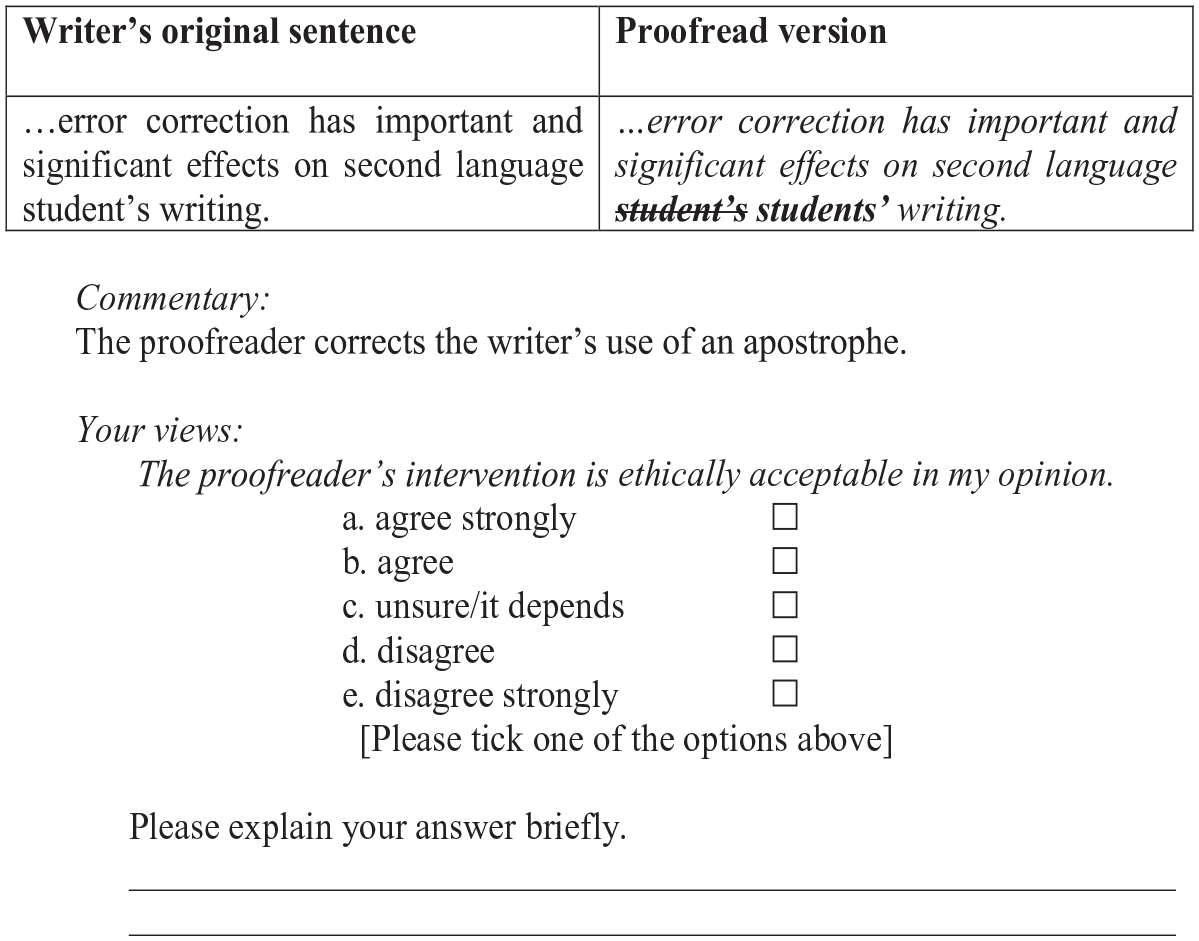
Questionnaire excerpt.
A longer version of the questionnaire was piloted with a colleague, a lecturer in education, and in a debriefing session afterwards the pilotee flagged up problems they had experienced with the questions and provided additional comments and suggestions for improvements. Problematic questions were eliminated or rewritten for greater clarity, and the number of interventions was cut from 27 to 20 items to reduce the time required of participants and to lessen fatigue, given that each intervention included an open question that invited respondents to elaborate on why they saw the intervention as ethically (un)acceptable. The final version of the lecturer/tutor version of the questionnaire can be found in Appendix 1. 4
Interview
A semistructured face-to-face or Skype follow-up interview with willing respondents enabled interviewees to explain their views on proofreading in more detail.
Interviewees were given their completed questionnaires at the start of the interview and were invited to elaborate on the reasons they had judged each intervention to be ethically (un)acceptable. In the second part of the interview, I invited respondents to comment on a series of arguments for and against proofreading on prompt cards. These arguments came from proofreading studies reviewed above, such as McNally and Kooyman (2017). Sometimes quotes from these articles were used, lightly edited for clarity and conciseness; for other prompt cards, I wrote my own summaries of pro-/anti-proofreading arguments. The prompt cards covered issues such as whether proofreading masks students’ deficiency in academic writing and the purported educative value of proofreading. The interview schedule is reproduced in Appendix 2; interviews lasted around 50 minutes.
Recruitment and Data Set
Having secured ethical approval from my institution to conduct the research, respondents were recruited by circulating details of the project on my UK Russell Group university research volunteer list, as well as on the British Association of Lecturers of English for Academic Purposes (BALEAP) mailing list. All participants were provided with a detailed information sheet and signed a consent form. Participants were paid £10 for completing the questionnaire, and a further £20 for an interview. I felt it was appropriate to offer these sums for participation, given the time and effort involved, in line with the argument by Gelinas et al. (2018), that the time and burdens involved in research participation should be compensated. Nonetheless, a few participants declined payment. An in-house grant partially funded these costs.
The data set comprised 122 usable questionnaires and 87 interviews. The questionnaires comprise responses from 32 lecturers, 34 language tutors, and 56 students. With reference to the lecturers, 9 were from the sciences, 19 were from the social sciences, and 4 were from the arts/humanities. With reference to the students, 24 were undergraduates and 32 postgraduates; 29 were L1 and 27, L2; and 18 were from the sciences, 26 from the social sciences, and 12 were from the arts/humanities. The interviews were conducted with 24 lecturers, 25 language tutors, and 38 students. There were also four other participants who were involved in the study because of the relevance of their roles to the university proofreading debate: a Specific Learning Difficulty (SpLD) tutor who worked with dyslexic students; an Equality, Diversity, and Inclusion Officer; a university librarian who students consulted in relation to various difficulties they were having with academic writing, and a Research Degree Support Officer, for whom proofreading policies regarding PhD theses were particularly relevant. However, since these four participants could not be placed easily in disciplinary lecturer or tutor groups, they are not included in this article.
Data Analysis and Coding
Quantitative analysis
The 20 types of proofreader intervention in the questionnaire were categorized into overarching intervention types for statistical analysis. This was done by drawing upon Mossop’s (2007) four types of intervention: Copyediting, Stylistic Editing, Structural Editing, and Content Editing; and upon the Kruger and Bevan-Dye and Harwood taxonomies described earlier. A full breakdown of how each of the 20 questionnaire interventions was classified according to these sources can be found in Appendix 3, but in brief, these interventions were classified as follows: Minor Copyediting: A1, A2, A9, A14; Major Copyediting: A18, A19; Content Editing: A3, A5, A13, A17; Structural Editing: A7, A16; Non-Intervention: A8, A12; Indirect, Educative Comment: A6, A10; Stylistic Editing: A11, A20; and General Evaluative Comment Without Correction: A4, A15.
The internal consistency of each of these scales was determined using Cronbach’s alpha, with the following results: Minor Copyediting = 0.68; Major Copyediting = 0.57; Content Editing = 0.82; Structural Editing = 0.77; Non-Intervention = 0.60; Indirect Intervention = 0.50; Stylistic Editing = 0.20; and General Evaluative Comments = 0.18. Based on these results, the Stylistic Editing and General Evaluative Comments scales were disregarded, and six scales were retained. 5 The data for each of the retained variables was found to be non-normally distributed. Thus, Kruskal-Wallis tests were employed to investigate whether there were significant differences between the three groups (lecturers, language tutors, and students) concerning their ethical acceptability judgments for the proofreading interventions represented by each of the six scales, addressing RQ1.
In addition, Mann Whitney U tests were used to investigate whether L1/L2 status or undergraduate/postgraduate status influenced students’ attitudes to proofreading (RQ2). The influence of discipline was investigated by asking students and lecturers to identify their disciplinary grouping (arts, sciences, social sciences) and I used Kruskal-Wallis tests to examine whether discipline affected attitudes (RQ2).
Qualitative analysis
Using techniques from Coffey and Atkinson (1996) and Saldaña (2009), I started qualitative coding of the interview data with nine interviews, three from each party (lecturers, tutors, and students), resulting in a draft codebook of 45 codes. I then used this draft codebook on nine different interviews, again three from each party. This resulted in further changes, including deletion, addition, and merging of codes. The next version of the codebook contained 44 codes. At this stage, an intrarater reliability test was carried out. I coded six new interviews, again representing all three parties, before recoding the same interviews a week later. This resulted in an agreement rate of 93.16%. A few remaining difficulties associated with the codebook were addressed, for instance by making minor refinements and additions to code definitions. Like the second version of the codebook, the final version contained 44 codes and is reproduced in Appendix 4. This final version was used to recode all of the interviews that had been coded previously, as well as all remaining interviews in the data set. Selected qualitative findings are presented later to substantiate and explain key quantitative findings (RQ3).
Results
Quantitative Analysis
How far do university content lecturers, English language tutors, and students feel it is ethically appropriate for proofreaders to intervene in students’ writing?
Table 2 provides an overview of the descriptive statistics derived from the questionnaire data, which presents the views of the three parties regarding the ethical acceptability of the various types of proofreading (ranging from 1 = strongly disagree to 5 = strongly agree). 6
Lecturers’, Tutors’, and Students’ Views on the Acceptability of Different Types of Proofreading.
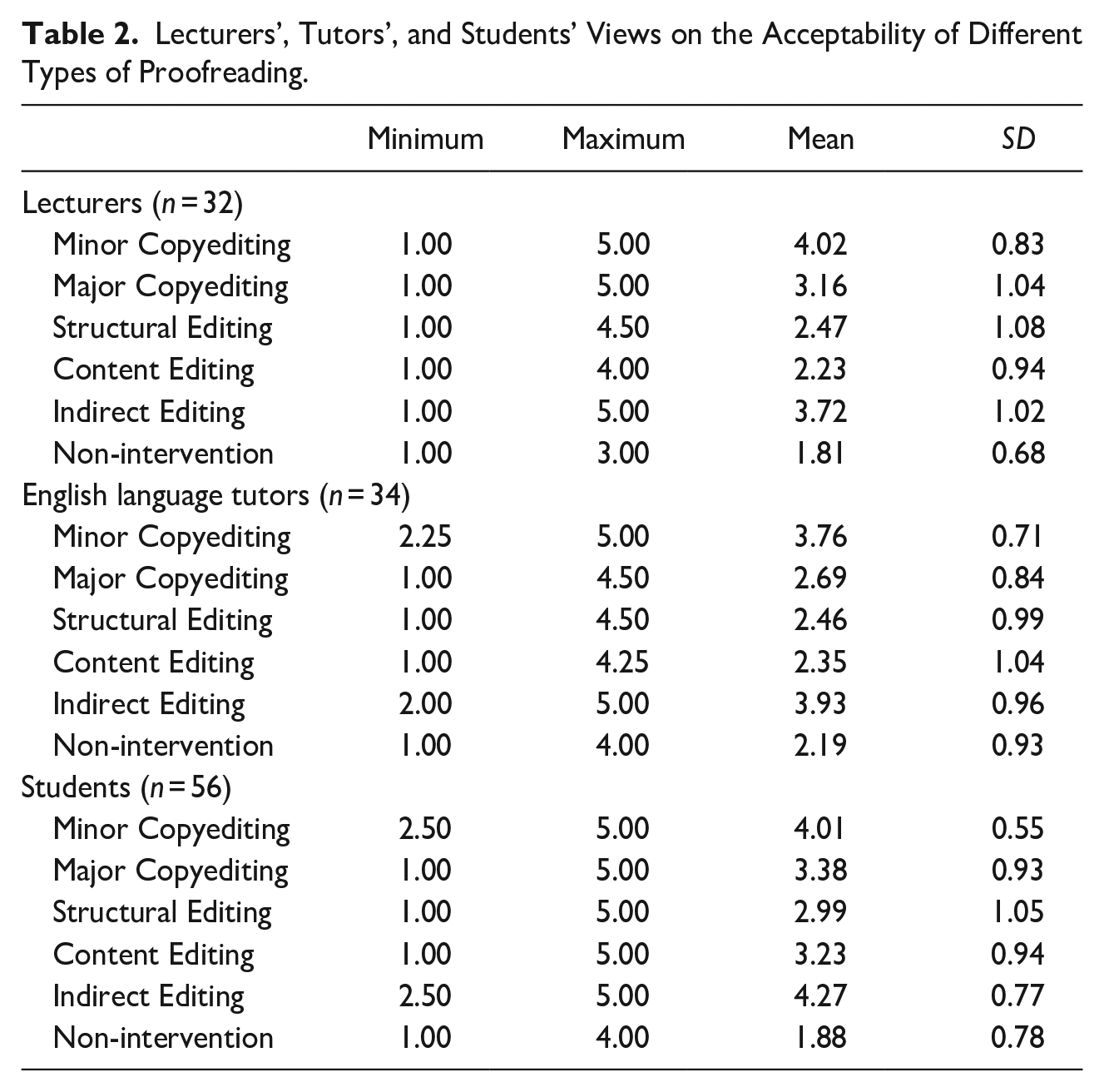
Lecturers scored three of the six categories higher than the midpoint of three: Minor Copyediting (M = 4.02), Indirect Editing (M = 3.72), and Major Copyediting (M = 3.16). Language tutors scored two categories above three: Indirect Editing (M = 3.93) and Minor Copyediting (M = 3.76). In contrast, students scored four of the six categories higher than the midpoint: Indirect Editing (M = 4.27), Minor Copyediting (M = 4.01), Major Copyediting (M = 3.38), and Content Editing (M = 3.23).
Lecturers scored three types of interventions below the midpoint: Non-Intervention (M = 1.81), Content Editing (M = 2.23), and Structural Editing (M = 2.47). Language tutors scored four types below three: Non-Intervention (M = 2.19), Content Editing (M = 2.35), Structural Editing (M = 2.46), and Major Copyediting (M = 2.69). For students, though, just two types of interventions were scored below the midpoint: Non-Intervention (M = 1.88) and Structural Editing (M = 2.99), these results pointing to students’ more permissive attitude towards various types of proofreading interventions.
Are the views of the three parties on the ethical acceptability of various proofreading interventions equivalent or not? Do factors such as L1/L2, undergraduate/postgraduate, and disciplinary status affect the responses by each of the three parties?
In order to explore whether the differences among the three parties regarding the ethical acceptability scores for each of the six scales were statistically significant, Kruskal-Wallis tests were conducted, revealing that differences between the parties for two of the six scales were nonsignificant (Minor Copyediting [H(2) = 4.591, p = .101]; Non-Intervention [H(2) = 3.262, p = .196]). In other words, in the case of Minor Copyediting, all three of the stakeholder groups are responding along the same lines as they see this type of intervention as broadly unproblematic (Lecturers: M = 4.02; Tutors: M = 3.76; Students: M = 4.01). However, in the case of Non-Intervention, all three stakeholder groups are responding broadly the same as they generally disapprove of this type of proofreader response (Lecturers: M = 1.81; Tutors: M = 2.19; Students: M = 1.88). In contrast, the results indicated statistically significant differences (p value ≤ .05) between the three parties on four of the six scales: Major Copyediting, H(2) = 11.990 (p = .002); Content Editing, H(2) = 21.875 (p = .000); Indirect Editing, H(2) = 7.116 (p = .028); and Structural Editing, H(2) = 7.006 (p = .030), showing that the views of the three groups regarding these interventions diverged. Post hoc Mann-Whitney U tests (with Bonferroni correction p = .008) were therefore conducted on the results for these four scales in order to determine which pairs of groups were different (i.e., lecturers vs. tutors, tutors vs. students, lecturers vs. students). No significant differences were found when comparing lecturers and tutors (p value between .05 and .97), but significant differences were found when comparing (a) tutors and students and (b) lecturers and students. Comparing tutors and students, two of the four scales were found to be significantly different: Major Copyediting (U = 540.00, p = .000; Tutors: M = 2.69; Students: M = 3.38) and Content Editing (U = 518.00, p = .000; Tutors: M = 2.35; Students: M = 3.23). And comparing lecturers and students, again, two scales were significantly different: Content Editing (U = 427.50, p = .000; Lecturers: M = 2.23; Students: M = 3.23) and Indirect Editing (U = 604.00, p = .010; Lecturers: M = 3.72; Students: M = 4.27). In other words, tutors and students as well as lecturers and students disagreed about the ethical acceptability of various types of proofreading. In summary, then, we see the students’ more permissive attitude to a wider range of proofreading than the other two parties come to the fore. Students were also more permissive regarding the ethics of more substantial forms of intervention, being more relaxed about Major Copyediting than tutors, and of Content Editing than either lecturers or tutors.
Are there attitudinal differences between L1 and L2 students regarding the ethical acceptability of different types of proofreading?
There were no significant differences between L1 and L2 student attitudes in any of the six categories (p value between .073 and .902).
Are there attitudinal differences between undergraduate and postgraduate students regarding the ethical acceptability of different types of proofreading?
There were no significant differences. Indeed, the p values were very far from significance (between .161 and .832).
Are there attitudinal differences according to discipline between students regarding the ethical acceptability of different types of proofreading?
A Kruskal-Wallis test indicated that there were no significant differences between students (p between .082 and .644) according to discipline. 7 The only score close to significance was in the student group with regard to the ethical acceptability of Structural Editing (0.08).
In sum, then, the results reveal that those differences within the lecturer and student groups cannot be attributed to the variables investigated (discipline, undergraduate/postgraduate status, or L1/L2 status). The differences are rather attributable to differences in reasoning, as revealed by the qualitative data examined below.
Summary and discussion of quantitative findings
There was a degree of consensus as to which types of proofreading are ethically acceptable, all three parties approving of Minor Copyediting and Indirect Editing interventions. In the case of Minor Copyediting, where the proofreader corrects punctuation (e.g., apostrophes), sentence structure and word grammar (“Compared error rates”  A comparison of error rates
  ; “to familiar with”
  to familiarize themselves with), and formats reference list entries, this finding is unsurprising, given the relatively modest nature of the interventions. This finding is also in line with McNally and Kooyman (2017), who found a similar consensus between lecturers/tutors and students regarding the acceptability of minor copyediting interventions.
There was also general consensus around the ethical acceptability of Indirect (Educative) interventions. The interventions on this scale featured correction symbols (the proofreader marking a grammatically incorrect sentence with ‘Gr’, indicating a grammar problem but leaving it to the writer to work out what the correct version should be) or advice about how to correctly format a reference list (Where there is more than one author, all authors’ last names and initials should be included. Double check if papers with multiple authors have been cited as “et al.” within the text, the proofreader again leaving the writer to make the corrections).
There was also consensus between lecturers and language tutors, in that no statistically significant disagreements were found regarding the ethical acceptability of the different proofreading scales between the two parties. In general, then, lecturers and tutors hold broadly similar views as to which kinds of proofreading interventions are ethically acceptable and which are off-limits.
However, there were statistically significant disagreements between lecturers and students, and between tutors and students. Students were more permissive regarding the ethics of Major Copyediting than tutors, of Indirect Editing than lecturers, and of Content Editing than either lecturers or tutors. This is in line with the fact that earlier studies have also identified disagreements between two or more parties regarding the ethical acceptability of various types of interventions: Kruger and Bevan-Dye (2013) described disagreements between proofreaders and lecturers, and McNally and Kooyman (2017) detected disagreements between lecturer/tutor and student views, concluding that “there is still significant confusion and dissent over what level of proofreading is acceptable” (p. A154).
As can be seen from the findings reported above, the picture is complex and nuanced. There is certainly some consensus—but there are also significant points of disagreement between students and lecturers and between students and tutors, with students taking a more permissive and ethically relaxed stance to a wider range of interventions. There are outliers also within each party whose views are very far apart. All of this underscores the knottiness of formulating university proofreading policy that all stakeholders would be prepared to subscribe to.
Qualitative Analysis
I begin this section by using the qualitative data to provide insights into participants’ reasoning as to why, in general, minor interventions were seen as ethically more acceptable than more substantial changes. I then look at an additional issue on which the qualitative data sheds light: in each group there are outliers who feel very differently about proofreading than most of their fellow respondents.
Why do lecturers, tutors, and students feel the way they do about the ethics of the various proofreading interventions?
Space limitations do not permit me to look at the reasoning behind respondents’ approval or disapproval of all six scales in this article. Instead, I look more closely at Minor Copyediting, a type of proofreading that all three parties generally agreed was ethical, and Content Editing, which goes well beyond traditional conceptualizations of proofreading, and which both lecturers and tutors generally felt was ethically unacceptable, although students took a more permissive attitude toward it. The principal reasons for respondents’ views are summarized by themed subheadings.
Minor Copyediting
No change to writer’s intended meaning or content of the argument
One reason there was a general acceptance of Minor Copyediting interventions was that respondents felt the proofread version remains faithful to the writer’s intentions in terms of meaning: [A2] I felt this was a pretty basic error . . . , the meaning “compared” and “a comparison of,” the root is the same, the meaning is basically the same and so it’s more changing the structure. But if it’s not affecting the intended meaning, I don’t see anything ethically unacceptable about this change. (Aine, language tutor)
8
[A2] Yeah, I agree that was legitimate. No change of meaning. Basically, I think what concerned me . . . was whether a proofreader was in some way adding something semantic to the text. If what they seemed to be doing was simply enabling the meaning to be expressed a bit more clearly, that seemed to me to be reasonable. (Herbert, Lecturer)
The proofreader is making the text easier for the marker to read
Another argument in favor of Minor Copyediting was that, by removing grammatical errors, the text would be a smoother read for the marker. And since the nature of the changes is supposedly only cosmetic, leaving the writer’s meaning unaffected, no harm would be done: [A1] It’s just a really simple grammar change which doesn’t really affect what the student is trying to say. . . . [I]t just makes it easier for the marker in this case, because that person is not distracted by the fact that there are grammatical errors. I mean, I know myself, if I read grammatical errors, you just get focused on the errors rather than what the student is trying to say. (Marcus, Lecturer)
The mark is unaffected
Most respondents believed that minor interventions would have little impact upon the mark the writing would receive and could therefore be seen as ethically acceptable: [A1] The proofreader corrects the writer’s use of an apostrophe [ . . . ] I think as long as the content remains the same, I would imagine small grammatical errors being corrected wouldn’t in any way significantly change the overall grade the student would receive. (Amir, Student)
There were, however, reservations about this line of reasoning. As Amir explained when talking about another Minor Copyediting intervention (A14, in which the proofreader correctly formats a reference for the writer), the questionnaire does not show how many of these minor changes the proofreader made. Hence Amir would feel uneasy if such interventions were numerous, as this series of minor interventions may indeed impact the final mark: [A14] I think it’s okay, provided it was just the one-off and it was a guidance, but if it was a list of 30 references and each one was formatted correctly for them, I think that would be wrong. I think there’s no harm in doing one and using it as an example. [ . . . ] But if it was done all throughout, that would . . . increase the grade or at least contribute to the references mark, I think it would be wrong.
Correcting minor errors is the proofreader’s job
The assumption that proofreaders exist to correct minor errors was generally uncontroversial: [A1] Where you’re correcting typos and grammar, for me that’s absolutely fine, and it’s one of the primary purposes of a proofreader in the student context, I guess. [ . . . ] Yes, I’d expect a proofreader to pick up on that stuff, and if they wouldn’t then I’d say they’re not doing their job. (Andrea, Lecturer)
The proofreader is doing no more than other writing resources would
Some respondents claimed that it was hard to see Minor Copyediting proofreading as unethical since the proofreader was only doing what electronic resources such as Microsoft Word’s spelling and grammar checker do for writers, and universities do not debar writers from using these tools: So for A1 [ . . . ], it’s a bit like getting Word to proofread it, isn’t it? It gives you the little underlining symbols and then you make the changes. It’s just the human version really. So, I don’t have a problem with that at all because it’s so minor. (Dorcas, Lecturer)
Other resources were mentioned, such as Grammarly, in the same vein: So for A1, I think it’s okay. It’s just a tiny typo. And . . . even Grammarly will point that out. (Flossie, language Tutor) [A14] The proofreader is doing what a digital reference manager would – no ethical issue here in my opinion. (Kurt, Student)
Students can learn from the proofreader’s interventions
While some respondents felt educating or teaching writers wasn’t the proofreader’s job, others felt differently, arguing that Minor Copyediting interventions would provide L2 writers in particular with learning opportunities and were therefore highly ethical: [A1] The student is coming from a non-English speaking background. [ . . . ] I feel like it would be unethical if you don’t correct that because, from these corrections, a student would end up learning from their mistakes. I don’t speak English as my first language . . . , but I find if I do such errors, I’d like to be corrected and if I’m not corrected, I . . . keep doing the same mistakes over and over. I feel like it’s very ethical to do that [laughs]! (Anita, Student)
Content Editing
The proofreader has changed/improved the writer’s work
Content Editing was seen as unethical by many respondents because it can add substance to the writer’s argument which was absent from the original text: [A3] It’s adding new material. . . . and in effect, the proofreader is inserting their own expectations about how that sentence ends, rather than necessarily being what the student would themselves have put. (Giles, Lecturer) [A13] Probably like [the proofreader’s] questions, like “Why is a random sample important?” . . . , these are not actually questions that the student would have ever thought of . . . , so I think it’s just adding too much content. (Karen, Student)
The proofreader’s changes will boost the writer’s mark
Some respondents claimed that substantial content-level interventions would likely raise the writer’s mark, leading to the writer being given credit for the proofreader’s ideas: [A3] If I was marking a piece of work, the addition of that extra phrase [by the proofreader] would slightly increase the mark the person might get. [ . . . ] We quite often will mark based on your justification of things. Yes, for me it was getting into that territory too much. (Andrea, Lecturer) [A3] It adds information that the student is more than likely being assessed on. So the student has said they want more subjects for their experiment. But any student knows that they should have more subjects. Not all students know why they should have more. And so here the proofreader has explicitly stated why . . . . So yeah, that would be crossing a line for me. (Richard, Lecturer)
The proofreader is overstepping his or her role, acting as a lecturer or supervisor
Many respondents felt that giving content-focused comments was the purview of the student writer’s lecturer or supervisor, and that proofreaders should stop short of enacting this role: [A5] Proofreader’s comment: “How do you know?” [ . . . ] It is not acceptable [ . . . ] I don’t think a supervisor is a proofreader or vice versa, and such a comment, “How do you know?” actually does not target the language and clarity. It targets the content . . . , and I don’t think that is the realm of a proofreader. (Averil, Lecturer) [A17] Actually saying, “Why don’t you use a different example for this point?” . . . It would be fine if it was their supervisor. . . . It doesn’t fall under proofreading, it falls under advising. (Andrea, Lecturer)
The proofreader’s questions and comments do not do the work for the student
Rather than seeing the proofreader’s content-oriented questions to the writer (e.g., How do you know? [A5]; Why is a random sample important? [A13]) as ethically problematic, those who took a more permissive view of these interventions differentiated between asking questions/making comments and doing the work for the writer. The former interventions were ethically acceptable, even if the latter were not: [A5] I quite like this because it’s indicating that perhaps more content is needed, but it’s not dictating the kind of content. So it’s like a prompt for the writer to add what they think should be there. It’s pointing out there’s something missing, you need to go back and look at it, but it’s not giving them the push towards what it specifically is. (James, Student)
This line of reasoning, which differentiates between the ethicality of asking questions and providing rewrites, is not exclusively associated with students: [A13] In this case, [the proofreader] raises certain questions. They give the writer the opportunity to still get those questions wrong. (Martin, Lecturer)
We saw above that some respondents claimed interventions were unethical when the proofreader’s comments seemed more akin to those of a supervisor. Interestingly, while some other respondents agreed that interventions like A5 and A13 were indeed like a supervisor’s, they felt the proofreader’s comments remained ethical, as they had not given the answer to the student: [A5] I strongly agree on this based on the experience I had with my dissertation supervisor. Because . . . , rather than saying, “Here’s your answer . . . ” if I was being a little bit unanalytical, he’d say, “Well, how do you know this? Why? . . . Justify your statement.” And I think that kind of thing is fine, because . . . the student still has to do some more research . . . and decide, “How DO I know?” (Kurt, Student)
The proofreader is acting as critical reader, improving the text, educating the writer
Some respondents believed content-level interventions which ask questions can be educative, stimulating the writer’s thinking and encouraging reflection: [A5] I think this is a really helpful comment. Because . . . in academia, you need to provide evidence and citations [ . . . ] it shows [the proofreader] wants the writer to learn from that kind of mistake. (Harry, Student) [A13] So I think that this is very good for the original author . . . . If it’s done on their behalf, I’d say that it’s quite unethical, but . . . the proofreader is telling them or encouraging them to think on their own. (Anita, Student)
Some lecturers also saw certain Content Editing interventions as educative and ethically acceptable: So A5 . . . , “How do you know?” So in a feedback sense, I think this is just pointing the student in the right direction. [ . . . ] The proofreader is not offering to make any change themselves, you’re getting the student to think, which in itself is very important, it is very useful. [ . . . ] The assessment is almost a means to an end, you want the student to think and to learn, and so on. And this is one way of you getting them to do that. (Marcus, Lecturer)
Outliers
Despite the general areas of consensus identified above regarding the ethics of certain types of interventions, it would be inaccurate to claim there was universal agreement that some forms of proofreading are either ethical or unethical. Indeed, there were outliers in each group who were either notably more or less tolerant of proofreading for ethical reasons, and here I look briefly at two outliers in the lecturer group, Fiona and Penelope, who have very different stances on proofreading. 9
Fiona disagreed with 18 of the 20 proofreader interventions (16 disagree strongly, 2 disagree) in the questionnaire and marked the remaining two interventions “Unsure/It depends.” Fiona was opposed to proofreading of assessed work on the grounds that it distorts the representation of the writer’s true abilities. In one of Fiona’s modules students are asked to write a letter to a client, and the accuracy and appropriacy of the language they use in this letter, as well as the content and structure, affect the grade: And so . . . if somebody else had proofread that or had any involvement in that, that would hugely affect the grade. . . . And therefore it isn’t the student’s work and therefore the mark they’re getting isn’t actually the true mark for them and their work.
Fiona believes that producing grammatically correct writing is something that university graduates should be able to do, and that proofreading, no matter how light-touch, means that the work is no longer that of the writer—whose name is on the essay, and who will get the credit for the work rather than the proofreader. Fiona was not opposed to all forms of proofreading—she was interested in exploring the idea of formative proofreading of non-assessed work—but believed the proofreaders should be students’ lecturers rather than third parties, and that lecturers could play a valuable role in developing students’ learning and their academic writing. Comparing Fiona’s views with the pro- and anti-proofreading arguments covered earlier and summarized in Table 1, we see that she references the anti-proofreading arguments relating to (a) the standards of English expected of graduates, (b) the masking of students’ true language abilities, and (c) unfair assessment. Drawing on a pro-proofreading argument, Fiona concedes that proofreading can be educative, but she concludes that proofreading of assessed work must be proscribed because of its impact upon assessment.
Penelope approached the ethics of proofreading very differently to Fiona. For Penelope, access to proofreading is tied to issues of fairness and social justice. This is because in today’s landscape of massified higher education, not all students arrive at university equipped with the academic literacy skills they need; Penelope therefore felt students should be permitted access to resources and to people—including proofreaders—who can help them develop this literacy: Could your mother teach you a professionalised middle class register? Lots of mothers can’t. . . . When students arrive [at university], they don’t all have the same levels of ability to access that professional register. [. . .] And improving those skills is not something that anybody does on their own. They do it in the networking context in which they find themselves. . . . And using proofreading is part of the context that they could access.
Penelope rejected Fiona’s argument that a mark is awarded to the writer and his or her abilities alone: No, the mark is for [the writer’s] ability to deploy all the resources they need to jump through the hoop that we’ve set. That’s what the mark is for.
Penelope also stressed that in the workplace much of the writing is done in teams, and that seeking help was a skill that graduates would need and employers would value. Hence Penelope is happy for her students to consult other parties (like proofreaders) and other resources (like dictionaries and spellcheckers) before submitting their work: So if it really matters to you that your student produces the work completely independently, then you need to set an unseen assessment. That doesn’t matter to me . . . because in the real world, they’re never going to have to produce work all by themselves. They’re always going to be operating within a team or within their broader networks, they’re always going to be able to use resources. I mean, I use a spell checker all the time. I would never submit something to publication that I hadn’t used a dictionary to write, so it seems to me unhelpful to set assessments that are so far removed [from] our students’ futures.
Comparing Penelope’s views with the pro- and anti-proofreading arguments covered earlier and summarized in Table 1, we see that she references the pro-proofreading arguments relating to proofreading being educative and a form of legitimate collaboration. Penelope asserts that academic literacy support in general and proofreading in particular can lessen social inequalities. She therefore rejects anti-proofreading arguments relating to unfair assessment, provided that all students have the opportunity to consult a proofreader.
Discussion and Conclusion
This research shows that while there is some degree of consensus between and within the three groups regarding the ethical permissibility or otherwise of certain types of interventions, there are also significant differences, particularly when comparing students’ attitudes to those of lecturers and tutors regarding the permissibility of more substantial interventions. There are also outliers in each group who hold incompatible views when compared to fellow group members. The qualitative data provide insights into respondents’ reasons for their stances towards the (un)ethicality of various interventions, and we see issues such as authorship, grading, and the (non-)educative value of proofreading coming to the fore. So where do these findings leave university proofreading policymakers?
Formulating Proofreading Guidelines
University policymakers commonly attempt to formulate a one-size-fits-all proofreading policy, to apply uniformly across their institution. In the light of my findings, I question how feasible this is—as Harwood et al. (2010) conclude, although clear proofreading guidelines are needed, given the varying views on the ethics of proofreading across and among the different stakeholders, “achieving such a consensus in individual departments, let alone across the university as a whole, is likely to be extremely difficult” (p. 64). We can defend a one-size-fits-all policy by saying that the greater tolerance for substantial proofreading interventions on the part of students in comparison to lecturers and tutors is an irrelevance—students must conform to a less permissive policy, one that is more closely aligned with the views of the other two groups whose views should carry more weight. However, we should also remember that there were outliers in both the lecturer and tutor groups whose views were incompatible with those of some of their peers, and the lack of consensus I identified tallies with that identified in previous research (Kim & LaBianca, 2018; Kruger & Bevan-Dye, 2013; McNally & Kooyman, 2017; Salter-Dvorak, 2019).
How then can we formulate policy to which all lecturers and tutors would subscribe? Recall how Fiona was opposed to any form of proofreading on work to be assessed because of the importance of language in the written work required of her students, in contrast to other lecturer respondents, who claimed that grammar would have little or no impact on the mark they would award, provided the student’s message was comprehensible. One response to this is that put forward by Penelope: that if one wishes to ensure students have no access to proofreaders, unseen examinations should be used. Another possibility would be for universities to allow academic departments—and individual staff members—latitude as to whether they permit proofreading from one module to another. That is, rather than having a blanket proofreading policy, universities could have a default policy from which individual subject modules or lecturers could opt out if they had good reasons linked to their learning aims, written tasks, and assessment criteria, and on condition that the modified module policy was very clearly highlighted to students. A third possibility is to take the approach favored by Richards (2022), whose guidelines differentiate and exemplify the various types of interventions that could be made by the proofreader (i.e., spanning the range from Minor Copyediting to Content editing), and that require written confirmation from the student writer’s supervisor that she or he permits or debars the proofreader to make each type of intervention. In addition to providing an admirable level of clarity for all three parties of how far the proofreader can go and the kind of changes she or he can make, the merit of Richards’s proposal is its flexibility, in that different supervisors would be able to permit greater or lesser degrees of intervention on a case-by-case basis. Regardless of the approach taken to formulating or revising existing proofreading guidelines, however, the above analysis shows that any (re)formulation of proofreading guidelines goes hand in hand with questions relating to the role of assessment. 10
Policymakers also need to tackle the question of who should be permitted to act as proofreaders. Corcoran et al. (2018) argue that proofreading should be brought in-house. By means of ongoing training and standardization of proofreaders, taking an in-house approach could result in a greater uniformity of proofreading style, contrasting with the markedly differing types of intervention students can receive at the hands of external proofreaders, with all the concomitant issues of fairness this entails (see Harwood, 2018, 2019). In-house provision would also mean that policymakers could mandate the use of an educative proofreading style, where proofreaders focused on educating the writer by directing them to academic literacy resources rather than merely fixing their texts (see North, 1984; and for a more detailed discussion of educative proofreading, see Harwood, 2022). It would however be naïve to believe that bringing proofreading in-house would be a panacea—some students who simply wish for their texts to be fixed would be prepared to violate university policies by using external proofreading services, and policing this would be very difficult to do. However, it was striking how many students spoke of engaging in “informal” proofreading, asking friends, family, and romantic partners to proofread for free, rather than seeking the help of commercial services. Some lecturers also spoke of how they actively encouraged students to seek out their coursemates as proofreaders. These findings tally with the findings of previous researchers (Conrad, 2020; Salter-Dvorak, 2019; Turner, 2011, 2018), and so an in-house service that was similarly free of charge may discourage students from approaching external, unregulated proofreaders and may encourage lecturers to recommend approaching in-house as well as informal proofreaders.
As will be apparent, I believe that formulating proofreading policy should be research-led, and the research reported here will be a useful place at which to start when contemplating how far proofreaders should be permitted to intervene. The quantitative analysis revealed that all three stakeholder groups viewed Minor Copyediting interventions as being broadly unproblematic, and so policy guidelines that permitted interventions of this type would likely attract majority, albeit not universal, consensus, given the views of a few participants like Fiona, who wish to see the proofreading of preassessed work entirely proscribed. When we consider more substantial interventions (Major Copyediting, Content Editing, Structural Editing), although students were more relaxed about their permissibility, lecturers and English language tutors were not, and indeed no significant differences were found when comparing the views of lecturers and tutors. Policymakers could achieve a broad consensus, then, at least as far as lecturers and tutors were concerned, by debarring proofreaders from intervening in these three areas, instead permitting only light-touch proofreading.
But rather than relying wholly on other people’s research results, policymakers can usefully complement existing findings and take an inclusive, participatory approach to formulating guidelines by adding another layer of research findings to the mix from their own institutions by soliciting input from all stakeholder groups, rather than simply imposing policy in a top-down fashion. One way of eliciting the views of stakeholders is via group discussions, and here we can draw inspiration from Conrad (2021). Conrad provides an interesting account of how students’ awareness can be raised as to the ethical issues associated with proofreading, describing the results of a lesson delivered to students on a first-year writing course in the United States. Conrad presented various types of proofreading to students as well as showing them their institution’s Code of Academic Integrity, asking the class which forms of proofreading were ethically acceptable or unacceptable. Conrad also had students question the ethics of using (expensive) paid-for services, considering the case of a master’s student paying $1,000 for a proofreader to correct her dissertation. Lastly, students were asked to reflect and comment upon the following thought-provoking questions: Where should universities draw the line between acceptable and unacceptable behaviour when it comes to students involving other people in their writing practices? What are some of the factors instructors and universities should consider when deciding whether a student’s behaviour is an academic integrity violation?
Kim and LaBianca’s (2018) “ethicality index” is another tool that could be usefully deployed to stimulate discussion as to how far proofreaders should go. A more granular approach that builds upon Conrad’s and Kim and LaBianca’s could expose students—and lecturers and language tutors—to various types and degrees of proofreading interventions, having them compare and contrast the original version of a student’s text with a proofread version in a similar way to my questionnaire, at the end of which respondents could be asked to arrive at a considered, nuanced position on the types of changes they see as ethically permissible, and in what situations. Various complicating factors such as excerpts from different authentic writing assessment criteria used by university subject departments (some criteria foregrounding the need for formal correctness of language more than others), differing relationships between writer and proofreader (paid-for services, language tutors in a writing center, friends and relatives), and marker/supervisor knowledge/ignorance of the fact the writing had been proofread could be added to the pot.
Disseminating Proofreading Guidelines
As Harwood et al. (2009) and the proofreaders in their study asserted, there is a need not only for policymakers to address the proofreading issue but also to effectively disseminate these guidelines to all stakeholders. Corcoran et al. (2018) and Cottier (2017) found students were unclear about proofreading regulations, and evidence from other studies is that freelance proofreaders are also “apparently unaware” of university guidelines and what they are and are not permitted to do (Harwood, 2019, p. 39). Similarly, students in this research were also unclear—but so, more surprisingly, perhaps, were the other two stakeholder groups, respondents confessing to a striking degree of ignorance concerning their institutions’ proofreading guidelines—just 22% of lecturers, 47% of tutors, and 10% of students claimed to be wholly or somewhat familiar with their institutions’ policies.
We saw above how all three stakeholder groups could be involved in discussions of the ethics of different types of proofreading as part of the process of formulating policy guidelines. Once these policies were formulated, dissemination could be enacted by having the same workshop groups judge whether a number of different authentic proofreader interventions complied with or violated these guidelines. Such discussions could form part of compulsory pre- or in-sessional academic literacy and integrity modules that were fully embedded into students’ programs and curricula, and could also form part of academics’ continuing professional development (CPD) training.
Research Limitations
There are at least two research limitations worth noting. I justified my choice of the proofreading term near the beginning of this article, explaining how it is the preferred term of convenience to describe third-party interventions in the UK university context at least, as opposed to alternative terminology like “editing.” I also explained how both light- and heavy-touch interventions can be carried out in the name of proofreading, and emphasized in my instructions at the beginning of my questionnaire that the proofreading term is contested and therefore I had declined to define the role or remit of a proofreader. However, if some of the participants were of the firm view that proofreading should only describe lighter-touch interventions, instead preferring a term like editing for heavier-touch interventions (as per the discussion in Haugen, 1990), these participants would see more major forms of intervention they associate with editing that featured in my questionnaire as ethically less acceptable than more minor interventions associated with definitions of proofreading in the literature, such as correcting punctuation. I could therefore have referred to “proofreading and editing” in the questionnaire rather than sticking to the proofreading term, although I suspect that doing so would have potentially caused more terminological confusion among the participants than my choice to simply refer to proofreading throughout.
A second issue relates to my decision to focus on an L2 writer’s text, and to state explicitly at the start of my questionnaire that I was soliciting views on the proofreading of texts written by L2 students. On this basis, I cannot claim that the views reported capture the participants’ views on the proofreading of both L1 and L2 writers’ texts. Nevertheless, at interview, both L1 and L2 student participants frequently spoke about their own experiences of proofreading and of having their work proofread, and referenced these experiences when discussing the ethicality of the proofreading interventions in the questionnaire. Hence, for the L1 student participants, at least, the discussion did not remain confined to L2 proofreading specifically. Nevertheless, I could usefully have asked participants to compare and contrast the perceived ethicality of proofreader interventions for L1 as well as L2 writers.
Issues for Further Research
More in-depth qualitative investigation would usefully complement the present article, and several publications are planned that feature in-depth explorations of respondents’ pro- and anti-proofreading arguments, as well as other themes emerging from analysis of the data—not least the theme of uncertainty as to the ethics of certain interventions and of proofreading in general. Other future avenues of investigation are suggested by the discussion above about proofreading guidelines: (a) studies describing the process of drawing up proofreading guidelines, and their dissemination, reception, and implementation and (b) the long-term effects of such policy changes on the behavior of student writers, but also on assessment practices and assessment rubrics. If these guidelines seek to bring proofreading in-house, researchers could explore the success or otherwise of such a policy from the perspectives of all of the various stakeholders I have focused on in the present article—lecturers, English language tutors (some of whom would now be acting as institutionally mandated proofreaders), and students.
Footnotes
Appendix 1
Lecturer and English language tutor questionnaire
This questionnaire asks your views on the proofreading of student writing before the writing is submitted for assessment.
Different people have different views on what “proofreading” is and what ethically acceptable proofreading is.
I don’t provide a definition of “proofreading” because of these differing opinions.
Instead, I will show you different, authentic examples of changes to student essays which proofreaders have made, and ask your opinion about whether or not each of these changes is ethically acceptable.
I’d like to hear your views on proofreading if you belong to one of the following groups:
(i) you are a
(ii) you are an
(iii) you are a
Appendix 2
Appendix 3
Types of proofreader interventions, classified by drawing upon Mossop (2007), Kruger and Bevan-Dye (2010, 2013), and Harwood (2018, 2019)
A1 Correcting incorrect punctuation usage (COPYEDITING)
A2 Correcting incorrect sentence structure (COPYEDITING)
A3 Meso Addition (where the proofreader inserts 6-9 new words into the writer’s text) (CONTENT EDITING)
A4 CONSULTATION/TEACHING POINT
A5 Inserting a comment to alert the author to significant content problems without correcting the problems (CONTENT EDITING)
A6 Flagging up but not correcting incorrect word structure (INDIRECT correction)
A7 Reordering paragraphs to ensure that the argument is logically structured (STRUCTURAL)
A8 NON-INTERVENTION
A9 Correcting incorrect word structure (COPYEDITING)
A10 Flagging up but not correcting problems with reference list (INDIRECT correction)
A11 Tailoring register so that it is suitable for the text type (STYLISTIC)
A12 NON-INTERVENTION
A13 Inserting comments to alert the author to significant content problems without correcting the problems (CONTENT)
A14 Correcting reference list in accordance with the prescribed style (COPYEDITING)
A15 CONSULTATION/TEACHING POINT
A16 Reordering sentences to ensure that the argument is logically structured (STRUCTURAL)
A17 Inserting comments to alert the author to significant content problems without correcting the problems (CONTENT)
A18 The proofreader inserts six or more consecutive words of his/her own (MAJOR COPYEDITING/REWRITING)
A19 The proofreader inserts six or more consecutive words of his/her own (MAJOR COPYEDITING/REWRITING)
A20 Removing redundancies (STYLISTIC)
Appendix 4
Interview Codebook
Acknowledgements
I would like to thank my colleague Dr. Beatriz Gonzalez-Fernandez for her help with the statistical analysis in this research.
Declaration of Conflicting Interests
The author declared no potential conflicts of interest with respect to the research, authorship, and/or publication of this article.
Funding
The author received no financial support for the research, authorship, and/or publication of this article.