




Abstract
This article presents findings from a study of a U.K. university writing centre regarding understandings of tutor roles, involving 33 Chinese international students, 11 writing tutors, and the centre director. The research used interviews and audio-recorded consultations as data to analyze and explore participants’ beliefs and understandings. The most common roles associated with tutors were proofreader, coach, commentator, counsellor, ally, and teacher. Mismatches were found in understandings of the proofreader role and counsellor role when comparing students’ views, tutors’ views, and the writing centre policy. Policy recommendations are made in light of the findings regarding how writing centres frame the tutor’s role and the function of writing consultations, in terms of (1) interrogating traditional conceptualizations of tutor role, (2) disseminating the centre’s aims to the student population and to the wider university, (3) expanding the centre’s activity across the university, and (4) strengthening tutor training and development.
Keywords
Introduction
Writing centre research has become increasingly important in the development of academic writing theory and practice (Ganobcsik-Williams, 2010). The one-to-one writing consultation is a core activity in writing centres (see Deane & Ganobcsik-Williams, 2012), often helping both L1 and L2 speakers of English with their texts, the tutor working with an individual student on a piece of writing she/he brings to the session, normally work to be assessed by content faculty.
The issue of writing tutor roles needs exploring because different understandings of the tutor role will result in very different types of writing consultations and levels of intervention by tutors, ranging from only the lightest-touch interventions at one extreme to content editing or even a form of ghostwriting at the other. Orthodox writing centre pedagogy has advocated a collaborative, nondirective teaching philosophy, a no-proofreading policy, and recommended that tutors prioritize helping students with higher order concerns such as structure and organization rather than lower order concerns such as grammar and language (Blau et al., 2002; Brooks, 1991; Bruffee, 1984; Lunsford, 1991; North, 1984). As they negotiate their role, we hear on the one hand of the “guilt” some tutors may feel when they begin proofreading and editing L2 writers’ texts or focusing on lower order concerns (Blau et al., 2002; Moussu & David, 2015; Nicklay, 2012). In contrast, other tutors may feel there is a case for relaxing the no-proofreading strictures writing centres commonly expect tutors to respect (Clark & Healy, 2008); and indeed some scholars make a case for rethinking traditional conceptualizations of the tutor’s role which have evolved from L1 tutoring when dealing with L2 writers (Myers, 2003; Nan, 2012; Powers, 1993). Furthermore, there has long been talk of L2 students not understanding or appreciating tutors enacting orthodox nondirective roles (e.g., Alhawsawi & Al Aradi, 2017; Eckstein, 2019; Elsheikh & Mascaro, 2017; Harris, 1995; Kim, 2014; Linville, 2009; Moussu, 2013; Nan, 2012; Powers, 1993; Santa, 2009), wishing instead for more direct intervention and help with their writing. In sum, then, the literature suggests that orthodox conceptualizations of the tutor’s role are contested.
The present study focuses on role perceptions of three parties associated with a U.K. writing centre: the tutors, the director of the centre, and international students, specifically Chinese students. The decision to focus on Chinese students was motivated by the fact that they dominate international student numbers in our context: of the 485,645 international students studying in the United Kingdom in 2018-2019, “Chinese students make up the largest cohort, with 120,385 studying in the UK” (Universities UK, n.d.). Moreover, the first author is Chinese and so has a particular interest in the writing development and experiences of Chinese students. Attending writing consultations herself during her time as a master’s and doctoral student in two different U.K. universities, she observed that many fellow Chinese students also drew upon consultation support. She therefore wished to explore Chinese writers’ expectations and understandings of the consultation, in addition to gaining an understanding of the beliefs about appropriate tutoring from the other parties involved (tutors and the centre manager). Such a project promised not only to shed light on the degree of alignment between tutors’ and students’ understandings of tutoring but also to enable universities to better scaffold their learning in relation to stakeholders’ views.
The Tutor’s Role in the Writing Centre
Previous studies have established that there are various roles a writing tutor can adopt during consultations; indeed, tutors can change roles from consultation to consultation and/or during a single consultation (Healy, 1991; Williams, 2005). Harris (1986) spoke of six tutor roles:
Coach (“helping writers develop their own skills”);
Commentator (“to give a larger perspective on what’s going on”);
Counsellor (“to move beyond the observable errors on the page, it’s necessary to inquire into the writer’s previous experience, prior learning, and motivation, outside problems, attitudes, and composing processes in order to form an adequate picture of how to proceed”);
Listener (“the teacher here is a friendly listener, interested in each student as an individual, a person who may have something to say”);
Diagnostician (“the teacher begins with the student’s concern and then does the work of diagnosing and defining the problem”); and
Activator (for students used to teacher-dominated tutoring, this role encourages students to play more of a part in the consultation—to take the initiative, to ask the tutor questions. Hence this role is about “helping these students back into the driver’s seat—and back on the road to self-sufficiency”). (pp. 33-38)
Harris’ roles have been referred to by many subsequent scholars. For example, the roles given by Harris are largely in line with those later put forward by Ryan and Zimmerelli (2010) of ally, coach, commentator, collaborator, writing “expert,” learner, and counsellor. Nevertheless, the roles postulated above lack empirical confirmation and are criticized by Thonus (2001) for ignoring the constraints of contexts and local conditions, which can impact on tutors’ roles.
Thonus (2001) herself explored how three groups of people (tutors, tutees, and disciplinary faculty) in a U.S. university view the role of writing centre tutors. Tutors were trained to follow orthodox pedagogy, adopting a peer tutoring model and avoiding directive and teacherly roles. Thonus analyzed audio-recordings of tutorials, tutors’ records of the consultations, and interviews with representatives of the three groups. Writing tutors tried to resist being directive and adopting a teacherly role in the consultations to a degree, as per their centre’s in-house guide to tutoring. Yet none of the tutorials evidenced the tutor completely abandoning this directive role. For example, one tutor reported that because of the limited time available for consultations, she had to pull students back to the key point of the paper and tell them how to revise directly. For their part, students “believe their tutors have the right and duty to be directive” (p. 74). Thonus (2001) concluded that there is “little unanimity” in the three parties’ perceptions of the tutor’s role, that tutors “persistently deviate” from the roles they have been trained to enact (p. 77), and that tutor roles are complex and should be flexible. Based on her findings, Thonus argued that it is important to examine how different groups of people understand the tutor’s role in order to gain a more comprehensive understanding of how tutors should act in writing consultations and how they can strive to meet the expectations of different stakeholders. However, although Thonus (2001) examined the perceptions of tutors, tutees, and instructors, her study does not include the views of writing centre management.
Another empirical study involving an examination of tutor role is Mack (2014), investigating English writing centre tutorials with low-level Japanese learners (with IELTS scores of 3.0-4.0) at a Japanese university. The writing centre provided tutors with training which promoted an orthodox style of nondirective intervention. The data set consisted of interviews with eight tutors, 24 student questionnaires, 30 writing consultation observations, and observations of two tutor training workshops. Tutors played six roles: proofreader, translator, coach, teacher, mediator, and time keeper, 1 enacting multiple roles in a single consultation. For instance, in line with Harris’ (1995) role of coach, Mack found tutors tried to build students’ confidence, emphasizing their capacity to make improvements and develop as writers. However, tutors also enacted less orthodox roles, proofreading because of learners’ low proficiency levels in line with students’ expectations, although adopting this role violated the writing centre’s pedagogy. Another unorthodox role enacted was that of translator—again, because of students’ low English proficiency. Tutors used Japanese to explain concepts and reformulate students’ sentences, translating students’ words into English. In conclusion, Mack suggests that tutors should embrace the more directive proofreader and teacher roles in contexts where they are working with lower level students, understanding the necessity for such students to receive more help in language and grammar than may be associated with writing tutor roles in classic work by the likes of North (1984).
Based on a focused review of the literature so far, we see cases of tutors working with L2 students drawing upon pedagogies that violate established writing centre practices, enacting more directive roles, and placing greater emphasis on formal correctness (see also Bonazza, 2016; Moussu & David, 2015; Voigt & Girgensohn, 2015, for additional evidence of this enactment of unorthodox tutoring). The research reported in the present article aims to continue these investigations, exploring understandings of the tutor’s role in one-to-one writing consultations in a research-intensive U.K. university from the perspective of students, tutors, and the writing centre manager. The results of this study will then allow us to make proposals regarding the writing centre’s policies and practices which have implications not only for U.K. contexts but also for writing centres internationally.
Methodology
Research Context
The tutorial service in focus here began in the 1990s. Consultations last for an hour and are free of charge, available to both international and home students who are registered with the university. In the 2018-2019 academic year, 1,994 consultation appointments were offered to students. About 35 writing tutors deliver consultations, and in-house guidelines state that tutors should mostly help with logical organization, linking of ideas, structure, referencing, grammar, and language. Proofreading and helping with content are prohibited. Tutors do not normally see students’ writing in advance of a consultation. Each student can book up to six consultations per academic year, view tutors’ summary and feedback record online afterward, and evaluate their consultation.
Our study design featured semistructured interviews, analysis of audio-recorded consultations, and analysis of documents collected from students, explained below. But first we describe our participants and their profiles.
Participants
The three parties’ profiles—students, tutors, and writing centre director—are outlined below, as well as details of how they were recruited to participate in this study.
Chinese students: Having secured ethical approval for the research from our institution, students were recruited via personal relationships (friends/social networks) or via social media (Chinese WeChat Group for students at the focal university) by the first author. The students were undergraduates and postgraduates studying various disciplines, primarily from the social sciences (e.g., Business Management, Education), but also included eight students from the sciences (e.g., Electronic Engineering, Molecular Medicine), and one student from the humanities (Music). Their IELTS scores ranged from 6.0 to 7.5, indicating intermediate or advanced learners of English. Twenty-five students were studying master’s degrees, five were PhD students, and three were undergraduates. All students attended at least one consultation, with 16 students attending one consultation, 12 students attending two consultations, and 5 students attending three or four consultations. The most frequent genre of writing they brought to the centre was an essay. Overall, 33 students participated in this research (33 being interviewed and 8 of these 33 also having their consultation audio-recorded).
Writing tutors: Eleven tutor participants were recruited via email and by some of the student participants alerting their tutor to our research. All tutors were experienced, qualified English for Academic Purposes teachers, with 3 to 7 years’ experience of writing centre tutoring, with most tutors holding postgraduate degrees. In addition, three of the tutors reported experience of teaching English in China. Seven of the 11 tutors were interviewed and 5 of the 11 participated in the audio-recorded consultations.
Writing consultation director: The director of writing consultations provided a perspective on tutors’ roles at the management/policymaker level. He was recruited through email and has a director of learning/teaching role at the university.
Data Sources
This research is a predominantly qualitative study which focuses on individual experiences and how individuals interpret their experiences in detail (Kalof et al., 2008). In addition to a short profile questionnaire, the following data sources featured: semistructured interviews with the three parties, audio-recorded consultations, and documents and other visual material collected from students (students’ texts, tutors’ feedback, and photos of the tutors’ whiteboard work during consultations).
Questionnaires
Pre-interview questionnaires (see Appendices A and B) were used to collect information on student and tutor profiles. The student questionnaire covered level of study, English proficiency, the number of consultations they had experienced, and the type of writing they discussed. Tutor questionnaires covered information about backgrounds, training, qualifications, and teaching/tutoring experience.
Interviews
The interview schedule was informed by previous researchers’ work on writing consultations and tutoring (e.g., Chanock, 1999, 2002, 2004; Harris, 1986; Mack, 2014; Thonus, 2001). It contained several questions related to the tutor’s role and follow-up questions explored role perceptions more deeply. A prompt card featured a list of putative tutor roles defined and described from the literature, including coach, commentator, counsellor, editor/proofreader, ally, disciplinary writing expert, teacher, and mediator (see Appendix C). Participants were asked whether or not writing tutors played each of these roles and to give examples of practices aligning with/at odds with these roles they had experienced. We also asked participants what happened during their consultations, how the tutor helped students, and what roles students expected tutors to play as indirect ways to get participants to discuss their understandings of the tutor’s role. Student interviews took 25 to 60 minutes, tutor interviews took 45 to 60 minutes, and the director’s interview took 80 minutes. The first author conducted all interviews, student interviews being in Mandarin, the shared L1, to better enable participants to express their views. 2
Documents/additional visual material
Upon request, 22 of 33 students brought their writing to the interviews as a supplementary source of data. This writing had been seen by tutors during students’ consultations and was often annotated with feedback and other interventions (e.g., corrections). These supplementary data were referred to by students at interview to illustrate tutor roles they had experienced during consultations. For example, students cited examples of tutor edits made to their text to evidence the tutor acting as proofreader. The first author also used these writing samples to check whether students’ descriptions at interview of the tutor’s interventions were accurate. For example, the writing samples helped establish whether tutors merely highlighted then elicited the correction from the student or whether the tutor made the correction himself/herself. Two students, Student 19 and Student 25, were willing to discuss two rather than one of their texts, and so were interviewed twice rather than once. Additional visual materials collected from students comprised photos of the tutors’ board work and other materials given by writing tutors during consultations, and were used at interview to help clarify the nature of the consultations.
Consultations
We also collected eight audio-recorded consultations to examine the extent to which consultation data corresponded with interviewees’ accounts of tutor roles, as well as collecting the students’ texts together with tutor annotations to the texts discussed during these consultations. These data therefore supplemented the interviews and served as a way of enhancing the validity of the research design.
Data Analyses
The thematic analysis approach was chosen to analyze the data. This approach helps researchers give a complex and nuanced description and interpretation of the data (Vaismoradi & Snelgrove, 2019). The interview and audio-recorded data were transcribed then coded following the thematic analysis approach. The coding and analysis of the data drew on techniques from Saldaña (2009), and the student interview codebook can be seen in Appendix D, featuring 28 codes. An intrarating test was done after the first-round coding by the first author with an agreement rate of 85%, following several versions of preliminary codebooks discussed with and critiqued by the second author. As a result of the intrarating, additional modifications were made to the codes to result in final versions of the student and tutor/director codebooks.
Findings
Tutors’ Roles
Tutors did not play one role during a consultation; they had multiple roles and they sometimes played a variety of roles at the same time, these roles overlapping or shifting throughout the teaching process, in agreement with Mack’s (2014) results. Tutors were “changing hats” (Harris, 1986, p. 63) based on students’ needs. However, it was also clear that there were different roles enacted by different tutors.
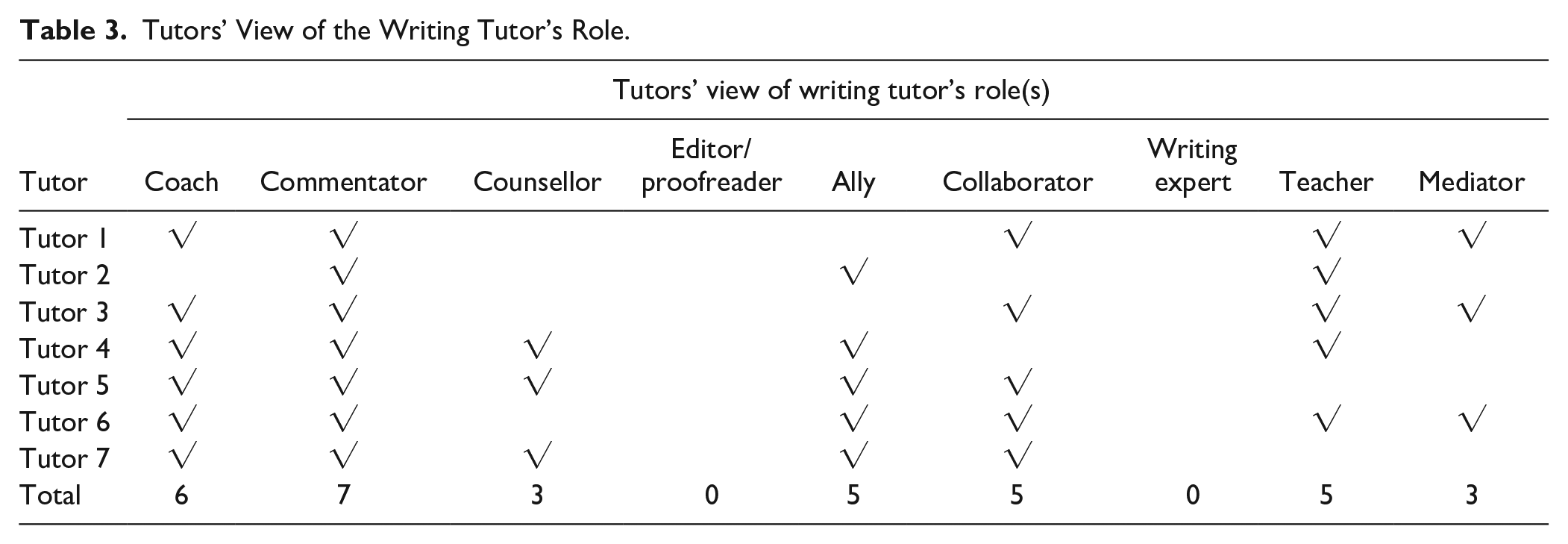
Tables 1, 3, and 4 show how students, tutors, and the director view the writing tutor’s role based on the interview prompt card about roles experienced/enacted. Table 2 shows the roles students wish their tutor to enact.
Table 1 shows what role(s) students believe their tutors actually played in the writing consultations they experienced. The most frequently mentioned role, as indicated by 28 of 33 students, is the proofreader. The other frequently mentioned roles are commentator, coach, counsellor, ally, and collaborator, while the role of teacher was less commonly referenced, with 13 students identifying this role. Disciplinary writing expert and mediator were only rarely referred to, being mentioned by two and five students, respectively. Table 2 provides a quantitative overview of roles the students would like the writing tutor to play according to the interview data.
Students’ View of the Writing Tutor’s Role They Experienced in Consultations.
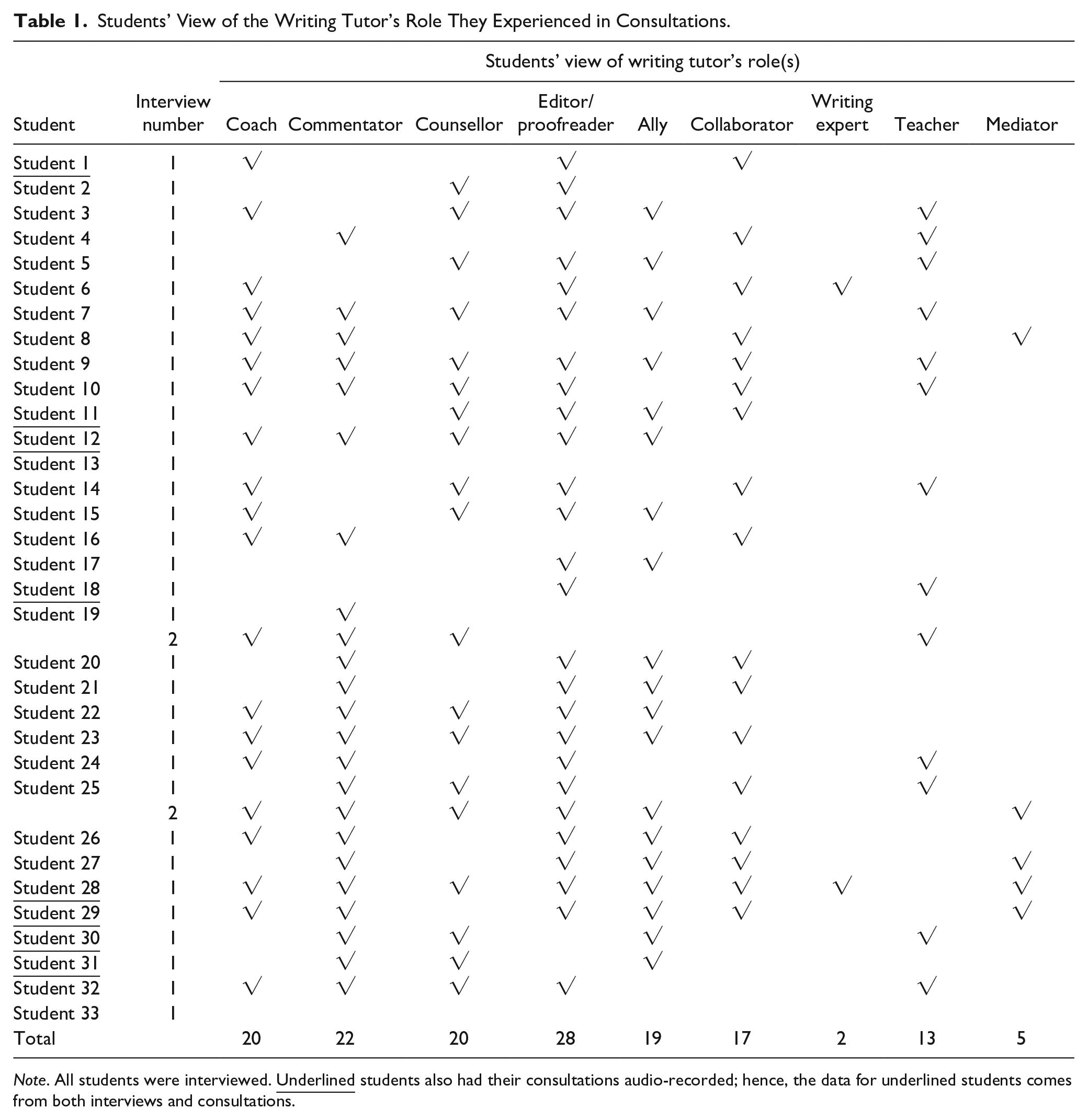
Note. All students were interviewed.
Students’ Wished-for Tutor’s Role.
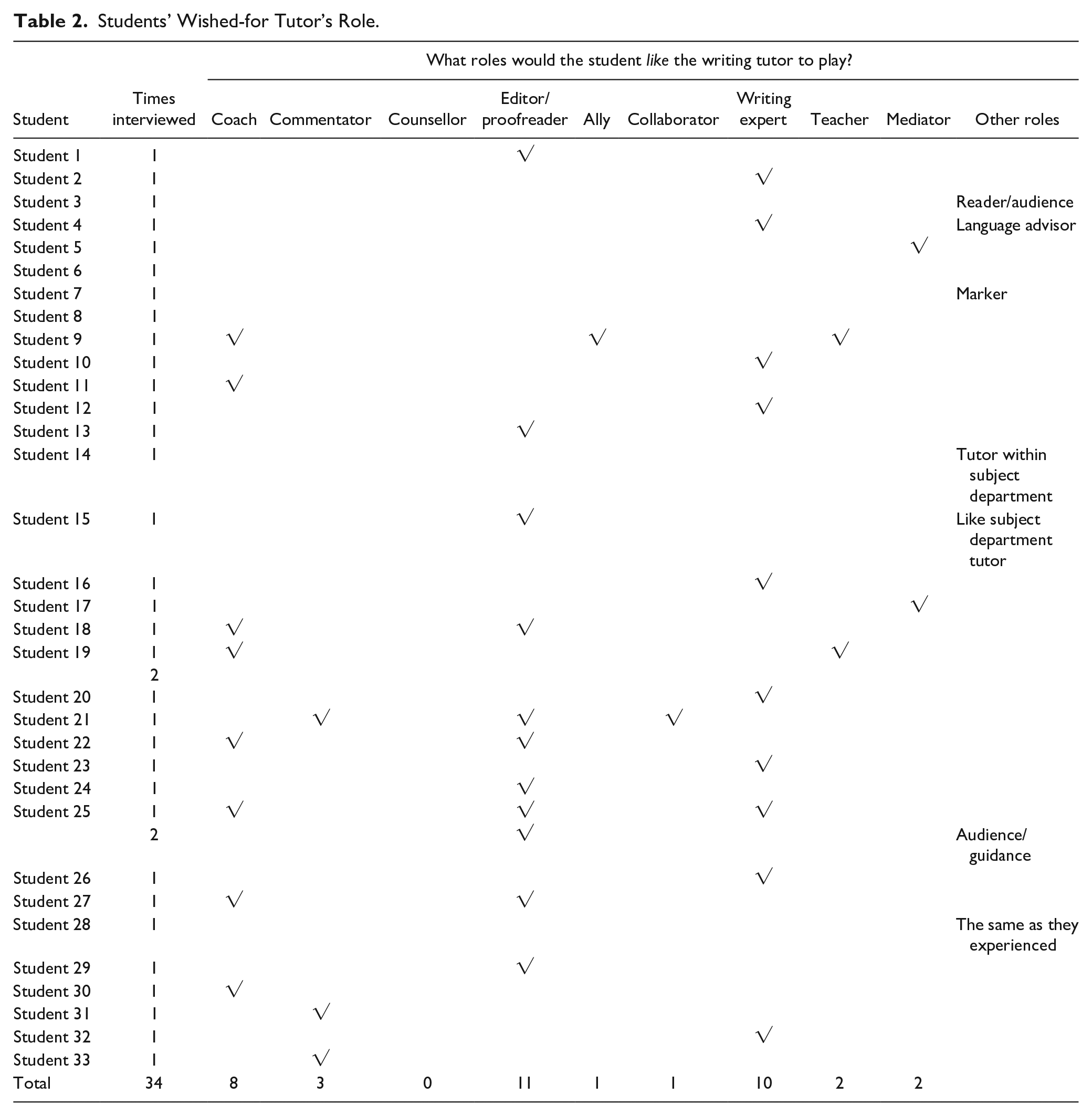
We see from Table 2 that the most popular wished-for role is that of proofreader, followed by disciplinary writing expert and coach.
Tables 3 and 4 show the tutors’ and the director’s view of the writing tutor’s role, respectively, and differences in comparison with the student data are evident, particularly as regards the role of proofreader.
Tutors’ View of the Writing Tutor’s Role.
Director’s View of the Writing Tutor’s Role.

As shown in Tables 3 and 4, writing tutors recognized the roles of coach, commentator, counsellor, ally, collaborator, teacher, and mediator, and the director recognized coach, commentator, counsellor, ally, collaborator, teacher, and mediator as legitimate tutor roles. All seven tutors believed they had played the role of commentator and six tutors felt their roles had included the coach. The roles of ally and collaborator were acknowledged by five tutors, and the roles of counsellor and mediator by three tutors. No tutor felt they had played the role of proofreader—a particularly interesting finding given that nearly all students claimed to have experienced the proofreading role in consultations, and given the proofreader was the most popular wished-for role. As for the disciplinary writing expert, while only two students claimed to have experienced a tutor enacting this role and no tutors claimed to enact it, it was the second most popular wished-for role, only narrowly less popular than the proofreader. There is therefore a conflict between tutors’ understandings of their roles in consultations and students’ perceptions of their experiences and expectations. However, tutors were aware that students desired them to act as proofreaders, as we shall see below.
Tutor’s Role as a Proofreader
The most salient roles (proofreader, coach, commentator, counsellor, ally, and teacher) as reflected in Tables 1 to 4 are now presented and discussed in detail.
There are wider and narrower definitions and conceptualizations of proofreading. An example of an inclusive definition is that of Harwood et al. (2009): “third party interventions on assessed work in progress” (p. 167). Here we follow Mack’s (2014) definition, understanding this role rather narrowly and traditionally in line with the writing centre literature, the proofreader focusing only on the correction of grammar, spelling, and syntax rather than on more substantive interventions (e.g., interventions related to content or organization), as is made clear in our prompt card (see Appendix C). This understanding of proofreading is also in line with the Chartered Institute of Editing and Proofreading (2020) definition of proofreading as “a process of identifying typographical, linguistic, coding or positional errors and omissions on a printed or electronic proof, and marking corrections.”
At present, the writing centre advocates a no-proofreading policy (while not specifying on its website what is meant by proofreading). However, as indicated above, it is interesting that the tutor role most frequently recognized by students in the interviews was proofreader. For example, Student 10, an MSc Molecular Medicine student who brought an article/book review to her consultation, claimed at interview that her tutor played the role of proofreader: “She revised my writing sentence by sentence.” The evidence that the tutor did indeed act as proofreader was strengthened when the student referred to the tutor’s interventions on her draft more specifically (see Figure 1).
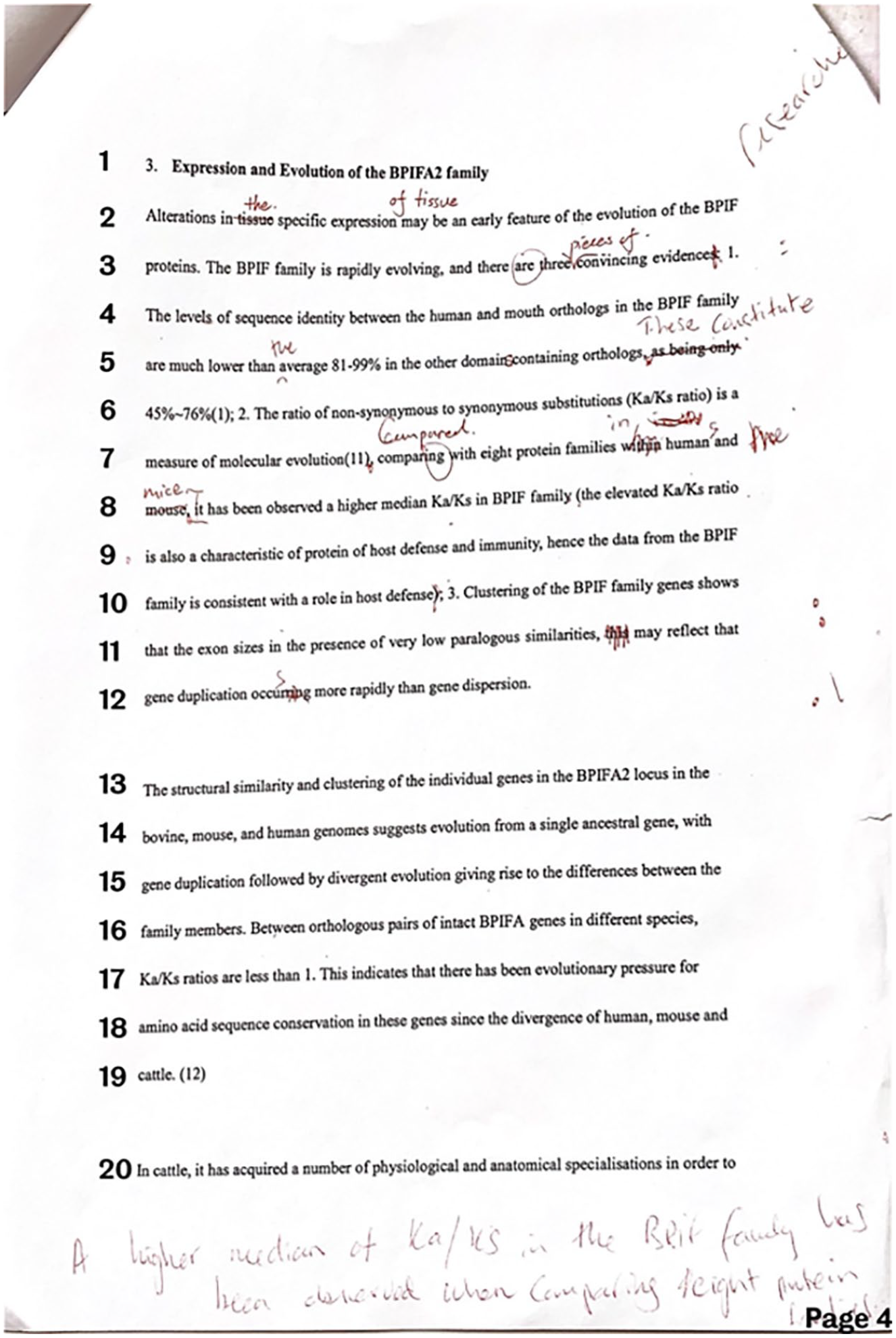
Excerpt from Student 10’s writing.
The following proofreading revisions made by the writing tutor can be seen in Figure 1:
2nd line: (word order) tissue specific expression versus the specific expression of
3rd line: (plural) three convincing evidences versus three pieces of convincing evidence
4th line: (plural) levels versus level
5th line: (article) average versus the average, (tense) domain versus domains
7th line: (adjectives -ing/-ed) comparing versus compared,
○ (preposition) in versus within
○ (plural) human versus humans
8th line: (plural) mouse versus mice
12th line: (tense) occurring versus occurs
Based on their revisions, the tutor did indeed play the role of proofreader, circling, underlining, and correcting errors for Student 10 line-by-line. Furthermore, the tutor supplied the corrections for the student rather than eliciting them. Reports of similar interventions are mentioned by many other students in their interviews, some of these students bringing their writing to interview and using their texts to substantiate their claims like Student 10.
However, none of the seven tutors regarded their role as a proofreader and there was no evidence in the eight audio-recorded consultations of writing tutors doing any proofreading. Three reasons were given by tutors for their avoidance of the proofreader role relating to ethics, job descriptions, and time constraints. First, tutors claimed “proofreading” may result in the tutor writing the essay for students, thus stymieing the development of learner autonomy. Second, the role of proofreader was said to be a job for other parties—namely, professional proofreaders outside the writing centre context. Third, time was said to be a constraining factor when tutoring. Tutor 6’s explanation refers to reasons two and three: I think a proofreader is somebody who checks for all the mistakes and our role here is not supposed to do that, because we don’t have time and it’s not just what we’re all about.
From the managerial perspective, the director conceded that, despite the writing centre’s no-proofreading policy, writing tutors have indeed sometimes enacted this role (although of course we also found evidence that such proofreading is not confined to past practices, as in Student 10’s case described above). However, the director explained how the advice on the centre’s website regarding tutor roles attempts to manage students’ expectations, stating explicitly that proofreading is debarred, and also explained that students who requested consultations that more squarely focused on proofreading were also told the proofreading role was off limits. Those students who insisted they wanted proofreading were advised to find a professional proofreader.
The director was adamant that the center’s no-proofreading policy was right for two reasons: first, writing tutors are not professionally trained proofreaders; and second, different academic departments have different conceptions of ethical proofreading boundaries and the extent to which proofreading is appropriate for their students before submission of assessed work.
There is an association of proofreaders who have been trained and qualified to do that sort of work. Our staff, they have not been trained to be proofreaders and there is a difficulty as well because different departments have different rules about proofreading, what is acceptable, what is not acceptable. So it is very dangerous territory for our teachers, so we say definitely no.
The director spoke of two techniques tutors should use to maintain a clear boundary between helping with language (permissible) and proofreading (not permissible); that is, to point out general areas for language improvement (permissible) and avoiding checking and correcting every error (not permissible). First, students rather than tutors should hold the pen during consultations so that tutors do not make corrections for students. 3 Second, tutors should help students answer questions rather than supplying them with the answer. In sum, then, the director insisted that tutors should not enact the proofreader role and that the need to avoid proofreading is highlighted in the centre’s tutor training.
No writing tutor played the role of proofreader in the audio-recorded consultation data, in contrast to evidence from students’ interview data and from students’ drafts brought to the interviews that some tutors did in fact act as proofreaders.
4
Instead, tutors in the audio-recordings helped more with higher order concerns (such as helping students with evidence and argumentation). While four of the audio-recordings showed no signs of helping with grammar, the other four consultations included work on language and grammar to different degrees, usually picking up on recurring errors and asking questions to stimulate students’ thinking about language-related issues. However, as Tutor 6 made clear in the following excerpt from his consultation, a proofreader outside the writing centre would need to be employed for a more comprehensive language check: For very detailed checking, you can always see a proofreader, because the proofreader will actually check each sentence for language. For the [consultation] it’s a more generic advice session, okay.
Tutor’s Role as a Coach
The three parties agreed that tutors enacted the role of coach, which is confirmed in the evidence from the recorded consultation data. In this study, a coach means someone who helps and encourages students and explains what they need to know in order to become more skilled and improve their writing, by, for instance, pointing students toward resources which will help develop their writing skills (see prompt card in Appendix C).
A large number of students (20) claimed to have experienced the tutor as coach. For example, Student 6 (postgraduate, studying Education) mentioned how her writing tutor helped hone her academic writing skills. By her own admission, Student 6 had little understanding of expectations surrounding critical thinking in U.K. university essay writing. However, her tutor taught her about this by giving a mini-lesson, using a whiteboard to do so in the consultation:
A, coach, yes, he taught me many writing skills. It’s like a template. He also gave me a website called Academic Phrasebank. I can use this to practice my skills.
Yes, you mentioned the tutor taught you many writing skills. Can you tell me more about that? And what do you mean by template?
For example, he taught and trained me in critical thinking, which is a crucial writing skill in English academic writing. The template was shown in the picture [see Figure 2, which shows a photo of the tutor’s whiteboard]. “Critical thinking=agree/disagree with sources; based on (1) other sources, (2) your experiences.” Moreover, the Academic Phrasebank has many academic phrases which can be used as templates and you can check it when you write. This is also a way to train your writing skills.
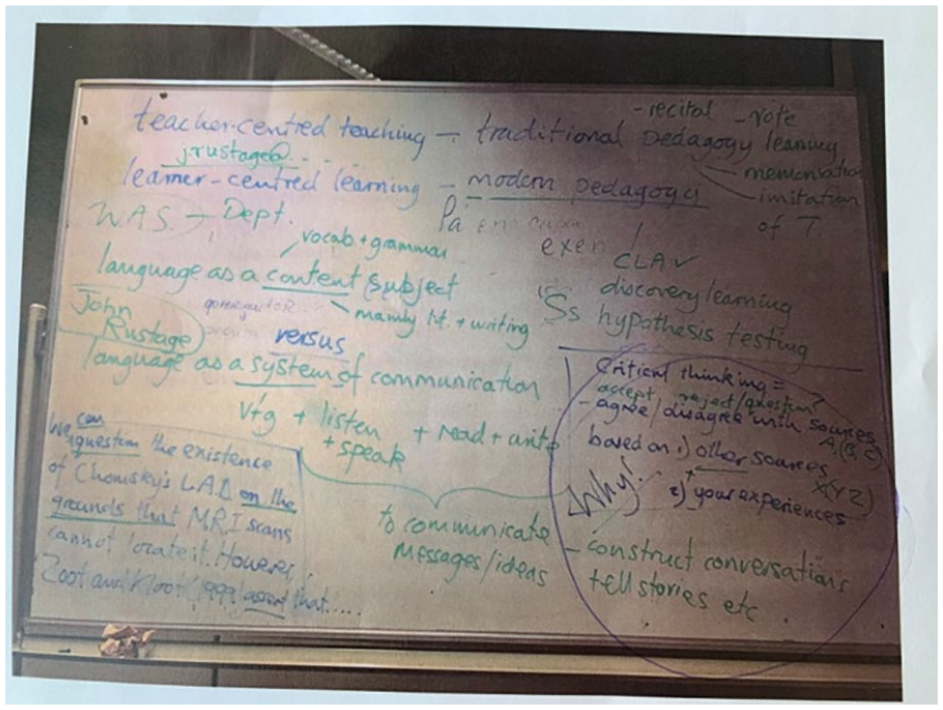
Board work from Student 6’s writing consultation.
Figure 2 illustrates how in this consultation the tutor used the bottom-right corner of the whiteboard to develop Student 6’s skills to write critically. Moreover, as Student 6 mentioned, the website she was referred to (Academic Phrasebank; see phrasebank.manchester.ac.uk) served as a resource to hone her academic writing skills in grammar and register as well as add to her knowledge of linking structures and lexical bundles. In this case, then, the tutor played the role of coach.
In line with students’ views and writing centre policy, six of seven tutors agreed their role includes that of a coach who helps develop students’ academic writing skills. Tutors mentioned that this role is particularly significant for students who did not attend a pre-sessional English course: Tutor 5: “I think a writing tutor should act as a coach, to encourage students and advise on what I think they need to know to become more skilful and improve their writing. I think that’s the key. I think we get some students who have done a pre-sessional course who might have a better idea of how to structure a paragraph and that sort of thing. But then you get students who come and they haven’t done a pre-sessional course and who sort of need help and guidance, I think, certain skills.”
The director agreed that acting as coach is one of the tutor’s roles and all eight audio-recorded consultations indicate that tutors perform the role of coach to a degree. Taking the audio-recording of Student 11 (postgraduate, studying Management) and Tutor 6 as an example, it can be seen how Tutor 6 played the role of coach in this consultation. We reproduce a consultation excerpt, together with part of Student 11’s text (Figure 3).
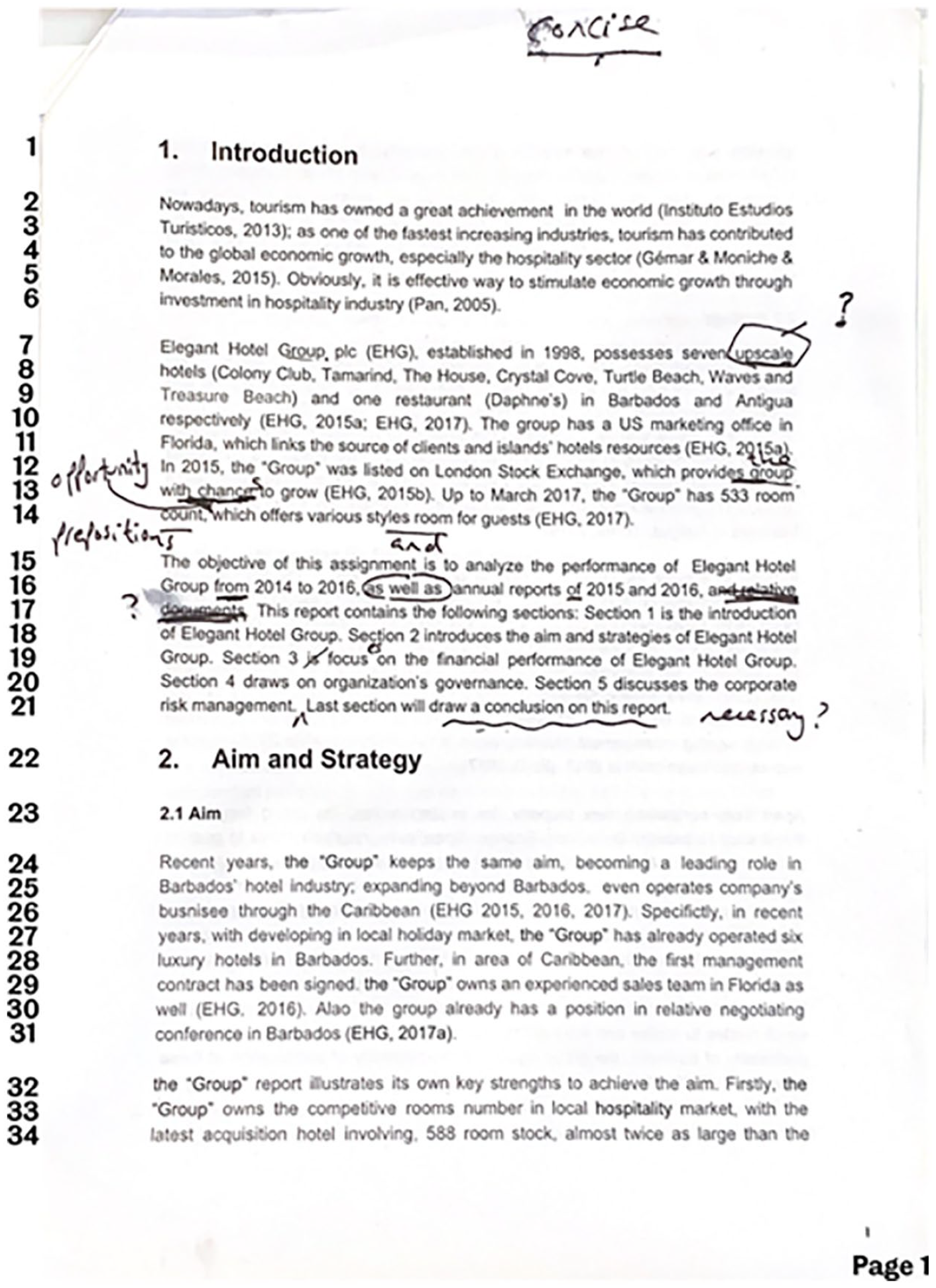
Excerpt from Student 11’s writing.
“Chance to grow” . . . [tutor is reading student’s writing and pauses here at 13th line of Figure 3]
Chances? Some term?
It could be “chances” or “some chance,” yeah. “Chance” is okay, but maybe a more academic word could be “opportunity.” That’s just one example of where . . .
Because I think in the writing, we always usually use some words that we use in normal life, but how to more academic like the words or the sentence?
Well, “chances” is possible in academic work, “opportunity” is just even more academic and to know these, you have to read lots of articles, that’s where the learning happens, you automatically acquire these as you learn more and more. Okay, this one is another example, okay, so we have words that are more academic, and we have, in other situations we have a choice, you can use three words, or one word. Which one is better? [Referring to 16th line of Figure 3]
One word.
Yeah, why?
It seems more simply and more clearly in the structure.
Yeah, we can say concise, that just means fewer words but clear meaning. So here you have “as well as” [16th line of Figure 3], is there a word we can use instead?
“Similarity”?
If we look at the whole sentence maybe it’s easier?
“And”?
Yeah, exactly. Okay, good, yeah.
The excerpt presented here, reproducing the tutor-student exchange, read in conjunction with Figure 3, shows the tutor acting as coach, helping train Student 11 in skills related to academic writing conventions. After Student 11 successfully produced the right answer, the tutor also tried to encourage the student by praising her.
Tutor’s Role as a Commentator
There was something of a consensus between all three parties that tutors acted as commentators. In this study, the role of commentator is defined as someone who explains, illustrates, and evaluates what is happening in students’ writing (see prompt card in Appendix C). Harris (1986) described this role as “to give a larger perspective on what is going on” (p. 36). Twenty-two of 33 students, all seven tutors, and the director agreed the role of commentator was present and appropriate in the centre’s tutoring. For example, at interview, Student 22 agreed her tutor had acted as commentator: As you can see from her feedback [tutor’s feedback in Figure 4], she firstly ascertained my grammar overall was good, and sentence structure has no big problem. And then she identified areas with weakness such as word selection and repetitiveness.
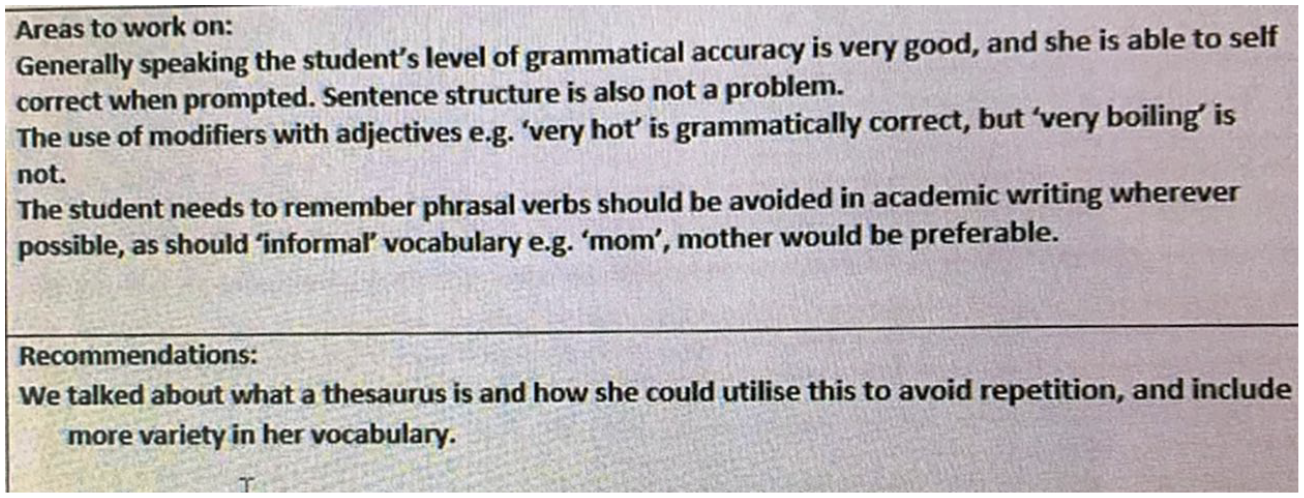
Excerpt from Student 22’s post-consultation feedback.
Figure 4 shows that the tutor commented from both macro- and micro-perspectives on the student’s writing.
Regarding the macro-perspective, the tutor evaluated the student’s grammatical accuracy and sentence structure positively (“very good’; “not a problem”), “and she is able to self correct when prompted.” Regarding the micro-perspective, the tutor pointed out problems in using modifiers with adjectives and phrasal verbs. After the consultation, Student 22 revised accordingly based on the tutor’s feedback.
In line with the findings above showing most students and all tutors agreed that tutors acted as commentators, the director reported that commentator is “one of the most common roles” of tutors in consultations: . . . that is one of the most common roles and sometimes you do have the tutor circling things and underlining things, and then just telling the student, “Okay, look at this, look at this,” then if the student doesn’t understand then you sort of comment.
Likewise, tutors also view the commentator as an important role. All tutor interviewees acknowledged their role as commentator. Our audio-recorded consultations also show tutors playing the commentator in all sessions, commentating, evaluating, and illustrating how students could improve their writing. Below is an excerpt from a recording where Tutor 6 comments on Student 11’s writing as giving enough information but suffering from language weaknesses: Tutor 6: “I think you have enough information and I definitely think you’ve done enough reading, enough work, but I think the language, the analysis is probably there, but the language needs to be checked, alright?”
In this conversation, Tutor 6 played the commentator role by commentating in macro, identifying the strengths and the weaknesses of Student 11’s writing in general rather than specific terms.
Tutor’s Role as a Counsellor
The interview data revealed a mismatch between students’ understanding and the tutors’/director’s understanding of the counsellor role. Being a counsellor means the tutor provides emotional support for students in consultations and makes students feel better emotionally (see interview prompt card in Appendix C). Most students (20/33) claimed tutors enacted the role of counsellor; however, most tutors (4/7) and the director denied that this was the case.
Students spoke of two effects of the tutor playing this role: (1) the tutor gave students a sense of security and (2) students gained confidence/comfort from the help and encouragement provided. At interview, Student 28 mentioned that the “sense of safety” was the most helpful thing about the consultation: It makes me feel safe when I know I will have a writing tutor to help with my writing for the one-year master program. It makes me feel safe that I know someone will support me.
Other students claimed the “emotional support” they derived from tutorials came about because their fears about failing their work were alleviated: You know you will pass [the writing assignment] and you have more confidence [as a result of the consultations]. So you won’t feel too anxious.
In contrast, most tutors disassociated themselves from the counsellor role. This was mainly because they believe their focus is on helping students with their writing rather than helping with personal problems, which tutors believed would be more appropriately managed by professionals outside the writing centre (e.g., trained counsellors in the University’s Student Support unit). Another reason for not identifying with the counsellor role was that tutors claimed most students don’t come to consultations with personal emotional issues: I mean we don’t have students crying, or like that, not that type of counselling. (Tutor 1)
From the managerial perspective, the tutor as counsellor role is not encouraged. The director explained his misgivings thus: We always say be sympathetic and listen but we’re not qualified or trained to offer personal advice, so it’s a very dangerous situation.
Instead, the director explained that tutors should refer students to professional counsellors.
Despite these denials by the tutors and the director that tutors play the role of counsellor, at times the willingness of tutors to encourage and patiently listen to tutees made students feel better emotionally, as explained in student interviews. In these situations, then, there is a sense in which tutors did indeed play the role of counsellor—even if they did not recognize their role as such and were unaware of the beneficial effects. Although we found no evidence of tutors giving advice on serious emotional problems in the audio-recorded sessions, in terms of giving affirmative feedback and encouragement, all tutors played this role to different degrees. For example,
Sometimes I try to avoid the repetition of the category. Yeah, I tried to use different words for it.
Okay. But it’s good that you’re trying to do that, but just make sure you translated it. And if you find something which is more proper, it is just as appropriate, meaning the same thing, great.
Our counsellor prompt card references both heavier and lighter touch understandings of “counselling,” from making someone feel better emotionally (lighter touch) to advising on personal problems (heavier touch). Students apparently affirmed the enactment of the counsellor role with reference to the lighter touch understanding, by confirming their consultations had given them an emotional boost; in contrast, tutors and the director denied the enactment of the counselling role with reference to the heavier touch understanding, explaining how they declined to intrude into tutees’ personal lives.
Tutor’s Role as an Ally and Teacher
The role of ally and teacher are put together here because in a sense these two roles emphasize contrasting functions and dealing with them simultaneously better enables us to mark out the differences. Both roles occurred in our data. Tutors enacting the ally leave revising to the student and tutors never do the work for students directly, while the role of teacher means the writing tutor tells students what to do (see interview prompt card in Appendix C). Most tutors and many students felt there was an element of both roles in tutoring (19/33 students agreed with ally, 13/33 students with teacher, 5/7 tutors agreed with ally, and 5/7 tutors with teacher) and the director agreed both roles were present and appropriate.
Sometimes tutors acted as an ally by asking questions to stimulate students’ thinking, but sometimes they ultimately needed to tell students how to deal with the issues directly (thereby switching from ally to teacher). An example is shown below from the audio-recorded consultation data, together with Figure 5, which shows an excerpt from the writer’s text. Student 28 is an MA Education student and the writing she brought to the consultation was a reflective essay talking about her past educational experiences and her plans for learning this major. The writing tutor acted as an ally first and then adopted a more direct, interventionist teacher role:
So, for example, if you look at this sentence here [“I was very committed to my students,” 20th line of the writing; see Figure 5], what do you think is wrong with that, the sentence?
I don’t know.
Or can you read it and think.
Oh, this is past [tense].
Yeah ok, so what do you think it should be?
“Have seen.”
Not “have seen,” like, because you got present and have you got past? Those two things don’t really mix in the sentence do they, so should this be past? Or should this be present? What do you think?
Present?
Maybe it is hard for you to know because you’re writing it, so it’s up to you what impact you want to have.
It should be present?
So, when you finish here, are you going back to being a teacher?
Yes.
So, you’re still a teacher really, you’re just a teacher which is not currently teaching.
Oh, that counts?
Yeah, okay so I think “I am.”
“I am”?
Because it’s also about the nature of this thing, you know what is education, what is it for, what is its value, umm so you know it’s very much about your attitude to education now and so when you write . . . what do you think education is for, what do you think your role is as a teacher, unless you stop being a teacher or become an academic, you wouldn’t really use past tense there.
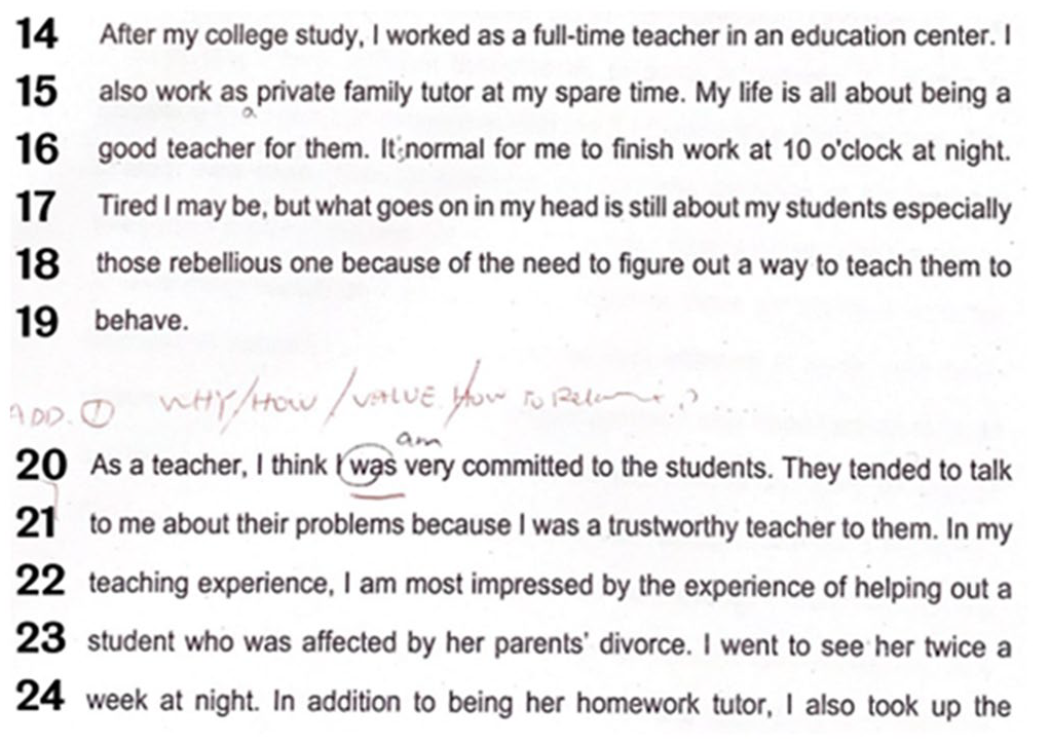
Excerpt from Student 28’s writing.
From the excerpt above, we see the tutor tried to encourage the student to figure out the problems herself. The strategies he used included (1) Socratic questions to promote thinking (Blau et al., 2001); (2) reading aloud (Murphy & Sherwood, 2008); and (3) implicit error correction, finding one grammar mistake as an example, circling it, and asking the student to then explain the right way to use it (Mack, 2014). However, when the tutor realized the difficulties the student was having as she tried to revise, he gave her the answer directly and explained the reason, switching to the teacher role.
In most cases, writing tutors reportedly acted as allies and tried to enable students to do the work themselves, as Student 12 mentioned at interview: I really like this tutor because he led me rather than told me. He got me to think rather than revise things directly for me. For example, he would ask me how to revise it? And I would give him three of my ideas. He then asked me which one did I think was the best? I feel through this process I learnt a lot and improved a lot.
Nevertheless, the audio-recorded data showed that there was always an element of a teacher role surfacing in practice because sometimes students lacked the knowledge to fix their own problems in writing (as in the example of Student 28 discussed above). In addition, at interview tutors justified enacting the more directive teacher role at times because of time constraints: Tutor 3: “I just tell [students the answer]. I mean, again, it’s the time, you know, we don’t have time to play games really, I think it’s, you got to say directly, go direct I’m afraid.”
Furthermore, the director defended a teacher role for writing tutors: . . . sometimes, depending on the level, sometimes the student just needs to know the answer and then sometimes, there is for example, we tend to make a difference between a mistake and an error, and we say a mistake is something that you point that out to a student and the student goes “Oh yes,” so that’s a mistake. We tend to say that an error is a knowledge gap, is that the student doesn’t know. So you go like, “Oh same mistake, same mistake, same mistake,” and then you’re like that, hmm the repeated mistake, and you say “What is the rule of this?”
The director suggested that the tutor’s role depends on the type of help students need. He suggested for mistakes, tutors may be able to act in an ally role, helping students self-correct; but that when there is a knowledge gap (errors), writing tutors can act as teachers, providing instruction and input when students are incapable of self-correction.
Roles That Students Would Like the Tutor to Play
The interviews show that students’ most wished-for tutor’s roles were proofreader, disciplinary writing expert, and coach. The main reasons were students’ lack of confidence in grammar and (perceived or real) difficulties noticing grammar errors by themselves. When asked what role she wished writing tutors to play, Student 18 answered: I hope the tutor could be A, coach, to train my writing skills and D, proofreader, because I aim at publication and I am an international student. I think it’s very difficult for me to realize some language problems by myself. I need a proofreader or editor to help me to do this.
Another reason for students expecting writing tutors to be proofreaders was because students see tutors and disciplinary faculty as helping them develop as writers in different ways: I actually really want D, proofreader. We have tutorials in our department to look at organization and structure. I feel that tutors in the writing centre mainly help with grammar. (Student 24)
Interestingly, another hoped-for role was disciplinary writing expert. Only two of 34 students agreed tutors played this role. However, 10 students reported that although they understand that consultations do not help with content, they still expect their tutors to have some discipline-specific knowledge.
Discussion
Tutors’ Roles
We have discussed the role of proofreader, coach, commentator, counsellor, ally, and teacher in connection with writing centre tutorials. Other roles, such as disciplinary expert, mediator, audience, and marker, were also mentioned by participants to different extents, but as they were not recognized as primary roles that tutors take in this context by participants, they were not discussed in detail.
There was overall consensus among the three parties in recognizing the role of coach, commentator, ally, and teacher. The enactment of these four roles was confirmed by the audio-recorded consultation data. Similar roles are discussed and highlighted by previous studies on writing centres (e.g., Harris, 1986; Mack, 2014). However, there were different understandings among participants of the proofreader and counsellor roles, requiring further discussion.
The proofreader role has always been debated in writing centre research. According to Turner (2011), in U.K. higher education some writing centres offer free proofreading services, some strictly forbid this, and some permit a paid-for proofreading service. Nonetheless, while most centres have a no-proofreading policy, some grammar help seems inevitable, especially with L2 learners. Eckstein (2016) found that “although most writing centres maintain policies against providing grammar correction during writing tutorials, it is undeniable that students expect some level of grammar intervention there” (p. 360). We uncovered similar student expectations, and this result was unsurprising, given Harris’ (2006) claim that student requests for writing centres proofreading are “ever-present,” and Severino et al.’s (2009) finding that L2 writers requested more help from tutors with grammar/punctuation than L1 students. Furthermore, there was evidence from the writing students brought to interview that at least some writing tutors were willing to proofread, in opposition to the centre’s policy. Various, albeit speculative, explanations for this breach of policy can be advanced:
Chinese students may lack confidence in their knowledge of grammar and language.
Tutors may lack training as to how to avoid proofreading. (Although the director claimed that training is compulsory and includes strategies to avoid proofreading, some tutors said they had not received any training.)
Tutors may take differing stances toward their centre’s no-proofreading policy, some adhering to and others resisting it 5 —recall that other studies, such as Thonus (2001), have revealed tutors’ violations of institutionally permitted roles, preferring more directive approaches.
Tutors may interpret “proofreading” differently. According to Harwood et al. (2009, p. 168), proofreading can be understood in various ways, and it is possible that some tutors violated the no-proofreading policy unwittingly.
Lastly, to end this section, we turn to the counsellor. Students and tutors had different interpretations of the role of counsellor. Tutors understood “helping students with personal emotional issues” as referring to relatively serious problems. Yet students spoke of the comfort and confidence they gained with reference to less extreme problems from tutors’ praise and encouragement. The audio-recordings show that no writing tutor gave advice on serious emotional problems; but all tutors provided affirmative feedback and encouragement to different degrees in consultations. This is consistent with Huijser et al.’s (2008) finding that emotional support is one of the key areas in which writing tutors should support learners.
In sum, then, the legitimacy of various tutor roles attracted consensus, while the proofreader role in particular was a source of tension, highlighting differing understandings and expectations of the role of writing tutors among the stakeholder groups. We now move on to making some recommendations writing centre managers may wish to consider which emerge from our study.
Recommendations for Writing Centre Administrators
We make four recommendations that we believe the writing centre in our study should contemplate, but which other writing centres may also find pertinent.
Establish an appropriate proofreading boundary
As Clark and Healy (2008) suggest, the difficulty of demarcating an ethically acceptable boundary between proofreading and help with language issues for L2 students is a problem unresolved in many writing centres. (Indeed, establishing such a boundary has been shown to be difficult even for proofreaders themselves: see Harwood, 2019.) Two recommendations were given by the director to identify and enforce such a boundary: (1) erect a physical boundary: let the student “hold the pen” and make the necessary interventions himself/herself; and (2) erect a pedagogical boundary: ensure the tutor helps students answer questions rather than the tutor answering questions and doing the students’ work himself/herself. Additionally, we would suggest that in tutor training sessions, participants should (1) discuss Harwood’s studies exploring differing conceptualizations of “proofreading” (e.g., Harwood, 2018; Harwood et al., 2009); (2) consider the extent to which the proofreaders in these studies adhere to or deviate from traditional definitions of proofreading provided by organizations like the CIEP; (3) discuss which definition of proofreading the writing centre should adhere to; and finally (4) have tutors practice giving feedback on authentic samples of student texts and in practice consultations in such a way as conforms with the centre’s proofreading boundaries. While we make these recommendations, we are under no illusions that resolving the proofreading issue is straightforward, and we discuss some of the complexities surrounding this issue below.
Manage/partially meet students’ expectations
Our findings highlight the importance for writing centre administrators to manage students’ expectations regarding tutors’ roles that conflict with writing centre policy. There was a disconnect between what the tutoring service permitted and the service that students wanted—in particular, the desire for proofreading. An obvious response is to better disseminate the goals and remit of the writing centre, that is, the centre’s roles and boundaries, both in general and for writing consultations in particular, to all stakeholders (see Harris, 2006). Writing centres need to ensure they clearly explain and disseminate their remit in advance of consultations (e.g., via talks by writing centre tutors to students across all university departments about the type of help on offer). Other ideas for dissemination suggested by Harris (2006) include “reports to (university) administrators, workshops for teachers (i.e., content lecturers), publicity, and invitations to students to visit the centre.” In line with North’s (1984) idea of the writing centre, directors may wish to stress that tutors are not running a “fix-it shop” (p. 435), but are rather focused on an educative approach (see also Brooks, 1991). We do not pretend all students will be happy with this; as we have seen from our study, and as attested by accounts from writing centres in other contexts (e.g., Alhawsawi & Al Aradi, 2017; Elsheikh & Mascaro, 2017; Linville, 2009; Moussu, 2013), the proofreading role was the most wished-for role on the part of the students. But such an educative, active approach will no doubt be more pedagogically beneficial for those students who buy into it, rather than having their work proofread as they sit passively by.
An alternative approach to attempting to manage students’ expectations regarding the writing centre brief would be to meet those students who wish for proofreading halfway: tutors could be permitted to make up to a certain number of edits as prescribed by the centre, with the proviso that the approach was formative. So, for instance, if the tutor observed a recurring tense problem in the writer’s text, she/he could edit out a couple of tense errors and refer the writer to some teaching materials on tense errors, leaving the writer to study the materials provided and edit out the rest of these errors from the text themselves (see comparable tutor practices in Voigt & Girgensohn, 2015). We can also look to Aljaafreh and Lantolf (1994) and Ferris (1999) for more ideas and techniques for scaffolding and supporting students in a manner which obliges writers to play an active part in correcting their own work after initial help from the tutor. Drawing upon Vygotsky and his concept of the zone of proximal development, Aljaafreh and Lantolf (1994) explain how tutors will do well to graduate their interventions, beginning with implicit styles of corrective feedback which become explicit—”more specific, more concrete” (p. 468)—until understanding between tutor and writer is achieved.
Aljaafreh and Lantolf (1994) also talk about how feedback should be contingent, “meaning that it should be offered only when it is needed, and withdrawn as soon as the [learner] shows signs of self-control and ability to function independently” (p. 468). In sum, then, “The process is thus one of continuous assessment of the [learner’s] needs and abilities and the tailoring of help to those conditions” (p. 468). In order to provide help at the appropriate level of graduation and contingency, dialogue between tutor and learner is needed, as the tutor gauges the effectiveness of the kind of help/talk she/he is providing and calibrates it in accordance with the tutee’s response. Later in their article, Aljaafreh and Lantolf describe a “regulatory scale” of teacher behavior, ranging from implicit to explicit feedback, that tutors can utilize. For her part, Ferris (1999) draws a distinction between treatable and untreatable errors. Treatable errors can be addressed by reference to a set of rules, unlike untreatable errors, which are associated with “a wide variety of lexical errors and problems with sentence structure, including missing words, unnecessary words, and word order problems” (p. 6). These “idiosyncratic” (p. 6) errors may need more direct/explicit intervention on the part of the tutor, and so again, a tailored approach to tutoring is called for, depending upon the nature of the error and the ease with which the tutor anticipates the tutee will be able to solve the problem for themselves.
At the same time, we should acknowledge that not all writing centre scholars and tutors would wish their centres to adhere unwaveringly to North’s writing centre dicta: we see in Clark and Healy (2008), for instance, a more permissive view of editing, at least in the case of some L2 writers, some of the time; and in Nan (2012) and Powers (1993) an argument for rethinking the remit of the tutor when dealing with L2 as opposed to L1 writers, making the tutoring process less collaborative and more directive. Furthermore, Eckstein (2019) finds that many L2 writers are in fact already receiving directive forms of intervention in United States writing centres; and Bonazza (2016) and Voigt and Girgensohn (2015) report that tutors of L2 writers in Germany at times find nondirective pedagogies less than helpful. For her part, Moussu (2013) relates how, when she was delivering a presentation at the annual TESOL Convention, she encountered objections from some members of the audience to orthodox, nondirective approaches to tutoring: these delegates began demanding to know what was so wrong about helping ESL students with their grammar. I was even asked how I could sleep at night with the knowledge that I was forcing ESL students to pay expensive editors instead of helping them free of charge in my WC [writing centre]. (p. 58)
Moussu goes on to explain that her experience highlights the “cultural gap” that exists between English as a second language (ESL) teachers and writing centre tutors in North America, ESL teachers being more comfortable with directive styles of intervention than writing centre tutors. However, in the United Kingdom and in many other contexts, teachers commonly work both as ESL teachers and writing centre tutors, sometimes out of exactly the same English language teaching centre on campus; indeed, writing centre tutors in the United Kingdom would normally have begun their teaching careers as EFL teachers, spending years “fixing” students’ grammar. As speculated above, then, there may sometimes be considerable tutor resistance to orthodox nondirective writing centre pedagogies, and going at least some of the way to adapt these pedagogies so that language work is included in consultations may not only be well-received by L2 students; it may also be well-received by some tutors, wishing to rid their writing centre brief of what Moussu and David (2015) call “the taboo of working on grammar” (p. 50).
Expand the writing centre’s activity across the university
We have explored above the possibility of recognizing and potentially meeting students’ expectations for tutors to be permitted to focus more heavily on proofreading and on language work than orthodox writing centre tenets would allow. However, if most students have either not received or accepted the message regarding the writing centre’s anti-fix-it shop raison d’être despite efforts to disseminate this message, perhaps a different approach is required. That is, to expand the centre’s activity across the university, similar to the University of Coventry’s Centre for Academic Writing (see Deane & Ganobcsik-Williams, 2012). Rather than being associated exclusively by students as a place to come to “fix” their work shortly before it is due to be submitted, writing centres could set up credit-bearing modules which focus on writing as a process, and which feature writer-tutor interactions on drafts over an extended period. In addition, and in line with Centre for Academic Writing, the centre could focus on training disciplinary faculty to incorporate explicit writing instruction into their subject modules, for instance, by helping lecturers “to introduce a formative assessment into a course to give students guided practice and feedback the students can implement in their summative assessment task” (Deane & Ganobcsik-Williams, 2012, p. 194). These initiatives could promote the association of the writing centre with long-term literacy development rather than short-term fixing.
Strengthen tutor training
The director explained the writing centre offers compulsory tutor training. However, we found that not every tutor had undergone this training or incorporated the centre’s tenets into their practice. In the future, management should ensure that all tutors have taken the tutor training properly and ensure all in-house tutoring principles and strategies are included in the training. As stated previously, we would recommend several rounds of actual practice with authentic student texts be incorporated into the training to ensure tutors reflect on how to give feedback to students and where they should draw the line between ethical and unethical interventions with reference to the centre’s policy. Furthermore, trainee tutors should attend live consultations to observe how experienced tutors intervene; and then when trainees are judged to be ready to begin tutoring themselves, experienced tutors should sit in to instruct and advise novice tutors for a further period. Additionally, it is advisable for trainers to provide trainees a list of useful links (e.g., Manchester Academic Phrasebank; IEEE reference guide) and other helpful services (e.g., information about in-sessional courses and other in-house academic literacy courses provided by the university) to help tutors tailor their interventions and advice to different writers.
Conclusion and Suggestions for Future Research
This research explored three parties’ beliefs about tutors’ roles in a U.K. university writing centre in order to provide a fuller picture of how tutoring roles are understood. We focused on the most predominant roles, including proofreader, coach, commentator, counsellor, ally, and teacher. Tutors can perform more than one role and can flexibly change their roles during the consultation. There was general agreement in acknowledging the presence of the role of coach, commentator, ally, and teacher in consultations, and discrepancies between tutors’ professed roles and actual tutoring practice with regard to proofreading. There were also different understandings of the roles of proofreader and counsellor, indicating further guidance and clarity from management is needed, as well as further research as to interpretations of tutor roles in general and of these roles in particular. 6 As Thonus (2001) argues, describing and delimiting writing tutors’ roles is not straightforward, as attempts to do so need to take into consideration specific contexts and their associated needs and affordances. Future researchers could explore writing tutors’ roles in other contexts (cf. Ganobcsik-Williams, 2012), involving tutors with different qualifications, and students with different English language levels. Future researchers could also study different disciplines to see how these differences affect tutors’ roles, if at all. (With regard to different disciplines, for instance, if tutors are working with a writer whose discipline they, the tutor, are familiar with [e.g., TESOL, education], do they tend to intervene more at the level of content suggestions than when working with a writer whose discipline they are unfamiliar with?) Additionally, future researchers could include more audio- or video-recorded consultation data since the amount of consultation data included here was limited.
Other potentially fruitful research directions include investigating the extent to which tutor role enactment changes as a result of the genre in focus (e.g., When reading essays vs. personal statements, do tutors more heavily enact the proofreading role in response to one genre over another?). And are tutees’ expectations of their tutor’s role also affected by genre (e.g., Do students expect word by word proofreading for certain genres more than others?). Future work could also look at whether there are differences in tutor behavior and student expectations in accordance with students’ undergraduate/postgraduate status, how tutor training helps regulate tutors’ behaviors, and could explore the extent and reasons for tutor resistance to writing centre policies around legitimate tutor roles. Two final suggestions for future research relate to technology and to the rise of online tutoring: to what extent have advances in technology and the rise of writing-related apps (e.g., Grammarly) impacted affected on tutoring, and to what extent has the switch to online tutoring we have seen in many contexts as a result of the coronavirus pandemic resulted in changes to the tutoring experience? Both of these questions could be investigated in terms of enactment of roles, effectiveness, and engagement from the perspective of both tutors and tutees.
Footnotes
Appendix A
Appendix B
Appendix C
Appendix D
Declaration of Conflicting Interests
The authors declared no potential conflicts of interest with respect to the research, authorship, and/or publication of this article.
Funding
The authors received no financial support for the research, authorship, and/or publication of this article.