




Abstract
Research shows that writing motivation decreases throughout schooling and predicts writing performance. However, this evidence comes primarily from cross-sectional studies. Here, we adopted a longitudinal approach to (a) examine the development of attitudes toward writing, writing self-efficacy domains, and motives to write from Grade 6 to 7, and (b) test their longitudinal and concurrent contribution to the quality of opinion essay in Grade 7, after controlling for quality in Grade 6. For that, 112 Portuguese students completed motivation-related questionnaires and composed two opinion essays in Grade 6 and 1 year later, in Grade 7. Findings showed that, while attitudes and all motives to write declined, self-efficacy did not. Additionally, opinion essay quality in Grade 7 was associated with essay quality in Grade 6 as well as with self-efficacy for self-regulation and intrinsic motives in Grade 7. In other words, current motivational beliefs seem more important to students’ writing quality than their past beliefs. This conclusion means that, in order to fostering students’ writing performance, middle-grade teachers should nurture their positive beliefs about writing by placing a higher value on writing motivation in the classroom.
Keywords
Writing is a powerful tool for people to understand themselves, combat loneliness, communicate, influence others, and learn (Graham et al., 2012). It plays a particularly privileged role in the school contexts in several ways. On the one hand, writing allows students to share their experiences and reveal what they know (Camping et al., 2020). On the other hand, writing enhances students’ reading ability (Graham & Hebert, 2011) and their understanding of subjects’ content by facilitating information gathering, keeping, reviewing, and transmission (Bangert-Drowns et al., 2004; Graham & Perin, 2007). Given the importance of writing, researchers have tried to understand the processes that it entails in order to identify the best writing instructional strategies.
Although early studies mostly adopted a cognitive perspective on writing (Bereiter & Scardamalia, 1987; Hayes & Flower, 1980), throughout the years more and more scholars have been interested in examining the motivational aspects of writing (Boscolo, 2009; R. H. Bruning & Horn, 2000; Camacho et al., 2020; Graham et al., 2018; Hayes, 1996; MacArthur et al., 2016). Recently, Graham (2018) proposed the Writer(s)-Within-Community (WWC) model, including motivational beliefs along with cognitive processes of writing. This theoretical proposal encompasses two main components: the writing community where writing takes place, and the resources and capabilities of its members (i.e., writers, their collaborators, and readers). Writers’ resources and capabilities comprise not only mental and physical operations (i.e., conceptualization, ideation, translation, transcription, and reconceptualization) but also control mechanisms (i.e., attention, working memory, and executive control), which rely on writers’ knowledge and motivation. Under the term motivation, Graham (2018) included beliefs about writing communities, identities as writers, success attributions, expectancy-value beliefs about writing, attitudes toward writing, writing self-efficacy, and motives to write. According to the WWC model, these motivational beliefs are an important component of writing that influences writers’ engagement, effort, and actions. For example, students who enjoy writing are more likely to look for opportunities to write. In addition, those who feel more confident about writing may put more effort into it. Moreover, students who write for different reasons should achieve their goals through distinct strategies, such as seeking assistance, using dictionaries, and stimulating themselves to write (Hidi & Boscolo, 2007). Given the broad influence of motivation in writers’ behaviors, it is particularly relevant to investigate the development of motivational beliefs and its connection with writing abilities.
In the last decade, research has shown a decline in writing motivation over the school years (Boscolo & Gelati, 2019) and a link between motivational beliefs and writing performance (Camacho et al., 2020). However, this evidence is mostly based on cross-sectional studies targeting general self-efficacy, while neglecting other beliefs, such as attitudes toward writing and motives to write. To overcome these gaps, we carried out the present longitudinal study with a twofold goal: to analyze the development of attitudes toward writing, writing self-efficacy domains, and motives to write from Grade 6 to 7, and to test their longitudinal (i.e., between adjacent grades) and concurrent (i.e., in the same grade) contribution to the quality of opinion essay in Grade 7, after controlling for quality in Grade 6.
In the sections that follow, we review what is known about the development of attitudes toward writing, writing self-efficacy domains, and motives to write in middle grades, along with the relationship between these motivational beliefs and writing performance.
Attitudes Toward Writing
Attitudes toward writing are also referred in the literature as affect (Limpo, 2018; MacArthur et al., 2016) or liking (R. Bruning et al., 2013). Despite the lack of consensus concerning its terminology and definition, this construct is generally described as students’ enjoyment of writing (Ekholm et al., 2018). In the present study, we conceptualized writing attitudes as an affective disposition in response to writing, ranging from happy to unhappy (Graham et al., 2007). Because this affective disposition is based on writers’ interpretation of their previous experiences, it is steadier than a temporary and contextually driven emotion, but more prone to change than a personality trait (Graham et al., 2007; Wright et al., 2020). Indeed, prior research has suggested that attitudes toward writing may change over school years, as it will be reviewed next.
In a study by Cleary (1991), students reported a growing dislike of writing throughout school, when asked about their actual and past experiences with writing. Despite the absence of longitudinal findings (Ekholm et al., 2018), those reports are consistent with cross-sectional results indicating that writing attitudes become less positive across primary and middle school (Graham et al., 1993), including from Grade 6 to 7 (Wright et al., 2020). This deterioration of positive attitudes toward writing seems problematic, given their link to the quality of students’ essays.
In line with WWC model propositions, empirical results showed that more positive attitudes were associated with better texts in middle school (Graham et al., 2018; Lee, 2013; Rocha et al., 2019). Two explanations have been proposed for this association (Graham et al., 2007). First, the more students like to write, the more often they write and the more energy they put into the task, which is essential to produce good writing (Graham & Harris, 2016; McKenna et al., 1995). Second, it is well established that positive affect facilitates the learning processes. Because a positive emotion requires less cognitive resources than a negative one (Coffey, 2020; Pekrun et al., 2002), favorable attitudes toward writing may free up cognitive resources for the task. Moreover, positive emotions have been associated with more adaptative forms of cognitive engagement (Isen, 1999), which may benefit writing production.
Writing Self-Efficacy Domains
Another motivational belief is writing self-efficacy, which includes students’ perceptions about their ability to successfully learn or perform writing tasks, such as composing a text (Bandura, 1997). Whereas some researchers relied on unidimensional approaches to self-efficacy (Pajares et al., 2007), others adopted multidimensional viewpoints, which may provide fine-grained analyses of self-efficacy for writing. R. Bruning et al. (2013) conceptualized this construct in three domains: conventions (i.e., transcribing ideas into writing), ideation (i.e., generating good ideas), and self-regulation (i.e., managing the cognitive, emotional, and behavioral aspects of writing). We were not able to locate any study comparing the strength of self-efficacy beliefs between domains. However, middle school students display higher proficiency in conventions-related skills (e.g., spelling) rather than ideation (e.g., planning) and self-regulation-related skills (Graham & Harris, 2000; Limpo & Alves, 2013a). Because confidence and competence work in tandem (Bandura, 1986), it is reasonable to think that students’ self-efficacy for conventions might be higher than their self-efficacy for ideation and self-regulation in middle school.
Among the cross-sectional studies targeting general self-efficacy, some observed a decrease in middle school (Pajares et al., 2007), whereas others found no grade-level differences (Cordeiro et al., 2018; Troia et al., 2013). To our knowledge, no middle-school study examined the development of self-efficacy as conceptualized by R. Bruning et al. (2013). Nevertheless, a cross-sectional study hinted at the possibility that self-efficacy domains may vary differently across educational levels (Zumbrunn et al., 2020). Although authors did not statistically test grade differences, an examination of effect sizes, based on the means and standard deviations provided in the article, showed moderate-to-high decreases in ideation and self-regulation items from Grades 3-6 to Grades 7-10; conversely, no differences were observed in conventions items.
Contrasting with the lack of longitudinal findings exploring self-efficacy development throughout schooling, students’ perceptions of their writing ability are among the strongest predictors of writing performance (Pajares, 2003). Several results with middle school students supported this proposition using unidimensional measures (R. H. Bruning & Kauffman, 2016; Graham et al., 2018, 2019; Pajares & Valiante, 1999). Stronger self-efficacy beliefs may contribute to better writing by influencing students’ choices and efforts in writing, helping them to cope with obstacles arising in the task, and promoting adaptative thinking patterns and emotional reactions (Pajares et al., 2007).
When using multidimensional self-efficacy measures, the link between self-efficacy and writing performance is not so clear (e.g., De Smedt et al., 2016; Limpo & Alves, 2017; Rocha et al., 2019). Some discrepancies were found concerning the relationship between the three self-efficacy domains and writing performance (Zumbrunn et al., 2020). A study using multiple-group structural equation modeling showed no link between any self-efficacy domain and writing performance among Belgian fifth- to sixth-graders (De Smedt et al., 2017). These results failed to replicate those of a multilevel modeling study conducted with a similar sample, according to which self-efficacy for ideation predicted writing performance (De Smedt et al., 2016).
Previous research involving Portuguese middle school students also revealed mixed findings. A path analytic study showed that self-efficacy for self-regulation was the unique predictor of writing quality in Grades 7-8 (Limpo & Alves, 2017). Conversely, Rocha et al. (2019) only found an association between sixth-graders’ self-efficacy for conventions and writing quality, using a multiple regression. Thus, although theoretical approaches, such as the WWC model, and general empirical results support the association between writing self-efficacy and writing performance, a closer look at self-efficacy domains shows some inconsistencies. These might be due to variations in the samples or data-analytic approaches. To uncover patterns relating different self-efficacy domains and writing performance, more studies with multidimensional views of self-efficacy are needed.
Motives to Write
Less studied than attitudes and self-efficacy are the incentives for students to engage in writing, known as motives to write (Graham et al., 2021). According to Self-Determination Theory (SDT; Deci & Ryan, 1985, 2000; Ryan & Deci, 2000), students’ reasons to write may be intrinsic if they engage in writing because it is an inherently satisfying task, or extrinsic if students engage in writing tasks to achieve something. Additionally, extrinsic motivation may range from autonomous, when writing is a means to attain a self-relevant outcome (e.g., good grades), to controlled, when students aim to get something from others. In the writing domain, this conceptualization was further refined by Graham et al. (2021), who suggested a multidimensional approach comprising seven motives to write: curiosity (i.e., to know more about the composition topic), involvement (i.e., to experience positive feelings), emotional regulation (i.e., to overcome negative emotions, such as anger or sadness), relief from boredom (i.e., to fill in time), grades (i.e., to raise one’s grades in school), competition (i.e., to surpass one’s classmates in school), and social recognition (i.e., to be praised for good writing performance). Through the lens of SDT, curiosity, involvement, emotional regulation, and relief from boredom represent intrinsic motives, whereas grades, competition, and social recognition represent extrinsic motives.
The WWC model recognizes motives to write as an important component of writing. Nevertheless, only a handful of studies compared writing motives within and between grade levels and examined their links to writing quality. Curiosity and grades were the strongest motives to write in middle school (Camping et al., 2020; Rocha et al., 2019). Moreover, all motives declined from lower to higher grades, although a plateau was observed between Grades 6 and 7 (Graham et al., 2021). Furthermore, curiosity predicted higher opinion essay quality, while social recognition contributed to lower opinion essay quality (Rocha et al., 2019). These findings were consistent with SDT assumptions (see also De Smedt et al., 2016, 2017). Intrinsic motives (such as curiosity) may result in better performance because of their association with persistence in tasks, interest in learning (Ryan et al., 1985), and the use of effective learning strategies (Pintrich & Schrauben, 1992). Conversely, extrinsic controlled motives (such as social recognition) undermine students’ sense of autonomy and keep them away from their real interests, which may lead to negative outcomes (Ryan & Deci, 2017).
Relations Between Motivational Beliefs
Although the present study focused separately on each motivational belief, namely, attitudes toward writing, writing self-efficacy, and motives to write, they are expected to be related with each other, according to general theories of motivation (Deci & Ryan, 1985). For instance, individuals who like to do something have more reasons to engage with it and may display stronger confidence in their own ability. While the links between writing motivational beliefs are neither the main focus of empirical studies nor explicitly modeled by theoretical approaches, preliminary correlational analyses have revealed some interrelationships. For instance, positive associations were observed between writing attitudes and all motives to write as well as self-efficacy domains (Rocha et al., 2019). This link between writing enjoyment and self-efficacy was already found among undergraduates (Graham et al., 2007; MacArthur et al., 2016; Sanders-Reio et al., 2014). In addition, almost all motives to write were correlated with self-efficacy for conventions and ideation within a sample of Chinese fourth- to fifth-graders (Ng et al., 2021). Overall, attitudes toward writing, writing self-efficacy, and motives to write may represent a set of motivational beliefs that work together and support each other during writing. This interconnection between motivational beliefs reinforces the importance of controlling for other motivational variables when testing the link between each one and writing performance.
Present Study
Given the limitations in the field of writing motivation described above, in particular, the lack of longitudinal research, the unidimensional approach to writing self-efficacy, and the neglect of other writing-relevant motivational beliefs (e.g., attitudes and motives to write), we conducted the present longitudinal study to increase knowledge about the development of motivational beliefs and their longitudinal and concurrent contribution to the quality of opinion essay in middle grades. Specifically, the study was designed to address two research questions (RQs):
RQ 1: How do writing motivational beliefs, namely, attitudes toward writing, writing self-efficacy domains, and motives to write, develop between Grades 6 and 7?
RQ 2: After controlling for the quality of opinion essays in Grade 6, do motivational beliefs in Grades 6 and 7 contribute to opinion essay quality in Grade 7?
To answer these questions, we asked 112 Portuguese students in Grade 6 to complete a set of motivation-related questionnaires and to write two opinion essays. This procedure was repeated 1 year later, when students were in Grade 7. We decided to target the transition from Grade 6 to 7 because, in Portugal, it corresponds to a key change in the Portuguese school system from the second to the third cycle of basic education (National Council of Education, 2020). This transition matches a change in the focus of teacher education from didactic aspects to content-related knowledge. Both the content of what is being taught and the way in which it is taught are relevant in any educational level. However, until Grade 6, teachers’ instruction is more generally focused on teaching strategies, whereas from Grade 7 onwards, there is a greater emphasis on teachers’ knowledge about the subject matter. This change in the focus of teachers’ education manifests in the classroom through an increased complexity of academic tasks as well as heightened expectations about students’ autonomy (Abrantes, 2005). Portuguese students face several academic and emotional challenges from Grade 6 to 7, a period in which they are concomitantly reconstructing their identities (Abrantes, 2005). Under these conditions, motivational aspects assume a privileged role in the teaching and learning of complex skills (Wolters et al., 2014), such as writing.
Concerning our hypotheses, we expected that, from Grade 6 to 7, attitudes toward writing would become less positive and writing self-efficacy as well as motives to write would decrease. Despite some mixed findings, past evidence showed a tendency for writing motivation to decrease in middle grades (Graham et al., 1993, 2021; Pajares et al., 2007; Wright et al., 2020). Additionally, we anticipated that, after accounting for quality in Grade 6, motivational variables in Grades 6 and 7 would be associated with the quality of opinion essays in Grade 7. Previous middle-grade studies already indicated that writing quality is not only associated with past performance in writing (Abbott et al., 2010) but also with better attitudes (Graham et al., 2018; Lee, 2013), greater self-efficacy (De Smedt et al., 2016; Limpo & Alves, 2017), stronger intrinsic motives, and weaker extrinsic motives (De Smedt et al., 2017; Rocha et al., 2019). To test these hypotheses, we used a paired-sample t test and two repeated measures analyses of variance (ANOVA), along with a multiple regression analysis, respectively.
Overall, this study sought to extend current knowledge in three ways. First, this is among the few longitudinal studies examining the development of motivational beliefs and their links with opinion writing quality in middle grades. Second, the multidimensional approach to self-efficacy provides a fine-grained focus on the construct by tapping into different writing dimensions. Third, because of the emphasis on relatively neglected variables, such as attitudes and mainly motives to write, this study also expands our knowledge about the motivational aspects of writing. Such information may be relevant to nurture positive beliefs about writing and ultimately foster students’ writing performance.
Method
Participants
Participants were 112 sixth-grade students (M = 11.59 years, SD = 0.25, range = 11-12; 58% girls) enrolled in two clusters of public schools, with a medium socioeconomic level, located in the North of Portugal. This represents a subsample from a previous work published by Rocha et al. (2019), which was a cross-sectional study aimed at analyzing the role of motivation in writing in Grade 6. For the purpose of the current study, we intended to reassess the sample, 1 year later. However, only 112 students were assessed in Grade 7 for two reasons: some students moved to other schools in the transition between the second and the third cycles, and schools were suddenly closed because of the COVID-19 pandemic and subsequent lockdown. Because of these practical constraints, we were only able to collect students’ socioeconomic status and school achievement for 46% of the sample. Students’ socioeconomic status was evaluated via their parents’ educational level. At the start of the first data collection point, mother’s/father’s educational level was as follows: 0%/1.9% completed Grade 4 or below, 7.7%/15.4% completed Grade 6-9, 19.2%/32.7% completed high school, 48.1%/40.4% graduated university with a licentiate degree, and 21.2%/3.8% completed a postgraduate university course. Students’ school achievement was assessed via their marks in the core subjects of the Portuguese school system, ranging from 1 (lowest mark) to 5 (highest mark). Considering the latest marks received by students before the start of the study, their average school achievement was 3.42 (SD = 0.67) for Portuguese, 3.77 (SD = 0.85) for Mathematics, and 4.19 (SD = 0.60) for Natural Sciences. All students were authorized to be included in the study by the legal guardian and agreed to participate. The work conducted integrates a research project led by the last author, which received ethical approval from the authors’ university.
Procedure
Participants completed three questionnaires measuring writing motivational beliefs in classroom groups with 20-25 students. The experimenter previously explained the overall procedure to complete the questionnaires, including that there were no right or wrong answers. Then, she read aloud each item at a time and students were asked to mark their answers individually. They were also asked to produce two opinion essays for 10 minutes with one week apart about the following topics: “Do you think teachers should give students homework every day?” and “Do you think it is good to have many brothers/sisters?” in Grade 6, and “Do you think there should be more field trips at school?” and “Do you think people should work out every day?” in Grade 7. The four topics were deemed appropriated to students’ age by a group of middle-grade teachers.
Measures
Attitudes toward writing
Students’ attitudes were assessed with the Attitudes Toward Writing scale developed by Graham et al. (2019) and validated to Portuguese by Rocha et al. (2019). The scale includes five items: “I enjoy writing”; “Writing is fun”; “I like to write at school”; “I like to write at home”; and “Writing is a good way to spend my time.” Answers are given in a 5-point scale, ranging from 1 (always true) to 5 (never true). For convenience of interpretation, the responses were reversed. Thus, higher scores indicate more positive attitudes toward writing. In the current study, internal consistency measured through the Cronbach’s alpha was .91 for Grade 6 and .88 for Grade 7.
Writing self-efficacy domains
Students’ self-efficacy beliefs were measured with the Self-Efficacy for Writing Scale. This is a 16-item scale developed by R. Bruning et al. (2013) and validated to Portuguese by Limpo and Alves (2017). The items are organized into three self-efficacy domains: conventions (e.g., “I can spell my words correctly”), ideation (e.g., “I can think of many ideas for my writing”), and self-regulation (e.g., “I can focus on my writing for at least 1 h”). For each item, students are asked to indicate how confident they feel about their ability to accomplish specific writing processes, using a number from 0 (no chance) to 100 (completely certain). Higher scores indicate higher self-efficacy in the respective domain. In this study, Cronbach’s alphas for Grade 6/7 were .76/.70 for conventions, .87/.85 for ideation, and .81/.86 for self-regulation.
Motives to write
Students’ motives to write were gauged with the Writing Motivation Questionnaire (WMQ) developed by Graham et al. (2021) and validated to Portuguese by Limpo et al. (2020). This instrument includes 21 items grouped into 7 factors: curiosity (e.g., “I write because I like to think about particular topics”), emotional regulation (e.g., “I write because it helps me calm down”), relief from boredom (e.g., “I write because it helps me pass the time”), competition (e.g., “I write because it is important to me to write better than other students”), grades (e.g., “I write in order to get better grades at school”), social recognition (e.g., “I write because I like it when other people think I am a good writer”), and involvement (e.g., “I write because I like to create a character that I can identify with”). In a previous study, Rocha et al. (2019) removed this last factor from the analysis because the original 7-factor model revealed a collinearity problem between involvement and curiosity, which has already been acknowledged in the reading domain (Schiefele et al., 2012). Thus, grounded on these previous findings with middle-grade students, involvement was not further examined in the present study. Each factor is composed of three items, illustrating possible reasons to write in free time. Students were asked to indicate the extent to which the reason presented was true for them, in a 5-point scale ranging from 1 (always true) to 5 (never true). For convenience of interpretation, the responses were reversed. Thus, higher scores indicate stronger motives to write in each dimension. In the current study, internal consistency for Grade 6/7 was .85/.89 for curiosity, .81/.89 for emotional regulation, .82/.86 for relief from boredom, .73/.72 for competition, .75/.73 for grades, and .73/.73 for social recognition.
Opinion essay quality
The quality of students’ opinion essays was evaluated from 1 (low quality) to 7 (high quality), by two research assistants blind to study purposes. Based on Cooper (1997), judges were asked to provide a single overall assessment considering four dimensions: creativity (i.e., originality and relevance of the ideas), coherence (i.e., clarity and organization of the text), syntax (i.e., syntactic correctness and diversity of sentences), and vocabulary (i.e., diversity, interest, and proper words usage). All texts were typed and corrected for spelling errors in order to avoid transcription biases (Graham et al., 2011). To evaluate agreement between judges, we used the intraclass correlation coefficients for average measures, which was high across texts and grades, ranging between .89 and .97. For each text, we computed the mean score across judges. To obtain a more valid and reliable measure of opinion essay quality per grade, these scores were averaged to create a composite measure for quality in Grades 6 and 7.
Data Analysis
RQ 1: Development of motivational beliefs
As a preliminary step we inspected if the data followed a normal distribution, by examining skewness and kurtosis. Respectively, values above |3| and |10| were considered as indicative of severe deviations from the normal distribution (Kline, 2016).
To examine the development of the motivational beliefs from Grade 6 to 7, we used a paired-samples t test for attitudes and repeated measures ANOVA for self-efficacy and motives to write. Specifically, for self-efficacy we used a 2 (Grade 6, Grade 7) × 3 (Conventions, Ideation, Self-regulation) ANOVA, and for motives to write we conducted a 2 (Grade 6, Grade 7) × 6 (Curiosity, Emotional Regulation, Relief from Boredom, Competition, Grades, Social Recognition) ANOVA. Significant interactions were decomposed with simple effect analyses followed by pairwise comparisons. For all pairwise comparisons, we used Bonferroni corrections to control for Type I error, and the Cohen’s d (Cohen, 1988) to estimate the effect size.
RQ 2: Contribution of motivational beliefs to opinion essay quality
To analyze the extent to which attitudes toward writing, writing self-efficacy, and motives to write had a longitudinal and/or a concurrent contribution to the quality of opinion essays in Grade 7, we conducted a multiple regression analysis, which allowed us to control for the relations between all predictors. This analysis was conducted in two steps. In Step 1, we introduced Grade 6 variables, namely, quality of opinion essays, attitudes, self-efficacy, and motives to write. In Step 2, we added Grade 7 motivational variables, namely, attitudes, self-efficacy, and motives to write. To increase the ratio of predictors to participants and consequently the power of the regression analyses, instead of the six motives to write, we used two average-based composite scores. Based on Deci and Ryan (1985) and Limpo et al. (2020), curiosity, emotional regulation, and relief from boredom factors were grouped into a “intrinsic motives” variable (α = .80 for Grade 6, α = .89 for Grade 7), whereas competition, grades, and social recognition were grouped into a “extrinsic motives” variable (α = .75 for Grade 6, α = .76 for Grade 7).
Results
RQ 1: Development of Motivational Beliefs
Preliminary analyses revealed no distributional problems for all measures. Skewness and kurtosis values were below |1.27| and |3.16|, respectively. These values are presented in Table 1, along with means and standard deviations.
Descriptive Statistics of all Measures by Grade.
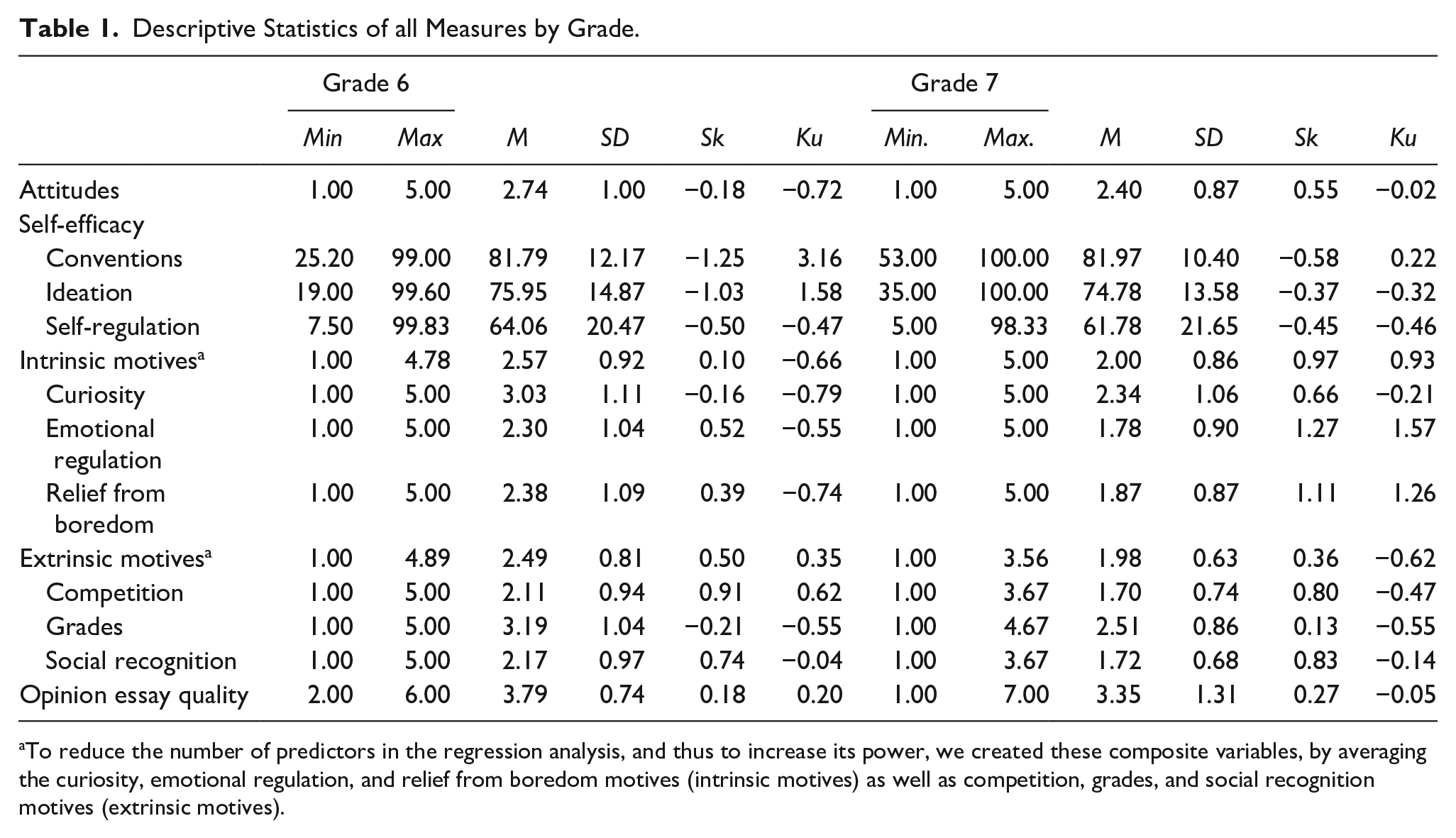
To reduce the number of predictors in the regression analysis, and thus to increase its power, we created these composite variables, by averaging the curiosity, emotional regulation, and relief from boredom motives (intrinsic motives) as well as competition, grades, and social recognition motives (extrinsic motives).
Attitudes toward writing
Results of the paired-samples t test showed a moderate decrease in attitudes toward writing from Grade 6 to 7, t(111) = −4.04, p < .001, d = −0.38.
Writing self-efficacy domains
ANOVA results revealed a main effect of self-efficacy domains, F(1, 111) = 117.33, p < .001, η2p = .51. Self-efficacy for conventions was higher than self-efficacy for ideation (t = 6.50, p < .001, d = 0.87), and both self-efficacy for conventions (t = 12.87, p < .001, d = 1.81) and for ideation (t = 9.93, p < .001, d = 1.32) were higher than self-efficacy for self-regulation. There was no interaction between grade and self-efficacy domains, F(2, 222) = 0.82, p = .44, η2p = .01.
Motives to write
ANOVA results showed a main effect of grade, F(1, 111) = 51.88, p < .001, η2p = .32; a main effect of motives to write, F(5, 555) = 59.51, p < .001, η2p = .35; and an interaction between grade and motives to write, F(5, 555) = 2.22, p = .05, η2p = .02. This interaction was decomposed with simple effects analyses, whose findings are described below.
Grade
differences by motives to write
There was a moderate to great decrease from Grade 6 to 7 for all motives to write, presented next in descending order of effect size: grades (t = −6.56, p < .001, d = −0.89), curiosity (t = −6.23, p < .001, d = −0.84), emotional regulation (t = −5.14, p < .001, d = −0.69), social recognition (t = −4.80, p < .001, d = −0.67), relief from boredom (t = −4.43, p < .001, d = −0.61), and competition (t = −4.14, p < .001, d = −0.56).
Differences
in motive to write by grade
Concerning motives to write in Grade 6, curiosity and grades (which did not differ between them, t = −1.82, p = 1.00, d = −0.26) were stronger than emotional regulation, relief from boredom, competition, and social recognition (ts > −10.81, ps < .001, ds > −1.34); these latter did not differ between them (ts < 1.73, ps > .46, ds < 0.23). In Grade 7, we found a similar pattern: curiosity and grades (which did not differ between them, t = −1.83, p = 1.00, d = −0.24) were stronger than emotional regulation, relief from boredom, competition, and social recognition (ts > −10.81, ps < .001, ds > −1.45); these latter did not differ between them (ts < 2.14, ps > .52, ds < 0.29).
RQ 2: Contribution of Motivational Beliefs to Opinion Essay Quality
Table 2 presents the correlations between all variables. Four main findings are worth noticing. Firstly, all self-efficacy domains were correlated among each other in both Grade 6 and 7 (.38 < rs < .65). Likewise, all motives to write were correlated among each other in both Grade 6 and 7 (.21 < rs < .80). Secondly, Grade 6 variables were correlated with the corresponding Grade 7 variables (.25 < rs < .56). Thirdly, attitudes toward writing were generally related to all self-efficacy domains and motives to write within and between Grades 6 and 7 (.19 < rs < .71). In addition, self-efficacy for ideation and self-regulation (.19 < rs < .40), but not self-efficacy for conventions (rs < .18), were correlated with the majority of motives to write within and between Grades 6 and 7. Lastly, though most of the motivational variables in Grade 6 were not correlated with quality in Grade 6 and 7 (rs < .16), the same variables in Grade 7 were generally correlated with quality in Grade 6 and 7 (.20 < rs < .42).
Bivariate Correlations Between All Measures in Grade 6 and 7.
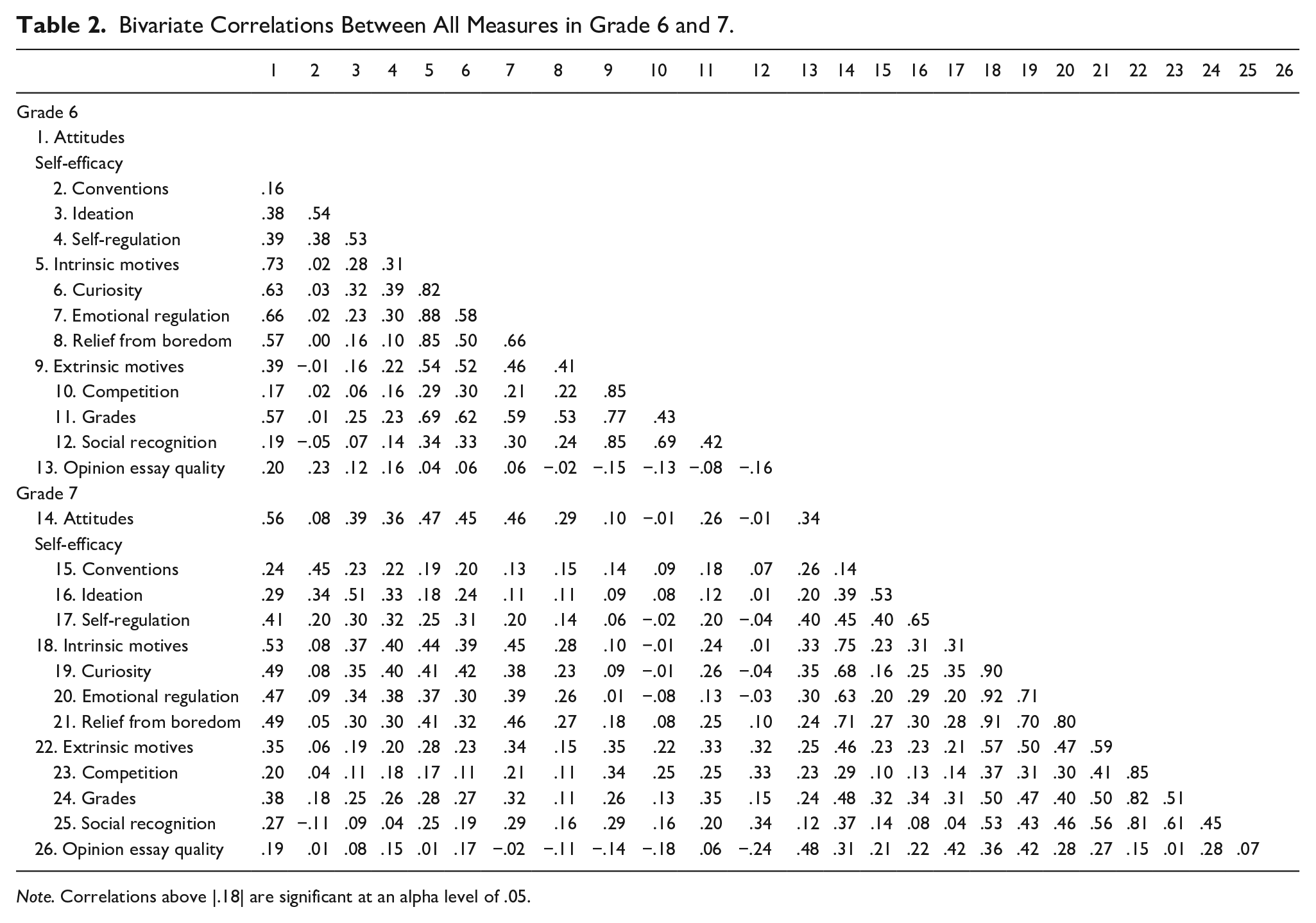
Note. Correlations above |.18| are significant at an alpha level of .05.
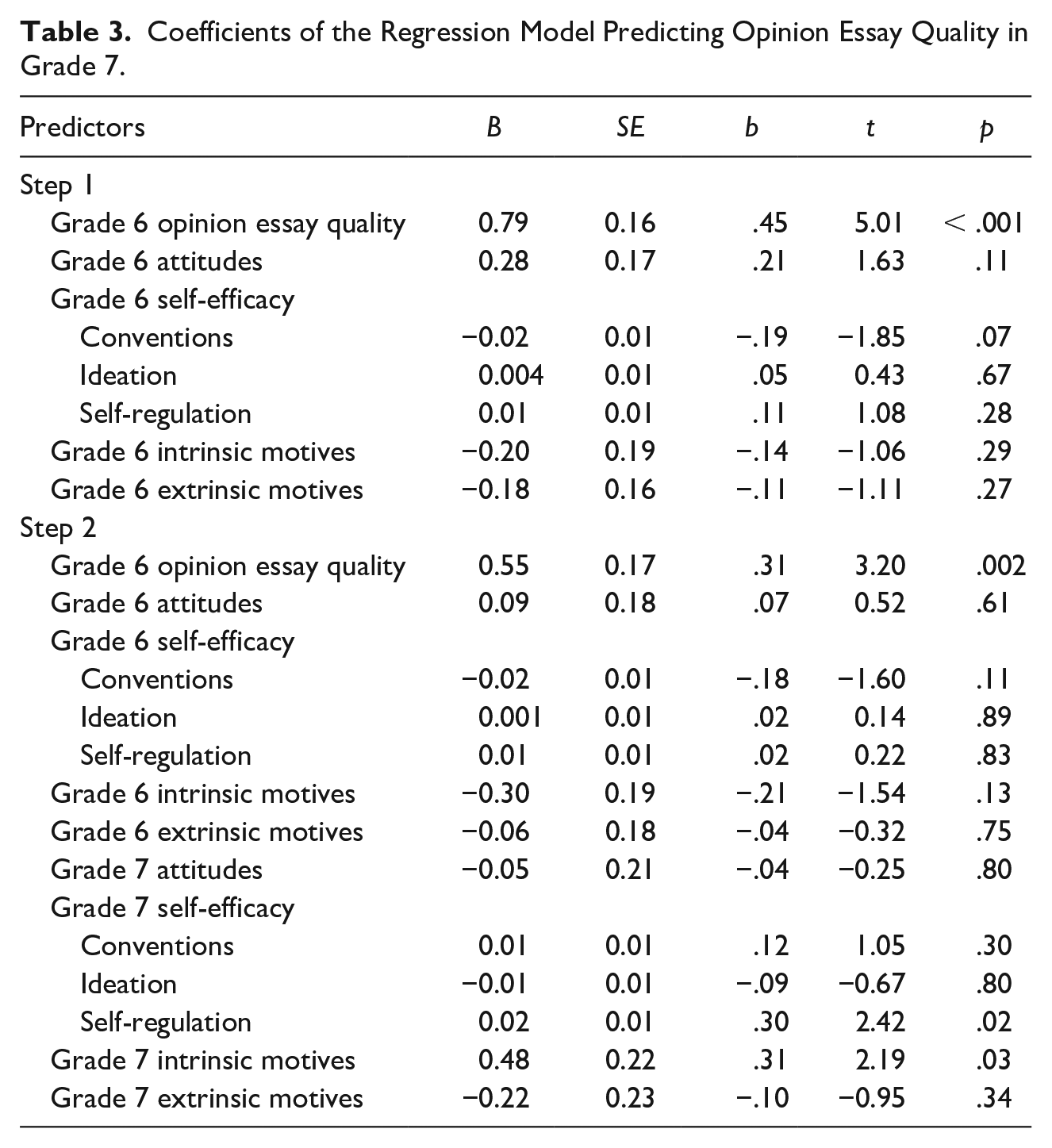
In the first step of the regression analyses, attitudes, self-efficacy, and motives to write in Grade 6 were found to explain 29% of opinion essay quality in Grade 7, R = .54, F(7, 104) = 5.97, p < .001. Quality in Grade 6 was the only significant predictor of quality in Grade 7 (b = .45, p < .001). When Grade 7 variables were entered into the model, there was a significant increase of 9% in the amount of variance explained, R = .62, Fchange(6, 98) = 2.48, p = .03. In addition to quality in Grade 6 (b = .31, p = .002), we found that self-efficacy for self-regulation (b = .30, p = .02) and intrinsic motives in Grade 7 (b = .31, p = .03) were significant predictors of opinion essay quality in Grade 7. Complete results can be found in Table 3.
Coefficients of the Regression Model Predicting Opinion Essay Quality in Grade 7.
Discussion
This study focused on the development of writing motivational beliefs and their role in opinion essay quality across a transition characterized by several academic and emotional challenges for students. Overall, we found that, after controlling for the quality of opinion essays in Grade 6, all motivational beliefs but self-efficacy decreased, and that only self-efficacy for self-regulation and intrinsic motives in Grade 7 contributed to text quality. In what follows, we discuss these results in detail by research question.
RQ 1: Development of Motivational Beliefs
In line with our hypothesis and replicating previous results (Graham et al., 1993; Wright et al., 2020), there was a moderate decrease in attitudes toward writing from Grade 6 to 7. This seems to indicate that students tend to become less happy when writing over the middle grades. Since attitudes are drawn upon writers’ understanding of their previous experiences (Wright et al., 2020), it is reasonable to infer that students are having unpleasant experiences with writing. Though not addressed in the present study, likely factors associated with these unpleasant experiences are the increase of writing complexity and writing demands in middle grades (Boscolo, 2009; Dobbs & Kearns, 2016), the unengaging, inauthentic, and overwhelming tasks about topics that students find dull (Zumbrunn et al., 2014), as well as the association of writing with evaluation moments (Camping et al., 2020).
Contrary to our expectations, no developmental differences were found in students’ self-efficacy domains between Grade 6 and 7. It should be noted that similar results with Portuguese students were already reported by Cordeiro et al. (2018), adopting a unidimensional approach to self-efficacy. Together, these findings suggest that students’ self-efficacy for writing may not fluctuate over the middle school, at least in Portuguese settings. Nevertheless, no strong conclusion should be taken based on just two studies. More research, including cross-cultural comparisons, is needed to understand the developmental trajectories of self-efficacy domains as well as differences between them. In the present study, students reported feeling more confident in putting their ideas into words (conventions) than generating good ideas (ideation) and, in turn, than managing the cognitive, emotional, and behavioral aspects of writing (self-regulation). To our knowledge, this is the first study statistically comparing the strength of writing self-efficacy across domains in middle grades. Findings were, however, not surprising because students’ confidence goes hand-in-hand with their skills (Bandura, 1986). While middle-grade students have highly developed conventions-related skills, they still struggle with generating ideas and mainly self-regulating the writing process (Graham & Harris, 2000; Limpo & Alves, 2013a).
As anticipated, all motives to write were found to become weaker from Grade 6 to 7. Although a similar declining trend was reported by Graham et al. (2021) in a cross-sectional study from Grade 3 to 8, a plateau was found between Grades 6 and 7. Given the lack of studies examining the development of motives to write throughout school, it is difficult to understand the nature of these inconsistent findings. Likely, they can be associated with differences between Portuguese and U.S. school contexts, including key transitions. In the Portuguese school system, the key transition from the second to the third cycle of basic education occurs from Grade 6 to 7. However, the equivalent transition in the schools participating in the Graham et al. (2021) study occurred from Grade 5 to 6, where there was a decrease in motives to write. This finding indicates that the school context may negatively affect some dimensions of writing motivation. Cross-cultural studies are warranted to understand the role that these contextual changes play in the development of motives to write. These studies may also help to explain why some of the motives are stronger than others. In our study, grades and curiosity were found to be the strongest motives to write in middle grades. This is a common result in the literature (Camping et al., 2020; Rocha et al., 2019), suggesting that students’ engagement in writing is driven by both intrinsic and extrinsic motives.
RQ 2: Contribution of Motivational Beliefs to Opinion Essay Quality
As a preliminary step, we examined the correlations between motivational variables. A main finding was that the more students enjoyed writing in Grade 6 and 7, the stronger their perceptions of ability for composing texts and their reasons to write. These results are consistent with the literature (Graham et al., 2007; MacArthur et al., 2016; Rocha et al., 2019; Sanders-Reio et al., 2014) and expand the WWC model (Graham, 2018) by suggesting that writing motivational beliefs form a constellation, in which all of them are connected and feed off each other. It is worth mentioning that, in our study, the higher the self-efficacy for ideation and self-regulation, but not for conventions, the stronger the reasons to write. The lack of association between motives and self-efficacy for conventions contradicts Ng et al. (2021). This difference may be related with participants’ age. Ng et al. (2021) targeted elementary school, in which these yet-to-be-acquired basic skills and associated self-efficacy may have a more prominent role in the writers’ motivation (Limpo et al., 2020).
To analyze the longitudinal and concurrent links between writing motivation and opinion essay quality, while controlling for the associations between different motivational beliefs, we regressed quality in Grade 7 on quality in Grade 6 and motivational beliefs in Grade 6 and 7. Our findings revealed a single longitudinal link to quality across grades: better opinion essays in Grade 6 were associated with better opinion essays in the following year. This anticipated result indicates that students’ competence for writing opinion essays in one grade is a key determinant of their posterior competence. This strong link between writing skills across adjacent grades was already demonstrated in previous research (Abbott et al., 2010). After controlling for this association, we found that none of the Grade 6 motivational beliefs contributed to opinion essay quality in Grade 7. Because of reduced evidence on the longitudinal links between motivation and writing quality, we recommend caution in interpreting this finding, which needs to be replicated in future research. Nonetheless, it hinted at the possibility that past motivational beliefs matter less than current ones. Indeed, we found evidence of concurrent links between seventh-graders’ beliefs and the quality of their opinion essays. Two findings are worth noting.
First, self-efficacy for self-regulation, but not for ideation or conventions, contributed to the quality of students’ texts. Perpetuating the mixed findings in the field previously detailed, our results contrast with those of De Smedt et al. (2016, 2017) and Rocha et al. (2019), but are in line with those of Limpo and Alves (2017). More research with multidimensional measures of self-efficacy is needed to unravel the predictive role of different self-efficacy domains. Still, the current study seems to indicate that students’ confidence in managing key writing processes during text production is critical to create high-quality opinion essays. It endorses the importance of students’ confidence about using self-regulation strategies, which is already well stablished in the literature (Festas et al., 2015; Limpo & Alves, 2013b). Despite the importance of self-efficacy for self-regulation in writing, our study showed that this was the weakest self-efficacy domain in middle grades, as discussed above.
Second, we found that the quality of students’ essays was associated with intrinsic but not extrinsic motives to engage in writing. These findings generally match those observed in earlier studies (De Smedt et al., 2017). On the one hand, our research suggested that writing to achieve a reward was not associated with the quality of the written product. This is in line with many studies showing no link between extrinsic motivation and performance (Graafland & Bovenberg, 2020; Standage et al., 2008). On the other hand, our study showed that writing because it provides inherent satisfaction seems to result in better opinion essays, which is aligned with previous research generally showing positive associations between intrinsic motivation and performance (Everaert et al., 2017; Liu et al., 2020). Based on these results and SDT assumptions (see also De Smedt et al., 2016, 2017), a good way for teachers to increase students’ intrinsic motives and therefore writing performance is to let them choose the writing topic, support them with planning, writing, and revising strategies, and show interest in their writing process. By satisfying their needs for autonomy, competence, and relatedness, respectively, teachers might be preserving students’ intrinsic motivation to write and, consequently, fostering the quality of their opinion essays.
It should be noted that the relationship between attitudes toward writing and text quality, which was consistent with past findings (Graham et al., 2018; Lee, 2013; Rocha et al., 2019), disappeared when all predictors were entered into the regression model. Pajares (2003) already suggested that, when writing quality is regressed onto self-efficacy together with other motivational beliefs, the key role of self-efficacy in writing may lead to a decrease in the predictive power of other predictors. This may explain why, in our study, attitudes toward writing did not play an independent contribution to opinion essay quality.
Taken together, our findings provided support for the WWC theoretical premise that writers hold a set of beliefs about writing and themselves as writers, which are associated with their writing performance (Graham, 2018). As shown here, the most important ones in middle grades appeared to be those related to students’ competence for self-regulating the processes underlying written composition and intrinsic motivation to write. Nonetheless, this association between writers’ motivational beliefs and their opinion essay quality only emerged when both variables were assessed in the same grade, suggesting that current motivational beliefs may override past ones.
Limitations and Future Directions
At least six limitations should be considered when interpreting findings of the present study. First, because of the first lockdown imposed by the COVID-19 pandemic, we only collected the students’ socioeconomic status and school achievement for 46% of the sample. In addition, we did not collect data concerning participants’ ethnicity nor detailed information about the characteristics of the involved schools (e.g., socioeconomic context, facilities, school climate, safety). Future studies should aim to gather school-related information, given past evidence showing their contribution to academic motivation (Stack & Dever, 2021) and performance (Garrett et al., 2019).
Second, single-indicator analyses were used to test the role of attitudes, self-efficacy domains, and motives to write. Despite the validity and reliability evidence on the measures used, these analyses do not account for measurement error. Thus, future studies with larger samples are needed, so structural equation modeling analyses can be used to replicate our findings with more robust statistical approaches. These can also be helpful to explore reciprocal relationships between the predictors, which were not the main focus of this study.
Third, our study only targeted a subset of all the motivational beliefs that influence writing (Graham, 2018). Future research should aim to include additional motivational beliefs, such as implicit theories about writing skill malleability and achievement goals. Limpo and Alves (2014) already showed that middle school students produce better texts when they believe their ability to write can be developed (incremental belief) than when they view such ability as unchangeable (entity belief). Moreover, prior research in middle school also showed that writing self-efficacy and quality benefit from orientations toward learning, understanding, and increasing writing competence (mastery goals) rather than orientations toward showing competence by surpassing others (performance-approach goals) or avoiding displaying lack of competence (performance-avoidance goals) (Limpo & Alves, 2017; Yilmaz Soylu et al., 2017). As a continuation of the present study, it would be interesting to analyze the relationships between writing self-efficacy, motives to write, writing implicit theories, and achievement goals.
Fourth, given the relatively reduced sample size, we choose to merge curiosity, emotional regulation, and relief from boredom in intrinsic motives to write, and competition, grades, and social recognition in extrinsic motives to write. By doing this, our analyses gained power, at the expense of specificity. Based on our findings, we cannot determine the unique contribution of each individual motive to the quality of texts produced in middle school. Additional research should prioritize the understanding of their differential role enhancing writing quality, as already done in some cross-sectional studies (Rocha et al., 2019).
Fifth, the contribution of motivational beliefs to writing quality was only examined for opinion essay writing. However, given the well-described specific demands imposed by different text genres (Beauvais et al., 2011; Berman & Nir-sagiv, 2007), motivation’s role in the writing process may vary across them. Therefore, it would be relevant to verify whether the current results would be the same with narrative or expository texts, for instance.
Finally, notwithstanding the advantages of the longitudinal approach, which is currently lacking in the field of writing motivation, our analyses were correlational in nature. To test causal relations between motivational beliefs and writing quality, it would be important to conduct experimental research. For example, researchers may want to develop interventions aiming to nurture positive motivational beliefs and examine their impact on text quality. Conducting this kind of studies at different school grades would be particularly relevant, as findings would inform about the developmental points where motivation plays the strongest role in writing.
Practical Implications
The present research gave us an overview of the development of motivational beliefs over middle school, which were generally found to decrease. Reversing this unsettling declining trend requires the implementation of strategies to nurture or preserve students’ attitudes toward writing and motives to write throughout schooling.
This is important because, as highlighted in the current study, the quality of opinion essays is associated with some of these beliefs, in particular, self-efficacy for self-regulation and intrinsic motives to write. These beliefs should therefore be targeted in writing interventions through the inclusion of specific activities and strategies. Enhancing students’ self-efficacy for self-regulation in writing should begin with an improvement of real self-regulation skills. A model that has been proven to be effective in promoting these skills is the Self-Regulated Strategy Development (SRSD), whose benefits in middle grades have already been shown in previous research (Festas et al., 2015; Limpo & Alves, 2013b). In addition to this model, several specific practices can help teachers to stimulate students’ intrinsic motivation, by satisfying their needs for autonomy, competence, and relatedness (Deci & Ryan, 2000; Ryan & Deci, 2017). Listening to students’ perspectives, being responsive to their interests, giving them meaningful choices, as well as avoiding controlling language and rewards (e.g., tickers or prizes for completing homework) have been shown to support students’ autonomy (Assor & Kaplan, 2001; Ryan & Deci, 2017). Optimal challenges, scaffolding teaching, informative feedback, and effort praise allow students to keep improving while feeling successful all along the way, which support their competence (Cecchini et al., 2019; Ryan & Deci, 2017). Warmth and inclusive atmospheres in which students perceive themselves as an important part of the class and feel accepted by peers and teachers have been proven to satisfy their need for relatedness to others (Gnambs & Hanfstingl, 2016; Ryan & Deci, 2017).
Conclusion
Our results showed that, over the middle grades, students’ motivational beliefs became weaker. Their concurrent but not longitudinal association with opinion essay quality denoted that students’ current beliefs influence the quality of their written products, whereas their past beliefs, albeit stronger, do not. The higher predictive power of current beliefs over past ones might, however, be positive. It shows that there is still a chance for middle-grade teachers to foster the quality of students’ writing by regularly building supportive and nurturing teaching environments capable of creating motivated writers.
Footnotes
Declaration of Conflicting Interests
The authors declared no potential conflicts of interest with respect to the research, authorship, and/or publication of this article.
Funding
The author(s) disclosed receipt of the following financial support for the research, authorship, and/or publication of this article: This research was supported by the M2S Project funded through the Operational Programme for Competitiveness and Internationalization, supported by FEDER and national funds allocated to the Portuguese Foundation for Science and Technology (NORTE-01-0145-FEDER-028404), and by the grant CPUP UID/PSI/00050/2013.