




Abstract
The present article examines collaborative writing in organizational consulting and training, where writing takes place as part of a group discussion assignment and is carried out by using digital writing technologies. In the training, the groups use digital tablets as their writing device in order to document their answers in the shared digital platform. Using multimodal conversation analysis as a method, the article illustrates the way writing is interactionally accomplished in this setting where digital writing intertwines with face-to-face interaction as the groups jointly formulate a documentable written entry for specific institutional purposes. The results show how writing is managed in situated ways and organized by three specific aspects: access, publicity, and broader organizational practice. The article advances prior understanding of the embodied nature of writing and writing with technologies by demonstrating how the body and the material and social nature of writing technologies intertwine within situated social interaction.
Keywords
Over the last few decades, digital technologies—computers, tablets, and mobile phones as well as various digital spaces—have become an integral part of working life even to the point where digital work is no longer easily distinguishable from its nondigital forms (Orlikowski & Scott, 2016). Often, digital technologies are related to writing as they are used for creating and sharing different kinds of organizational texts. In this way, they can be viewed as part of textualization of work where workers are increasingly required to construct knowledge via textual processes and products, and by so doing, often take part in “discoursing” across professional and organizational boundaries (see Brandt, 2005; Iedema & Scheeres, 2003; Karlsson, 2009; Karlsson & Nikolaidou, 2016; Scheeres, 2007). The textualization of work and the deployment of digital technologies thus also mean developing new kinds of social relations, identities, and structures in workplaces within a new knowledge-based work order (see Karlsson, 2009; Scheeres, 2007).
In this article, we examine the use of digital technologies for writing in one specific context, organizational consulting and training, that as a professional domain reflects these recent changes. Organizational consulting is an influential field that started to become a stabilized—yet also widely debated—industry in the 1980s and 1990s as it expanded from business to public administration in various countries (Nissi & Hirsto, 2021; Von Platen, 2018). Throughout its history, organizational consulting has closely followed the prevalent management theories, and paradigm shifts in academia have resulted in changes in professional practice. In recent decades, in particular, the field has moved from rationalist and positivist models focusing on improving productivity through standardization toward a relational understanding of leadership, which, in turn, emphasizes the importance of networks and relations and views reflexivity, self-expression, and mutual learning as sources of value (Nissi & Hirsto, 2021; Uhl-Bien, 2006). From this viewpoint, collaborative writing accomplished through digital writing technologies can be seen as a means for the implementation of new management ideas, values, and practices as it allows cross-sectoral communication and collaborative, iterative action where ideas are jointly negotiated and cultivated through shared text production. In training settings—the central sites of consulting—collaborative writing tasks are thus often embedded in training activities for the purposes of enhancing employee participation and the exchange of ideas and practice sharing within and between different employee groups.
However, the use of digital technologies may also bring unforeseen complexities to these settings as they do not only enable but also constrain writing. This is because writing as social practice is itself organized in specific ways. To begin with, writing always takes place in some physical location and is thus fundamentally embodied and material in nature. In this way, it is also shaped by the affordances of the physical context in question, including the technologies used. This also concerns digital spaces as they are accessed, for example, by mobile devices that are used in different kinds of environments. Moreover, when done collaboratively, writing occurs as part of social interaction so that the text under construction reaches its final form through the participants’ mutual discussion and negotiation. This, in turn, may be organized in diverse ways depending on the institutional and organizational setting, the roles the participants have, and the task they are looking to accomplish in the given setting (Mondada & Svinhufvud, 2016).
In the present study, writing occurs as part of a group discussion assignment addressed to management groups that are being trained in the situation and is used to document the groups’ joint answers (that supposedly display the training’s institutional task of inducing change within the groups’ professional practices). However, there are several interactional, spatial, and material features that influence writing and the completion of the assignment. Firstly, the training encounter is a mixture of a large-scale multiparty and a small group context: the whole training involves tens or even hundreds of people in one large room, but they are divided into small groups, where the writing takes place. Secondly, the groups write their answers using a digital platform with tablets. There are two ramifications of this kind of a digital application. The tablet, as a writing device, is easily transferable from hand to hand and the writing activity can be variably accessible or inaccessible to the other members of the group. The platform, on the other hand, renders the writing instantly and publicly available to others, being visually accessible to all the participants present in the training. Therefore, the groups have to negotiate not only who is going to write (on behalf of the group) but also what will be written (as a joint, public 1 answer).
In this article, we examine how the participants manage the complexities created by these specific features of the writing context in order to take part in collaborative writing. We specifically approach writing as writing-in-interaction (Mondada & Svinhufvud, 2016), namely, a situated, multimodal social practice that is actualized in and through sequentially unfolding interaction. The aim of the article is to shed light on the way writing is interactionally accomplished in the training setting where group discussion is transformed into digital, textual objects for institutionally relevant documentation purposes. In particular, we focus on three aspects of writing—access, publicity, and broader organizational practice—as the core organizing principles for writing-in-interaction we examine in our data. Our study supports the view that digital practices never totally replace other forms of workplace communication—such as face-to-face interaction—but instead take place within larger-scale multimedial practices (see Orlikowski & Scott, 2016). Based on our findings, we argue that studies of workplace writing should focus on the way digital technologies and digital writing intertwine with other forms of communication in contemporary workplaces.
In the following sections, we review previous research on writing and writing-in-interaction as relevant to our study. We then introduce our method and data before proceeding to an analysis of collaborative writing in the training.
Literature Review
In this literature review, we discuss two interrelated themes in existing research on writing: the embodied nature of writing and writing with technologies as part of different social contexts. In the third section of the literature review, we will turn to our primary perspective in this study—writing-in-interaction—in order to show how this framework can further integrate and deepen the previous themes and what it thus has to offer for the study of writing.
Embodied Nature of Writing
In their foundational study, Haas and Witte (2001) draw attention to how writing is inescapably embodied. The situated activity of writing, whether handwriting or typing, requires the use of fingers, hands, and arms and is contingent on the posture of the body. Olive and Passerault (2013) contend that we should not see writing only as a linguistic but also as a “visuospatial” activity. Even though embodiment is important for solitary writing as well (see Clayson, 2018b), it has been particularly emphasized in studies that focus on collaborative writing. Such studies have been conducted, for example, by Haas and Witte (2001), who examined how a technical document was revised by employees from two different organizations, Wolfe (2005), whose study investigated how a student writing group drafted a document, and Clayson (2018a), whose study used collaborative writing at work as its data.
All of these studies draw attention to gestures as a way of facilitating writing in a group. Haas and Witte (2001) refer to gestures as “embodied representations,” and they show how the participants can use gestures to represent both the current and an anticipated revised version of a document. This may be quite concrete in that a gesture may resemble a form of drawing in the document. Similarly, Clayson (2018a) shows how gestures may anticipate a forthcoming document through representing paragraphs and sentences using bracketing gestures. Wolfe (2005) makes similar observations. In addition, however, she notes that participants of collaborative writing use the physical space between them as if it was the document that they are drafting. Thus, there is research that shows how embodiment, particularly gestures, figures in (collaborative) writing. However, as Clayson, for example, contends, there is still a need for studies that reveal how writing actually happens as a moment-by-moment embodied activity (Clayson, 2018b). Such an approach calls for a more comprehensive picture of embodiment in writing, including the role and mutual organization of gaze, body postures, and movement in relation to verbal action. In this study, we respond to this need by examining embodiment as part of the interactional patterns through which collaborative writing is constituted.
Importantly, embodiment has a close affinity to materiality. This relationship is especially emphasized by Clayson (2018a, 2018b). She maintains that writing is done with not just the body but also different tools and artifacts, such as papers, pens, whiteboards, computers, and mobile phones. In her words, “materials and bodies are enmeshed” (Clayson 2018a, p. 157). This means, also, that embodiment is intertwined with writing technologies, including digital technologies. The intertwinedness of body and technologies can also be seen in the process of semiotic remediation, discussed by Prior and colleagues (see Prior & Hengst, 2010; Prior et al., 2006). Through the concept of semiotic remediation, they address the circulation and transformation of semiotic performances through different media and, consequently, different materialities. For example, the same “content” may be performed through speech, dance, and digital platforms, using the human voice, the body, and digital technologies (Prior et al., 2006). Similarly, in his study of a design process, Prior (2010) shows how it is constituted of a chain of drawing and writing activities with the help of various media. Prior research has thus shown how the materialities of different media need to be included in a study of the real-time accomplishment of writing. In particular, the development of digital technologies and their effect on embodied writing practices needs to be taken into account. This is important with regard to both writing research and writing in the workplace.
Writing With Technologies
In her study, Haas (1996) argues that digital writing technologies are essentially material tools. This means that writers interact physically with technologies and that the material form of the tool has a profound effect on the nature of the interactions. Her study shows, for example, that the two-dimensionality of the computer screen constrains the writer’s interaction with the text, compared to the three-dimensionality of working with the pen and paper. Thus, when new kinds of digital technologies are introduced, they tend to change the material configuration of writing. In addition to the material form of the tool, such as a desktop, laptop, tablet, or mobile phone, the materiality of writing also has to do with the surroundings where it happens. As Swarts (2016) notes, even though digital technologies are more or less mobile, using them always takes place in some physical location that influences the writing activity. This is shown, for example, by Pigg (2014), who studies the composing habits of students in semipublic spaces such as cafés and shows how they utilize the affordances of the physical space in their work.
Writing with technologies is also connected to different social activities. Studies that draw on the so-called third generation of activity theory (see Spinuzzi, 2018) often approach digital technologies as tools that have a mediating role in activities (e.g., Kaptelinin, 1996). As Kaptelinin and Nardi (2006) note, it is the accomplishment of those activities that is important for the users of technologies, not the technologies themselves. In studies of writing, the mediating role of technologies has been described as coordination: enabling organized activity between spatially dispersed actors. Pigg et al. (2014), drawing on literacy studies, show how students use digital technologies for coordination, that is, managing both their memory and their contacts with both their personal and professional communities. Swarts (2016), in his study of writing with mobile devices in workplace contexts, shows how the devices are used for many kinds of coordination, both “microcoordination,” where actors display that they are working with some kinds of shared purposes with regard to some activity, and “macrocoordination,” where more durable social structures between people are established.
The focus on macrocoordination points toward a further aspect of writing with technologies: it is embedded in not only singular activities but also the larger social context. For example, Kaptelinin and Nardi (2006) point out that technologies are used for accomplishing tasks that are part of projects. In their view, this broader context needs to be taken into account when designing technologies that are supposed to assist in those tasks, so that the technologies not only support lower-level writing practices but offer employees ways of organizing individual writing tasks with regard to workplace projects they are involved in. In addition, digital literacy practices have an effect on the larger social context through constructing roles and relationships in communities (Pigg et al., 2014).
Writing-in-Interaction
Previous studies of writing have shown how digital technologies have a material and social influence. However, in order to understand how people accomplish their day-to-day activities with technologies and how technologies either support or constrain those activities, we need a better understanding of the micro practices through which the influence of technologies is realized. In our study, we will contribute to this line of research by drawing from the field of writing-in-interaction (see Mondada & Svinhufvud, 2016) in order to delve into the moment-by-moment realization of writing with technologies. Such studies have been especially done in the conversation analytical tradition that examines the structures of social interaction.
This tradition brings forth two fundamental principles that allow a new contribution with regard to the themes presented in earlier sections. Firstly, it views interaction as sequentially chained social actions that are accomplished through the interplay between different semiotic resources, such as talk, gaze, gestures and the manipulation of material objects. The different resources work conjointly, but have a very specific division of labor, and are, for example, temporally organized in relation to one another. Secondly, it views social institutions as being constituted in and through social interaction that unfolds turn-by-turn. In other words, the micro-level social actions incorporate broader systems, practices, and contexts as the participants jointly construct different kinds of social situations with certain tasks and roles through their situated interactions. Social institutions are thus “talked into being” by organizing interaction in distinct ways (e.g., Mondada, 2019; Sacks et al., 1974; Sidnell, 2010). Conversation analysis always studies real interactions, obtained through (video) recordings, and aims at uncovering the dynamics and orderliness of social interaction and human social life that rests on it. In terms of writing, the studies coming from the tradition of writing-in-interaction thus aim to examine in detail how writing is accomplished in situ as part of multimodal, sequentially organized social interaction. At the same time, they show how writing plays an integral role in many institutional encounters, as textual documents are created for various kinds of institutional purposes.
We review these studies from the viewpoint of three aspects that form the core organizing principles for writing in our data and thus act as a basis for the analysis: the participants’ access to the writing, the publicity of writing, and writing as part of broader social practices in organizations. In particular, we discuss how these three perspectives contribute to the concerns raised in the previous sections, namely, embodiedness of writing and writing with technologies as part of different social contexts.
Access has to do with the possibility of the participants of the interaction to see and monitor the process of writing. It is related to both the embodied nature of writing and its material surroundings. It often relies on where the participants are sitting and how they position their bodies and writing instruments. There is a lot of variation with regard to access in different settings where writing takes place. In many settings, only the one who is writing has access to this activity. This may be the case both for hand-writing and typing. Pälli and Lehtinen (2014), for example, analyze performance appraisal interviews where the superior writes on an appraisal form that is on the table in front of him, and the subordinate, who sits on the opposite side of the table, can see that the superior is writing but has limited access to what he is writing. Similarly, Komter (2006) and van Charldorp (2011) investigate Dutch police interrogations where the police writes the police record during the interrogations on the computer while the suspect, who is on the other side of the table, has no access to it. Even in such settings, however, there are situated practices available for making the writing more accessible to the others. For example, the writer can read aloud what she or he is writing (Mortensen, 2013), or position the document so that the coparticipant is able to read it, or even let the coparticipant handle the document (Jakonen, 2016). Also, a nonwriter can choose her or his seat around a table closer to the writer to make it easier to position the body for the purposes of monitoring the writing (Samra-Fredericks, 2010).
In other settings, however, writing is accessible to others. This can also be the case for both hand-writing and digital writing. As for hand-writing, a blackboard or a whiteboard can be used (Greiffenhagen, 2014; Mondada, 2016), which makes not only the result but also the process of writing accessible to others in the room. This may be crucial with regard to the activity in question: Greiffenhagen (2014) has shown how, for lecturers in mathematics, the possibility of showing the students the process of solving mathematical problems on the blackboard is pedagogically important. Likewise, when using a computer, the computer screen may be projected on a whiteboard or a screen (Asmuss & Oshima, 2012; Nissi, 2015), thus making the writing activity and the real-time emergence of the textual document visible to others when collectively editing organizational texts in workplaces. Studies of writing interaction contribute further to our understanding of the embodied, material nature of writing, in particular, by showing how the dynamically changing positions of the participants’ bodies as well as the material instruments of writing, including writing technologies, influence the moment-by-moment flow of writing. However, studies of how access is managed when using different writing technologies are still scarce.
Our second aspect with regard to writing-in-interaction, publicity, draws attention to how writers take potential readers into consideration. Documents that are collaboratively written are often crafted for an audience. That is, they are meant to be public, and this publicity has an effect on how they are written. Publicity is, of course, important for solitary writing as well, as Luff et al. (2018) have shown in the study of writing in the traffic control room. A central tool in the control room is the so-called incident log where the participants record details of traffic “incidents” on the basis of information they have received through, for example, calls from bus drivers. In this case, the writing is conducted individually, but is then made public to the other workers through a digital application. Thus, the process of writing is not public, but the product is, and the writers are accountable for the usability of the product, in that others can understand and potentially update the incident reports.
In cases of collaborative writing-in-interaction, publicity often leads to a specific kind of accountability with regard to what is written. Even though only one person usually composes the text, for example, through keystrokes, the participants share responsibility for the product of the writing (e.g., Asmuss & Oshima, 2012; Mondada, 2016; Nissi, 2015), including the exact wording of the text. The accountability is visible in the procedures the participants, and particularly the composers of the text, use for securing shared agreement of the content of the writing. This is done through, for example, proposals and acceptances where the exact timing of writing or typing plays a crucial part and can be made visible to all the participants by using technological and digital tools. 2 Often writing closes the negotiation so that moving into writing displays an agreement about the proposal. As Nissi (2015) notes, when making decisions about what to write, the writers in the study make two decisions at the same time, a “proximal” decision on what to write, and a more “remote” decision on what the writers commit themselves to in relation to the audience of the text. 3 Some studies of writing interaction thus also demonstrate that the publicity and the shared accountability of the writing can be specifically managed through the use of digital technologies. In this way, they can provide further insights into the mediating role of writing technologies, especially various digital applications that enable the coordination of activities at different levels. We believe this offers a new way of looking at technologies as tools, a way of specifying how coordination (see Swarts, 2016) actually happens in real time and how it is afforded and constrained by particular sets of tools.
Finally, we want to draw attention to writing-in-interaction in relation to different organizational activities. This means, first of all, that writing has been studied as part of specific types of institutional encounters, such as police interrogations (Komter, 2006), counseling sessions (Svinhufvud, 2016), medical consultations (Sterponi et al., 2017), meetings (Nissi, 2015), or performance appraisal interviews (Pälli & Lehtinen, 2014). These studies have shown how writing is part of the fundamental activities of these types of encounters. For example, in performance appraisal interviews (Pälli & Lehtinen, 2014), writing is an integral part of goal-setting for the next appraisal period. Secondly, however, writing-in-interaction can be seen as part of broader organizational practices such as recruitment, human resource management, or strategy work. In particular, there are studies of writing in the context of strategy (Pälli et al., 2009; Samra-Fredericks, 2010). These studies show how the writers’ situated negotiation of what to write is intertwined with how they understand the ideological underpinnings of strategy as a way of understanding organizational practice. As Pälli et al. (2009) show, an important part of such negotiations is to come to terms with what the central concepts of strategy discourse mean and how they can be recontextualized in the particular organization in question. Samra-Fredericks (2010), in turn, draws attention to how collaborative writing is a learning experience for the participants, with regard to what it means to be a strategist. Drawing on these studies, we can offer a novel contribution to earlier writing research that explores how technologies are used as part of different social contexts by showing how broader institutional and organizational practices with their specific activity systems become visible in the local organization of social interaction. Further, we can show how such contexts are not fixed, but actually socially constructed in and through interaction as they are oriented to, negotiated—and also contested—by the participants within their turn-by-turn contributions.
The analytical framework provided by the research tradition that studies writing-in-interaction allows us to bring together many of the core themes addressed in other research on writing. However, by focusing on actual interactional practices, it can offer new insights into the ways writing is organized. We contribute to earlier research through showing how writing as an embodied and a social activity is constituted through real-time interactional practices and, in particular, how digital technologies both as material artifacts and as organizational tools are used in situated ways as part of those practices. Our study shows how different technologies both afford and constrain writing as part of social interaction and how the participants of interaction themselves orient to the complexities caused by digital writing devices and aim at resolving them in their situated action. Also, our study has practical implications for organizations adopting digital technologies, through showing what kinds of real-life consequences there are in selecting different technologies.
Method
The data for the study come from a workplace training of a Finnish educational organization, a school district responsible for providing comprehensive education. The training was provided by a consulting company and addressed to the management groups of local schools. The target of the training was to enhance the groups’ recognition of their routinized professional practices, to create practice sharing between the groups, and more broadly, to advance transparent and participatory leadership in the organization. The training lasted for eight months and was arranged as specific training days that took place at regular intervals, for example, in school premises. The days were attended by multiple participants: there were one or two consultants, visiting speakers, the members of the upper management and 80 to 250 trainees, namely, employees that came from different schools and represented their management groups with 5 to 6 members each. Importantly, the training utilized digital technologies: all the groups were logged in a shared digital platform that was updated by the groups with their tablets during the training day, and the results of the updates could be projected on the screen of the training hall. (See Figure 1.)
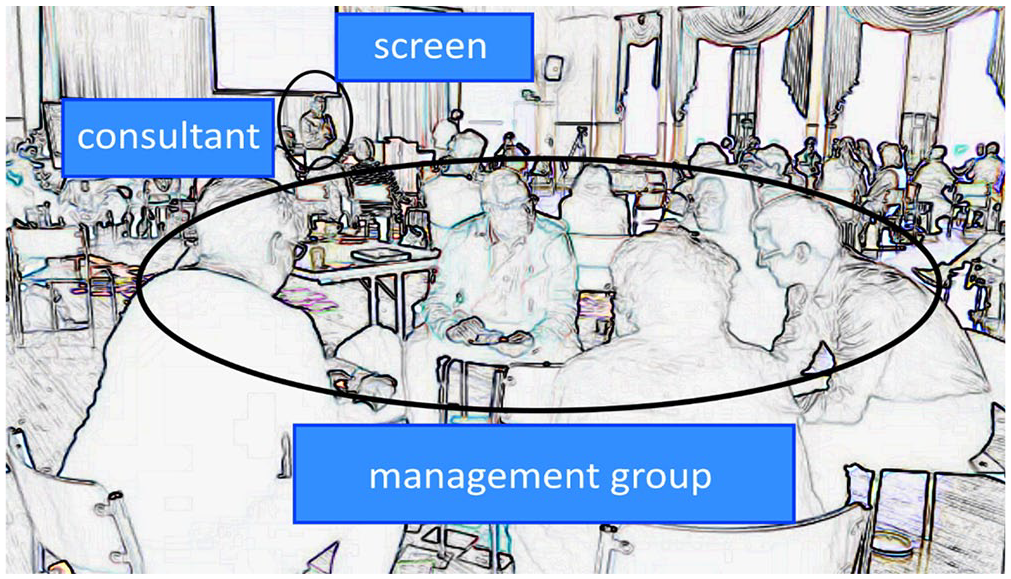
The spatial organization of the training hall.
The data were collected through an ethnographically informed approach so that the researcher (first author) took part in all training days, observed their activities, took field notes, and had discussions with the training participants, and by so doing, aimed at making sense of the social and organizational context of the participants’ actions. The training days were also video recorded in their entirety, resulting in 45 hours of video data, in order to enable a closer examination of the interactional patterns of the training (cf., e.g., Larsson & Lundholm, 2013). In video recording, several cameras with separate microphones were used to capture the actions of the training participants, in particular, the consultant and three management groups that were followed more closely in the research project. All the textual materials related to the training were also collected. This included the digital platform that was collected as screen captures. The collected video data were then analyzed by using multimodal conversation analysis, whose core principles were explained in the previous section. In the conversation analytical research process (e.g., Sidnell, 2010), data are at first looked at through a so-called unmotivated examination where the researcher tries to identify some non-predefined interactional phenomena peculiar to the data set. These may be verbal or nonverbal and range from single items (e.g., words) to longer stretches of talk (e.g., syntactic structures). After initial examination, the cases found are arranged into one or more collections and analyzed more thoroughly, for example, with regard to their function (what is interactionally accomplished with them) and form (how these social actions are designed verbally and in embodied ways). As conversation analysis does not focus on isolated utterances, but interaction, the analysis particularly aims at uncovering how the participants respond to each other’s conversational actions and thus jointly build the social situation they are in through their turns-at-talk. The analyst’s core target is thus to trace and make visible the participants’ own emic methods of organizing their interaction as it is publicly displayed in their interactional patterns.
Informed by the conversation analytical approach, we first aimed at identifying the most salient interactional patterns in this setting. We noted that the training was largely based on a recurrent sequence where (1) the consultant issues to the groups a request to reflect on their professional practices and (2) the groups undertake the task and discuss the given issue. At first, we collected all such sequences, leading to the collection of 58 cases. However, after analyzing them more closely, we noticed that they included two types: in the first one, the group members only had a verbal conversation, whereas in the second one, the consultant instructed the groups to document the results of their discussion in the shared digital platform. We decided to focus on this latter type as digital documenting was noticeably influenced by specific interactional characteristics of the setting that complicated the accomplishment of the task: that the text was composed by only one group member who held the writing device, the tablet; that once published, the results of the writing were visually accessible to the broader audience via the screen; and that the items to be written down were restricted by the consultant’s verbal task setting with specific expectations concerning, for example, the groups’ professional competence (how they have acted in the past) and peer learning (how they will disclose these actions to others in the context of the training). Moreover, the items were also restricted by the digital platform itself, as the task was initially presented there in the written form and the groups had to write their answers in a designated, limited space (see Figure 2). The analytical concepts of access, publicity, and broader organizational practice as the organizing principles of writing emerged inductively from these observations even though we could also find similar themes in previous studies within the tradition of writing-in-interaction.
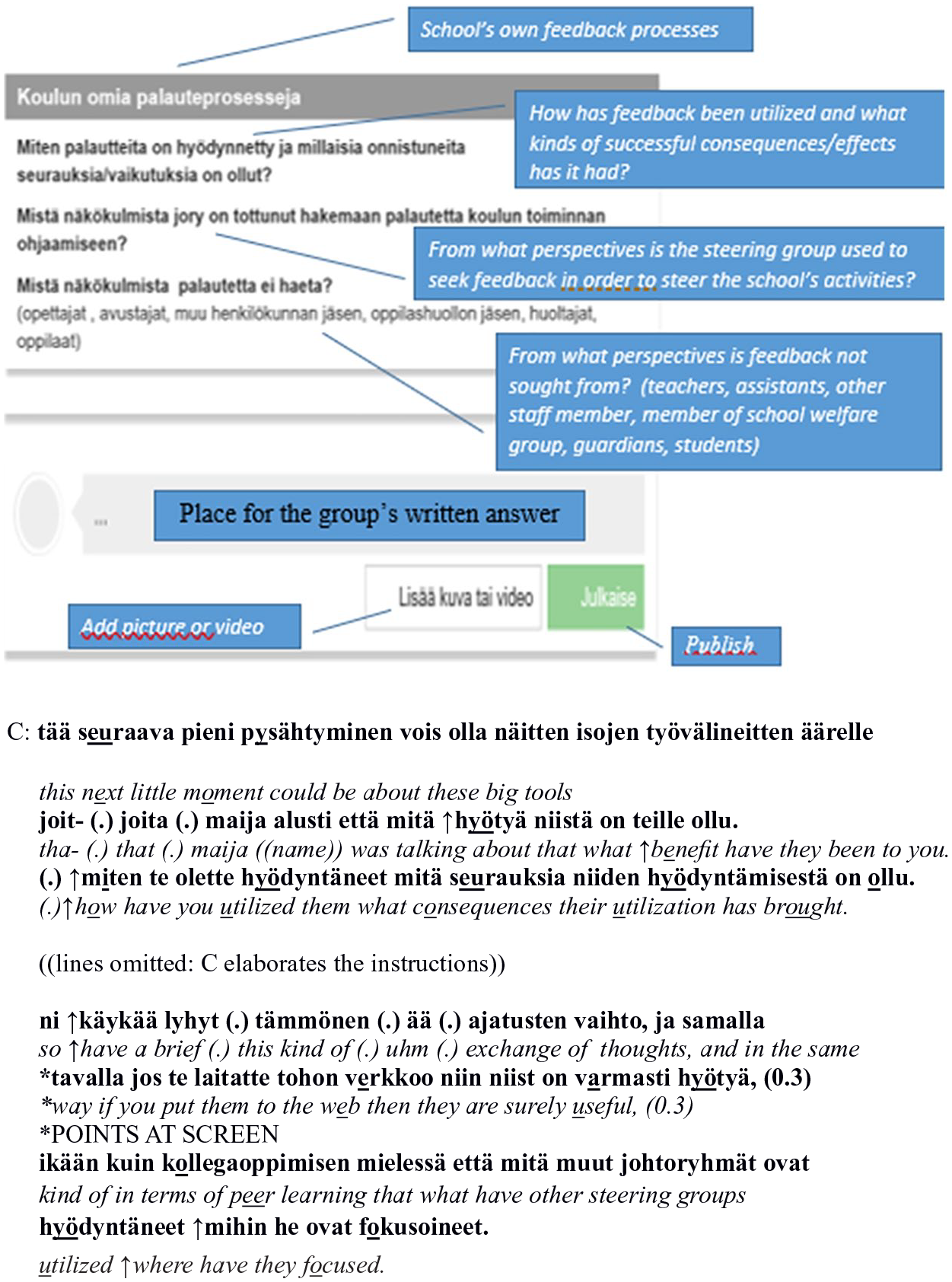
Screen capture of the digital platform and written instructions, followed by the consultant’s verbal instructions.
The final data that inform our analysis consists of a collection of 21 sequences that all include documenting the group discussion in the digital platform. 4 In the following analysis, we examine how this specific writing technology—the shared digital platform that is materialized as a readable and writable object in the tablets and on the screen—is mobilized in the participants’ situated, embodied writing and becomes intertwined with the consultant’s task assignment and the training activities in this institutional setting. The extracts shown denote the analyzed phenomena and have been selected because of their representativeness and transparency with regard to their interactional context.
Results
In this section, we analyze the interactional accomplishment of writing within the groups’ reflective discussion. At first, we examine access to writing and the way the groups manage the joint construction of the document. After that, we study the publicity of writing and the way they work toward documentable text entries. Finally, we investigate writing as part of broader organizational practices and the way the groups adjust to expectations and ideologies related to professional action and the training setting.
Managing the Joint Construction of the Document
As mentioned, the participants move on to joint discussion and concurrent digital documenting as a response to the consultant’s task assignment that specifically requires them to accomplish the task together as a group. In the groups, this creates a practical problem that has to do with access to writing as each group has only one tablet at hand. Therefore, the groups have to first resolve how to utilize the digital writing technology in the writing process (cf. Clayson, 2018b) in order to carry out the task given. Consequently, prior to joint discussion and documenting the groups specifically allocate the role of a composer to one group member by physically transferring the writing device, the tablet, to the selected participant who can document the discussion on behalf of the group. However, this brings further complexities into the activity, as treating one participant as the composer means that the groups then need to establish and maintain a distributed authorship in order to execute the joint construction of the document (cf. Nissi, 2015).
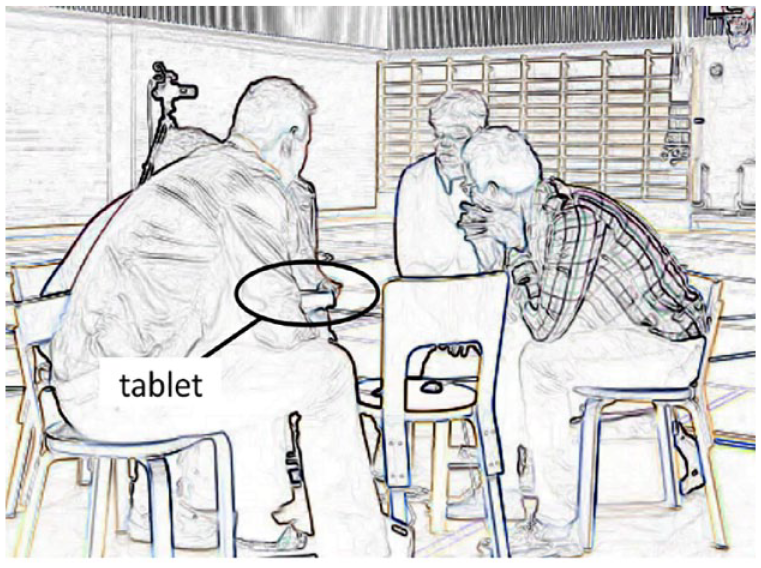
We show through Extract 1 how the group members manage their mutual access to the writing. In the extract, there are four members in the group and E2 has just been appointed to the role of the composer. In Line 1, she already holds the tablet in her hands. The group has been asked to reflect and document how they have sought feedback in their work. 5
Extract 1. (Day 8, Group 1) 01 E2: so what do I (.) now write here then, (1.5) e3: *GAZES AT TABLET 02 * from what perspectives have we sought, (.) what (.) *MOVES RIGHT INDER FINGER ON TABLET’S SCREEN e3: *LEANS TOWARD TABLET #pic.1
Picture 1 03 like what do I answer here, 04 E3: well 05 (.) 06 E2: te[ll me 07 E3: [all (.) actors (1.0) so (.) from @all actors@? e2: *WRITES 08 (5.5) 09 E1: what have we asked the parents. e3: *GAZES AT E1 10 E3: asked the [parents? 11 E4:
[about evaluation?
((lines omitted: participants continue joint remembering)) 12 E1: that somehow they kind of like (0.5) it is kind of e3: *GAZES AT TABLET *LEANS TOWARD TABLET 13 li[ke they are somewhere [there (.) in the outer circle, (.) (-) 14 E3: [ [what are you (doing) now 15 E2: [( I am writing down) that thing of 16 ours, (1.0) hang on (a moment), (.) what was it, *STOPS WRITING 17 E3: n- (.) no put it between those, (.) *POINTS TO A SPECIFIC PLACE AT TABLET’S SCREEN #pic.2
Picture 2 18 that (.) we se- (.) that that (.) @we seek feedback from all e2: *PLACES RIGHT HAND ON SCREEN 19 actors?@ (.) so let’s put there that (.) 20 @on each term@? 21 E2: yeah, 22 (0.3)*(0.4) e2: *WRITES 23 E3: and then let’s put there the things from where we e3: *GAZES AT E1 *GAZES AT E4 24 seek,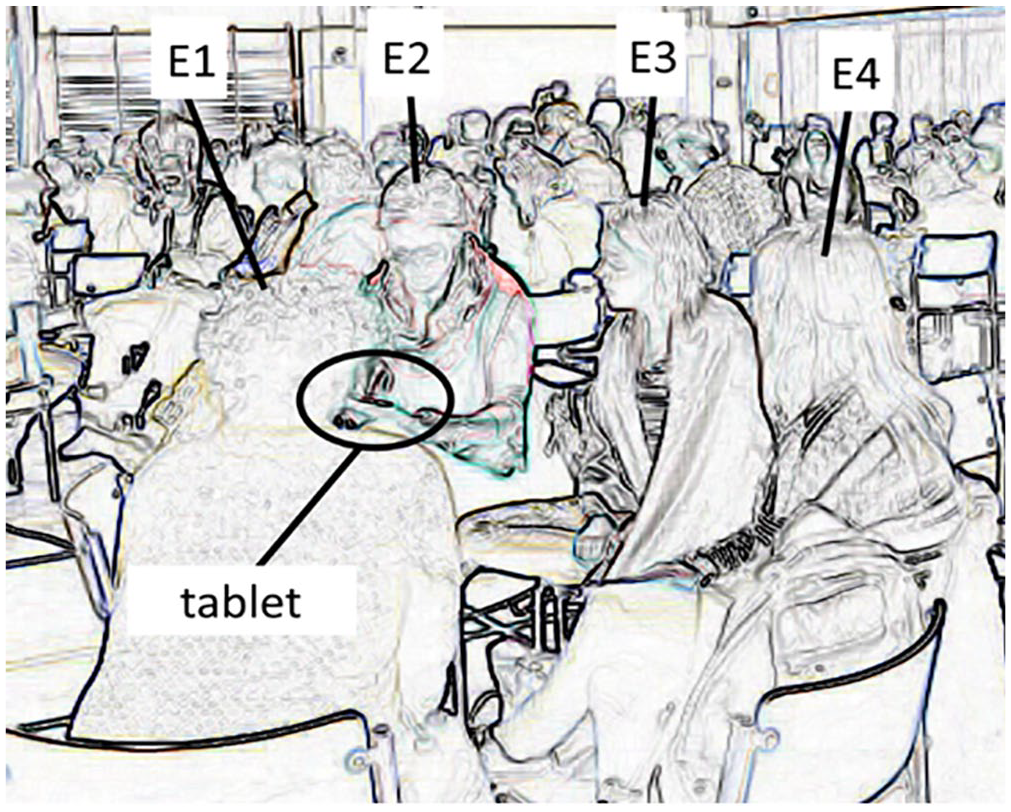
After E2 has been appointed as the composer of the text she requests help with a question (mitäs mä kirjotan tähän nyt sitte ny “so what do I now write here then”; Line 1). The question simultaneously marks her role as the composer but not the sole author of the documentation. However, there is no immediate response and E2 carries on her turn by reading aloud the question used in the consultant’s earlier task assignment, which is also disclosed in the digital platform (mistä näkökulmista ollaan haettu “from what perspectives have we sought”; Line 2). By moving her finger on the tablet, E2 shows that she is now citing the given assignment. This is followed by a third question where she repeats the earlier request for help (mitä niinku mitä mä vastaan tähän “what like what do I answer here”; Line 3), and a command (sanokaa “tell me”; Line 6) where she specifically addresses the task of answering to other group members. We can thus see how E2 in her role as the composer treats herself as being responsible for filling out the digital form, but needs the right kind of input for that. However, as other group members lack direct visual access to the platform and the original question format, she uses different verbal and embodied means in order to tailor their answers to the given assignment.
In interaction, the composer’s requests for help lead to coparticipants providing assistance which typically takes place through dictating. In other words, while answering, the group members employ a formal voice quality and a standard register to imitate “written language” (cf. Nissi, 2015). In this way, their answer depicts a ready-made text component that can be treated as “recordable” (cf. Nissi, 2015; Komter, 2006) and written down real-time. In Extract 1, we can see this take place on Line 7, where E3 produces a dictating turn where she also modifies the grammatical cases 6 so that the text component offered fits the question format of the assignment (“from what perspectives have we sought” ⇒ “all actors” ⇒ “from all actors”). As seen, E2 then begins to write down the answer while E3 is still producing her turn. Therefore, through mutual action, the participants manage to overcome the problems related to asymmetrical access to the writing task and technologies, and by doing so, they contribute to the emerging document as a joint creation.
However, group members can also claim access to writing independently through the practice of monitoring, that is, closely overseeing the writing activity of the composer (cf. Samra-Fredericks, 2010). This is accomplished by leaning toward the tablet and gazing at the screen as well as verbally asking the composer to produce an account of his or her actions. This kind of monitoring can further lead to a more visible intervention that is also accomplished verbally and in embodied ways, namely, by pointing at the specific place on the tablet’s screen and thus representing the anticipated version of the document (cf., e.g., Haas & Witte, 2001). In Extract 1, E3 monitors E2’s writing by leaning over already during E2’s citation (Line 2) and later on begins to monitor again, initially by gazing at the tablet and leaning over (Line 12), followed by direct questioning (Line 14). This shows how monitoring is guided by spatial arrangements (cf. Samra-Fredericks, 2010) and is naturally carried out by participants nearest to the composer. As it is not invited by the composer, it can also appear socially delicate. We can see this in Extract 1 where E2 treats E3’s verbal monitoring as an accusation and provides an account that explains her actions (Lines 15-16). However, this is not accepted by E3: instead, her monitoring escalates into repairing E2’s intended action (Line 17) and providing revised text components (Lines 18-20).
As we have seen, the formulation of the text takes place between E2 and E3 as it is shaped by the spatial arrangements. In this way, it excludes E1 and E4, who also belong to the group but sit further away from E2, the composer. However, in Line 9, E1 asks a question that focuses on a specific detail in the group’s organizational work. With the question, E1 is able to break into the ongoing documenting activity and change its participation framework: his question is immediately responded to by E3, marked by her changing gaze direction (Line 9). After this, the group members begin to jointly recall what actions have been made—which is then interrupted when E3 begins to monitor E2’s writing. Although this again creates an interactional alliance between these two, E3 also maintains the orientation to other group members through gaze (Line 23). By doing so, she also authorizes them to take part in editing the text and thus treats the emerging document as jointly authored and owned.
The extract shows how writing technologies are always used in some embodied, material context that both enables and restricts the ongoing interactional activity and situated writing (cf. Clayson, 2018b). In collaborative writing, the writing technologies themselves often create problems with access vis-à-vis the possibility to physically carry out writing, and more broadly, to take part in editing the text (cf. Nissi, 2015). Our data show how these problems are manifested in the case of digital writing devices that are utilized for documenting group discussion and resolved in interaction in three interrelated ways: (1) the selected composer orienting to other group members by making writing accessible to them through requests for help, (2) the other group members orienting to the selected composer by claiming access to writing through monitoring and instructing, and (3) the other group members orienting to each other by maintaining mutual access to writing as they jointly recall organizational events and actions. However, although the participants can use various verbal and embodied means—such as gaze, body posture, and pointing—to make writing accessible and to maintain a distributed and shared authorship, the spatial arrangements necessarily create them a different position in the participation framework of the ongoing activity.
Accomplishing a Documentable Entry
In this section, we explore another aspect of writing, namely, its public nature, which is also caused by the digital writing technologies used. Once the groups have resolved how writing as a collaborative action is accomplished, they also have to decide what to write and consider the potential audience of the text. Therefore, in the task assignment, the groups need to come up with a specific conceptualization of an issue under discussion that is appropriate for documenting it on the shared platform, for others to see and inspect, and are accountable for its recognizability and intelligibility (cf. Luff et al., 2018). This calls for texts that adopt a right kind of degree of abstractness as digital documenting involves a process of semiotic remediation (see Prior et al., 2006) where the same “content” is transformed from verbal, private discussion into a written, public form. We call this the text’s documentability and analyze how the participants take into account the publicity of writing in their action by aiming at producing documentable text entries. The documentability of the text can thus be viewed as a practical accomplishment that needs to be achieved by the group in a situated way.
We will illustrate this through Extract 2. The extract has to do with an assignment where the management groups were asked to reflect on which “processes” they had “talked about” in their work and prioritize these processes for the purpose of developing them. There are five members in the group, and one of them (E3) has the tablet in her hands. At the beginning of the extract, she introduces a new topic.
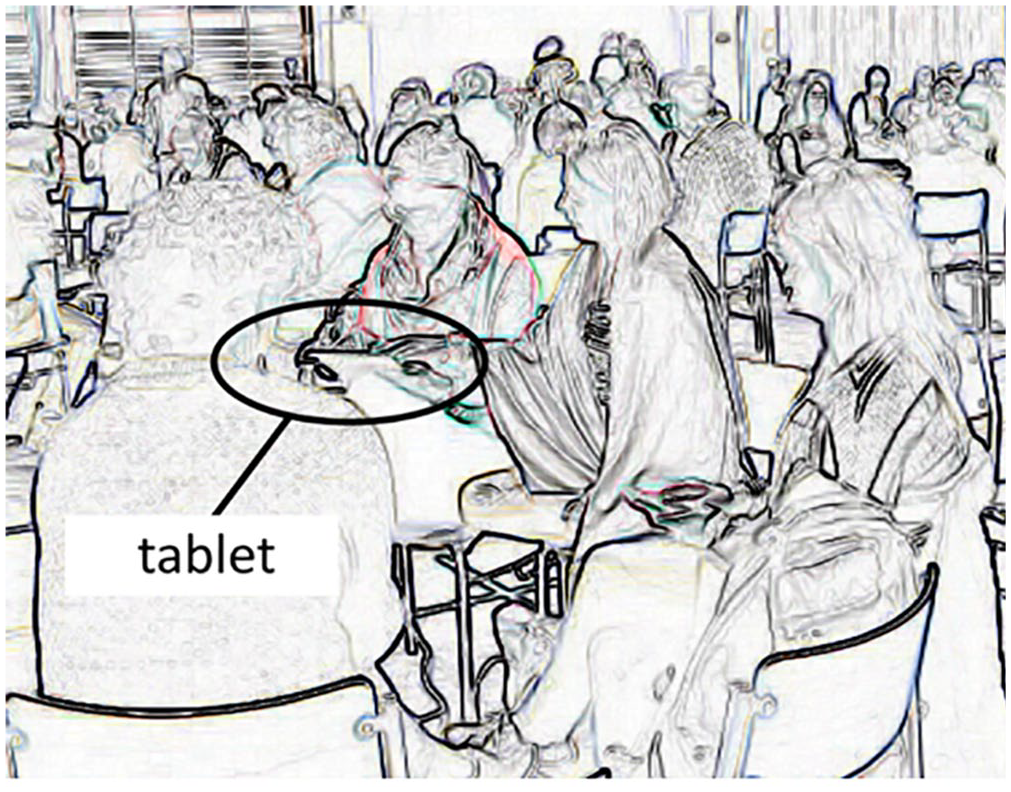
Extract 2. (Day 4, Group 3) 01 E3: then we have by the way talked about this, (-) 02 special education, we have talked about uhm 03 (1.0) can you say it aloud here like about 04 a cert- (.) certain class (0.5) and (.) er 05 its situation also. ((lines omitted, more discussion on the specifics of the case)) 06 E3: yeah, (1.0) yeah, #pic.3 07 E4: but isn’t it now this (.) support (0.4) 08 support e3: * 09 E3: yeah, 10 (.) 11 E4: special support like this (1.0) mt e3: * #pic.4
Picture 3
Picture 4 12 uhm (1.2) well (0.7) [sup- *GAZES TO HER SIDE 13 E3: [sharing support, 14 E4: sharing sup[port and diff- diff- (2.7) e3: *GAZES AT E4 *WRITES 15 E3: 16 E4: sharing support on different levels, 17 and organizing it, how we begin to 18 organize them.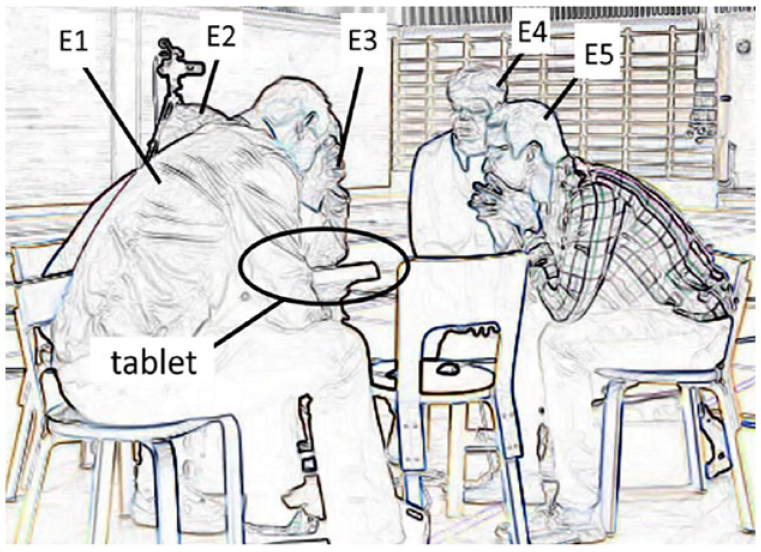
The beginning of a new topic is marked with discourse particles sit “then” and muuten “by the way” and it is presented as something the group has already “talked about”—thus being a potential answer to the assignment given. In her turn, E3 tentatively conceptualizes the issue under discussion as erityisopetus “special education” (Line 2) and then starts describing it in more detail (Lines 3-5; part of the description not shown in the transcription). In this description, we would like to draw attention to two aspects. Firstly, the issue is depicted as delicate through questioning whether it can be talked about at all in this context (Line 3). Secondly, it is described in a quite concrete way as a specific “class” is singled out as a source of problems (Line 4).
In Line 7, E4 produces a proposal that is in a question form and thus begins to formulate the issue in a new way. However, she finds it difficult to finish her proposal. There is a long word search in her turn (Lines 7-12). During the word search she repeats the noun tuki “support” four times, gives it the attribute erityinen “special,” but is unable to find the main word of the clause that would describe what would be done with the support. Finally, she displays frustration with the particle no “oh” (Line 12). At this point, E3 takes the turn and helps in the search through providing the word jakamista “sharing” (Line 13) that could potentially complete E4’s earlier proposal. In Lines 14-18, E4 accepts E3’s suggestion, and develops it further. We can thus see how the participants negotiate about the proper way of conceptualizing the issue and find the solution collaboratively. The process of finding the right kind of wording is observably crucial with regard to documenting the answer of the group. In Line 8, at a point where E4 has just produced the word tuki “support,” E3 moves the tablet closer to her body, into a position that projects writing (see Pictures 5 and 6) (cf. Pälli & Lehtinen, 2014). In Line 11, before the word search is completed, she also starts writing, and by so doing, displays already at this point that something documentable has been found. After the word search is completed, she continues writing (Line 14). We can thus see how writing acts as a closing action in the collaborative word search and the proposal sequence, making both participants jointly accountable for the content of the text (cf. Nissi, 2015).
What we have seen in Extract 2 is the process of semiotic remediation (see Prior et al., 2006) where the participants jointly transform an initially conceptualized issue into a documentable form. In this process, the joint authorship of the documentable version is observably accomplished as the participants move between speech and the digital platform with their specific material affordances: the initial proposal is produced for the others to be confirmed, and the word search is completed collaboratively. Finally, the sequence is closed by writing, the writing technologies thus coordinating the actions of the participants (cf. Swarts, 2016.). Importantly, in their joint action, the participants orient to the public nature of their writing product and aim at creating a text entry that is understandable to people who read it—and may do so even in some other social setting because of the durable nature of texts. The extract shows how this documentability essentially means a more general, abstract way of conceptualizing issues and events. In the case of Extract 2, for example, the concrete problem of a specific “class” in their organization is not something that can be documented. This is because it is not recognizable to the wider audience who lacks contextual knowledge about the case and thus does not comply with the generic conventions of a written entry—even if a more general issue of “sharing support” does.
Adjusting to the Contextual Expectations
In addition to arousing an orientation to sufficiently abstract, general text entries, the publicity of writing has another effect as well: the groups adjust to the contextual expectations and ideologies the digital documenting is embedded in. Here, it is important to consider writing as part of broader organizational practices (cf. Pälli et al., 2009), in the case of our data, human resources management and workplace training that advocates the ideals of reflective and participatory leadership. From this viewpoint, digital documenting requires the groups to act in a new kind of rhetorical situation (cf. Smart, 2000) and produce texts that are compatible with the aims of the training and discursively construe them as acceptable professional roles (cf. Pigg et al., 2014). However, once published on the digital platform, the entries of each group are immediately comparable with the entries of other groups, and by doing so, spotlight the groups’ social similarity with other groups.
We will show how the groups adjust to these contextual expectations through Extracts 3 and 4. Extract 3 is part of an assignment where the consultant has asked the groups to formulate “two questions” with regard to “managing processes” in their organization on the digital platform. The idea is that through seeing what kinds of questions and issues other management groups are working with they can learn from each other. Before the beginning of the extract the group in question has gone through a negotiation and ended up with a question that has to do with “committing the personnel to processes that concern them.” In Line 1, E1, who has the tablet in her lap, is already writing.
Extract 3. (Day 2, Group 2) 01 E1: * how can we comm- (.) commit the personnel. *WRITES 02 (3.0) can we get them to commit themselves *STOPS WRITING, GAZES UP TOWARD E4 03 (0.3) 04 E4: #pic.5
Picture 5 05 E2: yes. (0.5) commit themselves, (0.3) e1: *WRITES 06 to processes. to the processes that concern 07 them. e1: *STOPS WRITING, MOVES TABLET TOWARD E2 08 e2: *LEANS TOWARD TABLET 09 E1: yeah. *WRITES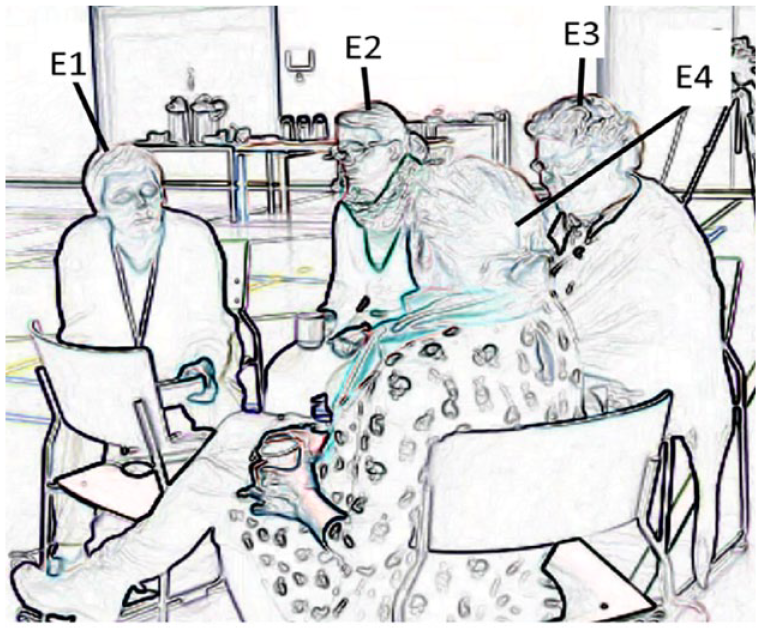
Simultaneously with her writing (Line 1), E1 reads out loud the emerging text and thus makes it accessible to other members of the group (cf. Mortensen, 2013). However, soon after this she repairs her own action and changes the verb of the sentence she is writing (Line 2). At the exact moment that she begins self-repair, she suspends her writing and raises her gaze at the direction of E4. In this way, she seeks confirmation from the others for the new formulation and receives, first, a slightly ambivalent acknowledgment token from E4 (Line 4), and then a clear expression of agreement from E2—in her turn, she produces an affiliative response particle nii “yes” and repeats the verb that E1 has suggested (Line 5). E2 also completes the sentence E1 has begun by recycling material from the earlier negotiation (Lines 6-7). Through this process of seeking and getting confirmation, the new formulation is produced as a joint one. Furthermore, in Line 7, E1 makes another initiative to ensure the joint construction of the text: she moves the tablet closer to E2, making it easier for her to see what she is writing. E2 responds by leaning toward the tablet (Line 8). Thus, the joint construction of the document is again accomplished through linguistic and embodied means.
We must, however, also look at what kind of a repair E2 makes. What is there to be corrected in the original formulation? The original verb, sitouttaa, and the new one, sitoutua, are semantically close to each other—they are derivatives of the same verb—but at the same time, there is an important difference between them. Sitouttaa means “to commit someone (to something),” while sitoutua means “to commit oneself (to something).” In other words, a different actor is implied in them. In the original version, it is the leadership of the organization that is making the personnel commit to the relevant processes, while in the new formulation the employees are the ones who commit themselves to the processes. Thus, at the core of the repair is a new kind of commitment to the ideals of “participatory leadership.” A documentable entry is not just abstract enough, it is also consonant with the objectives of the training.
In Extract 4, the participants have been asked to reflect the kinds of “feedback processes” they have used in their organizations and the “effects” of using those processes (see Lines 3-10). 7 Before the extract, the group had discussed various forms of feedback, but had difficulty in finding a type of feedback method that would have been used systematically. In particular, they have noted how they have not utilized a certain national feedback tool called ykkösarvio in their school. During their discussion, they have read the answers of other groups both from the screen and the tablet. In the extract, we can see what happens when they orient toward the task of documenting their own answer. The extract begins with E2, who acts as a composer, rereading the question (Lines 3-10) from the tablet, which she has in her left hand. Her right index finger is on the screen of the tablet. After this, E3 rereads the question from the large screen (Line 12) and explicates the need to find an answer (Line 15).
Extract 4. (Day 8, Group 1) 01 E2: uhm * e3: *GAZES AT SCREEN 02 E1: (-) 03 E2: feedba- (.) what feed[back processes have been 04 E4: [a lot goes 05 E2: [utilized in the [school? how has 06 E4: [(-) 07 E1: [yes. 08 E2: feedback been utilized, and what kinds of 09 successful results effects *SCROLLS THE TABLET 10 have there been. 11 (0.7)*(0.8) e1: *GAZES AT SCREEN 12 E3: so what fe[edba- *POINTS AT SCREEN 13 E1: [was this a continuation 14 to the, e4: *GAZES AT SCREEN 15 E3: ye[ah, one must answer now, 16 E1: [(–) 17 *(0.2)*(0.6) e3: *GAZES AT SCREEN e1: *GAZES AT SCREEN 18 E1: okay, 19 E2: there is really a lot of ykkösarvio here. #pic.6
Picture 6 20 (1.5)*(4.5) e1: *GAZES AT SCREEN 21 E2: and then just? 22 (1.6) 23 E1: (well don’t) we have all kinds of things (.) 24 that have been uti- (.) utilized 25 and that are 26 (.) 27 E2: what shall I write in here (.) then. *SWINGING GESTURE e3: *GAZES AT TABLET 28 E3: I can put it. *GRABS TABLET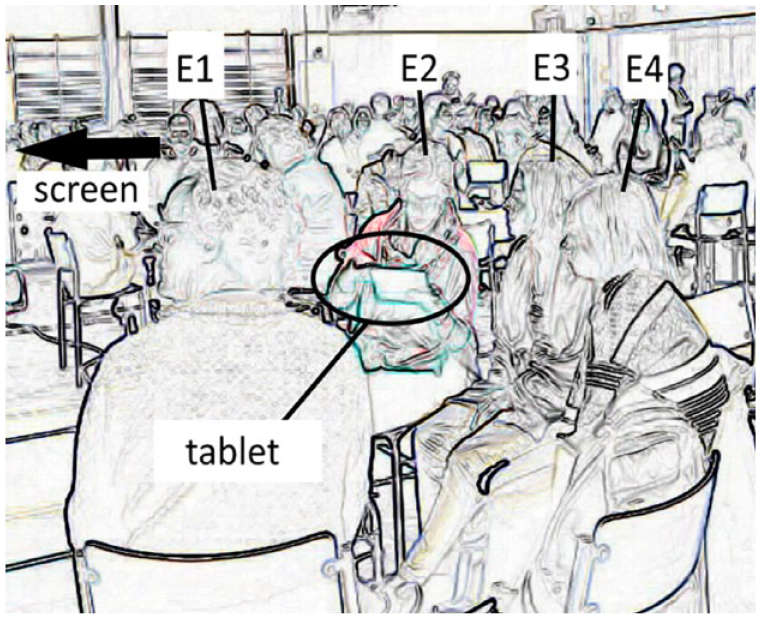
First of all, we can see that during the process of looking for a documentable answer, there are both embodied and verbal markers of a continued orientation to the answers of other groups. E1, E3, and E4 all gaze at the screen where the answers are reflected (see Lines 1, 11, 14, 17, 20; Picture 8). E2, for her part, scrolls the tablet with her finger, observably going through the answers of other groups (Line 9 onwards). During the scrolling, she verbally explicates one result of the scrolling (Line 19), that many of the other groups have documented the specific feedback tool that they have themselves not utilized.
Secondly, the difficulty of finding an answer can be clearly seen in the extract in as much as it includes a number of long pauses. The longest pause, 6 seconds (Line 20), occurs after E2’s explication of a typical answer by others and thus implies that this result complicates the matters for this particular group. During the pause, E1 glances at the screen the last time before making an effort toward opening up the discussion again on the basis of their own experiences (Lines 23-25). However, this initiation is not responded to. Rather, E2 reinitiates the task of documenting their own answer (Line 27), asking for the contribution of others. This question retains the orientation to the challenges of documenting. It is formulated as an open question, with no candidate answers. Thus, even after the long discussion, and scanning the answers of others, E2 shows that she does not have any suggestion as to what they could possibly write down as their answer. Also, she ends her question with the particle sitte “then,” which is amplified both through prosodic means and a very distinguishable swinging gesture, which is rhythmically calibrated with the syllables of the particle. The particle, which has a temporal meaning in as much as it connects what is said now to something that has happened earlier, ties the difficulty of finding something documentable to the earlier search for the answers of other groups. In other words, E2’s problem is, if she can’t write something similar to what other groups have written, what can she “then” write? We can thus see how the challenge of producing documentable entries may be connected to what other groups have written and how their answers position them as professional actors in the social context of the training.
Extracts 3 and 4 show how groups accommodate their writing to the social context in question and take into account the conceptual and ideological underpinnings of workplace training in formulating the text. Put differently, by documenting their answers in the digital platform they publicly display their understanding about the aims of the training and what is expected of them as training participants and leaders in the organization. In this way, digital documenting makes the groups morally accountable for their actions as it has to do with the public performance of one’s professional identity. From this viewpoint, the training is also a learning situation for the groups as accomplishing the task assignment urges them to reflect what it means to act as representatives of the professional category of a “leader” and implement the new leadership model that is promoted in the training (cf. Pälli et al., 2009; Samra-Fredericks, 2010)—and to disclose this learning experience through new kinds of writing technologies. As they also compare and adjust their public displays to the displays of other groups, the digital platform finally has a mediating role in coordinating the actions of different management groups and establishes cross-sectoral networks and social structures in the organization (cf. Swarts, 2016). Our data thus offer one example of the ways writing is intertwined with broader organizational practices and takes part in accomplishing wider-level organizational projects.
Discussion and Conclusions
In this article, we have examined writing in organizational consulting and training, which can be seen as one of the sites of the textualization of work in new knowledge-based working life. As noted in previous research (e.g., Karlsson, 2009; Scheeres, 2007), the textualization of work does not only mean the increasing amount of text-related tasks but also changing social relations, identities, and structures in workplaces. In the context of organizational consulting and new management ideals, it is particularly manifested in collaborative writing tasks—often accomplished with the help of digital writing technologies—in training settings for the purposes of enhancing employee participation and the exchange of ideas between different employee groups. In this article, we set out to explore the interactional dynamics of such tasks in workplace training where writing takes place as part of a reflective assignment issued by the consultant to the assemblage of management groups being trained in the situation. More specifically, we analyzed how certain aspects of writing—access, publicity, and broader organizational practice—are managed and function as the organizing principles of talk and action within group work discussions where the group members negotiate the dimensions of their shared digital documenting and resolve interactional problems brought by the very writing technologies. In order to do this, we drew insights from different research traditions that together allow novel theoretical and methodological perspectives for the study of writing as social practice.
Our study advances prior research on writing-in-interaction with its focus on a previously unstudied institutional setting. Earlier studies have shown how writing plays an integral role in many institutional encounters—such as classrooms (Jakonen, 2016), meetings (Nissi, 2015), or police interrogations (Komter, 2006)—where textual documents are created in coordination with talk and embodied action in order to accomplish institutionally relevant tasks. However, there are several new features in our data in terms of its interactional, spatial, and material characteristics that influence writing, namely, that the training encounter is a mixture of a large-scale multiparty and a small group context, and that writing is carried out by the combination of digital devices, the tablet and the digital platform.
Through our analysis, we showed how the tablet has a special kind of transferability and can be moved from person to person and in and out of a writing position, thus allowing shifting writer roles and flexible transitions between discussing, writing, and correcting the text, while the digital platform easily disseminates the written entries to a larger audience. However, once held by someone, the tablet also has limited access to other group members so that the groups have to specifically establish the composer each time while simultaneously securing shared access and authorship throughout the writing process. Similarly, in the digital platform, the entries are publicly available only after the participants press the publication icon. Thus, only the end results—not the process of writing—is public, which creates the possibility of monitoring the “documentability” of the entries beforehand and urges the participants to negotiate about their suitability.
By analyzing the actual interactional writing practices, our article shows how writing technologies are used within the structures of social interaction and at the same time shape them, thereby creating both affordances and constraints for collaborative writing that takes place as part of the participants’ situated action and institutional practice. Our results also contribute to other research on writing, with regard to the embodied nature of writing and writing with technologies as part of different social contexts. Following Clayson’s (2018b) call for studies of the moment-by-moment actualization of writing as an embodied activity, our analysis shows how writing—including digital writing—is fundamentally embodied. In particular, we have shown how the participants of interaction negotiate their access to the writing device in an embodied way, for example, through their sitting arrangement, posture, gaze, and gestures. Our study thus demonstrates how the body is inescapably intertwined with the materiality of the writing device.
Our study also provides an example of writing with technologies. In Line with Kaptelinin and Nardi’s (2006) view that technologies are used to accomplish social activities, we have shown how technologies are actually integrated into a particular organizational activity. Our study thus demonstrates how both the material and the social nature of technologies is crucial for accomplishing writing tasks that involve group work and aim at documenting the groups’ own professional practices and their development. As for materiality, writing is done with specific devices, which have certain affordances that the writers have to take into account when organizing their collaborative writing. As for the social aspect, technologies become part of a social activity, where writing is made public in particular ways, and where writing is embedded in particular social practices. We demonstrated how the participants display their orientation to the social context during their negotiation of what to write as they revise their text with regard to the ideology of the workplace training and what other groups have written. This means that even though the use of digital technologies can enhance communication in organizations, there are also restrictions, both with regard to the material affordances of the technologies, and the social conventions of the practices that they help to facilitate and in which they are embedded.
The organizational practice we have analyzed can also be seen as a place for learning, and our conclusions resonate with earlier studies of writing in different kinds of transitions (Ledwell-Brown, 2000; Russell, 1997; Smart, 2000). In Russell’s (1997) view, for example, learning to write in a new social context means learning a new genre within an activity system. Such a genre is a way of doing something with specific tools, for some purpose, as part of a social practice. Smart (2000), in his study of transitions in workplaces, stresses the importance of learning new rhetorical situations with new kinds of audiences. Our study shows how, in a workplace activity, the digital tools with their affordances are inextricably intertwined with the organizational and ideological expectations, but also how the writers navigate in a new situation through interacting with each other.
Finally, our results also offer potential areas for application in textualized and digitalized workplaces. We conclude by emphasizing three points for workplace organizations to consider in terms of implementing collaborative, digital writing technologies. Firstly, as we have shown, digital devices vary with regard to their material characteristics and how they support collaborative action. Therefore, when planning shared writing projects, the organizations would do well to first reflect on how the choice of the device—or the spatial arrangements of the physical context where it is used—affects the way joint projects can be undertaken. Truly collaborative action becomes possible only if the participants can all access the writing activity. Secondly, digital texts are durable and can be archived for long periods of time. Because of this, their audience may considerably expand even though the texts may not be intelligible to those who read them in some other time and place. Thus, when creating organizational texts, their level of publicity and target audiences should be discussed and made clear beforehand so that the participants know who they are writing for and can formulate their entries accordingly. Thirdly, digital practices advance broader organizational projects and are strategically used to implement organizational goals. In this way, they also require the participants who take part in these projects to position themselves vis-á-vis these goals. Organizations should consider what is actually at stake for the participants when they engage in the public displays of professional action and whether there is room for critical reflection, creative thinking, or even mistakes—including whether the documented answers simply perform viewpoints that were already established at the beginning for the process. These issues call for more research on digital writing in organizational contexts as well as collaboration and critical dialogue between the academia and the workplaces.
Footnotes
Appendix
Declaration of Conflicting Interests
The authors declared no potential conflicts of interest with respect to the research, authorship, and/or publication of this article.
Funding
The author(s) disclosed receipt of the following financial support for the research,authorship, and/or publication of this article: The study has been funded by The Finnish Cultural Foundation and The Academy of Finland (grant number 322733).